At Everything Dinosaur, we are keen to help young readers learn more about dinosaurs and other prehistoric animals. With a teaching background, our team members recognise the importance of early reading books and we have just added a set of four pop-up books designed with very young readers in mind.
Mini Pop-up Dinosaur Books
Each of the four books focuses on one specific dinosaur – Tyrannosaurus rex, Stegosaurus, Triceratops and Brontosaurus. Whilst we admire the robust hard covers and the size of the book ideal for small hands, it is clear they were not written by a palaeontologist. The name Brontosaurus is no longer used, it has been replaced by Apatosaurus.
There is an article on our blog explaining why Brontosaurus got its name changed:-
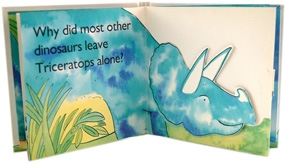
However, putting aside that one faux pas, these pop-ups are an excellent first dinosaur book. The illustrations are very colourful, the series even includes a pink Stegosaurus (quite accurate as we do think some dinosaurs could turn themselves pink!); and a blue Triceratops.
In each book there are a serious of simple questions about the dinosaur concerned, the print is large and easy to read. A flap in an illustration on the page is lifted and the answer revealed, there is a little more detail on the back of the flap to help Mums and Dads explain the answer.
A Mini Pop-up Dinosaur Book Featuring Triceratops
Learning about dinosaurs with a mini pop-up dinosaur book.
In addition, each book contains a card, self-assembly model of the animal featured in the book. When we this series with a group of 3-4 year olds they took to them very well. The mums had to help assembly the model but the children were able to read along and lift the flaps in the illustrations.
Team members at Everything Dinosaur get asked to review a number of dinosaur books for children, we are happy to oblige.
Today, February 3rd is the day on which Gideon Mantell, a doctor by training but also one of the very first palaeontologists was born. Gideon Mantell was born on this day in 1790. From his home in southern England, Dr Mantell was able to combine is medical duties with his passion for geology and fossils and often visited quarries and other promising sites whilst returning to his home after visiting patients. He named Iguanodon, the second member of the Order Dinosauria in 1825 and he made a considerable contribution to the early science of palaeontology. Over the years, he built up a very large collection of fossils, the great majority of which had to be sold when he fell upon hard times.
Sir Richard Owen, did attempt to take the credit for a lot of Gideon Mantell’s work, indeed the two men were bitter rivals. However, today the work of Gideon Mantell is not only highly respected but also his role in the study of the first dinosaur fossils is recognised.
Gideon Mantell
A memorial has been built to Dr Mantell, it is sited at Cuckfield, near Haywards Heath in West Sussex, England. It was from Cuckfield that many of the fossil remains of the Iguanodon were discovered. Dr Mantell received a sandstone block that contained an array of dis-articulated Iguanodon bones. This huge block of stone is on exhibit at the London Natural History museum, it has been nick-named the “Mantell-piece”.
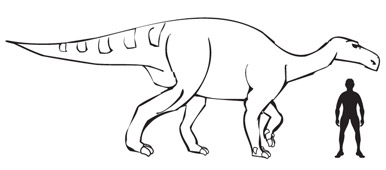
An Illustration of an Iguanodontid
Picture credit: Everything Dinosaur
Iguanodon
The name Iguanodon means “Iguana tooth”, it relates to the fact that teeth associated with this genus resembled those of a modern Iguana. In fact the first reconstructions of this dinosaur depicted it as a huge lizard-like animal with an enormous tail. It was thanks to the research by scientists like Dr. Mantell, that it was finally realised for example, the forelimbs were shorter and smaller than the hind-limbs indicating a bipedal type of locomotion.
The genera that make up the Iguanodontidae family are currently under review, many specimens including the original holotype described by Mantell, are very incomplete and may represent very different dinosaurs. The Iguanodon anglicus as named and described by Mantell in 1825, had much of the description based on just fossil teeth. Fossilised reptile teeth unlike mammal teeth, are not distinctive enough to be used as the holotype specimen to name genera and species. Mantell’s description has come under increasing scrutiny.
Mantellisaurus atherfieldensis
His description may no longer be valid, but as Iguanodon is synonymous with this type of advanced ornithopod, the name is likely to remain in scientific use. Ironically, a new type of iguanodontid is recognised, fossils of a more lightly built type of Iguanodon have been discovered in southern England and more recently on the Isle of Wight. This animal has been named Mantellisaurus atherfieldensis in honour of Gideon Mantell, who helped start the Iguanodontidae ball rolling as it were. Today, we pay tribute to Gideon Mantell and his role in the development of palaeontology.
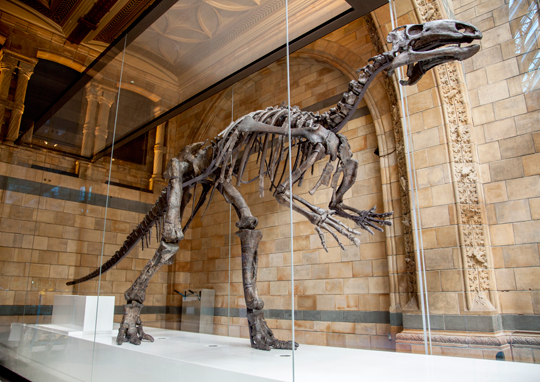
Mantellisaurus Fossil Exhibit on Display at the Natural History Museum London
Mantellisaurus on display in the Hintze Hall.
Picture credit: Everything Dinosaur
Everything Dinosaur stocks several models of iguanodontids including a replica of Mantellisaurus in the CollectA Prehistoric Life range of figures: CollectA Prehistoric Life Figures.
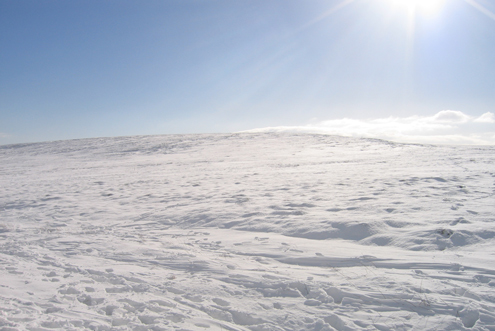
Today, the worst snow falls in 18 years have hit southern England bringing traffic to a standstill and the cancellation of most of the south-east’s public transport. Further north, we have had snow and it is still falling, although we have not had it as bad as London for example.
However, more snow is forecast tonight and the commute into work for some of the staff was a bit scary, what with the slippy road conditions. Good news everybody made it in and we have kept packing and despatching orders for customers.
Heavy Snow Falls Across Much of the UK
Heavy snow falls across much of the UK causing disruption. Picture credit: Everything Dinosaur.
Picture credit: Everything Dinosaur
A Snowy Scene
We invested in our own grit container and we have plenty of brushes and shovels in the warehouse so we set out this morning to sweep the warehouse yard and the access. It took about an hour to clear all the snow and then we salted the area to (hopefully) prevent more snow settling.
Most of the team have gone home early, but a few of us brave souls will work late tonight so that we can keep on top of things.
The weather forecast is bad for the next few days, we have had to cancel a couple of our teaching sessions due to the adverse weather. Let us hope that Spring arrives soon.
In the meantime, Everything Dinosaur team members advise our customers to stay safe and to wrap up warm. If you don’t want to venture outside, you can always visit Everything Dinosaur’s award-winning website: Visit Everything Dinosaur.
Dinosaur Dung is Stolen from the London Natural History Museum
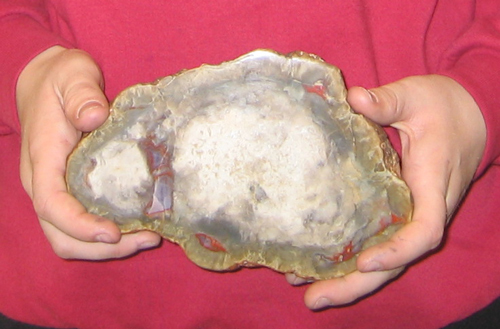
One of the saddest items of news to report for a while, criminals have stolen coprolite (that is fossilised dung), from the Natural History Museum in London. The museum has just published a list of specimens and exhibits that have been lost, stolen or destroyed over the last five years. The dinosaur dung was stolen from an exhibit at the Dino Jaws exhibition in 2006. Exactly what the thieves intended to do with it is unknown, such fossils do have some value but small pieces of coprolite can be purchased for a few dollars from a number of reputable fossil merchants. It is unlikely the thieves would have gained a great deal from the theft.
Coprolite
The problem with coprolite is that scientists cannot be entirely sure what sort of animal was responsible for producing the dung in the first place. This particular specimen, dating from the Late Cretaceous was believed to have been droppings from a large, herbivorous dinosaur, probably a titanosaur, such as Saltasaurus.
Titanosaurs are part of the sauropod branch of the dinosaur family tree. These long-necked, lizard-hipped dinosaurs still dominated the plant-eating faunas of the Southern Hemisphere for much of the Cretaceous. It is thought that some types of titanosaur evolved into the biggest land creatures ever to have existed, with some types weighing over 50 Tonnes or more.
Dinosaur Coprolite
“Shiny side up” the joys of “dino dung”. An example of a polished slice of dinosaur coprolite.
Criminals have also helped themselves to 167 scarab beetles originally from South America and a centipede. Another 2 dozen or so scarab beetles were stolen from a car in Vienna, Austria, when they were on loan to the Vienna Natural History Museum.
The theft of the 10 cm piece of dinosaur dung was reported, but police took no further action. After all, it is hardly worth their while putting out a national alert as there would be little chance of retrieving it and if an officer did come across it, we don’t think they would have been able to recognise it. Spotting dinosaur dung is a job for the professionals.
Commenting on the list of thefts and other exhibit incidents, museum director Professor Richard Lane stated:
“All of the items in the collections are of scientific and national value and many are literally priceless. Like works of arts they are completely unique and so cannot be compared to anything else. Consequently it is of great regret when items are stolen or lost”.
As for the coprolite theft Professor Lane went on to add:
“It is true that an item of fossilised dinosaur dung was stolen from the Dino Jaws exhibition; one might question what the thief would do with this.”
With more than 3.8 million visitors a year and anything up to 10,000 people at a time inside the Natural History Museum in South Kensington, such thefts are sadly inevitable. It is a question of balance between allowing visitors access to the exhibits yet being mindful of security.
An entire draw of butterflies was lost in 2005, when a number of items from the entomology department were being moved. A parcel containing mosquito specimens was lost in the post. More than 20 fossil conodonts, an extinct group of small, jawless marine creatures, believed to be some of the most primitive chordates known were destroyed when the box containing them was knocked over and they accidently got hoovered up.
These are the sort of problems the curators have when they are in charge of such a vast collection, a good proportion of which is on display to the public. Still if you get offered some dodgy dinosaur dung from a man in pub, you know what you must do.
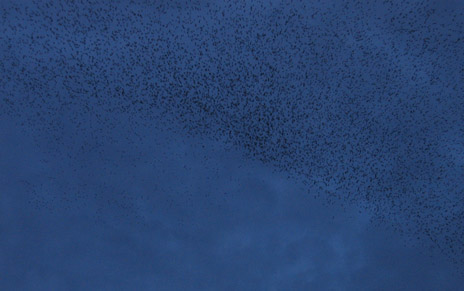
A couple of snaps taken by one of our team members in the early evening around 5pm GMT. Every day for the last month, as we have been organising the late afternoon despatches to the post office and collection depot we have been observing a phenomenon.
What’s in the Picture?
Picture credit: Everything Dinosaur
The tiny black dots in the sky are actually birds, common starlings to be exact and over the last few weeks since Christmas, increasing numbers of them have been coming to our town to roost. Starlings are small birds found in gardens and in the countryside, however, they form communal roosts and prefer to roost in towns (where it is slightly warmer than the surrounding countryside), and they create massive swirling clouds as they fly in vast numbers.
It is hard to estimate their numbers but an ornithologist suggested that there were in excess of 100,000 and they will dance and weave about above the town as they decide where to sleep for the night. We were told that they prefer to roost in conifers and that it is very unwise to park your car near them as during the night several kilogrammes of highly corrosive guano will be created.
As these birds fly in huge flocks above the town, the perform a spectacular aerobatic display. We have been lucky enough to see some amazing animal sights in our travels over the years, herds of wildebeest migrating across the Masai Mara, vast flocks of flamingos nesting on salt lakes, elephants, tigers and such like. However, perhaps the most amazing natural animal phenomenon any of us have observed is created by the humble starling just a few miles from our office.
Not a bad spectacle and I only got “pooped” on twice whilst taking the photographs.
When scientists are compiling their research, much of this work is done with little publicity for fear of publishing before theories and ideas have been thoroughly tested. Reputations can be made or lost on inappropriate conclusions and the last thing any researcher would want is to have their thesis taken apart during peer review.
Although, science is ultimately a quest for truth, keeping information to yourself until you are ready to announce it to the world is a common practice in many fields of scientific enquiry.
Everything Dinosaur
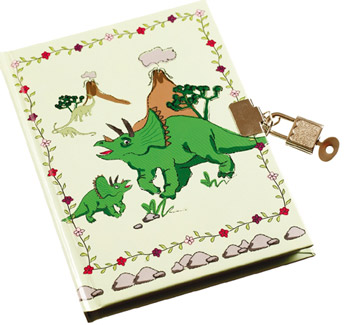
With this in mind, the team members at Everything Dinosaur have introduced a dinosaur themed secret diary to help keep all your thoughts, ideas and secrets safe. With a “Dinosaur for Girls” range that already includes pink T-shirts, letter writing sets with dinosaur themes and of course pink Utahraptors, the diary makes a fun edition. The pages of this particular diary are lined and there is room for you to put the date on each page at the top, so you can start your diary at any time of the year and with its handy, school backpack size, it can be taken anywhere.
The lock on the side of the diary protects the entries from snoopers and this diary comes with a pair of keys. You can keep one on your person but have a spare in safe place in the house, just in case you mislay the first one.
The Secret Dinosaur Diary
Picture credit: Everything Dinosaur
A lockable, secret dinosaur diary, that features Triceratops on the cover. Just date each page and you can create your own personal dinosaur diary. Diary comes with two keys and diary padlock. A great idea to help encourage young dinosaur fans with their writing.
New Study on Ceratopsian Skull Injuries indicates that Horns were used as Weapons
Palaeontologists have debated for many years as to what were the exact function and purpose of the horns and frill on horned dinosaurs such as Triceratops. Now a new study undertaken by American scientists has concluded that the horns on dinosaurs such as Triceratops were used as defensive weapons and wielded in battles with rivals. The scars and damaged bone found on the skulls of these dinosaurs reveal rare evidence of dinosaurs fighting each other the scientists have stated.
Fossils of Dinosaurs
Andrew Farke, curator at the Raymond M Alf Museum of Palaeontology, in Claremont, California said:
“Palaeontologists have debated the function of the bizarre skulls of horned dinosaurs for years now. Some speculated that the horns were for showing off to other dinosaurs, and others thought that the horns had to have been used in combat against other horned dinosaurs. Unfortunately, we can’t just go and watch a Triceratops in the wild.”
After studying a number of different skull specimens (fortunately, Triceratops skulls are relatively numerous in the fossil record, compared to other bones from these creatures), examining the fossilised bone for signs of traumatic injury; the team reported their findings in the journal the Public Library of Science One.
A Triceratops Exhibit on Display in a Museum
A cast of a Triceratops skeleton on display at the Naturmuseum Senckenberg (Natural History Museum – Frankfurt). On the left a wall mounted example of a Plateosaurus can be seen. Picture credit: Everything Dinosaur.
Picture credit: Everything Dinosaur
Triceratops
Triceratops is one of the most famous dinosaurs of all, partly because it has been depicted in many films and television programmes fighting predators such as Tyrannosaurus rex. This new research indicates that the script writers and production team may have got it right when they depict this six tonne dinosaur in combat with meat-eating dinosaurs. Traces of blood vessels found in the frill and horn have indicated that these adornments may have been used for display or for regulating the temperature of these large four-legged animals. As with other members of the ceratopsian family, the frill would have probably been covered with skin and may have been brightly coloured, suggesting that it was used for display purposes.
Locking Horns
A study by British scientists some years ago concluded that dinosaurs like Triceratops may have locked horns with opponents but not charged at them like a rhinoceros. The impact forces from a 9-metre-long, six tonne monster would have shattered the nasal and rostrum – not a particularly good outcome for the horned dinosaur.
The American team studied the skulls of Triceratops and compared them with the skulls of another ceratopsian called Centrosaurus. Triceratops had three horns, two large brow horns, in some specimens over a metre long, and a shorter nose horn. In contrast Centrosaurus (Centrosaurus apertus), had just one prominent horn, the nose horn.
From studies of the numerous centrosaurine skulls found at the Dinosaur Provincial Park Formation in Alberta, scientists believe that juvenile centrosaurs possessed a short, narrow horn. As the centrosaurs reached adult size, and presumably were able to breed, the nasal horn developed into a robust, long horn and parts of the skull became thicker and stronger.
The Horned Dinosaur Triceratops
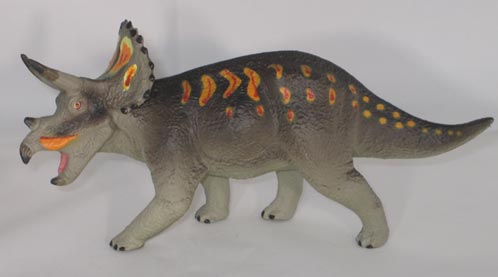
A Triceratops dinosaur model. Picture credit: Everything Dinosaur.
Picture credit: Everything Dinosaur
In the picture above, the three-horned Triceratops is depicted facing.
The model is from the Safari Ltd Prehistoric World model range.
Everything stocks the Triceratops. It is the “Triceratops with attitude” from the Procon/CollectA range and we also stock a Centrosaurus It is one of the dinosaur models from our party models collection.
The injuries seen in Triceratops skulls were consistent with combat injuries, perhaps as rivals battled with each other over social status in the herd. Centrosaurus skulls did not show similar injuries indicating that their horns and frill were perhaps used more for display.
Interestingly, a number of centrosaurine bone beds are known. A bone bed is a deposit of a large number of fossilised bones representing many individuals of a single species. Such bone beds are evidence that dinosaurs moved in large herds, perhaps a number of the herd members met their death at the same time, for example, fording a river, much in the same way that many gnu die when crossing flooded rivers in Africa.
Studying the Fossil Evidence
From this fossil evidence scientists have concluded that Centrosaurus lived in large groups, whereas no such bone bed evidence has been found to date for Triceratops. It can be speculated that Triceratops lived in much smaller groups, if this is the case then combat could be envisaged when males were seeking mates as the herd structure being smaller would have led to battles only occasionally. In contrast, if Centrosaurus lived in large groups, using facial ornamentation for display would make a lot of sense as in a large herd the chances of combat would be higher as more animals of near rank and size would be in close proximity to each other.
Dr Farke added: “If Triceratops and Centrosaurus only used their horns and frills for showing off, we would expect no difference in the rate of injury for both animals. The most likely culprit for all of the wounds on Triceratops frills was the horns of other Triceratops”.
The team went onto compare the horns of Triceratops with a Swiss Army knife, suggesting that the horns may have been used for a variety of purposes, combat, ritual display and for defence against predators. Skulls of ceratopsians had been studied in detail before, but this study looked at a huge number of different specimens and looked for similarities in the injuries they found and modelled how these wounds could have been caused.
Triceratops Pathology
The injuries seen on the Triceratops fossils were consistent with the animals battling one another and fighting with their horns. Centrosaurus, however, showed no such pattern, suggesting that its facial adornments were more for display.
“If Triceratops and Centrosaurus only used their horns and frills for showing off we would expect no difference in the rate of injury for both animals”.
Concluded Dr Farke.
One particular injury, of the squamosal bone on the frill, (top and back of the skull), was ten times more frequent in Triceratops than in Centrosaurus.
Dr Farke went on to add:
“Our findings provide some of the best evidence to date that Triceratops might have locked horns with each other, wrestling like modern antelope and deer. This suggests that the animals, principally males, sparred for dominance and access to mates. Many modern herbivores with antlers or horns do this”.
A fellow contributor to the study, Ewan Wolff of the University of Wisconsin-Madison stated that this was the most comprehensive assessment of ceratopsian combat yet. The conclusions have been compiled from an extensive study of a number of different specimens, allowing close comparisons between individuals to be made.
Ewan Wolff went on to state:
“In the past, individual remains have been used to reconstruct the story of ancient injuries. I think this research shows the great potential of looking at injury patterns, even less obvious ones, to provide appropriate conclusions. The features we studied were very subtle”.
Yesterday we wrote about the fascinating early hominid fossil skeleton of Lucy (Australopithecus afarensis), known to scientists by the fossil number A.L. 288. This 3.2 million-year-old fossil is part of an exhibit currently being held at the Pacific Science Centre in Seattle in the U.S. state of Washington.
Australopithecus afarensis
Lucy is perhaps the most famous fossil hominid, about 40% of the fossil was found and it is believed to represent a female that stood 107 cm tall and importantly, walked upright. So far, A. afarensis fossils have only been found in Ethiopia and Tanzania. Early hominid fossils are extremely rare and it is likely that this particular species was quite widespread across central and east Africa. The large distance between the fossil sites has led scientists to deduce this.
The media team at the Pacific Science Centre have sent us over some more information and some exclusive pictures of the various exhibits. The exhibition’s full title is: Lucy’s Legacy: The Hidden Treasures of Ethiopia, and it showcases the evolution of human history from the very cradle of human existence (scientists believe that our species did evolve in Africa and that that hominids first evolved on that continent).
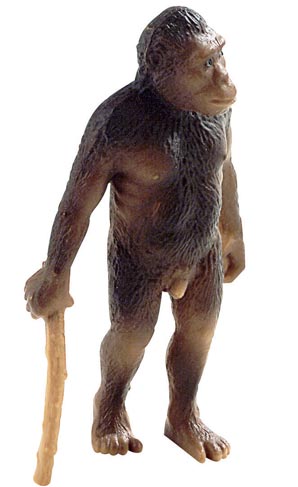
A Model of Australopithecus
At home on the plains. A model of Australopithecus.
As well as getting the very rare chance to view some of the ancient fossils of hominids from Ethiopia, visitors have the opportunity to explore the rich history and culture of Lucy’s homeland – a story that dates back to 5 million years ago.
The exhibit is well worth a visit, the fossils rarely travel outside of Ethiopia and the range of cultural artefacts on display provide a fascinating insight into the story of our own species and the development of humankind.
Museum officials at the Pacific Science Centre are “sleepless in Seattle” as concerns have been expressed over the low attendance at an exhibition that focuses on the origins of our species (the Lucy Exhibit), one of the first times that some of the fossils have been shown outside of Africa.
The Lucy Exhibit
Lucy – the name of the world famous fossil of an Australopithecus afarensis, had been booked by the Seattle based Pacific Science Centre, but it has not attracted the visitor numbers that the museum officials had hoped. With the exhibition due to close on March 8th, only 60,000 have attended to date, the exhibition organisers had hoped to attract 250,000 to this very special showcase of early hominid fossils.
Approximately, 40% of the fossil of Lucy has been found (discovered by Tom Grey and Donald Johanson at Hadar in Ethiopia in 1974). Her official name is A.L. 288, but the fossil, believed to represent a female, was named Lucy as the Beatles song “Lucy in theSky with Diamonds“, was playing in the field camp as the team celebrated their discovery.
The fossil has been dated to approximately 3.2 million years ago (Pliocene Epoch). Ironically, it is easier to establish the evolutionary relationships between different types of trilobites which died out over 250 million years ago than our own ancestry, with the origins of our own species dating back just a few million years. Fossil remains of extinct hominids are extremely rare and incomplete. With hominid fossils, only teeth, knuckle bones and parts of the skull are usually found. In comparison, trilobites, being animals of a marine environment with a hard exoskeleton are much more likely to be candidates for fossilisation.
Museum Facing a Deficit
According to the Seattle Times, the Pacific Science Centre faces a deficit of approximately $500,000 USD, this could lead to staff redundancies as the centre tries to balance the books.
The Lucy exhibit, part of a tour that commemorates the first time this particular specimen has been put on display outside of Africa, is believed to have cost the Pacific Science Centre approximately $2.25 million USD.
Commenting on the exhibit, the President of the Centre, Bryce Seidl stated:
“It’s a powerful story of evolution and culture and history … but we’re not getting the attendance we need for an exhibit of this scale”.
With an admission charge in excess of $20 USD, the low turnout has been blamed on the difficult economic conditions. At an earlier exhibit, back in 2007 at Houston, Texas over 200,000 people came to see the fossil skeleton and as a result the exhibit was extended by five months to accommodate the demand.
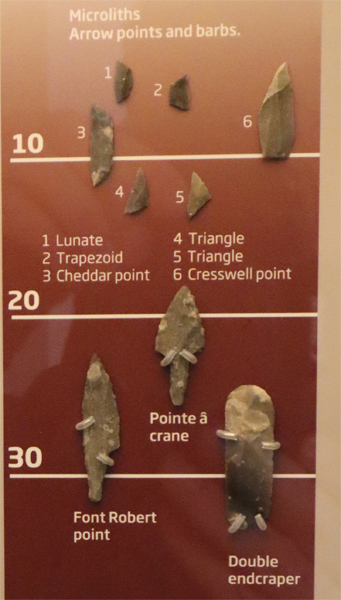
The Exhibit Looks at Hominin Evolution and the Development of Stone Tools
A collection of typical Stone Age Tools. Picture credit: Everything Dinosaur.
Picture credit: Everything Dinosaur
Donald Johanson, the American anthropologist who along with Tom Grey discovered Lucy and whose lecture “Lucy’s Legacy” on Feb 5 in Seattle is a sell-out, said fascination with the skeleton remains strong.
“As I travel around the country lecturing, people seem to have a deep interest in their origins, in their roots, “ Mr Johanson commented.
We will do our bit to promote this event, although travelling to Seattle is a bit too much even for our dedicated staff, we would encourage anyone in the area to take this opportunity to see Lucy and her fellow exhibits – after all, in a way it is just like going to meet a long lost relative, a 3 million-year-old relative at that.
In the meantime, Everything Dinosaur does stock a range of hominin figures that depict the evolutionary development of the human family. These models can be found here: Wild Safari Prehistoric World Figures.
Today, January 26th marks the start of the Chinese New Year. In China and in Chinese communities throughout the world this important date is marked by celebrations and festivities. In the Chinese calendar, years are symbolised by animals, for example 2009 is the year of the Ox. During this important festival and in the days following New Year a number of dragon dances are performed.
Chinese New Year
Dragons are synonymous with Chinese mythology. The colourful dragon dances, featuring lines of dancers, the dance leader wearing a dragon head costume; are very noisy and there is lots of drum banging and cymbal bashing. The idea behind most of the dances is to drive evil spirits away, with the fierce dragon and loud noises frightening away any evil presence that may persist in the area.
The Origins of Dragons
In this way the local Chinese can help to guarantee themselves a peaceful and prosperous New Year. Given the current state of the world’s economy, perhaps everyone should indulge in such practices. However, it is also worth considering the implications on palaeontology of the Chinese dragon myths. It is believed that when the Chinese came across the large fossilised bones of ancient animals they deduced that these were the bones of dragons. This may be how the dragon myths came about. Ironically, if the fossils found had been those of dinosaurs then the ancient Chinese were quite accurate.
In the west, dragons are mostly regarded as evil, but in oriental cultures dragons can represent both good and evil. Some dragons can even be seen as benevolent. Given the huge contribution to palaeontology made by Chinese scientists and institutions such as the Institute of Vertebrate Palaeontology and Palaeoanthropology in Beijing we have a lot to thank the Chinese for.
Studies of amazing fossil finds in provinces such as Szechuan and Liaoning have advanced our understanding of ancient life in the Mesozoic considerably. We predict that Chinese scientists will remain at the forefront of palaeontology for many years to come.
Everything Dinosaur stocks a large range of Chinese dinosaur models from the Chinese manufacturer PNSO: PNSO Age of Dinosaurs.