All about dinosaurs, fossils and prehistoric animals by Everything Dinosaur team members.
17 02, 2009

I’m Dreaming of a White Alligator

By |2022-12-20T12:34:47+00:00February 17th, 2009|Categories: Animal News Stories, Dinosaur and Prehistoric Animal News Stories, Main Page|0 Comments

Bizarre Looking Alligator on show at American Tourist Attraction

A white alligator is the star turn at a Florida crocodile farm and tourist attraction Gatorland.

The Alligator is a member of the Order Crocodylia.  There are just two species of alligator on the planet, the well-known and often viewed at zoos and American tourist attractions such as Gatorland, American alligator (Alligator mississipiensis) and the much rarer Chinese alligator (Alligator sinensis).  Alligators are therefore found in only two, widely separated regions of the world, in the south-eastern USA and China.  To be precise, the critically endangered Chinese alligator is found mainly in the upper reaches of the Yangtse river valley.

A Replica of a Chinese Alligator (Alligator sinensis)
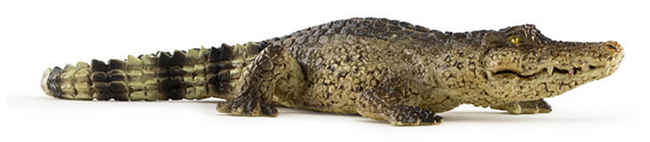
Siamese crocodile model.

Family Zoo Siamese crocodile model.

Tourist attractions like Gatorland in Florida, play a vital role in helping to preserve crocodiles, caimans and alligators.  As well as providing curious tourists with information and permitting them to get up close and personal with some of the most dangerous animals on Earth, Gatorland and other attractions carry out  conservation programmes and captive breeding schemes to help support the dwindling wild populations.

White Alligator

The latest residents of Gatorland to benefit from their protection is an exceptionally rare, white alligator, believed to one of only twelve such animals in the world.  This animal, a 200 kilogramme male called Bouya Blan (the name means white fog in the local Indian dialect) was collected from a Louisiana swamp and transferred from Audubon zoo in New Orleans to Gatorland.

This particular male alligator, with its ivory skin and deep blue eyes was part of a clutch of seventeen young alligators collected by workers from the Louisiana Land and Exploration Company who were surveying the swamp land in 1986.  The group was taken to the Audubon zoo where they remained until last year, before being transferred to the specialists at Gatorland.  Unfortunately, only a few of the original seventeen survived in the twenty years of so they spent in captivity, but now under the supervision of the Gatorland experts they may have a more certain future.

These bizarre looking animals are not examples of albino-ism, the nearly complete absence of any pigment is caused by a genetic disorder.  Animals that lack pigmentation are called leucistic (from the Greek leukos meaning white).  The large male alligator in the picture is one of four leucistic alligators kept at Gatorland.

Mark McHugh, President and Chief Executive of the Floridian tourist attraction commented:

“People are awestruck when they see them, and just one look into those icy, blue eyes will give you chills”.

He went on to state how excited he and the rest of the Gatorland staff were at having these rare alligators at the park.

Mark’s colleague Tim Williams added:

“This is the largest group of giant white gators in the world.  These are not albino animals, they are what we call leucistic, which means they have a little bit of pigmentation around the mouth and a little touch on the tail and they have piercing blue eyes.”

Mr Williams went on to explain that in the wild any animal with this genetic disorder would be unlikely to survive very long.  They have a sensitivity to sunlight and their lack of camouflage would make them easy to spot, bad news with so many hungry predators around in their swamp homes.

As a result of their rare genetic condition, the alligators are housed in special enclosures to protect them from sunlight – and the unwanted attention of other males.

“We have four white alligators here at Gatorland and because they are all males they cannot be in the same enclosure as they are all very big and they would all fight with each other”;

commented Mr Williams, noting the natural aggressive tendency of male alligators.

Creatures with the leucistic condition need extra vitamin D (normally obtained from sunlight), to help the Alligators; their diet is supplemented with food rich in this particular vitamin.  They are fed chicken, fish, red meat and do receive vitamin supplements as well.

Tim and his team are now hoping to breed white alligators with two female American gators who carry the leucistic gene.   They will certainly be quiet a site at the Gatorland park, but we at Everything Dinosaur, are concerned about such a breeding programme.

Perhaps it would be better to focus resources on breeding the critically endangered Chinese alligator, rather than trying to breed a type of alligator that could not survive in the wild.  We can appreciate the need for the attraction to generate visitor numbers by offering them the chance to view such strange creatures but we remain unsure as whether it is “right” to deliberately attempt to prolong this genetic disorder in a captive population of crocodilians.
15 02, 2009

New Crocodile Exhibition to Celebrate Darwin’s Birth

By |2024-01-14T09:15:53+00:00February 15th, 2009|Categories: Animal News Stories, Dinosaur and Prehistoric Animal News Stories, Main Page|0 Comments

Crocodile Exhibition to Celebrate Darwin 200

An Australian museum is putting on an exhibition showcasing the evolution of the crocodile as part of their celebrations marking the 200th anniversary of Charles Darwin’s birth.  The exhibit which is on display at the Northern Territories Museum and Art Gallery in Darwin is open until November.

Darwin itself, was named after the famous English scientist, he visited the area when the ship, HMS Beagle docked in September 1839, part way through its surveying expedition.  Australia has two native species of crocodile, the Saltwater or Estuarine and the smaller freshwater crocodile.  The Saltwater crocodile (Crocodylus porosus) is the largest living reptile with some specimens reaching lengths in of over 6 metres.

The exhibition is entitled “Supercrocodilians: Darwin’s ultimate survival story” is free to enter and tells the story of the evolution and development of this remarkable reptile group, one that has outlasted the dinosaurs.

Commenting on the events programme, exhibition curator Paul Horner said:

“We wanted to show Charles Darwin’s theory of evolution through an icon like the crocodile”.

Animals that were similar to modern crocodiles (phytosaurs) evolved around 240 million years ago.  Crocodiles as a group have been around since the Late Triassic period with the ancestors of the modern species known today (23 species of crocodiles in the world at present, although most are endangered), being traced back to the Cretaceous (neosuchians).  Some of the species of crocodilian around today may have remained largely unchanged for 5 million years or so.  The crocodilian life style of being a heavily armoured, ambush predator of rivers and lakes does seem to be a formula for a sustained run in terms of survival.  However, in their evolutionary history crocodiles have evolved to exploit a variety of environmental niches, from almost entirely marine forms such as Metriorhynchus, to fast running entirely terrestrial types.

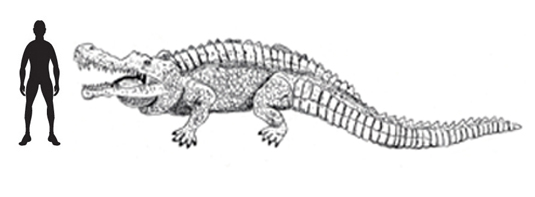
The exhibition highlight is the reconstructed skull of a 15 metre long giant crocodile called Sarcosuchus.  This particular crocodile, now fortunately extinct, lived in Africa during the Cretaceous period and although it had a long snout adapted for catching fish, it probably ambushed dinosaurs as they came down to drink.

Pictures show the skull of a Sarcosuchus and museum curator Paul Horner is dwarfed by it.  Even allowing for the change in perspective as Paul is further from the lens than the crocodilian skull, the cast of this fossil skull is very impressive.  Note the hooked tip to the upper jaw and the many sharp, needle-like teeth, believed to be adaptations to help catch slippery fish.  Such a jaw configuration and dentition is seen in baryonychid dinosaurs, which were also believed to be fish-eaters in the main.

A Scale Drawing of a Prehistoric Crocodile – Sarcosuchus

Sarcosaurus scale drawing

Everything Dinosaur’s scale drawing of Sarcosuchus. Picture credit: Everything Dinosaur

Picture credit: Everything Dinosaur

The exhibition has been planned for over a year and is a fitting tribute to Darwin, after whom the city is named and also highlights a need to conserve these remarkable and dangerous creatures.

Team members at Everything Dinosaur have been working on a model of Sarcosuchus that is being introduced later this year. Drawings have just been commissioned so that a fact sheet can be created for this new item.  Scientists remain unsure as to which type of crocodilian was the biggest of them all.  Sarcosuchus is a contender, along with the more heavily built Deinosuchus and the later Purussaurus from South America that lived during the Late Pliocene.  This particular crocodile, believed to be more closely related to modern Alligators could reach lengths in excess of 16 metres.

To view models of a variety of prehistoric crocodilians and other related species: Dinosaur, Crocodilian and Prehistoric Animal Models.

14 02, 2009

Fossilised Trees go on Display at North Wales Museum

By |2023-02-28T08:02:26+00:00February 14th, 2009|Categories: Dinosaur and Prehistoric Animal News Stories, Main Page|0 Comments

Return to the Carboniferous – take a trip to North Wales

The fossilised remains of gigantic tree-like plants are going on display at the Wrexham Museum as part of an exhibition entitled “From Coals to Carnations”.  The prehistoric fossilised trees, some of which were upwards of 40 metres tall once formed part of a dense swampland in which huge insects and the first reptiles thrived.

Fossilised Trees

The fossilised trees were first uncovered during overcast mining works on the site of a former steel mill near Wrexham in 2003.  The actual site is at the village of Brymbo, just a few miles to the north of Wrexham.  The fossilised finds demonstrate that approximately 300 million years ago the land that was to eventually form Wales was much closer the equator than today and made up part of a super continent called Laurentia that covered much of the Western Hemisphere.

Geologists have been working on the site since its discovery, but work was accelerated from 2006 as the exposed fossils formed from mudstone, began to be weathered and there were some concerns about losing these rare fossils.  More than 20 individual specimens have been identified, a number of which are going on display to the public for the first time at the Wrexham Museum.  These ancient plants date back from before the time of the dinosaurs, and before flowering plants.  They are the trunks of giant clubmosses like Lepidodendron.  The scientific name for clubmosses are Lycopsids, a number of clubmoss genera still survive today, but they tend to be very small, no match for their huge ancestors.

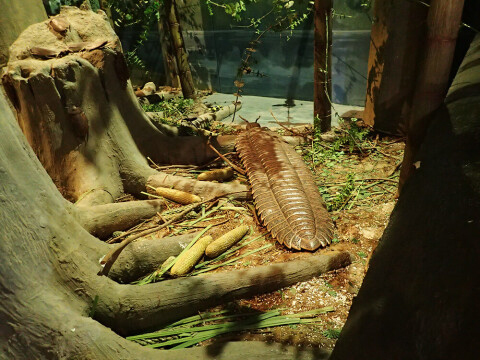
A Carboniferous Forest Scene

Arthropleura in a swamp habitat.

A museum exhibit showing a typical Carboniferous habitat.  Huge invertebrates such as Arthropleura roamed the forest floor.

Picture credit: Everything Dinosaur

Coal Deposits

As wood and other plant material was compressed and decayed it went onto form coal deposits.  The Welsh coal fields took approximately 20 million years to form, since the Industrial Revolution about 200 years ago, most of these coal fields have been exhausted.  A team of geologists helped oversee the preservation of the fossils, which had all been found at a site just 50 metres in length.  This land is designated for new housing and light industry, but the developer Parkhill Estates, after discussions with local lobbyists decided that they wanted to try to preserve as many of the fossil specimens as possible.

The Wrexham Museum exhibition will provide visitors with a rare insight into the area’s prehistoric past.

To view replicas and figures of animals from the Palaeozoic and other extinct creatures: CollectA Prehistoric Life Replicas.

12 02, 2009

Happy Birthday Charles Darwin Many Happy Returns!

By |2024-04-15T13:47:58+01:00February 12th, 2009|Categories: Dinosaur and Prehistoric Animal News Stories, Educational Activities, Famous Figures, Main Page, Palaeontological articles|0 Comments

200th Anniversary of the Birth of Charles Darwin

Today, February 12th marks the 200th Anniversary of the birth of Charles Darwin, the English naturalist and scientist who influenced scientific thinking through his theories on natural selection and evolution.

Charles Darwin

Darwin’s theories although not universally accepted, are the cornerstone of palaeontological research.  Although he is credited with coming up with the theory of natural selection, other researchers, scientists and thinkers had expressed similar ideas before Darwin.   In the early 19th century, how animals changed from one species to another was not properly understood but it was referred to as “transmutation”.

Indeed, Darwin was eventually forced into publishing his theory as a second English scientist, A. R. Wallace who had been working in the Far East; was about to publish a similar paper on the origins of species.  Darwin being the meticulous man he was had gathered together a vast amount of evidence to support his theory, so much so that when the book “The Origin of Species” was published, he described it as briefing paper as he had to leave out so much of the evidence to support his theory on natural selection.  A modern edition of the book still has over 450 pages.

The Origin of Species

With the publication of his revolutionary and ground breaking work in 1859, Charles Darwin established a view of the world that challenged the long held beliefs about Divine Creation and the development of life.  He challenged the notion that all animals were created at the same time and that they remain fixed, not changing over time.  His work has far reaching implications for humanity and remains one of the most hotly contended issues in science today.  Ironically, Darwin had no knowledge of genetics or DNA so the mechanism for evolution could not be explained.  It was to be another 30 years after his death before the work of the likes of Gregor Mendel came to be recognised and another 70 years or so before the nature of DNA began to be understood.

To read more about the publication of the “Origin of Species”:

Anniversary of the Publication of the “Origin of Species”.

The work and insight of Charles Darwin has made a lasting contribution to science and philosophy, a number of events are planned this year to mark the 200th anniversary of his birth.  The events are grouped under the collective term “Darwin 200” and include documentaries on television, a season of radio programmes exploring the impact of his work, as well as events, presentations and fossil festivals.

Happy Birthday Charles Darwin.

Visit Everything Dinosaur’s award-winning website: Everything Dinosaur.

11 02, 2009

Road Builders Uncover Rare Dinosaur Trackway

By |2024-04-15T13:48:21+01:00February 11th, 2009|Categories: Dinosaur and Prehistoric Animal News Stories, Main Page|0 Comments

Road Builders in Peru Discover Fossils

Peruvian construction workers have uncovered an array of body and trace fossils dating back to the age of the dinosaurs as they worked on a new road, one of the discoveries is a dinosaur trackway.  As well as dinosaur fossils, including some really well preserved footprints, the road workers found fossils of crocodiles, pterosaurs, primitive tortoises and remains of extinct species of fish.

Palaeontologists who have been called in to study the site have revealed that the remains of at least a dozen animals have been found, the sediments date back to the Early Cretaceous and have been dated to approximately 120 million years ago (Aptian faunal stage).

Dinosaur Trackway

Pictures show a set of four footprints, the prints have three prominent toes and the animal was walking from right to left as you look at the photographs.  Such prints are known as trace fossils.  Trace fossils preserve evidence of the activity of organisms, such as their tracks, trails, burrows or borings.  As these type of fossils are not subject to be moved by natural forces, as in the case of dinosaur bones for example, where an animal’s carcase can be moved a long way from where it died to where the body finally comes to rest and is fossilised, trace fossils are direct in situ evidence of the environment at the time and place the fossils were formed.

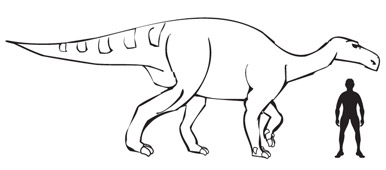
Unfortunately, as with most photographs of this type, there is nothing in the picture to give scale.  However, it does look like these particular prints were made by herbivorous ornithopod dinosaurs, perhaps something from the Iguanodontidae or a member of the Hypsilophodontidae.

These types of animals were relatively common during this part of the Cretaceous.  Iguanodontids have been associated with Australia, Asia, Europe, the UK and Africa.  Iguanodon for example, was one of the first dinosaurs to be scientifically described, although the taxon is currently under review.

Typical Ornithopods

Iguanodontids are typical ornithopods, with beaks, narrow mouths and banks of grinding teeth.  Most of these dinosaurs were heavily built quadrupeds, but also capable of walking on their hind legs.  The digits of the hands of the forelimbs were specialised and modified.  The thumb for example (digit one), was a large spike, probably used for defence.  The long, deep tail helped balance the animal as it walked.

An Illustration of Iguanodon

Picture credit: Everything Dinosaur

To see a model of Iguanodon and other ornithopod dinosaurs: Dinosaur and Prehistoric Animal Models.

Studying Dinosaur Tracks

By studying trackways, scientists can gain an appreciation of animal behaviour.  For example, if several tracks of a single species are preserved, all heading in the same direction this may indicate herding behaviour.  The velocity of the animal that made the tracks can be calculated using a formula and measuring the stride length and other items related to the leg speed of the animal.

The fossil site is located in the Ancash region of central Peru, approximately 250 miles north-east of Lima.  At a height of over 4,600 metres above sea level, this fossil dig site is believed to be one of the highest prehistoric fossil sites found to date.

10 02, 2009

Unique Isle of Wight Cretaceous Eco-system Revealed

By |2024-04-15T13:48:51+01:00February 10th, 2009|Categories: Dinosaur and Prehistoric Animal News Stories, Main Page|1 Comment

Insight into the Isle of Wight during the Cretaceous

The Wealden Group of the Wessex Basin is exposed on the surface in the coastal cliffs of the Isle of Wight off the English south coast.  This strata is famous for its abundance of well preserved dinosaur fossils, both body fossils and trace fossils.

Dinosaurs and other prehistoric animals from the Mesozoic have long been associated with this island, but now a new study into the island’s ancient fauna and flora has helped provide fresh insight into the diversity of life during the reign of the dinosaurs.

Forty-Eight New Species

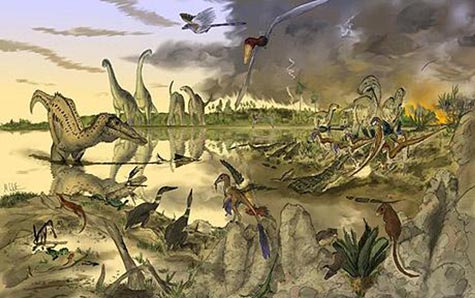
For Dr Steve Sweetman of the University of Portsmouth, the research has led to the identification of 48 new species of prehistoric animal including Deinonychus sized dromaeosaurs and large pterosaurs.  The work of Dr Sweetman and his colleagues has enabled scientists to fill in a number of gaps in the Early Cretaceous eco-system and provide much more detail than previously available on the smaller animals that shared the dinosaur’s habitat.

The Isle of Wight’s dinosaurs are globally significant; a large number of different dinosaur species have been discovered in the rocks that make up the island.  Most of the fossils date from approximately 135 – 130 million years ago (Hauterivian to Barremian Formation).  The island, during this part of the early Cretaceous was an extensive flood plain that linked the continents of Africa, Europe and what was to become the Americas.  The area formed a land bridge and as well as being a rich and fertile environment in itself it may have been on the migration route of many types of prehistoric animal.

Cretaceous Ecosystem

The number of new species discovered by Dr Sweetman and his team is remarkable, especially when all the work to prepare and identify the fossils, many of which are minute, has been undertaken in just 4 years.

Dr Sweetman’s haul includes eight dinosaurs, six mammals and fifteen different types of lizard all taken from cliffs of the Isle of Wight.  Thanks to his efforts we now have a better understanding of the eco-system and have the opportunity to study in more detail some of the smaller faunal types.

However, Dr Sweetman did find fossil evidence of brachiosaurs, the largest dinosaurs known from UK strata.

Rather than wait for fossils to be weathered out of the cliffs, he excavated a block of sediment approximately 3,500 kilogrammes in weight and then removed it all to a preparation area, where it was dried and then each individual grain was scrutinised.  As well as larger items such as fossil bone, he discovered tiny teeth, fossilised jaws and other micro-fossils that enabled him to build up a picture of life during the Early Cretaceous.

An Illustration of the Isle of Wight Cretaceous Fauna

Picture credit: Mark Witton

Systematic Working

Dr Sweetman explained that his technique was more comprehensive than traditional palaeontological methods and his systematic working has enabled such a rich picture of life to be built up.

“It has taken me just four years of hard graft to make my discoveries.  In the very first sample I found a tiny jaw of an extinct newt-sized, salamander-like amphibian and then new species just kept coming” he commented.

Dr Sweetman went on to add:

“Although we knew a lot about the larger species that existed on the island during the Early Cretaceous, no-one had ever filled in the gaps.  With these discoveries I can paint a really detailed picture of the creatures that scurried at the feet and in the shadows of the dinosaurs”.

This new study will cement further the reputation of the University of Portsmouth as well as reinforcing the belief that the Isle of Wight remains one of the most important sites in the world for Lower Cretaceous fossils.

For models and replicas of Early Cretaceous prehistoric animals: CollectA Prehistoric Life Models and Figures.

9 02, 2009

Amargasaurus – A Spectacular South American Dinosaur

By |2024-04-15T13:49:39+01:00February 9th, 2009|Categories: Dinosaur Fans, Everything Dinosaur News and Updates, Main Page|0 Comments

Spectacular Late Diplodocid Amargasaurus

Whilst on one of our fossil roadshows we were asked about the Late Jurassic sauropod Amargasaurus, a very bizarre and strange looking diplodocid from Argentina.  Known from just a few partial skeletons, the first fossils were found in a dried up river bed in 1984.  This particular dinosaur was named after the river (La Amarga) and the nearby town, plus the rock formation within which the fossils were discovered.  Amargasaurus was named and described by Leonardo Salgado and José Bonaparte.

Amargasaurus

Amargasaurus was considerably smaller than some of its more famous relatives, although it still may have attained lengths in excess of 12 metres.  The actual size of an adult Amargasaurus is unknown as the best specimen discovered to date lacked much of its tail.  It had a relatively short neck compared to other diplodocids and this feature coupled with the short, blunt teeth suggests that this particular dinosaur was a browser feeding on the leaves of trees.

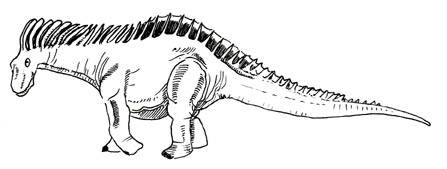
Closely related to the diplodocid Dicraeosaurus from Africa, Amargasaurus had two rows of tall spines jutting up from its backbone (neural spines).   These spines ran from the top of the head down the neck, tapering to a single row of smaller spines that ran down the rest of the body.

An Illustration of the Bizarre Diplodocid Amargasaurus

Picture credit: Everything Dinosaur

The precise function of this structure is unknown, although it is thought that the spines on the neck were a defensive weapon.  They may have been angled backwards on the neck to prevent this animal getting its head stuck in the branches of the tress that it browsed upon.  The smaller spines further down the body may have supported a sail that may have been used for visual display or thermal regulation.

Strange Neural Spines

As more and more Late Jurassic/Early Cretaceous diplodocids are discovered, Amargasaurus with its strange neural spines may be seen as very typical of this particular branch of the sauropod family, so it may not be known as “bizarre Amargasaurus the South American show off” for much longer.

A number of models of this dinosaur have been produced.  For example Safari added a model of this dinosaur to the Carnegie Dinosaur Collectibles range a couple of years ago.

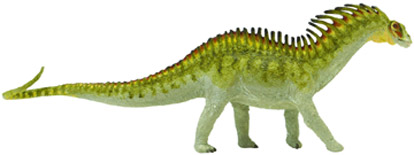
Interpretation of Amargasaurus (Carnegie Collectibles Series)

Amargasaurus model.

Picture credit: Everything Dinosaur

The model illustrated is the Carnegie Collectibles Amargasaurus dinosaur model.

The body proportions are well represented and short neck clearly shown.  The animal is depicted in shades of green, perhaps in reflection of the green and brown world this dinosaur inhabited.  The dashes of yellow, black and brown close to the larger spines indicate that the designers of this particular model saw the spines as a signalling device, perhaps used to communicate with other members within the herd.

To view the range of dinosaur, pterosaur and other prehistoric animal models available from Everything Dinosaur: Dinosaur and Prehistoric Animal Models.

8 02, 2009

Dinosaurs and the Water Cycle a Helpful Explanation

By |2024-04-15T13:50:08+01:00February 8th, 2009|Categories: Main Page, Teaching|0 Comments

Dinosaurs and the Water Cycle

What is it with the English and their weather?  The UK is essentially a “maritime climate”, this is what comes from being a small island at one side of the Atlantic ocean with a large continent (Europe) adjacent to us.  We do seem to get some very peculiar weather and June was no exception.  With the cricket season in full swing and Wimbledon tennis underway, last month proved to be one of the wettest on record, July has not started too well either.  Many parts of the UK have suffered from flash floods.  South Yorkshire seems to have been hit the worst with many villages and towns still underwater.

Dinosaurs and the Water Cycle

With all this rain everywhere, you might think that planet Earth has suddenly started to produce more water, but this is not the case.  The amount of water we have on this planet is just about fixed, water may change its state but this planet only has a finite amount.  If you pour yourself a glass of water and sit it on the table in front of you, that water in your glass could have been part of an ocean a little over a week ago.  It may have fallen as rain, just a couple of days before it found its way into your glass, but the water itself is virtually as old as the planet.

The same water that you see before you could have made up part of a shallow rock pool that stranded trilobites in the Ordovician 500 mya.  It may have formed part of a thunderstorm that caused a herd of plateosaurs to stampede in the Late Triassic, it might even have been drunk by a Tyrannosaurus rex.

The water we have gets recycled, this is what we call the “Water Cycle”, water is evaporated (or transpirated by plants as they lose water) and forms water vapour.  The water vapour in the air gets cold and forms clouds – this is called condensation.  You can see condensation on windows in the morning when the water vapour hits the cold window glass and turns back into liquid.

The clouds become saturated with water, so that they cannot hold any more and the water falls out back down to earth as rain, sleet, hail of snow.  The water may fall into or run off into oceans, lakes or rivers or get absorbed by the land into the “groundwater”, to be drunk by plants and trees or it will eventually under several natural processes, mainly gravity, find its way back to the sea – and the process starts all over again.

Visit Everything Dinosaur’s award-winning website: Everything Dinosaur.

7 02, 2009

Titanoboa – Huge Snake of the Palaeocene Epoch

By |2023-03-02T09:58:09+00:00February 7th, 2009|Categories: Dinosaur and Prehistoric Animal News Stories, Main Page|0 Comments

Fossil Skeleton of 45-foot long Snake Discovered in South America

With the mass extinction event that marked the end of the Mesozoic, those animals that remained, rapidly diversified and took up most of the ecosystem niches left vacant by the demise of the dinosaurs.  Mammals rapidly evolved and diversified and soon all the Orders that we know today were established.  However, those reptiles that had outlasted the dinosaurs also took the opportunity to exploit new environments and those places in the food chain left empty by the dinosaurs.

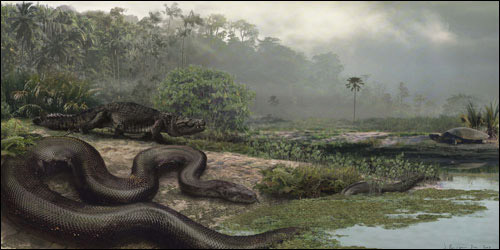
Fossils of one of the largest snakes known to science have just been unearthed in South America, and this new snake named Titanoboa would have probably been the apex predator in its jungle environment.

Titanoboa

The Palaeocene epoch lasted approximately 10 million years (65-55 million years ago).  The world slowly recovered from the catastrophes that had led to the extinction of approximately 60% of the life on Earth.  Within a few hundred thousand years of the end of the Mesozoic, planet Earth was covered in lush rain-forest, jungle and swamps.  Global temperatures rose to an average of 28 degrees Celsius and humidity increased permitting gigantism in creatures as diverse as insects, birds and reptiles.

“Hot House Earth”

Our planet had not experienced such a “hot house” environment since the Jurassic and those types of animals that had survived the extinction event soon found themselves in a lush, warm, humid environment, so warm in fact that tropical rain-forest and jungle stretched from the tips of Chile and South Africa right up to beyond the Canadian border.

European countries such as Germany and Poland had similar climates as did much of China in the east.  Even the United Kingdom was covered in tropical rain-forest (hard to believe considering the icy conditions that we have had this week).

With cold-blooded animals such as snakes, the temperature and availability of food can affect the potential size of a species. With such a warm climate, the absence of major predators such as the Theropod dinosaurs, snakes were able to exploit the conditions and truly huge forms began to evolve.

A New Genus of Snake

The fossils of this new genus of snake, believed to be a constrictor like a boa or the giant Anaconda of South America, were found at an open cast mine in north-eastern Columbia.  Along with the giant bones of the snake, fossils of crocodiles and turtles were also discovered, perhaps these other reptiles made up a large part of this Titanoboa’s diet.

An Artist’s Impression of Titanoboa

Picture credit: Jason Bourque

Estimating the Size of Titanoboa

Estimating the size of the snake based on comparisons with extant species indicates a length of 15 metres with a weight in excess of 1,200 kilogrammes.  Fossils of large snakes have been discovered in South America before.  An example would be Madtsoia bai, a huge constrictor known from fossils discovered in Argentina in the mid 1930s.  This particular species was believed to be up to 12 metres long, huge by modern snake standards but still 20% smaller than Titanoboa.

Commenting on the new discovery, Jack Conrad a snake expert at the American Museum of Natural History in New York stated:

This thing [Titanoboa] weighs more than a bison and is longer than a city bus.  It could easily eat something the size of a cow.  A human would just be toast immediately”.

The details of this discovery is published in this week’s edition of the scientific journal “Nature”.

Titanoboa cerrejonensis

The species has been formally named Titanoboa cerrejonensis, the name means “titan boa from the Cerrejon”, the region of Columbia where the snake fossils were found.  Although, probably more closely related to boas such as the Royal Python, this snake probably behaved more like an Anaconda, being at home equally well in water and on land.

The Boas (family Boidae), are considered to be relatively primitive in comparison with venomous snakes that make up the order Squamata such as vipers.  Scientists believe that snakes such as Boas evolved from lizards during the Late Cretaceous and snakes were constrictors at first, then eventually venomous forms evolved.

Boas retain several features that link them to their lizard ancestors.  For example, most species of boa retain a pelvic girdle and traces of the hind-limbs are found in a number of species.  The vestigial hind-limbs have been reduced to cloacal spurs in many types of boa, these can be seen on males.  Members of the Boidae family also retain the coronoid bone in the lower jaw, another link to their lizard ancestry that has been lost in higher snakes.

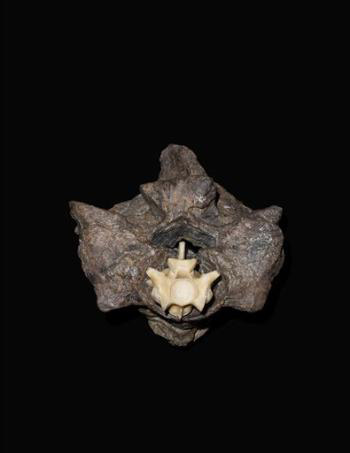
Titanoboa can make a claim for being the largest snake known to science.  When its fossilised bones are compared to those of a 6 metre Anaconda the true scale of this beast is revealed.

Comparison of Fossilised Titanoboa Vertebra with Extant Anaconda

Picture credit: Nature

Huge Fossil Vertebra

The huge fossil vertebra of Titanoboa dwarfs the vertebra of a modern Anaconda.  When alive Titanoboa would have been about as thick as an oil drum, making it a fearsome predator.

The beast was revealed in early 2007 at the University of Florida’s Florida Museum of Natural History in Gainesville.  Fossils collected at a huge open-pit coal mine in Colombia were being unpacked by graduate students and they realised that they were unwrapping the fossilised bones of something spectacular.  To date the scientists have identified about 180 different bones, mainly vertebrae and costae (rib bones).  These remains are believed to represent about a dozen individuals.

It seems that gigantic, fearsome reptiles did not disappear from our planet with the extinction of the dinosaurs.  Some types of reptile exploited the Palaeocene environment to evolve into new types of nightmarish creature.

Rebor Replicas

The model manufacturer Rebor has made several replicas of Titanoboa.  To view the figures (whilst stocks last): Rebor Replicas and Models.

6 02, 2009

Everything Dinosaur Introduces more Carnegie Collection Models

By |2023-02-28T15:11:58+00:00February 6th, 2009|Categories: Everything Dinosaur News and Updates, Main Page, Press Releases|0 Comments

Everything Dinosaur Introduces more Carnegie Collection Scale Models

Everything Dinosaur is adding to its existing range of prehistoric animal models by offering more of the Carnegie Museum scale models.  The Carnegie Collection is one of the world’s best known line of prehistoric animal models. This extensive collection is manufactured by the American company Safari Limited. A model range that includes a range of models normally in the 1:20 or 1:40 scale model range.

Carnegie Museum Scale Models

Each model is hand-painted, phthalate free and is a highly detailed replica of a prehistoric animal.  Every model comes with its own educational hang tag and these particular models are suitable for children aged 3+.

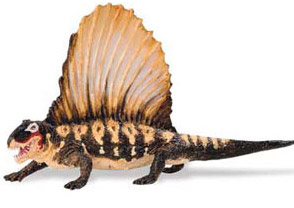
The Dimetrodon Model from the Carnegie Collection

Picture credit: Everything Dinosaur

As well as dinosaurs the range also includes a number of models of animals that were not dinosaurs, but reptiles, such as the pelycosaur Dimetrodon (pictured above).  Whether a dinosaur or not, all the models are skilfully created and carry the name of the Carnegie Museum of Natural History, one of the most important natural history museums in the world.

To view the Dimetrodon model, dinosaurs and other prehistoric animal replicas and figures: Dinosaur and Prehistoric Animal Models.

For dinosaur models and dinosaur toys, the Carnegie Collection is a must for serious model collectors and for young dinosaur fans.  It is great to see such a diverse range of animals represented and they are robust and tough, just what is required for creative play.

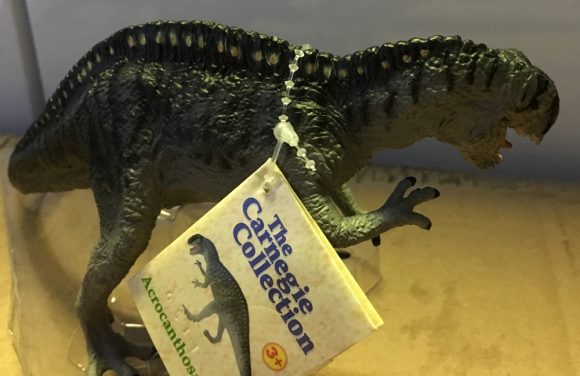
The Carnegie Collection Acrocanthosaurus Dinosaur Model

Carnegie Museum Scale Models. Acrocanthosaurus dinosaur model.

The rare and long ago retired Safari Ltd Carnegie Collection Acrocanthosaurus dinosaur model.

Picture credit: Everything Dinosaur

Wild Safari Prehistoric World Figures

To view the range of prehistoric animal replicas in the Safari Ltd range: Wild Safari Prehistoric World Figures.

Go to Top