All about dinosaurs, fossils and prehistoric animals by Everything Dinosaur team members.
6 08, 2015

Chinese Authorities Seize Hundreds of Dinosaur Eggs in Raid

By |2023-04-03T07:56:56+01:00August 6th, 2015|Categories: Dinosaur and Prehistoric Animal News Stories, Dinosaur Fans, Main Page|0 Comments

Dinosaur Skeleton and 213 Fossilised Eggs Recovered in Raid

Chinese police seized a total of 213 dinosaur egg fossils and an almost complete fossil of a small herbivorous dinosaur in a raid on a house in Guangdong Province (southern China).  Despite there being strict laws about the illegal removal and sale of ancient artefacts such as fossils in China, there is a significant trade in fossils from China, most of which are smuggled out of the country destined for the more lucrative markets for illegally sourced fossils in Europe and the United States.

A Huge Haul of Illegally Obtained Fossil Material
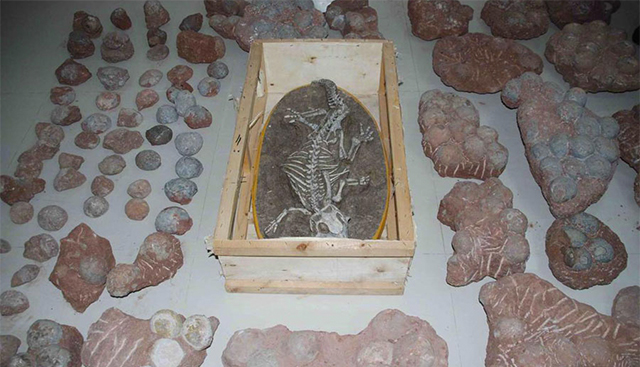
The Psittacosaurus was crated, either this is how it was sent from northern China or it was being prepared for illegal export.

The Psittacosaurus was crated, either this is how it was sent from northern China or it was being prepared for illegal export.

Picture credit: Xinhua News Agency

Authorities Raid House

The seizure took place on July 29th and was reported by the State run news agency – Xinhua.  The eggs come from a local construction site close to Heyuan City (Guangdong Province), they were looted by locals after workers uncovered a series of dinosaur egg fossils, discoveries of which have been reported over the last three months or so.  The eggs date from the Late Cretaceous, and this part of southern China is famous for its extensive dinosaur nesting site deposits.

Unfortunately, thefts of fossils are common as it is difficult for the authorities to keep track of each new fossil discovery.  Back in 2011, Everything Dinosaur team members reported on the return to China of a number of dinosaur eggs that had been illegally smuggled into the United States.

To read more about this: The Return of Stolen Dinosaur Eggs to China.

Fossil Thefts and Dinosaur Eggs

Chinese officials believe that local residents raided the construction site where a number of dinosaur egg fossils had recently been uncovered.  The fossils were being stored at a local address, most likely prior to being sold onto a middle man who would then forward the illegally obtained items onto other dealers for sale to private collectors abroad.  The skeleton found at the address has been identified as being that of a Psittacosaurus, fossils of which have been found throughout northern China.  Although Everything Dinosaur has no specific information on this specimen, it has been suggested that this fossil comes from the Liaoning Province (north-eastern China), perhaps from the Yixian Formation.

The Psittacosaurus fossil specimen is much older than the eggs, the strata that makes up the Yixian Formation is cited as being Lower  Cretaceous, the Psittacosaurus may be more than 120 million years old.

An Illustration of the Dinosaur Psittacosaurus
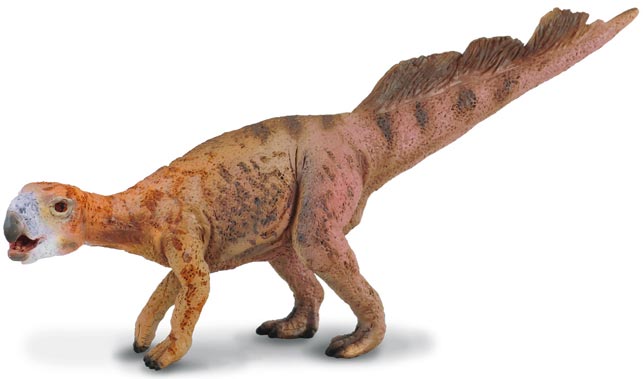
A typical psittacosaurid.

A typical psittacosaurid.

Picture credit: Everything Dinosaur

Dinosaur Eggs – Chinese Legislation

Although China has some of the strictest legislation in the world in a bid to stop the exploitation of its rich fossil heritage, policing dig sites, many of which are found as a result of building projects and not by scientific fieldwork, is extremely difficult.  Illegal excavations for dinosaur fossils are believed to be common in Guangdong Province.  Some locals steal the fossils and keep them at home, whilst others are part of a network which smuggles the material out of the country, destined for the black market in fossils overseas.

The Fossils were Scattered All Over the House
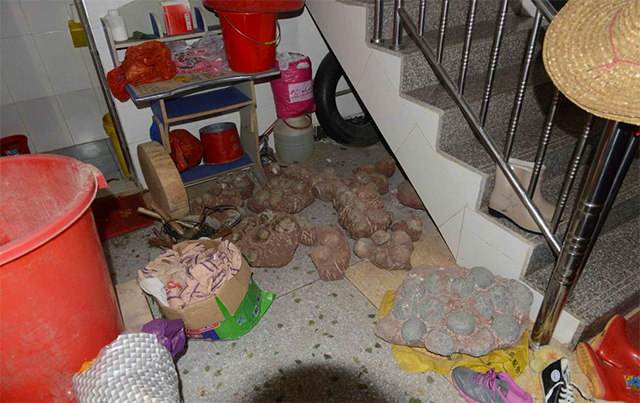
Police raid house and discover hundreds of dinosaur eggs.

Police raid house and discover hundreds of dinosaur eggs.

Picture credit: Xinhua News Agency

A spokesperson from Everything Dinosaur commented:

“This raid by the Chinese authorities might just deter would-be fossil thieves and make them think twice about the illegal removal of fossils. Sadly, we suspect that despite prompt police action in this case the smuggling and illegal sale of fossils from China is widespread and much more international co-operation is required in order to bring an end to this practice.”

Chinese Officials Inspect and Catalogue the Seized Fossils

Inspecting and sorting the fossilised eggs.

Inspecting and sorting the fossilised eggs.

Picture credit: Xinhua News Agency

Which Dinosaurs Laid These Eggs?

When asked to speculate on the type of dinosaur that laid the eggs, a spokesperson from Everything Dinosaur stated that the red sandstone around Heyuan City has yielded tens of fossils of dinosaur egg specimens.  The larger eggs in the photograph were most likely laid by duck-billed dinosaurs.  The smaller eggs were probably laid by oviraptorids.

“Although we cannot be certain, the smaller eggs may have been laid by a dinosaur known as Heyuannia huangi.  This small, theropod, believed to be a member of the oviraptorids, a group of very bird-like dinosaurs, was named and described back in 2002 from a number of fossils found in the same strata as the eggs.”

5 08, 2015

Dinosaurs Inspire at Summer School

By |2023-04-03T07:53:41+01:00August 5th, 2015|Categories: Educational Activities, Main Page, Teaching|0 Comments

Kingswood Primary Academy Summer School – Its All About Dinosaurs!

The start of the week (Monday) and an Everything Dinosaur team member was dispatched to Northamptonshire to visit Kingswood Primary Academy to help kick-off their summer school with its theme all about dinosaurs.  The enthusiastic teaching team have developed a two week summer school with a focus on literacy to help the children (mainly Key Stage 2), to get to grips with composition, transcription and sentence construction.

Dinosaurs Topic

With a topic like dinosaurs, there is certainly a great deal to write about.  For example, there are over 1,200 different types of dinosaur (genera) and new fossil discoveries are being made all the time.

The busy morning started with a short assembly which commenced immediately after registration.  In the assembly, Mr Bark (class teacher Year 5), outlined what the children would be doing during the course of the day and introduced our dinosaur expert who explained that fossils of prehistoric animals get discovered in the East Midlands of England and he demonstrated that fossils can even be found in the gravel outside of the classrooms.

Dinosaur Summer School

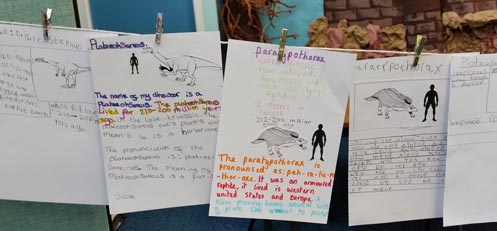
Then it was on with the activities.  The children were split into three groups (stegosaurs, brachiosaurs and the Triceratops group) and each group was given the opportunity to participate in a very tactile fossil exploration and dinosaur workshop led by Everything Dinosaur.  This session helped to reinforce learning whilst retaining the focus on literacy.  The kinaesthetic nature of the dinosaur workshop supported the other two sessions offered over the course of the day.  The children were challenged to create a prehistoric animal timeline, jam-packed with lots of information and useful facts researched and prepared by the groups, many of the children demonstrated a surprising amount of knowledge.

A Very Informative Dinosaur Themed Timeline Created by Kingswood Primary Academy Pupils

Lots of facts and dinosaur information.

Lots of facts and dinosaur information.

Picture Credit: Everything Dinosaur/Kingswood Primary Academy

Lots of Prehistoric Animal Themed Writing was Evident

Amazing facts all about Prehistoric Life.

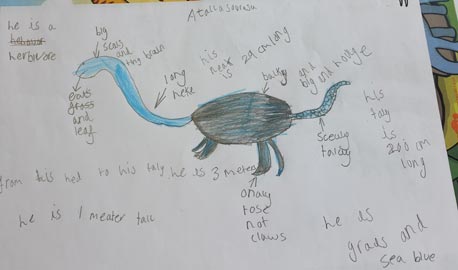
Amazing facts all about prehistoric life and extinct animals including aetosaurs.

Picture credit: Everything Dinosaur/Kingswood Primary Academy

Everything Dinosaur at Summer School

Everything Dinosaur had supplied lots of dinosaur and prehistoric animal themed resources to help support the teaching aims and objectives.  The lesson plan we devised for our tactile fossil handling and exploration session helped to support the work of the teachers.  There were lots of examples of writing on display and some great use of adjectives too.

In addition to supplying the resources for the timeline exercise, our expert, during his dinosaur workshop challenged the children to have a go at designing their very own dinosaur.  He used a modern reconstruction of Triceratops (T. horridus) to help inspire the children.  There were some amazing creations on display by the end of the afternoon, with names like “beastiesaurus” and “feathersaurus”, with once again, lots of evidence of labelling, independent research, comprehension and sentence construction.

Amazing Dinosaur Designs on Display

Very creative dinosaurs!

Very creative dinosaurs!

Picture credit: Everything Dinosaur/Kingswood Primary Academy

Dinosaur Themed Arts and Crafts

For drawing activities, posters and other dinosaur themed arts and crafts: Dinosaur Themed Art Materials, Crafts and Games.

Super labelling on the diagrams and we were really impressed to see that many of the budding young palaeontologists had thought about the animal’s colours, what it might have eaten and how big it may have been.  There was just time at the end of the day to answer some of the many questions from the children (and from the teachers too).

The summer school is running for a fortnight and next week our dinosaur expert will return to the school to help out further.  For the next visit we are going to try to take each group on a seaside fossil hunt, quite a challenge when you consider how far from the sea Northamptonshire is!

To learn more about Everything Dinosaur’s dinosaur outreach work: Contact Everything Dinosaur.

4 08, 2015

Unique Four-Legged Snake Fossil Slithers into Legal Dispute

By |2024-05-05T14:27:05+01:00August 4th, 2015|Categories: Dinosaur and Prehistoric Animal News Stories, Dinosaur Fans, Main Page, Palaeontological articles|0 Comments

Tetrapodophis amplectus Fossil Provokes Legal Action

Back on July 24th, Everything Dinosaur reported on the publication of a scientific paper that provided an insight into how snakes evolved from limbed ancestors.  The fossil of a snake-like creature with four tiny legs had been spotted on a tour of a German museum quite by chance.  It’s significance had not been realised until Dr David Martill (University of Portsmouth), spotted the beautifully preserved fossil whilst taking a party of his vertebrate palaeontology students on a visit to Germany to explore some of the country’s natural history museum fossil collections.

Tetrapodophis amplectus

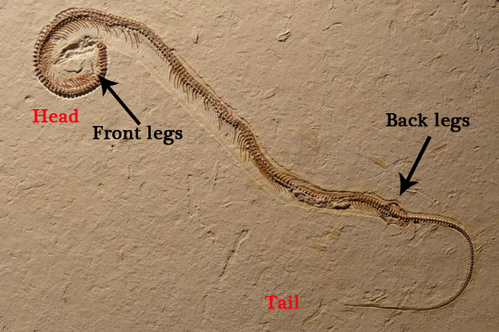
The unique specimen is believed to have been excavated from the Crato Formation of north-eastern Brazil.  The animal has been named Tetrapodophis amplectus , the name means “four-legged” embracing snake”, as the limbs probably did not have much of a locomotive function but probably served as claspers in mating or helping to control and manipulate prey.

To read more about Tetrapodophis: First Fossil Snake with Four Limbs Described.

With the paper published, a legal dispute has arisen with the Brazilian authorities and an investigation has begun to try to understand more about the provenance of the fossil material.  Brazil made it illegal in 1942 to sell or export fossils without the express permission of the Government.  The snake fossil was part of a private collection on display at the famous Bürgermeister-Müller-Museum in Solnhofen.  This museum, based in southern Germany, has amongst its fossil collection, spectacular Late Jurassic fossil specimens preserved in fine-grained, lithographic limestone.

By chance, during Dr Martill’s visit, the museum was putting on an exhibition of Cretaceous fossils from similar strata, but this time from Brazil.  Both the slab and the counter slab are known, but their exact provenance remains a mystery.  That’s the problem, it may have been collected prior to the Brazilian legislation, or perhaps it was collected after 1942, nobody is really sure.

The Beautifully Preserved and Extremely Significant Tetrapodophis Fossil

A beautifully preserved early, limbed snake.

A beautifully preserved early, limbed snake.

Picture credit: Dr Dave Martill/University of Portsmouth with additional annotation by Everything Dinosaur

Brazilian Officials Investigating

The Brazilian officials are keen to investigate to try to determine whether the snake fossil was taken out of Brazil illegally.  If this is the case, then they may have grounds for repatriation.

Commenting on the situation Felipe Chaves, (Head of the Fossil Division of the Brazilian National Department of Mineral Production, based in Brasilia), stated:

“We will formalise the request for an investigation with the Brazilian Federal Police, in order to ascertain how this fossil specimen left Brazil.  We know some details that merit being investigated.”

The twist in the tale highlights a major problem in palaeontology.  How much responsibility can scientists take when it comes to upholding the legality of the fossil specimens that they study?

High Prices for Fossils

Unfortunately, fossils, especially those of vertebrates, can fetch high prices.  There is a black market of illegal fossil material and many collectors are prepared to pay large sums for exquisite specimens.  This encourages the illegal excavation and trading of such artefacts.  There are a number of countries that have established tough laws to try to prevent the smuggling of fossil material, but there is a lot of evidence to suggest that illegal selling is still widespread.

To read an article about the seizing of a dinosaur fossil skeleton (T. bataar) that was put up for sale at a New York auction: U.S. Authorities Seize Dinosaur Fossil at the Centre of Auction Row.

Dr Nicholas Longrich, a palaeontologist at the University of Bath and a co-author of the fossil study stated:

“Personally, I would have liked to see the fossil go back to Brazil, but it wasn’t my fossil and so it wasn’t my choice.  We did discuss at length whether the specimen should be returned, given that we were uncertain about when it left, but the counterargument was that there was no evidence to suggest that any laws had been broken.”

After Paper Published Officials Became Aware of the Specimen

It was only when the scientific paper describing the snake fossil was published in the academic journal “Science”, that Brazilian Government officials became aware of the fossil’s existence. Felipe Chaves suggests that the research team should have informed the relevant authorities when they considered that this specimen most probably came from Brazil.  However, Dr Martill, the lead author of the Tetrapodophis scientific paper sees no need to do this.

He stated:

“There are hundreds, if not thousands of Brazilian fossils [in museum collections] all over the world.  It is a bit distracting if scientists have to mess about with the legality of fossils before they study them.  I see thousands of fossils every year from all over the planet.  I am not going to write to the governments of all those countries just to check each and every fossil.”

Looking at the Wider Point of View

Protectionist laws are in place in a number of countries, most notably China, where significant steps have been taken to try to reduce the smuggling of fossil material out of the country.  Such restrictions can hamper the collection and study of fossil specimens, but at the same time there is a need to protect a country’s heritage and to crack down on criminal activities.

Fossils from private collections often cause the greatest concern.  It can prove very difficult to establish how or when a fossil specimen was acquired.  However, should researchers publish data on fossils that may have been obtained illegally.

A number of academic journals produce guidelines to help clarify the situation, at least in so far as publishing a scientific paper.  For example, the academic journal “Cretaceous Research”, provides assistance to authors by noting in its author guidelines that papers on fossils of uncertain origin will not be accepted for publication, even if they are part of a museum’s collection.  The specimens must have unambiguous collection or ownership data associated with them.

Trying to Control the Exportation of Fossils

Given the wealth of vertebrate fossil material from the Crato and Santana Formations of Brazil in museums, it is doubtful whether the Brazilian investigation will make much progress.

A spokesperson from Everything Dinosaur explained:

“We can see both sides of the argument. Firstly, there is the desire to have controls on the exportation of fossil material and other artefacts from a country.  Retaining fossils in their country of origin can do much to encourage science education and research in that part of the world.  However, it is important to allow the continuation of research into fossils housed in various collections around the world even if their provenance can be described as a bit “murky”.  The important thing is to deter illegal collecting whilst at the same time encouraging a more open attitude towards scientific study.”

The spokesperson went onto add:

“Owners of private collections may be tempted to hide their collections away, thus denying scientists the chance to access them and to conduct research.”

To read an article about the return of Chinese fossils by American Customs officials following a number of seizures: Returning Contraband to China.

3 08, 2015

Earliest Evidence of Reproduction in a Complex Organism

By |2023-04-03T07:40:37+01:00August 3rd, 2015|Categories: Dinosaur and Prehistoric Animal News Stories, Main Page, Palaeontological articles|0 Comments

Unravelling the Secrets of Fractofusus

There has been much debate over the origins of life on Earth and over the last two decades our understanding of that “slow burning fuse” leading to complex multi-cellular life forms has greatly improved, but many mysteries still remain.  During the latter stages of the Proterozoic Eon, referred to as the Neoproterozoic, the very first ecosystems were established with bacteria, algae and protists (single-celled organisms with a nucleus), still dominating but slowly and surely more complex life began to evolve and to play an increasingly important role in these food webs.

Earliest Example of Reproduction in a Complex Organism

A team of scientists led by researchers from Cambridge University have identified the earliest example of reproduction in a complex organism, opening a window into life in deep water marine environments some 565 million years ago.

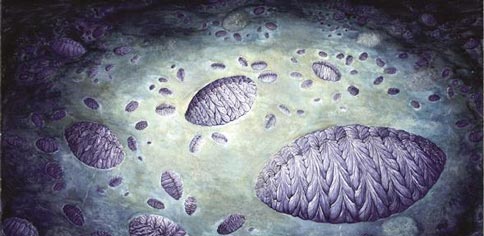
An Illustration of the Bizarre Ediacaran Fauna Fractofusus

An illustration showing how Fractofusus colonisised new territory.

An illustration showing how Fractofusus colonised new territory.

Picture credit: Cambridge University

Fractofusus – Two Species

Fractofusus (two species F. misrai and F. andersoni) was the organism studied.  Fractofusus, which belonged to a group of bizarre organisms that show links to both the Plantae and Animalia Kingdoms called Rangeomorphs, thrived in marine habitats during the Ediacaran, a geological period that marked the end of the Proterozoic Eon, that lasted from around 635 million years ago to 542 million years ago.

Ediacaran fauna represent a transition from the microbially dominated food chains of the early Earth towards the modern biota that can be identified in Cambrian fossils.

More than thirty different Ediacaran faunal types have now been described providing scientists with the oldest known record of diverse, complex creatures.  Fossils of these ancient communities have been found in Russia, the Ediacaran Hills of South Australia (from which this geological period was named) and in Canada (Newfoundland and Labrador).  The Fractofusus fossils in this study come from the Mistaken Point Ecological Reserve on the coast of Newfoundland.

Fractofusus

The research team discovered that Fractofusus took a bilateral approach to reproduction.  These lozenge shaped fossils were benthic (live on the sea floor) and sessile (attached to rocks), in addition, they were not mobile.  This means that fossils showing these strange organisms preserve them in situ, as they would have been when they were alive.  If an area is dotted with these fossils, then the scientists have a spatial map of how these organisms were distributed.  It is from these spatial maps that ideas about their reproduction strategy can be inferred.

Looking like fern fronds, Fractofusus was related to Charnia masoni, fossils of which were first identified from rocks exposed at Charnwood Forest in Leicestershire (Midlands of England).  These bizarre life-forms probably lived in deep water, far below the Epipelagic Zone of the ocean (the first two hundred metres of sea, where sunlight can penetrate).

At depth, no sunlight could reach, so these organism were not true plants as they could not photosynthesize.  They are difficult to place in the Kingdom Animalia as well.  They were fractual forms, with frond-like structures with no mouths, alimentary canal, anus or any method of locomotion.  It is likely that their large surface areas, (some of these organisms were up to two metres in length), allowed them to absorb nutrients directly from the sea water.  They probably grew extremely slowly.

Fractofusus Fossils Used in the Study

(a) = Fractofusus andersoni and (b) = Fractofusus misrai

(a) = Fractofusus andersoni and (b) = Fractofusus misrai

Picture credit: Cambridge University

Dominating the Fossil Assemblage

Fractofusus colonies dominate the fossil assemblage found along the coast of Newfoundland.  Two main species were analysed in this study.  Firstly, there is the more oval form (a) F. andersoni, pictured above and then there is the elongate form Fractofusus misrai (b).  Both these species exhibit the typical structures of this ancient organism, as preserved in the negative, epirelief external moulds formed in silts which were covered in volcanic ash deposits.

Analysis of the cluster patterns of the fossils revealed the likelihood of two methods of reproduction.  In one method, the organism sprouted “runners” from its body similar to the stolons produced by plants such as strawberries (asexual reproduction).  The second reproduction method (asexual or sexual reproduction), involved the release of waterborne propagules (simple buds or seeds released into the water column).

Able to Rapidly Colonise Areas

Such reproduction habits would have allowed this immobile organism to rapidly colonise a local area as well as to move to new territory.  The capacity of Fractofusus to derive the next generation by two distinct reproductive modes is a testament to its sophisticated biology.

Unfortunately, Fractofusus seems to have become extinct during the start of the Cambrian geological period around 542 million years ago, a time when more complex organisms were involving including animals with hard shells and armour with the establishment of the first complex predator/prey based ecosystems.

A Diagram Illustrating How Fractofusus Spread

Simplified diagram showing spatial distribution of Fractofusus.

Simplified diagram showing spatial distribution of Fractofusus.

Picture credit: Cambridge University

Dual Method of Reproduction

The dual method of reproduction is illustrated in the above diagram.  Larger “grand-parent” organisms were the product of ejected waterborne propagules, while the “parents” and “children” grew from stolon like structures sent out by the older generation.

Lead author of the scientific paper, which has just been published in the journal “Nature”, Dr. Emily Mitchell (Cambridge University) stated:

“It [Fractofusus] has a very distinct body plan that is totally unique. There is nothing like Fractofusus around today, which makes trying to understand anything about it really, really difficult.  We knew very little about it, apart from the fact that it lived in the deep sea, it has a relatively large surface area, so it got its nutrients from the water column.  We literally had no idea how it reproduced prior to this study.”

Dr Mitchell went onto add:

“Fractofusus doesn’t exhibit any of the features you associate with animals.  It certainly wasn’t a plant.  It belonged to a now extinct eukaryotic group known as Rangeomorphs.  But how Rangeomorphs relate to animals and the origins of animals is incredibly difficult to work out.”

This statistical, spatial mapping approach to the study of Ediacaran fauna is in its infancy.  The research team hope to employ this technique to explore how Fractofusus interacted with its environment and how colonies interacted with each other.

Visit Everything Dinosaur’s award-winning website: Everything Dinosaur.

2 08, 2015

The Limestone Fossils of Dudley (Wren’s Nest)

By |2023-04-03T07:33:11+01:00August 2nd, 2015|Categories: Dinosaur Fans, Geology, Main Page|0 Comments

Visit to the Wren’s Nest Nature Reserve (Dudley, West Midlands)

Prior to the first of Everything Dinosaur’s summer schools just time for team members to take in a quick trip to the famous Wren’s Nest National Nature Reserve (Dudley, West Midlands).  It was an early start, (yet again), but it did prove worth it as the weather behaved and team members were able to enjoy a walk around this very significant part of the world (in terms of geology anyway), before having a picnic close to the famous Silurian ripple beds.

Silurian Ripple Beds

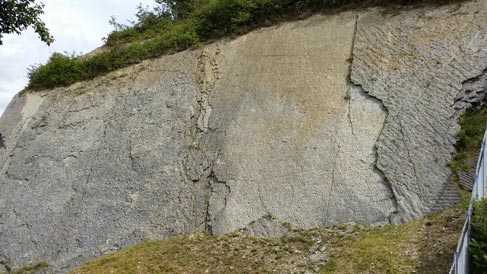
The Silurian ripple beds are just one of the amazing geological features to be found in this abandoned quarry.  The area was declared a National Nature Reserve back in 1956 due to the amazing fossil assemblage that can be found over the 100 acres or so of the Reserve.  Some seven hundred different invertebrate fossils have been identified at the site, they date from the Silurian age (approximately 423 million  years ago), the rocks themselves being part of the Wenlock Group.  Eighty-six of the fossil types are unique to Dudley, they have been found nowhere else in the world.

The Amazing Ripple Beds of Wren’s Nest

Amazing geological feature.

Amazing geological feature.

Picture credit: Everything Dinosaur

A Close up of the Silurian-aged Ripple Beds of Wren’s Nest National Nature Reserve

Preseved in limestone, the ripple beds.

Preserved in limestone, the ripple beds.

Picture credit: Everything Dinosaur

The quarry work ended in 1925 and when the Reserve was created it was the UK’s first ever geological National Nature Reserve.  It the area has also SSSI (Site of Special Scientific Interest) status due to its geological, palaeontological and historical significance.  It is also home to a wide variety of wild flowers and the caverns, now barricaded to prevent human visitors provide invaluable overwintering habitats for a number of species of bats.

Wren’s Nest

Although this picturesque nature reserve is enjoyed by local residents and visitors alike, it is the huge variety of invertebrate fossils that amazes team members.  Whilst we enjoyed our picnic (taking great care to remove all our litter), we marvelled at the array of fossils that can be found eroding out of the limestone beds (no hammers allowed).

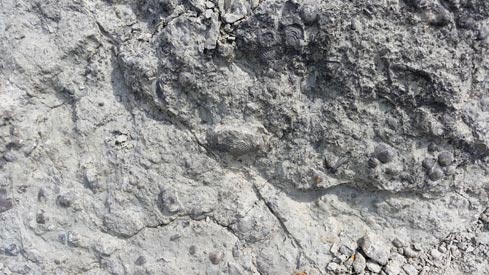
We contented ourselves by taking some pictures of the rich fossil assemblage, fossils to be found at this location include corals (tabulate and rugose forms), crinoids (sea lilies), brachiopods, bivalves, gastropods and some trace fossils (worm tubes).  Sadly, the trilobite fossils that made this part of the world so famous are increasingly rare.

A Close up of the Amazing, Highly Fossiliferous Limestone at Wren’s Nest

A huge variety of fossils can be found.

A huge variety of fossils can be found.

Picture credit: Everything Dinosaur

The exposed rock faces of the various quarry sites give geologists a unique opportunity to teach Silurian geology to students in an outdoor setting.  The location provides a definitive section through the Wenlock Formation.  The town of Dudley, is synonymous with the Wenlock limestone strata and the fossil assemblage contained therein.  This internationally famous location has provided a valuable insight into the marine life in coral sea environments during the Late Silurian geological period.  Both macro and micro-fossils have been preserved at this site.

Everything Dinosaur team members certainly enjoyed their visit to the fossil rich Wren’s Nest National Nature Reserve to celebrate the tenth anniversary of the company.

The UK-based mail order company stocks a variety of replicas of iconic fossil animals such as trilobites.  To view this selection: Replicas of Iconic Fossils.

1 08, 2015

Everything Dinosaur Tenth Anniversary Exclusive Celebrations

By |2024-05-05T14:28:06+01:00August 1st, 2015|Categories: Dinosaur Fans, Everything Dinosaur News and Updates, Main Page, Press Releases|0 Comments

Happy Tenth Birthday to Everything Dinosaur

Today, August 1st, marks the tenth anniversary of the founding of Everything Dinosaur.  Hasn’t the time whizzed by!  We wanted to take this opportunity to say a very big thank you to all our thousands of customers, friends, supporters and followers who have been with us on our amazing journey over the last decade.  We really appreciate your support.

Everything Dinosaur Tenth Anniversary

Happy Tenth Birthday!

Happy Tenth Birthday!

Picture credit: Everything Dinosaur

Everything Dinosaur

First thing to do this morning was to message the winner of our “name the pterosaur Guidraco” competition.  We will have made somebody’s day and their prize will be sent out shortly.  A super replica of a Guidraco pterosaur which is in 1:4 scale (CollectA Guidraco venator model).

How do we celebrate our tenth birthday?  We are having a get together this afternoon, hopefully a barbecue and then tomorrow, weather permitting, we are off on a fossil hunt!  Then it’s back to work with preparations for a summer school visit on Monday morning.

As for our tenth anniversary/birthday banner, we believe that tin is the traditional gift for a tenth anniversary so we put things on the banner from our vast product range to do with “tin”.

We have our popular “dinosaurs in a tin” gift set, but what else is there?  Can you spot the connection?

  • There is a model of Argentinosaurus.
  • A Dinosaurs counting set
  • A Tiny Towns Volcano play set

Over the last ten years we have loved every minute (well most of it anyway).  Our mission to be the best supplier of dinosaur toys, models and games remains very much at the heart of our business.

Once again a very big thank you to all our customers from around the world.  Here’s to the next ten years of dinosaur themed adventures.

Visit Everything Dinosaur: Dinosaur Models, Toys and Games.

31 07, 2015

Ornithocheiridae – Splendid and Enigmatic Pterosaurs

By |2024-04-11T10:04:18+01:00July 31st, 2015|Categories: Dinosaur Fans, Main Page, Photos of Everything Dinosaur Products|0 Comments

Ornithocheiridae – A Life on the Ocean Waves (Mostly)

With the introduction of the fabulous 1:4 scale Guidraco (G. venator) model by CollectA, pterosaurs have been much discussed around the Everything Dinosaur offices.  We received an email a couple of days ago from a model collector, who asked why one of the pictures we had published featuring this excellent model showed a volcano in the background, when he thought such flying reptiles lived on the coast.  Well, volcanoes can be found close to the sea, ask anyone who has visited Pompeii or Mount Etna, for example.  However, fossil material assigned to the one species of Guidraco known was found in rocks that were laid down far inland.

CollectA Guidraco Pterosaur Model

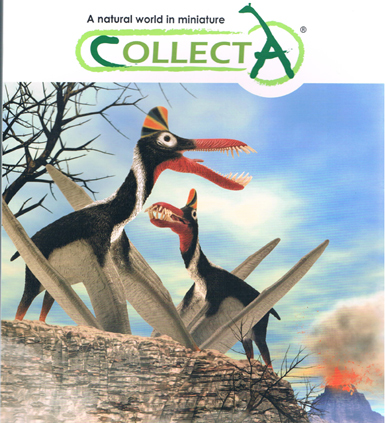
A Pair of Colourful Guidraco Pterosaurs

A pair of colourful Pterosaurs.

A pair of colourful pterosaurs.

Picture credit: Everything Dinosaur/CollectA

Guidraco fossils come from north-eastern China, from the famous Liaoning Province.  The sediments in which this pterosaur’s fossils were preserved were formed in a lacustrine (lakes) environment and laid down inland away from the coast.  Liaoning is famous for its exquisitely preserved fossils dating from the Early Cretaceous – birds, plants, fish, reptiles, pterosaurs and of course feathered members of the Dinosauria (Microraptor, Sinosauropteryx, Sinornithosaurus and the recently described Zhenyuanlong and so forth).

To read an article about the recently described feathered, predatory dinosaur called Zhenyuanlong: The New Winged Dragon from Liaoning Province.

Ornithocheiridae Family of Pterosaurs

The Ornithocheiridae family were widely geographically dispersed with ornithocheirid fossils described from strata found in North and South America, Australia, northern Africa, Europe as well as Asia.  Today, something like 120 genera of pterosaurs have been described, of these more than 10% have been assigned to the Ornithocheiridae, although the exact number is a mute point.  Many of the European Pterosaur fossils are extremely fragmentary and their taxonomic relevance is hotly debated.

Most ornithocheirids are known from quite poorly preserved fossil material. The exceptions are those genera associated with the Santana and Crato Formations of north-eastern Brazil, pterosaurs such as Ornithocheirus, Anhanguera, Cearadactylus and Coloborhynchus.

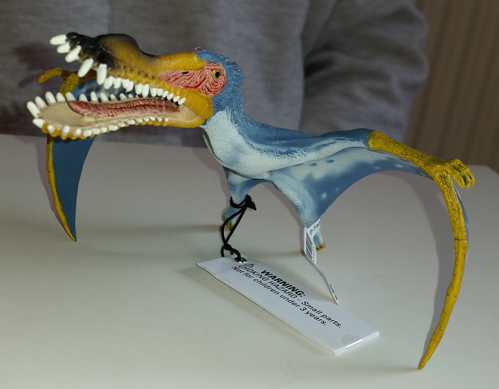
New for 2015 the Schleich Model of Anhanguera

Pterosaur.

A colourful model of the Pterosaur called Anhanguera by Schleich.

Picture credit: Everything Dinosaur

The Ornithocheiridae Family of Pterosaurs and Wing Load Studies

Wing loading studies and reconstructions of the wing surface coupled with comparisons to living birds provides evidence that the ornithocheirids had wings which were adapted to soaring long distances.  Their wing shapes resembles those of long distance fliers today, the Albatross for example.  This evidence, as well as those toothy jaws which would have been ideal for catching slippery fish, suggest that the majority of the Ornithocheiridae were adapted to marine environments.

Guidraco – An Inland Ornithocheirid?

So why the volcano in the illustration of a pair of Guidraco pterosaurs?  Near to the lush forests and deep lakes of what was to become Liaoning Province back in the Cretaceous was a line of volcanoes.  The area was actively tectonic.  Devastating volcanic eruptions would occasionally occur wiping out a lot of the fauna and flora.  It was this fine volcanic dust burying the corpses that led to the fantastic preservation of many of the Liaoning specimens.

Most probably a fish-eater, Guidraco pterosaurs would have found plenty to eat in the lakes and water courses that interspersed the temperate forests.  Although, palaeogeographical estimates suggest that this region was around 1,000 kilometres (620 miles) from the sea, an accomplished flier like Guidraco could have migrated this distance relatively easily.  Perhaps young Pterosaurs (the holotype specimen of Guidraco represents a sub-adult), could have spent some time inland, especially during bad weather at the coast.

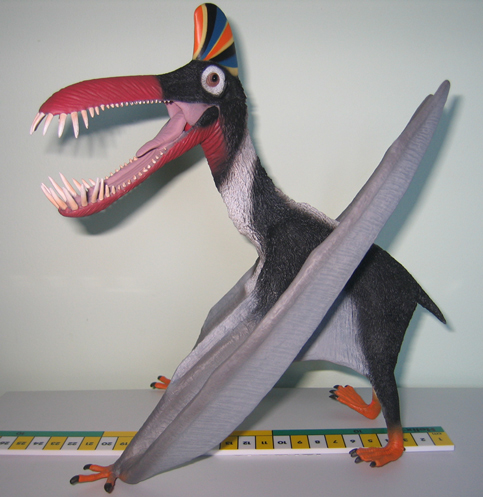
Another Fantastic Ornithocheirid Replica

Model has an articulated jaw.

Model has an articulated jaw.

Picture credit: Everything Dinosaur

To view the CollectA Guidraco and the other scale replicas in this series: CollectA Supreme Prehistoric World Figures.

With the introduction of the Schleich Anhanguera model along with the CollectA 1:4 scale Guidraco, it seems that ornithocheirids are as popular as ever.

To view the Schleich range of prehistoric animal figures: Schleich Dinosaurs, Pterosaurs and Other Prehistoric Animal Models.

30 07, 2015

New Study Suggests Earth’s Magnetic Shield is Older than Previously Thought

By |2024-04-11T10:00:19+01:00July 30th, 2015|Categories: Dinosaur and Prehistoric Animal News Stories, Geology, Main Page|0 Comments

Plate Tectonics Got Started Early in our Planet’s History

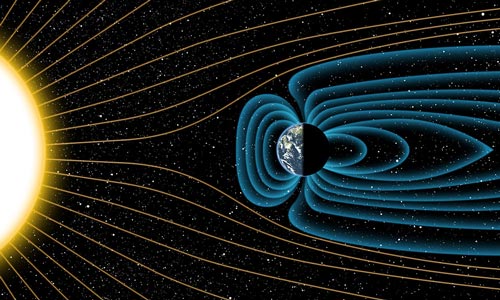
Our planet has a magnetic field, similar to the magnetic field that can be generated by a simple bar magnet.  This field is aligned close to but not directly with the Earth’s axis of rotation.  The magnetic poles lie some way from the geographic poles (separated by approximately eleven degrees).  Earth’s magnetism is powered by fluid motion inside our planet and this field protects all life from the harmful solar winds that are expelled by the sun.

When this field was first generated has remained a mystery.  It had been thought that the Earth’s magnetic field had been around for some 3.45 billion years, now new research conducted by scientists at the University of Rochester (New York) suggests that this magnetic field is actually much older.

Magnetic Field

John Tarduno, a geophysicist at the University of Rochester and lead author of a paper published in the journal “Science” estimates that the Earth’s magnetic field was formed at least four billion years ago.  This is much earlier in our planet’s history than previously thought, it is estimated that Earth was formed some 4.56 billion years ago.

Since 2010, the best estimate of the age of Earth’s magnetic field has been 3.45 billion years. But now a researcher responsible for that finding has new data showing the magnetic field is far older.

Why is the Magentic Field Important?

It has to do with our sun and cosmic radiation.  As well as visible light, the sun sends out streams of charged particles into space, it is not the only source of cosmic radiation, any luminous body in the universe produces radiation, but since the sun is 93 million miles away, at the centre of our solar system and with a radius of approximately 700,000 kilometres it is the biggest contributor to the harmful cosmic rays that get sent our way.

Particles of different wavelengths and energies are being generated all the time by our sun and it is these higher energy radioactive particles that are dangerous to life forms.  Thankfully, those that make it to Earth are deflected away by our planet’s strong magnetic field.  This magnetism acts as a shield helping to protect our planet and the life that exists on it.

An Artist’s Illustration of the Earth’s Magnetic Field Deflecting Particles

Helping to keep our planet habitable.

Helping to keep our planet habitable.

Picture credit: Michael Osadciw/University of Rochester

Professor Tarduno explained:

“A strong magnetic field provides a shield for the atmosphere.  This is important for the preservation of habitable conditions on Earth.”

Life Saving Magnetic Field

This life saving magnetic field is also responsible for producing the Aurorae (northern lights – Aurora Borealis and southern lights Aurora Australis), spectacular light shows that are created when the solar wind and its charged particles interacts with our planet’s magnetic field and atmosphere.  As these particles approach Earth, they distort our magnetic field and allow some charged, high energy particles to enter our atmosphere at the magnetic north and south poles.

These charged particles interact with gases in our atmosphere and “excite” the gas particles which in turn glow, just like the gas in a florescent tube light you might have in your kitchen.

Generated at the Earth’s Core

Our planets magnetism is generated in its liquid iron core.  It acts as a “geodynamo” and requires regular releases of heat from our planet to function.  This heat release is aided by plate movements at the Earth’s crust.  Convection allows the transfer of heat from the interior to our planet’s surface, but the origin of our tectonic plates is contentious, with many physicists suggesting that our planet lacked a magnetic field for more than a billion years after it was formed.

A study of the mineral magnetite found within zircon crystals collected from the ancient rocks of the Jack Hills of Western Australia has helped the Rochester University to determine that the Earth’s magnetic field is older than previously thought at around 4 billion years of age.

Magnetite

Magnetite is a naturally occurring magnetic iron oxide, it locks in information about the Earth’s magnetic field as it cools and forms from its molten state.  The ancient rock deposits of the Jack Hills represent some of the oldest strata on our planet and zircons from these rocks have already been used to help determine how quickly the Earth cooled after its initial formation.

To read more about this 2014 study by scientists from the University of Wisconsin- Madison: The Earth Cooled Earlier Than Previously Estimated.

In order for the team to get reliable, accurate results, it was crucial that the minerals remained unchanged over the vast period of time since their formation.  Professor Tarduno’s study of the magnetic field strength preserved inside the pristine zircon crystals has enabled the team to build up a picture of the Earth’s magnetic field over time.

The microscopic zircons were analysed using a superconducting, quantum interference device, which is unique to the University, the sensitive instrument (called a SQUID magnetometer), showed that the intensity measurements recorded in the samples were indeed as old as four billion years.

Implications for Life on Earth and Other Planets

The intensity measurements reveal information about the presence of a “geodynamo” at the Earth’s core.  Tarduno explained that solar winds could interact with the Earth’s atmosphere to create a small magnetic field, even in the absence of this core dynamo.  Under those circumstances, it has been calculated that the maximum strength of a magnetic field would be 0.6 μT (micro-Teslas).  The values measured by Professor Tarduno and his colleagues were much higher than 0.6 μT, suggesting the presence of a “geodynamo” at the planet’s core, as well as indicating the existence of the active plate tectonics needed to release the built-up heat.

Professor Tarduno added:

“There has been no consensus among scientists on when plate tectonics began.  Our measurements, however, support some previous geochemical measurements on ancient zircons that suggest an age of 4.4 billon years.”

The Solar System Four Billion Years Ago

Four billion years ago, our sun was much younger and it was sending out much more powerful solar winds which were up to a hundred times stronger than today’s.  In the absence of this nascent magnetic field the high energy particles that make up the solar wind would have ionised and blasted away light elements (those with a relatively low atomic mass), from the atmosphere, elements such as hydrogen, nitrogen, carbon and oxygen.  The loss of these elements would have made the evolution of complex life on our planet almost impossible (probably completely impossible).

Our planet, may have come to resemble that of our second nearest planetary neighbour, Mars.  Mars is approximately half the size of Earth, the mass of Mars is around ten percent of the Earth, it may once have had an active “geodynamo” for a time after its formation, but due to the planet’s size, this active, convectional dynamo seems to have run out of energy and ceased.  This led to the Red Planet losing any magnetic field that it had.  The atmosphere was blasted away by the solar wind.

Life on Mars

Today, scientists are confident that Mars once had liquid water but it is likely that this water was driven off along with most of the light elements in the atmosphere and on the surface of the planet.

Professor Tarduno believes that the loss of the “geodynamo” dramatically altered the history of Mars.  He stated:

“It may also be a major reason why Mars was unable to sustain life.”

Mars does have an atmosphere, it consists of nitrogen and carbon dioxide but it is just one percent the thickness of our own planet’s atmosphere.  Unmanned, robotic vehicles like the Mars Rover may have provided us with evidence that Mars may once have had vast amounts of liquid water – so much water in fact that there is evidence of global scale floods on its barren, rocky surface.

It seems we have a lot to be grateful for when it comes to our magnetic field and its early establishment may have assisted in the development of life on our own planet.

Visit Everything Dinosaur’s award-winning website: Everything Dinosaur.

29 07, 2015

Research to Get Your Teeth Into

By |2023-04-01T16:10:53+01:00July 29th, 2015|Categories: Dinosaur and Prehistoric Animal News Stories, Dinosaur Fans, Main Page|0 Comments

Structural Secrets of Theropod Teeth

Theropod dinosaurs, the majority of which were carnivorous, had a distinct advantage over other Mesozoic predators.  Their teeth had a deeply folded, serrated tooth structure that allowed them to rip and tear into the bodies of their victims.  This crucial, layered structure to the teeth has been identified by researchers from the University of Toronto Mississauga, with the assistance of colleagues from Taiwan and published today in the academic journal “Scientific Reports.”

A Specialised Tooth Structure for Feeding on Large Prey

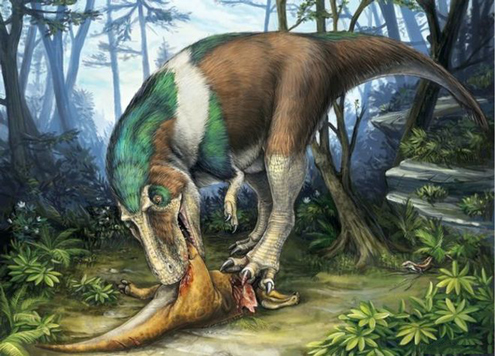
Gorgosaurus feeding - thanks to its specialised teeth.

Gorgosaurus feeding – thanks to its specialised teeth.

Picture credit: Daniele Dufault

The picture above shows a feathered Gorgosaurus, a member of the Tyrannosauridae family, feeding on a young Corythosaurus.

Theropod Teeth

The research team used scanning electron microscopes and a synchrotron located in Taiwan to study a wide variety of theropod teeth from the collections of Canadian museums, including the Royal Tyrrell, and the Royal Ontario Museum.  Meat-eating dinosaurs in the study, included Gorgosaurus, the Triassic predator Coelophysis, Tyrannosaurus rex, Allosaurus, and the giant African theropod Carcharodontosaurus.  Other non-Dinosauria creatures involved in the teeth study were Smilodon spp. and the shark O. megalodon, as well as early archosaurs, as the scientists tried to identify the evolutionary origins of these rather unique inter-dental folds.

Extant animals were also included in the research.  The only living animals with similar dentition and internal teeth structures are the Monitor Lizards, most notably the formidable Komodo dragon (Varanus komodoensis).  It is the largest lizard alive today and specialises in hunting large animals, thus reinforcing the theory put forward by the Canadian research team that these inter-dental folds evolved specifically to assist with predation of large herbivores.

Hidden Complexity of Dinosaur Teeth

Dr Kirstin Brink, a post-doctoral researcher in the Department of Biology, one of the authors of the paper commented:

“What is so fascinating to me is that all animal teeth are made from the same building blocks, but the way the blocks fit together to form the structure of the tooth greatly affects how that animal processes food.  The hidden complexity of the tooth structure in theropods suggests that they were more efficient at handling prey than previously thought, likely contributing to their success.”

Dr Kristin Brink with one of the Theropod Teeth Examines the Evidence

A special arrangement of layers of dentine at the base of each serration in the tooth.

A special arrangement of layers of dentine at the base of each serration in the tooth.

Picture credit: University of Toronto Mississauga

The picture above shows Dr Brink examining the special arrangement of layers of dentine at the base of the each tooth serration (denticle).  She is holding a tooth from the giant theropod Carcharodontosaurus.

Dinosaur Bite Forces

A lot of research has been undertaken into the bite forces of extinct animals, but this is the first time a study of this type has been carried out.  The teeth may have an outer coating of enamel, just like our teeth, but the tough dentine inside has a unique configuration of dental folds and this gives the teeth of theropod dinosaurs enlarged serrations, ideal for tearing into flesh.

The shape of the teeth (morphology) and their development, both in terms of their evolution and how they develop in an individual. can provide palaeontologists with a lot of information on the evolution of extinct animals and provide insights into feeding behaviour.

Theropod teeth, the only group of the Order Dinosauria, known to have produced meat-eaters, are characterised by the presence of serrations, known as denticles on the cutting edges of their teeth.  These serrations vary between genera, with troodontids for example, having relatively large denticles, whilst spinosaurids have proportionately much smaller ones.

Ziphodont Teeth

Teeth that are serrated along the cutting edge are referred to as ziphodont teeth.  In a study, Everything Dinosaur reported upon last year, the same University research team, examined the ziphodont teeth of Dimetrodon (D. grandis).  They concluded that the serrations gave this pelycosaur an evolutionary advantage over other Permian predators.

To read more about this study: Dimetrodon with Teeth Like a Steak Knife.

In this new paper, the researchers conclude that the structures previously thought to prevent tooth breakage, instead, first evolved to shape and maintain the characteristic denticles throughout the life of the tooth.  The relatively novel and complex dental folds produced at the base of the teeth characterises the theropods, with the exception of those genera that evolved a modified diet and a less meat intensive diet.  The scientists conclude that these teeth structures are vital for allowing the predation and consumption of large prey animals.

A Close up of a Gorgosaurus Tooth (Royal Ontario Museum Collection)

A close up of the tooth of Gorgosaurus

A close up of the tooth of Gorgosaurus – G. libratus

Picture credit: Scientific Reports

Examing the Skull and Teeth of Gorgosaurus

The picture above shows an illustration of the skull of the tyrannosaurid Gorgosaurus (A), drawing by Danielle Dufault.  The complete tooth (ROM 57981) is shown in (B) with extreme close ups of the denticles on the cutting edges of the tooth.  The tooth illustrated is from the upper jaw (maxilla).

Key

  • dej = dentine/enamel junction
  • e = enamel (outer coating of the tooth)
  • if = inter-dental fold
  • is = inter-dental sulcus
  • pd = primary dentine

The Sharp Edges of Predators Teeth Viewed Under Scanning Electron Microscopy

c

Theropod teeth have two sharp edges these are called carinae.

Picture credit: Scientific Reports

Theropod Teeth Up Close

The cutting edges (carinae) of various predators (all are examples of ziphodont teeth).  Pictures are from scanning electron microscopy images.  Note the scale bars and the pictures to the right of the black and white images are thin cross sections showing internal structure.

Key

  • C = unknown phytosaur
  • D = Coelophysis bauri
  • E = Allosaurus fragilis
  • F = Carcharodontosaurus saharicus
  • G = Gorgosaurus libratus
  • H = Tyrannosaurus rex

This adaptation may have played an important part in the initial radiation and subsequent success of the Theropoda as terrestrial apex predators.  After all, the theropod body shape and bauplan, especially those teeth, permitted them to dominate terrestrial ecosystems for the best part of 160 million years.

29 07, 2015

Just 48 Hours Left to Enter Everything Dinosaur’s Unique Guidraco Competition

By |2024-04-11T10:04:58+01:00July 29th, 2015|Categories: Dinosaur Fans, Everything Dinosaur News and Updates, Main Page, Press Releases|0 Comments

Win a 1:4 Scale Flying Reptile Model with Everything Dinosaur (Contest is Closed)

WIN! WIN! WIN! with Everything Dinosaur!  Just 48 hours left to enter Everything Dinosaur’s competition to win an amazing 1:4 scale replica of the pterosaur called Guidraco.

We have got another super, prehistoric animal replica to win in a fantastic, free to enter contest.  CollectA have already brought out some amazing dinosaur models this year and to celebrate this and the fact that Everything Dinosaur will be 10 years old on August 1st we are holding a special competition, a chance to win a wonderful 1:4 scale replica of a pterosaur.

CollectA Guidraco Pterosaur Model

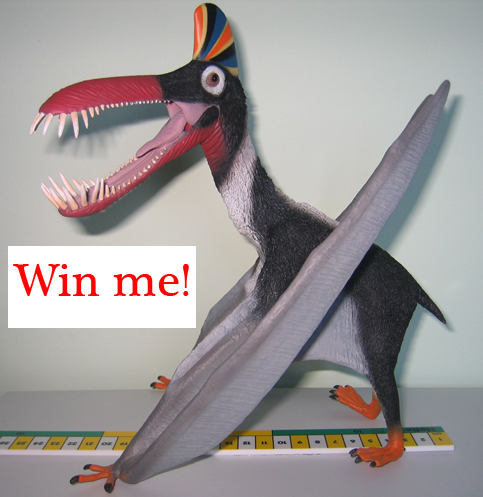
CollectA have added to their “Supreme” range of big scale models and the new for 2015 pterosaur replica (Guidraco), with its moveable, articulated jaw is super and it makes a great prize in our special tenth birthday competition.

Contest to Celebrate Everything Dinosaur’s Tenth Birthday 
Win this 1:4 scale model!

Win this 1:4 scale model of a Guidraco pterosaur!

Picture credit: Everything Dinosaur 

Prize Giveaway

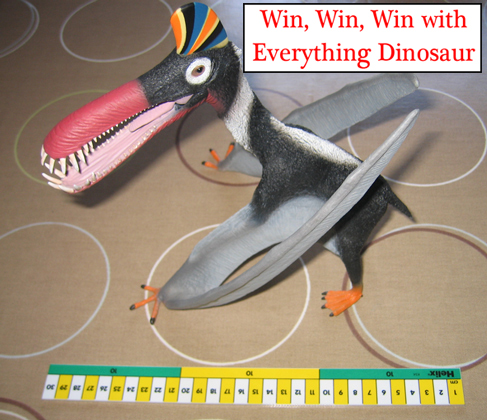
Our tenth anniversary prize giveaway is this beautiful Guidraco with an lower articulated jaw.  The replica measures more than twenty-five centimetres in height and more than twenty-six centimetres in length.  Its colouration is based on a modern sea bird, a puffin and our replica needs a name.  What name will you come up with?

To enter Everything Dinosaur’s competition, all you have to do is “Like” Everything Dinosaur’s FACEBOOK page, share, then comment on the picture (either here or on Everything Dinosaur’s Facebook page) don’t forget to include a suggestion for a name for this fabulous flying reptile.

Please note, this competition is now closed.

Everything Dinosaur on FACEBOOK: “LIKE” Our Facebook Page and Enter Competition.

For instance, if you believe our Guidraco pterosaur should be called “Glenda” or “Gertie”, then put your comment on our Facebook page or underneath this article in the comments section of this blog!

We will draw the lucky winner at random and the name caption competition closes on Friday, July 31st at midnight.  Good luck to everyone who enters our contest.

Just visit Everything Dinosaur’s Facebook page, give our page a “like” and then leave a comment on the picture showing the Guidraco pterosaur replica.  What flying reptile names can you think of?

“Like” Everything Dinosaur’s Page on Facebook

Like our Page (please).

Like our Page (please).

A Fantastic CollectA Guidraco Replica to Win Thanks to Everything Dinosaur
Just like our Facebook page to enter.

Just like our Facebook page to enter this competition.

Picture credit: Everything Dinosaur

Everything Dinosaur

To view Everything Dinosaur’s huge range of CollectA prehistoric animals: CollectA “Prehistoric Life/Prehistoric World” Figures.

To see the full range of CollectA scale prehistoric animal replicas: CollectA Deluxe/Supreme Prehistoric Animal Figures.

The CollectA Supreme/Deluxe Guidraco Pterosaur Model

CollectA Guidraco pterosaur model.

Available from Everything Dinosaur in late spring 2015 and a prize in a free to enter competition.

Terms and Conditions of the Everything Dinosaur Tenth Anniversary Contest

Automated entries are not permitted and will be excluded from the draw.

This promotion is in no way sponsored, endorsed or administered by, or associated with, Facebook.

Only one entry per person.

The prize is non-transferable and no cash alternative will be offered.

The Everything Dinosaur tenth anniversary competition runs until midnight on Friday 31st July 2015 (don’t forget the competition closes at midnight on 31st July).

Winner will be notified by private message on Facebook.

Prize includes postage and packing.

For full terms and conditions contact: Contact Everything Dinosaur.

Please note, this competition is now closed!

Go to Top