All about dinosaurs, fossils and prehistoric animals by Everything Dinosaur team members.
18 08, 2015

Pulanesaura – A Case of “Four Legs Good Two Legs Bad”

By |2023-04-05T07:55:51+01:00August 18th, 2015|Categories: Dinosaur and Prehistoric Animal News Stories, Dinosaur Fans, Main Page|0 Comments

South African Basal Sauropod Sheds Light on Niche Partitioning in Early Jurassic Herbivores

What does a quotation from George Orwell’s famous novella “Animal Farm” that satirises the Soviet system have in common with a newly described South African dinosaur?  Not a lot, you might think, but the slogan “Four Legs Good, Two Legs Bad” coined by the animals in the book can be aptly applied to the fossilised remains of a newly described Early Jurassic long-necked dinosaur.

The fossils of Pulanesaura eocollum suggest that this plant-eater spent all its life as a quadruped, that is, it had become adapted to walking around on four legs and feeding on low growing plants, as opposed to the sauropodomorphs that shared its world, dinosaurs like Massospondylus, which were either semi-bipedal for full bipeds.

Basal Sauropod

This four-legged stance would have given this eight metre long, five tonne herbivore a very efficient feeding platform, perhaps, providing it  with a distinct advantage over the other dinosaurs that it shared its habitat with.

A Diagram Showing Suggested Body Shape and Some of the Fossilised Bones of P. eocollum
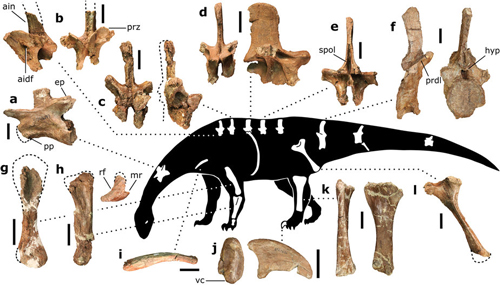
About 7% of the total skeleton is known.

About 7% of the total skeleton is known.

Picture credit: Witwatersrand University

The picture above shows representative fossil bones of the new sauropod.  The fossils were excavated from a small quarry measuring a little over ten square metres in size from a farm in the Spion Kop locality (Senekel District of the Free State, South Africa).  The close proximity of the fossils and the depositional environment which represents a low energy deposit dominated by poorly bedded sandstones and silts, suggests this site relates to a cut-off channel.

Fossils collected indicate the presence of two sub-adult to adult sized specimens.  Analysis of the almond-shaped teeth found in association with the bones along with the robust forelimbs suggest that Pulanesaura fed close to the ground, whilst its contemporaries, dinosaurs like Massospondylus and Arcusaurus (fossils of which were found at the edge of the same quarry), used their arms to help gather food from across a broad range of the forest canopy.

Head Down Browsers

The dinosaur, described by University of Witwatersrand PhD student Blair McPhee and colleagues in the journal “Scientific Reports” provides evidence of niche partitioning in Early Jurassic sauropods. Niche partitioning is defined as the process by which natural selection drives competing species into different patterns of resource use or different niches.

Niche partitioning in this way permits a number of similar animals to co-exist in an environment as each species does not directly compete with the other.  In simple terms, the stocky, heavy-set Pulanesaura may have specialised in grazing upon low growing plants such as ferns and horsetails, a “head down” approach to finding its dinner as described by one member of the Everything Dinosaur team.  In contrast, sauropodomorphs which could behave as facultative quadrupeds (mostly adopting a bipedal stance but able to go down on all fours if they desired), would feed on taller plants and trees, a “heads up” feeding strategy.

Niche Partitioning

This concept of niche partitioning in the Sauropoda has been applied before, notably when the extensive Late Jurassic sauropod fossil material from the Morrison Formation of the western United States is considered.  In the Late Jurassic, brachiosaurids and diplodocids lived side by side, along with camarasaurids.  Different dinosaur body shapes and neck lengths permitted each type of plant-eater to specialise on feeding on particular parts of the available flora.

Niche Partitioning in Late Jurassic Sauropods
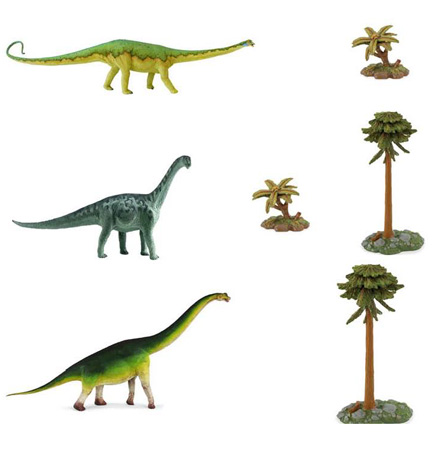
Long necks for different feeding envelopes.

Long necks for different feeding envelopes.

Picture credit: Everything Dinosaur

Other authors of the paper include Dr Matthew Bonnan (Stockton University), Dr Jonah Choiniere (Evolutionary Studies Institute at Witwatersrand University), Dr Adam Yates (Scientist at the Museum of Central Australia) and Dr Johann Neveling (Geologist from the Council of Geoscience).  The scientists conclude that Pulanesaura was an early member of the long-necked sauropod lineage of dinosaurs, distantly related to the super-sized Sauropoda that evolved later in the Jurassic and an early exponent of the “four legs good” lineage of plant-eating dinosaurs that were to dominant terrestrial habitats for much of the Jurassic.

Commenting on the significance of this dinosaur discovery, student Blair McPhee stated:

“This dinosaur showcases the unexpected diversity of locomotion and feeding strategies present in South Africa 200 million years ago.  This has serious implications for how dinosaurs were carving up their ecosystems.”

Pulanesaura eocollum – A Basal Sauropod

The exact date of the strata from which the fossils come from is difficult to determine.  The rocks containing the Pulanesaura material are associated with the Upper Elliot Formation, precise dating remains controversial with broad estimates of the age of these rocks ranging from 200 million years to around 180 million years old.

Dr Jonah Choiniere added:

“We used to think that only two species of sauropodomorph dinosaur were present in South Africa.  Now we know that the picture was much more complicated, with lots of species present. But Pulanesaura is still special because it was doing something that all these newly discovered species were not.”

The Teeth of the Plant-Eating Dinosaur
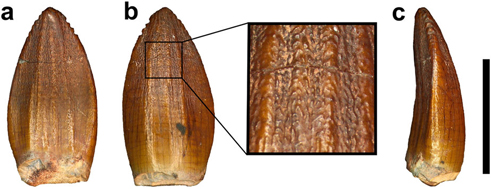
Scale bar = 1cm

Scale bar = 1cm.

Picture credit: University of Witwatersrand

There are two broken teeth associated with the fossil bones.  They are very similar to the teeth found in most basal sauropods.  The dinosaur’s name Pulanesaura eocollum is derived from the local language “Pulane” meaning rain-maker/bringer, a reference to the very wet conditions that the field team encountered when excavating the fossils.

What’s in a Name?

The species name means “dawn neck”, a direct reference to the anatomical modifications in the neck identified by the scientists which probably meant that this dinosaur did not have to move its body around too much in order to feed.  Less movement equates to less energy being expended to gather food, an efficient method of feeding that was to be taken to extreme lengths by the gigantic Sauropods that evolved later.

Stockton University’s Dr  Matthew Bonnan summed up the importance of this fossil discovery by explaining:

“The traditional picture of sauropod evolution is that when they came onto the scene, the other Sauropodomorphs were pushed aside.  Pulanesaura turns this notion on its head.  Sauropod evolution was occurring alongside and influenced by competition with their sauropodomorph brethren.”  

For models and replicas of Jurassic sauropods and other prehistoric creatures: CollectA Deluxe Prehistoric Animal Figures.
16 08, 2015

New Schleich Giganotosaurus (orange) Reviewed

By |2024-05-05T14:39:27+01:00August 16th, 2015|Categories: Dinosaur Fans, Everything Dinosaur Products, Main Page, Photos of Everything Dinosaur Products, Product Reviews|0 Comments

A Review of the Schleich Giganotosaurus (orange)

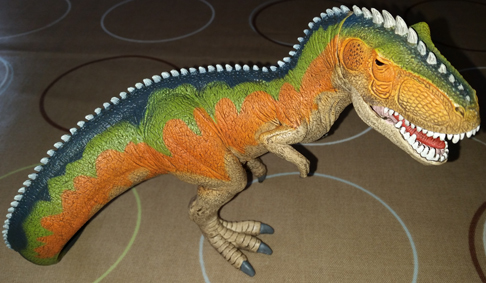
Carefully crafted with robust, creative play in mind, Schleich have produced another very attractive dinosaur model.  The figure in question is the recently introduced Schleich Giganotosaurus (orange) dinosaur model, one of two new models added to the company’s “World of History” model range this summer.  For prehistoric animal figure collectors it might be a case of “déjà vu” as this is the third Giganotosaurus model introduced by the German company in the last five years.  Of the three, it is certainly the most colourful.

Schleich Giganotosaurus

The Schleich Giganotosaurus (orange) Dinosaur Model

Giant Southern Lizard.

“Giant Southern Lizard.”

Picture credit: Everything Dinosaur

Giganotosaurus has grown in popularity since its formal naming and description by Argentinean palaeontologist Rodolfo Coria  back in 1995.  Each year, Everything Dinosaur produces a list of the most popular prehistoric animals and in 2014’s survey “Giant Southern Lizard” remained at number eight for the second year running.

To view the Everything Dinosaur 2014 survey: Everything Dinosaur’s Top Ten Prehistoric Animals 2014.

A Popular Cretaceous Meat-eating Dinosaur

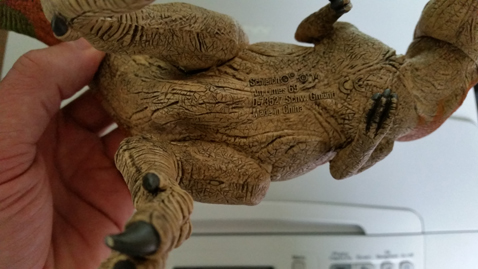
This model will do a lot to retain the popularity of this Cretaceous meat-eating dinosaur.  It is very sturdy, the model weighs close to half a kilogramme and it is very well sculpted.  The weight of the replica gives it a real feel of quality.  The feeling of quality is enhanced when the fine details of the skin texture including traces of skin folds are considered.  Unlike many inferior replicas, the detailing is continued on the underside of the model.

The Underside of the Schleich Giganotosaurus Dinosaur Model (Giganotosaurus orange)

Skin folds and texture on the underside of the model.

Skin folds and texture on the underside of the model.

Picture credit: Everything Dinosaur

Beautifully Painted Schleich Giganotosaurus

The model is beautifully painted with a striking bright orange down the flanks (it is this colour that gives this dinosaur model its name and helps it to distinguish it from the other two, earlier Schleich Giganotosaurus replicas).  The orange colouration is off-set by a light green band that runs down the body and a stripe of cobalt blue that starts as a small line on the tip of nose and runs down the top of the skull, down the back to the tip of the tail where it broadens out to give this model a dark tail colour.

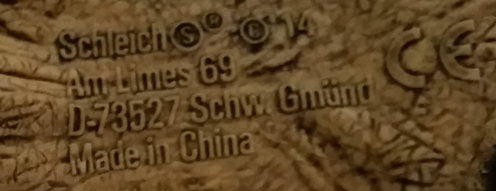
When inspecting the underside of this model, it is sensible to check the CE mark and manufacturer authentication which can be found on the belly.  We expect there will be a lot “Chinasaur” replicas being made so we advise collectors to purchase from an authorised Schleich distributor such as Everything Dinosaur.

Authentic Models Should Have the Manufacturer Details on the Underside

Look for the manufacturer's marks.

Look for the manufacturer’s marks.

Picture credit: Everything Dinosaur

Oversized Feet

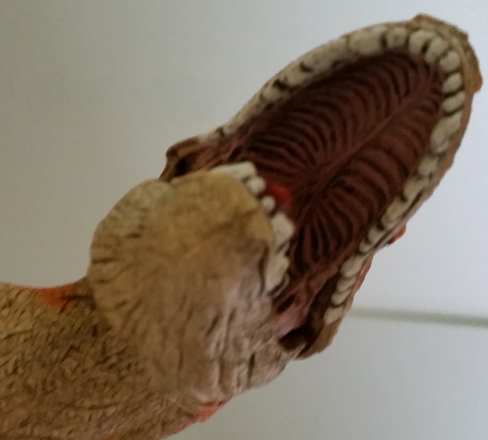
The feet are a little oversized but these help with the bipedal stance of this replica and like all the other large Theropod dinosaur models currently made by Schleich, this replica features an articulated jaw.  The excellent paint work continues inside the mouth, even the palate area, the roof of the mouth, has been sculpted and painted with care.  No soft tissue preservation from the skull area is known for Giganotosaurus (G. carolinii), but we appreciate the work of the design team at Schleich to include these details on their dinosaur model.

To view the range of large prehistoric animal models available (World of History): Schleich World of History Dinosaur Models.

The Schleich Giganotosaurus Model (orange) Even Shows Details of the Roof of the Mouth

Details of the mouth of the Schleich Giganotosaurus (orange).

Details of the mouth of the Schleich Giganotosaurus (orange).

Picture credit: Everything Dinosaur

Everything Dinosaur

On the Everything Dinosaur website, we give this model’s length as approximately twenty-four centimetres, but as the tail curls round on itself and the neck is slightly bent to the right, it is difficult to provide an extremely accurate measurement of this replica’s size.  When measured with one of Everything Dinosaur’s field tape measures, the model comes out at around thirty-three centimetres in length, but in our video review of this dinosaur model, to be published shortly, we retain the more conservative measurement and calculate a 1:58 scale size for this Giganotosaurus.

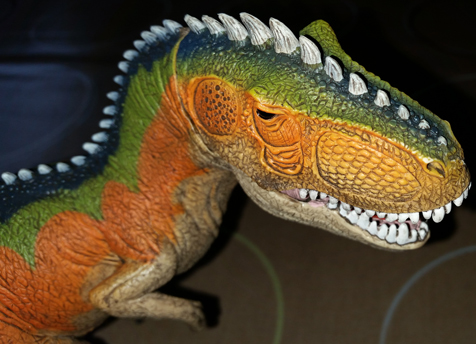
A Close up of the Head of the Schleich Giganotosaurus (orange)

Well painted model has an articulated lower jaw.

Well painted model has an articulated lower jaw.

Picture credit: Everything Dinosaur

The row of horns running along the length of the body and along the top of the snout may not exactly match the known fossil record, and the fenestrae in the skull are a slightly unusual shape (but at least the sculptors have indicated the skull of this dinosaur had large holes behind and in front of the eye socket).  All in all, this is an excellent model, one that we recommend for young dinosaur fans and collectors alike.

15 08, 2015

Somerset Reveals Its Diverse Triassic Fauna

By |2023-04-04T08:35:49+01:00August 15th, 2015|Categories: Dinosaur and Prehistoric Animal News Stories, Dinosaur Fans, Main Page|0 Comments

Ancient Triassic Seas of South West England Teemed with Life

An ancient coastal landscape has been brought to life thanks to the dedicated research of an undergraduate from Bristol University.  Klara Nordén has explored the diversity of animal life that inhabited the shorelines of south-western England 200 million years ago (Late Triassic), using fossils collected by Gloucester-based geologist Mike Curtis back in the 1980s.

Late Triassic Landscape

The student from the School of Earth Sciences (Bristol University) examined material from Late Triassic sediments at the Marston Road Quarry, near the town of Nunney in Somerset.  This site is well known for its microfossils and many types of fossil teeth.  Although Mike Curtis collected the material back in the 1980s the fossils have not been formally studied until now.

The paper published in the “Proceedings of the Geologists’ Association” highlights the diverse fauna that once existed in this part of south-western England.  The palaeoenvironment consisted of a shallow, tropical sea with many small islands close by.  It was on these islands that Bristol’s very own dinosaur the Thecodontosaurus roamed.

Triassic Fauna

Thecodontosaurus was the fourth dinosaur to be officially described (actually it was described before the term Dinosauria had been erected).  Although a number of specimens were lost when Bristol City Museum was bombed in World War II, enough fossil material has been collected to make this little Sauropodomorpha one of Britain’s best known early Mesozoic dinosaurs.

To read an article about Thecodontosaurus: Bristol Remembers Thecodontosaurus.

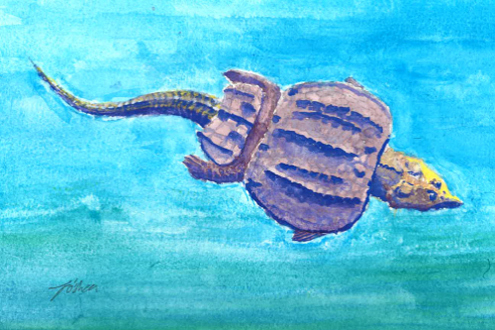
The study revealed a total of six species of bony fish and a further six species of shark, as well as the presence of a placodont, a type of marine reptile believed to be distantly related to the plesiosaurs and a member of the Sauropterygia.  The placodont has been identified as Psephoderma alpinum.  Described as being lizard-like with an armoured shell, this reptile fed on shellfish and other invertebrates found in the sediment on the seabed.

Psephoderma alpinum

An Artist’s Drawing of the Placodont Psephoderma alpinum

An illustration of the Triassic Placodont Psephoderma.

An illustration of the Triassic placodont Psephoderma.

Picture credit: James O’Shea

Predatory Marine Reptiles

In addition, the study revealed the presence of a number of predatory marine reptiles including a crocodile-like animal in the shallow coastal waters (Pachystropheus rhaeticus), a semi-aquatic reptile first described in 1935, nearly one hundred years after the fossils of Thecodontosaurus were scientifically studied.

Commenting upon her research into this ancient Somerset archipelago, student Klara stated:

“We were excited to find teeth from a placodont, which are rare in British sediments.  The presence of placodonts indicates that the area was once a coastal environment, with shallow waters and abundant invertebrate prey.  Placodonts were in decline in the Late Triassic and the placodont teeth from Marston Road mush come from some of the last of these reptiles to exist on Earth.”

The strata in this part of the world associated with the Upper Triassic (Rhaetian faunal stage), is well-known for its bone beds containing abundant remains of fish and reptiles.  It is not just marine fauna that has been preserved, fluvial processes have resulted in the long distance transport of the remains of land animals around at the time becoming deposited into the shallow marine strata being laid down.

The study also revealed the presence of sphenodontians that would have co-existed on the tropical islands alongside the dinosaurs.

Sphenodontians Alongside Dinosaurs

Sphenodontians inhabited the islands in the archipelago, which they shared with Thecodontosaurus, the famous ‘Bristol dinosaur’.  These small animals resemble lizards but they are not members of the Order Squamata.  They represent a very ancient reptilian lineage that probably originated in the Early Triassic.  Like lizards and snakes, they are diapsids and the sphenodontians are classified along with snakes and lizards in the SuperOrder Lepidosauria but on a distinct branch from the Squamata, (the Rhynchocephalia – meaning “beak heads”).  This study documents the first time that sphenodontian fossils have been recorded in British marine sediments.

Although once diverse, there is only one genus of Sphenodontian living today, the remarkable Tuatara that can be found on a few New Zealand islands (there are attempts being made to introduce this little reptile back to the New Zealand mainland).

To read an article about a genetic study into these ancient reptiles: The Tuatara Has a Surprise in its Genes.

The Triassic Fauna of a Coastal Landscape

Klara’s supervisor is Professor Michael Benton (School of Earth Sciences), he explained that the fossils reveal the details of a coastal landscape that existed some 200 million years ago and they paint a very different picture from today, after all, the Bristol Channel can hardly be regarded as a tropical sea.

The Professor stated:

“It’s really unusual to find remains of land-living animals mixed in with the marine fishes and sharks.  They must have been washed off the land into the shallow sea and this provides evidence to match the age of the marine and terrestrial deposits in the area.”

Co-author of the report, published in the “Proceedings of the Geologist’s Association”, Dr Chris Duffin added:

“I began working on these fossils from the Bristol area forty years ago and it’s great to see such wonderful work by a Bristol undergraduate.”

For models and replicas of Triassic dinosaurs and other prehistoric animals: CollectA Age of Dinosaurs Models and Figures.

14 08, 2015

Rare Hypselospinus On Show at Bexhill Museum

By |2024-05-05T14:24:30+01:00August 14th, 2015|Categories: Dinosaur and Prehistoric Animal News Stories, Dinosaur Fans, Main Page|0 Comments

Dinosaur Fossils Go on Display at Local Museum

Iconic locations such as the Badlands of Montana, the Hell Creek Formation and the exotic sounding Tendaguru Beds are the sort of places that most people would associate with spectacular dinosaur discoveries, but residents of East Sussex (southern England), don’t have to travel too far to explore life in the past.  The fossilised remains of a large, plant-eating dinosaur have just gone on display at Bexhill Museum.  The bones not only represent a dinosaur, but one of the most successful kinds of dinosaur, or indeed, any land vertebrate that has ever existed.

Hypselospinus Fossils

Say hello to Hypselospinus (Hypselospinus fittoni), a member of the Iguanodon-like group of dinosaurs, (Iguanodontia clade), fossils of which have been found all over the world.  Plant-eating dinosaurs such as the iguanodontids existed on our planet from the Middle Jurassic right up to the end of the Cretaceous, that’s a time span of some ninety million years or so.

Putting things into context, the Bexhill Museum specimen represents a type of herbivorous dinosaur the like of which roamed Earth over a period of time some four hundred times longer than our own species has existed.  Hypselospinus was a medium sized iguanodontid, it may not have been the largest of its kind, but with an estimated length of six metres and a body mass perhaps around the two tonnes mark, Hypselospinus was a sizeable beast!

Fossils on Display at the Museum

140 million year old dinosaur bones on display

140-million-year-old dinosaur bones on display.

Picture credit: Bexhill-on-Sea Observer

Hypselospinus fittoni

Hypselospinus (H. fittoni) is known from a variety of post cranial fossil material, all of it (we think), found in East Sussex.  The Hypselospinus fossils on display at Bexhill Museum consist of a number of limb bones and other material such as a beautifully preserved caudal vertebra (tail bone).  Local palaeontologists Peter and Joyce Austen are credited with the discovery, but it was David Brockhurst, an amateur fossil hunter, perhaps most famous for his work on Europe’s smallest known dinosaur, the curious “Ashdown Maniraptoran” who was responsible for the excavation.

The independent, voluntarily-run museum located in Egerton road, just an Argentinosaurus length away from the picturesque sea front, has a number of important fossils found in the local area on display.  It might be difficult for residents of Bexhill-on-Sea to believe, but back in the Early Cretaceous this part of England was home to a variety of dinosaurs and also flying reptiles (Pterosaurs).

An Iguanodontid

Hypselospinus was typical of an iguanodontid. It had a rectangular shaped skull, which ended in a broad muzzle with a beak that was well suited to cropping vegetation.  It spent most of its life ambling around on all fours, but it could, if it so wished, rear up onto its powerful back legs and adopt a bipedal stance.  Large neural spines associated with the dorsal vertebrae (back bones) suggest that Hypselospinus had a steeply arching back, this feature distinguishes this dinosaur from other iguanodontids associated with southern England.

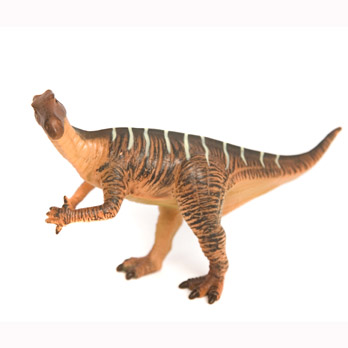
A Model of a Typical Iguanodontid (Iguanodon)

A typical Iguanodontid dinosaur.

A typical Iguanodontid dinosaur.

Picture credit: Everything Dinosaur

To view models and replicas of iguanodontids and other Early Cretaceous dinosaurs: CollectA Prehistoric Life Figures.

The Bexhill Hypselospinus

The Bexhill Hypselospinus fossils are being written up by Dr David Norman (Cambridge University), a palaeontologist who has studied a number of iguanodontid species and even has a plant-eating dinosaur, possibly another type of iguanodontid, but this time one that roamed China a few million years after Hypselospinus existed, named after him (Equijubus normani).  We look forward to reading Dr Norman’s appraisal of the Bexhill material.

Bexhill Museum curator, Julian Porter commented:

“We have got most of the parts, including the arms and legs.  One thing which is missing, however is the “thumb spike”.  Either we have not looked in the right place or it may be that this particular species didn’t have the thumb spike like other Iguanodonts.”

Perhaps, Everything Dinosaur can help to clear up the “thumb spike” issue, the Natural History Museum (London), has within its extensive ornithischian dinosaur collection a partial right forearm with an thumb spike measuring around eight centimetres in length.  This specimen (NHMUK R1832) has been assigned to Hypselospinus fittoni.

Checking Details in a Book

It’s a good job we had our “Dinosaurs of the British Isles” book (Dean Lomax and Nobumichi Tamura), handy to cross reference our notes on Hypselospinus fossil material.

If this is correct, than just like the more famous Iguanodon, Hypselospinus had a thumb spike, this spike probably served as a defensive weapon, very helpful, as large meat-eating dinosaurs also roamed around this part of East Sussex during the Early Cretaceous.

To learn more about Bexhill Museum: Bexhill Museum.

To read more about the “Ashdown Maniraptoran”, the cervical vertebra of which is on display at the museum: Europe’s Smallest Dinosaur.

13 08, 2015

New Rebor Replicas Due in Stock

By |2023-04-04T07:52:34+01:00August 13th, 2015|Categories: Dinosaur Fans, Everything Dinosaur News and Updates, Everything Dinosaur Products, Main Page, Photos of Everything Dinosaur Products, Press Releases|0 Comments

Latest Rebor Replicas Due in Stock at Everything Dinosaur

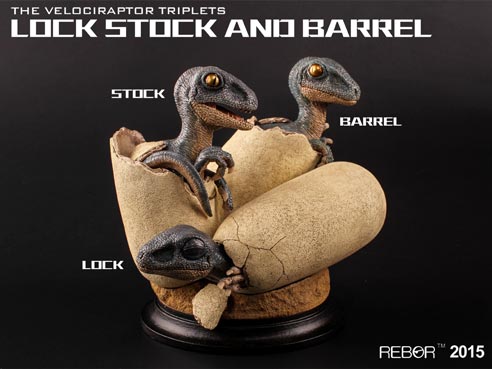
The latest editions to the ever-growing range of Rebor replicas are due to arrive at Everything Dinosaur’s warehouse tomorrow (Friday, 14th August).  We are expecting the new, limited edition hatching Velociraptors replica along with the two dinosaur nest dioramas (sauropod and theropod nest).  These items have already cleared European customs and the most up to date information we have is that they have now begun their onward journey with an expected arrival time in the UK later this evening.

If all goes to plan, stock should be in our warehouse sometime on Friday and team members are going to be on standby to make sure that once product has arrived and been checked over it can be on line at Everything Dinosaur within minutes.

The Limited Edition Hatching Velociraptors Replica

Introducing "Lock, Stock, and Barrel".

Introducing “Lock, Stock, and Barrel”.

Picture credit: Everything Dinosaur

Rebor Replicas

Only 1,000 Velociraptor Hatching replicas are being made, this is the second introduction into the “Rebor Club Selection” range and the sculpting team have decided to give their trio of theropods a retro feel with scaly skins rather than feathers.  It is certainly a most interesting figure.

To view Everything Dinosaur’s existing range of Rebor replicas and models: Rebor Replicas.

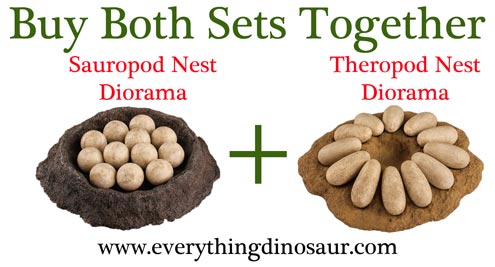
The other two additions to the Rebor range are the sauropod dinosaur nest diorama and the theropod dinosaur nest diorama.  These sets contain twelve removable dinosaur eggs and show that different types of dinosaur created different types of nest and laid differently shaped eggs.

Both Rebor Dinosaur Nest Dioramas will be available From Everything Dinosaur

Beautifully crafted figures.

Beautifully crafted figures from Rebor. The sauropod nest is on the left of the picture, whilst the theropod nest is seen on the right.

Picture credit: Everything Dinosaur

These dinosaur nest replicas would be great for creating prehistoric scenes or dinosaur themed dioramas.

12 08, 2015

Tracking Down German Meat-Eating Dinosaurs

By |2023-04-04T07:45:36+01:00August 12th, 2015|Categories: Dinosaur and Prehistoric Animal News Stories, Dinosaur Fans, Main Page|0 Comments

Biologist Provides Fresh Insight into Early Cretaceous Dinosaur Tracks

Many of us, will this summer, go for a stroll along the beach whilst on a visit to the seaside.  It seems this pastime may have been popular with theropod dinosaurs too.  Biologist Pernille Venø Troelsen of the University of Southern Denmark, has provided a fresh perspective on a set of fossilised dinosaur tracks, part of an extensive set of dinosaur trackways uncovered in Lower Cretaceous sediments at Münchehagen, twenty miles northwest of the city of Hanover (Germany).  The scientific paper on these footprints formed part of her Masters degree.

Meat-Eating Dinosaur Tracks

The exposed strata forms part of the Bückeberg Formation, which in turn is part of the Lower Saxony basin of northern Germany and the eastern Netherlands.  The rocks laid down represent sandstones and silts in a brackish environment as this part of Europe during the Early Cretaceous (Berriasian to Valanginian faunal stages), was on the coast of a shallow, tropical sea, which stretched up into the Arctic circle and covered most of what is now Germany, the Low Countries and parts of France.

The footprints have been dated to around 142 million years ago (Early Cretaceous) and they represent tracks made by a large theropod dinosaur and a second, much smaller theropod.

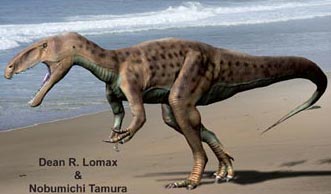
An Illustration of a Typical Theropod Dinosaur

The image above comes from the excellent "Dinosaurs of the  British Isles" book.

The image above comes from the excellent “Dinosaurs of the British Isles” book.

Picture credit: Nobumichi Tamura

The image of a theropod dinosaur strolling along a beach is from the front cover of the highly informative “Dinosaurs of the  British Isles” by Dean Lomax and Nobumichi Tamura.

More details about this dinosaur book can be found here: Siri Scientific Press.

Hundreds of Dinosaur Tracks

Although many hundreds of dinosaur footprints have been uncovered in this part of northern Germany, for Pernille, these tracks give her the opportunity to infer aspects of dinosaur behaviour, that many people might not associate with ferocious predatory dinosaurs.  For example, the theropods were ambling along, seemingly in no hurry.  The impressions made in the wet sand and now fossilised preserve a tiny fragment of life in the Early Cretaceous, from time to time, the dinosaurs skid on the wet sand and these slips and skids have been preserved in the sandstone.

The larger of the two meat-eaters, stood around 1.6 metres high at the hips, the smaller animal had hips that were around 1.1 metres high.  Hip height can be calculated by measuring the stride length of each dinosaur.  Both dinosaurs are moving in a south-easterly direction.

Mapping Dinosaur Footprints (Early Cretaceous Dinosaur Trackways)

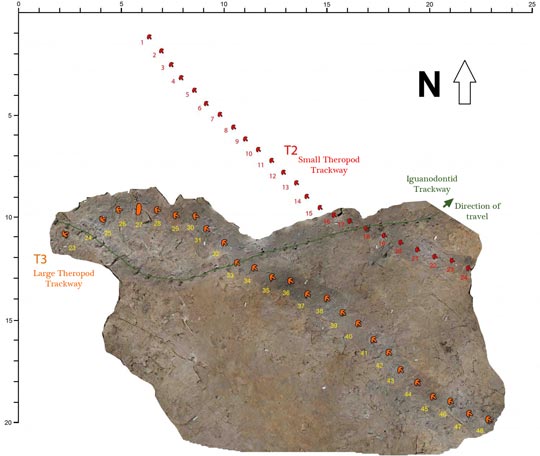
T3 is the large Theropod track, T2 represents the smaller Theropod.  The Iguanodontid track is highlighed in green.

T3 is the large theropod track, T2 represents the smaller theropod. The iguanodontid track is highlighted in green.

Picture credit: Pernille Venø Troelsen (University of Southern Denmark) with additional annotation by Everything Dinosaur

In the picture above, the tracks of the large theropod (T3) are highlighted in orange.  The smaller theropod (T2) is in red.  Each footprint has been numbered, more than fifty individual footprints were included in the study under taken by Penille Venø Troelsen.  Her interpretation of the inferred behaviours was presented at the thirteenth annual meeting of the European Association of Vertebrate Palaeontologists, last month, in Opole, Poland.  The paper was presented to the conference on the 10th of July.

Different Types of Dinosaur Represented

At some point, a large ornithopod, probably an iguanodontid wandered across the beach.  The trackway has been mapped onto the photograph above by Everything Dinosaur team members and the direction of travel noted.  It is not known whether this big, plant-eating dinosaur walked over the beach, before or after the theropods.  No interaction between the herbivore and the theropods is inferred.

Trace fossils such as dinosaur footprints provide evidence of the activity of organisms.  Unlike body fossils, in which the carcase of an animal might be transported many miles after death (by river currents for example), most trace fossils show direct, in situ evidence of the environment at the time and the place where the animal lived.

If you were to step into the footprints made by these dinosaurs you would be literally “walking with dinosaurs”, but for the sake of preservation we would urge readers not to do this should the opportunity arise (take a photograph instead).

Important Information Obtained from the Meat-eating Dinosaur Tracks

From a biologist’s perspective a lot of information can be obtained from such an extensive set of tracks.  Behaviour can also be inferred.  The average speed of the large theropod has been calculated at around 6.3 km/hour, a comfortable walking pace for most people.  The lighter, smaller theropod was travelling on average, a little faster, around 9.7 km/hour.  The footprints were first uncovered in 2009, they are part of a series of Early Cretaceous dinosaur tracks and individual footprints found in this part of Germany, more than 200 individual prints have been mapped to date.

The smaller theropod occasionally crossed its legs as it trotted across the sand.  Pernille puts forward a number of possible explanations for this, perhaps the little dinosaur got buffeted by a strong inshore breeze or perhaps it had found something to eat or was snapping at an insect that was bothering it.

There is another intriguing possibility.  For a biologist, these two tracks could have been made a the same time, that is, this was a large dinosaur and a smaller dinosaur, possible the same species moving together.  Could these be the tracks of a mother and its young?

Pernille Venø Troelsen suggested:

“As a biologist, I can contribute with knowledge about behaviour of individual animals.  If so, this may illustrate two social animals, perhaps a parent and its young.”

Social Dinosaurs

There is an increasing amount of fossil evidence to suggest that dinosaurs were social animals that they exhibited complex behaviours.  For example, a number of dinosaur nest sites have been discovered indicating that many different types of dinosaur nested in colonies, just like many species of birds do today.  Other fossil evidence such as extensive trackways show that dinosaurs moved in herds and that these herds had a structure, adult animals moving on the outskirts of the group to protect the juveniles who were clustered towards the centre of the herd.

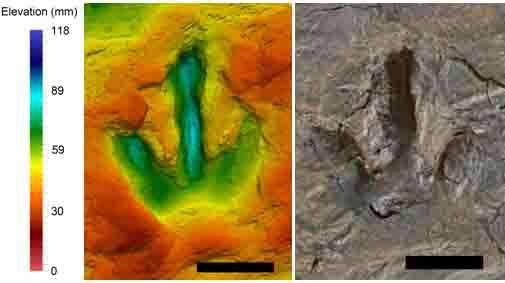
False Colour Image of One of the Smaller Theropod Dinosaur’s Footprints

The different colours signify different depths of the footprint.

The different colours signify different depths of the footprint.

Picture credit: Pernille Venø Troelsen

The picture above shows a false colour image of one of the smaller theropod dinosaur’s tracks.  The different colours illustrate the depth of various parts of the footprint.

Commenting on the study, a spokesperson from Everything Dinosaur stated:

“It is intriguing to think of these footprints representing an adult and juvenile dinosaur moving together, exploring the beach, perhaps looking out for any unfortunate animals that may have been stranded.  Or maybe moving along the open beach was easier than having to make progress through the surrounding woodland and scrub.”

The spokesperson added:

“Many large animals today, use beaches as natural highways, however, as far as we understand, it is not possible to state with any degree of certainty that these two separate tracks were made at the same time.  Given the parallel nature of the trackways and their relative sizes we can understand why the adult and juvenile dinosaur scenario has been inferred.”

Identifying the Species

As for the species of theropod, the lack of any body fossils found in association with the tracks prevents any identification being made.  In these cases, when an organism is known from just trace fossils, an ichnogenus is erected, that is, any animal known from just trace fossils such as burrows, coprolites or in this case footprints.

For models and replicas of Early Cretaceous dinosaurs and other prehistoric animals: Wild Safari Prehistoric World Models.

The tracks of the meat-eating dinosaurs have both been assigned to the ichnogenus Megalosauripus (Megalosauripus maximus).  However, whether these fossils were made by megalosaurid theropods remains open to debate, just like the dinosaur genus Megalosaurus, the ichnogenus Megalosauripus is a bit of a taxonomic waste basket when it comes to large, tridactyl theropod tracks found in Europe.

Everything Dinosaur acknowledges the help of the University of Southern Denmark in the compilation of this article.

11 08, 2015

Student Makes Exciting Marsupial Fossil Discovery

By |2023-04-03T15:59:22+01:00August 11th, 2015|Categories: Dinosaur and Prehistoric Animal News Stories, Main Page|0 Comments

Student and the Major Fossil Find in North Dakota

An intern with the North Dakota Geological Survey stumbled across a rare, fossil mammal jaw during a public fossil dig in south-western North Dakota last month.  The tiny fossil around two centimetres in length is a jawbone, complete with sixth teeth, it came from a Cretaceous marsupial mammal that scampered around along with the last of the dinosaurs.  The fossil has been identified as being from a Glasbius twitchelli, a mouse-sized marsupial that lived around sixty-five million years ago, it represents the most complete lower jawbone found for the species.

Glasbius twitchelli

Sean Ternes was helping to explain fossil hunting and preservation techniques as part of a public outreach event taking place in Slope County, near to the town of Marmarth.  He wandered away from the group and began to explore an area where some of the techniques discussed could be practiced.  He found the bones of a rabbit, looked down to explore them further and then he noticed a very different coloured bone about thirty centimetres away from the rabbit’s carcase.

An Incredibly Significant Discovery

Commenting on the discovery, Clint Boyd, a senior palaeontologist with the North Dakota Geological Survey team stated:

“This is an incredibly significant find!  This species has never been found in North Dakota before so this gives us new information when comparing faunas in neighbouring States.  Finding a complete mammal jaw from the Late Cretaceous is very rare, and the specimen Sean found may be the most complete lower jaw ever found for this species.”

Fossils of Glasbius twitchelli are known from Montana and Wyoming, but this is the first time a specimen has been discovered in North Dakota.

Hunting for Minerals Rather Than Fossils

For Sean, finding the fossil was a really exciting experience, but he does not see himself forging a career in palaeontology.  He has ambitions to work as a field prospector for minerals rather than fossils, however, he certainly has a keen eye.

Sean stated:

“When I found out that it was the first of its kind in North Dakota, it was pretty surreal.”

Looks like sharp-eyed Sean has got what it takes when it comes to field work.

For models and replicas of ancient, prehistoric creatures: Dinosaur and Prehistoric Animal Models.

10 08, 2015

Get Ready for School with Everything Dinosaur

By |2023-04-03T15:54:32+01:00August 10th, 2015|Categories: Educational Activities, Everything Dinosaur News and Updates, Everything Dinosaur Products, Main Page, Photos of Everything Dinosaur Products, Press Releases|0 Comments

Get Ready for School with Everything Dinosaur

A little under four weeks and then it will be the start of the new school year for much of the United Kingdom.  Summer holidays will be a thing of the past and school children will be preparing themselves for the rigours of the autumn term.  It does not seem that long ago since team members at Everything Dinosaur were safely and securely packing away all their fossils and other resources after completing their last teaching assignments of the summer term 2015.  Our dinosaur workshops and tactile sessions which involve the exploration of fossils are as popular as ever, but now we can look forward to the new school year.

Back to School

For mums and dads and other grown-ups looking to inspire and enthuse the next generation of scientists, look no further than Everything Dinosaur’s “Back to School Dinosaur Themed Range”.  We stock a huge range of prehistoric animal and dinosaur themed school kits, pens, pencils and stationery.  Whether it’s a dinosaur lunch box, dinosaur drinks bottle or dinosaur school bag Everything Dinosaur has it covered.

Back to School With Everything Dinosaur

Everything Dinosaur stocks an amazing range of dinosaur themed back to school items.

Everything Dinosaur stocks an amazing range of dinosaur themed back to school items.

Picture credit: Everything Dinosaur

See Everything Dinosaur’s back to school range by clicking on the image above.

Everything Dinosaur stocks a wide range of back to school items, all supported by our much admired customer service.  Send your budding young palaeontologists off to school with this brilliant range of dinosaur themed school stationery, lunch boxes, kit bags, pens, pencils and other dinosaur themed school items.  Take a dinosaur to school or out on your own prehistoric adventures with Everything Dinosaur’s inexpensive range of back to school supplies and back to school stationery.

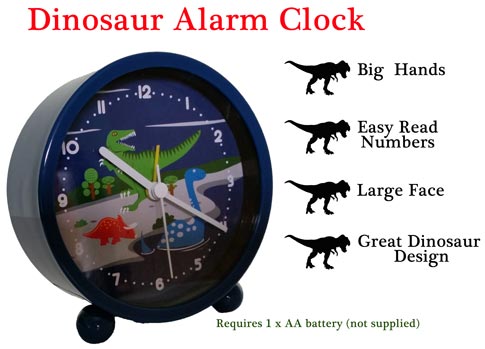
We even have a beautiful dinosaur alarm clock to help you get your little monsters up in the morning.

Dinosaur Themed Alarm Clock

Rise and shine with dinosaurs.

Rise and shine with dinosaurs.

Picture credit: Everything Dinosaur

The Everything Dinosaur Website

Buy dinosaur themed back to school items on-line. Everything Dinosaur stocks a very wide range of back to school items, which are ideal for primary school children.

To visit Everything Dinosaur’s award-winning website: Everything Dinosaur.

In the meantime, Everything Dinosaur team members are busy preparing a whole new set of dinosaur workshops and other school activities as our autumn term teaching schedule is being finalised.  Staff are already working on a number of new palaeontology themed teaching assignments, including creating suitable lesson plans for key stages one through to four.

To read an article about Key Stage 1 children developing writing skills: Writing Skills with Key Stage 1.

In the meantime, check out Everything Dinosaur’s comprehensive range of back to school items by clicking on the “Back 2 School” image above, or simply visit our website.

Back to School Merchandise from Everything Dinosaur: Back to School Dinosaur Themed Gifts.

9 08, 2015

Study of Teeth Hints at Late Cretaceous Theropod Diversity

By |2023-04-03T15:51:50+01:00August 9th, 2015|Categories: Dinosaur and Prehistoric Animal News Stories, Dinosaur Fans, Main Page|0 Comments

Theropod Diversity Study (Upper Cretaceous South Pyrenees Basin of Spain)

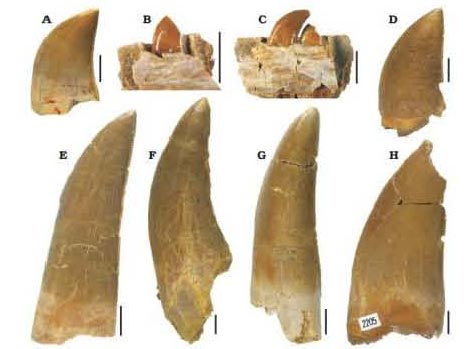
Large dinosaur bones might make the headlines and attract the most media attention, but an analysis of shed theropod teeth, some of them tiny, indicate that there were potentially many more different types of theropod dinosaur roaming around Spain in the Late Cretaceous.   Dinosaurs were able to replace teeth that they shed.

A meat-eating dinosaur for example, could lose hundreds of teeth over its lifetime and although no other part of it might be preserved as a fossil, these teeth could potentially provide an insight for palaeontologists as to the diversity of theropod dinosaurs in a given area.  That’s exactly what has happened as researchers from Spain and Canada have identified a further six non-avian dinosaurs in Upper Cretaceous strata from the South Pyrenees Basin (Spain).  Only two theropod dinosaurs had been known from this region prior to this new study.

Isolated Teeth Fossils Hint at Theropod Diversity on the Iberian Peninsula

scale bar = 5mm

scale bar = 5mm

Picture credit: Acta Palaeontologica Polonica

Theropod Teeth Hint at Diversity in Ecosystem

Publishing their work in the academic journal Acta Palaeontologica Polonica, the research team, which included lead author Angelica Torices, (University of Alberta) and famous Canadian palaeontologist Professor Phil Currie, have quadrupled the theropod dinosaur diversity in the areas studied.  At least one of the new types of theropod would have been “large”, although it is difficult to classify down to little more than taxonomic family level.

It has been speculated that the teeth indicating a large predator could represent either an abelisaurid like Tarascosaurus, (it has been proposed that the fragmentary fossil material assigned to this genus shows affinities to the Abelisauridae), known from Upper Cretaceous strata of France or a possible tyrannosaurid.

The Study Area

The area of study consists of eight localities from Treviño County, Huesca and Lerida, including the exceptional site of Laño, an abandoned sand quarry, strata of which represents Upper Cretaceous and Early Palaeogene deposits.  The study of 142 isolated teeth suggests that theropod numbers may have been underestimated elsewhere in the world.

Commenting on the research, Angelica Torices, (University of Alberta), explained:

“Studying these small parts helps us to reconstruct the ancient world where dinosaurs lived and to understand how their extinction happened.”

The post-doctoral fellow in biological sciences added:

“Teeth are especially important in the study of Upper Cretaceous creatures in Spain and the rest of Europe because we don’t have complete skeletons of theropods from that time in those locations.  We have to rely on these small elements to reconstruct the evolution of these dinosaurs, particularly the theropods.”

Reconstructing the Fauna

This study shows the value of isolated and fragmentary teeth fossils in helping to reconstruct the fauna in an ancient environment, when more other, more complete material, such as skeletal material is not present.

Locations of the Fossil Sites in the Study and Their Stratigraphical Sequence

The fossil study localities.

The fossil study localities.

Picture credit: Acta Palaeontologica Polonica

Theropod Teeth

A spokesperson from Everything Dinosaur commented:

“We have long suspected that the dinosaurs were more diverse than previously thought at the end of the Mesozoic.  However, the lack of fossilised bones that can provide an identification down to genus level has hampered scientists in the study of European dinosaurs.  It is this “under storey” of prehistoric life that can provide palaeontologists with a more complete understanding of the palaeofauna.  Tiny teeth can be just as important as the largest dinosaur bones.”

The research will have implications for the way in which the extinction of the dinosaurs at the end of the Cretaceous is viewed.  If this study is typical, then theropod diversity in the north of Spain does not experience a significant decline over the Campanian to Maastrichtian faunal stages.

Small Dinosaurs such as Dromaeosaurids were Present

A typical "raptor".

A typical “raptor”.

Picture credit: Everything Dinosaur

Lead author Angelica Torices stated:

“It completely changes the vision of the ecosystem.  We now understand that these dinosaurs disappeared very quickly in geological time, probably in a catastrophic event.  Climatic models show that we may reach Cretaceous temperatures within the next century, the only way we can study biodiversity under such conditions is through the fossil record.”

The study of 142 Late Cretaceous theropod teeth reveals that theropods were much more diverse in northern Spain towards the end of the “Age of Dinosaurs” than previously thought.

8 08, 2015

Alaska’s First Elasmosaur Described from Remarkable Fossils

By |2024-05-05T14:25:14+01:00August 8th, 2015|Categories: Dinosaur and Prehistoric Animal News Stories, Dinosaur Fans, Main Page|0 Comments

First Elasmosaur Specimen Found in Alaska

Alaska may be famous for many things, but in palaeontological circles it is the Dinosauria that usually grab the headlines when it comes to the largest and most sparsely populated U.S. State.  However, an expedition to the remote Talkeetna Mountains by scientists from the University of Alaska Museum of the North have discovered cervical vertebrae from a large plesiosaurid, an elasmosaur, the first marine reptile of this type to have been discovered in the most northerly part of the USA.

Life in Alaska some Seventy Million Years Ago

Elasmosaurs illustrated.

Elasmosaurs illustrated.

Picture credit: James Havens

Alaska’s First Elasmosaur

Elasmosaurus was one of the last and the largest of the long-necked plesiosaurids.  During the Late Cretaceous, North America was divided by a huge inland sea (the Western Interior Seaway), elasmosaur fossils have been found in a number of U.S. States as well as in Canada, this new discovery is significant as not only is it the first elasmosaur to be found in Alaska, it supports the theory that large marine reptiles lived at very high latitudes.

Although, Late Cretaceous Alaska was much milder than it is today, it would still have been cold with surface sea temperatures dropping to near freezing at times and for much of the year there would have been very little daylight.  This isolated fossil discovery provides evidence that large marine reptiles (the specimen is believed to exceed eight metres in length), did indeed live in the far north, and it tantalises palaeontologists who can speculate on whether this creature was a permanent resident or whether elasmosaurs were seasonal migrants.

An Extraordinary Long Neck

The most striking feature of the elasmosaurids were their extraordinarily long necks.  Approximately, fifty percent of the animal’s entire body length was made up of its neck.  These reptiles had over 70 cervical vertebrae, ten times the amount than in the neck of a human being (Homo sapiens).  Described back in 1868 from fossil remains found in Kansas, only one species is regarded as valid at the moment, E. platyurus.

The story of the first Alaskan elasmosaurid, began a few years ago.  Curvin Metzler a keen, amateur fossil collector who enjoyed hiking and exploring the slopes of the Talkeetna range found several fragments of fossil bone close to a steep hillside.  These were the first vertebrate fossils that he had found in the area and knowing that they could represent something important he contacted the Earth Sciences curator at the University of Alaska Museum of the North, Patrick Druckenmiller and persuaded him to visit the location.

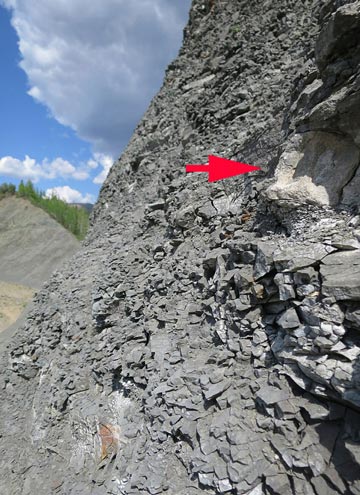
Patrick and a couple of colleagues duly visited in June and they were able to follow the bone erosion trail leading back to a section of strata in the hill where a good portion of the skeleton including some beautifully preserved, articulated cervical vertebrae lay exposed.

A Cervical Vertebrae (arrowed) Eroding out of the Surrounding Matrix

The red arrow points to a neck bone eroding out of the cliff.

The red arrow points to a neck bone eroding out of the cliff.

Picture credit: Patrick Druckenmiller/additional annotation by Everything Dinosaur

Exciting Discovery

Commenting on his discovery, Mr Metzler stated:

“I’m mostly interested in finding invertebrates, so when I saw the first vertebra I knew it was a bone from something. I didn’t want to disturb anything in the cliff so it was exciting to talk to Pat.  We are lucky to have someone in the State who works with fossils.”

Identifying the Last Resting Place of a Marine Reptile

Curvin Metzler (left), who discovered the Elasmosaur fossil and Patrick Druckenmiller examine the spot where bones were found sticking out of the cliff in the Talkeetna Mountains.

Curvin Metzler (left), who discovered the elasmosaur fossil and Patrick Druckenmiller examine the spot where bones were found sticking out of the cliff in the Talkeetna Mountains.

Picture credit: Patrick Druckenmiller

A New Species?

This could represent a new species, but it is too early to tell.  Although the team were able to collect a substantial portion of the exposed remains, there is probably more of the fossil specimen buried in the rock face, trouble is, there is more than ten metres of overburden on top and the fossil collecting season this far north is very short.

Undeterred Dr Druckenmiller explained:

“We got a good chunk of the animal but there is still more to excavate.” 

A field team will return to the site next summer to complete the extraction work.

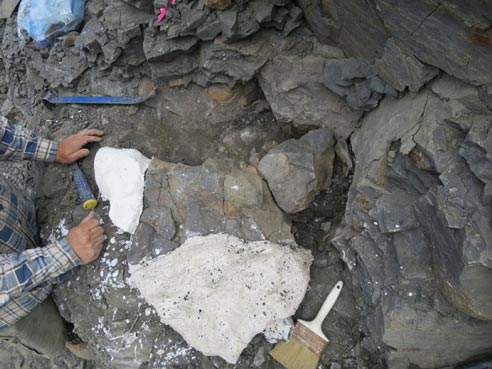
Preparing Elasmosaurid Vertebrae in the Field

Wrapping the articulated cervical vertebrae in burlap and plaster to protect the fossils dring removal.

Wrapping the articulated cervical vertebrae in burlap and plaster to protect the fossils during removal.

Picture credit: Patrick Druckenmiller

A spokesperson from Everything Dinosaur outlined the importance of this discovery, explaining that there were a number of Mesozoic aged formations in Alaska, many of which had yielded marine reptiles, but the rocks that had provided marine reptile fossils from this State were much older than the Talkeetna strata.

To read about the discovery of a Triassic marine reptile from Alaska: Thalattosaur discovered in Alaska at Low Tide.

A Geologically Younger Specimen

In the press release from the Museum, the strata is estimated to be around 70 million years of age (Maastrichtian faunal stage), whereas, most Elasmosaurus fossils from North America are associated with older Campanian faunal stage deposits.

A Model of an Elasmosaurus

Cretaceous Plesiosaur

Cretaceous plesiosaur – Elasmosaurus model.

Picture credit: Everything Dinosaur

Many models of Elasmosaurus depict this creature with a flexible, snake-like head.  This is inaccurate, Elasmosaurus had a very stiff neck, however, it still was a very effective hunter of fish.  The enormous neck enabled it to get up close to shoals before the bulk of the body came into view.  The sharp, interlocking teeth made an efficient fish grab.

Recently, Safari Ltd introduced an updated replica of Elasmosaurus, to view this model and others in the Safari Ltd range: Safari Ltd. Prehistoric Animal Models.

Go to Top