All about dinosaurs, fossils and prehistoric animals by Everything Dinosaur team members.

Articles, features and stories with an emphasis on geology.

5 08, 2007

The Everything Dinosaur Mystery Tour – Our visit to the Silurian

By |2023-02-14T13:16:33+00:00August 5th, 2007|Categories: Everything Dinosaur News and Updates, Geology, Main Page|0 Comments

Our Visit to the Silurian – Shropshire (UK)

So off we all went, with our knapsacks, dinosaur backpacks and geological tools back to the Silurian courtesy of some ancient sediments that are exposed in the English county of Shropshire.  This part of the Midlands is famous for its Silurian aged fossils and we found plenty.  Such a great day, out in the wonderful English countryside.  We saw less than a dozen people all day and everyone went home very happy.  We all had a wonderful time on the Everything Dinosaur fossil hunting trip.

Visit Everything Dinosaur’s award-winning website: Everything Dinosaur.

4 08, 2007

Roll up for the Mystery Tour – Time to visit the Silurian

By |2023-02-14T13:13:23+00:00August 4th, 2007|Categories: Everything Dinosaur News and Updates, Geology, Main Page|0 Comments

Everything Dinosaur – Fossil Hunting Trip

With the weather in the UK finally improving (it has been the wettest June and July on record), we have the opportunity to go on a field trip to Shropshire looking for invertebrate fossils.  Today we are going to Ludlow, a small, market town in Shropshire.  Not to sure how far it is from the office, but we have plenty of provisions to keep us going.

We have yet to decide which area we are going to prospect, but a study of our geological maps of the Midlands shows the area around Mortimer forest to be a likely place.  We will pack our hand lenses, light hammers (although we do not encourage hammering away at rock faces or bedrock) and our eye goggles.  The area has Silurian sediments laid down when this part of England was a warm, tropical sea.  The Silurian epoch dates from approximately 443 mya to 417mya.  We are hoping to find bivalves, brachiopods, corals and perhaps even if we are lucky we may find some partial trilobites or some evidence of trilobite moulds (like crabs trilobites shed their exoskeleton when they wanted to grow).

Mike has organised the picnic (so expect lots of sweets then)!  Sue has been given the task of remembering the camera so we can take some pics.

Wish us luck.

For models and replicas of iconic fossil animals: Everything Dinosaur Learning Section – Replicas of Fossil Animals.

13 06, 2007

Exciting Fossil Walks at Lyme Regis

By |2024-02-22T12:43:58+00:00June 13th, 2007|Categories: Dinosaur Fans, Geology, Main Page|0 Comments

Fossil Walks at Lyme Regis

Getting time off these days is a rare event but occasionally our occupation takes us to some pretty amazing places, take for example, our work with the Lyme Regis Development Trust and the annual fossil festival.  We are very fortunate to be able to travel down to Dorset at least once a year, on a bit of what you might say is a “bus man’s holiday”, but it is a nice break and usually the weather has been lovely.

Lyme Regis itself, is a beautiful, old English sea-side resort.  There has been some controversy recently with the coastal defence work that has been undertaken, but I think the new shingle beach and redeveloped cliff-top gardens have been created in keeping with the overall character of the town.  Lyme Regis is in West Dorset, it is on what is called the “Jurassic coast”, a UNESCO World Heritage site.  Quite rightly this part of the world has been granted World Heritage status as the unique stratigraphy of the area exposes a succession of rock formations that cover much of the Mesozoic (Age of Reptiles 248mya – 65 mya).  The rocks in and around Lyme Regis itself date from the Lower and Middle Jurassic periods, they are approximately 180 million years old.  These sediments are rich in marine fossils and the constant erosion exposes new material all the time.

It is a beautiful part of the world, thankfully not too over developed, the absence of rail links to London has helped protect this area but in the last few years we have noticed a lot more people have been purchasing second homes in this area so they can use Lyme as a bit of a weekend retreat.  Who can blame them, it is a lovely place to visit.

If you go beach-combing you are bound to pick up fossils, bullet shaped belemnites and pieces of ammonite are common.  If you are lucky you might spot the black concave discs that are Ichthyosaur vertebrae.  I would advise that it is best to go on a supervised fossil walk, the tides in the area can catch out unwary beach-combers and the adjacent cliffs are almost impossible to climb, if you are not careful you can become cut off by the tide.

Some of the best fossil ammonites can be found in large nodules, it is remarkable how many people I see bashing away at rocks in the hope of finding a fantastic specimen.  Often many of the day trippers are using the wrong tools, and even cracking open the wrong types of rock.  This can be a dangerous activity, splinters of rock can fly up and cut you, if you were unlucky to get hit in the eye it would be very painful and you could lose your sight (hence my trusty goggles that I wear).  We have made the mistake once or twice of walking across the beach in bare feet.  After all the excavation, the shoreline can resemble a quarry with sharp, shards of rock strewn all over the place, it can be a bit of a tricky exercise to pick our way through it all.

The best tools for fossil hunting are your own eyes.  If I am out with a group of friends I take them over to west of Lyme Regis to Chippel Bay or occasionally over to the other side of the bay on the Black Fen.  You don’t have to scurry around the base of the cliff to find fossils, I just get everybody to choose their own section of beach, preferably one with a couple of rock pools and a large rock which can act as a display table for them to put their finds on.  There is nothing more frustrating than building up a nice collection of ammonite parts preserved as pyrite (fools gold) only to forget where you put them.

If you are determined to go out on a fossil hunt try going on a supervised fossil walk with one of the local guides.  There are a number who offer guided walks, and as well as taking you to some of the best fossil finding areas, they can explain about the local geology and discuss your finds.  What is more, they will know the tide tables and ensure that you arrive back safely without having to get your feet wet.

One such local expert is Brandon Lennon.  He has been conducting guided fossil walks in the Lyme Regis area for many years.  He has found many interesting specimens and his enthusiasm and local knowledge can turn even the most sceptical into an ardent amateur palaeontologist, for an afternoon at least.
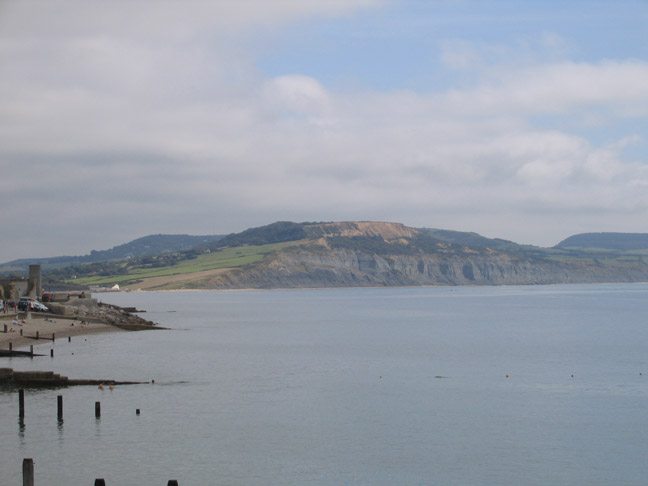
A fossil hunting we will go.

Picture credit: Everything Dinosaur.

The beautiful coast ready for fossil hunters on one of Brandon’s supervised guided fossil walks.

You can find out more at Brandon Lennon’s website:

www.lymeregisfossilwalks.com

Of course you can always cheat, and purchase a fossil from one of the many specialist shops in the area.  This area has become a haven for the amateur geologist/palaeontologist with lots and lots of fossil shops.  Many selling specimens from all over the world not just those found on the Jurassic coast.  You can get some fascinating and unusual items, they can be quite a conversation piece at a dinner party and could inspire old and young alike to take up fossil collecting as a hobby.

Brandon has his own fossil shop, it is well worth a visit:

www.lymeregisfossilsforsale.co.uk

4 06, 2007

Dinosaurs at Lymm (Cheshire) Looking for Lost Treasures

By |2024-02-08T08:44:47+00:00June 4th, 2007|Categories: Dinosaur Fans, Geology, Main Page|0 Comments

Dinosaurs at Lymm (Cheshire)

Yesterday on ITV1 there was a programme called “Lost Treasures”, I think this is a programme produced by Northwest regional television, the idea being to showcase some of the more unusual things found in the countryside.  Being based in the Granada region the programme focused on some of the mysterious objects and curiosities associated with villages in Cheshire.

I am not familiar with this TV programme, to be perfectly honest I don’t watch a lot of television, still it is nice to know when dinosaurs or prehistoric animals get a mention in the media.   The host, Mark Olly and his team visited Lymm, a small village near Warrington in Cheshire and reported on the fossil trackways of a prehistoric animal that had been unearthed in the area.  The outcrops of rock that can be seen in the Lymm area are red sandstone.  These were laid down mainly in the Permian period (Permian period from 290-248 million years ago), although some sediment may be more recent (Triassic).  During this time Cheshire (like much of Europe), was a vast sandy desert resembling the Sahara.

Dinosaurs at Lymm

An animal left a trackway in soft sandy sediment, much of Europe at the time was covered with a very salty sea (like the Dead sea), scientists have called this ancient waterway the Zechstein sea.  The sea levels fluctuated frequently and an animal walked along a shoreline and the footprints are fossilised showing remarkable preservation.  Unfortunately, the TV presenter stated that this fossil trackway was from an early dinosaur.  This is simply not true, yet another case of television presenters believing that all animals that create fossils must be dinosaurs.  Or is it more likely that if they talk about dinosaurs they are liable to keep the viewers interest?

An Ancient Trackway (Chirotherium Tracks)

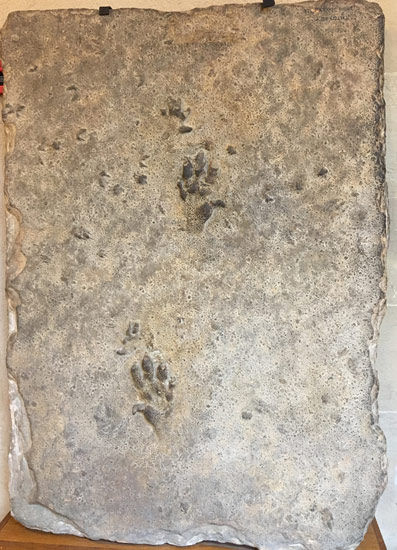
A Chirotheriuim trackway.

Chirotherium tracks on display at the Oxford University Museum of Natural History.

Picture credit: Everything Dinosaur

Chirotherium or Cheirotherium?

The fossil trackway shows a four-footed animal with hind feet bigger than the front feet.  The toes are clearly seen, in fact the prints so resembled an ape or human hand that the animal was named Cheirotherium (hand-beast).  It is also sometimes known as Chirotherium.  No fossils of this animal have ever been recovered but trackways of similar animals have been found in Germany and North America.

To see what the animal is supposed to have looked like search the Everything Dinosaur web log for images.

This animal was probably a diapsid (openings in the skull bones like dinosaurs) but an Archosaur (ruling reptiles), part of the group of reptiles from which dinosaurs are descended.  From the claw marks that can still be clearly seen on the footprints, this animals was probably a carnivore – one of the biggest around at the time.   It also possessed an upright stance unlike the sprawling stance of more primitive reptiles.

During the Triassic these types of archosaurs gradually became rarer as the dinosaurs began to establish themselves and out compete them.  It would certainly have been interesting to travel back in time to see what gave the dinosaurs an evolutionary edge over the other archosaurs as by the end of the Triassic all these animals had become extinct.

Scientists are still debating just how closely related animals like Cheirotherium were to the actual dinosaurs.  It did belong to the same group of reptiles – the archosaurs, but just how closely related it was to the ancestors of the dinosaurs is still hotly debated.  Indeed, with relatively few fossils being preserved from this period, the ancestry of the dinosaurs and their development is still unclear.

Unfortunately, there are no models of Cheirotherium available (none that we can find anyway).  Bullyland of Germany have specialised in producing models of European archosaurs from this period and have made a number of models, to view Everything Dinosaur’s range of dinosaur models and dinosaur toys for children, click the link below:

Dinosaur and prehistoric animal models available from Everything Dinosaur: Dinosaur and Prehistoric Animal Models.

Go to Top