All about dinosaurs, fossils and prehistoric animals by Everything Dinosaur team members.

Everything Dinosaur’s work with schools and other educational bodies. Articles, features and stories about dinosaurs and their role in education and educating young people.

9 02, 2021

Creating a New Stegosaurus Information Panel

By |2024-05-19T07:07:53+01:00February 9th, 2021|Categories: Dinosaur Fans, Educational Activities, Main Page, Photos of Everything Dinosaur Products, Teaching|0 Comments

Stegosaurus Information Panel

As part of our on-going work with an events management company Everything Dinosaur team members have been asked to prepare an information panel on Stegosaurus for an exhibition.  Despite being one of the most popular of all the dinosaurs and a “terrible lizard” that the public find very easy to recognise, this genus has proved to be problematical for palaeontologists and ever since the first Stegosaurus was scientifically described back in 1877 by the American palaeontologist Othniel Charles Marsh, the stegosaur family have gone through several revisions.

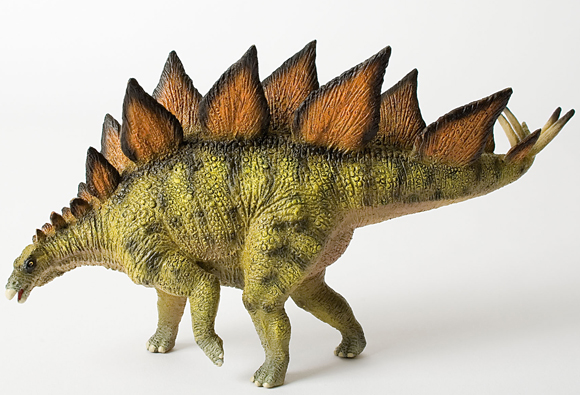
The Bullyland Stegosaurus Dinosaur Model – Stegosaurus is One of the Most Famous of All the Dinosaurs

Bullyland Stegosaurus dinosaur model.
The Bullyland Stegosaurus dinosaur model.  An iconic replica of a famous dinosaur that because of its plates and spiky tail is easy to identify for members of the public.  However, its taxonomic history has been far from straight forward.

The image (above) shows the superb Bullyland Stegosaurus dinosaur model.

To view the range of Bullyland prehistoric animal figures: Bullyland Prehistoric Animal Figures.

In surveys conducted by Everything Dinosaur, to determine favourite prehistoric animals, Stegosaurus has been placed as high as three, with only Tyrannosaurus rex and Triceratops beating it in terms of popularity.  Putting together a concise yet informative display panel for Stegosaurus represented quite a challenge.

The Stegosaurus Information Panel

Name: Stegosaurus

Means: Roof Lizard

Period: Late Jurassic, about 155-150 million years ago

Where have Stegosaurus Fossils been Found? Colorado, Utah and Wyoming in the USA and Portugal (Europe)

Stegosaurus was a slow-moving herbivorous quadruped and is perhaps one of the easiest dinosaurs to recognise thanks to its plates and tail spikes.  However, ever since the first fossils of this iconic dinosaur were found in 1877 Stegosaurus has caused much controversy.  For example, the famous American palaeontologist Othniel Charles Marsh, the first scientist to describe Stegosaurus, thought that the plates resembled the large flat bones that formed the shells of some types of prehistoric sea turtle.

Marsh suggested that Stegosaurus was an aquatic animal.  It was not until 1891, after the discovery of several more specimens that the first skeletal reconstruction of Stegosaurus was completed.  The hind limbs are much longer than the front limbs and it has been suggested that Stegosaurus could have reared up so it could feed on the branches of trees.

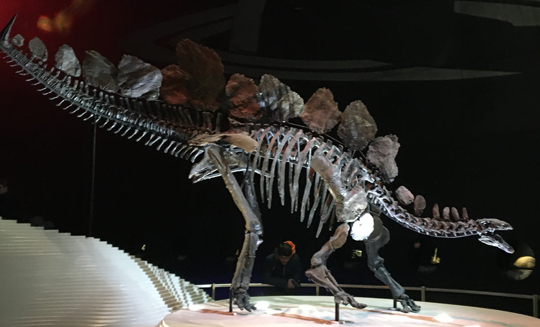
“Sophie” the Stegosaurus a Star Attraction at the London Natural History Museum

Sophie the Stegosaurus at the London Natural History Museum
Sophie the Stegosaurus (S. stenops), a star exhibit at the London Natural History Museum.  The most complete Stegosaurus specimen known to science.  Picture credit: Everything Dinosaur.

Picture credit: Everything Dinosaur

Bony Plate

Scientists are still debating what the bony plates were used for and how exactly they were arranged along the back.  The plates are not attached to the spine but held in place with cartilage, tendons and muscles.  It is thought that the plates were arranged in two alternating rows running down the back with the largest plates (up to 1 metre high), located over the hips.  In this position the plates would have provided very little protection, it seems more likely that they played a role in species recognition or display behaviour.  The bony plates may also have helped maintain body temperature by acting as heat regulators.

The largest species measured around 9 metres in length and weighed more than 3 tonnes.  Stegosaurus also had two pairs of spikes on the end of its tail. These were probably defensive weapons.

To read an article about the research into the most complete Stegosaurus (S. stenops) specimen known to science: “Sophie” the Stegosaurus at 1.6 tonnes.

Visit the award-winning and user-friendly Everything Dinosaur website: Everything Dinosaur.
6 02, 2021

Preparing a Pteranodon Information Panel

By |2023-08-15T05:37:29+01:00February 6th, 2021|Categories: Dinosaur Fans, Educational Activities, Everything Dinosaur News and Updates, Main Page, Teaching|0 Comments

Preparing a Pteranodon Information Panel

As part of their on-going work with an events management company, Everything Dinosaur team members have been asked to prepare an information panel on the famous pterosaur genus Pteranodon.  The information provided will be used for a display board that accompanies a life-size Pteranodon longiceps exhibit.  The Pteranodon panel is one of a series of display boards being created by Everything Dinosaur, all the other boards that staff members have been asked to create relate to dinosaurs.

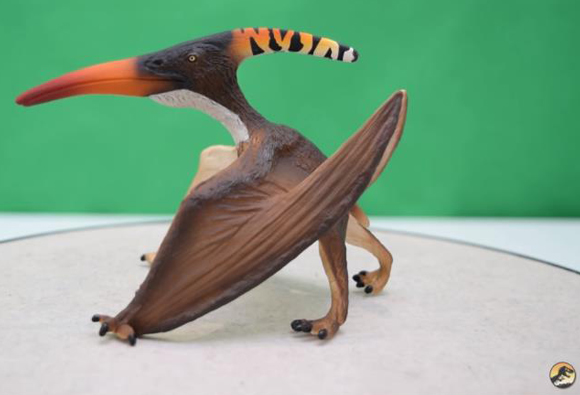
A Model of the Pterosaur Pteranodon longiceps

JurassicCollectables reviews the Wild Safari Prehistoric World Pteranodon figure.

Perhaps the most famous flying reptile of all!  A model of the flying reptile known as Pteranodon (P. longiceps).  Everything Dinosaur team members have been asked to create an information board to accompany a life-size museum display of this Late Cretaceous pterosaur.

Picture credit: JurassicCollectables

The image (above) shows a Pteranodon figure from the Wild Safari Prehistoric World model range.

To view this range: Wild Safari Prehistoric World Figures and Models.

The Pteranodon Information Panel

Pteranodon might be one of the best-known and extensively studied of all the Pterosauria.  Around 1,200 fossil specimens are known, ironically most are fragmentary and squashed as flat as a pancake.

Name: Pteranodon (Pteranodon longiceps).

Means: Winged and Toothless.

Period: Late Cretaceous, 85 Million Years Ago (approximately).

Where are the majority of Pteranodon Fossils Found?  They are found in Kansas, South Dakota and Wyoming (USA).

Pteranodon is a pterosaur, a type of extinct flying reptile and not a dinosaur!  Pterosaurs were a very unusual group of reptiles that lived alongside the dinosaurs.  They were the earliest back-boned animals to evolve powered flight and take to the sky.  There are many species known (more than 120).  The smallest had a wingspan of around 25 centimetres, whereas the largest had a wingspan of about 10 – 11 metres!

They became extinct at the end of the Cretaceous, around 66 million years ago.  Pteranodon is perhaps the most famous pterosaur; the largest specimens suggest a wingspan of around 7 metres.  Over a thousand specimens, from almost complete skeletons to fragmentary bones, have been found.  Pteranodon fossils are associated with strata laid down in marine environments and it is thought that these flying reptiles fed on small fish.

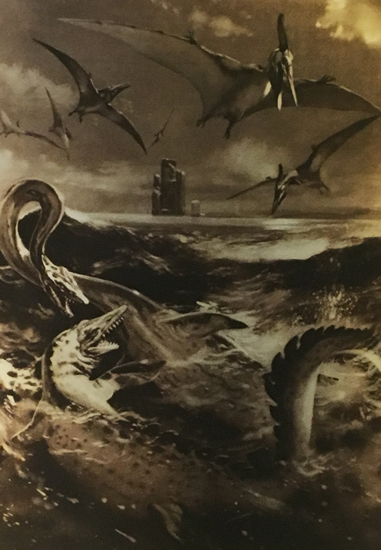
Many Prehistoric Scenes Feature the Iconic Pterosaur Pteranodon

The Western Interior Seaway (Late Cretaceous)

Dramatic scene from the Western Interior Seaway painted by Burian.  Pteranodon fossils are associated with marine deposits and this explains why they are featured in prehistoric seascapes, especially those depicting the Pierre Seaway and the Western Interior Seaway.

Picture credit: Zdeněk Burian

Visit the award-winning Everything Dinosaur website: Everything Dinosaur.
4 02, 2021

Preparing Information Panels for a Dinosaur Exhibition

By |2024-05-18T21:59:05+01:00February 4th, 2021|Categories: Dinosaur Fans, Educational Activities, Main Page, Photos/Pictures of Fossils, Teaching|0 Comments

Preparing Information Panels for a Dinosaur Exhibition

Everything Dinosaur team members have been asked by an events company to check some information panels about dinosaurs in preparation for a series of outdoor exhibitions planned for the UK in the summer of 2021.  Events companies are making plans to commence exhibitions and other public activities as the lockdown restrictions are likely to come to an end later on this year (hopefully).

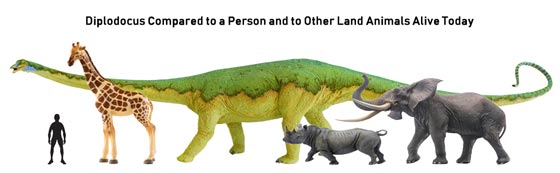
One of the dinosaurs featured is Diplodocus.  Everything Dinosaur team members have been busy checking and amending where necessary the information panel that will accompany an exhibit featuring this famous sauropod.  It is ironic that this is one of the first dinosaurs that we work on as we look forward to the end of lockdown.  Back in March 2020 staff were working with the Natural History Museum’s “Dippy” the Diplodocus touring exhibit, but the start of the first lockdown in the third week of that March led to all our outreach work being suspended.

A Size Comparison!  Diplodocus Compared to some Animals Alive Today

How big was Diplodocus?

Diplodocus compared to animals alive today.  This super-sized sauropod will be part of a set of prehistoric animals to be used by an exhibitions company.  Picture credit: Everything Dinosaur.

Picture credit: Everything Dinosaur

For dinosaur models and prehistoric animal figures: Prehistoric Animal Figures and Dinosaur Models.

The Information Panel

Name: Diplodocus
Means: Double Beam
Period: Late Jurassic, 154-150 Million Years Ago
Where have fossils been found: Colorado, Montana, Utah and Wyoming (USA)

Diplodocus is one of the longest dinosaurs to have ever lived.  It is also one of the best-known sauropods, as several skeletons have been discovered!  It is, at present, the longest dinosaur known from a practically complete skeleton.  Some dinosaurs were certainly larger, but they are known from less complete skeletons.  The largest specimen known is estimated to have been around 26 metres in length, about as long as three double decker buses and around 5 metres tall, from the toe to the hip.  Diplodocus weighed around approximately 10 to 15 tonnes!

The very first Diplodocus bones were discovered in a quarry in Colorado, USA, in 1877.  Diplodocus was herbivorous and possessed forward-pointing, long, peg-like teeth that were positioned at the front of its mouth; they were perfect branch-strippers.  Scientists believe that Diplodocus fed by closing its mouth around plant stems and stripping the leaves by pulling back its head – like a rake.

As our team members pointed out to the events company children are so well-informed and knowledgeable about dinosaurs, that whatever gets put on the information panel is likely to be challenged by them.  However, the panels we have helped to create we help to inform and to educate.

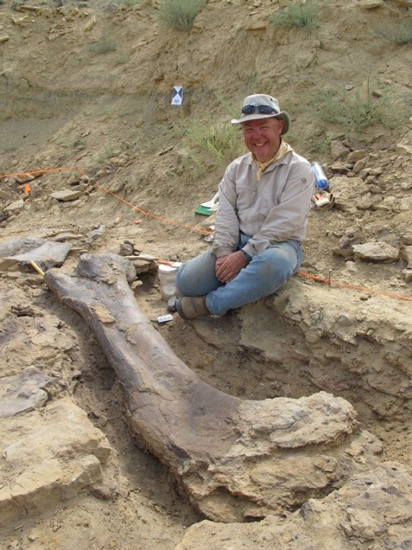
A Very Impressive Sauropod Femur (Diplodocid)

Professor Phil Manning and the diplodocid femur.

Professor Phil Manning (The University of Manchester) poses next to a diplodocid femur.  Huge sauropod fossils are still being found in the same area of the United States where the first Diplodocus fossils were discovered.

Picture credit: The University of Manchester

Visit the award-winning Everything Dinosaur website: Dinosaur Models and Toys.

2 02, 2021

A Unique Triceratops Drawing

By |2024-05-18T21:48:05+01:00February 2nd, 2021|Categories: Dinosaur and Prehistoric Animal Drawings, Educational Activities, Main Page|0 Comments

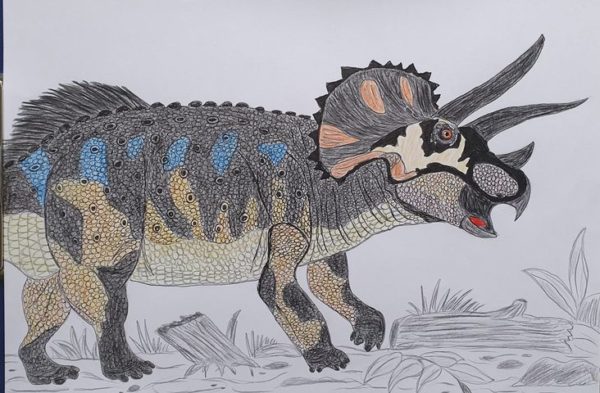
Triceratops Drawing

Our thanks to the talented artist Caldey who sent to Everything Dinosaur a drawing of one of her favourite Cretaceous dinosaurs – Triceratops (T. horridus).  We think that Caldey was inspired by the Beasts of the Mesozoic Triceratops (sub-adult) articulated model that was recently introduced.  Our thanks to Caldey for sending in her Triceratops illustration.

A Drawing of the Late Cretaceous Horned Dinosaur Triceratops (Illustration by Caldey)

An illustration of Triceratops produced by Caldey.

The beautiful Triceratops illustration produced by young artist Caldey.

Picture credit: Caldey

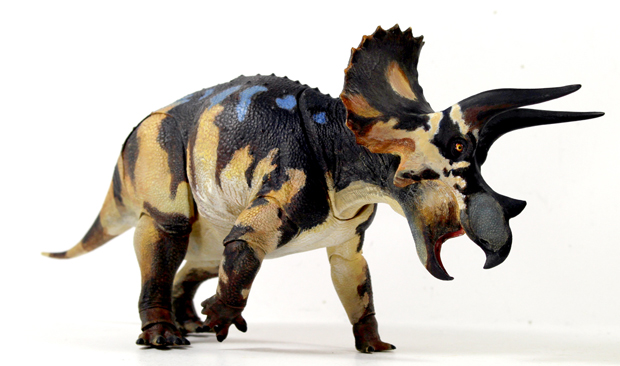
For comparison, here is a picture of the Beasts of the Mesozoic Triceratops figure that we think helped to inspire young Caldey.

The Beasts of the Mesozoic Triceratops horridus Articulated Dinosaur Model (Sub-adult Version)

 Beasts of the Mesozoic sub-adult Triceratops articulated model.

The Beasts of the Mesozoic sub-adult Triceratops articulated model.  Team members at Everything Dinosaur think that this model was the inspiration behind Caldey’s Triceratops drawing.

A spokesperson from Everything Dinosaur commented:

“Our thanks to Caldey for sending into us a beautiful drawing of a Triceratops.  We receive lots of illustrations and we enjoy looking at them all.  With so many amazing prehistoric animal figures and replicas around these days young artists can use these figures to help inspire their own creative efforts.”

The Beasts of the Mesozoic Triceratops (T. horridus) figure that inspired this young artist is just one of nine articulated ceratopsian figures currently in this range.  There will be more horned dinosaur models introduced in the near future (2021).  The Beasts of the Mesozoic Triceratops figure has already received several five-star customer reviews.

To purchase the Triceratops model, you can find it on this part of the Everything Dinosaur website: Beasts of the Mesozoic Models and Replicas.

18 12, 2020

Unique Interactive “I-Book” Provides Readers with Unprecedented Access to Archaeological Sites

By |2024-02-29T07:44:42+00:00December 18th, 2020|Categories: Book Reviews, Educational Activities, Main Page, Photos, Teaching|0 Comments

Interactive “I-Book” Provides Readers with Unprecedented Access to Archaeological Sites

An interactive ‘”I-Book” which allows users to virtually walk around otherwise inaccessible historical sites has been shortlisted as a finalist in a major award.  Entitled “The Shetland in the Iron Age”, this  Interactive “I-Book” gives anyone a VIP pass to three distant archaeological sites and has been highly commended in an industry awards ceremony.

Interactive “I-Book”

The concept of providing virtual access to sites of great historical significance was developed by Archaeological and Forensic Sciences PhD student Li Sou from the University of Bradford.  The “I-Book” offers a no-holds barred tour of three “broch”, Iron Age drystone hollow-walled structures found in the Shetland Islands, Scotland.  The technology is so simple to use, that anyone aged nine or over can use the “I-Book” and visit relatively remote and inaccessible sites.

University of Bradford Student Li Sou Demonstrates the “I-Book”

Archaeological and Forensic Sciences PhD student Li Sou from the University of Bradford.
Archaeological and Forensic Sciences PhD student Li Sou from the University of Bradford demonstrates the new “I-Book”.

Picture credit: University of Bradford

The “I-Book” provides 360° virtual maps of the interiors that users can explore.  Virtual visitors can wander around their inner workings, exploring different buildings, accessing staircases and corridors, as though they were there in the Shetlands themselves.

Providing Lots of Associated Information and Data

The cleverly designed “I-Book” includes clickable information hotspots that link to a wealth of associated data, including historic photographs and videos from experts in the field.  The concept was shortlisted in the Association for Learning Technologists Awards and the “I-Book” was highly commended.  The judges describing it as an “incredibly varied, engaging and accessible digital educational resource.”

Historic Environment Scotland have been developing this technology for use at other historic properties in their care and these will launch in 2021, both on site and freely downloadable online.

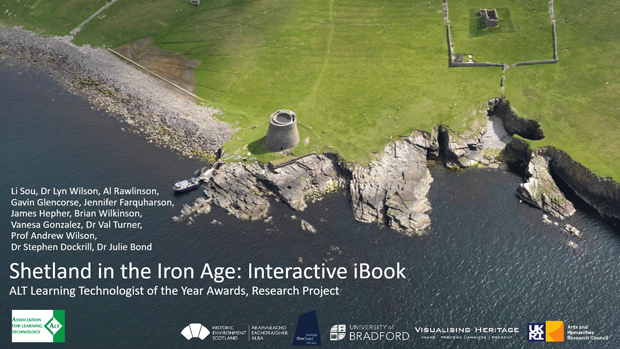
An Overhead Photograph of a Broch

An overhead photograph of a broch on the Isle of Shetland.
An aerial shot of a broch.

Picture credit: University of Bradford

The judging panel stated that the project:

“Has excelled in developing a range of versatile digital assets to aid in learning about complicated archaeological and academic themes.”

Commenting after the prestigious award ceremony, student Li Sou exclaimed:

“This is the culmination of a six-month project and brochs are complicated archaeological sites to understand and are not physically accessible to everyone.  The I-Book format is not very well known in the heritage sector, so the project was an excellent opportunity to design a resource that gives readers a chance to explore the sites as if they were there in real life, with integrated accessibility features to make them accessible to all.”

A Useful Resource in the Midst of a Global Pandemic

The use of technology such as this has significant implications for the support of archaeology and general education in the midst of a global pandemic.  The emergence and spread of COVID-19 has curtailed travel and restricted the opening times for heritage monuments.  “I-Books” such as this permit sites that might be closed to the public and otherwise difficult to reach due to the need to restrict travel or to self-isolate, to still be accessible to students, archaeologists and the general public.

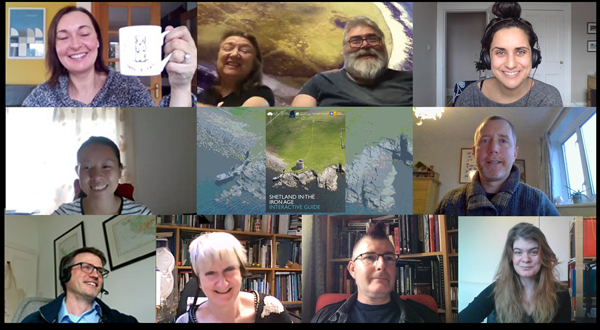
“I-Book” Development Team Photo (in an Age of Social Distancing)

Team photo of all those involved in the project
Team photo of all those involved in the “I-Book” project.

Picture dredit: University of Bradford

The interactive “I-Book”  entitled “The Shetland in the Iron Age” was developed in collaboration with the Shetland Amenity Trust with a working group from Historic Environment Scotland, along with the co-operation and assistance of the Visualising Heritage group within the School of Archaeological and Forensic Sciences, University of Bradford.

Implicatioms for Palaeontology Departments

A spokesperson from Everything Dinosaur commented that this type of technology has applications within the Earth sciences.  For example, interactive “I-Books” could be provided to help students and researchers virtually visit remote dig sites and fossil quarries.  It could also be used in other research areas such as allowing observations of fossil collections and other material that would otherwise be very difficult to access.

Everything Dinosaur acknowledges the assistance of a media release from the University of Bradford in the compilation of this article.

Visit the Everything Dinosaur website: Everything Dinosaur.
10 11, 2020

Win with Everything Dinosaur in a Free to Enter Competition

By |2024-03-19T12:53:52+00:00November 10th, 2020|Categories: Adobe CS5, Book Reviews, Dinosaur Fans, Educational Activities, Everything Dinosaur News and Updates, Main Page, Press Releases|0 Comments

Competition Time at Everything Dinosaur

Everything Dinosaur has another super, prehistoric animal themed giveaway.  We have a copy of the brand new book by the talented palaeontologist Dr Dean Lomax entitled “Prehistoric Pets” and we are giving you the chance to win it.

A Fabulous Book Competition

Please note this competition is now closed.

Win a Copy of “Prehistoric Pets” with Everything Dinosaur

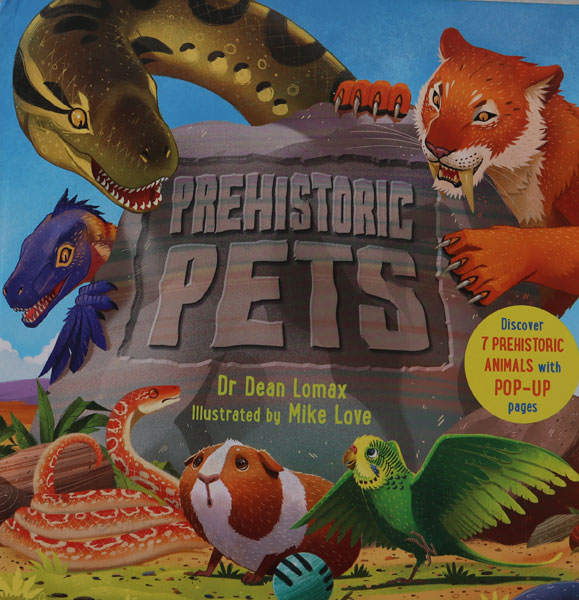
The front cover of "Prehistoric Pets".
This colourful and well-written book takes the reader on a journey back in time, linking common household pets today with their prehistoric ancestors.  You can win a copy of this super book that looks at seven common pets and using fossil clues reveals their prehistoric ancestry.

Picture credit: Templar Books/Everything Dinosaur

“Prehistoric Pets”

The internationally recognised, award-winning palaeontologist Dean Lomax takes a close look at some of our nation’s favourite animals and traces their ancestry back through deep time to explain their origins.  Crammed full of fun facts, this is an excellent book for the younger readers, it is beautifully illustrated and it has pop-ups too!

Visit the website of Dr Dean Lomax: Dr Dean Lomax – British Palaeontologist.

“Prehistoric Pets” is an ideal Christmas gift and best of all you can win a copy courtesy of Everything Dinosaur!

Win a Copy of “Prehistoric Pets” in our Competition

All you have to do is “Like” Everything Dinosaur’s FACEBOOK page, then comment on our dinosaur book competition post suggesting a name for the superb Sabre-tooth cat that features on the front cover.  The Sabre-tooth is illustrated by Mike Love but he/she needs a name!

Don’t Forget to Suggest a Name and to “Like” our Facebook Page

Like Everything Dinosaur on /Facebook
Like our Page (please).

Find Everything Dinosaur’s Facebook page here: Everything Dinosaur on Facebook.

We will draw our lucky winner at random and the “Prehistoric Pets” competition closes at midnight (GMT) on Tuesday 24th November.  Good luck!

To view Everything Dinosaur’s range of superb prehistoric animal and dinosaur themed gifts visit: Everything Dinosaur.

Win a Copy of “Prehistoric Pets” in our Free to Enter Prize Draw Competition

Win a copy of "Prehistoric Pets"!
Win a copy of the fabulous “Prehistoric Pets” book in our free to enter competition.  Just leave a suggested name for the Sabre-tooth cat featured on the front cover in our comments section on this post or on our Facebook page to enter. Picture credit: Everything Dinosaur.

Picture credit: Everything Dinosaur

You can always leave a comment on this blog post and we will enter you into our free prize draw.

Please note this competition is now closed.

Terms and Conditions of the Name the Sabre-tooth “Prehistoric Pets” Competition

Automated entries are not permitted and will be excluded from the draw.

Only one entry per person.

The prize is non-transferable and no cash alternative will be offered.

The Everything Dinosaur name the Sabre-tooth cat competition runs until midnight Tuesday  24th November 2020.

Winner will be notified by private message on Facebook.

Prize includes postage and packing.

For full terms and conditions contact: Contact Everything Dinosaur.

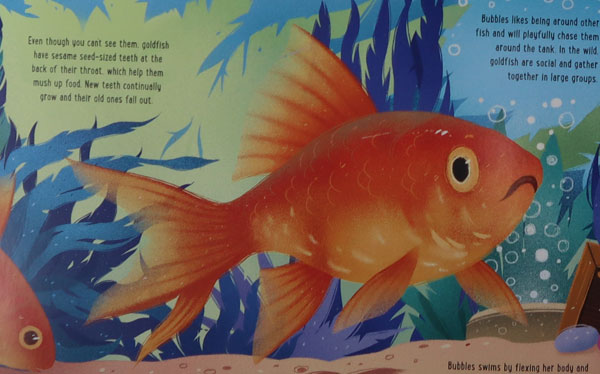
“Prehistoric Pets” Dives into the Evolution of the Goldfish

A goldfish from the book "Prehistoric Pets".
Did you know that goldfish are social creatures and the evolutionary history of fish dates back more than 500 million years?

Picture credit: Templar Books/Everything Dinosaur

To read Everything Dinosaur’s review of “Prehistoric Pets”: Everything Dinosaur Reviews “Prehistoric Pets” by Dr Dean Lomax (illustrated by Mike Love).

Please note this competition is now closed.

4 10, 2020

Predatory Tactics of Prehistoric Felids

By |2024-03-17T06:19:23+00:00October 4th, 2020|Categories: Dinosaur and Prehistoric Animal News Stories, Dinosaur Fans, Educational Activities, Everything Dinosaur News and Updates, Everything Dinosaur Products, Main Page, Photos of Everything Dinosaur Products, Press Releases|0 Comments

Predatory Tactics of Prehistoric Felids

In the summer, Everything Dinosaur was contacted by Kate from Nottingham University who was conducting research into the predatory habits of extinct felids.  Our team members are contacted quite frequently by academics, museum staff and students requesting our advice and guidance.  Kate wanted to know whether there were any replicas available that could represent Pseudaelurus, a genus of prehistoric cat that was both geographically and temporally widely distributed.  In addition, our advice was sought over finding suitable models of Smilodon species, specifically S. fatalis, S. gracilis and S. populator.

Models of Prehistoric Felids

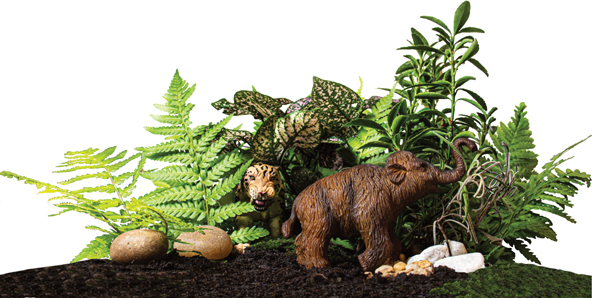
Smilodon Ambush – Creeping Up on a Young Mammoth

Smilodon ambushes a Woolly Mammoth calf.
Everything Dinosaur was asked about potential predator/prey interactions with specific reference to Smilodon.  A beautifully composed diorama depicting a hunting strategy of the sabre-toothed cat Smilodon.

Picture credit: Kate/Nottingham University

Everything Dinosaur has been involved in a number of prehistoric mammal themed projects recently.  Many museums around the world may have been closed due to the current pandemic but this has permitted exhibition organisers and curators the opportunity to review and revamp some of their public displays.  For example, Everything Dinosaur was asked to supply replicas of several prehistoric elephants including Deinotherium and Palaeoloxodon antiquus (Straight-tusked elephant), to a German natural history museum as part of a display featuring the teeth of extinct members of the Proboscidae.

Our work is certainly diverse, no two days are the same.

Identifying Prehistoric Animal Models

Having worked with several academics previously on enigmatic sabre-toothed predators, including gorgonopsids, we were able to advise Kate on which prehistoric animal models could be used to differentiate between the various species and sub-species of Smilodon.

As part of her project work, Kate created some beautiful dioramas using these figures in a bid to replicate hunting behaviours.

For models and replicas of prehistoric felids and other extinct animals: Prehistoric Animal Models and Figures.

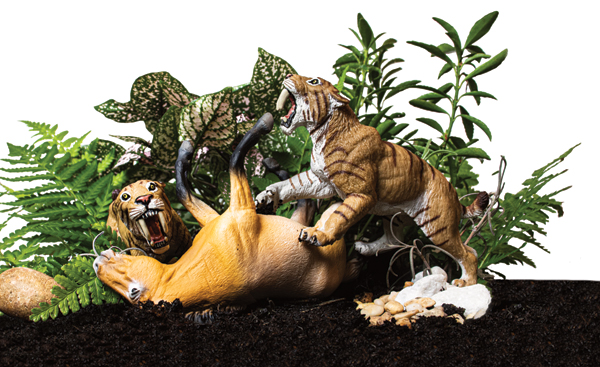
A Pair of Smilodon Tackle a Prehistoric Horse

A Smilodon diorama.
Smilodon hunting.  As apex predators these powerful animals would have preyed on a variety of animals including prehistoric horses, if they could get close enough to ambush them.

Picture credit: Kate Nottingham University

Commenting upon the assistance received from Everything Dinosaur, Kate stated:

“Thank you for your help and advice with the Smilodon models and prey species.  I had a lot of fun using them in my final project.”

A spokesperson from Everything Dinosaur commented:

“We get asked to work on all kinds of prehistoric animal related activities supplying models and figures to museums and other educational bodies all over the world.  The replicas that we supply have proved extremely useful in helping to visualise ancient, prehistoric landscapes and to inform and educate visitors.”

The Everything Dinosaur website: Everything Dinosaur.
27 09, 2020

Monsters of the Deep: Science Fact and Fiction

By |2024-03-16T06:40:45+00:00September 27th, 2020|Categories: Animal News Stories, Educational Activities, Main Page, Photos, Press Releases, Teaching|0 Comments

Monsters of the Deep: Science Fact and Fiction at the National Maritime Museum Cornwall (July to 3rd January 2022)

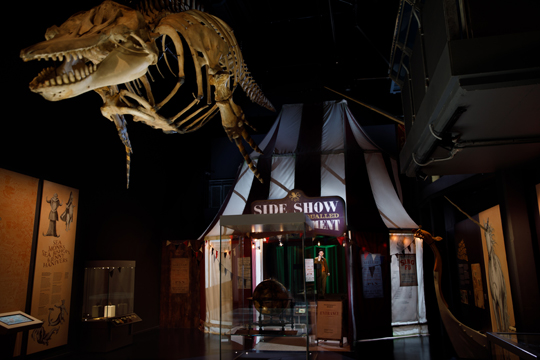
We might be living in a world of track and trace, where everywhere we go and who we meet can be uploaded into a gargantuan database, but there is a part of our planet that remains relatively unknown even in today’s digitally dominated environment.  The deep, dark depths of our oceans harbour some of the most bizarre and amazing creatures to have ever evolved and a recently re-opened exhibition at the National Maritime Museum (Falmouth, Cornwall), permits visitors to meet up with some of nature’s most curious creatures as well as plunging into the depths of our own imagination to explore legendary sea monsters – all without getting our feet wet.

Monsters of the Deep: Science Fact and Fiction

Monsters of the Deep exhibition.
Monsters of the Deep: Science Fact and Fiction at the National Maritime Museum (Cornwall).  Take the plunge!  Encounter myths, legends and real sea monsters. 

Picture credit: Courtesy of the National Maritime Museum Cornwall 

Monsters of the Deep Real and Imagined

Running until January 2022, this carefully crafted exhibition takes visitors on a voyage of discovery from Medieval folklore through cryptozoology and the modern-day monster hunters employing the very latest maritime technology used to explore those parts of planet Earth furthest from our sun.

A Collection of Ocean-dwelling Curiosities

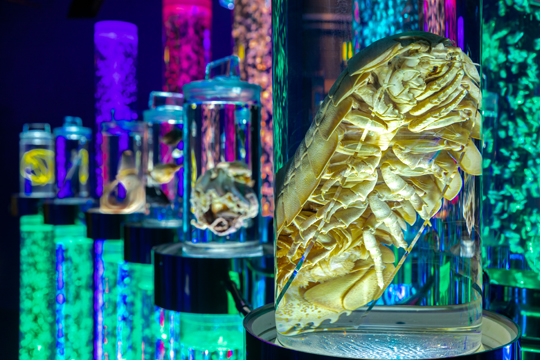
Giant Isopods on display.
Curious crustaceans such as giant isopods with their huge compound eyes stare back at you.  The exhibition permits visitors to closely examine some of the most amazing ocean-dwelling creatures known to science.

Picture credit: Courtesy of the National Maritime Museum Cornwall 

A Collaboration Between Leading Institutions

World class scientific collections from such august bodies as the British Museum, the National Oceanography Centre, the Science Museum, Royal Museums Greenwich and Cambridge University Library have been plundered by modern day buccaneers on a mission to inform, educate and entertain.  Rarely seen specimens, artwork and artefacts all housed under one roof including a large scale reproduction of the Carta Marina, the world’s most famous medieval map of the sea, complete with fanciful monsters and mermaids.

The exhibition highlights the myths associated with early exploration and showcases exquisite illustrations of sea monsters including the strange “mirror creatures”, denizens of the deep that haunted the nightmares of many a seafarer in the age of sail.

In the meantime, visit the Everything Dinosaur website: Everything Dinosaur.
Early Explorers Brought Home Tales of Encounters with Fantastic Sea Creatures

Explorers and sea monsters.
Early explorers brought back fanciful tales of sea serpents, mermaids and monsters.

Picture credit: Courtesy of the National Maritime Museum Cornwall

As Real as Elephants and Giraffes

Prior to the Age of Enlightenment which hastened a revolution in scientific thinking in the 17th century, little was known about the exotic fauna that inhabited our world.  On display at this exhibition is the Hortus sanitatis, the first ever natural history encyclopaedia.  Originally printed in 1491, the year before Christopher Columbus set out on his voyage that led to the discovery of the New World, it represents a significant landmark in our attempts to document and understand the natural world with unicorns and mermaids considered just as real as elephants and giraffes.

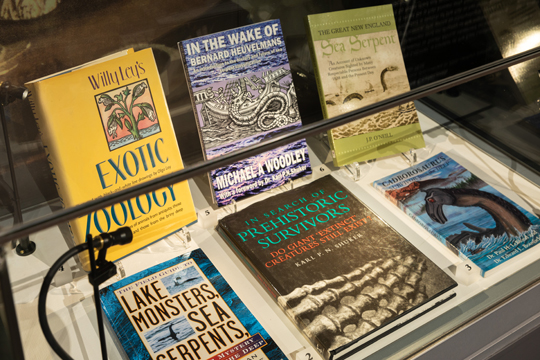
A Collection of Books on Cryptozoology on Display

Books about Sea Monsters on Display
A large number of books documenting our fascination with monsters of the deep are on display.

Picture credit: Courtesy of the National Maritime Museum Cornwall

Guest Curators and Leading Specialists

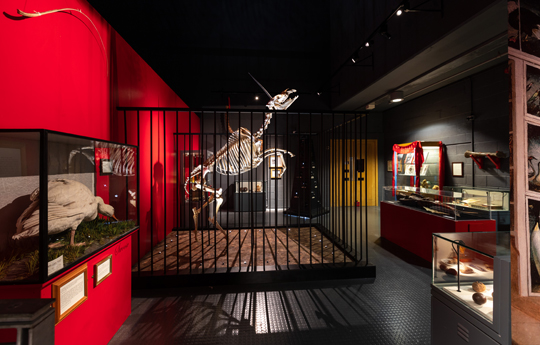
Monsters of the Deep: Science Fact and Fiction has been developed in co-operation with leading specialists and guest curators, including Viktor Wynd, the custodian of the “UnNatural History Museum”, bringing together a collection of curiosities including a mummified feegee mermaid and a skeleton of a unicorn!  This section of the exhibition is dedicated to exploring ideas about what is real and what can be falsified or faked.

A Rearing “Unicorn” on Display at the National Maritime Museum

A rearing unicorn skeleton.
An exhibit from the “UnNatural History Museum” – a rearing unicorn skeleton.

Picture credit: Courtesy of the National Maritime Museum Cornwall 

As well as exploring the theme of sea monsters in popular culture, the exhibition provides an insight into some of the very latest cutting-edge technical developments that have allowed marine biologists rare glimpses of the natural wonders that still exist in the largely unexplored regions of our planet such as the vast abyssal plain.

Combining Myth and Fantasy with Scientific Endeavour and Research

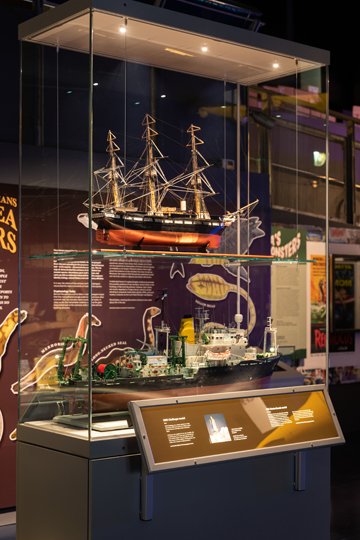
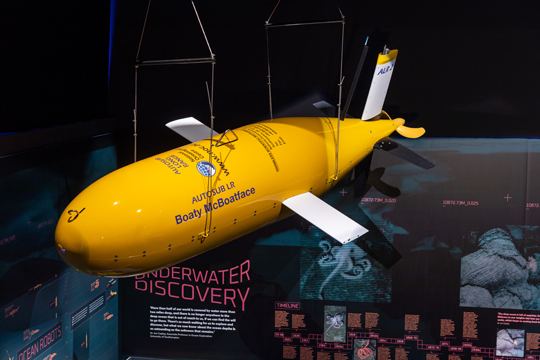
Meet Boaty McBoatface.
The exhibition highlights state-of-the-art technology such as the latest mini submersibles that are transforming our understanding of the world’s oceans.

Picture credit: Courtesy of the National Maritime Museum Cornwall 

To ensure the safety and wellbeing of all visitors and staff, the Museum has implemented a number of new health and safety measures, in line with the latest government advice including timed arrival slots, social distancing measures and on-line only booking.

As half-term approaches, escape your bubble and take the plunge!  Immerse yourself in a world of folklore, fun, facts and fantasy.

Monsters of the Deep: Science Fact and Fiction at the National Maritime Museum Cornwall (July to 3rd January 2022).  For further details: The National Maritime Museum.

9 09, 2020

What was Panthalassa? Helping Customers with their Queries

By |2024-03-14T17:02:38+00:00September 9th, 2020|Categories: Dinosaur Fans, Educational Activities, Geology, Main Page|0 Comments

What was Panthalassa? Where was it?

At Everything Dinosaur, we get lots of enquiries and questions emailed to us.  For example, we recently received an query about Panthalassa, the sender had heard the name but was not sure what this referred to, other than that it had something to do with ancient life.  Panthalassa is the name of the huge, super-ocean that was created with the convergence of the world’s landmasses into a single block, known as Pangaea (sometimes also referred to as Pangea).

The Panthalassa Ocean

Panthalassa was formed in the Late Palaeozoic Era it persisted for much of the Mesozoic.  It was sub-divided in the Late Triassic into Pacific and Atlantic regions as the geological process of rifting led to the formation of the Atlantic Ocean Basin.

A Map Showing the Approximate Location of Pangaea and the Surrounding Panthalassa Ocean (circa 200 mya)

The super-ocean Panthalassa.
The location of the super-ocean Panthalassa around 200 million years ago. Picture credit: Everything Dinosaur.

Picture credit: Everything Dinosaur

An Enormous Body of Water

The Panthalassa Ocean at its largest size covered more than 70% of the entire planet’s surface.  The term “Panthalassa” is derived from the Greek and means “all sea”.  This enormous body of water was so vast, that if you had observed our planet from certain viewpoints in outer space, no trace of any land on planet “Earth” could be observed.

A spokesperson from Everything Dinosaur commented:

” We get contacted by all sorts of people asking all kinds of questions, students at university, pupils at school, parents contacting us on behalf of a curious child who has asked a question which they themselves have been unable to answer and we do our best to respond to all the queries that we receive.  It might take a while for our team members to reply, but we do genuinely, try to help as many people as we can.”

Hopefully, the information we provided on Panthalassa will permit smooth sailing for the emailer when it comes to looking at prehistoric oceans from now on.

The Everything Dinosaur website: Everything Dinosaur.
31 08, 2020

Hunting Ammonites A Wonderful Fossil Collecting Trip

By |2024-03-14T09:21:22+00:00August 31st, 2020|Categories: Educational Activities, Geology, Photos, Photos/Pictures of Fossils|0 Comments

Hunting Ammonites

For a few hours team members at Everything Dinosaur were able to take a break from their duties and to visit the Yorkshire coast on a hunt for ammonites and other fossil remains.  It was an early start to take advantage of collecting on a low tide and to make the best of the fine weather that had been forecast.  For many fossil hunters, the hunt is almost as rewarding as the finds.  With all the problems with travel at the moment due to the COVID-19 pandemic, it made a pleasant change to be able to participate in a fossil hunting expedition, albeit only for a few hours.

The Spectacular and Very Beautiful Yorkshire Coast

A trip to the coast to collect fossils.
A visit to the North Yorkshire coast on fossil collecting expedition.  The beginning of the day, fine weather is forecast and the early start permitted the team to collect fossils on a falling tide.  Picture credit: Everything Dinosaur,

Picture credit: Everything Dinosaur

Avoiding the Cliffs Whilst Fossil Hunting

The recent heavy rains had saturated the cliffs, making the risk of rockfalls even greater.  During the team’s visit to the beach, several small rockfalls were observed, however, team members stayed away from the cliffs and were content to scour the foreshore looking for fossils.  As this location on the North Yorkshire coast is a SSSI (site of special scientific interest), hammering rocks out of the cliffs is not permitted.  There were plenty of ammonites to see, including quite large ones, preserved at numerous locations at beach level.

Large Ammonite Fossils Could be Observed on the Beach

Fossil ammonite (geological hammer provides scale).
Large ammonites preserved on the beach.  The geology hammer provides a scale.

Picture credit: Everything Dinosaur

The cliffs at this location are very dangerous and there is a steep and hazardous descent to the beach from the cliff top, this location is not for the faint hearted and not suitable for family groups.

Searching for Fossils on the Foreshore – Some Interesting Finds

Fossil hunting on the foreshore.
A Dactylioceras ammonite negative exposed in a broken “cannonball” and some brachiopod pieces collected from the foreshore.

Picture credit: Everything Dinosaur

The Everything Dinosaur website: Everything Dinosaur.
Lower Jurassic Fossils

The strata dates from the Lower Jurassic and there were plenty of small fragments of ammonites to collect in addition to the occasional gryphaea fossil along with various bivalves and brachiopods.  Some of the large specimens were kept as when we visit schools or conduct outreach science activities, we like to give away fossils to help provide resources to the teaching team and to encourage young people to take up fossil collecting as a hobby.

An Ammonite Fossil Found on the Beach

An ammonite fossil find.
An ammonite partially eroded out of a nodule. We think this is an example of Dactylioceras commune. A wonderful discovery whilst fossil hunting.

Picture credit: Everything Dinosaur

An Ammonite Model

When we visited schools we liked to take an ammonite model with us as well as ammonite fossils. The model helped the children to understand what the creature looked like in real life.

A Model of an Ammonite

CollectA Pleuroceras ammonite model.
CollectA Age of Dinosaurs Popular Size Pleuroceras ammonite model.

The picture (above) shows a CollectA ammonite figure. To view this range of prehistoric animal models: CollectA Prehistoric Life Figures.

Go to Top