Beasts of the Mesozoic Velociraptor osmolskae Figure (Limited Edition)
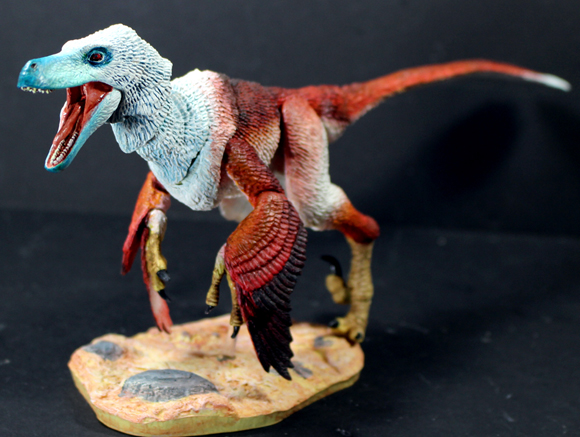
Plans are progressing well at Everything Dinosaur with regards to new additions to the very popular Beasts of the Mesozoic collectable “raptor” figures. New lines will be coming into stock in the spring and we have featured the new additions in a previous blog post and a customer e-newsletter. Today, we focus on one of these new replicas, the limited-edition Beasts of the Mesozoic Velociraptor osmolskae figure, that will only be available for sale in Europe from Everything Dinosaur.
New for 2019 – A Limited Edition Beast of the Mesozoic Velociraptor osmolskae Figure
Limited edition Beasts of the Mesozoic Velociraptor osmolskae figure.
The first batch of Beasts of the Mesozoic figures will focus on the “raptors”. However, there are plans to launch articulated ceratopsians and tyrannosaurs.
Superb Quality Articulated Figures
The Beasts of the Mesozoic range consist of superb quality, articulated figures. They are the brainchild of the highly talented and respected artist David Silva. Everything Dinosaur team members are eagerly looking forward to the arrival of the new “raptors” including the limited-edition Velociraptor osmolskae figure, the second species to be named in the Velociraptor genus (named in 2008, whereas V. mongoliensis was formally named and described back in 1924).
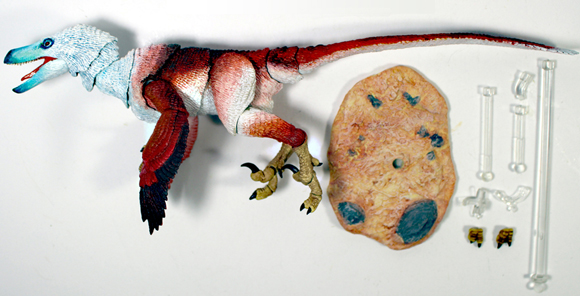
The Limited-edition Beasts of the Mesozoic Velociraptor osmolskae Box Contents
Box contents – the limited-edition Velociraptor osmolskae figure (Beasts of the Mesozoic).
A spokesperson from Everything Dinosaur commented:
“It is fitting to see a Velociraptor named after a Polish scientist – Halszka Osmólska, and one first described by researchers led by a Belgian palaeontologist – Pascal Godefroit, coming to Europe. It has been eleven years since this ground dwelling carnivore was formally named and described and more than ninety years since the genus Velociraptor was erected, it is great to see a Velociraptor osmolskae figure added to our inventory.”
To view the range of Beasts of the Mesozoic articulated figures offered by Everything Dinosaur: Beasts of the Mesozoic Figures.
Beautiful Artwork
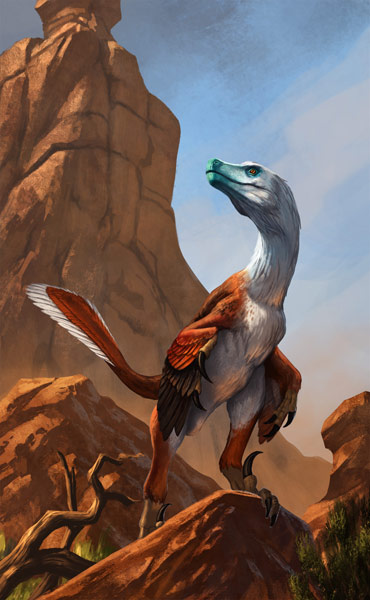
One of the features of this highly collectable range of prehistoric animals is the beautiful box art. The Velociraptor osmolskae illustration on the box is from renowned artist Raul Ramos. Raul will be the package illustrator for the ceratopsian themed articulated figure series which will be the next range of models to be launched.
The Stunning Velociraptor osmolskae Package Art
The original artwork of the Velociraptor osmolskae will feature on the box for the new for 2019 Beasts of the Mesozoic V. osmolskae replica.
Picture credit: Raul Ramos
In the beautiful illustration by Raul Ramos, the Velociraptor is depicted in a dry, arid environment. The type fossil specimen for this species comes from the Bayan Mandahu Formation of China, strata that represents a desert habitat, so the backdrop chosen by the artist is entirely appropriate.
Just a brief note to wish all our weblog readers, social media followers and customers a happy New Year. We wish everyone a peaceful, prosperous 2019. Team members at Everything Dinosaur have lots of exciting plans for the next twelve months, including adding numerous new prehistoric animal models to our range. We estimate that by the end of this year (2019), we will have added around fifty new prehistoric animal models to our inventory.
Happy New Year from Everything Dinosaur
We will also be updating our website and making some improvements to further aid navigation and enhance the website visitor experience.
Everything Dinosaur Team Members Wish Everyone a Happy New Year
Happy New Year from Everything Dinosaur. Picture credit: Everything Dinosaur.
Time to stick our collective necks out to see if we can predict the sort of news stories that we are going to feature on this blog next year (2019). We took a break from making predictions in 2018, after all, just like fossil collecting, attempting to foresee some of the scientific discoveries that will be covered in the next twelve months can be a bit of a hit and miss affair to say the least. However, with our trusty geological hammers tucked into our rucksack next to our crystal ball, here are our suggestions as to the fossil finds and palaeontology themed stories that 2019 will bring.
1). Bring on the Horned Dinosaurs – More Ceratopsians to be Named and Described from America
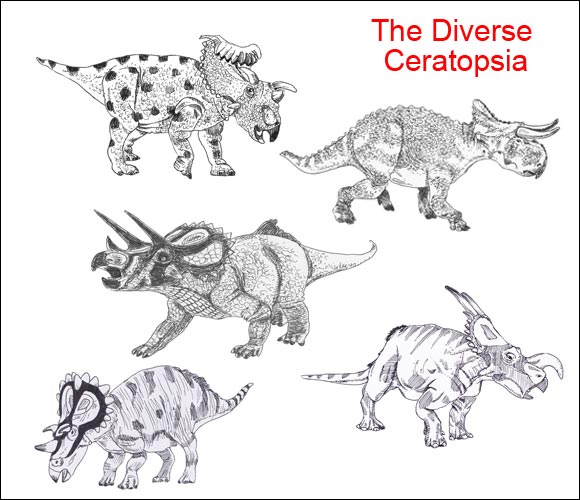
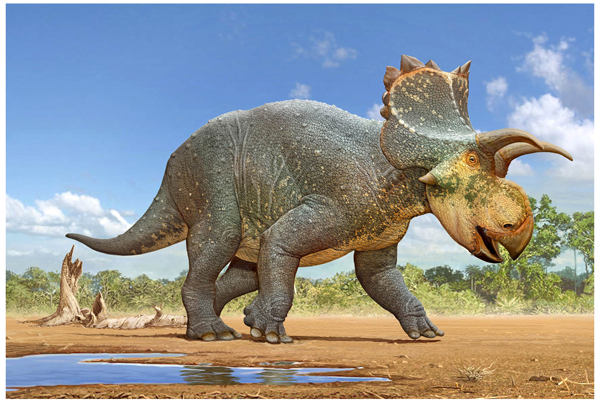
After the dearth of new horned dinosaurs named and described this year (only one – Crittenceratops krzyzanowskii), we expect the Marginocephalia clade, specifically the North American Ceratopsia to be increased substantially again next year. Team members at Everything Dinosaur predict that at least four new horned dinosaurs from the United States will be named and described in 2019.
The Diverse Ceratopsia – Likely to be More Diverse by the end of 2019
Diversity in the horned dinosaurs. Everything Dinosaur team members predict that there will be another four new Ceratopsia taxa from the United States described in 2019.Picture credit: Everything Dinosaur.
Picture credit: Everything Dinosaur
2). Herefordshire Lagerstätte To Make Its Mark Again
In recent years, we have featured a number of amazing fossil finds from the Silurian-aged deposits from the secret Lagerstätte in the county of Herefordshire. These fossils represent an ancient marine biota that was covered in fine volcanic ash some 425 million years ago. Such is the exquisite nature of their taphonomy that even the finest soft tissues have been preserved. We predict that British-based scientists will utilise high-resolution computed tomography in conjunction with computer-generated three-dimensional modelling to reveal a new species of Silurian marine invertebrate.
3). A New Dinosaur from India
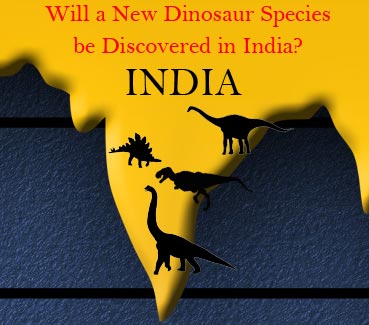
More Chinese dinosaur fossil discoveries are going to be made in 2019. We also expect fresh insights into the Cretaceous flora and fauna entombed in amber from Myanmar. However, amongst the twenty or so new species of dinosaur described in the next twelve months, we predict that one of these new-to-science specimens will be found in India. Many parts of the world (Africa and Asia) for example, are being opened up to geological and fossil exploration. Several different types of dinosaur are already known from the sub-continent and we predict that there will be a new addition to the dinosaur fauna described from India.
Will a New Dinosaur Species be Discovered in India?
Will a new dinosaur species be discovered in India?Picture credit: Everything Dinosaur.
Picture credit: Everything Dinosaur
4). Everything Dinosaur – A New Look to the Website
As well as writing about what other people have been doing, we expect our blog site to update readers on how Everything Dinosaur itself is evolving and changing. Our core values of customer service and finding the very best quality prehistoric animal products are not going to change, but visitors to: Everything Dinosaur can expect to see some changes next year – all aimed at improving our service and helping our customers. The number of different types of prehistoric animal models that we offer is also going to increase, but by how many? Let’s predict another fifty new models to be made available on our website in 2019.
5). More Fossils Reveal Melanosomes
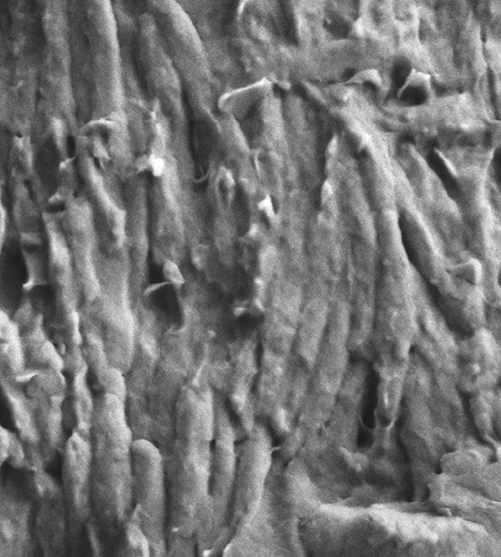
With more and more sophisticated and sensitive devices being made available to palaeontologists to aid their research, 2019 will see further developments in the study of fossil specimens on the molecular level. There have already been some remarkable papers published on the presence of fossilised microscopic structures containing the colour pigment melanin (melanosomes) and we confidently predict that this trend will continue. We predict that further evidence will emerge next year concerning the colour of members of the Dinosauria.
The Hunt is on for More Melanosome Structures in Fossil Material
Sausage-shapes – potential melanosomes. Research is likely to continue into prehistoric animal colouration in 2019.
Picture credit: Lund University (Johan Lindgren)
6). Giant Azhdarchid Pterosaurs
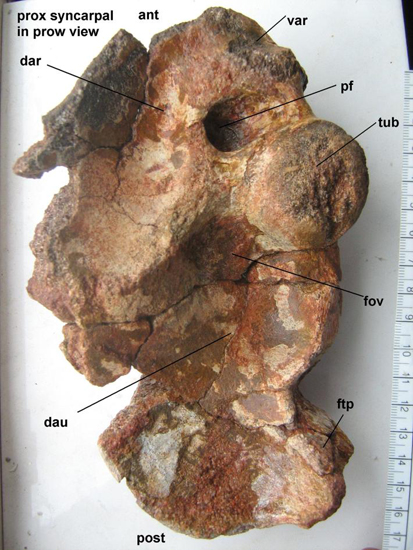
Recent fossil discoveries have indicated that the Pterosauria were more diverse than previously thought towards the very end of the Cretaceous (Campanian to Maastrichtian faunal stages). Everything Dinosaur has reported on the discovery of several fossil fragments from Europe and Africa in recent years and we predict that a new species of large, very probably azhdarchid, pterosaur will be described in 2019. The fossil find could come from northern Africa or perhaps from the famous Hateg Basin deposits of Romania.
An Azhdarchid Pterosaur Wrist Bone (Hateg Island) – Will a New Species of Azhdarchid Pterosaur be Described in 2019?
Azhdarchid pterosaur wrist bone. What surprises lie in wait for flying reptile researchers in 2019?
Picture credit: Mátyás Vremir
7). New Tyrannosaurids from the United States
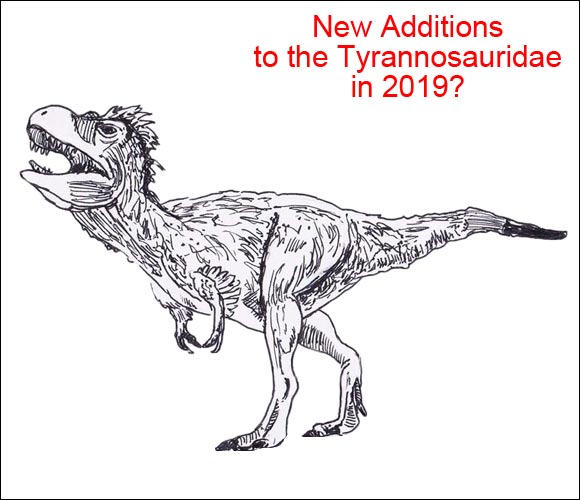
We began our predictions by stating that we thought it was likely that at least four new horned dinosaur taxa from the USA will be named next year. With all these herbivores being named and described, it would not surprise us if some more, large theropod dinosaurs were formally described from fossil material found in the United States next year as well. Let us conclude our crystal ball gazing by suggesting that two new species of Late Cretaceous tyrannosaurid will be identified from fossil finds from the southern USA (southern parts of Laramidia).
Will New Members be Added to the Tyrannosauridae Family in 2019?
Will new Tyrannosauridae taxa be described in 2019?Picture credit: Everything Dinosaur.
Picture credit: Everything Dinosaur
This time next year, as we approach the end of 2019, we will review our predictions and see how we got on.
Everything Dinosaur’s Top Blog Posts of 2018 (Part 2)
Today, we conclude our look at our most memorable blog posts of 2018, with a review of blog posts from July through to December. Since we try to post something up every day, there are certainly a lot of articles to choose from, in our previous posting covering the first six months of the year, we certainly came up with an eclectic mix: Top Blog Posts of 2018 (Part 1), part two is very much cut from the same cloth, with a wide range of scientific subjects covered.
July – Pink Life’s First Colour
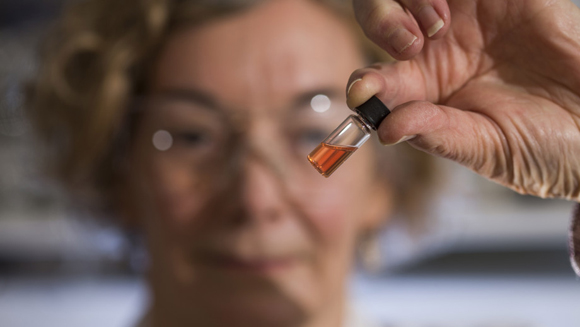
July featured marine crocodile evolution, a dinosaur discovery from Northern China (Lingwulong shenqi) that defied logic, Utah’s latest armoured dinosaur, Spanish plesiosaurs and French gomphotheres. However, we were “tickled pink” to be able to write about the analysis of 1.1 billion-year-old cyanobacteria that led to the extraction of pink coloured pigments from ancient marine shales. The world’s oldest biological colour turns out to be pink: In the Pink! The First Colour of Life.
A Team of International Scientists Have Isolated the Oldest Known Biological Colour
The oldest colours found to date.
Picture credit: Australian National University
August – DIY Taphonomy – (Make Your Own Fossils)
The beautiful summer weather continued into August and much of the UK faced drought conditions. However, fossil finds and prehistoric animal news stories did not dry up. Team members wrote about marine reptile discoveries in Queensland, a new nodosaurid from Mexico, Chinese alvarezsaurids, a challenge to the idea of aquatic spinosaurids, Scottish sauropods and toothy pterosaurs from the Late Triassic. It was an article on how a team of scientists had learned to mimic the fossilisation process, compressing millions of years into just 24-hours that really got our attention. After all, having a better understanding of how fossils form (taphonomy), will help to improve fossil interpretation: Do It Yourself Taphonomy!
September – Dickinsonia Definitely an Animal
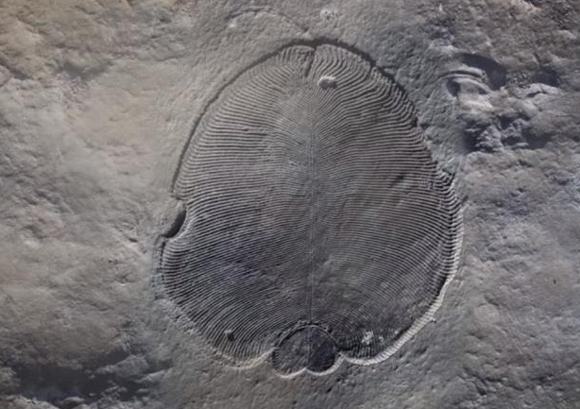
September turned the spotlight on the ediacaran fauna and one of the most puzzling of all the bizarre life forms to have ever existed – Dickinsonia. A research paper finally put to rest (most probably), a long-standing argument about this disc-shaped organism. It was an animal. What sort of animal? This remains an area of some debate, but the 550-million-year-old Dickinsonia is now in the same Kingdom as ourselves (Animalia). Here is our article: Mysterious Dickinsonia Classified as an Animal.
A Fossil of the Enigmatic Dickinsonia – Finally Classified and Placed in the Animalia
A beautifully preserved 558 million-year-old fossil of Dickinsonia, now classified as an animal (Metazoan).
Picture credit: Australian National University
October – A Better Understanding of the Sauropodomorpha (Sarahsaurus et al)
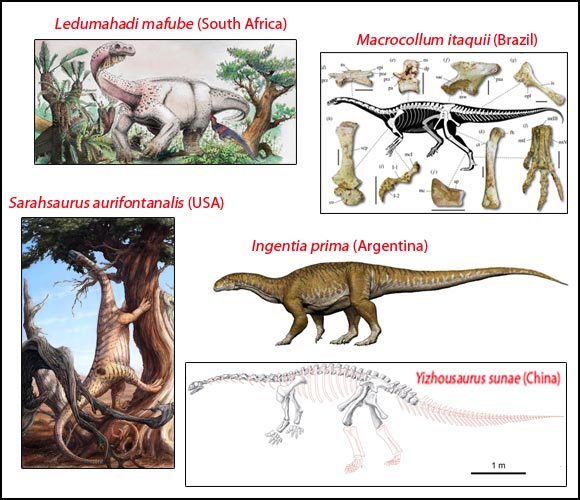
This year, we have seen numerous scientific papers published relating to the evolution and dispersal of the Sauropodomorpha (the sauropods and their ancestral forms). For example, researchers from the University of Texas concluded that ancestors of North American, Early Jurassic sauropodomorphs, such as Sarahsaurus were essentially migrants. In China, a study of Yizhousaurus fossil material yielded new data on the evolution of long-necked dinosaurs. The announcement of the discovery of a monstrous Late Triassic sauropodomorph from Argentina (Ingentia prima), demonstrated that gigantism in the Dinosauria occurred earlier than previously thought.
Amongst all these amazing sauropodiform/Sauropodomorpha articles, we even managed to publish a feature on the oldest, long-necked dinosaur described to date – Macrocollum itaquii. October like much of the year, was dominated by the sauropods: The Ancestors of Sarahsaurus Probably Did Not Originate in North America.
Great Strides in Our Understanding of the Sauropodomorpha in 2018
2018 will be remembered as the year that featured a lot of Sauropodomorpha fossil discoveries and research.
Picture credit: Viktor Radermacher (Witwatersrand University), R T Müller et al, Jorge A. González, Brian Engh, Xiao-Cong Guo and Everything Dinosaur
2018 is likely to be remembered by many vertebrate palaeontologists as the year in which the evolution of the Sauropodomorpha began to make more sense.
November – Fresh Insight into the “Siberian Unicorn”
Our blog posts in November were dominated by news of new models and figures for 2019.
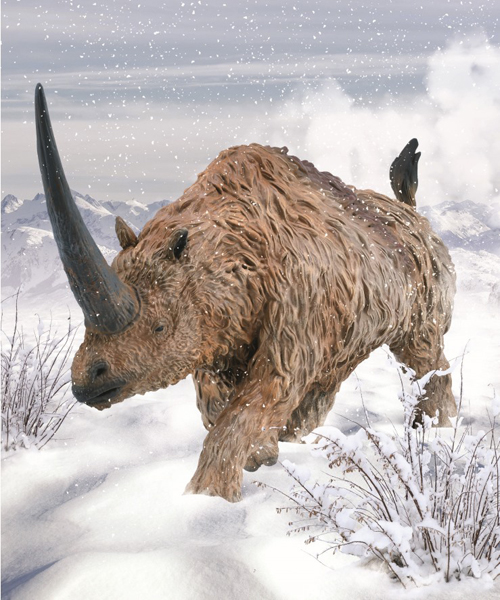
The weblog also covered elephant-sized Triassic dicynodonts, Oregon ornithopods, enantiornithine birds from Utah, ornithischian dental batteries, a new rebbachisaurid (Lavocatisaurus agrioensis), from Argentina and our work in schools. However, it was a feature on the enigmatic Elasmotherium, sometimes referred to as the “Siberian Unicorn” that stood out for us. A scientific paper published in November, revealed that the enormous Elasmotherium probably survived until as recently as 36,000 years ago. It was climate change that ultimately led to the demise of this beast, the paper on the relatively recent extinction of a member of the Rhinoceros family puts into focus the current plight of the remaining members of this once diverse and extensive family of hoofed mammals.
All extant members of the Rhinocerotidae face a very uncertain future.
An Illustration of the “Siberian Unicorn” – Elasmotherium
The CollectA Deluxe Elasmotherium model. A replica of the recently extinct Elasmotherium sibiricum.
Picture credit: Everything Dinosaur
December – Fuzzy Feathered Pterosaurs and the First New Ceratopsian of 2018
As the year drew to a close, the breadth and scope of the topic areas we attempted to cover did not diminish. Over the course of December lost Australian dinosaur toe bones, a new, dog-sized dinosaur from down-under (Weewarrasaurus pobeni), ichthyosaur blubber, new models and replica retirements all featured.
This month, we also wrote articles about a new Russian dinosaur (Volgatitan simbirskiensis) and featured a paper that demonstrated that the first flowering plants probably evolved at least fifty million years earlier than previously thought. Two articles we published stand out for us, firstly, on December 14th we produced an article on the ceratopsian Crittendenceratops krzyzanowskii, a new species of centrosaurine from Arizona. In the last twenty years or so, there have been an astonishing number of new horned dinosaurs described and named. Ironically, Crittendenceratops is the first (and only), new horned dinosaur to be named in 2018: A New Horned Dinosaur Species from Late Cretaceous Arizona.
A Life Reconstruction of Crittendenceratops krzyzanowskii
A life reconstruction of the newly described Ceratopsian Crittendenceratops (2018).
Picture credit: Sergey Krasovskiy
Secondly, our blog post from December 17th, featured the work of an international team of scientists who had identified four kinds of feather-like filaments on the fossils of pterosaurs: Are the Feathers About to Fly in the Pterosauria? If they are correct, then this suggests that either the Pterosauria evolved feathers as a form of convergent evolution separate from the Dinosauria, or, that feathers evolved many millions of years earlier than previously thought – in a common ancestor of the Dinosauria and the Pterosauria clades. Interesting times ahead for those palaeontologists that study flying reptiles.
Four Types of Feather-like Structures Identified in Chinese Pterosaurs
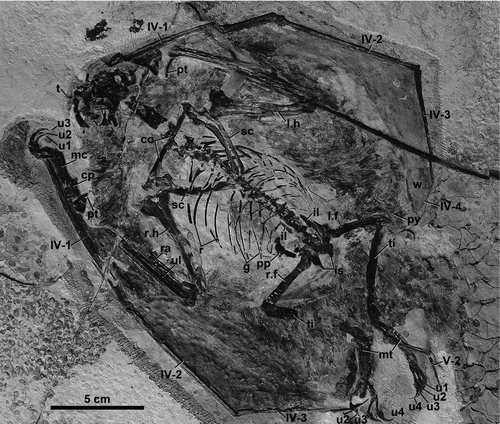
Pterosaur material. A study published in December 2018 suggests that flying reptiles had feathers.
Picture credit: Chinese Academy of Sciences/Journal of Vertebrate Palaeontology
Everything Dinosaur’s Top Blog Posts of 2018 (Part 1)
As we approach the end of 2018, we have time to reflect on all the blog articles that we published over the last twelve months. At Everything Dinosaur, we try to publish a blog article for every day of the year, this means of course that we have thousands of articles on our weblog so, providing a review of what we have published in 2018 is quite a mammoth task. Here is a selection of articles that were added over the course of January through to June 2018.
January – Rainbow Coloured Dinosaur (Caihong juji)
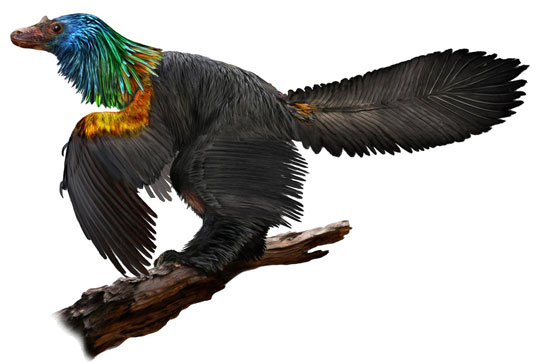
In January, we wrote articles on the discovery of a new, speedy ornithopod from Australia (Diluvicursor pickeringi), explained how drill cores from northern Germany pushed back the evolution of butterflies and moths by some seventy million years and discussed the naming of Mansourasaurus shahinae, the first, nearly complete dinosaur skeleton from Upper Cretaceous rocks in Africa. However, arguably the most “colourful” story covered was that of Caihong juji from Middle Jurassic rocks of China, a small theropod that may have had iridescent feathers.
Colourful Caihong – A Rainbow Coloured Dinosaur
An illustration of the Jurassic feathered dinosaur Caihong juji.
February-March Early Plants and Early Armoured Dinosaurs
As we moved into the spring, this blog site dealt with bipedal lizard tracks from the Cretaceous, how Neanderthals used their brains, new megaraptoran dinosaurs and celebrated publishing our 4,000th article. Perhaps, two of the most memorable articles featured new research indicating that plants may have evolved millions of years earlier than previously thought and the naming of a basal member of the Ankylosauridae from China called Jinyunpelta sinensis.
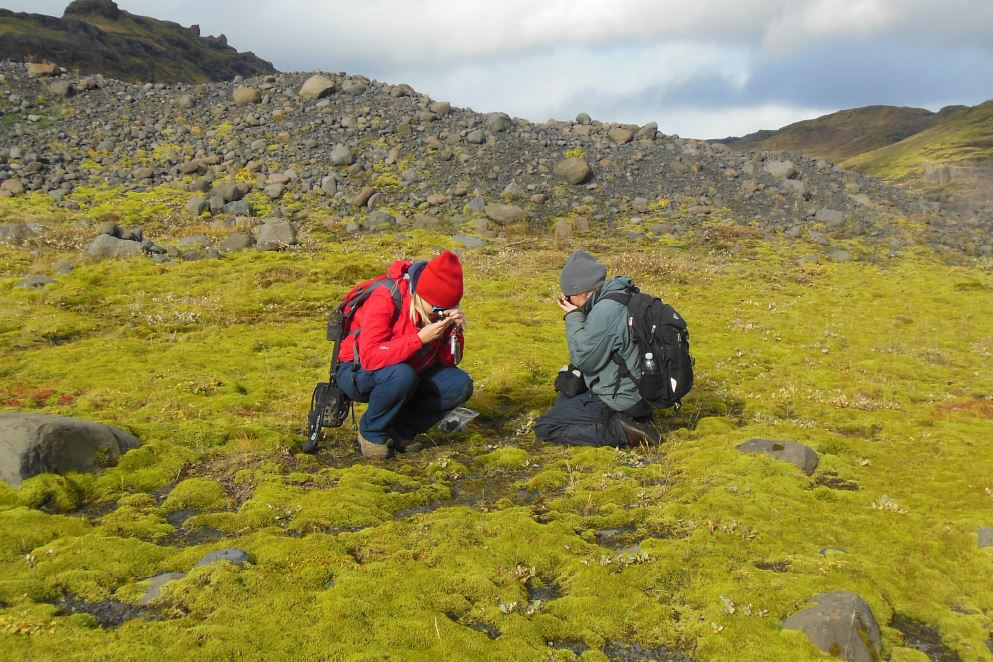
When Did the First Plants Evolve?
Early land plants would have resembled the flora found in this Icelandic lava field.
Picture credit: Paul Kenrick (Natural History Museum, London)
It has certainly been a big year for the Kingdom Plantae, new evidence has emerged that flowering plants (Angiosperms), may have evolved in the Jurassic!
April-May Human Migration and News about Spinosaurs
In April and May, we featured theropod feeding methods, clever Cretaceous lacewings and turtle evolution missing links. Wounded lufengosaurs made an appearance along with Uruguay’s first ever pterosaur, dinosaur dandruff, nesting behaviour and lots more flying reptiles, including an article on the largest pterosaur mandible ever found. Two posts that stand out for us, was one written on April 10th that documented the finding of a single human finger bone that indicates that Homo sapiens migrated out of Africa earlier: Finger Bone Points at Early H. sapiens Migration.
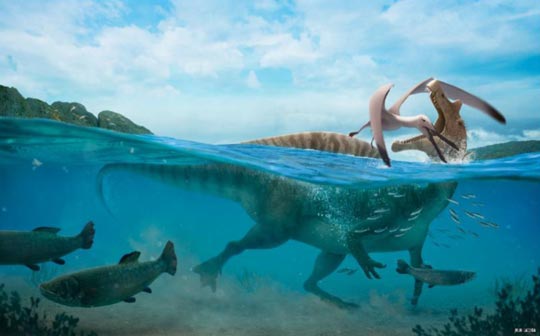
The second post concerned the discovery of a fragment of spinosaurid leg bone that provided an insight into how these theropod dinosaurs may have adapted to an aquatic lifestyle. Furthermore, the piece of bone hinted that spinosaurids in excess of ten metres long inhabited South America.
Adapting to an Aquatic Life – Spinosaurids
An illustration of a South American spinosaur attacking a pterosaur.
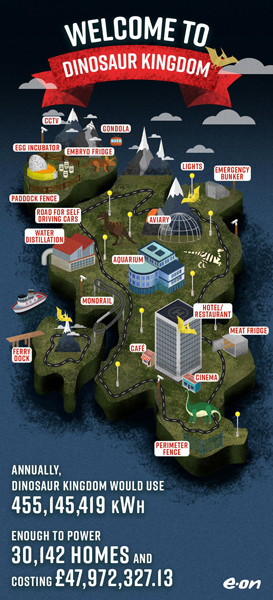
June was the start of a record breaking summer in the UK, in between basking ourselves and applying copious amounts of sun-tan lotion we tackled, rare Japanese dinosaurs, fossil fungi, stem mammals from the Early Cretaceous, tiny frogs preserved in amber and flocks of eumaniraptoran dinosaurs. With the premier of the latest film in the “Jurassic Park” franchise in cinemas, “Jurassic World – Fallen Kingdom”, rather than review the film, we chose to feature the work of some physicists from Imperial College London who calculated just how much energy would be required to run a real “Jurassic Park”.
The Running Costs of a Real “Jurassic Park”
The energy costs involved in running a “Prehistoric Park”.
Thus, ends our overview of the first six months of blog articles that we have written, tomorrow we shall look at the last six months of the year and feature the first colour to evolve along with DIY fossils and conclude a remarkable year for the Sauropodomorpha.
Armoured Dinosaurs Coped with the Mesozoic Heat Thanks to Nasal Air-conditioning
Being a very large dinosaur covered in armour, might help you to keep safe from attack by predatory dinosaurs, but this body plan does have its downsides. For example, how do you keep cool when you have a very broad body? New research from scientists based at Ohio University and the New York Institute of Technology College of Osteopathic Medicine at Arkansas State, suggests that those complicated Ankylosauria nasal passages acted like heat-exchanges helping to prevent these dinosaurs from overheating.
In essence, this study published in the academic, on-line journal PLOS One, suggests that members of the Ankylosauria clade had built-in air conditioning units in their noses.
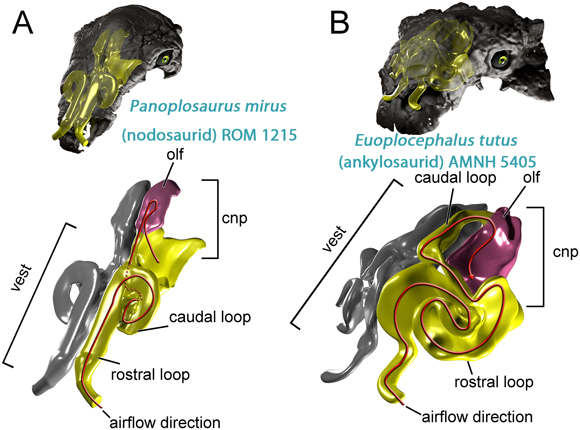
Convoluted Nasal Passages Helped Armoured Dinosaurs to Avoid Overheating
Ankylosauria nasal passages used as heat exchanges.
Picture credit: PLOS One with additional annotation from Everything Dinosaur
Panoplosaurus and Euoplocephalus Studied
The researchers, which included Jason Bourke (Assistant Professor at the New York Institute of Technology College of Osteopathic Medicine at Arkansas State), chose to examine the craniums of Euoplocephalus (E. tutus), a member of the Ankylosauridae family of dinosaurs along with the nodosaurid Panoplosaurus mirus. A representative of the Nodosauridae family as well as a member of the Ankylosauridae was selected as nodosaurs tend to have much narrower muzzles than the related ankylosaurs. In this way, the scientists were able to compare and contrast the different nasal passages associated with these two types of armoured dinosaur.
Assistant Professor Bourke commented:
“The huge bodies that we see in most dinosaurs must have gotten really hot in warm Mesozoic climates. Brains don’t like that, so we wanted to see if there were ways to protect the brain from cooking. It turns out the nose may be the key.”
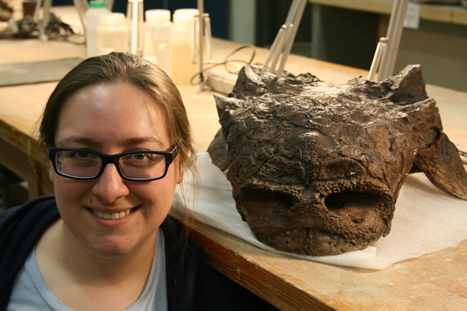
Dr Victoria Arbour, an Authority on the Ankylosauria Poses Next to the Broad Skull of Euoplocephalus (E. tutus)
Victoria next to a skull of a Euoplocephalus tutus (University of Alberta). Note the broad muzzle and the wide skull of this Late Cretaceous ankylosaurid.
Picture credit: Angelica Torices
Computational Fluid Dynamic Analysis
The research team created three-dimensional, computer generated models of two famous skull fossils, a Panoplosaurus specimen housed in the Royal Ontario Museum collection and a Euoplocephalus skull from the American Museum of Natural History (New York). A computational fluid dynamic analysis was then undertaken to map how air would have moved through the nasal passages as these dinosaurs breathed. The scientists wanted to test the heat exchange capacity of the complex passages, to see how well the Ankylosauria noses transferred heat from the body to the inhaled air.
Co-author of the study, Lawrence Witmer (Ohio University), explained:
“A decade ago, my colleague Ryan Ridgely and I published the discovery that ankylosaurs had insanely long nasal passages coiled up in their snouts. These convoluted airways looked like a kid’s ‘crazy-straw!’ It was completely unexpected and cried out for explanation. I was thrilled when Jason took up the problem as part of his doctoral research in our lab.”
Heat Exchangers
It is thought that these complex nasal passages gave members of the Ankylosauria clade, an exceptional sense of smell. This may have been their primary function, however, noses are also heat exchangers, ensuring that air is warmed and humidified before it reaches the delicate lungs. To accomplish this effective air conditioning, birds and mammals, including humans, rely on thin curls of bone and cartilage within their nasal cavities called turbinates, which increase the surface area, allowing for air to come into contact with more of the nasal walls. Ankylosaurs and nodosaurids lacked turbinates, to compensate for this they evolved exceptionally long and twisty nasal passages.
Comparing Armoured Dinosaurs to Living Animals
When the researchers compared their findings to data from living animals, such as the nasal passages of an avian dinosaur (pigeon), they discovered that the noses of armoured dinosaurs were just as efficient at warming and cooling respired air. The length of the winding and twisting nasal passages in the two armoured dinosaurs studied were also measured. In the narrow-snouted, nodosaurid Panoplosaurus, the nasal passages were a bit longer than the skull itself and in Euoplocephalus they were almost twice as long as the skull, which is why they are coiled up in the snout.
To see if nasal passage length was the reason for this efficiency in heat exchange, the researchers created alternative models with shorter, simpler nasal passages that ran directly from the nostril to the throat, as in most other animals. The results clearly showed that nose length and the length of the nasal passages were indeed key to their air-conditioning ability.
Assistant Professor Bourke stated:
“When we stuck a short, simple nose in their snouts, heat-transfer rates dropped over fifty percent in both dinosaurs. They were less efficient and didn’t work very well.”
Helping to Cool Brains
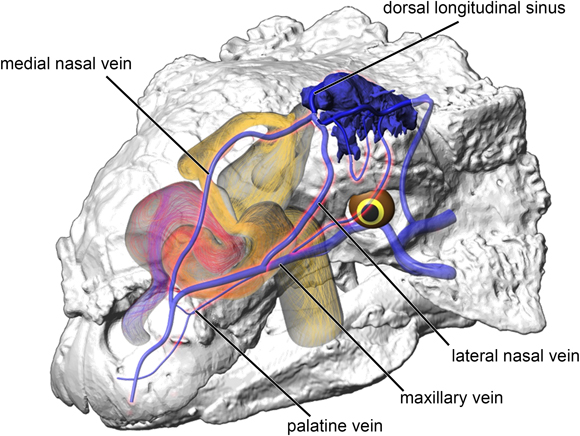
The blood vessels in the skull leading up to and surrounding the brain were mapped. The scientists wanted to explore whether the internal plumbing of the snout helped to cool the brains of armoured dinosaurs. The team found a rich blood supply running adjacent to the convoluted nasal passages.
Co-author Ruger Porter (Ohio University), explained:
“When we reconstructed the blood vessels, based on bony grooves and canals, we found a rich blood supply running right next to these convoluted nasal passages. Hot blood from the body core would travel through these blood vessels and transfer their heat to the incoming air. Simultaneously, evaporation of moisture in the long nasal passages cooled the venous blood destined for the brain.”
Euoplocephalus Kept a Cool Head
Vascular pathways associated with the brain of Euoplocephalus tutus. Red highlighted veins indicate main channels of heat transfer.
Picture credit: PLOS One
Thermoregulation – A Problem for Large Animals
The large, broad bodies of Panoplosaurus and Euoplocephalus were really good at retaining heat, which might have some advantages, especially when you need to stay warm, but this does cause problems when large tetrapods need to keep their cool. This heat-shedding problem would have put them at risk of overheating even on cloudy days. In the absence of some protective mechanism, the delicate neural tissue of the brain could be damaged by the hot blood from the body core. In simple terms, the small brains of armoured dinosaurs might have been cooked inside the skull.
The complicated nasal airways of these dinosaurs were acting as radiators to cool down the brain with a constant flow of cooled venous blood. This natural engineering feat also may have allowed some members of the Dinosauria to evolve into huge animals.
Lawrence Witmer added:
“When we look at the nasal cavity and airway in dinosaurs, we find that the most elaborate noses are found in the large dinosaur species, which suggests that the physiological stresses of large body size may have spurred some of these anatomical novelties to help regulate brain temperatures.”
The Carnegie Collection Acrocanthosaurus Model Discovered During a Stocktake
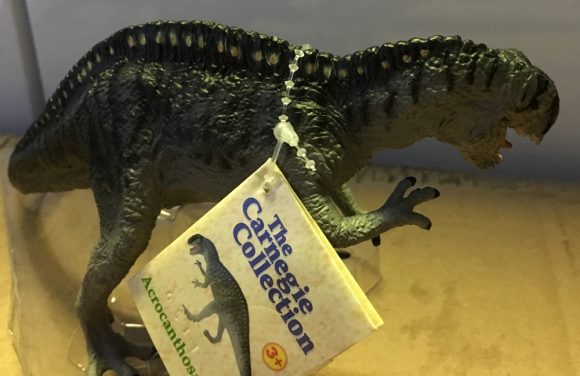
Team members at Everything Dinosaur recently started the company’s annual stocktake. Whilst tidying up, a handful of rare dinosaur models were discovered. Some Safari Ltd Carnegie Collection Acrocanthosaurus dinosaur models, complete with original packaging and labels. This dinosaur model went out of production many years ago and is highly-prized by collectors.
A Surprising Discovery in the Warehouse
The rare and long ago retired Safari Ltd Carnegie Collection Acrocanthosaurus dinosaur model. Picture credit: Everything Dinosaur.
Picture credit: Everything Dinosaur
The End of the Line Back in Early 2015
The Carnegie Collection range of prehistoric animal models was retired in early 2015. The last of the dinosaur models to be added to this range was a Velociraptor. The Carnegie Collection range is regarded as a set of “classic” figures, they may not be anatomically accurate, not by the standards set these days, but the hand-painted models are highly sought after by discerning collectors. To find some Carnegie Collection Acrocanthosaurus models is a real coup.
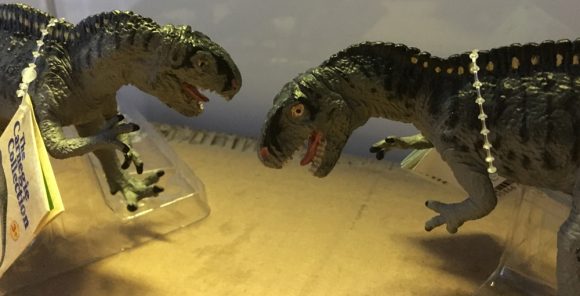
Two of the Hand-painted Carnegie Collection Acrocanthosaurus Models
The very rare Carnegie Collection Acrocanthosaurus dinosaur model.Picture credit: Everything Dinosaur.
A spokesperson for the UK-based dinosaur company stated:
“The models were found at the start of our annual company inventory review. Just a handful of these rare models are available, we expect that once we publicise this, the remaining figures that we have will be snapped up by dinosaur fans and model collectors. These figures come complete with their original labels and plastic bases – we never thought that we would see the likes of them again.”
Carnegie Collection Model Number 403901 – Acrocanthosaurus
The Carnegie Collection Acrocanthosaurus (model number 403901), was first produced back in 2001, like the rest of this popular range, it was thought to be long gone. However, a handful have been discovered, all in pristine condition in Everything Dinosaur’s warehouse.
For a chance to purchase one of these extremely rare dinosaur models and to view the rest of the prehistoric animal models in the Safari Ltd range that is in stock at Everything Dinosaur: Safari Ltd Dinosaur and Prehistoric Animal Models.
We wonder what other little treasures our annual stocktake might turn up!
Cretoxyrhina Tooth Embedded in the Neck of a Pteranodon
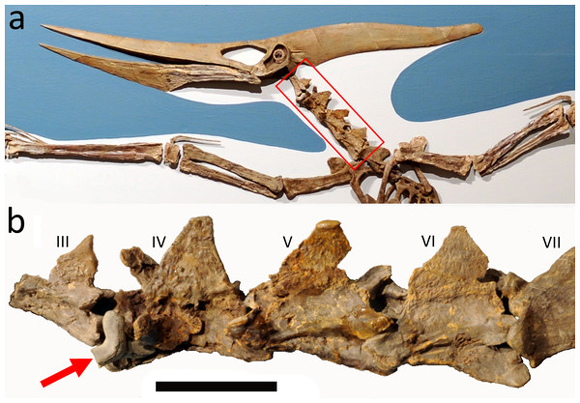
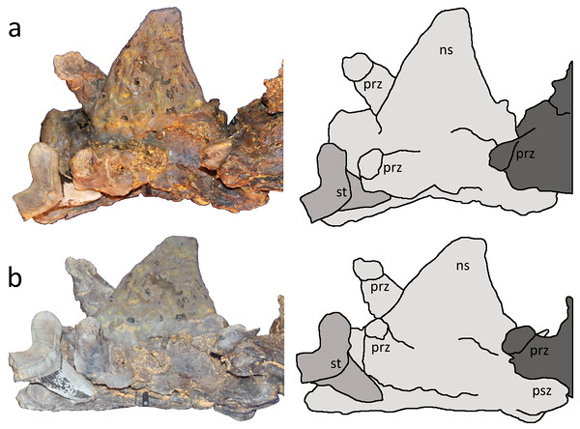
There has been quite a lot of media coverage this week, following the publication of a scientific paper that described the interaction between a shark from the Western Interior Seaway (Cretoxyrhina mantelli) and a pterosaur (Pteranodon). A single tooth from the shark, was discovered wedged against the fourth cervical vertebra (fourth bone in the neck), of the flying reptile. The association of the tooth and its proximity to the vertebra suggests that the preservation of bone and tooth together was more than mere coincidence. The specimen is evidence of a Cretoxyrhina shark biting a Pteranodon.
Evidence for a Shark Bite on the Neck of a Pterosaur
Evidence of a shark bite on the neck of a pterosaur. The red arrow indicates the location of the shark tooth and its association with cervical vertebra IV. Scale bar = 5 cm approximately.
Picture credit: (A) Stephanie Abramowicz, courtesy Dinosaur Institute, Natural History Museum of Los Angeles County, (B) David Hone
The Pteranodon specimen is housed in a glass case at the Los Angeles Museum of Natural History, so the researchers, David Hone (University of London), Mark Witton (Portsmouth University) and Michael Habib (University of Southern California), had difficulty in obtaining direct access to the fossils. However, undeterred they made measurements of the embedded fossil tooth and it is estimated to be 24 mm high (root plus crown) and its morphology suggests that it came from a well-known lamniform shark from the Western Interior Seaway – C. mantelli.
Based on the tooth dimensions, the shark is estimated to have been around 2.5 metres long, big, but not as large as some Cretoxyrhina mantelli specimens, this species of Late Cretaceous shark is believed to have reached lengths of around seven metres, making it larger than the extant Great White (C. carcharias).
Identifying the Attacker
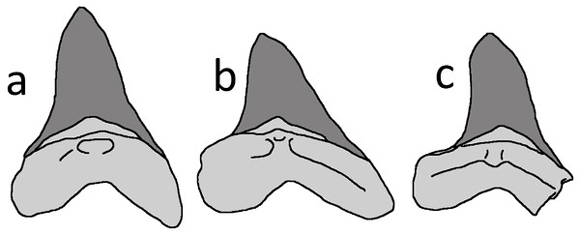
Teeth associated with lamniform sharks are particularly common in marine deposits associated with the Western Interior Seaway. The morphology of the tooth suggests that this tooth came from Cretoxyrhina mantelli and this fossil specimen (LACM 50926), is the first documented occurrence of this large shark interacting with any type of flying reptile.
Typical Teeth Morphologies Associated with C. mantelli
Tracing of Cretoxyrhina mantelli anterior teeth. The root of each tooth is shaded pale gray, whilst the crown is dark gray. Tooth (a) is position 3 in the jaw, (b) represents a tooth from position 4, whilst (c) is a representation of the fossil tooth found in close association with the Pteranodon cervical vertebra.
Picture credit: David Hone
Evidence of Cretoxyrhina Biting Pteranodon
It is not possible to state categorically, whether the fossil specimen (LACM 50926), is evidence of predation or whether the shark took a bite out of a Pteranodon carcase. Several examples of Cretoxyrhina spp. feeding traces are known on the fossilised remains of other vertebrates from the Western Interior Seaway. In addition, there is evidence to suggest other types of fish, including sharks, consumed Pteranodon. This is the first example of an interaction between Cretoxyrhina and “toothless wing”.
A Close-up View of the Neck Bone and the Shark Tooth
Shark tooth embedded in a Pteranodon neck bone. Two views (a and b) of the tooth in association with the pterosaur vertebra and accompanying line drawings.
Picture credit: David Hone
Spectacular Palaeoart
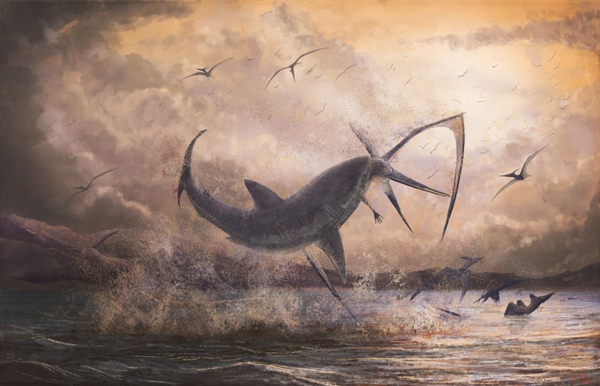
One of the co-authors of the paper, Mark Witton, is a highly respected palaeoartist, as well as an authority on the Pterosauria. He has produced a stunning illustration of a Cretoxyrhina shark leaping out of the water as it bites the neck of a Pteranodon.
A Large Pteranodon Meets Its End in the Jaws of a Cretoxyrhina Shark
A Cretoxyrhina shark leaps from the water as it attacks a Pteranodon.
Picture credit: Mark Witton
Pteranodon is widely believed to have foraged for small fish and other aquatic prey by alighting on the water and dip-feeding. Once on the surface of the sea, it would have been within the reach of predatory sharks, although whether the breaching Cretoxyrhina portrayed by Mark Witton accurately depicts an attack by the shark on a pterosaur is open to speculation. However, the image is visually stunning and as marine seabirds today are actively predated by sharks, an example being Tiger sharks attacking fledgling albatross chicks, such a dramatic scene could have taken place on the waters of the Western Interior Seaway.
However, the tooth in association with the cervical vertebra could have resulted from the scavenging of a pterosaur carcase.
Not All That it Seems
The Pteranodon fossil in the display case is not all that it seems. Like many museum specimens, it is a composite, it is made up of bones from several animals to help make the skeleton more complete. Furthermore, part of the fossil display is genuine, but numerous elements have been reconstructed to replace absent parts.
The authors note that the preservation quality and size of the vertebrae correspond well to the other elements (including the forelimb bones) and this implies that LACM 50926 may represent much of a skeleton. However, the absence of both anteriormost and posterior cervical vertebrae means no anatomical continuity links the 50926 vertebrae with the rest of the material and subsequently, their association to the rest of the skeleton cannot be stated confidently.
A Link Between a Feeding Cretoxyhina and a Pteranodon
With all this said, LACM 50926 is the first palaeoecological link between a feeding Cretoxyrhina mantelli and a Pteranodon. Such evidence of interactions like this are very rare in the fossil record. Pteranodon seems to have been a relatively common flying reptile, it makes up some 97% of the Niobrara Formation pterosaur fossil finds. Sharks feeding on large pterosaurs such as Pteranodon may have been a more frequent occurrence, but the hollow bones of these flying reptiles may have broken quite easily when subjected to the biteforce of a shark and so the likelihood of any fossil evidence being preserved would be diminished. Chances are the evidence of such interactions just got consumed.
The scientific paper: “Evidence for the Cretaceous Shark Cretoxyrhina mantelli feeding on the pterosaur Pteranodon from the Niobrara Formation” by David W. E. Hone, Mark P. Witton and Michael B. Habib and published in the open access journal PeerJ.
Saltriovenator zanellai – One Tonne Giant and Oldest Ceratosaurian Described to Date
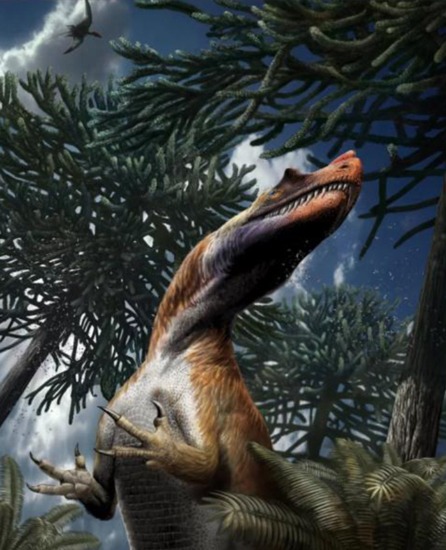
Scientists from Natural History Museum of Milan and the Geological Museum of Bologna (Museu di Storia Naturale di Milano and the Museo Geologico), have published a scientific paper on a new predatory dinosaur from the Lombardy region of northern Italy. This new species was a giant, weighing around a tonne and measuring approximately 7.5 metres in length. It lived some 25 million years before other known big predatory dinosaurs evolved and examination of the fossilised bones suggest that this dinosaur was still growing when it died. The dinosaur has been named Saltriovenator zanellai and it is the largest theropod described to date from the Early Jurassic (Sinemurian faunal stage).
A Life Reconstruction of the Newly Described Ceratosaurian Theropod Saltriovenator zanellai
A life reconstruction of Saltriovenator from the Early Jurassic of Italy.
Picture credit: Davide Bonadonna
A Chance Discovery
Saltriovenator was discovered by chance in the summer of 1996 by amateur fossil collector Angelo Zanella, whilst exploring fossil rich limestone layers associated with a marble quarry near the town of Saltrio (Varese Province, Lombardy). The strata containing the fossilised remains represent marine deposits and explosives used in the quarrying process had broken up the fossil bearing layer into hundreds of pieces. In total, 132 fossil pieces were excavated from the site, the remains of a single animal.
The bones show feeding traces from fish and borings from marine invertebrates. The palaeontologists writing in the on-line academic journal “PeerJ” suggest that the carcase was washed out sea and stayed on the seabed for some time, permitting the scavenging to take place.
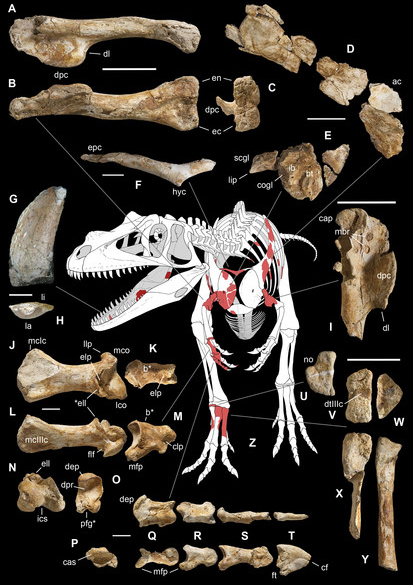
Fossil Elements Used to Confirm Ceratosaurian Affinity with a Skeletal Drawing
Selected fossils of Saltriovenator and a skeletal reconstruction. Sections coloured red indicate fossil material.
Picture credit: G. Bindellini, C. Dal Sasso and M. Zilioli and M. Auditore
The picture above shows key fossils that helped to classify Saltriovenator as a member of the Ceratosauria clade, it is the oldest ceratosaur described to date.
Key
A, B, C = views of the right humerus.
D = left scapula.
E = right scapular glenoid and coracoid.
F = furcula (wishbone).
G = single tooth from the anterior portion of the lower jaw.
I = partial left humerus, the circular depressions represent borings made by marine invertebrates feeding on the carcase.
J, L, N = views of the right second metacarpal (finger bone).
K, M, O, = views of the right second digit.
P-T = views of the right third digit.
U = distal tarsal IV.
V, X = third right metatarsal views.
W, Y = second right metatarsal views.
Z = reconstructed skeleton of Saltriovenator with identified fossil elements shaded red.
Scale bars: 10 cm in (A)–(E), (I), and (U)–(Y); two cm in (F), and (J)–(T); one cm in (G).
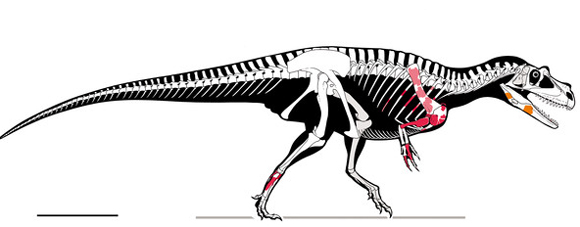
A Skeletal Reconstruction of Saltriovenator zanellai
Saltriovenator skeletal reconstruction. Colour key – right bones in red; counterlateral copies of the left bones in light red; bones from the medial side of the lower jaw in orange. Note scale bar equals one metre.
Picture credit: M. Auditore
The First Jurassic Dinosaur from Italy
Saltriovenator is the first dinosaur to be described from fossils found in the Italian Alps. It is the first dinosaur from the Jurassic Period to have been found in Italy and the country’s second theropod, the first being Scipionyx samniticus which lived during the Early Cretaceous and at just over two metres in length, was considerably smaller than S. zanellai. A study of growth rings found in a cross-sectional analysis of the fossil bones indicates that the dinosaur was around twenty-four years of age when it died.
It was still growing, albeit slowly, so the maximum size of this predator is not known, although at an estimated 7.5 metres long, it was considerably bigger than any other theropod from the Early Jurassic described to date.
CollectA have produced a replica of Saltriovenator.
Saltriovenator zannellai – A Mosaic of Basal and More Advanced Theropod Features
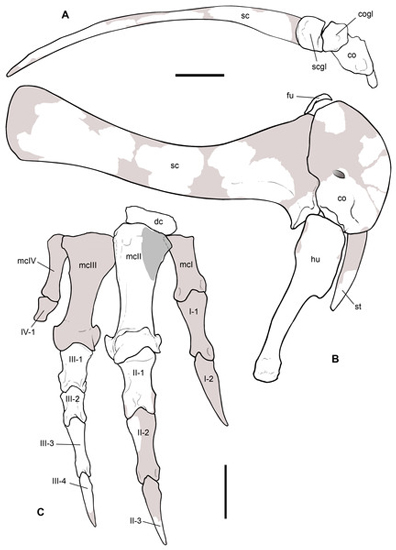
Saltriovenator exhibits a mosaic of features seen in four-fingered theropods and basal tetanuran dinosaurs. The fossilised finger bones indicate that this dinosaur had a fully functioning four-fingered hand, well-adapted for grasping and coping with struggling prey. Later ceratosaurs had only three fingers on each hand. Study of the finger bones will help scientists to understand better the evolutionary relationships between the four-fingered cilophosaurs, ceratosaurs and later types of theropod such as the allosaurs with their atrophied hands.
Views of the Pectoral Girdle and the Right Hand of Saltriovenator zanellai
Saltriovenator pectoral girdle and forelimb with a line drawing of the right hand showing four fingers. Preserved elements in white, reconstructed bone in light grey, exposed inner bone in grey, hidden bone in dotted lines. Scale bar equals 10 cm in (A) and (B), five cm in (C).
Picture credit: M. Auditore
Commenting on the importance of this fossil discovery, one of the authors of the scientific paper, Dr Andrea Cau (Museo Geologico), stated:
“The grasping hand of Saltriovenator zanellai fills a key gap in the theropod evolutionary tree: predatory dinosaurs progressively lost the pinkie and ring fingers and acquired the three-fingered hand which is the precursor of the avian wing.”
A spokesperson from Everything Dinosaur commented:
“The evolution of large, powerful predatory dinosaurs at the very beginning of the Jurassic, may have been a factor in the evolution of bigger and bigger herbivorous dinosaurs such as the sauropods. Think of it as an evolutionary arms race as carnivores got bigger, selection pressure was put on herbivores to become bigger and stronger themselves in order to avoid predation.”
Nanjinganthus dendrostyla – Putting Back Flowering Plants by 50 Million Years
When did flowering plants (angiosperms) evolve? That has been a puzzling question, one that has taxed the minds of leading scientists for more than 200 years. Genetic studies indicate that the diverse and widespread angiosperms have an ancient lineage, but the fossil record does not support this idea. Fossils of delicate flowers are very rare and the oldest known, date from the Early Cretaceous. Time for the fossil record to catch up with the announcement of the discovery of a plant that produced flowers some 174 million years ago, during the late Early Jurassic (Toarcian stage).
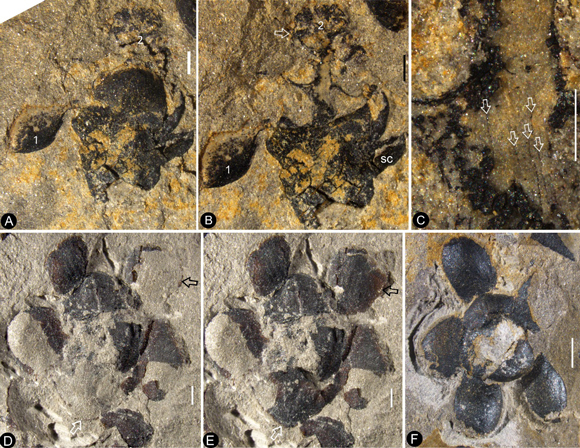
Specimens of the Newly Described Early Jurassic Flowering Plant Nanjinganthus dendrostyla
Views of individual specimens of Nanjinganthus, a flowering plant from the Early Jurassic.
Picture credit: (NIGPAS)
The newly described plant has been named Nanjinganthus dendrostyla and it comes from the South Xiangshan Formation (Nanjing, eastern China), which has been studied extensively since the turn of the century and is famous for its abundant plant fossils, which up until now had consisted of cycads, ferns, ginkgoes and horsetails. Researchers from the Nanjing Institute of Geology and Palaeontology of the Chinese Academy of Sciences (NIGPAS), have been able to identify the earliest known examples of a flowering plant, one that predates most of the angiosperm fossil material by around 50 million years.
Fossils Catching Up with the Molecular Clock
Analysis of the genetic data contained in living plant taxa indicates that plants probably evolved earlier than previously thought. In a study published in February, researchers from the Chinese Academy of Sciences as well as Bristol University, mapped the genetic make-up of 644 types of plant and concluded, based on molecular dating, flowering plants (angiosperms), probably evolved sometime between the Late Permian and the Late Jurassic.
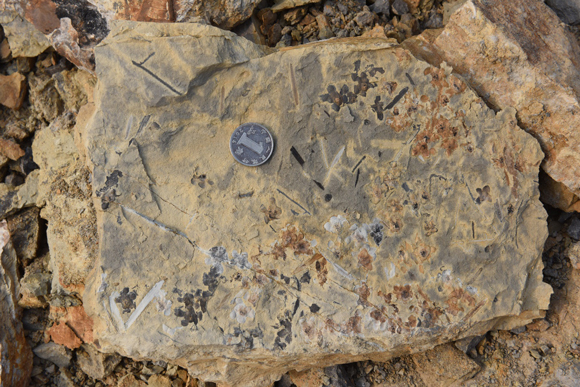
The researchers studied a total of 264 specimens representing 198 individual flowers preserved on 34 slabs of stone. The scientists had the luxury of working on so many examples of the same fossil organism. They produced numerous high resolution images of the flowers allowing the features of N. dendrostyla to be revealed in great detail. With so many fossil specimens, the scientists were able to exclude other plant types and confirm that the fossils do indeed represent an angiosperm.
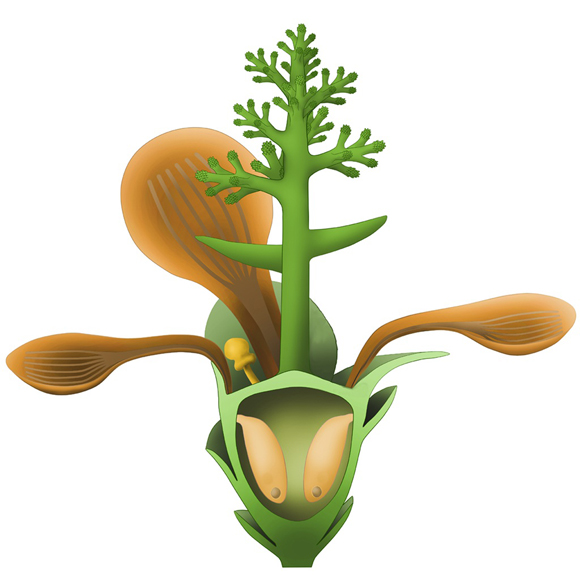
A Life Reconstruction of the Earliest Flowering Plant Described to Date
A life reconstruction of the flowering plant Nanjinganthus dendrostyla from the Early Jurassic of China.
Picture credit: (NIGPAS)
Commenting on the significance of the study, one of the researchers Wang Xin (NIGPAS), stated:
“The origin of angiosperms has long been an academic headache for many botanists. Our discovery has moved the botany field forward and will allow a better understanding of angiosperms.”
Identifying a Key Feature of Angiosperms
The scientists were able to identify the presence of fully enclosed ovules in the fossilised flowers. These are the precursors of seeds before pollination. The reconstructed flower was found to have a cup-form receptacle and ovarian roof that together enclosed the ovules/seeds. This botanical feature confirms that Nanjinganthus dendrostyla is definitely an angiosperm.
Numerous Examples of N. dendrostyla Preserved in Siltstone
One of the fossil blocks containing examples of Nanjinganthus (South Xiangshan Formation, China).
Picture credit: (NIGPAS)
Fossil Flowers in Jurassic Rocks
Discoveries of angiosperm-like fossils have been reported from Jurassic rocks before. In January (2018), Everything Dinosaur published an article on the remarkable discovery of fossilised wing scales from butterflies and moths that lived during the Late Triassic. This discovery challenged the theory of co-evolution between flowering plants and pollinating insects such as members of the Lepidoptera.
The morphological features of Nanjinganthus distinguish it from other specimens and suggest that it is a new angiosperm genus.
The scientists hope to determine whether angiosperms are monophyletic (all flowering plants share a common ancestor). If this is the case and Nanjinganthus is one of the earliest of all the flowering plants, then these fossils represent a stem group giving rise to all later species. Angiosperms could also be polyphyletic, (a group descended from more than one common ancestor), meaning Nanjinganthus represents an evolutionary dead end and subsequently, it did not give rise to later types of flowering plant.