Volgatitan simbirskiensis – Early Cretaceous Leviathan
A team of palaeontologists from Russia have announced the discovery a new genus of titanosaur from fossil bones found on the western bank of the River Volga close to the village of Slantsevy Rudnik in Ulyanovsk Oblast (western Russia). The dinosaur has been named Volgatitan simbirskiensis, it is one of a trio of sauropods recently described from Russian deposits, the others being Tengrisaurus starkovi and Sibirotitan astrosacralis, both of these herbivorous, long-necked dinosaurs were named and described in 2017.
Volgatitan simbirskiensis
V. simbirskiensis has been named based on the study of seven tail bones (caudal vertebrae), the first of which were discovered following a rock fall on the Volga River back in 1982.
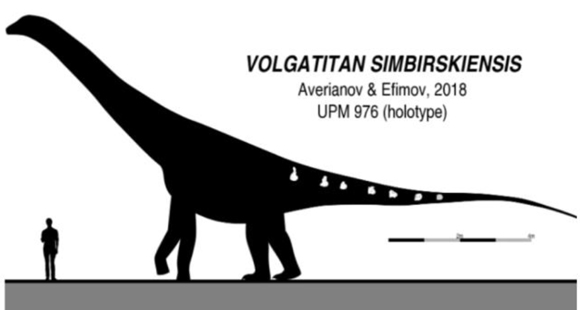
A Scale Drawing of Volgatitan simbirskiensis Showing the Anatomical Position of the Known Fossil Material
A reconstruction of Volgatitan simbirskiensis with a human being shown for scale.
Fortunately, for the Sauropoda, vertebrae can be quite diagnostic when it comes to ascribing new genera. Titanosaurs for example, have distinctive shaped caudal vertebrae, especially towards the base of the tail (proximal end close to the hips). The proximal tail bones of titanosaurs are procoelous (pronounced pro-see-lus), that is, the front face of the bone is concave and the opposite face, the bit that points in the direction of the tail, is bulbous (convex).
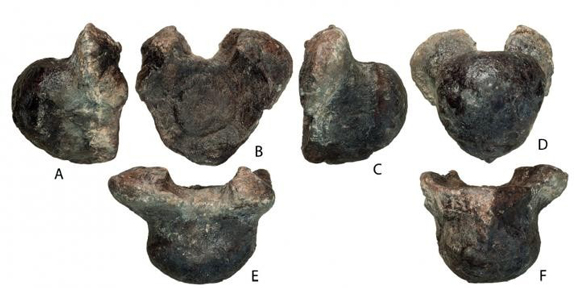
Views of the Holotype Caudal Vertebra of V. simbirskiensis
Views of a Volgatitan caudal vertebra.
Picture credit: Alexander Averianov and Vladimir Efimov
The photograph (above) shows the holotype caudal vertebra of Volgatitan simbirskiensis in right lateral (A), anterior (B), left lateral (C), posterior (D), dorsal (E) and ventral (F) views.
Dinosaur Nomenclature
The dinosaur’s genus honours the Volga River, whilst the trivial name is in honour of the old name for the city of Ulyanovsk (Simbirsk), after all, the fossils were found just three miles to the north of the city. Aleksandr Averianov, one of the authors of a scientific paper describing this new titanosaur, published in the journal “Biological Communications”, explained that the description of dinosaur taxa in recent years has become possible due to the progress in understanding the anatomy and phylogeny of the Dinosauria. Furthermore, the recent Russian sauropod discoveries have allowed scientists to learn more about how these species of lizard-hipped reptiles had lived and developed.
Based on comparisons with the fossilised bones of more complete titanosaurs, Volgatitan is estimated to have been around 16 metres long. Fully fused neural arches on the centrum from the most proximal of the caudal vertebrae indicate that the bones came from a fully, mature adult animal.
It had been thought that titanosaurs evolved in the Southern Hemisphere, specifically South America, with some taxa migrating into North America, Asia and Europe later in the Cretaceous. However, the formal description of Volgatitan coming so soon after the naming of Tengrisaurus from the Early Cretaceous of Transbaikal Region, suggests that Early Cretaceous titanosaurs were more widely distributed. It is possible to postulate that important stages in the evolution of this group of long-necked dinosaurs may have taken place in eastern Europe and Asia.
The seaside town of Hastings in East Sussex is steeped in history. It is synonymous with the battle that began the Norman conquest back in 1066 but scientists have been aware for many years that the cliffs to the east of the town contain evidence of much older inhabitants – dinosaurs. Researchers from the Department of Earth Sciences at Cambridge University have published a paper this week documenting dozens of Early Cretaceous dinosaur tracks and footprints that represent at least seven different kinds of dinosaur.
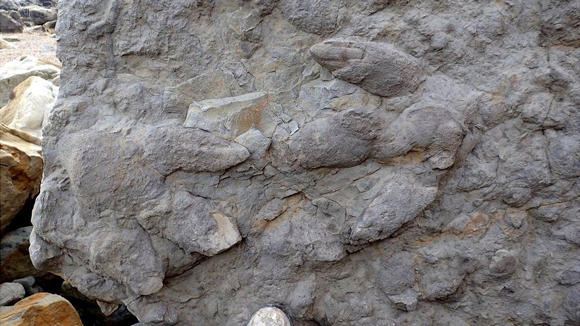
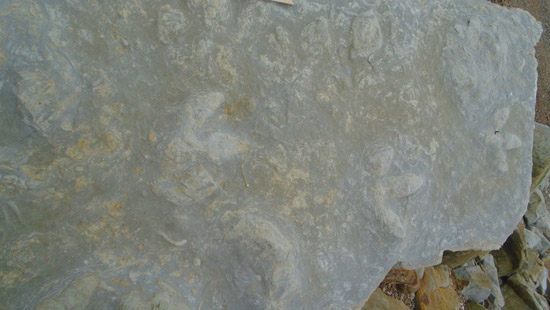
Two Iguanodontian Prints from the Lee Ness Sandstone (Ashdown Formation) Exposed at Hastings
Examples of two iguanodontian footprints from the Lee Ness Sandstone (Ashdown Formation).
Picture credit: Neil Davies/University of Cambridge
A Rich and Diverse Dinosaur Fauna
The footprints and trackways were identified and mapped by a team of researchers from Cambridge University between 2014 and 2018, following periods of extensive coastal erosion along the cliffs to the east of Hastings. The footprints range in size from 2 cm wide to over 60 cm across. These prints and tracks record a rich and diverse dinosaur fauna from the Lower Cretaceous – Lee Ness Sandstones (Ashdown Formation), which date from approximately 140 million years ago (Berriasian faunal stage of the Cretaceous).
The exact age of the Lee Ness Sandstone strata is unknown, however, the Ashdown Formation is estimated to be around 145-133 million years old, based on relative dating of ostracod fossils.
The researchers, writing in the academic journal ” Palaeogeography, Palaeoclimatology, Palaeoecology”, report on more than 85 exceptionally well-preserved dinosaur footprints, comprising prints from at least seven different types of dinosaur (ichnogenera). They document the trace fossils eroding out of cliffs and their work records the greatest diversity of dinosaurs in a single location in Cretaceous-aged rocks found in the UK. In particular, a variety of armoured dinosaurs (Thyreophora) are represented.
One of the Many Different Types of Armoured Dinosaur Print Found
A footprint ascribed to an armoured dinosaur (Thyreophora) from the Lee Ness Sandstone (Ashdown Formation). The print has been assigned to the Tetrapodosaurus ichnogenus.
Picture credit: Neil Davies/University of Cambridge
Details of Skin, Scales and Claws are Visible
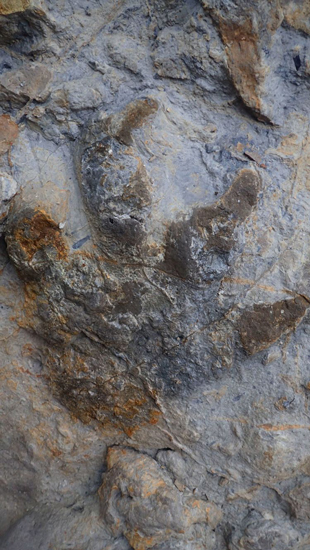
The trace fossils are preserved in remarkable detail. Impressions of skin, scales and even toe claw impressions have been preserved.
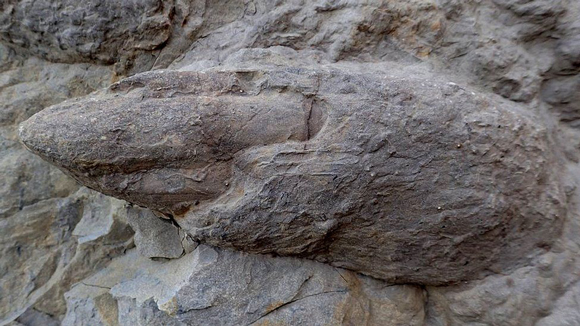
A Close View of an Iguanodontian Print Showing a Distinct Claw Impression
A close view of an iguanodontian claw impression preserved within one of the dinosaur footprints.
Picture credit: Neil Davies/University of Cambridge
An Iguanodontian Footprint with Preserved Skin Impressions
Some of the tracks from recent rock falls show skin impressions. This is the skin impression from the underside of an iguanodontian footprint.
Picture credit: Neil Davies/University of Cambridge
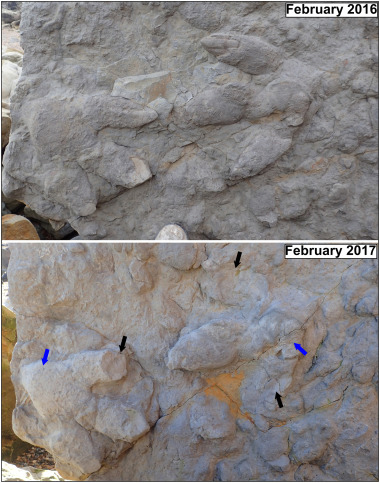
The best preserved prints come from large blocks of stone that are mapped and photographed after recently falling from the cliff. The tracks are quickly eroded with prolonged exposure to the elements and from damage caused by further rock falls. When dealing with a rapidly eroding cliff, it is essential that any fresh rock falls are examined and any fossils contained within the blocks are mapped and measured.
Two Photographs (February 2017 and February 2016) Showing the Extent of the Trace Fossil Erosion
The effect of weathering on the trace fossils. Over 12 months the tracks are heavily eroded.
Picture credit: Neil Davies/University of Cambridge
Wealden Group Trace Fossils
The Ashdown Formation is part of the Wealden Group of rock formations, the most important sequence of dinosaur fossil bearing strata in England. Numerous fossilised footprints are associated with the Wealden Group and the first report of tracks was made in 1846 by the Reverend Tagart, who described a series of three-toed prints, which he thought had been made by giant birds. Never before has such a diverse footprint assemblage been mapped and documented in the British Isles.
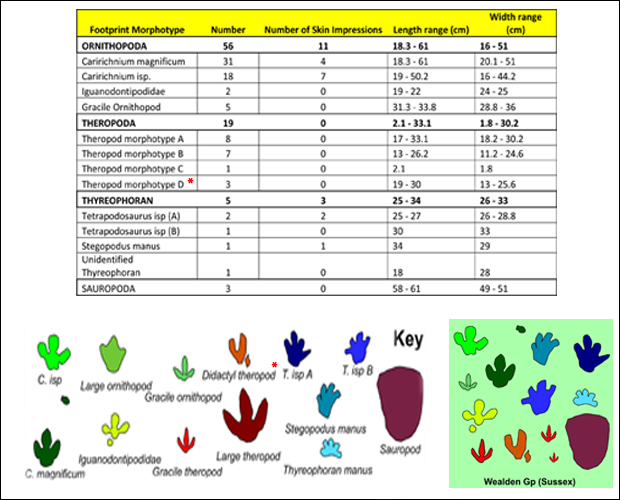
A Table Showing the Different Types of Dinosaur Footprint (Morphotypes) Mapped at the Location
A table showing the number and characteristics of the Hastings dinosaur footprint fossils.
Table credit: Palaeogeography, Palaeoclimatology, Palaeoecology with additional notation from Everything Dinosaur
One of the authors of the scientific paper, Anthony Shillito, a PhD student in Cambridge’s Department of Earth Sciences commented:
“Whole body fossils of dinosaurs are incredibly rare. Usually you only get small pieces, which don’t tell you a lot about how that dinosaur may have lived. A collection of footprints like this helps you fill in some of the gaps and infer things about which dinosaurs were living in the same place at the same time.”
Different Kinds of Theropod Dinosaurs
The footprints along with the various plant fossils and invertebrate trace fossils (burrows), are helping the scientists to put together a picture of life in this part of the world in the Early Cretaceous. Dinosaurs dominated the biota, with several different types of meat-eating dinosaur (theropods) identified, including a potential dromaeosaurid-like dinosaur, as two-toed prints (didactyl) have been found.
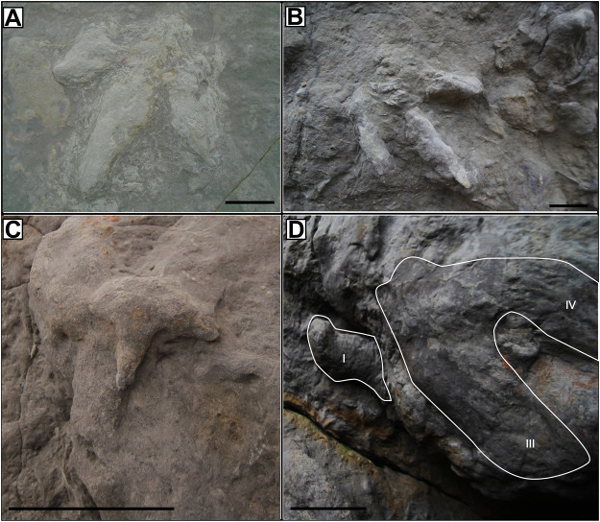
Different Types of Theropod Track Have Been Found
Examples of different types of theropod footprint (Lee Ness Sandstone – Ashdown Formation).
Picture credit: Neil Davies/University of Cambridge
Footprints of Dinosaurs
The picture above shows four different types of theropod footprint identified at the Hastings site. Picture (A) shows a large tridactyl (three-toed) cast with a long digit III and a faint heel impression. The footprint in (B), is also large but the toes are narrower and elongated, maintaining a consistent width for their whole length. The cast has no heel pad impression. The theropod morphotype (C), represents a much smaller animal with digit III being much longer than digits II and IV. Intriguingly, the researchers have also logged potential two-toed prints (D), this suggests that this floodplain, braided environment might have been home to dromaeosaurid-like dinosaurs.
PhD student Shillito added,
“You can get some idea about which dinosaurs made them from the shape of the footprints, comparing them with what we know about dinosaur feet from other fossils lets you identify the important similarities. When you also look at footprints from other locations you can start to piece together which species were the key players.”
Although, the majority of the footprints have been ascribed to ornithopods, and several are referred to as iguanodontian, none of these prints were made by a member of the Iguanodon genus. Iguanodon (I. bernissartensis), lived many millions of years after these prints were formed. There have been many different types of iguanodont described, it is possible that the larger prints were made by an animal such as Barilium dawsoni. The slightly smaller prints could have been created by the iguanodontid Hypselospinus (H. fittoni).
The Three-toed Tracks of a Small Ornithopod Dinosaur
Trackway assigned to a small, ornithopod dinosaur.
Picture Credit: Neil Davies/University of Cambridge
Dinosaurs Helping to Shape the Environment
Anthony Shillito is focusing on the role played by dinosaurs in terms of shaping their environment, how dinosaurs behave as zoogeomorphic agents. Large animals today, such as elephants and hippos can alter their habitats as they interact with their environment. Hippos for example, can create river channels and divert the course of water flow. Dinosaurs very probably did the same, with larger dinosaurs having a bigger impact than smaller dinosaurs.
The student commented:
“Given the sheer size of many dinosaurs, it’s highly likely that they affected rivers in a similar way, but it’s difficult to find a ‘smoking gun’, since most footprints would have just washed away. However, we do see some smaller-scale evidence of their impact; in some of the deeper footprints you can see thickets of plants that were growing. We also found evidence of footprints along the banks of river channels, so it’s possible that dinosaurs played a role in creating those channels.”
Evidence of Sauropods?
Footprint evidence indicating the largest dinosaurs of all, the presence of sauropods is virtually absent from the site. Three poorly preserved trace fossils have been tentatively ascribed to the Sauropoda, although they are very indistinct and could represent under traces representing the tracks of other ichnogenera.
It is very likely that there are many more dinosaur footprints hidden within the eroding sandstone cliffs of East Sussex, but the construction of sea defences in the area to slow or prevent the process of coastal erosion may mean that they remain locked away within the rocks.
The scientific paper: “Dinosaur-landscape Interactions at a Diverse Early Cretaceous Tracksite (Lee Ness Sandstone, Ashdown Formation, southern England)” by Anthony P. Shillito and Neil S. Davies published in Palaeogeography, Palaeoclimatology, Palaeoecology.
The ankylosaurid named Zuul (Z. crurivastator), is the centrepiece of a new exhibition that opened this week at the Royal Ontario Museum, (Canada). The exhibition is entitled “ZUUL: Life of an Armoured Dinosaur” and it tells the tale of how this beautifully-preserved dinosaur fossil was discovered and what it can tell us about life in the Late Cretaceous some 76 million years ago.
Zuul – Destroyer of Shins
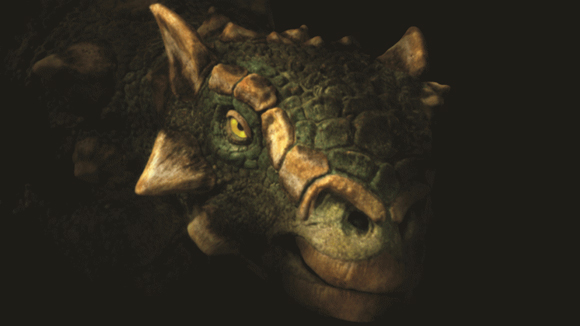
A life reconstruction of the giant armoured dinosaur from Montana Zuul crurivastator.
Picture credit: Royal Ontario Museum
Commenting on this new addition to the Museum’s galleries, Royal Ontario Museum Director and CEO Josh Basseches stated:
“We are thrilled to be introducing Toronto and the world to an extraordinary new dinosaur. The acquisition of Zuul represents a significant new addition to our globally renowned collection of dinosaurs and fauna. With the generous support of presenting sponsor Sinking Ship Entertainment, and our team of renowned palaeontologists and exhibition developers, we look forward to presenting a truly unique exhibition that will inspire and delight visitors of all ages.”
Cutting Edge Technology to Showcase Ancient Armoured Giant
The exhibition uses a combination of engaging video games, digital images and animations along with full-sized murals that recreates northern Montana/southern Alberta during the Campanian faunal stage of the Late Cretaceous.
This is the first time that the fossilised remains of Zuul have been put on display anywhere in the world. Touchscreens will let visitors rotate 3-D views of Zuul’s original fossil pieces, while life-size touchable bronze models of Zuul’s skull, armour, skin, and tail club will permit visitors to feel what it would have been like to touch the living dinosaur. An animal named after a monster from the 1984 film “Ghostbusters”, Zuul was named in honour of the horned, demi-god Zuul, the Gatekeeper of Gozer from the movie.
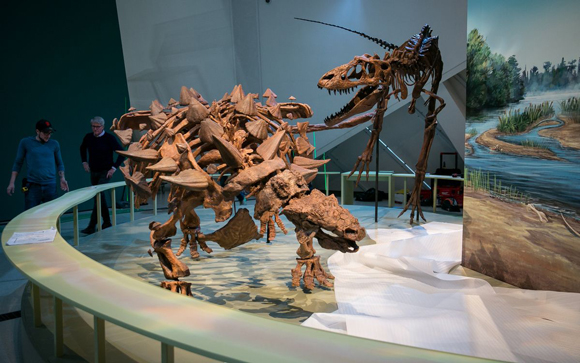
A Replica of the Zuul Fossil Material Being Attacked by a Gorgosaurus
A replica of the Zuul fossil material being attacked by a tyrannosaurid (Gorgosaurus).
Picture credit: Royal Ontario Museum
Dr David Evans, the exhibition’s lead curator and one of the palaeontologists that formally named and described this ankylosaur, commented:
“In this multi-faceted exhibition, visitors will see the breath-taking Zuul fossil up close and through a treasure trove of incredible fossils found alongside the skeleton, learn more about Zuul’s diverse ancient world. Zuul: Life of an Armoured Dinosaur will spark curiosity about our distant past and the evolution of life over time.”
To read Everything Dinosaur’s article on the discovery of this remarkably complete (95% of the skeleton has been preserved), armoured dinosaur: Zuul – The Destroyer of Shins.
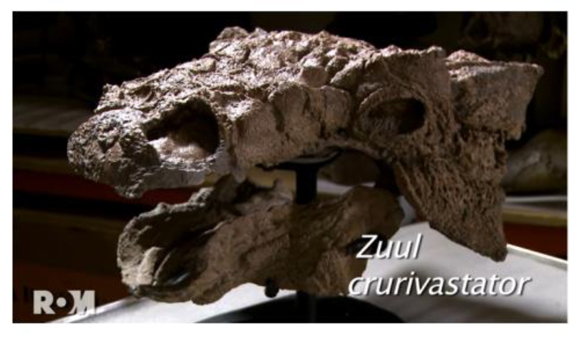
The Beautiful and Fantastically-well Preserved Skull of Zuul crurivastator will be on Display as Part of the Exhibit
The beautifully-preserved skull of Zuul crurivastator will be on display as part of the exhibit.
Picture credit: Royal Ontario Museum
Safari Ltd recently introduced a model of this armoured dinosaur.
Heralding from the famous Judith River Formation, Zuul crurivastator is one of the most complete ankylosaur fossils ever found. It has a complete skull and tail club as well as preserved skin and other soft tissues that will provide a rare and exciting opportunity for new, cutting-edge scientific research. Zuul was acquired by the ROM in 2016 through the generous support of the Louise Hawley Stone Charitable Trust.
Everything Dinosaur acknowledges the assistance of a press release from the Royal Ontario Museum in the compilation of this article.
Study Finds Four Types of Feather-like Structures in Pterosaur Fossils
Most palaeontologists have accepted that it is likely that pterosaurs (flying reptiles), were covered in a sort of hairy fuzz, technically referred to as pycnofibres, that helped insulate their bodies and keep them warm. However, an international team of scientists from Hong Kong University, Nanjing University (China), University College Cork, University College Dublin (Ireland), the Foundation for Scientific Advancement, (Arizona, USA), the Chinese Academy of Sciences and Bristol University (UK) have published a scientific paper that describes four kinds of feather-like structures associated with the fossilised remains pterosaurs.
If these structures are feathers, then this suggests that either the Pterosauria evolved feathers as a form of convergent evolution, or, that feathers evolved many millions of years earlier than previously thought – in a common ancestor of the Dinosauria and the Pterosauria.
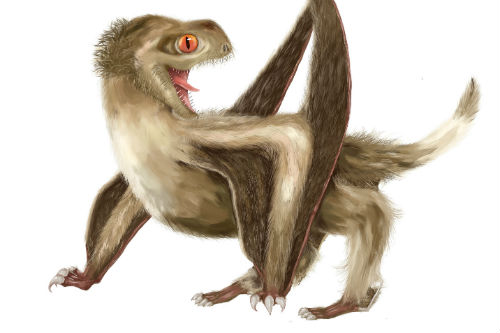
A Life Reconstruction of the Chinese Anurognathid Pterosaur
Daohugou pterosaur life reconstruction. Fossil evidence indicates that pterosaurs may have had at least four types of feathers.
Picture credit: Yuan Zhang
Two Anurognathid Pterosaur Specimens Studied
Writing in the academic journal “Nature Ecology and Evolution”, the scientists report how high-resolution microscopy revealed evidence of different kinds of pycnofibres on two pterosaur fossils (representing anurognathids), from the Daohugou Formation in Inner Mongolia. Although, when the rocks that make up the Daohugou Formation were deposited has been debated and the relative dating of these sediments in relation to other Chinese Jurassic/Early Cretaceous formations has proved controversial, it is suggested that the pterosaurs, one of which represents a new species, lived approximately 160 million years ago.
Four feather-like structures were identified:
simple filaments (hairs)
bundles of filaments
filaments with a tuft halfway down the shaft
down feathers
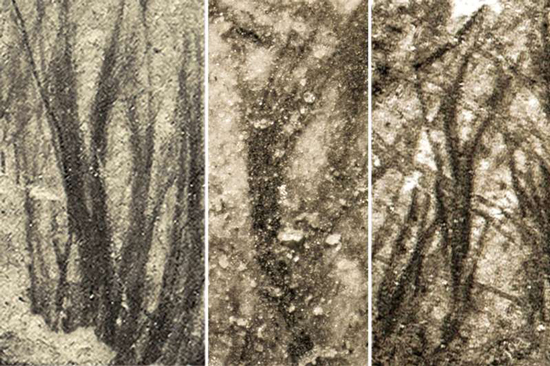
The Scientists Identified Four Types of Feather-like Structures in the Fossils
Close-up views of different types of feather-like filaments identified in pterosaur fossils.
Picture credit: Yang, Jiang, McNamara et al
An Amazing Pterosaur Discovery
One of the paper’s authors, Dr Maria McNamara (University College Cork), stated that some critics have suggested that there is only one simple hair-like type of pycnofibre, but this study shows different structures that we also see in dinosaurs, in essence real feathers. Furthermore, the team identified melanosomes that indicate that some flying reptiles may have been coloured a sort of reddish brown.
Dr McNamara explained:
“We focused on areas where the feathers did not overlap and where we could see their structure more clearly. They even show fine details of pigment granules, which may have given the fluffy feathers a ginger colour. This discovery has amazing implications for our understanding of the origin of feathers, but also for a major time of revolution of life on land. When feathers arose, about 250 million years ago, life was recovering from the devastating end-Permian mass extinction.”
The Enigmatic Anurognathidae
Only a handful of anurognathid fossils are known and only a few species have been assigned to this pterosaur family. Although, the first anurognathids were described from Upper Jurassic deposits of Bavaria (Solnhofen limestone), the best preserved and most complete specimens came from the Daohugou Beds of Inner Mongolia. Since these types of small, short-faced flying reptiles are known from Europe, South Korea, China and potentially North America, they seem to have been geographically widespread. Although very rare, the Daohugou Bed fossil specimens have some soft tissue and muscle outline preservation and have provided palaeontologists with a lot of information on pterosaur anatomy.
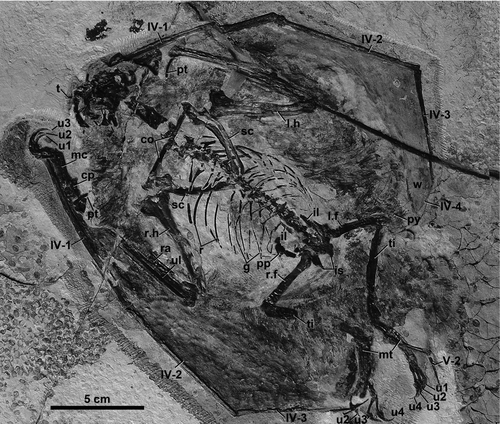
An Anurognathid Pterosaur from the Daohugou Beds – Jeholopterus ninchengensis
Pterosaur material from the Daohugou Beds. This is a fossil specimen of the anurognathid pterosaur Jeholopterus ninchengensis.
Picture credit: Chinese Academy of Sciences/Journal of Vertebrate Palaeontology
Re-writing the History of the Evolution of Feathers
Feathers are essentially highly modified scales; this new research could potentially re-write the evolutionary history of feathers. One of the authors, Professor Mike Benton (Bristol University), explained:
“We ran some evolutionary analyses and they showed clearly that the pterosaur pycnofibres are feathers, just like those seen in modern birds and across various dinosaur groups. Despite careful searching, we couldn’t find any anatomical evidence that the four pycnofibre types are in any way different from the feathers of birds and dinosaurs. Therefore, because they are the same, they must share an evolutionary origin, and that was about 250 million years ago, long before the origin of birds.”
Birds have two types of advanced feathers used in flight and for body smoothing, the contour feathers with a hollow quill and barbs down both sides. These types of feathers are found only in birds and the theropod dinosaurs close to the evolutionary origins of the Aves (birds). However, the other feather types of modern birds include monofilaments and down feathers, and these are seen much more widely across dinosaurs and pterosaurs.
Growth Suppressed
The armoured dinosaurs and the giant sauropods probably did not have feathers, but they were likely suppressed, meaning they were prevented from growing, at least in the adults, just as hair is suppressed in large-bodied animals today such as cetaceans, hippos and elephants.
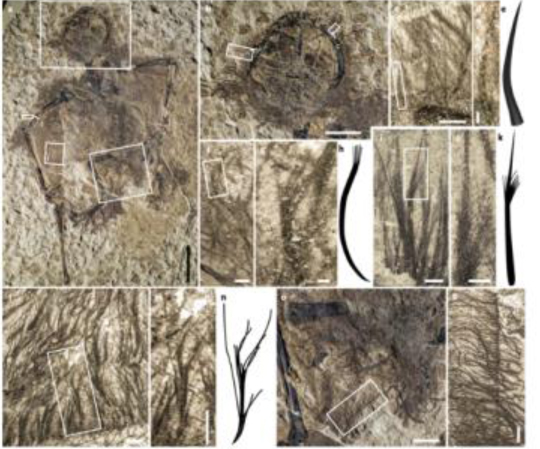
High Resolution Microscopy Revealed Different Types of Feather-like Structures
Different types of integumentary filamentous structures identified in specimen number CAGS-Z070.
Picture credit: Yang, Jiang, McNamara et al
Professor Benton added:
“This discovery has amazing implications for our understanding of the origin of feathers, but also for a major time of revolution of life on land. When feathers arose, about 250 million years ago, life was recovering from the devasting end-Permian mass extinction. Independent evidence shows that land vertebrates, including the ancestors of mammals and dinosaurs, had switched gait from sprawling to upright, had acquired different degrees of warm-bloodedness, and were generally living life at a faster pace.”
He went on:
“The mammal ancestors by then had hair, so likely the pterosaurs, dinosaurs and relatives had also acquired feathers to help insulate them. The hunt for feathers in fossils is heating up and finding their functions in such early forms is imperative. It can rewrite our understanding of a major revolution in life on Earth during the Triassic, and also our understanding of the genomic regulation of feathers, scales, and hairs in the skin.”
Different Kinds of Pycnofibres – Different Functions?
Pterosaurs were the first back-boned animals to evolve powered flight. However, following their extinction at the end of the Cretaceous, they left no living close relatives, nor indeed any near related analogues for scientists to study. Whilst the presence of pycnofibres on the bodies of these flying reptiles is quite well accepted by the scientific community, their functions are not fully understood. If different types of feather-like structures have been identified in two anurognathid pterosaur specimens, it is likely that other types of pterosaur had them too.
These different feather-like structures probably served a variety of functions, perhaps the first “pterosaur fuzz” evolved to provide insulation and then other types evolved perhaps to aid tactile sensing, visual communication and to assist with flight.
The scientific paper: “Pterosaur Integumentary Structures with Complex Feather-like Branching” by Z. Yang, B. Jiang, M. McNamara, S. Kearns, M. Pittman, T. Kaye, P. Orr, X. Xu and M. Benton and published in Nature Ecology and Evolution.
Everything Dinosaur acknowledges the assistance of a press release from Bristol University in the compilation of this article.
It might be an extremely busy time of year for Everything Dinosaur, but our focus on customer service has not been diminished, as demonstrated by the UK-based company continuing to achieve a 5-star Feefo rating. Feefo is an independent customer service and product rating organisation. This business is working hard to become the world’s most trusted supplier of reviews and feedback about purchases and service. Each review is genuine and comes from a bona fide Everything Dinosaur customer. This is genuine feedback that other customers and site visitors can trust and rely upon.
Everything Dinosaur Maintains Top Marks – Feefo Independent Rating
Everything Dinosaur Feefo rating December 2018. Over six hundred customer reviews are currently on-line and Everything Dinosaur continues to maintain top marks.Picture credit: Everything Dinosaur.
Picture credit: Everything Dinosaur
5-star Customer Service
Currently, there are over six hundred customer reviews on-line. Everything Dinosaur continues to maintain a top rating of 5-stars for its customer service. The company’s average product rating is very high too, standing at 4.8 out of a maximum of 5, not bad at all when you consider that Everything Dinosaur has some of the lowest prices around for dinosaur themed merchandise and models.
A spokesperson for Everything Dinosaur commented:
“At this time of year, we tend to get extremely busy and it is all hands to the pump, however, we continue to maintain our reputation for top-class customer service. We are doing all we can to ensure that orders are despatched promptly, this gives these parcels every chance of being able to reach their destinations in time for Christmas.”
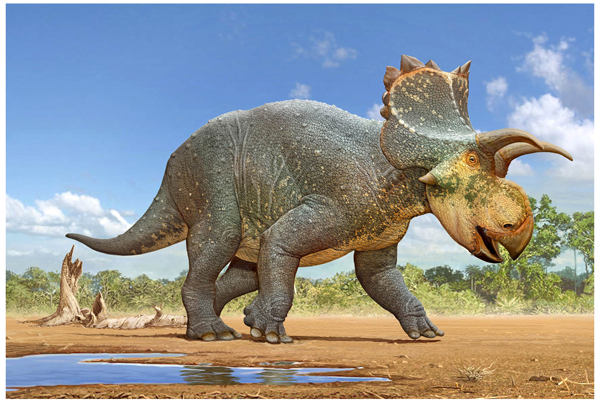
Crittendenceratops krzyzanowskii – A New Horned Dinosaur from Arizona
Many scientists and observers have described the last two decades as the “Golden Age” of dinosaur discoveries. Since the turn of the century, there have been some astonishing fossil finds and many new species of dinosaur have been discovered and described. None more so than with the horned dinosaurs and their relatives (Marginocephalia).
Over the last few years, we have reported on numerous new types of ceratopsian, many of these new horned dinosaurs having been discovered in strata laid down in the United States, for example, Medusaceratops, Aquilops, Kosmoceratops and Utahceratops. Surprisingly, there had been no new horned dinosaurs named in 2018, that is no longer the case with a scientific paper published describing a new centrosaurine dinosaur from the Late Cretaceous of Arizona – Crittendenceratops krzyzanowskii.
A Life Reconstruction of the Newly Described Ceratopsian Crittendenceratops krzyzanowskii
A life reconstruction of the newly described ceratopsian Crittendenceratops (2018).
Picture credit: Sergey Krasovskiy
Only a Few Dinosaurs Named from Arizona
Writing in the New Mexico Museum of Natural History and Science Bulletin, the researchers, Sebastian G. Dalman and Asher Lichtig, both Research Associates at the New Mexico Museum of Natural History and Science, in collaboration with John-Paul Hodnett from the Maryland-National Capital Parks Commission and Spencer G. Lucas (a curator at the New Mexico Museum of Natural History and Science), describe Crittendenceratops and assign it the Centrosaurinae subfamily of horned dinosaurs and specifically to the Nasutoceratopsini tribe.
There have been so many new horned dinosaurs from North America named and described in the last twenty years or so, that this has led to a revision of ceratopsian taxonomy. For example, the Nasutoceratopsini was erected recently (2016).
Despite the wealth of dinosaur fossil material associated with the western United States, Crittendenceratops is one of only a handful of dinosaurs named from Arizona.
A Reconstruction of the Parietosquamosal Frill of C. krzyzanowskii
A line drawing showing a reconstruction of the parietosquamosal frill of Crittendenceratops krzyzanowskii.
Picture credit: New Mexico Museum of Natural History and Science
Crittendenceratops krzyzanowskii from the Fort Crittenden Formation
This new herbivore has been described from fragmentary fossil material, including skull elements from the shale member of the Fort Crittenden Formation. Two individual animals are represented by the fossils. Crittendenceratops is estimated to have been around 3.5 metres in length and would have weighed about 750 kilograms. It lived 73 million years ago (Campanian stage of the Cretaceous) and the rocks that yielded the bones were deposited along the margins of a large lake that was present in an area southeast of Tucson, Arizona.
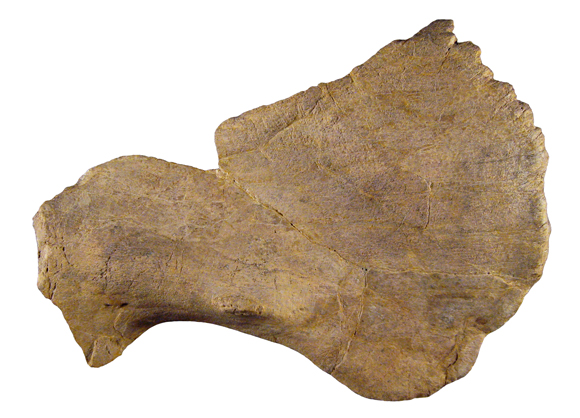
The Nearly Complete Left Squamosal (Skull Bone) of Crittendenceratops
Left squamosal bone of Crittendenceratops (NMMNH P-34906) dorsal view.
Picture credit: New Mexico Museum of Natural History and Science
Honouring Stan Krzyzanowski
The new species was named by Sebastian G. Dalman, John-Paul Hodnett, Asher Lichtig and Spencer G. Lucas. The genus name reflects the rock formation where the fossils were found (Fort Crittenden Formation), whereas the trivial name honours the late Stan Krzyzanowski, a Research Associate from the New Mexico Museum of Natural History and Science, who discovered the first bones to be ascribed to this new dinosaur in the Adobe Canyon area eighteen years ago. Crittendenceratops can be distinguished from other members of the Centrosaurinae subfamily by the unique shape of the bones in its frill.
The scientific paper: “A New Ceratopsid Dinosaur (Centrosaurinae Nasutoceratopsini) from the Fort Crittenden Formation Upper Cretaceous (Campanian) of Arizona” by Spencer G. Lucas, Sebastian Dalman, Asher Lichtig and John-Paul Michael Hodnett published in the New Mexico Museum of Natural History and Science Bulletin.
Everything Dinosaur acknowledges the assistance of a press release from the New Mexico Museum of Natural History and Science in the compilation of this article.
Subscribers to Everything Dinosaur’s regular newsletter have been kept up to date with all our special offers for Christmas. In addition, newsletter readers have had the chance to reserve the new for January 2019, Rebor limited edition “Club Selection” Hatching Baryonyx “Hurricane” as well as to ensure they are amongst the first in the world to receive the forthcoming Eofauna Scientific Research Giganotosaurus scale model.
Countdown to Christmas – Special Offers from Everything Dinosaur
Countdown to Christmas! Everything Dinosaur offers the Rebor “Vanilla Ice” tyrannosaurid figures Mountain and Jungle as a pair. Picture credit: Everything Dinosaur.
Picture credit: Everything Dinosaur
Beasts of the Mesozoic “Raptors”
Everything Dinosaur stocks the full range of these amazing 1/6th scale, Beasts of the Mesozoic articulated dinosaur figures, including the difficult to acquire accessory sets and the build-a-raptor kits. The Beasts of the Mesozoic dinosaur figures are targeted at discerning replica and figure collectors. All the figures are hand-painted and articulated and these prehistoric animal models are great to display. Everything Dinosaur is the exclusive European distributor for the Beasts of the Mesozoic range of models.
Beasts of Mesozoic figures available from Everything Dinosaur.Picture credit: Everything Dinosaur.
Picture credit: Everything Dinosaur
Kaiyodo Sofubi Toy Box T. rex Models and Trilobite Soft Toys
The Everything Dinosaur December newsletter also featured an update on the articulated, very rare, Kaiyodo Sofubi Toy Box Tyrannosaurus rex figures from Japan. All three colour variations including “smoke green” and the “classic” colouration are still available, but stocks are getting low. Safely arrived at our warehouse is a new soft toy, a wonderful example of Palaeozoic plush! We have a cute and cuddly trilobite soft toy in stock. The soft toy trilobite measures a fraction over 16 centimetres in length and we know the eyes are wrong (Trilobita had compound eyes), however, the soft toy is so wonderful we had to add it to our soft toy range.
A Perfect Pair – Kaiyodo Sofubi Toy Box Tyrannosaurs and a Soft and Cuddly Trilobite
Kaiyodo Tyrannosaurus rex figures and a soft toy trilobite.Picture credit: Everything Dinosaur.
Picture credit: Everything Dinosaur
To see the range of prehistoric plush in stock at Everything Dinosaur: Dinosaur Soft Toys.
Priority Reserve Lists for January Releases are Now Open
Our newsletter also featured an update on what is coming out early in 2019. Our reserve list for the forthcoming (January release), Rebor Club Selection limited edition hatching Baryonyx “Hurricane” has now opened and subscribers have been given VIP access to this figure, after all, only 1,000 “Hurricanes” have been made. Team members promise to set aside figures for list members and then email them to let them know that their hatching Baryonyx is available to purchase.
Priority Reserve Lists Open for New Rebor and Eofauna Scientific Research Figures
Reservation lists open for new dinosaur models. Picture credit: Everything Dinosaur.
Picture credit: Everything Dinosaur
Furthermore, our December newsletter featured an update on the eagerly anticipated Eofauna Scientific Research 1:35 scale Giganotosaurus model. This beautifully crafted model is also due to arrive in January. A reserve list has been opened and Everything Dinosaur customers have been urged to let us know their requirements to avoid disappointment when this figure is released.
To request a subscription to Everything Dinosaur’s regular newsletter, simply drop us an email: Email Everything Dinosaur.
Fossil Sea Urchin Preserves Evidence of an Attack from a Mosasaur
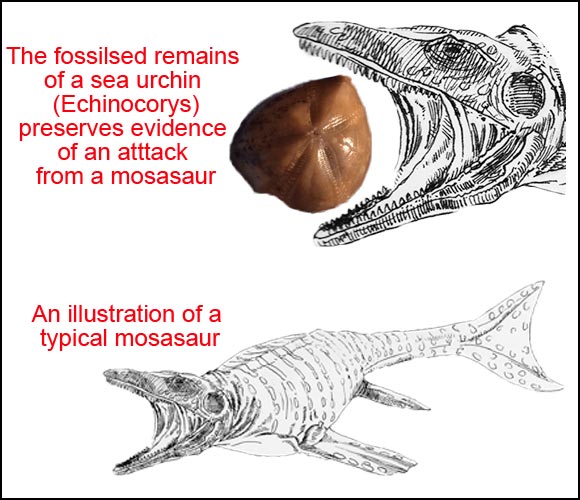
Sixty-six million years ago, in a shallow sea in what is now Denmark, a sea urchin lay partially submerged on the seabed, when a keen-eyed mosasaur spotted it and went in for the kill. The marine reptile grabbed the sea urchin and bit it, but for some reason, the attack was aborted, the invertebrate was dropped and the little sea urchin survived the encounter with the apex predator. How do we know all this? A remarkable fossil has been discovered by amateur geologist Peter Bennicke at Stevns Klint, a famous UNESCO World Heritage Site, one of the few places in the world where rock layers mark the Cretaceous-Palaeogene boundary providing evidence to support the extra-terrestrial impact event that contributed to the demise of the Dinosauria.
Fossil Provides Evidence of a Mosasaur Attack
Fossil evidence of predator/prey interaction – mosasaur attacks sea urchin. The image above shows an illustration of a typical hypercarnivorous mosasaur and an example of the fossilised test of a sea urchin. Picture credit: Everything Dinosaur.
Picture credit: Everything Dinosaur
Preserving Evidence of Predator/Prey Interactions
The stretch of chalk cliffs at Stevns Klint on the Danish island of Zealand (Sjaelland), was granted World Heritage Site status by UNESCO in 2014. The chalk deposits record the K/T boundary and the cliffs provide a record of the faunal turnover from the very end of the Cretaceous (Maastrichtian faunal stage), through to the earliest stage of the Palaeogene Period (Danian faunal stage). Sea urchin fossils are relatively common at this location, but the specimen found by Mr Bennicke is very special as it records evidence of predator/prey interaction.
The curator at the nearby Geomuseum Faxe, Jesper Milàn stated:
“It’s really an exciting find this, not only is there an exciting story to tell about it, but it also provides important information about how the animals in the Cretaceous sea lived and who ate who. It is such a find that helps put meat and blood on the otherwise dry fossils, when you can suddenly see such a small everyday drama caught in the stone.”
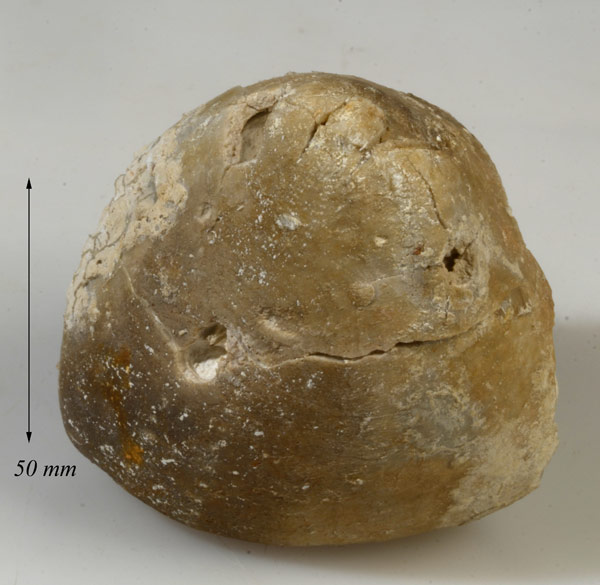
The Echinocorys Specimen Showing Evidence of a Mosasaur Attack
Echinocorys (sea urchin) fossil showing pathlogy (teeth marks from a mosasaur).
Picture credit: Jesper Milàn
What Type of Mosasaur Attacked the Sea Urchin?
The round tooth marks are located near the top of the Echinocorys specimen, suggesting that the attack came from above and it is likely that the sea urchin was partially exposed out of the sediment on the sea floor when the attack occurred. An examination of the morphology of the tooth marks and their spacing indicates that the attacker had slender teeth, that were circular in cross-section and that these teeth were spaced relatively far apart in the jaw. Two types of hypercarnivorous mosasaurids are known from Denmark – Mosasaurus hoffmanni and Plioplatecarpus spp. It could be speculated that one of these types of mosasaur was responsible for the attack.
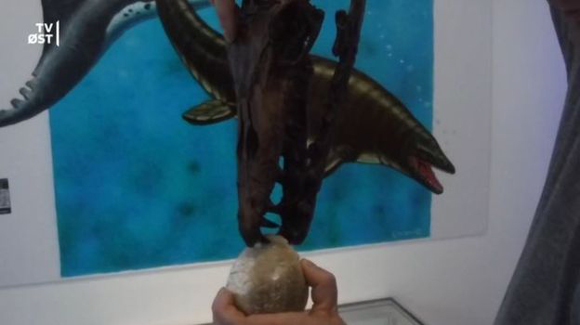
A Mosasaurid Specimen is Used to Demonstrate the Sea Urchin Attack
Demonstrating how the mosasaurid attacked the sea urchin.
Picture credit: TV OST
Lucky Escape for the Sea Urchin
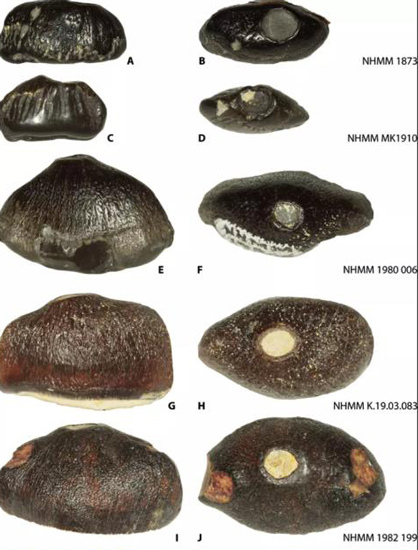
Although a mosasaurid grabbed the sea urchin, it apparently abandoned the attack. Hypercarnivores such as M. hoffmanni and Plioplatecarpus probably preyed on a variety of vertebrates and invertebrates, but their teeth are not really suited to crushing the shell of an Echinocorys. Recently, Jesper Milàn in collaboration with other scientists, reported the discovery of a single broken tooth of a mosasaur called Carinodens minalmamar. The tooth crown was found in the uppermost Maastrichtian chalk strata at Stevns Klint, indicating that this mosasaur probably lived around 50,000 years before the deposition of the iridium rich K/Pg boundary material. The shed tooth is reported to have come from the 11th or 13th position in the jaw. The tooth represents the northernmost occurrence of the genus Carinodens found to date. Carinodens minalmamar, was a very different type of predator compared to Mosasaurus hoffmanni and Plioplatecarpus, it was a specialist shell-eater (durophagus). The short, thick and rounded teeth of this type of mosasaur would have made quick work of the test of an Echinocorys.
Examples of the Teeth of Carinodens spp.
Examples of the teeth of the durophagus mosasaurid Carinodens.
Picture credit: Holwerda and Jagt
The sea urchin may count itself fortunate to have been attacked by a mosasaur more used to catching fish, sea birds and other marine reptiles. If a mosasaur such as Carinodens had grabbed the Echinocorys, then it is likely that the sea urchin would not have survived.
An exhibit telling the story of the sea urchin and who tried to eat it will open at the Geomuseum Faxe in February 2019.
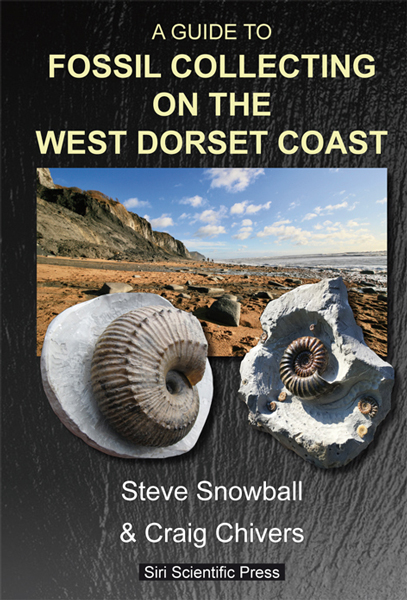
“A Guide to Fossil Collecting on the West Dorset Coast” – Book Review
At a conference in a rather chilly Helsinki held seventeen years ago this week, delegates of the World Heritage Committee of the United Nations Educational, Scientific and Cultural Organisation (UNESCO), confirmed that World Heritage Site status would be conferred upon a 95-mile stretch of the coastline of southern England covering the east Devon and Dorset coast.
In the minutes of the conference, the reason for this award was recorded:
“The Dorset and East Devon Coast provides an almost continuous sequence of Triassic, Jurassic and Cretaceous rock formations spanning the Mesozoic Era, documenting approximately 185 million years of Earth history. It also includes a range of internationally important fossil localities – vertebrate and invertebrate, marine and terrestrial – which have produced well-preserved and diverse evidence of life during Mesozoic times.”
The “Jurassic Coast”
However, this description does not convey the true majesty of this location, nor does it provide a sense of awe that this part of the British Isles inspires in so many people. Neither does it do justice to the simple pleasure of finding a fossil, gazing at it and realising that you are the first living creature in 180 million years to set eyes upon the petrified remains of what was once another inhabitant of our planet.
Then a book is published, a book that provides a sense of the stunning natural landscape, a book that transports the reader back in time, a book that conveys the sense of excitement and achievement associated with fossil collecting – “A Guide to Fossil Collecting on the West Dorset Coast” – does all this and more.
The Front Cover of “A Guide To Fossil Collecting on the West Dorset Coast”
A beautifully illustrated guide to fossil hunting on the West Dorset coast. RRP of £18.95 – highly recommended.
Picture credit: Siri Scientific Press
Conveying a Sense of Beauty, Conveying a Sense of Wonder
Authors Craig Chivers and Steve Snowball focus on one part of the “Jurassic Coast”, that beautiful coastline that runs east from Lyme Regis to the foreboding cliffs of Burton Bradstock. First the scene is set. There is a brief description of the geological setting and an outline of the contribution to science of arguably Dorset’s most famous former resident, Mary Anning, and then the reader is taken in Mary’s footsteps through a series of guided walks travelling eastwards along the coast and forwards in time to explore the geology and remarkable fossil heritage of this unique sequence of sedimentary strata.
The Book is Filled with Stunning Photographs of Fossil Discoveries
A Lower Jurassic ammonite (Becheiceras gallicum) from the Green Ammonite Member (Seatown, Dorset).
Picture credit: Siri Scientific Press (fossil found and prepared by Lizzie Hingley)
A Reference for All Collectors and Fossil Enthusiasts
Drawing on their detailed knowledge of fossil collecting, Craig and Steve describe what to look for and where to find an array of fossil specimens along this part of the “Jurassic Coast”. The landscape is vividly portrayed and the book provides a handy, rucksack-sized reference for fossil collectors, whether seasoned professionals or first time visitors to Dorset. We commend the authors for including copious amounts of helpful information on responsible fossil collecting and for publishing in full the West Dorset Fossil Collecting Code.
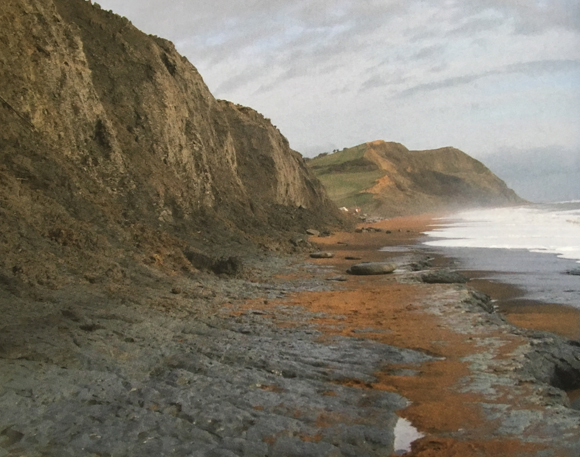
Breath-taking Views of the Natural Beauty of the Coastline
Golden Cap – excursions around Seatown. Majestic views of the “Jurassic Coast”.
Picture credit: Siri Scientific Press
Recreating Ancient Environments
Talented palaeoartist Andreas Kurpisz provides readers with digital reconstructions of ancient environments and brings to life the fossil specimens, showing them as living creatures interacting with other prehistoric animals in a series of Jurassic landscapes and seascapes. These reconstructions help to document the changing environments that are now preserved within the imposing cliffs of this remarkable part of the British coastline.
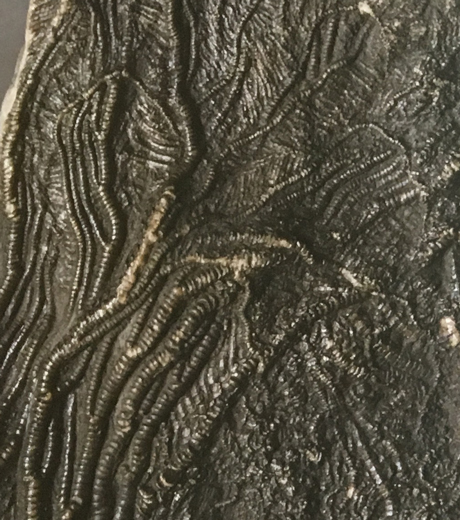
Crinoids (Sea Lilies) from the West Dorset Coast
The book contains stunning photographs of fossils from the “Jurassic Coast”.
Picture credit: Siri Scientific Press
Spokesperson for Everything Dinosaur, Mike Walley commented:
“This guide manages to capture the beauty and the fascination of this part of the “Jurassic Coast”. It is a “must have” for all fossil collectors and if ever the delegates at that UNESCO conference needed to reaffirm their decision to grant this stunning part of the British coastline World Heritage Site status, this book provides ample evidence to justify their original decision.”
Preparing a Fact Sheet for the Schleich Animantarx Model
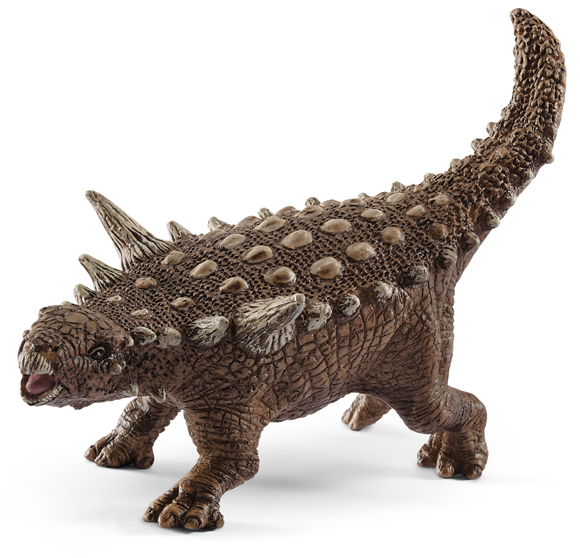
Team members at Everything Dinosaur have been busy preparing for the arrival of the first batch of new for 2019 Schleich prehistoric animal figures. In this first set of models from the German-based manufacturer, there is a replica of the armoured dinosaur called Animantarx (Animantarx ramaljonesi), a fact sheet providing information about this nodosaurid is being compiled, so that customers of Everything Dinosaur can learn about this enigmatic member of the Thyreophora (shield-bearers).
New for 2019 the Schleich Animantarx Dinosaur Model
The Schleich Animantarx dinosaur model (new for 2019).
Using Ankylosaurs for Biostratigraphical Dating of the Cedar Mountain Formation
The disarticulated and fragmentary fossils representing a single, individual animal were described in 1999 (Carpenter, Kirkland, Burge and Bird) and Animantarx is one of numerous ankylosaurs known from the Cedar Mountain Formation of the western United States. The Cedar Mountain Formation has the highest concentration of ankylosaurid species of any Lower Cretaceous formation, it is hoped that further field work will help palaeontologists to build up a better picture of their evolution and subsequent radiation.
The list of armoured dinosaurs is quite long for example:
Sauropelta – Poison Strip Sandstone
Cedarpelta – Mussentuchit Member
Animantarx – Mussentuchit Member
Peloroplites – Mussentuchit Member
Gastonia – Yellow Cat Member
It has been suggested that given the numbers of armoured dinosaurs present in the strata, ankylosaurids can be used to help with relative dating of rock layers (biostratigraphy).
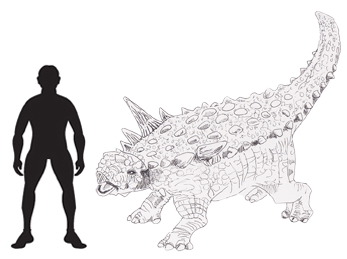
A Scale Drawing of Animantarx
A scale drawing of the armoured dinosaur from Utah – Animantarx ramaljonesi.Picture credit: Everything Dinosaur.
Picture credit: Everything Dinosaur
Distinct Cretaceous Dinosaur Faunas
Recent research has identified three distinct dinosaur-based faunas represented by the vertebrate fossils from the Cedar Mountain Formation. Ankylosaurs are the most common dinosaur of the upper part of the Yellowcat Member and Poison Strip Sandstone of the Cedar Mountain Formation but are rare in other members. This scarcity may be due to insufficient collecting in the middle and upper parts of the Cedar Mountain. Nevertheless, ankylosaur dinosaurs indicate a three-fold division of the Cedar Mountain dinosaur faunas.
Intriguingly, Animantarx is known from the youngest member of the Cedar Mountain Formation (Mussentuchit Member). These rocks hold a mixture of Early and Late Cretaceous dinosaur fossils – tyrannosaurids, ceratopsids, iguanodonts, ankylosaurids etc. The strata might document a migration event whereby Asian dinosaurs moved into North America via an Alaskan land bridge. This migration may have contributed to the extinction of several types of endemic North American members of the Dinosauria.