Schleich Spinosaurus Review by JurassicCollectables
Those clever and talented film-makers at JurassicCollectables have produced a review of the new for 2019 Schleich Spinosaurus, a figure that has received a lot of praise from dinosaur enthusiasts and model collectors. Schleich, the German model and figure manufacturer, have produced several Spinosaurus figures over the years. Team members at Everything Dinosaur have considered writing an article highlighting how changes in these models have reflected scientific understanding, but for the time being we have this wonderful video review of the Spinosaurus to watch.
JurassicCollectables Reviews the 2019 Schleich Spinosaurus Dinosaur Model
Video credit: JurassicCollectables
The Schleich Spinosaurus (2019)
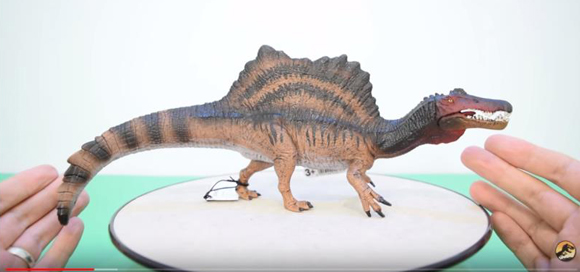
This is the first Spinosaurus model produced by Schleich that portrays this dinosaur as a quadruped. In this well-crafted and highly informative video the narrator takes viewers on a guided tour of this excellent addition to the Schleich model range. The video itself is just a little over seven minutes in length and a video review such as this, really helps dinosaur model fans to get a good look at a figure, helping them to decide whether or not to add it to their collection.
An Impressive and Highly Praised Schleich Spinosaurus is Reviewed by JurassicCollectables
JurassicCollectables have produced a video review of the 2019 Schleich Spinosaurus model.
Picture credit: JurassicCollectables
The YouTube channel of JurassicCollectables provides a comprehensive resource for dinosaur and prehistoric animal model reviews. The videos are skilfully produced and provide viewers with the opportunity to examine prehistoric animal figures and dinosaur models in detail.
Visit the YouTube channel of JurassicCollectables here: JurassicCollectables on YouTube, Everything Dinosaur recommends that dinosaur enthusiasts and prehistoric animal model fans subscribe to JurassicCollectables.
The New for 2019 Schleich Spinosaurus Dinosaur Model
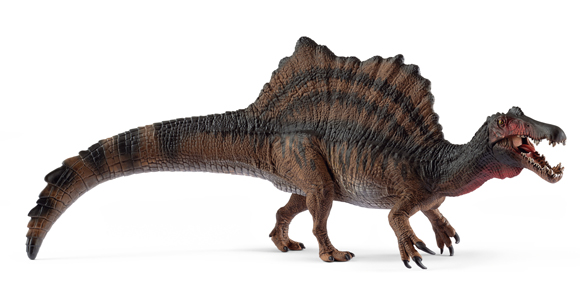
The new for 2019 Schleich Spinosaurus model, depicting Spinosaurus as a quadruped.
Crocodilian Features
In the video, the quadrupedal stance is commented upon. The influence of crocodilan anatomy on the model is also stated, many palaeontologists believe that Spinosaurus was semi-aquatic and took up an ecological niche similar to large crocodilians today – that of an aquatic predator. The narrator takes care to point out the long tail with its crocodilan scutes. The skull is also shown in detail and there are plenty of close-up shots of those long, narrow crocodile-like jaws.
The Spinosaurus Model is Carefully Measured in the Video Review
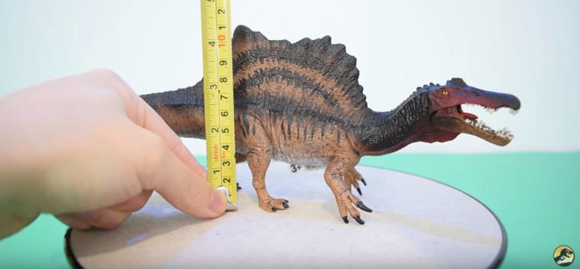
Measuring the new for 2019 Schleich Spinosaurus dinosaur model.
Picture credit: JurassicCollectables
Measuring the Model
JurassicCollectables include a video segment in which the model is carefully measured. At Everything Dinosaur, we also measure the models in our inventory. The length of the Schleich Spinosaurus is approximately 29 centimetres. Later on in the video, the Spinosaurus is compared with the classic Papo green Tyrannosaurus rex figure, off-colour Alan also makes a welcome return and helps to demonstrate just how large this new Schleich figure is.
This Spinosaurus is one of five new prehistoric animal models introduced by Schleich in early 2019. The other models are:
Dimorphodon
Dimetrodon
A new colour version of their Giganotosaurus model
The Eofauna 1:35 Scale Giganotosaurus Dinosaur Model
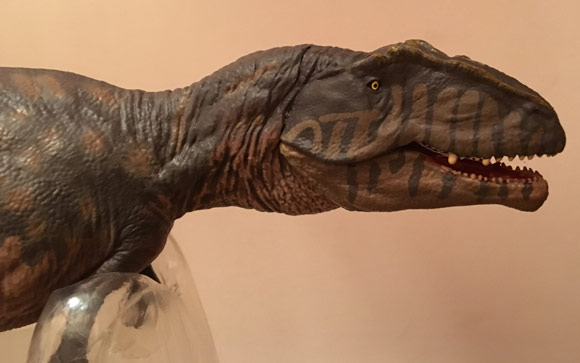
The Eofauna 1:35 scale replica of the huge theropod Giganotosaurus (G. carolinii), is in stock at Everything Dinosaur. This is the third replica in the Eofauna Scientific Research series and the first representative of the Dinosauria to be introduced to this highly-respected model range.
The Eofauna Giganotosaurus Dinosaur Model (1/35th Scale)
An Accurate Representation of a Member of the Carcharodontosauridae
Remarkably, when the fossilised remains of a leg bone from a large, meat-eating dinosaur was found by car mechanic Ruben Carolini whilst prospecting for fossils in Neuquén Province (Argentina), the field team that was dispatched to explore the site went onto excavate nearly seventy percent of the skeleton of an individual dinosaur. To find so many elements of the skeleton of a large theropod in close proximity is exceptionally rare. From this material, palaeontologists were able to build up an accurate picture of this hypercarnivore. Ironically, it was some years after the announcement of the discovery of Giganotosaurus (1994), that a more complete study of the anatomy of this Late Cretaceous dinosaur was undertaken.
The scientists at Eofauna Scientific Research have used their expertise to create an accurate representation of a member of the Carcharodontosauridae family. Giganotosaurus carolinii may have been bigger than Tyrannosaurus rex, although estimates of a body length in excess of 14 metres are based on fossilised teeth not more conventional size estimates such as femora measurements.
A Close-up of the Beautifully Detailed Skull of the Eofauna Giganotosaurus Dinosaur Model
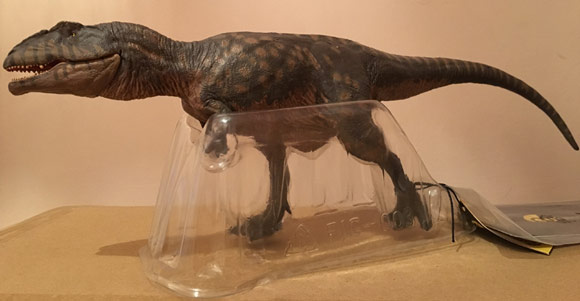
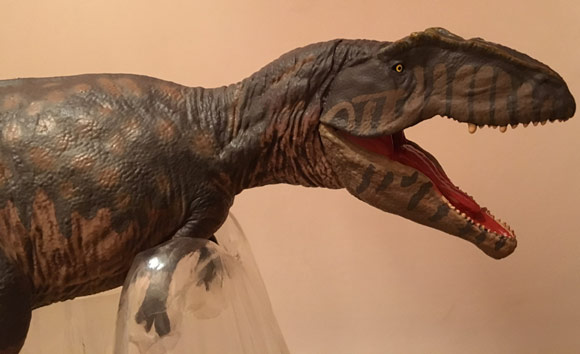
Measuring approximately thirty-nine centimetres in length and with a head height of eleven centimetres, this is a most impressive model and much larger than most other replicas of Giganotosaurus that have been produced in the last few years. The attention to detail on this figure is superb and the muted colours and patterns help to emphasis the figure’s quality. The lower jaw is articulated and when the mouth is opened a glossy, red coloured mouth and tongue are revealed.
The Eofauna Giganotosaurus Model has an Articulated Lower Jaw
Eofauna Scientific Research Giganotosaurus dinosaur model. Picture credit: Everything Dinosaur.
Picture credit: Everything Dinosaur
To purchase the Eofauna Giganotosaurus and the rest of the prehistoric animal models within the Eofauna Scientific Research range: Eofauna Scientific Research Figures.
There are life-size skeletal reconstructions of Giganotosaurus on display in several natural history museums around the world, however, we think collectors and dinosaur fans are going to be more than happy with this 1:35 scale, museum quality replica. Although this figure has been available for just a few days, reviews and feedback has already come in from Everything Dinosaur customers.
William wrote to tell us:
“The giganotosaur’s beautifully robust head is masterfully captured with clean lines, smoothly closing jaws an all-round superb job.”
Our thanks to William and all the other model collectors who have contacted us to let us know their delight at acquiring this fine piece.
A Lateral View of the Eofauna Scientific Research Giganotosaurus Model
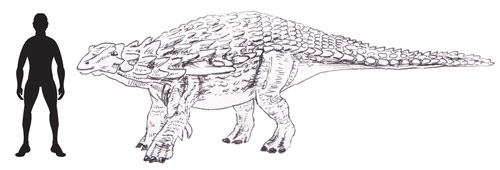
In a few weeks’ time, the first of the 2019 CollectA prehistoric animal models will be coming into stock at Everything Dinosaur. One of the first figures expected to arrive is the Age of Dinosaurs Borealopelta figure, a fifteen centimetre long replica of a nodosaurid that roamed north-western Alberta around 112 million years ago. The fact sheet for this new dinosaur model is being prepared and a scale drawing of Borealopelta (B. markmitchelli) has been produced.
The Scale Drawing of Borealopelta (B. markmitchelli)Prepared for the Everything Dinosaur Fact Sheet
A scale drawing of the armoured dinosaur Borealopelta from north-eastern Alberta (Canada). Picture credit: Everything Dinosaur.
Picture credit: Everything Dinosaur
Heavily Armoured with Countershading
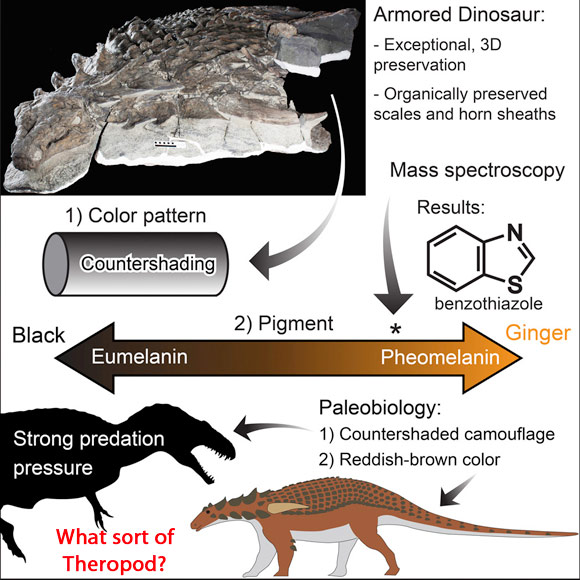
The exquisite state of preservation has permitted palaeontologists to gain a great deal of information about the position of the osteoderms and scutes that covered the dinosaur’s body. When the scientific paper providing the formal description of Borealopelta was published in 2017, the research team described how chemical analysis of organic compounds in the armour and skin permitted the research team to infer the armoured dinosaur’s pigmentation.
It was discovered that Borealopelta possessed countershading, with a reddish-brown top half contrasting with a much paler underside. In extant animals, countershading helps to provide camouflage against predators, but most large animals today, such as rhinos, elephants and hippos, don’t have countershading.
The CollectA Age of Dinosaurs Borealopelta Dinosaur Model
The Age of Dinosaurs Popular – CollectA Borealopelta. Note the paler underside of the animal – an example of countershading.
Borealopelta markmitchelli
At more than five metres long and with such strong armour, it seems surprising that this armoured dinosaur would evolve countershading to help it avoid detection. Such a large and powerfully built dinosaur would have presented a formidable opponent for most theropod dinosaurs, but apparently it paid Borealopelta to try to maintain a low profile.
It is not known what sort of meat-eating dinosaurs Borealopelta tried to hide from but three-toed prints, some measuring in excess of 90 cm long and ascribed to the ichnogenus Irenesauripis indicate that they may have been some 12-metre-plus carnivores in the ecosystem that were best avoided.
As to what sort of theropods could have predated Borealopelta, we can only speculate. However, it has been postulated that the super-sized carnivores that Borealopelta was trying to avoid were probably carcharodontosaurids or allosaurids. This armoured dinosaur is estimated to have weighed more than 1.3 Tonnes, it is much larger than animals alive today that have evolved countershading, therefore, the assumption is that there must have been super-sized, hypercarnivores that Borealopelta was trying to avoid.
Summarising the Research into the Armoured Dinosaur Borealopelta
Summarising the research into Borealopelta.
Picture credit: Brown et al, published in Current Biology with additional annotation from Everything Dinosaur
The scientific paper: “An Exceptionally Preserved Three-Dimensional Armored Dinosaur Reveals Insights into Coloration and Cretaceous Predator-Prey Dynamics” by Caleb M. Brown, Donald M. Henderson, Jakob Vinther, Ian Fletcher, Ainara Sistiaga, Jorsua Herrera and Roger E. Summons published in Current Biology.
The next edition of the quarterly magazine for dinosaur fans and prehistoric animal model collectors “Prehistoric Times”, is due to arrive very soon. Issue 128 (winter 2019), celebrates the 100th anniversary of the Edgar Rice Burroughs novel “The Land that Time Forgot”, hence the intriguing front cover where a tyrannosaurid is in combat with a Woolly Mammoth. Mammoths and members of the Tyrannosauridae family have featured on the front cover of this popular magazine before, but we can’t remember an edition of “Prehistoric Times”, where these two iconic but temporally distant creatures have appeared on the cover together.
The Front Cover of Prehistoric Times Magazine – Issue 128
The front cover of “Prehistoric Times” magazine issue 128 (winter 2019.
Picture credit: Mike Fredericks
“Prehistoric Times” and the “Land that Time Forgot”
American author Edgar Rice Burroughs, set the story at the height of World War I. A ship carrying the main protagonist of the book, Bowen Tyler, is sunk by a German U-boat U-33, the submarine also attacks the British vessel that attempts to pick up survivors of the first attack. A fierce struggle takes place between the British sailors and the German submariners and the U-boat is captured.
The survivors board the submarine and attempt to take it to an Allied port, but this proves too dangerous as all Allied shipping treats the U-boat as a potential target. Meanwhile, a saboteur disrupts the navigation and the vessel ends up in Antarctic waters. Low on food and fuel, the submariners find a huge island, surrounded by gigantic cliffs and when this landmass is explored, the German and Allied sailors discover it is populated by a pot-pourri of prehistoric animals.
The plot may sound familiar, as the story has featured in many publications, since its first inception a hundred years ago. In the mid 1970s a film with the same title as the novel came out with American actor Doug McClure playing the lead role of Bowen Tyler.
Trilobites, Triceratops and a famous Canadian Palaeontologist
The forthcoming edition of “Prehistoric Times” will feature a profile of one of the most famous dinosaurs of all, “three-horned face” – Triceratops. There is the latest instalment in the long running feature on the influential artwork of the Czech artist Zdeněk Burian by John Lavas, this time it is the Mosasauridae that are put into the spotlight. One of the most successful types of arthropod in evolutionary history, the Trilobita are given top billing. Team members are looking forward to reading more about this biostratigraphically important Class.
Last but not least, Professor Phil Currie is interviewed. This internationally renowned palaeontologist needs no introduction. Professor Currie’s scientific accomplishments have led to a greater understanding of dinosaurs and their historic significance and he was instrumental in helping to set up with the University of Alberta the first free-to-access on-line course on the Dinosauria – Dino 101.
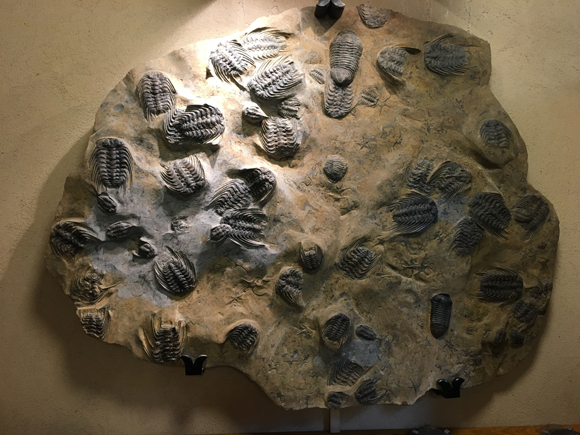
Trilobites Get Top Billing in “Prehistoric Times”
Trilobites galore – the Selenopeltis slab. Picture credit: Everything Dinosaur.
The county of Cheshire in north-west England has some fascinating geology, but from a palaeontological point of view, fossils are few and far between. However, there are some notable exceptions, the sandstone quarries that once operated around the picturesque village of Lymm have provided evidence that before the dinosaurs evolved, this part of rural Cheshire was stalked by a powerful, three-metre-long predator – Chirotherium.
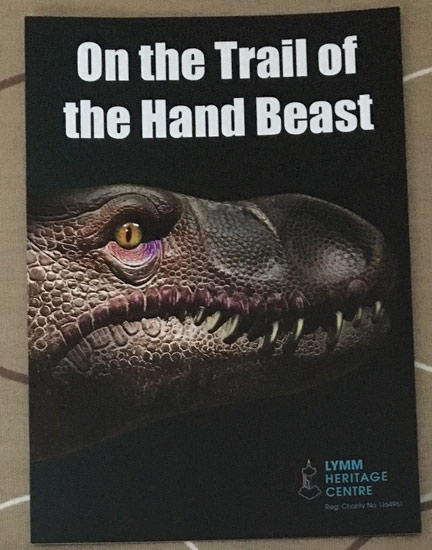
A new exhibition at the Lymm Heritage Centre, tells the story of Chirotherium and highlights the scientific importance of the trackways that revealed its existence. Visitors will be able to get up close to this distant relative of today’s crocodiles, meeting “Kerry”, Lymm Heritage Centre’s resident archosaur (ruling reptile) as well as embarking on the trail of the “Hand Beast”.
On the Trail of the “Hand Beast” – Chirotherium
On the trail of the “Hand Beast” – Chirotherium (Lymm Heritage Centre).
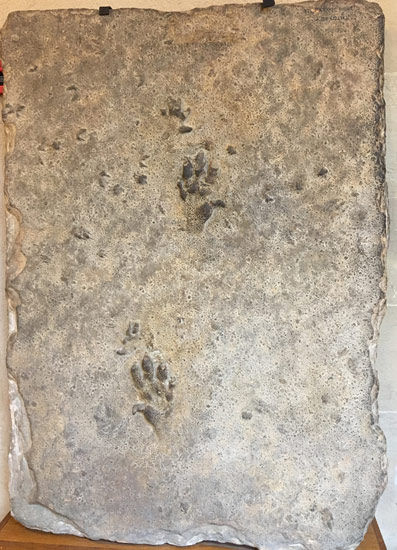
Strange, five-fingered tracks had been discovered in Triassic sandstones in Germany in the early 1830s. More tracks were uncovered at Storeton on the Wirral in 1836. As the demand for building materials grew, a number of sandstone quarries in the Lymm area were opened up and more footprints were found.
These trace fossils are preserved in the Tarporley Siltstones Formation, which was deposited in the early Middle Triassic. Lymm was located on the super-continent of Pangaea and the rocks deposited in this region portray a dry, arid Triassic landscape, dominated by sand dunes and salt lakes which were close to the sea. In areas, where freshwater was present, such as river valleys and oases, there was abundant life, but the animals and plants would have been very unfamiliar to us. The land was ruled by reptiles and one of the biggest and most dangerous was Chirotherium.
Tracks Assigned to the Ichnogenus Chirotherium on Display at Oxford University Natural History Museum
Chirotherium tracks on display at the Oxford University Museum of Natural History. Note the five-fingered tracks (pentadactyle).Picture credit: Everything Dinosaur.
Picture credit: Everything Dinosaur
Face to Face with Chirotherium
This new exhibition at the Lymm Heritage Centre brings you face to face with the “Hand Beast” and the hard-working, dedicated team behind this informative, interactive exhibition have created lots of family-orientated activities to support learning. You can go on your own fossil hunt, make prehistoric footprints and follow Lymm’s bespoke geology trail.
Further information about this new attraction, which officially opens tomorrow (January 12th), can be found here: On the Trail of the “Hand Beast”.
The exhibition is open from from 12 noon until 4pm Thursday to Sunday.
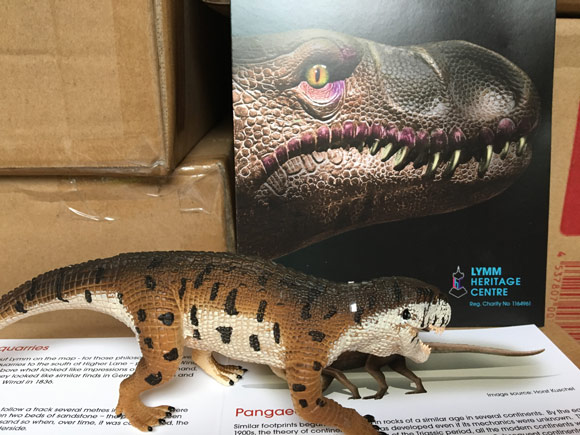
Everything Dinosaur team members have been involved in this project, many of the fossils have been supplied by our team members and visitors will be able to pick up a model of a Prestosuchus, a prehistoric animal that closely resembles the Chirotherium ichnogenus.
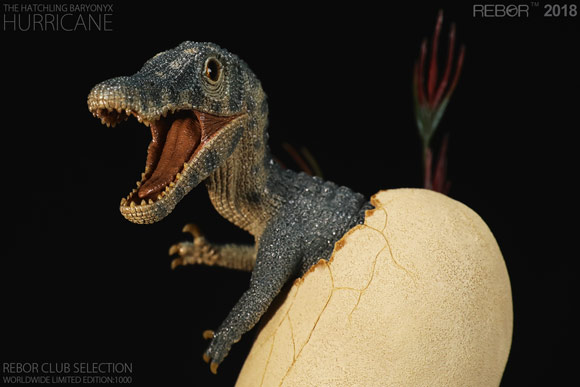
Unpacking and Displaying the Limited-edition Rebor Club Selection Hatching Baryonyx “Hurricane”
This week has seen the arrival of the eagerly anticipated Rebor Club Selection hatching Baryonyx figure “Hurricane”. Team members at Everything Dinosaur have been busy contacting all those customers who took advantage of our offer to reserve one of these limited-edition dinosaur replicas. The first of these highly collectable prehistoric animal models have already been despatched, however, we did take time away from our packing duties to post up a quick guide to unpacking and displaying this beautiful dinosaur model.
Hints and Tips when Unpacking and Displaying the Rebor Club Selection Hatching Baryonyx “Hurricane”
Video credit: Everything Dinosaur
Only 1,000 Figures Made
The total production run is only 1,000 figures. Each figure has a unique number on the base, so this Rebor hatching Baryonyx is a real piece for collectors. In our short video, (just over a minute in length), we show how to unpack the model from its protective foam packaging. We also provide some advice on how to secure the dinosaur egg to the special display stand, after all, with such a limited-edition Rebor replica, you don’t want the dinosaur model falling over and potentially getting damaged.
The Limited-edition Rebor Club Selection Hatching Baryonyx Figure
The limited-edition hatching Baryonyx figure “Hurricane” by Rebor. Everything Dinosaur has produced a short, helpful video to help customers display their figure.
Baryonyx (B. walkeri), is famous for its super-sized thumb claws. We are advising customers to take great care when first removing the figure from the protective foam packaging. The claws can be broken off, if care is not taken to remove the figure from the foam. In addition, Rebor has modelled an elongate-shaped egg for their theropod dinosaur. This is entirely in keeping with the shape of theropod dinosaur eggs.
Lots of different dinosaur eggs have been classified (classified by shape, pore structure and size), there is actually an oogenus (the term used when classifying an organism from eggs), called Elongatoolithus – ee-long-gah-two-lith-us which describes theropod eggs. The elongate egg needs to be carefully placed on its display base. If customers are not careful then the egg could topple over and there is a danger that the figure might be damaged.
Hopefully, a short, instructional video will help. Everything Dinosaur recommends that customers use double-sided tabs to secure their model when on display. Alternatively, something like reusable, sticky putty can be utilised just to help the elongate egg sit securely on its display base.
CT Scanner Helps Palaeontologists to Map the Braincase of a Marine Reptile
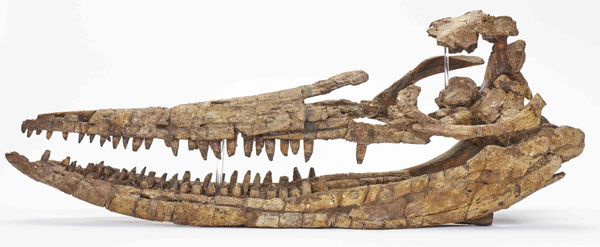
A farmer’s field in Warwickshire was the site of a remarkable fossil discovery more than sixty years ago. Thanks to the application of advanced medical science and computer modelling, a team of researchers including scientists from Manchester University, have been able to unlock secrets from inside the skull of a giant, Early Jurassic marine reptile. The almost 200 million-year-old fossil, was found at Fell Mill Farm (Warwickshire, England), in 1955. The material included a nearly one-metre-long skull of an ichthyosaur, it had been preserved in three-dimensions permitting scientists a rare glimpse into the internal workings of a prehistoric animal’s skull.
The Beautifully Preserved and Now Fully Restored Skull Specimen
The reconstructed, three-dimensional ichthyosaur skull (Protoichthyosaurus).
Picture credit: Thinktank, Birmingham Science Museum
Revealing New Information About a Rarely Preserved Marine Reptile Braincase
Most ichthyosaur cranial material is crushed, flattened and distorted during the fossilisation process. This specimen permitted the research team which included Dean Lomax (Manchester University), skilled fossil preparator Nigel Larkin and Laura Porro (University College London), to study a near complete and undistorted three-dimensional skull providing new insights into ichthyosaur cranial anatomy and the morphology of the braincase. Despite the fossil specimen’s excellent preservation, it had never been formally studied prior to this research.
Co-author of the paper, Nigel Larkin explained:
“Initially, the aim of the project was to clean and conserve the skull and partially dismantle it to rebuild it more accurately, ready for redisplay at the Thinktank Museum [Birmingham]. But we soon realised that the individual bones of the skull were exceptionally well preserved in three dimensions, better than in any other ichthyosaur skull we’d seen. Furthermore, that they would respond well to CT scanning, enabling us to capture their shape digitally and to see their internal details. This presented an opportunity that couldn’t be missed.”
Computed Tomography (CT) Scans
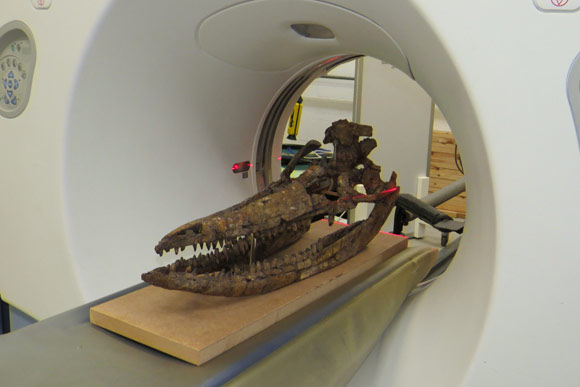
To help unlock the information contained inside the skull, the specimen was subjected to computed tomography (CT) scans using a large medical scanner located at the Royal Veterinary College (London). The powerful X-rays in conjunction with computer modelling allowed a three-dimensional and highly accurate digital reconstruction of the fossil to be made. This is the first time a digital reconstruction of a skull and mandible of a large marine reptile has ever been made available for research purposes and to the public.
Going Through the CT Scanner
A large marine reptile skull is placed in a CT scanner.
Picture credit: Nigel Larkin photograph taken at Royal Veterinary College, London
Further computed tomography analysis (micro-CT scanning) took place at the University of Cambridge.
Study Clears Up Marine Reptile Fossil Identification
When originally labelled several decades ago, the ichthyosaur was classified as an example of the species Ichthyosaurus communis. Indeed, when Everything Dinosaur wrote an article about this remarkably well-preserved skull back in 2016, the specimen was still being described as Ichthyosaurus. However, lead-author and ichthyosaur expert, Dean Lomax became convinced as the research progressed, that this specimen represented a much rarer species. He identified it as an example of an ichthyosaur called Protoichthyosaurus prostaxalis, the type species of this genus had originally been named in 1979.
With a skull almost twice as long as any other specimen of Protoichthyosaurus, this is the largest specimen known to science.
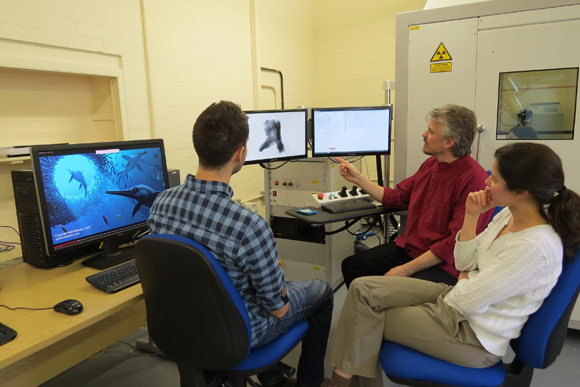
Research Team Members View the Results of the CT Scans
Dean Lomax (left), Laura Porro (centre) and Nigel Larkin (right) view 3-D images of the skull.
Picture credit: Nigel Larkin, taken at the University of Cambridge
Lead-author Dean Lomax stated:
“The first time I saw this specimen I was puzzled by its excellent preservation. Ichthyosaurs of this age (Early Jurassic), are usually ‘pancaked’, meaning that they are squished so that the original structure of the skull is either not preserved or is distorted or damaged. So, to have a skull and portions of the skeleton of an ichthyosaur of this age preserved in three dimensions, and without any surrounding rock obscuring it, is something quite special.”
Protoichthyosaurus prostaxalis
Protoichthyosaurus was first erected by the British palaeontologist Robert Appleby forty years ago. Prior to his research, the fossil material that Dr Appleby assigned to the new genus had been placed in the Ichthyosaurus genus. Indeed, subsequent research challenged this assessment and for some time, the validity of the Protoichthyosaurus genus remained in doubt.
In 2017, Dean Lomax along with colleagues Professor Judy Massare (State University of New York) and Rashmi Mistry (Reading University), conducted a re-examination of the fossil material and carried out extensive comparisons between ichthyosaur and suspected Protoichthyosaurus specimens. The researchers concluded that Protoichthyosaurus was indeed, a valid genus: Reaffirming Protoichthyosaurus as a Valid Genus.
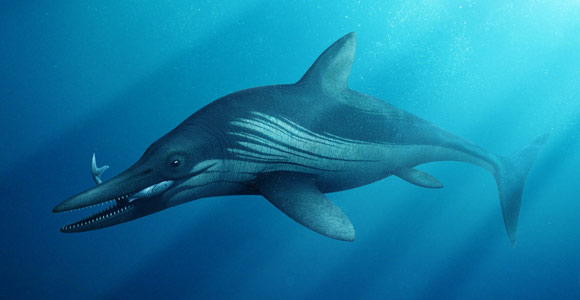
A Life Reconstruction of the Ichthyosaur Protoichthyosaurus prostaxalis
A life reconstruction of the ichthyosaur Protoichthyosaurus (P. prostaxalis).
Picture credit: Bob Nicholls @Paleocreations
Back to the Braincase
The skull is not quite complete, but several bones that make up the braincase, which are very rarely preserved in the Ichthyosauridae, are present. The micro-CT scanning conducted at Cambridge University provided crucial data to help reconstruct the internal anatomy of the animal’s skull and brain. The fossil only preserved bones from the left side of the braincase, however, using CT scans these elements were digitally mirrored and 3-D printed at life size to provide a complete braincase.
Commenting on how the use of modern technologies, such as medical scanners, have revolutionised the way in which palaeontologists are able to study and describe fossils, Dr Laura Porro stated:
“CT scanning allows us to look inside fossils – in this case, we could see long canals within the skull bones that originally contained blood vessels and nerves. Scans also revealed the curation history of the specimen since its discovery in the ‘50s. There were several areas reconstructed in plaster and clay, and one bone was so expertly modelled that only the scans revealed part of it was a fake. Finally, there is the potential to digitally reconstruct the skull in 3-D. This is hard (and risky) to do with the original, fragile and very heavy fossil bones; plus, we can now make the 3-D reconstruction freely available to other scientists and for education.”
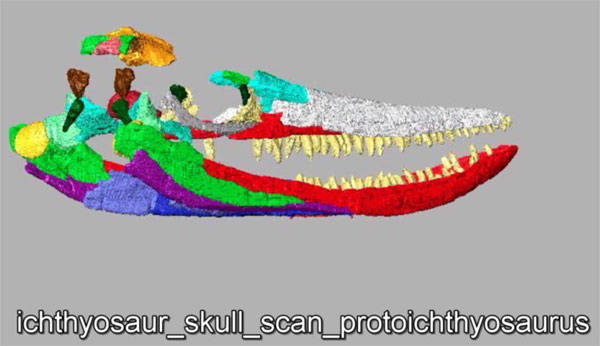
An Image of the Three-Dimensional Scan of the Protoichthyosaurus Skull Material
A three-dimensional image from the scan of the Protoichthyosaurus skull. Individual elements and bones are highlighted in different colours.
Picture credit: University of Manchester/Thinktank
Dean Lomax added:
“It’s taken more than half a century for this ichthyosaur to be studied and described, but it has been worth the wait. Not only has our study revealed exciting information about the internal anatomy of the skull of this animal, but our findings will aid other palaeontologists in exploring its evolutionary relationship with other ichthyosaurs.”
A New Tiny Dromaeosaurid Ichnogenus Dromaeosauriformipes
Catching up with our reading of scientific papers over the weekend and our attention was caught by the description of tiny, two-toed prints from South Korea that reaffirm the growing conviction amongst scientists that some types of non-avian dinosaur were very small, not much bigger than sparrows. The footprints might be the smallest dinosaur tracks discovered to date.
Writing in the academic journal “Scientific Reports”, researchers from South Korea, in collaboration with colleagues from Australia, China, Spain and the USA, describe eighteen diminutive, didactyl tracks that are attributed to either juveniles or tiny adult dinosaurs that may have had a hip height of around five centimetres.
Dinosaur Tracks
The tracks have been ascribed to a new ichnogenus – Dromaeosauriformipes (D. rarus), the name translates as similar in form to Dromaeosauripus*, small and rare.
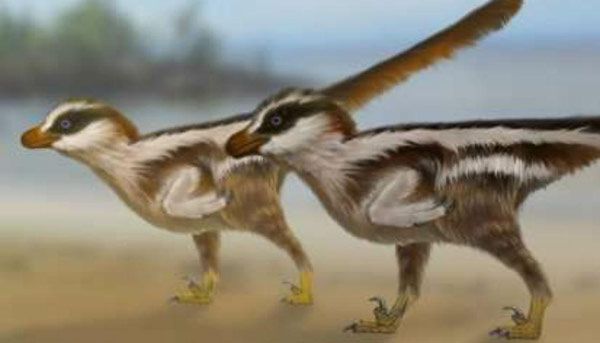
A Life Reconstruction of the Recently Described Dromaeosauriformipes rarus
A life reconstruction of the diminutive, dromaeosaurid ichnogenus Dromaeosauriformipes.
Picture credit: Anthony Romilio (Queensland University)
Dromaeosauripus* is an earlier described ichnogenus representing a larger set of tracks, three ichnospecies have been assigned to this ichnogenus to date.
Dromaeosauriformipes rarus – A Microsaur
The tracks were originally found by Professor Kyung Soo Kim (Chinju National University of Education, South Korea), one of the authors of the paper. The tracks come from a series of remarkable multiple track-bearing horizons from the JinJu Formation of the south-eastern part of the Korean peninsula. The deposits represent lakeshore sediments (Lower Cretaceous) and date from approximately 115 million years ago (Aptian faunal stage).
The trackways criss-cross an area that was once soft mud and the eighteen tracks are interpreted as representing an estimated 6 to 10 individual trackways possibly made by a similar number of different individuals. It is suggested that the prints could resemble a Microraptor-like dromaeosaurid (microraptorine). Some scientists have suggested that Microraptor was piscivorous (fish-eating). The tracks found in association with a lakeshore, could represent a Microraptor-like dinosaur searching for food, but equally the tracks could represent other types of activity.
Microraptorine Activity in Lakeshore Setting (D. rarus)
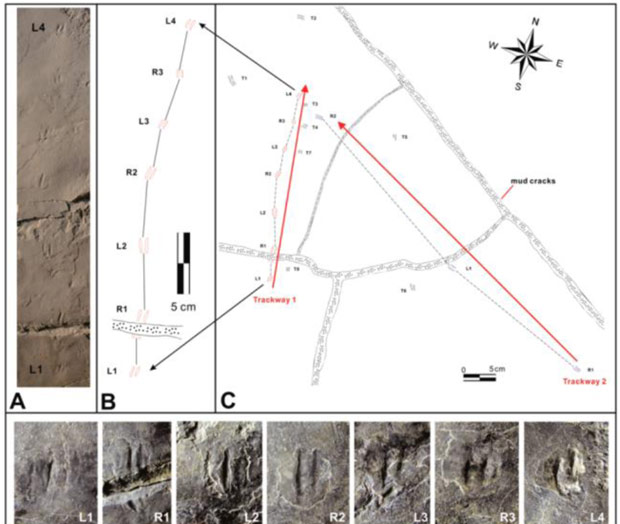
Diminutive dromaeosaurid tracks from South Korea (Dromaeosauriformipes rarus).
Picture credit: Scientific Reports – original photo (A) by Professor Kim
The picture shows (A), the seven print trackway of the diminutive dromaeosaurian Dromaeosauriformipes rarus. A line drawing of the trackway is shown (B) and (C) shows a line drawing of the track-bearing surface showing two tiny tracks but trackway 2 has a much bigger stride length indicating greater velocity than recorded in trackway 1. Pictured below are seven photographs recording the individual prints.
One of the authors of the scientific paper, Dr Anthony Romilio from the University of Queensland stated:
“They are the world’s smallest dinosaur tracks. These new tracks are just one centimetre in length, which means the dinosaur that made them was an animal you could have easily held in your hand.”
Hatched from Tiny Eggs
To estimate the size of the dinosaur that made the tracks, the team measured the footprint length and multiplied the value by 4.5 to get an approximate hip height. The maker(s) of these tiny tracks would have had a hip height of around five centimetres. The two-toed prints are definitively dromaeosaurid, as the second toe, the killing claw, is held off the ground as the dinosaur moves about, hence just two toe impressions are left behind in each print. In the paper, the scientists comment upon the fact that these tiny dinosaurs must have hatched from very small eggs.
Back in 2016, Everything Dinosaur featured the discovery of tiny three-toed theropod prints that had been discovered in Lower Cretaceous sediments from south-western China. As a result, a new “tiny-saurus” ichnogenus was erected – Minisauripus. The South Korean prints assigned to Dromaeosauriformipes rarus are even smaller.
Professor Kyung Soo Kim commented that the lake deposits at this location created ideal conditions that allowed for the preservation of tiny footprints, rarely found anywhere else in the world.
Professor Kim added:
“In addition to tiny dinosaur tracks, we have footprints made by birds, pterosaurs, lizards, turtles, mammals, and even frogs.”
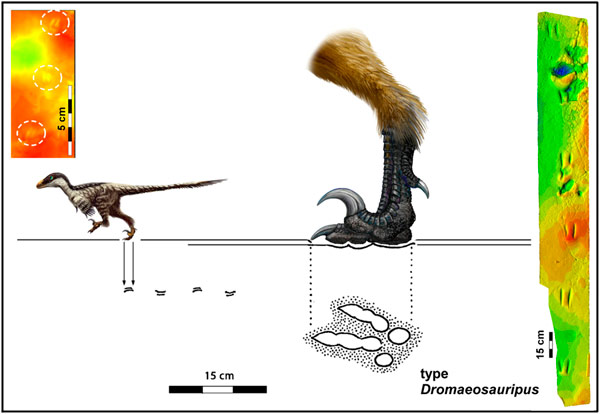
Comparing the Tracks of Dromaeosauriformipes rarus with Dromaeosauripus jinjuensis
Dromaeosauriformipes rarus tracks compared in size and scale to Dromaeosauripus jinjuensis.
Picture credit: Scientific Reports
The image above compares illustrations of the tracks of Dromaeosauriformipes rarus to the size of the trackways assigned to Dromaeosauripus jinjuensis. Note the raised second toe which produces the characteristic two-toed print. D rarus tracks suggest a much smaller dromaeosaur produced the tracks. The image in the upper left is a colour photogrammetric image of Trackway 1 which helps to define track depth and characteristics. This is compared to the photogrammetric colour image showing the type trackway of D. jinjuensis (right).
Are These Tiny Dinosaurs or Newly-Hatched Dinosaurs from a Much Larger Species?
The tracks support the idea that there may have been lots of very small dinosaurs, but their small bones would not necessarily be preserved in the fossil record so there may be a bias towards larger members of the Dinosauria due to their greater preservation potential. However, if conditions are right, then diminutive prints and tracks can be preserved, providing tantalising evidence to support the idea of a much more diverse Theropoda then previously thought. The researchers raise two fascinating questions in their published paper:
What is the size range of “raptor” tracks based on footprints or inferred from skeletal remains?
How might diminutive tracks of juveniles be distinguished from the prints made by tiny adults (microsaurs)?
Co-author Dr Martin Lockley (University of Colorado Denver’s College of Liberal Arts and Sciences), suggests that these tiny trackways could represent the prints of adult dinosaurs.
He commented:
“Rapidly growing dinosaurs don’t remain small or leave little footprints for very long. But of all of the footprints we’ve found of the Minisauripus, none grew larger than one inch; a preponderance of evidence of a small species and not babies. There’s a chance that we just found something smaller.”
Rebor Club Selection Limited-edition Baryonyx “Hurricane”
Team members at Everything Dinosaur are busy making plans for the imminent arrival of the latest figure in the Rebor Club Selection range – a hatching Baryonyx nicknamed “Hurricane”. Only 1,000 of these highly collectable replicas have been produced and like the hatching Triceratops (Jolly) and the T. rex (Rudy), the Baryonyx replica is likely to sell out quickly.
New for 2019, the Rebor Club Selection Limited Edition Baryonyx Figure
The Rebor Club Selection limited-edition Hatching Baryonyx figure.
Inspired by a Footballer – Harry Kane
Baryonyx is known from Lower Cretaceous strata from Europe, most notably the Upper Weald Clay Formation in Surrey, from which the holotype specimen was excavated in 1983. This theropod is associated with southern England and the Isle of Wight, but isolated teeth and other material from Portugal and further afield suggest that Baryonyx (or closely related species/ancestral forms) may have had a wider distribution.
Both the Weald Clay Formation and the Wessex Formation of the Isle of Wight, which has also yielded Baryonyx walkeri fossil material, represent palaeoenvironments that would have been subjected to tropical storms so the moniker “Hurricane” is scientifically appropriate. However, it was the 2018 renaissance of the English football team captained by Harry Kane that proved the inspiration for the name “Hurricane”.
Baryonyx and the World Cup
In 2018, the England football team reached the semi-finals of the World Cup in Russia and in the inaugural UEFA Nations League, England have qualified for the semi-finals. England’s semi-final against Holland in June 2019, will be played in Portugal, highly appropriate as fossil material ascribed to the Baryonyx genus has also been described from that country.
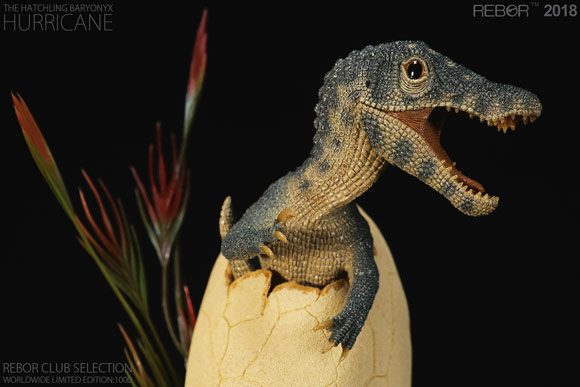
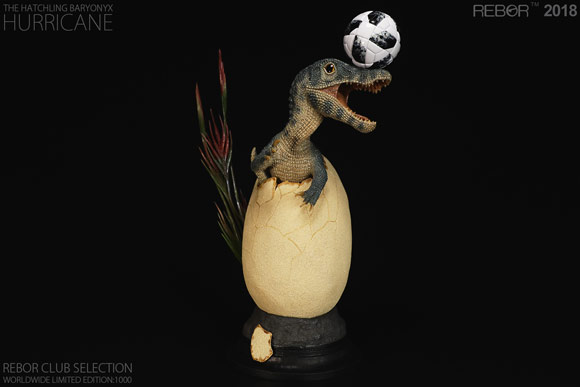
The Rebor Hatching Baryonyx – “Hurricane” (Harry Kane)
Rebor “Hurricane” limited-edition hatching Baryonyx dinosaur model. The football reaffirms the connection with the England soccer team.
Baryonyx walkeri
When the field team from the British Museum (London Natural History Museum), had finished excavating the fossil remains from the Smokejacks Brickworks in Ockley (Dorking, Surrey) in 1983, some 70% of the skeleton of an individual meat-eating dinosaur had been recovered. This makes this fossil material one of the most complete, large theropod dinosaur remains to have been found in Europe. The Smokejacks Brickworks material represents a sub-adult animal, so estimating the size of Baryonyx walkeri is difficult. However, most vertebrate palaeontologists estimate that this theropod reached an adult size of between 7.5 to 10 metres in length, but like all dinosaurs, this giant hatched from an egg.
The Limited-edition Rebor Hatching Baryonyx Dinosaur Figure “Hurricane”
The limited-edition hatching Baryonyx figure “Hurricane” by Rebor.
A Hand-painted Rebor Replica
The hand-painted, highly detailed figure has been beautifully sculpted and the dinosaur can be displayed with or without the football accessory. Note also the care taken to sculpt that enlarged, curved thumb claw, an anatomical feature that first drew the attention of the world’s media to the fossil discovery back in 1983.
A spokesperson from Everything Dinosaur commented:
“We are excited and can’t wait to take delivery of this limited-edition dinosaur figure. The stock is due to arrive at our warehouse in the next few days and then we shall be emailing all those collectors who have asked us to reserve a Club Selection replica hatching Baryonyx for them. We suspect that when “Hurricane” arrives it will create a bit of storm amongst fans of dinosaur models.”
Klobiodon rochei – Fanged Flier of the Middle Jurassic
The famous Stonesfield Slate mines located in Oxfordshire have provided palaeontologists with a rich assemblage of Middle Jurassic (Bathonian), marine and terrestrial fossils, perhaps most famously, the theropod Megalosaurus, the first dinosaur to be scientifically described. Joining “big reptile” as a member of the area’s prehistoric biota is a newly described, toothy pterosaur – Klobiodon rochei.
Writing in the academic journal Acta Palaeontologica Polonica, Dr Michael O’Sullivan, (University of Portsmouth), has reviewed the extensive but highly fragmentary pterosaur material and uncovered evidence of well-armed and substantial flying reptiles from historically important, but overlooked, British fossils.
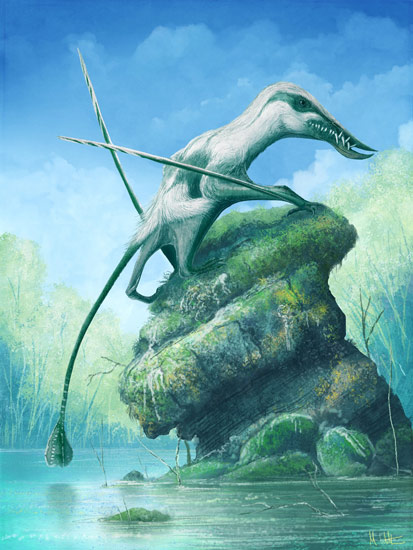
A Life Reconstruction of the Middle Jurassic Rhamphorhynchid Pterosaur Klobiodon rochei
A life reconstruction of the Middle Jurassic pterosaur Klobiodon rochei.
Picture credit: Mark Witton
An Uexpectedly Large and Formidable Flying Reptile
Working in collaboration with Professor David Martill (University of Portsmouth), Dr O’Sullivan examined many of the 215 fragmentary pterosaur fossils that have been collected from the Stonesfield Slate mines, K. rochei is one of the largest known from any Middle Jurassic-aged deposits. It had an estimated wingspan of two metres, making it about the size of a modern-day mute swan. Living around 166-165 million years ago, Klobiodon is an unexpectedly large and formidably-armed species.
Commenting on the significance of the newly described member of the Rhamphorhynchidae family, Dr O’Sullivan stated:
“It’s large fangs would have meshed together to form a toothy cage, from which little could escape once Klobiodon had gotten a hold of it. The excellent marine reptiles and ammonites of the UK’s Jurassic heritage are widely known, but we celebrate our Jurassic flying reptiles far less. The Stonesfield pterosaurs are rarely pretty or spectacular, but they capture a time in flying reptile evolution which is poorly represented globally. They have an important role to play in not only understanding the UK’s natural history, but help us understand the bigger global picture as well.”
Honouring Comic Book Artist Nick Roche
The genus name translates as “cage tooth”, a reference to its huge, fang-like teeth, up to 26 millimetres long, that lined the jaw (this pterosaur has been named based on the morphology of the lower mandible). The species name honours comic book artist Nick Roche in recognition of the role this popular media has in how extinct animals are portrayed. Comic books are a medium where prehistoric animals are portrayed in an increasingly scientifically accurate manner, Roche’s work at the turn of this century was one of the earlier examples of a revival of palaeoart.
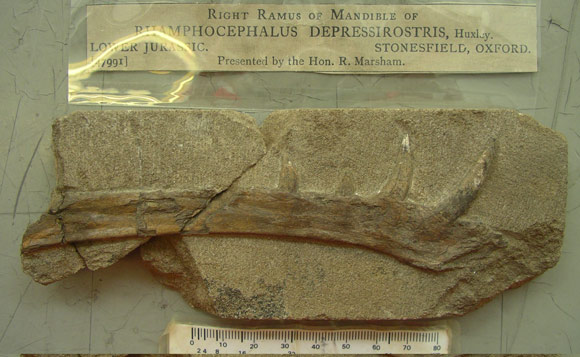
The Lower Jaw of Klobiodon rochei
The right lower mandible of the newly described Middle Jurassic pterosaur Klobiodon rochei. The photograph shows the original label assigned to the fossil the validity of Rhamphocephalus depressirostris has now been questioned.
Only the lower jaw of Klobiodon is known, but it has a unique dental configuration that allows it to be distinguished from other pterosaurs. It probably fed on small fish and squid, filling a role in the coastal ecosystem of an extant seagull or tern.
A Confused Pterosaur Picture
Much of Dr O’Sullivan’s research has involved untangling the messy science associated with these neglected specimens. For example, the pterosaur specimens from the Great Oolite Group (Stonesfield Slate is a unit of the Great Oolite Group), are held in museums scattered across the world, although the majority are housed either at the London Natural History Museum or within the collection of the Natural History Museum of Oxford University. Most of these fossils were assigned in the 19th century to the genus Rhamphocephalus and to one of three species namely: Rhamphocephalus prestwichi, Rhamphocephalus bucklandi, and Rhamphocephalus depressirostris.
This study reviewed the British Middle Jurassic Pterosauria assemblage, evaluating both their systematics and taxonomic diversity. The holotype of Rhamphocephalus, an isolated skull table, is found to be a misidentified crocodylomorph skull and the genus is therefore considered a nomen dubium. The holotype of Rhamphocephalus bucklandi is identified as missing and that of Rhamphocephalus depressirostris has characters diagnostic at a family level, not a generic or specific one. Both species are considered dubious.
Klobiodon rochei
Detailed examination of the entire pterosaur fossil assemblage shows that these fossils actually represent at least five different taxa, representing three families. The researchers propose that the fossil material includes the earliest occurrences of the Monofenestrata clade and sub-order Pterodactyloidea, that was to give rise to some of the largest flying reptiles known to science.
Dr O’Sullivan explained:
“Klobiodon has been known to us for centuries, archived in a museum drawer and seen by dozens or hundreds of scientists, but it’s significance has been overlooked because it’s been confused with another species since the 1800s.”
A spokesperson from Everything Dinosaur stated:
“The pterosaur fossils associated with Middle Jurassic deposits of Oxfordshire and Gloucestershire have been neglected. Research undertaken in the 19th century suggested that this was a time of relatively low pterosaur diversity. This new research suggests that this was not the case, the Bathonian pterosaur assemblage is actually quite diverse with important early representatives of key types of flying reptile having been identified from this English fossil material.”
Stonefield Slate’s Most Famous Resident
Perhaps the most famous member of the Great Oolite Group biota is Megalosaurus bucklandii, the first dinosaur to be formally described. The name was first used by James Parkinson in 1822 and published by the Reverend William Buckland in 1824, when he described various fossil remains including an iconic lower jaw bone (right dentary). Size estimates vary for M. bucklandii, it could have been around ten metres in length. It was probably the apex predator within this ecosystem and it is intriguing to think that the likes of Klobiodon could have scavenged the kills of Megalosaurus.
A Life Reconstruction of the Stonefield Slate’s Most Famous Member – Megalosaurus bucklandii
Megalosaurus feeding. An illustration of the Middle Jurassic Ecosystem (Great Oolite Group).
Picture credit: Mark Witton
The scientific paper: “Pterosauria of the Great Oolite Group (Bathonian, Middle Jurassic) of Oxfordshire and Gloucestershire, England” by Michael O’Sullivan and David M. Martill, published in published in Acta Palaeontologica Polonica (editor’s choice).
Everything Dinosaur acknowledges the assistance of a press release from the University of Portsmouth in the compilation of this article.