All about dinosaurs, fossils and prehistoric animals by Everything Dinosaur team members.

Fossil finds, new dinosaur discoveries, news and views from the world of palaeontology and other Earth sciences.

6 04, 2022

A New, Large Theropod Trackway from Spain is Described

By |2024-12-29T17:22:56+00:00April 6th, 2022|Categories: Adobe CS5, Dinosaur and Prehistoric Animal News Stories, Dinosaur Fans, Main Page, Palaeontological articles, Photos/Pictures of Fossils|0 Comments

Scientists have identified a trackway made by a large theropod dinosaur as it crossed shallow water, the tracks are exceptionally wide and reveal that this unfortunate predator probably had a dislocated toe.

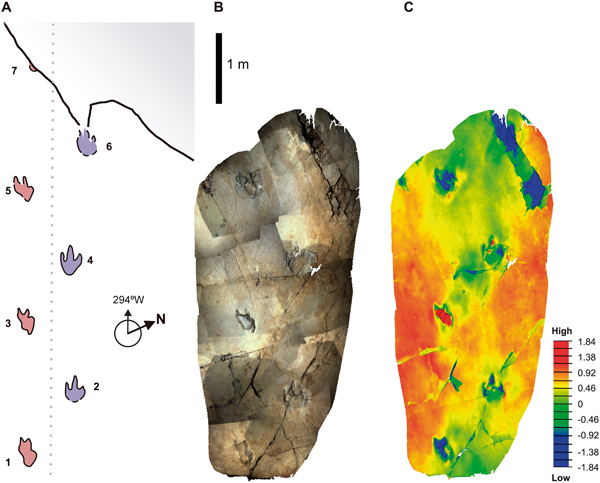
Writing in the open access journal PLOS One, the researchers describe an exceptionally wide trackway (LH-Mg-10-16), made by a meat-eating dinosaur at a site at the Las Hoyas locality (La Huérguina Formation), in central Spain. The trackway consists of six prints (three left and three right prints) and has been interpreted as representing a large theropod dinosaur crossing shallow water, blanketed by a microbial mat.

Views of the LH-Mg-10-16 theropod trackway.

Views of the LH-Mg-10-16 theropod trackway. Cartography done in the field (A), (B) scanned surface of the trackway, mounted from a set of colour photos. Colour ramp, showing the depths and the countours of the site (in cm). Note scale bar equals 1 metre. The cartography is reprinted from Las Hoyas a Cretaceous wetland, Gibert JM et al. under a Creative Commons BY licence, with permission from Dr. Friedrich Pfeil Verlag, original copyright 2016. Picture credit: Herrera-Castillo et al.

Lower Cretaceous (Barremian Faunal Stage)

The famous Las Hoyas site has been dated to around 129-127 million years ago (Barremian faunal stage of the Early Cretaceous). Although the Las Hoyas locality has yielded many amazing vertebrate fossils (birds, amphibians, fish), dinosaur fossils are relatively rare. Stride length calculations indicate that the theropod that produced this trackway had a hip height of around two metres. This would suggest a total body length of approximately eight metres. As far as Everything Dinosaur team members are aware, the only large theropod described from fossils associated with Las Hoyas is Concavenator (C. corcovatus).

It is not possible to determine the genus from these tracks, although the prints indicate a theropod that was either bigger than Concavenator or an exceptionally large Concavenator specimen. The known foot bones of Concavenator would have created a print, approximately half the size of the LH-Mg-10-16 tracks. This suggests that there may have been a much larger, as yet undescribed, theropod present in the Las Hoyas ecosystem.

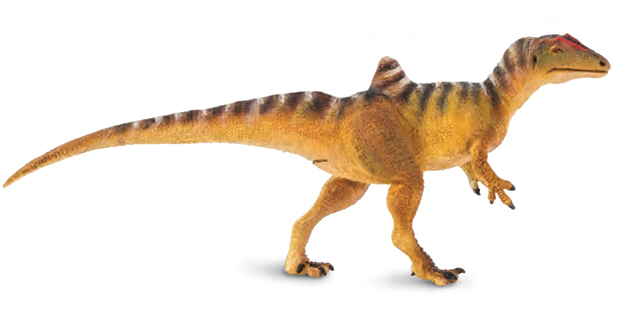
New for 2020 Wild Safari Prehistoric World Concavenator dinosaur model.

The new for 2020 Wild Safari Prehistoric World Concavenator dinosaur model.

The picture (above) shows a Wild Safari Prehistoric World dinosaur model.

To view this model range: Wild Safari Prehistoric World Models and Figures.

Theropod Dinosaur Crossing Water

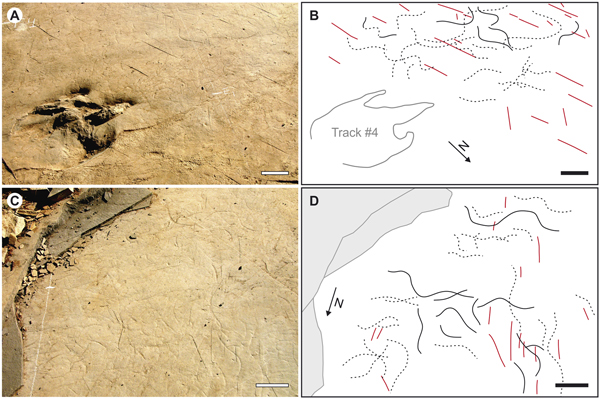
Sedimentary analysis indicate that the trackway was produced as the dinosaur traversed a microbial mat located on the bed of a watercourse. Marks on the surface of the substrate have been diagnosed as swimming traces of fish. The ichnospecies Undichna unisulca has been proposed, an ichnotaxon associated with the Las Hoyas site. The research team postulate that the trails were made by a type of deep-bodied bony fish (pycnodontiform), although body fossils of these fish are not common at Las Hoyas.

Fish trails found in association with the theropod track.

Undichna fish trails in Magenta LH-Mg-10-16. Fish trails (A and B) associated to the theropod footprints with interpretative line drawings (C) and (D). Lines in black trails and in red, wrinkles marks. Scale equals 10 cm. Picture credit: Herrera-Castillo et al.

A Damaged Left Foot

Detailed analysis of the trackway suggests that the “wide-steps” of the theropod are not unusual compared to other bipedal dinosaur tracks, but they do confirm that these trace fossils were made by a single individual animal.

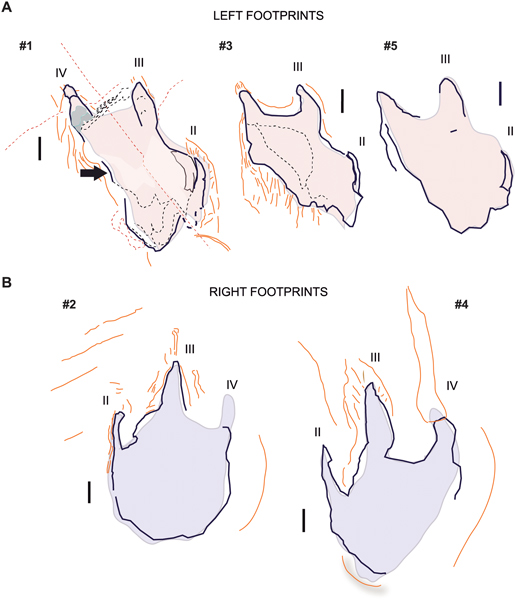
The right footprints are more regular in shape compared to those made by the left foot. On the left foot the limited impressions made by digit II suggest that either this toe is missing or it is dislocated in some way. Birds suffer from “crooked toes”, a condition caused due to environmental factors, dietary deficits or genetics. In theropod dinosaurs it is often digit II that shows pathology including damage to the bones.

Taphonomic features of the theropod prints.

Taphonomic features of the theropod prints. Left footprints (A) and right footprints (B). The right footprints are more regular in shape whilst analysis of the left footprints suggest that this dinosaur had an injured foot. The scientists suggest that digit II of the left foot was either missing or dislocated. Picture credit: Herrera-Castillo et al.

Evidence of a Deformity or Injury

The research team concludes that despite a suspected toe injury/deformity the tracks reveal no signs of a limp. These remarkable trace fossils have captured a moment in time during the Early Cretaceous when a large, meat-eating dinosaur with a body length in excess of eight metres crossed a pool of water that was teaming with fish.

The scientific paper: “A theropod trackway providing evidence of a pathological foot from the exceptional locality of Las Hoyas (upper Barremian, Serranía de Cuenca, Spain)” by Carlos M. Herrera-Castillo, José J. Moratalla, Zain Belaústegui, Jesús Marugán-Lobón, Hugo Martín-Abad, Sergio M. Nebreda, Ana I. López-Archilla and Angela D. Buscalioni published in PLOS One.

Visit Everything Dinosaur’s award-winning website: Everything Dinosaur.

5 04, 2022

Bradford University Receives £3 million in an Exclusive Research Grant to Boost Digital Capability

By |2024-12-29T17:17:49+00:00April 5th, 2022|Categories: Adobe CS5, Dinosaur and Prehistoric Animal News Stories, Main Page|0 Comments

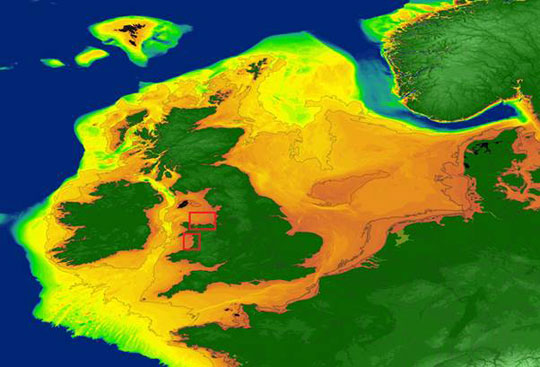
The University of Bradford has received an archaeology grant worth £3 million to boost digital research capacity. At a time when grants and financial support for UK universities is under a great deal of pressure, the grant award will help to secure the status of future research projects including the ongoing study of Stone Age communities on the submerged Doggerland in the North Sea.

The extent of the palaeolandscape prior to sea level changes.

Approximate maximum extent of marine palaeolandscapes off the Irish and British coasts (survey areas in red). Picture credit: University of Bradford.

Picture credit: University of Bradford

A Substantial Digital Heritage Collection

Bradford University has a substantial digital heritage collection, including human skeletal remains, world heritage landscapes and marine environments. The University, based in West Yorkshire, has become a centre for researchers worldwide. Unfortunately, over time the analysis of and access to this collection has become limited by the technical infrastructure.

An upgrade of the University’s technological capabilities will allow staff to digitise much more of its biological collections and to place these more easily within real-world or reconstructed digital environments, providing a rich virtual environment for other academics, researchers and educators.

Capability for Human Bioarchaeology and Digital Collections

The project entitled Capability for Human Bioarchaeology and Digital Collections will upgrade both the University’s biochemical analysis facilities and its ability to document objects and sites using three-dimensional models. By upgrading its X-ray capabilities to a dedicated CT (computerised tomography) and micro-CT facility the University will be able to capture information in the finest detail with minimal handling of fragile specimens, improving its world-class capability for imaging in human bioarchaeology research.

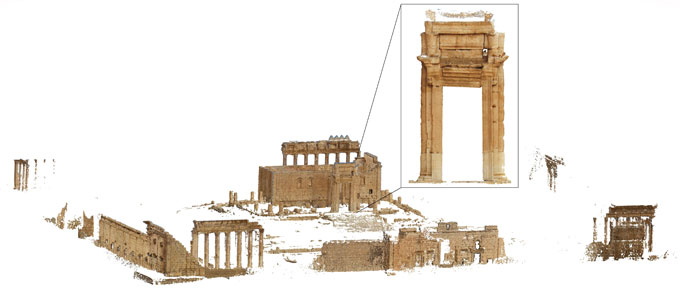
virtual reconstruction of the Temple of Bel, Palmyra in Syria.

A virtual reconstruction of the Temple of Bel, Palmyra, Syria. Picture credit: University of Bradford.

Picture credit: University of Bradford

A Pioneer of Digital Data

Scientists at Bradford University have pioneered the development of digitised data online through its Digitised Diseases project, where researchers access images of bone modifications that resulted from a range of diseases.

Digitised Diseases shares data on human skeletal remains through the Biological Anthropology Research Centre (BARC). BARC, a centre for international research in this field, specialises in the analysis of modern and ancient human skeletal remains, a fragile and limited resource.

Bradford University is also a leader in techniques to gather data from archaeological sites, working with past heritage landscapes, the historic environment, and the contemporary environment.

Commenting on the significance of the £3 million funding, Head of the University’s School of Archaeological and Forensic Sciences, Dr Cathy Batt stated:

“By increasing the data available from the human remains collection and combining it with environmental and site data in our collections a rich digital discoverable and searchable research environment will be created. This specifically allows capacity to place our biological collections within real-world or reconstructed digital environments, providing a valuable virtual environment for researchers and educators.”

Everything Dinosaur acknowledges the assistance of a media release in the compilation of this article.

The award-winning Everything Dinosaur website: Dinosaur Models.

31 03, 2022

Large Mammals with Small Brains Prone to Extinction

By |2024-10-30T13:47:40+00:00March 31st, 2022|Categories: Adobe CS5, Dinosaur and Prehistoric Animal News Stories, Key Stage 3/4, Main Page, Palaeontological articles|0 Comments

Scientists from the University of Tel Aviv in collaboration with colleagues from the University of Napoli have published a study that suggests having a small brain relative to your body size predisposed Late Quaternary mammals to extinction. If you were a “smart” mammal, with a relatively big brain in proportion to your body size, you were less likely to become extinct.

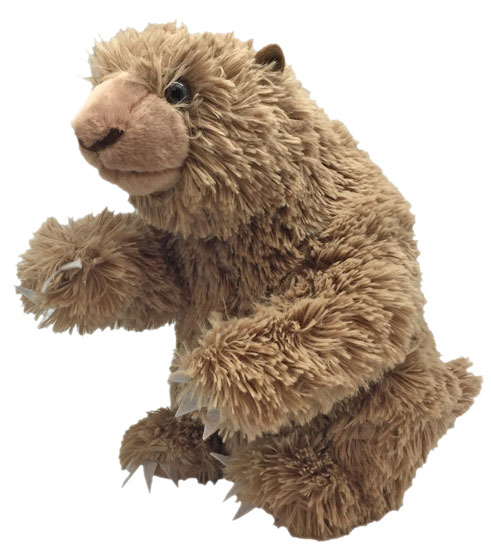
A Megatherium soft toy.

A soft toy Megatherium. The newly published research suggests that mammals with relatively small brains in proportion to their large bodies for example, many members of the Order Pilosa such as the ground sloths, were more likely to go extinct in the Late Quaternary.

The Extinction of Megafauna

The Late Quaternary is marked by a drastic global extinction event, mainly of large-bodied, land mammals. Causes proposed for these extinctions include overhunting by an increasing human population, particularly in areas such as the Americas and Oceania where modern humans had been largely absent previously. Earlier papers had proposed that species with traits that make them less prone to human hunting (arboreal, nocturnal, or forest dwelling) were more likely to survive.

However, the rapid decline and extinction of large, terrestrial animals is linked to the end of the last glacial period (25,000 to 12,000 years ago) which saw dramatic climate change. The research team hypothesised that the large mammals that survived the extinctions might have been endowed with larger brain sizes than those that perished. Larger brains might have helped these animals to adapt better and to cope with the wild fluctuations in climate.

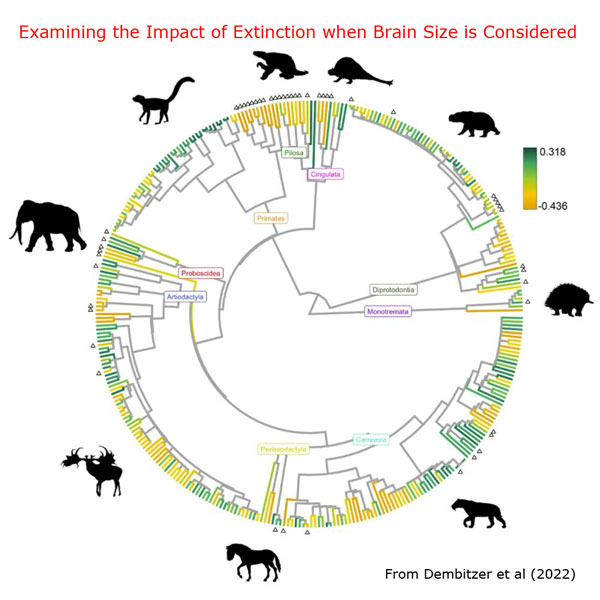
To test this idea, the scientists assembled data on the brain size of 291 living mammal species plus 50 more that went extinct during the Late Quaternary.

The team found that models that used brain size in addition to body size predicted extinction status better than models that used only body size. It was concluded that possessing a large brain was an important, yet so far neglected and rarely studied characteristic of surviving megafauna species.

Quaternary mammal extinction study

The phylogenetic tree used in the brains size relative to body size paper. Terminal branches are colored according to residuals of endocast volume versus body mass regression with order as a random effect (large brains: green; small brains: gold). Large mammals with proportionately large brains such as monkeys record a lower level of extinction compared to other types of mammal. Picture credit: Dembitzer et al.

Picture credit: Dembitzer et al

Implications for Large Mammals Living Today

One prominent feature shared by many extinct taxa was their large body size. In mammals, body size is correlated with several traits, including low population density, small population size, long lifespans, extended gestation periods along with prolonged inter-birth intervals and low fecundity.

Brain size is strongly correlated with body size as well and yet, mammals of similar size can have greatly different brain sizes.

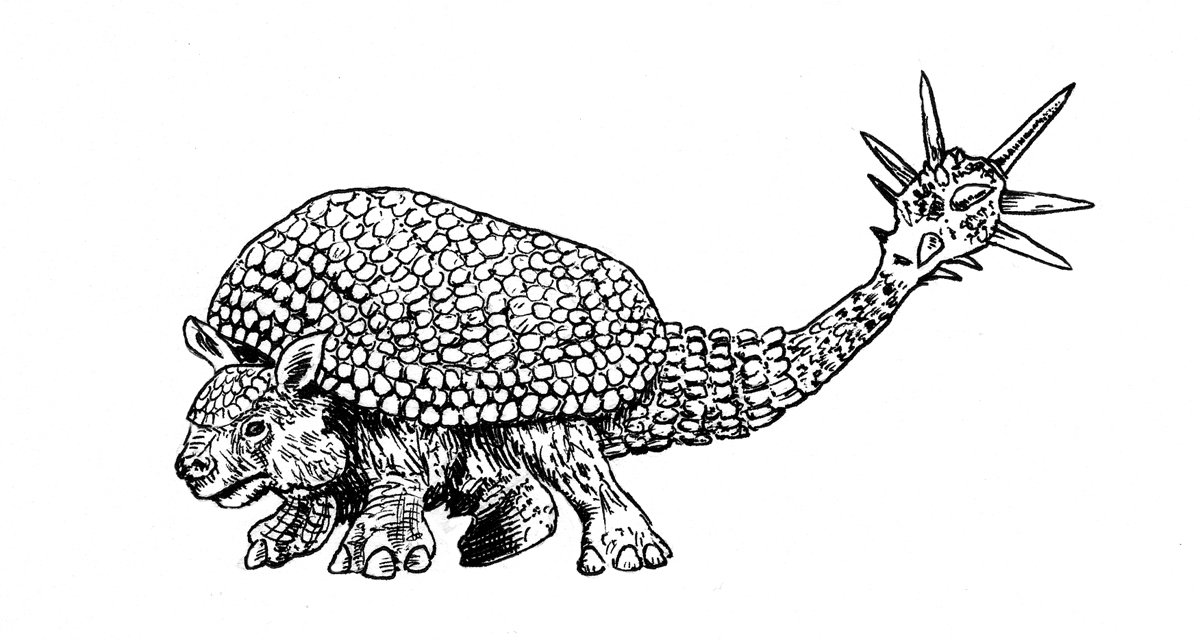
An illustration of Doedicurus. Prehistoric life models.

Members of small-brained orders may not have possessed the behavioural flexibility needed to cope with a changing climate and/or the arrival of Homo sapiens. Glyptodonts such as Doedicurus (order Cingulata), with their large bodies and small brains died out in the Late Quaternary.  Picture credit: Everything Dinosaur.

Picture credit: Everything Dinosaur

In studies of modern birds and mammals, large brains have been found to improve survivability as these animals can modify their behaviour and adapt to rapidly changing environments and new threats such as an expanding human population.

When considering which animals around today might be under the most severe threat of extinction, brain-size should be considered when calculating the risk factors.

The paper published as an open access document in “Scientific Reports”

The scientific paper: “Small brains predisposed Late Quaternary mammals to extinction” by Jacob Dembitzer, Silvia Castiglione, Pasquale Raia and Shai Meiri published in Scientific Reports.

The Everything Dinosaur website: Dinosaur Toys and Models.

29 03, 2022

When Did the Beetles Take Over the World?

By |2024-10-30T13:08:19+00:00March 29th, 2022|Categories: Adobe CS5, Animal News Stories, Dinosaur and Prehistoric Animal News Stories, Main Page, Palaeontological articles, Photos/Pictures of Fossils|1 Comment

Remarkably, one in four named animal species is a beetle. There are over 380,000 beetle species that have been scientifically described and perhaps several million more awaiting formal description. Members of the Order Coleoptera are distinguished from other insects as their front pair of wings are hardened into wing-cases (elytra) and they exploit a huge range of ecological niches and environments. However, their evolutionary origins remain uncertain and it is not known exactly when these six-legged animals became so numerous and specious.

Seventeen scientists including researchers from the University of Bristol have set about unravelling the evolutionary history of these amazing insects.

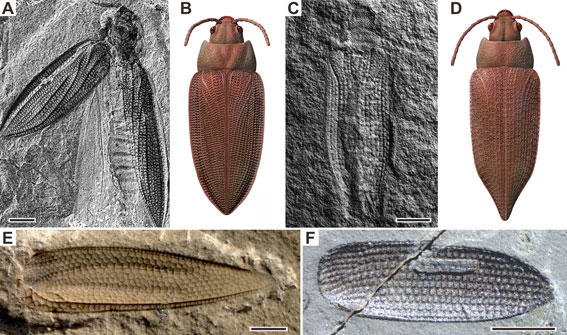
Permian beetle fossils and line drawings.

Examples of Permian beetles including fossilised wings and carapaces with (B and D) life reconstructions. Picture credit: NIGPAS.

Picture credit: NIGPAS

Mammoth Mathematical Models

A project to map the evolutionary history of arguably, the most successful and diverse animals of all time was a mammoth task. The researchers used a 68-gene character dataset that had been compiled previously which had sampled 129 out of the 193 recognised beetle families alive today and compared this to the beetle fossil record to provide a refined timescale of beetle evolution. A supercomputer at the University of Bristol’s Advanced Computing Research Centre slogged through the information for 18 months to produce the most comprehensive evolutionary tree of the Coleoptera ever created.

The mathematical models at the very heart of this research demonstrated that different beetle clades diversified independently, as various new ecological opportunities arose. There was no single, immense, all-encompassing divergence event.

One of the corresponding authors of the paper, published by Royal Society Open Science, Professor Chenyang Cai (University of Bristol) commented:

“There was not a single epoch of beetle radiation, their secret seems to lie in their remarkable flexibility. The refined timescale of beetle evolution will be an invaluable tool for investigating the evolutionary basis of the beetle’s success story”.

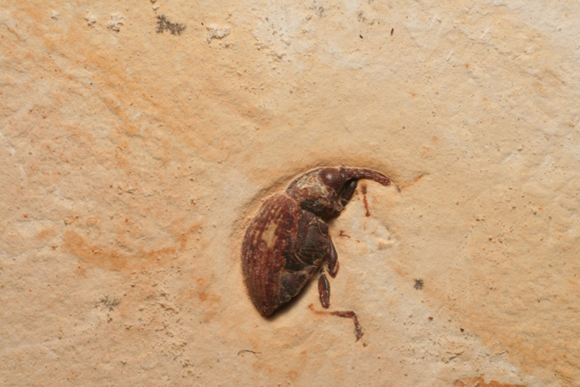
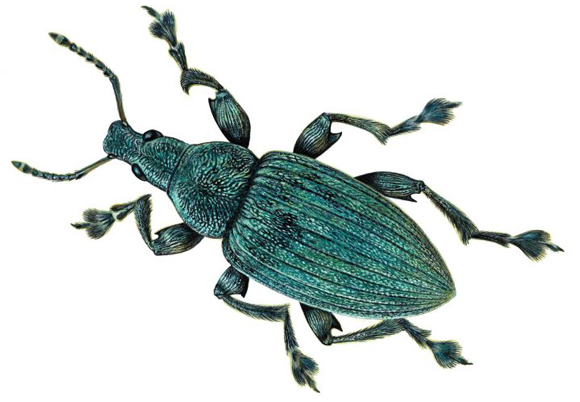
A beautifully preserved weevil fossil (Crato Formation).

Although beetle fossils are exceptionally rare, the research team used data from a total of 57 beetle fossils to help map the evolutionary development of the Coleoptera. The picture above shows the fossilised remains of a beetle from the Early Cretaceous of Brazil (Crato Formation). Picture credit: Museu Nacional.

Picture credit: Museu Nacional

Carboniferous Origins but the Evolution of Flowering Plants had Little Impact

The oldest beetle fossils date back to around 295 million years ago (Early Permian), molecular clock studies indicate an origin in the Late Carboniferous. The analysis revealed that all the modern beetle suborders had originated by the Late Palaeozoic with a Triassic-Jurassic origin of most of the extant families.

It had been thought that as flowering plants became the dominant terrestrial plants in a period referred to as the Cretaceous Terrestrial Revolution (KTR), so beetles diversified to take advantage of new ecological niches as the angiosperms evolved. However, this study concludes that the major beetle clades were present before the KTR. Nevertheless, some scarabaeoid and cucujiform clades underwent diversification during the Late Jurassic to Early Cretaceous, partly overlapping with the diversification of major angiosperms clades in the Early to mid-Cretaceous.

However, the previously postulated strong link between flowering plant evolution and the rapid expansion of the beetle suborder is refuted by this research.

Ancient weevil life reconstruction.

Newly published research concludes that the rise of the flowering plants did not result in a substantial expansion of the Coleoptera. Picture credit James McKay.

Picture credit: James McKay

Advances in Technology and Genetics

Professor Cai explained that this research into the Coleoptera would not have been possible without advances in computer technology and genetics. He stated:

“Reconstructing what happened in the last 300 million years is key to understanding what gave us the immense diversity beetles are known for today”.

Everything Dinosaur acknowledges the assistance of a media release from the University of Bristol in the compilation of this article.

The scientific paper “Integrated phylogenomics and fossil data illuminate the evolution of beetles” by Chenyang Cai, Erik Tihelka, Mattia Giacomelli, John F. Lawrence, Adam Ślipiński, Robin Kundrata, Shûhei Yamamoto, Margaret K. Thayer, Alfred F. Newton, Richard A. B. Leschen, Matthew L. Gimmel, Liang Lü, Michael S. Engel, Patrice Bouchard, Diying Huang, Davide Pisani and Philip C. J. Donoghue published in Royal Society Open Science.

The Everything Dinosaur website: Prehistoric Animal Models.

27 03, 2022

The Oldest Dinosauromorph from South America

By |2024-10-30T12:49:22+00:00March 27th, 2022|Categories: Adobe CS5, Dinosaur and Prehistoric Animal News Stories, Dinosaur Fans, Main Page, Palaeontological articles, Photos/Pictures of Fossils|0 Comments

The debate continues as to when the first dinosaurs evolved. Some of the oldest specimens described to date come from the famous Ischigualasto Formation located in north-western Argentina. These sediments are estimated to be around 232 million years old. It is thought that the first true dinosaurs evolved in the Southern Hemisphere and many palaeontologists favour a South American origin whilst others consider the evolutionary cradle of the Dinosauria was Africa: Dinosaurs Out of Africa?

To compound this debate, the fossil record of the ancestors of dinosaurs is particularly sparse. Some older Argentinian deposits have provided evidence of the precursors to the “true dinosaurs”, with some of these fossils estimated to be around 236 million years of age. However, scientists from the Universidade Federal de Santa Maria (Rio Grande do Sul, Brazil), have reported the discovery of a single fossilised thigh bone from Middle Triassic sediments in Brazil that predates all the Argentinian dinosauromorph fossils.

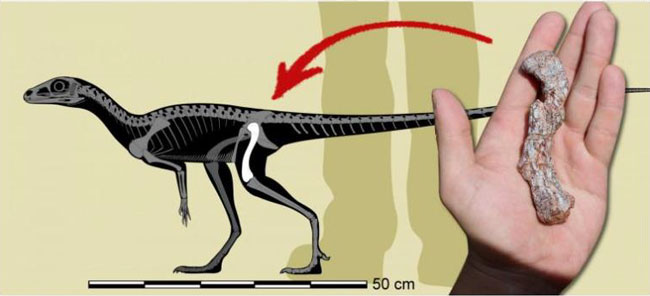
Dinosauromorph femur fossil from Brazil.

A skeletal drawing showing the placement of the right femur bone (shown in white) and a photograph of the actual fossil. Skeletal drawing by Maurício Silva Garcia, photography by Rodrigo Temp Müller. Note scale bar = 50 cm.

Picture credit: Maurício Silva Garcia/Rodrigo Temp Müller

The Dinodontosaurus Assemblage Zone

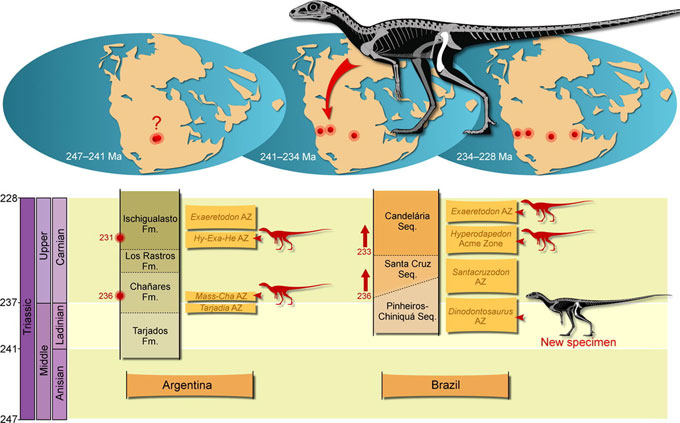
The fossilised thigh bone (right femur) measures 11 cm in length and it comes from Middle Triassic sediments (Pinheiros-Chiniquá Sequence) from the famous Dinodontosaurus Assemblage Zone, so named because as well as archosaur fossils, the sediments have yielded an abundance of fossil material associated with the dicynodont Dinodontosaurus. The femur has a morphology similar to the thigh bones of other dinosauromorphs, but it comes from much older stratum, estimated to be at least 237 million years old (Ladinian faunal stage of the Middle Triassic).

This newly described specimen establishes that the Dinosauromorpha (dinosaurs and their close ancestors), were present in South America earlier than previously recorded and extends the fossil record of South American dinosauromorphs into the Ladinian stage of the Triassic.

The thigh bone might be small and no genus has been erected based on this single fossil, but it does represent the oldest dinosauromorph fossil found in South America to date.

Fossils of South American dinosauromorphs compared.

A skeletal drawing of the Brazilian dinosauromorph (femur shown in white) with a comparison of fossil specimen stratigraphy from Argentina and Brazil which demonstrates the thigh bone represents the oldest evidence of Dinosauromorpha described to date in South America. Picture credit: Müller and Garcia.

Picture credit: Müller and Garcia

An Ecosystem Dominated by Other Reptiles

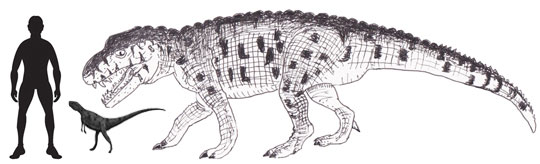
Based on comparisons with more complete fossil specimens the femur came from an animal around a metre in length, most of which was accounted for by its long, thin tail if this dinosauromorph possessed a similar body plan. It lived in a diverse ecosystem dominated by other types of reptile. For example, the giant pseudosuchian Prestosuchus was probably the apex predator and at nearly 7 metres in length, this giant member of the crocodile-line of the Archosauria would have dwarfed all the dinosauromorphs in the ecosystem.

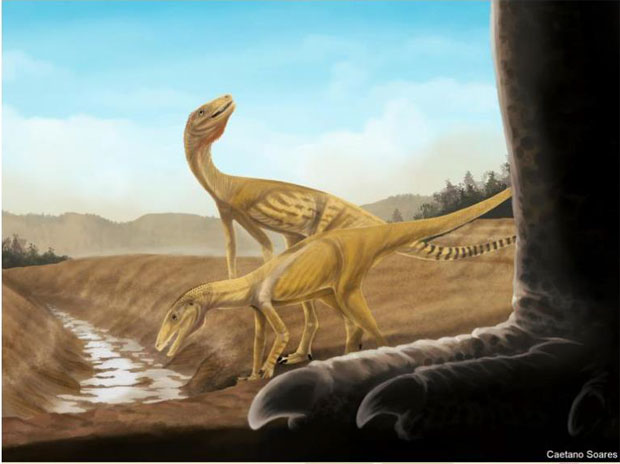
A life reconstruction of the Brazilian dinosauromorph

A life reconstruction of the Brazilian dinosauromorph based on the 11 cm long femur. This ancestor of the Dinosauria would have been dwarfed by other archosaurs in the ancient environment (Prestosuchus). Picture credit: Caetano Soares.

Picture credit: Caetano Soares

For an update on the research into South American dinosauromorphs: A New Silesaurid from South America.

Dinosauromorph compared to Prestosuchus

A scale drawing showing the relative sizes of the Brazilian dinosauromorph from the Pinheiros-Chiniquá Sequence compared to Prestosuchus chiniquensis. Picture credit: Everything Dinosaur.

Picture credit: Everything Dinosaur

The scientific paper: “Oldest dinosauromorph from South America and the early radiation of dinosaur precursors in Gondwana” by Rodrigo T. Müller and Maurício S. Garcia published in Gondwana Research.

Visit the Everything Dinosaur website: Prehistoric Animal Models.

26 03, 2022

First Titanosaur Nesting Site from the Late Cretaceous of Brazil

By |2024-10-30T12:24:45+00:00March 26th, 2022|Categories: Adobe CS5, Dinosaur and Prehistoric Animal News Stories, Dinosaur Fans, Main Page, Palaeontological articles, Photos/Pictures of Fossils|0 Comments

Scientists have identified the first confirmed dinosaur nesting site in Brazil. The fossilised eggs found suggest a colonial titanosaur nesting site and indicate individuals returning periodically to the same location to breed.  A paper has been published in the journal “Scientific Reports”.

The fossils consisting of preserved clutches and isolated egg fragments were excavated from sandy deposits in an abandoned limestone quarry (Lafarge Quarry) at Ponte Alta District, Uberaba Municipality in Minas Gerais State (south-eastern Brazil). The fossils were recovered from the Serra da Galga Formation (Upper Cretaceous) and although no fossilised embryos were found at the site, the shape of the eggs strongly suggest that they were laid by titanosaurs.

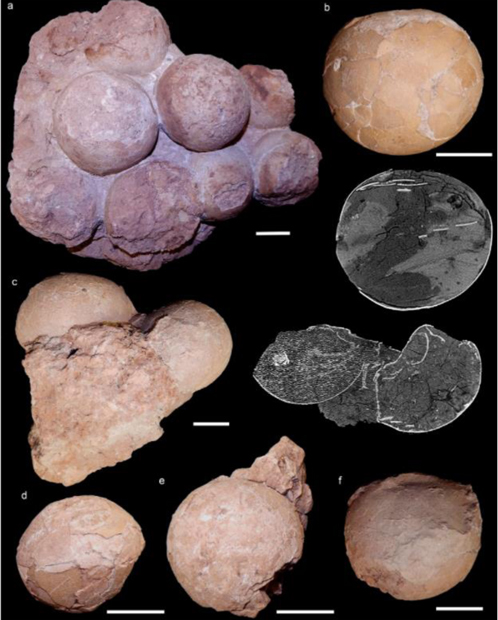
Images of titanosaur eggs from Brazil

Images of selected titanosaurian eggs and egg-clutches collected from the Late Cretaceous Serra da Galga Formation (Bauru Group) at Ponto Alta nesting site, Uberaba Municipality, Minas Gerais State, Brazil. CPPLIP 1798, (a) the best-preserved recovered egg-clutch, bottom view. CPPLIP 1801, (b) isolated egg, with accompanying tomographic slice, showing thickness of the shell and its sedimentary fill. Specimen number CPPLIP 1799, (c) egg-clutch with accompanying tomographic slice, showing thickness of the shell, shells collapsed and its sedimentary fill. The specimen number CPPLIP 1800, (d and e) two eggs found associated. Specimen number CPPLIP 1804 (f) isolated partial egg. Note scale bars 5 cm. Picture credit: Fiorelli et al.

Picture credit: Fiorelli et al

Nesting in Colonies and Evidence of Breeding-site Fidelity

The Titanosauria were a highly successful clade of long-necked, long-tailed herbivores that were globally distributed during the Cretaceous and survived up until the very end of the Mesozoic. Some of the biggest terrestrial animals known to science are members of this clade, dinosaurs such as Patagotitan, Argentinosaurus and Notocolossus. All three of these titanosaurs lived millions of years before the Lafarge Quarry eggs were laid and they lived much further south (higher palaeolatitude).

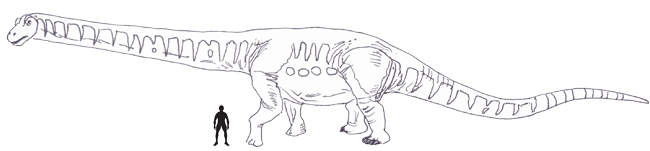
Patagotitan scale drawing.

A scale drawing of the giant titanosaur Patagotitan mayorum commissioned by Everything Dinosaur. This huge dinosaur was estimated to have measured around 35 metres when its fossil bones were initially examined. When Patagotitan was formally named and scientifically described its body size and weight was reduced slightly. However, a reconstructed, life-size skeleton was built measuring 37.2 metres in length. Titanosaurs are amongst the largest terrestrial animals known to science. Picture credit: Everything Dinosaur.

Picture credit: Everything Dinosaur

Numerous titanosaur nesting sites are known (Spain, Romania, France, India and most notably Argentina), writing in the academic journal “Scientific Reports”, the researchers report the first titanosaur nesting site from the Late Cretaceous of Brazil (Maastrichtian faunal stage). The fossil material consisting of several egg-clutches, partially preserved, isolated eggs and many eggshell fragments were found in two distinct levels, approximately two metres apart.

This discovery adds further support to the theory that these large herbivores nested in colonies and had preferred locations for their nesting sites, what is often referred to as breeding-site fidelity.

To read a related blog post about breeding-site fidelity (philopatry) identified in South American titanosaurs: Two New South American Titanosaurs Described.

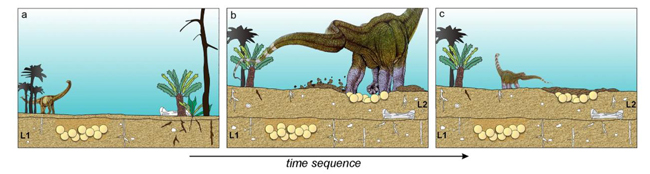
Brazilian titanosaur nesting site

The titanosaur egg fossils were found in two distinct layers (L1 and L2) approximately two metres apart. This suggests that this area was a preferred nesting site for titanosaurs. This is the first confirmed dinosaur nesting area found in Brazil. The eggs attributed to titanosaurs also represent the most northerly titanosaurian nesting site known from South America. The discovery of nests located at different levels indicates that titanosaurs returned regularly to preferred nesting areas. Picture credit: Fiorelli et al.

Picture credit: Fiorelli et al

Which Titanosaur Species?

Isolated and fragmentary remains of titanosaur eggs had previously been reported from Brazil, but the Lafarge Quarry specimens provide unambiguous proof of titanosaur nesting in Brazil. As no embryos have been found in association with the fossilised eggs, it is not possible to comment on the specific genus involved.

However, the researchers state that between the Santonian to the Maastrichtian faunal stages of the Late Cretaceous (86 to 66 million years ago) only derived titanosaurs such as saltasaurids and colossosaurians are recorded from South America. It is likely that the fossils associated with the nesting site represent an unknown genus.

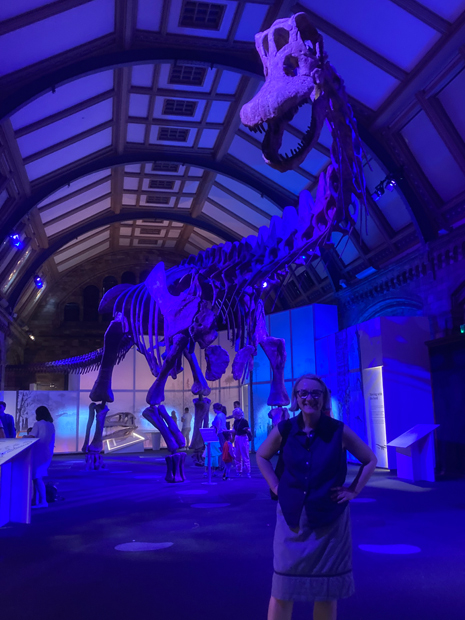
Patagotitan skeleton on display.

Sue from Everything Dinosaur poses in front of the colossal Patagotitan skeleton which is being exhibited at the Natural History Museum (London). Picture credit: Everything Dinosaur.

Picture credit: Everything Dinosaur

During the Late Cretaceous the Ponte Alta District would have been located at around 26 degrees south of the Equator, putting it on a similar palaeolatitude of titanosaur nesting sites found in India. Previously, South American titanosaur nesting sites have been recorded between 33 to 47 degrees south of the Equator. This latitudinal difference could also influence the distribution of species on the Gondwana continent. The palaeoclimatic variation and geological characteristics could result in a difference in nesting time between titanosaurs living at different latitudes.

How Did Titanosaurs Build Nests?

The Lafarge Quarry site indicates colonial nesting which also suggests that these herbivorous dinosaurs moved around in herds. It is likely that Ponte Alta District titanosaurs scooped out pits in the soft sand using their back legs and then laid their eggs in clutches, before burying them and perhaps covering the nest with vegetation to help incubation.

To read an article about the naming of Austroposeidon magnificus the largest dinosaur from Brazil described to date: Brazil’s Biggest Dinosaur.

The scientific paper: “First titanosaur dinosaur nesting site from the Late Cretaceous of Brazil” by Lucas E. Fiorelli, Agustín G. Martinelli, João Ismael da Silva, E. Martín Hechenleitner, Marcus Vinícius Theodoro Soares, Julian C. G. Silva Junior, José Carlos da Silva, Élbia Messias Roteli Borges, Luiz Carlos Borges Ribeiro, André Marconato, Giorgio Basilici and Thiago da Silva Marinho published in Scientific Reports.

The award-winning Everything Dinosaur website: Dinosaur Models.

25 03, 2022

New Bone Density Study Confirms Spinosaurids were Semi-Aquatic

By |2024-10-30T10:24:11+00:00March 25th, 2022|Categories: Adobe CS5, Dinosaur and Prehistoric Animal News Stories, Dinosaur Fans, Main Page, Palaeontological articles|0 Comments

Spinosaurus (S. aegyptiacus) and its close relatives (spinosaurids) are an enigmatic group of theropod dinosaurs that have undergone a radical shift in their place in Early to early Late Cretaceous ecosystems as more evidence has emerged that these predators were adapted to a semi-aquatic lifestyle.

This week, in the journal “Nature”, a new study was published reinforcing the idea that these dinosaurs were perfectly at home in the water. An examination of spinosaurid bone density in comparison to the bone densities of extant animals which are adapted to an aquatic life, demonstrates that Spinosaurus and its close relative Baryonyx (B. walkeri) were capable of submerging themselves underwater to hunt.
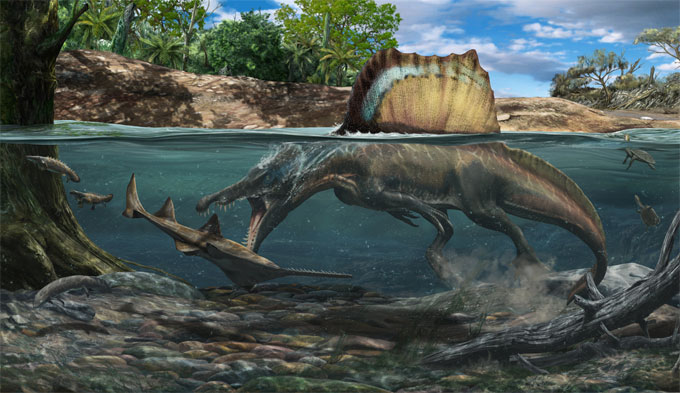
Spinosaurus underwater.

Spinosaurus, the longest predatory dinosaur known, is opening its elongate jaws, studded with conical teeth, to catch a sawskate. Contrary to previous suggestions, this animal was not a heron-like wader – it was a “river monster”, actively pursuing prey in a vast river system located in modern-day North Africa. Dense bones in the skeleton of Spinosaurus strongly suggest it spent a substantial amount of time submerged in the water. Picture credit: Davide Bonadonna.

Picture credit: David Bonadonna

Anatomical Adaptations for an Aquatic Life

Recent studies utilising fossil finds from North Africa had demonstrated that Spinosaurus aegyptiacus possessed a number of anatomical adaptations indicating an aquatic existence. It had long, narrow jaws lined with cone-shaped teeth, ideal for catching slippery fish. The nostrils were retracted and located further up the snout, Spinosaurus was a quadruped with short hind legs adapted for swimming and it is now known that it had a fin on its long tail, making it ideal as an organ for propulsion: Spinosaurus a River Monster!

When Baryonyx was first described after the discovery of its fossilised bones in a Surrey clay pit, scientists found evidence of fish scales and the remains of a small iguanodontid in the body cavity where the stomach would have been. This suggests that Baryonyx ate fish as well as other dinosaurs.

Dr Nizar Ibrahim

University of Portsmouth palaeontologist Dr Nizar Ibrahim has been at the forefront of research into spinosaurids, helping to change our perceptions about these super-sized predators. He has been a member of several field teams that have explored the Cretaceous deposits of North Africa helping to find more fossils of Spinosaurus aegyptiacus upon which these new revelations are based.
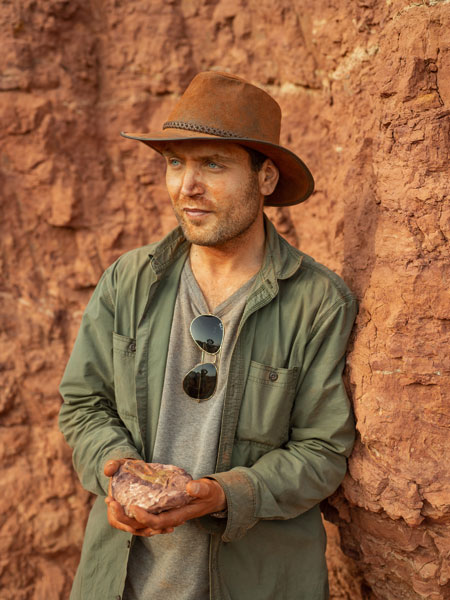
Dr Nizar Ibrahim

Dr Nizar Ibrahim in the Sahara. A co-author of the scientific paper that examined bone density of living animals comparing these results to those of spinosaurids to further strengthen the theory that dinosaurs such as Baryonyx and Spinosaurus were semi-aquatic. Picture credit: Paolo Verzone.

Picture credit: Paolo Verzone

Dr Ibrahim is one of the co-authors of the bone density paper. The continuing debate about just how much time Spinosaurus spent in the water and whether it was an underwater pursuit predator or hunted fish like a giant heron led lead author Dr Matteo Fabbri, (Chicago Field Museum), senior author Dr Ibrahim and international colleagues to try to find another way to infer the lifestyle and ecology of Spinosaurus.

Dr Fabbri explained:

“The idea for our study was, okay, clearly we can interpret the fossil data in different ways. But what about the general physical laws? There are certain laws that are applicable to any organism on this planet. One of these laws regards density and the capability of submerging into water.”

Bone density can provide evidence to support a vertebrate’s aquatic behaviour. Animals that spend a lot of time underwater tend to have dense bones to help them remain submerged. If spinosaurids had similar bones, then this would provide further evidence in support of the idea that these dinosaurs hunted underwater.

Bone Densities of Living and Extinct Animals Compared

The research team assembled an exceptionally large dataset of femur and rib bone cross-sections from 250 species of extinct and living animals, including both land-dwellers and water-dwellers, and covering animals ranging in weight from a few grammes to several tonnes including seals, whales, elephants, mice, and even hummingbirds.

The scientists also collected data on extinct marine reptiles like mosasaurs and plesiosaurs. The researchers compared bone cross sections of these animals to cross-sections of bone from Spinosaurus and its close relatives Baryonyx and Suchomimus.

A clear link was identified between bone density and aquatic foraging behaviour. Animals that submerge themselves underwater to find food have bones that are almost completely solid throughout, whereas cross-sections of land-dwellers’ bones look more like doughnuts, with hollow centres.

When the researchers applied spinosaurid dinosaur bones to this paradigm, they found that Spinosaurus and Baryonyx both had the type of dense bone associated with full submersion.
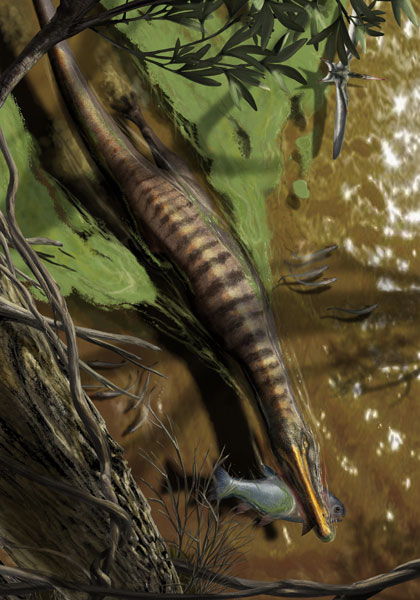
Baryonyx swimming.

Baryonyx, from Surrey in England, swims through an ancient river with a fish in its jaws. Like its much larger African relative Spinosaurus, Baryonyx had dense bones, suggesting that it too spent much of its time submerged in water. It was previously thought to have been less aquatic than its Saharan relative. Picture credit: Davide Bonadonna.

Picture credit: Davide Bonadonna

Commenting on their research Dr Ibrahim stated:

“The scope of our study kept expanding because we kept thinking of more and more groups of vertebrates to include.”

A Different Environmental Niche for Suchomimus

The closely related Suchomimus (S. tenerensis), fossils of which are known from the Early Cretaceous of Niger, was discovered to have less dense bones than both Baryonyx and Spinosaurus. It lived by water and ate fish, as evidenced by its crocodile-like snout and conical teeth, but based on its bone density, it wasn’t actually swimming much. Perhaps this dinosaur was not a subaqueous forager but hunted for fish by wading into the water, rarely getting out of its depth.
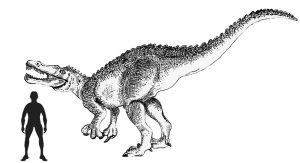
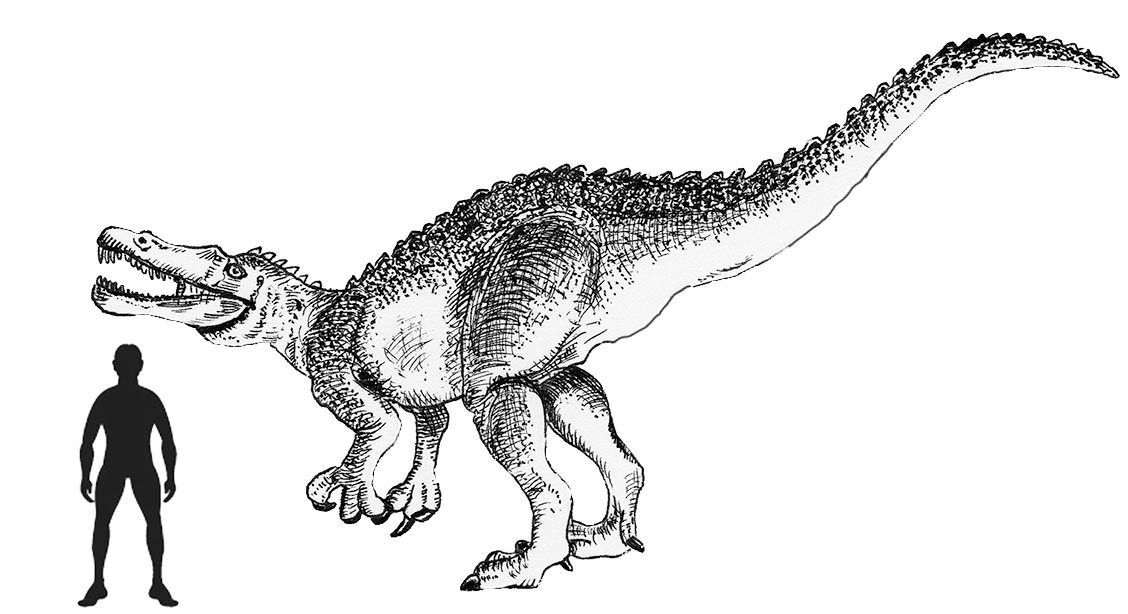
Suchomimus scale drawing.

A scale drawing of the theropod Suchomimus. Picture credit: Everything Dinosaur.

Picture credit: Everything Dinosaur

Different feeding behaviours might help to explain why similar types of spinosaurid could co-exist: Two New Spinosaurids from the Isle of Wight.

Spinosaurids were Semi-Aquatic

Co-author of the study, Dr Jingmai O’Connor from the Field Museum in Chicago explained that collaborative studies like this one that draw from hundreds of specimens, are “the future of palaeontology”. These studies might be very time-consuming to complete, but they let scientists shed light onto big patterns within the fossil record.

Dr Ibrahim is already thinking about his next research project, he commented:

“I think that, with this additional line of evidence, speculative notions that envisage Spinosaurus as some sort of giant wader lack evidential support and can be safely excluded. The bones don’t lie, and now we know that even the internal architecture of the bones is entirely consistent with our interpretation of this animal as a giant predator hunting fish in vast rivers, using its paddle-like tail for propulsion. It will be interesting to reconstruct in a lot more detail how these river monsters moved around – something we are already working on.”

Everything Dinosaur acknowledges the assistance of a media release from the University of Portsmouth in the compilation of this article.

The scientific paper: “Subaqueous foraging among carnivorous dinosaurs” by Matteo Fabbri, Guillermo Navalón, Roger B. J. Benson, Diego Pol, Jingmai O’Connor, Bhart-Anjan S. Bhullar, Gregory M. Erickson, Mark A. Norell, Andrew Orkney, Matthew C. Lamanna, Samir Zouhri, Justine Becker, Amanda Emke, Cristiano Dal Sasso, Gabriele Bindellini, Simone Maganuco, Marco Auditore and Nizar Ibrahim published in Nature.

Visit Everything Dinosaur’s website: Everything Dinosaur.

23 03, 2022

Very Unlucky Dinosaurs According to New Research

By |2024-10-30T10:11:45+00:00March 23rd, 2022|Categories: Adobe CS5, Dinosaur and Prehistoric Animal News Stories, Dinosaur Fans, Main Page, Palaeontological articles|0 Comments

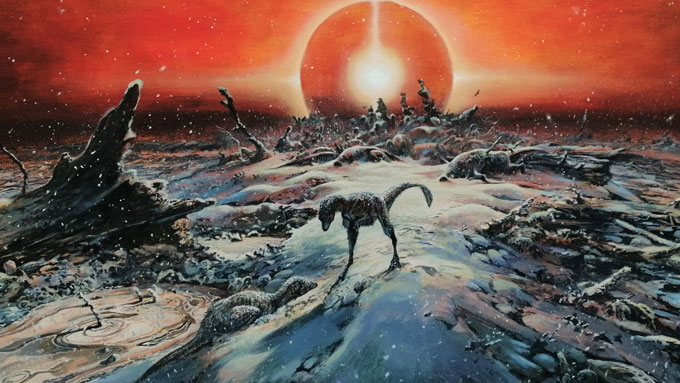
The extra-terrestrial impact event that marked the end of the Mesozoic is estimated to have wiped out more than three-quarters of all the marine animal species, including most of the marine reptiles and devastated life on land resulting in the extinction of the non-avian dinosaurs and the Pterosauria. As terrible the impact was, it was made worse by the presence of vast amounts of sulphur within the rocks that bore the brunt of the impact. In the immediate aftermath the sulphur particles thrust high into the atmosphere caused acid rain, blocked sunlight and prolonged planetary-scale cooling exacerbating the extinction event.

It seems the dinosaurs were just very unlucky…

Extinction of the dinosaurs.

The K-Pg extinction event was exacerbated by the high levels of sulphur at the extra-terrestrial impact site that led to prolonged global cooling. Picture credit: James McKay

Picture credit: James McKay

Unlucky Dinosaurs

Scientists from the University of Bristol, St Andrews University, Syracuse University (New York), Texas A&M University (College Station, Texas) and Ellington Geological Services (Houston, Texas), have published a paper in the prestigious Proceedings of the National Academy of Sciences that explores the consequences of the extra-terrestrial impact event.

They conclude that the expulsion of huge amounts of sulphur into the atmosphere contributed directly to the extinction of the dinosaurs.

The researchers found that sulphur gases circulated globally for years in the Earth’s atmosphere, cooling the climate and contributing to the mass extinction of life. This extinction event was catastrophic for the non-avian dinosaurs and other life, but also allowed for the diversification of mammals including primates, which ultimately led to the evolution of hominins such as our own species.

A Rapid and Catastrophic Change in the Global Geological Record

Commenting on the significance of the research, co-author of the paper Dr James Witts (School of Earth Sciences, University of Bristol) stated:

“Our data provides the first direct evidence for the massive amounts of sulphur released by the Chicxulub impact. It’s amazing to be able to see such rapid and catastrophic global change in the geological record.”

Sulphate aerosols have been implicated previously in the end-Cretaceous mass extinction event which marked the demise of the non-avian dinosaurs and the start of the “Age of Mammals”. The research team were able to examine the rare sulphur isotopes in material ejected by the impact and deposited in a nearby sea, now represented by rocks found along the Brazos River in Texas.

By examining the concentration of the sulphur deposits the team could assess the devastating consequences of the release of huge quantities of sulphur into the atmosphere some 66 million years ago.

The Effect of Atmospheric Sulphur

Atmospheric sulphur in the stratosphere scattered incoming solar radiation and prolonged planetary-scale cooling for many years after the original impact, causing acid rain and reducing the light available for photosynthesis which further depleted terrestrial vegetation and marine plankton extending the time it would have taken for food chains to recover.

Corresponding author Christopher Junium (Syracuse University) added:

“The initial effects of the impact were caused by rock dust, soot and wildfires, but the sulphur aerosols extended the time period over which life would have suffered from extreme cooling, reduced sunlight and acidification of the land surface and oceans. And it was this extended duration of cooling that likely played a central role in the severity of the extinction.”

Three Hundred Billion Tonnes of Sulphur – Unlucky Dinosaurs

In 2017, Everything Dinosaur produced an article that looked at similar research published in Geophysical Research Letters that examined the impact that may have ejected 300 billion tonnes of sulphur into the planet’s atmosphere. This paper too, emphasised the devastation caused by sulphur aerosols and it examined the consequences of the event, which they estimated caused a temperature drop on land by as much as 17 degrees Celsius.

The Japan-based researchers also calculated that had the catastrophe occurred elsewhere on the planet, the dinosaurs may not have become extinct and the resulting macroevolution of the mammals may not have occurred. Lucky for us, it did, to read our 2017 article: Chicxulub Impact – A Really Bad Place to Hit.

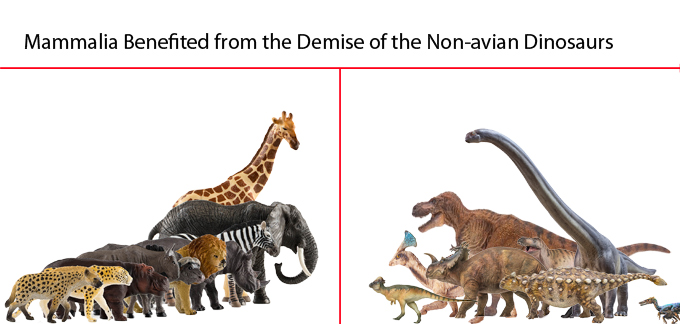
Mammals benefited from the extinction of the non-avian dinosaurs.

The extinction of the non-avian dinosaurs permitted the Mammalia to diversify and become the dominate terrestrial fauna. Picture credit: Everything Dinosaur.

Picture credit: Everything Dinosaur

The dinosaur figures in the picture above come from the PNSO model range.

To view this range: PNSO Age of Dinosaurs Models.

Lucky for us, the non-avian dinosaurs were very unlucky…

Everything Dinosaur acknowledges the assistance of a media release from the University of Bristol in the compilation of this article.

The scientific paper: “Massive perturbations to atmospheric sulfur in the aftermath of the Chicxulub impact” by Christopher K. Junium, Aubrey L. Zerkle, James D. Witts, Linda C. Ivany, Thomas E. Yancey, Chengjie Liu and Mark W. Claire published in The Proceedings of the National Academy of Sciences.

The Everything Dinosaur website: Dinosaur Toys.

22 03, 2022

Earliest Jaws in Evolutionary Trade-Off According to New Research

By |2024-10-30T10:02:57+00:00March 22nd, 2022|Categories: Adobe CS5, Dinosaur and Prehistoric Animal News Stories, Main Page, Palaeontological articles, Photos/Pictures of Fossils|0 Comments

Most vertebrates have jaws, specialised anatomical features for capturing and processing food. A newly published study suggests that the earliest jaws to evolve were caught in a trade-off between maximising their strength and their bite speed.

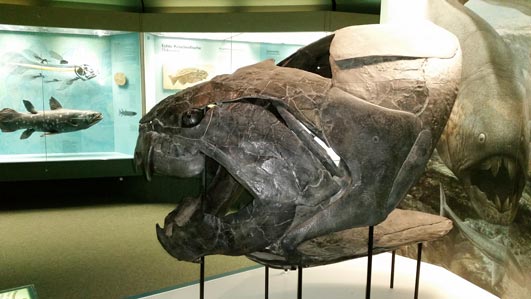
Dunkleosteus on display. A placoderm parent?

A spectacular Dunkleosteus exhibit. Dunkleosteus was one of 48 Placodermi genera whose jaws were examined in this study. Mathematical models of potential jaw shapes were compared against the actual fossil record. Jaw evolution has been constrained to shapes that have the highest possible speed and strength. Picture credit: Everything Dinosaur.

Picture credit: Everything Dinosaur

The Evolution of Jaws in Vertebrates

Jawed vertebrates dominate modern ecosystems emphasising the importance of jaw development in the evolutionary history of the vertebrates. Over 99% of all living vertebrates have jaws and the very first jaws evolved in prehistoric fish over 400 million years ago. These jaws evolved from gill arches, anatomical structures in fish that support their gills.

How jaws developed has been well documented, for example, Everything Dinosaur has blogged about their evolution: Ancient Shark Provides Insight into Jaw Development, however, researchers led by scientists from the University of Bristol have explored this important topic using a mathematical model to examine the early evolution and radiation of jaw types.

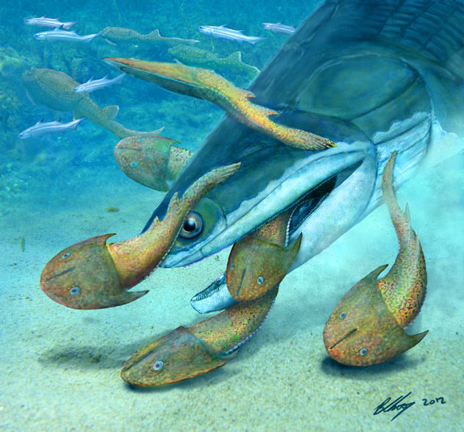
Megamastax amblyodus Illustration

Megamastax terrorises a group of jawless fish. The sarcopterygian Megamastax from the Late Silurian, a large, predatory fish with a powerful jaw attacking a group of jawless fish. The evolution of jaws probably led to the demise of the Agnatha (jawless fish) with only the Hagfish (Myxini) and the Lamprey (Hyperoartia) as the only living examples of this once extremely specious Infraphylum.  Picture credit: Dr Brian Choo.

Picture credit: Dr Brian Choo

The Development of a Novel Mathematical Model to Explore Jaw Development

Writing in the academic publication “Science Advances”, the researchers collected data on the shapes of fossil jaws and developed a mathematical model to assess their characteristics. The mathematical model produced permitted the scientists to extrapolate an extensive range of theoretical jaw shapes that could have been explored by the first evolving jaws. These theoretical jaws were tested for their strength – the amount of force they could endure without breaking, and their speed – how efficiently they could be opened and closed.

Jaw speed and jaw strength are two traits that conflict with each other. For example, really strong, powerful jaws like those associated with the giant placoderm Dunkleosteus would probably have been quite slow to open and close. Increasing bite force usually means a decrease in jaw speed.

By comparing the fossil record with the theoretical jaw shapes predicted by the mathematical model, the researchers deduced that jaw evolution has been constrained to shapes that have the highest possible speed in relation to their strength. Specifically, the jaws of early members of the Gnathostomata (jawed vertebrates) in the dataset were extremely optimal, and some groups evolved away from this optimum over time. These results suggest that the evolution of biting was very quick.

Studying the Earliest Jaws Using Mathematics

Bristol University PhD student William Deakin, the lead author of the paper explained:

“Jaws are an extremely important feature to gnathostomes – or jaw-mouths. They are not only extremely widespread, but almost all creatures that have them, use them in the same way – to grab food and process it. That’s more than can be said for an arm or a foot or a tail, which can be used for all sorts of things. This makes jaws extremely useful to anyone studying the evolution of function. Very different jaws from very different animals can be tested in similar ways. Here we have shown that studies on a large variety of jaws, using theoretical morphology and adaptive landscapes to capture their variety in function, can help shed some light on evolutionary questions.”

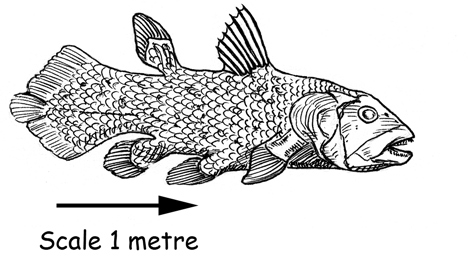
Scale drawing of a Coelacanth. What is a Coelacanth?

A scale drawing of a ceolacanth (Latimeria). he research team analysed the jaw shape of 121 extinct gnathostome taxa ranging in age from the Late Silurian to the end of the Devonian. The largest group of fossil fish studied were members of the Sarcopterygii (57 examples studied). The Sarcopterygii are the lobe-finned fishes an example of which is the extant Coelacanth (Latimeria). Picture credit: Everything Dinosaur.

Picture credit: Everything Dinosaur

Co-author of the study Professor Philip Donoghue (University of Bristol), added:

“The earliest jawed vertebrates have jaws in all shapes and sizes, long thought to reflect adaptation to different functions. Our study shows that most of this variation was equally optimal for strength and speed, making for fearsome predators.”

Emily Rayfield, who like Professor Donoghue is also a Professor of Palaeobiology at Bristol University and co-author of the paper, praised the new, insightful mathematical model developed by William Deakin commenting:

“The new software that Will developed to analyse the evolution of jawed vertebrates, is unique. It allows us to map the design space of key anatomical innovations, like jaws, and determine their functional properties. We plan to use it to uncover many more of the secrets of evolutionary history.”

Everything Dinosaur acknowledges the assistance of a media release from the University of Bristol in the compilation of this article.

The scientific paper: “Increasing morphological disparity and decreasing optimality for jaw speed and strength during the radiation of jawed vertebrates” by William J. Deakin, Philip S. L. Anderson, Wendy Den Boer, Thomas J. Smith, Jennifer J. Hill, Martin Rücklin, Philip C. J. Donoghue and Emily J. Rayfield published in Science Advances.

Visit the Everything Dinosaur website: Everything Dinosaur.
20 03, 2022

Is Torosaurus a Valid Genus? Canadian Fossils Suggest it is

By |2024-10-29T07:52:49+00:00March 20th, 2022|Categories: Dinosaur and Prehistoric Animal News Stories, Dinosaur Fans, Main Page, Palaeontological articles, Photos/Pictures of Fossils|2 Comments

Palaeontologists have debated the validity of the Torosaurus genus for decades. Some scientists see this large chasmosaurine known from the Upper Cretaceous (Maastrichtian faunal stage) as a distinct taxon, whilst others consider the genus to be invalid, the fossil material representing old and mature examples of Triceratops.

Analysis of horned dinosaur fossil material from Canada lends support to the idea that Torosaurus is distinct from Triceratops and that it is a valid taxon. A microscopic study of bone composition indicates that the individual animal represented was still growing at the time of its death. This evidence challenges the idea that fossils attributed to Torosaurus are just the remains of very old, fully grown and very mature Triceratops.

Dinosaur drawing commissioned by Everything Dinosaur.

An illustration of the Late Cretaceous chasmosaurine Torosaurus latus. Some palaeontologists have proposed that Torosaurus is simply a skeletally mature growth form of the contemporaneous Triceratops. New research studying partial ceratopsian frills and limb bones found in Canada suggests that Torosaurus is a valid taxon. Picture credit: Everything Dinosaur.
Picture credit: Everything Dinosaur

Canadian Fossils Indicate that Torosaurus is a Valid Taxon

Writing in the Zoological Journal of the Linnean Society, researchers from the Canadian Museum of Nature, the Royal Saskatchewan Museum and Fibics Incorporated (Ontario), analysed two partial cranial frills attributed to Torosaurus. The first, EM P16.1 comes from Frenchman Formation exposures in Saskatchewan which represent uppermost Maastrichtian deposits. This fossil material was collected in 1947 along with two fragmentary thigh bones that were later damaged by floodwater when in storage, the limb bones provided the material for the osteohistological analysis to determine the age of dinosaur. The second specimen UALVP 1646, was found along the Red Deer River valley (Alberta) in 1964. It comes from higher parts of the Lower Scollard Formation. Both frill specimens are estimated to between 66 and 67 million years of age.

PNSO Torosaurus Aubrey and Dabei dinosaur models.

In horned dinosaurs, taxonomy is complicated by the fact that the cranial ornamentation that is often used to distinguish species changes radically with age. The long head shield of Torosaurus with its fenestrae was thought to represent the head crest of very old and mature Triceratops. New research using Canadian fossils refutes this theory and postulates that Torosaurus is a valid genus and the Canadian specimens mark the northernmost distribution of this ceratopsid.

The image (above) shows a replica of an adult Torosaurus with a juvenile.  These figures are from the PNSO range of prehistoric animal figures.

To view the PNSO model range: PNSO Models.

Identifying Torosaurus

Torosaurus has been distinguished from the contemporary Triceratops by the presence of two large holes (paired fenestrae) in the neck frill, which tends to be longer and wider, formed by the longer and tapering squamosal skull bones. In addition, Torosaurus is associated with an increased number of epiparietals (bony bumps and horns) on the margins of the neck shield.

Torosaurus Fossils (EM P16.1)

Parietosquomosal frill of Torosaurus latus (EM P16.1). Dorsal surface (A) which has been reconstructed using plaster and clay with interpretative drawing (B). Schematic transverse cross-section of squamosal near caudal edge based on a sketch by H. Jones. Schematic of frill showing paired fossae and channels on ventral surface of squamosals, based on sketch by H. Jones. Picture credit: Mallon et al.

Picture credit: Mallon et al

Osteohistological Sampling

A fragment of limb bone representing a portion of the left femur found in association with EM P16.1 was subjected to osteohistological analysis to determine the age of the dinosaur when it died. Small cross-sections of bone were cut and mounted onto epoxy resin. These were then carefully ground down to produce the extremely thin bone slices. Light microscopy and scanning electron microscopy (SEM) were then employed to reveal the bone structure at the cellular level.

Although the femur had been extensively repaired with plaster, enough of the bone structure remained for the research team to identify that this dinosaur was still growing when it died. They conclude that the fossil material comes from a late subadult or early adult individual and not an extremely old and mature animal. The scientists refute the hypothesis that Torosaurus represents very old examples of Triceratops.

Osteohistology of Torosaurus

T. latus limb bones found in association with EM P16.1. Photograph (A) shows the thin cross-section of prepared bone taken from a fragmentary femur, the red box area is shown in greater magnification (B). Haversian tissue (C), thin section of cortical bone of left femur, the red box is highly magnifed (D). The bone analysis indicates that this individual was stil growing at the time of death, leading the researchers to conclude that Torosaurus is a valid genus and not simply a very old specimen of a Triceratops. Picture credit: Mallon et al.

Picture credit: Mallon et al

Torosaurus and Triceratops Present in the Late Cretaceous of Canada

Based on this study, the researchers conclude that Torosaurus was present in Canada during the Late Cretaceous. Triceratops is also known from fossils found in Canada, both the currently recognised species Triceratops horridus and the geologically younger T. prorsus have been reported. If the frill fossils and limb bone fragments do represent Torosaurus then they mark the northernmost range of this taxon.

Torosaurus Fossils UALVP 1646

Parietal of Torosaurus latus (UALVP 1646). Dorsal surface (A); with (B) interpretive reconstruction of dorsal surface. The ventral surface is shown (C) and (D) interpretive reconstruction ventral surface. Photograph (E), detail of left parietal fenestra. Arrows in B and D indicate epiparietal loci. Picture credit: Mallon et al.

Picture credit: Mallon et al

Different Species of Torosaurus?

Intriguingly, much of the fossil material that was used in the original description of Torosaurus (Marsh 1891) was not precisely recorded. As a result, the stratigraphic distribution of the early collected Torosaurus fossils is unknown. Most of the recently collected Torosaurus latus fossils from the Hell Creek Formation comes from the lower half of the formation.

The majority of the Hell Creek Formation Torosaurus material was deposited earlier than the Torosaurus fossils from the geologically younger upper portion of the Scollard Formation and the Frenchman Formation of Canada which are approximately the same age as the uppermost parts of the Hell Creek Formation.

One Torosaurus specimen (MPM VP6841) is an exception it having been discovered in sediments associated with the upper part of the Hell Creek Formation. Specimen number MPM VP6841 compares closely to the Canadian specimen EM P16.1 and it has been proposed that these fossils may represent another Torosaurus species. The Hell Creek Formation was deposited over a period of at least 700,000 years (possibly as much as a million years).

Palaeontologists are aware that the Triceratops material associated with different stratigraphy represent different Triceratops species – T. horridus and the geologically younger T. prorsus plus another, as yet unnamed transitional form between the two.

Torosaurus Stratigraphy

The distribution of Torosaurus latus fossil material suggests that as with Triceratops the Hell Creek strata may contain more than one species. Picture credit: Mallon et al with additional annotation by Everything Dinosaur.
Picture credit: Mallon et al with additional annotation by Everything Dinosaur

The researchers conclude that different species of Torosaurus would turn over in a similar manner as Triceratops within these uppermost Maastrichtian strata. There may be more species of Torosaurus identified in the future.

The scientific paper: “The record of Torosaurus (Ornithischia: Ceratopsidae) in Canada and its taxonomic implications” by Jordan C. Mallon, Robert B. Holmes, Emily L. Bamforth and Dirk Schumann published in the Zoological Journal of the Linnean Society.

The award-winning Everything Dinosaur website: Prehistoric Animal Models.

Go to Top