All about dinosaurs, fossils and prehistoric animals by Everything Dinosaur team members.

Fossil finds, new dinosaur discoveries, news and views from the world of palaeontology and other Earth sciences.

16 03, 2022

The Earliest Armoured Dinosaur found in Asia to Date

By |2024-10-28T13:52:04+00:00March 16th, 2022|Categories: Adobe CS5, Dinosaur and Prehistoric Animal News Stories, Dinosaur Fans, Main Page, Palaeontological articles, Photos/Pictures of Fossils|0 Comments

Scientists including Professor Paul Barrett of the London Natural History Museum have described a new species of basal armoured dinosaur from fossils found in China. The dinosaur named Yuxisaurus kopchicki, represents the first valid and undisputed member of the Thyreophora (armoured dinosaurs) to be described from fossils found in Lower Jurassic Asian strata.

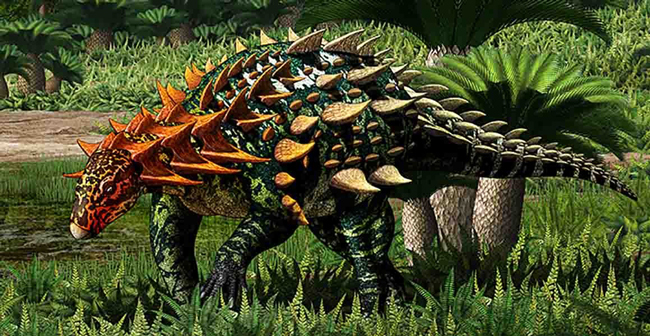
Yuxisaurus life reconstruction

A life reconstruction of the newly described, Early Jurassic Chinese armoured dinosaur Yuxisaurus kopchicki. Picture credit: Yu Chen.

Picture credit: Yu Chen

The Rapid Geographic Spread of Early Armoured Dinosaurs

With an estimated body length of around three metres, Yuxisaurus might be small compared to some of the later and much more famous members of the Thyreophora clade such as Ankylosaurus and Stegosaurus, but confirmation of the presence of early armoured dinosaurs in China underlines the rapid geographic dispersal of these ornithischians. The first armoured dinosaurs are thought to have evolved around 200 million years ago (Hettangian faunal stage of the Early Jurassic). Yuxisaurus fossils consisting of vertebrae, skull bones, elements from the limbs, shoulder blades (scapulae) and 120 osteoderms (bony armour), were excavated from the upper portion of Fengjiahe Formation exposures, near Jiaojiadian village, Yimen County, Yuxi Prefecture, Yunnan Province (southwestern China).

Although the dating of the strata has proved problematical, it is likely that the fossils are somewhere between 192 and 182 million years old (late Sinemurian to early Toarcian stage of the Early Jurassic).

Variety Amongst Early Members of the Thyreophora

Although relatively small compared to later armoured dinosaurs, the limb bones suggest a robust, stout animal indicating that Yuxisaurus had a different body shape compared to other known early thyreophorans such as Scutellosaurus and Emausaurus. This suggests that early armoured dinosaurs had a diverse morphology and ecology and they spread rapidly establishing a wide geographical distribution and filling a variety of niches in Early Jurassic ecosystems.

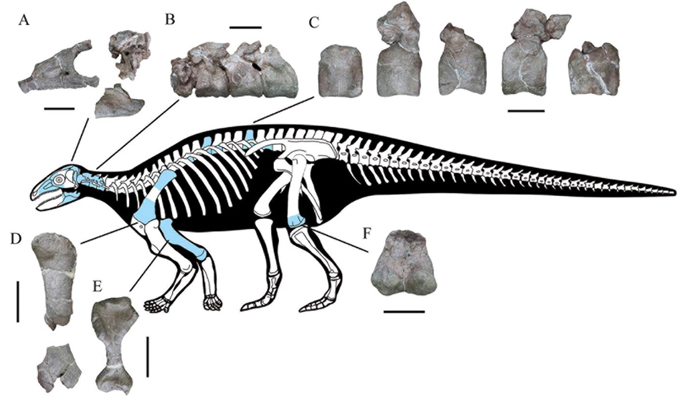
Yuxisaurus skeletal drawing.

Skeletal reconstruction of Y. kopchicki showing main preserved elements from the holotype (highlighted in blue). Details of the skull bones (A), cervical vertebrae (B) and dorsal vertebrae (C). The left scapula is shown (D) and the right humerus (E) along with the distal portion of the left femur (F). Note scale bars equal 5 cm for A-C and 10 cm for D-F. Osteoderms have been omitted to show the skeleton. Picture credit: Xi Yao.

Picture credit: Xi Yao

The First Unambiguous Armoured Dinosaur from the Early Jurassic of Asia

First author of the scientific paper, Professor Paul Barrett (Natural History Museum, London), commented:

“Although we’ve had tantalising fragments of early armoured dinosaurs from Asia, this is the first time we’ve had enough material to recognise a new species from the region and investigate its evolutionary history. I hope it’s the first of many new dinosaurs from the localities being discovered by my colleagues in Yunnan.”

Senior author of the paper, Dr Shundong Bi, a professor at Indiana University of Pennsylvania, explained that the dinosaur had been named Yuxisaurus kopchicki in honour of the Yuxi Prefecture, whilst the trivial or species name was in recognition of the work of molecular biologist Dr John J. Kopchick and for his support and funding of a new Indiana University of Pennsylvania science complex which is due to open in autumn 2023.

Dr Shundong Bi stated, that despite its robust body:

“Yuxisaurus was possibly a facultative quadrupedal. It was primarily adapted for walking on four legs, but also able to walk on two legs.”

Where Did Armoured Dinosaurs Originate?

Until recently all the unambiguous Early Jurassic Thyreophora taxa were described from fossils found in North America (Scutellosaurus) or Europe (Emausaurus and Scelidosaurus). This led palaeontologists to conclude that armoured dinosaurs originated in Laurasia, however, new phylogenetic analyses (Butler et al 2020, Boyd 2015, Raven and Maidment 2017, Maidment et al 2020 and Baron et al 2017a) have proposed that Lesothosaurus from southern Africa and Laquintasaura from Venezuela might also represent early members of the Thyreophora. If Lesothosaurus and Laquintasaura are early armoured dinosaurs, then this suggests that this clade could have originated in Gondwana.

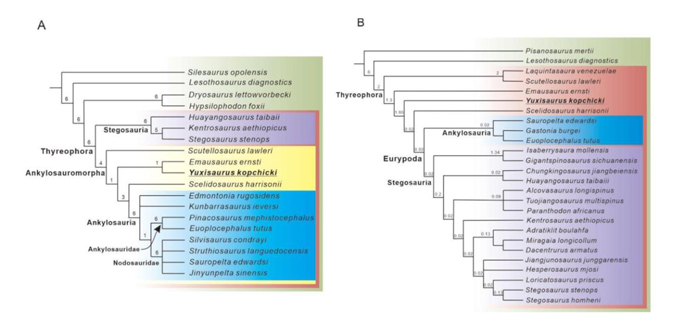
Yuxisaurus phylogeny

Phylogenetic assessments plotting the relationship of Yuxisaurus within the Thyreophora. Analysis (A) modified from Norman (2021) dataset which places Yuxisaurus as a sister taxon to Emausaurus which is known from the Early Jurassic (Toarcian) of Germany. Analysis (B) modified from Maidment et al (2020) places Yuxisaurus within the Thyreophora as an early-diverging branch between Emausaurus and Scelidosaurus which is known from the older sedimentary deposits from Charmouth on the Dorset coast. Picture credit: Yao et al.

Picture credit: Xi Yao et al

The phylogeny of early ornithischians remains disputed, it is hoped that further fossil finds will resolve this debate.

Everything Dinosaur acknowledges the assistance of a media release from the London Natural History Museum in the compilation of this article.

To read an article about the discovery of Laquintasaura: Laquintasaura What Does it All Mean?

The scientific paper: “A new early-branching armoured dinosaur from the Lower Jurassic of southwestern China” by Xi Yao, Paul M. Barrett, Lei Yang, Xing Xu and Shundong Bi preprint via bioRxiv before publication in eLife.

Visit the award-winning Everything Dinosaur website: Dinosaur Toys and Gifts.

14 03, 2022

When Did Killer Whales Become Killers of Whales?

By |2024-10-28T13:37:16+00:00March 14th, 2022|Categories: Adobe CS5, Dinosaur and Prehistoric Animal News Stories, Main Page|0 Comments

Only two living species of dolphins (members of the Delphinidae family), are known to attack and feed upon large mammals. There is the killer whale, also referred to as the Orca, (Orcinus orca) and the false killer whale (Pseudorca crassidens). Orcas attack a wide variety of other marine mammals including seals, sealions, whales and other dolphins, whereas the false killer whale mainly eats fish but attacks on smaller dolphins, sperm whales and the young of baleen whales have been reported.

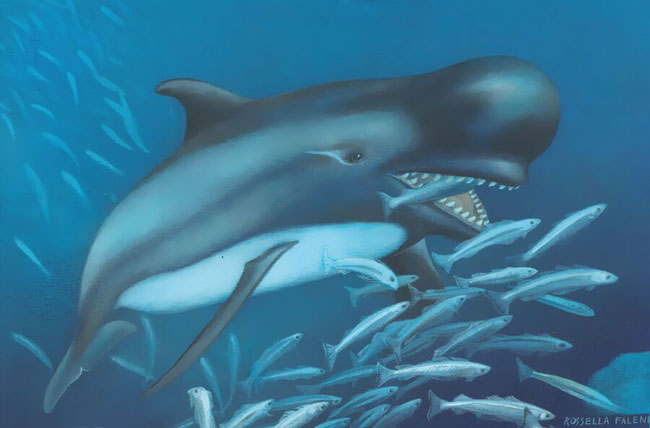
When did this feeding behaviour evolve? The fossilised remains of a newly described killer whale (Rododelphis stamatiadisi) which is believed to be the closest relative to both O. orca and P. crassidens may provide an answer. The fossils of R. stamatiadisi were found in Pleistocene strata aged between 1.5 and 1.3 million years old on the Greek island of Rhodes, traces of the last meal consumed were found, fish – blue whiting. This suggests that macropredation in members of the Delphinidae evolved relatively recently.

Rhododelphis life reconstruction

A life reconstruction of Rhododelphis feeding on blue whiting. Picture credit: Rossella Faleni.

Picture credit: Rossella Faleni

Comparing Two Ancient Whale Fossils Found Centuries Apart

Researchers from the University of Pisa (Italy) and the New York Institute of Technology (USA), analysed the fossil remains from Rhodes, discovered in 2020 and compared them to the fossils of Orcinus citoniensis, from Pliocene-aged deposits in Tuscany (Italy). The O. citoniensis fossils, consisting of partial postcranial material, skull and jaw bones were first described in 1883 by the famous Italian palaeontologist Giovanni Capellini.

Co-author of the Rododelphis paper, published in the academic journal “Current Biology”, Sara Citron (University of Pisa), had just finished her master’s thesis on Orcinus citoniensis. Microwear on the teeth was consistent with a diet of medium-sized fish, so although Orcinus citoniensis had a body length in excess of four metres, it probably did not specialise in hunting other marine mammals.

The Rododelphis material was discovered in the Bay of Pefkos on the south-eastern coast of the island by Polychronis Stamatiadis, an expert in the geology and palaeontology of Rhodes. Analysis of these fossils revealed five otoliths (calcium carbonate structures found in the inner ear of fish) from Micromesistius poutassou (blue whiting) which indicates that the last meal of this extinct cetacean was fish.

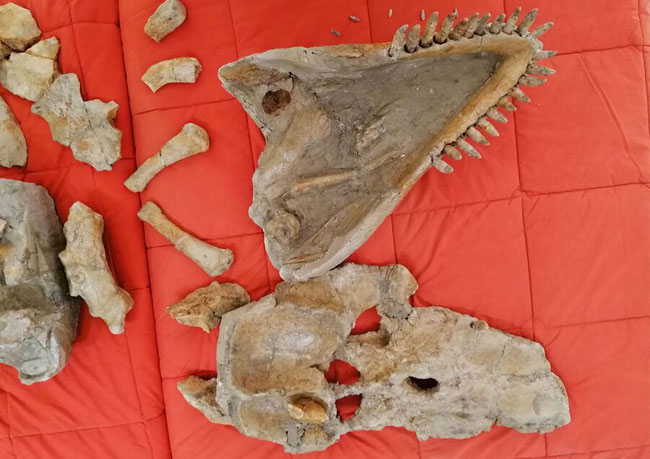
Rododelphis Fossils

Cranial and postcranial Rododelphis fossil material. Analysis of tooth wear suggests that this 5 metre-long cetacean was primarily a piscivore. Picture credit: G. Bianucci (University of Pisa).

Picture credit: G. Bianucci (University of Pisa)

Although estimated to have been around five metres long, R. stamatiadisi, like Orcinus citoniensis, was probably not a hunter of other marine mammals.

Evolution of Macropredation not Linked to Gigantism in Baleen Whales

Anatomist and co-author Jonathan Geisler (New York Institute of Technology), carried out an phylogenetic assessment and identified that Rododelphis was a close relative to Pseudorca crassidens as well as the extinct Orcinus citoniensis, which in turn was closely related to the living killer whale.

Dr Geisler explained:

“Our study supports the hypothesis that the Rhodes dolphin [R. stamatiadisi] and the Italian Orca [Orcinus citoniensis] represent two similar, but separate, evolutionary stages. In these stages, true and false killer whales preferentially preyed on medium-sized fish, rather than on seals, dolphins, and baleen whales. Thus, feeding on marine mammals happened very recently, showing that the predation by these fossil killer whales was not a driving force in the evolution of gigantism in baleen whales”.

Orcinus citoniensis lived around three million years ago, Rododelphis stamatiadisi is more recent, having lived approximately 1.5 to 1.3 million years ago. As baleen whales had already evolved large forms by the Late Miocene, it seems that predation from other cetaceans was not a factor in the development of gigantism.

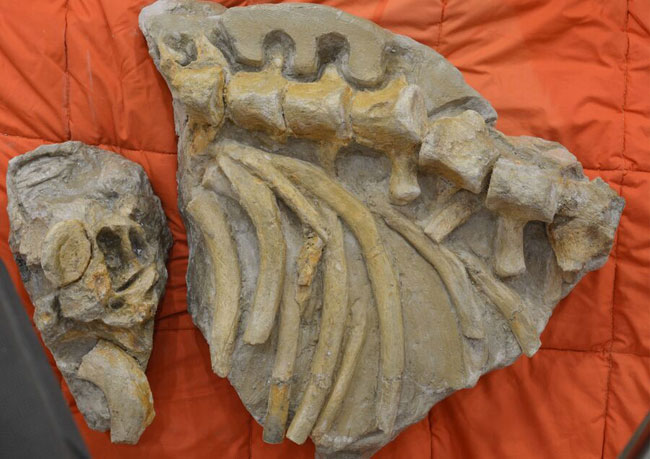
Rododelphis stamatiadisi ribs and vertebrae.

Prepared vertebrae and ribs of the recently described cetacean from the Pleistocene of Rhodes (Rododelphis stamatiadisi). Picture credit: G. Bianucci (University of Pisa).

Picture credit: G. Bianucci (University of Pisa)

Everything Dinosaur acknowledges the assistance of a media release from the University of Pisa in the compilation of this article.

To read a related article on the origin of filter feeding in whales: Coronodon havensteini – An Important Transitional Fossil.

The discovery of a four-legged whale ancestor from the Eocene of Peru: Ancient Ancestor of Modern Whales Discovered.

The scientific paper: “The origins of the killer whale ecomorph” by Giovanni Bianucci, Jonathan H. Geisler, Sara Citron and Alberto Collareta published in Current Biology.

The award-winning Everything Dinosaur website: Prehistoric Animal Toys.

13 03, 2022

Is Bashanosaurus the Oldest Stegosaur? A New Dinosaur Taxon

By |2024-10-27T22:05:57+00:00March 13th, 2022|Categories: Adobe CS5, Dinosaur and Prehistoric Animal News Stories, Dinosaur Fans, Main Page, Palaeontological articles, Photos/Pictures of Fossils|0 Comments

The trouble with being regarded as the biggest, longest, tallest or oldest when you are newly described species of dinosaur, is that sooner or later another fossil discovery will take this claim away from you. Back in 2019, team members wrote a blog post about the discovery of Adratiklit boulahfa from the Middle Jurassic of Morocco North Africa’s First Stegosaur. The fossils of this armoured dinosaur were estimated to be around 168 million years old (Bathonian faunal stage), making Adratiklit the oldest definitive stegosaur described.

Scientists including Dr Susannah Maidment a senior researcher at the London Natural History Museum, who co-authored the paper describing A. boulahfa, have announced the discovery of an even older stegosaur, this time from China. The new stegosaur named Bashanosaurus primitivus is at least one million years older than the Moroccan stegosaur.

The Fossils of Bashanosaurus

The fossils of Bashanosaurus herald from the Lower Member of the Shaximiao Formation and radiometric dating based on isotope decay analysis using zircon crystals (geochronological data), suggest that the deposits associated with the fossil bones are around 169 ± 0.68 million years of age.

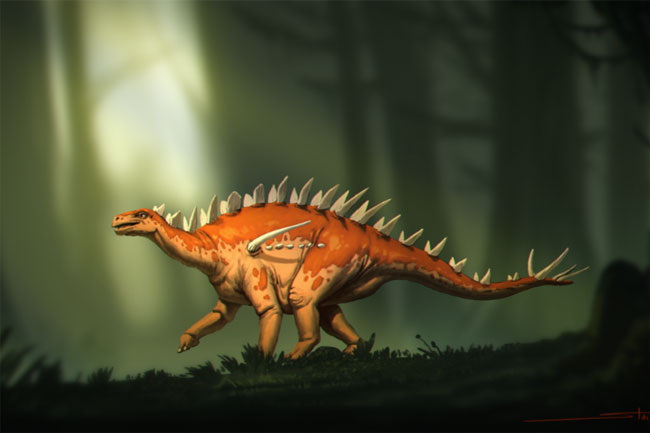
Bashanosaurus life reconstruction.

A life reconstruction of the newly described Chinese stegosaur Bashanosaurus primitivus. Picture credit: Banana Art Studio.

Picture credit: Banana Art Studio

Did the Stegosauria Evolve in Asia?

The fossil record of early stegosaurs is highly fragmentary and the evolution of this iconic branch of the Thyreophora is poorly understood. The Stegosauria represents a major clade within the Ornithischia (bird-hipped dinosaurs). Fourteen genera of stegosaur have been described to date and they are both geographically and temporally widespread, known from all the major landmasses except for Australia and Antarctica.

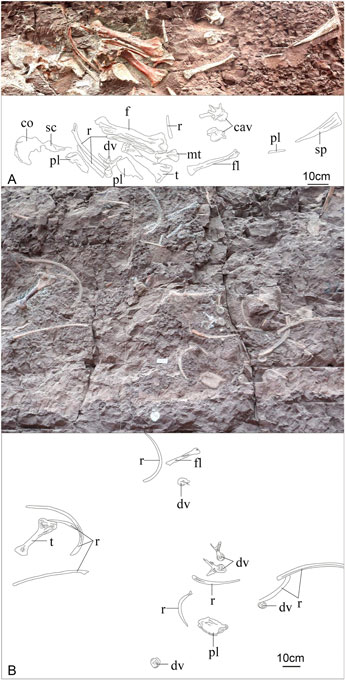
In 2016, a new dinosaur quarry was opened in Yunyang County, Chongqinq Municipality in southwestern China. Stegosaur fossil material was identified on the western side of the quarry. The disarticulated material preserved within the sandstone consisted of a dorsal vertebra, two tail bones (caudal vertebrae), a right scapula, a right coracoid and elements from the hind legs. Three pieces of dermal armour were also discovered at this location (one plate and two spines) along with fragments of rib bones. These fossils (CLGPR V00006-1) are regarded as the holotype of B. primitivus.

Potentially Three Bashanosaurus Specimens

More stegosaur fossils were found at the site approximately fifty metres away from the holotype material (CLGPR V00006-2). They consist of five dorsal vertebrae, a right tibia, a right fibula some ribs and a single piece of dermal armour (one plate). In addition, a single dorsal vertebra (CLGPR V00006-3) was found on the eastern part of the site some one hundred and twenty metres away from the holotype material.

Whilst the researchers have confidently assigned these fossils to the Stegosauria and specifically to Bashanosaurus primitivus, three individual stegosaurs are represented by the bones.

Bashanosaurus fossils.

Photograph (A) with interpretative line drawing showing the position of the B. primitivus holotype fossil material (CLGPR V00006-1) on the western side of the wall of dinosaur fossils. Photograph (B) with interpretative line drawing showing the second location with B. primitivus fossil material ((CLGPR V00006-2) towards the middle of the wall of dinosaur fossils. Picture credit: Hui et al.

Picture credit: Hui et al

It is not known whether the fossil bones represent a juvenile or a fully-grown animal. However, based on these bones, the researchers estimate that the largest stegosaur from the quarry was about 2.8 metres in length.

Unique Anatomical Traits

The scientists who include researchers from the Chongqing Bureau of Geological and Mineral Resource Exploration and Development in China and London’s Natural History Museum identified several unique anatomical traits that led to the erection of a new genus. Bashanosaurus possesses anatomical characteristics associated with basal thyreophorans as well as more derived features associated with early stegosaurs. For example, it has a smaller and less developed shoulder blade, the bony projection of the thighbone (fourth trochanter) is positioned below the middle of the shaft and the bases of the armour plates curve outwards and are thicker than the plates on the backs of later stegosaurs.

The genus name is derived from “Bashan” in reference to the ancient name for the area of Chongqing in China where the dinosaur was found. The species moniker is derived from the Latin for “first” – primitivus.

Lead author of the research team, Dr Dai Hui from the Chongqing Bureau of Geological and Mineral Resource Exploration and Development commented:

“All these features are clues to the stegosaurs’ place on the dinosaur family tree. Bashanosaurus can be distinguished from other Middle Jurassic stegosaurs, and clearly represents a new species.”

Phylogenetic Analysis

Phylogenetic analysis shows that Bashanosaurus primitivus is the earliest-diverging stegosaur, along with Chungkingosaurus (C. jiangbeiensis), which is thought to be closely related, although Chungkingosaurus lived much later than Bashanosaurus. Chungkingosaurus fossils are known from the Upper Member of the Shaximiao Formation.

The discovery of Bashanosaurus will help researchers to learn more about the evolution of stegosaurs and supports the theory that this type of armoured dinosaur first appeared in Asia. Although there have been some exciting fossil discoveries helping to improve understanding with regards to the evolution of armoured dinosaurs (Thyreophora), there are still numerous gaps in the fossil record which makes mapping the evolutionary development of these iconic dinosaurs extremely difficult.

For example, Everything Dinosaur recently wrote an article about the discovery of the basal thyreophoran Yuxisaurus kopchicki, whose fossils also come from China. Scientists from the London Natural History Museum also contributed to the scientific paper on Yuxisaurus: The Earliest Armoured Dinosaur Found to Date.

Everything Dinosaur has inserted Yuxisaurus kopchicki within the phylogenetic assessment of Bashanosaurus to help put these recent fossil discoveries into context (see below).

Bashanosaurus phylogeny and comparison with the recently described Yuxisaurus.

A phylogenetic analysis showing the placement of B. primitivus within the Stegosauria. It is believed to be around one million years older than the recently described Adratiklit boulahfa (Maidment et al) from the Middle Jurassic of Morocco. The earliest armoured dinosaur from Asia known to date (Yuxisaurus kopchicki) from Yunnan Province, China (Yao et al) has been incorporated into the image by Everything Dinosaur to show the approximate phylogenetic and temporal placement of Y. kopchicki when compared to B. primitivus. Picture credit: Hui et al with additional annotation by Everything Dinosaur.

Picture credit: Hui et al with additional annotation by Everything Dinosaur

The Stegosauria Clade Originated in Asia?

Commenting on the phylogenetic assessment Dr Hui stated:

“What’s more, our analysis of the family tree indicates that it [B. primitivus] is one of the earliest-diverging stegosaurs along with the Chongqing Lizard (Chungkingosaurus) and Huayangosaurus. These were all unearthed from the Middle to Late Jurassic Shaximiao Formation in China, suggesting that stegosaurs might have originated in Asia”

Chungkinogsaurus illustrated.

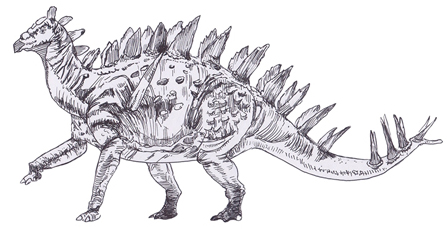
An illustration of the Chinese Stegosaur Chungkingosaurus. Picture credit: Everything Dinosaur.

Picture credit: Everything Dinosaur

The picture (above) shows a drawing of a model from the PNSO model range.

To view this range of prehistoric animal figures: PNSO Age of Dinosaurs Figures.

Co-author of the scientific paper published in the Journal of Vertebrate Paleontology, Dr Susannah Maidment of the London Natural History Museum and an expert in ornithischian dinosaurs added:

“The discovery of this stegosaur from the Middle Jurassic of China adds to an increasing body of evidence that the group evolved in the early Middle Jurassic, or perhaps even in the Early Jurassic, and as such represent some of the earliest known bird-hipped dinosaurs. China seems to have been a hotspot for stegosaur diversity, with numerous species now known from the Middle Jurassic right the way through until the end of the Early Cretaceous period.”

Everything Dinosaur acknowledges the assistance of a media release from the Taylor & Francis Group in the compilation of this article.

The scientific paper: “New Stegosaurs from the Middle Jurassic Lower Member of the Shaximiao Formation of Chongqing, China” by Dai Hui, Li Ning, Susannah C. R. Maidment, Wei Guangbiao, Zhou Yuxuan, Hu Xufeng, Ma Qingyu, Wang Xunqian, Hu Haiqian and Peng Guangzhao published in the Journal of Vertebrate Paleontology.

Visit the Everything Dinosaur website: Everything Dinosaur.

4 03, 2022

Sauropods Walked Like Hippos According to New Study

By |2024-10-27T11:02:43+00:00March 4th, 2022|Categories: Adobe CS5, Dinosaur and Prehistoric Animal News Stories, Dinosaur Fans, Main Page, Palaeontological articles, Photos/Pictures of Fossils|0 Comments

Researchers from Liverpool John Moores University have developed a new and innovative approach to interpreting sauropod trackways enabling them to calculate their gaits (the order in which the animal moved its four limbs to progress). Jens Lallensack and his colleague Peter Falkingham discovered that the placement of tracks relative to each other in a sauropod trackway changes in a consistent way when the animal changes its velocity (either speeding up or slowing down). Using this technique, subsequently verified by analysing the gaits of living animals such as dogs, horses, a camel and an elephant, the scientists have concluded that sauropods walked more like hippos than elephants.

Sauropod Tracks (Brontopodus plagnensis).

A picture of the sauropod trackway (Plagne, France). Picture credit: P. Dumas/Centre National de la Recherche Scientifique.

Picture credit: P. Dumas/Centre National de la Recherche Scientifique.

Quadruped Locomotion

Four-footed animals (quadrupeds), may use different gaits such as trots, walks, and pace gaits. In a trot, one diagonal limb pair (e.g. hind right and front left) moves together, followed by the other limb pair. Many mammals use trots at faster gaits, but reptiles also use trots at slow speeds. In a pace gait, in contrast, the limbs on one side of the body (e.g. hind right and fore right) move together in a similar way as the locomotion of a camel.

In-between these extremes is the single foot gait, in which the time lag between fore and hind feet is equal – a good example of this type of locomotion is the movement of horses.

The movements of living animals can be observed, direct observation of extinct animals such as huge, long-necked, long-tailed sauropod dinosaurs is not possible, but data can be obtained by careful study of their fossilised prints and trackways.

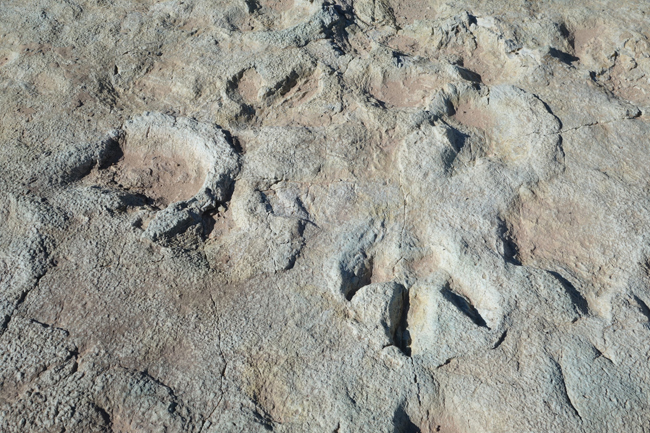
Dinosaur tracks

Trace fossils such as these dinosaur tracks can provide palaeontologists with data on dinosaur locomotion, velocity and gaits. Picture credit: Liverpool John Moores University.

Picture credit: Liverpool John Moores University

Examining Sauropod Tracksites

Liverpool John Moores University researchers Jens Lallensack and Peter Falkingham identified that the placement of an animal’s feet changes in a predictable and consistent way when the animal’s velocity changes. If a trackway is long enough and shows variation in stride length (indicating a change of speed), it is possible to calculate gaits and to gain an insight into how extinct animals moved.

Their predictions were confirmed in an analysis of the gaits of different types of living animal, including elephants, thanks to the help from locomotion expert Professor John Hutchinson (Royal Veterinary College, London), who provided elephant locomotion data. These new analytical methods were used to plot the limb movements along three sauropod trackways from the Lower Cretaceous De Queen Formation (Arkansas, USA). Although it is not possible to identify specific sauropod species (ichnospecies) from the De Queen Formation (Albian fauna stage) tracks, these trace fossils represent large, sauropod trackmakers (median average hind foot length 70-85 cm and maximum stride length 3.42 metres).

Commenting on the outcome of their findings, reported in the journal “Current Biology”, Dr Falkingham stated:

“Many researchers assumed that sauropods walked like elephants, with which they share many similarities, but that doesn’t appear to be the case.”

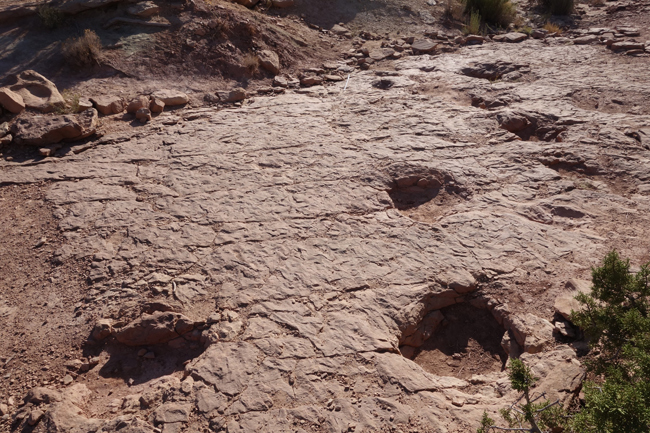
Dinosaur Trackway

Researchers have found a way to identify the gait of sauropods by studying their tracks. Picture credit: Liverpool John Moores University.

Picture credit: Liverpool John Moores University

Sauropod Dinosaurs Compared to Elephants

As elephants are the largest living terrestrial animals alive today, it had been suggested that their locomotion was an appropriate analogy for the movement of sauropod dinosaurs. Elephants use a gait intermediate between the pace gait and the singlefoot, i.e. the two limbs on the same body side tend to swing together. The gait analysis, in the current study by contrast, revealed that sauropods instead employed a gait intermediate between the singlefoot and a trot: the opposite-side limbs tend to swing together.

Based on this data, sauropod dinosaurs had a similar gait to hippos.

To Sway or Not to Sway

If sauropods moved very differently compared to the largest land animals alive today, this suggests that these two types of animal with large body sizes evolved different solutions to locomotion. Sauropods, even the titanosaurs known for their narrower trackways when compared to other types of sauropod such as diplodocids and dicraeosaurids, have a much broader stance than elephants. Elephants place one foot almost directly in front of another producing surprisingly narrow tracks for such large animals. Sauropod trackways, in contrast, are much broader. Their particular gait allowed sauropods to have at least one foot on the ground on both the left and right sides of the body at all times, preventing swaying from side to side.

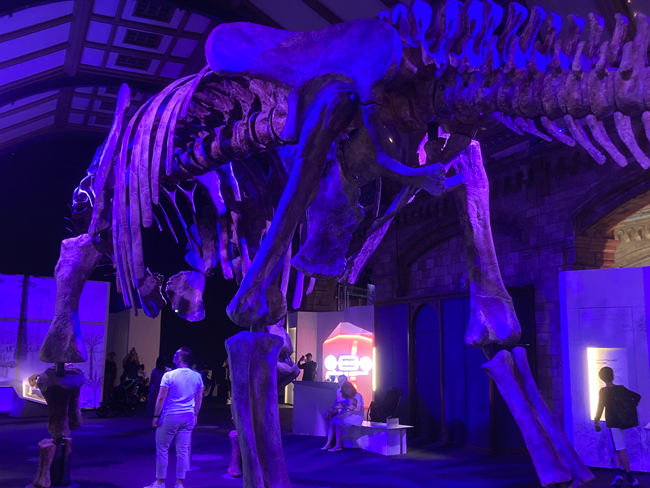
Patagotitan skeleton on display at the London Natural History Museum.

The enormous body of the titanosaur dwarfs visitors. Patagotitan mayorum skeletal reconstruction. Titanosaurs are known for their narrower tracks when compared to other types of sauropod but as many were much bigger than elephants, elephants do not make a good analogy for describing the gaits of titanosaurs or of sauropods generally. Picture credit: Everything Dinosaur.

Picture credit: Everything Dinosaur

Everything Dinosaur acknowledges the assistance of a media release from Liverpool John Moores University in the compilation of this article.

Lead author of the scientific paper Dr Jens Lallensack added:

Sauropods chose a gait that maximised stability but still allowed for efficient walking”.

The scientific paper: “A new method to calculate limb phase from trackways reveals gaits of sauropod dinosaurs” by Jens N. Lallensack, Peter L. Falkingham published in Current Biology.

The Everything Dinosaur website: Dinosaur Toys.

2 03, 2022

The Artwork in a Scientific Paper

By |2023-07-08T17:02:38+01:00March 2nd, 2022|Categories: Adobe CS5, Dinosaur and Prehistoric Animal Drawings, Dinosaur and Prehistoric Animal News Stories, Dinosaur Fans, Main Page, Palaeontological articles|0 Comments

When a new prehistoric animal is named and described in a scientific paper, often, an illustration featuring the new discovery is commissioned so that readers and viewers of any subsequent media release can get an impression of what the creature might have looked like. These life reconstructions show the animal in context, providing an insight into the palaeoenvironment and sometimes also highlighting contemporaneous species that shared the same habitat.

Illustrating a Scientific Paper

These, frequently stunning illustrations are carefully conceived. Great care is taken to reflect the scientific evidence, however, the artist has some licence when it comes to considering the landscape, the choice of colours and the motif of the artwork.

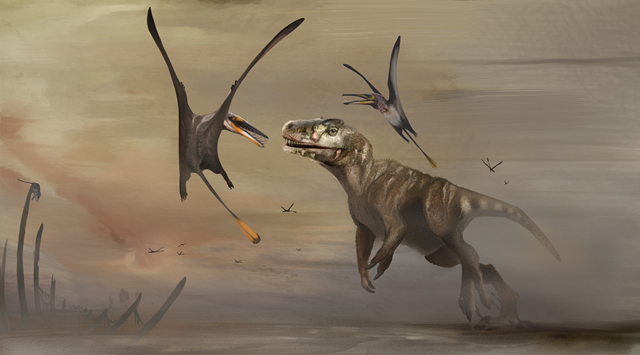
Sometimes the person responsible for the scientific illustration is one of the authors of the study. For example, the artwork supporting the media release on the recently described rhamphorhynchid pterosaur from the Isle of Skye (Dearc sgiathanach), was created by the lead author Natalia Jagielska, a PhD student at the School of GeoSciences, University of Edinburgh.

Isle of Skye pterosaur (Dearc sgiathanach).
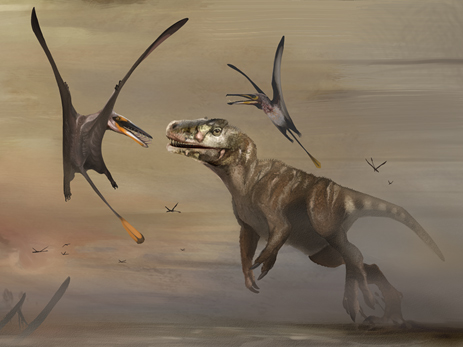
The Isle of Skye 170 million years ago. A theropod dinosaur hopes to catch a Dearc sgiathanach, but this large pterosaur is too quick and avoids capture. The lead author of the scientific paper created the stunning artwork that accompanied the media release. Picture credit: Natalia Jagielska

Everything Dinosaur asked the artist what inspired and influenced her when it came to illustrating the newly described Scottish pterosaur.

Reflecting Scientific Evidence in Palaeoart

Natalia explained that she was inspired by Scottish birds, both those in Edinburgh, where the D. sgiathanach fossil material is stored and also the many seabirds synonymous with the Isle of Skye (where the fossil was found). Gannets are common on the island. They have a similar wingspan to that estimated for Dearc sgiathanach. With their long crania, robust neck and slender wings, these piscivores could be regarded as occupying a similar niche in the marine based ecosystem as the rhamphorhynchids.

“I wanted to form this connection between contemporary local fauna and ancient fauna”, Natalia commented. “I also added a splash of blue hues and yellows on the head in some reconstructions, as a nod to its Scottish origin and the Scottish flag”.

Skye pterosaur artwork
Dominating the skies on the Isle of Skye. Several pterosaurs flying over the coastline (Dearc sgiathanach). Picture credit: Natalia Jagielska.

Setting the Scene for a Jurassic Pterosaur

The background into which the life reconstruction is inserted can also help to convey important information relating to geology and the ancient environment. The rugged cliffs (above), reflect the famous steep cliffs of Skye and link the Jurassic landscape to modern Scotland, as both have been extensive shaped by the Caledonian orogeny, a period of mountain building that occurred during the Palaeozoic.

The waters represent the Hebridean basin and are part of Boreal Seaway, their presence in the artwork helps to reinforce the view that Dearc sgiathanach was associated with coastal and marine habitats.

Adding a Theropod Dinosaur

A theropod dinosaur features in one of the illustrations included with the media release. The presence of theropods in the Middle Jurassic of Skye is indicated by tridactyl prints preserved in the petrified mudflats. The Megalosaurus depicted in the scene sports cranial crests. PhD student Natalia explained that as Megalosaurus does not have a well- preserved skull, she took the opportunity to give her theropod a pair of Allosaurus-inspired head crests.

The dinosaur provides a helpful scale, the viewer is in no doubt that Dearc sgiathanach was a large animal. Indeed, with a wingspan estimated to be around 2.5 metres, the Isle of Skye pterosaur is the biggest flying reptile described to date from Jurassic material.

“Pairing a theropod with the pterosaur is an excellent way of displaying Dearc’s sheer size and making the viewer perceive it’s in the Jurassic”, Natalia stated. “Megalosaurus is excellent too, showcasing basal bauplans of carnivorous dinosaurs associated with the Middle Jurassic”.

The Pterosauria

The Pterosauria continued to evolve throughout the Mesozoic, with some of the Late Cretaceous taxa evolving to become the largest flying animals of all time. Scientific illustrations evolve and change too. In Natalia’s email correspondence with Everything Dinosaur, it was pointed out that the original concept was to depict the pterosaur fighting with the dinosaur over a piece of carrion – a macabre tug-of-war between the two archosaurs. However, the final illustration depicts a different form of interspecific competition, the brash theropod chasing after the pterosaurs much like a dog might chase gulls or oystercatchers on the beach today.

Skye Art megalosaur and pterosaur interaction
The addition of a megalosaurid helps to provide a scale and illustrates a typical theropod from the Middle Jurassic. Picture credit: Natalia Jagielska.

The subtle tones of the sky at sunset add atmosphere and an almost ethereal quality to the artwork. Natalia commented that the background to the illustration featuring the theropod was inspired by J. M. W. Turner’s “The Fighting Temeraire”, she wanted to give her work a grandiose, maritime-look using the light, colours and shading as depicted in the famous Turner painting. The iconic painting “The Fighting Temeraire”, featuring a huge warship making its final journey to a London shipyard so that it could be broken up, was painted in 1839. Ironically, it was during the late 1830s that the remarkable pterosaur fossils including many examples of rhamphorhynchids, from the Solnhofen limestones of southern Germany were being subjected to detailed scientific scrutiny.

Bathonian Mammaliaforms and Sauropods

In the bottom left corner of the artwork, large rib bones can be seen and sitting precariously atop one of the bones is a small mammaliaform. The Lealt Shale Formation from which the pterosaur specimen was extracted, has not yielded many body fossils, but mammaliaforms such as Wareolestes (W. rex), are known from the roughly contemporaneous Kilmaluag Formation of the Isle of Skye. Natalia wanted to highlight the significance of Skye for helping to shed light on an important stage in the evolution of many different types of tetrapod, including our own ancestors.

The Isle of Skye is also famous for its extensive sauropod tracks. Admittedly, the pterosaur specimen comes from a bedding plane devoid of such prints although tracks associated with thyreophorans (stegosaurs) have been identified.

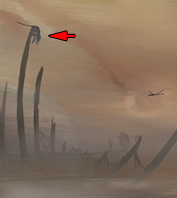
Sauropod ribs and a mammaliaform are also illustrated in the pterosaur artwork.
Mammaliaform fossils although exceptionally rare have been found in Middle Jurassic exposures in Scotland. The artwork highlights the presence of such creatures (arrowed) and the huge rib bones are a nod towards the extensive sauropod tracks associated with the Lealt Shale Formation. Picture credit: Natalia Jagielska.

The addition of the sauropod bones permitted the artist to hint at one of the theories put forward to explain the preservation of animal remains over a period of 170 million years or so.

Natalia explained:

“The ribcage in the foreground suggests one of theories suggesting superb preservation, maybe the fossil was buried in mudflats. The location showcases a marginal marine setting, with storm deposit layers and evidence for periodic aerial exposure – truly a perplexing combination”.

Stunning Illustrations in a Scientific Paper

The illustrations are certainly stunning, helping to tell the tale of a pterosaur that soared over Scotland way back in the Middle Jurassic. Our thanks to Natalia Jagielska for sharing her thoughts on the inspiration behind the artwork.

To read Everything Dinosaur’s blog post about the discovery of Dearc sgiathanach: Fantastic Pterosaur Fossil from the Isle of Skye.

Visit the award-winning Everything Dinosaur website: Visit Everything Dinosaur.

1 03, 2022

Are There Three Tyrannosaurus Species? New Research Asks the Question

By |2024-10-27T10:42:02+00:00March 1st, 2022|Categories: Adobe CS5, Dinosaur and Prehistoric Animal News Stories, Dinosaur Fans, Main Page, Palaeontological articles, Photos/Pictures of Fossils|0 Comments

So, the scientific paper is out and theropod feathers are about to be ruffled. The iconic Tyrannosaurus rex might not be just one species, but actually three. That is the conclusion reached by researchers Gregory S. Paul, Scott Persons and Jay Van Raalte – all highly respected scientists, but already other academics have challenged their findings.

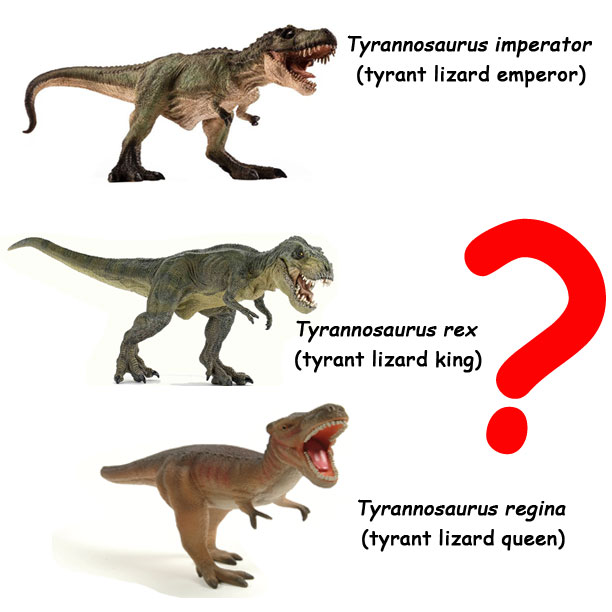
Writing in the academic journal “Evolutionary Biology”, two new Tyrannosaurus species are proposed, a geologically older, robust form newly named Tyrannosaurus imperator that was followed by two further species the already named Tyrannosaurus rex, also a robust tyrannosaur and a contemporaneous gracile form which has been named Tyrannosaurus regina.

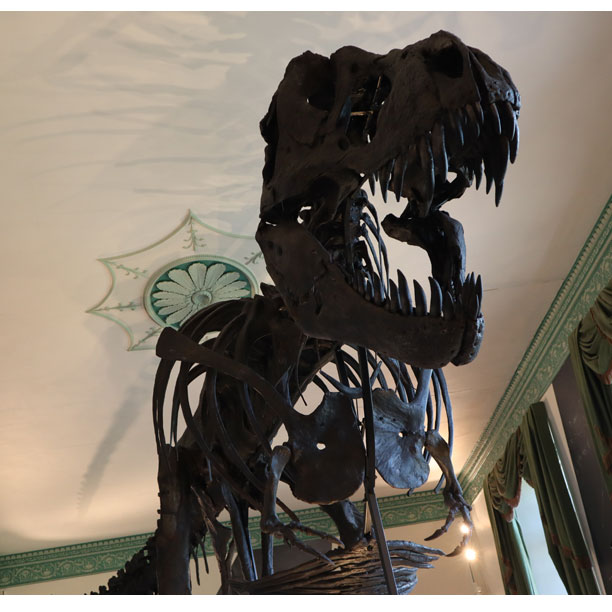
Titus the T.rex exhibit. A T. rex skeleton on display.

The spectacular Titus the T. rex exhibit at Wollaton Hall. PIcture credit: Everything Dinosaur.

Picture credit: Everything Dinosaur

The Tyrannosaurus Controversy

The fearsome, apex predator Tyrannosaurus rex might be synonymous with the famous Hell Creek Formation, but Tyrannosaurus fossils have also been found in many other Upper Cretaceous deposits (Maastrichtian stage). For example, T. rex fossils or at least indeterminate Tyrannosaurus material is associated with nine other North American geological formations.

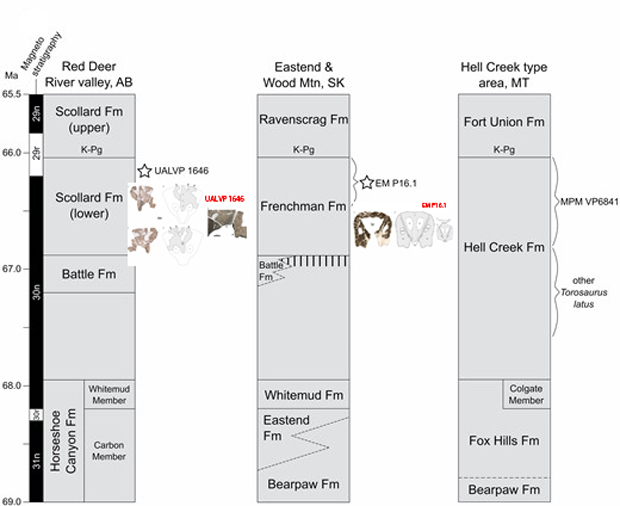
T. rex fossils have been found in exposures of the Scollard Formation of south-western Alberta the Frenchman Formation of southern Saskatchewan and south-eastern Alberta. This suggests that this large theropod roamed northern areas of Laramidia. Tyrannosaurus fossils from the Laramie Formation exposures in Colorado have been assigned to Tyrannosaurus rex. T. rex fossil material has been reported from much further south, from the Javelina Formation of Texas.

With only one species of Tyrannosaurus (T. rex), the fossil evidence as classified so far indicates that the “tyrant lizard king” had a huge geographical distribution, virtually the entire ancient landmass of Laramidia.

Furthermore, these deposits represent vast amounts of geological time. The Hell Creek Formation is believed to have been formed over two million years and as scientists have now concluded that other iconic taxa such as Triceratops evolved over this time period into new species, then surely T. rex would have been subject to the same evolutionary pressures.

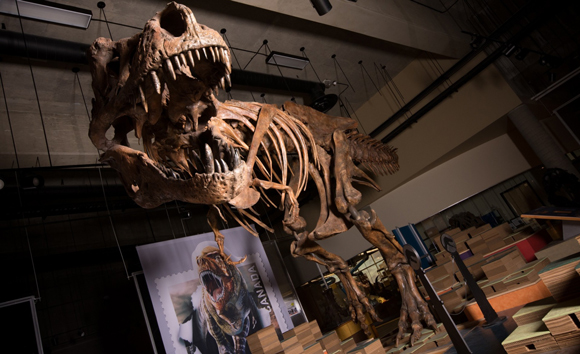
"Scotty" the Tyrannosaurus rex.

A reconstruction of the skeleton of “Scotty” the T. rex. The fossils come from the Frenchman Formation of Saskatchewan (Canada) and one of the authors of the scientific paper published in the journal the Anatomical Record was Scott Persons who is a co-author of the new paper describing three Tyrannosaurus taxa. Picture credit: Amanda Kelley.

Picture credit: Amanda Kelley.

Analysis of Limb Bones (Femora)

A total of thirty-seven fossil specimens were studied by the researchers. Two-thirds of these had femora (thigh bones) associated with them and the scientists found differences in the thickness and robustness of these bones, that were unlikely a result of individual variation within a single species. In the sample studied, Gregory S. Paul and his colleagues found greater variation in femur robustness in the T. rex thigh bone material than in the whole of the other tyrannosaurid femora material known from the preceding ten million years.

The team discounted size variations based on maturity, ontogeny (growth pattern) and the age of the Tyrannosaurus when it died. Robust forms and more gracile forms of T. rex have been known for some years. Some palaeontologists have speculated that the smaller, more slender bones of some T. rex specimens compared to the more robust femora of other specimens might be explained as differences in the sexes.

If robust forms represent females, and gracile forms males, then it would be expected that the fossil record would show roughly even numbers of these bone types. However, the research team point out an uneven ratio of robust bones to gracile bones and as such they discount the differences as sexual variation.

In addition, the team report that gracile bones are only found in higher layers of sediment. These bones are geologically much younger than other more robust T. rex bones associated with lower layers.

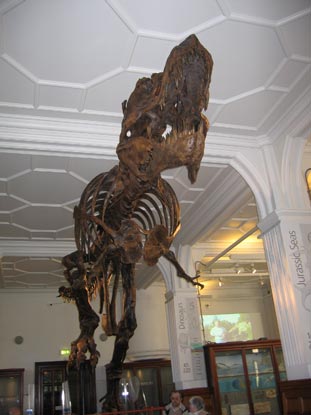
Tyrannosaurus rex cast skeleton on display

Which Tyrannosaurus species? A cast of the T. rex specimen known as “Stan” (BHI 3033), but researchers propose that there were actually three species of Tyrannosaurus present in the Late Cretaceous of North America. Picture credit: Everything Dinosaur.

Picture credit: Everything Dinosaur

Differences in Tooth Count

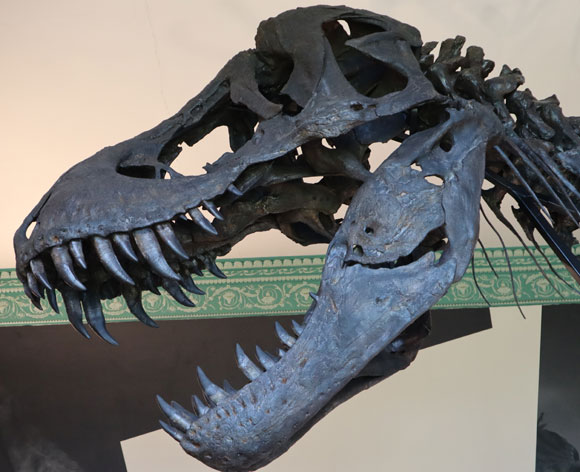
The scientists also commented on differences in tooth counts associated with Tyrannosaurus lower jaws (the dentary). Tyrannosaurus imperator (the earliest Tyrannosaurus species) had two small incisors in each dentary. Whilst the later species (T. regina and T. rex) had only one small incisor in each dentary.

Titus the T. rex Skull and Jaws. Dinosaur extinction.

The research team identified differences in the number of small incisor-like teeth in the lower jaw which they concluded was further evidence of the T. rex fossil material actually representing a trio of Tyrannosaurus species. Picture credit: Everything Dinosaur.

Picture credit: Everything Dinosaur

The researchers concede that they cannot rule out other explanations for their findings. Several palaeontologists have challenged the paper, stating that the variations seen in the fossils could be explained by factors such as individual variation amongst individuals of a single species. Like many dinosaurs, Tyrannosaurus rex changed radically as it grew and matured, this aspect of dinosaur taxonomy is going to be debated for a considerable time to come.

For fans of dinosaur models, does this mean that collectors will have to reassess their Tyrannosaurus rex models?

Three Tyrannosaurus species proposed.

Which Tyrannosaurus species are you? A newly published scientific paper proposes three Tyrannosaurus species. Picture credit: Everything Dinosaur.

Picture credit: Everything Dinosaur

The scientific paper: “The Tyrant Lizard King, Queen and Emperor: Multiple Lines of Morphological and Stratigraphic Evidence Support Subtle Evolution and Probable Speciation Within the North American Genus Tyrannosaurus” by Gregory S. Paul, W. Scott Persons IV and Jay Van Raalte published in Evolutionary Biology.

Visit the award-winning Everything Dinosaur website: Everything Dinosaur.

28 02, 2022

Kelumapusaura: A New Hadrosaur from Patagonia

By |2024-10-26T16:27:29+01:00February 28th, 2022|Categories: Adobe CS5, Dinosaur and Prehistoric Animal News Stories, Dinosaur Fans, Main Page, Palaeontological articles|0 Comments

Researchers from the Museo Argentino de Ciencias Naturales ‘Bernardino Rivadavia’ in Buenos Aires (Argentina), have described a new species of duck-billed dinosaur that roamed north-western Patagonia in the Late Cretaceous. The new dinosaur has been named Kelumapusaura machi and its discovery has helped palaeontologists to validate previously described South American hadrosaurids as distinct species.

The Largest Hadrosaur in the Allen Formation Ecosystem

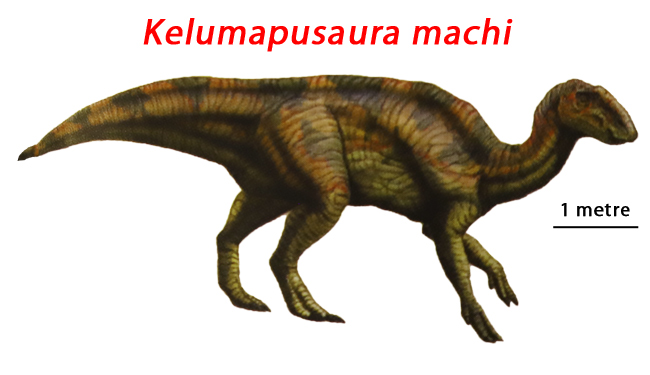
Numerous fossils have been reported, representing skull and postcranial material from several individuals. Comparison of the fossils suggests that bones from sub-adults as well as bones from more mature, adult animals were found. Based on the largest fossil bones, Kelumapusaura is estimated to have been up to 9 metres in length, perhaps weighing as much as 3 Tonnes.

Kelumapusaura machi life reconstruction.

Kelumapusaura machi life reconstruction. Note scale bar = 1 metre.

Getting to Grips with South American Hadrosaurids

The fossil material was collected from exposures associated with the Allen Formation (Upper Cretaceous Campanian–Maastrichtian stage). The research team report that these fossils represent one of the most complete hadrosaurids found to date in South America. Importantly, many of the skull and postcranial bones associated with K. machi overlap with bones associated with other South American hadrosaurids that have been named and described from much more fragmentary remains.

Using the Kelumapusaura fossils the research team confidently assert that previously named South American hadrosaurids – Secernosaurus koerneri, Bonapartesaurus rionegrensis and “Kritosaurus” australis are all valid taxa.

“Kritosaurus” australis was named and described in 1984 by the world-renowned Argentinian palaeontologist José Fernando Bonaparte who sadly passed away in February 2020: José Bonaparte the Father of Palaeontology in Argentina (1928-2020). Thanks to the K. machi study, “Kritosaurus” australis is thought to be sufficiently different to other Kritosaurus species found in North America to warrant its own genus Huallasaurus australis.

A South American Saurolophinae Clade

A phylogenetic analysis of the hadrosaurid fossils included in this study unites Kelumapusaura, the closely related taxon Huallasaurus (H. australis), along with Bonapartesaurus and Secernosaurus into a clade that can be nested within the Kritosaurini tribe as part of the Saurolophinae subfamily of hadrosaurs. The Saurolophinae is comprised of those hadrosaurs that generally tend to lack spectacular head crests, as opposed to the other major subfamily within the Hadrosauridae – the Lambeosaurinae.

According to the researchers, the Kritosaurini tribe now consists of both North American and South American saurolophine hadrosaurs, which means that Kelumapusaura is related to more famous hadrosaurs such as Kritosaurus and Gryposaurus from the United States and Canada.

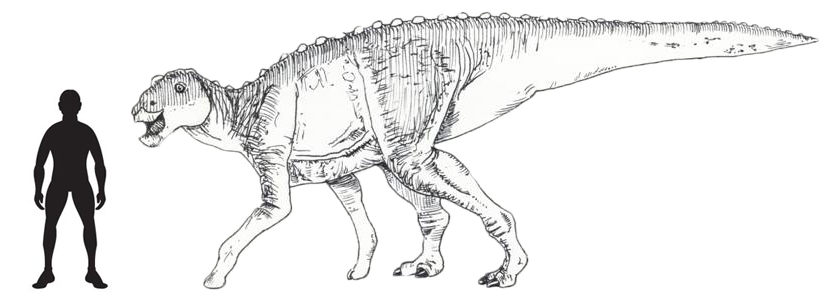
Gryposaurus scale drawing.

A scale drawing of the duck-billed dinosaur Gryposaurus. A scale drawing of the duck-billed dinosaur Gryposaurus. The newly described Kelumapusaura machi is related to Gryposaurus, several species of Gryposaurus have been named including the type species G. notabilis which lived as far north as Alberta (Canada).Picture credit: Everything Dinosaur.

Picture credit: Everything Dinosaur

Significantly, the clade status implies that these hadrosaurids shared a common ancestor, that all these different taxa that are widely distributed came from an ancestral population. The scientists conclude that the evolutionary development of Gondwanan hadrosaurids is not that well understood compared to the duck-billed dinosaurs from northern latitudes. They hope that more fossil discoveries from South America will help to further revise hadrosaur taxonomy.

The scientific paper: “A new hadrosaurid (Dinosauria: Ornithischia) from the Late Cretaceous of northern Patagonia and the radiation of South American hadrosaurids” by Sebastián Rozadilla, Federico Brissón-Egli, Federico Lisandro Agnolín, Alexis Mauro Aranciaga-Rolando and Fernando Emilio Novas published in the Journal of Systematic Palaeontology.

The Everything Dinosaur website: Dinosaur Toys.

25 02, 2022

Giant Trilobite was a Cannibal According to New Research

By |2024-10-26T16:09:23+01:00February 25th, 2022|Categories: Adobe CS5, Dinosaur and Prehistoric Animal News Stories, Dinosaur Fans, Main Page, Palaeontological articles, Photos/Pictures of Fossils|0 Comments

Researchers have conducted an extensive review of injured trilobites and disarticulated pieces of trilobite exoskeleton from the Emu Bay Shale Konservat-Lagerstätte on Kangaroo Island (South Australia). They conclude that the injuries caused to Redlichia trilobites were from attacks by other members of this genus. This is the oldest record of cannibalism recorded in the fossil record to date.

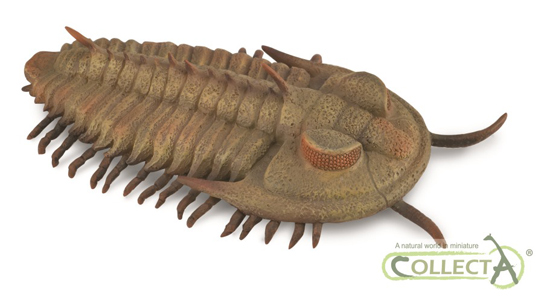
CollectA Redlichia rex trilobite. "First Life"

CollectA Redlichia rex trilobite model.

The picture (above) shows the CollectA Redlichia rex trilobite model.

To view this range of prehistoric animal figures: CollectA Prehistoric Life Models.

A Study of Redlichia Fossils from the Emu Bay Shale

The Cambrian explosion represents the rapid emergence of complex marine ecosystems and a huge burst of evolutionary activity that led to the establishment of virtually all the Animalia phyla recognised today. Whilst many palaeontologists do not like the phrase “explosion” as it implies a sudden event, opting instead to use the term “Cambrian radiation” to describe the emergence in the fossil record of abundant preserved shells and exoskeletons, the reasons for this change in the Earth’s ecosystems remains controversial.

It is thought that one of the main drivers of this evolutionary event was the development of predator/prey interactions. The proliferation of biomineralised exoskeletons and shells was a response to the evolution of the first predators capable of breaking through these defences.

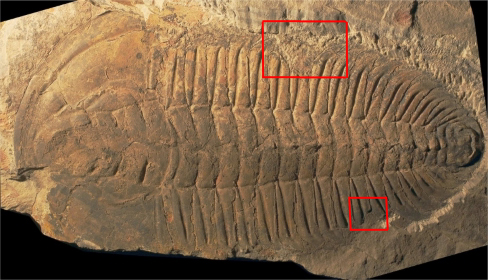
Writing in the academic journal Palaeogeography, Paleoclimatology, Palaeoecology, researchers from the University of New England, (Armidale, New South Wales), Uppsala University (Sweden), the University of Adelaide (South Australia), the South Australian Museum and Cambridge University conducted an analysis of 38 injured specimens representing two large trilobite species from the 515-million-year-old Emu Bay Shale deposits (Redlichia takooensis and Redlichia rex).

Redlichia rex injuries.

Healed but scarred injuries on a fossil specimen of Redlichia rex. The red squares indicate areas of damage possibly caused by an attack by another Redlichia. Picture credit: Bicknell et al (Palaeogeography, Paleoclimatology, Palaeoecology).

Picture credit: Bicknell et al (Palaeogeography, Paleoclimatology, Palaeoecology)

Studying a Giant Trilobite

The team concluded that that the injuries they documented were caused by a durophagous (consuming hard parts of the skeleton) predator.

Specimens of both species show that most injuries are located on the posterior portion of the thorax, indicating that predators most likely attacked from behind or that intended prey presented the posterior portion of their trunk to the attacker when threatened or attempting to flee. Previous studies had indicated that Cambrian trilobites exhibit most injuries to their right side. This study refutes this, arguing there is no evidence for a preference for attacking either the right or left side of intended prey.

The injured specimens typically represent some of the largest individuals known for the Redlichia taxa. This suggests that bigger trilobites were more successful in fighting off an attack and recovering from their injuries. Smaller individuals were probably completely consumed and therefore the likelihood of finding evidence of an attack on a smaller fossil specimen was greatly reduced.

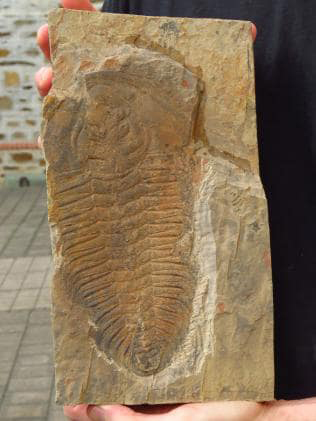
Redlichia rex trilobite fossil.

A near complete specimen of the large Cambrian trilobite Redlichia rex. Picture credit: University of Adelaide.

Picture credit: University of Adelaide

Redlichia rex

To read Everything Dinosaur’s blog post about the discovery of Redlichia rex: “King of the Trilobites” Discovered in South Australia.

The research team concludes that the scarred Emu Bay Shale trilobites represent the oldest record of cannibalism known to science.

The scientific paper: “Cambrian carnage: Trilobite predator-prey interactions in the Emu Bay Shale of South Australia” by Russell D. C. Bicknell, James D. Holmes, Stephen Pates, Diego C. García-Bellido and John R. Paterson published in Palaeogeography, Paleoclimatology, Palaeoecology.

Visit the Everything Dinosaur website: Everything Dinosaur.

24 02, 2022

The Last Day of the Mesozoic – It was Boreal Spring

By |2024-10-26T16:04:58+01:00February 24th, 2022|Categories: Dinosaur and Prehistoric Animal News Stories, Dinosaur Fans, Main Page, Palaeontological articles, Photos/Pictures of Fossils|0 Comments

An international team of researchers led by scientists from the Vrije Universiteit of Amsterdam, the Royal Belgian Institute of Natural Sciences (Brussels), Uppsala University (Uppsala, Sweden) in collaboration with colleagues from the European Synchrotron Radiation Facility, (Grenoble, France), have published a scientific paper that concludes the Chicxulub impact event took place in the northern hemisphere spring.

Writing in the academic journal “Nature”, the researchers postulate that the timing of this devastating event could have had a bearing on the types of animals that survived the mass extinction. For example, animals in the Northern Hemisphere spring (boreal spring), could have been rearing young that would have been extremely vulnerable to the dramatic, planet-wide changes. However, in the Southern Hemisphere winter was approaching (austral autumn), many mammals could have been in hibernation or sheltering in a bid to avoid the worst of the approaching wintry weather.

The Culimination of the Mesozoic

The research team postulates that the timing of the Chicxulub impact in boreal spring and austral autumn was a major influence on selective biotic survival across the Cretaceous–Palaeogene boundary.

The Remarkable Tanis Site

The Tanis Konservat-Lagerstätte preserves the devastation to a river system flowing into the Pierre Seaway (remnants of the Western Interior Seaway). The Tanis site would have been around 2,000 miles away from the impact in the Gulf of Mexico, earthquakes led to an immense water surge (a seiche), that shattered the ecosystem.

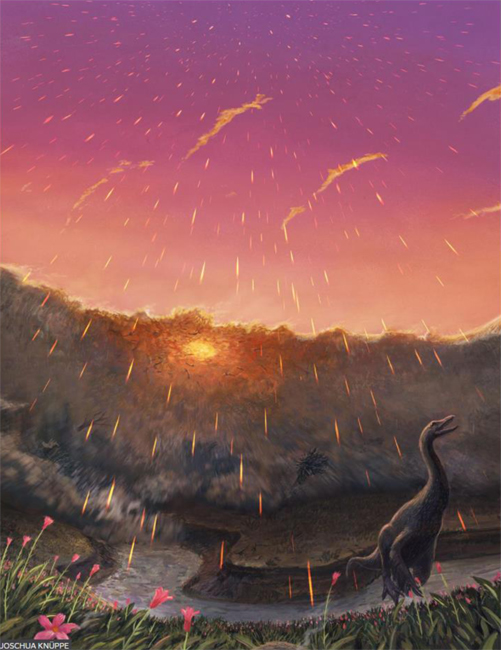
Palaeontologists have estimated that this event took place within an hour of the bolide impact. Enormous volumes of sediment engulfed fishes, ammonites and other creatures and buried them alive while impact spherules rained down from the sky.

Tanis Site Destruction

An artist’s impression of the seiche hitting the Tanis location. Picture credit: Joschua Knüppe.

Picture credit: Joschua Knüppe

To read an Everything Dinosaur article from last year (2021), summarising research that came to broadly similar conclusions as this study: Spring/Summer End to the Reign of the Dinosaurs.

Analysing Fish Fossils

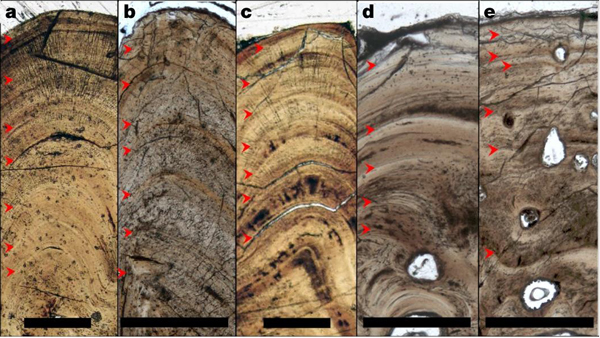
Histological analysis of thin sections of material extracted from six fish fossils found at the site enabled the researchers to conclude that the Tanis Konservat-Lagerstätte was formed in the Northern Hemisphere spring. The fish would have grown rapidly in the spring and summer when food was abundant, but much more slowly during the autumn and winter months when food was scarce.

Lines of arrested growth (LAG) preserved in the fossils show that all the fish (paddlefish and sturgeons) died shortly after beginning a new period of rapid growth. This evidence indicates these fish died in the spring and therefore if the Tanis site is a record of the immediate aftermath of the Chicxulub impact – the bolide must have hit Earth in the boreal spring.

Tanis Fish Bone Histology

Osteohistological thin sections of five fish fossils from the Tanis site. The red arrows indicate LAGs and indicate that these fish died in the spring. Scale bar in images a-e = 0.5 mm. Picture credit: During et al.

Picture credit: During et al

The Last Day of the Mesozoic

BBC Studios Productions have created a special documentary entitled “Dinosaurs: The Final Day” narrated by Sir David Attenborough. The one-off programme, will piece together the events that marked the end of the Mesozoic Era, using evidence from the remarkable Tanis site.

Sir David Attenborough stated:

Dinosaurs were among nature’s most extraordinary creatures, dominating the planet for over 150 million years before they became extinct. Tanis could be a place where the remains can give us an unprecedented window into the lives of the very last dinosaurs, and a minute-by-minute picture of what happened when the asteroid hit.”

The television programme is likely to be broadcast in the spring.

The scientific paper: “The Mesozoic terminated in boreal spring” by Melanie A. D. During, Jan Smit, Dennis F. A. E. Voeten, Camille Berruyer, Paul Tafforeau, Sophie Sanchez, Koen H. W. Stein, Suzan J. A. Verdegaal-Warmerdam and Jeroen H. J. L. van der Lubbe published in the journal Nature.

Visit the Everything Dinosaur website: Everything Dinosaur.

22 02, 2022

Fantastic Pterosaur Fossil from the Isle of Skye

By |2024-10-26T14:33:16+01:00February 22nd, 2022|Categories: Adobe CS5, Dinosaur and Prehistoric Animal News Stories, Dinosaur Fans, Main Page, Palaeontological articles|0 Comments

Around 170 million years ago, a toothy terror soared over the mudflats close to a tropical sea. Today, this land is the Isle of Skye and a team of researchers have published details of the remarkably well-preserved remains of that flying reptile. The fossil material found in Lealt Shale Formation exposures on the rocky coastline at Brothers’ Point (Rubha nam Brathairean), represents the most complete skeleton of a Middle Jurassic pterosaur ever found in the UK. With an estimated wingspan of 2.5 metres Dearc sgiathanach was a giant for this time in the Mesozoic.

Skye pterosaur artwork

Dominating the skies on the Isle of Skye. Several pterosaurs flying over the coastline (Dearc sgiathanach). Picture credit: Natalia Jagielska.

Picture credit: Natalia Jagielska

A Spectacular Pterosaur Fossil

Pterosaurs were the first vertebrates to evolve powered flight. Their evolutionary origins remain obscure. In comparison to the Dinosauria, their light, hollow bones have a poor fossil preservation potential. Very little is known about pterosaur evolution in the Early and Middle Jurassic, due to a global lack of fossils. The Middle Jurassic strata on the Isle of Skye are regarded as hugely important due to the number of vertebrate fossils preserved therein and the island has recently been awarded greater protection from the Scottish Government: Legal Protection for Isle of Skye Fossil Sites.

The spectacular specimen, discovered by PhD student Amelia Penny (University of Edinburgh), in 2017 during a field trip led by Professor Steve Brusatte (Personal Chair of Palaeontology and Evolution, School of GeoSciences, University of Edinburgh), is now part of the National Museums Scotland vertebrate fossil collection.

Natalia Jagielska with the pterosaur fossil.

PhD student Natalia Jagielska unveils the 170 million year old pterosaur fossil: Picture credit: Stewart Attwood.

Picture credit: Stewart Attwood

A Gaelic Name for a Scottish Pterosaur

The new species has been named Dearc sgiathanach (pronounced jark ski-an-ach). It translates as “winged reptile”. The species name also references the Gaelic term for the Isle of Skye (An t-Eilean Sgitheanach), in Gaelic, the Isle of Skye is known as the “winged isle”. A phylogenetic assessment of D. sgiathanach places it within the long-tailed pterosaur family the Rhamphorhynchidae. Comparing bones from specimens of Rhamphorhynchus and the related rhamphorhynchid Dorygnathus, permitted the research team to estimate that Dearc sgiathanach probably had a wingspan of around 2.5 metres when fully grown.

Bone histology using a wing finger bone from the Isle of Skye specimen indicates that this individual was over two years old when it died, but it was still actively growing and it had not reached adult size.

Dearc sgiathanach main fossil block.

Dearc sgiathanach main fossil block. Picture credit: Gregory Funston.

Picture credit: Gregory Funston

Commenting on the estimated size of Dearc sgiathanach Steve Brusatte stated:

“Dearc is the biggest pterosaur we know from the Jurassic period and that tells us that pterosaurs got larger much earlier than we thought, long before the Cretaceous period when they were competing with birds, and that’s hugely significant.”

Professor Steve Brusatte holding the pterosaur skull.

Professor Steve Brusatte holding the fossilised skull of Dearc sgiathanach. Picture credit: Stewart Attwood.

Picture credit: Callum Bennetts

A Battle Against the Incoming Tide

After Amelia Penny had alerted the rest of the field team about her discovery on the beach, a painstaking operation ensued to extract the fossil, led by Dugald Ross of Staffin Museum, involving the use of diamond-tipped saws to cut it from the rock, all while racing against time as the tide came in. The fossil had to be abandoned as the tide returned and its removal was only completed once the tide had begun to recede again.

Preparation of the beautifully preserved specimen was carried out by Nigel Larkin who is involved with the conservation of the Rutland ichthyosaur, the discovery of which was announced last month: The Giant Rutland Ichthyosaur.

Lead author of the paper, published in “Current Biology”, Natalia Jagielska stated:

“Dearc is a fantastic example of why palaeontology will never cease to be astounding. Pterosaurs preserved in such quality are exceedingly rare and are usually reserved to select rock formations in Brazil and China. And yet, an enormous superbly preserved pterosaur emerged from a tidal platform in Scotland.”

Carefully removing the pterosaur fossil from the beach.

Removing the pterosaur fossil from the beach. Picture credit: Steve Brusatte/National Museums of Scotland.

Picture credit: Steve Brusatte/National Museums of Scotland

A Lot to Learn from the Pterosaur Fossil

CT scans of the skull revealed large optic lobes indicating that Dearc had excellent eyesight. The conical teeth in the jaws suggest that this pterosaur was a piscivore. The discovery of Dearc sgiathanach reveals that pterosaurs, during the Middle Jurassic were capable of reaching sizes comparable to the largest living, volant birds alive today. Fragmentary pterosaur fossils had previously indicated that flying reptiles with wingspans in excess of 1.8 metres in diameter were present in the Middle Jurassic and the Isle of Skye fossil provides definitive proof.

The claws on the foot of Dearc sgiathanach.

A close-up view of the claws on the foot of Dearc sgiathanach. The fossil was prepared by conservator Nigel Larkin. Picture credit: Gregory Funston.

Picture credit: Gregory Funston

Subject to Further Analysis

The four slabs that comprise the D. sgiathanach specimen will be the subject of further analysis and study by Natalia Jagielska. It promises to reveal important insights into the anatomy, phylogeny, aerial abilities, feeding habits and favoured habitats of Middle Jurassic pterosaurs.

The research team are confident that this remarkable fossil will help palaeontologists to gain a better understanding of the taxonomic relationships and evolution of Middle Jurassic members of the Pterosauria.

We can expect to hear more from Dearc sgiathanach in the near future.

Isle of Skye pterosaur (Dearc sgiathanach).

The Isle of Skye 170 million years ago. A theropod dinosaur hopes to catch a Dearc sgiathanach, but this large pterosaur is too quick and avoids capture. Picture credit: Natalia Jagielska.

Picture credit: Natalia Jagielska

Everything Dinosaur acknowledges the assistance of a media release from the University of Edinburgh in the compilation of this article.

The scientific paper: “A skeleton from the Middle Jurassic of Scotland illuminates an earlier origin of large pterosaurs” by Natalia Jagielska, Michael O’Sullivan, Gregory F. Funston, Ian B. Butler, Thomas J. Challands, Neil D. L. Clark, Nicholas C. Fraser, Amelia Penny, Dugald A. Ross, Mark Wilkinson and Stephen L. Brusatte published in Current Biology.

The Everything Dinosaur website: Dinosaur and Pterosaur Toys.

Go to Top