All about dinosaurs, fossils and prehistoric animals by Everything Dinosaur team members.

Fossil finds, new dinosaur discoveries, news and views from the world of palaeontology and other Earth sciences.

20 02, 2022

New Spinosaur from Portugal

By |2024-10-26T12:53:59+01:00February 20th, 2022|Categories: Adobe CS5, Dinosaur and Prehistoric Animal News Stories, Main Page, Palaeontological articles, Photos/Pictures of Fossils|0 Comments

Scientists have announced the discovery of a new spinosaur species from Portugal. Iberospinus (I. natarioi), from Lower Cretaceous deposits associated with the Papo Seco Formation. Its discovery further supports the theory that these enigmatic theropods originated in western Europe.

Estimated to have been around eight metres in length, Iberospinus is the third spinosaur* to have been described based on fossil material found on the Iberian Peninsula. The scientific description of this taxon reinforces the idea that Iberia was a hotspot for spinosaur biodiversity, with several endemic genera having been identified from fossils found in this region.

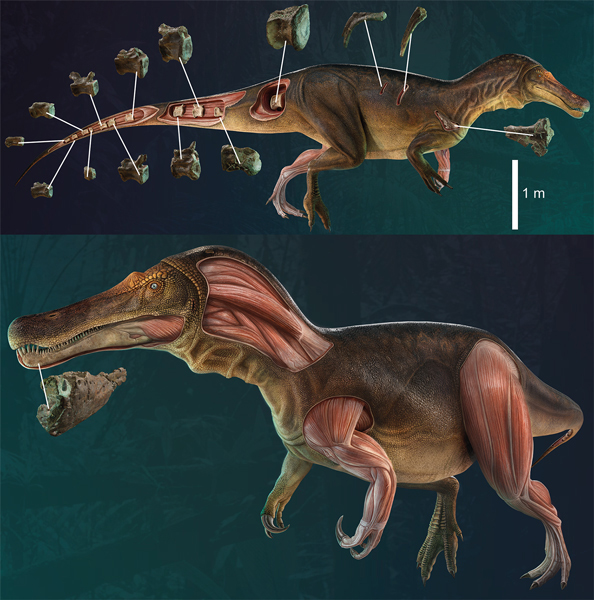
Iberospinus natarrioi reconstruction showing musculature.

Life reconstruction of Iberospinus natarioi (ML1190) showing three-dimensional digitalisation of some of the fossil bones, along with reconstructed musculature. Upper picture – right lateral view; Lower picture – anterolateral left view. Picture credit: Victor Feijó de Carvalho.

Picture credit: Victor Feijó de Carvalho

Iberospinus natarioi “Natário’s Iberian Spine”

Researchers Octávio Mateus and Darío Estraviz-López (NOVA School of Science and Technology, Caparica, Portugal), writing in the open-access journal PLOS One reassessed fossil material, originally found in 1999 and attributed to Baryonyx, combining this new study with an analysis of further fossil material recovered from the excavation site in the summer of 2020.

The scientists, both of whom work at the famous Museu da Lourinhã, Lourinhã (Portugal), identified a number of unique characteristics in the fragmentary fossils that permitted them to propose a new taxon. For example, CT scans revealed Iberospinus has a unique neurovascular system associated with the Meckelian groove in the lower jaw. The anterior portion of the lower jaw has a straight-profile and does not point upwards, an anatomical trait seen in other spinosaurs. The partial pubis is thickened towards its distal end and these autapomorphies permitted the erection of a new taxon

A New Spinosaur from Portugal

Iberospinus has been classified as a basal member of the Spinosauridae as its skeleton shows an intermediate condition between early tetanuran theropods and spinosaurids.

The dinosaur’s genus was inspired by the Roman name for the Iberian Peninsula and “spinus” from the Latin for spine in recognition of the long neural spines associated with spinosaurids. The species name honours amateur fossil collector Carlos Natário, who discovered the holotype fossil (specimen number ML1190) in 1999 and helped to ensure that it was placed within the vertebrate fossil collection of the Museu da Lourinhã.

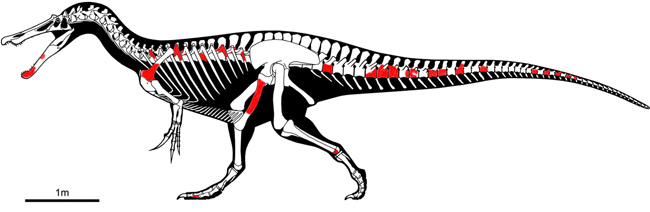
Iberospinus skeletal reconstruction.

A skeletal drawing of the newly described basal spinosaurid Iberospinus natarioi. The red coloured bones represent known fossil material. Note the scale bar = 1 metre. Picture credit: Octávio Mateus and Darío Estraviz-López modified from an original figure by Scott Hartman.

Picture credit: Octávio Mateus and Darío Estraviz-López modified from an original figure by Scott Hartman

Different Spinosaurs Co-existing in the Same Environment.

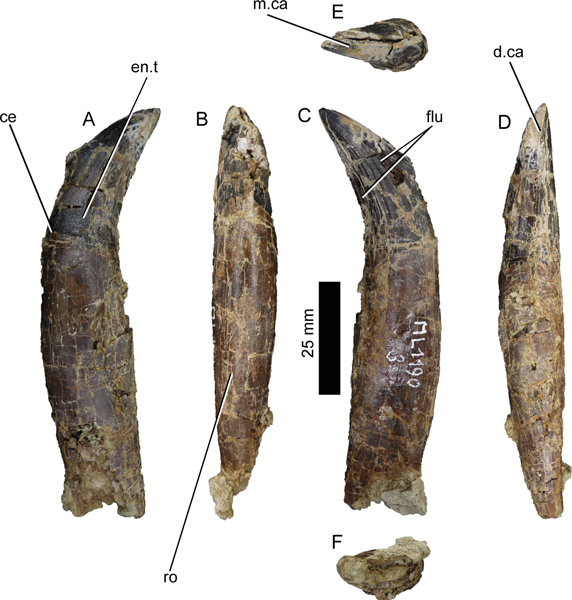
The large tooth complete with root was also described in the scientific paper. It possesses characters associated with the Baryonychinae subfamily of spinosaurs. The tooth crown is strongly recurved whilst more advanced and geologically younger members of the Spinosauridae such as Spinosaurus aegyptiacus tend to have straighter, conical teeth.

This reassessment of Iberian theropod fossil material demonstrates that different spinosaurid taxa co-existed within the same environment. The occurrence of more than one spinosaurid genus in a relatively restricted geographical area has been reported before, most recently with the naming of two new genera of spinosaurs (Riparovenator milnerae and Ceratosuchops inferodios) that co-existed in the Lower Cretaceous of southern England with Baryonyx (B. walkeri).

To read Everything Dinosaur’s earlier article about the recently described Isle of Wight spinosaurs: Two New Spinosaurids Described from the Isle of Wight.

Iberospinus tooth.

Tooth from the upper jaw of I. natarioi (specimen number ML1190-3) in A, lingual, B, mesial, C, lingual, D, distal, E, occlusal, and F ventral views. Note the scale bar = 25 mm. The tooth crown is strongly curved and the tooth morphology is similar to that seen in members of the Baryonychinae. Later spinosaurs had teeth that were straighter. Picture credit: Octávio Mateus and Darío Estraviz-López.

Picture credit: Octávio Mateus and Darío Estraviz-López

Iberian Spinosaurs*

Despite the lack of relatively complete fossil material, specimens collected from the Iberian Peninsula represent one of the best accumulations of spinosaurid fossils found to date. After Baryonyx (B. walkeri) was formally named and described in 1987, several fossils from this region were ascribed to this taxon. However, more recent analysis and further fossil discoveries has led to a revision and at present three contemporaneous spinosaur taxa have been attributed to this region.

  • Camarillasaurus cirugedae – from Teruel Province (north-eastern Spain). Formally named and described in 2014. Previously thought to represent a ceratosaur, now regarded as a member of the Spinosauridae.
  • Vallibonaventrix cani – from the Castellón Province (north-eastern Spain). Named and described in 2019, the taxonomic position of this genus remains uncertain although the current consensus is that the fossils do represent a member of the Spinosauridae family, but there is an on-going debate as to whether Vallibonaventrix is a member of the Baryonychinae or whether it is more closely related to Spinosaurus aegyptiacus.
  • Iberospinus natarioi – newly described (2022, Mateus and Estraviz-López) from the Papo Seco Formation of Cabo Espichel, Sesimbra, Portugal.

The scientific paper: “A new theropod dinosaur from the early cretaceous (Barremian) of Cabo Espichel, Portugal: Implications for spinosaurid evolution” by Octávio Mateus and Darío Estraviz-López published in PLOS One.

Visit the Everything Dinosaur website: Everything Dinosaur.

17 02, 2022

A New Abelisaurid from North-western Argentina

By |2024-10-26T12:31:06+01:00February 17th, 2022|Categories: Dinosaur and Prehistoric Animal News Stories, Dinosaur Fans, Main Page, Palaeontological articles|0 Comments

Ask any dinosaur fan about the Abelisauridae and they are likely to mention Carnotaurus, Abelisaurus and even Ekrixinatosaurus – all large predators whose fossils were found in Argentina. Whilst it is true that the South American fossil record of these short-armed, blunt-headed theropods is largely restricted to Brazil and Argentina, abelisaurid fossil material is not uniformly distributed across Cretaceous-aged sediments in these two countries. For example, in Argentina, abelisaurid fossil discoveries tend to be found in the south, in Patagonia. However, a new abelisaurid discovery is changing perceptions.

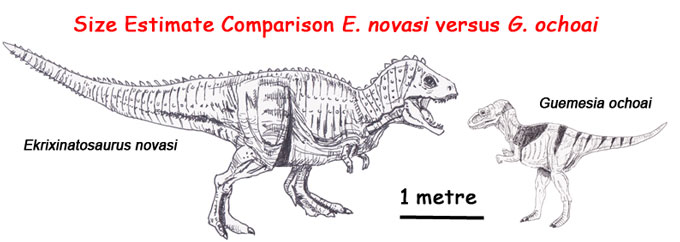
Abelisaurid size comparison.

The braincase fossil is 70% smaller than the braincase of other abelisaurs, suggesting that G. ochoai may be a diminutive form or perhaps the fossil material represents a juvenile. Size comparison between Guemesia ochoai (right) and the closely related Ekrixinatosaurus novasi (left) if specimen number IBIGEO-P 103 represents adult material. Picture credit: Everything Dinosaur.

Picture credit: Everything Dinosaur

Researchers writing in the “Journal of Vertebrate Paleontology”, have named a new abelisaurid taxon based on the discovery of a small braincase (fused skull bones which contained the brain, specimen number IBIGEO-P 103), in Salta Province in the far north-west of Argentina. The new dinosaur has been named Guemesia ochoai. Its discovery provides the first definitive evidence of the presence of these enigmatic theropods in this part of Argentina.

Patagonian abelisaurid fossils are relatively abundant and include extensively researched and partially complete specimens. In contrast, abelisaurids from north-western Argentina are represented by isolated bones and teeth, fossil material that is regarded as too scrappy to permit the erection of new taxa.

Los Blanquitos Formation

The nearly complete braincase comes from reddish sandy siltstone exposures in the Amblayo Valley (San Carlos department, Salta Province). The precise age of the fossil-bearing sediments is unknown, although radiometric dating studies of volcanic rocks associated with the top of the Los Blanquitos Formation indicate an age range of 69.5 to 70.5 million years, thus suggesting that these strata date from the Campanian/Maastrichtian.

Towards the end of the Mesozoic, rising sea levels led to the division of South America into several landmasses. A shallow sea separated the north-eastern part of the continent from the southern portion. The braincase autapomorphies established by CT-scan analysis undertaken at the TCba Salguero Diagnostic Centre in Buenos Aires, distinguish G. ochoai from Patagonian abelisaurids and its discovery supports the idea that distinct dinosaur communities existed in South America during the Late Cretaceous.

International Collaboration in the Hunt for Argentina’s Dinosaurs

The scientific paper, published in the Journal of Vertebrate Paleontology, provides an example of the extensive international collaboration between academics in a bid to discover more about the unusual dinosaur biota of northern Argentina.

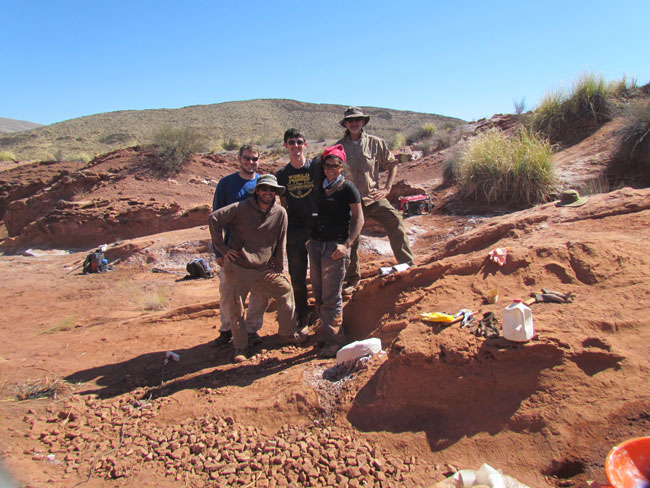
Guemesia Dig Site Photo

The field team at the G. ochoai dig site in the Amblayo Valley. The fossil specimen can be seen in the foreground it is covered in its protective plaster jacket prior to its removal from the dig site. Back row, left to right, Andrew Cuff, Thomas Halliday and Javier Ochoa. Front row, left to right Agustín Scanferla and Anjali Goswami). Picture credit: Agustín Scanferla (Universidad Maimónides, Buenos Aires).

Picture credit: Agustín Scanferla (Universidad Maimónides, Buenos Aires)

Co-author of the scientific paper Dr Andrew Cuff (Human Anatomy Resource Centre, University of Liverpool), explained:

“I was lucky enough to be a member of the small team that was exploring the area and heard the excited shouts of Javier Ochoa [a technician at the Museo Regional “Florentino Ameghino,” Río Tercero city, Argentina] (who found the fossil), and Agustín Scanferla [Universidad Maimónides, Argentina]. They said they had found a skull. After getting a closer look at it I guessed that it might be an abelisaur braincase from the bits we could see, but at that stage it was very much a guess. We extracted the specimen from the ground back in 2015. Some beautiful, and I imagine very difficult preparation of the braincase (due to the bone looking very similar in colour to the rock), has since occurred.”

Dr Cuff added:

“This was followed up with CT scanning to get a look inside the braincase allowing more in-depth study of where the brain itself would have been. The Argentinian team has carried out a great study, and I feel very privileged to have been involved in a small way.”

A Diminutive Abelisaurid or a Juvenile

It remains uncertain as to whether the skull material represents a mature, diminutive theropod or the remains of a juvenile. The bones forming the braincase are tightly fused, but the authors urge caution when using bone fusion as the sole indicator of the age of an animal. Hopefully, postcranial material will be found such as limb bones that will permit a histological analysis.

Commenting on the possibility of further fossil finds from north-western Argentina, Dr Cuff added:

“There is certainly a lot more material to be found in Salta province that would further enrich our knowledge of the Argentinian dinosaur record. I hope that further exploration will help us fill in these gaps in the South American and Argentinian fossil record.”

Etymology for a New Abelisaurid

The genus name honours Governor of Salta Province and military leader General Martin Miguel de Güemes (1785-1821). The species name recognises the contribution made to vertebrate palaeontology by Javier Ochoa, who found the braincase fossil.

To read an article from 2021 about a newly described abelisaurid from Neuquén Province (northern Patagonia): Llukalkan aliocranianus.

New species of abelisaurid described from south-eastern Brazil: Kurupi itaata from the Marília Formation.

The scientific paper: “First definitive abelisaurid theropod from the Late Cretaceous of Northwestern Argentina” by Federico L. Agnolín, Mauricio A. Cerroni, Agustín Scanferla, Anjali Goswami, Ariana Paulina-Carabajal, Thomas Halliday, Andrew R. Cuff and Santiago Reuil published in the Journal of Vertebrate Paleontology.

Visit the Everything Dinosaur website: Everything Dinosaur.

13 02, 2022

Prehistoric Croc with Dinosaur Remains in its Stomach

By |2024-10-26T11:37:53+01:00February 13th, 2022|Categories: Dinosaur and Prehistoric Animal News Stories, Dinosaur Fans, Main Page, Palaeontological articles, Photos/Pictures of Fossils|0 Comments

Scientists have announced the discovery of a new genus of crocodyliform from the Late Cretaceous Winton Formation of Queensland, Australia. Named Confractosuchus sauroktonos it is only the second crocodyliform known from the Cenomanian-aged Winton Formation and remarkably, the last meal of this predator has been preserved. The abdominal contents consist of the partial remains of a juvenile ornithopod, thus providing the first evidence of crocodile/dinosaur predation in Australia.

Furthermore, the ornithopod bones represent the first skeletal remains of this group reported from the Winton Formation, previously only known from tracks and shed teeth, the unfortunate dinosaur that was eaten by Confractosuchus may represent a new taxon.

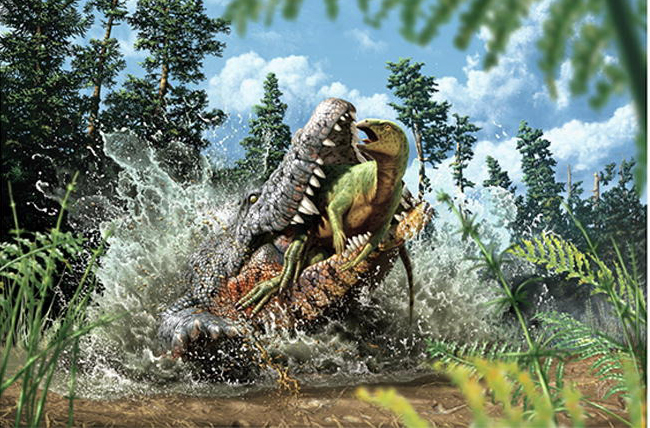
Confractosuchus sauroktonos attacks a juvenile ornithopod.

A life reconstruction of Confractosuchus sauroktonos capturing the juvenile ornithopod. Picture credit: Dr Matt White/Australian Age of Dinosaurs Museum.

Picture credit: Dr Matt White/Australian Age of Dinosaurs Museum

“Prehistoric Croc” High Resolution Scans Reveal Delicate Fossil Bones

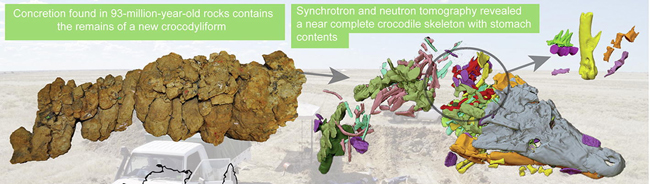
The crocodile specimen consisting of a nearly complete skull with post-cranial material representing about 35% of the total skeleton was discovered in 2010, on the Elderslie Station near to the town of Winton (Queensland). A field team was excavating the remains of a titanosaur and during the removal of the overburden the crocodile fossil material was found. Unfortunately, the concretion containing the fossil was partly crushed by an excavator. The small bones contained within the concretion were too fragile to be removed from the hard stone surrounding them so the object was subjected to neutron and synchrotron X-ray micro-computerised tomography so their details could be revealed.

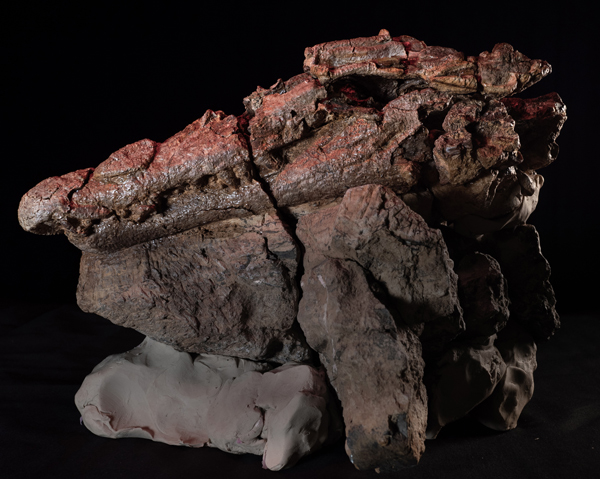
Confractosuchus skull fossil.

The skull of the newly desribed Confractosuchus sauroktonos, only the second crocodyliform to be described from Winton Formation fossils. Picture credit: Australian Age of Dinosaurs Museum.

Picture credit: Australian Age of Dinosaurs Museum

“Broken Lizard Killer”

The diet of fossil crocodyliforms are usually inferred based on distinctive bite marks on fossil bone, although it has long been suspected that just like their extant relatives, ancient crocodiles would have preyed upon a wide variety of other animals. This fossil specimen indicates that young dinosaurs were on the menu for Confractosuchus.

The genus name of the new taxon is derived from Confractus which means “broken” in Latin, a reference to the shattered concretion in which the fossil material was preserved and suchus from the Greek for the Egyptian crocodile god Sobek. The species name is also from the Greek meaning “lizard”, a common word used as a suffix for the Dinosauria and ktonos meaning “killer”.

Although the tail and hind legs were missing, the researchers estimate that this Confractosuchus preshistoric croc individual was around 2.5 metres long, but it was not fully grown. Analysis of the teeth and jaws suggest that it probably had a similar diet to an extant caiman, it probably did not specialise in hunting and killing young dinosaurs, but it would not have turned down the opportunity of catching a young dinosaur or scavenging a corpse.

Analysis of the ornithopod fossils suggest that the crocodile either directly killed the dinosaur or scavenged it quickly after its death.

Confractosuchus sauroktonos is only the second crocodyliform to be named and described from fossils found in Winton Formation strata. The related but much smaller Isisfordia duncani was named and described in 2006.

Confractosuchus sauroktonos from Queensland

The concrection (left) that when subjected to high resolution tomography revealed the remains of a juvenile ornithopod within the crocodyliforms body cavity. Picture credit: White et al.

Picture credit: White et al

Both C. sauroktonos and I. duncani have been classified as members of the Eusuchia clade of crocodyliforms. As such, they are distantly related to modern caiman, alligators, gharials and crocodiles as all living crocodyliforms are also eusuchians.

The scientific paper: “Abdominal contents reveal Cretaceous crocodyliforms ate dinosaurs” by Matt A. White, Phil R. Bell, Nicolás E. Campione, Gabriele Sansalone, Tom Brougham, Joseph J. Bevitt, Ralph E. Molnar, Alex G. Cook, Stephen Wroe and David A. Elliott published in Gondwana Research.

The Everything Dinosaur website: Prehistoric Animal Toys.

11 02, 2022

Abditosaurus kuehnei – The First New Dinosaur of 2022

By |2022-10-23T18:36:31+01:00February 11th, 2022|Categories: Adobe CS5, Dinosaur and Prehistoric Animal News Stories, Dinosaur Fans, Main Page, Palaeontological articles|0 Comments

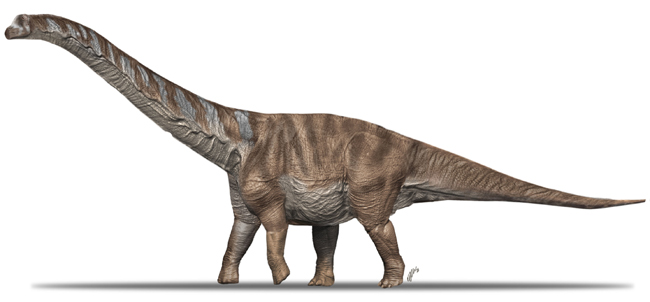
The first new dinosaur to be scientifically described in 2022, hails from the Late Cretaceous of the southern Pyrenees of Spain and it’s a giant. At an estimated 17.5 metres long, Abditosaurus kuehnei was probably the largest dinosaur on the European archipelago some 70.5 million years ago (Maastrichtian faunal stage of the Late Cretaceous) and its fossils represent the most complete titanosaur known from Europe described to date.

Abditosaurus kuehnei life reconstruction.
Abditosaurus kuehnei life reconstruction. Picture credit: Oscar Sanisidro / Museu de la Conca Dellà.

A Dinosaur That Took Decades to Discover

During the Late Cretaceous sea levels were exceptionally high and much of the continent of Europe we know today was underwater. The landmass of Europe was divided into a series of islands, this archipelago is known to have supported a wide variety of different types of non-avian dinosaur, titanosaurs were present, although none of the scientifically described genera would have matched Abditosaurus in size.

Late Cretaceous Europe.
Europe during the Maastrichtian faunal stage of the Late Cretaceous. Abditosaurus roamed the Ibero-Amorican island on the western age of the archipelago. The Ibero-Amorican island consisted of mainly southern France, Portugal and north-central Spain. The researchers propose that this large titanosaur migrated to the island from the south around 70.5 million years ago when sea level regression opened up a temporary land bridge with northern Africa. Adapted from Dalla Vecchia.

Related to Titanosaurs from Gondwana

The new titanosaur taxon demonstrates an unusual combination of characters not seen in other Ibero–Armorican titanosaurs. For example, it had a very robust humerus with a distally expanded deltopectoral crest, an anatomical characteristic typical of the Saltasauridae family of titanosaurs. A phylogenetic analysis carried out by the research team, who included Doctor Albert Sellés, a palaeontologist with the Institut Català de Paleontologia Miquel Crusafont at the Universitat Autònoma de Barcelona and the Museu de la Conca Dellà, nests Abditosaurus within a clade of South American and African saltasaurines and away from European titanosaurs. This suggests that Abditosaurus migrated to the Ibero-Amorican island around 70.5 million years ago when a temporary land bridge united the island with northern Africa.

Further evidence suggesting that dinosaurs migrated from Africa to the island was found at the dig site. Dr Albert Sellés, one of the co-authors of the scientific paper, explained that eggshell fossils from a titanosaurian oospecies known from Gondwana were also discovered.

Abditosaurus kuehnei fossil excavation.
Abditosaurus kuehnei fossil excavation (a) the fossils exposed at the Orcau-1 site and (b, c) fieldwork to extract the fossil material. Picture credit: Institut Català de Paleontologia Miquel Crusafont.

The “Forgotten Reptile”

German palaeontologist Walter Georg Kühne found the first fossil evidence of this large dinosaur in 1954 when exploring Upper Cretaceous deposits near the small town of Orcau (Catalonia). These fossils were despatched to the Instituto Lucas Mallada in Madrid. The following year Kühne returned and collected more bones. No further excavations took place until 1986, when the site was opened up again by a field team from the Institut de Paleontologia de Sabadell (Barcelona) which found dorsal ribs and part of the sternum. From 2012 to 2014 the dig site was opened up once more, this time by a joint Museu de la Conca Dellà, Institut Català de Paleontologia and Universidad de Zaragoza expedition and further fossil material was removed.

The generic name is derived from the Latin word “Abditus” (meaning forgotten) and the Greek word “sauros” (lizard), in recognition of the protracted excavation. The specific name honours Professor Walter Georg Kühne.

Abditosaurus kuehnei skeletal drawing.
Skeletal reconstruction and scale estimate of Abditosaurus kuehnei. The different coloured bones indicate which bones were excavated during the different field expeditions. The bones coloured light pink were excavated in the 1950s but have been subsequently lost. Picture credit: Bernardo González Riga.
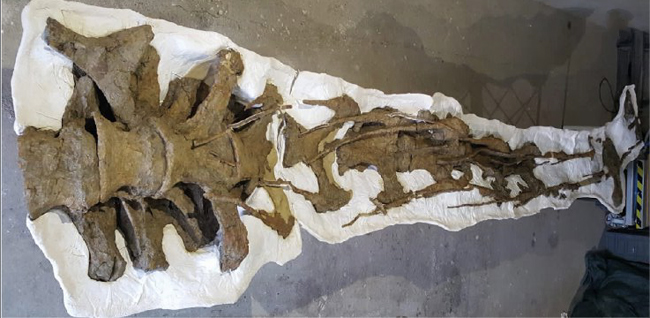
Cervical vertebrae of Abditosaurus kuehnei.
The partially complete but articulated cervical vertebrae of Abditosaurus kuehnei. Picture credit: Institut Català de Paleontologia Miquel Crusafont.

The photograph above shows the neck bones of Abditosaurus recovered from the dig site. Although famous for their long necks, the fossil record of sauropod cervical vertebrae is surprisingly sparse.

To read an Everything Dinosaur blog post that summarises some of the problems of restoring sauropod specimens when palaeontologists have only limited information about the size of the dinosaur’s neck: How Much Do We Know About Sauropod Necks?

The scientific paper: “A titanosaurian sauropod with Gondwanan affinities in the latest Cretaceous of Europe” by Bernat Vila, Albert Sellés, Miguel Moreno-Azanza, Novella L. Razzolini, Alejandro Gil-Delgado, José Ignacio Canudo and Àngel Galobart published in Nature Ecology & Evolution.

10 02, 2022

New Research Giving the Arthropoda a Leg Up

By |2024-10-24T08:23:19+01:00February 10th, 2022|Categories: Adobe CS5, Dinosaur and Prehistoric Animal News Stories, Main Page, Palaeontological articles, Photos/Pictures of Fossils|0 Comments

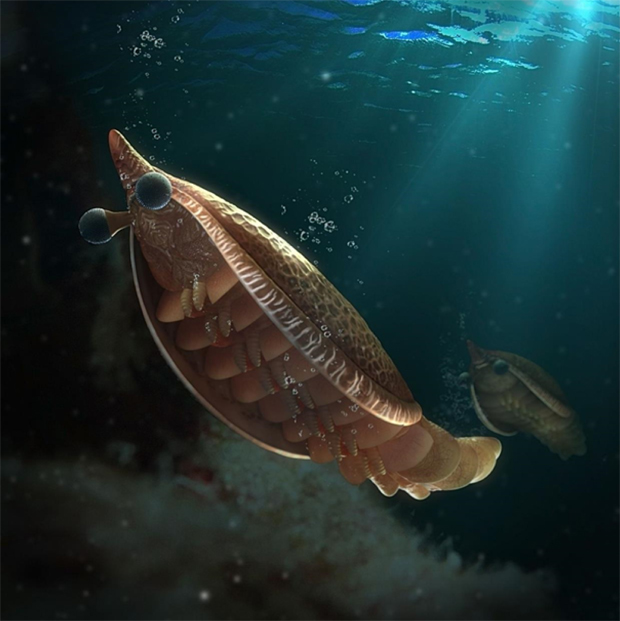
A University of Manchester researcher in collaboration with a team of international scientists from China, Sweden and Switzerland has helped invertebrate palaeontologists to resolve the puzzle of how arthropods evolved gills. Dr David Legg from the Department of Earth, Atmospheric, and Environmental Sciences and his co-authors have published a scientific paper this week that describes a new genus of ancient marine arthropod from the Chengjiang biota of Yunnan Province, China. The newly described Erratus sperare swam in a shallow tropical sea some 518 million years ago (stage 3 of the Cambrian). At around 3 centimetres in length, it was no giant, but it represents a giant leap forward in the evolution of the Arthropoda.

Erratus sperare life reconstruction

A life reconstruction of the Cambrian Erratus sperare which has helped palaeontologists to improve their understanding of the origin of gills in the Arthropoda. Picture credit: University of Manchester.

Picture credit: University of Manchester

The Evolution of Biramous Limbs

Extant water dwelling arthropods and their extinct counterparts such as the trilobites have biramous limbs, legs that have two distinct parts or branches – one for breathing and one for walking. The inner branch is known as the endopod and the outer branch is called the exopod, together these two branches form the marine arthropod limb.

How such specialised limbs evolved was a mystery. Some of the earliest fossil arthropods, like Anomalocaris, had swimming flaps that may have doubled as gills, but until now researchers didn’t know how arthropods made the jump from these specialised flaps to the biramous limbs of modern arthropods.

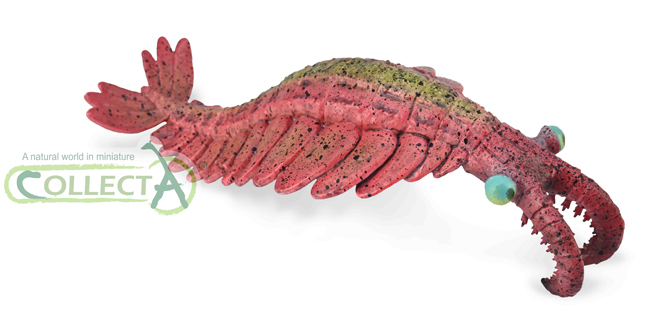
CollectA Anomalocaris

The CollectA Anomalocaris model. A fantastic replica of an early apex predator. The CollectA Anomalocaris (Other Prehistoric Animal Models).

The picture (above) shows a model of an Anomalocaris, a large Cambrian predator.  This model is part of the CollectA range.

To view the CollectA range of prehistoric animal figures: CollectA Prehistoric Life Models.

Erratus sperare – A Transitional Form

Erratus sperare fossils come from the UNESCO World Heritage Site located in Yunnan Province, China. The Maotianshan shales exposed in Chengjiang County preserve a record of a Cambrian marine community that existed several million years before the Burgess Shales of British Columbia were laid down. The highly fossiliferous strata have yielded at least 196 different species, with both hard parts and soft tissues preserved.

E. sperare appears to be a transitional form, it provides a missing link between arthropods that used specialised flaps such as Anomalocaris and arthropods with biramous limbs. It has both legs and flaps.

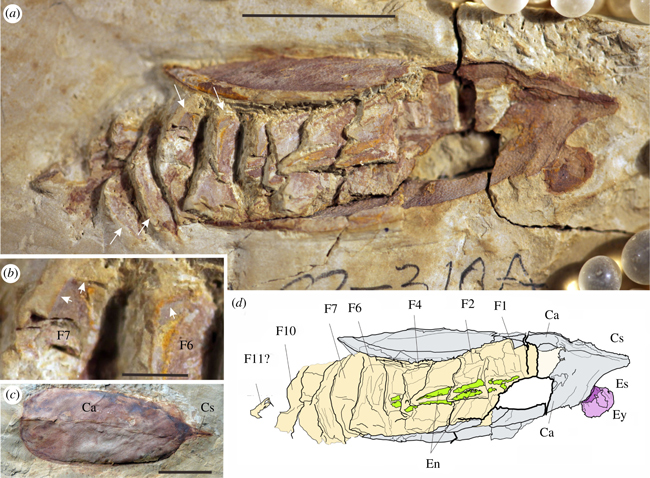
Erratus sperare fossils and explanatory line drawing.

Erratus sperare gen. et sp. nov. from the early Cambrian (Series 2, Stage 3), Chengjiang Lagerstätte, China. The fossils are approximately 518 million years old. Photograph (a) NWUS92-310, specimen formerly referred to Isoxys auritus note the carapace with short anterior spine and covering the seven most anterior body segments; the flap margin without setae (arrows); (b) details of flap 6–7; note the smooth margin. XDBZ102 (c), the complete carapace (Ca) of E. sperare in dorsal view, showing anterior spine and straight posterior margin; (d) line drawing of (a) showing cardinal spine (Cs), ventral eyes (Ey) with stalk (Es), and flaps 1–11; the ventral endopods (En) are present in the anterior trunk. Scale bars, 2 mm for (b) and 1 cm for others. Picture credit: Fu et al.

Picture credit: Fu et al

Explaining the significance of this fossil discovery, Dr David Legg commented:

“Fish aren’t the only organisms that have gills! Arthropods have gills too… they just have them on their legs. When it came to arthropods, however, we just weren’t sure where these gills came from. Thanks to this new fossil, Erratus sperare, we now have a much clearer idea. These gills also probably went on to evolve into the wings of insects and the lungs of terrestrial arthropods like spiders so were a very important innovation.”

Everything Dinosaur acknowledges the assistance of a media release from the University of Manchester in the compilation of this article.

The scientific paper: “The evolution of biramous appendages revealed by a carapace-bearing Cambrian arthropod” by Dongjing Fu, David A. Legg, Allison C. Daley, Graham E. Budd, Yu Wu and Xingliang Zhang published in Philosophical Transactions of the Royal Society B.

Visit the Everything Dinosaur website: Everything Dinosaur.

9 02, 2022

A New Super-predator from the Middle Triassic

By |2024-10-24T08:15:41+01:00February 9th, 2022|Categories: Adobe CS5, Dinosaur and Prehistoric Animal News Stories, Dinosaur Fans, Main Page, Palaeontological articles, Photos/Pictures of Fossils|0 Comments

Scientists from the University of Birmingham, Virginia Tech (USA) and the London Natural History Museum have described a new super-predator from the Middle Triassic of Tanzania. The ancient archosaur, a very distant relative of modern crocodiles, has been named Mambawakale ruhuhu, with a skull estimated to be around 75 cm long and a total body length of around 5 metres, Mambawakale is one of the largest terrestrial carnivores known from this period in Earth’s history.

Originally referred to as Pallisteria angustimentum, with the genus name honouring geologist John Weaver Pallister OBE (1912–1985), the researchers writing in the open-access journal Royal Society Open Science, wanted to acknowledge the contribution of local scientists and field team members from Tanzania and Zambia. Once it had been established that the fossils represented a new taxon, advice was sought and the genus name Mambawakale (from the regional Kiswahili language meaning “ancient crocodile”) was erected.

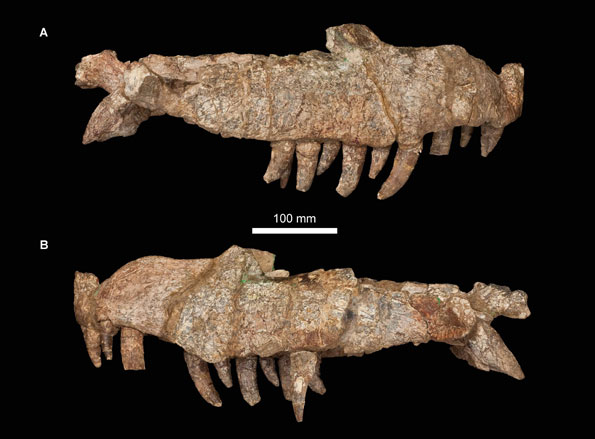
Photographs of the skull of Mambawakale ruhuhu (Holotype)

Photographs of the skull of Mambawakale ruhuhu (NHMUK R36620) in right lateral view (a) and left lateral view (b). Note scale bar = 100 mm. Picture credit: Butler et al.

Picture credit: Butler et al

The Manda Beds of Tanganyika (Tanzania)

The first, major collection of Triassic fossils from the Middle Triassic Manda Beds exposed in the Ruhuhu Basin of southern Tanzania took place in the 1930s. The research was led by the British geologist Gordon Murray Stockley. At the time Tanganyika was still part of the British Empire and the fossils were removed to the UK, Europe and to South Africa (an independent dominion of the British Empire). The archosaur fossils were studied by Alan Charig in the late 1950s, but this work was not published until after his death in 1997.

In 1963, two years after Tanganyika gained independence and was renamed Tanzania, Alan Charig participated in a British Museum (Natural History Museum) expedition to the region to find more archosaur material. This expedition was heavily reliant on Tanzanians and Zambians who helped excavate fossils, locate dig sites and built roads to permit transport of the fossils. Sadly, the efforts of these people were not recognised in published reports and no Tanzanians or Zambians were named in the publications.

The Mambawakale material consisting of a partial skull, lower jaw, cervical vertebrae and the bones from the left hand (manus), was one of the last sets of fossils from the 1963 expedition to be studied. Once the researchers had identified that these fossils represented a new genus, they wanted to recognise the previously little acknowledged contributions of the Africans, hence, the reference to the Kiswahili language for the genus name. The species epithet makes reference to the Ruhuhu Basin.

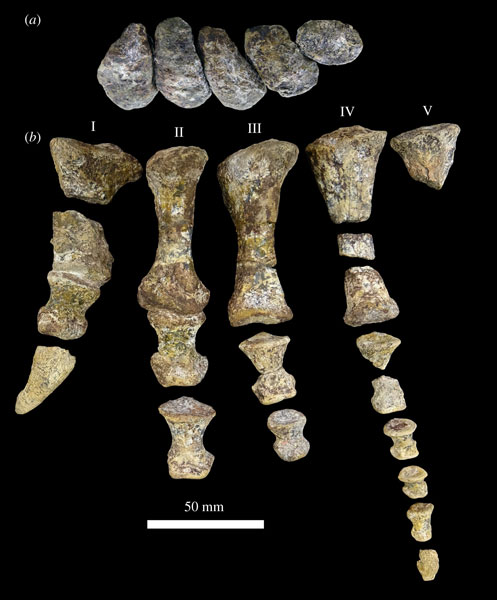
Mambawakale left manus

Left hand (manus) of the newly described pseudosuchian archosaur Mambawakale ruhuhu (specimen number NHMUK R36620). Picture credit: Butler et al.

Picture credit: Butler et al

One of the Oldest Known Archosaurs

The large skull and heterodont dentition in the anterior portion of the upper jaw, indicate that Mambawakale was a powerful animal and a formidable carnivore.

Corresponding author Richard Butler, Professor of Palaeobiology at the University of Birmingham stated:

“Mambawakale ruhuhu would have been a large and terrifying predator, which roamed across Tanzania some 240 million years ago. At around 5 metres long, it’s one of the largest predators that we know of from this period.”

Analysis of the skull led to the identification of cranial autapomorphies (unique characteristics) that permitted the research team to erect a new genus. The Mambawakale material can be confidently distinguished from all other Manda Bed archosaurs, with the possible exception of the probably very closely related Stagonosuchus nyassicus for which direct comparisons are not possible due to the lack of overlapping fossil bones.

Photographs of the skull of Mambawakale ruhuhu in (a) dorsal view and (b) ventral view

Photographs of the skull of Mambawakale ruhuhu in (a) dorsal view and (b) ventral view. Specimen number NHMUK R36620, note scale bar = 100 mm. Picture credit: Butler et al.

Picture credit: Butler et al

Professor Butler went onto add:

“Our analysis identifies Mambawakale as one of the oldest known archosaurs and an early member of the lineage that eventually evolved into modern crocodilians. It’s an exciting discovery, because identifying this animal helps us to understand the rapid early diversification of archosaurs and enables us to add a further link to the evolutionary story of modern-day crocodiles.”

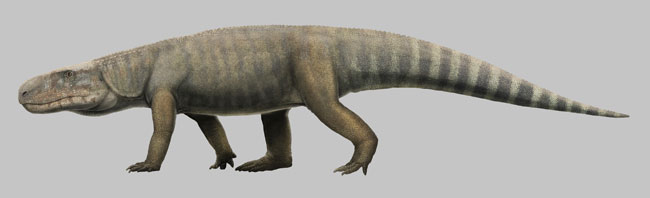
Mambawakale ruhuhu life reconstruction

Life reconstruction of the newly described pseudosuchian Mambawakale ruhuhu. Only the skull, elements from the jaw and fragmentary postcranial material are known so the body shape has been created based on better-known, large pseudosuchian relatives. Picture credit: Gabriel Ugueto.

Picture credit: Gabriel Ugueto

Dating the Manda Beds

Tetrapod fossils associated with the Manda Beds have led palaeontologists to propose that the deposits date from the Anisian stage of the Middle Triassic, however, the age of these rocks remains in dispute. Some recent papers have suggested that the rocks, and therefore the fossils contained therein are actually younger and that the strata were laid down in the Late Triassic (Carnian stage).

Everything Dinosaur acknowledges the assistance of a media release from the University of Birmingham in the compilation of this article.

The scientific paper: “A new pseudosuchian archosaur, Mambawakale ruhuhu gen. et sp. nov., from the Middle Triassic Manda Beds of Tanzania” by Richard J. Butler, Vincent Fernandez, Sterling J. Nesbitt, João Vasco Leite and David J. Gower published in Royal Society Open Science.

The Everything Dinosaur website: Prehistoric Animal Models.

5 02, 2022

A Remarkable Miocene Fish Skull Fossil Filled with Fossil Worm Poo

By |2024-10-23T07:18:40+01:00February 5th, 2022|Categories: Adobe CS5, Dinosaur and Prehistoric Animal News Stories, Main Page, Palaeontological articles, Photos/Pictures of Fossils|0 Comments

The famous marine sediments of the Chesapeake Group, which outcrops across North Carolina, Delaware, Virginia and Maryland in the USA are regarded as some of the most extensively studied Cenozoic marine deposits in the world. The first fossil described from North America (Ecphora quadricostata) a marine snail which was scientifically described in 1685, comes from deposits associated with the Chesapeake Group (St Marys Formation)

A Miocene Fish Fossil

Many different types of fish and marine invertebrates have been named from fossils found at locations such as the Calvert Cliffs on the western shore of Chesapeake Bay (Maryland). Cetacean fossil material is also associated with these strata, along with sea cows and many seabirds such as gannets and fulmars. Marine turtles and the remains of land tortoises and freshwater crocodiles are also known.

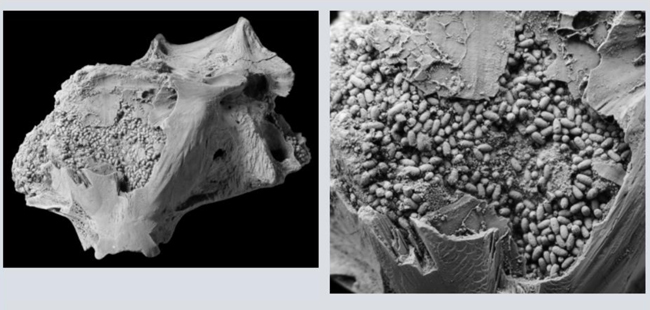
A researcher from the Calvert Marine Museum (Maryland), is one of the authors of a recently published scientific paper that highlights a first for these Miocene-aged deposits. The partial skull of a fish has been found crammed full of tiny, fossil poo probably created by scavenging worms that once feasted on the head of the fish.

Invertebrate faecal matter in fossil fish braincase.

Photograph (left) of the partial skull of the Miocene Stargazer fish (ventral view). Some of the bone has broken away revealing hundreds of fossilised faecal pellets filling the braincase. A close-up view of the faecal matter (right). Picture credit: Calvert Marine Museum.

Picture credit: Calvert Marine Museum

Stargazer Skull (Astroscopus spp.)

The specimen represents the first skull completely infilled with faecal pellets ever recorded, the fossil poo (micro-coprolite) is an example of the coprulid ichnospecies Coprulus oblongus. The pellets range in size from 1 mm to 5 mm in length and the skull comes from a Stargazer fish (Astroscopus), a genus of bottom living fish that bury themselves in soft sediment lying in wait to ambush small fish and invertebrates that come within striking distance.

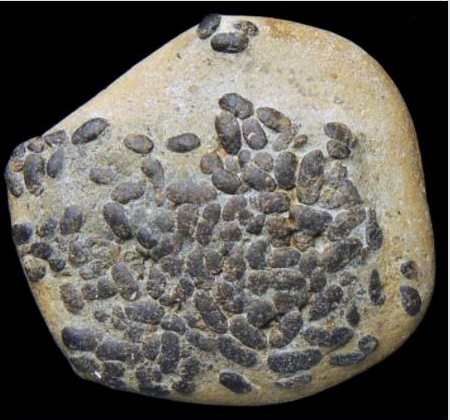
Miocene coprolite fossil.

A fossil of worm faecal pellets from Miocene-aged deposits from southern Maryland (USA). Each pellet is approximately 3 millimetres in length. Picture credit: Calvert Marine Museum.

Picture credit: Calvert Marine Museum

Crocodile Coprolites Studied Too

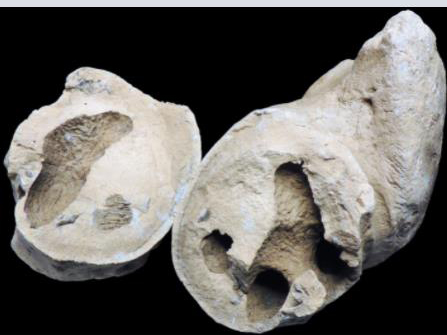
Writing in the academic journal “Rivista Italiana di Paleontologia e Stratigrafia”, the researchers also describe a series of trace fossils found in preserved crocodile coprolite from the Miocene Calvert Formation. The fossil crocodile poo was tunnelled into, presumably evidence of the faeces being consumed (coprophagy). The scientists are unable to identify the organism(s) responsible for producing the burrows although the sides of the burrows preserve evidence of scratches which are thought to be feeding traces.

Crocodile coprolite fossil with feeding traces.

Crocodile coprolite broken open showing trace fossil burrows made by a coprophagus organism. Feeding gouge marks can be seen on the walls of the burrow. Length of crocodile coprolite 17.5 cm approximately. Picture credit: Calvert Marine Museum.

Picture credit: Calvert Marine Museum

Whilst these remarkable fossils might not be as awe-inspiring as the whale bones that have been found in these rocks, they provide important evidence with regards to the recycling of nutrients from faecal matter in Miocene-aged marine environments.

The scientific paper: “Coprolites from the Calvert Cliffs: Miocene fecal pellets and burrowed crocodilian droppings from the Chesapeake Group of Maryland, USA” by Stephen J. Godfrey, Alberto Collareta and John R. Nance published in Rivista Italiana di Paleontologia e Stratigrafia.

4 02, 2022

Ice Age Animal Remains Found in Devon

By |2024-10-23T07:08:51+01:00February 4th, 2022|Categories: Adobe CS5, Dinosaur and Prehistoric Animal News Stories, Main Page, Photos/Pictures of Fossils|0 Comments

The remains of several different types of Ice Age mammal that inhabited south-western England have been recovered from a cave in Devon. The fossils, which are estimated to be between 30,000 and 60,000 years old provide scientists with a unique perspective on the fauna that existed during the Devensian, or the Last Glacial Period (LGP). Although ice sheets did not reach south-western England, Devon would have experienced extreme cold, tundra-like conditions.

Animal remains found in the cave include the partial remains of a Woolly Mammoth (Mammuthus primigenius), bones from a Woolly Rhinoceros (Coelodonta antiquitatis), the skeleton of a wolf, plus hyena, red fox, horse, reindeer and mountain hare fossils.

Ice Age Prehistoric Animal Remains found in Devon

The jumbled up bones of Ice Age animals found in a Devon cave. Picture credit: Historic England.

Picture credit: Historic England

An “Exceptional” Fossil Site

A substantial new town consisting of over 5,000 new houses and related infrastructure is being built close to Plymouth. The Sherford Consortium, the developers, state that the cave was located close to old lime kilns and Sherford Quarry. Commenting on the significance of the discovery, Duncan Wilson, Chief Executive of Historic England stated that these fossils were “exceptional” and added:

“To have found partial remains of such a range of species here in Devon gives us a brilliant insight into the animals which roamed around Ice Age Britain thousands of years ago, as well as a better understanding of the environment and climate at the time.”

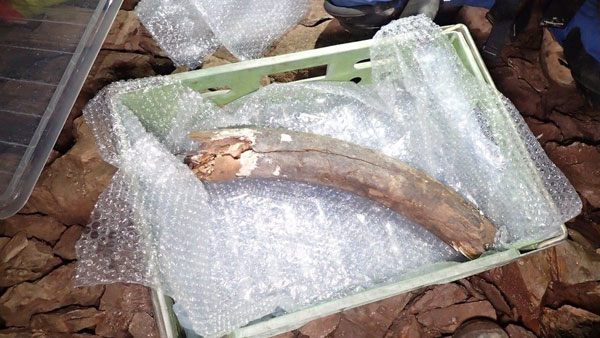
Mammoth Tusk from the Devon Cave

Part of a mammoth tusk carefully being packed into a box for transport off the dig site. Picture credit: AC Archaeology.

Picture credit: AC Archaeology

Ice Age Animal Remains

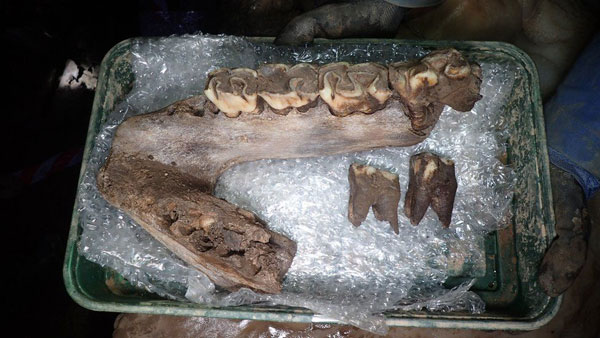
A team of experts have been brought in to carefully document and record the fossil finds. The fossils, including an exceptionally preserved lower jaw from a Woolly Rhinoceros (C. antiquitatis), are currently being studied. It is hoped that this collection of Ice Age remains will be able to stay in the county, with the most likely final destination for the fossils being “The Box”, a recently opened museum in Plymouth close to the University.

Woolly rhino jaw with dentition.

A lower jaw from a Woolly Rhinoceros with some teeth in situ with two additional teeth. Picture credit: AC Archaeology.

Picture credit: AC Archaeology

The Mammoth Gallery

Proposals have been made to put the fossils on permanent display in the Mammoth Gallery of The Box Museum. Plymouth’s former Museum and Art Gallery was re-opened as “The Box” in 2020 following extensive development and renovation. The Mammoth Gallery at the museum explores the natural history of Devon and includes many fossil specimens of the Ice Age fauna associated with south-western England.

The excavation and removal of the fragile fossils involved specialist archaeologists such as those from AC Archaeology, independent archaeological consultants and contractors who provide advice on historic environment issues to developers, local authorities and national bodies.

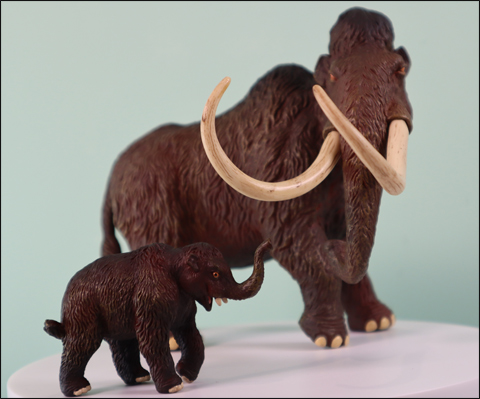
CollectA Woolly Mammoth models.

The CollectA Deluxe Woolly Mammoth model in 1:20 scale and the CollectA Prehistoric Life Woolly Mammoth calf. Woolly Mammoths roamed Devon. Picture credit: Everything Dinosaur.

Picture credit: Everything Dinosaur

1 02, 2022

Rare Dinosaur Tracksite Damaged by Construction Crew

By |2024-10-22T21:40:18+01:00February 1st, 2022|Categories: Dinosaur and Prehistoric Animal News Stories, Dinosaur Fans, Main Page, Palaeontological articles, Photos/Pictures of Fossils|0 Comments

Reports emerged over the weekend that a hugely significant dinosaur tracksite near to Moab in Utah had been damaged by Bureau of Land Management (BLM) contractors as they attempted to build a raised concrete and rail walkway at the site.  Team members were saddened to hear the news of a rare dinosaur tracksite damaged by a construction team.

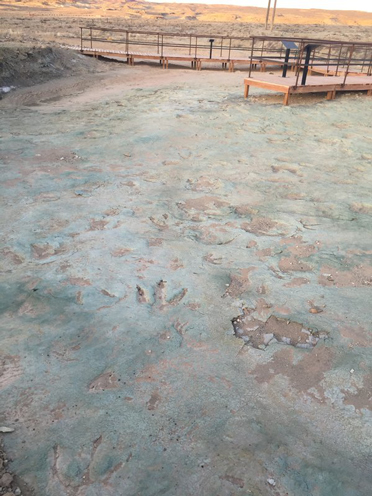
The Mill Canyon dinosaur tracksite was opened as a visitor attraction in 2016. The location features more than 200 dinosaur tracks representing at least 8 different types of dinosaur, a record of activity close to a water source some 112 million years ago (Albian faunal stage of the Early Cretaceous). Over the weekend, reports emerged on social media that a Bureau of Land Management project to replace the wooden boardwalk with a more robust structure had encountered problems. It has been alleged that a mechanical digger had driven over the exceptionally rare trace fossils and damaged as much of 30% of the site.

Mill Canyon tracksite.

At least six different dinosaur tracks have been deciphered at Moab (Utah). Picture credit: Bureau of Land Management.

Picture credit: Bureau of Land Management

Cease and Desist

It has been reported in the media that the Center for Biological Diversity (based in Tucson, Arizona), sent a cease-and-desist letter to the U.S. Bureau of Land Management’s Utah office, requiring the agency to halt the destruction with immediate effect.

Commenting on the alleged damage, Patrick Donnelly, Great Basin Director at the Center for Biological Diversity stated:

“I’m absolutely outraged that the BLM has apparently destroyed one of the world’s most important paleontological resources. This careless disregard for these irreplaceable traces of the past is appalling. It really calls into question the Bureau’s competence as a land-management agency.”

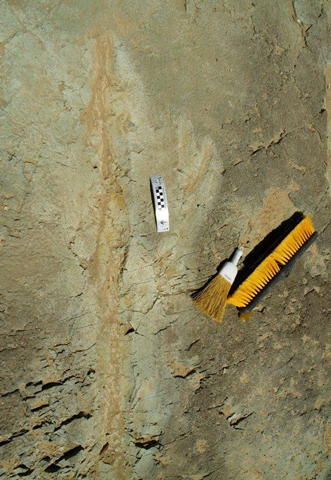
Trace fossil - crocodile tail drag.

The tail drag made by an ancient crocodile preserved in the Red Ruby mudstones of the Cedar Mountain Formation (Utah). Picture credit: Bureau of Land Management.

Picture credit: Bureau of Land Management

Dinosaur Tracksite Damaged

Last year, the Bureau of Land Management approved an environmental assessment to replace the existing boardwalk with a raised concrete-and-steel trail. The document explained that any risks to the dinosaur tracks would be mitigated by flagging sensitive areas and providing “onsite inspections during construction.” Photos shared on social media show a mechanical digger left on the site, tyre tracks damaging dinosaur prints and a rare crocodilian resting trace”.

The cease-and-desist letter documents the destruction of these rare artefacts and states that the Paleontological Resources Preservation Act of 2009 has been violated. Furthermore, the Bureau of Land Management may also be in breach of the National Environmental Policy Act and the Federal Lands Policy and Management Act for neglecting to adhere to project approval protocols.

A spokesperson from Everything Dinosaur expressed dismay at this development and went onto state:

“We have blogged about fossil thefts and vandalism to very important palaeontological sites, many of our posts relate to sites in Utah. It is extremely sad to have to write about this very unfortunate incident. Let’s hope that any damage that has occurred can be mitigated and this extremely significant trace fossil site continues to enjoy the protection that it deserves.”

To read Everything Dinosaur’s original post about the opening of the trackway to visitors: New Dinosaur Track Exhibit Opened.

25 01, 2022

A New Study of Struthiosaurus austriacus – Differences Between Nodosaurids and Ankylosaurids

By |2024-10-15T17:02:28+01:00January 25th, 2022|Categories: Dinosaur and Prehistoric Animal News Stories, Dinosaur Fans, Main Page, Palaeontological articles, Photos/Pictures of Fossils|0 Comments

A study published this month in “Scientific Research” suggests that the Late Cretaceous European nodosaurid Struthiosaurus was not the most active of dinosaurs and probably not the most social. Analysis of the single, partial braincase (IPUW 2349/6) of S. austriacus has permitted scientists to gain a better understanding of this armoured dinosaur’s senses. The conclude that the short semi-circular canals and the shortest cochlear duct described from dinosaur fossils known to date, indicate that Struthiosaurus led a rather inert, sedentary life and compared to other members of the Dinosauria, it was comparatively inactive with limited social interactions.

The researchers calculate that Struthiosaurus had poor hearing and it probably relied on a less active style of self-defence compared to their tail club swinging relatives the ankylosaurids.

Struthiosaurus austriacus life reconstruction

An illustration of the Late Cretaceous nodosaurid Struthiosaurus austriacus from Austria. A study of this dinosaur’s braincase suggests that it was relatively inert, sluggish and partially deaf. Picture credit: Fabrizio De Rossi.

Picture credit: Fabrizio De Rossi

Sluggish and with Limited Hearing

Researchers from the University of Vienna in collaboration with a colleague from the University of Greifswald in Germany subjected the partial braincase of S. austriacus to CT scans. From this information, three-dimensional models of the 5 cm wide braincase of this dinosaur were created.

The braincase consists of several fused skull bones that housed the brain and other neurosensory tissues. Analysis of the structures preserved can provide palaeontologists with information about the sensory capabilities of the animal and more fundamental details of anatomy such as the angle at which the animal held its head.

Struthiosaurus braincase study

Photographs (C,D,G,J) and photogrammetric models (E,F,H,I,K) created from the CT scans of the holotype specimen of Struthiosaurus austriacus, (IPUW 2349/6). Right lateral view (C,E), (D,F) left lateral, (I) anterior, (J,K) ventral and (G,H) posterior views. Note scale bar = 2 cm. Picture credit: Schade et al.

Picture credit: Schade et al

The results of this study of the braincase of Struthiosaurus indicate that its brain was very similar to the brains of other nodosaurids. For example, the flocculus, an ancient part of the tetrapod brain, associated with co-ordination and motor skills was very small. Ankylosaurs with their large tail clubs, such as Euoplocephalus had a proportionately larger flocculus. A bigger flocculus might have helped ankylosaurs to co-ordinate their defensive strikes with their powerful tail clubs.

In addition, the team which included Marco Schade (University of Vienna), plotted the auditory capacity of Struthiosaurus and calculated that its hearing range was rather limited (between 296 and 2164 Hz). In contrast, humans on average have a much broader frequency of hearing range – around 31 Hz to 19,000 Hz.

S. austriacus type locality and scale drawing.

Location of the Struthiosaurus austriacus fossil finds in Austria (A). To date three species of Struthiosaurus have been scientifically described, S. transylvanicus from Maastrichtian-aged deposits or Romania, S. languedocensis from the early Campanian of France and S. austriacus which was described from fragmentary fossil material including a partial braincase discovered during coal mining operations near the town of Muthmannsdorf (early Campanian Grünbach Formation). The type locality of S. austriacus is marked by the star. Scale drawing of S. austriacus from Fabrizio De Rossi. Picture credit: Schade et al.

Picture credit: Schade et al

Nodosaurids Occupied a Different Ecological Niche

Both nodosaurids and their close relatives, the ankylosaurids were lumbering, heavily armoured animals adapted to low browsing. Although postcranial fossils are quite similar, there is a growing body of evidence to indicate marked differences between these two types of dinosaur. Nodosaurids may have preferred coastal or floodplain environments and may have evolved stronger jaws to give them a more powerful bite, an adaptation to processing tough vegetation. Gut contents associated with nodosaurids such as Borealopelta markmitchelli, suggest they were selective feeders: Borealopelta was a Fussy Eater.

This study suggests that for Struthiosaurus at least the combination of a relatively short cochlear duct, a reduced flocculus, less elaborate nasal passages and the absence of a tail club but with heavily reinforced dermal armour suggests that nodosaurids had different ecological adaptations when compared to ankylosaurs.

The researchers postulate that nodosaurids were possibly less reliant on their sense of hearing, had a less active style of self-defence and may have occupied different ecological niches than ankylosaurids.

Struthiosaurus may have lived alone and may not have moved in social groups.

PNSO Isaac the Sauropelta dinosaur model.

The recently introduced Isaac the Sauropelta model depicts the typical armour and spikes of a nodosaur. These dinosaurs may have been relatively slow moving, with a limited sense of hearing but they would have represented a formidable adversary for a younger theropod.

The scientific paper: “Neuroanatomy of the nodosaurid Struthiosaurus austriacus (Dinosauria: Thyreophora) supports potential ecological differentiations within Ankylosauria” by Marco Schade, Sebastian Stumpf, Jürgen Kriwet, Christoph Kettler and Cathrin Pfaff published in Scientific Reports.

The Everything Dinosaur website: Dinosaur Toys.
Go to Top