All about dinosaurs, fossils and prehistoric animals by Everything Dinosaur team members.

Fossil finds, new dinosaur discoveries, news and views from the world of palaeontology and other Earth sciences.

29 03, 2015

“Sibirosaurus” Strides In an Amazing Dinosaur Discovery

By |2024-05-05T09:45:11+01:00March 29th, 2015|Categories: Dinosaur and Prehistoric Animal News Stories, Dinosaur Fans, Main Page|0 Comments

Potential New Titanosaur Genus from Siberia – “Sibirosaurus”

Scientists at Tomsk State University (Russia) are busy compiling a technical paper and completing further studies that could affirm fossilised remains found in 2008 are those of a giant titanosaurid dinosaur, very probably a new genus as well.  Although titanosaurids are known from most continents, even Antarctica, this, as far as we at Everything Dinosaur are aware, is the first case of a potential titanosauriform being scientifically described from Russia.

The animal lived in the Late Cretaceous, around 100 million years ago (later part of the Albian faunal stage) and its remains which include cervical vertebrae, a partial scapula (shoulder blade) and elements from the sacrum have been painstakingly extracted from sandstone, which much to the chagrin of the research team is from a band of rock that is as hard as concrete.

New Titanosaur Genus

The dinosaur’s bones were discovered in strata, that forms part of an eroded cliff on the banks of the Kiya River, close to the small village of Shestakovo in the Kemerovo region of southern Siberia, around ninety miles south-east of the city of Tomsk.

The Excavation Site – Kiya River Location

Palaeontologists need a head for heights.

Palaeontologists need a head for heights.

Picture credit: Tomsk State University

Challenging Access to the Fossils

The fossil bearing strata is located half way up a ten-metre-high bank and it is only really accessible during the late spring and summer months.  This part of Russia is subject to extremely cold temperatures and a lot of snowfall in the late autumn through to the spring.  From the months of October through to March the average daytime temperature rarely rises above freezing.  However, August temperatures can exceed thirty degrees Celsius.  It is the changing temperatures (freeze/thaw) that lead to erosion of the banks exposing dinosaur fossils.

A Scientist Explores the Fossil Bearing Sediment

A scientist carefully works away at the rock face.

A scientist carefully works away at the rock face.

Picture credit: Tomsk State University

Discovered in 2008

The fossils were originally discovered back in 2008, they had been preserved inside sandstone concretions and although in some cases the fossils were compressed and they represent just a fraction of the skeleton, their location and size indicate that these fossils consist of the remains of a long-necked dinosaur that would be new to science.

The rocks around the village of Shestakovo have already yielded a number of dinosaur fossil specimens.  Last year, Everything Dinosaur team members reported upon the naming of a new species of Psittacosaurus from fossils found in this locality by scientists working for the Kemerovo regional museum.

To read more about the new species of Psittacosaurus: Russian Scientists Name New Psittacosaurus Species.

Commenting on the research, Dr. Stepan Ivantsov (scientific researcher in the Laboratory of Mesozoic and Cenozoic Continental Ecosystems), stated:

“When we discovered this finding, it was only clear that the remains belonged to a very large, herbivorous dinosaur from the sauropod group.  It was the first scientifically described dinosaur from this group in Russia.  Now after work on the excavation of all the remnants and the restoration [of the bones] is almost completed, we can confidently say that we have found a new species and maybe even a new genus.”

A Dinosaur Amongst the Woolly Mammoths

This part of Russia is famous in palaeontological circles for the preserved remains of another large, prehistoric herbivore but one that is geologically hundreds of times younger than any Late Cretaceous dinosaur.  Many fossils of Woolly Mammoths are found in this region, including shed teeth and intact tusks.

A Close up of Some of the Titanosaur Fossil Material

Some of the fragmentary fossils.

Some of the fragmentary fossils.

Picture credit: Tomsk State University

Preparing the Fossil Material

The fossils in the picture look like elements from the cervical vertebrae (neck bones).  In the background on the right, the posterior end of a large Woolly Mammoth tusk can be seen.  The scientists will continue their studies and a scientific paper on this new dinosaur should be published in the near future, as for where the fossils might end up, the researchers have expressed a wish that they should remain within the palaeontological collection of the University, but stress that they could be put on display for members of the public, as well as students to see.

As fossil material is being constantly eroded out rocks at this site, the scientists hope to find more fossils of titanosaurs.  In 1995, bones believed to come from the foot of a titanosaur were also discovered in the same area.  At this stage, the researchers cannot say for certain whether these foot bones are from the same animal whose fossils were found in 2008, they can’t even be sure whether or not the foot bones and the 2008 material come from the same genus.  Still, it is very likely that more dinosaur fossils are awaiting discovery.  The dinosaur has been nick-named Sibirosaurus (lizard from Siberia), but a more formal nomenclature is expected.

A Close Up View of One of the Fossil Specimens

A close up of one of the fossilised bones.

A close-up of one of the fossilised bones.

Picture credit: Tomsk State University

Letting Erosion to Take Its Course

The picture above shows a close up of one of the fossil remains. Although, it is difficult to make out for certain, this fossil might represent a fragment from the sacrum (fused sacral vertebrae).  The sandstone rock is extremely hard and this limits the amount of fossil material that can be removed.  Use of explosives to bring down large portions of the bank have been ruled out as the force from such an explosion would very likely damage any adjacent fossil material.  For the scientists, it is simply a question of allowing natural erosion to do its work, aided and abetted by careful manual excavation whilst hanging onto a rope ladder which dangles several metres down the near vertical bank.

Everything Dinosaur stocks a wide-range of titanosaur replicas and models. To view the models section of Everything Dinosaur’s award-winning website: Dinosaur and Prehistoric Animal Models.

A spokesperson from Everything Dinosaur commented:

“It is very likely that more dinosaur fossil remains will come from the Shestakovo locality, however, they are likely to remain highly fragmentary making species level identification very difficult.  However, this fossil material adds to our understanding about the globally distributed titanosaurs, some of which were the largest terrestrial animals known to science.”

Everything Dinosaur acknowledges the role of the Siberian Times in the compilation of this article.
26 03, 2015

Woolly Mammoth Genes Inserted into Asian Elephant Skin Cells

By |2023-03-25T10:27:46+00:00March 26th, 2015|Categories: Animal News Stories, Dinosaur and Prehistoric Animal News Stories, Educational Activities, Teaching|0 Comments

Potentially One Step Closer to Woolly Mammoth Resurrection (Woolly Mammoth De-extinction)

Researchers at Harvard Medical School led by genetics professor George Church have combined laboratory grown elephant cells with genetic material retrieved from the frozen remains of Siberian Woolly Mammoths.  The genetic material, a total of fourteen genes, was spliced into the skin cells of an Asian elephant (Elephas maximus), the closest living relative to the extinct Woolly Mammoth.  The results are promising with the altered skin cells functioning properly in their petri dish environment, but the scientists stress that cloning a viable Woolly Mammoth is still a very long way off.

Woolly Mammoth

Investigating the Possibility of a Return for the Woolly Mammoth (Mammuthus primigenius)

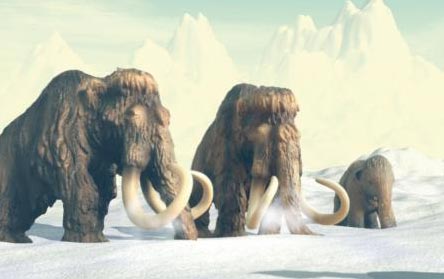
Will the Woolly Mammoth return?

Will the Woolly Mammoth return?

Picture credit: Everything Dinosaur

 Scientists from Harvard Medical School are working on a number of genetic projects, including research into the Woolly Mammoth genome.  They are however, competing against a number of other institutes including South Korea’s Sooam Biotech Research Foundation in a bid to extract viable DNA from a long dead animal with a view of investigating the possibility of cloning.

Ancient Genetic Material

The ancient genetic material was inserted into the cells using a complicated cut and splicing technique, an analogy would be to think of a film editor cutting and stitching snippets of film together so as to make a coherent movie.  The system used was CRISPR (clustered regularly interspaced short palindromic repeat).  Although this work has yet to be peer reviewed and no paper has been published describing the research in detail, preliminary findings suggest that the mutated cells are functioning normally.

If this is the case, then this is the first time that Woolly Mammoth genetic material has functioned since the very last of these Ice Age creatures became extinct the best part of 4,000 years ago.

Having a established a thorough understanding of the Mammoth genome, the team focused on identifying and then adding to the elephant skin cells those genes which are responsible for the Mammoth’s adaptations to a cold climate, genes such as those for small ears, long body hair and thick layers of subcutaneous fat.

Mammoth De-extinction

Professor Church pointed out that they were a long way off from “Mammoth de-extinction”, despite some remarkable finds in recent years, including one amazingly well-preserved female Woolly Mammoth carcase, nick-named Buttercup, that was the subject of a number of cloning documentaries that aired recently.

To read more about the Woolly Mammoth called “Buttercup”: To Clone or Not to Clone a Woolly Mammoth.

The genetics laboratory is the largest research facility at Harvard University and the researchers have been responsible for a number of important genome studies in recent years.  Much of the team’s work involves studying the human genome as well as working on how to manipulate the genes of mosquitoes to help fight the spread of malaria and other diseases such as dengue fever.

Professor Church commenting on their success with the combining of elephant cells and Woolly Mammoth genes stated:

“We won’t be seeing Woolly Mammoths prancing around any time soon, because there is more work to do.  But we plan to do so.”

Splicing the DNA into the skin cells of Asian elephants is only the first step in, what will be a very long process.  The next hurdle is to find a way of turning the hybrid cells into specialised tissues, to see if they produce the correct traits and characteristics.  For example, will the genes for small ears, actually produce ears that are small and able to lose less heat.

With animal rights groups preventing the use of elephants as surrogate mothers, hybrid cells will have to be adapt to being grown in an artificial womb.  If a viable embryo is created, then it is a case of being able to bring that embryo to term and to produce a viable offspring.

Using Mammoth DNA

If all this goes to plan and cold-adapted, hybrid elephants are produced then more and more Mammoth DNA can be introduced into subsequent generations to drive out the Asian elephant traits.  The Harvard team hope to genetically engineer an elephant that can survive in inhospitable, sparsely populated habitats, where such creatures would face fewer threats from humans.

A long term aim would be to develop herds of Woolly Mammoths, once more roaming the steppes of the northern hemisphere.

Everything Dinosaur stocks a range of prehistoric mammal models including Woolly Mammoth replicas: Models of Prehistoric Mammals.

Team members at Everything Dinosaur wait to read more about this research and to see the peer reviewed comments, although we have made a wager that by 2045, a viable Woolly Mammoth will be produced somewhere in the world.  Just thirty years to go then.

24 03, 2015

Giant Triassic Amphibian of the Algarve

By |2023-03-25T07:53:21+00:00March 24th, 2015|Categories: Dinosaur and Prehistoric Animal News Stories, Main Page|0 Comments

Metoposaurus algarvensis – Triassic Predator the Size of a Door

Portugal may have earned a deserved reputation for being the Jurassic dinosaur fossil capital of Europe, but more ancient sediments provide equally fascinating insights into life on our planet just as the Dinosauria were beginning to diversify and dominate terrestrial ecosystems.  Step forward (or more appropriately waddle forward), Metoposaurus algarvensis a new species added to the Metoposaurus genus described from a bone bed found in the Algarve region of southern Portugal.

A team of international scientists which include Dr Steve Brusatte (University of Edinburgh) and J. Sébastien Steyer (Centre de Recherches en Paléobiodiversité et Paléoenvironnements, Paris), Dr Richard Butler (Birmingham University) and Professor Octávio Mateus (Museu da Lourinhã, Portugal) have been studying the fossilised remains of several individuals that apparently died together when their lake dried up.

A Pair of Super-sized Amphibians Await Their Fate as the Lake Dries Up

Two metre long amphibious predator.

Two-metre-long amphibious predator.

Picture credit: Joana Bruno

Metoposaurid Fossils

Metoposaurid fossils are known from Europe, Africa, North America and India, although this is the first time fossils relating to this genus have been discovered in the Iberian peninsula.  Some of the fossil specimens indicate that these amphibians reached lengths in excess of two metres and the shape of the skull along with other anatomical differences between the Portuguese fossils and other material known from Poland and Germany has permitted a new species to be erected.

The bonebed that contains the remains of numerous individuals, ten skulls have been excavated so far, was discovered more than thirty years ago, but not properly mapped and explored until 2009 when the dig site was relocated.  Although, these predators superficially resemble a modern salamander, scientists debate whether the Order Temnospondyli which the metoposaurids are part of, are actually closely related to extant amphibians.

The Scientists at Work Excavating the Bone Bed

Scientists carefully extract blocks containing fossil material.

Scientists carefully extract blocks containing fossil material.

Picture credit: Steve Brusatte/Richard Butler/ Octávio Mateus/J. Sébastien Steyer

Metoposaurus algarvensis

Although the mouth was large and lined with many sharp teeth, the thick-set body was supported by relatively weak limbs.  It is very likely that M. algarvensis spent a great deal of time in water, the fossils of these large amphibians are associated with strata laid down in lake or river environments (lacustrine and fluvial environments).

These animals were probably ambush predators catching fish with rapid movements of their large mouths from side to side.  They may also have ambushed unsuspecting small creatures, even some small early dinosaurs as these animals came down to the waters edge to drink.  They would have been very capable swimmers but the small legs would have made movement on land rather clumsy and awkward.

Three European species of Metoposaurus have now been described (M. diagnosticus from Germany,  M. krasiejowensis from Poland and M. algarvensis from Portugal).  Some of the German fossil specimens indicate amphibians approaching 3 metres in length, however, the majority of the temnospondyls became extinct by the end of the Triassic.  The Portuguese bone bed evidence further supports the theory that these large animals were confined to very wet habitats with lots of freshwater and therefore the sort of areas that these creatures could live in was much more restricted when compared to the rapidly evolving reptiles such as the crocodiles and the Dinosauria.

The Temnospondyls

As an Order, the temnospondyls probably evolved sometime in the Early Carboniferous and their fossils represent some of the most widely distributed terrestrial fossils recorded in Permian/Triassic strata.  Their global range seems to have been limited to low latitudes during the Middle to Late Triassic, a distribution similar to but not identical to the phytosaurs (crocodile-like reptiles that most probably become extinct at the end of the Triassic).

Phytosaurs are archosauriforms and provide plenty of evidence that the long-snouted, fish grabbing, swimming predator form has evolved in lots of different types of animal over the course of the history of our planet.  Their more primitive ankle configuration (when compared to extant crocodiles), did not prevent the phytosaurs from evolving into a myriad of different forms.

One Survivor into the Cretaceous

However, apart from some controversial fossils, which most scientists claim are Late Triassic and not Early Jurassic the phytosaurs along with most of the temnospondyls were extinct by around 200 million years ago.  However, viewers of the seminal television series “Walking with Dinosaurs” will remember that in programme five “Spirits of the Silent Forest”, which focused on life in the southern polar regions around 106 million years ago, a Koolasuchus makes an appearance.    Two fossil jaws found in Victoria, Australia suggest that at least one type of temnospondyl survived into the Cretaceous.

CollectA have introduced a range of Triassic and Jurassic prehistoric animal figures.  To view this range: CollectA Deluxe Prehistoric Life Models.

22 03, 2015

Spring Low Tides Uncover Rare French Dinosaur Footprints

By |2024-05-05T09:35:27+01:00March 22nd, 2015|Categories: Dinosaur and Prehistoric Animal News Stories, Geology, Main Page|0 Comments

The Dinosaur Footprints at Veillon Beach (Vendée)

The low tides brought about as a result of the spring equinox has exposed a remarkable series of Early Jurassic trace fossils, giving residents of the town of Talmont-Saint-Hilaire the chance to go “Walking with Dinosaurs”.  The exceptional low tides on France’s North Atlantic coast have revealed 200-million-year-old footprints as well as ripple marks preserved in the mudstone and sandstone which were laid down at the very beginning of the Jurassic (Hettangian faunal stage).

Dinosaur Footprints

The site represents an estuary, or shallow bay area and this was criss-crossed by many different types of dinosaurs.  Hundreds of footprints have been recorded, a large number have been removed to prevent further damage by erosion, but at very low tides, especially in the spring when the seaweed and algae growth is not extensive, many three-toed prints can still be seen.

Discovered in 1963

The site was discovered in 1963 by a local engineer and chemist Gilbert Bessonnat, but it was not until March 1965 when a team of French palaeontologists mapped the area in earnest that the full significance of the location was revealed.  The mapping project begun on March 19th that year, taking advantage of the very low tide associated with the spring equinox, allowed the scientists to discover what has turned out to be the largest single concentration of dinosaur ichnofauna in the whole of France.

Dinosaur trace fossils from the Lower Jurassic are exceptionally rare, the site is protected and no fossil collecting is allowed.  After all, the sandstones and mudstones preserved here record terrestrial life shortly after the End Triassic extinction event, those footprints were made some fifty million years before the likes of Stegosaurus and Diplodocus and other iconic Jurassic dinosaurs roamed the Earth.

A Dozen Ichnospecies

In all, about a dozen different ichnospecies have been identified, including large and small theropods.  Some footprints may not represent dinosaurs, for example, some trace fossils have been assigned to the Order Rauisuchia and ascribed to the Postosuchus genus (a type of ancient, terrestrial crocodylomorph).  Ichnospecies associated with the site include: Eubrontes veillonensis tentatively described as a megalosaur, Talmontopus tersi which could be a bipedal ornithischian dinosaur and several dinosaurs assigned to the coelophysids (ichnogenus Grallator).

It seems that low tides on the North Atlantic coast of France, are providing scientists with a unique opportunity to learn about life in the Early Jurassic, well at least over the spring and autumn equinox anyway.

For dinosaur and prehistoric animal models: Dinosaur Models and Prehistoric Animal Figures.

19 03, 2015

An Update on the Utahraptors

By |2023-03-24T21:43:44+00:00March 19th, 2015|Categories: Dinosaur and Prehistoric Animal News Stories, Dinosaur Fans|0 Comments

Preparation of Stone Block in a Bid to Learn Utahraptor Pack Secrets

In early 2015, Everything Dinosaur team members reported on the excavation and removal of a massive 9,000 kilogramme block from the Arches National Park (eastern Utah).  The block contains the fossilised remains of at least six different Utahraptors (U. ostrommaysorum).  These were fast and agile predatory dinosaurs that roamed the western United States some 125 million years ago (Early Cretaceous)

Fossils of an iguanodont were also found at this remote location.  It has been suggested that the ferocious Utahraptors may have been attracted to the area by the stench of the rotting carcase of this ornithopod.  Unfortunately, these creatures seem to have become trapped in soft ground (the same likely fate as their intended iguanodont victim), as a result several specimens have been preserved together.

An Illustration of Utahraptor (U. ostrommaysorum)

Speedy, dinosaur hunters

Speedy, dinosaur hunters.

Picture credit: Everything Dinosaur

Utahraptor

We think that Utahraptor is the largest member of the Dromaeosauridae family yet described.  It may have reached lengths in excess of seven metres or more and palaeontologists hope that these fossils will greatly increase the understanding of Utahraptor anatomy and ontogeny.  Ontogeny is the study of how an animal grows.   Amongst the fossils documented so far are a number of skulls.  These range in size from a little over ten centimetres (a very young animal), to a skull more than six times as big (the skull of a fully grown adult).

The Huge Boulder Wrapped in Burlap and Plaster

The logistics of fossil transportation.

The logistics of fossil transportation.

Picture credit: ABC News

 To read Everything Dinosaur’s original article on the Utahraptor excavation: One Nine Tonne Block = 6 Potential Utahraptors.

Preparing the Fossils

It will take many months to prepare the fossils, extracting them with great care from the surrounding matrix.  Their orientation and layout are as important as the fossils themselves.  They may provide clues as to the sequence of deposition and possibly reveal evidence of pack behaviour in these very bird-like predators.  The removal and transport of such a huge boulder was extremely difficult, especially when the relatively remote location of the Mesa where the specimen is from is taken into consideration.  However, the picture above shows the great care taken by Utah’s Department for Natural Resources in order to ensure a happy ending to this highly complicated logistical undertaking.

We await further developments and the publication of scientific papers documenting these fossils over the next eighteen months or so.

17 03, 2015

The “Carolina Butcher” a Remarkable Fossil Discovery

By |2024-05-05T09:36:27+01:00March 17th, 2015|Categories: Dinosaur and Prehistoric Animal News Stories, Main Page|0 Comments

Carnufex carolinensis – Three Metre Long Crocodylomorph Challenged Early Theropod Dinosaurs

Palaeontologists from North Carolina State University and the North Carolina Museum of Natural Sciences have published a paper in the open access journal “Scientific Reports” about their research into one of the most fearsome predators that roamed the Americas during the early stages of the Late Triassic some 231 million years ago.  The reptile, identified as an ancestral crocodile has been named Carnufex carolinensis and it probably occupied an apex predator position in the lush, humid, tropical ecosystem as represented by the strata of the Pekin Formation found in North Carolina.

An Illustration of the Fearsome Crocodylomorph C. carolinensis

Fearsome predator of the Triassic.

Fearsome predator of the Triassic.

Picture credit: Jorge Gonzales

 The fossilised remains were found in Chatham County. They include a fifty-centimetre-long partial skull, which when digitally mapped and reconstructed in three dimensions provided the scientists with a very accurate picture of the skull of this carnivore.  It may have walked on four legs for some of the time, but it would also have been able to rear up onto its powerful hind legs, perhaps to help it run down prey.  C. carolinensis was very probably a facultative biped.

Commenting on the significance of the study, Assistant Research Professor at North Caroline State University, Lindsay Zanno said:

“Fossils from this time period are extremely important to scientists because they record the earliest appearance of crocodylomorphs and theropod dinosaurs, two groups that first evolved in the Triassic Period, yet managed to survive to the present day in the form of crocodiles and birds.  The discovery of Carnufex, one of the world’s earliest and largest crocodylomorphs, adds new information to the push and pull of terrestrial top predators across Pangea.”

Rapid Evolution

After the end Permian extinction that wiped out a lot of terrestrial animals there seems to have been a period of rapid evolution as new animal types evolved to exploit the vacant positions in ecosystems.  The fossil record from the Early and Middle Triassic indicates that land-living predator diversity attained new levels with a seeming overabundance of carnivorous animals due to the evolution of entirely new types of predator.  One of the most significant clades to evolve was the Crocodylomorpha that still survive today.  The crocodiles represent one of only two archosaurian lineages that are extant.

The second lineage are the Aves (birds).  In contrast to their modern-day descendants, the earliest crocodylomorphs were generally small, cursorial animals occupying a subsidiary role to other types of predator.  However, C. carolinensis represents a large-bodied taxon with a slender skull, lined with sharp teeth.  It was clearly a formidable hunter and these fossils from Chatham County represent the remains of one of the oldest and earliest diverging crocodylomorphs described so far.

Roaming Pangea at the time were large terrestrial predators which formed the rauisuchians group, amongst the rauisuchids there was a sub-group of poposauroids which were also mainly predatory.  In the southern part of the super-continent, these types of ancient crocodile-like creatures competed with the rapidly evolving theropod dinosaurs.  The fossils of Carnufex also suggest that in the northern part of Pangea, large-bodied crocodylomorphs, not dinosaurs were making up a large portion of the apex terrestrial predators.

Lindsay Zanno went onto add:

“These animals hunted alongside the earliest theropod dinosaurs, creating a predator pile-up.  We knew that there were too many top performers on the proverbial stage in the Late Triassic.  Yet, until we deciphered the story behind Carnufex, it wasn’t clear that early crocodile ancestors were among those vying for top predator roles prior to the reign of the dinosaurs in North America.”

Although the skull material was fragmentary, the scientists were able to build up a picture of the features of Carnufex using comparisons with better known crocodylomorphs from the fossil record.  Sophisticated computer modelling helped the scientists to piece together the skull of this ancient crocodile.

A 231-Million-Year-Old Jigsaw Puzzle

Piecing together the skull from the fragmentary bones.

Piecing together the skull from the fragmentary bones.

Picture credit: North Caroline State University

The picture above shows the various bones associated with the fossil specimen (blue), these have been superimposed on a model of a skull (white parts relate to fossil material, grey pieces are based on related animals from the fossil record).

As the Triassic period came to an end there was another set of extinctions, although nowhere near as dramatic as the End Permian extinction.  Many of these large, apex predators did not survive into the Jurassic, only the small-bodied crocodylomorphs and the Theropoda survived.

Lindsay Zanno stated:

“Theropods were ready understudies for vacant top predator niches when large-bodied crocs and their relatives bowed out.  Predatory dinosaurs went on to fill these roles exclusively for the next 135 million years or so.”

However, for the ancestors of today’s crocodiles, gharials, caimans and alligators there were plenty of other ecological niches for them to exploit.  As the theropods began to get bigger and bigger, these early crocodiles continued to flourish but this time they occupied secondary predatory roles.

Graduate student Susan Drymala of North Carolina State University and a co-author of the study put it rather nicely when she explained:

“The ancestors of modern crocs initially took on a role similar to foxes and jackals, with small, sleek bodies and long limbs.  If you want to picture these animals, just think of a modern fox, but with alligator skin instead of fur.”

Perhaps the most famous member of the Order Rauisuchia is Postosuchus, fossils of this six-metre-long giant have been found in North Carolina.  However, it appeared around ten million years after Carnufex carolinensis roamed the Earth.  The last of the large-bodied rauisuchians became extinct at the end of the Triassic.

A Famous Early Crocodile – Postosuchus

Scale drawing of Postosuchus

Scale drawing of Postosuchus.

Picture credit: Everything Dinosaur

Everything Dinosaur stocks a range of crocodylomorph replicas and models. To view some of these figures: Safari Ltd. Prehistoric World Models.

16 03, 2015

Unique Dinosaur Nest Site Vandalised

By |2024-05-05T09:37:02+01:00March 16th, 2015|Categories: Dinosaur and Prehistoric Animal News Stories, Dinosaur Fans, Main Page, Palaeontological articles|0 Comments

Vandals Destroy Dinosaur Nests and Footprints

A rare and extremely significant dinosaur nest site vandalised.

Everything Dinosaur has received press reports that vandals have smashed a number of dinosaur eggs and footprints that made up part of an outdoor display at the Mirador del Cretáceo dig site in Coll de Nargó, Catalonia (north-eastern Spain).  The tourist attraction was opened in 2005 and combines a serious palaeontological study of Upper Cretaceous highly fossiliferous sediments with a tourist attraction, which permits onlookers to walk round the site and to view some of the fossil specimens in situ as well as other exhibits that show how dinosaurs nested.

Dinosaur Nest Site Vandalised

Some of the items believed to have been smashed include dinosaur eggs that had been reassembled from the fossil remains to give the impression that they had just been laid.

Sites containing dinosaur egg remains and evidence of nesting behaviour are extremely rare and the dig site in the Pyrénéen village is believed to represent the largest location of its kind yet discovered in Europe.  In addition, the fossils are very well preserved and these in conjunction with the numerous dinosaur footprints that have been mapped in the area indicate the presence of at least six different types of dinosaur present in this Late Cretaceous ecosystem.

One of the Fossilised Eggs Preserved at the Site

An important Late Cretaceous dig site.

An important Late Cretaceous dig site.

Picture credit: (Xavier Delclòs, Faculty of Geology UB)

Fossil Vandalism

Sadly, this is not the only example of vandalism reported upon by Everything Dinosaur, back in 2012, team members from Everything Dinosaur published an article about an act of dinosaur vandalism in Alberta, Canada.

To read more about this incident: Hooligans smash duck-billed dinosaur fossils.

More recently, a sauropod bone at the Dinosaur Monument in Utah was broken and a piece stolen, this theft and the damage to that part of the bone that remained led to the specimen having to be removed.

Salvador Moyà, the manager at the Palaeolithic Institute of Catalunya (ICP) called the destruction of the fossils “inconceivable” and the mayor of Coll de Nargó, Senor Benito Fité stated that this was a “catastrophe”.

These incidents are all to frequent, especially at sites which are relatively open and allow public access.  Back in 2013, the site was raided by a local resident and several specimens stolen.  These were only returned when it became public knowledge that whoever was responsible for the theft would face prosecution for their criminal action.

15 03, 2015

Those Highly Adaptable Humans According to New Research

By |2024-05-05T09:37:30+01:00March 15th, 2015|Categories: Dinosaur and Prehistoric Animal News Stories, Main Page, Palaeontological articles|0 Comments

Research Suggests that H. sapiens Adapted Quickly to Different Environments

If the onset of a period of deforestation resulting from climate change provided the stimulus for the evolution and development of that part of the Homo genus that would eventually give rise to our own species H. sapiens, then how did our species cope when encountering extensively forested habitats?  The answer according to new research conducted by scientists from Oxford University, Sri Lanka and the University of Bradford is that our big-brained ancestors coped remarkably well.

Homo sapiens

Writing in the on-line edition of the academic journal “Science” the research team report on carbon and oxygen isotope analysis carried out on the teeth of twenty-six individuals whose remains are associated with archaeological sites in Sri Lanka that date from the Pleistocene into the Holocene Epochs.  The isotope analysis provides evidence of human diet and it seems that humans as far back as 20,000 years ago were obtaining a significant proportion of their food requirements from the rainforest.

Tropical rainforest environments are nutritionally poor and their dark and often treacherous interiors are difficult to navigate.  They would have represented challenging environments for human hunter/gatherers and up until now they had been little concrete evidence presented to suggest human habitation of rainforest environments prior to the advent of the Holocene, some 10,000 years ago.  This new study suggests that humans were exploiting rainforests for food, rather than more open habitats at least 20,000 years ago and in the scientific paper, the research team postulate that our species could have been making a home in tropical forests perhaps as far back as 45,000 years ago.

Previous archaeological research provides “tantalising hints” that humans could have been occupying rainforest ecosystems back in the Late Pleistocene (Late Tarantian stage), although it is not clear whether these early rainforest inhabitants were seasonal visitors or whether they permanently occupied the forests.

An International Research Effort

The research represents a collaborative effort between Britain-based scientists and their counterparts from Sri Lanka (The Institute of Archaeology and the Department of Archaeology, both based in Colombo).

Commenting on the research findings, co-author Professor Julia Lee-Thorp (Oxford University) stated:

“The isotopic methodology applied in our study has already been successfully used to study how primates, including African great apes, adapt to their forest environment.  However, this is the first time scientists have investigated ancient human fossils in a tropical forest context to see how our earliest ancestors survived in such a habitat.”

“Out of Africa”

If the “Out of Africa” theory of H. sapiens evolution is accepted, then it is from Africa that modern humans migrated, this migration eventually leading to the colonisation of the rest of the world.  Fossils found in south-west Asia, Jordan for example, indicate a complex pattern of human and Neanderthal migrations most likely driven by climate change.  From around 60,000 years ago, modern humans moved eastwards across Asia into India, south-east Asia and eventually into Australia.  This migration may have taken as little as fifteen thousand years.

The scientists examined the fossilised teeth of humans from three archaeological sites in Sri Lanka, which are today surrounded by rainforest or more open terrain.  The isotope analysis revealed that all of the humans in the study had a diet sourced from slightly open, “intermediate rainforest” environments, only two individuals showed signs of a diet mainly sourced from an open grassland habitat.  However, the teeth that showed the “grassland signature” were dated to around 1,000 B.C. (Late Bronze Age to Early Iron Age), some of the youngest teeth used in the study.

Early Humans Exploited Different Environments

Neanderthals battling a mammoth.

Early humans adapted to living in a variety of habitats including grasslands and forests.

Picture credit: Everything Dinosaur

Adaptable Early Humans

This new research supports the notion of just how adaptable early, modern humans were.  Back in 2011, Everything Dinosaur published an article about a remarkable discovery in East Timor that suggests as early as 40,000 years ago humans were catching Tuna.

To read this article: Prehistoric Fisherman Able to Catch Fast Swimming Tuna.

Lead author of the scientific paper, Patrick Roberts (Oxford University) explained:

“This is the first study to directly test how much early human forest foragers depended on the rainforest for their diet.  The results are significant in showing that early humans in Sri Lanka were able to live almost entirely on food found in the rainforest without the need to move into other environments.  Our earliest human ancestors were clearly able to successfully adapt to extreme environments.”

The rapid spread of our species across the globe after the initial out of Africa migration does seem to support the idea that early H. sapiens were extremely adaptable, although they are not the only member of the Homo genus to have made the rainforest their home.  Homo erectus,  was the first widespread hominin species.  Fossils have been found in China and Indonesia.  It is very likely that H. erectus also adapted to forested regions.

In addition, the mysterious Homo floresiensis, fossils of which come from the remote Indonesian island of Flores was very well adapted to its mostly forested island home.  H. floresiensis may have survived to 13,000 years ago, but islanders talk of stories of strange little people living in the forest from much more recent times, perhaps until just a few hundred years ago.

Visit Everything Dinosaur’s user-friendly website: Everything Dinosaur.

13 03, 2015

Giant Ordovician Filter Feeder Provides Important Clues to Arthropod Evolution

By |2024-05-05T09:40:12+01:00March 13th, 2015|Categories: Dinosaur and Prehistoric Animal News Stories, Main Page, Photos/Pictures of Fossils|0 Comments

Two Metre Long Aegirocassis benmoulae Expands Ecological Role of Anomalocarids

A beautifully preserved fossil of a giant arthropod from Morocco is helping palaeontologists to gain a better understanding of the evolution and the development of the arthropoda as well as providing a new perspective on the fauna that formed an extensive and diverse ecosystem in an Early Ordovician sea.

The Arthropoda

The Arthropoda are the largest phylum in the Kingdom Animalia and the first fossils of these segmented creatures with their hard, external skeletons date from the Early Cambrian.  Characteristics of these animals include that exoskeleton, a segmented body plan and paired, jointed appendages that can perform a variety of functions, such as swimming, walking and feeding.  Typical arthropods include crustaceans, spiders, king crabs, scorpions, mites and insects, all very familiar to us today. Extinct forms include the Trilobita and the anomalocarids, one of which turns out to be a two-metre-long giant that fed like a baleen whale.

A team of researchers including scientists from Yale University and the University of Oxford have been examining the three-dimensional remains of this strange, new type of anomalocarid in a bid to understand how the arthropods diversified and those highly adaptable paired, jointed appendages first evolved.  It could be argued that it is the arthropods that dominate animal life on our planet.  As a phylum they have adapted to a huge range of different habitats and they make up over eighty percent of all described animal species.  Enter into the debate, a newly described anomalocarid named Aegirocassis benmoulae.

The Anomalocarididae Family

The Anomalocarididae family are long-extinct.  However, they are regarded as basal members of the Arthropoda and their fossil record extends from the Cambrian into possibly the Devonian, although Devonian anomalocarids remain a controversial area of palaeontology due to differing interpretations of fossil material.   These marine creatures grew to very large sizes in relation to other marine fauna and the majority of them were nektonic predators.  However, A. benmoulae evolved in a very different direction.

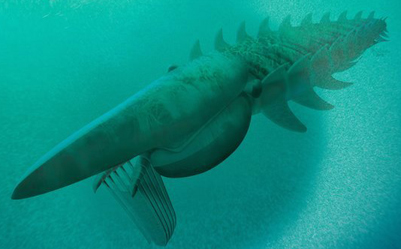
An Illustration of the Giant Aegirocassis benmoulae – Filter Feeder of the Early Ordovician

An early, filter-feeding giant.

An early, filter-feeding giant.

Picture credit: Marianne Collins, ArtofFact

Unlike Any Living Animals

The anomalocarids were like no living animal today.  The mouth was circular on the underside of the head and surrounded by frightening, jagged (in most cases) hard tooth plates, designed for crushing the exoskeletons of other arthropods.  The large, compound eyes gave these active hunters an excellent all-round field of vision and at the front of the head was a pair of spiny, grasping appendages used to grab prey.  Their elongated, segmented bodies had flaps on the side that were used for propulsion.  Until the discovery of A. benmoulae it had been believed that anomalocarids had only one set of flaps per body segment and that they had completely lost their walking legs.

The fossils, which have been preserved in three dimensions, an extremely rare preservation state for an arthropod, come from the Draa valley in south-east Morocco.  The sediments were formed at the bottom of a deep sea and the strata has provided palaeontologists with an insight into life in the Early Ordovician.  Very occasionally violent storms disturbed the seabed and buried large numbers of animals.  These events led to the formation of a very rich Lagerstätten, which has helped scientists to map the pace of evolution from the Cambrian explosion some sixty million years before these fossils formed to the end of the Ordovician some 443 million years ago.

The fossils from this part of Morocco form the Fezouata Biota, representing a marine habitat dating from around 485-480 million years ago.

To read about the discovery of a giant, predatory anomalocarid from the same region of Morocco: Giant Marine Predator of the Ordovician.

Aegirocassis benmoulae

The description of Aegirocassis benmoulae provides new evidence for Arthropoda evolution.  The exquisite preservation reveals that anomalocaridids had in fact, two separate sets of flaps per segment.  The upper flaps equate to the upper limb branch of modern Arthropods, while the lower set of flaps represent modified walking limbs that were adapted for swimming.  A reassessment of older anomalocarid fossilised remains also show two separate flaps per body segment.  The scientists have concluded that the anomalocaridids represent a stage of Arthropoda evolution before the fusion of the upper and lower appendages that form the double-branched limbs of extant arthropods.

Peter Van Roy, an associate research scientist (Yale University) and an authority on the Fezouata Biota stated:

“It was while cleaning the fossil that I noticed the second, dorsal set of flaps.  It is fair to say I was in shock at the discovery and its implications.  It once and for all resolves the debate on where anomalocaridids belong in the arthropod tree and clears up one of the most problematic aspects of their anatomy.”

The Adaptable Arthropoda

As if to reflect the adaptability of the Arthropoda bauplan, it seems that this Moroccan giant evolved to exploit the abundance of small marine organisms that flourished in the Early Ordovician.  The head appendages that formed the spiky, grasping claws of this anomalocarid became modified into delicate filter feeding apparatus.  It is likely that this creature cruised the oceans feeding on tiny plankton and other organisms floating on the currents just like modern baleen whales, manta rays and whale sharks.

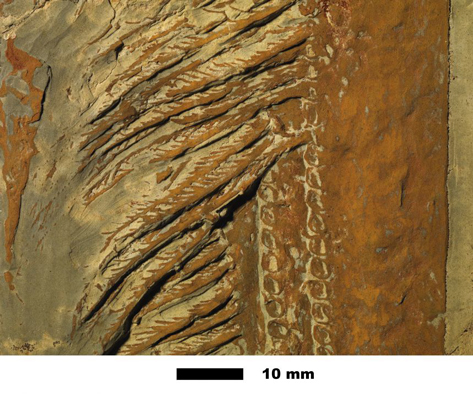
A Close up Showing the Delicate “Fronds” of the Filter Feeding Net

Delicate feeding apparatus.

Delicate feeding apparatus.

Picture credit: Peter Van Roy (Yale University)

The picture shows a close up of the prepared fossil material showing the delicate fronds which the creature used to sieve sea water for food (scale bar = 10 mm).

Filling an Ecological Role

Commenting on the implications for Early Ordovician ecosystems, co-author of the scientific study, Dr Allison Daley (Oxford University’s Department of Zoology) stated:

“These animals are filling an ecological role that hadn’t previously been filled by any other animal.  While filter feeding (filtering water to find food) is probably one of the oldest ways for animals to find food, previous filter feeders were smaller, and usually attached to the sea-floor [benthic].  We have found the oldest example of gigantism in a freely swimming filter feeder.”

Everything Dinosaur stocks a variety of invertebrate replicas, models of iconic fossil animals including important arthropods. To view the range available: CollectA Prehistoric World/Prehistoric Life.

5 03, 2015

The Very Complicated Human Family Tree Revealed by New Discoveries

By |2024-05-04T22:01:59+01:00March 5th, 2015|Categories: Dinosaur and Prehistoric Animal News Stories, Geology, Palaeontological articles|0 Comments

New Research and New Discoveries Shed Light on our Ancestry

If anyone has had an opportunity to trace their family tree, then they know that given the wealth of data around today, a few clicks of the keyboard can provide a great deal of information about your family.  However, when it comes to tracing the origins of the “human family”, the evolution of our own species, then things are much more tricky.  New research published today in the journal “Nature” is helping to unravel the complicated journey that hominins have taken, a journey that eventually saw the emergence of our species, Homo sapiens sometime around 220,000 years ago.

Homo habilis

Using a fossilised very human-like partial jawbone found at Ledi-Geraru, (Ethiopia), which has been dated to around 2.8 million years ago, in addition with already described material, an international team of scientists have reconstructed the skull of the early hominin Homo habilis (handy man) and looked at the ancestry of this species.  The research team included scientists from the University College London, in collaboration with the National Museums of Tanzania and the Max Planck Institute for Evolutionary Anthropology (Leipzig, Germany).

This new research helps to establish the human lineage and to determine what makes H. habilis so distinctive from the early Australopithecines such as the famous “Lucy” fossil –  A. afarensis which ironically, was discovered not too far from where the 2.8 million year old hominin lower jaw was found.  However, the fossils of “Lucy” are much older.  The partial skeleton of “Lucy” has been dated to around 3.2 million years ago.

The Famous “Lucy”

To read more about an exhibition that features the remarkable preserved remains of “Lucy”: Pictures from an Exhibition.

The first fossils of “handy man”, Homo habilis were described in 1964.  They consisted of a distorted lower jaw, hand bones and a highly fragmented braincase, all representing the bones of a single individual.  These fossils were catalogued as Olduvai hominin (OH7).   The rarity of early human bones, along with the very distorted remains associated with the earliest evidence of H. habilis made determining the unique characteristics and features of this species extremely difficult.

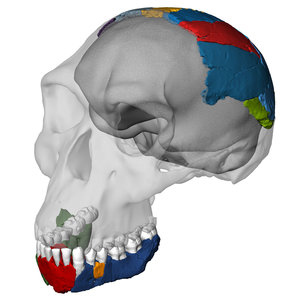
However, this research team utilised state-of-the-art computerised tomography and sophisticated computer modelling to unscramble the distorted remains and to piece together a reconstruction of the skull and jaws of Homo habilis.

The Human Family Tree

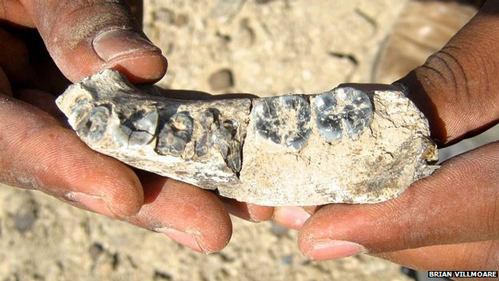
The question that has puzzled palaeoanthropologists since the scientific description of Homo habilis and the subsequent discovery of more Australopithecine fossil remains was, could the likes of “Lucy” have evolved into the very first human-like creatures? Professor Brian Villmoare (University of Nevada), believes that the discovery of this 2.8 million year old jaw bone, complete with five teeth helps to confirm this hypothesis.

The Fossilised Jaw Bone (2.8 million years old)

Something for the palaeoanthropologists to get their teeth into.

Something for the palaeoanthropologists to get their teeth into.

Picture credit: Brian Villmoare (University of Nevada)

The problem is this, the fossil record between the time period when “Lucy” and her kin were alive and the emergence of Homo erectus (with its relatively large brain and human-like body proportions), some two million years ago, is extremely sparse.  What has been found, is also very fragmentary, making tracing evolutionary links difficult.  The ancient human-like jawbone is highly significant.  The molar teeth are much smaller and less robust than those of other hominins known from the fossil record.  It is the size of the jaws and the teeth wherein that helps scientists to distinguish more human-like species from those which are more ape-like.

Commenting on the significance of this fossil find, scientists have stated that this new discovery pushes back the human evolutionary line by some 400,000 years or so.  The fossilised jawbone with its mix of primitive and more advanced traits makes it a candidate for a transitional species between the Australopithecines and the human family tree.

The Digital Reconstruction of the Skull and Jaws of Homo Habilis

The digitally mapped and reconstructed skull of H. habilis.

The digitally mapped and reconstructed skull of H. habilis.

Picture credit: University College London

“Handy Man”

The “handy man” fossil material having undergone its computer modelling reveals new information about the jaw shape.  The computer having reassembled the distorted jaw described in 1964, to provide a more accurate reflection of the living bone.  The research published in “Nature” suggests that Homo habilis has older evolutionary roots than previously thought.  This research supports the idea that many different types of Homo species existed in Africa between 2.1 and 1.6 million years ago.

Climate change, leading to a much drier, deforested habitat may have led to a spurt in evolutionary experimentation as species adapted to the new environment and exploited new niches in the changing ecosystem.  The modelled lower jaw reveals primitive traits such as seen in Australopithecine fossil material, but it also has more advanced features, distinguishing H. habilis from its contemporary Homo rudolfensis.

The potential transitional link between hominins and Australopithecines remained elusive until the University of Nevada discovery of the 2.8 million year old jawbone.  The fossil, known as LD 350-1 is an excellent candidate for the ancestor of Homo habilis and other early hominins.

 Commenting on the fossil jawbone discovery, Dr Villmoare stated:

“LD 350-1 reveals that many of the anatomical patterns we see in two million year old Homo were established much earlier in the evolution of the genus.  At 2.8 million years ago we see relatively evolved Homo traits in combination with other, much more primitive anatomical features, a result that is particularly interesting in light of the shape of the OH7 reconstruction.”

Go to Top