All about dinosaurs, fossils and prehistoric animals by Everything Dinosaur team members.

Fossil finds, new dinosaur discoveries, news and views from the world of palaeontology and other Earth sciences.

24 04, 2015

Woolly Mammoth Genome is Sequenced

By |2023-03-26T11:42:19+01:00April 24th, 2015|Categories: Dinosaur and Prehistoric Animal News Stories, Main Page|0 Comments

Scientists Sequence the Mammoth Genome, not Once but Twice

A new study of the genomes of two Woolly Mammoths has been published in the scientific journal “Current Biology”. An international team of researchers have been able to sequence the complete genome of two of these iconic, ancient elephants.

Mammuthus primigenius

The researchers are not involved in experiments to resurrect a Woolly Mammoth (Mammuthus primigenius), the focus on this research has been on how Mammoth populations declined and the stress the last few Mammoths may have been under before the final population became extinct.  Knowing the genetic diversity of isolated populations and searching out evidence of in-breeding as the numbers of a species dwindles, can provide scientists with valuable data to help support conservation efforts for severely endangered species around today.

Dr Love Dalén, from the Swedish Museum of Natural History (Stockholm), commented that the first ever publication of the full DNA sequence of the Woolly Mammoth could help those trying to bring this Ice Age creature back, a sort of “de-extinction of the Mammoth”.

The doctor stated:

“It would be a lot of fun [in principle] to see a living Mammoth, to see how it behaves and how it moves.”

Surrogate Asian Elephant Females

However, when one considers the suffering of any surrogate Asian elephant females that may be involved in any attempt to genetically engineer a Woolly Mammoth, he added that he would rather not see the research used for this purpose:

“It seems to me that trying this out might lead to suffering for female elephants and that would not be ethically justifiable.”

Bone and Occasionally Tusks are Used to Extract Genetic Material

Great care is taken to prevent contamination of any genetic material recovered.

Great care is taken to prevent contamination of any genetic material recovered.

Picture credit: Swedish Museum of Natural History/Current Biology

The genome is an organism’s complete set of DNA, the information needed to build and maintain an organism, be it a fungus, a tulip or indeed a Woolly Mammoth.  The genome includes all the genes involved with coding proteins and all the non-coding elements of the DNA or RNA.  In the case of the Woolly Mammoth, the genome is extremely long, consisting of several billion base pairs or nucleotides (A’s with T’s, C’s with G’s and so forth).

Woolly Mammoth Fossils

The two Mammoths studied came from both geographically and chronologically distant places.  The first of the Mammoth genomes sequenced represents a Woolly Mammoth from Wrangel Island dating from approximately 4,300 years ago, one of the very last of the Mammoths to have been alive.  The second Mammoth genome represents a specimen from north-eastern Siberia.  This one dates from the Late Pleistocene and is estimated to be about 44,800 years old.

Genetic Research

The genetic research shows that the last remaining Mammoths on the very remote and isolated Wrangel Island suffered from inbreeding.  The authors of the scientific paper cannot state categorically that the inbred population was the cause, or contributed to the extinction of this species, however, although inbreeding sometimes does not have a detrimental effect on a population it can do and therefore the results of this study make inbreeding a potentially significant factor in the demise of the Woolly Mammoth.

The 40,000 year time difference between the two samples enabled the molecular clock of the Woolly Mammoth to be re-calibrated.  A molecular clock for an organism is a very simple concept.  If it is assumed that the rate of genetic change (mutation) is relatively constant, then by comparing the genomes of two animals which died at different times will show the amount of difference in the genetic material over this time period.  The research team describe two “bottlenecks” that occurred in the history of the Woolly Mammoth, each bottleneck leading to a reduction in animal numbers and a reduction in the genetic diversity of the Woolly Mammoth.

Woolly Mammoth Genome

We note that Associate Professor Beth Shapiro (University of California, Santa Cruz) has commented on this particular piece of Mammoth research.  Beth is an evolutionary biologist and a pioneer in ancient DNA research, and one of Everything Dinosaur’s team members is currently reading her newly published book “How to Clone a Mammoth”.

How to Clone a Mammoth
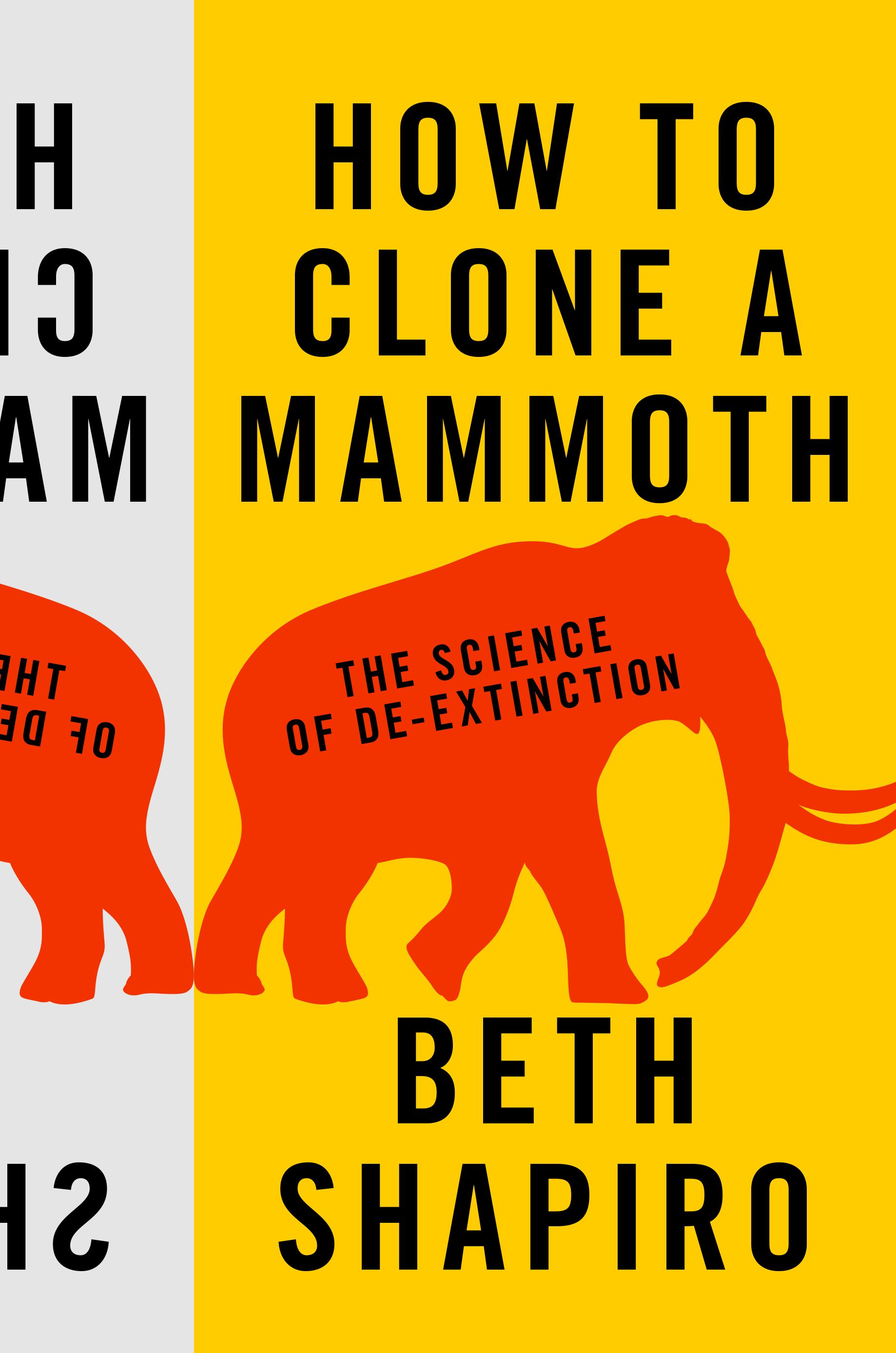
The science of de-extinction by Beth Shapiro.

The science of de-extinction by Beth Shapiro.

Picture credit: Princeton University Press

How to Clone a Mammoth

In this excellent book, Beth, discusses the joys of hunting for Mammoth remains in the Arctic tundra.  She recounts an amusing tale when Dr Dalén was asked to participate in a television documentary all about the hunt for Woolly Mammoth fossils.  It seems that sometimes, documentary makers have to have quite a bit of poetic licence when it comes to programme making, fossils, even those of three tonne elephants don’t always appear when they are supposed to.

You can read more about “How to Clone a Mammoth” and order the book here: Princeton Press.

Associate Professor Shapiro explained that there was a lot more work to be done before a Woolly Mammoth, or at least an elephant with Mammoth characteristics capable of surviving in the high Arctic could be born.  When explaining the significance of the genome sequencing she stated:

“We’ll probably find answers to questions that we’ve yet to think of.  Genomes are rich sources of information, and we have only tapped the surface of that information.”

This might be an important step, but scientists remain a long way from Woolly Mammoth cloning and for the moment Mammoth de-extinction will require a number of other important breakthroughs in genetic research before we can see these ancient elephants roaming the Arctic tundra.

Everything Dinosaur stocks a large range of museum quality prehistoric mammal replicas including Woolly Mammoth models: Prehistoric Mammal Models and Figures.

Last month, Everything Dinosaur reported on research carried out by Harvard Medical School that resulted in genetic material from a Woolly Mammoth being inserted into the skin cells from an Asian elephant which were being grown in a petri dish.

To read more about this research: Woolly Mammoth Genes Inserted into Asian Elephant Skin Cells.

23 04, 2015

Did Boy Stegosaurs have Bigger Plates than the Girls?

By |2023-03-26T11:38:23+01:00April 23rd, 2015|Categories: Dinosaur and Prehistoric Animal News Stories, Dinosaur Fans, Palaeontological articles|2 Comments

Evidence for Sexual Dimorphism in the Stegosaurs

Show most five-year-olds, a picture of a Stegosaurus and the chances are they will be able to name it.  The plated plant-eater with its small head, stout limbs and its tail spikes is one of the most recognisable of all the dinosaurs.  However, palaeontologists still know remarkably very little about this Late Jurassic herbivore.

A new paper, written by a researcher from Bristol University and published in the on-line academic journal PLoS One (public library of science), suggests that the shape and size of those famous back plates varied between the males and females.  If the researcher’s conclusions are correct, male stegosaurs had back plates that were more rounded and up to 45% bigger than the females.

Plate Size and Shape Provides a Clue

One of the Best Loved but Not that Well Understood Dinosaurs

Still lots to learn about this Ornithischian dinosaur.

Still lots to learn about this ornithischian dinosaur.

Picture credit: Everything Dinosaur

Annual Survey of Prehistoric Animals

In Everything Dinosaur’s annual survey of popular prehistoric animals, Stegosaurus is nearly always recorded in the top five.  It seems most popular with girls.

To view models and replicas of Stegosaurus and other prehistoric animals: PNSO Age of Dinosaurs Models and Figures.

In this new research, University of Bristol MSc student Evan Saitta proposes that skeletal evidence from a bonebed in central Montana referred to as quarry JRDI 5ES, suggests sexual dimorphism in a stegosaur species known as S. mjosi.  Evan spent a total of six summers working as part of a field team from Princeton University (New Jersey), excavating the Stegosaurus fossils as part of his undergraduate thesis.

To view the results of Everything Dinosaur’s most recent prehistoric animal survey: Top Ten Prehistoric Animals of 2014 (Part 1).

The top five in our most recent survey can be found here: Top Five Most Popular Prehistoric Animals of 2014.

Professor Michael Benton, Director of the Masters in Palaeobiology at Bristol University commented:

“Its very impressive when an undergraduate makes such a major scientific discovery.”

Sexual Dimorphism in Stegosaurs

This is certainly true, but let’s not get too carried away for the moment at least.  Take for example the species name Stegosaurus mjosi, there is some uncertainty whether the fossils represent a Stegosaurus.  About thirty years ago, palaeontologists discovered the fossilised remains of a large stegosaur during field work on the oldest part of the Morrison Formation exposed in Montana.  This dinosaur was formally named in 2001 as Hesperosaurus mjosi.  Although there have been many fossils found, including an almost complete skull, it is still debated whether these fossils represent a distinct stegosaur genus or a species of Stegosaurus.

The strata from which the fossils come from has been estimated to be around 155 million years old, it has been suggested that Hesperosaurus mjosi, or if you prefer the junior synonym Stegosaurus mjosi, is a basal member of the stegosaur family.  Its exact phylogenetic place in the stegosaur family tree remains controversial.

Late Jurassic Plated Dinosaurs

However, this issue does not detract from the research carried out into the shape and size of the plates.  The dig site known as JRDI 5ES, as it is one of the sites managed by the Judith River Dinosaur Institute, provides a fascinating and tantalising glimpse into the lives of these large, Late Jurassic plated dinosaurs.  The site contains the remains of at least five individuals preserved in mudstone.  Although two distinct types of plates can be observed, the rest of the bones indicate that this group of stegosaurs represent a single species.

The bones, although disarticulated for the most part, are found within the same stratigraphic horizon and they were probably not transported very far prior to burial.  This is indicated by the presence of many smaller bones such as unguals and skull elements as well as a lack of wear on the bones from transportation.

The absence of shed crocodilian and theropod teeth indicate that the corpses were not scavenged and so burial must have been quite rapid.  It could be inferred that this was a group of stegosaurs that died together, could this species of stegosaur have lived in social groups?  Does this suggest stegosaur co-existence?

Stegosaurus Plates

Suggested Silhouettes of a Male and Female

Females may have had reduced plates that were more spiky.

Females may have had reduced plates that were more spiky.

Picture credit: Evan Saitta (additional annotation by Everything Dinosaur)

Detailed Measurements and Quantitative Analysis

Detailed measurements and quantitative analysis indicated that there were two distinct types of plates present.  Of the fairly complete plates found within the bonebed, four could be described as large and wide, whilst five more could be classified as being taller and more spiky in appearance.  These are distinct characteristics and what is more, Mr Saitta’s analysis suggests that there are no plates present that show traits of both wide and spiky characters.

Evan commented:

“Simply looking at them by eye, you can identify two varieties.  But then you can also measure them and do a more quantitative analysis and demonstrate that, yes, there are two distinct varieties of plates, and that there don’t appear to be any clear-cut intermediates.”

Two Distinct Plate Morphologies have been Described

The widest plate morph compared to the tallest plate morph (scale = 10cm)

The widest plate morph compared to the tallest plate morph (scale = 10 cm)

Picture credit: PLoS One

Plate Shape and Sexual Dimorphism

The plate shapes suggest sexual dimorphism in stegosaurs, males and females evolved different shaped plates.  But which is which?  The Bristol based scientist cannot say for sure whether the males or the females had the broader, larger plates however he speculates that the boys had the bigger more rounded plates.

“We know from modern animals that males typically invest more into their ornaments than do the females.  In this case, the broader variety reaches sizes 45% larger in surface area than do the tall plates.  And I argue that these wide plates would create a great ‘billboard’ for male Stegosaurs if they were using them to attract a mate.”

The Evidence for Sexual Dimorphism in Stegosaurs

If the fossils represent a single species, then sexual dimorphism seems the “best fit” for an explanation.  Analysis of the fossil material indicates that the animals were fully grown and so the shape of the plates cannot be put down to dinosaurs at different stages of growth.  Plates from all positions on the body can be classified as being of the rounded or taller shape so the variation cannot be due to the location of the plate on the animal.

Other isolated stegosaur fossils found in Wyoming and ascribed to the same genus/species support the idea of sexual dimorphism in plate shape as these specimens too show only one plate shape.

Evan Saitta Cutting a Thin Section of Stegosaur Plate for Ontogenetic Analysis

Evan Saitta prepares a section of plate for cross-sectional study.

Evan Saitta prepares a section of plate for cross-sectional study.

Picture credit: Judith River Dinosaur Institute

Everything Dinosaur Comments

A spokesperson from Everything Dinosaur commented:

“This is a remarkable study.  We made one of our “palaeontological predictions” that 2015 would bring Stegosaurus into the limelight once more and this new research provides tantalising evidence of sexual dimorphism in ornithischian dinosaurs.  We can speculate that the plates evolved as defensive armour or possible temperature regulators and over countless generations of females selecting mates with the most impressive plates, two distinct sets of plates formed in the species.”

The spokesperson went onto add:

“At first glance the spiky, taller plates associated with the females may have offered better defence against predator attack.  The more rounded plates ascribed to the males may not have been as effective.  The male stegosaurs sacrificing some defensive capability in order to have a more impressive visual display to woo a female.  Although sexual dimorphism is not common in extant reptiles and birds, there are examples seen today.  For instance, the male peacock has sacrificed the ability to camouflage itself from predators by evolving a very obvious, huge tail feather display, all for the purpose of attracting a mate.”

Peacocks

Female peacocks may have influenced the tail length and plumage of the males by selecting males in the peacock population that had slightly longer tails and more flamboyant plumage. These traits are then passed onto offspring and this form of sexual selection by females leads to more ornate tail feathers in males as they have an advantage in terms of mating success.  It could be inferred that sexual selection by female stegosaurs led to the evolution of larger, broader plates on the backs of the males.  The bigger more rounded plates providing the males with an advantage when it comes to mating, despite being less helpful when it came to fending off an attack from a theropod.

Intriguing Conclusions

The conclusions from this study are likely to be debated for a very long time.  This new paper provides a new “angle” on the purposes of those enigmatic plates and further research into “Sophie” the Stegosaurus stenops specimen at the Natural History Museum in London may help to “round off” the debate.

To read more about “Sophie” the Stegosaurus specimen exhibited at the Natural History Museum: All about “Sophie”.

To see the list of Everything Dinosaur’s “palaeontology predictions” for 2015: Palaeontology and Fossil Predictions for 2015.

17 04, 2015

Zombie Worms and Plesiosaurs Some Amazing New Research

By |2024-05-05T10:03:09+01:00April 17th, 2015|Categories: Dinosaur and Prehistoric Animal News Stories, Dinosaur Fans, Main Page|0 Comments

Bone-Eating Worms Consumed Marine Reptile Carcases

A type of bone-eating marine worm that had been thought to have evolved to exploit the food potential of cetacean carcases lying on the seabed also fed on the remains of giant marine reptiles, according to new research published in the academic journal “Biology Letters”.

Osedax Genus

The worm, the genus is known as Osedax, was only discovered in 2002 (formally described in 2004), has been found at depths of more than 4,000 metres.  It feeds on the bones of vertebrates that lie on the seabed.  As the bizarre worms were discovered in association with the carcases of whales, it had been suggested that these scavengers had co-evolved with whales and dolphins in the Cenozoic.  However, analysis of microscopic bore holes found in the limb bones of a plesiosaur and the remains of an ancient turtle, indicate that Osedax worms existed much earlier than whales.  Their origins have been traced back at least 100 million years.

Osedax Worms Helped Breakdown the Corpses of Marine Reptiles

Fossil traces of Osedax worms found in marine reptile bones.

Fossil traces of Osedax worms found in marine reptile bones.

Picture credit: Plymouth University/D. Nicholas Higgs

Zombie Worms

A number of species have now been identified and this genus seems to be widely distributed in the world’s seas and oceans.  The great geographic range of the worms had been a bit of a mystery for marine biologists, especially for those who believed that these worms, some females of which can grow up to fifty millimetres in length, solely fed on the bones of cetaceans, as corpses of whales and dolphins are extremely rare when the size of the marine environment is considered.  This new study suggests that the zombie bone-eating worms might be more generalist feeders, happy to bore into a variety of different types of carcase.

The Osedax genus has been classified as a member of the Siboglinidae (sigh-bog-lin-ee-day) family of worms.  The adults lack a mouth and any form of digestive system.  They feed by boring into bones by secreting acid through their root-like tendrils.  The worms rely on a symbiotic relationship with bacteria inside their bodies.  The bacteria converts the bone collagen and lipids that are absorbed into food for the host worm.

Studying Plesiosaur Bones

The research team, including Dr Nicholas Higgs from the Marine Institute (Plymouth University), examined the fossilised bones of a plesiosaur as well as the remains of a prehistoric turtle which were part of the marine reptile fossil collection at the University of Cambridge Museum.  Detailed CAT scans were taken, using the CAT scanner at the Natural History Museum in London.

These scans and the subsequent computer models created from them, revealed that two bore holes in the bones from a plesiosaurs’s flipper and four bore holes from the turtle bones, were remarkably similar to the bore holes made by Osedax in the bones of modern cetaceans.  These trace fossils suggest that before the whales evolved, these types of worm were already present in the marine ecosystem scavenging on the bones of dead marine reptiles.

The Bones of Plesiosaurs could have been Colonised by Osedax Worms

plesiosaur vertebrae

Fossil specimen found by Brandon Lennon.

Picture credit: Brandon Lennon

Bone-eating Worms in the Mesozoic

Commenting on the research, D. Higgs stated:

“Our discovery shows that these bone-eating worms did not co-evolve with whales, but that they also devoured the skeletons of large marine reptiles that dominated oceans in the age of the dinosaurs.”

Dr. Nicholas and co-author Silvia Danise (Plymouth University/University of Georgia), reported that the trace fossils suggest that marine reptile carcases, before whales, played a crucial role in the evolution and dispersal of Osedax and this study supports the idea that these worms are generalised scavengers of vertebrate remains.  The generalist ability to colonise different vertebrate corpses, such as fish, marine birds and reptiles would seem to be an ancestral trait.  The trace fossils suggest that the Siboglinidae evolved much earlier than previously suggested by phylogenetic estimates.

CAT Scans Showed Signature Bore Holes Made by Osedax spp.

Computer models from CAT scan data revealed the shape of the bore holes.

Computer models from CAT scan data revealed the shape of the bore holes.

Picture credit: S. Danise/N. Higgs/Biology Letters

Examining Fossil Bore Holes

The scientists examined the bore holes and found that they resembled those caused by Osedax in the bones of extant whales.  Whilst scientists cannot be certain how many more marine reptile fossils might have been preserved without the likes of Osedax feeding on the bones and destroying them before they could be buried and potentially fossilised, it does seem likely that our fossil record for marine vertebrates is poorer as a result of at least 100 millions of feeding.

Back in 2014, Everything Dinosaur team members reported on the microscopic analysis of the bones of an Ichthyosaur which also showed signs of having been consumed by the action of a number of scavengers, including Osedax worms.

To read more about this research: What happens when an Ichthyosaur Dies?

The University of Plymouth team conclude that although the vast majority of marine reptiles died out at the end of the Cretaceous (Mosasaurs, Plesiosaurs) and the Ichthyosaurs died out a few million  years earlier, these worms survived on the carcases of turtles and other creatures in the twenty million years or so before the first whales evolved.

13 04, 2015

The Remarkable Achievosaurs – Reinforcing Positive Learning Behaviours

By |2024-05-05T10:24:02+01:00April 13th, 2015|Categories: Dinosaur and Prehistoric Animal News Stories, Dinosaur Fans, Educational Activities, Main Page, Teaching|0 Comments

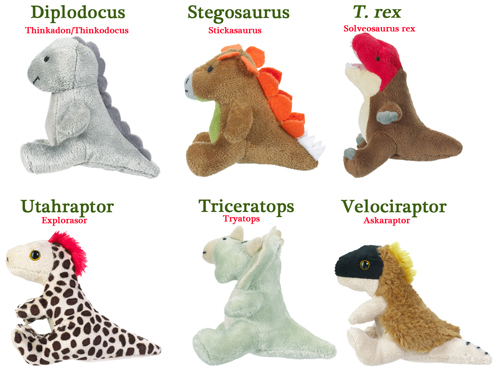
Soft Toy Dinosaurs Helping Young Children to Learn Life Skills (Achievosaurs)

Using a range of soft toy dinosaurs to help encourage young children to learn life skills and to reinforce positive values in schools is something Everything Dinosaur team members are very familiar with.  Now that the three inch plus dinosaur range known as the Itsy Bitsies are back in production, our team members set out to examine how one teaching concept, the “Achievosaurs,” came into being.

Achievosaurs Dinosaur Soft Toys

We were contacted by retired Bristol school teacher Lori Mitchell who explained to us how her idea for using dinosaur soft toys took shape.

Ms Mitchell explained:

“The idea for the Achievosaurs came after a South Gloucestershire Early Years course “Providing Challenge, Improving Outcomes” in October 2010.  During the day, we were asked to consider how we encourage our children to reflect on their learning, rather than just talk about their activities, and how we can help them develop the skills needed to become life-long learners.  We discussed the learning-focused qualities we wanted to encourage in our children and a colleague shared the “Curious Cat” she used with her class.  One of the Early Years advisors then said something like “you know, dinosaurs would be another idea..you could have a Thinkasaurus”…and that was it…I went home after the course and devised the Achievosaurs!”

The Achievosaurs (Dinosaur Soft Toys) in 2015

Helping to reinforce life-long learning skills.

Helping to reinforce life-long learning skills.

Picture credit: Everything Dinosaur

To view the dinosaur soft toys in stock at Everything Dinosaur: Dinosaur Soft Toys.

Soft Toys Help with Learning

With the rigours of a new curriculum being rolled out across England, there is a great deal of emphasis placed upon preparing pupils for the opportunities, responsibilities and experiences of later life.  For example, the idea of introducing scientific working and the scientific method underpins a lot of Everything Dinosaur’s teaching activities in schools.  It is essential for those children at the Early Years Foundation Stage to acquire appropriate social skills as well as developing positive behaviours to help them make good progress.

Naming the Achievosaurs

We asked Lori, how the names of the first Achievosaurs came about and she explained that she based her prehistoric animal names on the specific learning qualities that she wanted to encourage in her Reception class (FS2).  For the last seven years of her working career, before taking early retirement, Lori was a teacher at Cadbury Heath Primary School, Warmley, near Bristol, South Gloucestershire (south-west England).  Using her experience, Lori devised a series of dinosaurs (plus one flying reptile), which she could use as props to help reinforce desired behaviours.

The names of Lori’s Achievosaurs were:

  • Exploring ideas and resources: Explorasor
  • Sticking to a task: Stickasaurus
  • Sharing ideas and resources: Shareadactyl
  • Trying their best: Tryatops
  • Asking questions: Askaraptor
  • Working to solve problems: Solveosaurus rex
  • Thinking carefully about tasks: Thinkadon

Over the years we have come across a number of variants, with something like 1,200 different dinosaur genera described to date and a new one being named on average every 20-30 days or so, educationalists certainly have plenty of scope.

When asked about how she came up with her Achievosaur names, Lori said:

“When I first drafted the idea, all the names ended in “asaurus,” but when I found the wonderful collection of Itsy Bitsy dinosaurs at Everything Dinosaur, my 20 year-old son got involved (dinosaurs really are any age child friendly), and selected the dinosaurs and adapted their name to “fit,” so, for example, we took Velociraptor to make “Askaraptor”.

Sharing the Concept with Colleagues

Lori was invited to share her idea with a team of South Gloucestershire assessment co-ordinators and this simple, but very effective teaching aid has been taken up by a number of primary schools and other educational establishments.

Team members at Everything Dinosaur dedicate a lot of time to supporting teaching teams and many EYFS (Early Years Foundation Stage) and Key Stage 1 teachers incorporate a dinosaur themed topic into their scheme of work.

A spokesperson from the Cheshire based company stated that a topic based on prehistoric animals dove-tailed into desired learning outcomes across the curriculum, whether it was using the size and scale of dinosaurs to help build confidence with numbers or having a class imagine what it would be like to have a pet Triceratops in order to lay the foundations for some creative writing.

Dinosaurs as a Term Topic Can Encourage and Motivate Young Learners

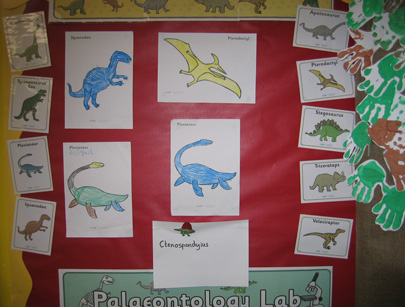
Pupils learn about the shapes and sizes of different prehistoric animals.

Pupils learn about the shapes and sizes of different prehistoric animals.

Picture credit: Everything Dinosaur

Everything Dinosaur

For further information on Everything Dinosaur’s extensive product range: Contact Everything Dinosaur.

When asked why the likes of Tyrannosaurus rex and Stegosaurus are so popular with young learners Lori suggested:

“One reason I think is their wonderful names.  They sound fascinating, and what child doesn’t like to impress an adult by knowing long words and being able to pronounce them?  Another is that, although huge and terrifying when they lived, dinosaurs are not around anymore so they can’t get us!”

Dinosaurs enduring popularity with children (quite a few adults as well), is an area that has been explored frequently.  Team member, “Dinosaur Mike”, part of the company’s teaching team was interviewed by the BBC on this subject and he hypothesised:

“Dinosaurs are never really out of the media, so children are exposed to prehistoric animals such as Diplodocus and Tyrannosaurus rex from an early age.  When talking to Mums and Dads we know how proud they are when their son or daughter explains all about their favourite dinosaur.  With so many facts and figures associated with these prehistoric reptiles, they do help sow the seeds for an appreciation of life- long learning.”

To learn more about the Everything Dinosaur team: About Everything Dinosaur.

A Big Success

Her Reception class loved the idea of Achievosaurs right from the start, but we wanted to know which was Lori’s own favourite.  Lori declared that she was very fond of them all as the encouragement these soft toys had given to her charges, getting them to think about learning skills and to develop positive behaviours, was of real benefit.

“It has been fantastic to hear the children identifying what they need to do in order to move their learning on, for example, suggesting they need to be a “Stickasaurus,” which concentrates, in order to learn their letters or a “Solveosaurus rex,” which makes links between ideas, when faced with a problem.  However, if I had to pick one favourite Achievosaur, I think it would be Tryatops”.

Lori explained:

“There is sometimes a perception that learning is just for “clever” children, and I think Tryatops helps to teach children that no matter what the activity or skill level, we can ALL try our best, never give up and in consequence, achieve.”

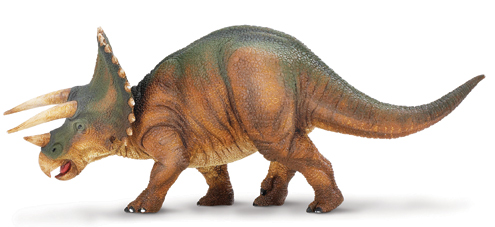
Tryatops Based on Triceratops

Tryatops – Based on the Horned Dinosaur Triceratops

An excellent replica of a Triceratops.

An excellent replica of a Triceratops.

Picture credit: Safari Ltd/Everything Dinosaur

Not being discouraged, even when experimental results don’t quite turn out as expected, is an important aspect of scientific working.  Lessons learned early in life will help pupils face future challenges with more confidence.

In conclusion, we asked Lori if she could design her very own dinosaur what would it be like?

“The Achievosaurs were my first design attempt, with specific characteristics and names, to tie in with the Early Years Characteristics of Effective Learning.  I had a lot of fun inventing and writing about them and I couldn’t be more delighted that other Early Years professionals and schools have found the concept useful.  However, I’ve recently been thinking about the PSE side of things [personal, social and emotional development]: could an Achievosaur help children to take account of one another’s ideas (an Early Learning Goal) or be thoughtful/helpful?  What about a Respectadocus?  Now that the toys are back in production, anything is possible! “

At Everything Dinosaur we have had the privilege of working with a number of dedicated teaching professionals who have adopted and adapted dinosaur soft toys to assist them with their own learning objectives.  As a result, we have come across a large number of different Achievosaurs all aimed at reinforcing appropriate behaviours and encouraging the development of life-long learning.

Thank you Lori for being a wonderful “Shareosaurus” and sharing your story with us.

10 04, 2015

Calling Calamosaurus! An Amazing Fossil Discovery

By |2024-05-05T10:22:24+01:00April 10th, 2015|Categories: Dinosaur and Prehistoric Animal News Stories, Dinosaur Fans, Main Page|0 Comments

Isle of Wight Fossil Find – British Compsognathidae?

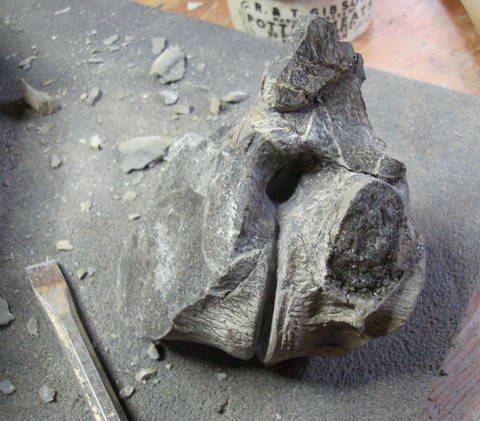
It may not look like much, it is a dinosaur fossil but highly eroded and with a great deal of the original bone material missing but this could just be one of the most important fossil finds on the Isle of Wight for a decade.  Amateur fossil collector Dave Badman found the 4 cm long dinosaur bone at Chilton Chine.  It has been identified as a neck bone (cervical vertebrae) from a small meat-eating dinosaur, that roamed the area that was to become the Isle of Wight around 130 million years ago.  This is the first fossil find associated with this species for nearly 140 years.

Calling Calamosaurus

Calling Calamosaurus – Significant Fossil Find

A rare fossil find indeed - the first of its kind for nearly 140 years.

A rare fossil find indeed – the first of its kind for nearly 140 years.

Picture vredit: Isle of Wight Council

 The photograph above shows the fossil being held in David’s hand, this provides a “handy” scale, like we stated earlier, it may not look like much but this fossil discovery could prove to be very significant.

What’s All the Fuss?

Whizz back in time to 1882 or thereabouts, two articulated cervical vertebrae were purchased by the then British Museum (now the Natural History Museum, London).  These bones were part of a collection being sold by the estate of the Reverend William Fox (1813-1881) who had been an avid collector of vertebrate fossils on the Isle of Wight, whilst the curate of Brighstone Church.  These two bones were stored with fossils of turtles but the “Keeper of the Fossils” at the British Museum, Richard Lydekker, noticed how similar these bones were to that of a dinosaur – Coelurus, a small theropod.

Lydekker erected the genus Calamospondylus in 1889, however, this had to be changed two years later to Calamosaurus as the name Calamospondylus had already been used back in 1866 to name another theropod dinosaur from the Isle of Wight.  The way these neck bones fitted together suggested that the dinosaur had a curved neck, their size indicated that the dinosaur was relatively small, no more than three metres in length.  It was postulated that this was further evidence that compsognathids roamed what was to become the British Isles.

The Compsognathidae

Dinosaurs of the Family Compsognathidae are small, some of the smallest dinosaurs known.  They were fast-running, long-necked hunters with light bodies, small heads, graceful legs and lengthy tails.

An Illustration of a Typical Compsognathid Dinosaur

Small, agile dinosaur.

Small, agile dinosaur.

No other fossils related to this genus had been found since, that was until sharp-eyed Dave spotted one on a beach at Chilton Chine.

Mr Badman’s discovery helps to reaffirm the belief that the original two fossils were from the Wealden Group Beds exposed at the coast just a few miles from the village of Brighstone, where the Reverend Fox lived.

Everything Dinosaur Comments

A spokesperson from Everything Dinosaur commented:

“The Reverend Fox was an amateur fossil collector so it is very appropriate for another amateur fossil collector to find the next material to be associated with this elusive dinosaur.  Although, very little is known about Calamosaurus (C. foxii), there were probably a number of small theropods, scurrying around the undergrowth in this part of the world during the Early Cretaceous.  Perhaps more fossil material will come to light, hopefully we won’t have to wait another 140 years or so before it does.”

The fossil has been donated to the Dinosaur Isle Museum.

Councillor Shirley Smart, (Executive Member for Economy and Tourism) on the island stated:

 “This find has once again shown the Isle of Wight is one of the world’s best sites for dinosaur fossil discoveries and there is a real community spirit.  I want to thank Dave for bringing the specimen to the museum and allowing it to go on display so that it can be enjoyed by visitors for years to come.”

9 04, 2015

Dastardly Daspletosaurus a Cannibal? A Fascinating Question

By |2024-05-05T10:20:52+01:00April 9th, 2015|Categories: Dinosaur and Prehistoric Animal News Stories, Dinosaur Fans|0 Comments

Tyrannosaurid Bite Marks on the Remains of Daspletosaurus

Palaeontologists have been aware for some time of a growing body of evidence to suggest that a number of different types of theropod dinosaur engaged in intraspecific combat, that is, one member of a species fights with another member of the same species.  Pathology preserved on skull and jaw bones has been found in a number of different types of meat-eating dinosaur to suggest that activities such as facial biting could have been common place.

Face Biting

These face bites could have been part of some form of ritual combat, perhaps over pack status or perhaps the bites resulted due to competition over mates (or they may have even been inflicted during mating).  A research paper published in the on line academic journal PeerJ, provides further evidence of facial injury, this time the evidence suggests that some of the wounds were premortem, they occurred whilst this dinosaur lived, the other wounds indicate that a large meat-eating dinosaur scavenged the carcase.

Daspletosaurus Cannibalism

The fossils of a Daspletosaurus recovered from the Dinosaur Provincial Park (Alberta, Canada) reveal a rather gruesome story.  This dinosaur suffered from a serious of facial bites whilst it was alive, when it was dead its body was fed upon by another dinosaur. Could this be evidence of cannibalism in the Dinosauria?

Daspletosaurus was a large tyrannosaurid, whose fossils have been found in Alberta and the western United States.  It lived several million years before its more famous relative Tyrannosaurus rex.  Established as a distinct genus in 1970, this stocky, robust carnivore, may have reached lengths in excess of nine metres and weighed as much as an Indian elephant.

A Model of the Fearsome Predator – Daspletosaurus

The fearsome tyrannosaurid Daspletosaurus.

The fearsome tyrannosaurid Daspletosaurus.

Picture credit: Everything Dinosaur

Daspletosaurus

A number of specimens of Daspletosaurus have been associated with facial injuries.  This particular specimen that consists of a mostly complete but disarticulated skull, vertebrae, ribs including gastralia (belly ribs) and some wonderfully well-preserved tail bones, was discovered in 1994.  The corpse seems to have been transported in a slow moving river system (low energy environment).  Other parts of the skeleton may have originally been present but these probably were eroded away prior to excavation.  A partial femur was also recovered but this has been crushed and distorted.

The authors of the scientific paper Dr David Hone (School of Biological and Chemical Sciences, University of London) and Darren Tanke, an expert in vertebrate fossil preparation at the Royal Tyrrell Museum (Drumheller, Alberta, Canada), consider the thigh bone to have been crushed not long after the animal died, i.e. the damage occurred in the Late Cretaceous.  They conclude this as much more delicate and thinner skull bones show no damage at all.

An Illustration of Face Biting Amongst Two Daspletosaurs

The skull and mandible of the dinosaur shows facial injuries.

The skull and mandible of the dinosaur shows facial injuries.

Picture credit: Luis Rey

Note the illustrator, the very talented Luis Rey, has chosen to represent Daspletosaurus as a feathered dinosaur.

Analysing the Fossil Material

Based on an analysis of other Daspletosaurus material, the researchers estimate that this dinosaur was not fully grown when it died.  It was probably around ten years of age, measured 5.8 metres and weighed more than half a tonne.  This dinosaur suffered a number of injuries, one dorsal rib shows evidence of a fracture but this was well healed by the time the animal died.  It is the skull and the jaws that show most signs of pathology.

Not all Injuries from Bites

Not all the injuries to the skull came from bites, but there is plenty of evidence preserved on the bones to indicate that this dinosaur lived a tough life and that it had its face bitten on numerous occasions.  Many of the bite marks do match the tell-tale shape of puncture wounds from Tyrannosaur teeth, including one particularly savage bite that left a considerable tooth-shaped hole in the back of the skull.

Pathology on the Skull and Upper Jaw Bones of the Daspletosaurus Specimen

Evidence of premortem injury.

Evidence of premortem injury (left lateral view).

Picture credit: PeerJ

Defining the Damage

The picture above shows a digital image of the premaxilla, maxilla and other skull bones with the arrows indicating different injuries that were sustained.

A. = A bite to the tip of the snout leaving a sub-circular depression with a diameter of 13 mm and a depth of 6 mm.

B. = A lesion in the bone that resembles a tyrannosaurid bite and drag mark.  Lesion is 22 mm long and at its widest 8 mm, maximum depth 1.5 mm.

C. = Comma shaped potential bite and drag mark on the maxilla which is 22.5 mm long and about 6.5 mm wide at its maximum width.

E. = A puncture wound on the left nasal bone approximately 9 mm radius and 2 mm deep.  Most likely caused by a bite.

All these lesions show signs of healing so they are regarded as premortem.

2. = The base of the  left maxilla is broken and these breaks can be aligned with the left lacrimal bone.  This damage could have been caused either when this animal was alive or as a result of feeding postmortem, or perhaps by trampling or transport by water to the final resting place of the carcase.  This damage is treated conservatively by the authors and regarded as indeterminate, not being classed either as premortem or postmortem damage.

Surangular Bone Damage

The right surangular bone (rear most portion of the jaw that abuts the dentary and sits above the angular bone), also shows signs of premortem damage.  There are a number of lesions and patches of osteomyeltic bone (bone which shows signs of infection).  This pathology also supports the hypothesis that the Daspletosaurus suffered a series of facial injuries when the animal was alive.

A Close up of the Right Surangular Bone Showing Evidence of Lesion

Scale bar = 20 mm

Scale bar = 20 mm

Picture credit: PeerJ

The red arrow in the picture shows the roughened bone area that indicates a lesion.  Below this lesion a lighter (light grey) area can be seen, this is almost circular in shape.  This is damage to the fossil that was probably caused by the excavation process.

Postmortem Damage

The scientists also point out evidence of postmortem damage to the specimen.  This damage is defined based on the lack of any indications of healing (swelling, reactive bone).  There are a series of tooth marks with one set of bite-marks found on the medial side of the right dentary (inside of the bone facing the tongue).  A number of other elements have been noted that show possible signs of biting which indicate feeding on the carcase.

The spaces between the tooth marks suggest that a large theropod made these marks, probably scavenging on the carcase prior to its burial.

Evidence of Postmortem Damage – Tyrannosaur Feeding

Evidence of scavenging on the carcase.

Evidence of scavenging on the carcase.

Picture credit: Peer J

The picture above shows the rear part of the dentary, the medial side of the lower jaw bone (side facing the inside of the mouth).   The white arrow indicates a near vertical break in the bone, whilst the black arrows highlight damage to the surface of the bone caused by teeth from a large dinosaur.

Other Predators Present

Other predators were present in the Dinosaur Provincial Park ecosystem, indeed alongside the Daspletosaurus remains, the scientists uncovered a couple of bones (tibia and phalanx) from a small theropod, along with teeth from crocodilians and a tooth from champsosaur (long-snouted, reptile that probably ate fish).

The tooth marks are quite widely spaced up to two centimetres apart.  This spacing rules out a crocodile scavenging on the carcase as the crocodilian fauna associated with the Dinosaur Park Formation are all relatively small.  The research team conclude that only a large tyrannosaur could have left such trace fossils in the specimen.

Is this Evidence of Cannibalism?

Commenting on the animal’s injuries, Dr David Hone stated:

“This animal clearly had a tough life, suffering numerous injuries across the head including some that must have been quite nasty.  The most likely candidate to have done this is another member of the same species, suggesting some serious fights between these animals during their lives.”

But does the evidence of feeding on the carcase indicate a case of cannibalism?  The authors are careful to state that this probably is not a case of one large tyrannosaur hunting and killing a smaller tyrannosaur – a predator/prey relationship.  Instead, the term “late stage carcase consumption” is used.  It is unusual for feeding evidence to be found on the skull and jaws, these areas would not have had a lot of flesh on them.  It can be speculated that much of the carcase had already been buried when a carnivore found the skull and jaw bones and fed upon them.

This unfortunate sub-adult Daspletosaurus could have been scavenged by a member of its own species.  However, another potential scavenger also co-existed with the Daspletosaurs.

Gorgosaurus on the Scene

A second type of tyrannosaur, Gorgosaurus, lived at the same as Daspletosaurus and as this predator reached lengths of around nine metres or so, it would have been more than capable of chomping the bones of the fallen Daspletosaurus.

It is not possible to determine whether a passing Gorgosaurus fed on the corpse or whether this is a case of Daspletosaurus cannibalism.

There have been a number of papers published on the face biting phenomenon in theropod dinosaurs.  Everything Dinosaur team members recently reviewed data published on Monolophosaurus from the Middle Jurassic of China, a Megalosaur, which also shows evidence of intraspecific combat (face biting).

Facial Biting

To read the article on evidence of facial biting found on the fossilised remains of a juvenile Tyrannosaurus rex: Evidence of Facial Biting in tyrannosaurids.

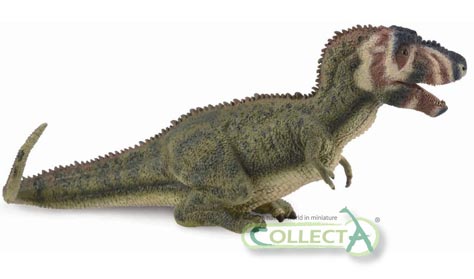
CollectA have made a super Daspletosaurus dinosaur model, no evidence of face biting, but none the less a fantastic dinosaur replica.

To see the CollectA range of not to scale prehistoric animal models: CollectA Prehistoric Life/Prehistoric World Figures.

8 04, 2015

The Return of Brontosaurus? That’s a Great Question!

By |2024-05-05T10:04:47+01:00April 8th, 2015|Categories: Dinosaur and Prehistoric Animal News Stories, Dinosaur Fans, Main Page|0 Comments

Is Brontosaurus Back?

There have been lots of comments about the paper published yesterday in the academic, on-line, open access portal PeerJ as the resurrection of the genus Brontosaurus has been proposed.  Could “thunder lizard” be back?  We thought it would be a good idea to summarise the research and provide a brief explanation as to what the paper actually means.  So, with apologies to the three authors Dr Emanuel Tschopp​, Professor Octávio Mateus, (both associated with the Museu da Lourinhã, Portugal), Dr Roger Benson (Oxford University) and to their academic editor Dr Andrew Farke (Raymond M. Alf, Museum of Palaeontology, Claremont, California, USA) here are our thoughts on the research.

Brontosaurus Resurrected

Brontosaurus resurrected.

The Problem with Brontosaurus

Let’s start at the very beginning, why was the dinosaur name Brontosaurus dropped in the first place?

It was the famous American palaeontologist O. C. Marsh who described and named the genus Apatosaurus back in 1877.  He placed two species in this genus Apatosaurus ajax and Apatosaurus grandis.  Both these two dinosaurs come from the famous Morrison Formation (more about this later), A. ajax from Gunnison County, Colorado and A. grandis from Albany County, Como Bluff (Wyoming).

Two years later, more bones of a large, long-necked, plant-eating dinosaur were found by an expedition led by Marsh, close to the Albany County quarry where the fossils of Apatosaurus grandis had come from.  Marsh named this new dinosaur Brontosaurus (Brontosaurus excelsus), the name translates as “Noble Thunder Lizard”.

So, we have Apatosaurus and Brontosaurus….

Apatosaurus and Brontosaurus….

But, during the late 1870s and the 1880s Marsh was in competition to find dinosaur bones in the western United States with his great rival Edward Drinker Cope.  The personal feud between these two men has become known as the “Bone Wars”.  A consequence of their rivalry was a need to outdo each other when it came to publishing details of new dinosaur discoveries.  As a result, a number of new species of long-necked dinosaurs from the Morrison Formation came to be erected, some within the Apatosaurus genus, some within Brontosaurus, plus several others as well.  In essence, a number of questionable genera were established.

By the beginning of the 20th century both Marsh and Cope had passed away and a new generation of palaeontologists were continuing to explore the strata of the Morrison Formation in the quest for dinosaur fossils.  One such scientist was Elmer Samuel Riggs. Riggs discovered an Apatosaurus specimen in 1900 near the town of Fruita, Mesa County, (Colorado).  He went on to review and examine the then known, Apatosaurus and Brontosaurus material and concluded that B. excelsus was so similar to ascribed Apatosaurus fossil material that it should be considered part of the Apatosaurus genus.

Thus in 1903, in a paper entitled “Structure and relationships of opisthocoelian dinosaurs, part I” (part II dealt with his newly discovered Brachiosaurus), Riggs successfully argued that the genus Brontosaurus should be dropped in favour of the genus Apatosaurus.  Brontosaurus was no more, instead it was regarded as a junior synonym of Apatosaurus.  Time to erase Brontosaurus out of the literature….

Synonyms and More Synonyms

What on Earth does the term “Brontosaurus is now a junior synonym of Apatosaurus” mean?

Taxonomy is the science of classifying organisms.  In scientific classification there are certain rules.  Most of these rules were laid out by the great Swedish botanist Carolus Linnaeus in his publication classifying flowers in 1735.  It was Linnaeus who first set out the ground rules for defining genera and species as part of a hierarchy or ranking system that is termed Linnaean classification.

A synonym is simply another name used for an object.  One of the rules in taxonomy, is that the earlier a name is used the more senior it is to other names used for the same organism.  Apatosaurus was named in 1877, Brontosaurus in 1879, therefore when Riggs proposed that Brontosaurus was so similar to known Apatosaurus fossil material, the Apatosaurus name, which had been used first, took precedence and Brontosaurus became a junior synonym of Apatosaurus.

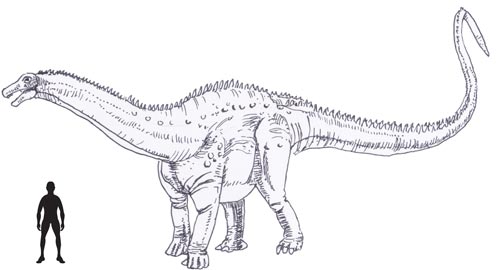
An Illustration of Brontosaurus

Drawing of Brontosaurus.

A scale drawing of Brontosaurus.

Picture credit: Everything Dinosaur

Revising the Diplodocids

Over the last hundred years or so, there have been several reassessments of the dinosaurs included in the Diplodocidae Family.  We are not aware of anyone disputing that both Brontosaurus and Apatosaurus should be included in this family of long-necked dinosaurs.  Indeed, the fossil specimens referred to as Brontosaurus and Apatosaurus are placed in the same sub-group of diplodocids, the Apatosaurinae (as opposed to the other sub-group in this family which includes the likes of Barosaurus and Diplodocus).

This new research has gone further, it undertook a comprehensive revision of the diplodocids not at a genus level, or indeed by looking at the combined characteristics of several specimens that represent a single species, but by looking at individual specimens – lots and lots and lots of individual specimens.  The researchers conducted the most complete review of the fossil material that has ever been done.  It has taken five years and we think it is the largest scale study of this kind ever carried out.

So Why do this Research?

The scientists did not set out to establish the dinosaur name Brontosaurus once again.  They are not (as far as we know), part of some secret, shadowy organisation devoted to supporting all those lazy movie makers, and toy manufacturers who churned out films, models, dinosaur toys and other merchandise associated with the Brontosaurus moniker.

The resurrection of Brontosaurus as a valid genus is just one consequence of an amazingly detailed analysis which set out to review how the Diplodocus Family of dinosaurs was classified from a taxonomic perspective.  Something like fifty-five percent of all the diplodocid species known were named and described in the 19th or early part of the 20th century, often from fragmentary specimens, from dig sites that had been poorly mapped.

Approximately, three-quarters of all the diplodocid genera named to date come from the Morrison Formation of the western United States (see, we said we would mention the Morrison again), and no one had yet gone through all the available fossil material with a fine-toothed comb at the individual specimen level and tried to work out how closely related each type of diplodocid was to the other Diplodocidae.

How do you Decide a Species?

When it comes to extinct animals it’s a lot more complicated.  There is not a lot of Diplodocidae DNA knocking about for a start.  Palaeontologists look at the bones that they have, try to find bones from the same part of the body, cranial material (skull) or vertebrae for example, can be particularly helpful when assessing the long-necked dinosaurs, these are then compared to find similarities and differences.   It helps if mature, fully grown individuals can be compared, for example, we think that the first Apatosaurus species named A. ajax back in 1877 might be made up of the bones from several individual dinosaurs and some of them probably represent sub-adults.

This form of analysis relies on the concept that all the Diplodocidae shared a common ancestor and evolutionary relationships can be established by looking at all the anatomical features and seeing which species share the same derived characteristics.  The more derived characteristics in common between two species the closer they are on the family tree, in other words, these two species are closely related and would sit close together on a diagram showing the Diplodocidae family tree.

477 Different Characteristics

In total, the scientists identified 477 different characteristics with which to classify this part of the Sauropoda.  They built up a massive data set and then used computer algorithms to examine it all and work out the best “pattern of fit” for the information, what evolutionary tree diagram best matched.

When this was done, the statistical analysis revealed that those specimens assigned to Apatosaurus excelsus, were so different morphologically to other specimens assigned to the Apatosaurus genus that they belonged outside Apatosaurus in a distinct genus.  Time to resurrect Brontosaurus then and to bring back B. excelsus.

A Model of Apatosaurus (Wild Safari Dinos Series)

Apatosaurus with an identity crisis perhaps?

Apatosaurus with an identity crisis perhaps?

Picture credit: Safari Ltd/Everything Dinosaur

Three Species of Brontosaurus

What’s more, this extremely detailed study has thrown up a number of other important points.  The Apatosaurinae deck of cards has been well and truly shuffled!  A species of long-necked dinosaur that had been named Apatosaurus yahnahpin  in 1994 was re-named by Bob Bakker, after a revision in 1998, as Eobrontosaurus.  Eobrontosaurus means “dawn thunder lizard”, because it was thought to be more primitive than Apatosaurus.

When the eminent Dr Bakker erected the genus Eobrontosaurus , it permitted the name Brontosaurus, at least in part, to be associated once again with a super-sized, Late Jurassic herbivore from the Morrison Formation.  However, under this new more complete interpretation of the Diplodocidae, Eobrontosaurus has gone, along with A. yahnahpin.  It turns out that this particular dinosaur shares more derived characteristics with Brontosaurus and as a result, it has been resigned to the Brontosaurus genus and has adopted the name B. yahnahpin to comply with binomial classification rules.

The Return of Brontosaurus

Then there is the case of Elosaurus (E. parvus).  This sauropod dinosaur was named and described in 1902 (before the Riggs revision).  The specimen was excavated from Albany County (Wyoming), not too far from where the first fossils of Apatosaurus grandis (1877) and Brontosaurus excelsus had been discovered.  It was formerly believed not to be too closely related to either Apatosaurus or Brontosaurus, but under this new research, Elosaurus has been “nested” inside the Brontosaurus genus.  Fossils ascribed once upon a time to Elosaurus are now Brontosaurus parvus.

So we have three species of Brontosaurus in the Brontosaurus genus:

  1. One Brontosaurus excelsus (1879)
  2. Two Brontosaurus parvus (1902)
  3. Three Brontosaurus yahnahpin (1994)

It really is a case of “Bully for Brontosaurus”!

A Comprehensive Study

This comprehensive study, a truly sauropod-sized undertaking has provided a fresh perspective.  We applaud the efforts of the scientists behind this research.  To trawl through the thousands of specimens, to cope with a fragmentary fossil record, as well as one that has been, in part, poorly recorded and mapped – this is an astonishing academic feat.  To be able to determine morphological characteristics for the analysis, whilst contending with ontogenic considerations as well as issues related to distortion, crushing and inappropriate curating of specimens, this is amazing.

Furthermore, this analysis has led to other revisions within the family Diplodocidae.  For example, the study identifies a number of unique autapomorphies for “Diplodocus” hayi which means that this fossil material represents a unique genus, which has been named Galeamopus (G. hayi).

Some of the conclusions made will no doubt, lead to further debate, other revisions have been made by the team behind this research to the Diplodocidae and more will follow as further fossil finds add to the database.  But perhaps the most important lesson here has nothing to do with Brontosaurus at all.  The research has demonstrated how individual specimen-based analysis can be used to help evaluate the Sauropoda.

This approach can be applied to other parts of the Dinosauria and indeed to other sections of the fossil record, potentially revealing fresh, new evolutionary relationships in our study of taxa.

Everything Dinosaur stocks a range of sauropod models and figures including a replica of a Brontosaurus in the CollectA Prehistoric Life range. and lots of diplodocids and other long-necked dinosaurs in the Mojo Fun Dinosaur and Prehistoric Animal range.

7 04, 2015

Scientists Set Out to Explore Chicxulub Impact Crater

By |2023-03-25T12:01:30+00:00April 7th, 2015|Categories: Dinosaur and Prehistoric Animal News Stories, Geology, Main Page|0 Comments

Impact Crater from Dinosaur Extinction Event to be Explored

Plans are in place for a team of international researchers to drill into the seabed off the Yucatan peninsula (Mexico), so that they can explore the composition and structure of the Chicxulub impact crater, the site where around 66 million years ago, a huge rock from space crashed into our planet.  The impact was so immense that the devastation and climate change events that this collision caused may well have resulted in (or at least assisted with), the extinction of the dinosaurs.

The scientists intend to drill into the crater, which is buried under sediments over fifteen hundred metres thick and study the elevated sections called the “peak ring”.  These rocks were forced up by the impact and form the boundary of the impact site, these topographically elevated rings are present in nearly all extraterrestrial impacts and the scientists hope to learn more about the Chicxulub impact itself as well as gaining a better understanding of such impact events and their effect on our our rocky planet.

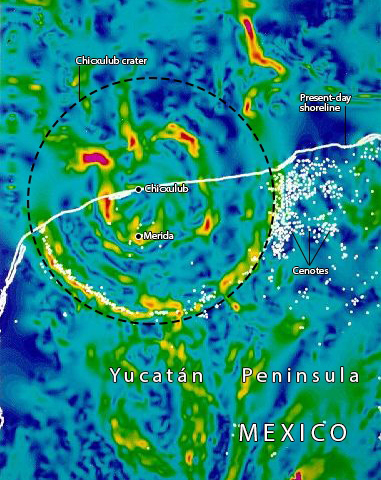
Chicxulub Impact crater

An International Research Team Plan to Explore the Chicxulub Impact Crater

scientists set out to explore impact crater

Data on the impact crater.

Picture credit: Map from Nature Geoscience / illustration courtesy of NASA

The Cretaceous mass extinction event is one of the most researched areas of science.  Improving our knowledge of how the climate change affected life in the past is helping to shape current policies as our planet experiences a period of exceptional warming.  Whether or not the extraterrestrial impact was the cause of the extinction of about 70% of terrestrial life, marking the end of the Age of Dinosaurs, is still debated.

Dating the Impact Event

Recent research from Glasgow University dates the impact at approximately 66,038,000 years ago +/- 11,000 years (margin of error).  This date according to many scientists is about 300,000 years before the Dinosauria extinction.  Whether the impact is the single cause, or whether it contributed to the mass extinction which occurred as a result of a number of factors remains when one of the hottest topics in palaeontology.

It was father and son team Luis and Walter Alvarez, who in 1980, publicised the discovery of a layer of clay with high levels of the rare Earth element iridium which mark the Cretaceous/Tertiary boundary (the K-T boundary).  They argued that the iridium was deposited as a result of an impact event where a meteorite or some other rocky body crashed into our planet.  The discovery of the Chicxulub crater that dated from the end of the Cretaceous provided “the smoking gun” evidence that just such an event had occurred.

The scientists involved in this new research project gathered in the city of Merida (Mexico) last week.  Merida, is within the 125 mile wide impact site that marks the Chicxulub event.  Scientists have estimated that the extraterrestrial object, perhaps an asteroid or even a comet, was at least six miles wide and it was travelling about eight times faster than a bullet when it hit the Earth.

Expensive Research Programme

About £6 million GBP has been set aside for funding, approved by the European Consortium of Ocean Research Drilling (ECORD).  Sean Gulick, who holds many academic posts including Associate Professor at the UT Jackson School of Geosciences, is part of the research team and has spent many years studying the geology of the Yucatan peninsula.  He hopes to acquire samples from the crater in a bid to learn more about the impact and its consequences.

Explaining the purpose behind the planned expedition, which is due to start next year, Sean stated:

“What are the peaks made of?  What can they tell us about the fundamental processes of these impacts, which is this dominant planetary resurfacing phenomena?”

The Associate Professor and long-time co-worker, Professor Joanna Morgan (Imperial College, London) have collaborated on a number of research projects exploring the Chicxulub impact crater, to read more about their research and earlier explorations of the geology of the Yucatan peninsula, click the link below:

To read more about this earlier research by the University of Texas: Getting to the Bottom of the Chicxulub Crater.

A Geophysical Map Outlining the Impact Crater and the Crater Peaks

A geophysical map of the impact crater.

A geophysical map of the impact crater.

Picture credit: NASA

The picture above shows a colour coded geophysical gravity map of the Yucatan peninsula.  The white dots represent “Cenotes”, these are sink holes which were formed as a result of the impact event.

Exploring Traces of Microscopic Life

The international research team are keen to explore the traces of microscopic life that may have lived inside the peak rocks of the crater.  The geophysical maps of the region indicate that these rocks are porous and they may have acted as miniature environments for types of extremophiles to thrive in the hot, chemically enriched area surrounding the crater.

In addition, core samples should provide evidence of the earliest recovery of marine life after the extraterrestrial impact, providing scientists with an idea about how life on Earth bounces back from such cataclysmic events.

Commenting on the search for evidence of life, Associate Professor Gulick stated:

“The sediments that filled in the crater should have the record for organisms living on the sea floor and in the water that were there for the first after the mass extinction event.  The hope is, we can watch life come back.”

Working from an offshore platform, the expedition is likely to last eight weeks and the cores taken will be the first to be extracted from the impact site.  The first papers on the analysis of these core samples are expected at the end of next year, we at Everything Dinosaur, look forward to this analysis of the “Alvarez smoking gun”.

5 04, 2015

“Savage” The New Ceratosaurus Model Countdown – Two Weeks!

By |2024-05-05T09:41:22+01:00April 5th, 2015|Categories: Dinosaur and Prehistoric Animal News Stories, Dinosaur Fans, Everything Dinosaur News and Updates, Everything Dinosaur Products, Main Page, Photos of Everything Dinosaur Products|0 Comments

Rebor Ceratosaurus “Savage” Available Around Mid April

The next edition in the highly acclaimed Rebor replica series will be arriving at Everything Dinosaur shortly.  A spokesperson for the company stated that the shipment of 1:35 scale Ceratosaurus replicas could be at the company’s warehouse as early as the middle of April.  The Ceratosaurus is the fourth replica in the Rebor Collection to be introduced, it is also the fourth theropod dinosaur ( it joins Yutyrannus, Tyrannosaurus rex and Utahraptor).   Unlike the other meat-eating dinosaurs in this very collectible series, the genus Ceratosaurus actually consists of a number of species.

Rebor Ceratosaurus

At least six different species have been assigned although a number are regarded as nomen dubium, this contrasts with the other carnivorous dinosaurs so far depicted by Rebor which only have one species within their genus.  It could be argued that there is a second species within Tyrannosaurus (T. bataar), but at Everything Dinosaur we tend to support the hypothesis that although North American tyrannosaurids are descended from Asian tyrannosaurs, the distinct genus for Tarbosaurus remains valid.

New Rebor Replica on the Block –  1:35 Scale Ceratosaurus

Available from Everything Dinosaur from Mid April.

Available from Everything Dinosaur from Mid April.

Picture credit: Rebor

“Savage”

The Ceratosaurus has been nick-named “Savage” and it is a representation of one of the largest of the Ceratosaurus species named so far (C. dentisulcatus).  This species was erected in 2000 A.D. after a re-assessment of a particularly large specimen found in the famous Cleveland-Lloyd quarry in Utah (Morrison Formation).  Although believed to represent a single dinosaur, the bones that were used to establish this new, larger species of Ceratosaurus were found over a period of many years and from a number of locations (but within the same horizon), within the dig site.

It has been estimated that Ceratosaurus dentisulcatus could have reached a length around 8.5 metres, one third longer than the first species of Ceratosaurus named by Othniel Charles Marsh back in the mid 1880s.  Like all the ceratosaurs, it had a relatively long tail compared to the rest of its body.

Marsh commented on the resemblance of the tail to a crocodile’s when he studied the bones that would be assigned to C. nasicornis, the first species to be named.  He suggested that this dinosaur would have been very much at home in the swampy regions of the Morrison and the tail would have helped this dinosaur to swim very effectively across the many large rivers and lakes that existed in this part of the United States back in the Late Jurassic.

The Skilfully Constructed Base Reflects the Swampy Home of Ceratosaurus

Skilfully hand-painted base

Skilfully hand-painted base.

Picture credit: Rebor

A Superb Display Base

The hand-painted base boasts realistic plants, logs, mud effect and even a puddle that’s made of transparent resin to create the impression of real water.  Although, Ceratosaurus dentisulcatus is known from a collection of bones thought to represent a single animal, all the material ascribed to this species come from the Brushy Basin Member of the Morrison Formation.  This is the youngest member of the Morrison, with strata dating from around 148 million years ago.  At this time, this part of the world was more humid and wetter than previously, desert areas had given way to lush, verdant habitats.

It seems likely that Ceratosaurus dentisulcatus was a dinosaur that lived in a wetland environment.  The details on the replica’s base reflect this and Rebor must be credited for the care and attention they have lavished on the development of an accurate base for their replica.

Intriguingly, although some cranial material has been ascribed to C. dentisulcatus, it is not known for sure whether this dinosaur actually possessed that signature nasal horn that gives this genus its name.  These bones have not been found, as far as we at Everything Dinosaur are aware.

Why Ceratosaurus dentisulcatus?

We asked our chums at Rebor why this particular species rather than the better known Ceratosaurus nasicornis?  C. nasicornis is the species that we at Everything Dinosaur based our own Ceratosaurus fact sheet upon and the first species to be identified within the genus.

A spokesperson for Rebor stated that there were several reasons behind their choice.  Firstly, C. dentisulcatus was a more massive and robust animal when compared to what is known about C. nasicornis.  The tibia (shinbones) for example are six centimetres longer and other direct comparisons indicate that Ceratosaurus dentisulcatus was a bigger and more formidable carnivore.  Rebor are aware that the fossil material first used to describe Ceratosaurus nasicornis very probably represents a sub-adult and that C. nasicornis could well have been much bigger and heavier than stated.

Different Ceratosaurus Species

However, when you take into account those more recurved and substantially bigger teeth associated with C. dentisulcatus when compared to other Ceratosaurus species, you can understand the appeal of this particular Ceratosaurus species to a model manufacturer.  Incidentally, it is the larger and strongly recurved teeth in the premaxilla (upper jaw) and the front three teeth of the dentary (lower jaw) with their very visible parallel grooves running down their medial surface (inside facing) that give this species its name.  We speculate that these grooves helped inflict maximum damage with bites and that the grooves could have helped blood flow from wounds thus hastening the demise of victims – very nasty, the Dinosauria equivalent of “dum-dum” bullets!

A Comparison of Ceratosaurus magnicornis skull material with Ceratosaurus dentisulcatus

Although not to same scale the more strongly recurved teeth of C. dentisulcatus can be seen.

Although not to same scale the more strongly recurved teeth of C. dentisulcatus can be seen.

Picture credit: Utah Geological Survey/Everything Dinosaur

In the diagram above, the left lateral views of skull material from C. magnicornis and C. dentisulcatus are compared.  Although the skull of C. magnicornis is more compressed and these diagrams are not to scale, the proportionately bigger and more curved teeth of Ceratosaurus dentisulcatus can be made out.  Ceratosaurus magnicornis, which is known from the lower part of the Brushy Basin Member of the Morrison Formation, but this time from exposures located in Colorado (Fruita, Colorado), was very probably larger than Ceratosaurus nasicornis, but perhaps not as big as C. dentisulcatus.

Comparing the Size of Dinosaurs

Direct size comparisons are difficult, as the holotype material associated with C.  magnicornis, just like C. nasicornis may represent a not fully grown animal.  What is interesting is that the nose horn on C. magnicornis is bigger, so it has been concluded that if Ceratosaurus dentisulcatus is larger still, then its nose horn was probably big too.  A large nose horn can be clearly seen on the Rebor replica.

A Dorsal View of the Rebor Ceratosaurus Model

The characteristic bony armour (ossicles and osteoderms) can be clearly made out.

The characteristic bony armour (ossicles and osteoderms) can be clearly made out.

Picture credit: Rebor

“Savage”, the 1:35 scale Rebor Ceratosaurus replica is going to be available from Everything Dinosaur around the middle of April.  Could Ceratosaurus finally be stepping out into the limelight and join Allosaurus and Saurophaganax in being regarded as an apex predator?

To view Everything Dinosaur’s Rebor range of models: Rebor Dinosaur and Prehistoric Animal Models.

3 04, 2015

Shaking Those Tail Feathers – How to Distinguish Boy Dinosaurs from Girl Dinosaurs

By |2023-03-25T10:56:44+00:00April 3rd, 2015|Categories: Dinosaur and Prehistoric Animal News Stories, Dinosaur Fans|0 Comments

Evidence to Support an Oviraptoridae Hypothesis – A Tale of Dinosaur Tails

Being able to tell the girl dinosaurs from the boys is one of the challenges facing palaeontology today.  The fossilised bones of long extinct creatures rarely provide clues as to whether an individual was male or female.  However, a team of scientists at the University of Alberta have published a paper in the academic journal “Scientific Reports” that provides evidence of sexual dimorphism in the tails of two oviraptorids.

Oviraptorid Study

Oviraptorids (Family Oviraptoridae), are a group of very bird-like theropod dinosaurs, whose fossils are known from Late Cretaceous strata of the Northern Hemisphere, most notably Asia.  In many ways, these dinosaurs were anatomically very similar to modern Aves (birds) and it is very likely that these light, agile dinosaurs were covered in a down of insulating feathers.

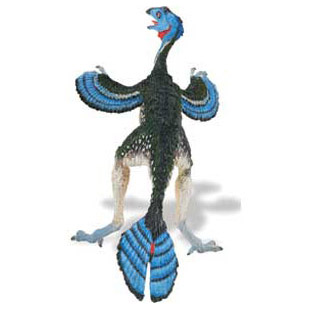
A Typical Member of the Oviraptoridae (Caudipteryx zoui)

Was the tail plume combined with a short tail used for display?

Was the tail plume combined with a short tail used for display?

Picture credit: Everything Dinosaur

Dinosaur Feathers

Other kinds of feathers are associated with these types of dinosaurs.  For example, long, symmetrical feathers on the forearms and on the end of the tail.  In an earlier paper reported upon by Everything Dinosaur in 2013, one of the University of Alberta scientists, proposed that fossils from a type of oviraptorid known as Khaan mckennai might show evidence of fused tail bones, a sort of dinosaur equivalent of a bird’s pygostyle (five fused caudal vertebrae at the very end of the tail).

The scientist who conducted this study, Scott Persons, hypothesised that these types of dinosaurs may have had plumes and tufts (as depicted in the Caudipteryx picture above), these appendages could have formed a display function, just like the fan of feathers found in extant peacocks for example.

To read more about this research: Shaking their Tails and Strutting Their Stuff.

In addition, the young researcher, who conducted this study for his Masters thesis, postulated that one day dinosaur fossils might be found that show different types of tail structure and this might help palaeontologists to work out which fossils represent males and which ones females.  Funny he might have thought that…

Dinosaurs

That’s exactly the conclusion reached by the research team, having examined the near complete fossilised remains of two oviraptorids found fossilised together.  The fossils represent two specimens of Khaan mckennai, one of which is the holotype for this species. The remains of these two dinosaurs were found within twenty centimetres of each other, they both represent adult animals and as a result they were nicknamed “Romeo and Juliet”, the star-crossed lovers from Shakespeare.  They were also named “Sid and Nancy” after the punk rock singer and his girlfriend.

These two little dinosaurs died together when a sand dune, destabilised by heavy rain collapsed and buried them both.  The fossils came from the Djadokhta Formation of the Gobi desert (Mongolia) and although one specimen is missing elements from the middle and posterior part of the tail, the Canadian based researchers have identified differences in the shape, size and structure of chevron bones associated with the end of the tail.  One specimen has longer tail bone chevrons and these end in a broad tip.

The Fossilised Tail Bones of the Oviraptorids Compared

Differences in the shape, size and structure of the tail bones could provide a clue.

Differences in the shape, size and structure of the tail bones could provide a clue.

Picture credit: University of Alberta/Scientific Reports

“Romeo” and “Juliet”

Commenting on the research Scott Persons stated:

“We discovered that, although both Oviraptors were roughly the same size [femur lengths of 19.5 cm and 19 cm respectively], the same age and otherwise identical in all anatomical regards “Romeo” had larger and specially shaped tail bones.  This indicates that it had a greater capacity for courtship displays and was likely a male.  By comparison the second specimen “Juliet” had shorter and simpler tail bones, suggesting a lesser capacity for peacocking, and has been interpreted as a female.”

Far be it for scientists to speculate, but this could be the preserved remains of a mated pair, a couple of dinosaurs who lived together and died together some seventy-five million years ago.  The fossils are part of the Mongolian Academy of Sciences palaeontological collection, fossil reference MPC-D 100/1127 is the holotype material for Khaan mckennai and believed to be a female by the University of Alberta scientists.  Whilst, fossil specimen MPC-D 100/1002 with its larger and differently shaped tail chevrons is regarded as a male.

Diagrams Showing the Morphology of the Two Specimens and Comparisons with Other Oviraptorids

Comparing the caudal vertebrae and chevrons of oviraptorids.

Comparing the caudal vertebrae and chevrons of oviraptorids.

Picture credit: University of Alberta/Scientific Reports

Differences in the Caudal Vertebrae

The differences in the tail bones can’t be explained by individual variation between animals of the same species and it is not thought the differences are due to trauma such as an injury, the dissimilarity could be due to sexual dimorphism and therefore if the tail bones of oviraptorids are present, this could be a method whereby scientists can distinguish between males and females, certainly amongst the Oviraptoridae anyway.  Further analysis of the known fossil record for this large family of dinosaurs along with more fossil discoveries will be needed to help support this hypothesis.

Scientists Might Be Able to Distinguish between Male and Female Gigantoraptors

Feathers used for display and courtship.

Feathers used for display and courtship.

Picture credit: BBC (Planet Dinosaur Television Series)

Go to Top