All about dinosaurs, fossils and prehistoric animals by Everything Dinosaur team members.

About Mike

Mike runs Everything Dinosaur, a UK-based mail order company specialising in the sale of dinosaur and prehistoric animal models, He works alongside Sue, and between them they have become the "go to guys" for museum quality prehistoric animal models and figures. An avid fossil collector and reader of dinosaur books, Mike researchers and writes articles about palaeontology, fossil discoveries, research and of course, dinosaur and prehistoric animal models.
3 08, 2024

New Eofauna Tyrannosaurus rex Figure Reviewed

By |2024-08-02T10:50:54+01:00August 3rd, 2024|Categories: Eofauna Scientific Research Models|0 Comments

Dinosaur fan and model collector William sent to Everything Dinosaur a model review.  The review focused on the new for 2024 Eofauna Tyrannosaurus rex figure.  We created a short blog post summarising the reviewer’s comments.  This dinosaur model is based on the T. rex specimen housed at the Field Museum in Chicago.  The specimen is nicknamed “Sue” after Sue Hendrickson, who discovered the dinosaur in 1990 during a commercial excavation trip in South Dakota.

You can read William’s review of the Eofauna T. rex model here: Eofauna “Sue” Model is Reviewed.

This tyrannosaur model is supplied with a display base.  In addition, the figure has an articulated jaw.  William congratulated the design team. He stated that in his opinion, this was the most accurate Tyrannosaurus rex model to date.

Eofauna Tyrannosaurus rex model.

The Eofauna Tyrannosaurus rex dinosaur model photographed in the studio. Dinosaur model fan and collector William reviewed this figure.  Picture credit: Everything Dinosaur.

Picture credit: Everything Dinosaur

To view the Eofauna Scientific Research range of prehistoric animal figures: Eofauna Scientific Research Figures.

Eofauna Tyrannosaurus rex

Everything Dinosaur team members have posted up a summary of William’s comprehensive view on the Eofauna Tyrannosaurus rex product page.

Here is the review as it appears on the Eofauna T. rex product page:

“Simple! It’s an Eofauna figure. Two years in development but well worth the wait for a model of ‘Sue’, not some fantasy beast but a replica of a once living animal. Eofauna Tyrannosaurus rex “Sue’. It is a banquet for the eyes. Congratulations! We all now own the most accurate scientific Tyrannosaurus rex figures to exist.”

The reviewer went onto praise Everything Dinosaur stating:

“Customer service from Everything Dinosaur is of the highest level. A prime example was last week whilst I was ordering two PNSO Megalosaurus I received an email from Sue to confirm that it was not a mistake and that I did want two figures. Thank you Everything Dinosaur for your care and consideration.”

Mike from Everything Dinosaur thanked William for his model review and for his kind words about the company.

Visit the award-winning Everything Dinosaur website: Dinosaur Toys and Models.

2 08, 2024

Awesome Dinosaur Drawing Submitted by Aspiring Young Palaeontologist

By |2024-08-02T10:37:12+01:00August 2nd, 2024|Categories: Dinosaur and Prehistoric Animal Drawings|0 Comments

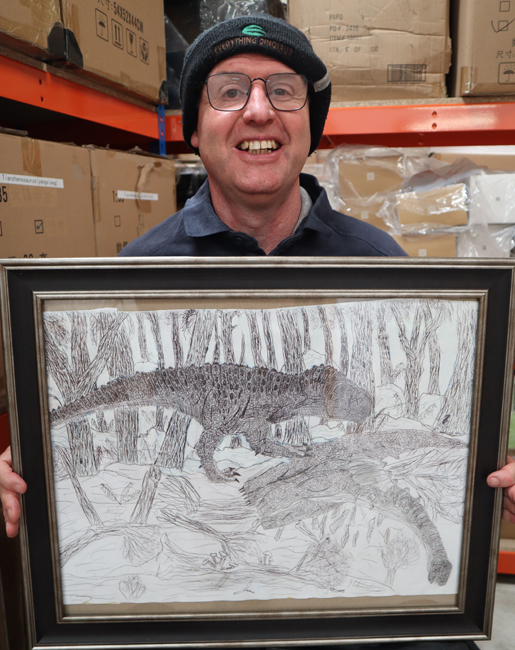
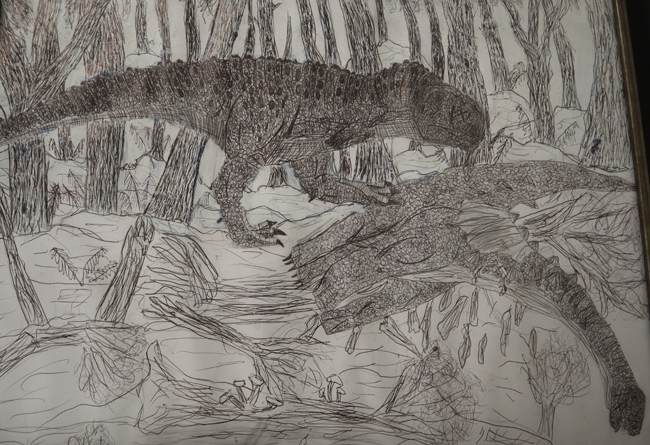
Our thanks to Dominic a young and very knowledgeable dinosaur fan who along with his family visited Everything Dinosaur and presented us with a super dinosaur illustration.  Dominic decided to give us his Koleken dinosaur drawing.  We had met Dominic back in the late spring at a film premiere that Everything Dinosaur had sponsored (Why Dinosaurs?).  He impressed us with his fantastic dinosaur knowledge, so much so that he knew more about a recently described dinosaur (Koleken inakayali), than anyone else at the event.

Dominic’s mum explained that he had been working on a drawing of this new dinosaur and, as it was his birthday, he wanted to come and present us with his Koleken dinosaur drawing. It is a wonderful piece of prehistoric art, and we really appreciate the great care and attention to detail shown by this young artist. We were thrilled to receive Dominic’s drawing and we plan to display it prominently at our offices.

The Koleken dinosaur drawing by young Dominic

Mike from Everything Dinosaur holding the Koleken dinosaur drawing presented to team members by Dominic and his family. Picture credit: Everything Dinosaur.

Picture credit: Everything Dinosaur

The Koleken Dinosaur Drawing

Koleken (K. inakayali) was formally described earlier this year (Pol et al). it is an abelisaurid and it shared its Late Cretaceous environment with the much bigger, related Carnotaurus (C. sastrei). The fossil material is associated with the La Colonia Formation of Chubut Province (Argentina). The discovery of Koleken inakayali reinforces the view that abelisaurids were the dominant predatory dinosaurs in Gondwana during the Maastrichtian faunal stage of the Cretaceous.

To read Everything Dinosaur’s recent blog post about Koleken inakayali: A New Abelisaurid from Southern Argentina.

The Koleken is feeding on a saltasauroid titanosaur.  We suspect that this is a representation of Titanomachya.  Titanomachya (T. gimenezi) is also associated with the Colonia Formation. This dinosaur was also described this year (Pérez-Moreno et al). It was relatively small for a titanosaur. Titanomachya is thought to have measured around six metres in length. Fragmentary remains of another titanosaur have been found in the same area. As yet, these fossils have not been scientifically described or formally studied.

The dinosaur drawing by young Dominic.

The dinosaur drawing from Dominic. A Koleken feasts on a saltasauroid titanosaur (Titanomachya). Picture credit: Dominic.

Picture credit: Dominic

Mike from Everything Dinosaur commented:

“We are honoured to receive this artwork, from a gifted illustrator. It is lovely to see the passion and creativity of dinosaur fans, young and old, come to life through art.”

Helping to Inspire the Next Generation of Palaeoartists

Team members hope that Dominic’s inspiring illustration will encourage more young artists. The company remains committed to fostering the next generation of palaeontologists, palaeontology enthusiasts, and dinosaur fans like Dominic.

At Everything Dinosaur, our team is dedicated to nurturing the passions of young aspiring palaeontologists and palaeoartists.  We believe that encouraging creativity is key to inspiring the next generation of scientific pioneers. Through educational resources, hands-on activities, and personalised feedback, we strive to provide a supportive environment.  An environment in which young dinosaur fans can explore their interests and cultivate the skills needed to turn their dreams of becoming a palaeontologist into reality.

The award-winning Everything Dinosaur website: Dinosaur Toys and Gifts.

1 08, 2024

A New PNSO Prehistoric Animal Slider Image for Everything Dinosaur

By |2024-07-16T12:37:56+01:00August 1st, 2024|Categories: Everything Dinosaur News and Updates|0 Comments

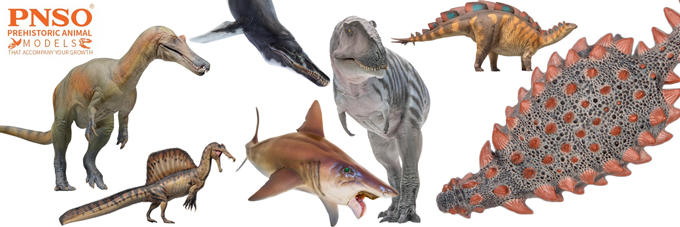
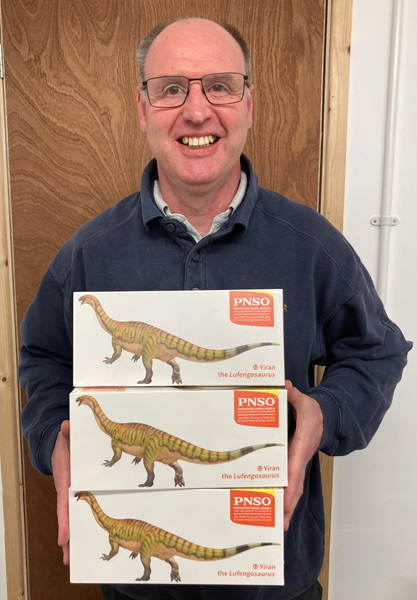
Everything Dinosaur team members have been busy preparing a new PNSO prehistoric animal model image for use on the company’s updated website.  The PNSO range has grown significantly over the last few years.  They continue to impress with the introduction of dinosaur and prehistoric animal models.  For example, new figures for this year (2024) include Lufengosaurus, Baryonyx, Tyrannotitan and an updated Spinosaurus.  In addition, a spectacular Edmontosaurus (Zabad) and a beautiful Wuerhosaurus (Xilin) have been added.

A new image has been created to help highlight the extensive PNSO prehistoric animal model range.  The image (below) features seven different PNSO figures.  A spokesperson from Everything Dinosaur commented that they wanted the picture to include a marine reptile as well as a prehistoric shark.

The new PNSO prehistoric animal slider for the updated Everything Dinosaur website.

The new PNSO prehistoric animal slider for the updated Everything Dinosaur website. In total, seven PNSO prehistoric animal figures are featured. Can you name them all? Picture credit: Everything Dinosaur.

Picture credit: Everything Dinosaur

Can you name them all?

To view the PNSO models and figures available from Everything Dinosaur: PNSO Age of Dinosaurs.

The Extensive PNSO Prehistoric Animal Range

PNSO prehistoric animal models have proved to be extremely popular with fans of dinosaurs.  Model collectors have been able to build up quite a collection. The PNSO range features popular prehistoric animals but also, some of the more obscure creatures from the fossil record too.

Mike from Everything Dinosaur stated:

“The artwork and posters supplied with the PNSO figures are superb.  Furthermore, it is wonderful to see figures of Chinese prehistoric animals coming into production.  Dinosaurs such as Lufengosaurus, Tsintaosaurus and of course Wuerhosaurus.  We really do appreciate the design team’s efforts.”

A trio of PNSO Lufengosaurus models.

Mike of Everything Dinosaur with three Lufengosaurus dinosaur models. Picture credit: Everything Dinosaur.

Picture credit: Everything Dinosaur

Collectors and dinosaur fans can expect more new model announcements from PNSO.

To visit the award-winning Everything Dinosaur website: Everything Dinosaur – Dinosaur Toys.

31 07, 2024

A New Deep-snouted Tyrannosaur from Asia

By |2024-08-01T16:58:12+01:00July 31st, 2024|Categories: Palaeontological articles|0 Comments

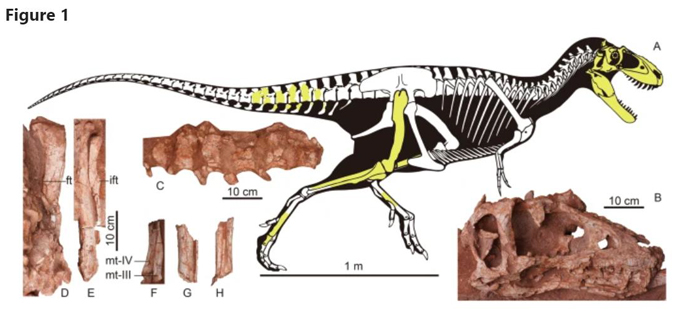
Another week, and another new dinosaur.  This time, it is a tyrannosaur, and it has been named Asiatyrannus xui.  The fossils consist of a nearly complete skull and postcranial material. The postcranial material comprises leg bones and caudal vertebrae. A cross-sectional analysis of the right fibula has permitted the researchers to estimate the age of this tyrannosaur. It was at least thirteen years old when it met its demise.

Asiatyrannus co-existed with the much larger, Qianzhousaurus sinensis. Qianzhousaurus had a long, narrow snout.  When it was formally described in 2014 it was nicknamed “Pinocchio rex”.  The different skull morphologies and their different body sizes suggest that Asiatyrannus xui and Qianzhousaurus sinensis likely had different feeding strategies and occupied different ecological niches.  Asiatyrannus is the first deep-snouted tyrannosaurid to have been described from the Late Cretaceous of south-eastern China.

Asiatyrannus xui skeletal reconstruction.

A skeletal reconstruction of the newly described (2024) deep-snouted Asian tyrannosaur (Asiatyrannus xui). Known fossil material in (A) shown in yellow. Photographs of the fossils (B-H). Picture credit: Zheng et al.

Picture credit: Zheng et al

Asiatyrannus xui

The fossil material was unearthed in September 2017 at a construction site in Shahe Town, Nankang District, Ganzhou City (Jiangxi Province).  The fossils were taken to the Zhejiang Museum of Natural History, Hangzhou, China for cleaning and preparation.  The genus name translates as “Asian tyrant king”, whilst the species name honours Dr Xing Xu (Institute of Vertebrate Paleontology and Paleoanthropology, Chinese Academy of Sciences).  Dr Xing Xu has made a huge contribution to the study of Chinese dinosaurs including research into and the naming of other tyrannosaurs (Dilong, Guanlong and Yutyrannus).

The discovery of Asiatyrannus highlights the diversification of deep-snouted tyrannosaurids towards the end of the Cretaceous.  It demonstrates that during the Late Cretaceous (Maastrichtian), different types of tyrannosaurs co-existed in south-eastern China.  Numerous dinosaurs are known from the strata in this area (Nanxiong Formation).  Ornithischians and sauropods have been described, but the majority of dinosaurs discovered are theropods, overwhelmingly oviraptorosaurs.

To read a blog post from 2016 about another oviraptorosaur from the Nanxiong Formation: Tongtianlong – A New Oviraptorosaur.

For an article describing a new oviraptorosaur (Corythoraptor) named in 2017: Another New Oviraptorosaur from Jiangxi Province.

Isolated teeth and other fragmentary elements suggest that there could have been other tyrannosaurid taxa present in this area at the very end of the Cretaceous.

Asiatyrannus xui skull and line drawing.

Photograph (A) and line drawing (B) of the skull of Asiatyrannus xui (ZMNH M30360) in right lateral view. Picture credit: Zheng et al.

Picture credit: Zheng et al

Tyrannosaurid Growth Spurts

The open-access study published in “Scientific Reports”, includes details of bone histology.  This analysis revealed that this dinosaur died when it was a least thirteen years of age.  This is significant as the research team conclude that whilst this individual was not fully-grown, it had already passed through its most rapid growth phase.  Early tyrannosauroids such as Guanlong and Moros reached their adult size at around six to seven years of age.  In contrast, large-bodied tyrannosaurs from the Late Cretaceous (Campanian/Maastrichtian) such as Daspletosaurus, Tyrannosaurus rex and Albertosaurus had rapid growth spurts in their teenage years.  These theropods did not reach their full adult size until at least twenty years old.

Qianzhousaurus and Asiatyrannus xui

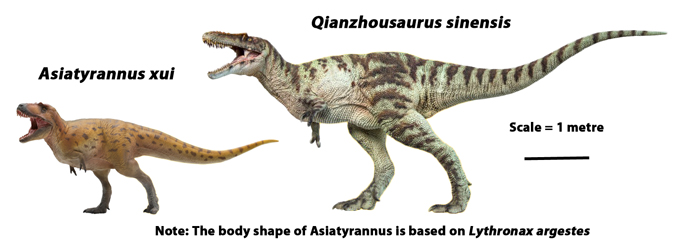
The skull of Asiatyrannus measures 47.5 cm in length.  Based on this, and the limb sizes, the research team estimate that Asiatyrannus had a body length of around 3.5 to 4 metres.  Qianzhousaurus (Q. sinensis) was over twice as big.  It had an estimated body length of around 9 metres.

These two carnivores very probably co-existed.  The long-snouted Qianzhousaurus was likely to have been the apex predator, with the smaller Asiatyrannus having the role of a secondary predator in the ecosystem.  Their different body sizes, and different shaped skulls suggest that these two dinosaurs may have had different hunting behaviours and perhaps, preyed on different animals.  They may not have directly competed, each tyrannosaur becoming adapted to a different ecological niche.  This could be an example of niche partitioning within coeval tyrannosaurids.

Asiatyrannus xui and Qianzhousaurus sinensis size comparison.

A size comparison between the probable, coeval tyrannosaurids Qianzhousaurus and Asiatyrannus. Picture credit: Everything Dinosaur.

Picture credit: Everything Dinosaur

The image above shows an approximate size comparison between the newly described Asiatyrannus xui and the probably coeval Qianzhousaurus sinensis.

Note: the models used to show the comparison are the PNSO Lythronax and Qianzhousaurus figures.

To view the PNSO range of prehistoric animal models: PNSO Dinosaur Models.

Implications for Mid-sized Theropod Carnivores

The paper’s authors comment that the discovery of Asiatyrannus might have implications for the way in which Mesozoic ecosystems are perceived.  Medium-sized carnivorous dinosaurs are relatively rare in the fossil record.  For example, in the Late Cretaceous carnivore guilds are monopolised by tyrannosaurids.  Adult, medium-sized predators are exceptionally rare.  Scientists have postulated that the “missing mid-sized” niches in the theropod guilds of Late Cretaceous Laramidia and Asia could be a consequence of these types of carnivores being outcompeted by juveniles and sub-adults of much larger taxa.

To read an article about a scientific paper that postulates the juveniles of apex predators out-competed mid-sized theropod carnivores: Why Are There So Few Medium-sized Carnivorous Dinosaurs?

The polar tyrannosaur Nanuqsaurus (N. hoglundi) was thought to be a mid-sized Late Cretaceous carnivore.  However, new fossil material from the Prince Creek Formation of Alaska suggests that it was comparable in size to the likes of Gorgosaurus and Daspletosaurus.  In the light of the continuing speculation as to the taxonomic validity of Nanotyrannus, the paper’s authors propose that Asiatyrannus xui currently represents the only definitive small to medium-sized member of the tyrannosaur family.

Everything Dinosaur acknowledges the assistance of the scientific paper in the compilation of this article. The paper is licensed under a Creative Commons Attribution 4.0 International License: The Creative Commons License.

The scientific paper: “The first deep-snouted tyrannosaur from Upper Cretaceous Ganzhou City of southeastern China” by Wenjie Zheng, Xingsheng Jin, Junfang Xie and Tianming Du published in Scientific Reports.

30 07, 2024

A New Limited-edition Category for Everything Dinosaur

By |2024-07-25T14:22:35+01:00July 30th, 2024|Categories: Everything Dinosaur News and Updates|0 Comments

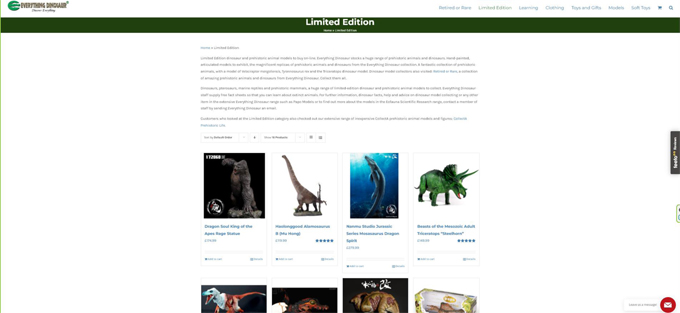
Team members at Everything Dinosaur have added a new limited-edition category to the company’s award-winning and user-friendly website.  This new category is a destination for dinosaur fans and model collectors looking for limited-edition prehistoric animal models.  Limited-edition figures have become an increasing part of many manufacturer’s product offerings. There is a growing demand for rare and exclusive collectables, and prehistoric animal figures are no exception.

The new limited-edition category at the Everything Dinosaur website.

The new limited-edition category at the Everything Dinosaur website. We added this section in July 2024. Picture credit: Everything Dinosaur.

Picture credit: Everything Dinosaur

To view the new limited-edition category at Everything Dinosaur: Limited-edition Prehistoric Animal Figures.

The Limited-edition Category

This is a new category for Everything Dinosaur.  It has gone live on the company website at the same time as another new category entitled “Retired or Rare”.  Limited-edition figures have become an increasing part of many manufacturer’s product offerings. There is a growing demand for rare and exclusive collectables, and prehistoric animal figures are no exception.  Limited-edition figures have been introduced by the likes of Rebor, Nanmu Studio and Beasts of the Mesozoic.

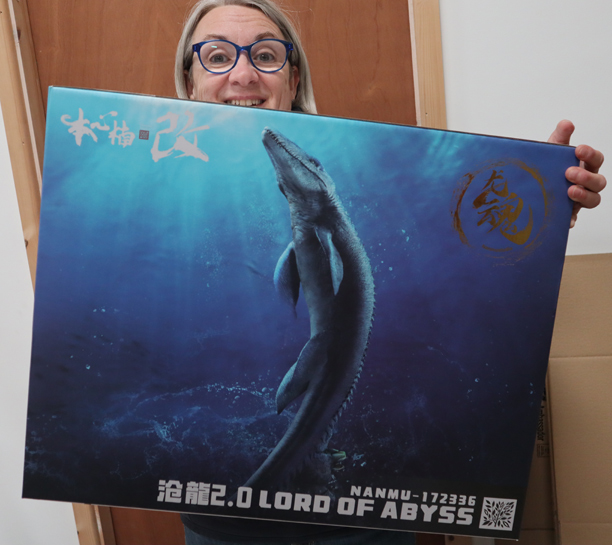
Mosasaurus Dragon Spirit

The spectacular limited-edition Nanmu Studio Jurassic Series Mosasaurus Dragon Spirit model. This marine reptile collectable can be found (whilst stocks last), in the new product category on the company website.  Picture credit: Everything Dinosaur.

Picture credit: Everything Dinosaur

The picture (above) shows Sue from Everything Dinosaur holding the limited-edition Nanmu Studio Jurassic Series Mosasaurus Dragon Spirit.  This collectable figure is huge! Our new limited-edition category currently contains it (whilst stocks last).

Mike from Everything Dinosaur declared:

“Attention, collectors and enthusiasts! Our website is thrilled to announce the launch of a brand-new category dedicated to limited-edition prehistoric animal models.  This exciting addition caters to the growing demand for rare and exclusive collectables in the world of palaeontology.”

Visit the Everything Dinosaur website: Dinosaur Toys and Figures.

29 07, 2024

New Research Indicates Size Does Not Matter for Mammals with Complex Brains

By |2024-07-27T11:53:30+01:00July 29th, 2024|Categories: Animal News Stories|0 Comments

Size doesn’t matter for mammals with more complex brains, according to new research led by the University of Bath.  Mammals that have developed more sophisticated brains tend to have a smaller size difference between males and females of that species.  The research paper has been published in the academic journal “Nature Communications”.  The study can provide new insights into mammal evolution and the role of sexual selection.

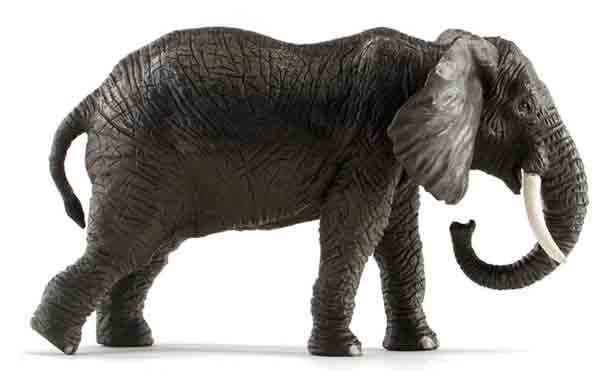
In many mammal species, the males can be bigger than the females.  In some species, the females can be bigger on average than the males. This is a trait called sexual size dimorphism (SSD). For instance, male southern elephant seals (Mirounga leonina), are around three times larger than females. African elephants (Loxodonta) show SSD.  Males can weigh several thousand kilograms more than mature females.

An African elephant model.

A male African elephant (Loxodonta).  Male elephants tend to be much larger than the females.

In contrast, dolphins have no difference in sizes between the sexes. Humans are somewhere in between, with the average male being larger than the average female, but across the population there is an overlap.

Analysing the Genomes of 124 Species of Extant Mammal

The study involved researchers from the Universities of Bath and Sheffield, along with Cardiff University and UNAM (Mexico).  The team examined the genomes of 124 extant species of mammals. The genes were grouped into families of similar attributes and functions.  The size of these gene families was then calculated.  The researchers discovered that those species with a big difference in size between the sexes had bigger gene families linked to olfactory functions (sense of smell) and smaller gene families associated with brain development.

Therefore, this could also mean that those species with very little difference in sizes between males and females (termed monomorphic) had larger gene families associated with brain development. The authors suggest that in species with a large SSD, traits such as the sense of smell could be important for identifying mates and territories. In contrast, mammals with a smaller SSD are potentially investing in their brain development and tend to have more complex social structures. This means they compete for mates using other means than simply using size to select who to mate with.

Corresponding author for the research, Dr Benjamin Padilla-Morales (University of Bath), commented:

We were surprised to see such a strong statistical link between a large SSD and expanded gene families for olfactory function. Even more interestingly, the gene families under contraction were linked with brain development. This could mean that those species with a small SSD have bigger gene families associated with brain function and tend to show more complex behaviours such as biparental care and monogamous breeding systems.”

Size is Important in Some Mammal Species

The research team concluded that whilst body size in some mammal species is significant, for others it does not matter so much.  If size plays a role in sexual selection, then it leads on to considering how traits like SSD are shaping mammalian evolution.  Is SSD in some species influencing brain and genome development?

This new research helps to illustrate the complex interplay between sexual dimorphism, gene family size evolution, and their roles in mammalian brain development and function. It provides a valuable perspective in understanding mammalian genome evolution.

The research team hope to develop this line of enquiry further.  They want to investigate how testes size impacts the evolution of the mammalian genome.

Being small insectivores with fewer skull bones led to mammalian evolutionary success: Reduction in Skull Bones Led to Success for the Mammals.

The Implications for Mammalian Evolution

This research highlights the importance of considering the multifaceted nature of sexual selection and its diverse effects on different aspects of mammalian evolution and biology. The finding that body size plays a role in sexual selection for some species but not others suggests that the evolutionary pressures shaping sexual dimorphism can vary considerably across the mammalian lineage.

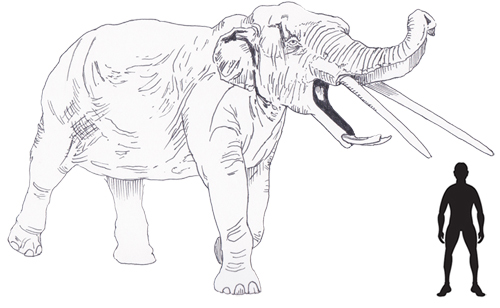
Understanding these nuanced relationships is crucial for piecing together the complex tapestry of mammalian evolution. Perhaps, a study of the fossilised remains of a particular group of mammals with descendants still living today could shed new light on when these relationships established. Could the Proboscidea Order (elephants and their relatives) provide a starting for this research? By examining the fossil records of such groups, scientists could gain a better understanding into the evolutionary processes that have given rise to the incredible adaptations found in the Mammalia.

Konobelodon atticus scale drawing.

A scale drawing of the Late Miocene prehistoric elephant Konobelodon atticus.  Could a study of ancient elephants provide a fresh perspective on the evolution of sexual size dimorphism (SSD).  Picture credit: Everything Dinosaur.

Picture credit: Everything Dinosaur

Everything Dinosaur acknowledges the assistance of a media release from the University of Bath in the compilation of this article.

The scientific paper: “Sexual size dimorphism in mammals is associated with changes in the size of gene families related to brain development” by Benjamin Padilla-Morales, Alin P. Acuña-Alonzo, Huseyin Kilili, Atahualpa Castillo-Morales, Karina Díaz-Barba, Kathryn H. Maher, Laurie Fabian, Evangelos Mourkas, Tamás Székely, Martin-Alejandro Serrano-Meneses, Diego Cortez, Sergio Ancona and Araxi O. Urrutia published in the journal Nature Communications.

The award-winning Everything Dinosaur website: Prehistoric Animal Models and Toys.

28 07, 2024

A New Everything Dinosaur About Us Website Page

By |2024-07-24T11:35:28+01:00July 28th, 2024|Categories: Everything Dinosaur News and Updates|0 Comments

As part of on-going site improvements team members have developed a new Everything Dinosaur about us page for the company website.  The “About Us” page is an essential component of a website.  When a potential customer visits: Everything Dinosaur one of the first things they are likely to look for is the “About Us” page.  This page plays a crucial role in a company’s on-line presence.  It gives visitors an overview of the business.  Furthermore, it can help to set the company apart from its competitors.

The new Everything Dinosaur about us website page.

The new Everything Dinosaur “About Us” website page. This page was updated in July 2024. Picture credit: Everything Dinosaur.

Picture credit: Everything Dinosaur

The Everything Dinosaur About Us Page

We are very fortunate at Everything Dinosaur.  Over the years, we have built up a strong rapport with our customers and suppliers.  The business has an amazing record of customer service.  We are an award-winning company with one of the best ratings for customer satisfaction on record.  For example, Everything Dinosaur has been awarded the Feefo Platinum Trusted Service award, ever since this prestigious accolade was introduced.

To read more about our latest customer service award: Platinum Trusted Service Award 2024.

However, the Everything Dinosaur about us page should provide more than just dry facts about our accomplishments.  This page might contain information about the company, its history and what it does.  In truth, this page should say more.  This is an opportunity to tell Everything Dinosaur’s unique story and to share our brand’s unique personality.  Moreover, it should outline what makes us tick!

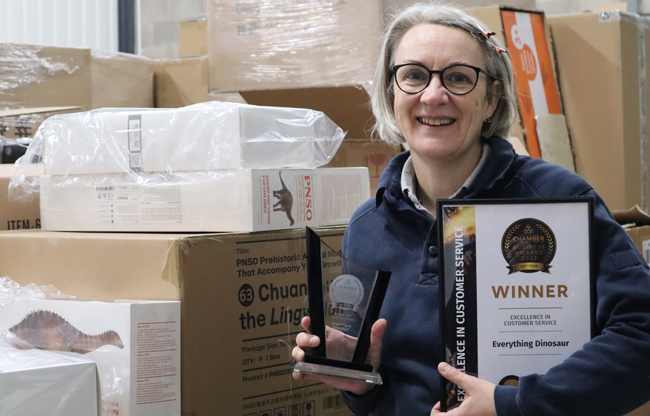
Sue of Everything Dinosaur with the trophy and certificate

Sue with the trophy and the certificate from the South Cheshire Chamber of Commerce. Everything Dinosaur is an award-winning company and whilst an “About Us” page might include details of your company’s history and achievements, it is an opportunity to tell your unique story. Picture credit: Everything Dinosaur.

Picture credit: Everything Dinosaur

Your Brand’s Personality

This part of our website should give visitors an impression of our brand’s personality.  It can highlight core values and explain what we do and how we do it. Furthermore, it helps to inspire and encourage.  A brand personality refers to the set of human characteristics that are associated with a particular business. It is the personality that a brand projects to its target audience and consumers.  The objective of developing a distinct brand personality is to make the brand relatable, memorable, and appealing to the audience.  Carefully incorporating a unique brand personality is a vital part of creating an impressive “About Us” page.

Some key pointers about information on an “About Us” page:

  • The company story, its values and principles.
  • Details about team members and core values.
  • It should reflect the company culture.
  • What is our mission?  What problems do you solve for customers?
  • Listing relevant awards and business milestones.
  • A clear call-to-action!  Make it easy for customers/visitors to contact you.

We hope that the Everything Dinosaur about us page comes up to the mark!

A compelling “About Us” page can give website visitors a reason to engage with us and our brand.  Having visited this page, visitors should feel more confident about doing business.  It remains an important part of any website.

The Everything Dinosaur “About Us” page: About Everything Dinosaur.

For further information about us: Contact Everything Dinosaur.

27 07, 2024

Which are the Best Prehistoric Animal Models?

By |2024-07-23T14:32:14+01:00July 27th, 2024|Categories: Dinosaur and Prehistoric Animal Models|0 Comments

At Everything Dinosaur, we get sent lots of questions by dinosaur fans.  We try our best to reply to them all.  Sometimes the questions we receive relate to a new dinosaur discovery.  We get enquiries about the latest research and fossil finds.  In addition, our email inbox is populated with enquiries about prehistoric animal figures.  Some of these questions involve us providing information about a single model.  For example, recently we received lots of enquiries about the new Eofauna T. rex 1/35th scale model. However, we also receive more general questions, such as which are the best prehistoric animal models?   This is a tricky question to answer.  After all, an appreciation of dinosaur and prehistoric animal models is extremely subjective.

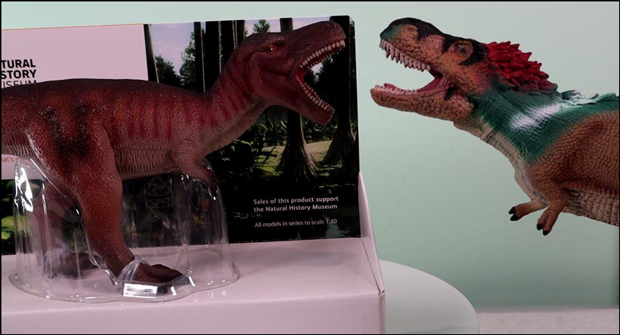
Comparing dinosaur models.

Comparing T. rex dinosaur models. The Natural History Museum figure compared to a CollectA 1:40 scale Tyrannosaurus.  Which prehistoric animal is best?  That’s a subjective question.  Picture credit: Everything Dinosaur.

Picture credit: Everything Dinosaur

The image (above) features two prehistoric animal dinosaur models.  The Natural History Museum Tyrannosaurus rex is on the left, whilst a CollectA Deluxe T. rex is shown (right).

To view the CollectA Deluxe model range: CollectA Deluxe Models.

The Everything Dinosaur article about the new Eofauna T. rex figure: The New Eofauna Scientific Research Theropod Figure.

The Best Prehistoric Animal Models?

Prehistoric animals and extinct creatures have long captivated the imagination of children and adults alike. The most popular museums tend to be ones that focus on natural history. The most popular galleries in these museums are often the ones containing prehistoric animal fossils. From the fearsome Tyrannosaurus rex, to the majestic mammoth (Mammuthus), these animals drive curiosity and a thirst for knowledge. Moreover, for those seeking to bring the past to life, high-quality animal replicas can be an invaluable resource.  Whether used for educational purposes, creative storytelling, or simply as display pieces in museums, prehistoric animal models offer a tangible connection to ancient ecosystems.

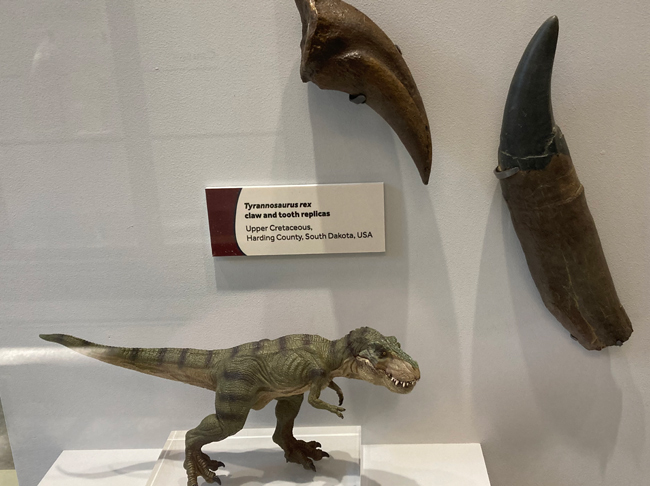
Papo running T. rex

A Papo green running Tyrannosaurus rex model on display next to a replica of a T. rex tooth and a T. rex claw. An exhibit at the Manchester Museum of Natural History.  Papo models and figures may not be the most accurate replicas on the market.  However, they are used to illustrate dinosaur fossil displays. Picture credit: Everything Dinosaur.

Picture credit: Everything Dinosaur

The picture (above) shows the popular Papo running T. rex figure in a museum exhibit featuring tyrannosaur material.  Papo prehistoric animals may not be the most scientifically accurate models, but these figures have been spotted being used in museums.

To view the range of Papo dinosaurs and other figures available: Papo Dinosaurs and Prehistoric Animals.

Scientific Accuracy or Play Value?

Arguably, the best prehistoric animal models not only capture the unique physical characteristics of their subjects, but also their sense of power and presence. Many also feature articulated joints, allowing for dynamic posing and creative play.  So, when considering which are the best prehistoric animal models what factors should we prioritise?  Do we focus on scientific accuracy or play value?  For example, the Beasts of the Mesozoic figures are essentially for display.  However, their stunning paintwork along with their myriad of articulated joints can attract younger dinosaur fans to this model range.

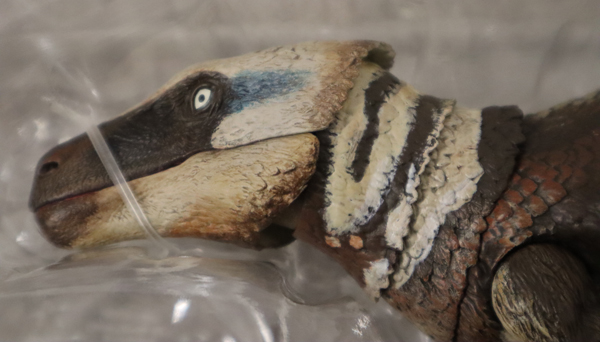
A close-up view of the Beasts of the Mesozoic Utahraptor model.

A close-up view of the stunning Beasts of the Mesozoic Utahraptor figure. This dinosaur model has an articulated lower jaw and numerous points of articulation.  Is this a collectable or does it lend itself to imaginative play?  Picture credit: Everything Dinosaur.

Picture credit: Everything Dinosaur

Additionally, there are personal preferences to consider.  For Everything Dinosaur team members, it is not possible for us to answer the question about “the best prehistoric animal models”.  Any answers would be difficult to quantify and extremely subjective.  Ultimately, it is a case of “beauty being in the eye of the beholder” and there are probably no right or wrong answers to this question.

Happy model collecting.

To visit the user friendly and award-winning Everything Dinosaur website: Dinosaur Toys and Models.

26 07, 2024

A New Dinosaur Book for the Festive Season

By |2024-07-26T14:59:42+01:00July 26th, 2024|Categories: Book Reviews|0 Comments

The extremely talented Professor Paul M. Barrett of the London Natural History Museum has written a new book all about the Dinosauria.  Entitled “A History of Dinosaurs in 50 Fossils”, this publication explains the evolution of the dinosaurs as outlined by fifty remarkable fossil specimens.  Many of these fossils are to be found within the Natural History Museum’s vertebrate fossil collection.

Published by the Natural History Museum, the book is likely to be available in time for the festive season.

We wanted to highlight this excellent book, so we created a YouTube short about it.

Video credit: Everything Dinosaur

“A History of Dinosaurs in 50 Fossils”

The book is split into three general sections.  It also includes a helpful cladogram and an inventory of the fossil specimens featured.  In addition, this new dinosaur book incorporates some stunning dinosaur themed artwork.  The first section sets the scene.  The Dinosauria are defined, and their evolutionary origins outlined.  Fittingly, the first dinosaur to be discussed in detail is Megalosaurus (M. bucklandii).  Megalosaurus was the first dinosaur to be scientifically described (1824).  The evolution of the Theropoda and the sauropods are reviewed.  Furthermore, the origins of the first entirely herbivorous dinosaurs are highlighted.  Also, there are extensive notes on Lesothesaurus, Massospondylus and Herrerasaurus.

Megalosaurus bucklandii fossils.

A view of the skull and jaw material associated with the first dinosaur to be scientifically described (Megalosaurus). Megalosaurus bucklandii is the first dinosaur to feature in a new book written by Professor Paul M. Barrett. Picture credit: Everything Dinosaur.

Picture credit: Everything Dinosaur

Part two of this well-written volume examines the huge variety of different types of dinosaur to evolve.  This astonishing variety is highlighted by beautiful photographs of fossil material. The dinosaurs featured include Mamenchisaurus, Allosaurus, Stegosaurus and Giraffatitan.  It is pleasing to note that many dinosaurs from the British Isles are included, although it is hard for us to imagine Hypsilophodon as “Mesozoic cows”.

To read a blog post from 2023 about the describing of a new species of Wessex Formation hypsilophodontid: Vectidromeus – A New Hypsilophodontid from the Isle of Wight.

Furthermore, this section delves into the evolution of powered flight amongst members of the Maniraptora and there are numerous, splendid photographs of feathered dinosaur fossils.  Naturally, look out for the text dedicated to the iconic Archaeopteryx lithographica.

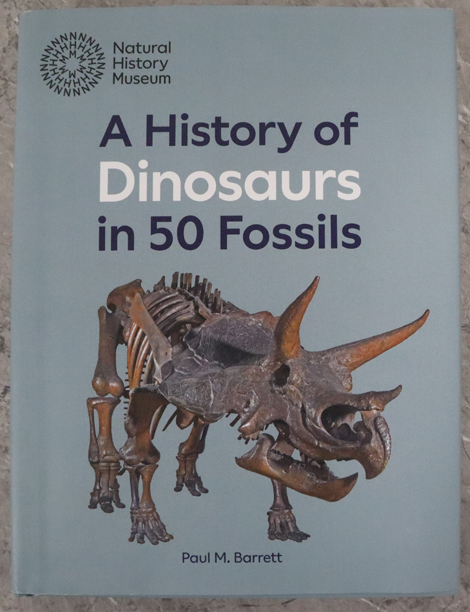
A History of Dinosaurs in 50 fossils by Professor Paul M. Barrett.

The front cover of the book features a mounted skeleton of Triceratops. Picture credit: Everything Dinosaur.

Picture credit: Everything Dinosaur

Locomotion, Diet, Breathing and Enormous Titanosaurs

The third and final section highlights dinosaur biology.  Topics covered include diet, locomotion, breathing, ontogeny and the endothermic versus ectothermic debate.  Of particular note was the “life at the extremes” segment.  This discussed the remarkable titanosaur Patagotitan, one of the largest terrestrial vertebrates known to science.  Perhaps, Professor Barrett was inspired by the recent Patagotitan exhibition held at the museum.

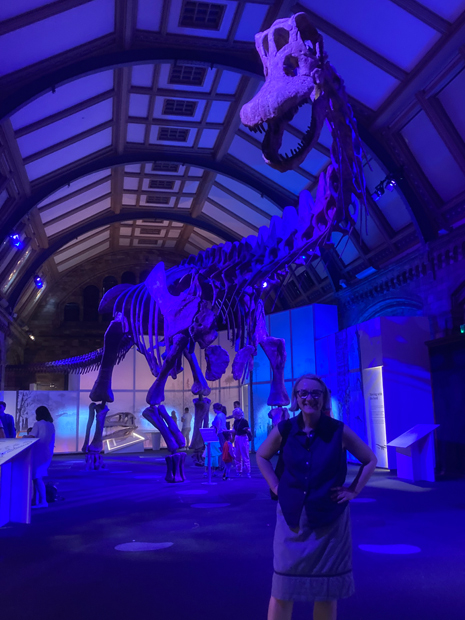
Patagotitan skeleton on display.

Sue from Everything Dinosaur poses in front of the colossal Patagotitan skeleton which is being exhibited at the Natural History Museum (London). Picture credit: Everything Dinosaur.

Picture credit: Everything Dinosaur

“A History of Dinosaurs in 50 Fossils” by Professor Paul M. Barrett is published by the London Natural History Museum (ISBN: 9780565095338).

We expect it to be out in all good book stores in the autumn and, we highly recommend this new dinosaur book!

25 07, 2024

New Brachiopod Study Sheds Light on Biodiversity

By |2024-07-25T10:04:11+01:00July 25th, 2024|Categories: Palaeontological articles|0 Comments

Research into a living fossil has provided scientists with a fresh perspective on animal evolution.  A new brachiopod study, involving the careful analysis of over a thousand genera, indicates these ancient creatures were diversifying and evolving but this did not result in many new species.  The research published in the journal “Nature Ecology & Evolution”, challenges some of the core principles of evolution.

Let’s hear it for the humble brachiopod!

What is a Brachiopod?

Brachiopods (Brachiopoda) are shelled animals that originated during the Cambrian.  Many resemble Roman oil lamps, hence their common name “lamp-shells”.  Their shells consist of two parts (valves), with one part larger than the other.  They are entirely marine and benthic.  These filter feeders have shells around two to five centimetres in diameter, although some genera grew much larger.  Although superficially similar to molluscs such as clams, mussels and oysters, they are not closely related.
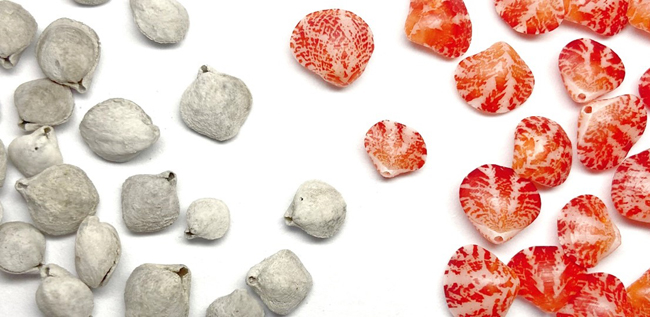
New brachiopod study sheds light on biodiversity.

Triassic brachiopod fossils (left), recent brachiopod shells (right). Picture credit: Zhen Guo.

Picture credit: Zhen Guo

In many species of brachiopod, the animal is attached to the sea floor by a fleshy stalk (pedicle).  The presence of a pedicle is indicated by the hole located on the larger of the valves (see picture above).  They were abundant in the Palaeozoic and Mesozoic and are often the most common fossil found in Palaeozoic marine deposits.  These ancient creatures are still around today but most species are confined to deep water.  Some 12,000 fossil species have been named.  In contrast, it has been estimated that there are less than 500 extant species.
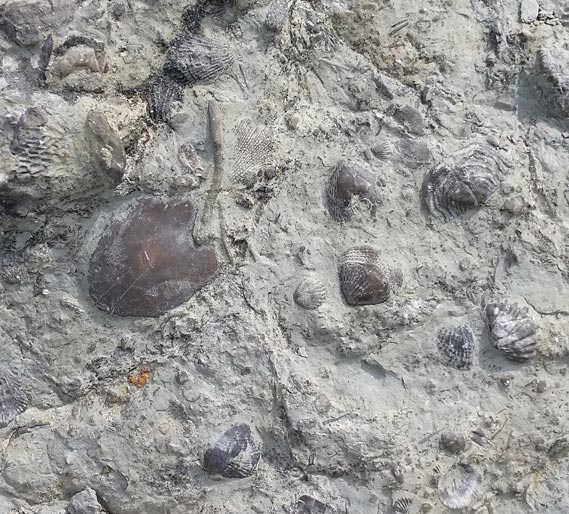
More than 700 different fossils found at Wren's Nest

Lots of brachiopod and coral fossils to find at Wren’s Nest.  The strata were deposited during the Silurian, a time when the Brachiopoda were abundant. Picture credit: Everything Dinosaur.

Picture credit: Everything Dinosaur

New Brachiopod Study

This new brachiopod study is a collaboration between the University of Bristol, the China University of Geosciences and the Open University.  The team found that following the end-Permian mass extinction event, the Brachiopoda were evolving in new directions, but this did not lead to many new species.  In comparison, the Mollusca became increasingly dominant.  Today, the Mollusca is an amazingly diverse phylum with more than 50,000 species. The Brachiopoda currently contains just 394 known species.  The research team found that brachiopods were evolving new shell shapes and ecological behaviours following the end-Permian mass extinction, but their diversity did not grow.

Lead author Dr Zhen Guo (China University of Geosciences) explained:

“In the Palaeozoic, from 540 to 250 million years ago, brachiopods ruled the seabed.  Most of them are quite small–you could hold twenty of them in your hands; but others were big and thick-shelled and lived a long time. Their shells were anything from circular to widely stretched and they had either smooth shells or carried deep ridges and troughs.”

Professor Michael Benton (University of Bristol), a co-author of the new brachiopod study, commented:

“The brachiopods were hit very hard by the end-Permian mass extinction 252 million years ago.  The group could have disappeared completely, and indeed from that point, molluscs just became more and more successful. For a long time, it was thought that the brachiopods remained rare because the survivors were stuck in just a few modes of life.”

Studying Over 1,000 Brachiopod Genera

This new research involved the analysis of a vast brachiopod database.  More than 1,000 genera were studied.  This database was comprised of brachiopods that lived after the Permian.  For each genus, the analysts recorded dozens of measurements of the overall shape of the shells, their external sculpture, and internal anatomy. These features were analysed together to provide measurements of overall diversity of shapes for each major brachiopod group at each point in geological time. This measure of “diversity of shape”, is referred to in biology as “disparity”.  An understanding of shape innovations and changes over time could then be plotted.

These Mesozoic-Cenozoic brachiopods were adapting to different modes of life, but there were fewer species evolving than expected.
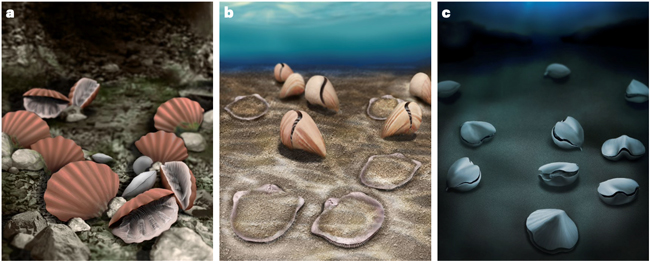
Brachiopods showing adaptations to different environments.

Reconstructions of some Mesozoic-Cenozoic brachiopods, showing adaptations to certain environments. Picture credit: Shunyi Shi.

Picture credit: Shunyi Shi

The co-author from the Open University, Dr Tom Stubbs added:

“In fact, the post-extinction brachiopods were innovating and trying new modes of life. One group, the terebratulids, were diversifying their body shapes and ecological functions from the end of the Permian to the present day, but their diversity did not increase.”

To read about an earlier, related brachiopod study conducted by University of Bristol researchers: Brachiopods and Bivalves (Mollusca) Faunal Turnover Study.

Unexpected Results

Fellow researcher Professor Zhong-Qiang Chen of the China University of Geosciences said:

“This was quite unexpected. Brachiopods were far from failures after the end-Permian extinction. They were evolving in new directions and exploring new modes of life, just as the molluscs were at the same time. But this did not turn into evolutionary success in terms of the numbers of species. Despite their bursts of evolution in form and function, they could not spread widely, and the exact reason remains unclear.”

Modern brachiopods represent the tip of the ecological iceberg for this once immensely abundant phylum.  Extant species do not provide scientists with an understanding of their extremely successful lineage, but we don’t know why these marine creatures did not become super-abundant again after the Permian.

Dr Zhen Guo explained the importance of this research.  This new brachiopod study suggests that disparity and diversity are effectively decoupled, at least as far as the Brachiopoda after the Permian are concerned.

Dr Zhen Guo concluded:

“It’s important to understand modern biodiversity in terms of the processes that lie behind it.”

Everything Dinosaur acknowledges the assistance of a media release from the University of Bristol in the compilation of this article.

The scientific paper: “Morphological innovation did not drive diversification in Mesozoic–Cenozoic brachiopods” by Zhen Guo, Michael J. Benton, Thomas L. Stubbs, and Zhong-Qiang Chen published in Nature Ecology & Evolution.

The Everything Dinosaur website: Prehistoric Animal Toys.

Go to Top