All about dinosaurs, fossils and prehistoric animals by Everything Dinosaur team members.
26 01, 2026

Why Choosing a Specialist Dinosaur Model Retailer Matters

By |2026-02-03T11:51:14+00:00January 26th, 2026|Categories: Dinosaur Fans|0 Comments

Buying a prehistoric animal figure is not always straightforward. Many retailers sell prehistoric figures. However, very few truly understand them. That difference matters. Everything Dinosaur is a specialist dinosaur model retailer.

At Everything Dinosaur, specialism comes first. From the outset, the focus has been on scientifically accurate dinosaur and prehistoric animal models. Consequently, accuracy is never an afterthought.  The company has been supplying dinosaur and prehistoric animal figures for over twenty years.

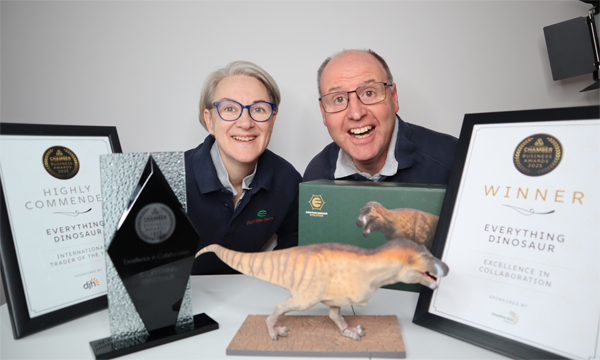
Mike and Sue with the first awards for the Everything Dinosaur Evolution T. rex figure.

Sue and Mike from Everything Dinosaur with their numerous awards. The company won the Excellence in Collaboration award and received Highly Commended for their international sales. It’s official! Everything Dinosaur is an award-winning specialist retailer of scientifically accurate dinosaur and prehistoric animal models. Picture credit: Everything Dinosaur.

Picture credit: Everything Dinosaur

A Specialist Dinosaur Model Retailer

Moreover, specialist knowledge helps customers make better choices. Models vary in scale, purpose, and level of detail. Therefore, understanding anatomy, posture, and fossil evidence is essential. General toy retailers rarely offer this depth. In contrast, a specialist retailer can explain why one figure is more accurate than another.

In addition, many models are used in education. Teachers, museums, and collectors need confidence in what they buy. For that reason, scientifically informed sourcing is crucial. It also ensures models support learning, not misconceptions.

Furthermore, specialist retailers often work closely with designers and manufacturers. This allows new figures to reflect current palaeontological research. As a result, customers gain access to up-to-date reconstructions.

Ultimately, expertise adds value. It builds trust, improves understanding, and enhances enjoyment. When accuracy matters, choosing a specialist makes all the difference.

Mike from Everything Dinosaur comments:

“We are a multi-award-winning specialist dinosaur model retailer, with over twenty years’ experience of the industry. For us, it is about trying to help educate and inform.  For example, we provide free prehistoric animal fact sheets with prehistoric animal figures.  Currently, I am working on new fact sheets for the theropod dinosaurs Tameryraptor and Taurovenator.”

For dinosaur and prehistoric animal figures, visit: Scientifically Accurate Dinosaur and Prehistoric Animal Models.

25 01, 2026

Everything Dinosaur Reviews Earn Feefo Platinum Trusted Service Award

By |2026-01-27T14:45:52+00:00January 25th, 2026|Categories: Everything Dinosaur News and Updates|0 Comments

Everything Dinosaur reviews have helped our company achieve a major milestone. We are delighted to announce that Everything Dinosaur has received the Feefo Platinum Trusted Service Award. This exclusive accolade recognises businesses that deliver outstanding customer experiences year after year.  This is the sixth year in a row we have won the prestigious Feefo Platinum Trusted Service Award.  Furthermore, we have been awarded this accolade every year since its inception.

Everything Dinosaur reviews earn Platinum Trusted Service Award.

Consistently excellent Everything Dinosaur reviews has led to the award from Feefo of the prestigious Platinum Trusted Service Award. Picture credit: Feefo.

Picture credit: Feefo

Top Marks for Everything Dinosaur Reviews

Feefo awards Platinum status only to companies that achieve the highest standards of customer service. This recognition reflects our ongoing commitment to excellent customer service. It also shows how much our customers value our expertise, reliability, and friendly support.

A blog post highlighting a typical Everything Dinosaur customer service review: Terrific Feedback from Feefo.

Feefo bases its awards on verified customer feedback. Therefore, Everything Dinosaur reviews provide a genuine and transparent insight into our service. In a digital world where reviews can be manipulated, Feefo’s verified system gives customers confidence and peace of mind.

As award winners we receive a set of digital and print assets that we can use in our marketing.  For example, we have a new Feefo badge to display on our website.

Everything Dinosaur's Platinum Trusted Service Award badge (2026).

We can display our Platinum Trusted Service Award badge (2026) on our website and on our social media platforms. Picture credit: Feefo.

Picture credit: Feefo

A Wonderful Achievement

Mike, Co-owner of Everything Dinosaur, commented:

“Achieving the Platinum Trusted Service Award is a wonderful achievement for our team. Our customers consistently tell us how much they appreciate our service, and this award confirms that we are delivering on our promises.”

As we move into 2026, shoppers increasingly seek trusted, human-centric brands with good reputations. We strive to provide expert advice, fast dispatch, and exceptional customer care. This award highlights our dedication to building long-term customer relationships.

We would like to thank all our customers for their support and for sharing their feedback. Your reviews help us improve and continue delivering the best possible service to prehistoric animal fans worldwide.

The multi-award-winning Everything Dinosaur website: Dinosaur Models and Toys.

24 01, 2026

Rhynie Chert Fossils Provide a Rare and Extraordinary Window into Early Devonian Life

By |2026-01-27T11:03:41+00:00January 24th, 2026|Categories: Palaeontological articles|0 Comments

The Rhynie chert fossils represent one of the most important palaeontological discoveries ever made. This unique Scottish site preserves an Early Devonian ecosystem in astonishing detail. As a result, scientists can learn about an ancient palaeoenvironment.  The biota that existed in a swamp close to hot, mineral-rich springs was like nothing known on Earth today.

Moreover, the Rhynie chert captures life in situ. It preserves hot spring environments, early land plants, arthropods, and microbial communities. Therefore, it provides a rare snapshot of terrestrial ecosystems around 407 million years ago.  As part of a media release concerning a new study into the giant, enigmatic taxon Prototaxites, we received an artist’s impression of the Rhynie chert Devonian landscape.

The Rhynie Chert - a palaeoenvironment reconstruction.

Artist’s impression of what the environment at Rhynie, Aberdeenshire, where the Prototaxites fossils were discovered, would have looked like 410 million years ago. Picture credit: Matt Humpage.

Picture credit: Matt Humpage

Researching Rhynie Chert Fossils

Recent research has provided additional insight. A recent study suggests that Prototaxites does not belong to fungi or plants. Instead, it may represent an entirely unknown complex life form. This discovery reshapes how we understand early terrestrial life and evolutionary experimentation.

To read our blog post about this research: Beautiful Rhynie Chert Fossils Reveal Their Secrets.

The Rhynie chert fossils continue to challenge long-held assumptions. They demonstrate that Early Devonian ecosystems were already diverse and surprisingly sophisticated. Consequently, this site remains a global reference point for palaeobiology and evolutionary research.

Mike from Everything Dinosaur commented:

“Museum fossil collections are invaluable. Fossils collected decades ago can play a role in new research. Improved analytical techniques allow scientists to re-examine old specimens and uncover fresh insights. We still have so much to learn about our incredible planet and its deep evolutionary history.”

The Rhynie chert fossils continue to transform our understanding of early terrestrial life. They remind us that evolution experimented in unexpected ways during the Devonian.

Everything Dinosaur acknowledges the assistance of the National Museums of Scotland in the compilation of this article.

Visit the Everything Dinosaur website: Models of Prehistoric Animals and Plants.

23 01, 2026

New Papo Edmontosaurus Model in Stock

By |2026-01-25T17:14:00+00:00January 23rd, 2026|Categories: Papo Prehistoric Animal Models|0 Comments

Everything Dinosaur stocks the new Papo Edmontosaurus model.  It is the first new Papo figure to arrive this year (2026).  Papo is a popular range with prehistoric animal model collectors.  The Edmontosaurus is beautiful, it is a fantastic colour scheme.

Papo Edmontosaurus figure shown in lateral view.

The Papo Edmontosaurus figure measures over twenty-four centimetres in length. Picture credit: Everything Dinosaur.

Picture credit: Everything Dinosaur

The Papo “Les Dinosaures” range includes several duck-billed dinosaurs. For example, Corythosaurus and Parasaurolophus.  Papo has added a row of spines running down from the back of the head down to the tip of the tail.  The mouth is open and the design team have added lots of detail.

To view the range of Papo prehistoric animal models in stock: Papo Prehistoric Animal Models.

The New Papo Edmontosaurus Model

The model measures over twenty-four centimetres long.  Papo does not declare a scale for their figures.  Moreover, it is difficult to determine how big this herbivore was.  However, the absence of a head crest suggests that this model could represent E. annectens. The largest individuals of this species could reach a length of thirteen metres. If a conservative twelve metre size is considered, then a model around twenty-four centimetres long would be in 1:50 scale.

The Papo Edmontosaurus model shown in anterior view.

The new Papo Edmontosaurus model shown in anterior view. Picture credit: Everything Dinosaur.

Picture credit: Everything Dinosaur

Mike from Everything Dinosaur comments:

“The Papo Edmontosaurus model is a beautiful figure.  It has an expressive face, and the painting scheme is carefully applied.  This saurolophine is likely to be extremely popular with dinosaur model fans.”

Visit the award-winning Everything Dinosaur website: Dinosaur and Prehistoric Animal Models.

22 01, 2026

New Research Postulates Giant, Prehistoric Kangaroos Could Still Hop

By |2026-01-22T07:30:00+00:00January 22nd, 2026|Categories: Palaeontological articles|0 Comments

Researchers studying the fossilised remains of giant, prehistoric kangaroos have concluded that even marsupials weighing more than two hundred kilograms were not too big to hop. This new study, published in the academic journal “Scientific Reports” challenges the long-held view that these giants were walkers rather than hoppers. The research team examined fossils of short-faced kangaroos (Sthenurinae). During the Pleistocene some of these kangaroos evolved giant, robust forms. Their method of locomotion remains controversial. Did humans encounter walking giant short-faced kangaroos or did they witness a sthenurine hopping?

Cast of the skelton of Sthenurus occidentalis. Was this a hopping stenurine?

Cast of a sthenurine skeleton (Sthenurus occidentalis) in the South Australian Museum. Picture credit Megan Jones.

Picture credit: Megan Jones

A Sthenurine Hopping Hypothesis

The Sthenurinae are a subfamily of the Macropodidae. The Macropodidae is a large family of marsupials that includes kangaroos, wallabies and their relatives. The largest extant kangaroo is the red kangaroo (Osphranter rufus). Males can weigh as much as ninety kilograms and stand 1.6 metres tall. They are the largest terrestrial mammal native to Australia and the largest living marsupial. However, during the Pleistocene, much larger kangaroos evolved.  For example, whilst small, wallaby-sized sthenurines are known, other taxa were much larger than living kangaroos. The sthenurine Procoptodon goliah is thought to be the biggest kangaroo that ever existed.  Males stood around two metres tall and weighed perhaps as much as two hundred and forty kilograms.

Life reconstruction of a sthenurine hopping.

Reconstruction of a giant short-faced kangaroo (sthenurine) hopping. Picture credit: Megan Jones.

Picture credit: Megan Jones

Earlier studies suggested that hopping would become mechanically impossible above a body weight of a hundred and fifty kilograms. Those conclusions were largely based on studies of extant kangaroo skeletons.  The anatomy of modern kangaroos was simply scaled up.

To read a blog post from 2014 that looked at evidence for walking locomotion in largest members of the Sthenurinae: Giant Kangaroos Made for Walking.

This new study involved scientists from The University of Manchester, in collaboration with the University of Bristol and the University of Melbourne.  These researchers took a different approach.  Measurements taken from the skeletons of extant species were compared with the fossil remains of extinct species.  The researchers conclude that giant kangaroos may have been capable of hopping.  Indeed, early Australians could have observed a sthenurine hopping.

Lead Researcher Megan Jones, (The University of Manchester) explained:

“Previous estimates were based on simply scaling up modern kangaroos, which may mean we miss crucial anatomical differences. Our findings show that these animals weren’t just larger versions of today’s kangaroos, they were built differently, in ways that helped them manage their enormous size.”

Examining the Two Limiting Factors for Hopping

The research team examined two potential limiting factors for hopping, the strength of the foot bones and the ability of the ankle to anchor the powerful tendons that power hopping.  The analysis demonstrated that giant, short-faced kangaroos had shorter, robust foot bones capable of withstanding landing forces and their heel bones were broad enough to support much thicker tendons.

However, Pleistocene giant kangaroos probably did not bounce across the landscape like modern red kangaroos.

Co-author Dr Katrina Jones (Bristol University), stated:

“Thicker tendons are safer, but they store less elastic energy. This likely made giant kangaroos slower and less efficient hoppers, better suited to short bursts of movement rather than long-distance travel. But hopping does not have to be extremely energy efficient to be useful, these animals probably used their hopping ability to cross rough ground quickly or to escape danger.”

Giant short-faced kangaroo heel bone.

Heel bone (calcaneum) of the largest kangaroo species, Procoptodon goliah. P. goliah stood over two metres tall and had an estimated body mass of 240 kilograms, almost three times the size of the largest living kangaroos. Picture credit: Megan Jones/UCMP.

Picture credit: Megan Jones/UCMP

A Range of Locomotion Strategies Identified

The fossil analysis also reveals a range of locomotion strategies adopted by extinct kangaroos.  Some giants may have mixed hopping with other forms of movement, including bipedal walking and moving around on all fours.  Sthenurine hopping may have just been one part of a broader “movement repertoire”.  The research implies different ecological niches for prehistoric kangaroos.

Fellow researcher and co-author Dr Robert Nudds, Senior Lecturer in Evolution, Infection and Genomics at The University of Manchester commented:

“Our findings contribute to the notion that kangaroos had a broader ecological diversity in prehistoric Australia than we find today, with some large species grazers like modern kangaroos while others were browsers – an ecological niche not seen in today’s large kangaroos.”

The research provides the most comprehensive assessment to date of the mechanical feasibility of hopping in giant extinct kangaroos.

Everything Dinosaur acknowledges the assistance of a media release from The University of Manchester in the compilation of this article.

The multi-award-winning Everything Dinosaur website: Models and Replicas of Prehistoric Mammals.

21 01, 2026

Early Devonian Prototaxites A “New” Form of Life

By |2026-01-27T09:32:34+00:00January 21st, 2026|Categories: Palaeontological articles|0 Comments

Newly published research suggests that Early Devonian Prototaxites was a “new” form of life.  This giant organism, represented in the fossil record by columnar fossils up to eight metres tall, is distinct from plants and fungi.  Writing in the academic journal “Science Advances”, scientists from the University of Edinburgh and National Museums Scotland postulate that Prototaxites fossils represent a complex lifeform that is neither a fungus or a plant. Furthermore, the researchers postulate that these novel organisms died out around 360 million years ago.

Prototaxites life reconstruction.

An artist impression of what Prototaxites would have look like in life. It is surrounded by primitive plants in the Rhynie chert landscape. Picture credit Matt Humpage.

Picture credit: Matt Humpage

Studying Prototaxites Fossils

The fossil at the centre of this investigation comes from the famous Rhynie chert. Named after the nearby village of Rhynie in Aberdeenshire (Scotland), the rocks preserve a terrestrial ecosystem that existed approximately 407 million years ago.  Hot springs saturated with minerals periodically inundated a nearby marsh ecosystem.  The primitive plants and other organisms were preserved in amazingly detail.  Cell walls and pore spaces were replaced by these minerals.  The fossils from this locality provide a unique insight into early terrestrial plant communities.

The fossil material used in this study will be housed and cared for at the National Museums Collection Centre in the north of Edinburgh.

Lead co-author Dr Sandy Hetherington, Research Associate at National Museums Scotland and Senior Lecturer from the School of Biological Sciences at the University of Edinburgh, explained:

“It’s really exciting to make a major step forward in the debate over Prototaxites, which has been going on for around 165 years. They are life, but not as we now know it, displaying anatomical and chemical characteristics distinct from fungal or plant life, and therefore belonging to an entirely extinct evolutionary branch of life. Even from a site as loaded with palaeontological significance as Rhynie, these are remarkable specimens and it’s great to add them to the National Collection in the wake of this exciting research.”

Prototaxites fossil study.

National Museums Scotland Research Associate Sandy Hetherington with a sample of the 410-million-year-old fossil of Prototaxites. Picture credit: Neil Hanna.

Picture credit: Neil Hanna

Prototaxites (P. taiti) Chemically and Structurally Distinct from Fungi

Following an analysis of the Prototaxites fossil material, the research team concluded that this organism was chemically distinct from contemporaneous fungi. In addition, the study demonstrates that it is structurally distinct from all known fungi.

Co-lead and first author Dr Corentin Loron (UK Centre for Astrobiology at the University of Edinburgh) said:

“The Rhynie chert is incredible. It is one of the world’s oldest fossilised terrestrial ecosystems and because of the quality of preservation and the diversity of its organisms, we can pioneer novel approaches such as machine learning on fossil molecular data. There is a lot of other material from the Rhynie chert already in museum collections for comparative studies, which can add important context to scientific results.”

Prototaxites fossil sample being examined.

Co-author of the study Corentin Loron from the University of Edinburgh with a slice sample of the Prototaxites fossil. Picture credit: Neil Hanna.

Picture credit: Neil Hanna

A Separate and Entirely Extinct Form of Life

This study casts doubt upon the fungal affinity of Prototaxites, instead suggesting that this enigmatic organism is best assigned to an entirely extinct eukaryotic lineage.

Co-first author Laura Cooper, a PhD student from the Institute of Molecular Plant Sciences at the University of Edinburgh, added:

“Our study, combining analysing the chemistry and anatomy of this fossil, demonstrates that Prototaxites cannot be placed within the fungal group. As previous researchers have excluded Prototaxites from other groups of large complex life, we concluded that Prototaxites belonged to a separate and now entirely extinct lineage of complex life. Prototaxites therefore represents an independent experiment that life made in building large, complex organisms, which we can only know about through exceptionally preserved fossils.”

Dr Nick Fraser, Keeper of Natural Sciences at National Museums Scotland said:

“We’re delighted to add these new specimens to our ever-growing natural science collections which document Scotland’s extraordinary place in the story of our natural world over billions of years to the present day. This study shows the value of museum collections in cutting-edge research as specimens collected over time are, cared for and made available for study for direct comparison or through the use of new technologies.”

Everything Dinosaur acknowledges the assistance of the National Museums of Scotland in the compilation of this article.

The scientific paper: “Prototaxites fossils are structurally and chemically distinct from extinct and extant Fungi” by Corentin C. Loron, Laura M. Cooper, Sean McMahon, Seán F. Jordan, Andrei V. Gromov, Matthew Humpage, Niall Rodgers, Laetitia Pichevin, Hendrik Vondracek, Ruaridh Alexander, Edwin Rodriguez Dzul, Alexander T. Brasier, Michael Krings, and Alexander J. Hetherington published in Science Advances.

The award-winning Everything Dinosaur website: Prehistoric Animal and Prehistoric Plant Models.

20 01, 2026

Praising the PNSO Paul the Allosaurus Dinosaur Model

By |2026-02-02T22:16:42+00:00January 20th, 2026|Categories: PNSO Age of Dinosaurs Models|0 Comments

PNSO produces excellent theropod figures.  For instance, their figure of an Allosaurus has received praise from dinosaur fans and collectors.  Paul the Allosaurus figure is regarded as an exceptional example of the art of theropod model making.

PNSO Paul the Allosaurus dinosaur model.

The PNSO Paul the Allosaurus dinosaur model shown in lateral view. Picture credit: Everything Dinosaur.

Picture credit: Everything Dinosaur

To view the range of PNSO dinosaur models in stock: PNSO Age of Dinosaurs Models.

Praising the PNSO Paul the Allosaurus Dinosaur Model

Paul the Allosaurus dinosaur model is a favourite theropod of collectors. Everything Dinosaur receives model reviews and this Allosaurus has had its fair share.  For example, one reviewer on the Everything Dinosaur website exclaimed that they had been waiting ages for an accurate Allosaurus.  Furthermore, the PNSO Allosaurus ticks all their boxes.  The reviewer stated that the model is exceptional.

Another collector (Greg) wrote:

“Allosaurus is my absolute favourite dinosaur. I have a number of these, and Paul is a brilliant addition to my collection.”

We receive lots of complimentary messages from dinosaur fans about PNSO models.  It is a pleasure to receive comments and feedback.  In addition, Allosaurus is one of our favourite theropods and we like the PNSO figure too.

Visit the Everything Dinosaur website: Visit Everything Dinosaur.

19 01, 2026

New Study Highlights the Potential Presence of Small Pterosaurs in the Late Cretaceous

By |2026-01-25T13:46:59+00:00January 19th, 2026|Categories: Palaeontological articles|0 Comments

Researchers have reported the discovery of a fragment of pterosaur finger bone from the UNESCO World Heritage site Stevns Klint. The Stevns Klint cliffs are located on the eastern coast of the Danish island of Sjaelland. The fossil along with other fragmentary bones, was found in the uppermost Maastrichtian, Højerup Member of the Møns Klint Formation strata of Holtug limestone quarry.  This is the first time that pterosaur remains have been reported from this location.  The specimen is a piece of the phalanx 1 of digit IV (the wing finger).  Its size suggests that small-bodied pterosaurs with a wingspan of less than half a metre existed during the last fifty to sixty thousand years of the Cretaceous.

Unfortunately, it is not possible to determine whether the specimen is an adult or juvenile.  However, if the fossil represents a bone from an adult pterosaur, then this is the smallest pterosaur known from the Late Cretaceous.

It overlaps in size with contemporaneous birds, rejecting previous hypotheses that Late Cretaceous pterosaurs and birds avoided competition through size-based niche partitioning.

Pterosaur finger bone fossil and idealised diagram of a pterosaur showing location on the skeleton.

Fragments of the pterosaur finger bone and skeletal reconstruction showing location of a bone fragment. Drawing of pterosaur skeleton showing location of fragment OESM 13096 in red (A). OESM 13096 (B) left phalanx 1 of digit IV in ventral view, dorsal (C), posterior (D), proximal (E), and distal (F) views. OESM 13323, fragment of phalanx 2 or phalanx 3 of digit IV in lateral (G) and ventral (H) views, end cross-sections (I, J). Specimen number OESM 13324 (D) unidentifiable fragment displaying numerous (pneumatic) foramina, rotated around vertical axis in different views (K, L, M). Picture credit: Milàn et al.

Picture credit: Milàn et al

Studying a Fragmentary Pterosaur Finger Bone

The preserved fragments indicate the individual was perhaps a tenth to a fifth the size of the smallest of the latest Maastrichtian pterosaurs from Morocco (Alcione elainus). It is not possible to provide a more precise taxonomic assessment of the specimen, other than referring it to the Pterosauria.  The researchers conclude that these bones could indicate a flying reptile with a wingspan of perhaps twenty to fifty centimetres. For comparison, the common blackbird (Turdus merula) has a wingspan of around thirty-five to forty centimetres.  This could be evidence of small pterosaurs present in the late Maastrichtian of the Cretaceous.  Ironically, a time when it had been thought that birds had replaced small pterosaur species.

Everything Dinosaur’s blog post about pterosaur diversity in the Late Cretaceous: Late Cretaceous Pterosaurs More Diverse Than Previously Thought.

The Stevns Klint Palaeoenvironment

The strata comprising the cliffs on the island of Sjaelland are remarkable. The limestone and chalk deposits represent a sequence of deposition from the very end of the Cretaceous through to the Palaeogene (Danian faunal stage of the Palaeocene). As such, these rocks provide scientists with an insight into the last few thousand years of the Cretaceous and the period immediately after the End-Cretaceous extinction event.

It had been thought that the emergence of birds led to the extinction of small pterosaur species. The niches previously occupied by small-bodied pterosaurs were gradually filled by birds. However, this pterosaur finger bone discovery and the other specimens suggest that this might be an oversimplification of the true picture. That small pterosaurs did persist until the end of the Cretaceous.

Palaeogeographic map of northern Europe with Stevns Klint location where pterosaur finger bone fossil was found highlighted.

Palaeogeographic map of northern Europe during the end Maastrichtian, showing the location of the present day Stevns Klint. The nearest coastline was at that time located approximately 150 km northeast in the Fenno-Scandian landmass in what is today southern Sweden. Picture credit: Milàn et al.

Picture credit: Milàn et al

An Additional Implication for the Pterosauria

If the new pterosaur specimen derives from a near or fully grown adult individual, then it is evidence for the presence of at least one taxon of small-bodied pterosaur persisting until the end of the Cretaceous. Intriguingly, this discovery opens up another scenario concerning Late Cretaceous pterosaurs.  If the fossil is from a hatchling or juvenile of a species that attained much larger size when fully grown, then it was already capable of flying great distances.  The fossil material comes from the Højerup Member.  These rocks were laid down in a relatively deep-water environment at least ninety miles (one hundred and fifty kilometres) offshore.  Hatchling pterosaurs were likely super-precocial and capable fliers.

Previous studies suggested that hatchling or juvenile pterosaurs were initially adapted to active sustained flight in restricted, vegetation-filled environments. As they grew and matured, they became more efficient long-distance gliders necessarily utilising more open environments. In turn, this supports the idea of niche partitioning in pterosaurs, where individuals at different ages occupied different ecological niches and environments.  However, this fossil material, if not from an adult, indicates that even young pterosaurs were capable of flying considerable distances in open environments.

The Pterosauria are an enigmatic clade.  They were the first vertebrates to evolve powered flight.   This study highlights that we still have a lot to learn about these remarkable flying reptiles.

Everything Dinosaur acknowledges the assistance of one of the paper’s authors (Jesper Milàn) in the compilation of this article.

The scientific paper: “A diminutive pterosaur from the uppermost Maastrichtian chalk of Denmark” by Jesper Milàn, Sten Lennart Jakobsen and Bent Erik Kramer Lindow published in
Acta Palaeontologica Polonica.

For pterosaur models and figures: Pterosaur and Dinosaur Models.
18 01, 2026

Helping Teachers and Teaching Assistants with Prehistoric Animal Facts

By |2026-01-23T06:40:47+00:00January 18th, 2026|Categories: Teaching|Tags: , , |0 Comments

Teaching aids play a vital role in primary education. However, accuracy must always come first. At Everything Dinosaur, we support teachers and teaching assistants.  We have produced helpful lesson plans and have even outlined term topics.  Unfortunately, some teaching materials still promote misleading ideas, including illustrations of “swimming dinosaurs”.

Team members at Everything Dinosaur recall spotting a misleading teaching aid. An image showed a plesiosaur. However, the caption referred to swimming dinosaurs. This is incorrect. Plesiosaurs were marine reptiles, not dinosaurs.  In addition, another visual referred to “Tyrannosaurus Rex”. In binomial nomenclature, the trivial or species name is never capitalised.

Swimming Dinosaurs and other information.

Spotted in a primary school, a series of pictures of prehistoric animals. However, not all the information is correct. Picture credit: Everything Dinosaur.

Picture credit: Everything Dinosaur

Swimming Dinosaurs? Why Accuracy Matters in the Classroom

Such mistakes may seem minor. However, they undermine learning. Children build knowledge step by step. Therefore, early inaccuracies can create long-term confusion.  Marine reptiles such as the Plesiosauria lived during the Mesozoic, non-avian dinosaurs are also associated with the Mesozoic.  However, plesiosaurs are not members of the Dinosauria.  In fact, they are not closely related. Consequently, grouping them together weakens scientific understanding.

Everything Dinosaur believes clarity is essential. Accurate terminology supports curiosity and confidence. Most importantly, it encourages children to ask better questions.

By challenging misconceptions about marine reptiles and swimming dinosaurs, educators can promote stronger, evidence-based learning in the classroom.

Mike from Everything Dinosaur commented:

“At Everything Dinosaur, we are committed to helping people.  We demonstrate this in various ways. For example, we answer lots of questions about dinosaurs and we supply free prehistoric animal fact sheets with the models we sell.  Helping to inform and educate about the amazing creatures that once roamed our planet is at the heart of everything we do.”

Fact sheets prepared by Everything Dinosaur for the Beasts of the Mesozoic range of models.
A collection of Beasts of the Mesozoic fact sheets created by Everything Dinosaur.  Information sheets are supplied free of charge. Picture credit: Everything Dinosaur.

Picture credit: Everything Dinosaur

The multi-award-winning Everything Dinosaur website: Dinosaur and Prehistoric Animal Figures.

17 01, 2026

New Arrivals at Everything Dinosaur

By |2026-01-20T15:01:32+00:00January 17th, 2026|Categories: Beasts of the Mesozoic Models|Tags: , , |0 Comments

Exciting news for collectors everywhere. New stock of Beasts of the Mesozoic articulated models has arrived at the Everything Dinosaur warehouse. In addition, fresh deliveries from the Beasts of the Cenozoic range are now safely in storage. These highly detailed figures remain hugely popular with collectors. As a result, demand has once again been extremely strong. Each model features exceptional articulation, accuracy, and display potential. Collectors and dinosaur fans also use these figures to make innovative stop motion videos. Therefore, these ranges continue to attract collectors, educators, and palaeontology fans alike.

Mike from Everything Dinosaur shared his enthusiasm for the range. He explained:

“We are delighted to have Beasts of the Mesozoic back in stock. The response has been incredible. We will now be contacting all customers who asked us to reserve a figure for them.”

Meanwhile, packing and customer notifications are already underway. Consequently, reserved models will be allocated promptly. However, remaining stock is limited.

Collectors are advised to act quickly. These Beasts of the Mesozoic figures rarely stay available for long.

More Beasts of the Mesozoic figures in stock at Everything Dinosaur.

More stock of popular Beasts of the Mesozoic and Beasts of the Cenozoic models have arrived at our warehouse. Picture credit: Everything Dinosaur.

Picture credit: Everything Dinosaur

To view the Beasts of the Mesozoic/Beasts of the Cenozoic figures in stock: Beasts of the Mesozoic/Cenozoic Figures.

Beasts of the Mesozoic Figures

The first articulated models launched by the factory were sold under the Beasts of the Mesozoic banner.  The Beasts of the Cenozoic and Cyberzoic figures are later introductions.  The delivery includes items from the “Mesozoic”, “Cenozoic” and “Cyberzoic” brands.  Models in stock include the ceratopsian Medusaceratops, the theropod Dilong and the Cyberzoic Allosaurus jimmadseni model.

Mike added:

“The buzz surrounding these articulated figures has been amazing. New models are currently in production and due out soon, models such as Stegosaurus and Pachycephalosaurus.”

Meanwhile, Sue and Mike busy themselves picking and packing orders. Furthermore, reserved models will be rapidly despatched. Please note, remaining stock is limited.

Collectors are advised not to delay. Our current stock of many lines will soon be exhausted.

The award-winning Everything Dinosaur website: Prehistoric Animal Models and Figures.

Go to Top