

A recently published paper highlights Australia’s oldest known crocodilian eggshells. The study is helping researchers from the University of New South Wales to unlock clues to an ancient ecosystem that thrived before Australia became an island continent. The eggshell fragments have been assigned to the oospecies Wakkaoolithus godthelpi.
The fossilised fragments of eggshell are approximately fifty-five million years old (Eocene Epoch). The come from mekosuchine crocodiles. These now extinct crocodiles dominated inland waters during the Eocene. Modern saltwater and freshwater crocodiles only arrived in Australia around 3.8 million years ago.
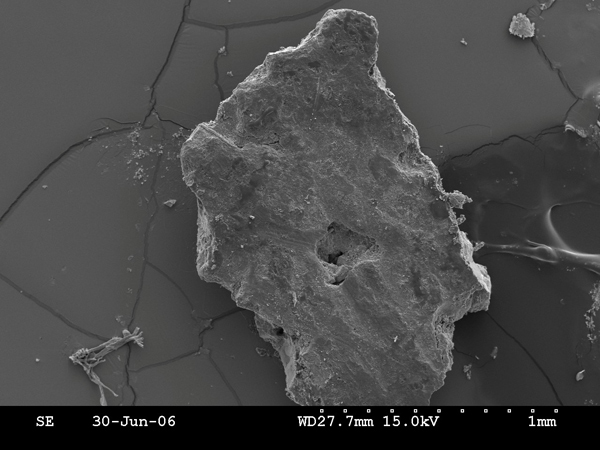
Electron microscope scans of the eggshell fragments. Picture credit: Xavier Panadès.
Picture credit: Xavier Panadès
Field teams have been working in clay pit close to the small town of Murgon in southeast Queensland. The clay layers preserve evidence of when Australia was still connected to South America and Antarctica. It is one of the oldest fossil sites in Australia. An international research team led by the Institut Català de Paleontologia Miquel Crusafont (ICP) in collaboration with researchers from University New South Wales (UNSW) identified the mekosuchine fossil eggshells.
Commenting on the significance of the fossil finds, lead author of the study Xavier Panadès i Blas (El Museu de la Conca Dellà, Isona, Spain), stated:
“These eggshells have given us a glimpse of the intimate life history of mekosuchines. We can now investigate not only the strange anatomy of these crocs, but also how they reproduced and adapted to changing environments.”
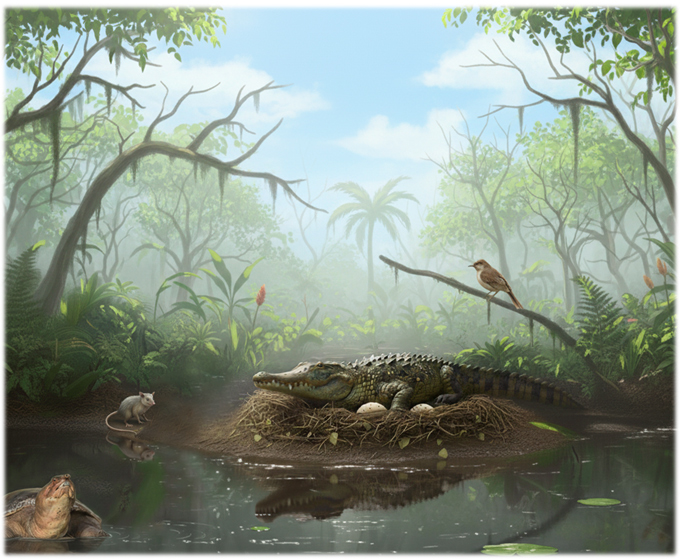
A virtual reconstruction of the Murgon palaeoecosystem during the Early Eocene, featuring the oospecies Wakkaoolithus godthelpi. Also shown is one of the abundant giant soft-shell turtles, Murgonomys braithwaitei, an archaic marsupial, Djarthia murgonensis, and an unnamed ancestral songbird. The clays that form the fossil deposit were accumulated in this ancient lake. Image: generated with Google Gemini AI.
Picture credit: Google Gemini AI
Swimming and Tree Climbing Crocodiles
Unlike Australia’s crocodiles today, mekosuchines filled much more varied ecological niches. For example, some species were almost entirely terrestrial and inhabited forests. Others were at home in the river systems and grew to at least five metres in length. Co-author of the paper, Professor Michael Archer (UNSW) has postulated that some species were at least partly arboreal, and these animals have been termed “drop crocs.”
Professor Archer added:
“They were perhaps hunting like leopards – dropping out of trees on any unsuspecting thing they fancied for dinner.”
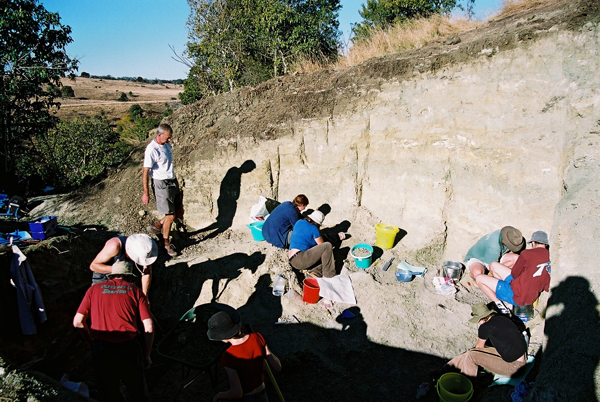
The palaeontological team from UNSW excavating the Tingamarra fossil deposit at Murgon, Queensland, Australia. The hard clay is quarried, dried and then soaked in water to release the fossils it contains. Photo credit: Mina Bassarova.
Picture credit: Mina Bassarova
Delicate Time Capsules
The authors state that tiny, fossilised eggshells are an underused resource in vertebrate palaeontology. They preserve microstructural and geochemical signals that provide information on the kinds of creatures that laid them but also where they nested and how they bred.
Xavier Panadès i Blas explained:
“Our study shows just how powerful these fragments can be. Eggshells should be a routine, standard component of palaeontological research – collected curated and analysed alongside bones and teeth.”
The shell fragments from the clay pit were examined under optical and electron microscopes. Their microstructure indicates that they were laid on the margins of a lake, with the reproductive strategy adapting to fluctuating conditions.
Co-author of the study, Dr Michael Stein (UNSW), commented that mekosuchine crocs may have lost much of their inland territory because of encroaching dry land. These crocodiles eventually had to compete in the shrinking waterways not only with new crocodilian rivals arriving in Australia but also with dwindling numbers of prey. As the climate became much drier, many of the large prey animals that these crocodiles hunted became rarer.
The researchers think that the lake was surrounded by a lush, tropical forest.
Dr Stein said:
“This forest was also home to the world’s oldest-known songbirds, Australia’s earliest frogs and snakes, a wide range of small mammals with South American links, as well as one of the world’s oldest bats.”

Wakkaoolithus godthelpi eggshell fragments shown in high magnification. Picture credit: Xavier Panadès.
Picture credit: Xavier Panadès
A Study with Teeth
The research into the Tingamarra deposits at Murgon is just part of a much bigger story. Professor Archer recalls finding a bizarre crocodilian jaw fragment in 1975 in the Texas Caves of southeastern Queensland. This jaw fossil has been confirmed to represent a mekosuchine crocodile. The large teeth in situ were linked to another type of extinct crocodile known from South America. This was the first evidence of crocodiles related to South American crocodiles being present in Australia during the Eocene.
Discoveries like this are more than just a glimpse into ancient history. They are reminders that Australia’s fossil record can provide important clues to help save today’s threatened species. For example, scientists have been working to help bring a small possum – Burramys parvus back from the brink of extinction. Researchers discovered that the possum’s prehistoric relatives, evolving over the past twenty-five million years, have always thrived in temperate lowland rainforests.
This led to the theory that the immediate ancestors of B. parvus likely followed the rainforests as they moved up into the alpine areas during a warm, wet interval during the Pleistocene Epoch. However, when the climate in the alpine zone changed and became cooler, these small marsupials had to evolve evasive behaviours such as hibernation to escape the increasingly hostile conditions.
Based on the findings from the fossil record a breeding facility in an area of non-alpine rainforest was set up. As a result, the numbers of Burramys parvus have increased. The possums are flourishing in a non-alpine sanctuary, just as the fossil record predicted.
Wakkaoolithus godthelpi Fossils Provide Guidance to Conservationists
As climate change threatens Australia’s fauna today, the fossil record can provide important indicators to assist with the conservation of species.
Professor Archer stated:
“Clues from the fossil record matter. Not just to understand the past, but also to help secure the future”.
The new crocodile species’ name, Wakkaoolithus godthelpi, acknowledges, with permission, the Wakka Wakka First Nations people, on whose Country the fossils were found. The second part of the name recognises Henk Godthelp, who was part of the UNSW palaeontologist crew along with Professor Archer, Professor Sue Hand and many other research staff and students.
Everything Dinosaur acknowledges the assistance of a media release from the University of New South Wales in the compilation of this article.
The scientific paper: “Australia’s oldest crocodylian eggshell: insights into the reproductive paleoecology of mekosuchines” by Xavier Panadès I Blas, Àngel Galobart, Michael Archer, Michael Stein, Suzanne Hand and Albert Sellés published in the Journal of Vertebrate Paleontology.
The award-winning Everything Dinosaur website: Prehistoric Animal Models.

Leave A Comment