

The First Evidence of Colour Patterning in Sauropod Dinosaur Skin
A new study published by the Royal Society Open Science reveals colour patterning in sauropod dinosaur skin. Interpretation of the preserved integumentary covering has led scientists to suggest that the dull grey, elephant-like colouration of sauropods is probably inaccurate. The peer-reviewed study was led by Tess Gallagher (Department of Palaeobiology, University of Bristol), and it provides exciting new information on the Sauropodomorpha.
This is the first reported evidence of colour patterning in a sauropod. Exceptionally preserved juvenile diplodocid (Diplodocus) skin impressions from Montana formed the basis of this study. The fossils come from the Mother’s Day Quarry (Morrison Formation) and for the purposes of this study they were ascribed to Diplodocus. However, the taxonomic classification of these sauropods might change with future research.
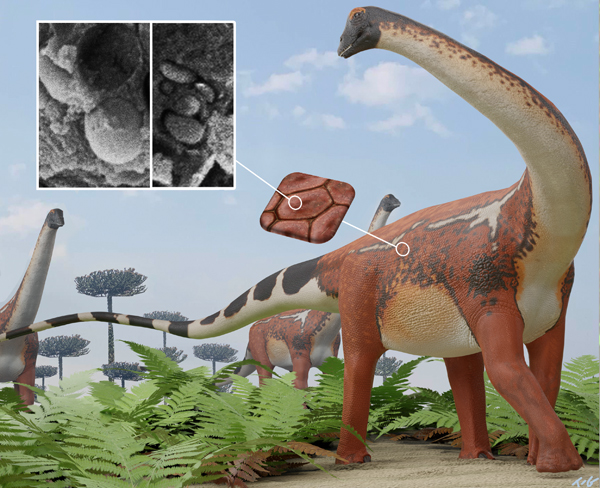
Sauropod dinosaur skin speculative life reconstruction with graphic microscopy (inset). Picture credit: Tess Gallagher.
Picture credit: Tess Gallagher
Studying Sauropod Dinosaur Skin
One of the key conclusions from the research is the confirmation of the presence of two distinct microbody morphotypes associated with the integument. These structures have been identified as melanosomes. Therefore, they are linked to pigmentation and colouration. The different shapes of these microbodies indicates that young sauropods may have displayed visual patterning rather than being a single uniform colour.
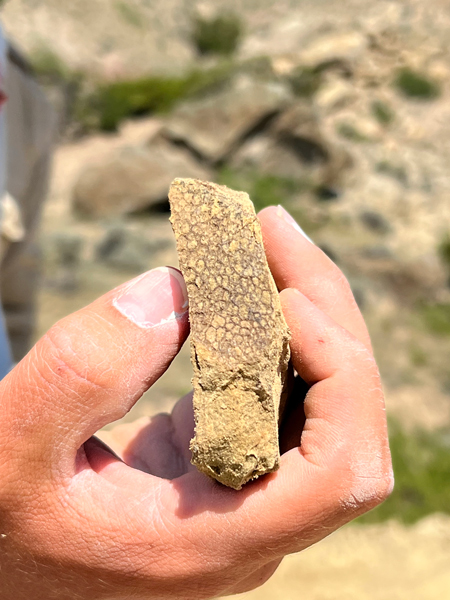
Elevation Science student holding a sample of Diplodocus fossilised skin. Picture credit: Joshua Levy.
Picture credit: Joshua Levy
It is possible that juvenile Diplodocus had complex colour patterning. Perhaps, these leviathans had similar colouration to extant archosaurs such as birds.
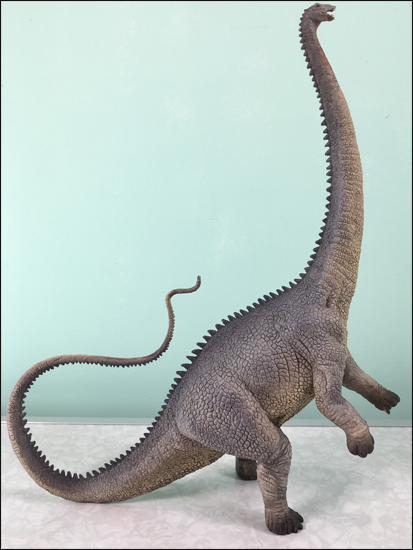
The new for 2020 CollectA rearing Diplodocus dinosaur model in the elephantine colour scheme. Many sauropods are depicted with a uniform colouration. This colouration has been inspired by large mammals alive today. However, new research suggests that Diplodocus had complex colour patterning. Picture credit: Everything Dinosaur.
Picture credit: Everything Dinosaur
Difficult to Confirm the Exact Colours
The first sauropod to be scientifically described from fossilised bones was Cetiosaurus (1842 – Owen). Initially thought to be aquatic lizards, these animals were mainly terrestrial and some of them grew to enormous sizes. Some taxa are regarded as the largest land animals that have ever existed. Although dozens of genera have been named, evidence for their colouration is lacking. This research provides a rare insight into the colouration of juvenile sauropods and opens new avenues for studying dinosaur biology and behaviour.
Commenting on the significance of the research, Tess Gallagher (University of Bristol) stated:
“This study investigates fossilised juvenile Diplodocus scales and marks the first instance of colour patterning found in a long-necked dinosaur. The skin is preserved 3-dimensionally as clay minerals with melanosome groups (melanin bearing organelles) dispersed throughout. Disk-shaped objects were found intermixed with the melanosomes. The disk-shaped objects are hypothesized to be melanosomes, though their bizarre shape makes it impossible to determine the true colour of the scales. Regardless, the results show juvenile sauropods could create more diverse melanosome morphologies than previously thought, akin to modern birds and mammals.”
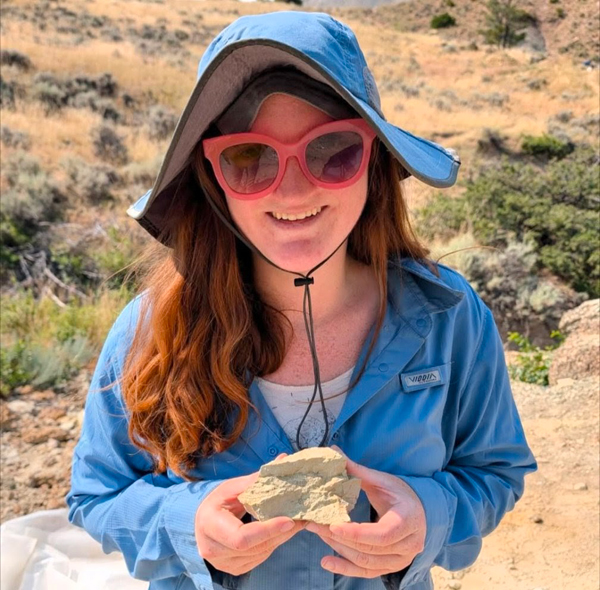
Field photo of Tess Gallagher holding a preserved skin impression. Picture credit: Skye Walker/Elevation Science Institute.
Picture credit: Skye Walker/Elevation Science Institute.
The Significance of Integumentary Fossils
Remarkable, well-preserved integumentary fossils have the potential to help us learn more about dinosaur physiology. In addition, we can infer ecological niches and the appearance of dinosaurs in terms of their colouration.
Co-author of the paper, Jason Schein (Executive Director of Elevation Science for Natural History Exploration) added:
“It wasn’t that long ago when it seemed impossible that we could even really know what dinosaurs truly looked like. Technology and innovative scientists like Tess are pushing us into new frontiers, and showing us what is actually possible.”
Everything Dinosaur acknowledges the assistance of a media release from the Elevation Science Institute for Natural History Exploration in the compilation of this article.
The scientific paper: “Fossilized melanosomes reveal colour patterning of a sauropod dinosaur” by Tess Gallagher, Dan Folkes, Michael Pittman, Tom G. Kaye, Glenn W. Storrs and Jason Schein published in the Royal Society Open Science.
The multi-award-winning Everything Dinosaur website: Models of Sauropods and Other Prehistoric Animals.