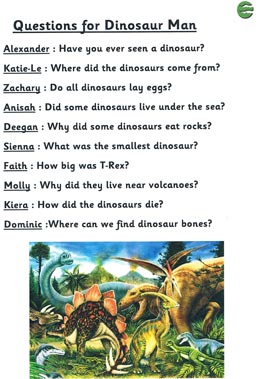
Everything Dinosaur team members have been asked to compile a short list of questions about dinosaurs by a researcher for a UK national radio programme. The researcher read the recent Everything Dinosaur blog article about the discovery of a large, tridactyl dinosaur footprint in Yorkshire and contacted the company with the request.
A spokesperson from Everything Dinosaur commented:
“We are delighted to help out and devise some dinosaur themed questions. Usually we are the ones being asked questions about prehistoric animals, by dinosaur fans of all ages. It makes a nice change to turn the tables.”
The questions compiled by pupils at Mayfield Primary. Normally, it is Everything Dinosaur team members who get asked questions about dinosaurs and prehistoric animals. Picture credit: Everything Dinosaur.
Questions About Dinosaurs
As requested by the radio station researcher, we have compiled a list of questions on dinosaurs.
The word “dinosaur” or to be technically correct the “Dinosauria” was first coined by a British scientist in the early 1840s – who was it?
What does the term dinosaur actually mean?
Tyrannosaurus rex is perhaps the most famous dinosaur of all, in what year was T. rex formally, scientifically described?
Dinosaur fossils are found in rock formations that were laid down during three geological time periods – one of these periods is called the Jurassic – hence the movie “Jurassic Park” but what are the names of the other two geological periods associated with the dinosaurs?
What was the name of the first dinosaur to be scientifically described?
The world’s first life-size dinosaur models are still in existence, but where in the world would you have to travel to if you wanted to see them?
The answers and accompanying notes will be prepared and made available to the researcher.
A team of scientists have been studying a Pinacosaurus larynx and have concluded that this armoured dinosaur was probably capable of producing a variety of sounds and calls.
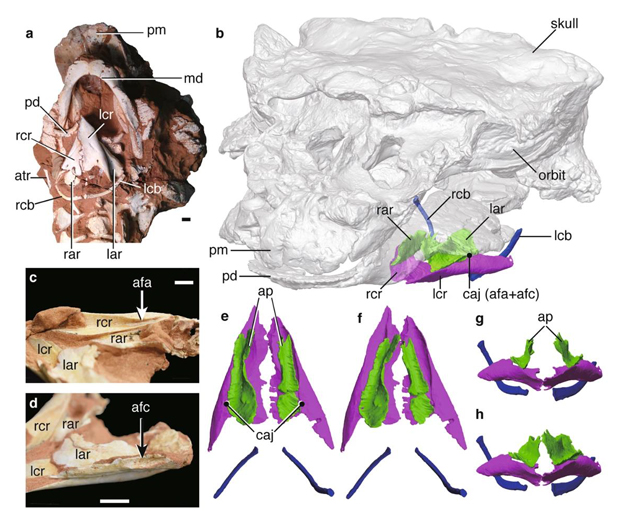
A juvenile specimen of Pinacosaurus (P. grangeri), specimen number IGM100/3186, preserves a hyoid and two laryngeal elements (cricoids and arytenoids) in almost life articulation. From these remains the researchers have concluded that just like crocodilians and birds, Pinacosaurus was capable of producing a range of vocalisations. The calls may have had several functions, to alert others of a predator approaching, to threaten a predator, to define territory or to search for a mate. The sounds made by this ornithischian dinosaur may have been related to courtship, or perhaps helped to call offspring to their side.
Skull in ventral view (a) photograph by Michael D’ Emic and edited by Junki Yoshida. A 3-D reconstruction of the skull, jaws and hyolaryngeal apparatus in left oblique view (b). Crico-aryteniod joint of right cricoid in medial view (c). The joint of left arytenoid in dorsolateral view (d). Arytenoid position in glottal opening (e) and glottal closing in anterior views (f). Arytenoid position in glottal opening (g) and glottal closing in dorsal views (h). Abbreviations: afa, articular facet for arytenoid; afc, articular facet for cricoid; ap, arytenoid process; atr, atlas rib; caj, crico-arytenoid joint; lcb, left ceratobranchial; lcr, left cricoid; md, mandible; pm, premaxilla; pd, predentary; rar, right arytenoid; rcb, right ceratobranchial; rcr, right cricoid. Scale bars equal 1 cm. Picture credit Yoshida et al.
Pinacosaurus grangeri
Pinacosaurus (P. grangeri) is regarded as a basal member of the Ankylosaurinae subfamily of ankylosaurs. It is known from copious fossil material, and it is one of the most extensively studied of all the Late Cretaceous Thyreophora. Fossils are known from the Mongolia and China (Djadokhta Formation and the geologically older Alagteeg Formation).
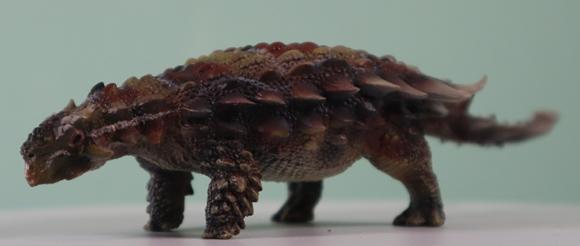
A Pinacosaurus dinosaur model (PNSO). A study into their vocalisation has been published. Picture credit: Everything Dinosaur.
The image (above) shows a not-to-scale replica of Pinacosaurus (PNSO).
In tetrapods the voice box (larynx) has several functions. It plays a role in respiration, protects the airway to prevent food items becoming lodged and it has a function in vocalisation. Fossil preservation of the larynx in archosaurs is extremely rare. The Pinacosaurus fossil material (IGM100/3186) represents the oldest voice box known to science. It provides scientists with an opportunity to better understand the evolution of the larynx in non-avian dinosaurs.
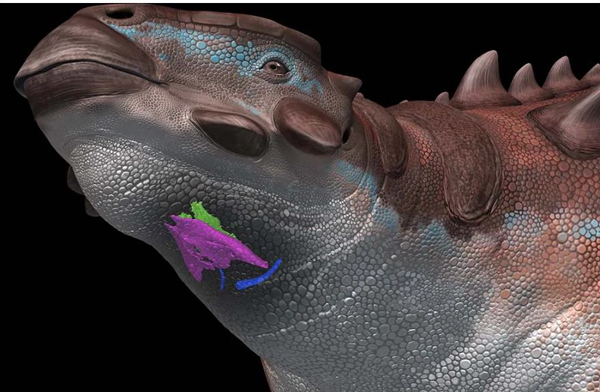
The Pinacosaurus hyolaryngeal apparatus (tongue and voice box) in situ. A life reconstruction. Cricoid (purple), arytenoid (green), and ceratobranchial (blue) are depicted. Artwork by Tatsuya Shinmura.
Vocal Armoured Dinosaurs
Ossification of the cricoid and arytenoid is confirmed in Pinacosaurus, and it has been reported in Saichania, another Asian ankylosaurine. This configuration is also found in extant birds. The complex arrangement of the hyolaryngeal apparatus led the researchers to conclude that it did not simply function as a barrier to preventing food entering the trachea (airway protection). It was specialised for opening the glottis and possibly acting as a sound modifier.
The voice box of modern birds and crocodilians differs. In crocodiles and their close relatives it is the larynx that produces sounds. In birds, the larynx forms part of the vocal tract but they have a specialised organ (syrinx) located at the base of the trachea (wind pipe), that produces sounds.
Pinacosaurus – Shared Anatomical Characteristics
The researchers suggest that Pinacosaurus retained the same hyolaryngeal elements as found in crocodilians. However, Pinacosaurus shows many shared characters with birds in the arrangement and morphology of the larynx.
The authors of the scientific paper, which was published this month in “Communications Biology” (Junki Yoshida, Yoshitsugu Kobayashi and Mark Norell), propose that Pinacosaurus did not use the larynx as a sound source like non-avian reptiles. The larynx probably worked as a sound modifier as found in birds
Furthermore, the authors postulate that bird-like vocalisation likely appeared in non-avian dinosaurs before the evolution of the Aves (birds).
Article sourced from the open-access paper in Communications Biology.
The scientific paper: “An ankylosaur larynx provides insights for bird-like vocalization in non-avian dinosaurs” by Junki Yoshida, Yoshitsugu Kobayashi, Mark A. Norell published in Communications Biology.
At Everything Dinosaur we enjoy reading all the customer comments and feedback we receive. Here is a guide to reviewing Everything Dinosaur or an Everything Dinosaur product on the company’s website.
How to Leave a Review
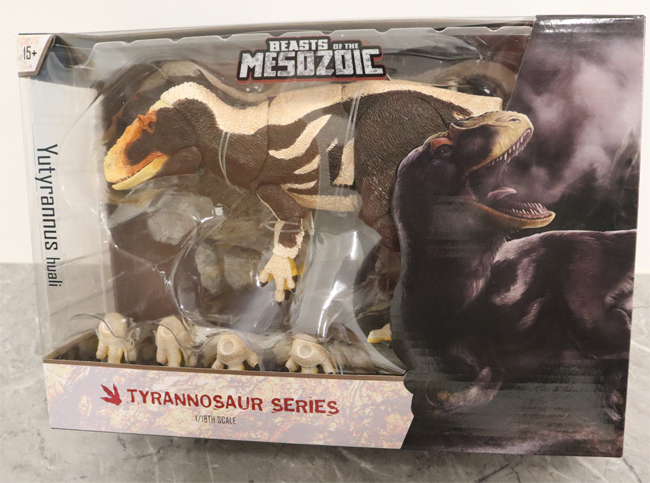
Leaving a review on the website is quite easy and straightforward. To demonstrate this, let us use leaving a review on the recently arrived Beasts of the Mesozoic Yutyrannus huali model as an example.
The Beasts of the Mesozoic Yutyrannus huali articulated dinosaur model. Picture credit: Everything Dinosaur.
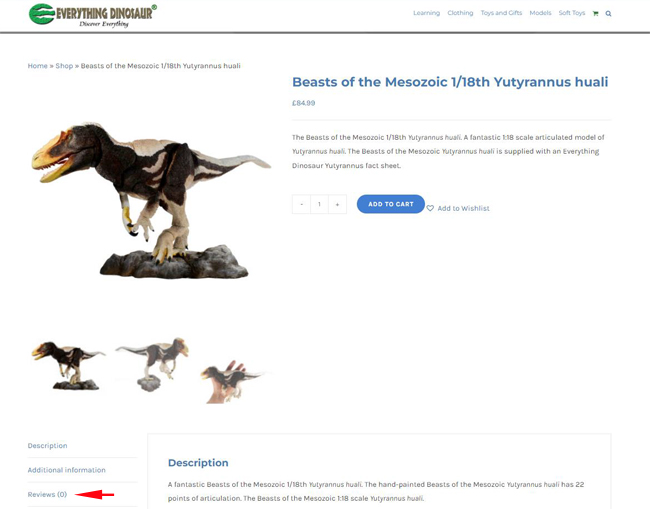
Visit the product page, the page of the item that you wish to review. Scroll down the page and find the blue “Reviews” link.
Click the “Reviews” link and then leave a comment/feedback and a product rating out of 5-stars.
Scroll down the product page and click the link entitled “Reviews” (highlighted by a red arrow). When on the review section, rate the item out of 5-stars and leave a comment. Picture credit: Everything Dinosaur.
Reviewing Everything Dinosaur
In the image (above) we have highlighted with a red arrow where the “Reviews” link can be found on the Beasts of the Mesozoic Yutyrannus huali model page.
A spokesperson commented:
“Reviews are very important to us and we enjoy reading the comments and feedback from customers.”
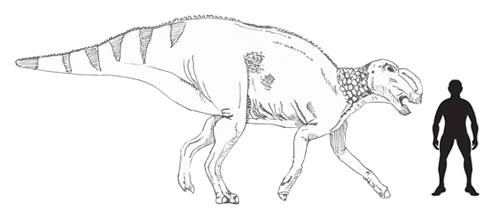
Everything Dinosaur team members are busy preparing for the arrival of the new CollectA models and have finished a Hadrosaurus scale drawing. The illustration will be incorporated into the free Hadrosaurus fact sheet which will be sent out with model purchases.
The Hadrosaurus foulkii scale drawing. Picture credit: Everything Dinosaur.
Picture credit: Everything Dinosaur
Hadrosaurus foulkii
As Everything Dinosaur prepares for the arrival of the first of the new for 2023 CollectA prehistoric animal figures we have been commissioning scale drawings of the models to incorporate into our free fact sheets. Fact sheets featuring Ceratosuchops, Anomalocaris, Ruyangosaurus and Shastasaurus are also being prepared.
A spokesperson from Everything Dinosaur commented that they hoped to have most of these fact sheets finished in the first week of March. The Hadrosaurus foulkii data sheet is currently being finalised.
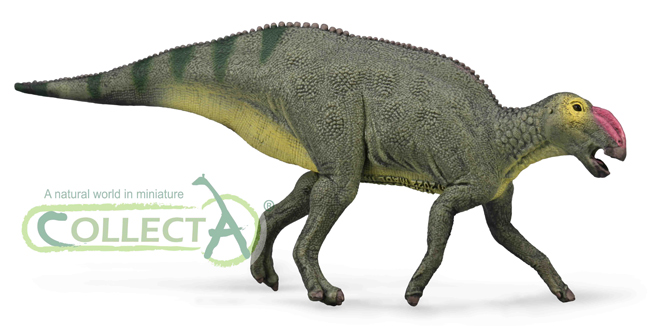
The new for 2022 CollectA Age of Dinosaurs Hadrosaurus dinosaur model.
Hadrosaurus Scale Drawing
The Hadrosaurus scale drawing will provide a visual guide to fact sheet readers as to the size of this herbivorous dinosaur. The fact sheet will explain about this dinosaur’s discovery and its importance in palaeontology. Hadrosaurus was the first dinosaur to be scientifically described from fossils found in North America. It was the first duck-billed dinosaur named and when an exhibition of its fossils was opened at the Philadelphia Academy of Natural Sciences in 1868, it became the first mounted dinosaur skeleton to be erected in the USA.
It is widely accepted by palaeontologists that birds are descended from theropod dinosaurs. Their evolutionary lineage, the transition over time from the fast-running, agile, terrestrial Maniraptora to the birds we see today remains not fully understood. A new research project is being set up giving scientists the opportunity of tracing dinosaur footsteps to help them to better understand the evolutionary path of the avian dinosaurs.
A three-toed theropod footprint: Picture credit: Dr Peter Falkingham.
A £2.2 million GBP ($2.65 million USD) Research Project
A £2.2 million GBP ($2.65 million USD) research project funded by the European Research Council is being set up to permit scientists to study the evolution of the Dinosauria through their fossil tracks. The research project is to be led by Dr Peter Falkingham, a reader in vertebrate biology in the School of Biological and Environmental Sciences at Liverpool John Moores University.
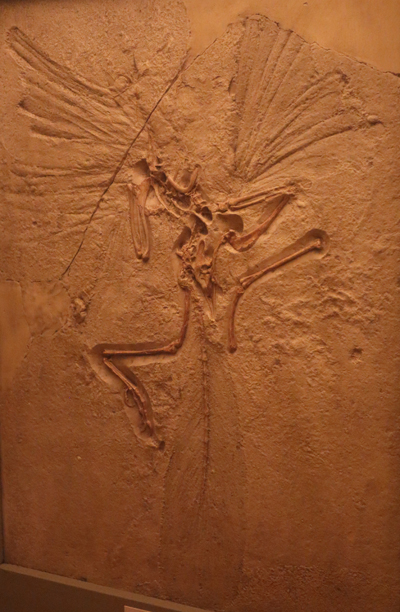
Fossils of feathered dinosaurs and Mesozoic birds are known and have been extensively studied. Perhaps, one of the most intensively studied species in the entire fossil record is Archaeopteryx lithographica, a feathered theropod from the Upper Jurassic of southern Germany.
This five-year research programme, with its focus on studying theropod trace fossils, will provide a fresh perspective on the locomotion of the theropod/avian lineage.
Archaeopteryx fossil cast. Archaeopteryx is arguably one of the most extensively studied genera in the fossil record. This new research programme will focus on the locomotion of theropod dinosaurs. Picture credit: Everything Dinosaur.
Commenting on the scope of the study, Dr Falkingham explained:
“Fossil footprints are a direct record of motion in a way that skeletons can never be. I will use fossil footprints to explore the locomotor changes that took place as theropod dinosaurs evolved into birds.”
Creating a New Team
The plan is to establish a new team of post-doctoral scientists and technicians that will undertake advanced 3-D imaging of fossilised tracks and fossil skeletons. By combining trace fossils and body fossils in this way, the team hope to utilise kinematic and kinetic analyses to build an unprecedented view of footprint formation.
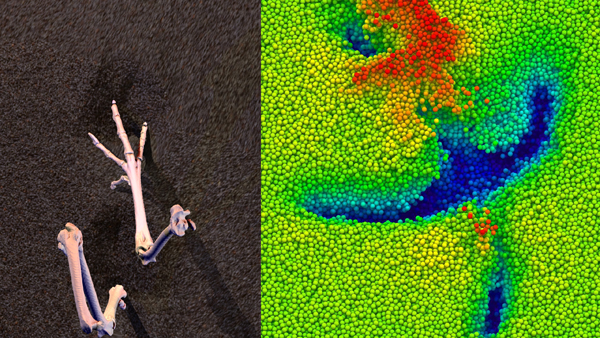
A simulated footprint (Guineafowl) mapped. Picture credit: Dr Peter Falkingham.
Tracing Dinosaur Footsteps
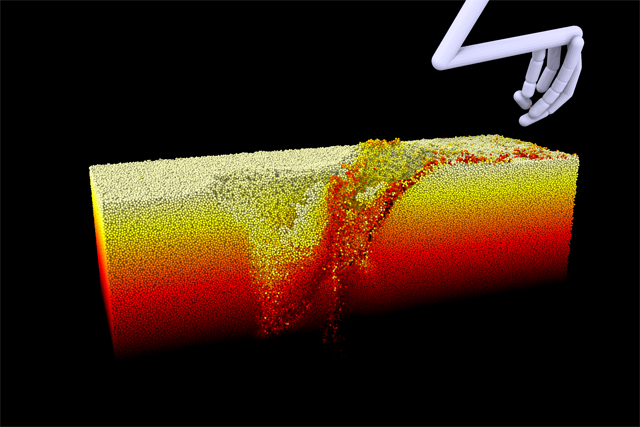
Limb motions of dinosaurs will be reconstructed using fossil tracks. Supercomputer simulations modelling every grain of a sediment responding to the indenting foot will be used to evaluate the reconstructed motions.
Dr Falkingham commented:
“These simulations will compute the forces occurring between foot and ground. These forces and motions will drive musculoskeletal biomechanical simulations that will shed light, not only on what the feet of dinosaurs were doing, but on how the whole limbs and even bodies of these enigmatic animals once moved. By sampling fossil tracks from around the world, spanning the 230 million years since theropods first appeared, this project will recover fossilised motions along the dinosaur-bird lineage.”
Mapping the locomotion of the avian lineage. Picture credit: Dr Peter Falkingham.
Extending our Knowledge About the Dinosaurs
Dr Falkingham added:
“The results should give us a unique view of locomotor evolution that cannot be recovered from bones alone.”
Everything Dinosaur acknowledges the assistance of a media release from Liverpool John Moores University in the compilation of this article.
For further information and to follow the progress of this research project, visit the website of Dr Peter Falkingham: Dr Peter Falkingham.
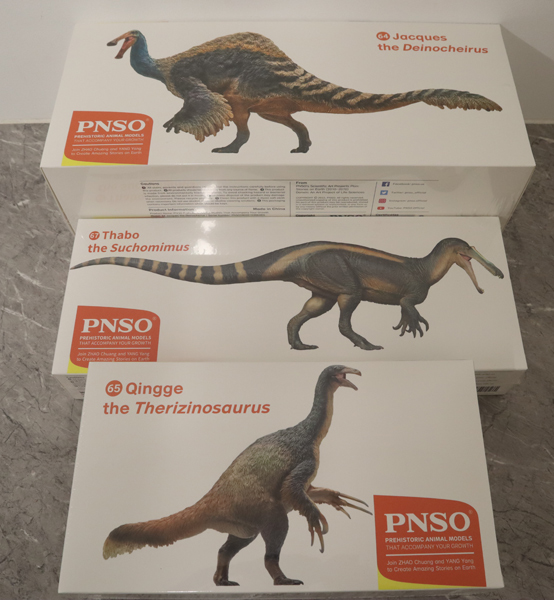
Everything Dinosaur has received a delivery of PNSO prehistoric animal models and figures including Qingge the Therizinosaurus and Thabo the Suchomimus. Team members have been busy contacting all those customers who wanted to be informed when these new PNSO figures arrived.
The popular PNSO Jacques the Deinocheirus figure is now back in stock (February 2023).
PNSO models in stock. Jacques the Deinocheirus (top), Thabo the Suchomimus (middle) and Qingge the Therizinosaurus (bottom). Picture credit: Everything Dinosaur.
Picture credit: Everything Dinosaur
Prehistoric Animal Models
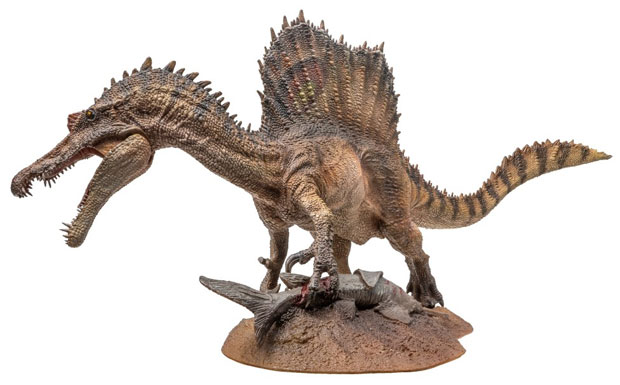
The shipment contained a wide variety of dinosaur models and figures including 1:35 scale figures such as the new colour variant of Spinosaurus (2022) and the horned dinosaur models – Doyle and the Torosaurus replicas Aubrey and Dabei.
PNSO Essien the Spinosaurus dinosaur model in 1:35 scale.
PNSO Models in Stock
A spokesperson from Everything Dinosaur explained that the shipment was being unpacked and the models checked and that this stock would be available on the company’s website as quickly as possible. The company had received lots of enquiries about the new models, Qingge the Therizinosaurus and Thabo the Suchomimus, and staff were doing all they could to keep customers informed about the shipment’s progress.
The spokesperson added:
“We received lots of emails about the new theropod models [Suchomimus and Therizinosaurus], as well as lots of emails about when the likes of the PNSO Deinocheirus model would be available again. We have been busy emailing all those customers who expressed an interest in these figures.”
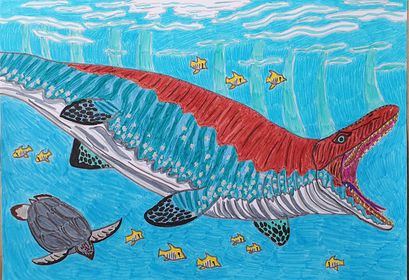
Our thanks to young Caldey who sent into Everything Dinosaur a colourful Mosasaurus drawing. The giant marine reptile, is accompanied by a prehistoric turtle and a school of Cretaceous fish.
A very colourful Mosasaurus illustration. The huge marine reptile swims with a prehistoric turtle (Archelon) in the background. Picture credit: Caldey.
Picture credit: Everything Dinosaur
Mosasaurus Drawing
The Mosasauridae are extinct members of the Order Squamata. They are distantly related to lizards and snakes. Caldey has given her Mosasaurus a forked tongue and pterygoid teeth, two characteristics that underline the taxonomic relationship between these marine reptiles and living members of the Squamata.
The artist depicts the mosasaur swimming close to the water’s surface. It is thought that most mosasaurs did frequent the surface zone of the ocean (Epipelagic zone), although some mosasaur fossils are associated with estuarine and freshwater environments.
Caldey has chosen to give her mosasaur a striking colour scheme with the use of dramatic reds and blues. The underside is a lighter colour and reflects countershading. Most palaeontologist think, that just like living sharks, mosasaurs were countershaded with light undersides and darker backs.
The colouration of mosasaurs remains controversial. In 2014 researchers from Lund University (Sweden), published a paper in the journal “Nature”, that reported the discovery of melanin in the preserved scales of a mosasaur’s skin.
A spokesperson from Everything Dinosaur commented:
“The carefully composed Mosasaurus is accompanied by typical Late Cretaceous fauna of the Western Interior Seaway. Caldey has included an Archelon in her mosasaur illustration. It is a very colourful and striking illustration, of what would have been an apex predator.”
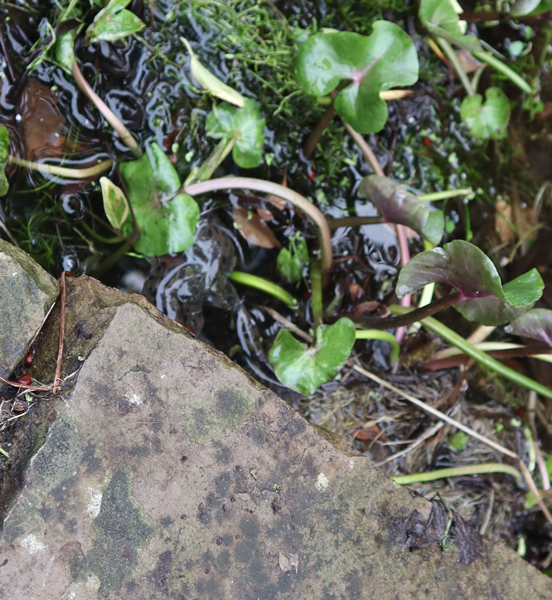
Team members at Everything Dinosaur have spotted frogs in the office pond. This is the first time this year (2023) that the amphibians have been recorded. The pond has been recently cleaned, lots of pond weed and other plants have been removed. Pebbles have been added to one side of the small pond to make it easier for small animals to enter the pond and for birds to bathe.
In the photograph (below), the group of frogs are in a “knot”, located in the shallows at the edge of the pond.
Frogs have been spotted in the office pond for the first time this year (2023). Will there be some frogspawn soon? Picture credit: Everything Dinosaur.
Picture credit: Everything Dinosaur
Rana temporaria
The frogs are Common frogs (Rana temporaria). The name is a bit of a misnomer as frogs are becoming less common in the British countryside. Small ponds are a vital resource for wildlife and this morning we spotted a “knot” of frogs, possibly three frogs altogether. No frogspawn was spotted, perhaps this was a group of over enthusiastic males, fighting each other prior to the arrival of a female.
Frogs in the Office Pond
Although the winter has been quite mild, it is still a little early to expect frogspawn. In 2022, the first frogspawn in the office pond was spotted on the 2nd of March.
A spokesperson from Everything Dinosaur commented:
“We had stored some rainwater over the autumn which we used to top up the water level in the pond. We have removed a lot of the weed which was choking the pond and tidied up the area in the hope that we could attract more wildlife including frogs. Perhaps we might even see a newt or two this year.”
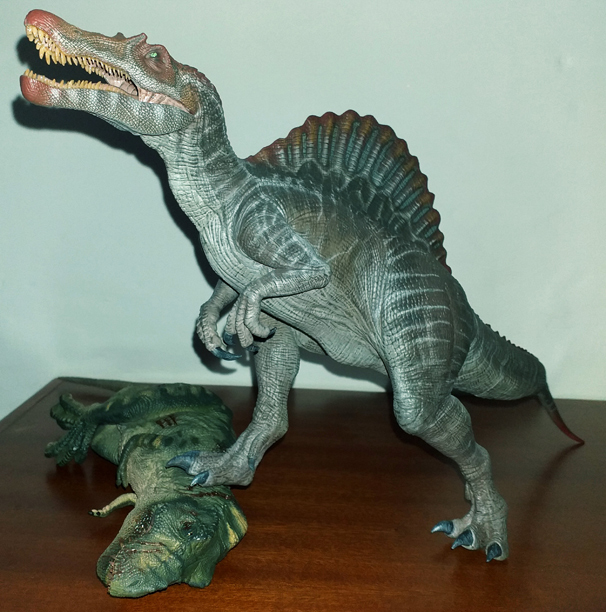
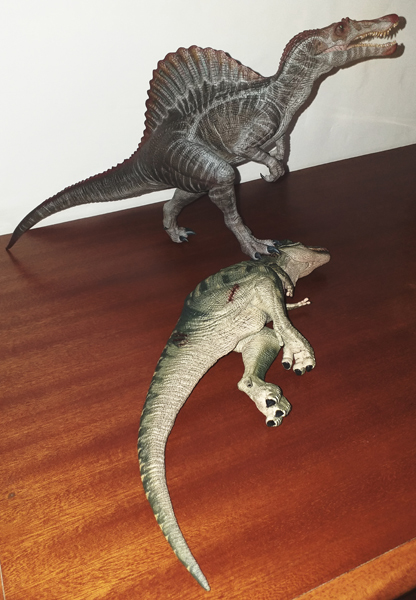
Our thanks to prehistoric animal collector Maurizio who sent into Everything Dinosaur some pictures of his latest acquisitions. He has combined the Rebor Tyrannosaurus rex carcase in the jungle colour scheme with the original Nanmu Studio Spinosaurus Supplanter to recreate an iconic scene from a famous dinosaur movie. In Jurassic Park III (2001), a huge Spinosaurus gets the better of a Tyrannosaurus rex in a fight. Maurizio has created his own homage to the T. rex and Spinosaurus fight from the Jurassic Park franchise.
A dinosaur model collector recreates a classic scene from the Jurassic Park movie franchise. The Nanmu Studio Jurassic Series Supplanter Spinosaurus and the Rebor T. rex carcase in the jungle colour scheme. Picture credit: Maurizio.
Picture credit: Maurizio
Rebor Replicas and Nanmu Studio Jurassic Series Models
Commenting on his composition, the collector stated:
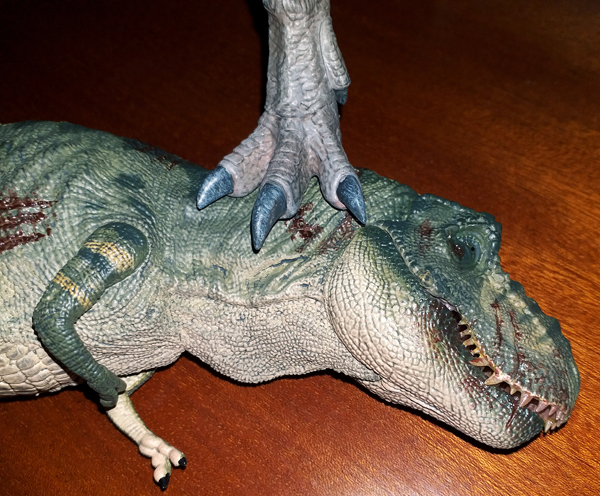
“I received my latest order from Everything Dinosaur that included the Rebor green dead T. rex, and I thought I would share with you some photographs. Surprisingly, the 1:35 scale Rebor tyrannosaur scales perfectly with Nanmu Studio Jurassic Series first Spinosaurus model. The Tyrannosaurus rex figure can even be displayed under the foot of the Spinosaurus replica.”
Spinosaurus triumphs over T. rex. Picture credit: Maurizio.
Picture credit: Maurizio
Spinosaurus Versus T. rex
A spokesperson from Everything Dinosaur explained that team members enjoyed seeing photos of the collections of dinosaur fans and commented:
“It’s a great composition, the combining of the two figures to commemorate a memorable scene from the third Jurassic Park film, which was released back in 2001.”
The defeated Rebor Tyrannosaurus rex (carcase in the jungle colour scheme). The T. rex figure can even be displayed under the foot of the Nanmu Studio Jurassic Series Spinosaurus model. Picture credit: Maurizio.
A giant, carnivorous dinosaur left an unusual footprint in soft sediment approximately 166 million years ago. Remarkably, the print has been preserved as a fossil, providing palaeontologists with yet more evidence to demonstrate the diverse, dinosaur dominated ecosystem which has been preserved in the rocks that comprise the Yorkshire coast.
Giant Dinosaur Footprint
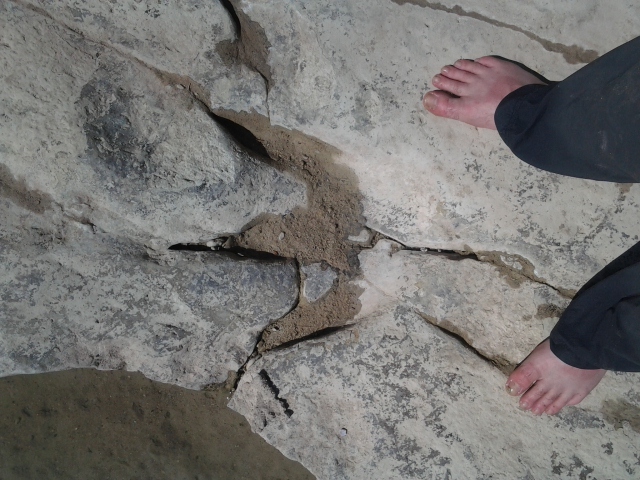
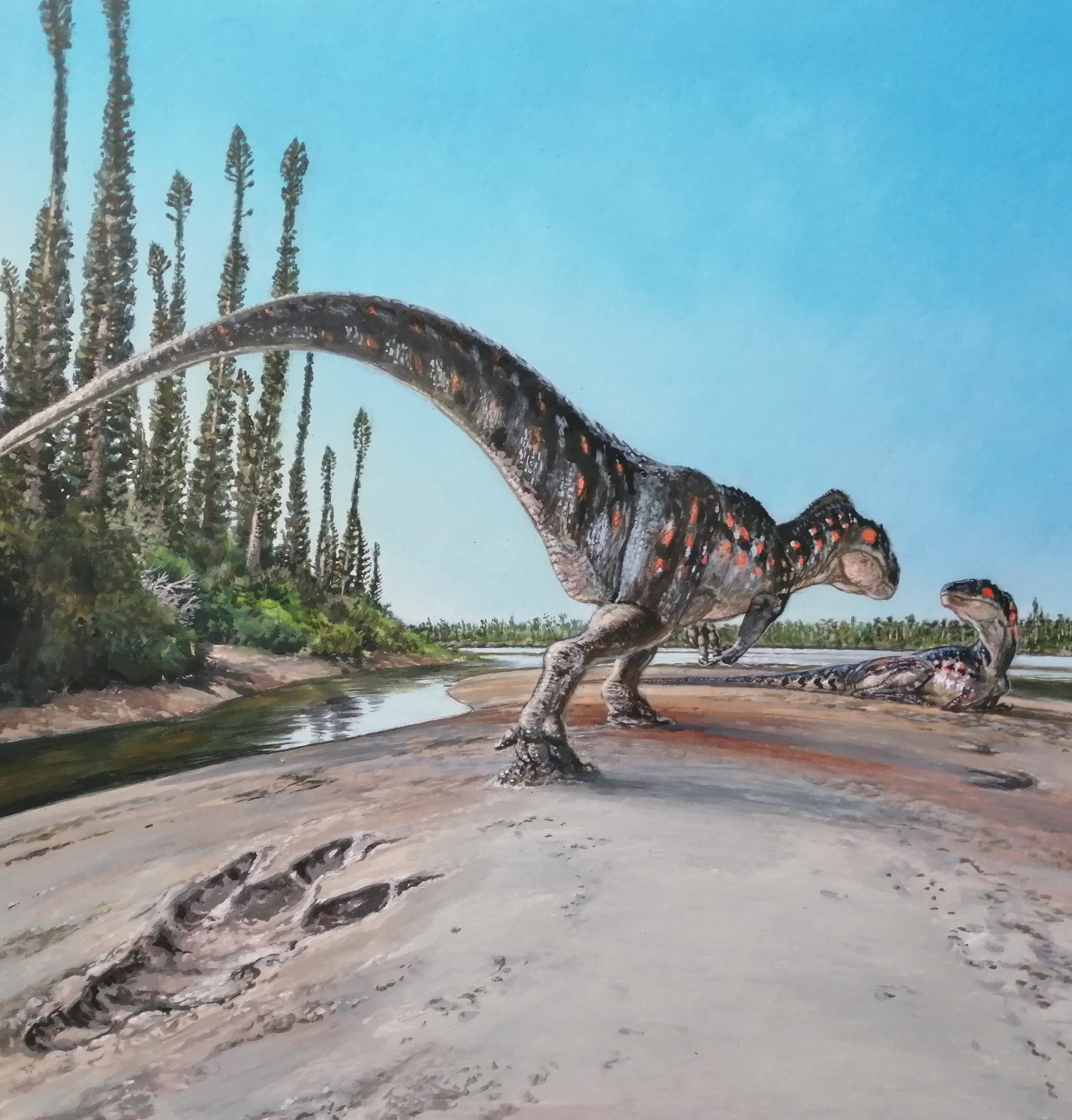
The trace fossil measures around eighty centimetres in length, and it was probably made by a large theropod dinosaur (Megalosauridae).
The print was probably made by a large, carnivorous dinosaur similar to a Megalosaurus (Theropoda – Megalosauridae). Picture credit: James McKay.
Picture credit: James McKay
The Yorkshire Coast
The Yorkshire coast is renowned for producing some visually and scientifically significant fossils, including thousands of dinosaur footprints and tracks. A popular destination for professional palaeontologists and fossil fans, people come from far and wide to see what they can discover.
The three-toed (tridactyl) print is exceptionally rare and unusual. It appears to record the moment when a meat-eating dinosaur crouched down or rested.
Discovered by a Local Archaeologist
The print was discovered in April 2021 by Marie Woods, a local archaeologist. She was walking along the coast and found this amazing trace fossil by chance. Marie contacted local fossil experts to see if the print had already been recorded, but none of them were aware of the track she described.
Dr Dean Lomax, a vertebrate palaeontologist affiliated with The University of Manchester was contacted and asked to examine the fossil find.
Dr Lomax, a co-author of the study published in the Proceedings of the Yorkshire Geological Society commented:
“I couldn’t believe what I was looking at, I had to do a double take. I have seen a few smaller prints when out with friends, but nothing like this. I can no longer say that ‘archaeologists don’t do dinosaurs’. At the time of the discovery, it generated a lot of public interest and I was overwhelmed with the messages on social media from people around the globe.”
The large tridactyl print, the toes are on the right side of the photograph. The footprint was produced by a large theropod dinosaur and it measures approximately 80 cm in length. Picture credit: Marie Woods.
Picture credit: Marie Woods
An Extremely Significant Fossil Discovery
The footprint is one of only six similar prints to have been recorded in the area, the first of which was identified in 1934. This print is an extremely significant fossil discovery, not only are tridactyl prints rare, but this trace fossil is the largest found in Yorkshire to date.
Local geologist and lead researcher on the paper John Hudson explained:
“This important discovery adds further evidence that meat-eating giants once roamed this area during the Jurassic. The type of footprint, combined with its age, suggests that it was made by a ferocious Megalosaurus-like dinosaur, with a possible hip height between 2.5 and 3 metres.”
Dinosaurs of the British Isles
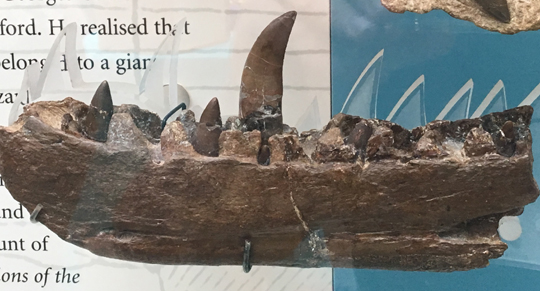
Megalosaurus (M. bucklandii), was the first dinosaur to be formally described (1824). Around a hundred different dinosaur genera have been described from fossils found in the British Isles. Such is the significance of dinosaur fossils from the UK, that Dr Lomax was inspired to write a book documenting the extensive dinosaur fossil discoveries that have been made on these islands.
The partial dentary for teeth associated with Megalosaurus bucklandii. Picture credit: Everything Dinosaur.
Picture credit: Everything Dinosaur
A Fragile Fossil
Photographs shared between the research team led them to conclude that the specimen was exceptionally fragile and likely to suffer further damage if it remained on the shoreline. Action was taken to rescue the fossil. The dinosaur trace fossil was expertly recovered by experienced fossil collectors Mark, Aaron and Shae Smith of Redcar.
As the rescue mission progressed it came to light that the print had been spotted five months previously, by Bob Taylor a local fossil collector who subsequently helped to write the research paper on the specimen.
Dr Lomax thanked Mark, Aaron and Shae for ensuring the safe recovery of the fossil and he stated:
“We’re incredibly grateful to Mark, Aaron and Shae for rescuing this important specimen and ensuring that it was saved for science. Now that the specimen has been studied, plans are in motion for it to go on public display, to spark the imagination of the next generation of fossil hunters.”
Donated to Scarborough Museum and Galleries
The fossil has been donated to Scarborough Museum and Galleries. Plans are in place to include this remarkable dinosaur in an exhibit, once conservation has been completed.
Dr Mike Romano (University of Sheffield), an expert on dinosaur tracks and other trace fossils, also co-authored the scientific paper. Dr Romano has spent more than two decades researching the dinosaur tracksites associated with the coast of Yorkshire.
He added:
“The east coast of Yorkshire is known as the Dinosaur Coast for very good reasons”
A huge number of dinosaur tracks, ranging in the thousands, have been discovered. As a result, this stretch of coastline is considered one of the best places in the world for dinosaur footprints. Although the first prints were documented in 1907, it was not until the 1980s that finds were being reported on a regular basis (by amateurs as well as professional geologists).
Twenty-Five Different Types of Track Described
Around twenty-five different types of footprints have been identified from the Jurassic strata exposed on the coast of Yorkshire. These prints and tracks demonstrate that during the Middle Jurassic a diverse, dinosaur-dominated ecosystem thrived in an ancient coastal plain environment. The trace fossils also recorded behaviours, palaeontologists have identified trace fossils that indicate walking, running and even swimming dinosaurs.
A Dinosaur Behaviour “Locked in Time”
Dr Lomax outlined how this single print can help scientists to better understand theropod dinosaur behaviour.
He commented:
“This is a wonderful find. Not only does this specimen represent the largest theropod footprint found in Yorkshire, but by studying the angle of the footprint, its shape, and the impressions of the claws, the fossil provides insights into the behaviour of this individual from around 166 million years ago. In fact, features of the footprint may even suggest that this large predator was squatting down before standing up. It’s fun to think this dinosaur might well have been strolling along a muddy coastal plain one lazy Sunday afternoon in the Jurassic.”
This is an example of the behaviour of a long extinct prehistoric animal being preserved in the fossil record, a footprint that provides evidence of the behaviour of a dinosaur that has been dead for 166 million years.
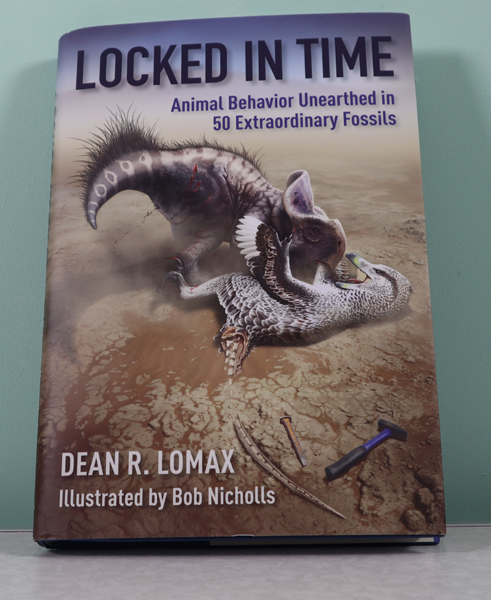
Dean Lomax is also the author of “Locked in Time”, a book which examines animal behaviour preserved in fifty exceptional fossil discoveries.
The front cover of the book “Locked in Time – Animal Behaviour Unearthed in 50 Extraordinary Fossils” by Dean Lomax with illustrations by Bob Nicholls. Picture credit: Everything Dinosaur.
Picture credit: Everything Dinosaur
Everything Dinosaur acknowledges the assistance of a media release from the University of Manchester in the compilation of this article.
The scientific paper: “A new giant theropod dinosaur track from the Middle Jurassic of the Cleveland Basin, Yorkshire, UK” by Hudson, J. G., Romano, M., Lomax, D. R., Taylor, R. and Woods, M. published in the Proceedings of the Yorkshire Geological Society.