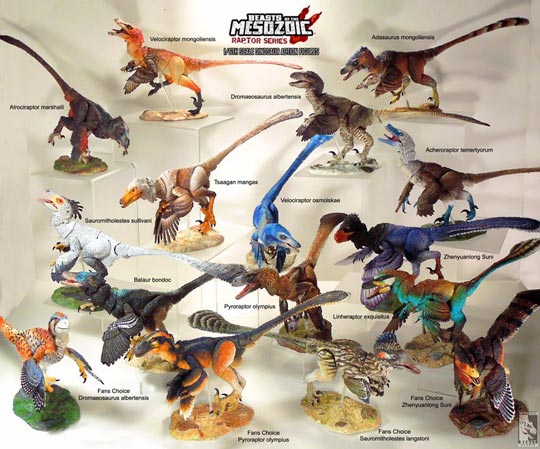
Great news for dinosaur fans and model collectors. Another shipment of the excellent Beasts of the Mesozoic 1/6th scale “Raptor” figures has arrived at the Everything Dinosaur warehouse. This exciting range consists of 24 collectable figures, all members of the Eumaniraptora clade (or if you prefer the Paraves). Put simply, the models represent dromaeosaurids, troodontids and given the current debate about Balaur bondoc, a flightless bird.
A New Shipment of Beasts of the Mesozoic Figures Has Arrived at Everything Dinosaur
The Deluxe Raptors in the Beasts of the Mesozoic range available from Everything Dinosaur.
Everything Dinosaur has extended their interest in this range by adding the two Build-A-Raptor kits. Make your very own customised and unique dinosaur with this unpainted set of “Raptor” parts. The Beasts of the Mesozoic Build-A-Raptor sets have lots of interchangeable parts so you can design and build your own unique prehistoric animal. So adaptable are the components that the parts in set A (Velociraptor) are interchangeable with the parts in the Build-A-Raptor set B (Atrociraptor).
The Beasts of the Mesozoic Build-A-Raptor Kits Have Been Added to Everything Dinosaur’s Range
The Beasts of the Mesozoic Build-A-Raptor Sets (Velociraptor and Atrociraptor).Picture credit: Everything Dinosaur.
Picture credit: Everything Dinosaur
Fact Sheets Sent Out with Every Figure
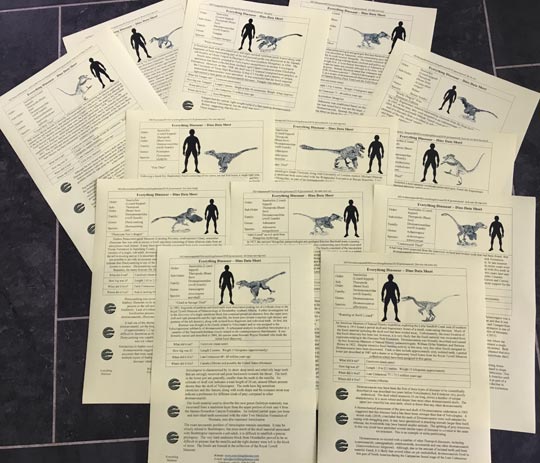
As part of Everything Dinosaur’s commitment to helping collectors and dinosaur fans learn more about prehistoric animals, we have researched and written a fact sheet on all the creatures featured in this range. Each fact sheet contains a scale drawing and explains a little more about the dinosaur (or in the case of Balaur bondoc, flightless bird), that this skilfully made replica depicts. Our fact sheets provide an A to Z guide on the dromaeosaurids and their relatives, or if you will, Acheroraptor through to Zhenyuanlong suni!
Customers Receive a Fact Sheet with Every Purchase
A collection of Beasts of the Mesozoic fact sheets created by Everything Dinosaur. A fact sheet is sent out with every Beasts of the Mesozoic figure purchased.Picture credit: Everything Dinosaur.
Picture credit: Everything Dinosaur
Which One is Your Favourite?
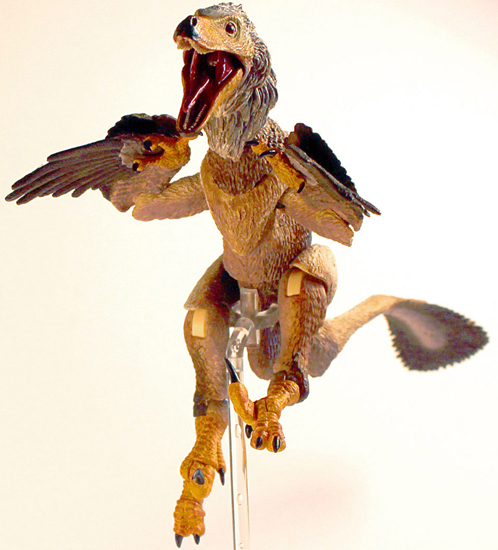
With so many figures in this wonderful range to choose from, it is hard to decide which replica is our favourite. For example, there is the magnificent Tsaagan mangas, an articulated, poseable replica of a fearsome dromaeosaurid, that was a contemporary of Velociraptor (V. mongoliensis is also included in the Beasts of the Mesozoic range).
The Two-metre-long Fearsome Tsaagan mangas
The Beasts of the Mesozoic Deluxe “Raptor” Tsaagan mangas.
Or perhaps a figure of a European prehistoric animal is more your preference? Maybe your favourite is the enigmatic and mysterious Balaur bondoc from the Hateg Formation of Romania.
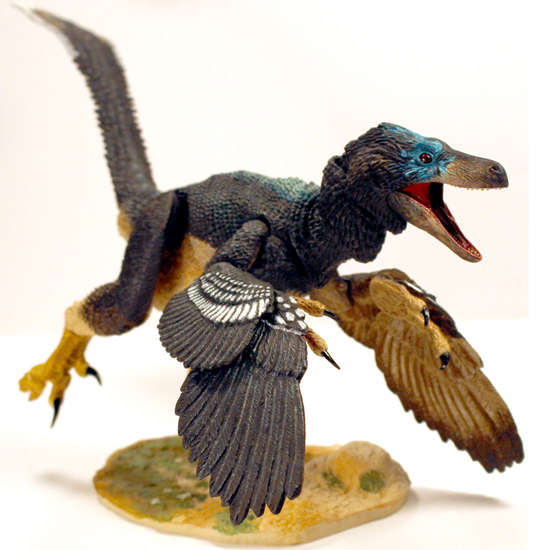
Is it a Bird or is it a Dinosaur? Beasts of the Mesozoic Balaur bondoc
The Beasts of the Mesozoic Balaur bondoc replica.
Which Beasts of the Mesozoic 1/6th scale figure is your favourite?
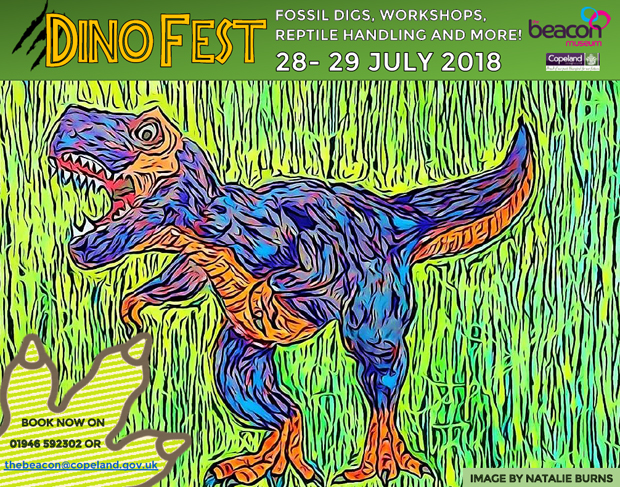
The countdown has started, there are less than 48-hours to go before our first dinosaur and fossil workshop at The Beacon Museum (Whitehaven, Cumbria). Staff at Everything Dinosaur have been preparing all the fossils and sorting out a vehicle so that it can be loaded up with all the fossils and other goodies which we will need this weekend as Everything Dinosaur delivers dinosaur and fossil workshops. The plan is that visitors to Dino Fest at The Beacon will be able to help our team members hunt for fossils including real dinosaur bones!
Dino Fest from Friday 27th July until Sunday 29th July
Dino Fest at The Beacon Museum July 2018.
Picture credit: The Beacon Museum/Natalie Burns
Dinosaur and Fossil Workshops
Join team members from Friday afternoon and throughout the weekend and take part in fossil casting, fossil handling and get the chance to find your very own fossils of prehistoric animals. What you find you can keep, so, why not start your very own fossil collection.
A spokesperson from Everything Dinosaur commented:
“We will be delivering a total of three dinosaur and fossil workshops. The first one would be starting Friday afternoon. We plan to conduct some fossil casting of specimens from our collection, including T. rex teeth and Velociraptor claws and then we can look at dinosaur skulls and of course, being shark week, we will have to include some prehistoric sharks too.”
When not providing workshops, the team members from Everything Dinosaur will be laying out fossil trays and inviting visitors to The Beacon Museum to search for ancient crocodile armour, Silurian coral, fossilised wood, sharks teeth, brachiopods, ammonites and other evidence of ancient life Everything Dinosaur has collected on their travels around the world. As you would expect from a company called “Everything Dinosaur”, there will be some dinosaur fossils to find as well.
Dinosaur and Fossil Themed Workshops at The Beacon Whitehaven
Everything Dinosaur at the Beacon Museum 27th July to 29th July. Picture credit: Everything Dinosaur.
Picture credit: Everything Dinosaur
Late Cretaceous Dinosaurs
An Everything Dinosaur spokesperson explained that as fossils erode out of the ground, they are acted upon by natural forces causing the material to weather. If people did not go out hunting for fossils, then much of the fossil record would simply be eroded away and lost forever.
“Imagine a 66 million-year-old Triceratops leg bone, exposed by erosion in the Hell Creek Formation of Montana. It might be from an animal that lived in the Late Cretaceous but just a few years of freeze/thaw and weathering and the bone would simply crumble away. By conducting fossil workshops and helping to explain how to tell fossils from rock, we might one day help someone discover their very own prehistoric animal, after all, around 100 different dinosaurs are known from fossils found in the British Isles.”
For further information about Everything Dinosaur, visit the company’s website: Everything Dinosaur.
Lingwulong shenqi – The Dinosaur That’s Not Supposed to be There
Dinosaurs, so often regarded in the past as epitomising animals that were too slow and stupid to survive, are demonstrating that they were one of the most successful groups of terrestrial vertebrates to have evolved. A newly described, long-necked dinosaur from the Middle Jurassic of northern China suggests that sauropods dispersed and diversified much earlier than palaeontologists had previously thought. The new dinosaur has been named Lingwulong shenqi and it is the earliest known diplodocoid.
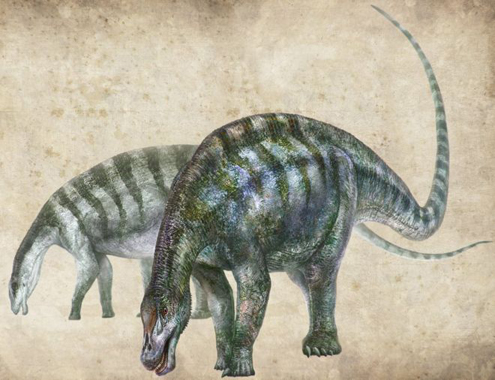
A Life Reconstruction of the Newly Described Lingwulong shenqi
A life reconstruction of Lingwulong shenqi, the earliest known diplodocoid.
Picture credit: Zhang Zongda
Subgroups of Sauropods with Restricted Geographical Ranges
Although the sauropods dominated terrestrial faunas for much of the Mesozoic and their fossils are globally distributed, scientists had been aware that several subgroups demonstrated restricted geographical ranges. For example, the sauropod superfamily Diplodocoidea, which is part of a huge clade of long-necked dinosaurs called the Neosauropoda, was believed to have never existed in eastern Asia. This permitted a unique range of long-necked dinosaurs to evolve and thrive in this part of the world, the Mamenchisauridae. In essence, the isolation of eastern Asia permitted to evolution of the region’s very own endemic range of dinosaurs.
Lingwulong shenqi – The Implications for Dinosaur Distribution
The Neosauropoda consists of two distinct groups of sauropod, firstly there is the Diplodocoidea, this includes some of the most famous dinosaurs of all, animals such as Brontosaurus, Apatosaurus, Diplodocus and Amargasaurus. The second type of sauropod within the Neosauropoda are the Macronaria, which consists of equally famous dinosaurs such as Brachiosaurus and Camarasaurus. It had been thought that once eastern Asia became isolated, the neosauropods were unable to spread to this part of the world.
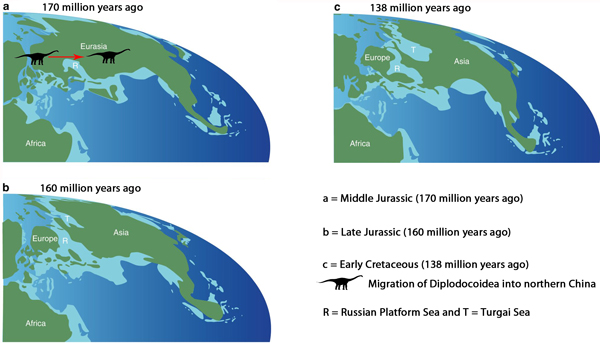
Their absence had been explained by the break-up of the super-continent Pangaea. A seaway was formed cutting off and isolating this part of Asia during the Jurassic. In the case of the Diplodocoidea, these types of long-necked dinosaur evolved and dispersed but they never reached northern China. By the time sea levels had changed and land connections were once again formed linking northern China to other land masses in the Early Cretaceous, the diplodocoids were in decline and their numbers and geographic range had been greatly reduced since their Late Jurassic heyday.
The discovery of Lingwulong shenqi changes all this. Diplodocoids were present in eastern Asia, so they must have evolved and diversified into this region earlier than previously thought, or land bridges may have existed linking this part of Asia to the rest of Pangaea for longer.
Mapping the Distribution of the Diplodocoidea
An epicontinental sea formed during the Jurassic which isolated northern Asia from Europe. This restricted the spread of certain types of dinosaur. Diplodocoid dinosaurs had already evolved and spread before northern Asia was cut off.
Picture credit: Nature Communications with additional annotation by Everything Dinosaur
Co-author of the open access paper published in “Nature Communications”, Dr Philip Mannion (Imperial College London), explained the significance of this dinosaur discovery:
“Not only is it [Lingwulong] the oldest member [of the Diplodocoidea], but it’s the first ever from Asia. For a long time it was thought that neosauropods didn’t get into Asia during the Jurassic. This suggests that firstly [neosauropods] got in before any kind of barrier came up, but increasingly the geological evidence suggests maybe this barrier was quite ephemeral”
The Formation of the Russian Platform Sea and the Turgai Sea
Tectonic forces led to the formation of an epicontinental seaway during the Middle to Late Jurassic and this isolated northern Asia from the rest of Pangaea. The fossils of Lingwulong come from the Yanan Formation in the Ningxia Hui Autonomous Region of China, the strata are estimated to be around 175 to 168 million years old (late Toarcian to Bajocian faunal stages). The discovery of Lingwulong indicates that many advanced kinds of sauropod originated at least 15 million years earlier than previously realised. The Diplodocoidea achieved a global distribution whilst Pangaea was still a single, coherent landmass.
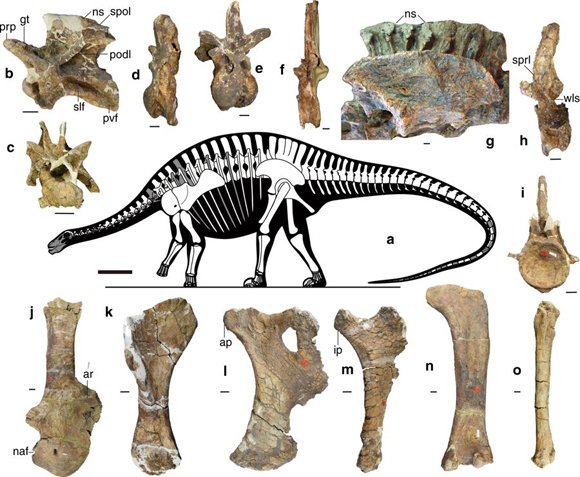
A Reconstruction of the Skeleton of L. shenqi and Examples of Some of the Fossil Bones
A skeletal reconstruction of Lingwulong shenqi and examples of fossil bones. In the skeleton drawing, the bones in white represent fossils associated with this taxon.
Picture credit: Nature Communications
Lingwulong shenqi – “Lingwu’s Amazing Dragon”
The dinosaur has been named after Lingwu, the region in which the fossils were found and the Mandarin Chinese “long” which means dragon. The trivial name – shenqi, comes from the Mandarin for “amazing”, reflecting the unexpected discovery of this type of dinosaur in the Middle Jurassic of China. Excavations originally commenced in 2005 led to the discovery of between 7 and 10 individuals, including two specimens with associated skull material. The fossils represent a range of animal sizes, representing juveniles as well as adults.
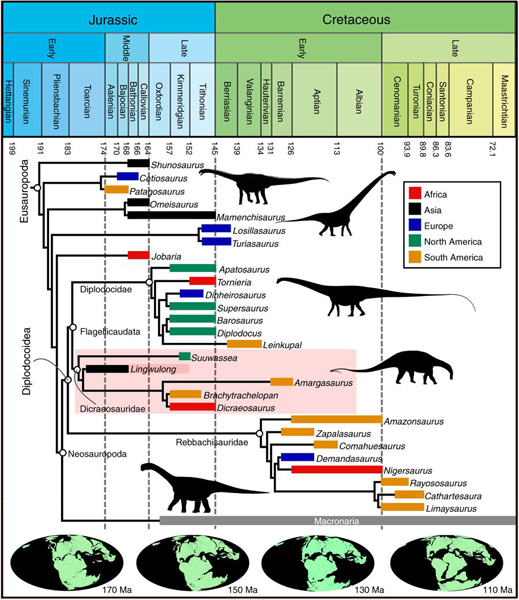
With so much fossil material to study, the researchers were able to assign this new genus to a specific place within the broad Superfamily of the Diplodocoidea. They conclude that Lingwulong is a basal member of the Dicraeosauridae.
The Dicraeosauridae includes species such as Suuwassea from the Late Jurassic of Montana, Brachytrachelopan from the Late Jurassic of Argentina and Amargasaurus from the Early Cretaceous of Argentina.
The Position of Lingwulong shenqi Within the Neosauropoda
Plotting the taxonomic position of Lingwulong within the Diplodocoidea.
Picture credit: Nature Communications
The Bigger Picture
The idea that the eastern parts of Asia were cut off from other landmasses during the Jurassic has been put forward to explain the substantial differences between the Jurassic (and sometimes Early Cretaceous), terrestrial biotas between this part of the world and the rest of Pangaea. It is likely that a seaway formed to the west of the Ural Mountains (the Russian Platform Sea), this seaway in conjunction with an ingress of water from the north (the Turgai Sea), isolated the land to the northeast.
This isolation has been used to explain the evolution of a number of new types of prehistoric animal in eastern Asia, such as:
Mamenchisaurid sauropods
Oviraptorosaurs
Therizinosaurs
Marginocephalians
In addition, this sea barrier has been used to explain the absence of many groups that were present elsewhere in Pangaea during the Jurassic, such as:
Diplodocoid sauropods (now debunked by Lingwulong)
Early titanosauriform sauropods
Dromaeosaurids
Nodosaurids
The lineage leading to the iguanodontian ornithopods
The scientific paper: “A New Middle Jurassic Diplodocoid Suggests an Earlier Dispersal and Diversification of Sauropod Dinosaurs” by Xing Xu, Paul Upchurch, Philip D. Mannion, Paul M. Barrett, Omar R. Regalado-Fernandez, Jinyou Mo, Jinfu Ma and Hongan Liu, published in Nature Communications.
Internal Sources of Preserved Melanin Throw Doubt on Dinosaur Colour
One of the most exciting discoveries in the last two decades or so when it comes to the Dinosauria, was the recognition that fossilised, microscopic structures containing melanin (called melanosomes), could provide an indication of colour. The shape of the preserved melanosome when compared to the same type of structures found in living animals, gave scientists an insight into the potential colouration of long extinct creatures.
However, new research from a team of palaeontologists led by scientists from Bristol University and University College Cork (Ireland), has upset the colour scheme somewhat. They have discovered new sources of the pigment melanin such as in the liver, lungs and spleen preserved in fossils, this means how palaeontologists reconstruct the dinosaurs and other extinct prehistoric animals is going to have to be revisited.
Implications for the Dinosauria
This study has implications for the interpretation of colour within the Dinosauria.
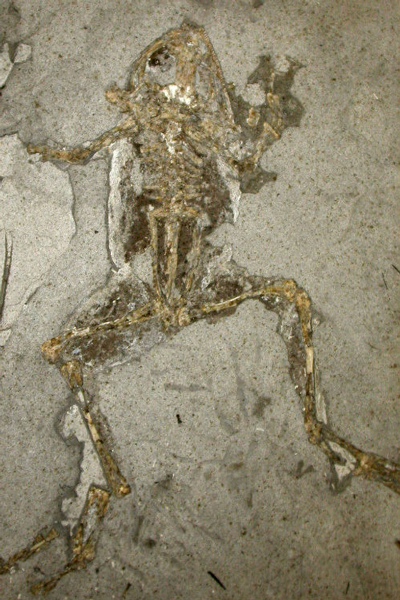
A Fossil Frog from the Miocene of Spain – Dark Areas in the Chest Cavity and Legs are Melanosomes
Scientists have detected new sources of melanin in fossil specimens.
Picture credit: Museo Nacional de Ciencias Naturales, Madrid, (Spain)
Study Published in “Nature Communications”
Writing in the academic journal “Nature Communications”, the researchers looked at living and extinct amphibians. It is known that extant vertebrates have melanosomes within internal tissues, the scientists demonstrated that these internal melanosomes have a high fossilisation potential and can vastly outnumber those from the skin. This means that there could be a bias in fossils for preserved internal melanosomes thus “blurring” the picture when it comes to interpreting the colour of extinct animals.
Back to the Drawing Board? Do we Really Know the Colour of Extinct Creatures?
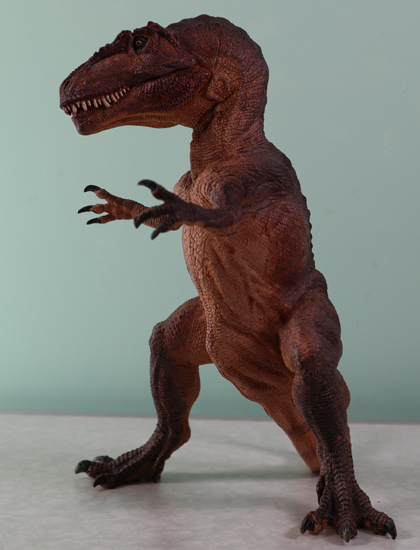
The Papo Giganotosaurus dinosaur model. Picture credit: Everything Dinosaur.
Picture credit: Everything Dinosaur
The picture (above) shows a brown Papo Giganotosaurus dinosaur model. Is this an accurate reflection of Dinosauria colouration?
Powerful microscopes in conjunction with the chemical analysis of body tissues demonstrated that internal melanosomes are abundant. Lead author of the study, Dr Maria McNamara (University College Cork), stated:
“This means that these internal melanosomes could make up the majority of the melanosomes preserved in some fossils.”
However, all might not be lost as according to Dr McNamara, the shape and size of skin melanosomes are usually different from the melanosomes found in internal tissue. If this is the case, it might permit palaeontologist to refine their melanosome assessments, differentiating between internal and skin melanosome types. This could lead to more accurate depictions of extinct animals including dinosaurs.
Experiments with Decaying Frogs
Dr Paddy Orr (University College Dublin), along with Dr McNamara’s PhD student Valentina Rossi, also participated in the research, plotting the decay profiles of frogs in order to gain more information on how internal melanosomes can leak into other body parts during the fossilisation process.
Collaborator, Professor Mike Benton from the University of Bristol’s School of Earth Sciences, commented:
“Understanding the origin of melanosomes is crucial in the new studies of colour in dinosaurs and other extinct beasts.”
Slab and Counter Slab Splitting Can Influence the Picture
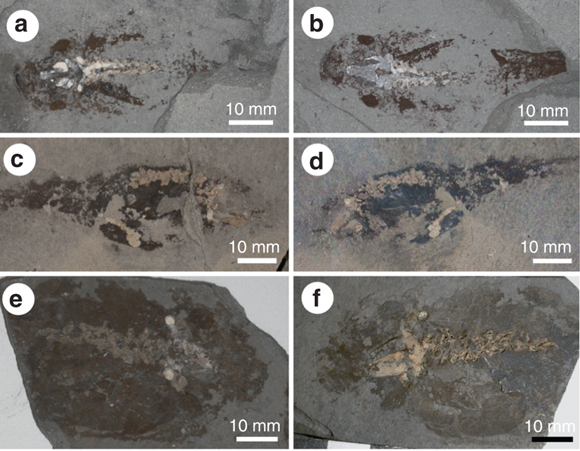
How a fossil is found in a slab or concretion can also influence any analysis of melanosomes. The researchers examined the distribution of soft tissues in the slab and counter slab of fossil amphibians. If the plane of splitting passes through the middle of the soft tissues, non-integumentary melanosomes can be exposed at the surface, producing nearly identical distributions of soft tissues in the slab and counter slab.
Distribution of Soft Tissues in the Slab and Counter Slab
Amphibian fossils from Europe (slab and counter slab) showing nearly identical distribution of soft tissue between the two parts.
Picture credit: Nature Communications
The photographs (above), labelled a to f, show near identical distributions of soft tissues in the slab and counter slab components of a fossil. However, if the fossil is split, not quite in the middle (not a medial split), then the slab and counter slab are likely to show different distributions of soft tissue components. Internal melanosomes may still be exposed at the surface of the fossil.
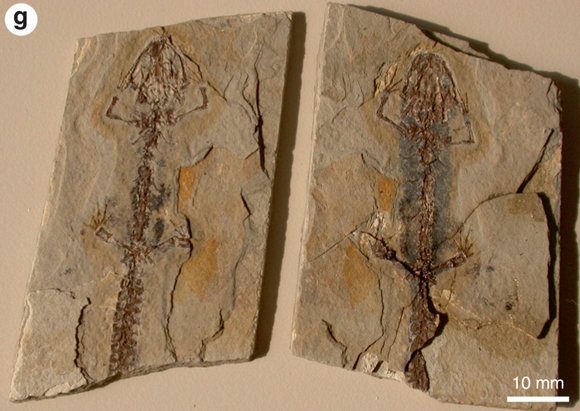
Uneven Distribution of Soft Tissue Between Slab and Counter Slab
The dissimilar distribution of soft tissues in part and counterpart demonstrates that the plane of splitting is not precisely medial within the soft tissues; non-integumentary melanosomes may still be exposed at the surface.
Picture credit: Nature Communications
The picture (g), is the slab and counter slab of the prehistoric salamander Chelotriton from the Miocene of Spain. The part of the fossil on the right shows more black staining, the remnants of soft tissues preserved in the fossil. The plain of splitting of this fossil is not precisely medial, therefore leading to one side of the fossil showing greater staining than its counterpart.
A spokesperson from Everything Dinosaur commented:
“This newly published research, rather than thwarting attempts to reconstruct dinosaurs and other prehistoric animals, might actually lead to a refining of the illustration process, allowing palaeontologists and the palaeoartists that work closely with them to create more accurate reconstructions.”
Everything Dinosaur acknowledges the assistance of a media release from the University of Bristol in the compilation of this article.
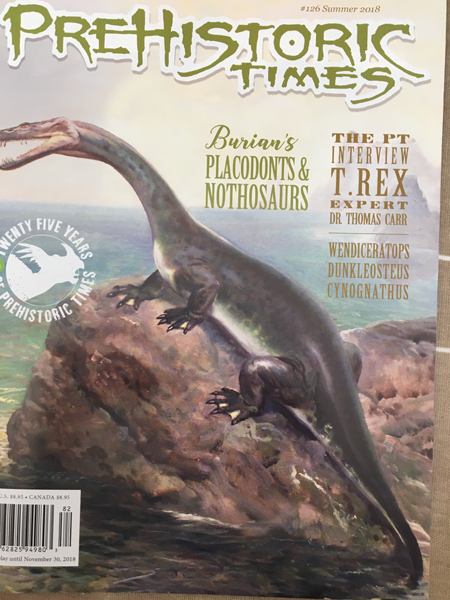
The latest issue of “Prehistoric Times”, the magazine for dinosaur fans and prehistoric model collectors has arrived at the Everything Dinosaur offices. Issue 126 came with a little bit extra, one of the stamps on the carefully prepared envelope to ensure safe despatch from America and arrival in the UK, had a scratch and sniff element. This edition of “Prehistoric Times” came with a hint of strawberries!
“Prehistoric Times” Magazine
Our thanks to the sender for highlighting this feature for us, we probably would have missed it.
On the subject of features, issue 126 is crammed full of top-class articles and features. The front cover depicts a painting of a nothosaur by the influential Czech artist Zdeněk Burian. John Lavas builds on his piece incorporated into issue 125 on Burian’s ichthyosaurs, writing about placodonts, nothosaurs and primitive turtles.
The Front Cover of Issue 126 Features a Nothosaur
Prehistoric Times magazine (issue 126). The front cover features a nothosaur.
Picture credit: Prehistoric Times (Summer 2018)
Wendiceratops, Cynognathus and Dunkleosteus
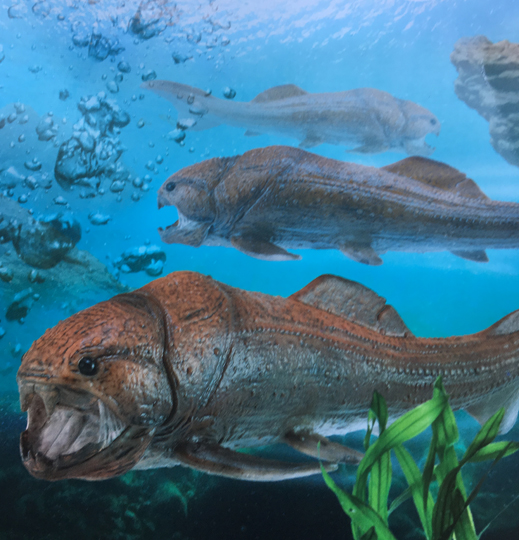
This issue covers not two but three prehistoric animals. Phil Hore treats us to a run down on Wendiceratops, a centrosaurine named in 2015. To read Everything Dinosaur’s article about the discovery of Wendiceratops: Wendiceratops pinhornensis from Southern Alberta, in addition Phil has penned a most informative article on Cynognathus, a bizarre Triassic critter that has been studied for more than 120 years, still there is lots more to learn about this therapsid. Matt Bille describes that Devonian delight Dunkleosteus, so there are placodonts and placoderms in the summer 2018 edition.
Dunkleosteus terrelli – First King of the Ocean
The CollectA 1:20 scale Dunkleosteus replica which was introduced in 2018. Dunkleosteus described by Matt Bille as the “first king of the ocean”.
The picture (above) highlights the CollectA 2018 Deluxe Dunkleosteus figure.
Look out for some amazing reader’s artwork that accompanies these articles. Special mentions to Meg Berstein, Kevin Hedgpeth and Jake Walsh (Wendiceratops), Jorge Blanco, Giovanni De Benedictis and John Sibbick for their contributions to the Cynognathus piece. The editor of “Prehistoric Times” magazine gets so many pictures from readers that an entire page (page 7), of this issue is allocated to showcasing some of the work that has been submitted.
An Interview with Palaeontologist Dr Thomas Carr
Expert on the Tyrannosauroidea, vertebrate palaeontologist Dr Thomas Carr discusses T. rex and makes the case for a new species of Daspletosaurus, as well as explaining the trend for reduced arms in Late Cretaceous theropods in what is a most in-depth and interesting interview. In Tracy Lee Ford’s excellent regular slot, Tyrannosaurus rex takes centre stage and the writer describes how to reconstruct the body of the most famous dinosaur of all from the tip of the snout down to the last caudal vertebra.
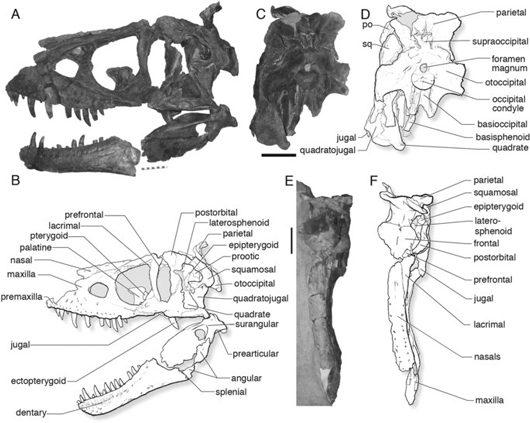
Dr Thomas Carr Discusses Daspletosaurus
Views of the skull and jaws of the holotype fossil material (D. horneri).
Editor Mike Fredericks discusses what’s new in the world of prehistoric animal and model collections as well as covering new book releases. He has also found time in his very congested diary to write about the history of Ossineke’s Prehistoric Zoo, an early version of a dinosaur theme park that was the work of artist and dinosaur enthusiast Paul N. Domke. The black and white photographs showing some of the models are exquisite, look carefully and you can read some of the original notes written on the photos.
Allen Debus writes about two influential dinosaur books, plus there is an update on new fossil discoveries, a step-by-step guide in Wendiceratops model building and a fascinating piece on the history of a single replica series written by Robert Telleria.
There is certainly a lot to commend this edition and Everything Dinosaur recommends that dinosaur fans and model collectors subscribe to this quarterly publication.
Akainacephalus johnsoni – One of the Oldest “Swingers” from North America
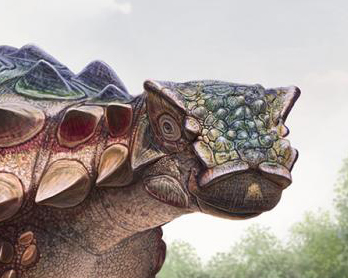
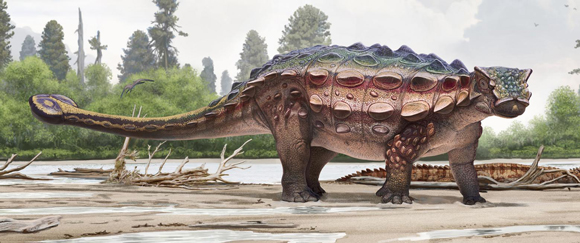
On Thursday of last week, a scientific paper was published in the on-line open access journal PeerJ, that described the discovery of a new species of armoured dinosaur from Utah. The armoured dinosaur was named Akainacephalus johnsoni, the genus name is derived from the Greek meaning “spiky” or “thorn”, a reference to the large number of bony scales (caputegulae) located on the top and sides of the skull. The species name honours Randy Johnson, a volunteer preparator at the Natural History Museum of Utah, who skilfully and patiently prepared the skull and lower jaws of this newly described ornithischian.
Akainacephalus johnsoni
A Close-up View of the Bony and Scaly Head of Akainacephalus
A close up of the ornate head of Akainacephalus johnsoni.
Picture credit: Andrey Atuchin (Denver Museum of Nature and Science)
Secondary Functions of the Dermal Armour
This was one very heavily armoured ankylosaurid, with a face described by many media outlets as “ugly” or being one that only a “mother could love”. The fossilised skull, which is nearly complete reveals an extensive amount of armour and ornamentation. For example, the snout is particularly bony, covered in large osteoderms and above each eye there is a substantial horn. Although this armour would have served as protection against attack, the degree of ornamentation in Akainacephalus was quite remarkable, it is likely that these osteoderms, the various lumps and bumps on the dinosaur’s body and head, served a number of functions.
Suggested functions for the extensive ornamentation of A. johnsoni
Anti-glare and anti-dazzle for the eyes. If you look at the close-up view of the head of Akainacephalus in the illustration (above), the eye is shaded. The various projections along the broad snout could have obscured the animal’s vision, but the eye would have been shaded from direct sunlight, a positive advantage in the Late Cretaceous of Utah.
Sexual selection – the greater the ornamentation the more imposing the individual. Just as with peacocks and their impressive tails, deer and their antlers, the greater the number of bumps and lumps could have been a sign of the animal’s fitness to mate. It might be one very ugly looking dinosaur to us, but beauty is in the eye of the beholder, the lumpier the Akainacephalus the greater the appeal of that individual.
In a similar vein to the point made above, the ornamentation could have played a role in display, intimidating rivals as part of ritualistic intraspecific combat or helping to put off the unwanted attentions of any large theropod that had decided to try and make a meal of this four-metre-long armoured dinosaur.
Thermoregulation – the dermal armour of crocodilians serves a number of functions, one of which is to help to regulate the animal’s body temperature. The wide gut of ankylosaurids gave them a large surface area for the sun to beat down onto. By pumping blood into the osteoderms the animal could cool down, helping to maintain its body temperature.
Armoured Dinosaur Mixed Up with Lots of Other Fossils
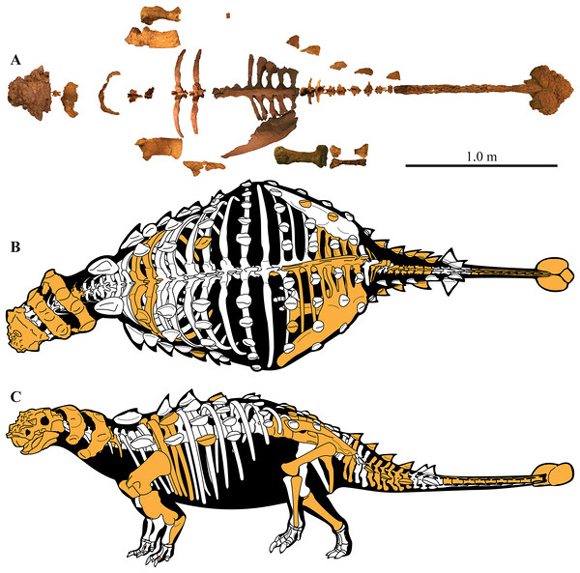
The Fossil Remains of Akainacephalus and two Skeletal Reconstructions
The skeletal remains of Akainacephalus with two line drawings (dorsal and lateral views). Known fossil bones are highlighted in orange.
Picture credit: PeerJ
The first fossils were found in 2008, in a quarry which contained a mixed assemblage of vertebrate remains. Finds at the site, known as the Horse Mountain Gryposaur quarry, include a nearly complete skull of the hadrosaurid Gryposaurus, turtle fossil remains (Arvinachelys goldeni), a skull and postcranial remains of a new taxon of alligatoroid and a poorly preserved partial skull of a small theropod.
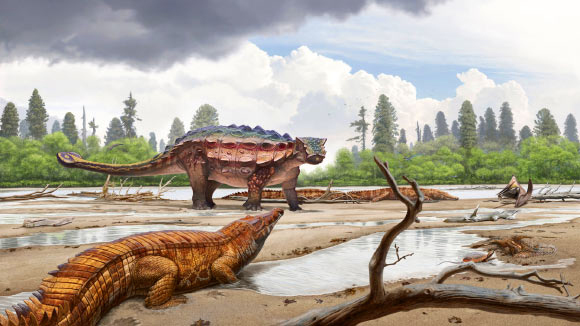
Akainacephalus Wanders Past Ancient Crocodilians
The Akainacephalus drawing shows some of the fauna associated with the dig site – crocodiles and a small freshwater turtle (right) – Arvinachelys goldeni.
Picture credit: Andrey Atuchin (Denver Museum of Nature and Science)
The Amazing Kaiparowits Formation
The fossils were excavated from sediments associated with the Kaiparowits Formation, which provides a unique perspective on the biota of south/central Laramidia during the Campanian faunal stage of the Late Cretaceous. This thick succession of sandstones and mudstones was deposited at an unusually rapid rate within a time frame of less than two million years, making it one of the most rapidly deposited terrestrial formations in the world. Akainacephalus dates from 76.2 to 75.9 million years ago, as such it is one of the oldest ankylosaurids known from North America.
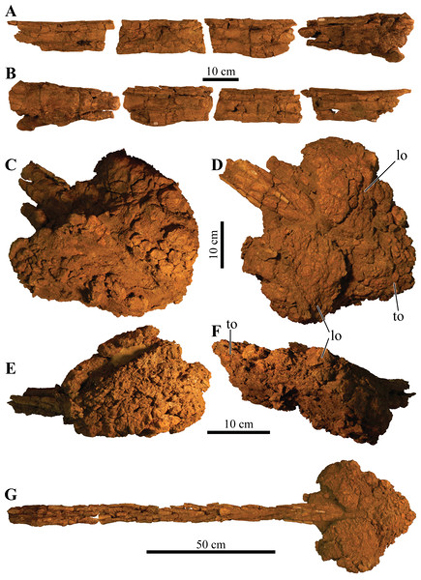
It is also the first documented example of ankylosaurid skull and postcranial bones from the Kaiparowits Formation. Although, some of the fossil bones are in a better condition than others, the fossils, including that amazing tail club are remarkably complete.
Views of the Caudal Vertebrae and the Tail Club of A. johnsoni
Akainacephalus caudal bones and tail club.
Picture credit: PeerJ
Dinosaur Immigrants from Asia
Those lumps and bumps on the skull (cranial ornamentation), are reminiscent of an armoured dinosaur from New Mexico (Nodocephalosaurus kirtlandensis), the researchers postulate that these dinosaurs might be closely related. However, it is worth noting that Nodocephalosaurus is around three million years younger than Akainacephalus. Both Nodocephalosaurus and Akainacephalus are also similar to Asian ankylosaurids such as Saichania chulsanensis, Pinacosaurus grangeri, and the spectacularly horned Minotaurasaurus ramachandrani. The discovery of Akainacephalus adds support to the idea that ankylosaurids migrated across an ancient land bridge from Asia into North America prior to 76 million years ago.
The addition of this new ankylosaurid taxon from southern Utah provides further information on ankylosaurid diversity and supports the theory regarding there being regional variations in dinosaur biota across Laramidia during the later stages of the Cretaceous.
Indicating that Ankylosaurids Migrated from Asia into North America (Akainacephalus johnsoni)
Akainacephalus illustrated.
Picture credit: Andrey Atuchin (Denver Museum of Nature and Science)
A team of international researchers including scientists from the University of Alberta, Midwestern University and the Chinese Academy of Sciences have published a paper describing the remarkable discovery of the preserved remains of a baby snake entombed in amber from Myanmar (Burma). The snake has been named Xiaophis myanmarensis.
Amber deposits from northern Myanmar are providing scientists with some amazing insights into life in a forest some 100 million years or so ago. Other amber nodules, known as burmite have revealed the preserved remains of baby birds, a dinosaur tail, frogs and an astonishing range of invertebrates and plant material. The amber is proving to be a treasure trove for palaeontologists helping them to map the biota of a Cretaceous environment.
The Polished Amber Nodule Revealing the Fossilised Remains of a Baby Snake
The preserved remains of a baby snake preserved in amber from Myanmar.
Picture credit: Ming Bai (Chinese Academy of Sciences)
Xiaophis myanmarensis – Dawn Snake of Myanmar
The baby snake measures around eight centimetres in length. The fossil reveals that the vertebrae are not yet fully formed and this indicates that the snake was very young when it got trapped in the sticky tree resin. The snake has been named Xiaophis myanmarensis, which means “dawn snake of Myanmar”.
The international research team, led by Dr Lida Xing (China University of Geosciences, Beijing and the Chinese Academy of Sciences) and Professor Mike Caldwell (University of Alberta), have described this discovery as a remarkable fossil find.
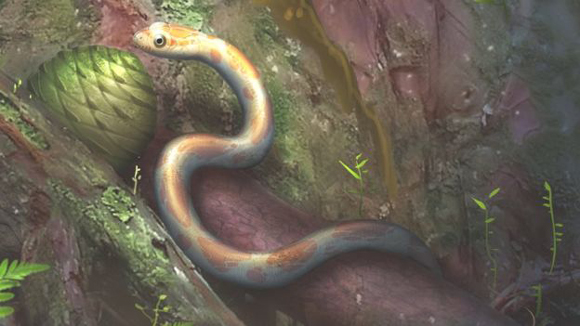
A Life Restoration of Xiaophis myanmarensis
An illustration of Xiaophis myanmarensis (dawn snake of Myanmar).
Picture credit: Cheung Chung Tat
Not One Fossil Snake but Two
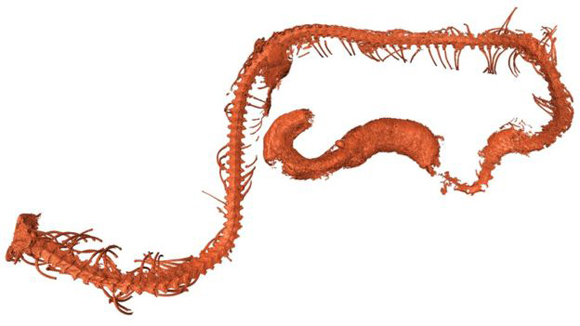
Although the baby snake is missing its skull, ninety-seven vertebrae have been preserved along with associated fossil ribs. The tiny reptile’s bones were analysed using a synchrotron to bombard the specimen with X-rays and plot the result. The back bone is remarkably similar to those found in neonatal snakes today. This suggests that the vertebrae of snakes have remained largely unchanged for 100 million years.
A second amber fossil was discovered, which preserves a piece of the shed skin of another, much larger snake. It is unclear whether these two fossils represent the juvenile and adult of the same species.
The Skeleton of the Baby Snake As Modelled from the Synchrotron Data
The skeleton of the baby snake Xiaophis myanmarensis.
Picture credit: Ming Bai (Chinese Academy of Sciences)
Xiaophis myanmarensis – A Remarkable Fossil
The discovery of this remarkable fossil, along with the piece of shed snake skin helps palaeontologists to build a picture of the evolution of snakes and how they spread following the break-up of the super-continents during the latter stages of the Mesozoic.
Dr Palci (Flinders University) and a co-author of the scientific paper published in the journal “Science Advances” commented:
“At 100 million years old, it dates back to the age of the dinosaurs, well before snakes started to differentiate into modern groups. This Asian fossil helps shed light on how primitive snakes dispersed from the southern to the northern continents. Although found in the Northern Hemisphere, it strongly resembles South American snakes that lived at the time.”
An Illustration of the Second Snake Specimen (Life Reconstruction)
The preserved skin of a second prehistoric snake has been found in amber from Myanmar.
Picture credit: Yi Liu
During the Jurassic, the region that we now know as Myanmar was joined to Antarctica, Australia, Africa and South America, forming the giant, southern super-continent of Gondwana. As the Mesozoic progressed so this landmass began to split apart, Myanmar separated from Gondwana and drifted north, eventually colliding with Asia.
This is the first baby snake fossil from the Mesozoic ever found and it, along with other remarkable specimens preserved in amber from Myanmar (burmite), are providing scientists with a unique window into the Late Cretaceous world.
New Research Examines the Diets of Giant Dinosaurs
How many plants would a ten tonne Diplodocus need to eat to keep it happy and healthy? For that matter, what about one of its larger cousins such as the macronarian Camarasaurus that tipped the scales at an estimated twenty tonnes? If you had a pet Dreadnoughtus (D. schrani), a long-necked, herbivorous dinosaur that was heavier than a dozen African elephants, how much food would you need to feed it each day?
Super-sized Sauropods and Their Super-sized Digestive Tracts
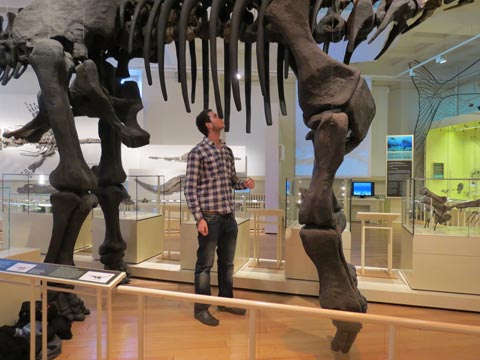
A belly up view of “Whale Lizard”. Palaeontologist Dean Lomax tackling the tummy of Cetiosaurus. How much food did “Whale Lizard” eat?
Picture credit: Dean Lomax
Palaeontologists have puzzled over the dietary requirements of these super-sized animals for many years. One of the theories put forward to explain the huge size of sauropods is that they needed to grow big so that they could carry around their vast digestive tracts that were needed to process the huge volumes of plant matter required to provide them with enough energy to do what dinosaurs needed to do.
Sauropoda body mass becomes a sort of self-fulfilling prophecy. You grow up fast and grow big to avoid predation, so you require a lot food to sustain your body, the bigger you get the more food you need to keep you going, the larger the stomach, especially as your teeth don’t play any role in helping to break up tough stems and foliage.
A Novel Approach
A team of scientists, including researchers from Leeds University, Nottingham University and the University of Göttingen (Germany), have conducted a novel piece of research so that the dietary needs of the largest terrestrial vertebrates can be better understood. The team grew their own dinosaur food in atmospheric conditions that replicated the environment of the Late Jurassic. Writing in the journal “Palaeontology”, the research team report on an experiment in which they grew typical plants that would have played a role in the diet of giant, herbivorous dinosaurs, ferns, horsetails, monkey puzzle trees and ginkgos.
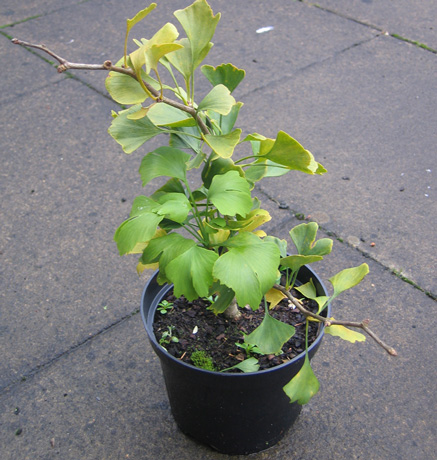
The Ancient Ginkgo (Maidenhair) Tree – Dinosaur Food Assessed in this Plant Growth Experiment
A small Ginkgo tree (G. biloba). Typical of the canopy plants that would have been fed upon by sauropods. Picture credit: Everything Dinosaur.
Picture credit: Everything Dinosaur
Plants of the Jurassic Had a Low Nutritional Value
It had been thought that plants growing in an atmosphere with a high amounts of carbon dioxide had low nutritional value. As a result, herbivorous dinosaurs had to consume vast quantities of plant material in order to obtain enough energy to sustain themselves.
A new experimental approach led by Dr Fiona Gill (School of Earth & Environment, Leeds University), has demonstrated that this may not be the case. To explore the nutrition of a typical sauropod’s diet, a range of plants were chosen. Plants representing the understory community, such as a fern (Polypodium vulgare), a type of horsetail (Equisetum hyemale) as well as Ranunculus acris, a member of the buttercup family to represent an early Cretaceous angiosperm (flowering plant), were selected. Plants representing the forest canopy included the Ginkgo (G. biloba), Araucaria araucana, the monkey puzzle tree and a type of redwood conifer (Metasequoia glyptostroboides).
A Sauropod Stomach Study
The atmosphere was controlled as the plants were grown in walk-in growth chambers and the carbon dioxide concentrations were selected to represent a range of recent estimated CO2 values for the Mesozoic. Although we are seeing a rise in atmospheric amounts of carbon dioxide today, it has been estimated that during the Age of Dinosaurs there was considerably more CO2 in the atmosphere. By simulating prehistoric atmospheres, the research team could then cut leaves from the plants and test their nutritional value. The understory plants were exposed to a Mesozoic climate for three months, the slower growing plants representing the canopy were give six months in the Mesozoic atmospheric conditions.
The Researchers Set Out to Create a Growing Room Atmosphere that Replicated the Conditions of the Mesozoic
Turning walk-in growing rooms into the Jurassic!
An Artificial Sauropod Stomach
An artificial fermentation system was used to simulate digestion of the plant leaves in the sauropods’ enormous stomachs. This permitted the research team to calculate the leaves’ nutritional value. The results showed many of the plants had significantly higher energy and nutrient levels than previously believed.
The scientists concluded that these megaherbivores would have needed to consume much less plant material per day than previously thought. Dinosaur numbers may not have been as constrained by the amount of plant food available. Ecosystems could have potentially supported a much bigger dinosaur population density. This might go some way to helping to explain the presence of lots of megaherbivores, including several different genera of sauropod present in the Upper Jurassic Morrison Formation of the United States.
Lead author Dr Gill, explained:
“The climate was very different in the Mesozoic Era, when the huge Brachiosaurus and Diplodocus lived with possibly much higher carbon dioxide levels. There has been the assumption that as plants grow faster and/or bigger under higher CO2 levels, their nutritional value decreases. Our results show this isn’t the case for all plant species.”
Higher CO2 Levels
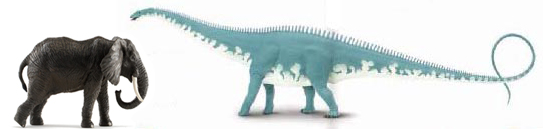
Having modelled the effect of different food metabolisable energy (ME), contents in digested plants and plotted this against estimated energy requirements for different sized sauropods, the scientists concluded that instead of having to consume over a hundred kilograms of plants per day much smaller quantities would be required. For example, a 10 tonne Diplodocus with an assumed energy requirement of 280 kJ of metabolisable energy per kilogram of body weight per day, feeding exclusively on ferns would need to eat 33.2 kg per day. If it dined exclusively on horsetails it would need to eat 23.8 kilograms per day. An elephant, although smaller, as an endothermic mammal has a much greater energy requirement and would need to consume around 40 kilograms of plant material to sustain it.
An African Elephant Compared to a Diplodocid
The nutritional requirements of dinosaurs have been compared to those of megaherbivores today.Picture credit: Everything Dinosaur.
Picture credit: Everything Dinosaur
Studying Dinosaur Diets
Dr Gill stated:
“The large body size of sauropods at that time would suggest they needed huge quantities of energy to sustain them. When the available food source has higher nutrient and energy levels it means less food needs to be consumed to provide sufficient energy, which in turn can affect population size and density. Our research doesn’t give the whole picture of dinosaur diet or cover the breadth of the plants that existed at this time, but a clearer understanding of how the dinosaurs ate can help scientists understand how they lived.”
This research is not limited to the Dinosauria, the same methodology can be utilised to model the atmospheric conditions at other points in geological deep time, to assess the nutritional requirements and feeding habits of long extinct, Miocene and Oligocene mammals for example.
The scientific paper: “Diets of Giants: the Nutritional Value of Sauropod Diet during the Mesozoic” by Fiona L. Gill, Jürgen Hummel, A. Reza Sharifi, Alexandra P. Lee, and Barry H. Lomax published in Palaeontology, the journal of the Palaeontological Association.
By Mike|2024-05-11T06:03:03+01:00July 18th, 2018|Categories: General Teaching|Comments Off on It’s Planning Time Again as New Academic Year Begins
Lots of Teachers Already Preparing for the New Academic Year
For many schools in England and Wales, the long summer holidays are about to start. Although many teaching staff will be taking a deserved vacation, we note from the number of emails, phone calls and general enquiries that we have received that lots of dedicated teaching professionals are well advanced with their planning for dinosaur and fossil teaching the start of the next academic year.
September will soon come around and teachers supported by teaching assistants and other learning support providers will be busying themselves making preparations for the challenges that a new academic year brings. From the enquiries that we have received so far this month, it seems that the Cornerstones Curriculum “Dinosaur Planet” and the term topic “Jurassic Forest” are going to be popular choices when it comes to Key Stage 1 and Reception term topics.
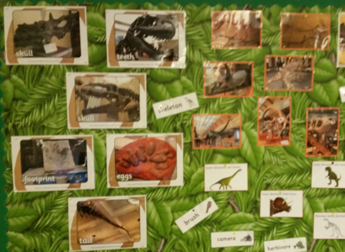
Lots of Schools are Planning Term Topics Focused Around Dinosaurs and Fossils
Lots of dinosaur and fossil pictures on display. Picture credit: Everything Dinosaur.
Picture credit: Everything Dinosaur
Preparing Prehistoric Themed Schemes of Work
As always, our dedicated teaching team are on hand to provide advice and assistance. There are numerous downloadable resources available from Everything Dinosaur’s dedicated teaching website, all provided free of charge. Our handy lesson plans, resource packs, teaching suggestions and information sheets have been downloaded by teachers, educationalists, museums and other institutions hundreds of times. We are happy to help and we get a large amount of emails from teachers asking for specific information, these are all responded to and we do our best to assist and advise where we can.
For Everything Dinosaur’s educational themed items including toys and games: Dinosaur Toys and Games.
Lesson Plans Helped to Inspire a Poster Making Exercise
Example lesson plan (Key Stage 2).Picture credit: Everything Dinosaur.
Picture credit: Everything Dinosaur
Dinosaur and Fossil Workshops in School
Our dinosaur and fossil workshops in schools are booking up fast, we already have bookings for the summer term of 2019 and enquiries for the 2019/20 academic year. We conduct a lot of work with schools and our workshops are built around curriculum teaching aims and objectives including developing writing skills, aiding literacy, exploring ideas, problem solving, working scientifically, building confidence and encouraging an understanding of materials and the wider world.
There is certainly a big “wow” factor with a visit from ourselves but everything we do attempts to reinforce learning and help achieve the teaching outcomes required by the school. Dinosaurs as a teaching theme lends itself to all sorts of ideas and extension activities and we often provide additional resources to help support the school’s scheme of work.
For further information about our dinosaur workshops in schools and to request details of our science outreach work: Contact Everything Dinosaur.
Our hard-working team members will do all they can to accommodate teaching needs, but, spaces are getting booked up fast.
Thank You Letters Received After Another Successful Dinosaur Workshop
Feedback from Primary School (EYFS). Picture credit: Everything Dinosaur.
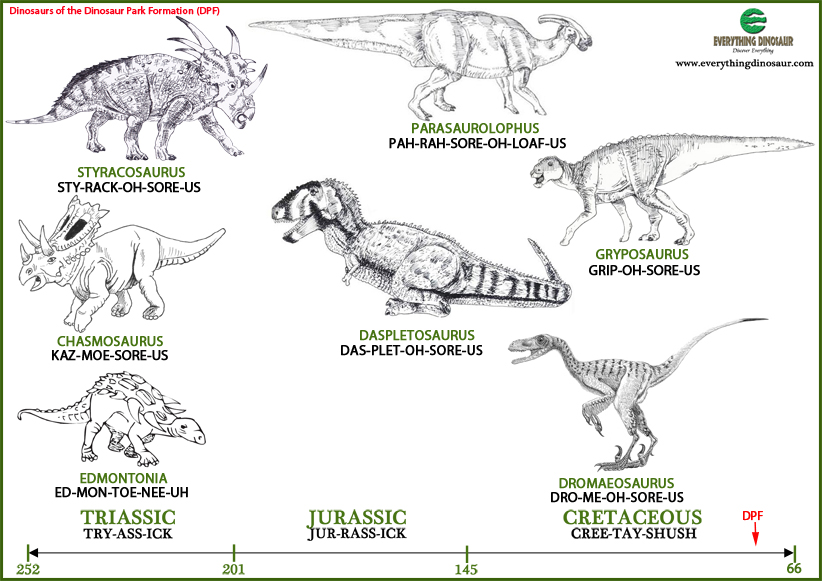
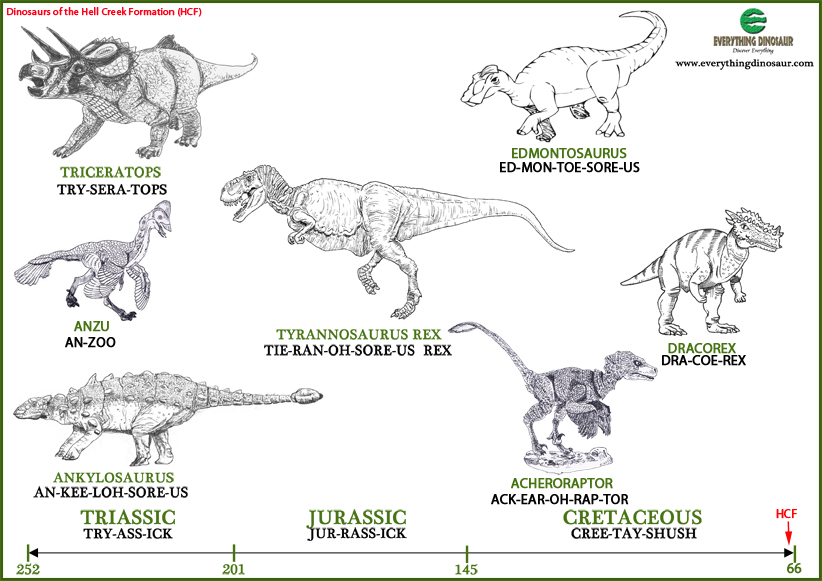
The Dinosaur Park Formation (DPF) and the Hell Creek Formation (HCF)
We have been asked to give a brief explanation of the different dinosaurs associated with two famous North America rock formations. A comment on the different dinosaur faunas associated with the Dinosaur Park Formation (DPF) of southern Alberta and the Hell Creek Formation (HCF), which is mostly associated with the state of Montana but also outcrops in North and South Dakota as well as Wyoming.
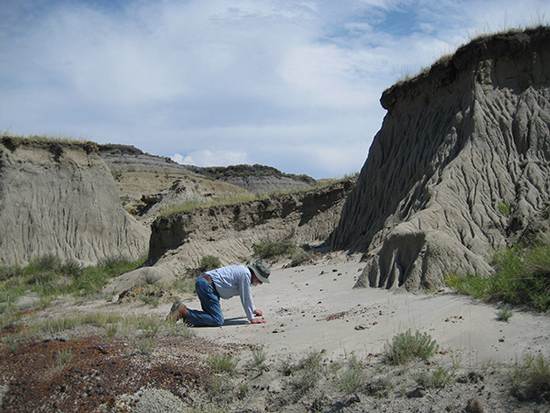
The Badlands of the Dinosaur Park Formation (DPF) – Hunting for Dinosaur Fossils
A typical view of the “Badlands” of the Dinosaur Park Formation. The red arrow in the picture highlights the layer in which the fossils of a new type of horned dinosaur were discovered.
The Badlands
Both the Hell Creek Formation and the Dinosaur Park Formation are referred to as “Badlands”, this term is derived from the French phrase “les mauvaises terres” and dates back to the early years of exploration of these vast tracts of land. The term describes an area largely devoid of vegetation that is subjected to rapid erosion caused by wind, rain and running water.
The DPF is older, the strata were laid down between 76.5 and 75 million years ago in the Late Cretaceous (Campanian faunal stage). In contrast, the Hell Creek Formation is younger. The rocks were formed at the very end of the Cretaceous (Maastrichtian faunal stage) and the strata records the transition from the end of the Cretaceous into the Palaeocene, the first Epoch of the Cenozoic. The HCF spans approximately 66.8 to 66 million years ago and documents evidence of an extra-terrestrial impact event preserved as a thin clay layer that contains large quantities of the rare Earth element iridium, marking the Cretaceous-Palaeogene boundary, representing an extinction event denoting the end of the age of the dinosaurs and the start of the Cenozoic.
Looking for Fossils – Hell Creek Formation
Prospecting for fossils – Hell Creek Formation (Montana).
Picture credit: University of California Museum of Palaeontology
The Ancient Environments – Dinosaur Park Formation and Hell Creek Formation
The strata that forms the DPF represents a coastal plain environment, crossed by numerous large rivers. The majority of the rocks are sandstones and mudstones, although there are layers of volcanic ash (bentonite), which resulted from the sporadic eruptions of volcanoes in the region. In the upper part of the DPF, coal deposits can be found (Lethbridge coal zone), representing deposition in a swampy environment.
The sea gradually encroached onto this coastal plain and the area was eventually flooded, resulting in the deposition of the marine shales that represent the Bearpaw Formation that overlies the DPF.
The Hell Creek Formation was created under similar circumstances. It too represents clays, mudstones and sandstones deposited on a delta, a low-lying flood plain crossed by many rivers. The HCF also has peaty, coal-like deposits (lignite), representing deposition in coastal swampy environments.
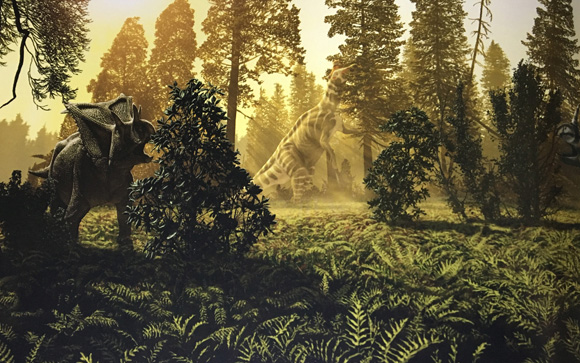
The Palaeoenvironment of the Dinosaur Park Formation
Alberta around 75 million years ago (Dinosaur Park Formation).
Picture credit: Julius Csotonyi
A Chasmosaurus and a Lambeosaurus feeding during the late evening, a typical scene representing the biota associated with the DPF.
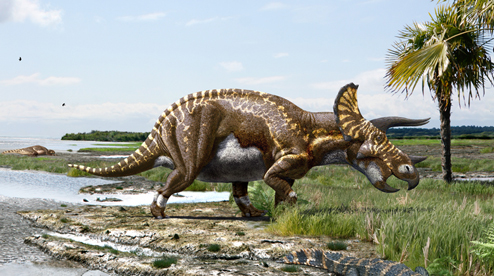
The Palaeoenvironment of the Hell Creek Formation
Triceratops was one of the last dinosaurs to evolve. A resident of the Hell Creek Formation.
Picture credit: Julius Csotonyi
A Triceratops grazes next to a palm tree on the coastal plain that is represented by deposits that help to make up the Hell Creek Formation of Montana.
Different Time Periods – Different Dinosaurs
Both the HCF and the DPF are famous for extensive dinosaur fossils. It is worth remembering that numerous other kinds of animal (and plants) are represented in the fossil record of these two formations. Although, the dinosaur fauna is similar between the DPF and the HCF, for example the terrestrial large herbivores are dominated by duck-billed dinosaurs and ceratopsians, the genera represented are very different.
In simple terms, the stage scenery might be similar and the cast of characters reminiscent but the actors on the stage are different.
Typical Dinosaurs from the Dinosaur Park Formation (Campanian Faunal Stage of the Cretaceous)
Typical dinosaur fauna of the Dinosaur Park Formation (Alberta, Canada). Picture credit: Everything Dinosaur.
Picture credit: Everything Dinosaur
Typical Dinosaurs from the Hell Creek Formation (Maastrichtian Faunal Stage of the Cretaceous)
Typical dinosaurs of the Hell Creek Formation. Picture credit: Everything Dinosaur.
Picture credit: Everything Dinosaur
The images in the pictures (above) are based on various dinosaur models sold by Everything Dinosaur. To view the range of models available: Prehistoric Animal Models and Replicas.
We are looking forward to our visit to the Beacon Museum at Whitehaven (Cumbria). Everything Dinosaur will be taking visitors on a fossil hunt and we hope to be able to give away real dinosaur bones.