All about dinosaurs, fossils and prehistoric animals by Everything Dinosaur team members.
5 01, 2011

The Ibis that Went Clubbing – New Research is Published

By |2024-04-21T11:34:11+01:00January 5th, 2011|Categories: Animal News Stories, Dinosaur and Prehistoric Animal News Stories, Main Page|1 Comment

Prehistoric Bird with Club-like Wings

Nature is full of examples of different types of organism that develop the same biological or anatomical characteristics as an adaptation to their environments.  For example, ichthyosaurs (and now possibly mosasaurs), with their tail-flukes that resemble those of dolphins.  The flying squirrel and the flying lizard, both accomplished gliders but not closely related.

Just occasionally, a fossil is found that throws up something so unusual and uncharacteristic that scientists are perplexed as to what their discovery could mean.  They have no benchmarks to work with.

One such instance of this has been reported in the scientific journal “The Proceedings of the Royal Society – Biology”.  A paper has just been published on the fossilised remains of a type of Ibis from the Caribbean island of Jamaica.

Xenicibis xympithecus

This extinct, flightless bird known only from Jamaica, apparently evolved banana-shaped clubs from its wings.  What these “clubs” were actually for remains open to speculation, but researchers have concluded that they may have been used in intraspecific conflicts, perhaps fights over nesting sites or mates.

This strange bird, was roughly the size of a chicken, it has been scientifically described as Xenicibis xympithecus.  The genus Xenicibis had been first described in 1977 and a number of bones ascribed to it from several Caribbean islands.  However, this new study has been based on much more complete remains found in caves sited at the southern end of Jamaica.  Evidence suggests that this bird was alive as recently as 10,000 years ago, and may have been driven to existence by man, the fate of so many flightless birds, the Dodo for example.

Commenting on this strange creature, researcher Nicholas Longrich, a vertebrate palaeontologist at Yale University stated:

“There is just nothing else out there like this in any other vertebrate.  Usually evolution tends to hit on the same designs over and over, and this is just something completely different, so as a biologist it’s sort of cool to find something and be able to say: Wow!  I haven’t seen that one before.

Distorted Hands and Block-like Fingers

The strangely distorted hands had short, block-like fingers, long palm bones, thicker than the bird’s femur and wrist joints that allowed the wings to swing rapidly back and forth like flails or clubs.

Longrich added:

“I sometimes compare these things to nunchucks, which I guess would make this a ninja bird, although perhaps a better analogy would be a pair of baseball bats – they were actively swung rather than moving passively like a flail.”

Evidence of broken wings in the fossil record, suggest these clubs were potent weapons in intraspecific combats.

At first, scientists thought that this was a deformity but as more fossils were found showing the same anatomical configuration it became clear that the club-like wings were an adaptation.  Their use as weapons to fight off predators has not been ruled out, as it seems that both males and females possessed these strange wings.

For models and replicas of extinct animals, take a look at the Mojo Fun range of figures: Mojo Fun Prehistoric and Extinct Models.
4 01, 2011

Cutting out the Microraptors

By |2023-01-14T16:28:15+00:00January 4th, 2011|Categories: Adobe CS5, Main Page|0 Comments

Fiddly Feathered Dinosaurs – Microraptor

With the new year well under way, time to change one of the banners on the Everything Dinosaur website.  Not the easiest of tasks as none of us at the company would describe ourselves as particularly gifted when it comes to photoshop skills.  However, we are determined to have a go and after the first few days of January, the “Happy New Year” banner had to go.

Microraptor

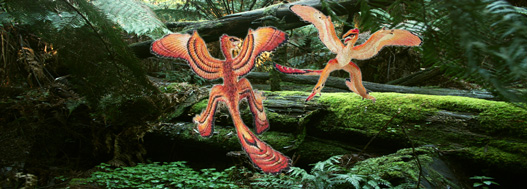
The subject for our next banner was to be a forest scene, depicting a feathered dinosaur.  We tried to imagine what it would have been like to visit the Liaoning Province of what was to become northern China during the Early Cretaceous.

It took a bit of effort but we were able to secure the image of some forest undergrowth, to this we added the images of two feathered dinosaurs – Microraptor (Microraptor gui).  We have tried to depict these two small, bird-like dinosaurs as if they were displaying to each other.

Microraptors Displaying in the Early Cretaceous Forest

Picture credit: Everything Dinosaur

The picture shows a Microraptor dinosaur model, specifically the Carnegie Collection Microraptor dinosaur, an excellent example of a feathered dinosaur model.

This feathered dinosaur was at least in part arboreal (living in the trees).  It was capable of gliding according to some interpretations of the fossil evidence.  Microraptor had long feathers on its arms and legs.  When spread apart, these would have provided an effective gliding surface, perhaps permitting this little crow-sized animal to glide from tree to tree.  The tail was also feathered and it had a plume, presumably to help this little dinosaur steer whilst in flight.

In the dark understorey of the Cretaceous forests, it is possible that many dinosaurs were brightly coloured to help them display to each other.  Although very little is known about dinosaur colouration, certainly any fossil material associated with the Microraptor genus does not reveal information about possible colour, Microraptors are generally depicted as colourful creatures and we think they stand out quite well against the dark vegetation.

The model chosen for this scene was the Microraptor replica from the Safari collection, to view the range of models made by this company:

Prehistoric animal models and dinosaur figures: Safari Ltd. Wild Safari Prehistoric World.

3 01, 2011

Last Year’s Predictions – How did we do?

By |2023-01-14T15:47:47+00:00January 3rd, 2011|Categories: Everything Dinosaur News and Updates, Main Page, Press Releases|0 Comments

Review of Predictions for 2010

At the beginning of each year, team members at Everything Dinosaur put their heads together and just for a little bit of fun, they have a go at predicting some of the news stories and events that they might report on in the year ahead.  So with 2010 over and as we are looking forward to this year, it is time for a quick look back to see what predictions we made twelve months ago.

Everything Dinosaur

We have already made some predictions for 2011, to view our predictions for the forthcoming year: Palaeontology Predictions for 2011.

How did we do with our 2010 predictions?  Were we within a fossilised gnats nose or out by the length of a diplodocid’s tail?

The List of Predictions Made by Everything Dinosaur at the Start of 2010

1). More Dinosaurs and other prehistoric animals to go under the hammer

2). Increased pressure for change in UK museum funding

3). “Dakota” to hit the headlines once again

4). Criminal charges for a palaeontologist in the United States

5). Everything Dinosaur trilobite hunt at last

6). Increased emphasis for science teaching in UK primary schools

7).  March to mark a millennium for Everything Dinosaur’s web log

8). A new genus of pterosaur to be announced

9). Beware of smugglers

10). Last but not least a thought for South Africa

Quite an eclectic mix of predictions, but how did we do?

Our prediction regarding more auctions of dinosaurs and prehistoric animals proved to be quite accurate with a number of high profile sales in Europe and the United States.  For example, in May we wrote about an auction of a range of prehistoric items, including T. rex teeth, the skull of a Cave Bear and the remains of a Woolly Mammoth.

For dinosaur and prehistoric animal models and figures: Prehistoric Animal Models and Dinosaur Figures.

The prediction about pressure on museums to charge entrance fees, proved to be only partially correct.  With the change of UK government we were aware that charging for museum entrance was discussed, but fortunately this policy was not put forward and no charging plans have been implemented – yet.

Our predictions for “Dakota” the magnificently well preserved, Edmontosaurus “mummified” dinosaur fossil were partially accurate.  There were a number of news stories published about how the research work was progressing and what plans were in place to display the fossil once the preparation was completed, but there were no “outstanding” new breakthroughs.  Limits on funding and the problems caused by trying to analyse such a huge and unwieldy fossil put a check on progress.  However, the dedicated team of researchers are still working on this very significant find and more information about this Hadrosaur will be, no doubt come to light shortly.

As for our prediction regarding the prosecution of an American over a fossil related matter, we are aware of a number of incidents, but fortunately, the new laws and restrictions imposed by the United States seem to be having the desired effect.  Which is more than can be said about Everything Dinosaur’s trilobite hunt, we have yet to visit the location we had wanted to, but with a little better planning and time management we are hopeful to do some fieldwork at this particular site in the near future.

Greater teaching emphasis for science – we were at a meeting in the Autumn at which individuals close to the UK Government briefed us on the situation regarding the need emphasis the teaching of science topics in school.  School funding has been affected by the recession and the Government spending cuts, but we at Everything Dinosaur continue to lobby and to offer subsidised teaching of Earth Sciences.  Fortunately, following  a review, the plans to slash the science teaching budget have been put on hold, at least for the time being.   Some good news then.

The prediction about Everything Dinosaur’s web log reaching its 1,000 article landmark in March 2010 proved partly correct, albeit that the 1,000th article was published a little later than we predicted.  We aim to publish an article, review, or photograph every single day (seven days a week).  Our 1,000th article was published on April 17th, at present we are well on the way to publishing our 1,300th web log article.

Blog Landmark Reached

As for our prediction about a new species of pterosaur (flying reptile) being announced, sure enough there were a number of new papers published, most notably perhaps the paper from a team of Irish scientists about a new genus of flying reptile we reported on in May, plus new research into how pterosaurs launched themselves into the air.  Giant flying reptile models even invaded London for a short time to help promote the 350th anniversary of the founding of the Royal Society.

The black market in fossil sales continued to grow, despite increased activity by both internal and international security services.  The smuggling of fossils and other ancient artefacts is big business and it is rare these days to hear of a fossil dig site in parts of the world such as India that is not raided at least once by trophy hunters, curious locals or professional fossil smugglers.

Finally, with the world’s attention focused on South Africa for the 2010 World Cup we thought that we would have one prediction for this particular African country.  True enough, there were a number of important discoveries reported upon.  More ancient hominid remains and the evidence of Early Jurassic dinosaurs being just two stories about the rich fossil record of South Africa published last year.  We also ought to report on one extinction event that occurred in that country in the Summer – the extinction of England’s national football team after there insipid performance in the tournament.  Sadly, England failed and once again, after all the hyperbole and expectations, our national football team did not deliver on the world stage.

Trying to predict what will happen with the study of Dinosauria and other fossils over the next year is a difficult business, at least we won’t try to predict when England will win the World Cup, that would be just too difficult to contemplate.

To view the entire article on our 2010 predictions: Everything Dinosaur’s Predictions for 2010.

2 01, 2011

Review – David Attenborough’s “First Life”

By |2023-03-06T14:43:57+00:00January 2nd, 2011|Categories: Book Reviews, Main Page|1 Comment

A Review of the Book – “First Life”

Designed to accompany the two-part television series, “David Attenborough’s First Life” covers the billions of years of time, leading up to the development of advanced forms of life on our planet.  It is a chronological journal, split into eleven chapters that tells the story of the “slow burning fuse” that led to the explosion of life in the Cambrian, the development of the Phyla of organisms that are still with us today.

“First Life”

The text is informative, not too technical and designed for the lay person to follow.  There are many splendid photographs and lots of information on the fossil locations, although it would have been interesting to read more about some of the UK fossil locations such as Crail in Scotland and perhaps there are too few scary creatures for children to enjoy.  Although, it is amazing to see the strange and wonderful creatures known as the Ediacaran fauna (soft-bodied, bizarre organisms).

By the Late Precambrian, around six hundred million years ago, simple food chains had become established with over thirty different genera recognised, this simply ecosystem is known as the Ediacaran fauna after the Ediacara Hills, north of Adelaide in South Australia, where a variety of Late Precambrian fossils were discovered in the late 1940s.

The introduction, written by Sir David Attenborough, really brings out his passion for fossils and fossil collecting.  The highlight of the book, was reading about Sir David’s own connection with Charnwood forest, the site in Leicestershire, the county of Sir David’s childhood, where the important Precambrian fossil Charnia (Charnia masoni) was discovered.

Academic Content and Computer Generated Wonders

At over 285 pages in length, this book provides an appropriate balance between academic content and computer generated wonders.  One of the features of this book, are the extreme close up photographs of important fossils.  The vast majority of fossils from the Precambrian and the Cambrian geological period are extremely small, but the highly magnified and full colour photographs really help to bring the fossil evidence “to life”” as it were.  The reader is treated to some wonderful images, illustrations of the primitive sea landscapes and some excellent computer generated impressions and graphics as to what the fauna and flora of the Burgess Shale site might have looked like (British Columbia, Canada).

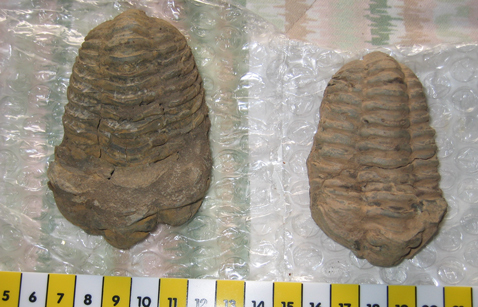
Trilobites Feature in the Television Series “First Life”

The definition of benthic.  A pair of trilobite fossils. Trilobites feature in the televison programme "First Life".

Trilobite fossils (Calymene).  Picture credit: Everything Dinosaur.

Picture credit: Everything Dinosaur

So in summary, a good book, an interesting read, perhaps not ideally suited for children but a fitting tribute to the work of scientists and to Sir David himself.

Prehistoric Animal Replicas

To view models and replicas of trilobites and other ancient creatures: CollectA Prehistoric Life Models.

1 01, 2011

Happy New Year from Everything Dinosaur

By |2023-03-06T14:44:56+00:00January 1st, 2011|Categories: Adobe CS5, Everything Dinosaur News and Updates, Main Page|0 Comments

Happy New Year to all our Readers

January 1st and just time to write to thank all our readers for staying with us over the last twelve months or so and to wish them all a peaceful and prosperous new year.  We put up a new banner on the front page of the Everything Dinosaur website Everything Dinosaur last night marking the start of 2011.

Happy New Year from Everything Dinosaur

Picture credit: Everything Dinosaur

Not to sure why we put a Quetzalcoatlus on the banner, pterosaurs are not traditionally associated with new year (not so far as we know), but I suspect this flying reptile was quite quick to photoshop which is why it was chosen.

Everything Dinosaur

Perhaps as it is soon to be the Chinese new year and it is going to be the year of the rabbit we subconsciously posted up a picture of an animal that if it were around today, may well feed on rabbits, hares and all things Lagomorpha.  Personally, I think the former is more likely to be the case.

Happy New Year!

Visit Everything Dinosaur’s website: Everything Dinosaur’s Website.

Go to Top