All about dinosaurs, fossils and prehistoric animals by Everything Dinosaur team members.

Pictures of fossils, fossil hunting trips, fossil sites and photographs relating to fossil hunting and fossil finds.

12 06, 2026

A Stunning Theropod Skull on Display

By |2026-06-13T06:38:16+01:00June 12th, 2026|Categories: Photos/Pictures of Fossils|0 Comments

During a visit to the Museum für Naturkunde (Berlin) we took the opportunity to photograph the beautiful skull of Tristan the Tyrannosaurus rex.  The skull is one of the most complete and best-preserved tyrannosaur skulls known to science.  The T. rex fossils, on display next to the skull material have been named Tristan Otto.  To scientists the material is referred to by its specimen number MB.R.91216.

Tristan the Tyrannosaurus rex skull.

The beautiful Tristan the Tyrannosaurus rex skull shown in lateral view. Picture credit: Everything Dinosaur.

Picture credit: Everything Dinosaur

Tristan the Tyrannosaurus rex

In total, about 170 fossil bones from an individual T. rex have been collected.  They make a remarkable exhibit.  Furthermore, they dwarf the Allosaurus on display next to the T. rex fossil material. Tristan Otto remains privately owned.  However, the owners have made the specimen available for study as well as public exhibit through the Museum für Naturkunde in Berlin.

The fossilised remains were found in 2010 in Montana (Hell Creek Formation). Businessmen Niels Nielsen and Jens Peter Jensen purchased the fossils in November 2014.  The dinosaur was named after the sons of the owners.  It is a beautiful tyrannosaur specimen.

Mike from Everything Dinosaur commented:

“I had wanted to see Tristan Otto for a long time.  Whilst in Berlin I took the opportunity to visit the amazing Museum für Naturkunde.  I went early on a Sunday and the museum was quiet. Furthermore, I had the theropod gallery all to myself for a few moments.   Fortunately, I was able to take a photograph of the beautiful skull, before more visitors arrived.”

For museum quality models of tyrannosaurs and other prehistoric animals: Models of Theropod Dinosaurs.

4 06, 2026

Tracking Down an Elusive Allosaurus Species

By |2026-06-07T08:29:54+01:00June 4th, 2026|Categories: Photos/Pictures of Fossils|0 Comments

Allosaurus has become a bit of a taxonomic waste basket.  This term relates to fossil material from theropods being assigned to the genus.  However, some of the evidence for assigning the material is tentative.  For example, theropod bones from southeastern Tanzania (Tendaguru Formation) had been assigned to an allosaur species named Allosaurus tendagurensis.  In 1925, when A. tendagurensis was erected (Janensch), Allosaurus was the best-known large Upper Jurassic carnivorous dinosaur.  These days, palaeontologists have a better understanding of Late Jurassic meat-eating dinosaurs.  These fossils are now described as “Tetanurae indet.”

Allosaurus tendagurensis

Whilst on a visit to the Museum für Naturkunde Berlin, we tracked down some of the Allosaurus tendagurensis fossils.  In a display case in the dinosaur gallery, we found a large tibia (lower leg bone), two teeth and a caudal vertebra.  The fossils had their original labels on them and were perhaps some of the material cited by the German palaeontologist Werner Janensch in the paper “Die Coelurosaurier und Theropoden der Tendaguru-Schichten Deutsch-Ostafrikas” published in 1925.

Allosaurus tendagurensis fossils (as originally labelled).

Originally described as Allosaurus tendagurensis by the German palaeontologist Werner Janensch (1925), these fossils are not associated with any specific theropod taxon but rather referred to as possible megalosauroid or carcharodontosaurid material. Picture credit: Everything Dinosaur.

Picture credit: Everything Dinosaur

The remains of several large predatory dinosaurs were found in the Upper Jurassic deposits of Tendaguru. From these remains two teeth, a lower leg bone (tibia) and a tail vertebra (caudal vertebra) are shown in the photograph. Although the material is incomplete, scientists can narrow down the group that the animal belonged to. It was probably a member of the carcharodontosaurid. However, as a more definite identification cannot be made, the fossil material is described generally as “Tetanurae indet.”

The Tetanurae Clade of Theropod Dinosaurs

The Tetanurae is a clade of theropod dinosaurs. It contains all the theropods more closely related to birds than to Ceratosaurus. Constituents include coelurosaurs, megalosauroids and allosauroids. Intriguingly, the Tendaguru bones tend to be larger than those associated with most allosaurids. Therefore, palaeontologists have concluded that theropods comparable in size to T. rex were present in the ecosystem.  The fossils originally referred to Allosaurus tendagurensis could represent a carcharodontosaurid or possibly a megalosauroid.

Several Species of Allosaurus

Over a hundred years after Janensch described the Tendaguru theropod fossils, palaeontologists have a much better understanding of the composition of the Allosaurus genus. For example, several species are now recognised:

  • Allosaurus fragilis – named by Othniel Charles Marsh in 1877 (North American species).
  • Allosaurus europaeus – from the Upper Jurassic strata of Portugal associated with the Lourinhã, Bombarral, and Alcobaça geological formations (Mateus et al 2006).
  • A. jimmadseni – another North America species erected after a reassessment of fossil material formerly assigned to A. fragilis (Chure and Loewen, 2020).
  • Allosaurus anax – erected following a reappraisal of fossil material formerly assigned to Saurophaganax (Danison et al, 2024).

New research suggests that Allosaurus europaeus is not a valid taxon: Research Undermines an Allosaurus Species.

The naming of Allosaurus jimmadseniA New Species of Allosaurus is Erected.

The demise of Saurophaganax: New Study Suggests Saurophaganax is Not a Valid Taxon.

Unfortunately, species assignment and potential synonyms are complicated by the type specimen of Allosaurus fragilis (YPM 1930) being extremely fragmentary.  This has led to difficulties ascribing fossils found in North America, Europe and elsewhere in the world to Allosaurus.

Most dinosaur models probably represent Allosaurus fragilis, or possibly Allosaurus jimmadseni.

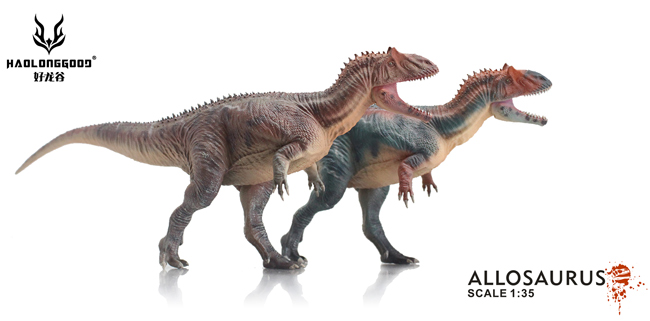
Haolonggood dinosaur models (Allosaurus figures).

The Haolonggood Allosaurus dinosaur models (Allosaurus Yangzhi and Suochao). These are typical of the high quality of Allosaurus models available.  Although Haolonggood do not declare a genus, the crests above the eyes suggest Allosaurus fragilis.

To view the extensive range of Haolonggood figures in stock: Haolonggood Dinosaur Toys.

Mike from Everything Dinosaur commented:

“Considerable work has been undertaken leading to a revision of the Allosaurus genus.  Several species have been erected. However, some taxonomy remains controversial.  Moreover, it is likely that fossils associated with this famous dinosaur will be revised further in the future.”

Allosaurus roaming Australia: Highlighting Australian Dinosaurs.

The multi-award-winning Everything Dinosaur website: Prehistoric Animal Models and Dinosaur Toys.

18 05, 2026

Happy International Museum Day (2026)

By |2026-05-18T15:28:04+01:00May 18th, 2026|Categories: Photos/Pictures of Fossils|0 Comments

Today is International Museum Day and, here at Everything Dinosaur, we would like to celebrate the incredible work carried out by museums around the world. Museums help inspire curiosity, encourage learning and connect people with nature. They also play a crucial role in education, science communication and outreach.

We have always enjoyed visiting museums, especially natural history museums. These institutions bring prehistoric animals to life and help visitors of all ages discover Earth’s remarkable past. Furthermore, museums provide an important bridge between academic research and public understanding.

Many of the prehistoric animal models supplied by Everything Dinosaur are used by museum staff and educators. Our models help support outreach activities, handling sessions, educational workshops and public exhibitions. In this way, scale models can help visitors engage with palaeontology and fossil discoveries in a fun and accessible manner.

Celebrating International Museum Day

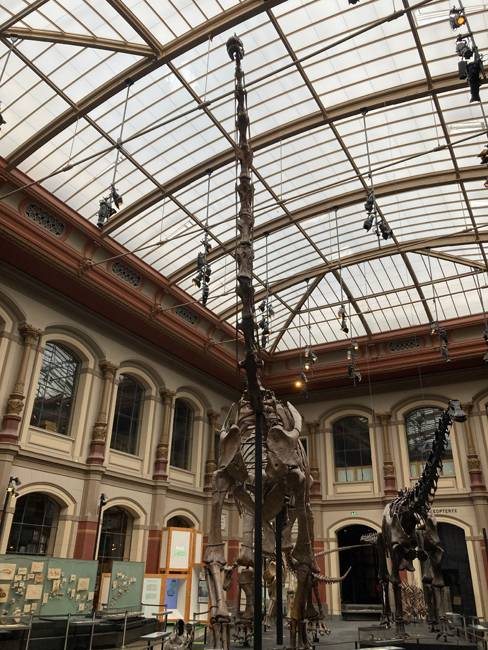
Recently, we visited the remarkable Museum für Naturkunde Berlin in Germany. This world-famous museum houses one of the finest dinosaur galleries anywhere in the world. The spectacular mounted skeleton of Giraffatitan (G. brancai) dominates the main hall and remains one of the museum’s most iconic exhibits. The mounted fossil is recognised as the tallest dinosaur skeleton on display (we think).  It has an official certificate from the Guinness World Record organisation adjacent to the fossil skeleton.

Museum für Naturkunde Berlin dinosaur gallery.

The spectacular dinosaur gallery at the Museum für Naturkunde Berlin. Picture credit: Everything Dinosaur.

Picture credit: Everything Dinosaur

Visitors can also admire the enormous Diplodocus exhibit nearby. Together, these giant sauropods create a breath-taking display that demonstrates the immense size of some of the largest animals ever to walk our planet.

To read a recent blog post about a newly described sauropod dinosaur: A New Sauropod from South America with Brachiosaurid and Diplodocid Affinities.

Commenting on International Museum Day, Sue from Everything Dinosaur stated:

“Natural history museums have a unique way of inspiring people of all ages. We always enjoy visiting museums and seeing how they help bring science and palaeontology to life. It is wonderful to know that some of our prehistoric animal models are also being used to support museum education and outreach programmes.”

Natural history museums continue to inspire future generations of scientists, fossil collectors and dinosaur fans. Indeed, many new discoveries are made by utilising the extensive collections stored in museums. On International Museum Day, we would like to thank museum staff, researchers and educators for all their hard work and dedication.

Happy International Museum Day!

The award-winning-Everything Dinosaur website: Museum-quality Dinosaur Models.

12 05, 2026

Spotting a Gorgeous Ammonite Fossil in a Floor Tile

By |2026-05-12T13:54:13+01:00May 12th, 2026|Categories: Photos/Pictures of Fossils|0 Comments

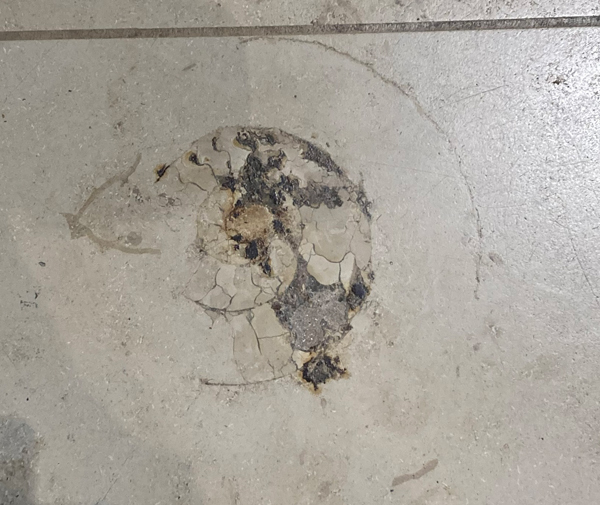
Waiting for a plane is tiresome. However, with our interest in fossils there is always the opportunity to go on an impromptu fossil hunt.  For example, whilst at Brandenburg Airport Berlin (Flughafen Berlin Brandenburg – BER), Sue and I passed the time examining the numerous ammonite and other invertebrate fossils preserved in the polished floor tiles of the airport.  We took the opportunity to photograph some specimens including one example that we termed “an ammonite fossil in floor tile”.  To document an example of a fossil preserved in the Jurassic limestone.

Berlin Brandenburg airport ammonite fossil.

Large numbers of ammonite fossils can be found on the polished floor tiles of Berlin Brandenburg airport. The floor is constructed from Jura limestone, and it is highly fossiliferous. Picture credit: Everything Dinosaur.

Picture credit: Everything Dinosaur

The stone floor of the airport consists of Jura limestone. Builders use this common material in many German public buildings, including airports. For example, during a visit to Nuremberg Airport (Flughafen Nürnberg), we photographed numerous Jurassic fossils preserved in the floor tiles.

An earlier blog post about finding fossils at Flughafen Nürnberg: Fossil Hunting at Nuremberg Airport.

The limestone contains a rich variety of fossils. Visitors can observe the remains of marine invertebrates, including ammonites and belemnites, in the polished surfaces.

An Ammonite Fossil in Floor Tile is Spotted

The suture lines on the shell are clearly visible. Palaeontologists often identify ammonite species by studying the septa and the suture patterns inside the shell. The animal formed septa as internal walls that divided the shell into separate chambers. As the ammonite grew, it built new chambers and sealed the older ones with these walls. Each septum met the outer shell wall and created a line called a suture. When the shell fossilised, these sutures often remained visible after erosion removed the outer shell layer.

The shape and complexity of the sutures help scientists identify different ammonite groups and species. Some species developed simple, gently curved sutures. Other species evolved extremely intricate patterns with frilled or fern-like edges.

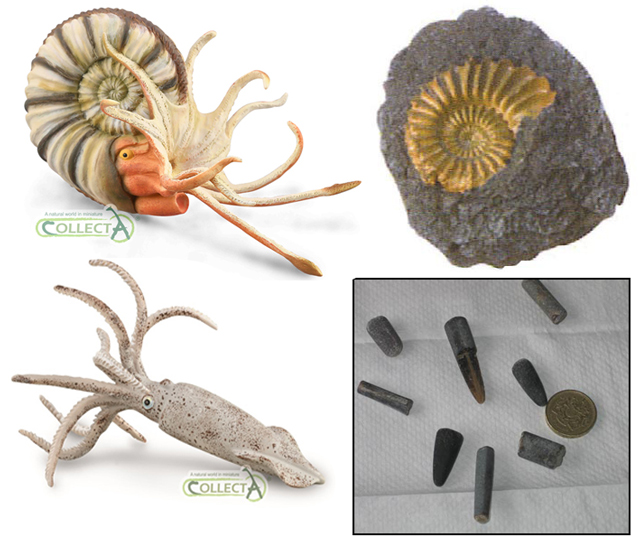
Pen-like belemnite fossils are also preserved in the stone.

CollectA ammonite and belemnite.

The CollectA ammonite and belemnite 2020 models next to examples of fossils. These figures are excellent representations of the living animals. Picture credit: Everything Dinosaur.

Picture credit: Everything Dinosaur

Models of Ammonites and Belemnites

Models of ammonites and belemnites help collectors.  They can be used to help explain what the prehistoric animal probably looked like.  Several companies make these models. For example, the image (above) shows the CollectA Pleuroceras ammonite model and the CollectA belemnite.

To view the range of CollectA prehistoric life models: CollectA Prehistoric Life Prehistoric Animal Figures.

Mike from Everything Dinosaur commented:

“Airports can feel stressful at times. However, we soon discovered an amazing distraction at the Berlin airport. As we walked through the terminal, we spotted beautifully preserved Jurassic fossils in the floor tiles. Moreover, the polished Jura limestone revealed an incredible array of ancient marine organisms. We observed ammonites, belemnites and other invertebrate remains preserved in remarkable detail.”

He added:

“Consequently, the time passed quickly as we searched the floor for more fossils. Every few metres, another specimen caught our attention. We even managed to photograph an ammonite specimen as we went through the baggage check. It turned an ordinary wait at the airport into a memorable fossil hunting experience.”

The award-winning Everything Dinosaur website: Prehistoric Animal Figures and Dinosaur Models.

6 05, 2026

Beautiful Eryops Fossil Skeleton on Display

By |2026-05-07T22:10:53+01:00May 6th, 2026|Categories: Photos/Pictures of Fossils|0 Comments

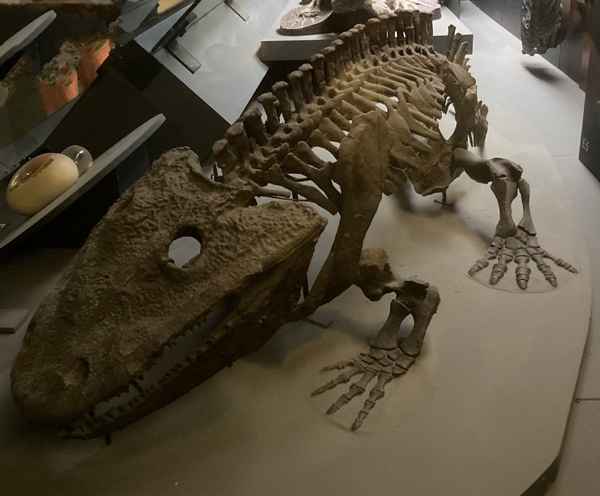
As a child, one of my favourite prehistoric animals was the giant temnospondyl Eryops.  It always brings me pleasure when I come across fossils of this Early Permian predator.  Indeed, just viewing a reconstructed skeleton makes me smile.  When at the London Natural History Museum, I try to make time to see the Eryops megacephalus skeleton on display.

Eryops megacephalus skeleton.

A cast of a Eryops megacephalus skeleton on display at the London Natural History Museum. Picture credit: Everything Dinosaur.

Picture credit: Everything Dinosaur

I remember seeing pictures of this strange amphibian in prehistoric animal books.  I marvelled at its huge size and enormous head.  It remains one of my favourite Palaeozoic prehistoric animals.

Recalling pictures of Eryops megacephalus in old books: My Favourite Picture of Eryops.

One day, perhaps a model making company will make a detailed replica of this giant temnospondyl.  Let’s hope so.

For models of Palaeozoic creatures and other prehistoric animals: Prehistoric Animal Models.

1 04, 2026

April Fool’s Day and Prehistoric Pranks: When Fossils Fool Us

By |2026-04-03T18:09:29+01:00April 1st, 2026|Categories: Photos/Pictures of Fossils|0 Comments

April Fool’s Day is the perfect excuse for a little mischievous fun. Every year on the 1st of April, people play practical jokes and the media is full of bizarre news stories that turn out to be hoaxes. However, while jokes are often harmless fun, some deceptions have had a lasting impact on science. Prehistoric pranks can come in various shapes and sizes.  For example, we are aware of bogus new dinosaur model announcements in the past.  Strange chimera consisting of theropods crossed with ceratopsians.  Indeed, we have been asked to help out with museums when they wanted to add a little bit of mischief to their April communications.

In addition, even the likes of Sir David Attenborough have been fooled by fossils.  The accomplished naturalist and broadcaster recalls the story of how he was once convinced to purchase a trilobite mating fossil.  The specimen proved to be a fake, a clever concoction prepared by a Moroccan fossil preparator to bump up the price.

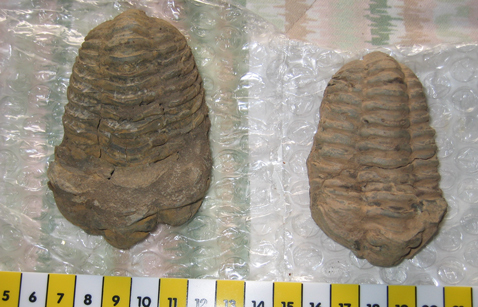
The definition of benthic. A pair of trilobite fossils. Trilobites feature in the televison programme "First Life".

Calymene trilobites. Unscrupulous fossil sellers often “customise” fossils to make them more valuable. Even Sir David Attenborough has been caught out by such practices. Picture credit: Everything Dinosaur.

Picture credit: Everything Dinosaur

When Science Gets it Wrong

In fact, the world of palaeontology has not been immune to prehistoric pranks and trickery. Over the years, a few famous fossil hoaxes have fooled experts and captured the public imagination. So, as we enjoy April Fool’s Day, it is worth exploring how even scientists can sometimes be misled. Science relies on evidence. However, mistakes can be made when it comes to interpreting the evidence. Occasionally, these mistakes are not accidents at all. Instead, they are deliberate hoaxes designed to mislead.

One of the most famous examples is the so-called “missing link” known as Piltdown Man. In 1912, fragments of a skull were discovered in Sussex, England. At the time, this discovery seemed extraordinary. The remains were claimed to represent a new species of early human, one with both human and ape-like features.  It was not until 1953 that the fossils were definitively proved to be a hoax. The material was identified as a human skull from the Middle Ages, fossil teeth from ape (chimpanzee), and an orangutan jawbone that was a few hundred years old.

As a result, Piltdown Man became one of the greatest scientific hoaxes of all time.

Lessons from a Prehistoric Prank

The Piltdown Man forgery provides important lessons for palaeontologists. Science is not just about discovery; it is also about verification. Because of this case, scientists became more cautious. They now rely on improved techniques and stricter peer review.

Similarly, a fossil from China claimed to be a missing link between birds and theropod dinosaurs. The specimen was given the informal name of “Archaeoraptor”. A sensational article announced this remarkable discovery in an article in “National Geographic” magazine (1999). Subsequently, the specimen was found to consist of several pieces from real fossils that had been rearranged and stuck together to make the material more valuable.

Moreover, the story highlights how expectations can influence interpretation. At the time, many researchers expected a transitional form between terrestrial theropods and true birds to be discovered.

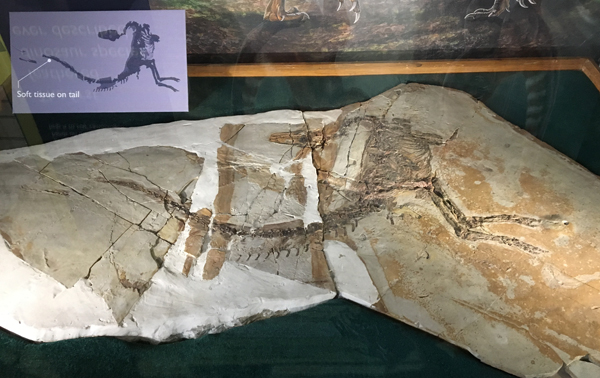
Sinosauropteryx fossil material.

Sinosauropteryx on display – the first feathered dinosaur described. It was described in 1996, and scientists were expecting more feathered dinosaur fossils from China.  This helped set the scene for the “Archaeoraptor” forgery. Picture credit: Everything Dinosaur.

Picture credit: Everything Dinosaur

A Light-Hearted Look at Fossil Discoveries

Of course, not all “fossil surprises” are serious. Every year, museums, universities, and even palaeontology blogs join in April Fool’s Day fun. From imaginary dinosaur species to bizarre fossil discoveries, these playful stories entertain and educate at the same time. At Everything Dinosaur, we have enjoyed joining in over the years. After all, a good-natured joke can spark interest in the Earth sciences. For example, fifteen years ago we were asked to help promote a prehistoric animal exhibition by helping to organise the discovery of a dinosaur bone on a beach in Cumbria.

To read more about this prehistoric prank: Unbelievable! Dinosaur Bone Found at Whitehaven.

April Fool’s Day is an annual reminder to question what we see and read. Whether it is a surprising fossil claim or an unusual news story, it is best to be sceptical. At the same time, curiosity remains at the heart of scientific endeavour. By asking questions and testing ideas, we continue to uncover more amazing evidence about life on Earth.

So, if you come across a “new dinosaur discovery” today, take a closer look. It might just be an April Fool’s trick!

And if it is real—well, that’s even more exciting!

The award-winning Everything Dinosaur website: Dinosaur and Prehistoric Animal Models.
14 03, 2026

New Dinosaur Taxa Likely to be Named from Jenguebi Locality Fossils

By |2026-03-08T07:41:25+00:00March 14th, 2026|Categories: Photos/Pictures of Fossils|0 Comments

Recently, Everything Dinosaur reported upon the discovery and naming of a new species of African spinosaurid.  The theropod has been named Spinosaurus mirabilis.  It is the second species in the Spinosaurus genus to be recognised.  However, the fossil site in Niger will also yield other new dinosaur species.  It is not just the remains of theropod dinosaurs that have been preserved at the Jenguebi locality.  Fossils of sauropods have been discovered too. The Jenguebi sauropod fossils documented by the Spinosaurus mirabilis field team are likely to represent the remains of new taxa.

Jenguebi Sauropod Fossils

The newspaper headlines might have focused on the new Spinosaurus species.  After all, it is a remarkable discovery, however the fossil quarry in a remote part of Niger (Africa) preserves evidence of an inland Cretaceous waterway that teemed with life.

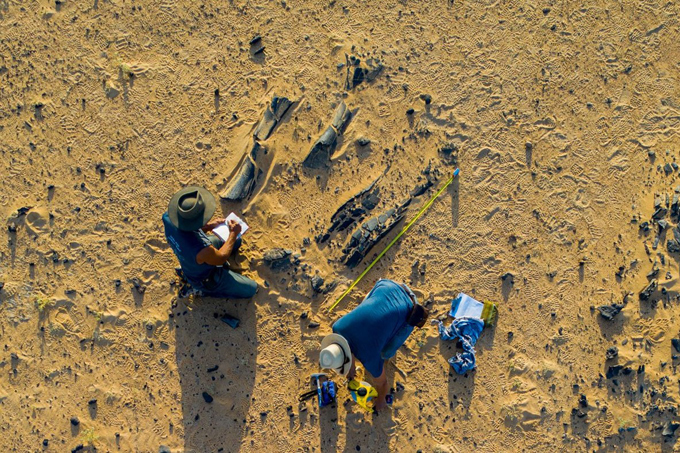
The picture below shows two field team members (Paul Sereno and Daniel Vidal) recording details of sauropod limb bones in November 2019.  The deposits at this site are associated with the Farak Formation.   The strata dates from the first faunal stage of the Late Cretaceous (Cenomanian).  The Jenguebi sauropod fossils are approximately ninety-five million years old.

Jenquebi sauropod fossils.

Field team members document sauropod fossil bones in November 2019 at the Jenguebi locality. Picture credit: M. Irving.

Picture credit: M. Irving

To read Everything Dinosaur’s earlier blog post about Spinosaurus mirabilis: New Scimitar-crested Spinosaurus Species is Described.

The Farak Formation

Sauropod fossil remains are already known from the Farak Formation. For example, fossils ascribed to the titanosaur Aegyptosaurus have been found. In addition, the remains of a rebbachisaurid have been discovered.  The newly discovered sauropod fossils, including limb bones may lead to a revision of the sauropod taxa associated with the Farak Formation.

We look forward to learning more about the remarkable vertebrate fossils found at this important locality.

Everything Dinosaur acknowledges the assistance of a media release from the University of Chicago in the compilation of this article.

The scientific paper: “Scimitar-crested Spinosaurus species from the Sahara caps stepwise spinosaurid radiation” by Paul C. Sereno, Daniel Vidal, Nathan P. Myhrvold, Evan Johnson-Ransom, María Ciudad Real, Stephanie L. Baumgart, Noelia Sánchez Fontela, Todd L. Green, Evan T. Saitta, Boubé Adamou, Lauren L. Bop, Tyler M. Keillor, Erin C. Fitzgerald, Didier B. Dutheil, Robert A. S. Laroche, Alexandre V. Demers-Potvin, Álvaro Simarro, Francesc Gascó-Lluna, Ana Lázaro, Arturo Gamonal, Charles V. Beightol, Vincent Reneleau, Rachel Vautrin, Filippo Bertozzo, Alejandro Granados, Grace Kinney-Broderick, Jordan C. Mallon, Rafael M. Lindoso and Jahandar Ramezani. Paper published in the journal Science.

The award-winning Everything Dinosaur website: Dinosaur and Prehistoric Animal Toys.

15 02, 2026

A Giant Ammonite Fossil on Display

By |2026-02-20T18:15:55+00:00February 15th, 2026|Categories: Photos/Pictures of Fossils|0 Comments

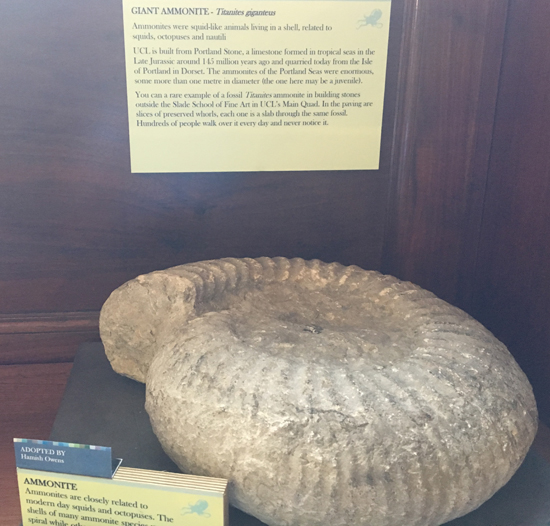
A Titanites giganteus fossil on display!  Everything Dinosaur team members photographed a giant ammonite fossil.  It was an exhibit at the Grant Museum of Zoology in London. It is a spectacular specimen.  This species is known from Upper Jurassic sediments. It is one of the largest ammonite taxa known in the UK.

A Titanites giganteus fossil on display.

A giant ammonite fossil Titanites giganteus on display at the Grant Museum of Zoology (London). Picture credit: Everything Dinosaur.

Picture credit: Everything Dinosaur

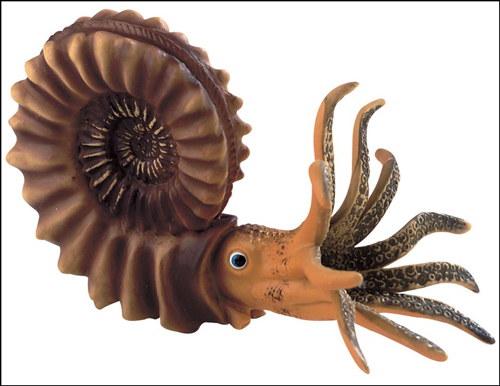
Titanites could grow to huge sizes.  Some species can reach a shell diameter of more than one metre.  However, Titanites giganteus specimens are normally around sixty to seventy centimetres in diameter. Ammonites were cephalopods. It is likely to have come from Dorset from a Portland Stone quarry.  The picture (below) shows a life reconstruction of an ammonite.  It is the Bullyland ammonite figure.

Bullyland ammonite model.

The Bullyland replica ammonite model.  A wonderful example of this extinct cephalopod.

To view the range of Bullyland figures in stock at Everything Dinosaur: Bullyland Prehistoric Animal Models.
Mike from Everything Dinosaur commented:

“Large ammonite fossils are rare, but they can still be found in parts of southern England today.  The Portland Stone is limestone, and invertebrate fossils are relatively common.  However, finding a well-preserved Titanites fossil would be the find of a lifetime.”

The award-winning Everything Dinosaur website: Prehistoric Animal Figures.

29 01, 2026

Beautiful Jurassic Fossils Spotted at Nuremberg Airport

By |2026-02-02T21:55:58+00:00January 29th, 2026|Categories: Photos/Pictures of Fossils|0 Comments

Searching for fossils usually means visiting cliffs, quarries, or coasts. However, sometimes remarkable specimens can be found in unexpected places. During a visit to Germany, Mike of Everything Dinosaur found himself fossil hunting inside Nuremberg Airport. Numerous Jurassic fossils at Nuremberg airport were observed.

Jurassic Fossils at Nuremberg airport.

A cross-section of a cephalopod fossil spotted in the floor at Nuremberg airport (Germany). The specimen is probably an ammonite. However, the lack of clear suture lines prevents discounting this fossil as a nautiloid. Picture credit: Everything Dinosaur.

Picture credit: Everything Dinosaur

Hunting for Jurassic Fossils at Nuremberg Airport

This region of southern Germany is famous for its limestone quarries.  The strata were formed in the Jurassic and consist largely of marine deposits.  Limestone is used in many buildings in the region. Consequently, the stones used in the construction date back to the Jurassic. When these limestones are cut and polished, fossil details often become strikingly visible. As a result, the airport floor itself becomes a fossil display.

The picture (below) shows an ammonite model next to a polished section of an ammonite fossil.  The model is from the Bullyworld model range.

To view the range of Bullyworld prehistoric animal figures in stock: Bullyworld Prehistoric Animal Models.
The Bullyland ammonite model next to a polished section of an ammonite fossil.

The Bullyland ammonite model is often used in museum displays to depict the living animal next to fossil material. Picture credit: Everything Dinosaur.

Picture credit: Everything Dinosaur

While walking through the terminal, Mike paused to examine the polished stone tiles. Embedded within them were clear examples of Jurassic marine invertebrates. These included coiled ammonites, nautiloids, and numerous belemnite guards. Each fossil is a record of life from a Jurassic marine environment.

A close-up view of one of the numerous Jurassic Fossils at Nuremberg airport.

A close-up view of one of the numerous Jurassic Fossils at Nuremberg airport. The specimen in question is very probably an ammonite. Picture credit: Everything Dinosaur.

Picture credit: Everything Dinosaur

Fossils Under Your Feet

Importantly, thousands of travellers walk across these stones every day. Yet, most never notice the scientific treasures beneath their feet. This highlights how fossils can surround us in everyday environments, not just museums or at dig sites.

So, where have you spotted a fossil in an unexpected place? Perhaps in a building, pavement, or even a kitchen worktop? We would love to hear your discoveries.

The award-winning Everything Dinosaur website: Prehistoric Animal Models and Figures.

16 01, 2026

Helpful Ammonite Diagram Brings Fossils to Life

By |2026-01-18T20:11:49+00:00January 16th, 2026|Categories: Photos/Pictures of Fossils|Tags: , , |0 Comments

Ammonite fossils are extraordinary.  Often, the preserved shells of these marine invertebrates are amongst the first fossils acquired when starting a fossil collection. Sue and I (Everything Dinosaur) field questions about ammonites frequently.  We do our best to respond to all the emailed enquiries we receive. In addition, we have collected large numbers of ammonite fossils ourselves.  Visitors to our offices and warehouse can be given a fossil from our collection as a souvenir of their visit.  Ammonite fossils are a favourite. Moreover, we have commissioned an ammonite diagram.

The preserved shells do not give an impression of the animal.  These cephalopods are known from their ubiquitous fossilised shells but very few specimens showing the actual animal have been found.  However, we have created a helpful diagram that depicts a living ammonite.  Furthermore, we have labelled our illustration.

An ammonite diagram.

An ammonite diagram with the shell keel, the ribbing on the shell along with the eye, mouth and tentacles labelled. Picture credit: Everything Dinosaur.

Picture credit: Everything Dinosaur

An Informative Ammonite Diagram

The ammonite is shown in lateral view.  The visible parts of the animal outside the shell are coloured.  The shell (often preserved as a fossil), is shown in monotone.  In addition, we have provided helpful labels.  We could produce a more sophisticated diagram.  However, we have refrained from doing so as the majority of our ammonite enquiries come from junior/primary school teachers and young fossil collectors.

Our drawing is based upon the Bullyland ammonite figure. This model is popular with fossil collectors.  It is often included inside ammonite fossil display cabinets.

We spotted a Bullyland ammonite model being used to help illustrate a display of ammonite fossils. Ammonite replicas are often purchased by fossil hunters.

A Bullyland ammonite model is used to help illustrate a display of ammonite fossils. Picture credit: Everything Dinosaur.

Picture credit: Everything Dinosaur

To view the range of Bullyland prehistoric animal figures available: Bullyland Models and Figures.

Mike from Everything Dinosaur commented:

“Ammonites are fascinating. Their fossils are important markers in biostratigraphy and helpful in relative dating.  Remarkably, these molluscs did not die out at the end of the Cretaceous. There is evidence to indicate that a few taxa survived into the Palaeocene.  What amazing invertebrates!”

Go to Top