

Recently, we published a post highlighting the on-going research into the remarkable Oxfordshire “dinosaur highway”. A limestone quarry preserves the remains of numerous dinosaur tracks. The tracks are preserved in strata laid down in the Middle Jurassic. Palaeontologists estimate that the trackways are around 166 million years old (Bathonian faunal stage). In a recent radio interview, a researcher commented that one of the tracks could be a record breaker. At around 220 metres in length, one Oxfordshire trackway could represent the longest continuous sauropod trackway known to science. However, describing them as Cetiosaurus dinosaur tracks is somewhat controversial.
To read Everything Dinosaur’s earlier blog post: Oxfordshire Trackway Could be the Longest Sauropod Trackway Discovered to Date.
Could a Cetiosaurus Have Left the Longest Sauropod Trackway?
Whilst undoubtedly made by sauropods, it is difficult to assign with any certainty the taxon that walked across a lagoon that led to the footprints being trapped in time. Indeed, as the tracks are different sizes, they could represent several taxa. Alternatively, the tracks might represent a single species, but different aged individuals walking together. However, Cetiosaurus is the sauropod most often mentioned in association with the trace fossils. Why might that be the case?
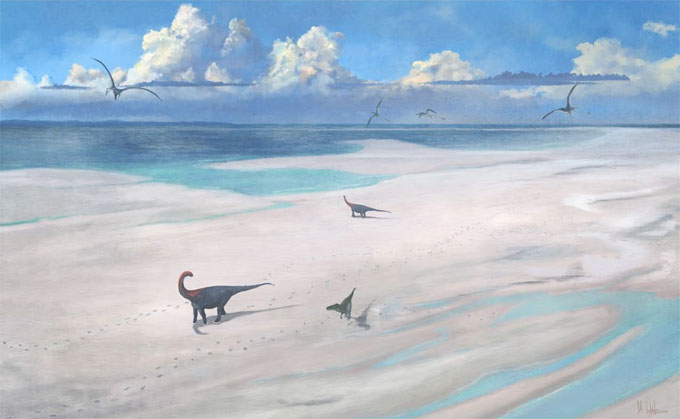
An artist’s reconstruction of the Dewars Farm Quarry site 166 million years ago. A Megalosaurus tracks an adult Cetiosaurus with a second sauropod in the background whilst pterosaurs soar overhead. Picture credit: Mark Witton.
Picture credit: Mark Witton
Cetiosaurus is regarded as being a primitive member of the Sauropoda. Nevertheless, this is an important genus. It has the distinction of being regarded as the first sauropod dinosaur to be formally described (Owen 1841). However, Owen’s scientific study was inaccurate. For example, Owen suggested that the large vertebrae with their rough texture were similar to extant whale vertebrae. As the fossils had been found in marine deposits, Owen incorrectly concluded that the fossils represented an enormous marine crocodile.
Cetiosaurus oxoniensis
Unfortunately, most Cetiosaurus fossil specimens consist of fragmentary material. Indeed, little is known about Middle Jurassic sauropods. Significantly, the species Cetiosaurus oxoniensis was described from fossils found in Oxfordshire. The material comes from deposits that are approximately the same age as the trackway bedding planes at the quarry site. So, it is possible that these extensive trace fossils do indeed represent Cetiosaurus dinosaur tracks.
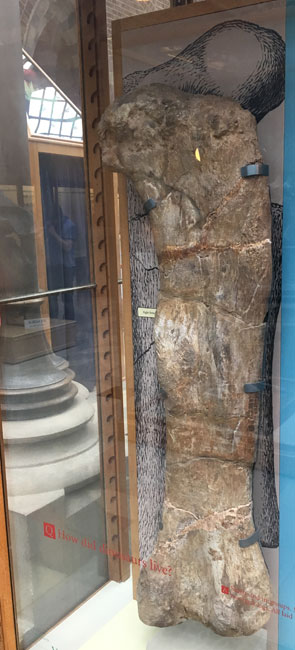
The enormous and robust right femur of a Middle Jurassic sauropod. The femur has been ascribed to the taxon Cetiosaurus. Picture credit: Everything Dinosaur.
Picture credit: Everything Dinosaur
Cetiosaurus Dinosaur Tracks
Whether or not these footprints represent Cetiosaurus dinosaur tracks remains open to debate. However, as perhaps the first sauropod formally described, this taxon is iconic. In addition, it is pleasing symmetry if a Cetiosaurus did leave what may prove to be the world’s longest sauropod trackway. Such an accolade only enriches England’s rich fossil heritage.
Mike from Everything Dinosaur commented:
“At around 220 metres in length, one Oxfordshire trackway could represent the longest continuous sauropod trackway ever discovered. Other lengthy European sauropod trackways are known. For example, from Portugal and France. These fossil trackways are over 140 metres in length, so they are considerably shorter than the trackway from Oxfordshire. Nonetheless, they are still impressive and give palaeontologists the opportunity to learn more about these enormous creatures.”
Everything Dinosaur acknowledges the assistance of a media release from the University of Birmingham supplied in January 2025 in the compilation of this article.
For sauropod models and other dinosaurs: Dinosaur Figures and Prehistoric Animal Models.

Leave A Comment