

Scientists have identified a new species of ancient crocodylomorph from Upper Triassic rocks in southwest England. The newly named species, Galahadosuchus jonesi, lived around 215 million years ago and it represents the second species of non-crocodyliform crocodylomorph described from the Late Triassic–aged fissures of the Bristol Channel area.
Non-crocodyliform crocodylomorph fossil material is known from both sides of the Bristol Channel. Osteoderms, teeth and bones have been found. Most of these fossils have been assigned to the species Terrestrisuchus gracilis (Crush, 1984). However, it is probable that T. gracilis has become a taxonomic waste basket to some extent. Different genera of early crocodylomorphs are likely present. The discovery of Galahadosuchus jonesi, named from fossils formerly assigned to Terrestrisuchus confirms previous suggestions of under-described pseudosuchian diversity from these deposits.
The fossil specimen was discovered in 1969. However, researchers have only recently recognised that it represents a previously unknown species. The findings have been published in the academic journal “The Anatomical Record”.
A Small, Fast-moving Terrestrial Predator
Unlike modern crocodilians, Galahadosuchus was not an aquatic ambush hunter. Instead, it was a lightly built, agile, fast-running animal that spent its life on land.
Researchers describe it as resembling a reptilian greyhound. It had long, slender limbs, an upright posture and a body adapted for speed. The animal probably hunted small reptiles, amphibians and early mammals.
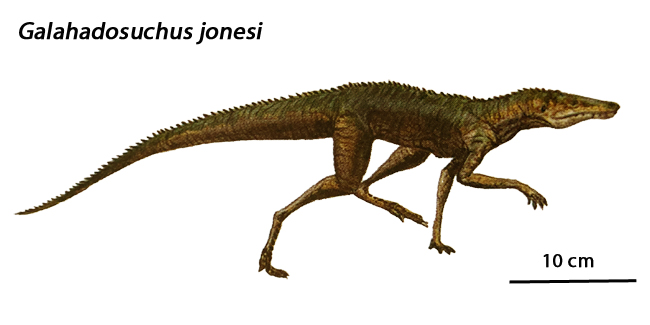
Galahadosuchus jonesi scale drawing (based on Pseudhesperosuchus jachaleri). Note scale bar equals 10 cm. Picture credit: Everything Dinosaur.
Picture credit: Everything Dinosaur
Several anatomical features support this interpretation. These include elongated wrist bones, tightly grouped metacarpals and a distinctive ankle structure. Together, these traits indicate that Galahadosuchus was a highly cursorial predator, related to Terrestrisuchus but a distinct genus.
Fossils from an Ancient Karst Landscape
The fossil comes from the famous fissure deposits found around the Bristol Channel area. During the Late Triassic, this region consisted of limestone uplands surrounded by hot, arid lowlands. Over time, caves and fissures formed within the limestone. The remains of animals were washed into these natural traps and became buried by sediment. As a result, the fissure deposits preserve a fascinating snapshot of life, although the exact dating of the deposits has proved controversial. For example, the geological age of these deposits and their fossil content remains unknown.
Some academics suggest that the fossils represent a biota from the youngest faunal stage of the Triassic (Rhaetian). Moreover, that the fossils date from around 206 to 201.5 million years ago. In contrast, other researchers consider these deposits to be much older and spanning a greater interval of deep geological time. For instance, it has been postulated that these fissure fill deposits span an age range from the Carnian to the Rhaetian (around 230 to 201.5 million years ago).
These rocks have provided numerous important vertebrate fossils including early dinosaurs and ancestors of modern lizards.
To read Everything Dinosaur’s blog post from 2021 about the discovery of an early theropod dinosaur: “Chief Dragon” from a South Wales Quarry.
Evidence of modern lizards in the Late Triassic: Cryptovaranoides is Clearly a Squamate.
Identifying a New Species
The specimen was originally assigned to Terrestrisuchus. However, a detailed study revealed important anatomical differences (autapomorphies). The research team identified thirteen anatomical traits that distinguish the fossil from known Terrestrisuchus specimens. Several of these differences involve the wrist bones, which are shorter and more robust in the new species. The differences in the morphology of the limb and wrist bones might correspond to differences in locomotory function between Terrestrisuchus and Galahadosuchus. These differences could reflect varying specialisations within Late Triassic crocodylomorphs.
Phylogenetic analysis places Galahadosuchus as a sister taxon to Terrestrisuchus. Both animals belong to a family of early crocodylomorphs known as the Saltoposuchidae.
These findings demonstrate that early crocodylomorph diversity was greater than previously recognised.
Galahadosuchus jonesi Honours an Inspirational Teacher
The species name honours David Rhys Jones, a physics teacher at Ysgol Uwchradd Aberteifi in Cardigan, Wales.
Lead author of the study, Ewan Bodenham explained that Mr Jones played an important role in encouraging his interest in science. The teacher’s enthusiasm, humour and willingness to challenge students helped inspire a future palaeontologist.
Meanwhile, the genus name combines “suchus” (crocodile) with a reference to Sir Galahad from Arthurian legend, a knight renowned for his moral uprightness. Therefore, the genus name reflects the upright stance of this reptile.
A Window into Early Crocodylomorph Evolution
The discovery of Galahadosuchus jonesi adds another important species to the rich fossil record of the Bristol Channel fissure deposits. These remarkable fossils continue to improve our understanding of life during the Late Triassic. Furthermore, they provide valuable evidence about the early evolution of crocodylomorphs, a lineage that would eventually give rise to modern crocodilians.
Everything Dinosaur Comments on Galahadosuchus jonesi
Commenting on the study, Mike from Everything Dinosaur stated:
“The fissure deposits of southwest England and South Wales continue to produce extraordinary insights into Late Triassic ecosystems. The identification of Galahadosuchus jonesi highlights just how diverse the early relatives of crocodiles had become before the end-Triassic extinction event. It also demonstrates the importance of revisiting historic museum specimens, as collections can still contain species waiting to be recognised.”
Everything Dinosaur acknowledges the assistance of the media team from University College London and the London Natural History Museum in the compilation of this article.
The scientific paper: “A second species of non-crocodyliform crocodylomorph from the Late Triassic fissure deposits of southwestern UK: Implications for locomotory ecological diversity in Saltoposuchidae” by Ewan H. Bodenham, Stephan N. F. Spiekman, Susannah C. R. Maidment, Paul Upchurch and Philip D. Mannion published in The Anatomical Record.
The Everything Dinosaur website: Dinosaur Toys and Models.

Leave A Comment