All about dinosaurs, fossils and prehistoric animals by Everything Dinosaur team members.
19 03, 2011

Crocodile found in Middlesbrough

By |2023-01-16T07:53:33+00:00March 19th, 2011|Categories: Animal News Stories, Main Page|0 Comments

Spectacled Caiman found in Middlesbrough

Police seized a baby crocodile in a raid on an industrial unit in Middlesbrough (north-east England).  The crocodile, actually a Spectacled Caiman (Caiman crocodylus) is currently being checked over by vets.  Caimans are a group of small crocodiles that share the same characteristics of their larger cousins the crocodiles and alligators.  Many Spectacled Caimans are imported into the U.S. for the pet trade, it may be that this particular animal may have been brought over from the United States.

This caiman was being kept as a pet by a thirty year old, exotic animal enthusiast from Middlesbrough.  At only two feet long, the baby, known as “fluffy” may not be a man-eater but they still possess a powerful bite and could be capable of taking off a finger if a handler was not careful.  As an adult, Spectacled Caiman reach lengths of up to 2.5 metres in length, and although they rarely attack land mammals and people they are highly dangerous.

For more sensible purchases, take a look at the crocodile models and figures available from Everything Dinosaur: Everything Dinosaur.

Crocodile Found in Middlesbrough

A man has been arrested on suspicion of keeping a dangerous wild animal without a licence.  A spokesperson for the National Wildlife Crime Unit which worked alongside Cleveland Police in this case, commented:

“The Spectacled Caiman has been seized and removed through the animal reception centre at Heathrow airport, where they will find a more appropriate home for it.”

The spokesperson (Andy McWilliam) went on to add:

“There are people who want to keep animals like these, but they need to have a licence, as there is a risk.  They need to pay for the licence, have their premises inspected by the local authority and meet significant standards so the animal is safe and cannot escape.”

Although not particularly endangered, many caimans are hunted illegally in the wilds of South America for their skins which are used to make handbags and other fashion items.  The eggs and young of these ancient creatures are also highly prized and once hatched these animals can be sold as pets.

A number of zoos and wildlife parks keep these animals as part of a world-wide conservation effort, indeed some Caimans kept in captivity are believed to learn their names and respond to them when they are called.  To read more about Caimans in captivity: Crocodiles Respond to their Own Names when Called.
18 03, 2011

Frogspawn in the Office Pond Spotted

By |2022-12-20T22:51:16+00:00March 18th, 2011|Categories: Animal News Stories, Everything Dinosaur News and Updates, Main Page|0 Comments

We have Frogspawn in our Office Pond

The frogs have been busy in the office pond, on Wednesday and Thursday we were able to count up to seven frogs in the pond, but no spawn until this morning.  We have just spotted the first batch of spawn, which must have been laid last night, despite the clear skies leading to a drop in air temperature to just above freezing.

When we compare notes from previous years, the frogs have spawned two days earlier this year than they did in 2010.  So far we have not seen as many frogs in the pond as last year but we are confident that more spawning will take place and that we may well end up with as much frogspawn as we did last year.  This is the fourth year in a row that we have had frogs spawning in our office pond.

17 03, 2011

New Giant Sauropod – Angolatitan – Ancient Fish Food

By |2023-03-07T14:29:54+00:00March 17th, 2011|Categories: Dinosaur and Prehistoric Animal News Stories, Dinosaur Fans, Main Page|0 Comments

Scientists Announce Discovery of a New Sauropod Species

As Angola is opened up to permit exploration of its diverse geology, so scientists are being given the opportunity to study the fossilised remains of the ancient flora and fauna of this huge African country.  Angola is perhaps one of the last places on Earth that has yet to be fully explored in terms of its geology and this has led to a number of new prehistoric animal discoveries, the latest of which is the formal announcement of a new giant sauropod species.

Angolatitan adamastor

The new dinosaur, a member of the Sauropoda (long-necked dinosaurs) has been named Angolatitan adamastor.  The name means “Angola giant”, the species name refers to a mythical sea creature from Portuguese legend.  Although, only a partial forelimb has been found to date, scientists are confident that this creature represents a new species of sauropod.

Team members at Everything Dinosaur wrote an article outlining the possibilities of many new dinosaur discoveries from this African country, to read this article and to learn more about the work being undertaken in Angola by palaeontologists: Angola Starts to Share its Fossil Secrets.

Upper Cretaceous Fossils

The paper on this new species of herbivorous dinosaur, the latest titan to be found in Africa was published in the scientific journal “The Annals of the Brazilian Academy of Science”.  The fossilised bones, longer than an adult man, were found in marine strata dating from approximately 90 million years ago (Turonian faunal stage).  Scientists think that the carcase of this animal was washed out to sea and its body was scavenged by marine reptiles and predatory fish such as sharks.  Indeed, a number of fish bones and shark teeth were found in association with the fossil dinosaur bones.

Commenting on the naming of this new species, Matthew Bonnan, a sauropod expert at Western Illinois University (United States) stated that the research team’s claim to have discovered a new species is entirely justified.

Dr Bonnan said:

“I think they’ve been very careful, the more people and places that we involve in science, the better off we all are.”

Pictures show palaeontologist Octavio Mateus who has been prominent in an number of important Angolan excavations, standing next to the scapula and the humerus of this new giant dinosaur providing scale.

Angolan Dinosaur Research

He went onto add how this new discovery could help palaeontologists understand how sauropods adapted to different environments stating that it was “really cool” to see research coming out of Angola.  Given the huge size of this country and the early reports from palaeontologists we have received about other dinosaur hunting “hot spots”, it is very likely that many more new dinosaur genera will be discovered.

For models and replicas of titanosaurs and other prehistoric animals: CollectA Age of Dinosaurs Scale Models.

16 03, 2011

A Review of the CollectA Ankylosaurus Model (1:40 scale)

By |2023-03-07T08:04:47+00:00March 16th, 2011|Categories: Everything Dinosaur Products, Main Page, Product Reviews|0 Comments

CollectA Ankylosaurus Model Review

CollectA have added a 1:40 scale model of the Late Cretaceous armoured dinosaur Ankylosaurus to their scale model range.  This range has increased over the last two years and includes a number of dinosaur and prehistoric animal models, including T. rex, Brachiosaurus and a number of other armoured dinosaurs such as Stegosaurus and Hylaeosaurus. Today, we review the CollectA Ankylosaurus model.

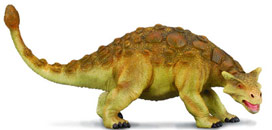
A Picture of the Collecta Deluxe Ankylosaurus Replica

Picture credit: Everything Dinosaur

The model measures twenty-five centimetres in length and stands nearly 10 centimetres tall at the shoulder.  The tail club is shown in mid swing and the animal seems to be bellowing, perhaps warding off an attack from a predatory Tyrannosaurus rex.  The model is well painted and the detail quite fine on what is a large model of an Ankylosaurus.

CollectA Ankylosaurus Model

Purchases of the CollectA Deluxe Ankylosaurus made from Everything Dinosaur’s award-winning website will also include an Ankylosaurus fact sheet, researched and written by team members.

To view the CollectA range (Collecta Deluxe Dinosaurs) and other dinosaur models: CollectA Deluxe Prehistoric Life Models.

15 03, 2011

Megalodon Jaws Ready to Go Under the Hammer

By |2023-01-16T07:44:28+00:00March 15th, 2011|Categories: Dinosaur and Prehistoric Animal News Stories, Dinosaur Fans, Main Page|0 Comments

Giant Shark Jaws – Up for Auction

The giant prehistoric shark, Megalodon (Carcharodon megalodon) may well have been one of the largest marine predators of all time.  This huge fish, conservatively estimated to have reached lengths in excess of fifteen metres lived during the Miocene and Pliocene Epochs.  Very few fossilised remains of its body have been discovered, with a body supported by cartilage (like all sharks and rays), only under special conditions can cartilage be preserved.  However, the teeth, made of enamel, the same as our teeth, are a different story.  It is mainly  from the many thousands of fossil teeth that have been found that scientists have pieced together what we know about this enormous hunter of whales and other sea creatures.

Now the biggest set of Megalodon jaws ever constructed is being auctioned in the USA.  If you wanted the set of jaws, which stand nearly nine feet tall, they would probably set you back a jaw dropping £500,000.  Fossil hunter Vito Bertucci took almost twenty years to construct the huge jaws, the largest ever assembled and which measure over 3.2 metres in diameter.  Indeed Megalodon is believed to have been so big, that it could swallow an adult Great White Shark whole.  The teeth were retrieved from rivers in South Carolina, where the robust, tough fossils get washed into as they are eroded out of sediments by the action of the water.

Megalodon Jaws

The set of jaws consist of 182 beautifully preserved fossil teeth, some of which are over twenty centimetres in length.  They are going under the hammer at Heritage Auctions (Dallas, Texas) on June 12th and experts expect this lot to sell for in excess of $700,000 USD.

David Herskowitz, Director of Natural History Auctions at Heritage Auctions commented:

“Megalodon ruled the temperate and warm waters of all the oceans between 25 million and 1.5 million years ago.  It was a shark that grew to the length of two city buses and preyed on whales and other sharks.  With jaws that size, and a hugely voracious appetite, you or I would be no more than an hors d’oeuvre for this monster.”

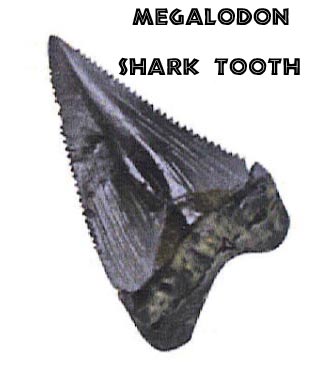
A Close up of the Teeth in the Jaws of the Megalodon

Giant shark tooth

Picture credit: Everything Dinosaur

Vito Bertucci died in 2004 in Georgia whilst diving for prehistoric shark’s teeth.  It is his brother Joey Bertucci who is auctioning the jaws.  Joey stated:

“This was something he [Vito] had a vision to do, it took him a lifetime of collecting to be able to build it.”

Megalodon may have been the largest shark of all time, although due to the nature of its cartilage skeleton the maximum size of this fish is difficult to determine.  Indeed, the extant Whale Shark (Rhincodon typus) a filter feeder may prove to be the largest shark known to science.  However, we at Everything Dinosaur do sell a lot of Megalodon models on line.

To view a number of prehistoric animal monster toys, a “Megalodon shark model”, take a look at the CollectA range of prehistoric animal models: CollectA Deluxe Prehistoric Life Models.

Update

Please note the scientific name for this shark is now widely accepted to be Otodus megalodon.

14 03, 2011

Man Survives Attack from Four Metre Crocodile

By |2023-01-16T07:42:10+00:00March 14th, 2011|Categories: Animal News Stories, Main Page|0 Comments

Fisherman Survives Mauling by Saltwater Crocodile

Attacks by Saltwater crocodiles are becoming more frequent in Australia as locals and these large, predators come into close contact.  The latest attack involved a fisherman who was dragged into the water by a four-metre long crocodile whilst fishing near the bank of Trunding Creek, near Weipa on western Cape York Peninsula (Queensland).  Todd Bairstow (aged 28) was attacked on Wednesday, police say the man grabbed mangrove branches and fought for his life, punching and kicking the crocodile for fifteen minutes before his efforts and those of the person who came to his aid and hit the large croc across the head with a branch, permitted him to escape.

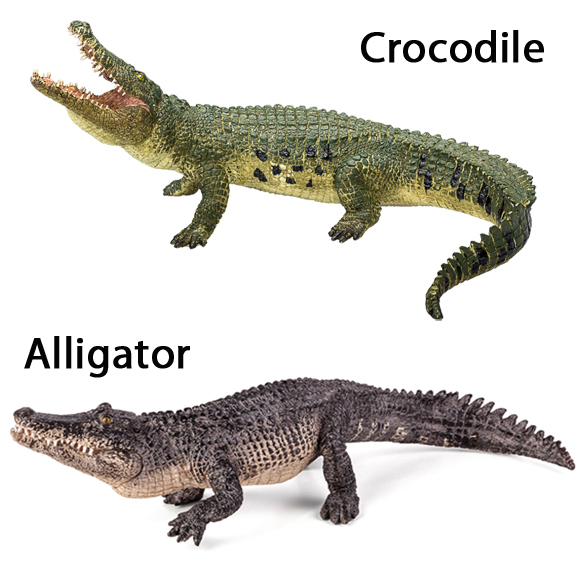
The Difference Between a Crocodile and an Alligator

Crocodile and Alligator comparison.

Crocodile (top) and Alligator (bottom).

Mr Bairstow suffered multiple puncture wounds, dislocations and fractures including a broken finger.  The area is well-known for its large crocodiles and local fishing guide Dave Donald says that Todd was lucky to survive.

Mr Donald stated:

“His legs were very badly damaged and they think the croc may have tried to roll with him while he was still hanging onto the mangrove roots and made quite a mess of his legs.  It did try to grab him again as he was being dragged out of the water apparently, it was pretty aggressive.

Wildlife rangers will search for the crocodile in the hope they can locate it and remove it from the wild.  It is likely that a trap will be set so that the crocodile can be relocated to an area which is less populated.

For models of crocodiles and alligators (whilst stocks last), visit the Mojo Fun section of the award-winning Everything Dinosaur website: Mojo Fun Prehistoric and Extinct Models.

13 03, 2011

Update on Mail Services into the USA and Canada

By |2023-01-16T07:37:26+00:00March 13th, 2011|Categories: Everything Dinosaur News and Updates, Main Page, Press Releases|0 Comments

Latest Information from Royal Mail about North American Deliveries

With U.S. Homeland security services having increased checks and having employed additional security measures to check incoming mail to North America, customers using Airmail, Airsure and Surface Mail services have experienced further delays with their parcels.  We at Everything Dinosaur do all we can to ensure a prompt despatch of orders, checking customs forms, addresses and ensuring that customers are contacted with details of when and how their parcel(s) are being sent out.

For information about Everything Dinosaur’s postage and shipping policy: Everything Dinosaur Shipping and Postage.

Royal Mail Information

Below is a transcript from the Royal Mail outlining the latest information on mail services to the USA and Canada.  Reading between the lines, it seems that Royal Mail acknowledges that there have been considerable delays to their normally very efficient mail service.  At Everything Dinosaur, we monitor parcels sent abroad and through our communications with our customers we have built up a picture of how long mail is actually taking to reach destinations in the United States.  Having to wait up to 30 working days for a parcel sent by Airmail service is an experience that a number of our overseas customers have had.

The Royal Mail update: (7th March)

“Further to the recent increased security measures for items carried on passenger airlines to the USA, Royal Mail has continued to work with relevant airlines and deploy a range of contingency measures and routes to get as much mail to the States as quickly as possible.

We are pleased to confirm that the vast majority of items have now reverted back to being flown to the USA, with only a small amount of mail having to be diverted to alternative routes, including sea containers.

As a result, most items, including personal and business letters and packets, should be delivered in the US within a few days of posting.  However, delays of about two weeks may continue for heavier packets sent by social (non-contract) customers that are still unable to fly due to security restrictions.  We are continuing to explore alternative solutions for these items, to return them to air transit as soon as possible

Royal Mail is very sorry for the recent unavoidable delays; we are continuing to work to minimise disruption to our customers, whilst ensuring we comply fully with the US directives and regulations.”

Everything Dinosaur

Customers at Everything Dinosaur can be reassured that we are doing all we can to help expedite parcel deliveries.

Take a tour of Everything Dinosaur’s user-friendly and award-winning website: Visit Everything Dinosaur.

12 03, 2011

Remarkable Miocene Tarsier Fossils from Thailand

By |2024-04-21T10:10:17+01:00March 12th, 2011|Categories: Animal News Stories, Dinosaur and Prehistoric Animal News Stories, Educational Activities, Main Page, Palaeontological articles|0 Comments

Fossils from a Coal Mine in Thailand Reveal New Species of Primate

The Tarsiers are small, tree-dwelling prosimians found in Asia.  These small creatures are mainly nocturnal and voracious hunters of insects, tiny lizards, mammals and nestling birds.  They may not be very conspicuous up in the tree-tops but to anthropologists and palaeontologists they are extremely important in helping to decipher our own origins.  Scientists have announced the discovery of a Miocene Tarsier, fossils of which were found in a coal mine.

A number of fossilised jawbones found in a coalmine in Thailand have enabled scientists to identify a new species of Tarsier, one that may have been mainly herbivorous.  But first, why are Tarsiers so important when it comes to working out our own fossil lineage?

Miocene Tarsier

It is all to do with noses.  The Tarsier’s nostrils , which project sideways, are rounded.  Fur grows almost to the edge of them and surrounds them, separating them from the upper lip.  The nostrils of other prosimians, lemurs and pottos for example, in contrast are shaped like commas, permanently moist and linked to the upper lip by a strip of naked skin.  To a Tarsier the sense of smell is very much less important than to a lemur or another member of the prosimian group.

The only other tree-dwellers that have noses like the Tarsier’s are the true monkeys.  This suggests that the Tarsiers are ancestral to the monkeys, if this is the case, then as apes and ourselves are related to monkeys, the Tarsier may be a branch on that part of the tree of life that led to our own species H. sapiens.

The pictures circulated show a Tarsier from South-east Asia on the left compared to a Potto from West Africa on the right.  Although very similar, note the “comma” shaped nostrils of the Potto, whilst the nostrils of the Tarsier suggest that creatures such as these were the ancestors of true monkeys, and ultimately ourselves.

Tarsius sirindhornae

The new species, formally named as Tarsius sirindhornae, lived during the mid Miocene Epoch, approximately 13 million years ago.  Based on the size of the fossilised jawbones, this Tarsier species would have been a giant amongst its kind.  However, it probably weighed less than 200 grammes, about the weight of grapefruit.

Research leader, Yaowalak Chaimanee, a geologist with Thailand’s Department of Mineral Resources, stated that this Tarsier was the largest discovered to date and a total of eighteen jawbone fossils from the new species were found in deposits at disused coalmine in Lampang Province.  Each tiny jaw holds one to four teeth.

She stated:

“Tarsiers were, and still are pretty rare, so you can imagine to have eighteen jaws is marvellous.”

Like modern Tarsiers, the extinct species probably have had large eyes, would have been a great jumper and would have had the ability to rotate its neck 180 degrees.  But the fossils show that at least one trait makes the new species different from its modern cousins.

Chaimanee said:

“We know living Tarsiers eat insects or small mammals.  They have very sharp teeth.  Our fossils have very rounded teeth, every tooth has been worn.  We expect it ate something different.”

The large jaws and dentition suggest that this animal may well have been a vegetarian, perhaps feeding on leaves.  Plant material is much more difficult to digest and the teeth may have evolved to permit these prosimians to grind food up in their mouths efficiently to allow their digestive systems to extract nutrients effectively.  Being a vegetarian often leads to evolving a larger gut, perhaps this explains why this extinct Tarsier species grew to be a relative giant amongst its carnivorous relatives.

In a bid to explain why the jawbones were found in close proximity, Chaimanee and her colleagues have speculated that the area around the coalmine was dense, tropical jungle and the jawbones represent the regurgitated remains after these Tarsiers were predated upon by birds of prey.

She suggested:

“The predator made waste pellets, and then these pellets would wash out into the region that became the coal mine.  This would explain why our team found so many jaws together.”

To find the fossils of such an arboreal Miocene animal as a herbivorous Tarsier is rare, to find eighteen jawbones is truly remarkable.  The team hope to return to the coalmine site in the near future to explore the deposits in greater detail, perhaps revealing more evidence of ancient Tarsiers and of the other animals, may be even the predatory bird that shared their ancient jungle home.

For models of prehistoric mammals and other extinct creatures: CollectA Deluxe Scale Prehistoric Animal Models.

11 03, 2011

A Video Review of the new “Terror Bird” Model – Kelenken

By |2023-03-07T08:09:45+00:00March 11th, 2011|Categories: Everything Dinosaur News and Updates, Everything Dinosaur Products, Everything Dinosaur videos, Main Page|0 Comments

Ferocious Kelenken – A Video Review of the New “Terror Bird”

The fragmentary fossils of a huge phorusrhacid were discovered in Argentina in 2006.  The fossil material included a huge 46 centimetre long rostrum (part of the beak).  This rostrum is the largest found to date and when these fossils were formally described in 2007, the “Terror Bird” called Kelenken came into being.

Regarded, as perhaps the tallest of all the South American phorusrhacids, Kelenken was a formidable predator with a viciously curved beak.  Here is a video review made by Everything Dinosaur team members of the Collecta model of this amazing prehistoric bird from the Miocene.

A Video Review of the “Terror Bird” Kelenken (Kelenken Collecta Deluxe)

Everything Dinosaur’s review of the CollectA Deluxe Kelenken model.

 Video credit: Everything Dinosaur

Kelenken

Sales of Kelenken models from Everything Dinosaur’s award-winning website will be sent out with a Kelenken fact sheet researched and written by Everything Dinosaur team members.

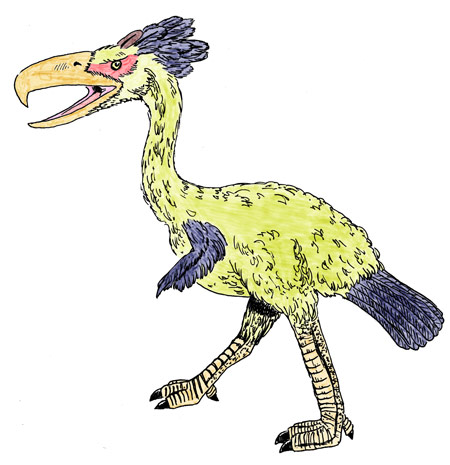
A Drawing of the Giant Flightless Bird Kelenken

A drawing of Kelenken. Phorusrhacids illustrated. The "Terror Birds".
The Kelenken in all its glory. Picture credit: Everything Dinosaur.

Picture credit: Everything Dinosaur

To view Everything Dinosaur’s range of CollectA models such as the CollectA Deluxe Kelenken and dinosaur models: CollectA Deluxe Prehistoric Life Models.

10 03, 2011

Amazing Haul of Prehistoric Animal Fossils from a Car Park in Los Angeles

By |2024-04-21T10:11:45+01:00March 10th, 2011|Categories: Dinosaur and Prehistoric Animal News Stories, Main Page|0 Comments

Scientists Marvel at Insight into Ancient Los Angeles

The tar pits located at Rancho La Brea, Los Angeles (California) are world famous for their Late Pleistocene prehistoric animal fossils, revealing almost an entire ecosystem that existed between 40,000 and 10,000 years ago.  For the last five years, scientists from the Page Museum (located at La Brea), have been working on the site of a nearby car park, helping to uncover a treasure trove of fossil material, including an almost complete skeleton of a giant Columbian Mammoth, the most complete fossil Mammoth of this species to be found in the area to date.

The word “Brea” is Spanish for tar, an apt description as this area was pock-marked with natural pools of asphalt that had bubbled up from the ground.  Rain water would have settled on these pools of black, sticky liquid and creatures coming to drink would have become trapped and eventually preserved as fossils as they sank into the mire.

For the past few years, a team of scientists, fieldworkers and volunteers have been carefully chipping away at blocks of hardened tar to reveal a huge amount of fossil material dating from the Late Pleistocene.  The site is going to be an underground car park but as it is adjacent to the La Brea tar pits it was always highly likely that a lot of fossil material would be found once the construction programme started.

Karin Rice, an excavator with the Page Museum commented:

“You’re opening up this ancient world and getting to look back in time.”

Field workers first, crated large chunks of the asphalt before they were transported back to the preparation area of the museum so that excavators could remove the fossilised bones.  Care is being taken to ensure micro-fossils and plant remains are also excavated alongside large mammal bones.  The data from these fossils will help scientist to build up a more complete picture of the environment and the Pleistocene eco-system.

Scientist have unearthed 23 boxed deposits, removing some 16,000 fossil bones – horses, camels, dire wolves, ground sloths, a giant jaguar and mammoths.  Among the finds, partial skull material and the lower jaws of a number of sabre-toothed cat kittens, all found within a square metre of each other.

Prehistoric Animal Fossils

The picture shows a museum member of staff working on the skull of the Columbian mammoth, nicknamed “Zed” (Mammuthus columbi).  The strange pair of objects looking the heels of trainers in the middle of the fossil are the giant molars of this huge herbivore.

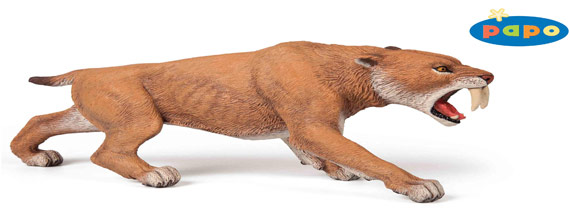
Papo of France has recently introduced a new scale model of a Pleistocene Sabre-toothed cat (Smilodon), although we cannot be certain, we think that this model is based on Smilodon fatalis.  As far as we can remember, the majority of the Smilodon material from the La Brea site is ascribed to S. californicus. 

An Image of the Papo Smilodon Model

Smilodon model available from Everything Dinosaur.

Picture credit: Everything Dinosaur

To view Everything Dinosaur’s range of Papo prehistoric animal models including Mammoth and Sabre-toothed cats as well as dinosaur models: Papo Dinosaurs and Prehistoric Animal Models.

The Smilodon genus had four species; there is conjecture whether Smilodon floridus and Smilodon californicus are true species or sub-species of Smilodon fatalis.

Go to Top