All about dinosaurs, fossils and prehistoric animals by Everything Dinosaur team members.
28 03, 2011

The Big Boys From Brazil – New Spinosaurid Described

By |2023-03-07T07:53:34+00:00March 28th, 2011|Categories: Dinosaur and Prehistoric Animal News Stories, Dinosaur Fans, Main Page|0 Comments

New Spinosaurus from South America Described – A Rival to T. rex

A team of scientists have just published a scientific description of a new genus of giant spinosaurid dinosaur, perhaps one that rivalled Tyrannosaurus rex in terms of its size.  The palaeontologists have provided a fascinating insight into the ancient Cretaceous ecosystem of Brazil, one that may have been dominated by this giant predator.

Giant Spinosaurid Dinosaur

The spinosaurids have only really come to the attention of the wider public, thanks to the appearance of a giant Spinosaurus in the film – Jurassic Park III, a movie which required a new angle on the Tyrannosaurus rex being the big baddie, as T. rex had been the main dinosaur star in the first two films in the J.P. franchise.  Known from the early 20th Century, thanks to Stromer’s expeditions to North Africa, the spinosaurids represent an unusual off-shoot of the Theropoda clade.  Carnivores, perhaps specialist piscivores (fish-eaters), these bipedal dinosaurs had long, narrow snouts, superficially similar to the jaws of crocodiles.

The teeth were straight and sharp, lacking the curvature of a tyrannosaurid, dromaeosaurid or allosaurid teeth.  The teeth on the lower jaw were numerous and relatively small, the tip of the upper jaw (premaxilla) held a separate rosette of of much larger teeth, the upper jaw had a distinctive “kink” and the nostrils were positioned well back from the tip of the snout.  These may have been adaptations to permit these predators to catch fish. The narrow snouts would have entered the water, the small teeth could catch a slippery fish, and the nostrils would still be held clear of the water.

However, many members of the spinosaur family, including this new genus described in the scientific journal “The Annals of the Brazilian Academy of Sciences”, were also most probably apex predators hunting and killing other dinosaurs as well as crocodiles and other creatures that shared their watery world.

This new Spinosaurus has been named Oxalaia quilombensis.  It becomes the newest member of the bizarre Spinosaurus family and with scientists estimating that it could have reached lengths in excess of 14 metres and weighed as much as 7 tonnes, it rivals the more famous T. rex in terms of size.

An Illustration of O. quilombensis
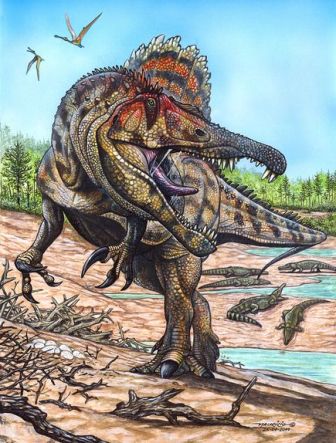
Picture credit: Brazilian National Museum/Elaine Machado.

The artist has depicted this new spinosaur with a sail-like structure running along the back, a feature found in other members of this dinosaur family.  There is no fossil evidence to suggest that this particular spinosaur had a sail.

The fragmentary fossils including the tip of the upper jaw, so characteristic of other known spinosaur material were found in the Alcantara Formation on Cajual island which is part of north-eastern Brazil’s Maranhao state.  The fossils have been dated to around 98 to 95 million years ago (Cenemanian faunal stage) and the scientists who have been studying this new dinosaur have stated that this new discovery is important as it helps to establish the ancestral line of this geographically dispersed group of theropods.

Alexander Kellner, a Brazilian palaeontologist and one of the researchers who has studied the fossils, stated that this new dinosaur from Brazil, although known from only fragmentary material seems to have a closer affinity to African spinosaurs than to other spinosaurids known from South America.  This similarity suggests that the ancestors of the African and Brazilian genera came from the same area before the African and South American continents split as part of the Atlantic ridge formation, sometime between 130 and 110 million years ago.

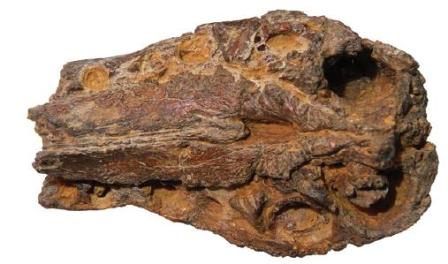
The Characteristic Snout Tip of a Spinosaur – Oxalaia quilombensis
Evidence of Giant Spinosaur?

Picture credit: Kellner et al.

The picture shows the tip of the upper jaw of Oxalaia quilombensis, this the view from underneath (ventral view), the holes along the sides are sockets for teeth.  The end of the jaw is to the right of the picture.

The Brazilian scientists hope to be able to find more fossil material from the site, but they have been hampered by the problem of fossil material being rapidly eroded and destroyed once it is exposed.  The fossils found so far, are being stored at the Federal University of Rio de Janeiro’s National Museum.

It seems that this particular theropod had two rows of extra teeth on both sides of its mouth, suggesting that it could replace worn or broken teeth.  Just like in many other theropods and sharks, as one tooth was lost another was waiting to erupt through the gum line as a replacement.  This ensured that these dinosaurs always had a toothy grin, just what is needed when you are an active hunter.

Unfortunately, no limb bones have been found, so this new specimen is unable to add to the debate over whether these large predators were entirely bipedal or facultative quadrupeds (able to walk on all fours if the need arose).  The limb proportions of some spinosaurs indicate that their arms were much longer than other large theropods, much larger than tyrannosaurs, allosaurs and abelisaurids.  This has led to some interesting and very different interpretations of spinosaurs from model makers – from the graceful and delicate features of the Safari Carnegie Spinosaurus model to the more robust models made by Schleich and CollectA.

To view Everything Dinosaur’s selection of scale Spinosaurus models and other spinosaurids, take a look at this section of the Everything Dinosaur website: CollectA Deluxe Prehistoric Life Models.

The scientific paper: “A new dinosaur (Theropoda, Spinosauridae) from the Cretaceous (Cenomanian) Alcântara Formation, Cajual Island, Brazil” by Alexander W. A. Kellner, Sergio A. K. Azevedo, Elaine B. Machado, Luciana B. De Carvalho and Deise D. R. Henriques published in the Annals of the Brazilian Academy of Sciences.
27 03, 2011

How big was Eotyrannus?

By |2023-01-17T10:38:16+00:00March 27th, 2011|Categories: Dinosaur Fans, Main Page|0 Comments

Eotyrannus – The English Tyrannosaur

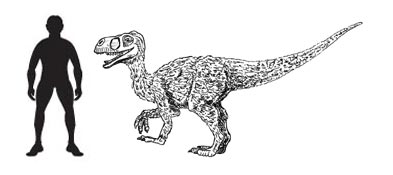
At Everything Dinosaur we get lots of letters, drawings, emails and other correspondence from young dinosaur fans.  On Friday, we received an email asking the question just how big was Eotyrannus?  We replied to this email yesterday, here is our answer.

How Big was Eotyrannus?

Eotyrannus is known from only one fossilised skeleton which was found by amateur fossil collector Gavin Leng in 1996.  The fossil material, represents less than half of the entire animal skeleton, so it is difficult to estimate the size of this meat-eating dinosaur when studying such few bones.  The fossil material consists of parts of the skull, jaws, teeth, parts of the backbone and elements of the limbs including bones from the hands and feet.  This dinosaur has been assigned to the tyrannosaur family (Tyrannosauroidea) and represents one of the earliest tyrannosaurs known to science.  It was formally named and described by a team of British palaeontologists in 2001.

A Scale Drawing of Eotyrannus (Drawing based on the CollectA Dinosaurs Model)

Eotyrannus Illustrated.

Picture credit: Everything Dinosaur

Early Cretaceous Fossils

The fossils date from the Early Cretaceous, they were found in a plant debris bed of the Wessex Formation on the south-west coast of the Isle of Wight (off southern England).  Comparisons between the Eotyrannus material and other meat-eating dinosaurs (coelurosaurs) suggest that the individual that the fossil material represents was about 4 metres long.  However, some of the bones indicate that they belong to a sub-adult animal.  Based on the assumption that this animal was not fully grown, palaeontologists have estimated that this animal may have reached a length of approximately 6 metres.

Unlike the more famous, Tyrannosaurus rex the forelimbs and fingers of Eotyrannus were long and most probably were used to grasp prey.  A model of this meat-eating dinosaur is available from Everything Dinosaur, it can be found in the CollectA model series, to view this model and other members of the tyrannosaur family, see the link below to find the CollectA Prehistoric Life models section on our website.

Dinosaur Models including the CollectA Eotyrannus dinosaur model: CollectA Age of Dinosaurs Prehistoric Life Models.

26 03, 2011

Happy Birthday to Richard Dawkins

By |2023-03-07T08:00:58+00:00March 26th, 2011|Categories: Famous Figures, Main Page|1 Comment

Professor Richard Dawkins is Seventy Today

Professor Dawkins, a Fellow of the Royal Society and the Royal Society of Literature, a recipient of numerous other awards and accolades is seventy today.  Many happy returns Professor.  In 2008, Channel Four (United Kingdom), broadcast a three-part television documentary entitled “The Genius of Charles Darwin”, a series that examined the legacy and work of that great scientist and thinker.  These programmes were very well made and highly informative.

The professor played a significant role in creating the television series.  A graduate of Oxford University, he is a prominent evolutionary biologist and science writer.

Professor Dawkins

Professor Dawkins has written many books. Most of these books have been bestsellers.  He writes in support of the theory of evolution, natural selection and Darwinism.  At the moment, one of the team members at Everything Dinosaur is reading “The Greatest Show on Earth”, a book which was first published in 2009,.  The book commemorates the 200th anniversary of the birth of Darwin and the 150th anniversary of the “Origin of Species” being first put into print.

Supporting the Theory of Evolution

This book outlines the evidence in support of evolution, it is a most educational and entertaining read.  Professor Richard Dawkins puts across his point of view and explains scientific principles with tremendous enthusiasm.  He has a rare gift of being able to explain complex issues in such a way as to make the subject eminently understandable.

Our behalf of Everything Dinosaur, we wish Professor Dawkins a happy birthday.

In the meantime, for dinosaur themed toys and gifts visit: Everything Dinosaur.

25 03, 2011

And the Frogs have Left the Pond – Great News!

By |2024-04-21T10:04:08+01:00March 25th, 2011|Categories: Animal News Stories, Main Page|0 Comments

Frogs Leave Record Amount of Spawn in Office Pond

This morning, we noticed that all the frogs had left the office pond.  One large individual, was found close to the pond on the paving slabs adjacent to the water’s edge.  It was very lethargic and we did not stop to examine whether it was a male or female Common Frog.  The males develop a fleshy pad (called a nuptial pad) on their first digit.  They use this pad to secure themselves to a female during breeding, so during the mating season at least it is relatively easy to distinguish between males and females.

The frog was quite dry, so we suspected that it had been out of the water for sometime.  Concerned for its well being, especially with the prospect of a sunny day threatening to de-hydrate it and bring out the neighbourhood’s cats to investigate, we decided to move the frog to a safer place.

Carefully a colleague picked up the animal and transported it to an area of overgrown, shady scrub and made sure the frog was well hidden.  We suspect that since this creature showed no outward signs of any harm, it may simply have been exhausted after the exertions of the last few days.  By placing it a quiet, sheltered spot, we are confident that this frog will recover and perhaps return again next year to our office pond to breed.

The frogs have certainly been busy over the last week or so, we have a record amount of frog spawn in the pond, perhaps as many as eight females have laid eggs.

24 03, 2011

Sabre-Toothed Vegetarian from the Late Permian

By |2023-03-07T08:01:57+00:00March 24th, 2011|Categories: Animal News Stories, Dinosaur and Prehistoric Animal News Stories, Dinosaur Fans, Main Page|2 Comments

Dagger-Toothed Vegetarian Reptile from the Late Permian of Brazil

Researchers reporting in the scientific journal “Live Science” have announced the discovery of a bizarre vegetarian reptile, with large upper canine teeth making it look a little like a miniature Sabre-toothed cat.  The animal formally named as Tiarajudens eccentricus was about the size of an Alsatian, it was a plant-eater, as other teeth in the fossilised jaws are clearly adapted for crushing plant matter, but the large, prominent canines represent a palaeontological puzzle for scientists.

A number of animals in the fossil record show large sabre-like teeth, the Sabre-toothed cats (Smilodon) are perhaps the best known but other groups such as the gorgonopsids evolved oversized, dagger-like teeth.  Most of these creatures were entirely carnivorous, however, herbivores with enlarged teeth are known.  For example, the two-metre-long dicynodont Dinodontosaurus had an enlarged upper tooth either side of its top jaw.  These teeth would not have been very useful in feeding, perhaps the teeth, which resemble tusks had a display function.

Tiarajudens eccentricus

The upper teeth each measure over 14 centimetres in length, research leader Juan Carlos Cisneros of the University of Piaui in north-eastern Brazil, stated these animals may have used their teeth to intimidate rivals or to attract a mate.  The teeth could also be used in threat gestures to scare of any potential predators.

This new genus has been compared to the extant Musk Deer (genus Moschus), which also has a pair of large, tusk-like teeth but is entirely herbivorous.

Dr Juan Carlos Cisneros, a specialist on Permian and Triassic Tetrapods stated that when discovering animals like this:

“Shows us how nature is extremely creative in providing solutions for several life tasks.”

In the picture showing a ventral view of the left side of the skull, a long, dagger-like tooth can be clearly seen, along with peg-like teeth from the premaxilla.  The large orbit, (eye socket) indicates that vision was a very important sense for this small member of the Anomodontia.

The research team state that the palate of the mouth was studded with teeth, allowing for rapid replacement of lost teeth an adaptation to a diet of tough, fibrous leaves.

Dr Juan Carlos Cisnero went onto add:

“It looks like a combination of different animals and it takes some time to believe it when you this animal in front of you.  It has the incisors of a horse, which are very good for cutting and pulling plants, the big molars of a capybara [large rodent] for grinding and the canines of a sabre-toothed cat.”

To view models and replicas of Triassic and Permian prehistoric animals: CollectA Deluxe Prehistoric Life Models.

23 03, 2011

Rare Ankylosaur Fossil Turns up in Alberta’s Oil Sands

By |2023-01-17T07:54:35+00:00March 23rd, 2011|Categories: Dinosaur and Prehistoric Animal News Stories, Main Page|2 Comments

Oil Worker Digs up Armoured Dinosaur

An oil worker using a mechanical excavator to clear debris in preparation for more crude oil extraction in the vast oil sands field of Alberta (Canada), has unearthed a rare ankylosaur fossil.  A surprising find, as the sediments that the fossil was found in were laid down in a marine environment.  Occasionally, fossils of ammonites and shellfish are found, but to discover a dinosaur fossil, is extremely unusual.

Ankylosaur Fossil

Scientists have speculated that the carcase of the ankylosaur was probably washed out to sea by a flood event.  The heavy armour on the back would have acted as “keel” for the corpse and the body would have floated for some time, buoyed up by gas contained in the stomach and other internal organs.  Eventually the body would have ruptured, the gas would have escaped and the remains of this armoured dinosaur would have sunk to the bottom of the sea.  Over time, the body would have been covered with sediments and 110 million years later the fossilised ankylosaur was dug up by the surprised oil worker.

The Albertan oil sands, are a huge area of tar and sand which is mined for its crude oil deposits. The sediments were laid down in the Cretaceous and represent a marine environment.  Around ten years ago, the fossil of an ichthyosaur (marine reptile), was found in this strata, but to discover a dinosaur in these sediments is most unusual but not completely unknown.  For example, in the marine Jurassic strata of Dorset, the fossils of an earlier armoured dinosaur have been discovered- Scelidosaurus.

The Albertan fossil, may represent a new genus of ankylosaur, commenting on the discovery Donald Henderson, the curator at the Royal Tyrrell Museum (Alberta) stated:

“We’ve never found a dinosaur in this location.  Because the area was once sea, most finds are invertebrates such as clams and ammonites.”

Researchers have estimated that this dinosaur would have measured in excess of five metres long and would have been at least 2 metres wide.

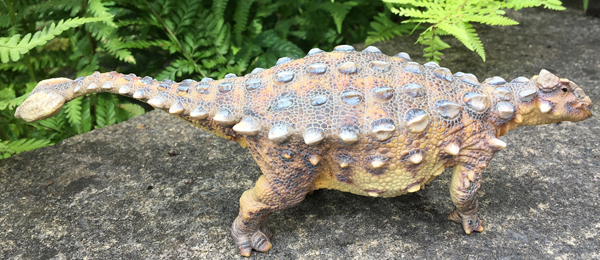
A Typical Model of an Ankylosaur

PNSO Ankylosaurus "Sede".

“Sede” the Ankylosaurus dinosaur model. Typical ankylosaur model.  Picture credit: Everything Dinosaur.

Picture credit: Everything Dinosaur

The ankylosaur model (above) is “Sede” from PNSO. To view the PNSO range: PNSO Age of Dinosaurs Figures.

Photographs show some of the preserved scutes (body armour), the pen provides a scale for the photograph.

Dr Henderson added:

“It is pretty amazing that it survived in such good condition.  It is also the earliest partially complete dinosaur that we have from this province [Alberta].”

The fossil is very well preserved and is almost three-dimensional, not having suffered too much compression as the layers of sediments built up on top of the remains.

The ankylosaur was found by a Suncor Energy excavator operator, who ironically had visited the Royal Tyrrell Museum just the week before.

Dr Henderson suggested that the worker had been thinking about dinosaurs and was therefore able to spot the unusual rock that was dug out of the ground:

“Maybe his mind was subconsciously prepared.”

The energy company has suspended excavation work to permit scientists to fully explore the site so that other fossil elements can be safely removed and shipped to the Royal Tyrrell for preparation.

22 03, 2011

Amazing Age of Dinosaurs Animatronic Dinos arrive at the London Natural History Museum

By |2024-04-21T10:04:35+01:00March 22nd, 2011|Categories: Dinosaur and Prehistoric Animal News Stories, Main Page|0 Comments

Tarbosaurus, Camarasaurus and Gallimimus the Star Attractions

With a substantial part of the permanent dinosaur galleries at the London Natural History Museum being closed for refurbishment this summer, dinosaur fans can have their insatiable thirst for all things Dinosauria quenched with a trip to a new exhibition which is due to open at the museum next  month.

The exhibition entitled “Age of the Dinosaur” combines specimens from the museum’s extensive fossil collection with video, computer generated images as well as live-size, animatronic dinosaurs such as Tarbosaurus, the giant long-neck Camarasaurus and the speedy Gallimimus.

Dinosaur Galleries

Staff at the museum are busy settling the animatronic models into their new home, in readiness for the exhibition opening on April 22nd.  Visitors will be transported back to realistic Jurassic and Cretaceous settings to experience sounds, smells and sights from the Mesozoic.  The lifelike dinosaurs have been supplied by the Japanese animatronic manufacturer Kokoro based in Tokyo.  Plans to ship some of the models had been interrupted as a result of the recent devastating earthquake and tsunami that hit the north of Japan.

The Tarbosaurus, a close relative of Tyrannosaurus rex is one of the highlights of the tour, and this particular theropod will be on display along with models of smaller meat-eaters such as Oviraptor and Velociraptor.

An Animatronic Tyrannosaurus rex on Display

T. rex on display. Dinosaurs Unleashed.

Ferocious T. rex. An animatronic dinosaur on display.  Picture credit: Everything Dinosaur.

Picture credit: Everything Dinosaur

Interpretation Developer at the Natural History Museum, Georgina Bishop commented as the large exhibits were carefully wheeled into place:

“Everyone loves dinosaurs, don’t they? Complete with sounds, scenery and scientific specimens, Age of the Dinosaur gives visitors the chance to really experience the land of these giants – a must for any budding dinosaur experts.”

The exhibition runs until September 4th.

For models and replicas of many of the prehistoric animals that will feature in the dinosaur galleries: Dinosaur and Prehistoric Animal Models.

21 03, 2011

Comparing Sauropods to Vacuum Cleaners using New Research

By |2024-04-21T10:06:36+01:00March 21st, 2011|Categories: Dinosaur and Prehistoric Animal News Stories, Main Page, Palaeontological articles|2 Comments

New Study Extols the Virtue of Having a Long-Neck for Sauropods

A team of UK based researchers have calculated that sauropods such as Apatosaurus and Nigersaurus evolved long-necks so that they could reach a lot of plant food material without having to move very far.  This new study has calculated that the long necks of these herbivores enabled them to gather a great deal of food without having to expend a lot energy.  Think of a Diplodocus as a thirty metre long feeding platform.

Sauropods

The scientists have compared the long-necks of sauropods to the long, extension nozzle fitted to post war vacuum cleaners, devices to help housewives and their partners cope with having to lug a heavy machine around the house.

The long necks of these highly successful group of lizard-hipped dinosaurs, taken to extremes by the enormously long neck of the sauropod Mamenchisaurus for example, resemble the solution that designers came up with when they realised that early vacuum cleaners were too cumbersome to manoeuvre easily around a room.  The fitting of a long, extension hose permitted the user to reach more area of the carpet, without having to move the heavy suction machine and the bag.

In a study led by Professor Graeme Ruxton (Glasgow University) and Dr David Wilkinson at Liverpool John Moores University, animals such as the Late Jurassic Brachiosaurus would have used 80% less energy foraging for food when its neck reached nine metres from its torso than if the neck was only six metres long.

Long-necked Dinosaurs – Nature’s Vacuum Cleaners

Picture credit: Everything Dinosaur

With a 6-metre-long neck, the heavy Brachiosaurus could only have reached food immediately beneath or above it and would have had to move to reach more, but a longer neck gave the creature the ability to feed on vegetation further away while standing still.

Sauropod Models and Replicas

For models and replicas of sauropods such as Nigersaurus, Apatosaurus and Brachiosaurus, take a look at the Wild Safari Prehistoric World model range: Safari Ltd. Wild Safari Prehistoric World Models.

A lot of work has already been undertaken by researchers as they try to understand the anatomy of sauropods, creatures that were the largest type of land animal ever to evolve, with some species reaching lengths in excess of thirty metres.  In the study, published in the scientific journal “Biology Letters” the researchers state:

“We draw an analogy here with the cylinder vacuum cleaners that were commonplace in households in industrialised countries from the 1950s to the 1970s.  Because the machinery required to create suction was large and heavy, the main body of the vacuum cleaner was positioned by the user in a central location within a room.  The user then moved the light head-part at the end of a long tube across the surrounding carpet.

This is certainly an interesting comparison, one that helps to explain the “feeding platform” concept favoured by many palaeontologists.  Over recent years more fossils of Jurassic and Cretaceous sauropods have been discovered, indicating just how diverse this basic long-necked body plan became.

For example, the bizarre sauropod Nigersaurus (from Niger in Africa) has been nicknamed the “Mesozoic Lawnmower”, to read more about this peculiar long-necked dinosaur click the link below:

Nigersaurus: Nigersaurus – the dinosaur that grazed like a cow.

20 03, 2011

Frogspawn (March 2011) an Important Update

By |2024-04-21T10:05:37+01:00March 20th, 2011|Categories: Animal News Stories, Main Page|0 Comments

Exciting News – First Pictures of Frogspawn from the Office Pond

Team members at Everything Dinosaur  have spotted the first frogspawn in the office pond.  Quietly, without wishing to disturb any frogs that may also be spawning, we have taken a photograph of the frogspawn.

Frogspawn in the Office Pond

Frogspawn in the Office Pond

Frogspawn in the pond.

Picture credit: Everything Dinosaur

A picture of this year’s frogspawn in the office pond.  We look forward to observing the development of the eggs.

20 03, 2011

Suspected Man-Eater Caught in Queensland

By |2023-01-16T08:00:07+00:00March 20th, 2011|Categories: Animal News Stories, Main Page|0 Comments

Crocodile Suspected of Attack on Fisherman is Caught

A three-metre-long Saltwater crocodile suspected of attacking fisherman Todd Bairstow has been caught in a trap say Australian Wildlife Rangers.  A spokesperson for the Department of Environment and Resource Management (DERM) said the crocodile was caught using a trap set at Trunding Creek, near where Todd Bairstow, clung to mangroves as a large Saltwater crocodile attempted to drag him to his death from the bank where he had been fishing.

Saltwater Crocodile

The DERM staff are now attempting to confirm that this was the crocodile responsible for the attack.  Mr Bairstow has undergone a number of operations and has had to suffer protracted and painful sessions to clean his wounds caused by the highly infectious crocodile bites.  The captured crocodile has been transferred to a secure facility near Weipa for assessment and will then be taken to a zoo or a crocodile farm.

To read Everything Dinosaur’s blog post about the crocodile attack: Man Survives Crocodile Attack.

Visit Everything Dinosaur’s award-winning website for models of crocodiles and alligators and these replicas do not bite!

The Everything Dinosaur website: Everything Dinosaur.

Go to Top