All about dinosaurs, fossils and prehistoric animals by Everything Dinosaur team members.
6 04, 2011

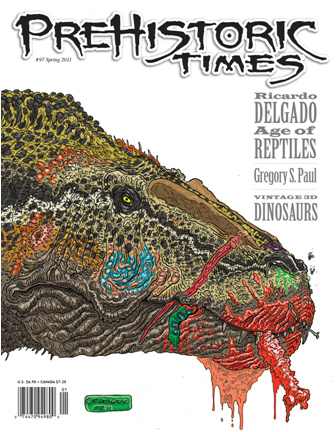
Prehistoric Times – New Front Cover Issue 97

By |2024-01-01T17:29:39+00:00April 6th, 2011|Categories: Magazine Reviews, Prehistoric Times|0 Comments

Prehistoric Times Front Cover (Issue 97)

Team members at Everything Dinosaur are looking forward to receiving their next copy of the dinosaur and model collectors magazine “Prehistoric Times”

Sneak Peek of the Front Cover of Issue 97

The front cover of the next edition of “Prehistoric Times”.

Picture credit: Mike Fredericks

“Prehistoric Times”

Everything Dinosaur team members would like to thank the magazine’s editor Mike Fredericks for sending an email that highlighted the rather gory, but extremely colourful front cover of issue number ninety-seven.

Visit the “Prehistoric Times” website to subscribe to this quarterly publication: Prehistoric Times Magazine.

5 04, 2011

Massachusetts “Mayfly” A Remarkable Fossil Discovery

By |2023-03-07T07:49:23+00:00April 5th, 2011|Categories: Dinosaur and Prehistoric Animal News Stories, Educational Activities, Main Page|0 Comments

Fossil Hunter Stumbles Upon Amazing Fossil Behind Shopping Centre

Fossils come in all shapes, forms and sizes.  Palaeontologists group fossils into various categories, for example there are body fossils and trace fossils.  Body fossils preserve something of the bodily remains of organisms, whereas trace fossils preserve evidence of the activity of animals, such as a fleeting impression made in soft mud by a flying insect from over 300 million years ago. Scientists report on a remarkable fossil discovery from the USA.

Remarkable Fossil Discovery

Some 300 million years ago, what was to become the U.S. state of Massachusetts in what is now the eastern United States, lay close to the equator, part of an enormous land mass that consisted of both what was to become Europe and the Americas (except South America).  The land was dominated by dense swamps, roaming these lush environments were amphibians and the first types of reptiles.

The air was dominated by insects, the only creatures that had evolved to exploit an aerial way of life at the time.  One such insect, an ancestor of today’s mayflies landed on the muddy edge of a body of water, probably a puddle or small pool, it then took off again, but it left the delicate impression of its body and marks in the mud where its thin legs stuck into the soft sediment.

Remarkably, this tiny impression was quickly covered in fine sediment, perhaps it rained and the water level rose, sweeping grains of mud into the imprint left by the insect.  This trace of the fleeting resting place of an insect way back in the Carboniferous Period, was preserved as a fossil and stumbled upon by a keen fossil collector, who was looking for fossil bearing strata at the back of a shopping mall.

This primitive, ancestral mayfly fossil has become the oldest known full body impression of a flying insect, displacing the previous earliest discovered so far by some 30 million years or so.

Fossil Site Behind Shopping Mall

University undergraduate, Richard Knecht was looking for a fossil site, in a swampy area behind a shopping mall three years ago when he literally stumbled upon this amazing trace fossil.  As he emerged from the swamp he came to a rock outcrop of the type he was looking for, and the Harvard University Museum worker states

“I grabbed a loose piece of rock on the outer edge of the outcrop and it was already naturally split as rocks tend to do as they weather.  I opened it like a book and there were both halves [cast and mould] of the specimen.”

A spokesperson for Everything Dinosaur in the UK stated that this was like finding the slab and counter slab of a fossil, but to discovery such a perfectly preserved trace fossil of a flying insect is truly astonishing.  As insects are soft bodied and very light they rarely fossilise.  Trace fossils of these arthropods are extremely rare, especially anything dating as far back as the Carboniferous.

Ancient Fossil Insect

Commenting on the discovery, Conrad Labandeira, curator of palaeoentomology at the Smithsonian Institute in Washington said:

“Most fossil insects, when you look at them, you don’t really have a lot of surface detail.  This is a very valuable type of preservation.  You can actually view some of the movements of the appendages.  This gives you some idea of the scope of movement of the legs… information that we don’t normally get from body fossils.”

The research team have been studying the fossil bearing site have had their findings to date published in the scientific journal “The Proceedings of the National Academy of Sciences”.  Insects preserved in amber is one thing, but to have such a superb trace fossil of a primitive mayfly is very exciting.

The oldest evidence of any kind of insects comes from a body fossil dating to the Devonian Period (approximately 418 million years old).  The only other older insect specimen is one of a flightless insect, found by the same research team at the very same location as the mayfly trace fossil.  A number of fascinating fossils have been found so far, including the tracks of a primitive reptile as well as numerous insect and plant fossils.

Richard Knecht, commenting on the fossil discoveries made so far stated:

“We have found a lot of interesting stuff, this [mayfly fossil] is just one of the characters coming out.”

For models and replicas of Palaeozoic creatures: Prehistoric Animal Models and Figures.

4 04, 2011

The Remarkable Shoshone Mountains Reptile

By |2024-04-21T10:02:09+01:00April 4th, 2011|Categories: Dinosaur Fans, Educational Activities, Main Page|0 Comments

Shonisaurus – Giant of the Ichthyosauria

Team members at Everything Dinosaur received an email the other day with a request for more information on giant ichthyosaurs.  There were certainly a number of very large members of the ichthyosaur family.  The Ichthyosauria are a very diverse Order, evolving in the Early Triassic and surviving for over 140 million years before becoming extinct shortly before the end of the Cretaceous Period.   There is the giant Cymbospondylus (pronounced Sim-bow-spon-die-lus), fossils of which have been found in North America and Europe.  This gigantic marine reptile had a large body, an eel-like tail, a metre long head with large jaws.  Cymbospondylus is the biggest marine reptile known from Late Triassic strata.

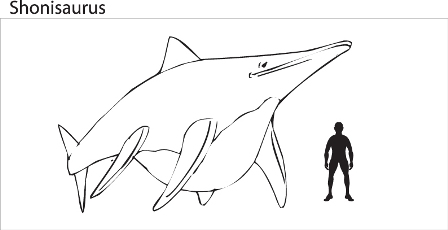
Shonisaurus

Perhaps our favourite large ichthyosaur is Shonisaurus (Shonisaurus popularis), a marine reptile that may reached lengths in excess of fifteen metres.  The first fossils of this ichthyosaur were found by miners around the now deserted mining town of Berlin, Nevada in North America.  The fossils were so plentiful that miners used them to decorate their dwellings and some of the large, flat vertebrae were even used as dinner plates!  Reports of these fossils had been made from as early as 1869 but the miners were too busy digging for gold and silver to worry.

Shonisaurus popularis is the largest ichthyosaur to have been discovered to date in the United States and was believed to be the biggest in the world until fossils of a new species of ichthyosaur over 23 metres long were unearthed in Canada just a few years ago.

A Scale Drawing of Shonisaurus popularis

Shonisaurus

Giant ichthyosaur of the Late Triassic and Early Jurassic. Picture credit: Everything Dinosaur.

Picture credit: Everything Dinosaur

This ichthyosaur had a very deep body, and four, long, narrow equally sized flippers.  Teeth were present only in the front of the jaw.  This animal probably hunted cephalopods – ammonites, belemnites, squid and octopi.

For models and replicas of giant marine reptiles including ichthyosaurs: Models of Sea Monsters.

3 04, 2011

Watching a Beautiful Blue Triceratops

By |2024-04-21T10:01:40+01:00April 3rd, 2011|Categories: Animal News Stories, Everything Dinosaur News and Updates, Main Page, Product Reviews|0 Comments

Triceratops – Wild Watchers

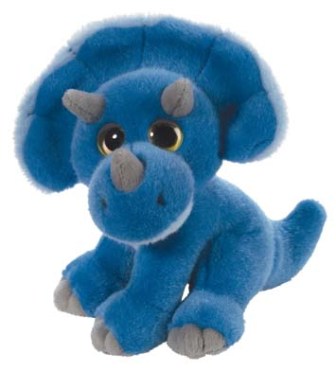
Recently introduced into the Everything Dinosaur, extensive range of prehistoric animal soft toys are four new soft toys, each one representing a different dinosaur.  We think, that as they look so cute, that they resemble young animals (prior to distal growth), the big eyes and large heads giving these soft toys the appearance of baby dinosaurs.  There is an Oviraptor (with glow in the dark eyes), a Diplodocus, a very cute Tyrannosaurus rex (if such a thing is possible) and a bright blue baby Triceratops.  These are super, and very colourful dinosaur soft toys.

Dinosaur Soft Toys

Yes, bright blue and why not indeed.  Nobody knows for sure what colour horned dinosaurs were so why not blue.  There are a number of reptile genera which are coloured blue, many birds and reptiles are brightly coloured.  Scientists are fairly confident that like birds and crocodiles the Dinosauria had colour vision and colour would have played an important role in their lives, if their extant relatives are anything to go by.

Wild Watchers Triceratops Soft Toy

Picture credit: Everything Dinosaur

This new dinosaur soft to is part of a range called “Wild Watchers”, to view the range of prehistoric animal plush and dinosaur soft toys currently in stock on our award-winning website: Dinosaur Soft Toys.

It is also important to remember that the dinosaur clade first evolved in a world that was dominated by greens and browns, there were no bright, colourful flowering plants (Angiosperms), these did not evolve for around 100 million years after the first dinosaurs appeared.  So being colourful against a backdrop of mainly greens and browns may have been useful when displaying to attract a mate for example.

Blue Dinosaurs

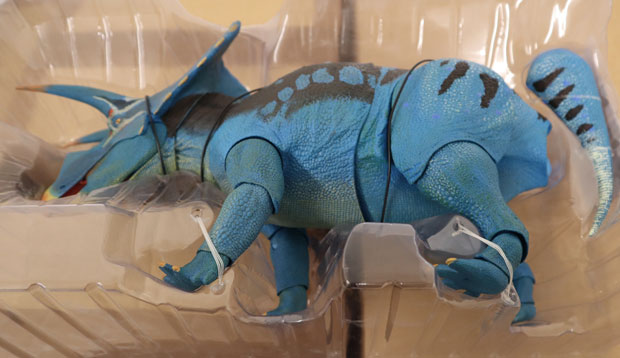
Beasts of the Mesozoic Torosaurus latus dinosaur model.

A view of the Beasts of the Mesozoic Torosaurus articulated dinosaur model out of its packaging.  This is a blue horned dinosaur figure.  Picture credit: Everything Dinosaur.

Picture credit: Everything Dinosaur

The picture (above) shows a Torosaurus replica from the Beasts of the Mesozoic family of articulated dinosaur models.  To view this range of colourful dinosaur figures: Beasts of the Mesozoic Articulated Dinosaur Models.

In comparison to reptiles and Aves (birds) our own Order (Mammalia) are surprisingly colour shy – we of course have some remarkably colourful mammals, for example the Okapi and let us not forget the stark contrast of a herd of zebras but the team members at Everything Dinosaur could not think of a single type of mammal that was coloured predominantly green.

Indeed, the colour blue itself is very rare in the mammalian colour scheme, some primates, monkeys and such like have blue faces (and other parts) but we could not think of many more.  Even Belgium blue cattle and the Blue Whale are not coloured exactly blue, not least from the pictures we could find that depicted these animals.

2 04, 2011

New Species of Tyrannosaur Announced

By |2023-03-07T07:51:34+00:00April 2nd, 2011|Categories: Dinosaur and Prehistoric Animal News Stories, Dinosaur Fans, Main Page|0 Comments

Zhuchengtyrannus magnus – A fearsome Chinese Tyrannosaurus

It may have been a little awkward, after all, with the press releases about the discovery of a new member of the tyrannosaur clade (Zhuchengtyrannus magnus), one that may rival the likes of Tarbosaurus bataar and Tyrannosaurus rex in terms of size on the eve of April Fool’s Day, but the good news is the ever growing family of Tyrannosauridae has definitely got a new member, and who knows, perhaps a second one is on the way.

The trouble is, if there is a press release sent out about dinosaurs at the end of March, some parts of the media automatically query it as they regard such information as a potential April Fool story.  There are a number of bogus articles doing the rounds, we know, we have been asked to comment on a few and indeed, aid in the preparation of one (sauropod femurs turning up on the coast of Cumbria).

However, amongst an extensive hadrosaur bone-bed an international team of dedicated palaeontologists have literally pieced together the evidence to indicate that there was at least one giant tyrannosaur theropod roaming the Shandong province of China in the Late Cretaceous and what a fearsome beast Zhuchengtyrannus may turn out to be.

An Illustration of Zhuchengtyrannus magnus
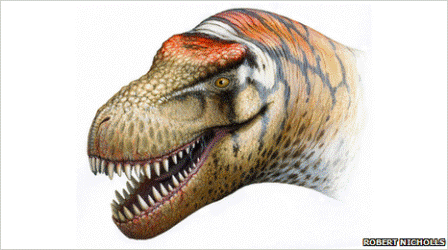
Picture credit: Robert Nicholls

Zhuchengtyrannus magnus

With the information being published in the scientific journal “Cretaceous Research” we can reveal that based on measurements made of the fragmentary elements of the skull material found, it seems that this particular tyrannosaur may have measured as much as 11 metres long with a body weight tipping the scales at around six tonnes.

Dr David Hone from University College (Dublin), the palaeontologist given the job of naming this ferocious predator and the scientist who led the research team that has worked on the fossilised bones stated:

“There is no doubt that Zhuchengtyrannus was a huge Tyrannosaurine.”

More information on this remarkable discovery, we think only the second really big tyrannosaur to be discovered in this region of China, can be found on David’s excellent and highly informative web log – Archosaur Musings.

Doctor Hone went on to comment:

“With only some skull and jaw bones to work with, it is difficult to precisely gauge the overall size of this animal.  But the bones we have are just a few centimetres smaller than the equivalent ones in the largest T. rex specimen.”

The binomial name for this new member of what is a rapidly expanding clade of the dinosaur family tree is Zhuchengtyrannus magnus. The name means “Tyrant from Zhucheng city”, as the fossils were found in the city of Zhucheng – a part of the world gaining a reputation as a “hot spot” for dinosaur fossils.

This is the first dinosaur that Dr Hone has named (as a first author) and although the lack of fossil material prevents the scientist from making more definite calculations as to the size of this tyrannosaur; from the dentary (lower jaw bone) and the maxilla (upper jaw bone), it is clear that this dinosaur was very, very big.  The species element of the binomial name reflects the large size of this dinosaur.

Zhucheng is a relatively small town and has already been recognised in recent years for the great vertebrate fossil potential the area has.  A number of new dinosaurs have been discovered in this area, this new tyrannosaur is just the latest of a whole range of important discoveries that have been made by palaeontologists.  It seems that much of the strata in the area may represent flood deposits where a large number of corpses have been washed up together forming extensive bone-beds.  The material ascribed to Zhuchengtyrannus (pronounced “zoo-cheng-tie-ran-us”) was found in a hadrosaur bone-bed deposit.

A Scale Drawing of the Newly Described Tyrannosaur Zhuchengtyrannus magnus
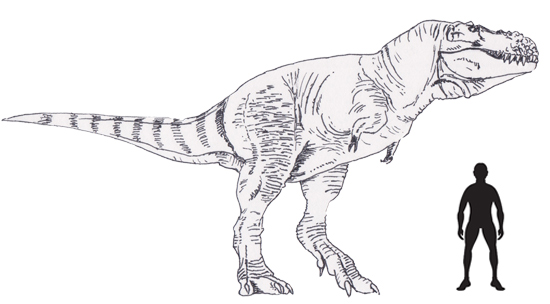
Zhuchengtyrannus magnus scale drawing.

Everything Dinosaur’s scale drawing of the giant, Late Cretaceous Asian tyrannosaur Zhuchengtyrannus magnus. Picture credit: Everything Dinosaur.

Picture credit: Everything Dinosaur

Tyrannosaur maxillae are important bones as they help distinguish different genera, the different taxonomic characters can be determined by careful study of certain parts of the fossil skeleton and the maxilla and other parts of the skull are key bones in helping researchers to determine whether or not they have discovered a new genus.

To view models and replicas of Chinese dinosaurs including Zhuchengtyrannus (whilst stocks last): PNSO Age of Dinosaurs Models.

Importantly, what fossil material that has been found is in excellent condition and measurements taken of the dentary show that this new tyrannosaur would probably only have been slightly smaller than its Chinese cousin Tarbosaurus (Tarbosaurus bataar) and also not quite the size of the largest specimen of Tyrannosaurus rex known to science.  But this new discovery suggests that there are other super-sized, apex predators in the tyrannosaur family.

Dr Hone comments:

“Zhuchengtyrannus is basically just another giant Tyrannosaurine in the mould of these two more famous giants [T. rex and Tarbosaurus].

Remarkably, the site where the fossils of Zhuchengtyrannus were found may yield many other discoveries, including another giant tyrannosaur.  The research team excavated a number of teeth and postcranial elements including vertebrae, femora and various metatarsals (backbones, thigh bones and toe bones).  Importantly they found another maxilla and another dentary, neither of which match the material ascribed to Zhuchengtyrannus magnus or other known tyrannosaurs. This suggests that there may be at least one other tyrannosaur at the dig site awaiting further analysis.

However, if there is another taxon present, then this will complicate matters for the palaeontologists.  Imagine trying to put together a jigsaw puzzle, without knowing for sure how many pieces you have or indeed the precise identity of what you are trying to create.  Then imagine the added complication of having to try to put together two similar but definitely different jigsaws, with all the known pieces you have jumbled up together, each one having no illustration to guide you, and you still do not know how many pieces of each you have to work with – tricky.

The potential to find another taxon is covered in the scientific paper, but for the time being just one new taxon has been named and described.  Expect to hear a lot more about the bone-beds of Shandong Province and the amazing dinosaur fossils that await discovery.

Our congratulations to Doctor David Hone and his colleagues for their work.

1 04, 2011

Unbelieveable! – Dinosaur Bone found on Whitehaven Beach

By |2023-01-17T11:00:45+00:00April 1st, 2011|Categories: Dinosaur and Prehistoric Animal News Stories, Dinosaur Fans, Main Page|0 Comments

Sauropod Bone Discovered on Cumbrian Coast

From time to time, amazing fossils and other objects are discovered on the shoreline of various parts of the United Kingdom.  It seems that prehistoric animal remains are not just found on the Jurassic coast of southern England as this press release from the Beacon Museum, Whitehaven in Cumbria explains.

Dinosaur Bone

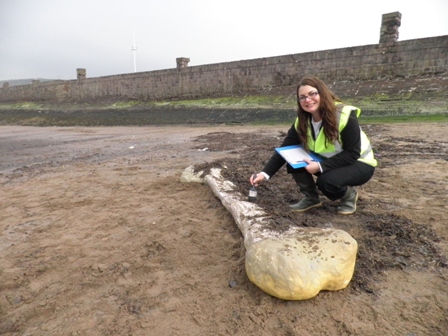
A suspected dinosaur bone has been found on Whitehaven Beach by a dog walker. The small dog thought he had gone to heaven. Dog walker Pamela Martin said:

 “I heard my dog bark and he was digging at something. I couldn’t believe what ‘Snoot’ had dug up.  I said ‘You’re not taking that home with you!’’.

The eight foot long thigh bone has been identified from photographs by expert palaeontologist Dr David Gelsthorpe from Manchester Museum as perhaps a Cetiosauriscus, long-necked dinosaur.

One of the Beacon Museum Staff with the Dinosaur Bone

Picture credit: Beacon Museum (Whitehaven)

The picture shows one of the museum staff, brushing away some of the surrounding material from the dinosaur bone.  From the size of the specimen our experts would suggest that it represents a bone from the hind limb, the thigh bone (femur).  A close examination of the sediment surrounding the fossil shows a number of footprint impressions left in the sand, clearly such a fossil find has attracted the attention of a number of leading scientists already – or is that evidence of dinoturbation that we can see?

The Beacon’s Curator, Charlotte Stead said:

“This fantastic find throws another angle to Copeland’s rich history”.

The bone has been discovered in good time to promote the Beacon’s summer blockbuster exhibition ‘BBC Walking With Dinosaurs’, which opens to the public from 11th June to 4th September.

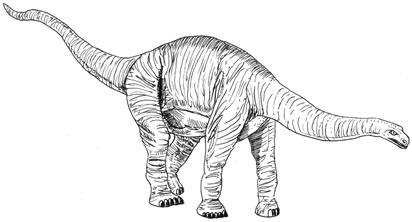
An Illustration of the Long-necked Dinosaur Cetiosauriscus

Picture credit: Everything Dinosaur

Dr David Gelsthorpe, Curator of Earth Sciences at The Manchester Museum said,

“This is a fantastic discovery and all the more amazing because it was found in Cumbria. This Jurassic giant grew up to 15 metres long and would have roamed Cumbria around 175 million years ago. It is a truly astonishing find and is the furthest north Cetiosauriscus has ever been discovered. Cumbria is the place to watch for internationally important dinosaur discoveries”.

This is not the first time, a fossil bone from a Cetiosauriscus has been found in the United Kingdom.  In 2009, a fossilised femur ascribed to this particular long-necked, Jurassic herbivore was discovered in Gloucestershire.

To read more about that discovery: Cetiosauriscus Leg Bone Found in Gloucestershire Quarry.

A spokesperson from Everything Dinosaur commented that today’s discovery made April 1st a day to remember in the long history of dinosaur discoveries in the United Kingdom.

And a happy April Fool’s Day from everyone at The Beacon, Whitehaven!

For serious prehistoric animal models and replicas: Dinosaur and Prehistoric Animal Models.

31 03, 2011

Answering Questions from Teachers (Providing Helpful Answers)

By |2024-04-21T10:02:43+01:00March 31st, 2011|Categories: Educational Activities, Main Page|0 Comments

Advising Schools about Dinosaurs

Another day and another challenge for the team members at Everything Dinosaur.  Lots of primary schools are using dinosaurs as a teaching topic for their Summer term.  We seem to be getting more than our usual number of enquiries from teachers and teaching assistants who are busy preparing schemes of work in readiness for the start of next term.  It seems quite a popular subject area at the moment, teaching about dinosaurs and fossils in schools.

Everything Dinosaur

Our staff always try to help where they can.  Many of them have teaching qualifications of their own and they remember having to work Sundays to prepare the class lesson plans for the following week.  As far as the dinosaur information requested in the last few days, it has been eclectic to say the least.  We have helped with the provision of lesson plans involving how fossils form, pictures of different types and sizes of dinosaur bone, supplied details of dinosaur and other prehistoric animal teeth, as well as giving instructions on how to build a timeline from the beginning of the Mesozoic to the present day.  All good fun, but my particular favourite had nothing to do with the Dinosauria at all.  We received a request to provide some further information on the Cambrian explosion – trilobites and all.  These members of the Arthropoda have a special place in the hearts of many a palaeontologist, sure they don’t quite have the impact of a Tyrannosaurus rex, but they are an extremely important group in terms of the fossil record that they left behind.

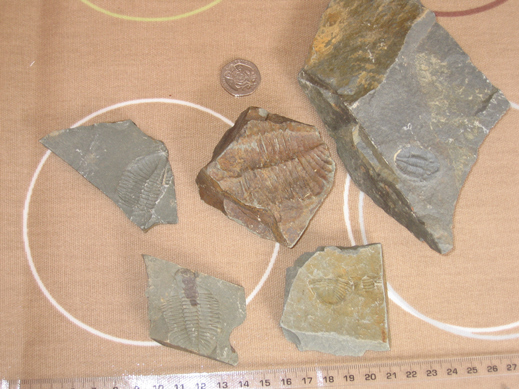
An Illustration of a Trilobite

Cambrian extinction. Everything Dinosaur highlights trilobite fossils.

Terrific trilobites. Picture credit: Everything Dinosaur.

Picture credit: Everything Dinosaur

Examining Trilobites

For the uninitiated, trilobites are an extinct group of Palaeozoic, entirely marine arthropods with a distinct threefold longitudinal division of their body and hard, armoured exoskeleton.  These exoskeletons had to be moulted for the animals to grow and they have resulted in a rich and abundant fossil record from the early Cambrian to the end of the Permian geological period.  So diverse were the trilobites that we think at last count they constituted nine distinct Orders, represented by something like 15,000 species.

Great fun providing advice, guidance and information to teachers, we can sleep easy tonight as we have helped give some teachers and teaching assistants their Sundays back.

For models and replicas of Palaeozoic creatures including trilobites: CollectA Age of Dinosaur Popular Figures.

30 03, 2011

“Small Thief or Plunderer” – Microraptor a Dromaeosaurid with Attitude

By |2024-04-21T10:03:31+01:00March 30th, 2011|Categories: Dinosaur Fans, Everything Dinosaur News and Updates, Main Page|0 Comments

Microraptor gui – A Dromaeosauridae with Attitude

The dinosaur known as Microraptor (Microraptor gui) is one of the smallest dinosaurs known in the fossil record, with some specimens having a body length less than ten centimetres.  Known from the finely grained Cretaceous sediments of the Liaoning province of northern China.  The short, stiff body was covered in primitive feathers and this tiny dinosaur had asymmetrical flight feathers on both its relatively long arms and legs.  These fossils provide important evolutionary evidence between the dinosaurs and birds (Aves) and several manufacturers have produce Microraptor models.

An Illustration of Microraptor (Microraptor gui)

Wild Safari Prehistoric World Microraptor models

A pair of Microraptors compete in intraspecific combat. Visual displays were probably very important to these small dromaeosaurs.

Microraptor Models

In the picture, two Microraptors are displaying to each other, their bright, colours make them very visible in the dark understorey of the Cretaceous forest.  Analysis of the claws on the toes and hands show that they were sharp and highly curved.  These claws would have made very effective grappling hooks to help this little creature scale the trunks of trees.  How much time it spent in the trees is very much open to debate and extremely difficult to prove given the fossil data available.  However, it was very well adapted to an arboreal existence and with a number of terrestrial predators lurking in the forest, the branches of trees might have been a very safe place to be.

A recent study using computer modelling revealed that as well as being an effective glider, anatomically Microraptor was probably capable of short-bursts of powered flight.  This four-winged wonder could have safely “perched” on the branches of trees, picking off insects from the leaves whilst being safe from attack from the larger dinosaurs that roamed the forest floor – it was a dromaeosaur with attitude.

For models and replicas of feathered dinosaurs including Microraptor (whilst stocks last): Wild Safari Prehistoric World Replicas.

29 03, 2011

Dinosaur Drawing in Utah – Creationists say it is Proof

By |2023-03-07T07:52:40+00:00March 29th, 2011|Categories: Dinosaur and Prehistoric Animal News Stories, Main Page|0 Comments

Creationists Still Say “Sauropod” Drawing is Proof

A drawing on the sandstone face of a rock in Utah has excited Creationists since its discovery, as it seems to show a long-necked dinosaur, a sauropod.  Many Creationists have claimed that this drawing was evidence that our ancestors lived alongside dinosaurs.  The area of Utah where the “dinosaur drawing” was found a few years ago has many such sites.  Native Indians using the rock formations and cave walls to depict scenes from their environment, including pictures of wild animals that shared their world, animals like deer and bears.

Sauropod Drawing

If they had drawn a picture of a dinosaur, then, as many Creationists would believe, this was evidence that people really did exist alongside the dinosaurs.  This is not the only case of such “dinosaur drawings”, we have seen pictures of temples in the Far East that seem to show a Stegosaurus cut out in relief on the temple’s stone wall.  Even back in Utah there are other sites of native Indian drawings that show strange creatures, including, as some observers claim, a drawing of a horned dinosaur – possibly a Triceratops.

Certainly, native Americans were aware of strange objects that could be found in certain places, the state of Utah has many fossil rich sites, and many vertebrate fossils including dinosaurs are eroding out of the strata and can be found on the ground, these objects were most certainly seen and examined by people.  Native Americans thought that the fossilised bones of what we know as Triceratops were the remains of a giant, long dead type of buffalo that had roamed across their lands.

For Phil Senter, an associate professor of biology at Fayetteville State University (part of North Caroline State), having seen the image himself and noting the resemblance to a sauropod, he decided that it needed further investigation.

The associate professor contacted archaeologist Sally Cole, an authority on cave drawings and other imagery and she examined the drawing and concluded that it was actually a composite of two separate drawings.  The first drawing is a snake, this explains the long “sauropod-like” neck that can be seen to the right of the pictures.  The supposed “legs” of the dinosaur are just stains from minerals or mud.

Published Research

The results of this study has been published in the journal “Palaeontologia Electronica”.  The scientists state that this is an example of a paraeidolia, the psychological phenomenon of perceiving significance from random or vague stimuli.  Examples would be “seeing” a human face in an item of food or animals in cloud shapes and formations.

On a sunny day, a while ago, one of our team member took a picture of an instance of paraeidolia – they thought they could see the shape of the Loch Ness monster (a hump-backed Nessie) in a cloud.

To read this article and to view the picture: Hunting Nessie in the Clouds.

Leading Creationists have denounced the study, claiming that the image was not examined up close, citing that it would be difficult to come to any firm conclusions if the image was studied at a distance through binoculars.  It is unlikely that this new study will persuade any of the parties to change their views.  The Creationist versus Evolutionist debate will run and run.

For models and replicas of sauropod dinosaurs: Wild Safari Prehistoric World Figures and Models.

28 03, 2011

The Big Boys From Brazil – New Spinosaurid Described

By |2023-03-07T07:53:34+00:00March 28th, 2011|Categories: Dinosaur and Prehistoric Animal News Stories, Dinosaur Fans, Main Page|0 Comments

New Spinosaurus from South America Described – A Rival to T. rex

A team of scientists have just published a scientific description of a new genus of giant spinosaurid dinosaur, perhaps one that rivalled Tyrannosaurus rex in terms of its size.  The palaeontologists have provided a fascinating insight into the ancient Cretaceous ecosystem of Brazil, one that may have been dominated by this giant predator.

Giant Spinosaurid Dinosaur

The spinosaurids have only really come to the attention of the wider public, thanks to the appearance of a giant Spinosaurus in the film – Jurassic Park III, a movie which required a new angle on the Tyrannosaurus rex being the big baddie, as T. rex had been the main dinosaur star in the first two films in the J.P. franchise.  Known from the early 20th Century, thanks to Stromer’s expeditions to North Africa, the spinosaurids represent an unusual off-shoot of the Theropoda clade.  Carnivores, perhaps specialist piscivores (fish-eaters), these bipedal dinosaurs had long, narrow snouts, superficially similar to the jaws of crocodiles.

The teeth were straight and sharp, lacking the curvature of a tyrannosaurid, dromaeosaurid or allosaurid teeth.  The teeth on the lower jaw were numerous and relatively small, the tip of the upper jaw (premaxilla) held a separate rosette of of much larger teeth, the upper jaw had a distinctive “kink” and the nostrils were positioned well back from the tip of the snout.  These may have been adaptations to permit these predators to catch fish. The narrow snouts would have entered the water, the small teeth could catch a slippery fish, and the nostrils would still be held clear of the water.

However, many members of the spinosaur family, including this new genus described in the scientific journal “The Annals of the Brazilian Academy of Sciences”, were also most probably apex predators hunting and killing other dinosaurs as well as crocodiles and other creatures that shared their watery world.

This new Spinosaurus has been named Oxalaia quilombensis.  It becomes the newest member of the bizarre Spinosaurus family and with scientists estimating that it could have reached lengths in excess of 14 metres and weighed as much as 7 tonnes, it rivals the more famous T. rex in terms of size.

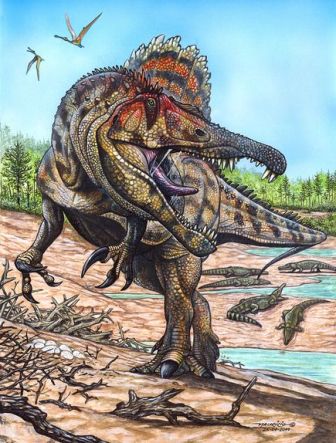
An Illustration of O. quilombensis

Picture credit: Brazilian National Museum/Elaine Machado.

The artist has depicted this new spinosaur with a sail-like structure running along the back, a feature found in other members of this dinosaur family.  There is no fossil evidence to suggest that this particular spinosaur had a sail.

The fragmentary fossils including the tip of the upper jaw, so characteristic of other known spinosaur material were found in the Alcantara Formation on Cajual island which is part of north-eastern Brazil’s Maranhao state.  The fossils have been dated to around 98 to 95 million years ago (Cenemanian faunal stage) and the scientists who have been studying this new dinosaur have stated that this new discovery is important as it helps to establish the ancestral line of this geographically dispersed group of theropods.

Alexander Kellner, a Brazilian palaeontologist and one of the researchers who has studied the fossils, stated that this new dinosaur from Brazil, although known from only fragmentary material seems to have a closer affinity to African spinosaurs than to other spinosaurids known from South America.  This similarity suggests that the ancestors of the African and Brazilian genera came from the same area before the African and South American continents split as part of the Atlantic ridge formation, sometime between 130 and 110 million years ago.

The Characteristic Snout Tip of a Spinosaur – Oxalaia quilombensis

Evidence of Giant Spinosaur?

Picture credit: Kellner et al.

The picture shows the tip of the upper jaw of Oxalaia quilombensis, this the view from underneath (ventral view), the holes along the sides are sockets for teeth.  The end of the jaw is to the right of the picture.

The Brazilian scientists hope to be able to find more fossil material from the site, but they have been hampered by the problem of fossil material being rapidly eroded and destroyed once it is exposed.  The fossils found so far, are being stored at the Federal University of Rio de Janeiro’s National Museum.

It seems that this particular theropod had two rows of extra teeth on both sides of its mouth, suggesting that it could replace worn or broken teeth.  Just like in many other theropods and sharks, as one tooth was lost another was waiting to erupt through the gum line as a replacement.  This ensured that these dinosaurs always had a toothy grin, just what is needed when you are an active hunter.

Unfortunately, no limb bones have been found, so this new specimen is unable to add to the debate over whether these large predators were entirely bipedal or facultative quadrupeds (able to walk on all fours if the need arose).  The limb proportions of some spinosaurs indicate that their arms were much longer than other large theropods, much larger than tyrannosaurs, allosaurs and abelisaurids.  This has led to some interesting and very different interpretations of spinosaurs from model makers – from the graceful and delicate features of the Safari Carnegie Spinosaurus model to the more robust models made by Schleich and CollectA.

To view Everything Dinosaur’s selection of scale Spinosaurus models and other spinosaurids, take a look at this section of the Everything Dinosaur website: CollectA Deluxe Prehistoric Life Models.

The scientific paper: “A new dinosaur (Theropoda, Spinosauridae) from the Cretaceous (Cenomanian) Alcântara Formation, Cajual Island, Brazil” by Alexander W. A. Kellner, Sergio A. K. Azevedo, Elaine B. Machado, Luciana B. De Carvalho and Deise D. R. Henriques published in the Annals of the Brazilian Academy of Sciences.

Go to Top