All about dinosaurs, fossils and prehistoric animals by Everything Dinosaur team members.
16 04, 2011

Canadian Fossil Discovery Centre being Filmed Once Again

By |2023-01-17T21:09:10+00:00April 16th, 2011|Categories: Dinosaur Fans, Main Page|0 Comments

Canadian Fossil Discovery Centre gets ready for “Reign of the Dinosaurs”

The Canadian Fossil Discovery Centre is preparing to host a film crew from the Discovery Channel again, for the second time in less than a year.  On Monday, April 18th a Discovery Channel crew will arrive at the centre (CFDC) to film content for an upcoming TV series titled “Reign of the Dinosaurs.”

Canadian Fossil Discovery Centre

The purpose behind the visit of the Discovery Channel is to build the scientific components behind what is primarily an animated story on ancient mosasaurs and sharks.  This is the first time that the CFDC is being sought by a major media network to solidify the scientific components behind its wonderfully imaginative stories.  An expert in fossil videography is being brought in from the United States specifically for this project.

“Typically what’s occurred in these instances is that the Hollywood story tellers have referenced the marine reptile fossil collection that is present in the Kansas area” explains curator Anita Janzic.  “It is a great honour to be sought by the international media & scientific community as a valuable and noteworthy fossil resource centre.  This is further recognition of the high quality scientific work taking place at the CFDC!”

The “Reign of the Dinosaurs” series has been described by the network as “Avatar meets Jurassic Park”.  This presentation is slated to be a follow-up to their wildly successful Walking with Dinosaurs series and
combines the latest paleontological research with Hollywood storytelling and the talent of the world’s best dinosaur illustrators, animators and scientists.

Marine Reptiles on Display
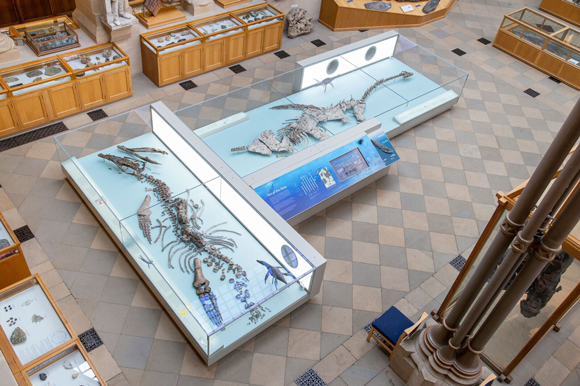
Two marine reptile fossils on display.

Plesiosauria fossils on display at a museum. Museums often display marine reptiles alongside dinosaur exhibits. Picture credit: Everything Dinosaur.

Picture credit: Everything Dinosaur

Discovery Channel

The previous visit by the Discovery Channel was coordinated by its Daily Planet news show.  The film crew was present in the early summer of 2010 to film the preliminary excavation of what soon became a major Xiphactinus fish fossil discovery.  This segment involving the CFDC is set to air during the spring offering of the Daily Planet programme.

“The great thing about this scenario is that we’re able to offer a Discovery Channel type of experience to our average visitor.  Our Fossil Dig Adventure Tour programs have a 100% success rate in finding fossils since 2008.  The fossil resource in the Morden area is vast and exciting.  Our website contains great information on this unique adventure program.  We invite you to find out for yourself why we have the Discovery Channel returning year after year!” states general manager Tyler Schroeder.

Almost every CFDC story has a strong local connection and that remains true with this story.  World famous dinosaur animator, David Krentz has connections with the Phil Enns family from Winkler.  Mr. Krentz was a key component in having the CFDC included in this Hollywood production and is a huge fan of Canada’s largest marine reptile fossil collection in Morden, Manitoba (Canada).

To view models and replicas of prehistoric animals, fossils of which have been found in Canada: Dinosaur and Prehistoric Animal Models.
15 04, 2011

Ranavirus – Office Pond Looking OK (Great News)

By |2024-04-21T10:13:56+01:00April 15th, 2011|Categories: Animal News Stories, Everything Dinosaur News and Updates, Main Page|0 Comments

No Signs of Ranavirus

Last week staff at Everything Dinosaur became concerned over the behaviour of some of the frogs that had spawned in the office pond.  At least three seemed lethargic and almost in a stupor.  Their movements were slow and we were concerned that the concentration of amphibians in the pond as they started their breeding season had led to an outbreak of the deadly virus Ranavirus.

Office Pond

This virus had first entered the UK sometime in the early 1980s and has spread up from the south.  Something like 80% of the frog population of the UK has been affected and the Common Frog population (Rana temporaria) has plummeted as a result.  Small ponds, even garden ponds are now extremely important to amphibians, we were concerned that the odd behaviour of the frogs after spawning may have been as a result of a virus outbreak.

No dead frogs have been found in and around the pond area and the tadpoles seem to be thriving.  We suspect that we had observed females who were exhausted after the stressful spawning time.  However, we will continue to maintain a “watching brief” on the pond and if we do find positive signs of a Ranavirus outbreak, we will report it to Froglife – the organisation formed to protect UK amphibian populations – straight away.

Fingers crossed.

Visit Everything Dinosaur’s award-winning website: Visit Everything Dinosaur.

14 04, 2011

The Origin of Birds not something to Sniff At

By |2023-03-06T16:02:22+00:00April 14th, 2011|Categories: Dinosaur and Prehistoric Animal News Stories, Dinosaur Fans, Main Page|0 Comments

Sniffing out the Origin of Birds

A new study published in the scientific journal, the Proceedings of the Royal Society B (Biology) shows that the sense of smell of small theropod dinosaurs may have improved over time and this would have had important implications for their evolutionary descendants – the birds.

Although having a good sense of smell is only part of the story, some scientists have speculated that the ancestors of modern birds might have survived the end Cretaceous extinction event that wiped out the theropods and all other Dinosauria for that matter, by having a better sense of smell.

The Origin of Birds

Prior to this new study, a view held by a number of scientists was that as birds evolved from small, cursorial theropods, their olfactory sense (smell) became less prominent at the expense of the need to evolve better vision, better balance and improved co-ordination for active flight.

Commenting on the study, researcher, Darla Zelenitsky, a palaeontologist with the University of Calgary (Alberta, Canada) stated:

“Scientists thought that parts of the brain were being dedicated to these latter senses, while the region of the brain associated with olfaction deteriorated through evolution.”

However, by examining the braincases and skull proportions of species, an estimate of the brain size can be deduced and from this information, with a little further work, the size of the region of the brain dedicated to smell can be calculated.  In humans, the olfactory bulb, that portion of our brains dedicated to analysing smells, is very small, making up a tiny proportion of our overall brain mass.  In dogs, an animal known for its keen sense of smell, the olfactory bulb is many times larger than our own and it makes up a much larger proportion of the dogs overall brain mass.

In the famous theropod Tyrannosaurus rex, nearly 50% of its brain mass is dedicated to the sense of smell, this proportion of brain mass/smelling sense is only exceeded by the extant Turkey Vulture, (Cathartes aura) which relies on its remarkable sense of smell to detect rotting meat hidden under the canopy of jungle trees.

The research team examined the skulls of a number of extinct and extant creatures including the skull material associated with the first bird known to science (Archaeopteryx lithographica).  The team discovered that this Jurassic bird/reptile probably had as good a sense of smell as its dinosaur relatives.

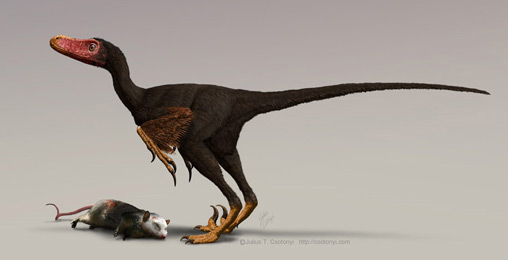
Small Theropods such as Bambiraptor Had a Good Sense of Smell

Picture credit: Julius Csotonyi

The illustration shows a typical dromaeosaur (Bambiraptor), a fast running, cursorial predator.  Skull analysis suggests these little dinosaurs had an acute sense of smell.

A lot of work has been done on Archaeopteryx by scientists at the Natural History Museum, working closely on the “London specimen”.  The aim of this research led by the distinguished Dr Angela Milner was to determine this ancient creature’s flight capabilities and in particular examine evidence for its sense of balance and hearing.

To read more about this research: Lets Hear It for Archaeopteryx.

To see how the sense of smell might have changed as birds evolved, researchers studied 130 species of living birds, seven species of fossil birds and 20 species of nonavian Theropod dinosaurs, which include carnivores such as Velociraptors and the mighty Tyrannosaurus rex.  The team concentrated on the dimensions of the animals’ olfactory bulbs, measuring them and working on the assumption that “larger bulbs meant a better developed sense of smell”.

The researchers found the sense of smell improved overall during the evolution of small theropods to modern birds, apparently only decreasing much later on in some lineages of birds less dependent on scent.  The earliest bird-like creatures such as Archaeopteryx, had a sense of smell comparable to pigeons, while some dromaeosaurs had a sense of smell perhaps as acute of that of the Turkey Vulture.

A Sense of Smell as Good as a Turkey Vultures?

Picture credit: Everything Dinosaur

This improved sense of smell, as well as larger brains overall, might have provided an edge that could explain why modern birds are still around and their dinosaur and archaic bird relatives are not.

For replicas and models of dromaeosaurid dinosaurs: Beasts of the Mesozoic Dinosaur Models.

Darla Zelenitsky added:

“Since some modern-day birds are known to use their sense of smell for foraging and for navigation, perhaps the combination of flight and larger brains — including larger olfactory bulbs — gave modern birds a competitive edge over archaic birds and other dinosaurs to survive this mass extinction.”

13 04, 2011

Little “Demon” from Dawn of the Dinosaurs

By |2023-01-17T14:57:55+00:00April 13th, 2011|Categories: Dinosaur and Prehistoric Animal News Stories, Dinosaur Fans, Main Page|0 Comments

New Dinosaur Discovery Helps Explain Diversity of Theropods

The Ghost Ranch location in New Mexico (United States) is famous for its amazing vertebrate fossils that date from the Late Triassic.  Perhaps most famously of all, this fossil rich location has provided palaeontologists with many specimens of the small, agile theropod Coelophysis.  Now a new type of meat-eating dinosaur has been discovered, one which might provide evidence as to how the theropods diversified during the remainder of the Mesozoic.

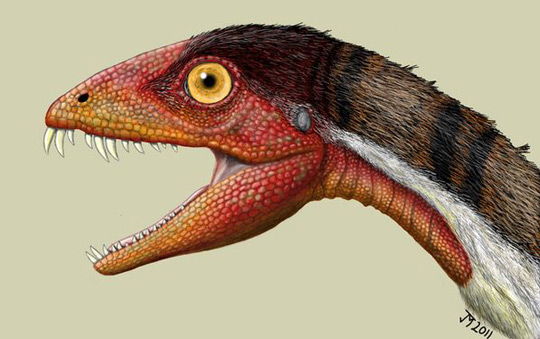
In a paper published in the scientific journal “The Proceedings of the Royal Society B (Biology)”, researchers describe a small, predatory dinosaur, whose fossil remains may indicate how larger, later theropods evolved.  The dinosaur has been formally named as Daemonosaurus chauliodus, the name means “buck-toothed evil spirit”.

Daemonosaurus chauliodus

Co-author of the scientific paper, palaeontologist at the National Museum of Natural History in Washington, D.C. (United States), Hans-Dieter Sues, explained why this dinosaur fossil was so significant.

He stated:

“It has a deep, short snout and these monstrous front teeth.  That’s a kind of skull structure for a predatory dinosaur that’s really unexpected for this early point in time.”

An Illustration of the New Dinosaur Species – D. chauliodus

Picture credit: Jeffrey Martz

Scientists believe that the first dinosaurs evolved approximately 230 million years ago in what was to become South America.  This group included early versions of two-legged, meat-eating dinosaurs known as theropods.  One of the largest of these carnivores was Herrerasaurus (H. ischigualastensis), a fearsome four to five metre long dinosaur whose fossil remains have been found in north-western Argentina.

An Illustration of Herrerasaurus

An early theropod illustrated.

Picture credit: Everything Dinosaur

To view a range of models which includes a replica of Herrerasaurus, simply click on the link below this paragraph.

CollectA prehistoric animal models: CollectA Age of Dinosaurs Prehistoric Life Models.

A substantial gap in the known fossil record in the Middle Triassic had led many palaeontologists to suggest that these early meat-eaters had become extinct.

As Hans-Dieter Sues explained:

“The idea was that there was this early diversification of dinosaurs… but then they went extinct, and more advanced predators took over during the Late Triassic and diversified later at the Triassic/Jurassic boundary, when we know that dinosaur predators greatly diversified and increased in size.”

This new dinosaur, Daemonosaurus chauliodus, known only from skull material and cervical material, helps to bridge the gap in the fossil record and link the two predatory dinosaur groups.

Dr Sues, stated:

“Our new dinosaur, along with another one that was found a few years ago … at the same site,[Coelophysis] indicates that those basal dinosaurs already included a number of early theropods, and that they survived all the way through the Triassic to nearly the beginning of the Jurassic Period.”

Although, only partial remains have been found, the neck vertebrae and the all important skull material show that this dinosaur had several advanced features.  For instance, the vertebrae show cavities linked to the respiratory system – bridging the evolutionary gap between the first dinosaurs and the Neotheropoda, the next group of predatory dinosaurs to evolve.  This type of respiratory system can be found in creatures alive today – the birds, the very last type of theropod left on planet Earth.

Finding the dinosaur in New Mexico adds another interesting aspect to the discovery.

Dr Sues said.

“We had some inkling that the earliest dinosaurs had made it into the Northern Hemisphere when the super-continent Pangaea was still in existence and animals could walk around on dry land.  But the fossil record was limited to South America.  The new find gives further evidence that the earliest radiation of dinosaurs did have a wider distribution, and it is due to the incompleteness of the fossil record that we’d found them only in Argentina and Brazil.”

12 04, 2011

Dinosaurs and Spaceflight Rare Dinosaur Fossils Sent into Outer Space

By |2024-04-21T09:59:59+01:00April 12th, 2011|Categories: Everything Dinosaur News and Updates, Main Page|0 Comments

The First Dinosaurs in Space

As today, April 12th is the 50th anniversary of the first human space flight, we at Everything Dinosaur thought it best to catch the mood by discussing briefly dinosaurs in space.  Yes, dinosaurs have been into space, at least the fossils of two dinosaurs that is.

Dinosaurs and Spaceflight

On this day in 1961 Yuri Gagarin, a Russian cosmonaut, became the first human in space and the first to orbit the Earth.  His space craft, called Vostok 1 made the historic 108 minute venture into space on this day fifty years ago.  The flight took place in the morning with a launch around 9am local time. This would have meant that this epic journey, the start of the space race between the USA and the Soviet Union, began in the early hours of the morning in the United Kingdom around 6am.  We suspect that this event was not widely known until the evening.  After all, there was not the blanket news media that we have today around half a century ago.

However, dinosaurs have made it into space, but not until the mid 1980s, where as part of the United States space programme a fossil of an ornithopod called Maiasaura (Maiasaura peeblesorum) went up into space.  Maiasaura was a large hadrosaur (member of the hadrosaurine group of duck-billed dinosaurs – distinguished by their lack of adornments and head crests).  It was discovered by the American palaeontologist John Horner in 1978 and officially named a year later.

The remains of this dinosaur have been found in western Montana, in the Late Cretaceous rocks of the Two Medicine Formation.  Few dinosaurs left traces behind providing clues as to how these animals lived and behaved, however, Maiasaura is a definite exception to this.  Over 200 individual skeletons have been unearthed to date, from hatch-lings right up to mature adults.  Jack Horner and his team discovered a Maiasaura nesting site that has yielded a great deal of information about how this type of dinosaur raised its young.

“Good Mother Lizard”

It seems that Maiasaura looked after its babies (the name means “Good Mother Lizard”), very apt in this dinosaur’s case.  Fossils recovered from the nesting site, show that these animals made nest mounds out of mud, and may have covered any eggs laid with vegetation to keep them warm.  Hatch-lings that have been fossilised show teeth wear but their legs are not fully formed (undeveloped legs is  feature seen in the chicks of many birds).  This indicates that the babies were fed at the nest, as they were unable to forage for themselves.   It can be surmised from this data that the parents looked after the youngsters to a degree.  The nesting site seems to have been vast, with many thousands of animals at the site, this indicates that Maiasaura lived in large herds, or at least congregated at communal nesting sites.

An Illustration of Maiasaura

Dinosaurs and spaceflight. Maiasaura fossils have been into space.

“Good Mother Lizard”.  Maisaura fossils have been sent into space.  Picture credit: Everything Dinosaur

Picture credit: Everything Dinosaur

Maiasaura’s other claim to fame is that this dinosaur was the first to be taken up into space.  A piece of fossilised bone from a baby Maiasaura along with a piece of Maiasaura eggshell was taken into space by astronaut Loren Acton on a NASA mission in 1985.  Not a bad record for Maiasaura, being totally unknown just 7 years earlier, and then the first dinosaur in space.  The second dinosaur to travel in space was the skull of a Coelophysis, (Triassic theropod).  The skull was sent into space on the US space shuttle Endeavour on 22nd January 1998.  It travelled to the Mir space station, one of a number of trips made by space shuttles to the orbiting station in the Shuttle-Mir programme.

For models of ornithopods including many members of the hadrosaur lineage: PNSO Age of Dinosaurs Figures.

The Reptilia Class in Space

Dinosaurs were not the first representatives of the Class Reptilia to travel in space.  Tortoises were used in some of the research programmes as manned space flight was being developed.  The first tortoise in space was launched by the Soviet Union in September 1968, as part of the research programme monitoring the potential effect of long space flight on humans.

Tortoises were ideal “guinea pigs” for such experiments, due to their ability to survive hostile conditions and to live on little food and water, characteristics recognised by early explorers on Earth, who often sailed with tortoises and turtles on board ship to provide a source of fresh meat into the journey.  We have no record of what happened to this particular tortoise after the capsule in which it had travelled returned to Earth.

As far as we can tell no adult birds have been sent up into space.  Chicken embryos were sent up into space as part of an experiment kit to test the development of chicks in zero gravity by the Americans in 1989.  This particular experiment had been scheduled to take place three years earlier but it was lost when the space shuttle Challenger exploded shortly after launch on January 28th 1986.  Other fertilised bird’s eggs have been sent into space on subsequent occasions, no birds as far as our research shows.  It would be fascinating to find out how birds cope with zero gravity.  Effectively, once in motion they would not need to flap their wings, perhaps they could use their wings to stabilise themselves as they were subjected to zero G.

11 04, 2011

Remarkable Dinosaur Balloon Art

By |2024-04-21T10:00:27+01:00April 11th, 2011|Categories: Educational Activities, Everything Dinosaur News and Updates, Main Page|3 Comments

Dinosaur Balloon Art – Not as Easy as it Looks

Weekend took us to my niece’s birthday party (she is four today).  During the fun, festivities and games, the entertainer did some balloon art.  He made swords, teddy bears, giraffes and all sorts of animals for the children.  Not wishing to be left out, one of the Everything Dinosaur team members who attended requested a dinosaur.  Mr Dazzle (the name of the entertainer), explained that he could do dinosaur balloon art, but his repertoire would be slightly limited as he had thirty enthusiastic and very excited four-year olds to manage.

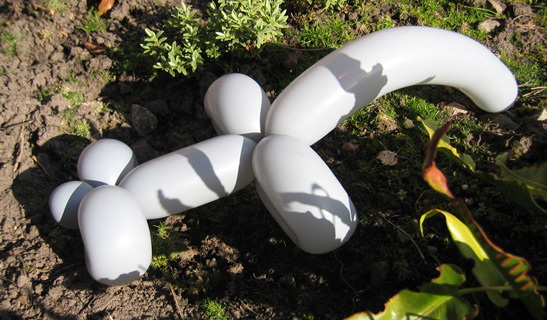
Dinosaur Balloon Art

True to his word, he produced a grey, long-necked dinosaur a few minutes later (see pic).  It certainly had a long neck and legs and it was a very credible effort, not withstanding the fact that it had no tail.

Our Balloon Dinosaur

Picture credit: Everything Dinosaur

Interesting that he choose to depict a sauropod as a grey animal.  As the largest land living animal today (African elephant) is regarded as being grey by many observers, this may have “coloured” our perception as to the colour of the largest type of extinct terrestrial animal – Sauropoda.  The colour of these herbivorous dinosaurs is very much open to speculation, but most illustrators do depict these large animals as coloured grey.  Hatchlings, may have been very differently coloured from adults, perhaps camouflaged to enable them to hide in the undergrowth to avoid predation.  Nice balloon dinosaur though, although a colleague said it reminded them of some of the bizarre Cambrian life forms preserved in the Burgess Shale deposits of British Columbia.

Visit Everything Dinosaur’s award-winning website: Everything Dinosaur.

10 04, 2011

Warm Weather Brings out the Alligators and Crocodiles

By |2023-01-17T14:27:34+00:00April 10th, 2011|Categories: Animal News Stories, Main Page|0 Comments

Floridians Warned about Increased Alligator and Crocodile Activity

The warm weather over the last few days in Florida has led to state authorities issuing a number of warnings to Florida residents about the perils of getting up too close to those alligators and American crocodiles that have started to become more active.  The authorities have warned of increasing alligator and crocodile activity.

Florida as two species of crocodilian, the American alligator (Alligator mississippiensis ) and the much rarer American crocodile (Crocodylus acutus).  These two protected species are regarded as dangerous to humans, although the American crocodile (found in the southern parts of Florida), has not been recorded as attacking humans and is generally regarded as a very shy animal.  However, attacks on people have been logged elsewhere in this reptile’s geographical range, so authorities in the State urge residents to take extreme care when in these creature’s habitats.

Alligator and Crocodile Activity

As cold-blooded animals, American alligators and crocodiles have been largely inactive in the cold weather that has occurred over the last few months.  However, with the onset of spring these reptiles will start to move more and there is the risk that they will run into contact with humans.

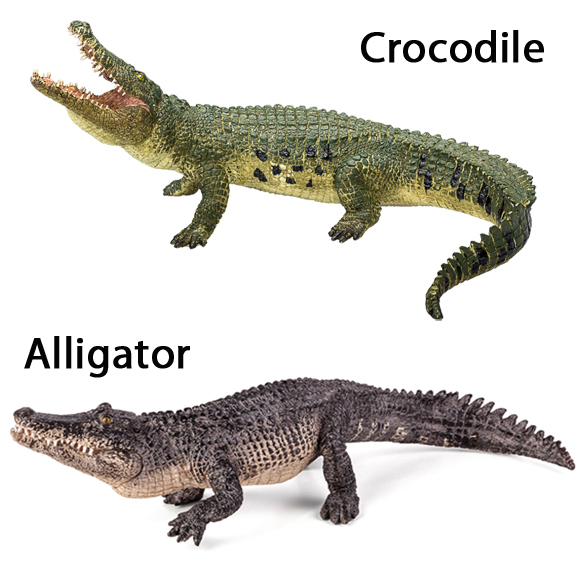
The Differences Between an Alligator and a Crocodile

Crocodile and Alligator comparison.

Crocodile (top) and Alligator (bottom).

The onset of warm weather in the spring is when Florida’s alligators and crocodiles begin getting active, and the Florida Fish and Wildlife Conservation Commission (FWC) reminds Floridians and visitors to be cautious when having fun in and around water.

The FWC has published a set of handy guidelines to ensure that humans and crocodilians can get along, the guidelines include:

1). Leave alligators and crocodiles alone.  The danger of being injured by a provoked alligator is much higher than by an unprovoked one.  Often if one of these reptiles is spotted on the waters edge basking in the sun, it will most probably move off on its own without being molested.

2). Never feed these animals, dispose of fish scraps from a fishing trip in the designated areas.  It is illegal to feed these creatures.  Alligators lose their natural fear of humans when fed, and become accustomed or attracted to people. Alligators that have been fed may be more likely to attack, and are more likely to become nuisance animals that must be destroyed.

3).  Don’t swim at night.  Alligators are more active at night or at dawn or dusk.  At these times they are more likely to be feeding than during the heat of midday.

4).  Do not swim in water that is known to contain large alligators, also do not swim outside of designated swimming areas.  Alligators are most active during the summer months.  Since this is the time of year when people are also likely to be in the water, areas known to contain alligators should be avoided.

5).  Never let children play alone near water.  Make sure children are supervised and in view.

6).  Do not allow pets to go near water that is known to contain these reptiles.  Dogs and other small pets are more likely to be attacked than humans because they resemble a natural prey item for the alligator.  Therefore, pets can attract alligators to swim areas and create a danger for humans also.

7).  Never capture or accept a baby alligator or crocodile as a pet.  Capturing alligators is illegal and can be dangerous.  Alligators do not become tame in captivity, and handling even small ones could result in a bite.

8).  Seek medical advice immediately if you are bitten or scratched by an alligator or crocodile.  Because of the environment in which they live, alligators’ mouths can harbour very dangerous bacteria (particularly Aeromonus hydrophila).  Any bite or scratch, even a small one, should be examined by a doctor or trained medical staff.

More information on how to avoid alligator or crocodile encounters visit the FWC’s website.

In the meantime, for models of crocodilians visit this part of the Everything Dinosaur website: Mojo Fun Prehistoric Life Models.

9 04, 2011

Expanding Birthdays – New Additions to the Everything Dinosaur Product Range

By |2024-04-21T10:01:07+01:00April 9th, 2011|Categories: Everything Dinosaur News and Updates, Main Page|0 Comments

New Addition to the Everything Dinosaur Birthday Cards and Gift Wrap Range

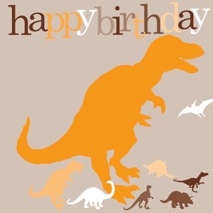
At Everything Dinosaur, hardly a day goes by without some new product or other having been approved by our testers and getting added to our range.  Today, the new Tyrannosaurus rex birthday card and matching wrapping paper have gone into our retail product lines.

To view the extensive selection of dinosaur and prehistoric animal themed toys and gifts in stock, visit Everything Dinosaur’s award-winning website: Visit Everything Dinosaur.

We already stock a variety of dinosaur themed cards but this new one, and the matching dinosaur gift wrap, appealed as they are so bright and colourful, after all, not many birthday cards depict an orange coloured T. rex.

The New Everything Dinosaur Birthday Card

A “Snappy” Birthday Card.

Picture credit: Everything Dinosaur

Everything Dinosaur

As one of our testers commented, the card and the brightly coloured wrapping paper made them “smile a lot”, so I guess we just had to include them.  Another tester stated that the wrapping paper was particularly good quality and they liked being able to cut out the dinosaur shapes once the gift wrap had been opened.

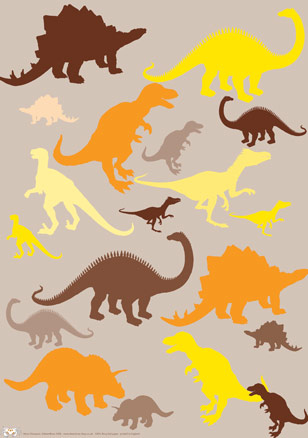
Colourful Dinosaur Gift Wrap

Dinosaur gifts all wrapped up.

Picture credit: Everything Dinosaur

The wrapping paper measures a generous 50 cm by 70 cm and features brightly coloured dinosaurs such as Triceratops, Apatosaurus, Stegosaurus and of course T. rex.  Both these new items fit in well with our existing gift wrap and dinosaur themed birthday card ranges.

We are confident these two new products will help add that special finishing touch to any young dinosaur fan’s birthday.

8 04, 2011

Suspected Ranavirus in the Office Pond Frog Population

By |2023-03-06T16:03:38+00:00April 8th, 2011|Categories: Animal News Stories, Everything Dinosaur News and Updates, Main Page|0 Comments

Lethargic Frogs – We suspect Ranavirus Outbreak

Over the last couple of weeks, team members at Everything Dinosaur have observed some strange behaviour in the frog population around our offices.  As many as seven individuals were counted at any one time in the office pond at the height of the spawning season and we logged a record amount of frogspawn laid this year.  However, we have noticed some strange behaviour from the adult frogs.  Three frogs (Common Frog – Rana temporaria) were extremely lethargic, almost in a stupor.  The frogs seemed perfectly healthy but the were very slow to react to any disturbance and almost seemed to be in a trance. 

The first frog, a little thin was moved away from the pond by a team member of Everything Dinosaur and placed in a safe and secure part of the yard, out of harm’s way in case one of the neighbourhood cats discovered it.  The second frog, left the pond but took almost six hours to cross the small courtyard and seek shelter behind some fence panels.  It was raining for much of this time, so the frog remained moist but we were all surprised to see the animal move so slowly and to expose itself to any predation in such a reckless manner.  Some team members commented that this particular frog had a “deathwish”.

At first we put the strange behaviour we had observed down to the fact that the frogs were in poor condition after mating, but the third frog we have been observing is making us question whether or not there is something more serious going on.

This frog, has been observed for the best part of a week now, it barely moves from a small rocky area by the office pond, it is thin and lethargic, not frightened by our approach at all.  It simply does not react.  We think that this lethargy may be the result of viral infection.  We are trying to observe this frog to see if we can spot any red blotches on the skin (erythema) or any bleeding (haemorrhaging), this and the drowsiness and lack of condition could indicate an outbreak of the dreaded Ranavirus.

If this is the case we will report our findings to froglife, the organisation that monitors the UK wild frog population.

Ranavirus was first found in the UK in the early 1980s.  It is most common in south-east England but known from elsewhere in the UK.  This virus could decimate the local population, there is no cure and for all we know if the adult frogs have caught the disease then this may have dangerous implications for the tadpoles in the pond.

We will keep monitoring the situation and if required, we will report this disease outbreak.

Fingers crossed that we have got this wrong.

Visit Everything Dinosaur’s award-winning website: Everything Dinosaur.

7 04, 2011

Dinosaur Teaching Topics – How to Name a Dinosaur

By |2023-03-06T16:04:51+00:00April 7th, 2011|Categories: Educational Activities, Everything Dinosaur News and Updates, Main Page|1 Comment

Brontomerus mcintoshi Research Helps School Pupils Get to Grips with Palaeontology

Pupils at Sacred Heart Primary school, Blackburn, have been travelling back in time to visit the age of Dinosaurs in a range of teaching activities. The budding young palaeontologists in Miss De Piano’s Year Three class, were given the chance to name their very own prehistoric animal.

Students had been getting to grips with fearsome creatures such as Tyrannosaurus rex and Velociraptors as well as marvelling at peaceful plant eating giants such as the armoured Stegosaurus and the huge Diplodocus. This was part of the school’s science week events organised, to coincide with National Science and Engineering Week, by one of the school’s teachers – Mrs Smith. They were given the chance to look at some of the research carried out on a new species of long-necked dinosaur – Brontomerus mcintoshi.  This dinosaur, fossils of which have been found in Utah, (United States), has only just been formally named and scientifically described.

In total, fragmentary remains of two dinosaurs were discovered in the same quarry, one adult and a much smaller juvenile.  The name Brontomerus means “thunder thighs”, in recognition of an enlarged anterior portion of hip-bone associated with the remains of the smaller specimen.  Scientists have suggested that the expanded hip bone served as an anchor for large leg muscles, giving this particular dinosaur very strong legs.

The Age of Dinosaurs

For the young scientists in Miss De Piano’s class the challenge set by Everything Dinosaur was to consider how animals change as they get older.  If animals change as they grow, could they come up with an alternative name for Brontomerus once they had reviewed the fossil evidence?

The class was split into two groups for this part of the dinosaur teaching session, each group was given the task of answering questions on chickens, however, one group was asked to describe a chick, whilst the other portion of the class described an adult bird.  Although each group was asked the same questions, it soon became clear to the pupils that a chick looks very different when compared to an older bird.

Based on this, and with an overview of the fossil evidence of Brontomerus provided by Everything Dinosaur, the class set about creating their own names for this type of dinosaur.  All part of the fun when it comes to teaching about dinosaurs in school.

Organisms Change as they Grow

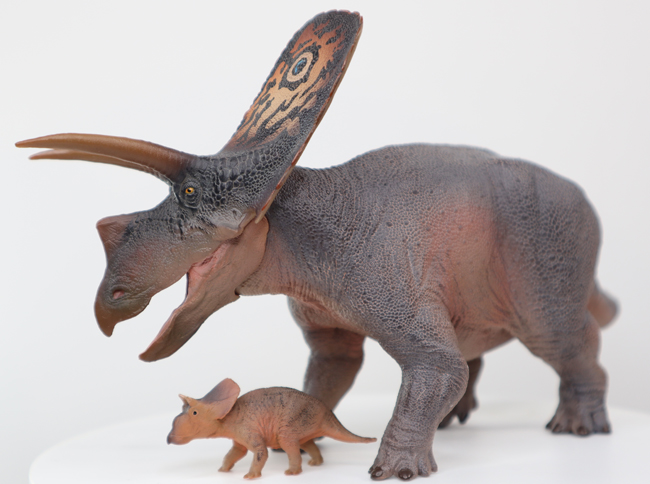
PNSO Aubrey and Dabei (Torosaurus dinosaur models)

The 1:35 scale PNSO Torosaurus models (Aubrey and Dabei). The adult Torosaurus figure has an articulated lower jaw. the adult Torosaurus is very different in appearance than the juvenile. Picture credit: Everything Dinosaur.

Picture Credit: Everything Dinosaur

The Torosaurus in the picture (above) is from the PNSO range of prehistoric animal figures.

To view this range: PNSO Age of Dinosaurs Figures.

The chicken was used in this dinosaur workshop to illustrate issues related to ontogeny (how organisms grow), helpful in explaining to the students differences in the fossil skeleton of the adult compared to the juvenile dinosaur.

The pupils worked on the theory that, if this plant-eating dinosaur really had very strong limbs, perhaps it could rear up onto its hind legs to help it to graze on parts of trees that other dinosaurs could not reach, just like a Gerenuk antelope in Africa does today.

A wide variety of alternative names were thought up, a few examples from the clever pupils were Two-legosaurus, Standuposaurus, Treeasaurus, Anteloposaurus and our personal favourite Vegesaurus.
It was a real pleasure visiting Sacred Heart Primary and helping the children with their dinosaur experiments and showing some of our fossils.  Our thanks to all the students, teaching assistants and teachers who helped make the day so special.

Go to Top