All about dinosaurs, fossils and prehistoric animals by Everything Dinosaur team members.
9 03, 2011

Taking Issue with Sir David Attenborough (Helpful Information)

By |2024-04-21T10:08:17+01:00March 9th, 2011|Categories: Book Reviews, Everything Dinosaur News and Updates, Main Page|0 Comments

First Life – Some Factual Errors

Just finished reading the book that accompanies the BBC television series “First Life” narrated by Sir David Attenborough.  First Life updates readers on the remarkable advances in our knowledge of how life first began on planet Earth.  Over the last fifty years or so, new research techniques and fossil discoveries have enabled scientists to gain a better understanding of how first evolved.  The book takes readers on a journey back in time to the key moments in the development of life on Earth, from the first single celled organisms through to the conquest of the land and the dominance of the arthropods in early terrestrial habitats.

The book is generally well written and provides an entertaining and informative read.

To see Everything Dinosaur’s review of this book: Book Review – “First Life”.

However, there are one or two interesting inaccuracies and anomalies that we have found in the text.  These sections of the book have led to more debate amongst our team members than any other part of what is, in general an excellent publication.

Sir David Attenborough

Firstly, in chapter 10, entitled “Landfall: The Worm that Walks”, part of the book dedicated to the conquest of the land by the first land living invertebrates, on pages 252-253 there is a computer generated image of an ancient marine ecosystem.  This seems somewhat out of place when considering the context of the chapter.  The scene shows a number of primitive marine organisms including Opabinia and Wiwaxia, creatures associated more with the Cambrian than with the geological time period when arthropods were first venturing out onto dry land.  At least the fossil evidence does not suggest land fall as early as the Cambrian Period.

Secondly, when discussing the success of the Insecta, the book states that insects have adapted to a whole range of different habitats. We don’t doubt the validity of this particular statement, but the narrative specifically refers to insects in marine environments.  In essence, despite their tremendous diversity very few insect genera have been able to adapt themselves to a truly marine, pelagic way of life (pelagic – living above the sea floor).  This lack of insects in truly, entirely marine environments is a puzzle for scientists.

In addition, in the final chapter – “Taking Wing: End to an Era”, there is a section that contrasts the internal skeleton of vertebrates with the exoskeletons of invertebrates. A rhinoceros is compared to a rhinoceros beetle.  We admit, some important points are made over the advantages and disadvantages of each type of support structure for an animal. However, when concluding this segment the writer states:

“The rhino, however, has an internal skeleton to give it strength and structure.  This skeleton grows with the rhino and is constantly replenished and strengthened throughout the rhino’s lifetime.  The rhino will never need to shed its skin, and so it is able to grow to an enormous size.  At full size, it grows to become the largest terrestrial creature on Earth, a feat that the beetles could never achieve.”

This is a surprising statement, although the several species of rhinoceros alive today are very large, the biggest, heaviest terrestrial vertebrate in our opinion would be the African elephant.  It seems strange that such a well researched and carefully compiled publication would include a number of mistakes.    Although we noted these occurrences it did not stop us enjoying what is an excellent book to accompany the BBC television series.

For models of even larger animals from the fossil record including dinosaurs and giant relatives of modern rhinos like Paraceratherium: Dinosaur and Prehistoric Animal Models.
8 03, 2011

Celebrating International Women’s Day Around the World

By |2024-04-21T10:07:31+01:00March 8th, 2011|Categories: Educational Activities, Everything Dinosaur News and Updates, Main Page|0 Comments

March 8th – International Women’s Day

International Women’s Day is a global celebration of the economic, political and social achievements of women past and present.  In some countries this day is marked by a national holiday.

International Women’s Day

This is the one-hundredth anniversary of International Women’s Day, the first official commemorations took place in some European countries (Denmark, Austria, Germany and Switzerland) in 1911, a time of great social change when the rights and roles of women in Europe and the United States were becoming more prominent in the political debates of the age.

There have been many great female scientists, within the field palaeontology the role of the likes of Mary Anning is now widely recognised, however when Mary was alive her contribution to the nascent science of palaeontology was played down by her male peers.  Indeed, many of the thoughts, descriptions and explanations that Mary proposed relating to the fossil discoveries on the Dorset coast (southern England) were accredited to other (male) scientists rather than to Mary herself.

As a working class woman, she was shunned by the academics and scientists of her day.  For example, she was not permitted to join the Geological Society of London.  She spent most of her life in financial difficulties and it was only in her final years that she was awarded a pension by the British Association for the Advancement of Science, in recognition of her pioneering work.

In 2010, the Royal Society published a list of the ten women who had most influenced science in the United Kingdom – Mary Anning was one of them.

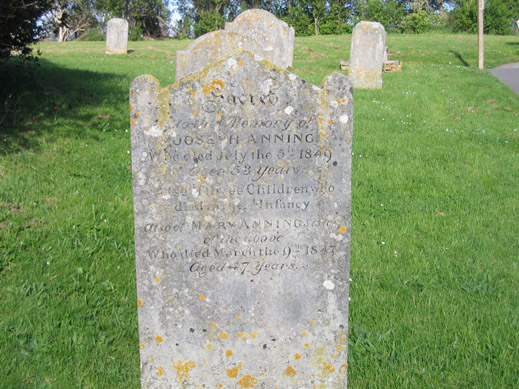
We have visited Lyme Regis on numerous occasions and when there we often take time out to visit St. Michael’s church and to spend a few moments of reflection besides Mary and her brother Joseph’s grave.  Her contribution may have been overlooked during her lifetime, but we at Everything Dinosaur, continue to use the inspirational story of Mary and other female scientists working in the Earth sciences to help motivate and encourage girls to take more of an interest in these sciences.

The Grave of Mary Anning at Lyme Regis

Picture credit: Everything Dinosaur

Visit Everything Dinosaur’s website: Everything Dinosaur.

7 03, 2011

A Video Review of the new Papo Smilodon Prehistoric Animal Model

By |2023-03-07T09:33:15+00:00March 7th, 2011|Categories: Everything Dinosaur News and Updates, Everything Dinosaur videos, Main Page, Product Reviews|3 Comments

A Video Review of the New Papo Sabre-Tooth Cat Model

Papo introduced a hand-painted Smilodon model into their “Les Dinosaures” range a few weeks ago.  Our team members at Everything Dinosaur, have already written a number of reviews and articles concerning this new replica from the French figure manufacturer.  As part of our product review, we have produced this short video that shows this new model and comments on the use of Smilodon fossil material to help re-create this predator from the Pleistocene.

A Video Review of the Papo Smilodon Prehistoric Animal Model

Everything Dinosaur views the Papo Smilodon model.


Video credit: Everything Dinosaur

These extinct predators seem to hold a fascination for many people, and no Ice Age tale such as 10,000 BC or indeed the trilogy Ice Age animated films can do without its resident Smilodons or Sabre-toothed cats amongst the cast of characters.

Smilodon Model

There are a number of Smilodon models available, the fine detail on the coat and the attention to anatomical accuracy puts this new Papo Smilodon up there with the best replicas.

To view the range of Papo prehistoric animal figures in stock at Everything Dinosaur, visit the company’s award-winning website: Papo Prehistoric Animal Models and Figures.

6 03, 2011

Everything Dinosaur Authors Earn “Expert” Status

By |2023-01-16T07:11:12+00:00March 6th, 2011|Categories: Everything Dinosaur News and Updates, Main Page, Press Releases|0 Comments

Everything Dinosaur’s Articles are Recognised for their Excellence

A major e-zine publisher, an online resource for articles and information has recognised the efforts of our Everything Dinosaur team members by granting them “expert” status on the strength of their article submissions to the e-zine website.

Everything Dinosaur

Everything Dinosaur’s staff include qualified teachers and dinosaur experts and between them they have produced a wide variety of articles ranging from information on the latest interpretation of fossil finds to model reviews and commentary related to dinosaur teaching resources in schools.

These articles (and this web log) have also been used by teachers in international language schools to help students who do not have English as a first language with their studies.

Everything Dinosaur’s E-zine Articles Awarded Expert Status

As Featured On EzineArticles

We are very honoured to receive accolade and we would like to pass on our thanks to all the people who helped with our various writing projects.

Visit Everything Dinosaur’s award-winning website: Everything Dinosaur.

5 03, 2011

Rare, Giant Crocodile Skull to Visit Schools to Help Students

By |2024-04-21T12:22:26+01:00March 5th, 2011|Categories: Dinosaur and Prehistoric Animal News Stories, Main Page|0 Comments

Deinosuchus Skull to Tour Utah Schools

Students at a number of schools in the U.S. state of Utah are being given the opportunity to get up close to one of the state’s ancient predators as the Bureau of Land Management has arranged for the skull of a giant, extinct crocodile to visit schools as part of a touring science outreach programme.

Giant Fossil Crocodile Skull

The cast of the giant, Late Cretaceous crocodilian Deinosuchus is due to visit a number of schools in Utah, as the fossil from which this replica was cast was found at the nearby Grand Staircase-Escalante National Monument.  This site is world famous for its excellent dinosaur body and trace fossils.  The skull, representing a 12-metre plus crocodile that lived alongside duck-billed dinosaurs and the tyrannosaurs, indicates that Deinosuchus lurked in the swamps, rivers and lakes that once covered this part of the western United States.

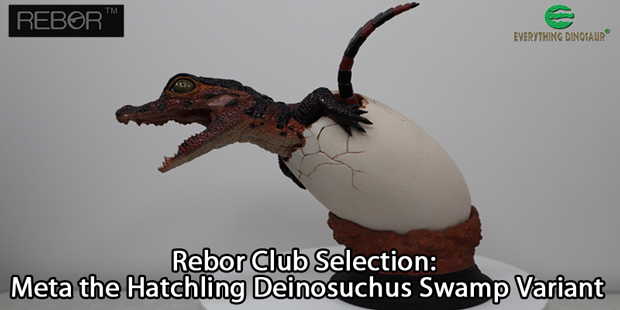
A Model of a Hatchling Deinosuchus

Rebor Club Selection: Meta the Hatchling Deinosuchus Swamp Variant

The Rebor Club Selection: Meta the Hatchling Deinosuchus Swamp Variant is featured in an Everything Dinosaur video showcase.  A model of a hatching Deinosuchus.  Picture credit: Everything Dinosaur.

Picture credit: Everything Dinosaur

The photograph (above) shows a Rebor Club Selection limited-edition hatchling Deinosuchus. To view the Rebor range: Rebor Prehistoric Animal Models and Figures.

The skull is part of a travelling exhibit assembled by the U.S. Bureau of Land Management, showcasing some of the amazing fossil discoveries found around the Grand Staircase-Escalante National Monument.  The skull of this “predator of predators” will tour a number of schools before taking up permanent residency at the new Utah Museum of Natural History (Salt Lake City).

Commenting on the skull, Bureau of Land Management palaeontologist Alan Titus, stated:

“It [Deinosuchus] was the biggest and baddest predator of its day.”

He went onto add, that thanks to the presence of volcanic ash in the rock deposit associated with the skull material scientists were able to estimate the age of the fossil – around 75 million years old (Campanian faunal stage).

To read more about the giant crocodile Deinosuchus and how a study of coprolite (fossil poo) is helping scientists to learn more about the diet of this large predator: Ancient Crocodile Poo Provides Evidence of Deinosuchus Diet.

Everything Dinosaur team members also take fossils and other artefacts to schools, either as part of a dinosaur workshop or as part of other outreach science activities such as teaching about fossils in primary schools.

4 03, 2011

Pteranodon Fossils Found In Texas

By |2023-01-15T20:35:19+00:00March 4th, 2011|Categories: Dinosaur and Prehistoric Animal News Stories, Main Page|0 Comments

New Pterosaur perhaps the Oldest Known Pteranodontidae from Texas

Texas, the second biggest state in the United States is a part of the world where things can be found on a very large scale.  From amazing sporting arenas such as the Dallas Cowboys stadium to huge portions of fries served up at some of their highway restaurants and from our perspective, some spectacular dinosaur body and trace fossils. Added to this heady mix is a set of remarkable Pteranodon fossils.

In terms of Pterosauria, the huge azhdarchid pterosaur, arguably the largest known to science, Quetzalcoatlus (Q. northropi) heralds from that part of the world, but thanks to the hard work of one American amateur scientist an important new pterosaur discovery can be added to the fossil record of the lone star state.  It is not the size of this pterosaur that is important, although only  a portion of the entire skeleton was found, it has been estimated that this flying reptile had a wingspan of around 4 metres, it is the age.

Pteranodon Fossils

This new specimen, most probably representing a new species of Pteranodon was found in marine strata dating from approximately 89 million years ago (Turonian faunal stage).  This would make it the oldest known specimen of a pteranodon ever found in North America.

Pterosaurs are an extinct group of flying reptiles, with no close living relatives.  Their wings were formed by a stretched membrane of skin that was supported by an elongated fourth digit.  The wings extended along the arms and down the body and these creatures dominated the skies for much of the Mesozoic and in some cases evolved into giant forms, the largest flying animals ever.

The fossilised bones were discovered by amateur palaeontologist Gary Byrd as a new culvert drain was being excavated north of Dallas.  It appears that this poor unfortunate creature, was flying over the Western Interior Seaway, when for some reason it crashed into the sea.  It probably drowned and the corpse sank to the bottom where over time it was covered with sediment and preserved as a fossil.

Commenting on his discovery, Gary stated:

“I found a couple of parts from a fish, and then when I saw these [pterosaur bones] my initial thought was that they were not fish.  I knew it was something different, a bird-like thing.  It is very rare to find those long, thin bones.”

He donated his discovery to Southern Methodist University’s Museum of Palaeontology and scientists at the museum identified the bones as belonging to the left wing of a member of the Pteranodon genus.

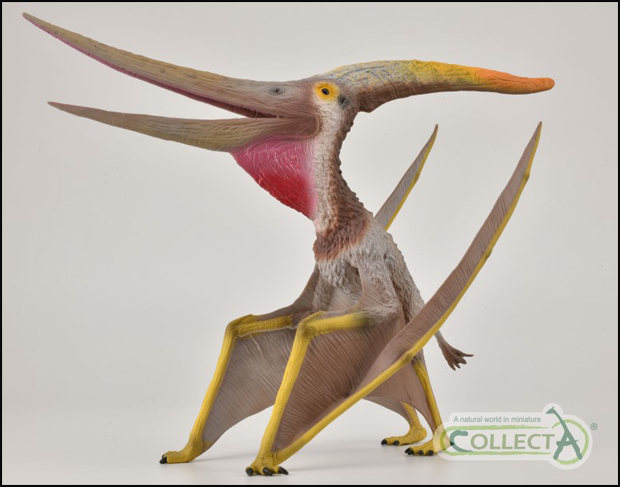
A Model of a Pteranodon Flying Reptile (CollectA Pteranodon Figure)

CollectA Deluxe Pteranodon model in 1:15 scale.

The CollectA Deluxe Pteranodon model in 1:15 scale.

In a statement issued by the University, one of the palaeontologists responsible for the analysis of the fossil material said:

“It it wasn’t crushed so badly, it would be possible to determine if it really is a Pteranodon.  These bones are easily flattened.  They are hollow inside, because they have to be lightweight to allow a pterosaur to fly, so they compress like a pancake as they are embedded in layers of rock.”

To view the range of pterosaur figures available in the CollectA Deluxe scale model series: CollectA Deluxe Prehistoric Life Models.

Certain structures on the bone suggest this was indeed a member of the Pteranodon genus.  It had, for example, a “prominent warped deltopectoral crest” characteristic of members of the Pteranodontidae family.

Before this discovery, these type of pterosaurs were known from other parts of the United States, most notably Kansas, but this specimen pre-dates the oldest found in the USA by at least 1.5 million years.  If this specimen is proved to be a true member of the Pteranodon genus then it is in the running to be the oldest known example of this genus in the world.

If this Texas fossils proves to be an actual Pteranodon, it will be the oldest example of the species in the world.

This new specimen also lived at an important time of transition for pterosaurs.  During this time, around 80-90 million years ago, the winged reptiles were diversifying from toothed forms to toothless varieties like the Pteranodons and the Azhdarchidae.

A spokesperson commented:

“This new specimen adds a lot more information about pterosaurs in North America.  It helps constrain the timing of the transition from toothed to toothless because there’s only a few million years separating this specimen and Aetodactylus.”.

Aetodactylus was a toothed pterosaur (Aetodactylus halli).  Its fossils have been found in north-eastern Texas and the strata from which the fossils were excavated has been estimated to be around 95 million years old (Cenomanian faunal stage).

3 03, 2011

A Video Review of the New Papo Dinosaur Model Styracosaurus

By |2023-01-15T18:51:46+00:00March 3rd, 2011|Categories: Everything Dinosaur News and Updates, Everything Dinosaur videos, Main Page, Product Reviews|0 Comments

Video Review of the Papo Styracosaurus Dinosaur Model

A welcome addition to the Papo “Les Dinosaures” model collection, a wonderful, hand-painted replica of that Late Cretaceous centrosaurine with the mean looking spikes on its neck frill – Styracosaurus. Everything Dinoaur team members have produced a short video reviewing the Papo Styracosaurus dinosaur model.

Papo, the figure and model manufacturers based in France are fast becoming firm favourites amongst professionals and model collectors when it comes to turning out authentic prehistoric animal replicas.  This sixteen centimetre model is a lovely example of a horned dinosaur and a credit to Papo’s designers and model makers.

A Short Video Review

In this short video, we showcase this new Styracosaurus model.  Staff at Everything Dinosaur discuss the relevance of this new model to the fossil material and highlight one or two features of note on this dinosaur replica.

Everything Dinosaur’s Review of the Papo Styracosaurus

Our review of the Papo Styracosaurus dinosaur model (Styracosaurus in red).

Everything Dinosaur’s video review of the red Papo Styracosaurus dinosaur model.

Video credit: Everything Dinosaur.

Papo Styracosaurus Dinosaur Model

The Papo Styracosaurus dinosaur model is supplied with a Styracosaurus fact sheet that has been researched and written by Everything Dinosaur team members.

To view the exciting range of Papo dinosaur and prehistoric animal figures: Papo Dinosaur Models and Prehistoric Animal Models.

2 03, 2011

Attenborough in Search of the Elephant Bird and his Fossil Fascination

By |2023-03-06T11:25:02+00:00March 2nd, 2011|Categories: Everything Dinosaur News and Updates, Main Page, Radio Reviews|0 Comments

Highlights on Television and Radio this Week

Tonight the BBC are showing a documentary entitled “Attenborough and the Giant Egg”, this is part of the BBC Natural History Unit’s documentary series on the amazing fauna and flora of Madagascar.  These programmes have been narrated by Sir David Attenborough and the programme being shown tonight recounts Sir David’s quest to find out more about the Elephant Bird that once lived on the island.

Elephant Bird

The hour long programme starts at 8pm on BBC2, it combines archive footage of Sir David’s Zoo Quest television show which documented his visit to Madagascar in 1960, with an update on the story.

Back in 1960 he tried to piece together a egg from the giant Elephant bird, (Aepyornis genus), which lived on the island before being wiped out by hunters in the 17th century.  This flightless bird was one of the most massive birds known to science and certainly the largest seen by modern people.

Pieces of Eggshell

David enquired amongst locals for pieces of eggshell and offered a reward for any pieces that could be found.  He was inundated with fragments and then one native brought him an almost complete egg.  He was astonished at just how many pieces of egg shell that turned up and the documentary tonight, filmed fifty years later, goes in search of the birds that laid these eggs.

Should be a fascinating programme.

Also, don’t forget to tune into Radio 4, Friday 8.50pm GMT (repeated Sunday mornings 08.50am GMT) for the latest instalment of David Attenborough’s Life Stories.  In the next programme, Sir David discusses his fascination with fossils.  So this week we have both compulsive viewing and listening to look forward to.

For models and replicas of extinct animals and prehistoric creatures: Mojo Fun Extinct Animals and Prehistoric Animal Figures.

1 03, 2011

Create Your own Prehistoric Scene with Helpful Advice from Everything Dinosaur

By |2024-04-21T12:23:30+01:00March 1st, 2011|Categories: Educational Activities, Everything Dinosaur News and Updates, Main Page|0 Comments

Dinosaurs Come Back to Life

Since Everything Dinosaur began, sometime back in the Holocene (the name of the Epoch that we are living in at the moment), staff have created drawing materials, quizzes, puzzles and games relating to dinosaurs and prehistoric creatures.  We have even helped young dinosaur fans create their own prehistoric scene. These items are part of our ongoing commitment to help young people learn more about Earth Sciences through their fascination with dinosaurs.

Our work with teachers and educators has been recognised and we have supplied lots of help and assistance when it comes to teaching science subjects.

Prehistoric Scene

A natural extension, (we like to think that we are evolving), is to take the vast number of prehistoric animal drawings, fact sheets and other data and utilise them in such a way so as to help schools, and mums and dads create their own prehistoric scenes for young dinosaur fans.

Our idea is very simple, we provide all the drawing materials of dinosaurs, prehistoric animals, vegetation, marine creatures and such like and dinosaur fans can create their very own prehistoric scenes featuring their favourite animals.  With so many illustrations, dinosaur drawings can be supplied by Everything Dinosaur.

A Mesozoic Timeline

We have created four scenes that link together providing a time-line from the Triassic through to the end of the Cretaceous.  We even have a marine environment scene so that prehistoric animal enthusiasts can depict marine reptiles swimming in the sea and create their version of sea monsters.

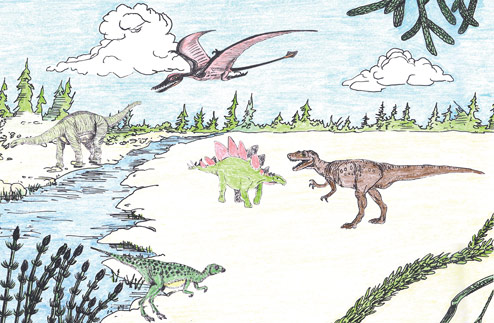
Life in the Late Jurassic

Picture credit: Everything Dinosaur

The scene shows a view of the Late Jurassic, sometime around 148 million years ago for instance.  A large allosaur (predator) confronts a Stegosaurus waiting for an opportunity to attack.  A sauropod wanders by in the background, whilst in the foreground a small, nimble ornithopod tries to avoid the gaze of the fierce Allosaurus and scampers back into the horsetails.  The vegetation is based on fossil plants from this geological period and the animals depicted are creatures whose fossils date from this time in the Late Jurassic.  The pterosaur flying overhead, surveying the scene is a long-tailed pterosaur, a Rhamphorhynchus, the dominant type of flying reptile that lived during this time.  Dinosaur fans can create their own Jurassic scene using our backdrop, we can supply a range of prehistoric animals so that they can have their own, unique dinosaur poster on their wall, or why not think big and make a wall mural?

To view the extensive range of dinosaur and prehistoric animal models available from Everything Dinosaur’s award-winning website: Dinosaur and Prehistoric Animal Models.

28 02, 2011

BBC Annouces Plans for their Dinosaur Season

By |2023-01-15T18:43:16+00:00February 28th, 2011|Categories: Dinosaur and Prehistoric Animal News Stories, Everything Dinosaur News and Updates, Main Page, TV Reviews|0 Comments

The Dinosaurs are Back on the BBC – this time in 3-D

The BBC have announced details of their new ground breaking television programmes combining prehistoric animals, the latest research and new media technology.  This marks the first time that the BBC has developed a palaeontology themed television series since the world famous “Walking with Dinosaurs” aired more than a decade ago.

Prehistoric Animals

The new documentary series, filmed in 3-D is to be entitled “Planet Dinosaur” and focuses on the research that has been carried out since the “Walking with” series.  Dinosaurs featured will include Spinosaurus and the fierce, cannabalistic Majungasaurus (also known as Majungatholus).

To see a replica of Majungatholus and other dinosaur models: CollectA Age of Dinosaurs Prehistoric Life Models.

Giant Marine Reptiles

The television programmes will also include giant marine reptiles such as the infamous pliosaur “predator X”, perhaps the largest carnivore ever to live on planet Earth.  The three-part series will combine 3-D graphics, computer imagery and photo-realistic fight scenes to give a fresh perspective on dinosaurs.  At Everything Dinosaur, we have been contacted to help with the graphics, advising on a number of projects associated with the programmes.

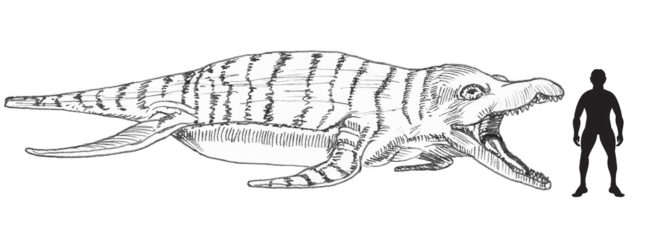
A Scale Drawing of a Pliosaur

Pliosaurus scale drawing. Huge pliosaur remains.

A scale drawing of a Pliosaurus. Picture credit: Everything Dinosaur.

Picture credit: Everything Dinosaur

To accompany the programmes BBC 4 will show three documentaries – a sort of “making the sequels to Walking..”, they will be called How to build a dinosaur, Survivors and Dinosaurs, Myths and Monsters.

For models and replicas of prehistoric animals: Models of Prehistoric Animals.

Go to Top