The amazing ITOY Studio Paraceratherium models have arrived at Everything Dinosaur. We have in stock the ITOY Studio Deluxe Paraceratherium that comes with a heavy polystone base and the ITOY Studio Elite Paraceratherium, the model being supplied without the display base.
The two ITOY Studio Paraceratherium replicas are in stock at Everything Dinosaur (whilst stocks last). The ITOY Studio Elite without display base (top) and (bottom) the ITOY Studio Deluxe Paraceratherium model which is supplied with a polystone display base. Picture credit: Everything Dinosaur.
Picture credit: Everything Dinosaur
A Very Large Model of a Very Large Prehistoric Mammal
The Paraceratherium genus is considered by many palaeontologists to have been the largest land mammal to have ever existed. Some fossil specimens indicate that this giant relative of the extant rhinoceros stood nearly five metres tall at the shoulder. The ITOY Studio model, in keeping with the fossil record, is also enormous. The figure measures over 40 cm in length and that beautifully detailed head is nearly 25 cm off the ground.
A view of the eagerly anticipated ITOY Studio Paraceratherium model. This figure is in stock at Everything Dinosaur (August 2021). This is the Deluxe version – it is supplied with a polystone display base. Picture credit: Everything Dinosaur.
Picture credit: Everything Dinosaur
Everything Dinosaur customers who purchase this model will also receive our free fact sheet that provides information about this extinct genus. Scientists are learning more about Paraceratherium as new fossils are discovered. Recently, we published a blog post about a newly described species of Paraceratherium
Scientists had uncovered fossil bones and we produced a blog post summarising the paper that announced a new Paraceratherium species (Paraceratherium linxiaense) from Gansu Province, China.
The ITOY Studio Paraceratherium replica. The model in the picture is the ITOY Studio Deluxe Paraceratherium (polystone display base included).
Paraceratherium Elite and Deluxe
The decision was taken to bring in both versions of the Paraceratherium replica (Elite and Deluxe). This enabled team members to price the Elite version (supplied without the heavy polystone base) lower than the price for the Deluxe figure.
The ITOY Studio Paraceratherium (Elite).
The Elite Paraceratherium figure is supplied in a big black box, whilst the Deluxe model with base is supplied in a large white box. At least this colour scheme will help our packing team to differentiate between the two replicas.
The ITOY Studio Paraceratherium packaging – this is the Elite Paraceratherium box, it is huge! The geology ruler provides a scale. Picture credit: Everything Dinosaur.
The ITOY Studio Paraceratherium Deluxe packaging – this is the white Deluxe Paraceratherium box, it is enormous. The geology ruler provides a scale. Picture credit: Everything Dinosaur.
Picture credit: Everything Dinosaur
To view the two new Paraceratherium models and the rest of the ITOY Studio figures available from Everything Dinosaur: ITOY Studio Models.
Scientists have named a new species of dromaeosaurid from fragmentary jawbones found in Upper Cretaceous deposits in the Brazilian state of Minas Gerais (south-eastern Brazil). Named Ypupiara lopai, this is the first dromaeosaurid described from fossils found in Maastrichtian-aged deposits in Brazil. Y. lopai has been classified as a member of the dromaeosaurid subfamily the Unenlagiinae, possibly a sister taxon to Austroraptor (A. cabazai), which is known from the Late Cretaceous of Argentina.
A life reconstruction of Ypupiara lopai. The shape and spacing of the teeth of this small dromaeosaurid suggest that it was a fish-eating dromaeosaurid. Picture credit: Guilherme Gehr.
Fragmentary Bones from the Jaws
A fragment of upper jaw and a piece of bone representing the back portion of the lower jaw (dentary), were found in close association and are believed to have come from a single animal. The fossils originate from the Marília Formation (Maastrichtian faunal stage).
The right maxilla of the newly described fish-eating dromaeosaurid Ypupiara lopai from Brazil. The maxilla (DGM 921-R), is shown in lateral view (A), medial view (B) and ventral view (C) with accompanying line drawings. Note scale bar = 1 cm. Sadly, this fossil and the portion of dentary were lost in a fire that took place in September 2018. Picture credit: Brum et al.
The researchers, writing in “Papers in Palaeontology”, conclude that these fossils represent the first evidence of unenlagiines from the Marília Formation (Bauru Group, Brazil) and the second confirmed evidence of this type of dromaeosaur in Brazil. Previously, a single dorsal vertebra from the geologically younger Adamantina Formation (Bauru Group) had been assigned to the Unenlagiinae subfamily. Numerous isolated teeth had hinted at the presence of dromaeosaurs including potential unenlagiines in the Late Cretaceous of Brazil, but Ypupiara is the first to be named and scientifically described.
Outlining the Unenlagiinae
The Dromaeosauridae consists of several subfamilies although the taxonomy of this geographically and temporally widespread family of theropod dinosaurs is subject to almost constant revision as more fossil discoveries are made around the world. The Unenlagiinae comprises several genera of small to medium-sized theropods and for the time-being they are confined to the southern portion of the Gondwana landmass (Antarctica and South America). Their geographical distribution may change as fossil specimens from Madagascar, Europe, Australia and North America have been putatively assigned to the Unenlagiinae.
The biggest member of this subfamily described to date is Austroraptor, which at five-metres long was much larger than Ypupiara. To read Everything Dinosaur’s article from 2008 about the discovery of Austroraptor: Introducing Austroraptor – Fearsome Predator of the Late Cretaceous.
Models of this kind of dromaeosaur are few and far between, but within the Beasts of the Mesozoic “Raptor” series, the Wetlands Accessory Pack features a replica of Buitreraptor, an unenlagiine from western Argentina known from deposits some 30 million years older than those associated with Ypupiara lopai.
The Beasts of the Mesozoic Buitreraptor gonzalezorum model from the Wetlands Accessory Pack.
The picture above shows an articulated dinosaur figure from the Beasts of the Mesozoic model series.
Analysis of the three teeth located in the upper jaw (shape and spacing along the jaw), suggests that Ypupiara was a piscivore (fish-eating). The strata associated with the fossil find, indicates that Ypupiara inhabited an alluvial floodplain with sediments extensively reworked by a braided river system. The genus name comes from the local Tupian dialect and refers to a mythical aquatic creature, a reference to the high probability that this little dinosaur lived near water. The species name honours Alberto Lopa, for his role in helping to map the geology of the state of Minas Gerais and in recognition of his discovery of the fragmentary bones that led to the erection of this new dinosaur genus.
Lost to Science
Sadly, the original fossils are no longer available to study. The fossil material was on loan to the Museu Nacional-Universidade Federal do Rio de Janeiro when fire destroyed the main building of the museum in September 2018, the fossils were not recovered and are considered to have been lost.
The scientific paper: “A New Unenlagiine (Theropoda, Dromaeosauridae) from the Upper Cretaceous of Brazil” by Arthur S. Brum, Rodrigo V. Pĕgas, Kamila L. Bandeira, Lucy G. Souza, Diogenes A. Campos and Alexander W. A. Kellner published in Papers in Palaeontology.
PNSO will be adding a replica of the prehistoric fish Dunkleosteus to their mid-size model range. This stunning placoderm model will be in stock at Everything Dinosaur in the autumn (2021).
A close-up view of the articulated head and jaws of the PNSO Dunkleosteus model.
A Perfect Placoderm
Those clever and talented people at PNSO have increased their range of mid-size prehistoric animal models dramatically over the last 12 months or so. For example, Zaha the Dunkleosteus is the second prehistoric fish to be introduced, after the announcement of Haylee the Helicoprion earlier this year. Dunkleosteus is a firm favourite amongst prehistoric animal model collectors, with a number of replicas of this Late Devonian terror already on the market, but we at Everything Dinosaur suspect that the PNSO Dunkleosteus figure is going to be very popular.
A stunning model of a placoderm – the PNSO Dunkleosteus model.
Zaha the Dunkleosteus
The Placodermi are famous for their armoured heads, but they were also the first fish to evolve pelvic fins, an important evolutionary step that was later reflected in the first tetrapods. Dunkleosteus was one of the last placoderms to evolve and at approximately 6 metres in length, it was an apex marine predator during the Late Devonian. The cleverly designed PNSO model reflects the hinged armoured plates associated with the head shield and this figure has been engineered in such a way to permit an articulated lower jaw to be added.
The PNSO Zaha the Dunkleosteus has an articulated jaw and armoured plates.
Commenting on the Scale of Zaha the Dunkleosteus
PNSO do not declare a scale size for their mid-size model range. However, the model measures around 23 cm in length and based on an adult Dunkleosteus terrelli which could have been 6 metres long, then this figure is in approximately 1:26 scale.
Ten species of Dunkleosteus have been described. The body plan and the maximum size of this fish is unknown. Some commentators have suggested that D. terrelli could have been up to 10 metres long. If this is the case, then a 23 cm long model would be in approximately 1:43 scale.
The PNSO Zaha the Dunkleosteus measures 23 cm in length and the caudal fin stands some 7.5 cm tall.
PNSO’s Placoderm – Zaha the Dunkleosteus
Several beautifully preserved fossils of the armoured head of Dunkleosteus have been found, but very little is known about the posterior portions of this fish. In the PNSO model a sloping dorsal fin has been placed quite far along the back of the animal, directly over the paired pectoral and pelvic fins. The PNSO model has been given a heterocercal tail, with an extended dorsal lobe of the tail fin and a much less prominent ventral lobe. This reflects what has been seen in smaller placoderm fossils and a heterocercal tail is commonly seen in many living sharks.
PNSO Zaha the Dunkleosteus the second prehistoric fish to the PNSO mid-size model range after Haylee the Helicoprion.
The sleek and supple body shape given by PNSO to their Dunkleosteus replica supports the hypothesis that the largest members of this genus were active, nektonic predators of ocean surface waters.
The product packaging for the new for 2021 PNSO Dunkleosteus model.
In Stock in the Autumn of 2021
A spokesperson from Everything Dinosaur praised PNSO for introducing a replica of the iconic Devonian predator Dunkleosteus into the mid-size model range and confirmed that this figure will be in stock at the UK-based company in the autumn of 2021.
A spectacular Dunkleosteus exhibit. A museum display showing the armoured head and thorax of the giant Devonian predator Dunkleosteus terrelli. Picture credit: Everything Dinosaur.
Last week, Everything Dinosaur team members posted up a silhouette of a prehistoric animal model and challenged our customers and fans on social media to see if they can guess what the model was. Once again, our loyal customers, dedicated fans and followers on social media rose to the challenge and although we thought we had set quite a tricky test, lots of respondents guessed correctly.
The model in question was the ITOY Studio Paraceratherium.
The silhouette image we posted last week as a teaser, our congratulations to all those who correctly guessed it was the ITOY Studio Paraceratherium model. The silhouette image was taken from the box image of the ITOY Studio Paraceratherium. Picture credit: Everything Dinosaur.
The eagerly awaited ITOY Studio Paraceratherium replicas (Elite and Deluxe) docked at a UK port last week and once cleared customs these models should be in stock at Everything Dinosaur in a few days’ time (mid-August 2021).
The ITOY Studio Paraceratherium replica. This is the deluxe version (supplied with a display base).
The ITOY Studio Paraceratherium is a very large figure. What an amazing replica the ITOY Studio model is! The detail on the figure is simply fantastic! It is incredibly realistic with beautiful skin folds and creases. It is very big too, the model measures over 40 cm long and the display base is a generous 32 cm in length and over 14 cm wide.
The box contents (Paraceratherium elite replica). The ruler provides a scale, giving an impression of the size of the ITOY Studio figure. Picture credit: Everything Dinosaur.
Picture credit: Everything Dinosaur
Two ITOY Studio Paraceratherium Figures
Everything Dinosaur has imported both models in the ITOY Studio Paraceratherium portfolio. The two figures that will be available are:
ITOY Studio Paraceratherium – Deluxe (model supplied with polystone display base)
ITOY Studio Paraceratherium – Elite (model supplied without polystone display base)
To view the existing range of ITOY Studio prehistoric animal models available from Everything Dinosaur: ITOY Studio Models and Figures.
A stunning fossil of a beetle that had been on display at the Denver Museum of Nature and Science (Colorado), has been identified as a new species and named in honour of the English naturalist and broadcaster Sir David Attenborough. Named Pulchritudo attenboroughi (Attenborough’s beauty), the fossil originates from the famous Green River Formation and it is believed to be around 49 million years old.
The stunning Pulchritudo attenboroughi fossil beetle from the Green River Formation of Colorado (USA). Picture credit: Krell and Vitali.
Incorrectly Labelled
In the Museum’s exhibition display the fossil was labelled as a longhorn beetle, however, Senior Curator of Entomology at the Denver Museum of Nature and Science, Frank Krell had doubts so he invited Francesco Vitali of the National Museum of Natural History of Luxembourg, an authority of fossil beetles, to examine the fossil.
The crooked hind legs identified in the specimen, gave away the beetle’s true affinity. The fossil represents an example of a frog-legged beetle, a widespread family of beetles, which are sometimes referred to as kangaroo beetles, as they are found in Australia as well as Africa, Asia and South America.
Writing in the academic journal “Papers in Palaeontology”, the researchers concluded that the 2.2 cm long fossil represented a female frog-legged beetle from the subfamily Sagrinae. This is only the second known fossil representative of this beetle subfamily known from North America. Beetles of the subfamily Sagrinae are not found in North America today, but the authors noted that Atalasis sagroides from Argentina is remarkably similar to the fossil specimen.
Digital reconstruction of Pulchritudo attenboroughi based on the part and counterpart of the holotype fossil. Picture credit: Krell and Vitali.
Honouring Sir David Attenborough
Sir David Attenborough has been honoured on numerous occasions by having new species (living and extinct) named after him. For example, he has had a placoderm (Materpiscis attenboroughi), as well as the pliosaurid Attenborosaurus conybeari and a Cretaceous damselfly – Mesosticta davidattenboroughi named after him. Sir David might be ninety-five years young, but his influence on the scientific community as well as the wider public is undiminished.
In the scientific paper, naming and describing this new genus of beetle from the Eocene Epoch, the researchers wrote that the specific name attenboroughi is from the Latinised form of the surname Attenborough and they state that this fossil genera is:
“dedicated to Sir David Frederick Attenborough, broadcaster and naturalist, who has nothing to do with this fossil but has been inspiring the authors, their family down to the littlest, and millions of others by his unsurpassed documentaries on the natural world, extant and bygone. Nobody imparts the grandeur and beauty of nature more impressively than Sir David. This fossil, unique in its preservation and beauty, is an apt specimen to honour the great man”.
Still Enthusing about the Natural World. Picture credit: Everything Dinosaur.
A genus of beetle from the Eocene honours Sir David Attenborough.
The scientific paper: “Attenborough’s beauty: exceptional pattern preservation in a frog‐legged leaf beetle from the Eocene Green River Formation, Colorado (Coleoptera, Chrysomelidae, Sagrinae)” by Frank-Thorsten Krell and Francesco Vitali published in Papers in Palaeontology.
Our thanks to dinosaur model collector William who sent into Everything Dinosaur a detailed review of his recently purchased CollectA Megalosaurus in ambush model. This dinosaur figure had been introduced by CollectA earlier this year and William was keen to sing the model’s praises.
The CollectA Age of Dinosaurs Popular Megalosaurus in ambush figure. The muted tones would have provided excellent camouflage for this Jurassic hunter.A model collector sent into Everything Dinosaur a detailed review of this 2021 figure. Picture credit: Everything Dinosaur.
Picture credit: Everything Dinosaur
Megalosaurus in Ambush Reviewed
William recommends this updated version of the famous Jurassic theropod stating:
“Yes, the CollectA Megalosaurus is that good in hand – really worth purchasing”.
The enthusiastic model collector explained that Megalosaurus bucklandii was the first dinosaur to be scientifically described and named, referring to this genus as the “pride of the United Kingdom palaeo community”.
He is quick to point out that the 2021 figure replaces an earlier Megalosaurus replica in the CollectA Prehistoric Life Model series.
The first CollectA Megalosaurus figure to be introduced. This replica is due to be retired (2021).
The Megalosaurus Head Sculpt
William commented that with this new CollectA replica there was a more accurate representation of the fossil material ascribed to this genus. Specifically, when discussing the head of the new model, he stated that the muzzle was well defined and the skin folds under the jaws were a nice touch. William added that there was excellent definition with the nostrils, eyes and ear vents commented upon. He also noted the addition of lips on the model, a detail that reflects current palaeontological debate.
The new CollectA Megalosaurus has lips. Picture credit: Everything Dinosaur.
Picture credit: Everything Dinosaur
The Limbs, Arms and Torso of the Megalosaurus Figure
The position of the limbs and arms were praised for their anatomical accuracy, although the reviewer commented that the feet on the model were a little over sized, presumably to help with model stability and to prevent the need for a display base. William liked the long and sleek torso and briefly commented upon this theropod body plan being reflected in later allosaurids and tyrannosaurids.
When commenting on the tail, the model collector explained that the tail was well proportioned and he liked the dorsal raised scales that ran down the body and along the tail.
The new for 2021 CollectA Megalosaurus in ambush dinosaur model. This figure was reviewed by an Everything Dinosaur customer. Picture credit: Everything Dinosaur.
William described the model’s colour scheme stating that the main base colour was a grey-beige with black muzzle points and dark colouration around the ears. Striping ran down the flank and the tail, before giving way on the torso to black spots. He commented on the “natural appeal” of the figure and praised the fine sculpting along with the throat and belly folds and wrinkles.
CollectA Megalosaurus Size and Scale
In William’s review he provided the following measurement information and proposed a scale of approximately 1:38 for the CollectA figure.
Length = 6.25 inches
Height = 2 inches
Scale 1:38
William’s Megalosaurus Biography
In addition to making comments about the CollectA model, William provided some information on the discovery and scientific description of Megalosaurus.
He explained that strange, unexplained fossil bones and been unearthed from stone quarries in England and that they had caught the attention of leading academics of the day such as Professor Robert Plot of Oxford University.
Time: 166 mya (approximately) – Bathonian faunal stage of the Jurassic
The Megalosaurus display case (Oxford Museum of Natural History). This exhibit contains some of the actual fossils used to name and describe this genus of theropod dinosaur. Picture credit: Everything Dinosaur.
Picture credit: Everything Dinosaur
A Predator of the Jurassic
Concluding his comprehensive review William explained that Megalosaurus was one of the largest theropods known from the Middle Jurassic and it probably was the apex predator in the ecosystem, often stealing from the kills of other smaller theropods such as Cruxicheiros and Iliosuchus.
Finally, the reviewer commented on the work of the Reverend William Buckland and the French comparative anatomist Georges Cuvier that led to the formal description of this large, meat-eater at a meeting of the Geological Society of London on the 20th of February 1824.
William commented:
“The first named dinosaur Megalosaurus was the spark that set the world ablaze with a deep passion for dinosaurs”.
Just for a bit of fun, Everything Dinosaur team members have created a little teaser for their fans and customers, can you identify the model from the image we have posted? There are no prizes, but our knowledgeable customers can be assured that they have our total respect if they can identify the prehistoric animal model from the image below.
Can you guess the prehistoric animal model from the image that Everything Dinosaur has posted? There are no prizes or awards on offer, but are you up to the challenge and can you identify the prehistoric animal model just from its silhouette? Picture credit: Everything Dinosaur.
Picture credit: Everything Dinosaur
Very Well-informed Customers, Fans and Followers of Everything Dinosaur
A spokesperson from Everything Dinosaur commented:
“We are constantly amazed how well-informed and knowledgeable our customers, fans and followers on the Everything Dinosaur social media platforms are. We like to set little quizzes and tests from time to time just to keep them on their mettle, but we have not been able to get the better of our customer base to date.”
There are no prizes or awards on offer, just the satisfaction of having got the better of the Everything Dinosaur team members.
As a clue, we can say that several species have been assigned to this genus. It is a prehistoric mammal and perhaps, one of the largest terrestrial mammals to have ever lived. Can you guess?
We will reveal the answer next week (week commencing 9th August 2021), providing an update on this exciting prehistoric animal replica.
Our thanks to dinosaur model fan and collector Luke who sent into Everything Dinosaur a photograph recreating a famous Charles R. Knight painting that features Tyrannosaurus rex confronting a herd of Triceratops. Having purchased the Rebor 1:35 scale Vintage Palaeoart Tyrannosaurus rex “Mesozoic Rhapsody” Valley, Luke was inspired to recreate the Charles R. Knight illustration that shows a short-faced Tyrannosaurus rex threatening a group of horned dinosaurs. The Triceratops models in the image sent to us by Luke are from the Papo range (Papo Triceratops dinosaur model).
Luke recreates a famous Charles R. Knight painting using a pair of Papo Triceratops dinosaur models and the Rebor 1:35 scale Vintage Palaeoart Tyrannosaurus rex “Mesozoic Rhapsody” Valley dinosaur model. Picture credit: Luke.
The Original Tyrannosaurus rex Artwork
Charles Robert Knight (1874-1953), was an American artist, regarded as one of the most influential illustrators of prehistoric animals in the 20th century. His artwork appears in many museums, most notably the American Museum of Natural History (New York). He was commissioned to produce a life restoration of an entelodont for the Museum. Using his knowledge of anatomy and living animals he created a most impressive artwork, so much so that Dr Jacob Wortman of the American Museum of Natural History commissioned Knight to create a series of illustrations and murals for the galleries.
We at Everything Dinosaur are not sure when the T. rex and Triceratops artwork was produced but some sources have suggested 1919. It is a very famous T. rex illustration.
The famous Charles R. Knight illustration of a Tyrannosaurus rex confronting a trio of Triceratops dinosaurs including a juvenile. Picture Credit: American Museum of Natural History.
A spokesperson from Everything Dinosaur commented:
“Our congratulations to Rebor fan Luke who has used his latest Rebor acquisition to recreate a famous piece of palaeoart. We think that Charles R. Knight would have been quite flattered to see his work from around a hundred years ago imitated in this way.”
Rebor Retrosaurs
Rebor have introduced two dinosaur figures into their “Retrosaurs” range of prehistoric animals. Joining “Mesozoic Rhapsody” is the Rebor 1:35 80s T-REX Toy HD Remastered “Californiacation” VHS. This range pays tribute to the way in which dinosaurs such as Tyrannosaurus rex were depicted in the 20th century.
Scientists have examined the fossilised remains of a large ornithopod dinosaur, whose fragmentary remains were discovered in 1963 and concluded that these remains represent one of the “oldest” dinosaurs known to science. The fossils assigned to a basal member of the Hadrosauroidea known as Gobihadros mongoliensis are not that geologically old, this dinosaur roamed Mongolia around 93 million years ago, the important point to note is that the fossils come from a very aged dinosaur. These fossilised bones have provided palaeontologists with a unique insight into the ageing process of non-avian dinosaurs.
A life reconstruction of the basal hadrosauroid Gobihadros mongoliensis. The bones from an elderly dinosaur indicate that when fully grown Gobihadros was around 7.5 metres long. Picture credit: A. Kapuścińska.
Most Dinosaur Fossils Represent Young Animals
Palaeontologists classify vertebrate fossils such as dinosaur remains into three broad age categories. These categories are juvenile, subadult and adult. In the absence of a detailed assessment of bone structure examining lines of arrested growth (LAGs), that can provide a guide to the number of years an animal has lived, the age of the vertebrate is estimated by looking at the degree of ossification of the skeleton, the bone microstructure and the size of animal. Larger animals with more ossification present in their skeleton indicate older animals.
Most of the dinosaur fossil remains represent young animals such as subadults or juveniles. However, a team of scientists writing in the academic journal “Scientific Reports”, have published a paper looking at the fragmentary Gobihadros material that was discovered in 1963 and concluded that these bones represent a very aged dinosaur. How old is difficult to tell, but the presence of abnormal calcium deposits in some of its bones indicate that this Gobihadros suffered from a form of arthritis, which is found mostly in very old members of a population.
Probably Gobihadros mongoliensis
Elements representing limb bones, part of the left foot and nine tail bones (caudal vertebrae) have been preserved. The femur and tibia match fossil material assigned to Gobihadros (G. mongoliensis) which was named and described in 2019: A New Hadrosauroid Dinosaur from Mongolia.
As G. mongoliensis is the only large ornithopod known from the Baynshire Formation in the Khongil Tsav locality (Mongolia), where the fossils were found, the material has been assigned to this species. When first scientifically described in 2019, the holotype fossil material indicated a dinosaur around three metres in length, these fossils, representing a much larger animal suggest that Gobihadros grew to a maximum size of around 7.5 metres long.
The absence of open transcortical channels associated with the limb bones indicate that this dinosaur was very old when it died.
Views of the top end of the right femur (a-c) and the partial tibia (d-f) of the fragmentary bones attributed to G. mongoliensis. Picture (g) shows a close-up view of the top of the femur (proximal) open transcortical channels associated with bone growth are not found in the Gobihadros femur, but can be seen in the femur of a Protoceratops andrewsi shown for comparison (h). The white arrows in (h) mark the open transcortical channels. Picture credit: Slowiak et al.
Calcium Pyrophosphate Crystals Found
Traces of abnormal calcium deposits were identified in some of the bones. Computerised tomography (CT scans) revealed that this dinosaur suffered from a form of very painful arthritis called CPPD (calcium pyrophosphate crystal deposition). These calcium crystals build up in the joints and lead to restricted movement, joint stiffness and considerable pain. This condition is found in our own species, it most often affects people in their late fifties.
Life reconstruction of Gobihadros mongoliensis with pathology including evidence of CPPD highlighted indicating that this dinosaur was very old when it died. Picture credit: Slowiak et al.
Co-author of the paper Dr Tomasz Szczygielski (Polish Academy of Sciences) commented:
“Dinosaurs in the reptile family tree are close to birds, but some of their characteristics, such as metabolism, refer to mammals. That is why it is still difficult for us to interpret how these organisms aged”.
The fossilised remains of this elderly dinosaur are currently on display at the Museum of Evolution at the Palace of Culture and Science in Warsaw (Poland). The scientists hope that further research using other museum specimens may provide more information on how dinosaurs aged and this might provide an insight into why some kinds of archosaur such as the crocodiles survived the end-Cretaceous mass extinction event but the non-avian dinosaurs did not.
The scientific paper: “Dinosaur senescence: a hadrosauroid with age-related diseases brings a new perspective of “old” dinosaurs” by Justyna Słowiak, Tomasz Szczygielski, Bruce M. Rothschild & Dawid Surmik published in the journal Scientific Reports.
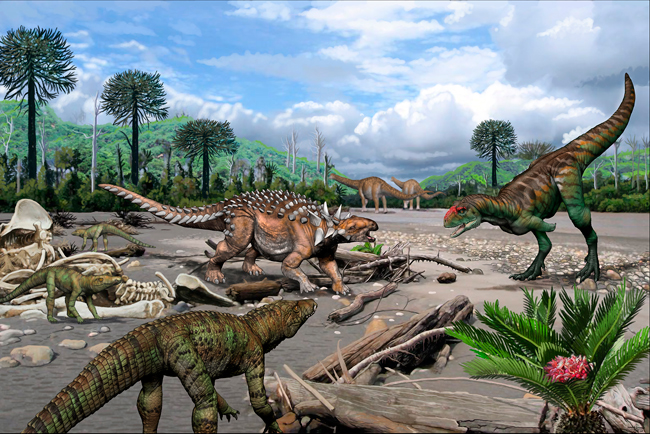
The clade of very bird-like dinosaurs known as the Oviraptorosauria, were very successful and widely distributed in the Northern Hemisphere during the Late Cretaceous. For example, the Nemegt Formation (Mongolia), is famous for the numerous oviraptorosaur dinosaurs that have been named and described from fossils, dinosaurs such as Conchoraptor, Rinchenia, Gobiraptor and the recently described two-fingered Oksoko (O. avarsan) that we featured in an article in October 2020: A New Species of Two-fingered Oviraptorosaur is Described.
Roosting oviraptorids. The discovery of fragmentary fossils attributed to Elmisaurus (E. rarus) suggests that there was only one caenagnathid dinosaur present in the Nemegt Formation biota rather than two as previously thought. Picture credit: Mike Skrepnick.
Analysis of fragmentary fossil remains attributed to the caenagnathid Elmisaurus suggests that these members of the oviraptorosaur clade (the Caenagnathidae) were actually rare in Mongolia compared to the much more numerous and diverse oviraptorids.
Researchers, which include the eminent Professor Phil Currie (University of Alberta), writing in PLOS One conclude that caenagnathids may have been outcompeted by other oviraptorosaurs and as such, caenagnathids like Elmisaurus only made up a tiny portion of the dinosaur population associated with the Nemegt Formation.
Examining the Oviraptorosauria
The Oviraptorosauria clade consists primarily of two large families of feathered dinosaur, the Caenagnathidae “recent jaws” and the closely related Oviraptoridae “egg thieves”.
Overall, the anatomy of caenagnathids is very similar to that of oviraptorids, but there are a number of differences. For example, caenagnathid jaws exhibited a distinct suite of specialisations not seen in other oviraptorosaurs. The jaws of caenagnathids tend to be relatively long and shallow, this suggests that their bite was not as powerful. The inside of the lower jaws also reveal a complex series of ridges and tooth-like processes, as well as a pair of horizontal, shelf-like ridges. Recent studies have demonstrated that as caenagnathids grew and got older they started to lose their teeth (ontogenetic edentulism).
The unusual jawbone morphology was produced by various tooth reduction patterns and this in turn, suggests that these dinosaurs changed their diet as they matured. Furthermore, the jaws of caenagnathids are unusual as the bones are hollow and air filled. In addition, in general terms caenagnathids tend to be more lightly built than the closely related oviraptorids.
The clade of feathered dinosaurs known as the Oviraptorosauria (egg thief lizards) contains two large families the Caenagnathidae, represented by Elmisaurus in the Nemegt Formation and the Oivraptoridae family which in the Nemegt Formation is represented by Conchoraptor, Nemegtomaia and Rinchenia. In a recently published research paper (summer 2021), scientists conclude that oviraptorids may have restricted caenagnathids to marginal roles in Late Cretaceous Asian ecosystems. Picture credit: Everything Dinosaur.
Picture credit: Everything Dinosaur
Nomingia gobiensis Actually Elmisaurus rarus
Two members of the Caenagnathidae had been described from fossils associated with the Nemegt Formation, Elmisaurus rarus which was scientifically described back in 1981 and Nomingia gobiensis which was named in the year 2000. The research team which included Gregory Funston (University of Edinburgh), Chinzorig Tsogtbaatar (North Carolina State University), Tsogtbaatar Khishigjav (Mongolian Academy of Sciences) as well as Professor Currie, examined a partial skeleton which had been discovered in 2018, close to the site where the holotype fossils of Nomingia had been found.
The team were able to highlight similarities in the overlapping elements of Elmisaurus and Nomingia. They concluded that fossil material previously attributed to Nomingia gobiensis might represent Elmisaurus rarus and that just one species of caenagnathid is known from the Nemegt Formation.
Fragmentary cranial and axial elements attributed to Elmisaurus rarus. The researchers concluded that fossil material assigned to the genus Nomingia actually represented Elmisaurus and therefore just one caenagnathid was currently known from the Nemegt Formation. Picture credit: Funston et al.
Oviraptorids Outcompeted Caenagnathids
The researchers discount the idea that a bias in fieldwork has led to the lack of caenagnathid fossil specimens found. After all, numerous small dinosaurs such as dromaeosaurids and oviraptorids are known from Nemegt Formation. The team postulated that the caenagnathids were marginalised and out competed by the similarly sized oviraptorids.
The pectoral girdle of Elmisaurus. Left scapulocoracoid in lateral view (A) and (B), left scapula in medial view. Left coracoid in medial view (C). Interpretive illustration of the closely related Canadian caenagnathid Apatoraptor pennatus for comparison. A fragmentary, weathered caenagnathid skeleton discovered near to the holotype quarry of Nomingia gobiensis is referable to Elmisaurus rarus, revealing more of the morphology of the skull, jaws, pectoral girdle, and pubis. Picture credit: Funston et al.
Differences in Asian and North American Late Cretaceous Ecosystems
The lack of caenagnathids reported from the Nemegt Formation might reflect competition amongst different types of small, cursorial, feathered dinosaurs. In North America, caenagnathids were the only oviraptorosaurs present (no oviraptorids are currently known from North America). In contrast, both oviraptorids and another type of oviraptorosaur closely related to the Caenagnathidae – the avimimids Avimimus portentosus and Avimimus nemegtensis were present in Mongolia during the Late Cretaceous.
The researchers conclude that although the highly diverse Nemegt Formation oviraptorids probably had very specialised diets, they may have outcompeted the caenagnathids in the niche of small omnivores.
A skeletal reconstruction of Elmisaurus rarus. Fossils highlighted in red represent the recently discovered material from a site adjacent to the Nomingia holotype quarry. Analysis of the pectoral girdle suggests that Elmisaurus had quite powerful arms, adapted for rapid movements and the grabbing of prey. Picture credit: Funston et al.
As Nomingia gobiensis was named and scientifically described some nineteen years after Elmisaurus rarus, the research team postulate that Nomingia gobiensis should be regarded as a junior synonym of Elmisaurus. In addition, low caenagnathid diversity in the Nemegt Formation might reflect their inability to compete with other oviraptorosaurs, particularly oviraptorids.
The scientific paper: “A partial oviraptorosaur skeleton suggests low caenagnathid diversity in the Late Cretaceous Nemegt Formation of Mongolia” by Gregory F. Funston, Philip J. Currie, Chinzorig Tsogtbaatar, Tsogtbaatar Khishigjav published in PLOS One.