All about dinosaurs, fossils and prehistoric animals by Everything Dinosaur team members.

Pictures of fossils, fossil hunting trips, fossil sites and photographs relating to fossil hunting and fossil finds.

27 04, 2020

New Late Cretaceous Giant Shark from Spain

By |2024-02-18T12:52:47+00:00April 27th, 2020|Categories: Dinosaur and Prehistoric Animal News Stories, Dinosaur Fans, Main Page, Photos/Pictures of Fossils|0 Comments

Ptychodontid Sharks Grew Big and Lived for a Long Time

Scientists from the University of Vienna have been able to determine the approximate age and to estimate the rate of growth of an extinct species of shark that lived around 85 million years ago.  In addition, the researchers, writing in the open access on-line journal PLOS One, have estimated that this ammonite crunching fish could have been in excess of seven metres in length, but even though it was a giant, this shark was not yet fully mature and still had some growing to do.

Much of what we know about prehistoric sharks comes from studies of their fossilised teeth.  However, apart from providing indications on size, taxonomy and potential diet, these teeth do not provide a great deal of information about the life and the age of the individual.  In contrast, the calcified vertebrae of elasmobranchs (sharks, skates and rays), specifically the centra, yield important information about ecological and biological traits.  Two fossil shark vertebrae assigned to the genus Ptychodus found in northern Spain, have enabled researchers to gain valuable information on the life of a single individual animal that lived during the Late Cretaceous.

Site Photographs of the Shark Vertebrae
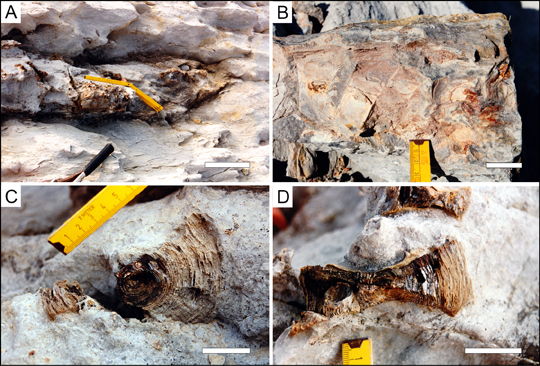
The shark vertebrae (articulated and disarticulated specimens).
Additional articulated (A, B) and disarticulated shark vertebrae (C,D) found in situ.  Scale bar (A) = 20 cm and scale bar = 3 cm in B, C and D).

Picture credit:  K. Oppermann

A Shark from Northern Spain

The fossil material consists of a portion of the spine representing five articulated and several disarticulated vertebral centra from a single animal.  The fossils were found in Upper Cretaceous strata around six miles west of the town of Santander in northern Spain, from a limestone exposure close to the village of Soto de la Marina.

The extensive marine sediments document much of the Late Cretaceous – ranging from early Santonian through to Maastrichtian-aged deposits.  The shark fossils come a bedding plane representing the earliest Santonian (circa 85 million years ago).  Although no teeth were found in association with the fossil material, the scientists have referred this material to the Ptychodus genus.  A relatively common and widespread genus that specialised in eating hard-shelled animals such as shellfish and ammonites (duraphagous diet).

Calculating the Size of the Prehistoric Shark

Previous research had shown a link between the total length attained for several living shark species and the diameter of the vertebral centra.  The linear regression used to calculate potential length was applied to these fossils and the scientists concluded that the shark was between 4.3 to 7.07 metres in length.

Estimating the Size of the Ptychodus spp.
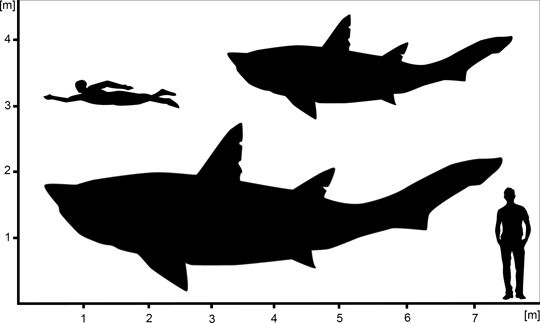
Scale drawing of Ptychodus specimen based on size estimates.
Estimated size of between 4.3 and 7.07 metres for the Ptychodus spp. from the Santonian of Spain.

Picture credit: Patrick L. Jambura (University of Vienna)

Intriguingly, the centra of sharks also preserve evidence of growth rate, from which an age range can be deduced, just as the rings on a tree stump can provide an indication of the tree’s age.  An analysis of the centra from two fossils indicated that this shark was around thirty years old when it died, quite an age for a shark, although what age some sharks species alive today can live to remains unknown.  Based on this study, the researchers propose that ptychodontid sharks grew very slowly, matured very late, but also showed high longevity and had the potential to reach huge body sizes.

Calcification Pattern on the Centra Can Provide an Indication of Growth Rate and Age
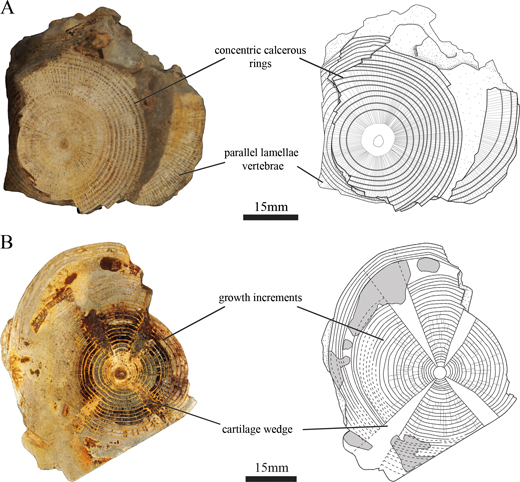
Calculating the age of a prehistoric shark.
Close view and line drawing of the vertebral centra EMRG-Chond-SK-1a (A), whilst (B) shows a close view and accompanying line drawing of  EMRG-Chond-SK-1b, the second centra examined in this study.  Note scale = 1.5 cm.

Picture credit: PLOS One (Jambura and Kriwet)

The scientific paper: “Articulated remains of the extinct shark Ptychodus (Elasmobranchii, Ptychodontidae) from the Upper Cretaceous of Spain provide insights into gigantism, growth rate and life history of ptychodontid sharks” by Patrick L. Jambura and Jürgen Kriwet published in PLOS One.

The Everything Dinosaur website: Everything Dinosaur.

23 04, 2020

St George’s Day – There Be Dragons

By |2024-02-18T08:15:13+00:00April 23rd, 2020|Categories: Dinosaur Fans, Educational Activities, Main Page, Photos/Pictures of Fossils|0 Comments

Happy St George’s Day

Today, April 23rd, is the patron saint day of England (and in a number of other countries such as Portugal and Malta).  April 23rd commemorates the saint’s day of England’s patron saint St George.  Legend has it, St George was a Knight, someone strongly associated with this sceptred isle as William Shakespeare wrote, who coincidentally is believed to have been born on this day in 1564 and also died on this day (1616).

St George was not English and he might be famous for slaying a dragon but this story was probably brought back to Europe by returning crusaders.  St George is believed to have been a Roman soldier who became a martyr following his execution for refusing to denounce his Christian faith.

The Dragon Metaphor May Have Influenced Early Illustrations of Prehistoric Animals

"Great Sea Dragons" illustration by John Martn
The circa 1840 illustration of marine reptiles and pterosaurs by John Martin.  Both the pterosaurs and the marine reptiles show a strong resemblance to the classical depiction of a dragon.

Picture credit: John Martin

Dinosaurs and Dragons

Dragons and dinosaurs are synonymous.  It has been suggested that the dragons from Chinese folklore, which actually pre-date St George by hundreds of years, were probably thought up to explain the large fossil bones found in many parts of China.  Those early Chinese scientists were remarkably close to the truth.  Many dinosaurs that have been discovered in China have the word “long” incorporated into the genus.  For example, Guanlong, Yinlong, Tianyulong, Xiongguanlong, Beishanlong and Zhenyuanlong.  The word “long” is derived from the Mandarin Chinese for dragon.

A Specimen of the Dromaeosaurid Dinosaur Zhenyuanlong (Z. suni

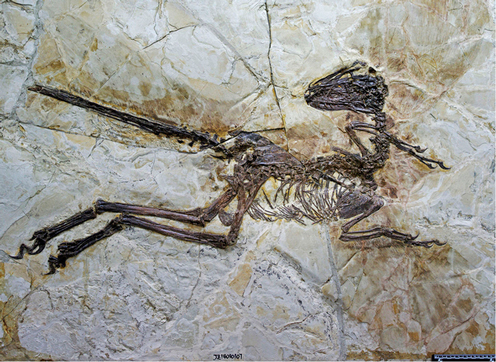
Zhenyuanlong fossil.
Large-bodied, short-armed Liaoning dromaeosaurid.  Zhenyuanlong suni fossil material, dinosaurs are still being named as “dragons” today.

Picture credit: Chinese Academy of Geological Science

The trend to name Chinese dinosaurs “dragons” shows no signs of abating.  For example, earlier this year, Everything Dinosaur reported upon the discovery of Wulong bohaiensis (dancing dragon).  W. bohaiensis has been classified as a member of the Microraptoria clade of feathered dromaeosaurs.

To read more about the discovery of this crow-sized dinosaur: Little Dancing Dragon Sheds Light on How Dinosaurs Grew Up.

The Everything Dinosaur website: Everything Dinosaur.
19 04, 2020

Wood You Believe It? Mahogany Dates Back to the Dinosaurs

By |2024-02-17T18:43:09+00:00April 19th, 2020|Categories: Dinosaur and Prehistoric Animal News Stories, Dinosaur Fans, Main Page, Photos/Pictures of Fossils|0 Comments

Canadian Fossil Proves Origins of Mahogany Earlier Than Previously Thought

A fossilised fruit found on a beach in Canada has been identified as having come from a member of the mahogany tree family (Meliaceae).  This suggests that this commercially important hardwood evolved in the Cretaceous.   The fossil is some 15-20 million years older than any other fossil found that has been ascribed to the Meliaceae.  This type of tree would have been familiar to the dinosaurs.  Indigenous to the tropics of the Americas, the discovery of this fossil which dates between 79-72 million years ago (Campanian stage of the Late Cretaceous), will support palaeoclimate studies of high latitudes and permit palaeobotanists to better understand how modern tropical, angiosperm dominated ecosystems developed.

Manchestercarpa vancouverensis

The new species of Cretaceous-aged tree has been named Manchestercarpa vancouverensis.

Views of the Fossilised Mahogany Fruit (Manchestercarpa vancouverensis)

Fossil maghogany fruit - holotype material.
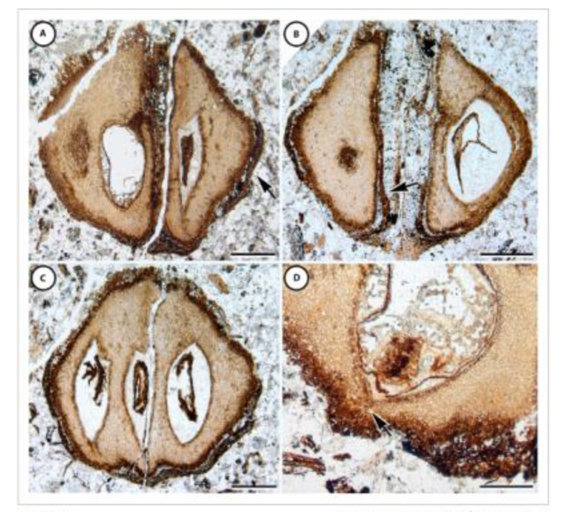
Fossil mahogany fruit (Manchestercarpa vancouverensis).  Holotype SH790 scale bars A-C equal 1 cm, scale bar in D equals 0.5 cm.

Picture credit: Brian Atkinson (University of Kansas)

The picture (above), shows cross-sectional views of the fruit and seeds of the newly described species of Cretaceous mahogany (Manchestercarpa vancouverensis).   The thick-walled outer skin of the fruit (endocarp) is identified along with the middle portion, the flesh of the fruit (mesocarp).  Evidence of seeds inside the fruit has also been found.

A Significant Fossil Discovery

Today, mahogany is a commercially very important hardwood, valued for its strength and beauty.  It is used in cabinet making, furniture and for creating musical instruments.  In the days of sailing ships, mahogany was much prized as this tough wood did not splinter as much as European timber when struck by a cannonball.  The UK is the world’s second largest importer of mahogany, after the United States.  To a palaeobotanist, finding a fossil that is reminiscent of fruit associated with these trees, lets them know that tropical forests similar to the ones we know today were in existence at the time of the dinosaurs.

Prior to this discovery, the oldest fossils attributed to the Meliaceae family date from the Palaeogene and Eocene such as those specimens found in the Green River Formation of Colorado.  However, the earliest previously recorded fossils associated with Melia are leaves and scientists have been reluctant to assign these fossils taxonomically.  The most diagnostic material are fossil fruits and these fossils have been found in several, geographically dispersed Eocene-aged deposits such as the London Clay and the Nanjemoy Formation of North America.

Geographically Widespread

It seems that in the past, these types of trees and therefore tropical forests were much more widespread than they are today.

Author of the scientific paper, published in the American Journal of Botany, University of Kansas researcher Brian Atkinson stated:

“For understanding when many of the different branches of the tree of life evolved, we’re primarily dependent on the fossil record.  In this case, Meliaceae, the mahogany family, is an ecologically and economically important group of trees.  A lot of researchers have used this group as a study system to better understand the evolution of tropical rainforests.  This work is the first definitive evidence that the tropically important trees were around during the Cretaceous period, when we first start to see the modernisation of ecosystems and modern groups of plants.”

The rock containing the fossilised fruit was found on a beach at Shelter Point, Vancouver (British Columbia), by fossil collector Graham Beard, the director of the Qualicum Beach Museum of Natural History.  The matrix in which the fossil was found is associated with the Spray Formation (Campanian faunal stage).   The genus name honours palaeobotanist Steve Manchester (University of Florida Museum of Natural History).  The species name honours the location of the fossil find.

Fossil Confirms a Cretaceous Origin for the Meliaceae

This paper clearly confirms a Cretaceous origin for Meliaceae and that important tropical families were present prior to the development of modern tropical ecosystems in the Cenozoic.

Graham Beard’s fossil hunting exploits have been featured in this blog before.  In 2011, Everything Dinosaur reported upon a paper that had been published naming a new species of Canadian pterosaur (Gwawinapterus beardi), that had been named in his honour.  A subsequent study published a year later, confirmed that the fossilised remains attributed to a late-surviving istiodactylid pterosaur actually represented the remains of a fish.  To the consternation of the academics associated with this study, it also turned out the Graham had been wrongly accredited with finding the fossil specimen.

To read more: Flying Reptile with “Piranha-like” Jaws the original article.

A second piece correcting the identity of the discoverer:  Mistake in Naming Pterosaur Fossil Discoverer.

The scientific paper: “Fossil evidence for a Cretaceous rise of the mahogany family” by Brian A. Atkinson published in the American Journal of Botany.

The Everything Dinosaur website: Everything Dinosaur.
17 04, 2020

New Research Explains Why Some Insects are Iridescent

By |2024-02-17T18:34:00+00:00April 17th, 2020|Categories: Dinosaur and Prehistoric Animal News Stories, Main Page, Photos/Pictures of Fossils|0 Comments

Researchers Study Weevils from the Pleistocene

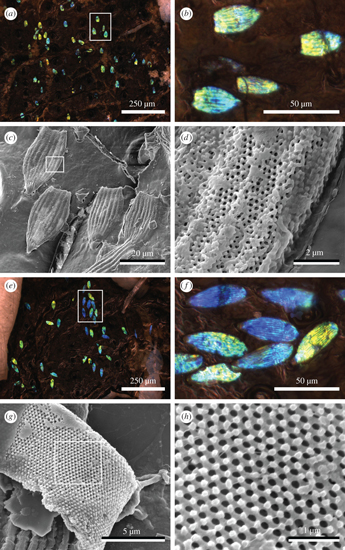
Scientists have been studying the preserved wing cases of ancient weevils to help them to better understand how the huge colour palette associated with insects evolved.  Writing in the academic, open-access journal “Biology Letters”, the researchers from University College Cork (Ireland), in collaboration with colleagues from Yale-NUS College in Singapore, subjected the preserved elytra of weevils found in Switzerland to powerful electron microscopy to analyse miniscule photonic nanostructures housed within the cuticular scales of the wing case.

Studying Weevil Fossils

The researchers conclude that the vibrant colours produced may have evolved as a form of crypsis (camouflage).

Pleistocene Weevil Scales Reveal Three-dimensional Photonic Nanostructures

Weevil scales from the Pleistocene reveal their secrets.
Pleistocene subfossil weevil scales from specimens L150D-L (a–d) and L150D-N (e–h) imaged using light microscopy (a, b, e, f) and SEM (c, d, g, h).  Light micrographs show the preservation of scales preserving bright blue, green and yellow hues, while electron micrographs reveal three-dimensional photonic nanostructures (b, d, f, h).  Regions bounded by white boxes in (a, c, e, g; a, e rotated 90° clockwise), respectively.

Picture credit: McDonald et al published in Biology Letters

Three-dimensional Photonic Nanostructures Housed within Scales

With only the preserved elytra (wing cases), to study the researchers could not pin down the exact genus, but the vibrant greens, yellows and blues produced by the light reflecting structures (photonic nanostructures), identified in the cuticular scales are reminiscent of the living weevil genera Polydrusus or Phyllobius.  Although the optical properties of these miniscule structures are well understood, their evolutionary history remains somewhat opaque.

The specimens, believed to be around ten to sixteen thousand years old, were subjected to scanning electron microscopy and small-angle X-ray scattering techniques that revealed that the elytra possess a single-diamond photonic crystal nanostructure.  These “diamonds” are one of numerous types of crystal-like nanostructure found in nature that interacts with light to produce vivid colours, often with an iridescent, metallic hue.

A Life Reconstruction of One of the Pleistocene Weevils

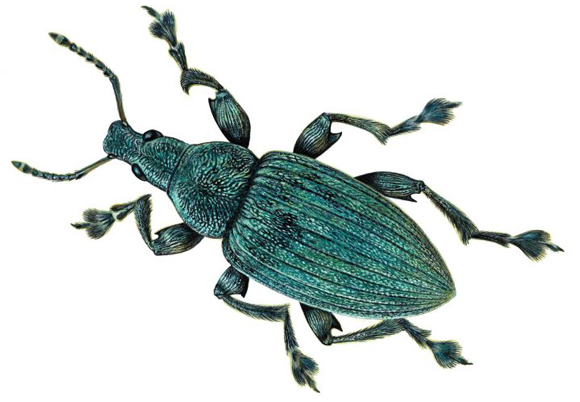
Ancient weevil life reconstruction.
A life reconstruction based on the Swiss Pleistocene subfossil.

Picture credit: James Mckay

Rarely Preserved in the Fossil Record

The preservation of three-dimensional nanostructures within the fossil record of the Insecta is extremely rare.  This study represents the second time such nanostructures have been found, the only other instance of such structures being recorded was discovered in another fossil weevil by two of the authors of this scientific paper Dr McNamara (University College Cork) and Assistant Professor Vinodkumar Saranathan (Yale-NUS College).

The team suggest that these hues evolved to allow the insects to blend into their background.  These substrate-matching green colours have been maintained over hundreds of thousands of generations suggesting that the same selective pressures for camouflage have been acting on these weevils over millennia.  This supports the idea that this type of colouration originally evolved to provide crypsis to prevent these small creatures being seen by potential predators.

The researchers suggest that the fossil record of insects, although sparse, could provide further evidence regarding the evolutionary history of colouration within the Insecta.

The scientific paper: “Brilliant angle-independent structural colours preserved in weevil scales from the Swiss Pleistocene” by Luke T. McDonald, Suresh Narayanan, Alec Sandy, Vinodkumar Saranathan and Maria E. McNamara published in Biology Letters.

Visit the Everything Dinosaur website: Everything Dinosaur.
16 04, 2020

Amazing Fossils Inspire Aeronautical Engineers

By |2024-02-17T18:28:23+00:00April 16th, 2020|Categories: Dinosaur and Prehistoric Animal News Stories, Dinosaur Fans, Main Page, Photos/Pictures of Fossils|0 Comments

Fossils Influence Mechanical Designs in the Aeronautical Industry

In vertebrates, powered flight has evolved independently in several groups, within the mammals there are the bats and within the Archosauria clade, other types of animal have evolved the ability to take to the air and to keep themselves airborne.  We have the birds, but also their close cousins the non-avian dinosaurs, as palaeontologists have discovered numerous examples of volant dinosaurs (Microraptor, Ambopteryx and Yi qi for instance).

There are also the pterosaurs, some of which were the largest flying animals to have ever existed with wingspans measuring more than ten metres across.  Engineers are now taking a serious look at some of the different types of wing morphology that have evolved.  The fossil record is helping to inspire new thinking in mechanical design.

The Recently Described Giant Azhdarchid Pterosaur Cryodrakon boreas Helping to Inspire New Ideas in Mechanical Design

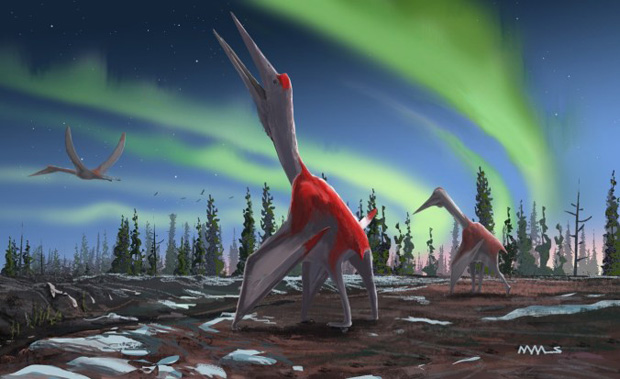
The Canadian azhdarchid pterosaur C. boreas.
A life reconstruction of the Canadian pterosaur Cryodrakon boreas.  A giant Late Cretaceous pterosaur with a wingspan in excess of ten metres.

Picture credit: David Maas

The Evolution of Different Solutions to the Problem of Sustained Powered Flight

Living birds and insects have been studied to help find solutions to aeronautical problems encountered when designing new planes, helicopters and unmanned aircraft such as drones.  However, a team of scientists including researchers from Bristol University, the Natural History Museum of Los Angeles County and Queen Mary University (London), have examined what the fossil record can teach us about powered flight.

Lead author of a recently published paper in “Trends in Ecology & Evolution”, Dr Elizabeth Martin-Silverstone, explained that there were a select few pterosaur fossils that provide dramatic insights into the anatomy and morphology of wing membranes, which could influence the thinking of aeronautical engineers as they contemplate concepts such as vertical take-off and landing capabilities in drones.

The post-doctoral researcher commented:

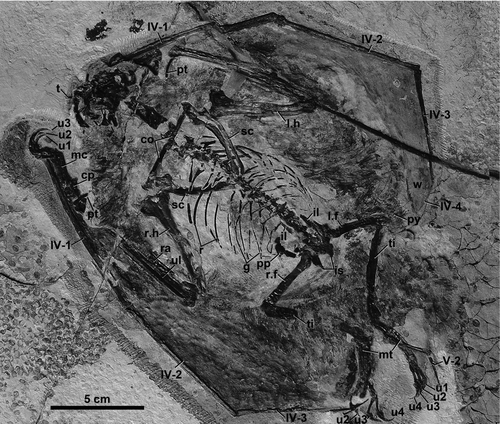
“There are two or three absolutely amazingly preserved pterosaur fossils that let you see the different layers within the wing membrane, giving us insight into its fibrous components.  Also, some fossils are preserved enough to show the wing attachments beneath the hip.  While you don’t know exactly the shape of the wing, by knowing the membrane attachments you can model the effectiveness of different wing shapes and determine which would have performed best in natural conditions.”

Beautifully Preserved Pterosaur Fossil Remains Helping to Inspire Engineers

Jeholopterus pterosaur fossil.
Pterosaur fossil material.  This is a fossil specimen of the anurognathid pterosaur Jeholopterus ninchengensis.  Some exquisitely preserved pterosaur fossils are helping to inspire the design ideas of aeronautical engineers.

Picture credit: Chinese Academy of Sciences/Journal of Vertebrate Palaeontology

Taking to the Air – A Big Leap Upwards

Taking to the air is a challenge in itself.  In the natural world, leaping or jumping to launch yourself into the air, using what is termed a ballistic launch is very common.  For larger birds, they require a running start in order to build up enough momentum before lift-off.

Pterosaurs, some of which weighed more than 250 kilograms and stood taller than a giraffe, may have developed a unique method of taking to the air from a stationary position.  For example, co-author Mike Habib (Natural History Museum of Los Angeles County), postulates that the wing membrane and powerful, robust associated muscle attachment within the wings allowed these flying reptiles to generate a high-powered leap off their elbows and wrists – providing the drive to enable them to become airborne.

Studying Pterosaur Fossils

The unique physiology of the Pterosauria, exquisitely laid out in some beautifully preserved fossil specimens might help engineers to overcome some of the launch problems associated with drones.  In essence, future biomechanical studies of long extinct creatures may influence the next generation of manned and unmanned aeronautical vehicles.

A number of different types of maniraptoran dinosaur came up with novel solutions when it came to flight. Whether or not animals such as the bizarre scansoriopterygid Yi qi were gliders or were capable of powered flight remains open to debate, but these bizarre evolutionary dead ends (extinct leaving no modern descendants), could help to drive innovative solutions to some of today’s aeronautical conundrums.

A Model of the Bizarre Scansoriopterygid Yi qi

Yi qi dinosaur model (PNSO).
A model of the bizarre scansoriopterygid Yi qi, the name of this bizarre dinosaur translates as “strange wing”.

The picture (above) shows a scansoriopterygid from the PNSO model range.

To view this range: PNSO Age of Dinosaurs.

Everything Dinosaur acknowledges the assistance of a media release from the University of Bristol in the compilation of this article.

The scientific paper: “Volant Fossil Vertebrates: Potential for Bioinspired Flight Technology” by Elizabeth Martin-Silverstone, Michael B. Habib and David W.E. Hone published in Trends in Ecology & Evolution.

The Everything Dinosaur website: Everything Dinosaur.
13 04, 2020

Chirping Caribbean Coquí Frogs from the Oligocene

By |2024-02-17T15:52:48+00:00April 13th, 2020|Categories: Animal News Stories, Dinosaur and Prehistoric Animal News Stories, Main Page, Photos/Pictures of Fossils|0 Comments

The Oldest Record of a Frog from the Caribbean

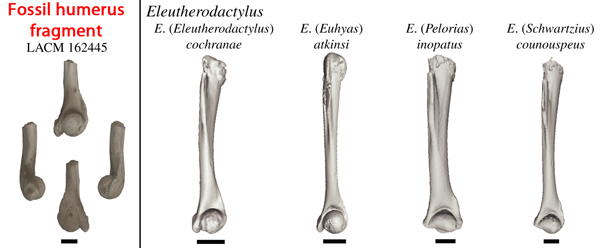
Researchers from the Florida Museum of Natural History (Florida University) and the Natural History Museum of Los Angeles County have published a scientific paper describing a portion of a left humerus (upper arm bone), discovered in north-western Puerto Rico that represents the oldest fossil remains of a frog ever found in the Caribbean.  The tiny bone, it measures less than one centimetre in length, has been assigned to the genus Eleutherodactylus, colloquially called coquí frogs in reference to the distinctive “coe-kee” call made by the males of some species as they seek to attract a mate.

The Fossilised Humerus is Compared to the Humeri of Extant Genera

Comparing the fossil material to extant genera.
Comparisons of the fossil specimen to representatives of each extant Caribbean frog genus as well as each Caribbean subgenus of Eleutherodactylus (Eleutherodactylus, Euhyas, Pelorias and Schwartzius).  Note various views LACM 162445 anterior, medial, posterior and lateral views.  Scale bar = 1 mm.

Picture credit: Blackburn et al (Biology Letters) with additional annotation by Everything Dinosaur

The authors of the scientific paper comment that it is fitting to have discovered this fossil bone in Puerto Rico, as the coquí is one of the national symbols associated with this tropical island.

From the San Sebastian Formation and Estimated to be 29 Million Years Old

The tiny bone was found by co-author Jorge Velez-Juarbe (Natural History Museum of Los Angeles County), in a mudstone layer of the San Sebastian Formation, exposed by a river (Rio Guatemala), in the north-western portion of the island, close to the town of San Sebastián.  The mudstone layer has been dated to 29.47 million years ago (+/- 300,000 years) and it represents an estuarine environment.  Other vertebrate fossils associated from this location include turtles, gharials and rodents.

Commenting on the discovery, lead author David Blackburn (Florida Museum of Natural History), stated:

“It’s a national treasure.  Not only is this the oldest evidence for a frog in the Caribbean, it also happens to be one of the frogs that are the pride of Puerto Rico and related to the large family Eleutherodactylidae, which includes Florida’s invasive greenhouse frogs.”

A Life Reconstruction of the Prehistoric Frog

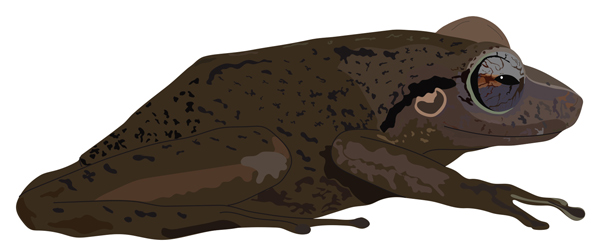
Ancient frog from the Oligocene of Puerto Rico.
The 29-million-year-old Eleutherodactylus frog life reconstruction. Based on measurements of the partial humerus, the scientists estimate the extinct frog to have measured around 4 centimetres in length.

Picture credit: Jorge Velez-Juarbe (Natural History Museum of Los Angeles County)

Looking for Evidence of Oligocene Frogs

Scientists studying data from phylogenetic assessments had postulated that these types of frogs had established themselves in the Caribbean during the Oligocene but until now there was no fossil evidence to support this line of research.  The bones of frogs tend to have a poor preservation potential.   They are small, light and any corpse would very likely, quickly decompose in the hot, humid tropical conditions.

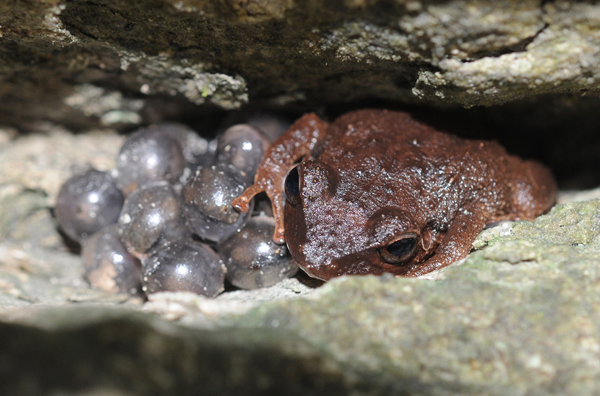
Possibly first arriving in the Caribbean by rafts of vegetation displaced from South America, these small tree frogs in the genus Eleutherodactylus, which encompasses some 200 species, dominate the Caribbean today.  Coquís differ from most other frogs as they usually do not lay their eggs in water.  They do not have a hatching tadpole stage, instead the tadpole stage takes place within the egg, the male carefully tending the nest and ensuring that the eggs remain moist.  When the eggs hatch, the young emerge as fully formed froglets.

A Male Coquí Frog Protecting a Clutch of Eggs

Male coquí frog protecting a clutch of eggs.
A male coquí frog protecting a clutch of eggs.

Picture credit: Jorge Velez-Juarbe (Natural History Museum of Los Angeles County)

Everything Dinosaur acknowledges the assistance of a media release from the University of Florida in the compilation of this article.

The scientific paper: “The earliest record of Caribbean frogs: a fossil coquí from Puerto Rico” by David C. Blackburn, Rachel M. Keeffe, María C. Vallejo-Pareja and Jorge Vélez-Juarbe published in Biology Letters.

The Everything Dinosaur website: Everything Dinosaur.
12 04, 2020

Homo erectus Originated in Africa

By |2024-02-17T06:42:21+00:00April 12th, 2020|Categories: Dinosaur and Prehistoric Animal News Stories, Main Page, Photos/Pictures of Fossils|0 Comments

Homo erectus Evolved Earlier Than Previously Thought

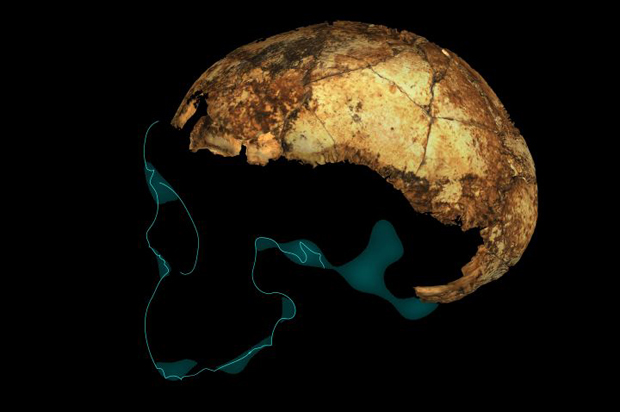
A partial skull, painstakingly reconstructed from more than 150 fragments has revealed that Homo erectus existed at least 100,000 years earlier than previously thought.  In addition, the fossil remains, excavated from the Drimolen Fossil Hominin site in the Cradle of Humankind, northwest of Johannesburg (South Africa), suggest that this hominin evolved in Africa and not in Asia.

The Reconstructed Partial Skull of the Homo erectus Infant from the Drimolen Fossil Hominin Site

Partial H. erectus cranium from the Drimolen Fossil Hominin site.
The partial H. erectus cranium (specimen number DNH 134),  from the Drimolen Fossil Hominin site.  The skull pieces have been carefully reconstructed and superimposed on the outline of a Homo erectus skull.

Picture credit: La Trobe University (Australia)

The African Origins of Homo erectus

This week, an academic paper has been published in “Science” detailing the research into a fragmented hominin skull representing a toddler that was approximately 2-3 years old.  The Drimolen Fossil Hominin site was discovered in 1992 by geologist André Keyser.  The sediments represent cave deposits but as the rocks that made up the caves have been eroded away, the breccias in which the fossils are located are exposed.  The site is one of the most important in the world for early hominin remains, with more than a hundred individual fossil specimens described to date.

Lead author of the study and project director Professor Andy Herries (La Trobe University), explained that it had taken five years to excavate the specific fossil site and retrieve all the skull fragments.

He stated:

“The Homo erectus skull we found, likely aged between two and three years old when it died, shows its brain was only slightly smaller than other examples of adult Homo erectus.  It samples a part of human evolutionary history when our ancestors were walking fully upright, making stone tools, starting to emigrate out of Africa, but before they had developed large brains.”

Dating the Fossil Skull Fragments

The fossilised fragments, first spotted by student Richard Curtis during field work five years ago, were subjected to a variety of dating techniques including uranium-lead dating of associated flowstones, palaeomagnetism of sediments and uranium-series electron spin resonance using fossil teeth found in the same strata.  Each of these different dating methods produced a constrained dating range for the site.

The fossils from the Drimolen Fossil Hominin Main Quarry were between 2.04-1.95 million years of age.  This indicates that the skull fragments are around two million years old, suggesting that Homo erectus existed some 100,000 to 200,000 years earlier than previously thought.  In addition, prior to the publication of this paper, the oldest H. erectus fossil specimen known had been found in Georgia (Dmanisi).  It had been dated to between 1.85 and 1.78 million years ago and consequently scientists had argued that Homo erectus evolved in Asia, but this newly described, much older fossil skull supports the theory, that like most other types of hominid, H. erectus originated in Africa.

Professor Herries explained that unlike the world today, where our species (Homo sapiens), is the only hominin in existence, in southern Africa around two million years ago, our direct ancestors shared the environment with other hominins and closely related species.

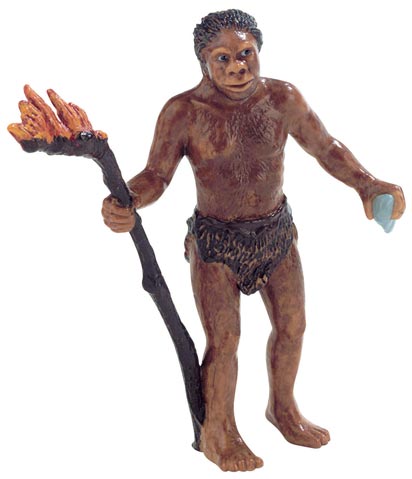
A Model of H. erectus (Bullyland Figure)

H. erectus illustration.
The dating of the Drimolen skull fragments suggest that this hominin lived 2 million years ago.  Homo erectus mastered fire and made stone tools.

The picture (above) shows a hominin figure from the Bullyland model range.

To view this range of figures: Bullyland Figures.

The professor stated:

“We can now say Homo erectus shared the landscape with two other types of humans in South Africa, Paranthropus and Australopithecus.  This suggests that one of these other human species, Australopithecus sediba, may not have been the direct ancestor of Homo erectus, or us, as previously hypothesised.”

Different Hominins with Different Adaptations Sharing the Same Environment

The paper, is one of a number published recently that leads to the conclusion that several early types of human shared the same environment.  Palaeoanthropologists now have an intriguing question to answer – how did these different species, with quite different adaptations co-exist?

Co-author of the scientific paper, Dr Justin Adams (Monash University, Melbourne, Australia), suggested that the new date for the Drimolen skull raised fascinating questions about how different species survived in the same landscape, but eventually as habitats changed, what role did Homo erectus play, if any in the extinction of the other species.  Furthermore, how did Homo erectus survive and yet australopithecines and Paranthropus did not?

Similar Trends in Mammal Species from the Pleistocene

The authors of the paper, note a similar trend in other mammal species in southern Africa during the Pleistocene Epoch.  For instance, more than one species of prehistoric felid from the genus Dinofelis has been recorded from this area.  South African fauna during the Early to Middle Pleistocene comprised a mixture of different evolutionary lineages, a mixed community of ancient and more modern mammalian species.

An Illustration of a Prehistoric Cat – Dinofelis

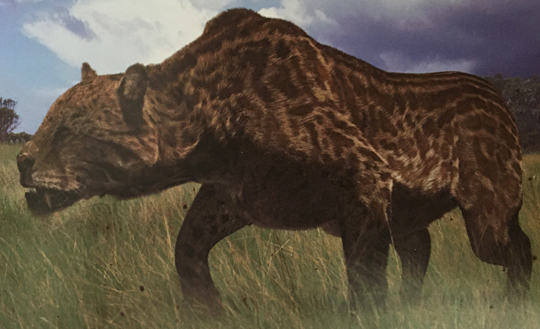
Prehistoric cat Dinofelis.
The prehistoric cat Dinofelis.  These agile predators probably hunted hominins.

Picture credit: BBC

The publication of this paper and the study into Homo heidelbergensis reported upon by Everything Dinosaur earlier this week, suggests that we still have a lot to learn about our origins.

The H. heidelbergensis article: Homo heidelbergensis Younger Than Previously Thought.

The Everything Dinosaur website: Everything Dinosaur.
9 04, 2020

Massospondylus Eggs Give Up Their Secrets

By |2024-02-16T17:15:06+00:00April 9th, 2020|Categories: Dinosaur and Prehistoric Animal News Stories, Dinosaur Fans, Main Page, Photos/Pictures of Fossils|0 Comments

Dinosaur Eggs from the Late Triassic Reveal Their Contents

Researchers from the University of Witwatersrand (Johannesburg, South Africa), have utilised the high-powered and intense energy of the European Synchrotron Radiation Facility (ESRF), located at Grenoble in France to unscramble the embryonic development of dinosaurs.  The study, published in the journal “Scientific Reports”, demonstrates that dinosaur embryos show many similarities to the embryonic development of their living archosaurian relatives – birds and crocodiles.  In addition, the scientists found that in the dinosaur studied (the Sauropodomorpha Massospondylus carinatus), a set of simple teeth developed, in addition to the teeth the animal would have when it hatched.

Massospondylus carinatus

These simple teeth (null-generation teeth), were either reabsorbed into the jawbone or shed prior to the animal breaking out of the egg.  This anatomical trait is found in crocodiles and lizards such as geckos (Order Squamata).

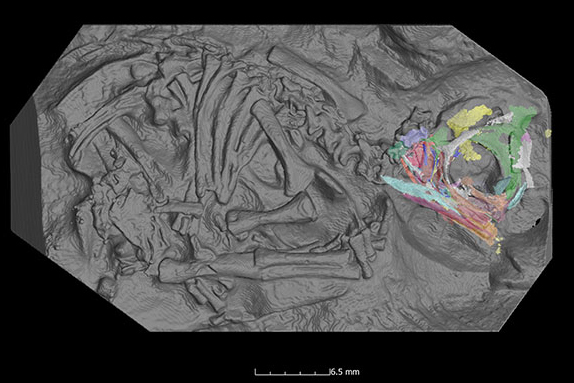
A Computer Generated Image of a Massospondylus Embryo Showing the Skull Bones

Synchrotron analysis to reconstruct dinosaur embryos.
Identifying the skull bones of Massospondylus carinatus using synchrotron analysis.  The individual bones of the tiny skull have been highlighted in different colours.

Picture credit: Dr Kimberley Chapelle (University of Witwatersrand)

Lizards are not members of the Archosauria, they are not closely related to dinosaurs (nor to birds or crocodiles for that matter), this suggests that the production of null-generation teeth that are lost prior to hatching is an embryonic trait which is basal within the Class Reptilia and that, in essence, the embryonic developmental pattern in reptiles was established early in their evolutionary history.

Digitally Reconstructing the Skulls of Baby Dinosaurs

In the study, led by Dr Kimberley Chapelle and Professor Jonah Choiniere of the Evolutionary Studies Institute, based at the University of Witwatersrand, three-dimensional, computer generated images were created of the less than 2 cm long skulls of the embryonic dinosaurs.  The clutch of eggs was discovered in 1976 at a location within the Golden Gate Highlands National Park (Free State Province), the fossil specimens represent some of the oldest dinosaur eggs known to science.

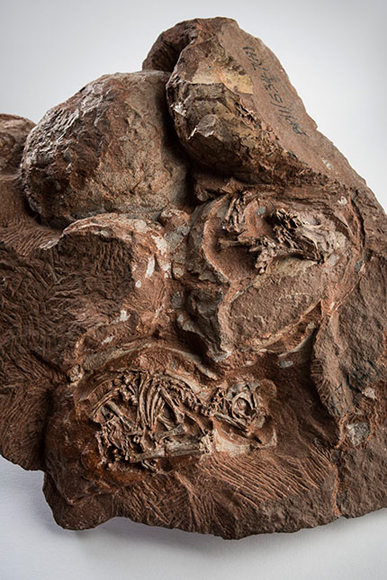
The Clutch of Massospondylus Eggs Discovered in 1976 (Free State Province)

Clutch of Massospondylus carinatus eggs discovered in 1976
The clutch of Massospondylus carinatus eggs discovered in 1976 and the subject of the new scientific paper.

Picture credit: Brett Eloff

Amongst the Rarest of Dinosaur Fossils

The fossilised remains of dinosaur embryos are among the rarest of all vertebrate fossils.  However, if palaeontologists can study them, then they can provide unique insights into the development of baby dinosaurs and permit comparison with the development of living archosaurs such as birds and crocodiles.

The powerful X-rays generated by the synchrotron allowed the researchers to obtain extremely detailed images of the fragile contents of the eggs, in what is a non-destructive technique.  The study commenced in 2015, when the fossils were transported to the ESRF at Grenoble.  It took nearly three years to process all the data generated back at the University, but the work was worth it as the scientists were able to reconstruct the delicate, tiny skulls of the dinosaurs in exquisite detail.

The fossil specimens were scanned at an unprecedented level of detail, the team were able to define and map individual cells within the fossilised bone.

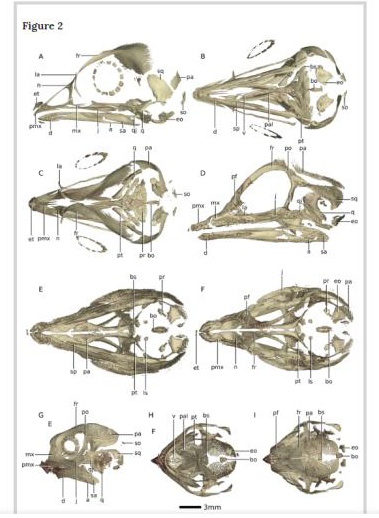
Views from Various Angles of the Tiny Skull of a Massospondylus Embryo

The skull of a Massospondylus embryo.
Views of the skull of an embryonic Massospondylus.  It took 3 years to process all the data generated from the synchrotron X-ray scans.

Picture credit: University of Witwatersrand/Scientific Reports

Working Out the Developmental Age of the Dinosaur Embryos

It had been thought that the fossilised Massospondylus eggs represented a clutch that had perished just prior to hatching.  An analysis of the state of the skull bones and direct comparison with the development stages of crocodile, chicken, turtle and lizard embryos revealed that the Massospondylus embryos were much younger than previously thought.  These dinosaur babies were only 60% of the way through their incubation.  This makes them some of the ontogenetically youngest dinosaur embryos known.  All other dinosaur embryos in the literature with ontogenetic age estimates are believed to represent dinosaurs in the last third of their development in the egg or close to hatching.

Hatching Massospondylus Dinosaurs in the Late Triassic of South Africa

Massospondylus nesting site - life reconstruction.
Massospondylus (basal Sauropodomorpha) nesting site.  The study provided new information on  how to estimate the ontogenetic age of dinosaur embryos.

Picture credit: Julius Csotonyi

The Discovery of Null-generation Teeth in Dinosaur Embryos

Furthermore, the researchers discovered that each tiny embryo had two types of teeth preserved in its developing jaws.  One set was very similar to the teeth associated with Massospondylus adults, the second set consisted of tiny, very simple triangular teeth that were either reabsorbed into the jaw or shed prior to hatching.  These types of teeth are referred to as null-generation teeth and they are found in crocodilians and some types of extant lizard embryos such as geckos.

An Illustration of the Tooth Crowns of an Adult Massospondylus

Adult Massospondylus dinosaur teeth.
The teeth of an adult Massospondylus dinosaur.  The teeth of Massospondylus are proportionately quite long and the crowns end in a broad, leaf-shaped structure with distinctive ridges on their tips and sides.

Picture credit: Everything Dinosaur from Gow et al (University of Witwatersrand)

Commenting on the discovery of null-generation teeth in the jaws of the dinosaur embryos, lead author, Dr Chapelle stated:

“I was really surprised to find that these embryos not only had teeth, but had two types of teeth.  The teeth are so tiny, they range from 0.4 to 0.7 mm wide.  That’s smaller than the tip of a toothpick!”

The scientists conclude that dinosaurs developed in their eggs in very similar ways as extant archosaurs, so what we know about the development of birds and crocodiles in the egg can be confidently applied to extinct archosaurs such as dinosaurs and pterosaurs too.  The development traits shared with members of the Squamata Order (lizards and snakes) would permit these findings to be applied generally to a much wider variety of extinct reptiles, such as those assigned to the Lepidosauria clade, the sister clade to the Archosauria, reptiles on a different branch of the Reptilia family tree.

Synchrotron Analysis Likely to Lead to Further Insights into Dinosaur Development

The research team hope to utilise the thousands of scans they have amassed to better understand the post-cranial development of sauropod dinosaurs.  They will be examining the rest of the skeleton of the Massospondylus embryos to see if this dinosaur shares similarities in development with extant archosaurs.  The scientists hope to shed further light on how these dinosaurs moved about when they first emerged from the nest.  Palaeontologists think that these types of dinosaurs hatched as bipeds before adopting a quadrupedal stance as these animals grew and matured.

Everything Dinosaur acknowledges the assistance of a media release from the University of Witwatersrand in the compilation of this article.

The scientific paper: “Conserved in-ovo cranial ossification sequences of extant saurians allow estimation of embryonic dinosaur developmental stages” by Kimberley E. J. Chapelle, Vincent Fernandez and Jonah N. Choiniere published in Scientific Reports.

Visit the Everything Dinosaur website: Everything Dinosaur.
6 04, 2020

New Study Suggests Homo heidelbergensis Younger Than Previously Thought

By |2024-02-09T08:19:47+00:00April 6th, 2020|Categories: Dinosaur and Prehistoric Animal News Stories, Main Page, Palaeontological articles, Photos/Pictures of Fossils|0 Comments

Dating the Broken Hill Skull – H. heidelbergensis Younger than Previously Thought

Palaeoanthropologists have long recognised that the evolution of the hominins and our own species (Homo sapiens), was complicated and not simply a linear transgression from one species to another.  Human fossil remains are exceptionally rare and sometimes, a new study can upend previously assumed concepts and ideas.  For example, a team of scientists including researchers from the Natural History Museum (London), Australian National University (Canberra), University College Dublin, Muséum national d’Histoire naturelle (Paris), University of the Free State (South Africa), University of Wollongong (Queensland), University of Southampton and Griffith University (Queensland), have published new dating information for a hominin skull discovered in 1921.

The skull representing Homo heidelbergensis turns out to be much younger than previously thought.

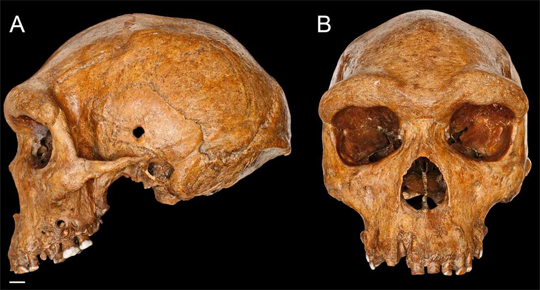
The Famous Broken Hill Skull (Kabwe 1) Homo heidelbergensis

The famous H. heidelbergensis skull (Kabwe 1).
Views of the Broken Hill Skull (Kabwe 1).  Left lateral view (A) and anterior view (B).

Picture credit: The Trustees of the Natural History Museum

Studying Homo heidelbergensis

Writing in the academic journal “Nature”, the researchers conclude that this skull, previously thought to be around half a million years old, was much younger with an estimated date of between 274,000 and 324,000 years of age.  This result suggests that in the later stages of the Middle Pleistocene of Africa (Chibanian stage), there were many different types of hominin living at the same time.  Homo sapiens, H. heidelbergensis/H. rhodesiensis and Homo naledi were all contemporaneous.

The Broken Hill Skull

The skull studied, referred to as the Broken Hill specimen, currently resides in the collection of the Natural History Museum (London) and is on display in the Human Evolution gallery, but there are ongoing discussions about the return of this fossil to Africa.

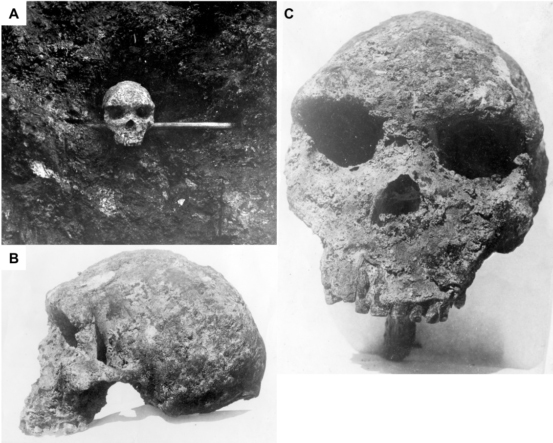
The skull was discovered in 1921 by an African miner and his Swiss co-worker Tom Zwigelaar at the lead and zinc mine located at Broken Hill, which at the time was in northern Rhodesia but is now Kabwe in Zambia, hence the reference to the fossil skull as Kabwe 1.  Other fragmentary human remains were also found at the mine (partial upper jaw, tibia, sacrum and two elements from a femur from another individual).  The fossils were donated by the mining company to the then British Museum (Natural History Museum), at the time of their discovery anthropologists regarded these fossils as the most significant hominin fossils found on the African continent.

Early Photographs of Kabwe 1 (Broken Hill Skull)

Original photographs of the Broken Hill skull (Homo heidelbergensis).
Original photographs of the Broken Hill skull (H. heidelbergensis).

Picture credit: Griffith University (Queensland)

Problems Dating the Skull and Fossil Bones

Nearly a hundred years ago, data recording surrounding such an important fossil discovery was nowhere near as thorough at it is today.  Mining work continued in the area where the skull and other bones had been found so any evidence to help accurately date the fossils was subsequently lost.  Assigned to Homo heidelbergensis, the skull was originally dated to around 500,000 years ago.  However, these researchers, led by Professor Rainer Grün (Environmental Futures Research Institute at Griffith University), subjected the skull and the other hominin fragments from the site to radiometric dating and determined that these people lived between 274,000 and 324,000 years ago.

Commenting on the importance of this research, Professor Grün stated:

“The new best age estimate of the fossil impacts our understanding of the tempo and mode of modern human origins”.

One of the co-authors of the scientific paper, Professor Chris Stringer (Natural History Museum), added:

“Previously, the Broken Hill skull was viewed as part of a gradual and widespread evolutionary sequence in Africa from archaic humans to modern humans.  But now it looks like the primitive species Homo naledi survived in southern Africa, H. heidelbergensis was in Central Africa, and early forms of our species existed in regions like Morocco and Ethiopia.”

Homo rhodesiensis and Piltdown Man

It was Sir Arthur Smith Woodward, the curator of the Geology Department at the British Museum who proposed the new species Homo rhodesiensis to describe the Kabwe 1 skull as “Rhodesian Man”.  However, most scientists now consider H. rhodesiensis to be junior synonym of H. heidelbergensis or possibly an African sub-species of it.  Despite a prestigious academic career, Sir Arthur is best remembered for his association with the Piltdown Man hoax of 1912.  Even on his deathbed, he still believed that the fossil remains found in a Sussex gravel bed at Barkham Manor, near to Piltdown Common, represented a species of archaic human, unlike any other species of early hominin known to science.

Unfortunately, for Sir Arthur, five years after he died, new dating techniques proved the human skull bones from the site to be less than 500 years old.

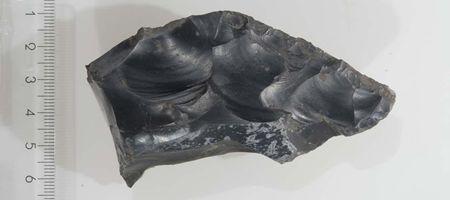
The new, younger date for the Kabwe 1 skull also casts a cloud over the provenance of stone tools associated with hominin fossils from the late Middle Pleistocene.  As scientists have evidence to indicate Homo heidelbergensis present in Africa as recently as 300,000 years ago, stone tools from this date may not have been crafted by our species.

Not All the African Stone Tools Around 300,000 Years of Age Can be Ascribed to our own Species

Heidelbergensis flint spear.
Crafted with considerable skill – a flint spear point associated with Homo heidelbergensis.  The much younger age of the Kabwe 1 specimen casts doubts about which species made the stone tools associated with Middle Pleistocene hominin fossils.

Picture credit: Dr Nicholas Conrad/University of Tubingen

The new age estimate for Kabwe 1 raises questions about our own evolution.  It casts doubts on the presumption that H. heidelbergensis/H. rhodesiensis was a direct ancestor of our species Homo sapiens.  This research suggests that there were multiple contemporaneous hominin lineages in Africa during the later stages of the Middle Pleistocene, reflecting a similar model found in Eurasia.

  • African hominins (late Middle Pleistocene) – H. sapiens, H. nalediH. heidelbergensis/H. rhodesiensis
  • European/Asia hominins (late Middle Pleistocene) – H. neanderthalensis, H. luzonensis, H. floresiensis, the Denisovans and perhaps also H. heidelbergensis and H. erectus

Everything Dinosaur acknowledges the assistance of a media release from Griffith University in the compilation of this article.

The scientific paper: “Dating the skull from Broken Hill, Zambia, and its position in human evolution” by Rainer Grün, Alistair Pike, Frank McDermott, Stephen Eggins, Graham Mortimer, Maxime Aubert, Lesley Kinsley, Renaud Joannes-Boyau, Michael Rumsey, Christiane Denys, James Brink, Tara Clark and Chris Stringer published in Nature.

To read an article about the presence of H. heidelbergensis in Kent: Giant Prehistoric Straight-tusked Elephant Butchered by H. heidelbergensis.

The Everything Dinosaur website: Everything Dinosaur.
26 03, 2020

New Study Suggests Late Cretaceous Southern United States Had “Raptors” Too

By |2024-01-20T12:46:34+00:00March 26th, 2020|Categories: Dinosaur and Prehistoric Animal News Stories, Dinosaur Fans, Main Page, Palaeontological articles, Photos/Pictures of Fossils|0 Comments

Dineobellator notohesperus – A Velociraptorine with Extra Attitude!

Scientists have described a new species of “raptor” from the Late Cretaceous of New Mexico.  Described from fragmentary remains, this two-metre-long carnivore was related to Velociraptor.  It may have been roughly the same size as the Mongolian genus, but it probably was even more agile with a stronger grip.  Its discovery suggests that the dromaeosaurids were diversifying right up to the end of the Age of Dinosaurs.

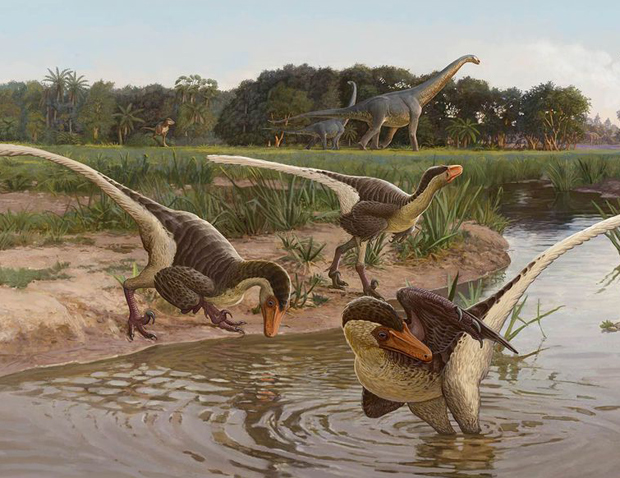
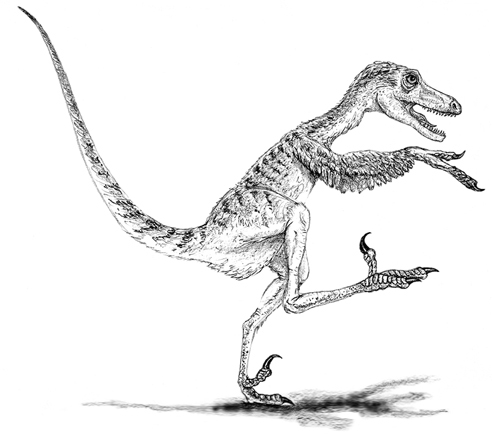
Life Reconstruction Dineobellator notohesperus (Maastrichtian of New Mexico)

Dineobellator Life Reconstruction
A trio of the newly described dromaeosaurid from the Late Cretaceous of New Mexico (Dineobellator) gather at a waterhole.  The titanosaur Alamosaurus passes by in the background and in the distance a tyrannosaur is approaching.

Picture credit: Sergey Krasovskiy

Dineobellator notohesperus

Writing in the academic journal “Scientific Reports”, the researchers from The University of Pennsylvania and the New Mexico Museum of Natural History and Science, describe a partial, skeleton excavated from the Bisti/De-na-zin Wilderness of New Mexico, found within a few metres above the base of the Naashoibito Member.  The coarse sandstone deposits are notoriously difficult to date, these sediments were deposited towards the end of the Cretaceous between 70 and 66.3 million years ago (Maastrichtian faunal stage).

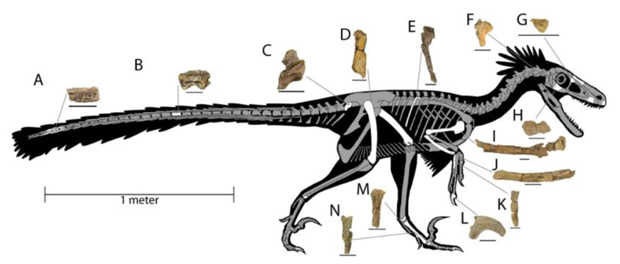
Fossil material includes parts of the skull, elements from the jaws, fragments of vertebrae, tail bones (caudal vertebrae), one rib with other pieces of rib and limb bones including a nearly complete right upper arm bone (humerus) and a nearly complete right ulna (bone from the forearm).  The first fossilised remains were found in 2008, subsequent field work carried out in 2009, 2015 and 2016 yielded more fossil material, mostly very fragmentary in nature.  It is believed all the fossil material, including a claw from the right hand, represents the remains of a single dinosaur.

A Skeletal Reconstruction of Dineobellator notohesperus

Known fossil material and skeletal reconstruction of Dineobellator.
A silhouette and postulated skeleton of Dineobellator (known fossil material in white).

Picture credit: Jasinski et al/Scientific Reports

A Small but Dangerous Dinosaur

Dineobellator notohesperus is the first dromaeosaurid to be described from the southern United States.  It would have lived in the south of the Cretaceous landmass of Laramidia.  Although no evidence of feathers has been found, the ulna shows evidence of a row of small rounded pits in the bone, interpreted as anchor points for large feathers on the arm (ulna papillae).  Analysis of the forelimbs suggest that Dineobellator had stronger arms with a more powerful grip.  A study of the tail bones suggest that the tail had greater movement which would have made this dinosaur adept at making sharp turns and agile changes of direction.

The researchers suggest these anatomical traits provide an insight into how this small theropod hunted and behaved.

The researchers, which include Dr Steven Jasinski (Department of Earth and Environmental Science, University of Pennsylvania), postulate that Dineobellator was an active predator that occupied a discrete ecological niche in the food chain whilst living in the shadow of Tyrannosaurus rex.

The newest North American “raptor” Dineobellator notohesperus is pronounced dih-nay-oh-bell-ah-tor noh-toh-hes-per-us and the genus name comes from the native Navajo word “Diné”, a reference to the Navajo Nation and the Latin word “bellator” which means warrior.  The trivial name has been erected to acknowledge the location of the fossil find.  The word “noto” is from the Greek meaning southern and “hesper” the Greek for western.  This is an acknowledgement that Dineobellator roamed the south-western part of the United States.  In addition, Hesperus is a reference to a Greek god, the personification of the evening star (Venus) and by extension “western”.

Dr Jasinski has already had a considerable impact on the Dromaeosauridae family.  Back in 2015, Everything Dinosaur reported on the formal description of Saurornitholestes sullivani, a dinosaur named by Steven Jasinski whilst a PhD student at the University of Pennsylvania.  To read more about S. sullivaniSniffing Out a New Dinosaur Species.

An Illustration of Saurornitholestes sullivani

Saurornitholestes sullivani illustrated
An agile dinosaur, an illustration of Saurornitholestes sullivani.  Although the fossil material associated with this species was found in New Mexico, S. sullivani lived several million years earlier than Dineobellator notohesperus. Picture credit: Everything Dinosaur.
Picture credit: Everything Dinosaur

A Tough Life for a Tough Dinosaur

A phylogenetic analysis undertaken by the research team places Dineobellator within the Velociraptorinae subfamily of the Dromaeosauridae.  Other Maastrichtian “raptors” known from North America are few and far between (Acheroraptor and Dakotaraptor – both from the Hell Creek Formation).  The discovery of Dineobellator suggests that dromaeosaurids were still diversifying at the end of the Cretaceous and as an velociraptorine, its fossils lend further weight to the idea that faunal interchange between Asian and North American dinosaurs took place sometime during the Campanian/Maastrichtian.

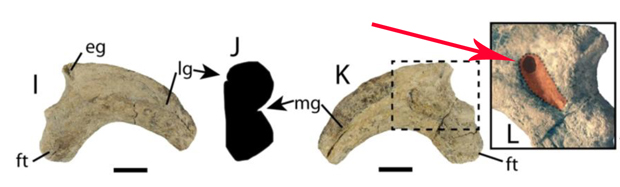
It is not known whether Dineobellator notohesperus was a pack hunter.  The fossilised remains do indicate that this was one very tough dinosaur but it did not have everything its own way.  A rib shows a deformity, suggesting that this bone was broken, but the animal suffered this trauma a while before it died as the break is healed.  Intriguingly, the scientists identified a prominent gouge mark preserved on the hand claw (manual ungual).  This gouge mark, which measures nearly a centimetre long, terminates in a small depression.

The scientists suggest that this damage was not caused by disease or by any process associated with the preservation of the fossil bones.  The team suggest that this was an injury that occurred close to, or at the time of this dinosaur’s demise.

Injured in a Fight?

The researchers speculate that this Dineobellator received an injury in a fight with another Dineobellator or perhaps this damage to its hand claw was inflicted upon it by another type of predatory theropod.

Views of the Hand Claw of  Dineobellator notohesperus Showing Damage Interpreted as a Wound Inflicted by Another Theropod Dinosaur

The manual ungual of Dineobellator.
Views of the hand claw of Dineobellator.  The right manual ungual of Dineobellator notohesperus (I) lateral view, with (J) a silhouette of the transverse plane of the right manual ungual near the distal end.  Image (K) shows the claw in media view with the dashed area highlighted in (K) showing the gouge mark (L).  The red arrow indicates the pathology.  Scale bars equal 1 mm, please note (L) is not to scale.

Picture credit: Jasinski et al/Scientific Reports with additional annotation by Everything Dinosaur

The scientific paper: “New Dromaeosaurid Dinosaur (Theropoda, Dromaeosauridae) from New Mexico and Biodiversity of Dromaeosaurids at the end of the Cretaceous” by Steven E. Jasinski, Robert M. Sullivan and Peter Dodson published in Scientific Reports.

The Everything Dinosaur website: The Everything Dinosaur Website.

Go to Top