Nanotyrannus lancensis Fossils and the Link to Edmontosaurus annectens
Recently, Everything Dinosaur posted up an article featuring the research work undertaken on an extensive Edmontosaurus (E. annectens) bonebed located at Hanson Ranch in eastern Wyoming. The dinosaur fossils associated with the five quarries and three exploratory quarries are almost entirely representative of Edmontosaurus annectens. Approximately, 94 percent of all the dinosaur bones found at this site represent this Edmontosaurus species.
While the quarry is clearly dominated by the remains of Hadrosauridae, the researchers report finding a few skeletal elements assigned to bird-hipped dinosaurs such as ceratopsids, pachycephalosaurs, armoured dinosaurs (nodosaurids) and small ornithopods associated with the Thescelosauridae family. Such a large number of Edmontosaurus carcasses did not go unnoticed by carnivorous theropods. Shed teeth from meat-eating dinosaurs are common in the bonebed, evidence of these animals scavenging the decaying Edmontosaurus remains. The most common teeth associated with Hanson Ranch have been ascribed to the Dromaeosauridae and Troodontidae with the larger teeth identified as Tyrannosauridae.
The Fossil Bones of Nanotyrannus lancensis
Nanotyrannus (N. lancensis), is a controversial genus of tyrannosaurid dinosaur known from several fossil specimens including a remarkable fossil found in association with a ceratopsid nick-named “Bloody Mary”. The validity of this taxon is debated. Many palaeontologists claim that fossils ascribed to Nanotyrannus (dwarf tyrant), represent the remains of juvenile, sub-adult Tyrannosaurus rex.
In the scientific paper, detailing the Edmontosaurus bonebed, reference is made to a Nanotyrannus fossil discovery. In 2001, the remains of the foot of a Nanotyrannus lancensis were found on the surface at a nearby site designated Stair Quarry (not included in the Edmontosaurus study). The paper cites that over the next fifteen years or so, fifty additional bones from this specimen including a right maxilla with teeth in situ and a left dentary, also with some teeth present were discovered.
A PNSO Model of the Controversial Genus Nanotyrannus
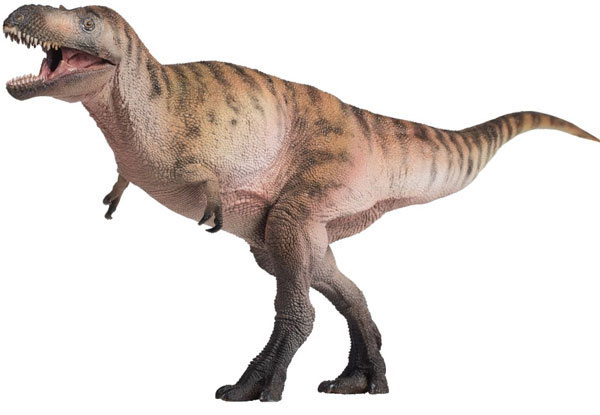
The PNSO Nanotyrannus dinosaur model.
The picture (above) shows the PNSO Nanotyrannus dinosaur model.
In the scientific paper, the researchers comment that although these fossil remains have yet to be formally scientifically described, they have enabled the research team to clearly distinguish the slender, blade-like shed teeth of Nanotyrannus from the more robust, D-shaped crushing teeth of Tyrannosaurus, both of which are commonly found in the bonebed. It is intriguing to speculate that if this material ascribed to Nanotyrannus is studied extensively, then it might prove helpful in resolving the debate over the validity of the Nanotyrannus genus.
A Comprehensive Guide to the Fossils from the Kem Kem Beds of Eastern Morocco
A team of international researchers have documented the fossil vertebrates associated with the early Late Cretaceous (Cenomanian-Turonian) of the famous Kem Kem beds of eastern Morocco. They conclude that with the abundance of hypercarnivores such as Spinosaurus, abelisaurids, Carcharodontosaurus and Deltadromeus, several large pterosaurs and a multitude of giant fish and crocodyliforms, no comparable modern terrestrial ecosystem exists with a similar bias toward large-bodied carnivores.
Arguably, the sediments that make up the Kem Kem Group, which is composed of the lower Gara Sbaa and upper Douira formations, represent the most dangerous place and time in the whole of the Cretaceous.
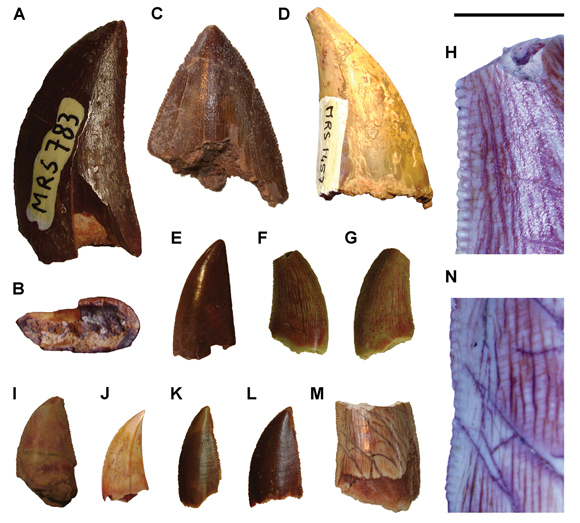
Examples of Theropod Teeth Associated with the Kem Kem Group of Eastern Morocco
Indeterminate theropod teeth from the Kem Kem Group with (H) showing the denticles of (F) and (N) close up view of denticles in (M). Scale bar equals 2 cm in A-C and I-M whilst 3 cm in D and 5 mm in H and N.
Picture credit: Ibrahim et al (ZooKeys)
An Ambitious Target
The researchers which included Nizar Ibrahim and Paul Sereno (University of Chicago), David Unwin (University of Leicester), Samir Zouhri (Université Hassan II, Casablanca, Morocco) and David Martill (University of Portsmouth), had an ambitious objective. The scientists set out to document and summarise the taxonomic status of the fauna that had been described based on the major collections of Kem Kem fossils, as well as to report on the geological age of the various strata and to plot the palaeoenvironment of this part of north Africa during the early stages of the Late Cretaceous.
The team’s comprehensive report has been published with free access in the journal ZooKeys.
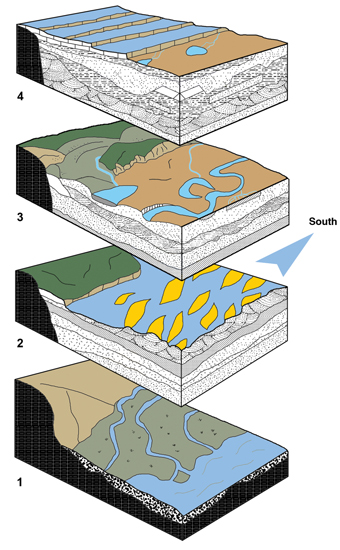
The Changing Palaeoenvironment Represented by the Kem Kem Group Sediments
Schematic paleoenvironmental stages depicting the Kem Kem region during the Cretaceous. Stages: (1) wide rivers, (2) large river systems with substantial sandbanks, (3) deltaic conditions and (4) rise of the limestone platform.
Picture credit: Ibrahim et al (ZooKeys)
A Very Dangerous Place to Be (Large Crocodyliforms and Pterosaurs)
The strata have provided evidence of large number of crocodyliforms from one-metre-long insectivores, herbivorous forms to giant predators such as Sarcosuchus imperator. Several different types of pterosaur are also associated with these deposits. The first pterosaur remains recovered consisted of isolated teeth collected in the late 1940s and early 1950s but at the time their affinity with the Pterosauria was not recognised. For an article from Everything Dinosaur about recent pterosaur discoveries from Morocco: Pterosaurs, Pterosaurs and Even More Pterosaurs.
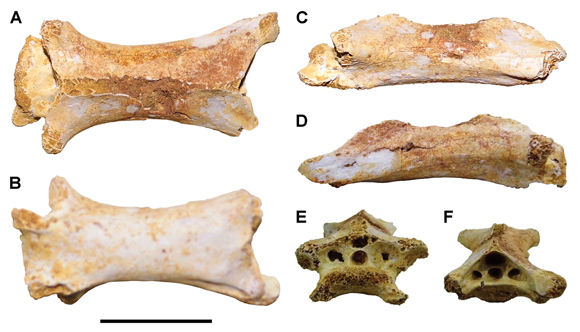
Cervical Vertebra (Bone from the Neck) Ascribed to an Azhdarchid Pterosaur
Near complete third cervical? of an azhdarchid pterosaur from the Kem Kem Group. FSAC-KK 3088 in (A) ventral, (B) dorsal, (C) right lateral, (D) left lateral, (E) anterior and (F) posterior view. Scale bar equals 5 cm.
Picture credit: Ibrahim et al (ZooKeys)
In addition, the first tapejarid pterosaur from Africa was reported recently (Afrotapejara zouhrii), the trivial name honours Professor Samir Zouhri, one of the authors of the extensive review. To read an article about Afrotapejara: The Fourth New Moroccan Pterosaur – Afrotapejara.
Lots and Lots of Dinosaurs – A Bias Towards the Theropoda
Dinosaurs are strongly associated with these strata, but there is only very fragmentary evidence of ornithischians including a single, large footprint. This suggests that bird-hipped dinosaurs were present but, in contrast to most other Cretaceous biotas, they seem very much underrepresented by the fossil material. Sauropods such as the rebbachisaurid Rebbachisaurus garasbae and titanosaurs are known from both the Douira and Gara Sbaa formations, however, it is theropod specimens that dominate the Dinosauria associated with the Kem Kem Group. There is evidence to support one medium-sized to large Kem Kem abelisaurid and the discovery of single neck bone (cervical vertebra) indicates a Noasauridae presence.
Huge hypercarnivores such as Carcharodontosaurus saharicus and Spinosaurus aegyptiacus have been reported. The habitat seemed to have an overabundance of large, carnivorous dinosaurs, although extensive niche partitioning is proposed by several authors.
Perhaps the Most Famous African Dinosaur of them all – Spinosaurus aegyptiacus
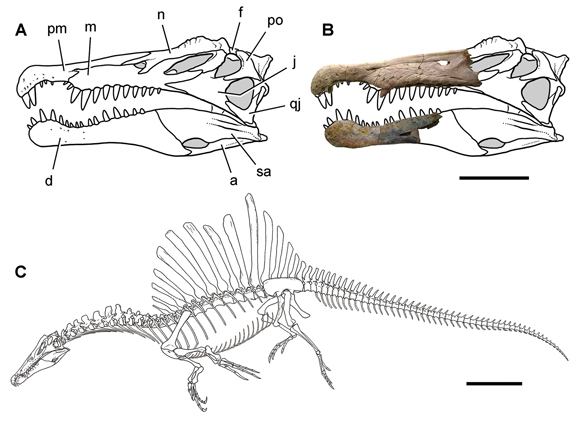
Skull and skeletal reconstruction of Spinosaurus aegyptiacus. Scale bars equal 40 cm in A and B, whilst in C the scale bar is 1 metre.
Picture credit: Ibrahim et al (ZooKeys)
Deltadromeus agilis
One of the most mysterious of all the theropods from Morocco is Deltadromeus agilis. The taxonomic position of this meat-eater remains controversial. A partial skeleton (UCRC PV11), was discovered in a coarse sandstone layer in the upper portions of the Gara Sbaa Formation. The bones were found in association with teeth of the huge sawfish Onchopristis as well as teeth from crocodyliforms. Fossils associated with D. agilis from eastern Morocco show a resemblance to isolated material recovered from the roughly contemporaneous Bahariya oasis in the Western Desert of Egypt by the German palaeontologist Ernst Stromer.
The Egyptian fossils were assigned to the taxon Bahariasaurus ingens, but the Moroccan and Egyptian material could represent the same genus. If this is the case, then D. agilis would become a senior synonym of B. ingens. A single thigh bone from the Bahariya oasis measures 144 cm long. This suggests that whatever sort of carnivore Deltadromeus/Bahariasaurus was, it was huge. Some commentators have suggested that based on femur proportions Deltadromeus could have been only slightly shorter (but more lightly built), than Tyrannosaurus rex.
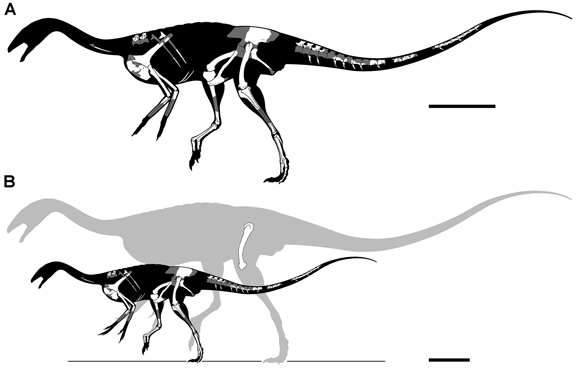
Holotype of D. agilis (A) and Compared in Size to the Egyptian Femur Specimen (B)
Deltadromeus agilis from Morocco and Egypt. A (A) revised reconstruction based on UCRC PV11 (B) holotype compared to a large femur (now lost) referred to the genus and species from the Bahariya Formation, Egypt. Known elements in white. Scale bars: 1 m.
Picture credit: Ibrahim et al (ZooKeys)
Sadly, like much of Stromer’s material from the Egyptian expeditions, the femur has been lost.
It is very likely that there were lots of smaller predatory dinosaurs too. Dromaeosaurid teeth have been reported from several localities but bones are exceptionally rare and the only positively identified dromaeosaurid skeletal elements are some foot bones found in Sudan and recovered from Cenomanian-age rocks.
A Predominance of Aquatic Predators
The authors state that the Kem Kem assemblage is dominated by aquatic and subaquatic invertebrates and vertebrates, the majority of which are predators. They suggest that as most of the taxa are exploiting aquatic food resources, then like modern marine food chains, the habitat is predator dominated. As to the overabundance of carnivorous dinosaurs compared to plant-eating ones, the researchers conclude that this is not due to sampling bias or preservation factors. Large theropods in the food web were supported primarily in the case of Spinosaurus or secondarily in the case of the terrestrial carnivores by the huge amount of aquatic protein sources.
The dissected deltaic plain and nearshore environments may have enhanced aquatic resources while limiting, or rendering patchy areas of available vegetation for large-bodied dinosaurian herbivores. Hence the bias towards carnivores when it comes to assessing the fossilised remains of dinosaurs from the Kem Kem beds.
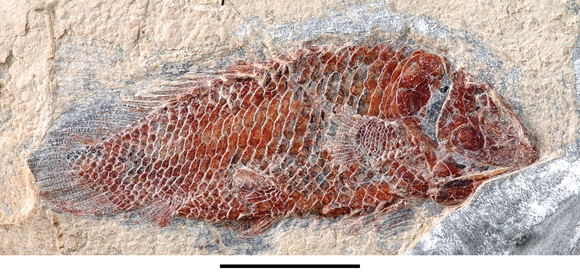
The Presence of So Many Carnivores could be Explained by the Abundance of Aquatic Food Sources such as Small Fish
Serenoichthys kemkemensis from the Douira Formation. Scale bar equals 1 cm. The abundance of predators could be explained by the large amount of aquatic protein sources present in the environment.
Picture credit: Ibrahim et al (ZooKeys)
The scientific paper: “Geology and paleontology of the Upper Cretaceous Kem Kem Group of eastern Morocco” by Nizar Ibrahim, Paul C. Sereno, David J. Varricchio, David M. Martill, Didier B. Dutheil, David M. Unwin, Lahssen Baidder, Hans C. E. Larsson, Samir Zouhri and Abdelhadi Kaoukaya published in ZooKeys.
Massive Edmontosaurus Bonebed Provides Data on Dinosaur Decomposition
A team of scientists have produced a study mapping an astonishing dinosaur bonebed that has so far yielded a staggering total of 13,000 individual fossil elements. In truth, the bonebed contains many more fossils, but individual dinosaur teeth, ossified tendons and other fragmentary elements under five centimetres in length have not been counted.
Edmontosaurus annectens
The site is located in eastern Wyoming and consists almost entirely of the preserved remains of a single type of dinosaur, a hadrosaur (Edmontosaurus annectens). The bonebed study has not only provided a great deal of information about this duck-billed dinosaur but shed light on how death assemblages consisting of a large number of corpses are formed and how various bones of differing sizes might be transported before final deposition.
Dinosaur Bonebeds such as the Danek Edmontosaurus regalis Bonebed in Edmonton Have Yielded Thousands of Fossil Bones
The Danek Edmontosaurus bonebed is typical of an Edmontosaurus-dominated bonebed which are widespread in the Upper Cretaceous (Campanian to Maastrichtian) of western North America).
Picture credit: Victoria Arbour
The Hanson Ranch Bonebed (Lance Formation)
Writing in the on-line, open access journal PLOS One, the scientists which include Keith Synder of the Biology Dept. of the Southern Adventist University, Tennessee, document the taphonomy and depositional history of an extensive E. annectens bonebed known as Hanson Ranch, in the Lance Formation of eastern Wyoming. The bonebed includes five main quarries and three exploratory quarries. Approximately 13,000 elements including around 8,400 identifiable bones, have been recovered in 506 square metres of excavated area in twenty years (1996-2016).
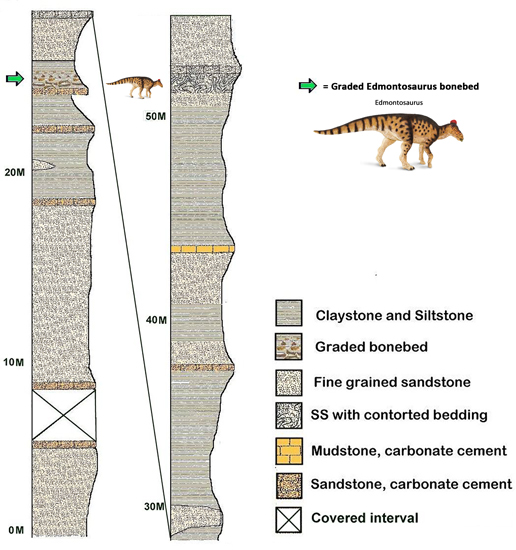
Virtually all the fossils are located within a fine-grained (claystone to siltstone) bed that has a maximum depth of two metres.
Mapping the Stratigraphy of the Main Bonebeds at the Hanson Research Station (Wyoming)
Local stratigraphy associated with the main bonebeds at the Hanson Research station. The green arrow indicates position of main bonebed.
Picture credit: Synder et al (PLOS One) with additional annotation by Everything Dinosaur
Edmontosaurus annectens Fossils in an Excellent State of Preservation
Almost all the fossils recovered from the site exhibit exquisite preservation with little or no abrasion, breakages or signs of weathering prior to deposition. All the material is disarticulated and scattered although over a relatively confined area. This evidence in conjunction with analysis of the sediments associated with the fossils indicates that the bones were moved and buried after a period of initial decay and decomposition of the Edmontosaurus carcasses.
Mapping the Distribution of Fossil Bones in a Bonebed
A map showing typical disarticulated fossil bone distribution in a bonebed.
Picture credit: Synder et al (PLOS One)
Gaining a Better Understanding of Edmontosaurus Biostratigraphy
The thousands of fossil bones represent mainly adult or sub-adult specimens. Due to the huge number of fossils associated with the Hanson Research site, the scientists have been able to gain a deeper understanding of Edmontosaurus biostratigraphy including how elements from the skeleton can be transported over distances prior to deposition. The most abundant fossil bones are ischia, pubes, scapulae, ribs and limb bones. In contrast, vertebrae, ilia and chevrons are rare.
Explaining the Composition of the Bonebed
When it comes to cranial material lower jaw bones (dentaries), nasals, quadrates and jugals are prevalent whilst premaxillae (upper jaw bones), predentaries and bones associated with the braincase are seldom found. The researchers suggest that following decay and break-up of the carcase, water action sorted and removed the articulated sections such as the backbone and the smaller bones such as the digits and toes, before, or at the same time, the remaining material was swept up in a subaqueous debris flow that created the final deposit.
The scientists suggest that similar processes may have been at work that created the other hadrosaurid-dominated Upper Cretaceous bonebeds associated with such geological formations as Hell Creek, Two Medicine, Horseshoe Canyon, Prince Creek as well as the Lance Formations of western North America. It is noted that there is a remarkably similar skeletal composition among the fossil bonebeds studied. It is also noted that there is a significant correlation between the hadrosaurid bonebeds and fluvial assemblages representing thanatocoenosis* events seen with modern-day vertebrate death assemblages.
Thanatocoenosis* Explained
Thanatocoenosis refers to a site where a collection of fossils representing a variety of organisms are found together. Such sites are often referred to as death assemblages. The organisms represented at the location may not have been associated in life, but their remains have been transported and deposited together thus forming a fossil bed composed of an extensive amount of fossilised material.
Not All of the Dinosaur Fossils are Edmontosaurus
The bonebed can be described as monodominant as the vast majority of the fossil material found can be assigned to just one species Edmontosaurus annectens. Non-dinosaurian terrestrial taxa identified include mammals and squamates along with the remains of many aquatic creatures such as crocodiles, turtles, gar and other fishes and numerous molluscs. Some other types of plant-eating dinosaur are represented notably, ceratopsids, pachycephalosaurs, nodosaurs and members of the family Thescelosauridae. Numerous shed theropod teeth are also associated with this location.
Everything Dinosaur will post up a separate article detailing one rather special theropod fossil associated with a quarry close to the Hanson Research station in the near future.
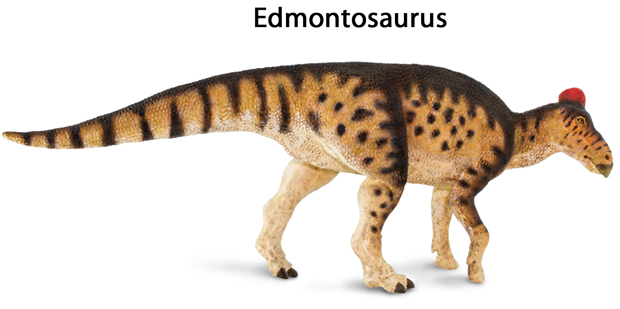
A Life Reconstruction of the Hadrosaurid Edmontosaurus
The new for 2020 Wild Safari Prehistoric World Edmontosaurus dinosaur model.
The picture (above) highlights the 2020 Wild Safari Prehistoric World Edmontosaurus dinosaur model.
The scientific paper: “Over 13,000 elements from a single bonebed help elucidate disarticulation and transport of an Edmontosaurus thanatocoenosis” by Keith Snyder, Matthew McLain, Jared Wood and Arthur Chadwick published in PLOS One.
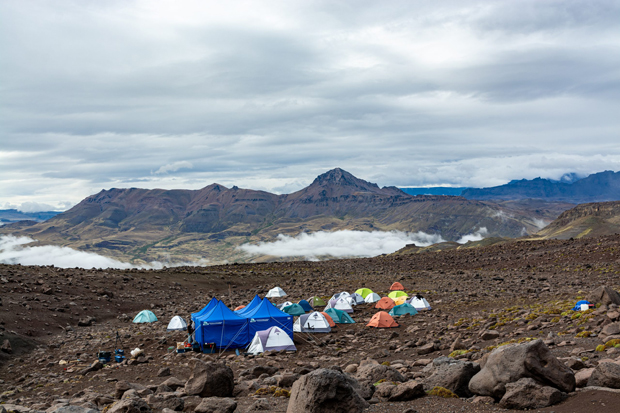
A team of international scientists led by Dr Fernando Novas of the Museo Argentino de Ciencias Naturales (Buenos Aires, Argentina), have been exploring the Upper Cretaceous, fossil rich beds at Estancia La Anita in the Province of Santa Cruz, Patagonia. In a media release, circulated this week, the researchers from the Museo de Ciencias Naturales report the discovery of the fossilised remains of a giant megaraptorid dinosaur. At an estimated ten metres in length, it potentially represents the largest confirmed member of the Megaraptora clade discovered to date.
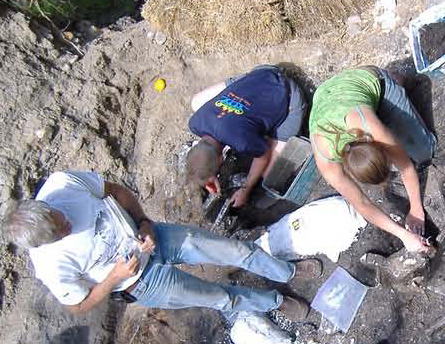
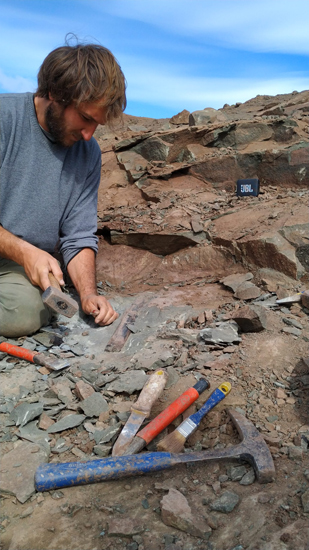
A Field Team Member Carefully Removing Overburden Close to a Fossil Bone
A field team member works close to a fossil bone.
Picture credit: Museo Argentino de Ciencias Naturales
Upper Cretaceous Sediments
The research team, which includes scientists from a number of Argentinian universities as well as colleagues from the National Museum of Tokyo (Japan), have spent much of the early part of the Southern Hemisphere autumn, working in the remote and mountainous Estancia La Anita which is some 1,750 miles (2,800 km), south of Buenos Aires. Many different vertebrate fossils were found, including those of the basal iguanodontid Isasicursor. The palaeontologists speculate that rather than attack the titanosaurs that lived in this region during the Late Cretaceous, megaraptors may have specialised in catching smaller, more agile prey such as the five-metre-long Isasicursor.
Members of the Megaraptora were quite lightly-built, long-armed carnivores. Very little is known about these dinosaurs, although they do seem to have been both geographically and temporally widely dispersed. They were not closely related to the dromaeosaurids, a family of dinosaurs that includes the “raptors” such as Velociraptor.
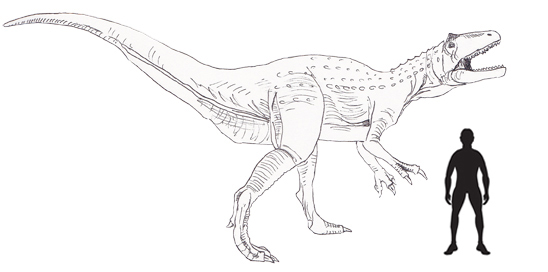
A Speculative Life Reconstruction of the Giant Megaraptor from Argentina
A speculative life reconstruction of the giant megaraptor from Patagonia.Picture credit: Everything Dinosaur.
Elements from the rib cage and vertebrae have been found, but sadly no skull material has been reported. It is likely that a new genus will be erected as a result of these discoveries, the scientific paper is likely to be published next year.
The Field Team’s Campsite at the Remote Location
The remote campsite at Estancia La Anita in Patagonia.
Picture credit: Museo Argentino de Ciencias Naturales
One of the Last of its Kind
The fossils represent the youngest material discovered to date that have been assigned to the Megaraptora. It is therefore quite likely that these types of theropod persisted until the extinction of the non-avian dinosaurs. Fernando Novas has been instrumental in the development of our understanding of this type of carnivorous dinosaur. It was Dr Novas who co-authored the review of theropod dinosaurs from Argentina in 2013, that led to the establishment of the Megaraptor clade.
To read a related article from Everything Dinosaur that looks at the ancient biota from this part of the Late Cretaceous of Argentina: Dinosaurs from the End of the World.
Recently Haolonggood introduced a megaraptor dinosaur model.
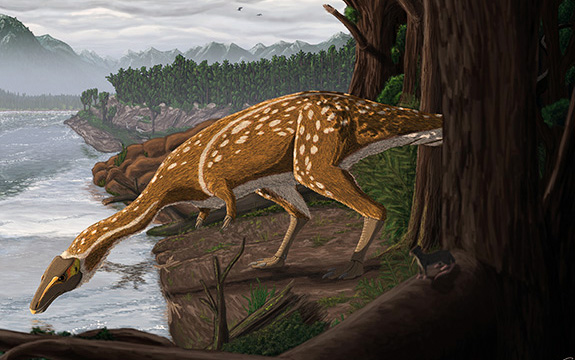
Think of a theropod dinosaur and a ferocious carnivore with a large head and big teeth probably comes to mind. However, the Theropoda is an extremely diverse clade within the Dinosauria, not all of them were big, particularly ferocious or even had teeth. One group the elaphrosaurines, were very bizarre indeed and the discovery of a single neck bone in Victoria has led to the conclusion that these strange, light-weight dinosaurs distantly related to Carnotaurus, roamed Australia in the Early Cretaceous.
A Life Reconstruction of the Australian Elaphrosaurine
A life reconstruction of the first elaphrosaur from Australia.
Picture credit: Ruairdh Duncan (Swinburne University of Technology, Victoria)
From the Lower Cretaceous of Australia
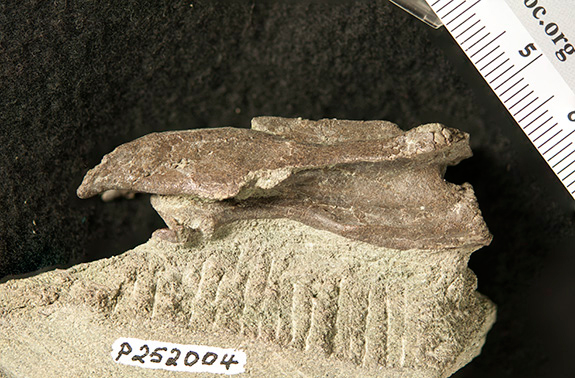
Volunteer Jessica Parker discovered a 5-centimetre-long bone whilst helping out at the annual Dinosaur Dreaming excavation near Cape Otway, Victoria (2015). The sediments at the site, known as Eric the Red West, date from the late Albian faunal stage of the Lower Cretaceous and are part of the Eumeralla Formation. At first, the bone identified as a cervical vertebra (neck bone), was thought to have come from a pterosaur.
Intriguingly for Swinburne University palaeontologist Dr Stephen Poropat and PhD student Adele Pentland, once the fossil specimen had been prepared it became clear that this was not a bone from the middle portion of the neck of a flying reptile.
Dr Poropat explained:
“Pterosaur neck vertebrae are very distinctive. In all known pterosaurs, the body of the vertebra has a socket at the head end, and a ball or condyle at the body end. This vertebra had sockets at both ends, so it could not have been from a pterosaur.”
The Cervical Vertebra – Evidence of Australia’s First Elaphrosaur
The five-centimetre-long bone identified as a middle cervical from an elaphrosaur.
Picture credit: Dr Stephen Poropat
Geologically Much Younger Than Most Elaphrosaurines
The taxonomic affinity of the subfamily Elaphrosaurinae within the Theropoda remains controversial. A number of authors have placed this little-known group, characterised by their small, light, graceful bodies, tiny heads, long necks and reduced forelimbs within the Noasauridae family, which means that they are distantly related to abelisaurids such as Ekrixinatosaurus, Majungasaurus and Carnotaurus.
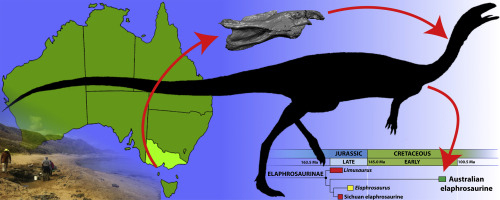
Most elaphrosaurs are known from the Late Jurassic, but this new elaphrosaur from Australia, lived some forty million years later. Only Huinculsaurus (H. montesi), from the Cenomanian/Turonian (early Late Cretaceous), of Argentina is geologically younger, than the Australian fossil remains.
The Fossil Find Location, Typical Elaphrosaurine Body Plan and Placing the Fossil Find in a Chronological Context
A silhouette of the elaphrosaur with a map showing fossil location and a timeline showing elaphrosaurine chronology. The newly described elaphrosaurine from Victoria is geologically the second youngest member of this group known.
Picture credit: Poropat et al (Gondwana Research)
A Dinosaur of the Polar Region
The discovery of this single, fossilised neckbone adds support to the idea that the elaphrosaurines were geographically and temporally much more widespread than previously thought. The similarity of these dinosaurs to the much better-known ornithomimosaur theropods (bird mimics), could help to explain why few other Cretaceous elaphrosaur specimens have come to light. Fossil material may have been found but misidentified as representing ornithomimids.
As the Cape Otway location would have been situated much further south during the Early Cretaceous (110-107 million years ago), at around a latitude of 76 degrees south, this implies that elaphrosaurines were capable of tolerating near-polar palaeoenvironments.
Elaphrosaurines were Related to Noasaurids
Recently, Everything Dinosaur wrote a post about the discovery of noasaurid from an opal mine close to Lightning Ridge (New South Wales). Noasaurids and elaphrosaurines were related, most scientists classifying them as different branches within the Abelisauroidea. Coincidentally, the New South Wales noasaurid was identified from a single cervical vertebra too. Both it and the Cape Otway elaphrosaurine dinosaur have not been assigned to any genus, but both fossils are likely to represent new species.
To read Everything Dinosaur’s article about the recently discovered noasaurid from New South Wales: Noasaurids from Australia.
The scientific paper: “First elaphrosaurine theropod dinosaur (Ceratosauria: Noasauridae) from Australia — A cervical vertebra from the Early Cretaceous of Victoria” by Stephen F. Poropat, Adele H. Pentland, Ruairidh J. Duncan, Joseph J. Bevitt, Patricia Vickers-Rich and Thomas H. Rich published in Gondwana Research.
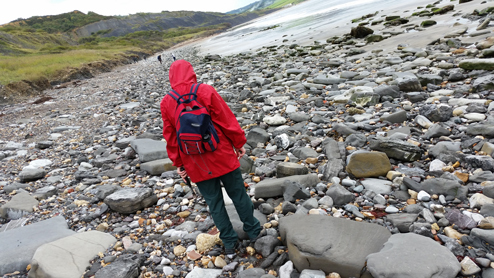
Everything Dinosaur team members had lots of plans for fossil collecting expeditions over the late spring and summer months. Like lots of people at the moment we have had to postpone these activities (COVID-19). Instead, team members are busy planning some projects and fieldwork for the late autumn and for 2021.
Missing Fossil Collecting
A Lot of Plans for Fieldwork are Having to be Redrawn
Looking for fossils at Lyme Regis. Plans for fieldwork are suspended. Picture credit: Everything Dinosaur.
Picture credit: Everything Dinosaur
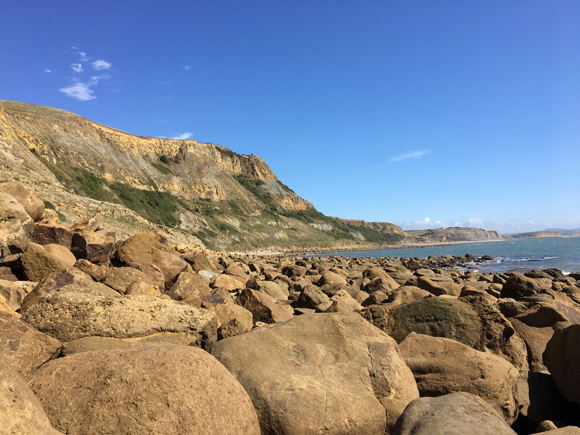
A point often overlooked when discussing fossil collecting as a hobby, is that if fossils were not found and collected, many important specimens would be lost to the elements. Fossils eroding out of the cliffs along the Dorset coast for example, they could easily be lost to the sea as there are very few visitors permitted to the “Jurassic Coast” at the moment.
With Many Countries in Lockdown Fossil Finding Expeditions for Many People are not Possible at the Moment
The view towards West Bay and Burton Bradstock. Much of the “Jurassic Coast” is devoid of visitors at the moment (COVID-19).Picture credit: Everything Dinosaur.
Picture credit: Everything Dinosaur
Museums Closed Too
Important research work has also had to be postponed or suspended. Researchers wanting to access museum specimens will probably have to wait until these institutions and other academic bodies such as universities can function properly with a full complement of staff.
Access to Museum Collections is Restricted for the Time Being
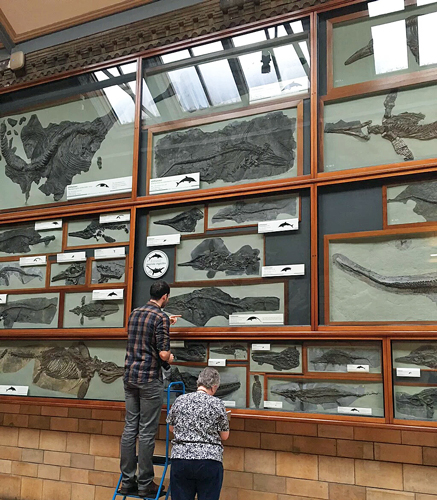
Dean Lomax and Judy Massare examining Ichthyosaur specimens in the marine reptile gallery at the Natural History Museum (London) as part of their research into the Ichthyosauria.
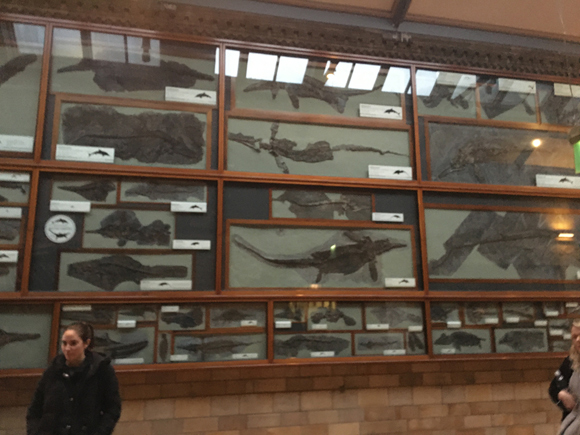
Everything Dinosaur team members have lots to keep them occupied. Ironically, a few weeks before the lockdown came into effect, we were at the London Natural History Museum undertaking some project work ourselves. We visited various parts of the museum including the marine reptiles gallery, although if you know that part of the museum quite well, it is not only the marine reptile specimens that are on display, we were there for the ichthyosaurs, the Metriorhynchidae (marine crocodyliforms) as well as one other very important fossil specimen that is located there but we won’t mention this…
The Marine Reptiles Gallery at the London Natural History Museum
The famous marine reptiles gallery at the London Natural History Museum.Picture credit: Everything Dinosaur.
Stellasaurus ancellae – Missing Link from the Two Medicine Formation of Montana
A new species of horned dinosaur has been described based on fossil material from the famous Two Medicine Formation of north-western Montana. The new species named Stellasaurus ancellae is a possible missing link in the evolutionary transition of Centrosaurinae dinosaurs from Styracosaurus to one of the last of the horned dinosaurs known to science – Pachyrhinosaurus.
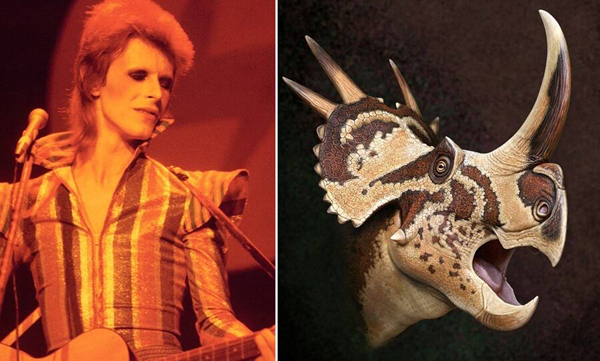
Stellasaurus means “star lizard”, reflecting the ornate star-shaped head crest and in honour of British rock/pop star David Bowie, famous for his flamboyant appearance and his hit single “Starman” which was released on April 28th 1972, almost 48 years to the day that the Stellasaurus scientific paper was published in Royal Society Open Science.
United by a Flamboyant Appearance David Jones AKA David Bowie and “Star Lizard” AKA Stellasaurus
David Bowie (left) and Stellasaurus ancellae (right).
Picture credit: Getty Images and Andrey Atuchin
Stellasaurus ancellae
Just like the career of David Bowie, Stellasaurus has had to wait a while before becoming famous. The fossil material now assigned to Stellasaurus was discovered in 1986, near the town of Cut Bank in Montana, close to the USA/Canadian border. The discovery was made by Carrie Ancell. It remained catalogued but not studied in the Museum of the Rockies (Montana), vertebrate fossil collection.
The contribution of Carrie Ancell, now a senior preparator at the Museum of the Rockies, has been recognised as the species name honours her. Carrie Ancell has played a significant role in developing our understanding of northern Laramidian centrosaurines. She discovered and prepared MOR 492, the holotype specimen of Stellasaurus ancellae, as well as the holotype of Achelousaurus horneri, and co-discovered the holotype of Einiosaurus procurvicornis.
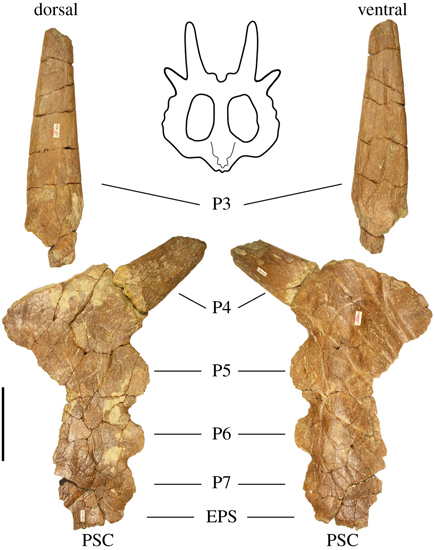
Views of the Holotype Fossil Material of Stellasaurus ancellae
Left lateral parietal bar of Stellasaurus ancellae holotype MOR 492 in dorsal and ventral views. The line drawing has been reproduced from a PLOS One article (Evans and Ryan). Note scale bar on left equals 10 cm.
Picture credit: Wilson et al/Royal Society Open Science
Reviewing the Centrosaurinae Fossil Material from the Two Medicine Formation
A review of cranial material, specifically the ornamentation associated with the neck frill (parietal processes), previously assigned to the centrosaurine Rubeosaurus ovatus resulted in the identification of this new taxon. However, this assessment could mark the demise of R. ovatus as the researchers, which include John Wilson of Montana State University, conclude that only what was the holotype fossil, a partial parietal specimen number USNM 11869, can be attributed Rubeosaurus. This could spell the end for Rubeosaurus. When USNM 11869 was first described it was assigned to a new species of Styracosaurus (S. ovatus).
Thus, this new paper proposes that the genus Rubeosaurus is now no longer valid and that Styracosaurus ovatus is the sister taxon to Styracosaurus albertensis and Stellasaurus marks a missing link in centrosaurine evolution between Styracosaurus and Einiosaurus procurvicornis.
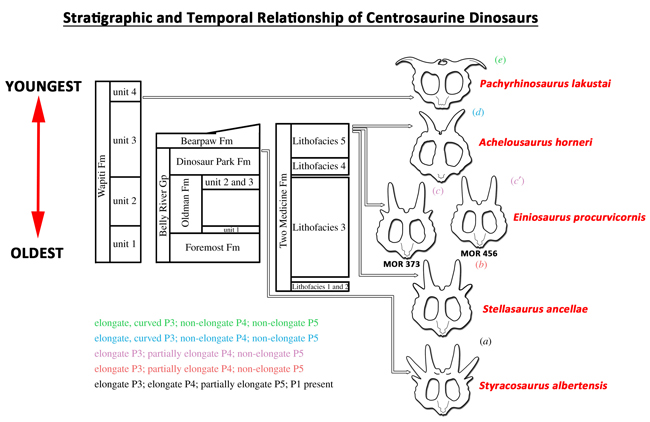
A Stratigraphical and Temporal Assessment of Late Cretaceous Centrosaurines Based on Two Medicine Formation Fossil Material*
Stratigraphic and temporal relationship between Two Medicine Formation centrosaurine taxa. *Pachyrhinosaurus lakustai fossil material is not from the Two Medicine Formation but from the younger unit 4 sediments of the Wapiti Formation of Canada.
Picture credit: Wilson et al/Royal Society Open Science
A Missing Link Amongst the Centrosaurinae
The researchers postulate that Stellasaurus represents a missing link in the centrosaurine family tree. The fossils of Stellasaurus are believed to be around 75 million years old. From a stratigraphical perspective, they are younger than Styracosaurus albertensis fossils, but older than fossils assigned to Einiosaurus. That flamboyant head shield with its various lumps and bumps could reflect a transitional stage between the headshield morphology of Styracosaurus and that of Einiosaurus. It is suggested that Stellasaurus was preceded by Styracosaurus and that Styracosaurus evolved into Stellasaurus. In addition, Einiosaurus evolved from Stellasaurus.
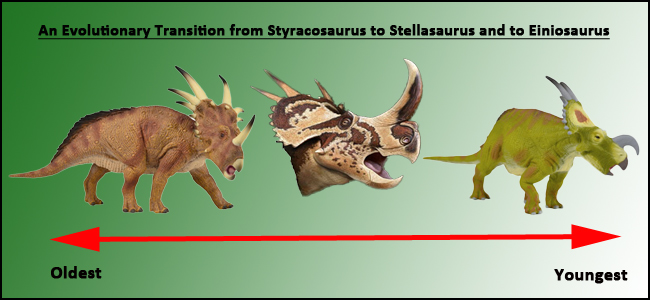
A Transitional Process – One Horned Dinosaur Leading Directly to Another Species of Horned Dinosaur
Anagenesis within centrosaurine dinosaurs. Stellasaurus evolved from Styracosaurus and Einiosaurus evolved from Stellasaurus.
Commenting upon the importance of this new research, lead author John Wilson stated:
“The ornamental horns and spiky frills on the skulls of these animals are what changed the most through evolution. The new species has skull ornamentation which is intermediate. This gives us evidence these species are members of a single, evolving lineage – this type of evolution is called anagenesis.”
The Phylogeny of the Centrosaurinae from Statistical Analysis Undertaken by the Research Team
Phylogeny of the Centrosaurinae clade of the Ceratopsidae based on Bayesian statistical analysis mapped against a temporal range. Styracosaurus ovatus (formerly Rubeosaurus ovatus), is placed as the sister taxon to Styracosaurus albertensis, whilst Stellasaurus is mapped between S. albertensis and Einiosaurus procurvicornis.
Picture credit: Wilson et al/Royal Society Open Science
The scientific paper: “A new, transitional centrosaurine ceratopsid from the Upper Cretaceous Two Medicine Formation of Montana and the evolution of the ‘Styracosaurus-line’ dinosaurs” by John P. Wilson, Michael J. Ryan and David C. Evans published in Royal Society Open Science.
A team of international researchers including scientists from Leicester University, the University of Portsmouth and the University of Detroit Mercy, have published a paper in the academic journal “Nature” that concludes that the giant theropod Spinosaurus was indeed an aquatic animal.
Studying Spinosaurus
In the autumn of 2014, a paper was published in the journal “Science” entitled “Semiaquatic adaptations in a giant predatory dinosaur”. Spinosaurus was depicted as an obligate quadruped very much at home in the water. In this latest publication, three of the authors involved in the earlier study, Nizar Ibrahim of the University of Detroit Mercy, Cristiano Dal Sasso and Simone Maganuco from the Natural History Museum of Milan (Italy), have collaborated with numerous other researchers in the analysis of Spinosaurus aegyptiacus tail bones.
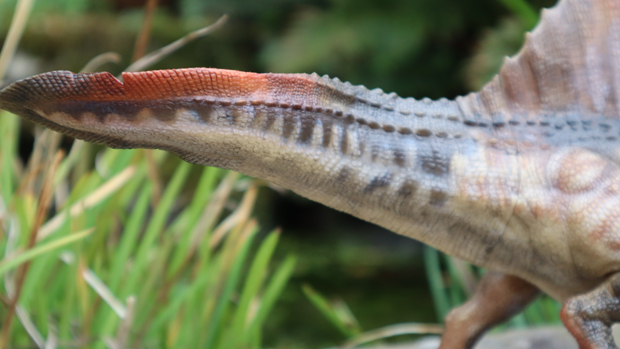
The tail of Spinosaurus was unlike any other known theropod. The fossil tail bones, indicate that the tail was wide, flexible and fin-like. It seems very well adapted to propelling this huge dinosaur through water. The researchers conclude that this is unambiguous evidence for an aquatic propulsive structure in a member of the Dinosauria. In other words, Spinosaurus was very much at home in the rivers, swamps and lakes of the Cretaceous of northern Africa. Here is one dinosaur that took to the water.
Life Reconstruction of Spinosaurus (S. aegyptiacus) 2020
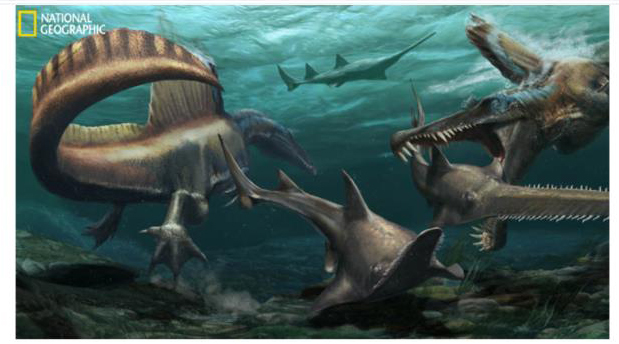
A pair of spinosaurids hunting the giant, prehistoric sawfish Onchopristis.
The beautiful illustration (above), depicts Spinosaurus hunting the 8-metre-long sawfish (Onchopristis). A partial fossil jaw found in 1975 (MSNM V4047), attributed to Spinosaurus had a vertebra thought to have come from an Onchopristis embedded within it. Although, the vertebra is thought to have become lodged after the Spinosaurus died, it demonstrated that Spinosaurus and this giant prehistoric fish were contemporaneous.
Not All Dinosaurs were Entirely Terrestrial
Unlike a lot of Kem Kem fossil material from Morocco, the Spinosaurus specimen, which was discovered in 2015, with the tail section found in 2018, consists of numerous associated bones. Most of the vertebrate fossils found within these deposits are isolated, but these caudal vertebrae with their tall neural spines and elongated chevrons, have permitted the researchers to reconstruct the tail and to test its swimming capabilities using robotic flapping apparatus that was built to model the tail’s morphology and motion.
The researchers conclude that the tail of Spinosaurus was long, strong, flexible and ideal for propelling this monster through water. It is likely that these fossils will provide much more information on the enigmatic Spinosaurus, as the material represents the most complete theropod dinosaur found to date in northern Africa.
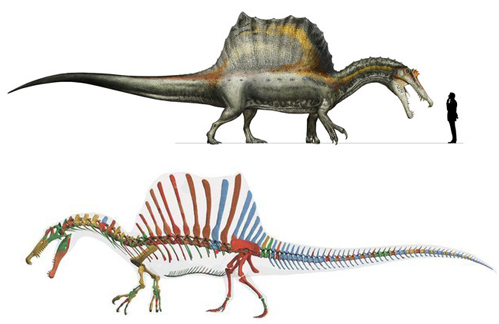
The Reconstructed Spinosaurus – Obligate Quadruped with a Typical Theropod Tail (circa 2014)
Life-size reconstruction and supplemental figure from the autumn 2014 scientific paper.
Picture credit: Davide Bonadonna (top) Ibrahim et al (bottom)
A Reconstruction of Spinosaurus aegyptiacus 2020
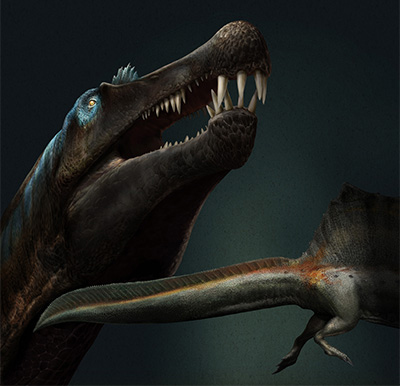
View of the crocodile-like snout of Spinosaurus and the new interpretation of the tail.
Note the differences in the shape of the tail between the 2014 reconstruction and the very much more fin-like 2020 reconstruction. The tail of Spinosaurus aegyptiacus has been described as resembling that of a giant crested newt.
Co-author of the scientific paper, Dr David Unwin (University of Leicester), commented:
“The Spinosaurus’ fin-like tail is a game changing discovery for us that fundamentally alters our understanding of how this dinosaur lived and hunted – it was actually a ‘river-monster’. As well as its tail, many other features of this dinosaur, such as the high position of the nostrils, heavy bones, short legs and paddle-like feet point to a life spent in the water rather than on land. Not only did dinosaurs dominate the land and take to the air as birds, they even went back into the water and became the top predators there as well.”
The Papo Limited-edition Spinosaurus Model (2019)
Historically, some types of dinosaurs were associated with aquatic environments, for example, Jurassic sauropods and duck-billed dinosaurs such as Corythosaurus and Lambeosaurus. However, these ideas have now been abandoned by most scientists and the Dinosauria is regarded as almost entirely terrestrial. Recent studies have suggested that the enigmatic spinosaurids, dinosaurs such as Oxalaia, Irritator, Siamosaurus and Ichthyovenator along with Suchomimus, Baryonyx et al, may have been semi-aquatic. This newly published paper demonstrates that Spinosaurus aegyptiacus possessed a number of anatomical adaptations indicating an aquatic habit. In 2019, Papo introduced a new, limited-edition figure of Spinosaurus, depicting this animal as a semi-aquatic, obligate quadruped.
The Papo Limited-edition Spinosaurus Figure (2019)
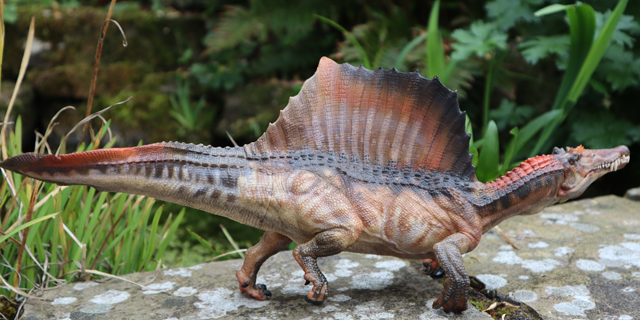
The Papo limited-edition Spinosaurus dinosaur model (2019). This Papo replica depicted Spinosaurus with a fin-like tail, ironically, this shape of tail has now been proposed by vertebrate palaeontologists.Picture credit: Everything Dinosaur.
Picture credit: Everything Dinosaur
A Close-up View of the Thick Tail Adapted for Swimming of the Papo Spinosaurus
The tail of the Papo limited-edition Spinosaurus dinosaur model (2019).Picture credit: Everything Dinosaur.
Picture credit: Everything Dinosaur
Implications for Other Members of the Spinosauridae
Spinosaurus aegyptiacus was one of the last of the spinosaurids. The authors of the scientific paper postulate that other members of the Spinosauridae are thought to have had aquatic adaptations which suggests a substantial invasion of aquatic environments by this clade of theropods.
Our congratulations to the scientists for their research into this fascinating theropod, we look forward to further papers being published as the Spinosaurus material from the Moroccan site continues to be excavated. Our congratulations to Papo, for producing a fantastic replica, that although might not depict the dinosaur as exactly as some palaeontologists might, but they do seem to have produced a tail that reflects the newly published scientific data.
The scientific paper: “Tail-propelled aquatic locomotion in a theropod dinosaur” by Nizar Ibrahim, Simone Maganuco, Cristiano Dal Sasso, Matteo Fabbri, Marco Auditore, Gabriele Bindellini, David M. Martill, Samir Zouhri, Diego A. Mattarelli, David M. Unwin, Jasmina Wiemann, Davide Bonadonna, Ayoub Amane, Juliana Jakubczak, Ulrich Joger, George V. Lauder and Stephanie E. Pierce published in the journal Nature.
A researcher from the Swedish Museum of Natural History in collaboration with colleagues from the University of Fribourg (Switzerland) and the Instituto Antártico Argentino based in Buenos Aires (Argentina), has published a scientific paper which provides details of the first fossil frog to have been found on the continent of Antarctica.
A Fossil Frog from Seymour Island
The fossils, consisting of a partial ilium and a bone from the skull which were found in Eocene-aged deposits on Seymour Island, resemble an extant lineage of frogs known as helmeted frogs (family Calyptocephalellidae). Until this discovery, no Cenozoic ectothermic continental tetrapods (amphibians and reptiles), had been documented from Antarctica. The tiny frog fossils suggest that around 40 million years ago, climatic conditions at high latitudes in the southern hemisphere were still mild enough to support “cold-blooded” amphibians.
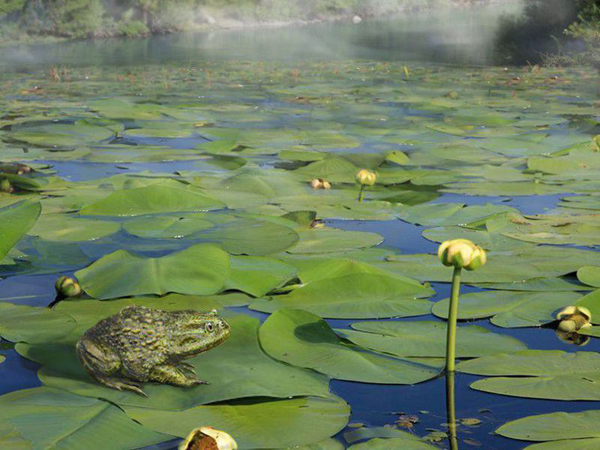
A Life Reconstruction of the Helmeted Frog Found on the Antarctic Peninsula (Seymour Island)
Life reconstruction of the frog genus described from the Eocene of Antarctica.
Picture credit: Pollyanna von Knorring / Swedish Museum of Natural History
Studying Eocene Freshwater Habitats
Writing in the academic, on-line journal “Scientific Reports”, the researchers conclude that some Eocene freshwater habitats in Antarctica provided habitats that were favourable for cold-blooded (ectothermic) vertebrates such as frogs. Antarctica was much milder than it is today, the warmest months of the year averaging around 13 degrees Celsius whilst temperatures in the winter would have dropped to below an average of 4 degrees Celsius. Frogs were present in freshwater ecosystems at a time in the history of Antarctica where ice sheets had formed in upland areas towards the interior of the continent.
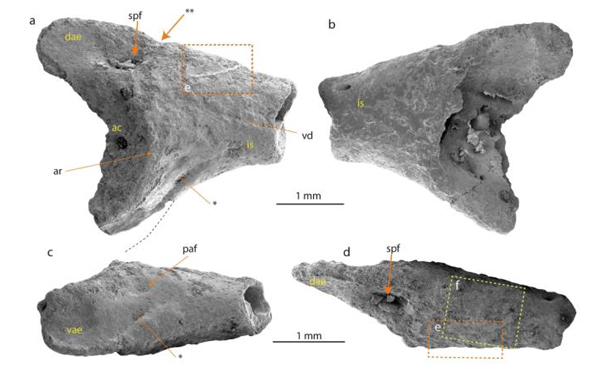
Views of the Fragmentary Ilium from Seymour Island
Ilium (NRM-PZ B282) of Calyptocephalella sp. from Seymour Island, Antarctica. Ilium in lateral (a), medial (b), ventral (c) and dorsal (d) views. Scale bar equals 1 mm.
Picture credit: Swedish Museum of Natural History
The Discovery of Fossil Frog Remains
The fossil frog remains were collected during three joint Argentinian-Swedish expeditions to Seymour Island in the southern hemisphere summers 2011–13. The bone fragments were concentrated from dry-sieved sediment samples. The closest living relatives of the Eocene specimen are limited to the Chilean Andes (Calyptocephalellidae). With the discovery of the fossils on Seymour Island, the researchers conclude that these types of helmeted frog were much more widespread across what remained of Gondwana during the Eocene.
The material is housed in the palaeozoological collection of the Swedish Museum of Natural History, Stockholm.
The scientific paper: “First fossil frog from Antarctica: implications for Eocene high latitude climate conditions and Gondwanan cosmopolitanism of Australobatrachia” by Thomas Mörs, Marcelo Reguero and Davit Vasilyan published in Scientific Reports.
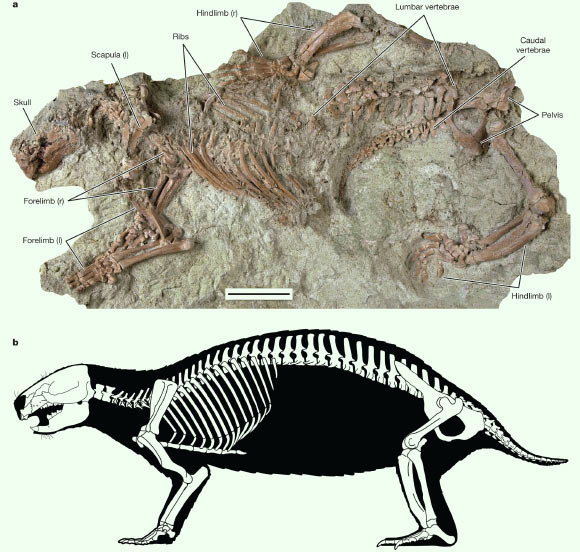
This week, has seen the publication in the journal “Nature” of a scientific paper describing a new species of bizarre mammal from the Late Cretaceous of Madagascar. Named Adalatherium (A. hui), this cat-sized animal shared its island home with a variety of predators such as abelisaurid dinosaurs, crocodilians and snakes. At an estimated three kilograms, Adalatherium was no giant, but the fossilised remains, which represent a near complete skeleton of an individual, indicate that this mammal was not yet fully mature when it died and as such, it is one of the largest members of the crown group of mammals described from Upper Cretaceous material.
Adalatherium hui
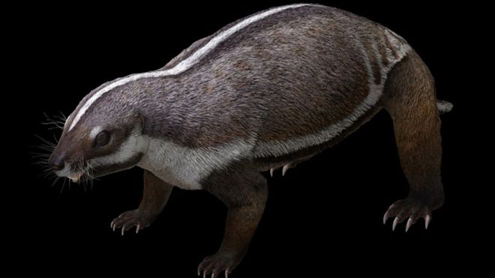
A Life Reconstruction of Adalatherium (A. hui)
A life reconstruction of Adalatherium hui.
Picture credit: Reuters
Madagascar became isolated from the rest of Gondwana around 88 million years ago. Animals on the island were effectively marooned and many pursued a different evolutionary route compared to related forms on the rest of the super-continent. Classified as a member of the Gondwanatheria, an extinct group of mammaliaforms confined to the southern hemisphere and up until now, only known from isolated teeth and fragmentary bones, the Adalatherium lineage developed an unusual and unique set of characteristics never seen before in a tetrapod.
“Crazy Beast”
The backbone has more vertebrae than any other Mesozoic mammal and one of its rear leg bones (tibia) was bowed. How this animal moved around is a bit of a mystery, but the authors of the scientific paper suggest that this animal lived in burrows (fossorial). The snout shows a mixture of primitive and very advanced anatomical traits. Adalatherium had more foraminia, small holes in the nasal cavity that served as passageways for nerves and blood vessels, than any other mammal extinct or living today.
The snout was probably extremely sensitive and covered in whiskers, they may have helped it find its way about underground. One foramen (hole for nerves or blood vessels), at the top of the snout has no know parallel with any other mammal.
These strange characteristics inspired the researchers to name this animal “crazy beast” from the local Malagasy and from the Greek.
The Preserved Skeleton of Adalatherium and Accompanying Line Drawing
The articulated remains of Adalatherium hui and an accompanying line drawing. Note scale bar in (a) equals 5 cm.
Picture credit: Krause et al.
Adalatherium hui – Bending and Breaking a Lot of Rules
Corresponding author, Dr David Krause (Denver Museum of Nature and Science), commented:
“Knowing what we know about the skeletal anatomy of all living and extinct mammals, it is difficult to imagine that a mammal like Adalatherium hui could have evolved, it bends and even breaks a lot of rules.”
Dr Krause is no stranger to bizarre prehistoric animals from Madagascar. In 2008, Everything Dinosaur wrote a blog post about the “frog from Hell”, a research team led by Dr Krause had discovered the fossilised remains of a giant frog that inhabited the Late Cretaceous of Madagascar.
The scientific paper: “Skeleton of a Cretaceous mammal from Madagascar reflects long-term insularity” by David W. Krause, Simone Hoffmann, Yaoming Hu, John R. Wible, Guillermo W. Rougier, E. Christopher Kirk, Joseph R. Groenke, Raymond R. Rogers, James B. Rossie, Julia A. Schultz, Alistair R. Evans, Wighart von Koenigswald and Lydia J. Rahantarisoa published in the journal Nature.