All about dinosaurs, fossils and prehistoric animals by Everything Dinosaur team members.
25 06, 2009

Science Weeks – A Big Success for Schools

By |2022-12-25T16:37:57+00:00June 25th, 2009|Categories: Everything Dinosaur News and Updates, Main Page|0 Comments

Science Week in Schools

Teachers at Everything Dinosaur are frequently asked to attend schools and participate in school projects, events or programmes promoting science.  Such activities can involve students in all sorts of exciting and curriculum enriching lessons and palaeontology does lend itself to become the basis for a science or maths orientated lesson plan.  After all, if the children are genuinely interested and excited about something they are doing they are likely to learn more and remember.  Everything Dinosaur team members recently took part in Lorton Primary School’s science week, we met lots of enthusiastic students and as usual we were bombarded with questions as we cast dinosaur teeth, showed fossils and demonstrated how much you can learn by looking at dinosaur foot prints.  We even took a peep inside a dinosaur’s stomach!  All part of our teaching about fossils in schools.

Nervous Moments with an Experiment

Picture credit: Everything Dinosaur

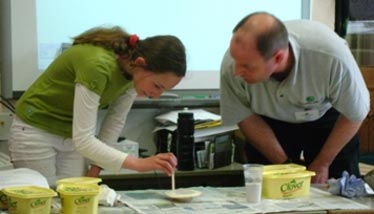
The picture above shows a pupil at Lorton Primary School, carefully preparing a cast of a real Tyrannosaurus rex tooth, that was found in Alberta, Canada.  A steady nerve is required, but with luck the class will have their very own T. rex tooth to study in a few minutes time.

Fossils are Really Cool!

Picture credit: Everything Dinosaur

Science Weeks

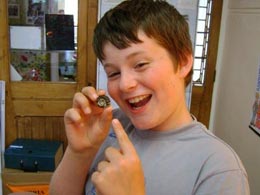
One of the really great things about fossil hunting is that in most case, when looking in the United Kingdom, you can keep what you find.  One pupil is rather taken by this beautiful ammonite fossil found by an Everything Dinosaur team member at Charmouth, Dorset.  We use the ammonite fossils to explain a little about the fossilisation process and to demonstrate that not all fossils are dinosaurs.

Rather Taken with T. rex Toes

Rather taken with T. rex toes.

Picture credit: Everything Dinosaur

With all the museum quality fossils and casts that we have in our collection, young palaeontologists get the chance to handle and get close to some amazing objects such as this cast of an adult Tyrannosaurus rex left metatarsals (II,III and IV), part of our section of the teaching programme where we try to compare the bones of a big dinosaur to those of own bodies.  With our qualified teachers we certainly get invited to a lot of schools and who knows, we might just inspire a young person to take up a career in science.

We always appreciate the hard work of the teachers, teaching assistants and the PTA for organising such activities, as part of our commitment to the Institute for Learning and other bodies we are members of, we get feedback on our work.  We get some lovely comments and team members are always thinking up new ways to inform and to educate.

To view the range of dinosaur and prehistoric animal themed items we stock: Visit Everything Dinosaur.

24 06, 2009

Proof Reading and yet more Proof Reading

By |2022-12-25T16:35:01+00:00June 24th, 2009|Categories: Everything Dinosaur News and Updates, Main Page|0 Comments

The Joys of Proof Reading

Today a little proof reading of some signage and information panels for an exhibition we are working on was required.  We had to proof a series of A2 sized information panels that are being printed to provide details of some prehistoric animals that are making up part of exhibition, Everything Dinosaur is going to be involved with over the Summer.

Proof Reading

Team members are often asked to help out with such tasks, either devising the information for the panels or checking what the design team have come up with.  We try to turn things around as quickly as we can in order to minimise any hold ups.  Everything went well until we came to proof the panel associated with Ornithomimus.  Rather than describe a genus such as Ankylosaurus, and Triceratops as with the other information panels, for some reason the panel on Ornithomimus referred to Ornithomimosaur, which in taxonomic terms relates to the Superfamily level rather than to a single genus (Ornithomimosaurs).  The Superfamily is also referred to as Ornithomimosauria or indeed ornithomimids.  The name actual means “bird mimics”, as these animals are similar anatomically to large flightless birds such as emus and ostriches.

Ornithomimus was a member of a family of dinosaurs that are sometimes called “ostrich-like dinosaurs”, as they resembled flightless, long-legged birds such as ostriches and emus.  This dinosaur may have reached lengths in excess of 4.5 metres (15 feet) long.

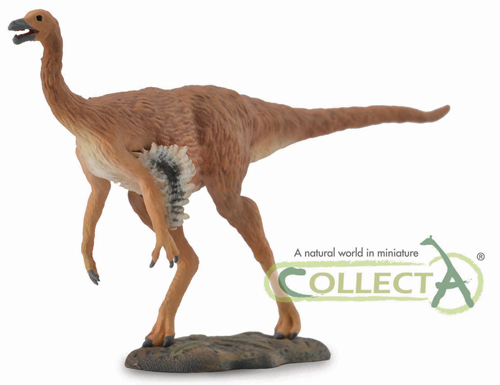
A Model of a Typical Ornithomimid Dinosaur (Struthiomimus)

CollectA Struthiomimus dinosaur model.

A Struthiomimus dinosaur model.

We added a range of facts to each of the data panels, hopefully when the exhibition opens the panels will provide visitors with extra information.  Panels were checked on Ankylosaurus, Oviraptor, Triceratops and of course Tyrannosaurus rex.

To view the huge range of dinosaur and prehistoric animal models available from Everything Dinosaur, take a look at the CollectA Age of Dinosaurs model range: CollectA Age of Dinosaurs Prehistoric Life Models.

23 06, 2009

Taking a Bite out of a Record – Largest Theropod Tooth to Date found in Spain

By |2022-12-25T16:32:57+00:00June 23rd, 2009|Categories: Dinosaur and Prehistoric Animal News Stories, Main Page|0 Comments

Allosaurs on the Hunt in Spain

A partial theropod tooth measuring nearly 10 cm in length has been discovered in Spain.

Scientists from the Teruel-Dinopolis Joint Palaeontology Foundation in Spain have been busy examining a single broken tooth from a large meat-eating dinosaur found in the Riodeva area, approximately 100 miles west of Madrid.  The shape and size of this tooth (9.83 cm long), have left the researchers in no doubt that this is evidence of a large allosaur roaming around this part of Spain approximately 155 million years ago.  The tooth is the largest yet found in the country and indicates that whatever type of animal lost this tooth, it probably was the apex predator in the region.

Commenting on the classification, Luis Alcalá, one of the researchers involved with the study stated:

“Given the great variations between the teeth of different kinds of allosauroids, it would be prudent for us to assign this fossil to an indeterminate Allosauroidea”.

Theropod Tooth

Allosaurs are classified as part of the theropod tetanuran group (stiff tails).  They were large, bipedal predatory dinosaurs with deep skulls and were notable for having prominent brow bumps or ridges along the tops of their skulls.   Known from the Jurassic of Northern Hemisphere, this group became rare into the Cretaceous but survived in the south and became some of the largest meat-eating dinosaurs known to science with animals such as the Carcharodontosaurids dominating the food chains of Africa and South America.

The paper on this single tooth is due to be published in the upcoming issue of Estudios Geológicos.

The single, curved and sharply pointed tooth was found by locals in Riodeva, Teruel and is from the Villar del Arzobispo Formation.  Comparisons with other Allosauroidea fossils from the Iberian Peninsula have shown that this is the largest tooth of a meat-eating dinosaur found in the country to date.  A tooth measuring 12.7cm was discovered in Portugal a few years ago, this too is believed to represent a member of the Allosauroidea.

A Jurassic Ecosystem

The scientists hope to be able to build up an accurate picture of the ecosystem in this part of Jurassic Europe, one of the few parts of what we now know as continental Europe that was not covered with warm, shallow, tropical sea.  To date, fossils of stegosaurids, ornithopods and sauropods have been found in the region, now they have evidence of a top predator, although the remains of smaller theropods had been discovered previously.

Meat-eating dinosaurs shed teeth throughout their lives, hence one of the reasons for their nickname “land sharks”.  This particular tooth and the condition of its crown (without any re-absorption surfaces), may indicate that this tooth was shed from the jaws of a decaying corpse.  If this is the case then further remains of the dinosaur may be uncovered and the palaeontologists may be able to get a lot closer to this giant carnivore than previously thought.

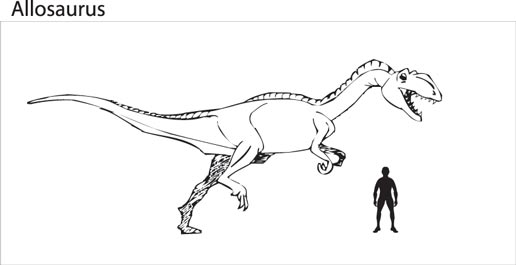
An Illustration of a Typical Allosaurus Dinosaur

Picture credit: Everything Dinosaur

Over the years, Allosaurus has proved to be one of the most popular of all the meat-eating dinosaurs to make models of.  The best specimens are known from the Late Jurassic strata of the USA, for example the Morrison Formation.

To view a model of a typical Allosaurus and other meat-eating dinosaurs take a look at the Wild Safari Prehistoric World model range: Safari Ltd. Wild Safari Prehistoric World Models.

22 06, 2009

New Research Suggests Dinosaurs were Thinosaurs – A Weighty Issue?

By |2024-04-17T10:30:06+01:00June 22nd, 2009|Categories: Dinosaur and Prehistoric Animal News Stories, Main Page|0 Comments

Dinosaurs on a Diet – Statistical Evidence over Body Mass Queried

Dinosaurs were thinosaurs! New research suggests that the weight of some dinosaurs has been overestimated.

It may be time to re-write the entry for dinosaurs in the Guinness Book of World Records as evidence from an American based research team have uncovered a series of potential flaws in the calculations used to estimate dinosaur mass and body weight.  Just when we were getting used to bigger and bigger estimates for the size of some of the larger genera such as the titanosaurs, it seems that the calculations as to how heavy some of these creatures may have been, need to be scaled down.

Dinosaurs were Thinosaurs

The team from Colorado State University have analysed the current statistical model used to estimate the weight of extinct animals and they have found that potentially a large sauropod such as Apatosaurus, once thought to weigh over 30,000 kilogrammes may actually weighed under 20,000 kilogrammes.  Some scientists state that Tyrannosaurus rex, the large, well-known carnivorous dinosaur of the Late Cretaceous, weighed over 7 tonnes.  According to this new model, it would have weighed about 1 tonne less.

Commenting on the research, Gary Packard of Colorado State University said:

“Palaeontologists have for 25 years used a statistical model to estimate the body weight of giant dinosaurs and other extraordinarily large extinct animals, we have found that the statistical model is seriously flawed and the giant dinosaurs probably were only about half as heavy as is generally believed”.

If dinosaurs were far lighter than previously thought, this would have very significant implications for their lifestyle, habits and behaviours.  They would be leaner and perhaps more agile and faster.  They would have needed less food to sustain them and so some of the interpretations regarding large dinosaurs may have to be revisited.

Not so Huge Perhaps?  An Illustration of an Apatosaurus

Picture credit: Everything Dinosaur

The differences in the calculations are dependent on what type of analysis is undertaken.  The dimensions of bones such as the humerus and the femur are relatively easy to calculate, there are many fossilised bones for the scientists to use. The problem lies in the mass ascribed to the skeleton, since soft tissue is rarely preserved scientists have little to go on when it comes to accurately estimating body-weight, particularly in creatures which are so very different and much larger than extant species.

Gary Packard and his fellow researchers worked from the same information regarding dinosaur bone measurements as previous scientists, but rather than using back-transformation from logarithmic formulae, they chose to use equations fitted by non-linear regression.  The team’s results vary from the accepted statistics given for many dinosaurs and the heavier the animal studied, the greater the variation between the Colorado team’s estimated weight and the weight given in many textbooks.  However, to verify their measurements the Colorado based scientists used their amended formula to work out the weight of a modern African elephant.  Their findings estimated a weight of 5,900 kilogrammes, about what you would expect for a large adult elephant.

This work is not that unique, there have been many theories put forward regarding the actual mass of extinct animals, particularly the larger dinosaurs.  Another paper published last year in the scientific journal Fossil Record used a different technique for estimating body mass, but calculated similar results to those of the Colorado team. That study was led by Hanns-Christian Gunga of the Charité-Universitätsmedizin Berlin.

Evidence from Fossils

The superbly well-preserved hadrosaurine (nick-named Dakota), an Edmontosaurus, has preservation of flesh around some of the bones, we at Everything Dinosaur have seen cross-sections through the ulna and radius (arm bones), measurements as to the depth of flesh around the bones in specimens such as this duck-billed dinosaur may help scientists clarify the estimated weight of other types of dinosaurs.  Interestingly, the vertebrae seem to be further apart in this specimen than previously thought.  This may mean that scientists are going to have to amend their estimated sizes for this type of hadrosaur.  They may actually have been bigger than we think!  Animals such as Edmontosaurus have been estimated at lengths in excess of 13 metres, now this new find may lead to scientists having to revise these estimates.  They may have been larger than previously thought, but their actual body mass remains controversial.

John Hutchinson, a researcher in evolutionary biomechanics at the Royal Veterinary College (London), has also tried to estimate the weight of dinosaurs such as Tyrannosaurus rex, as part of his studies into Dinosauria locomotion.

Commenting on problems associated with guessing the weight of a dinosaur he stated:

“The best we can do is put the weight [T. rex] at six to eight tons for a typical adult.  There is a big question about how much skin they had and how much flesh”.

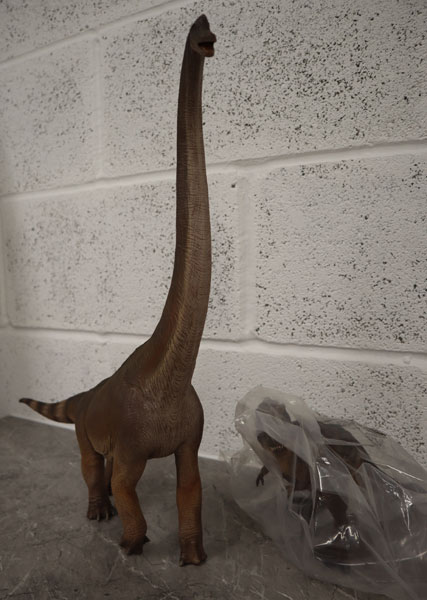
Perhaps it is time for a re-think on the body mass of the largest dinosaurs.  Everything Dinosaur team members are already working on a new, sleeker model of a brachiosaurid – Giraffatitan.

A Model of a Giraffatitan

W-Dragon Giraffatitan Compared to a Papo standing T. rex dinosaur model

W-Dragon Giraffatitan Compared to a Papo standing T. rex dinosaur model. Picture credit: Everything Dinosaur.

To view the range of dinosaur and prehistoric animal models in stock at Everything Dinosaur: Dinosaur and Prehistoric Animal Models.

22 06, 2009

Bizarre Jurassic Ceratosaur Points Finger at Unique Dinosaur Avian Link

By |2024-04-17T10:30:38+01:00June 22nd, 2009|Categories: Dinosaur and Prehistoric Animal News Stories, Main Page, Palaeontological articles|1 Comment

Chinese Jurassic Ceratosaur Provides Evidence of Ancestral Link between Theropods and Birds

A recently discover Jurassic ceratosaur provides further evidence of an ancestral link between theropod dinosaurs and Aves.

The link between certain types of dinosaur and birds is largely accepted by many scientists today, the first rumblings about a connection can be traced back to the 1880s the time of  Harry Govier Seeley, largely responsible for the taxonomic classification of Dinosauria.  Indeed, the likes of the Thomas Henry Huxley in the early 1860s had remarked how similar anatomically dinosaurs were to birds; fuelled no doubt by the discovery of an almost complete skeleton of Archaeopteryx in 1861.

However, the paucity of the fossil record and the lack of key, transitional fossils showing animals evolving from one type of creature to another, the stages of evolution as it were, does mean that debate still continues as to the precise relationship between Dinosauria and Aves.

The Dinosauria/Bird Link

A recent study by scientists at the Oregon State University, analysing the process of bird’s breathing and their lung structure led this particular team of researchers to conclude that birds are not the direct descendants of theropod dinosaurs.  Evidence gathered from their particular study indicated a shared, common ancestor but no direct descent.

To read more about the Oregon State University research: Controversy over the Dinosaurs/Birds Link.

This is one of the fascinating aspects of palaeontology, as new fossils are found, or as new techniques are developed to study known fossils, theories and concepts regarding Dinosauria change and evolve.

When trying to demonstrate some of the anatomical links between birds and dinosaurs a roast chicken or turkey can be dissected and some of the similarities shown.  This is not recommended at Christmas, as it can interrupt the festivities and upset the cook.  However, a couple of years ago, we did publish an article pointing out some of the things to look for when you carve the Christmas dinner.

To read this article: Christmas Dinner Links Dinosaurs to Birds.

One of the problems associated with the link between dinosaurs and birds was trying to explain the differences in the finger pattern seen in theropod dinosaurs and in birds.  Put simply, the theropod ancestors of birds and birds share a characteristic of having three fingers (digits), problem is; theropods have digits I, II and III, whilst birds have digits II, III and IV.  Now the discovery of a new, bizarre theropod with four fingers on each hand may provide evidence that explains this anomaly and help to unravel the mystery of how birds are descended from dinosaurs.

An international team of palaeontologists led by scientists from the Institute of Vertebrate Palaeontology and Palaeoanthropology (IVPP) in Beijing, have uncovered the articulated remains of a bizarre, beaked, herbivorous theropod that may shed some light on the bird/dinosaur digit mystery.  In total two skeletons were found, including evidence of gastroliths (stomach stones) it is these stones that provide evidence of a tough, fibrous diet for this little, biped.

Jurassic Ceratosaur

The remains were found in Jurassic strata (Oxfordian faunal stage), dating this dinosaur to the Middle to Late Jurassic approximately 156 million years ago.  The dinosaur has been named Limusaurus (means mud lizard), the binomial name is Limusaurus inextricabilis.

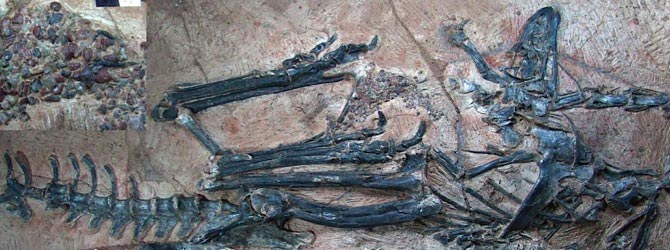
The Fossils of Limusaurus (L. inextricabilis)
Picture credit: James Clark

A Strange Theropod Dinosaur

The head of Limusaurus is towards the right of the picture, the beautiful and very well preserved caudal vertebrae (tail bones) of this dinosaur can be seen in the bottom left.  In the centre of the picture between the claws of the hind legs a pile of gastroliths are shown, in what would have been the stomach cavity. This section of the fossil is enlarged and the individual stones can be made out (top left corner).

A total of two skeletons of this dinosaur have been found, identified as a member of the Theropoda, but a plant-eater, Limusaurus exhibits characteristics that may identify it as a transitional fossil, providing evidence on how dinosaur digits evolved and changed over time.  The remains are of juveniles (analysis of bone fusion), these animals were 1.7 metres long, and lightly built, but it is not known how big a fully grown adult would have been.

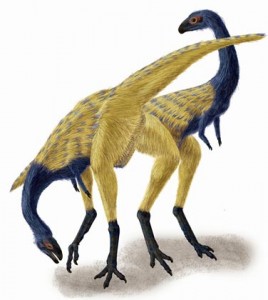
The long hind limbs indicate that this dinosaur was a fast runner and as many other theropods from China have been discovered with primitive feathers, Limusaurus is illustrated as a feathered dinosaur.  This dinosaur could not fly, but an active, cursorial lifestyle may indicate that this dinosaur was warm-blooded and the feathers would have helped insulate the animal and retain body heat.

An Artist’s Illustration of Limusaurus
Limusaurus drawing.

Picture credit: Portia Sloan

An Unusual Theropod Dinosaur

Limusaurus is certainly an unusual theropod.  Classified as a primitive Asian ceratosaur, this long-limbed, short-armed, toothless but beaked dinosaur may prove to be a transitional fossil helping to explain the evolution of Theropoda digits to the II, III, IV digit formation of birds.  The remains were found in the Junggar Basin in the Xinjiang Uygur region of northwest China.

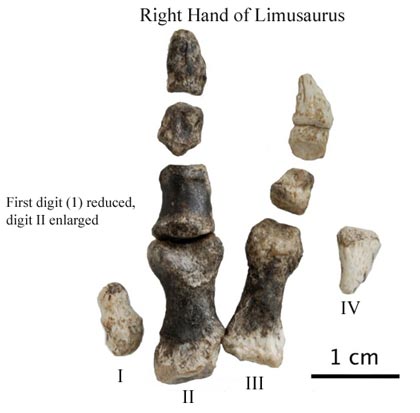
Xu Xing, one of the principal investigators and an illustrious member of the scientists at the IVPP describes this dinosaur as having four digits (fingers) on each of its small hands.  Digits I, II, III and IV equivalent to the thumb, index finger, middle and the ring fingers in humans.  However, digit I (thumb) is greatly reduced and the second finger (digit II – index) is very much larger, perhaps compensating for the vestigial state of the first digit.

Dinosaur Bird/Theory

Palaeontologists who supported the dinosaur-bird theory long faced a problem on fingers. Previous fossils of theropod dinosaurs showed earlier dinosaurs had five fingers and later ones gradually lost their ring finger and little finger, what is know as lateral shedding, the outside fingers went.  Birds show skeletal traces of former fingers, the index, middle and ring fingers, in other words digits II, III and IV.  The different digit formations is one of the major stumbling blocks when it comes to accepting the theory that birds are indeed descended from theropod dinosaurs and in essence highly evolved, avian dinosaurs.  Limusaurus may provide evidence as to how the changes in fingers came about, Xu Xing commenting on the fingers of Limusaurus stated:

“The new Limusaurus indicated a different pattern of finger reduction.  It was the thumb that was lost, instead of the ring finger”.

Co-author of the research paper on this new dinosaur, James Clark, of the George Washington University (United States) stated:

“This new animal is fascinating by itself, and when placed into an evolutionary context it offers intriguing evidence about how the hand of dinosaurs evolved into the hand of birds”.

The Right Hand (right manus of Limusaurus)
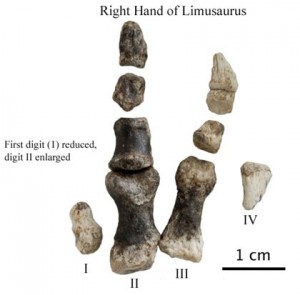
The hand of a dinosaur.

Picture credit: James Clark (annotation by Everything Dinosaur)

The international team re-examined hand skeletons of some previous fossils of theropods.

“We realised the pattern of their finger reduction was much more complicated than people had thought,” Xu added.

The scientists believe that the first digit becoming smaller and the importance of the second digit becoming greater indicate the beginnings of a trend in the evolution of dinosaur digits that would eventually lead to the configuration of II, III, IV as seen in birds.  Limusaurus marks the beginning of a trend in finger development.

A New Hypothesis

They also presented a new hypothesis to explain why advanced theropods, from which birds were believed to have evolved, had the second, third and fourth fingers but they looked like the first three ones, as some fossils showed.  Previously, palaeontologists believed that theropod dinosaurs as they evolved and changed over time, gradually lost fingers, but from the outside of the hand inwards (the lateral side).

Theropod dinosaurs have traditionally been assumed to have lost fingers from the lateral side inwards.  This differs from the bilateral reduction seen in other tetrapod groups, i.e. losing digits from both the medial and lateral sides (inside and outside digits of the hand).

This strange reduction pattern is clearly present in primitive, basal theropods and has also been inferred in other types of theropod, based on the identification of their three-fingered hands (digits I, II and III present).  However, this contrasts with the evidence from the extant theropods, the birds which have digits II, III and IV present.

Jurassic Ceratosaur

The evidence from the skeletal remains of Limusaurus indicate that the index finger may well be taking on the appearance and prominence of the thumb, a case of digit II evolving into digit I.

Xu Xing went on to state: “Homeotic changes might happen on dinosaurs, which means that the index finger has the features of a thumb.  Such changes happened in humans, for example, a person usually has seven cervical vertebraes [neck bones] but, for some people, the first thoracic vertebrae has the feature of the cervical ones”.

Commenting on these findings, Alan Feduccia, (Palaeobiologist at the University of North Carolina) stated:

“If confirmed, this would be the only early dinosaur with a hand composed of the middle three digits, which is the same pattern as that of modern birds, albeit dramatically different in overall hand morphology, as well as having a highly abbreviated forelimb”.

He went on to add:
“The new fossil answers many questions and raises still another set of unknowns”.

Guenter Wagner, a renowned Yale evolutionary biologist, responded to the paper (published in the scientific journal Nature):

“There is very strong developmental evidence that there was a homeotic change in digit identity in the evolution of the bird lineage.  I find it intriguing that there is more similarity to the 2,3,4 digits proximal, and more similarity to 1, 2, 3 digit identities distally”.

Wagner, however, remained neutral on the question of whether the morphology of this animal is a derived feature that may not be informative of the stages the bird lineage went through.  This new research does provide some very interesting and intriguing questions, whether or not Limusaurus is a true transitional fossil has yet to be determined, but it does provide an interesting insight into one potential path from cursorial three-fingered dinosaurs to the birds that can be seen today.

Reference: Xing Xu et al, “A Jurassic ceratosaur from China helps clarify avian digital homologies” Nature 459:940 doi:10.1038/nature08124


20 06, 2009

New Radiocarbon Dating Information Changes Mammoth Extinction

By |2022-12-25T11:29:29+00:00June 20th, 2009|Categories: Dinosaur and Prehistoric Animal News Stories, Educational Activities, Main Page|0 Comments

Mammoths around in Great Britain much Longer than Previously Thought

Radiocarbon dating information changes the date of the extinction of Woolly Mammoths from the British Isles.

A trip to the beautiful county of Shropshire 14,000 years ago may well have resembled a visit to a safari park as amongst the exotic wildlife around at the time, herds of Woolly Mammoths could still be seen.  This is the conclusion of a group of scientists that have recalculated the age of several Mammoth fossils found in the Shropshire.  It seems that herds of these iconic Ice Age mammals were wandering around the English countryside, thousands of years after they were thought to have gone extinct.

In research published in the scientific publication “Geological Journal”, researchers from the Natural History Museum in London have re-examined data on five Woolly Mammoth fossils found at Condover, Shropshire in 1986.  Improvements in the technology of radiocarbon dating has enabled the scientists to reassess the age of these fossils and their work indicates that these animals died 14,000 years ago, 7,000 years later than previously thought.

Condover, is a small village in the centre of Shropshire, the area is well-known to geologists as there are a number of small fault lines in the region and earthquakes in the vicinity are not unknown.  The last substantial quake occurred in 1990.  There are a number of sandstone and gravel quarries around the village and it was in one of these gravel pits that the remains of one adult and four juvenile mammoths were discovered in 1986.  The skeletons were well preserved and articulated and the site remains one of the best locations known for fossil Mammoths in the UK.  There is a model of the Condover Woolly Mammoth on display at the Shropshire Hills Discovery Centre in the nearby town of Craven Arms.  Members of Everything Dinosaur have been to Shropshire on many occasions, normally to visit sites such as Ludlow and the Mortimer forest to explore the excellent Silurian aged rock formations and hunt for trilobite fossils.

Radiocarbon Dating Information

However, developments in dating techniques has enabled a team of scientists from the Natural History Museum to reassess the age of the Mammoth remains.  The new dates point to climate change as the reason for this elephant’s decline rather than hunting by early humans and Neanderthals.

Commenting on the new data, Professor Adrian Lister (Natural History Museum) stated:

“Mammoths are conventionally believed to have become extinct in north-western Europe about 21,000 years ago during the main ice advance, known as the Last Glacial Maximum”.

However, more sophisticated radiocarbon dating techniques used on bones, plus a new study of the micro fossils, plant and insect fossils found at the site indicate that these large herbivores persisted longer in the United Kingdom than previously thought.

Professor Lister went on to add:

“Our new radiocarbon dating of the Condover mammoths changes that, by showing that Mammoths returned to Britain and survived until around 14,000 years ago”.

The Condover Mammoth Fossils

The Condover Mammoth fossils are the last known record of Mammoths living in the north-west of Europe, their demise seems linked with climate change rather than the pressure of hunting from human settlers.  The advance of the ice sheets from the north, led to a change in the habitat, the open grassy plains, (known as Mammoth steppe, due to these large creature’s influence on the ecosystem), gave way to much more conifer forest and scrub.  This habitat was not suitable for a large herbivore that grazed on grasses and sedges.

Professor Lister added:

“The new dates of the Mammoths’ last appearance correlate very closely in time to climate changes when the open grassy habitat of the Ice Age was taken over by advancing forests, which provides a likely explanation for their disappearance.

 There were humans around during the time of the Condover mammoths, but no evidence of significant mammoth hunting”.

Although Woolly Mammoths are seen as “classical” animals of the Ice Age and they were well adapted to cold climates, they were not limited to cold environments.  Types of Mammoths lived throughout the northern hemisphere during the Pleistocene.  Contrary to popular belief, Mammoths did not live in habitats dominated by ice and snow but rather on the cold grasslands (steppe) beyond the reach of the ice sheets.  Mammoths were well adapted to cold conditions, with small ears (to reduce heat loss), thick set bodies, and two types of body hair to help keep them warm.  The outer layer of hair, was thick with long guard hairs, over a metre in length in some cases.  This hair was coarse and up to six times thicker than human hair.  The under-layer of hair was dense, softer and shorter with individual hairs much thinner than the outer hair covering.  This helped trap air which added to the insulation properties of this inner layer of body hair.

Many types of Mammoth had thick skin and a layer of body fat up to 10 cm thick, again providing excellent protection from the cold.

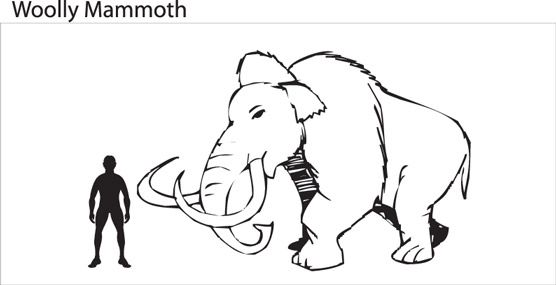
An Illustration of a Woolly Mammoth

Picture credit: Everything Dinosaur

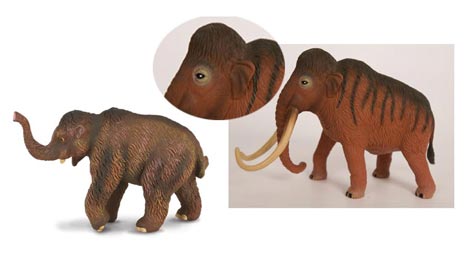
Evidence from frozen Mammoth corpses from Siberia indicate that the hair colouring of Mammoths varied from reddish orange to a dark brown.  The Natural History Museum Woolly Mammoth model is depicted as a reddish brown coloured animal whereas other Mammoth models such as the new baby Mammoth model from Procon/CollectA is depicted with the more “traditional” dark brown colouration.

Woolly Mammoth Model Comparisons

Comparing Mammoths.

Picture credit: Everything Dinosaur

The picture shows the adult Woolly Mammoth model as created by the Natural History Museum in London, the colouration is distinctly reddish with darker hair on the crown of the head and along the back and part way down the flank (inset).  The model of the baby Mammoth from the Procon/CollectA prehistoric animal model series, is depicted with a dark brown colouration all over.  Note also the different interpretations of nail colour between the two replicas.

To view the range of Woolly Mammoths and other prehistoric mammals available from Everything Dinosaur: Prehistoric Mammal Models and Dinosaurs.

19 06, 2009

A Remarkable Dinosaur Encounter – Bournemouth International Centre (BIC)

By |2024-04-17T10:31:13+01:00June 19th, 2009|Categories: Everything Dinosaur News and Updates, Main Page, Press Releases|0 Comments

Dinosaur Encounter Exhibition in Bournemouth Summer 2009

Everything Dinosaur will be working at the Dinosaur Encounter exhibition in Bournemouth over the summer.

Travel back in time to the Mesozoic and come face to face with giant dinosaurs, that is just one of the many Summer attractions being offered this season at the Bournemouth International Centre (BIC), Bournemouth, Dorset.  Just a fossilised dinosaur bone’s throw from the Jurassic coast, come face to face with Tyrannosaurus rex and other famous dinosaurs with the Natural History Museum’s Dinosaur Encounter Exhibition.

Dinosaur Encounter

Are you brave enough to meet the huge armoured Ankylosaurus with a 50 kilogramme club on the end of its tail ready to take a swing at you?  Or do you fancy yourself standing beneath the gaping jaws of a T. rex?  All this and more awaits the brave dinosaur hunters who venture into the BIC this Summer.

Dinosaurs continue to fascinate and amaze, in fact on average a new dinosaur species is named and described every six weeks, dare you enter their world and come face to face with these giant prehistoric creatures.  The BIC in association with the Natural History Museum and aided by team members at Everything Dinosaur are bringing the Jurassic and Cretaceous world’s to life with fossil encounters, activities, interactive exhibits, replicas and of course the dinosaurs themselves, many of which are animated (they move), thanks to the those clever robotic engineers at Kokoro.

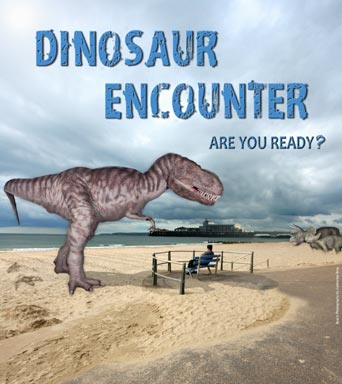
Dinosaurs at the Seaside – Bournemouth

Picture credit: BIC

Theories from Palaeontologists

Palaeontologists have put forward a theory that dinosaurs like Triceratops may have lived in coastal environments, so at least one huge dinosaur is going to feel at home on the south coast this Summer.

If you are unable to visit the south coast, take a look at Everything Dinosaur’s website instead: Everything Dinosaur.

The Dinosaur Encounter Exhibition runs from Saturday July 11th until Friday 28th August, 160 million years of dinosaur evolution crammed into seven weeks, that’s not bad going!  The Solent hall at the BIC has never had such fearsome and awesome visitors and with the event opening at 10am each day (final entry 5pm), there has never been a better chance to get up close to dinosaurs and learn a little about these amazing creatures.

BIC ticket hot-line (UK) 0844 576 3000 (family concessions available).

Travel back in time this Summer and come and see the dinosaurs, this exhibition is going to be a “roaring success”!

18 06, 2009

New Giant Parrot-Like Species of Dinosaur Discovered (New Species of Psittacosaurus)

By |2022-12-25T11:22:21+00:00June 18th, 2009|Categories: Dinosaur and Prehistoric Animal News Stories, Main Page, Palaeontological articles|0 Comments

New Species of Psittacosaurus Named and Described

Psittacosaurus may not be as well known as later ceratopsians such as Triceratops (horned dinosaurs), but for this genus of dinosaur it has an important place in palaeontology, simply because it is the most species diverse of all the known dinosaur genera.

Psittacosaurus

Now a new species of Psittacosaurus or “parrot lizard” has been named and described – Psittacosaurus gobiensis, making this, in our estimation the ninth type of Psittacosaur to be named and described to date.  Once regarded as an ornithopod, psittacosaurs are now believed to be a transitional form between Ornithopoda and the ceratopsians, fossils of these particular dinosaurs are associated with Asia, most famously the Gobi desert region.  Although small by dinosaur standards, with the largest species a little over 2 metres long, the numerous fossils found to date have provided scientists with a wealth of data on the evolution and behaviour of these Cretaceous animals.

In recent years some remarkable fossils associated with this genus have been discovered.  For example, remains of a group of baby Psittacosaurs were found together, perhaps evidence of herding or flocking behaviour.

To read more about this discovery: Dinosaur Nursery Unearthed in China.

Feathered theropods are known from the fossil record, but another fossil specimen of a Psittacosaurus from Liaoning (China) indicates that these ornithischians may have had feathers too, at least according to a Chinese scientific paper published recently in the journal Nature.

To read about feathered Psittacosaurs: Feathered Ornithopods upset the Scientific Apple Cart.

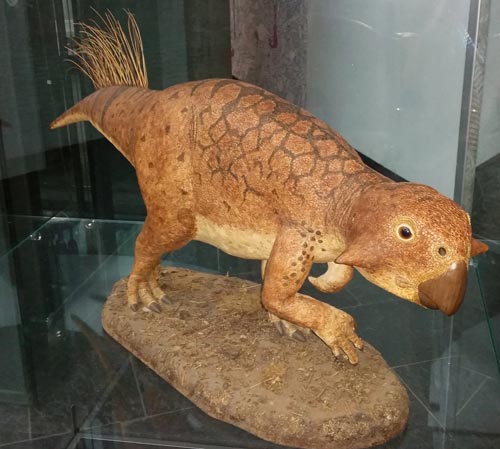
An Illustration of a Feathered Psittacosaurus

Life-size Psittacosaurus replica.

A model of the dinosaur called Psittacosaurus. Picture credit: Everything Dinosaur

Picture credit: Everything Dinosaur

Psittacosaurus was named “parrot lizard” after its parrot-like beak, this little dinosaur was a low browser, perhaps adapted to feeding on the fruits and nuts of angiosperms (flowering plants).  It had long hind legs and was capable of adopting a bipedal stance if required and some fossils indicate that it had long, quills running down its back and along its tail (as illustrated above).  Psittacosaurs are associated with Cretaceous strata, P. gobiensis for example, has been dated to approximately 112 million years ago (Aptian faunal stage).

Scientific Paper

In a paper on this new type of dinosaur, P. gobiensis, this one-metre-long dinosaur, may have had a diet dominated by nuts and seeds and this specimen is associated with gastroliths (stomach stones) which may reinforce the high fibre diet theory.  The paper on this dinosaur has been published in the Proceedings of the Royal Society B: Biological Sciences.

Picture show the skull of P. gobiensis compared to a the skull of a modern parrot (Macaw).  Analysis of the skull of this new psittacosaur indicates that this animal chewed its food in a similar way to parrots.

Professor Paul Sereno, from the University of Chicago commented:

“These and other features, along with the presence of numerous large stomach stones, suggest that psittacosaurs may have had a high-fibre, nut eating diet”.

“Parrot Lizard”

The short snout, just a third of the skull length was different to most dinosaurs, giving the skull its parrot-esque profile.

Professor Sereno went on to add:

“Psittacosaurs are all relatively small in body size, ranging from one to two metres in body length.  Their geographic range is limited to central Asia, and their temporal range may be as narrow as 10-20 million years in the mid Cretaceous”.

The head is rather square looking in profile, which along with the heavy beak makes the skull resemble a parrot’s .  There are no teeth in the front of the jaw but robust teeth further to the back of the jaws are blunt and designed for chopping and crushing.

To view models of ornithopods, ceratopsians and psittacosaurs visit the models section of the award-winning Everything Dinosaur website: Dinosaur and Prehistoric Animal Models.

17 06, 2009

Dinosaur Wall Murals – Ideas for a Dinosaur Themed Bedroom

By |2023-03-02T14:04:21+00:00June 17th, 2009|Categories: Everything Dinosaur News and Updates, Main Page, Press Releases|5 Comments

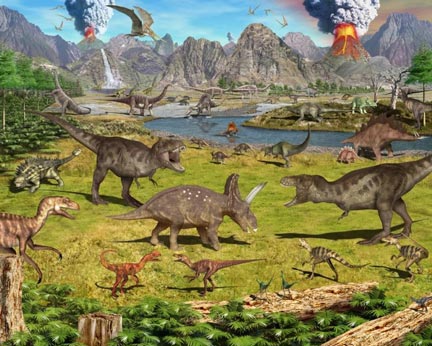
A Dinosaur Wall Mural

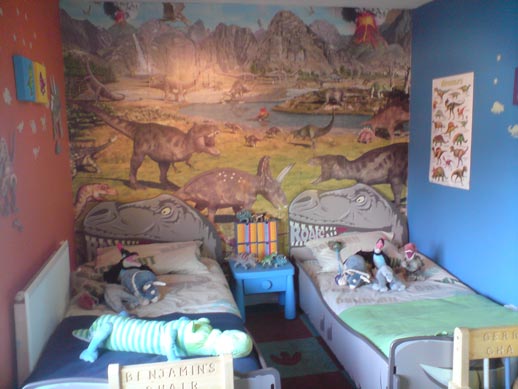
Team members at Everything Dinosaur have just completed our testing programme and added to our product range, this wonderful and very colourful dinosaur mural.  Turn a child’s bedroom wall or part of a classroom into your own dinosaur theme park with this 3-D computer generated image of the world of dinosaurs and other prehistoric animals.

Dinosaur Wall Mural

Picture credit: Everything Dinosaur

Everything Dinosaur

This wall mural is made up of 12 strips which can be assembled and stuck to the wall of a child’s bedroom or a school room to make your very own dinosaur “dino-rama”.  Although such a scene is entirely a fabrication of the designer, we love the way that all sorts of prehistoric animals from the Mesozoic have been put into the mural together.

Clearly this reconstruction is not accurate, firstly the animals featured are separated by millions of years of evolution and many of the genera depicted lived on different continents.  However, this picture and many reconstructions of prehistoric life seen in dinosaur books are merely representations of life and not actual depictions of genuine prehistoric environments.  Another reason why such busy-looking panoramas are not the equivalent of typical snapshots of a habitat is perhaps not so obvious as the other two reasons mentioned above.

In reality, it is most unlikely that so many different individuals of different species of large animals would be in the same area at exactly the same time.  If you talk to any wildlife photographer or speak with anyone involved in wildlife illustrations, artwork or even nature themed television programmes, they will tell you how unrepresentative such pictures are.  However, this is not the point; the mural nicely depicts a whole host of prehistoric animals in relatively accurate and natural poses.

The mural represents a sort of “pictorial palaeontological garden” and we are confident it will delight many dinosaur fans and enthusiasts.

To view the range of dinosaur themed toys and gifts available from Everything Dinosaur’s award-winning website: Visit Everything Dinosaur.

Putting aside the one or two inaccuracies, this dinosaur land mural is easy to put up and can cover a wall 10 feet wide by 8 feet tall (3.05 metres x 2.44 metres).  It can be easily trimmed (we found wallpaper scissors or robust kitchen scissors worked fine), so that it can fit any wall.  The special backing to the mural prevents any underlying wallpaper from being seen, so there is no need to strip off the existing wallpaper to fit this mural.  It requires adhesive to stick it to the wall, we found wallpaper paste worked well and as it was supplied in 12 strips it was very easy to handle and put up.

A Dinosaur Themed Bedroom

Dinosaur themed bedroom mural.

Picture credit: Everything Dinosaur

16 06, 2009

Welcome to our New Office – We Wish

By |2024-04-17T10:31:42+01:00June 16th, 2009|Categories: Educational Activities, Everything Dinosaur News and Updates, Main Page|0 Comments

Welcome to our Office – We Wish

Lots of science weeks and school exercises at the moment for Everything Dinosaur team members, they are always fun (but hard work too).  We were invited to attend a “Dinosaur Day” at a school in the wonderful county of Cumbria yesterday.  Happy to meet all the young, enthusiastic and knowledgeable dinosaur fans, trouble was we had to get up at 4.30am to arrive in time to start the first session.

Long days and early starts are not too bad, especially this time of year with the light mornings.  We spent the day at the school, carrying out a range of activities for children aged 5 years to 11 years (KS1 and KS2).  By the end of the day we had covered a round trip of 298 miles, so we were very tired but some of the views of the Lake District that we had on our way to the school were awesome.

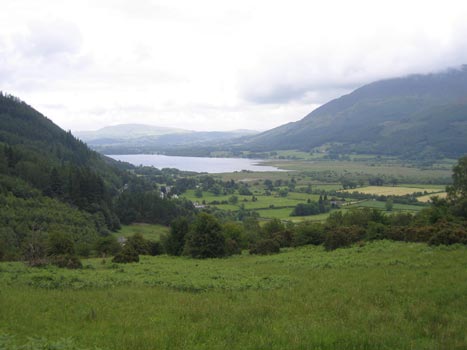
Not a Bad Place to Work – A View of the Lakes

Picture credit: Everything Dinosaur

Everything Dinosaur

These early starts certainly have some compensations.  We stopped for a flask of coffee and sandwich and just relaxed for a while and enjoyed the view.  As well as being very beautiful and a favourite destination for walkers and bikers there is some amazing geology to see (and lots of fossils to collect), but that will be for another day, but we could not help ourselves when we saw a very inviting scree slope that we were very tempted to clamber up.

One thing for certain, we get the chance to visit some amazing places on behalf of our work for Everything Dinosaur.

If you want to visit an amazing place, take a look at Everything Dinosaur’s award-winning website: Everything Dinosaur.

Go to Top