All about dinosaurs, fossils and prehistoric animals by Everything Dinosaur team members.
15 06, 2009

Tadpoles – So far so Good

By |2023-02-28T09:55:26+00:00June 15th, 2009|Categories: Animal News Stories, Main Page|0 Comments

Tadpoles in the Office Pond – So Far so Good

Pond watching during our breaks from working at Everything Dinosaur, is very much a favourite pastime of the staff.  It is pleasing to note that even though the pond was cleared out last Autumn, the removal of much of the pond weed and the disturbing of the bank side vegetation does not seem to have affected the wildlife at all.

The pond snails seem to be thriving, although we have counted more Ramshorn snails than Pond snails this year for the first time.  The invertebrate life seems to have flourished as well with the first of the Damsel flies emerging as winged adults over the last ten days or so.  They really are a joy to watch as they whirl and fly around the pond.

The tadpoles are much more visible than last year.  Despite having fewer places to hide they seem to be doing well also.  We have noted two distinct sizes of tadpole, although we know that they are from the same batch of frogspawn laid earlier this Spring.  The larger tadpoles are bigger overall and have proportionately larger heads.  We have speculated that some tadpoles may adopt a more predatory role in the pond compared to others and they are genetically predisposed to develop larger jaws as they attack and eat other pond animals.

We have read about this but we are not sure whether it is true, that in the Common frog (Rana temporaria), and perhaps in other genera, there is a tendency for some of the tadpoles to develop carnivorous habits and it is these animals that have the best chance of surviving and making it to the froglet stage.  Today, one of our colleagues reported they had seen one of these larger tadpoles with back legs, the first time that this has been observed.

Perhaps these larger, predatory tadpoles grow slightly faster on their protein rich diet and therefore complete the metamorphosis into frogs that much quicker.

14 06, 2009

Teaching Time Again for Dedicated Team Members

By |2024-04-17T10:32:36+01:00June 14th, 2009|Categories: Everything Dinosaur News and Updates, Main Page|0 Comments

Time to go Teaching

Sunday morning and team members at Everything Dinosaur, are in the office sorting out teaching materials ready for another busy day carrying out dinosaur themed experiments and science themed course work with school children.  We have an early start tomorrow morning (5am), so it is even more important that we prepare all the teaching materials and resources today before we set off tomorrow for a trip to the Lake District and a school visit.

The school is holding a “Dino Day” and we are the guests of honour.  Well as a matter of fact, I think the pupils are rather looking forward to the fossil casting experiments and the work on the dinosaur trackway we have planned, than meeting up with one or two old fossils such as ourselves.  As qualified teachers with the backing and support of a number of Government led educational organisations, Everything Dinosaur gets involved in a lot of school work, supporting national curriculum activities at key stages 1, 2 and 3.  Having to contend with dinosaur fans at various ages from 4 years to 12 years can be a bit of a challenge in itself but with the innovative and enthusiastic approach from our staff we seem to manage this.

Everything Dinosaur

Tomorrow we are conducting a series of experiments, the morning session is dedicated to dinosaur digestion, linking in with school work associated with teeth and nutrition, with a sub-plot of food chains.  In the afternoon, we are turning “dinosaur detectives” and taking the slightly older children on a trip back in time to the Early Jurassic to look at the evidence that a dinosaur trackway (trace fossil) can provide.

Dinosaur Detectives – Looking at Evidence and Interpretation

Picture credit: Everything Dinosaur

This morning we intend sorting out what we need and in readiness for another 15 hour day.  Spending so long out of the office, we turn to the equipment we use on our fossil hunting expeditions, most importantly of all, the lunch boxes, and the thermos flask.  After all, we must be properly provisioned.

Visit Everything Dinosaur’s user-friendly website: Everything Dinosaur.

13 06, 2009

Dinosaur Museums Suffer in the US Recession

By |2022-12-25T11:08:55+00:00June 13th, 2009|Categories: Dinosaur and Prehistoric Animal News Stories, Main Page|1 Comment

Dinosaur Museum in Wyoming Set to Close

An American dinosaur museum suffers in the global recession.

It may be hard to believe as people queue to gain access to the Natural History Museum in London or wait excitedly to see the “Dinosaurs Live” stage tour, but not every museum or attraction associated with dinosaurs is doing well in the current recession.

Dinosaur Museum

The Natural History Museum in London has an hourly capacity of 10,000 visitors and in the Summer months, especially during the school holidays it regularly reaches this limit.  It can be so busy that sometimes visitors can not even get near the souvenir shop.  Nice to know that they can shop in comfort from their own home at Everything Dinosaur and still be assured that many of the items they buy from us help support the palaeontologists at the museum.

To visit our on-line shop:  Everything Dinosaur.

However, not every dinosaur themed attraction is doing as well in the current difficult economic climate.  For example, the University of Wyoming Geological Museum, a museum based on the campus of Wyoming University is being forced to close down.  Budget cuts of $18.3 million have been announced and the museum will be closed to visitors from the 1st of July.

Myron Allen the Wyoming University provost stated:

“It wasn’t a decision anyone wanted to make.  We didn’t like any of the least of the evils”.

Cuts in the annual University budget had to be made and unfortunately the axe has fallen on the museum with its many dinosaur fossils including a replica of “Big Al” a superbly preserved sub-adult Allosaurus (A. fragilis), a dinosaur which was the subject of a television documentary made by the BBC under the “Walking with Dinosaurs” franchise.

Famous Mesozoic Fossils

Wyoming is associated with a number of famous Mesozoic fossils, not just allosaurs but also Apatosaurus, Stegosaurus and Camptosaurus to name but a few.  Of particular importance are those parts of the state with exposed elements of the Morrison Formation and areas such as Como Bluff.  A number of Late Jurassic fossils are directly associated with this part of the USA.

Unfortunately, the Director of the Museum Brent Breithaupt and one part-time assistant will lose their jobs as a result of the closure.  The administration felt that cutting the $80,000 budget was the best action they could take to protect other areas of the University in these difficult economic times.

The fossils will remain in place but the visitor side of the operation will cease next month.  It is a shame to hear this news, we wish everyone affected by the decision whether an employee or a student studying courses at the University the very best of luck and here’s hoping that the museum will shortly be able to open again and put on public display its prehistoric animal fossils and exhibits.

A petition has been organised (thank you commentator), and we have signed it hoping that our viewpoint may in some small way help in saving this valuable teaching and educational resource.

To sign the petition to save the Dinosaur Museum In Wyoming visit the museum’s website.

12 06, 2009

Prehistoric Business Hopes Van will be a Roaring Success

By |2022-12-25T11:05:51+00:00June 12th, 2009|Categories: Everything Dinosaur News and Updates, Main Page, Press Releases|0 Comments

Everything Dinosaur in the Local Paper

As a company run by parents, teachers and real dinosaur experts (Everything Dinosaur), we tend to be regarded as quite unusual.  We certainly stand out amongst the other businesses in our area, a fact that has allowed Everything Dinosaur to gain a lot of publicity regarding our educational activities with schools and other organisations.

Everything Dinosaur

None of us would claim to be experts in the art of public relations, but PR does play an important part in our marketing communications mix.  Public Relations is concerned with the management of relationships between organisations and their stakeholders (publics), be they customers, financiers, suppliers and so on.

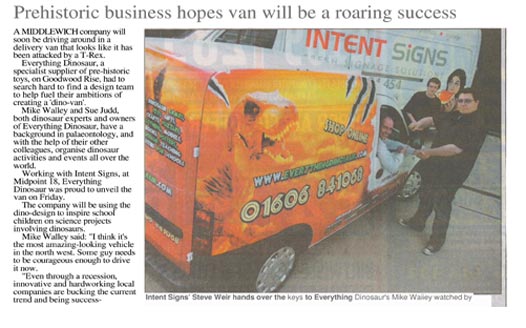
A typical example of PR for Everything Dinosaur is when we got our new van and wanted to put some signage on it to promote us.  Rather than opt for the more prosaic options, we ran a competition and the winning design incorporated the concept of the van being attacked by a dinosaur.  Certainly this design was very different from the run of the mill signage seen on other vehicles.

Our new “Dino-Van” was so eye-catching that the local paper sent a photographer round when the vehicle signage was unveiled.

The “Dino-Van” Article in the Local Paper

Picture and story credit: Middlewich Guardian

The picture shows one of our team members collecting the van keys from a member of the signage company that brought our concept of a van attacked by a dinosaur to life (Intent Signs).

Our “Dino Van”

The article states that Everything Dinosaur will be using the dino-design to inspire school children on science projects involving dinosaurs.

To quote the article:

“Even through a recession, innovative and hard-working local companies are bucking the current trend and being successful in these difficult times”.

Publicity is always useful, and although it takes a little time and effort to achieve the right results, we think it is very worthwhile.

Visit Everything Dinosaur’s award-winning website: Everything Dinosaur.

11 06, 2009

Controversy over the Dinosaurs/Birds Link

By |2023-03-02T14:16:19+00:00June 11th, 2009|Categories: Dinosaur and Prehistoric Animal News Stories, Main Page, Palaeontological articles|0 Comments

New Research Questions “Birds Descended from Dinosaurs Theory”

For some time the theory that theropod dinosaurs gave rise to birds has been an accepted part of scientific thinking, a hypothesis that is largely believed by the majority of palaeontologists and academics.  However, the exact relationship between Dinosauria and the Aves has to be determined.  There are certainly enough common anatomical similarities to indicate an evolutionary relationship, but whether or not birds actually are the descendants of small, bipedal meat-eating dinosaurs has been questioned on numerous occasions.

Newly Published Research

A new research paper published in the scientific publication “The Journal of Morphology” provides a new perspective on this problem, one that was debated as long ago as the 1880s by eminent British scientists such as Huxley.

That birds may be the descendants of dinosaurs is perhaps of the most strongly accepted hypotheses in current evolutionary research.  However, there is mounting evidence to suggest that the theory is simply not right, the interpretation of the relationship may be wrong and evidence has been published by the Oregon State University in the United States that asks scientists to reassess the dinosaur-bird link.

Because of the demands associated with powered flight, birds have a very unique physiology.  Birds breathe very differently from mammals and reptiles.  Their lungs are particularly efficient and have a circulation system that does not permit oxygenated air to mix with de-oxygenated air.  These lungs are much more efficient than the lungs of a cold-blooded reptile such as a crocodile for example.

To read more about the structure of Avian lungs: Ideas on Dinosaur Breathing – A Breathe of Fresh Air.

In addition to very efficient lungs, birds have an immobile thigh bone. The locked femur has been known for some time, but the role it actually plays in aiding flight is the subject the new discovery from the Oregon University based team.  The researchers found that there is a strong relationship between the immobile femur (thigh bone) and the air-sac structure of the lungs.

The researchers state there is a strong relationship between:

“the fixed position of bird bones and musculature that keeps their air-sac lung from collapsing when the bird inhales”.

An immobile femur is unique to birds, it is not seen in other vertebrates.   According to Oregon State University’s John Ruben (Professor of Zoology) this work on the link between the femur and the lung structure may indicate that birds evolved alongside dinosaurs in the Mesozoic not directly from a specific SuperOrder such as Theropoda.

He stated that:

“This discovery probably means that birds evolved on a parallel path alongside dinosaurs, starting that process before most dinosaur species even existed”.

Theropod Dinosaurs

Understanding the lung function of dinosaurs is crucial in establishing the relationship between Aves and the Dinosauria.  However, the lack of fossil evidence (limited soft tissue preserved), has prevented scientists from making progress in this particular field of research.   Perhaps, the mummified hadrosaurine known as “Dakota” which seems to have a lot of soft tissue preserved may provide more data.  This new research from the American team, challenges the accepted, current theory.  Anatomical evidence from dinosaur fossil bones supports the theory that theropods had a mobile femur and as a result their lungs would have to be very differently structured to those of a bird.

Professor Ruben commented:

“Theropod dinosaurs had a moving femur and therefore could not have had a lung that worked like that in birds.  Their abdominal air sac, if they had one, would have collapsed”.

The question arises therefore, that if birds did not descend from theropods, then where did they come from?  There is evidence of birds in the fossil record from the post Callovian/Oxfordian faunal stages (Archaeopteryx lithographica), but there are very few fossils of birds in the known fossil record, even including those remarkable fossils from Liaoning Province in China.  If birds are not really feathered, flying theropods then this theory from the American team would suggest that they are still related and that they evolved from a common ancestor – the reptilian thecodonts (Thecodontia).

Everything Dinosaur stocks a wide range of theropod dinosaur models including: Papo Dinosaurs.

The dinosaur-bird link will remain controversial and be debated for many years to come, until some of the new technology including genetic research provides more information about known fossils or a new fossil is found to provide a fresh perspective.

10 06, 2009

Review of the New 1:40 Scale Model of Baryonyx (Procon/CollectA)

By |2024-04-17T10:21:59+01:00June 10th, 2009|Categories: Dinosaur and Prehistoric Animal News Stories, Dinosaur Fans, Everything Dinosaur News and Updates, Main Page|2 Comments

Review of 1:40 Scale Model of Baryonyx (Procon/CollectA)

Everything Dinosaur team members review the CollecA Deluxe Baryonyx model.

Some time ago, team members at Everything Dinosaur were given the opportunity to review early prototypes of the Procon/CollectA 1:40 scale range of prehistoric models. It was pleasing to note that as well as featuring the likes of Tyrannosaurus rex, some more unusual and perhaps less well-known dinosaurs were to be included. For example, this replica range includes a scale model of Baryonyx (Baryonyx walkeri), an unusual carnivore that may have been an ancestor of the Spinosauridae.

Baryonyx walkeri

One of the most remarkable features of this particular meat-eating theropod dinosaur from the Barremian faunal stage of the Early Cretaceous (125 million years ago), are the two huge 30 cm long claws on its first digit (thumbs). The claw was the first part of this dinosaur’s fossil to be discovered. An amateur fossil hunter, William Walker was exploring a Surrey clay pit and unearthed this huge manual ungual (claw). Nothing quite like it had been found in the fossil record at the time (1983). A team from the Natural History Museum (London) was despatched to investigate and over the next few months nearly 70% of the skeleton was recovered.

It was formerly named and described in 1987 (Baryonyx walkeri), the species part of the scientific name being in honour of the amateur palaeontologist who first found evidence of this fearsome creature.

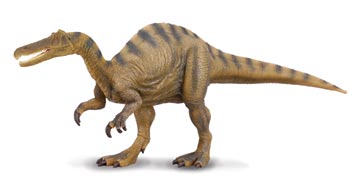
CollectA Deluxe Baryonyx Model

The scale replica from the Procon/CollectA series depicts Baryonyx as a dark brown dinosaur with, black vertical stripes running along the back and to the tip of the tail. This dull, mottled colouration would have helped camouflage this 10 metre long dinosaur as it moved through undergrowth in conditions where light was broken up by trees and becoming dappled.

Model Colouration

The head has greenish hue, which would have helped obscure it from fish as this fish-eating dinosaur looked into rivers and lakes trying to spot an unwary fish. The underside of the jaw is quite lightly coloured. It has been speculated that the lower jaws and chest of this piscivore would probably have been quite dark, again providing effective camouflage as it leaned over water trying to spot fish. Any camouflage to help break up this animal’s outline against a dark background of vegetation would have been useful for Baryonyx, especially if the speculation about it being a silent stalker of fish such as Lepidotes are to be believed.

The 1:40 Scale Model of Baryonyx

Baryonyx “Heavy Claw”.

Picture credit: Everything Dinosaur.

To view the scale model of Baryonyx and other prehistoric animal replicas in the CollectA Deluxe scale model series: CollectA Deluxe Prehistoric Animal Models.

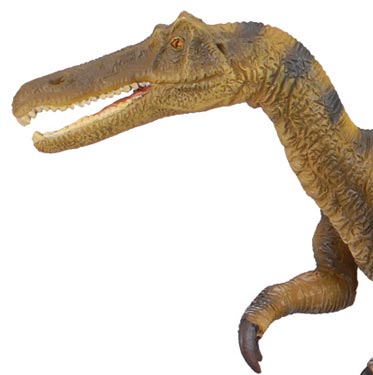
The model shows fine detailing, the prominent hump back is in evidence, indicating that the model makers have read up on recent papers concerning Baryonychidae anatomy. The jaws are well painted and the distinct kink in the upper jaw is visible on the model, although not very clear. The strong, powerful forelimbs and those famous claws are accurately portrayed.

The Baryonyx model measures approximately 30 cm long and stands 10 cm high at the hips. It makes a good contrasting theropod model when compared to the more robust looking T. rex model from the same prehistoric animal model series.

A Close up the Scale Model of Baryonyx

Baryonyx 1:40 scale.

Picture credit: Everything Dinosaur.

To view the extensive range of prehistoric animal models and figures available from Everything Dinosaur’s award-winning website: Dinosaur and Prehistoric Animal Models.

Marketed under the “Deluxe” banner, this 1:40 scale model of a Baryonyx provides a contrast to the earlier models of this dinosaur as depicted in the Carnegie Safari and Natural History Museum model ranges.  It makes an excellent addition to any dinosaur collection.

8 06, 2009

Life Begins at 40 for the Open University

By |2023-03-02T14:39:05+00:00June 8th, 2009|Categories: Dinosaur and Prehistoric Animal News Stories, Educational Activities, Main Page|0 Comments

Open University Celebrates Forty Years

The Open University is marking four decades of educating people far and wide, young and old with a series of events being held throughout the country over the Summer.  The Open University is the only British University dedicated to providing educational courses to students via distance learning.  The concept of the University is that you can study the courses, whether degree, post graduate or other on a part-time basis, perhaps whilst working or taking a career break.

The Open University

Founded in the late 1960s, the Open University was the world’s first successful distance teaching university and part of a vision by the UK Government to provide “Open Doors” to all members of the community in terms of education provision.  It now provides distance learning courses to many thousands of people, many of them overseas.

Established in the ‘White Heat of Technology’ era, the Open University was founded on the belief that communications technology could bring high quality degree-level learning to people who had not had the opportunity to attend campus universities.

A number of our staff and team members have studied with the Open University, everything from business qualifications to brushing up on geology.  The courses are very well written, up to date and extremely enjoyable.  We would recommend the Open University to anyone considering doing some part-time study.

A section dedicated to the educational sector.

The Open University has become a “Hot Spot” for education.  Picture credit: Everything Dinosaur.

Picture credit: Everything Dinosaur

Many thousands of people now study on a huge range of courses offered by the University.  In our experience as teachers, the courses offered are second to none but it is interesting to recall the opposition to a “University of the Air”, as the OU was called when it was first launched.

Celebrating Forty Years

The Open University was the first institution to break the insidious link between exclusivity and excellence.  It is a University founded on an ideal and, like all revolutionary ideas, attracted hostility and criticism.

In 1969, when the idea of The Open University was announced, it was described as “blithering nonsense” by Iain Macleod MP.  More than three decades on, The Open University has managed to convince sceptics that academic excellence need not be compromised by openness, indeed some of the degrees and courses offered are extremely well regarded in the academic world.

To learn more about the Open University and the courses that it offers: The Open University.

Happy 40th Birthday to the Open University.

7 06, 2009

Further Dinosaur Finds from the Morrison Formation

By |2023-03-02T14:41:30+00:00June 7th, 2009|Categories: Dinosaur and Prehistoric Animal News Stories, Main Page|0 Comments

Morrison Formation Dinosaur Discoveries

By the middle of the 19th century, pioneering palaeontologists had discovered the fossil rich Jurassic aged strata of mid-west America that became known as the Morrison Formation.  The Morrison Formation is exposed in several parts of the USA, in the south, the strata was laid down in an arid, dry desert-like environment and fossil finds are relatively sparse.  However, in the sequence of rocks exposed in Utah, they indicate a large, low-lying, alluvial flood plain and Mesozoic fossils, including dinosaurs are more numerous.

Morrison Formation

The rocks date from the Upper Jurassic and several genera of dinosaurs have been discovered in the many Utah quarries and dig sites, including famous dinosaurs such as Diplodocus, Allosaurus, Camptosaurus and Stegosaurus.  New discoveries are being made each year and scientists at the Burpee Museum of Natural History have reported unearthing a virtual treasure trove of dinosaur remains at a new excavation.

The researchers report that between 60-70 new bones have been found at this new dinosaur quarry, including several articulated cervical vertebrae (neck bones) of a sauropod.

A New Fossil Site

This new site is close to Hanksville, a small town in Wayne County Utah.  The early signs are that this could be an important site for Upper Jurassic fossils and may yield a new species or two.  It seems that the site represents sediment that was laid down at a bend or slower flowing part of a river.  Over many years, the remains of dead animals and drift wood were deposited in the same place and a sort of “Jurassic log jam” built up.  The fossils are concentrated into an area about 2/3 the size of a football pitch.

Commenting on the fossil bone concentration, Scott Williams, Collections and Exhibits Manager at the Burpee Museum stated:

“In some places you can’t work to remove one bone without finding four or five more”.

It sounds like there are going to be some very well stocked dig stations as the team continue to excavate the fossil bones from the site.  The researchers are hoping that the new discoveries will help them piece together a little more information about the ecosystem and the environment in the American mid-west 145 million years ago.

The team are expecting to have 10 years worth of digging ahead of them to fully explore this new location.  Free guided tours of the dig sites will be taking place for the first couple of weeks of June, after that it will be time to get done to work for the palaeontologists as they attempt to plot, map and decipher the position of the many bones trapped in the rocks.

Numerous Dinosaur Genera

The Morrison Formation has yielded a number of dinosaur genera, it is especially known for the number of sauropods (long-necked dinosaur) discoveries and the variety of theropods excavated.

The theropods in particular have provided scientists with a unique insight into the evolution of meat-eating dinosaurs and the relationships between genera.  Dinosaurs such as Ceratosaurus, Marshosaurus, Stokesosaurus and Torvosaurus are known from this area (Kimmeridgian to Tithonian faunal stages).

Perhaps the best known of all these theropods is Allosaurus (A. fragilis).  At least 44 individuals have been recovered from the Cleveland-Lloyd quarry alone.  Allosaurus was a formidable hunter, with a length of over 12 metres and weighing as much as 2.5 Tonnes. Its hind legs were massive, helping to support the animals weight and the head was perched on top of a “s” shaped neck.

The three-fingered hands had large claws on the digits and the arms were very strong.  It seems to have been one of the largest predators in the area during this particular part of the Late Jurassic.

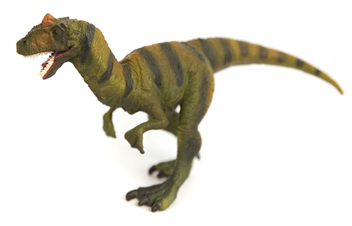
A Model of an Allosaurus
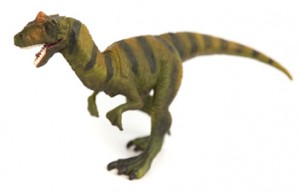
The fearsome Jurassic predator Allosaurus.

Picture credit: Everything Dinosaur

Dinosaur Models

To view a model of an Allosaurus and other figures in the Wild Safari Prehistoric World series from Safari Ltd: Safari Ltd. Wild Safari Prehistoric World.

Allosaurus belonged to a group of theropod dinosaurs called the allosaurids, a group that also includes such giants as Giganotosaurus and Carcharodontosaurus as well as the more lightly built Sinraptor.

To see a model of Sinraptor, Everything Dinosaur recommends readers take a look at the extensive PNSO modell range: PNSO Age of Dinosaur Models.

During the Cretaceous these animals went into decline and were gradually replaced in most parts of the world by other types of meat-eating dinosaur such as the spinosaurids, abelisaurs and tyrannosaurs.  A few allosaurids survived into the Early Cretaceous but their remains are seldom found.  It seems that from a peak in the Late Jurassic this type of meat-eating dinosaur became a sort of “living fossil” for the remainder of the Mesozoic.


5 06, 2009

A Chance to go Digging for Remarkable Dinosaurs

By |2024-04-17T10:23:24+01:00June 5th, 2009|Categories: Geology, Main Page, Palaeontological articles|0 Comments

Digging for Dinosaurs in the Dinosaur Provincial Park (Canada)

Looking for something to do over the Summer holidays, something a little bit out of the ordinary and unusual, well how do you fancy taking part in a real dinosaur excavation at a World Heritage site?

Digging for Dinosaurs

The Dinosaur Provincial Park, a UNESCO World Heritage site, situated in the Badlands of Southern Alberta, Canada, is offering a new dinosaur excavation programme.  For either one or two days participants (must be over 14), get the chance to take part in a real dinosaur bone bed excavation, working on real dinosaur fossils and helping to map the site and excavate Late Cretaceous dinosaurs.

The programme has been titled: “Bone Bed 30 – Guided Excavation Program”  not perhaps the most exciting or catchy title but an opportunity to help excavate dinosaur bones and take part in real research is a very serious business and there are very few opportunities to participate in such excavations.  The package is being offered throughout the Summer months (runs July to early September), and one or two day programmes are available.

Digging for Dinosaurs

Digging for Dinosaurs

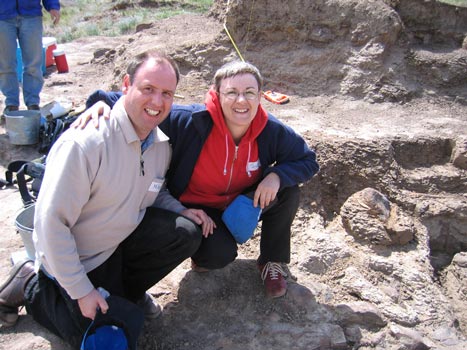
Pause for a pic next to a digs station.  Team members at Everything Dinosaur have worked on fossil dig sites.

Picture credit: Everything Dinosaur

For any person lucky enough to be in that area of southern Alberta this Summer, we would heartily recommend you taking up this opportunity to, as the tourism information says:

“Unearth the past, contribute to the future”

To learn more about the opportunity to help excavate real dinosaur bones, visit the Dinosaur Provincial Park’s official website.

Dinosaur Models

Everything Dinosaur stocks a wide variety of prehistoric animal models and replicas including many models of dinosaurs, fossils of which come from the Upper Cretaceous deposits of the Dinosaur Provincial Park Formation.

For example, the PNSO range includes models of ceratopsians, tyrannosaurs and duck-billed dinosaurs: PNSO Age of Dinosaurs Models and Figures.

4 06, 2009

New Models from CollectA

By |2022-12-25T08:32:21+00:00June 4th, 2009|Categories: Everything Dinosaur News and Updates, Main Page|4 Comments

New Prehistoric Animal Models from CollectA

Everything Dinosaur announces new models from CollectA.

The manufacturer known as CollectA has continued to add new prehistoric animals to its very successful and popular CollectA model series, also known by Everything Dinosaur team members as the Dinosaur Collection.  The range has recently been expanded and the trend continued to add slightly more unusual animals to the series.

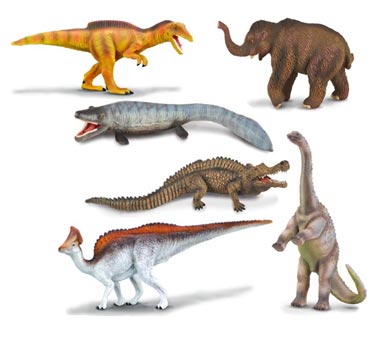
Recent additions have been a baby Woolly Mammoth calf, Sarcosuchus (a giant crocodile from the Cretaceous), Tylosaurus a fierce mosasaur (marine reptile), plus of course more dinosaurs.  The new dinosaur models, include a juvenile Tyrannosaurus rex plus Olorotitan, a hadrosaurine from Siberia and Becklespinax.  Becklespinax was a fierce meat-eating dinosaur, fossils have been found in the United Kingdom.

Additions to the CollectA Prehistoric Animal Model Range

Picture credit: Everything Dinosaur

To view the CollectA range: CollectA Age of Dinosaurs Prehistoric Life Models.

New Models from CollectA

It is pleasing to see dinosaurs like Becklespinax being added to the range.  The CollectA range already contains a number of prehistoric animals associated with Britain, Baryonyx, Polacanthus, Iguanodon and Neovenator for example.  Mind you, the collection also features models of dinosaurs from other parts of the world.  For instance, one of the new additions (CollectA dinosaurs) is a model of Rhoetosaurus in a rearing stance.  Rhoetosaurus is a sauropod, fossils of which are associated with Queensland, Australia.

All the models supplied by Everything Dinosaur, come with their own, unique fact sheet.  The fact sheets are written and produced by the dinosaur experts at Everything Dinosaur.

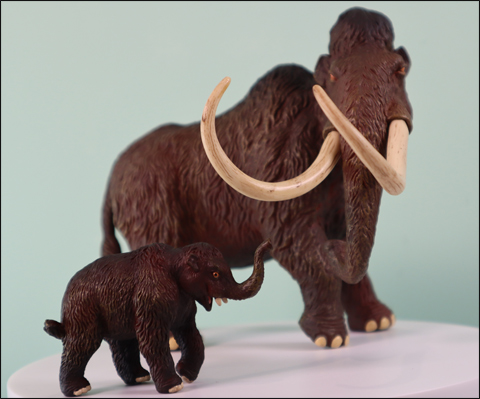
The new CollectA Baby Woolly Mammoth Photographed with the CollectA 1:20 Scale Mammoth

CollectA Woolly Mammoth models.

The CollectA Deluxe Woolly Mammoth model in 1:20 scale and the CollectA Prehistoric Life Woolly Mammoth calf.

Picture credit: Everything Dinosaur

Go to Top