More Snow and Ice on the Way – Could cause further Problems for Christmas Mail
With just a few days left until the big day, the threat of further snow and cold weather is causing a number of retailers to withdraw their online retailing offers, for fear of not being able to pack and despatch parcels in time for them to be received at Christmas.
Christmas Deliveries
We at Everything Dinosaur, have been aware of the backlog of parcels and other deliveries building up with UK couriers and Royal Mail. Certainly, the bad weather has not just been restricted to parts of the UK, other areas of Europe have experienced delays with parcel deliveries as Airmail and international courier networks have been disrupted due to the ice and snow. The extra staff and longer working hours implemented by the company has enabled Everything Dinosaur to keep up with the packing and despatching of items and this has ensured that parcels have been sent out as quickly as possible, giving them every chance of making it to their destination in time for the festivities.
The last recommended safe posting date for Royal Mail standard parcels is tomorrow the15th of December, with the last recommended date for second class this Saturday and for first class the following Tuesday. Staff at Everything Dinosaur, are working late into the night to ensure that they keep on top of the orders, but insist on checking and re-checking address labels, especially postcodes, doing all they can to ensure a speedy delivery.
A spokesperson for Everything Dinosaur stated:
“We are aware that the recent bad weather has severely disrupted deliveries of goods into a number of areas of the UK, the weather forecast for the end of this week, is not very encouraging as more snow and ice could cause further delays. However, we will do all we can to pack and despatch parcels as quickly as we can to give them every chance of reaching their destination in time for Christmas.”
A team of palaeontologists and field workers are busy extracting the fossilised remains of a Permian predator, a Dimetrodon, that has been nicknamed “Wet Willi” by the excavation team.
Dimetrodon Fossil
The scientists from the Houston Museum of Natural Science (Texas), including Dr Robert T. Bakker, the curator of palaeontology at the museum, are busy, carefully excavating the articulated specimen of this ancient carnivore from 287 million year old strata in Baylor County.
“Willi” as he is known (although at this stage identifying whether this is a male or female is a very complicated issue), is a species of Dimetrodon called Dimetrodon giganhomogenes, originally described in 1907.
However, this is the first Dimetrodon of this species to be found with most of the skull material intact. The researchers gave the fossil the name “Wet Willi” – because the bones were first seen whilst a team of construction workers dug a drainage trench for the quarry site. The second part of the name is for Samuel Williston, a renowned palaeontologist of the early 20th Century who conducted a number of excavations of Permian aged material from this location.
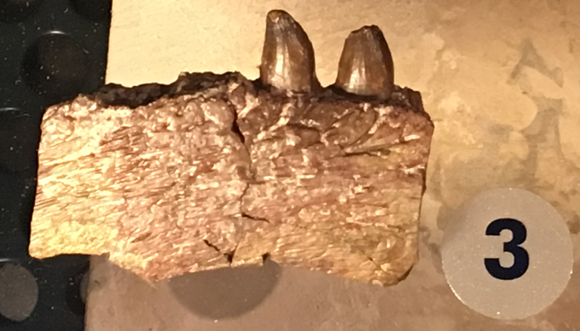
A View of a Jaw Fragment from a Dimetrodon
A close-up view of a jaw fragment from a Dimetrodon (Dimetrodon spp.).
Picture credit: Everything Dinosaur.
Pictures show some of the rod-like extensions that supported the sail which was on the back of Dimetrodon, an anatomical trait that Dimetrodon shared with other pelycosaurs, the purpose of which, remains a mystery.
Dimetrodon Bones
Single Dimetrodon bones are occasionally found at the Craddock quarry dig site, but the discovery of an articulated, almost complete specimen is an exceptionally rare event. Most of the mounted Dimetrodon exhibits seen in natural history museums around the world are constructed using material found in the north of Texas. This part of the United States with its significant quarries and prominent exposures of Permian aged strata is one of the most important locations in the world for Permian aged vertebrate fossils.
In life, “Willi” was one of the apex predators of the world during the Permian. Although, Dimetrodon models and toys are often included in dinosaur model sets, Dimetrodon was not a dinosaur, in fact as a synapsid, it is actually more closely related to mammals than to the dinosaurs. The large sail-like structure on the back of Dimetrodon, was supported by rod-like extensions of the backbone. Scientists remain uncertain as to why these pelycosaurs had these anatomical features. They could have been used for display or perhaps acted like giant radiators and were used in some form of thermoregulation.
Most of the Specimen Probably Present
Most of the specimen seems to be present, the only elements missing are parts of the lower jawbone, elements of the limbs and the caudal vertebrae (tail bones).
“Wet Willi” will be the star of the Permian section of the Museum’s newly renovated palaeontology hall, which is due to open in 2012, and will serve as a focal point for this part of the museum.
David Temple, Associate Curator of Palaeontology at the Houston museum stated:
“I am delighted that the nearly half million school kids who visit the museum each year will have the opportunity to see this relic of Texas geologic history. We are very passionate about science literacy and in particular, geo-science literacy. The palaeontology hall, will be a powerful tool for learning and exploring the geo-sciences.”
Permian Outcrops
The Permian outcrops in Texas are an excellent portal for learning about this important and enigmatic period in Earth’s history. The Permian ended with the worst mass extinction known, and was a direct precursor to the rise of dinosaurs. At present, the Museum has a mural of the Permian Period featuring a Dimetrodon, but no fossils on display.
Over the past five years, the Houston Museum of Natural Science field crews under the direction of Dr Robert T. Bakker, have collected hundreds of bones, teeth, and coprolites (fossilised dung), as well as complete skeletons of the smaller reptiles and amphibians that lived alongside the fearsome Dimetrodons. They have been able to build up a picture of the environment in prehistoric Texas, with its bizarre flora and fauna.
Commenting on the discovery of the Dimetrodon fossil, Dr Bakker stated:
“There is a very strong Texas connection to Dimetrodon, and we are thrilled to be able to display one in Houston, along with the other animals that made up this ancient ecosystem.”
Dr Bakker went onto add that he thought the skeleton was “jaw droppingly beautiful”, certainly, the finding of such a complete specimen is an exceptionally rare event and with the relatively intact skull material, perhaps more can be discovered about the way in which these large predators interacted with their environment.
2010 will be remembered by many palaeontologists as the “Year of the Ceratopsian”. For the Chinese, in their traditional calendar, 2010 may well be the year of the tiger but for palaeontologists, the last twelve months seem to have been dominated by new discoveries, new theories and new insights into all things Marginocephalian. We even have had the suggestion that some ceratopsians took to the water, as with the recent discovery in South Korea of Koreaceratops.
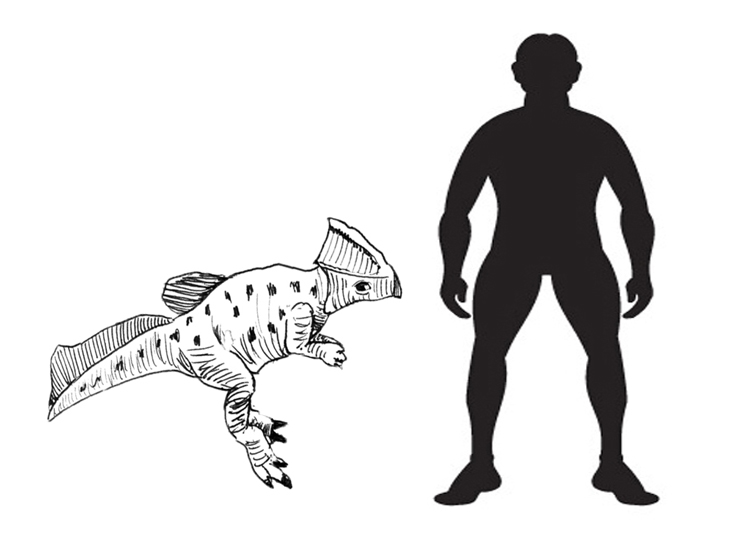
A Scale Drawing of Koreaceratops
One of the smallest and most bizarre horned dinosaurs – Koreaceratops.
Picture credit: Everything Dinosaur.
Year of the Ceratopsian
Following on from the extensive re-assessment of the ceratopsian family undertaken at the Royal Tyrrell Museum in Alberta, Canada (ceratopsian symposium), a whole host of new genera have been announced, not just from the United States, as in the case of Medusaceratops lokii, but also from elsewhere in the world.
Earlier this year, the discovery of a large, Chinese horned dinosaur was announced Sinoceratops zhuchengensis and Mexico had its first ceratopsian dinosaur discovery published – Coahuilaceratops magnacuerna. To add to the new discoveries, there were also a number of new studies undertaken on existing fossil material, such as the research into whether Triceratops, perhaps the most famous of all the Late Cretaceous horned dinosaurs was actually a valid genus or not.
One of the puzzling things that has emerged recently, is the amazing diversity of the horns, bumps and lumps that ceratopsian genera possessed. The facial characteristics of these large ornithischian herbivores were extensively varied. The diversity seen in the fossil record prompted a study by palaeontologists Kevin Padian (University of California) and Jack Horner of the Museum of the Rockies.
These scientists examined the array of horns, frills, neck shields and other facial ornamentation and concluded that, in contrast to earlier beliefs they did not appear to have evolved for combat purposes such as defence against predators.
The team concluded that if defence was the primary function of such structures then the arrangement of the horns and crests could be expected to be similar across different genera. There would have been an optimum pattern for defence evolved to see off the large theropods of the Cretaceous. However, the variation seen in the ceratopsian fossil record, whether the centrosaurines or chasmosaurines are studied, suggests that fending of predators was not the sole factor driving the evolution of such structures.
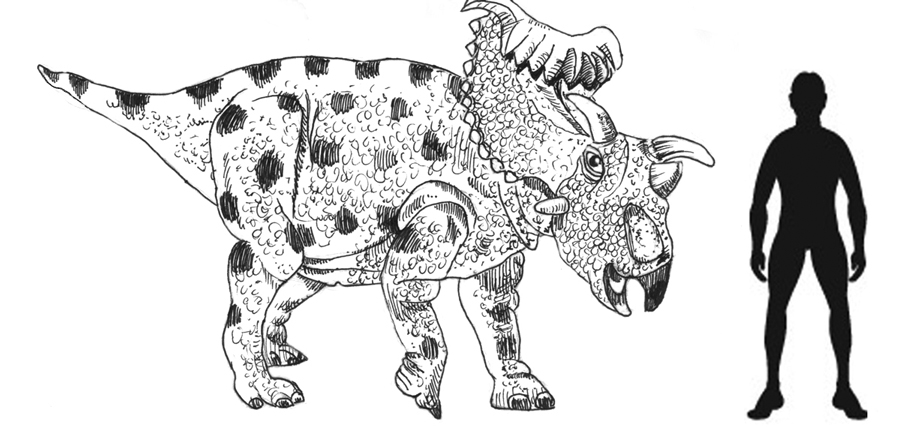
Horner and Padian state that something as simple as species recognition could have played a significant role in the evolution of the myriad forms of ceratopsian “head gear”. Perhaps these horned dinosaurs, from the single horned Monoclonius crassus to the multi-horned dinosaur described by a member of Everything Dinosaur as a “walking Swiss army knife” – Kosmoceratops richardsoni, were nothing more than a lot of show offs.
A few months ago, whilst perusing a tides timetable that a colleague had picked up whilst visiting Dorset, we realised that there were going to be some exceptionally low tides in the Lyme Regis area. This, in combination with the stormy weather that the Dorset coast had endured recently, made us confident that lots of fascinating fossil material would soon be discovered on the beaches surrounding Lyme Regis and Charmouth.
Sure enough, keen eyed amateur palaeontologists, holiday makers and fossil hunters were soon finding lots of new fossils, all exposed due to the low tides and additional erosion caused by the bad weather. We have heard about a number of marine reptile remains that were discovered in the days and weeks following our original article.
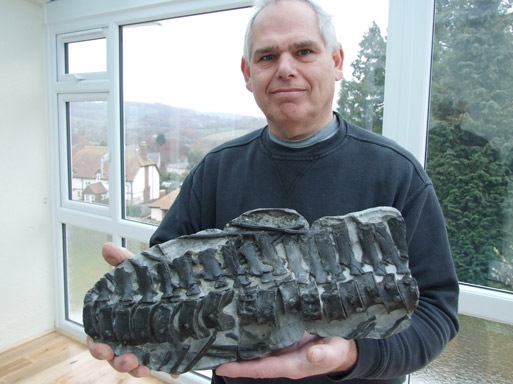
Pictures show a very well preserved section of the backbone of an ichthyosaur (caudal vertebrae), Brandon Lennon, the expert fossil hunter who discovered this particular piece estimates that it is part from a specimen that would have measured more than 4 metres long in total.
Lyme Regis Fossil Dealer Mike Jeffries with Ichthyosaur Vertebrae
More ichthyosaur material.
Picture credit: Mike Jeffries/Brandon Lennon.
Note how the rock matrix is being held (the rock surrounding the actual fossil material), fossilised bones should not be touched unless absolutely necessary. The hand provides scale and the photograph shows the fossil the correct way up (neural spines seen at the top of the vertebrae).
The picture above shows, Lyme Regis fossil dealer, Mike Jeffries with another section of ichthyosaur vertebrae (lateral view). This carefully prepared articulated fossil reveals plenty of detail – the round, dished vertebrae with blocky neural spines protruding above them. The fossils were prepared and cleaned by Dorset based expert fossil developer David Costain.
Lyme Regis Fossils
Brandon Lennon had found two sections of the backbone about a year ago, the other (middle section of the final prepared fossil), was missing, but Brandon found the “linchpin” vertebra recently so the whole piece could be reconstructed. With the discovery of the missing vertebra a section of ichthyosaur could be connected together again.
Schleich Announce Retirement of Glyptodon and Macrauchenia Models
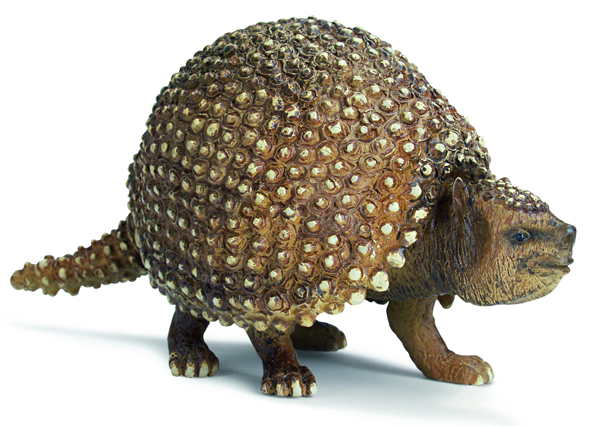
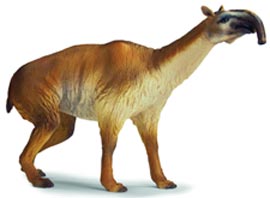
Schleich, the German based manufacturers of models and figures have announced the retirement of two more prehistoric animal figures from their prehistoric animal models range (Glyptodon and Macrauchenia). The Glyptodon and the Macrauchenia figures are being retired and once existing retail stocks have been sold, no more of these particular models will be available.
The Glyptodon Figure from Schleich
Schleich Glyptodon.
Picture credit: Everything Dinosaur
Glyptodon was related to modern armadillos and sloths, these creatures survived in South America, Central America and the southern parts of North America until around 10,000 years ago.
Glyptodon and Macrauchenia
The news of the loss of these two models follows on from the retirement of two other models from this range, that of the Giant Ground Sloth and the Cave Bear. Schleich will only make the Sabre-toothed cat and Mammoth models in this range next year.
The Macrauchenia Model from Schleich
The Macrauchenia Prehistoric Animal model by Schleich.
Picture credit: Everything Dinosaur
This South American mammal was a member of the Litoptern group of mammals, a bizarre group of hoofed creatures which have no surviving members today, the distended nose was a form of “trunk” that permitted this animal to browse on the bushes and trees of the South American pampas. Over two metres high at the shoulder, these large animals roamed the extensive grasslands in vast herds and may have been the most important prey animal for the South American Smilodons.
Schleich are not going to introduce any new models into their Schleich dinosaurs or prehistoric animal model ranges in 2011.
U.S. Postal Network and Royal Mail Comment on Mail Delays
Royal Mail have commented upon the delays customers are experiencing with Airmail deliveries of parcels to the United States and Canada. In a statement, made in conjunction with their mail counterparts in the United States, Royal Mail have said:
Royal Mail Information
In November, the United States Department of Homeland Security increased security measures for items carried on passenger airlines. As a result, mail entering the U.S. from around the world, and including the UK, that would normally be sent via passenger aircraft must now travel by other means, including cargo planes.
The vast majority of items, including letters and Christmas cards, posted prior to the last recommended posting date of 10th December have been and will continue to arrive in the U.S. in time for Christmas. However, these ongoing security issues, combined with the impact of recent severe weather on the movement of mail throughout the UK, are causing delays to some items bound for the U.S. We’re really sorry for these unavoidable delays and are doing everything we can to keep mail moving out of and into the UK.
Disruption in the Mail Network
Since the middle of November and throughout the recent period of weather related service disruption in parts of the UK, we have implemented a number of contingency plans to ensure as much of our customers’ mail reaches the U.S. as quickly as possible. In finding alternative, available routes and transportation to the U.S., it’s possible that the delivery pattern of some items may have been interrupted and not all mail will arrive in the sequence in which it was posted.
Handling significantly increased volumes of mail at this festive time along with the complexity of reacting at pace to contingency arrangements, means we’re unable to track individual items for customers or identify exactly when in the current arrival patterns deliveries are likely to take place.
Apologising to Customers
We apologise for any inconvenience this may cause and are continuing to work to minimise disruption to our customers, whilst ensuring we comply fully with the U.S. directives and regulations.
Statement Ends:
Visit Everything Dinosaur’s award-winning website for dinosaur models, toys and gifts: Everything Dinosaur.
Everything Dinosaur
At Everything Dinosaur, we are doing all we can to ensure that parcels bound for the United States, are packed and despatched as quickly as possible, we have organised extra staff and shifts to ensure we can keep on top of our busy workload. We are also monitoring the situation and we will put on this blog site any additional information regarding delays to U.S. postal deliveries that are reported by Royal Mail.
The discovery of the remains of a bizarre early ceratopsian (horned dinosaur) from the Korean peninsula has been announced. This small, herbivorous dinosaur, a member of the same family of dinosaurs as the horned giants such as Styracosaurus and Triceratops may have been semi-aquatic – on home on the land and in the water.
The partial skeleton has been excavated from rock that dates to approximately 103 million years ago (Cretaceous – Albian faunal stage). It represents a new genus of primitive Asian ceratopsian and predates other dinosaur finds from south east Asia such as the small, agile, fully bipedal ceratopsian – Graciliceratops (G. mongoliensis).
The fossils of this sheep-sized dinosaur were discovered by a South Korean, Japanese, American and Canadian team of scientists. The results of their study have been published in the online scientific journal Naturwissenchaften: The Science of Nature.
Koreaceratops
This new type of dinosaur has been formally named Koreaceratops hwaseongensis in honour of the South Korean city of Hwaseong (the name translates as “Korean horned face from Hwaseongensis city”).
One the scientists studying the fossils was Dr Michael Ryan of the Cleveland Museum of Natural History.
Dr Ryan commented:
“This is a rare find. Fossils of dinosaurs have not typically been found in this region, whereas evidence of dinosaur eggs and footprints occur more commonly.”
The origin of the ceratopsians can be traced back into the Early Cretaceous, this basal ceratopsian will help fill in the gaps in this particular dinosaur group’s family tree. In a press release, Dr Ryan stated that the discovery of these fossils will help to fill a missing 20-million-year gap in the fossil record between the origin of Ceratopsians in Asia and their first appearance in North America.
Some time after the Ceratopsians evolved, migrations took place and these animals moved eastwards into North America, crossing land bridges that existed linking Asia and the Americas. It was in the United States that giant forms of horned dinosaur evolved towards the end of the Cretaceous, chasmosaurine dinosaurs like Pentaceratops and Triceratops as well as centrosaurines such as Pachyrhinosaurus and Styracosaurus.
The species is represented by a single fossil specimen. The fossil is far from complete, consisting of a significant part of the backbone, including the caudal (tail) section. Parts of the hips and partial hind limbs were also discovered.
The Main Block showing the Partially Articulated Specimen (K. hwaseongensis)
Picture credit: Y. Lee
The block shows the robust, hind limbs with the long tail. Interestingly, the picture shows the very tall neural spines associated with the caudal vertebrae. This indicates that this basal neoceratopsian had a broad, undulating tail. The purpose for the tail, remains open to speculation, but it has been suggested that this little dinosaur may have been semi-aquatic. The broad tail would have helped the animal propel itself through the water. Other basal ceratopsians such as Bagaceratops (B. rozhdestvenskyi) also had tall neural spines on the tail, but this is the first time, that team members at Everything Dinosaur have come across the concept of a “swimming ceratopsian”.
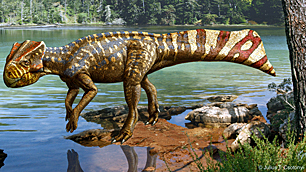
An Artist’s Impression of Koreaceratops hwaseongensis
A swimming ceratopsian?
Picture credit: Julius Csotonyi
Described as a fast, cursorial biped, with a “parrot-like face” and horny beak, Koreaceratops measured about 6 feet long and would have weighed about as much as an Alsatian dog. The skeleton adds weight (no pun intended) to the theory that obligate quadrupedalism (walking on all fours), occurred gradually in neoceratopsians.
The earliest dinosaurs were probably entirely bipedal, evolving through forms that were larger and became facultative quadrupeds (able to walk on two legs as well as all four). Finally the large ceratopsians that lived at the very end of the Mesozoic were entirely quadrupedal.
The broad tail could have been used to store fats to help the animal get through difficult, seasonal conditions, extant Alligators store reserves of fat in their tails to help them survive harsh weather when food may be scarce. The tail could also have evolved as a visual signalling device to attract mates, demonstrate social status in a herd and such like. The wide tail could also have helped to “fool” an attacking theropod , getting it to focus its attack at the “wrong end” as it were.
The heavy snowfalls, icy conditions and freezing fog have hampered the delivery of Christmas gifts and parcels according to sources in the mail network close to Everything Dinosaur. Whilst Royal Mail and its dedicated staff are doing all they can to make deliveries, the wintry weather has taken its toll on their normally very efficient service.
Everything Dinosaur
For more than a week now, much of the UK has been affected by a cold snap, which has led to record snowfalls in some parts of the country at this time of year. Several airports have been closed and roads have become impassable in places. The rail network has also suffered, with many train routes, which would normally carry mail as well as passengers shut down.
This is causing delays in the delivery of parcels and mail. For example, in parts of southern England, badly affected by snow and black ice, some second class parcels are taking more than seven working days to arrive. There is normally a backlog of mail at this time of year, as the Christmas rush kicks in. Unfortunately, the extremely cold weather has made the situation in many areas much worse.
Update on Parcel Deliveries
Royal Mail is trying to prioritise urgent, special deliveries but cannot guarantee next day delivery for some of these services. First class post is also being delayed and the Royal Mail’s proud record of having a 93% next day successful delivery is under severe threat.
Staff at Everything Dinosaur, continue to prepare, pack and despatch parcels as quickly as they can. We have four collections a day and work late into the night to ensure goods ordered from the Everything Dinosaur website are sent out rapidly. However, please be patient, the Post Office, Royal Mail and other delivery services are working as hard as they can to clear any backlogs.
Some delay to airmail deliveries can be expected too. The closure of airports has interrupted mail leaving the country and the receipt of airmail into the UK. As always, if orders can be placed in plenty of time then this will help the mail network cope with the inevitable Christmas rush, keeping customers informed, it is all part of our Everything Dinosaur customer service.
Global Warming Gave Early Reptiles the Edge in the Carboniferous
Scientists have concluded that global warming gave Carboniferous reptiles a competitive advantage.
A team of British and Canadian scientists writing in the scientific journal “Geology” have stated that the sudden and dramatic collapse of the world’s equatorial forests in the Carboniferous allowed Reptilia to rapidly diversify. It was the reptiles that went onto dominant terrestrial habitats, giving rise eventually to the dinosaurs, birds and of course the mammals.
Carboniferous Reptiles
The rapid diversification of the reptiles during the Carboniferous Period (360 million years to approximately 299 million years ago), was identified by the research team as they investigated fossil evidence from a number of globally important fossil locations including the UNESCO World Heritage site at Joggins, Nova Scotia (Canada). The strata at this site were laid down approximately 313 million years ago. They represent a Carboniferous forest that was prone to wildfires, (high oxygen levels in the Carboniferous). Fossils of some of the first egg-laying, lizard-like animals have been found preserved in the hollows of ancient trees.
The research team have concluded that the collapse of the coal forest ecosystems created remnant pockets of rain-forest habitat in which species adapted in relative isolation, ultimately strengthening the reptilian gene pool and aiding diversification.
University of London, palaeontologist Howard Falcon-Lang comments in a summary of the findings:
“Climate change caused rain-forests to fragment into small “islands” of forest. This isolated populations of reptiles and each community evolved in separate directions, leading to an increase in diversity.”
Co-author, Mike Benton of Bristol University stated this process was:
“A classic ecological response to habitat fragmentation. You see the same process happening today whenever a group of animals becomes isolated from its parent population.”
Lead author of the study, Canadian scientist Sarda Sahney, also based at Bristol University commented:
“It is fascinating that even in the face of devastating ecosystem-collapse, animals may continue to diversify through the creation of endemic populations.”
She went onto add a warning with regards to the fragility of the Amazon rain-forest given the current concerns with global climate change stating:
“Life may not be so lucky again in the future, should the Amazon rain-forest collapse.”
Joggins Fossil Cliffs
The Joggins Fossil Cliffs in Nova Scotia as well as a number of other fossil sites from around the world provided the research team with an analysis regarding amniotes diversification. An amniote is a vertebrate, whose embryos develop within a special protective membrane – the amnion. The group includes some of the earliest tetrapods, as well as reptiles, birds, mammals and ourselves.
One of the most remarkable features of the Joggins site is the presence of numerous tree-sized stumps and trunks (mainly Lepidodendron remains). Inside some of these, can be found the fossilised remains of the oldest known egg-laying amniotes genera such as Hylonomus and Palaeothyris, primitive reptiles.
Howard Falcon-Lang summarised by saying:
“In a sense, the whole story starts at Joggins with the origin of reptiles. When reptiles first evolved, they were adapted to dry conditions, because reptiles lay eggs with hard shells rather than spawn in ponds like frogs. However, when rain-forests collapsed around the tropical belt, the reptiles were ready and got their big break rapidly diversifying.“
Layers of charcoal preserved in the strata provide evidence of extensive forest fires that plagued the area. Perhaps these primitive, early reptiles sought shelter in the tree stumps during a fire, but were suffocated. As these animals were small, most less than 20 centimetres long, it is possible that these tree stumps acted as natural traps and helped to preserve the remains of these insectivores.
The diversification of the reptiles, led to the establishment of large, herbivorous vertebrates in the Permian Period, animals such as Edaphosaurus and other forms of advanced synapsids – animals that would eventually give rise to Mammalia and over many millions of years, lead to the evolution of apes and humans.
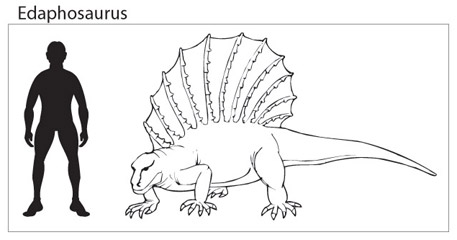
An Illustration of Edaphosaurus
Picture credit: Everything Dinosaur
The illustration shows a scale drawing of the edaphosaurid reptile Edaphosaurus. By the Middle Permian herbivorous reptiles such as Edaphosaurus had grown into 3 metre long giants, preyed upon by other huge reptiles. Complex reptilian based food chains had formed, and, according to this new study, the diversity of the reptiles was as a result of the isolation of groups of animals as area of rain-forest shrunk.
Pelycosaurs Thrived During the Permian
The Dimetrodon jaw fragment exhibit at the National Museum (Cardiff). The Pelycosauria thrived in the Permian. Picture credit: Everything Dinosaur.
Team members at Everything Dinosaur would like to remind our customers that tomorrow, Monday the 6th of December (2010), is the last recommended posting date for international airmail parcels and letters to South and Central America, the Caribbean, the Middle East, Far East, Asia (including Japan) and New Zealand.
With Christmas rapidly approaching the UK mail organisation (Royal Mail) provides helpful information as to by which dates parcels need to be posted in order to give them every chance of reaching their destination in time for the big day. We at Everything Dinosaur publish our own information, this summarises the last recommended posting dates for sending goods from the UK around the world.
Whilst our dedicated staff do all they can to pack and despatch parcels promptly, it is always better to order early to prevent disappointment at Christmas when a parcel fails to arrive on time.