All about dinosaurs, fossils and prehistoric animals by Everything Dinosaur team members.
23 12, 2010

Window into an Ancient Post Permian Ecosystem Provided by Amazing Fossils

By |2024-04-21T11:43:07+01:00December 23rd, 2010|Categories: Dinosaur and Prehistoric Animal News Stories, Geology, Main Page|0 Comments

20,000 Fossils Provide Glimpse into Marine Ecosystem Post Mass Extinction Event

A hillside in south-west China has revealed a treasure trove of beautifully preserved fossils, capturing an almost entire ecosystem and providing scientists with an insight into how life on Earth recovered from the Permian mass extinction event.  The discovery of such a wealth of fossil material may help scientists to understand more about how ecosystems and natural communities recover from extinction events.

The mass extinction event that ended the reign of the dinosaurs may be better known, but the extinction event some 250 million years ago that ended the Permian Period was more severe with an estimated 95% of marine animal species dying out.  Scientists have calculated that approximately two-thirds of all the land vertebrate families also died out.  One of the factors involved in the mass extinction was a huge reduction in the total area of shallow continental shelf sea environments as plate movements created one, global, large land mass.  Ironically, the 16-metre-thick limestone sediments that have yielded the fossils represent the deposits at the bottom of a shallow, marine environment.

Permian Ecosystem

The record of this ancient marine ecosystem forms part of a hillside in Luoping County, Yunnan Province, south-west China.  Since 2007 teams of fieldworkers and researchers have been carefully examining and extracting fossils, mainly invertebrates such as molluscs, sea urchins and arthropods but also fish and marine reptiles including ichthyosaurs.  Something like 20,000 specimens have been discovered so far, many of which have had soft body parts preserved providing palaeontologists with a huge amount of data about life in the Early Triassic, post the Permian mass extinction event.

The excavation work was supervised by scientists from the Chengdu Geological Centre in China and the paper, which was co-authored by Professor Michael Benton (Bristol University) has been published in the scientific journal “The Proceedings of the Royal Society B (Biology)”.  The site preserves evidence of an entire marine ecosystem, providing scientists with an understanding of how organisms recovered from the Permian mass extinction event.

Amongst the many beautifully preserved remains are those of some of the earliest large marine reptiles known from the Triassic.  These animals would have been the apex predators, at the top of the food chain.  The biggest creature discovered so far is a thalattosaur (name means “ocean lizards”), a type of marine reptile over 3 metres long, which would have preyed upon the larger fishes that lived in the shallows.  The exact phylogeny of the thalattosaur group is not known, but most scientists believe that this group should be placed between the later ichthyosaurs and more primitive archosaurs that adopted a marine habit.

A Model of an Ichthyosaur
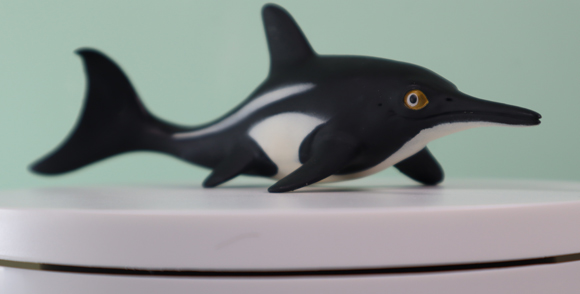
An Ichthyosaurus model

The Ichthyosaurus model (Wild Safari Prehistoric World) ready to take its turn on the Everything Dinosaur turntable. Picture credit: Everything Dinosaur.

Picture credit: Everything Dinosaur

To view the Wild Safari Prehistoric World range: Wild Safari Prehistoric World Figures.

The Chinese scientists also unearthed a number of ichthyosaurs, providing evidence of the evolutionary origins of this important group of marine predators.

Professor Shixue Hu of the Chengdu Geological Centre stated:

“It has taken us three years to excavate the site, and we moved tonnes of rock.  Now, with thousands of amazing fossils, we have plenty of work for the next ten years.”

Commenting on the discovery, Professor Benton (Bristol University) added:

“The fossils at Luoping have told us a lot about the recovery and development of marine ecosystems after the end-Permian mass extinction.  There is still more to be discovered there and we hope to get an even better picture of how life reasserted itself after the most catastrophic global event in the history of our planet.”

He went onto comment:

“The few hardy species that survived the ensuring scarcity of food, wild fluctuations in temperature and shortage of oxygen in the ocean served as the starting point for the recovery of life in the next geologic period, known as the Triassic.”

Until the discovery of the extensive fossil site at Luoping, very little fossil material from the Permian/Triassic boundary was known.  The strata has been dated to approximately 245 million years ago, providing an insight into the rise of life forms after a mass extinction event.

Only about half the site has been explored to date, scientists are confident that many new species will be unearthed.  The site has provided the researchers with a better understanding of how groups of organisms recovered from the extinction event.  It seems that small, marine invertebrates recovered first, with ammonoids (cephalopods – ammonites) reaching precataclysm levels of diversity within two million years, as did snails and other molluscs such as clams and oysters.

However, it seems that the severity of the extinction event meant that it took around ten million years for a fully established ecosystem to develop.  The site has also a number of fossils of land based organisms, including reptile teeth and plant material such as fir cones.  These items were washed into the sea by rivers that emptied into the shallow bay.

A fossil tooth is so well preserved that the serrated edges of the tooth can still be made out.  Archosaurs became the dominant land reptiles during the Triassic, the tooth was washed into the sea after having been shed on land.

For models and replicas of prehistoric animals: Prehistoric Animal Models and Replicas.
22 12, 2010

Why are Pterosaurs sometimes called Pterodactyls?

By |2023-01-14T14:26:05+00:00December 22nd, 2010|Categories: Dinosaur Fans, Main Page|2 Comments

The Confusion over Pterodactyls

As far as scientists have been able to ascertain from the fossil record, only a very few types of dinosaur evolved the ability of flight.  Of course, technically birds, of which there are something like 10,000 species today; evolved flight and these creatures could be classified as avian dinosaurs.  However, setting aside the Aves (birds) for one moment we know that the early Mesozoic skies came to be dominated by another group of reptiles – pterosaurs.  Pterosaurs seem to have evolved sometime in the Middle Triassic.  Over the course of the next 160 million  years or so, they diversified into a myriad of different forms.  Some of these creatures were no bigger than blackbirds, others, for example a group known as the Azhdarchidae; evolved into flying reptiles the size of small aircraft.  However, all pterosaurs had the same basic skeleton and body plan.

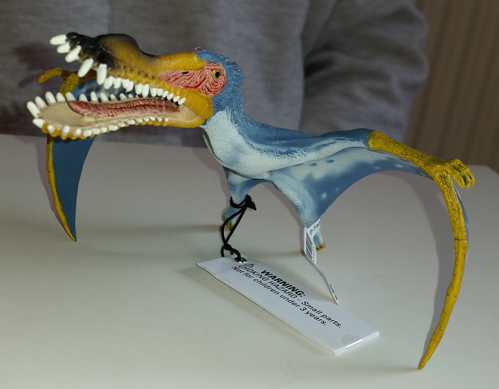
A Replica of a Pterosaur

Pterosaur.

A colourful model of the pterosaur called Anhanguera by Schleich. Picture credit: Everything Dinosaur.

Picture credit: Everything Dinosaur

To view models and replicas of prehistoric animals in the Schleich model range: Schleich Dinosaurs and Prehistoric Animal Models.

Pterosaurs

Pterosaurs (flying or winged lizards) are sometimes referred to as pterodactyls (winged fingers).  Pterodactyl is the name for just one particular family of pterosaurs, and in particular for a German flying reptile called Pterodactylus.  Fossils of Pterodactylus were found in the 19th century and remain some of the most complete and best preserved of all pterosaur fossils.  The name pterodactyl became quite well known and used a lot in popular culture and as a result the name “pterodactyl” – a term used colloquially to describe all pterosaurs became established.

21 12, 2010

Relatives of Tyrannosaurus rex were Vegetarians According to New Research

By |2024-04-21T11:43:35+01:00December 21st, 2010|Categories: Dinosaur and Prehistoric Animal News Stories, Main Page|0 Comments

New Study Shows Diversity in Coelurosaurs

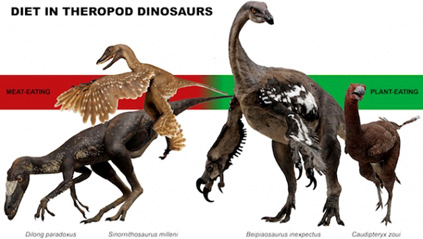
The coelurosaurs were the most successful and diverse of the groups of dinosaurs that make up the theropods.  Scientists had thought for many years that the majority of the animals that were classified as coelurosaurs were small, nimble predators with long arms, equipped with sharp-clawed, three-fingered, grasping hands.

Birds are now believed to be advanced members of the coelurosaur group.  Although the phylogeny of Coelurosauria is far from resolved, tyrannosaurs are classifed as members of the Coelurosauria and as such the typical coelurosaur may be thought of as being entirely carnivorous.  However, a new study into the known coelurosaur fossil material has revealed that a surprising number of families were not entirely meat-eaters, indeed, many were omnivores whilst others may have been entirely vegetarian.

Coelurosaurs

In a new review of all thing Coelurosauria, published in the scientific publication “The Journal Proceedings of the National Academy of Sciences”, it seems that members of the Coelurosauria adapted to a very wide ranging variety of diets.  True, some were vicious predators, feeding entirely on meat, whilst others adopted a completely vegetarian habit.

The study was carried out by scientists attached to the Field Museum in Chicago (United States), ironically, the home of the perhaps the best known extinct Coelurosaur fossil of all – the giant T. rex known as “Sue”.  One of the authors, Lindsay Zanno stated:

“Anything that belongs in that group that seems to be an exclusive meat-eater, things like Velociraptor of Jurassic Park fame, it means it probably evolved from an ancestor that had already begun eating some plants.”

Classifying the Theropoda

The problem with the classification of Theropoda can be traced back to the 19th century when Victorian scientists first began to classify dinosaurs.   Their early work led to the establishment of two, great groups of bipedal, lizard-hipped dinosaurs.  Firstly, there was the Carnosaurs – large bodied, bipeds with large skulls, a group that included the likes of Allosaurus and Megalosaurus.  It was the German scientist and palaeontologist Friedrich von Huene who first coined the phrase Coelurosauria (1914), the “hollow tailed lizards”, consisting of small, gracile, bipedal theropods.  It was Huene himself, who first postulated that the tyrannosaurs may be coelurosaurs and not carnosaurs, contradicting his classification of these two main groups of theropod dinosaurs.  This was the start of the intense debate over theropod phylogeny.

The Diversity of Diets within Coelurosauria

Picture credit: Lindsay Zanno

Adding to the data, is this new study by Lindsay Zanno and her Field Museum colleague Peter Makovicky.  If one considers extant birds, they all have toothless beaks, but they eat a great variety of different foods, from garden worms, insects, to berries, nectar and carrion.  Zanno and Makovicky set out to review the fossil coelurosaur material to see if they could establish a clearer idea of just what each main type of coelurosaur may have eaten.

The researchers identified 72 coelurosaur species that had been found with direct fossil evidence of what they ate, including fossilised stomach contents and coprolites.  The American based scientists then statistically analysed the anatomy of these dinosaurs looking for physical traits that correlated with plant-eating.

Coelurosaur Species

Physical characteristics such as a longer neck, leaf-shaped or peg-like teeth and the presence of a horny beak were identified in 44 of the species studied, across six subgroups.  Their assessments indicate that these members of the coelurosaur family were at least partly vegetarian.

Commenting on the findings, Lindsay Zanno said:

“It appears as if the transition from carnivory, or meat-eating, to plant-eating occurred very early in the evolutionary history of the group and probably occurred once.”

The research suggests that Late Cretaceous carnivores such as Tyrannosaurus rex and Velociraptor likely evolved back to meat-only diets after their ancestors spent at least some time chewing on plants.

Commenting on the study, Thomas Holtz, a vertebrate palaeontologist at the University of Maryland stated:

“Wer’re not seeing special cases of herbivory evolving from carnivorous ancestors.  We are seeing one origin of the herbivory here.”

The study raises new questions about the environmental niches inhabited by coelurosaurs, such as whether switching to plant-based diets restricted their range.  The research is also helpful in the context of understanding the evolutionary of Aves.  Although beaks evolved independently many times throughout history, the new study suggests that a plant- based diet was the push the coelurosaurs needed to turn toothy mouths into toothless beaks.

An Example of a Coelurosaur (Theropod Dinosaur)

Feathered dinosaur. Coelurosaurs.

Small, bipedal and possibly feathered. An early coelurosaur.

Picture credit: Everything Dinosaur

Zanno commented:

“Once you have a beak, you can adapt it into all different shapes and sizes, and you can adapt it to do all different kinds of things.”

To view models and replicas of coelurosaurs: Safari Ltd. Prehistoric World Figures.

21 12, 2010

What’s up with the Prehistoric Animal Models

By |2023-09-03T10:05:23+01:00December 21st, 2010|Categories: Dinosaur and Prehistoric Animal News Stories, Main Page, Press Releases|0 Comments

Safari Ltd withdraw Baby Woolly Mammoth Model

We accept that prehistoric mammals are not as popular as dinosaurs and pterosaurs but we were disappointed to hear of yet another prehistoric mammal model being retired by a major manufacturer.  It seems that Safari Ltd, after a review are going to stop making their baby Woolly Mammoth, Whilst we can understand the reasons for doing so, it is such a shame especially with the Chicago Field Museum “Mammoths and Mastodons” exhibition touring the United States and then Europe.

Baby Woolly Mammoth Model

To confirm, the Prehistoric Life Woolly Mammoth Baby – product code 280029 is being retired in 2011.

For further information about model retirements and introductions: Email Everything Dinosaur Team Members.

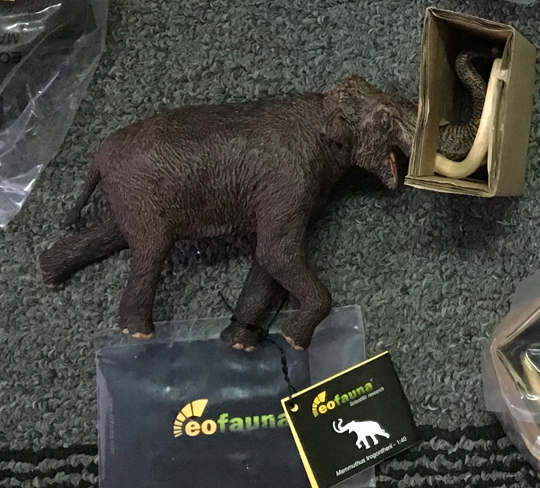
However, there are lots of other prehistoric mammoth models including a replica of a Steppe Mammoth.

Mammoth (Steppe Mammoth) Model

Steppe Mammoth model.
The amazing detail on this Steppe Mammoth model can be easily seen. A replica of a Steppe Mammoth. Picture credit: Everything Dinsaur.

Picture credit: Everything Dinosaur

The picture (above) is a replica of a Steppe Mammoth from the Eofauna Scientific Research series.

To view the models in this range: Eofauna Scientific Research Figures and Models.

20 12, 2010

Everything Dinosaur – Working to Ensure Christmas Deliveries Arrive Promptly (Important Update)

By |2024-04-21T11:57:07+01:00December 20th, 2010|Categories: Everything Dinosaur News and Updates, Main Page, Press Releases|0 Comments

Update on Christmas Mail

The continuing bad weather over much of the UK and Europe is still affecting parcel deliveries.  The extra staff at Everything Dinosaur and the longer shifts have helped keep us on top of the packing and despatching of Christmas parcels.  We continue to work hard to ensure that parcels, letters and packets are given every chance of reaching their destination in time for the big day.

Everything Dinosaur

However, please note, that the adverse weather conditions are having an impact on Royal Mail and other national mail networks.  Some delays into areas such as the northeast of England and Scotland are inevitable.

Royal Mail have put up further information on their website, but as a summary this is what they are currently saying:

Royal Mail teams are working hard across the country to operate services impacted by recent weather conditions.  In Scotland, it’s taking longer to deal with the mail affected by recent and current weather conditions, as well as the additional seasonal mail coming into and out of the country. We’re deploying additional measures where we can, in the continuing difficult conditions to collect, sort, transport and deliver the large volume of seasonal mail now progressing through our network.  We’re doing all we can in Scotland to get mail to customers as quickly as possible.”

The last recommended posting dates for First Class mail in time for Christmas is Tuesday 21st December (UK customers).  All orders placed on Saturday afternoon and yesterday are packed, checked and  being despatched this morning (Monday).  They will all be sent out with the very first collection of the day.

Visit Everything Dinosaur’s award-winning website: Everything Dinosaur.

19 12, 2010

What is an Ichnologist? A Helpful Explanation

By |2024-04-21T09:24:06+01:00December 19th, 2010|Categories: Dinosaur Fans, Educational Activities, Main Page|5 Comments

Ichnology – A Definition

The other day we were asked the question what is an Ichnologist?  This is an interesting question and gives us the opportunity to discuss a very important aspect of palaeontology, trace fossils.  An Ichnologist is someone who studies trace fossils, those marks preserved in the fossil record that show evidence of the activity of organisms.  Trace fossils have a major advantage over body fossils.   Unlike body fossils that may be transported a long distance from where the original organism actually lived, most trace fossils are direct evidence of the environment at the time and the place the organism lived.  For example, dinosaur trackways show where dinosaurs actually walked.

Examples of Dinosaur Footprints

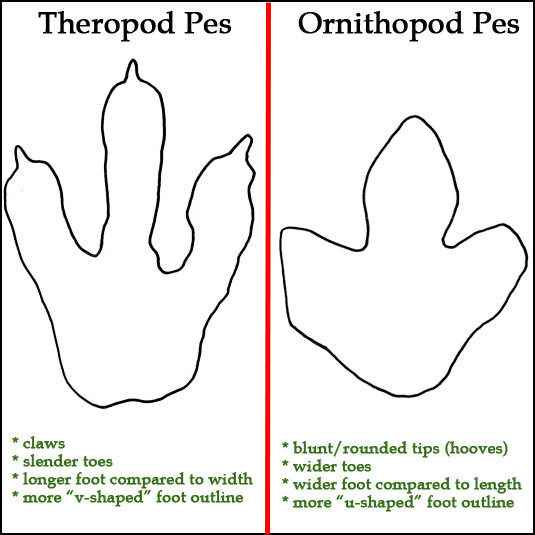
Comparing different types of dinosaur footprint. Studying dinosaur tracks.

Theropod print compared to an ornithopod print. Picture credit: Everything Dinosaur.

Picture credit:  Everything Dinosaur

Ichnologist

The branch of geology that deals with the study of traces of organisms is called Ichnology.  Trace fossils include fossils of tracks, individual footprints, trails, burrows and borings.  Cave paintings made by our ancestors, as they are evidence of activity are classified as trace fossils.  The word Ichnology is derived from Latin and from Greek – ikhneumon “tracker” and from iknnos meaning “footstep”.

Visit Everything Dinosaur’s website: Everything Dinosaur.

18 12, 2010

No Australian Tyrannosauropus After all – Lark Quarry Revisited

By |2023-03-06T15:11:37+00:00December 18th, 2010|Categories: Main Page, Palaeontological articles|0 Comments

New Interpretation of Lark Quarry Dinosaur Trackways – Suggest no Large Theropod

Every once in while a very special type of fossil site is discovered, one that provides an exciting and unique glimpse into the ancient world of the Mesozoic.  One such place is Lark Quarry, located near the small town of Winton, Queensland (Australia).  The region is very famous for its Early Cretaceous dinosaur fossils.  However, at Lark Quarry it is not fossilised bones that so excited researchers when they were first brought to the site, it is the presence of literally hundreds of beautifully preserved dinosaur footprints.

One set of footprints, was believed to show the presence of a large “T. rex-like” meat-eater causing smaller dinosaurs to stampede.  Now some further research published in the scientific journal “Cretaceous Research” offers a new interpretation.

Lark Quarry Revisited

Many scientists have studied the extensive trace fossils, but perhaps the most famous part of the site represents the preserved evidence of what took place in perhaps less than ten seconds nearly 100 million years ago.  A herd of small, plant-eaters (the footprints of which have been ascribed to Wintonopus by ichnologists), plus a large number of predatory coelurosaurs (named Skartopus) were disturbed by the approach of what was thought to be a large, carnivorous theropod dinosaur (known as Tyrannosauropus).

The large, meat-eater seemed to have the smaller dinosaurs trapped and the only chance they had to escape was to run straight past the giant predator as quickly as they could.  The tracks indicate that the smaller animals sprinted past the bigger dinosaur, running at speeds in excess of 12 miles an hour as judged by the stride length.

Fossil Trackway

This famous part of the trackways preserved in the fine grained sandstone of Lark Quarry was studied by doctors Tony Thulburn and Mary Wade, who published their results in 1984.  They cited the evidence of the large footprints to support the theory that enormous predatory dinosaurs lived in what was to become Australia, in the Early Cretaceous.  This, they thought was evidence of 11-metre-long carnivores stalking smaller dinosaurs.  The Trannosauropus’s trackway actually consists of eleven footprints, (three-toed prints), some of which were interpreted as showing the marks left in the soft sand by sharp claws on the toes.

The stride length indicates that it moved at about 3-5 miles per hour – a walking speed and it seems to have weaved about slightly, with a tendency to slow down towards the end of the tracks.  This was interpreted as the meat-eater lurching at the smaller dinosaurs but slowing down as it realised that its attack had been unsuccessful.

It was the large prints that were originally interpreted as being from a large, meat-eating dinosaur, however, a new study has indicated that this may not be the case.

New research by scientists at the University of Queensland suggests that the large footprints were not made by a carnivorous dinosaur at all.  The prints actually represent the tracks made by a large, but definitely herbivorous dinosaur.  If this new theory is accepted it means that the Lark Quarry trace fossils are not evidence of a large theropod dinosaur, something similar to a T. rex or an Allosaurus.

University of Queensland School of Biological Sciences PhD student Anthony Romilio, the lead author of the research, believes that the large prints actually represent the tracks made by an ornithopod dinosaur, perhaps something resembling a Muttaburrasaurus.

Muttaburrasaurus

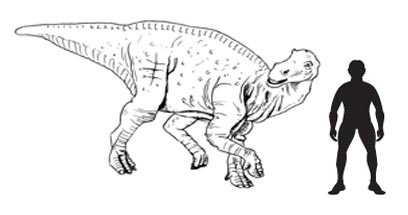
Muttaburrasaurus (M. langdoni), is known from two skeletons found in eastern Australia.  This large animal has been taxonimcally classified as an iguanodont, an ornithopod.

An Illustration of Muttaburrasaurus langdoni

Muttaburrasaurus. Picture credit: Everything Dinosaur.

Picture credit: Everything Dinosaur

To view models of Australian dinosaurs and other prehistoric animals: CollectA Deluxe Prehistoric Animal Models.

Anthony came to this conclusion after comparing the characteristics of the Lark Quarry Tyrannosauropus prints with those of other theropods and known ornithopods.

He stated:

“Making the distinction between the three-toed tracks of herbivorous ornithopod dinosaurs and the three-toed tracks of carnivorous theropod dinosaurs can be quite difficult.  This confusion has led to numerous ornithopod dinosaur tracks being incorrectly identified as belonging to theropods, and vice versa.”

Tracks Made by a Plant-eater

For many years, these large prints from the Lark Quarry site were regarded as being from a meat-eater that had caused a dinosaur stampede, but earlier work, highlighted by Mr. Romilio does suggest a big plant-eater was the culprit.

Threshold values for specific foot proportions for both theropod and ornithopod dinosaurs enabled the Queensland team to distinguish between the tracks made by different types of dinosaur and based on this research Anthony was able to conclude:

“The footprint analysis shows overwhelmingly that the Lark Quarry tracks were made by an ornithopod dinosaur.  The best preserved prints show a remarkable similarity in overall size, shape and claw outline to ornithopod tracks from Canada named Amblydactylus gethingi.  These features mean that we need to re-name the large Lark Quarry tracks Amblydactylus cf.  A. gethingi.”

The size of the prints and the fact that Muttaburrasaurus fossils have been found in sediments of the same age as the Lark Quarry deposit have led the team to suggest that a “Muttaburrasaurus-like” animal probably made them.  Muttaburrasaurus is believed to have been a facultative biped, that is, an animal that walked on all fours for most of the time, but if the need arose it could rear up onto its hind legs and walk in a bipedal fashion.

To view a model of Muttaburrasaurus and other dinosaur toys: CollectA Age of Dinosaurs Prehistoric Life Models.

Anthony’s PhD supervisor, Dr Steve Salisbury stated that the previous identification of the Lark Quarry tracks as belonging to a large, meat-eating dinosaur was central to the interpretation of the track site as a stampede.

He added:

“The approach of the large dinosaur was thought to have triggered the stampede of 150-170 smaller dinosaurs across the sandy mud nearly 100 million years ago.  Whether the presence of a large herbivore like Muttaburrasaurus was enough to spook a herd of smaller dinosaurs into a stampede is now unclear.  Further research on the actual nature of the stampede itself is what we are now focusing on.”

17 12, 2010

Research Suggests that some of our Ancestors were Cannibals

By |2023-03-06T15:19:00+00:00December 17th, 2010|Categories: Everything Dinosaur News and Updates, Main Page|0 Comments

Gnawed Bones Indicate Cannibal Cavemen

A team of researchers have conducted a rather macabre experiment to see if they could confirm the theory that some of our ancestors chewed on human bones, that some of our ancestors were cannibal cavemen.  Scientists have found butcher marks and other signs on fossil human bones suggesting that some of our ancestors and indeed, some other species of hominid were cannibals.  However, to gain further insight, scientists needed to show that the marks and scratches found on ancient human remains had been created by people biting and chewing on the bones.

Cannibal Cavemen

To understand more about the marks on the bones, the researchers first had to gain more information as to what such bite and gnaw marks might look like.

Volunteers were asked to chew and gnaw on a variety of bones, not human bones of course, but raw pork ribs and sheep legs as well as a variety of cooked bones.  The bone-chewers included both Europeans and representatives of the Koi people from Namibia.  It was important to include Africans in this study as most scientists now believe that hominids and our own ancestors evolved in Africa.

The researchers identified several patterns in the chewed bones, including bent rather scalloped edges, surface punctures and grooves.  Similar bite marks and scratches have been found on 12,000-year-old fossil bones from H. sapiens (modern humans) from Gough’s Cave in England.  Gough’s Cave is part of a cave system in the Mendip Hills (Somerset), there has been extensive evidence of human habitation, now this new research sheds light on a more disturbing aspect of human behaviour.   Similar marks and scratches on fossilised bones have been found on the ancient bones of the extinct human species H. antecessor at the Gran Dolina site in Spain.

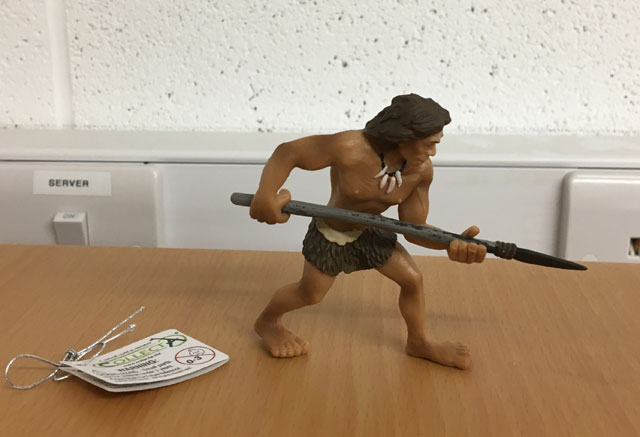
A Replica of a Neanderthal Caveman

CollectA Neanderthal man model

Selecting a CollectA Neanderthal man figure for an Everything Dinosaur customer. Picture credit: Everything Dinosaur.

Picture credit: Everything Dinosaur

To view the range of CollectA models in stock: CollectA Prehistoric Life Models.

Pictures show a rib fragment compressed and slightly bent at one end (shown by the white arrow), chewed by a European volunteer using the molars (cheek teeth).  The small inset shows one of the volunteers in action.

It is interesting to speculate on the reasons for the cannibalism.  Perhaps, it was out of necessity with hominids having to turn to eating human flesh and bones due to lack of other food resources.  May be the gnawing of human bones had some sort of ceremonial purpose.

One of the authors of the report, which appears in the latest edition of the scientific publication “The Journal of Human Evolution”, Fernandez-Jalvo stated:

“Think that a member of your group dies, the body can give one day off from hunting, which was always dangerous at that time, and what to do with the dead body that may attract other dangerous carnivores that may attack the group.  This could be a good solution.”

16 12, 2010

Geminiraptor – Part of a Record Breaking Year for Utah’s Dinosaurs

By |2023-03-06T15:12:48+00:00December 16th, 2010|Categories: Dinosaur and Prehistoric Animal News Stories, Main Page, Palaeontological articles|0 Comments

New Troodontid Dinosaur from Utah – Record Breaking Year for the American State

The announcement of the discovery of a new genus of dinosaur from Utah, makes it a record-breaking year for the State, as this is the eighth new genus of dinosaur announced in 2010.  More importantly, the discovery of a troodontid dinosaur from Lower Cretaceous strata is the first evidence of this dinosaur family living in North America in the Early Cretaceous.

Troodonts were a group of active, relatively small theropod dinosaurs, that from a phylogenetic perspective seem to fit somewhere between the Ornithomimidae (ostrich-like dinosaurs) and the fearsome dromaeosaurids (raptors) on the dinosaur family tree.  These animals were bipedal, fast running and all the genera described to date had large eyes and big skulls.  Scientists believe that these little dinosaurs were warm-blooded and most probably covered in feathers.

The brains of troodontids were the largest brain in comparison to body size of any known type of dinosaur.  A number of palaeontologists, perhaps most notably Canadian Dale Russell, have suggested that had these meat-eaters not died out; they would possibly have evolved into an intelligent humanoid form over the sixty-five million years from the end of the Cretaceous to the Quaternary Period.

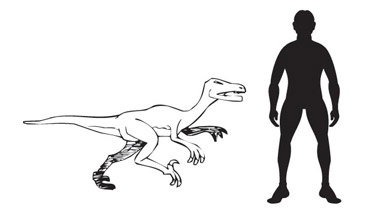
An Illustration of a Typical Troodontid (Troodon formosus)

Picture credit: Everything Dinosaur

Troodontid Dinosaur

Not only does this discovery make it a record breaking year for Utah, in terms of new dinosaurs but it adds greatly to our understanding of the Troodontidae.  Troodonts are known from the Upper Cretaceous of Asia and from the Upper Jurassic and Upper Cretaceous of North America, however, this is the first evidence of troodonts living in what was to become North America in the Early Cretaceous.

Commenting on the new dinosaur, Scott Foss, a regional palaeontologist for the U.S. Bureau of Land Management stated:

“Its skull is six times larger than other dinosaurs.  One find a year is unusual but eight is outstanding.”

He went on to add that approximately one percent of all known dinosaurs described to date have had their fossils found in Utah.  We at Everything Dinosaur, think this claim is a little exaggerated, but the importance of the western United States as a location for Mesozoic vertebrate fossils should not be underestimated.

Seven of the new types of dinosaur found this year in the State of Utah have been found on Bureau of Land Management territory, whilst the other find was from the Dinosaur National Monument.

The dinosaur has been named Geminiraptor suarezrum.  The name is derived from the Latin geminae (twins), in honour of Doctors Celina and Marina Suarez, twin geologists who discovered the fossil bearing rock strata in which this dinosaur and other dinosaurs remains have been found.  The scientific name can be interpreted as “twin thief from the Suarez site”.

The Suarez site, has produced a number of dinosaur fossils, notably the fossils of the Early Cretaceous therizinosauroid Falcarius (scythe lizard).  The rocks have been dated to the Barremian faunal stage, approximately 125 million years old, the first fossils of this particular dinosaur were found in 2004 and the animal has been estimated to have measured about two metres in length.  The upper jaw bone (maxilla) is small enough to fit in the palm of the hand.

Co-author of the scientific paper, James Kirkland of the Utah Geological Survey commented that the maxilla was hollow and could be inflated “like a balloon”.  This strange characteristic has got the scientists speculating as to what purpose this anatomical adaptation may have served.

He stated:

“There is no clue what it was used for.  Maybe it was some kind of resonating chamber for vocalisation.”

Geminiraptor suarezrum

Some birds have resonance capabilities using air to assist vocalisation and provide them with more powerful calls, if these little dinosaurs lived in flocks then perhaps the jawbone provided extra resonance for their communication calls.

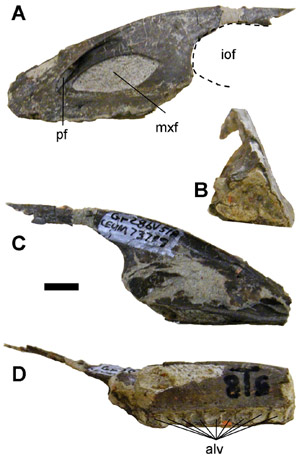
The Maxilla of Geminiraptor suarezrum

Geminiraptor fossil material.

Picture credit: PLoS ONE Journal

Key to the Illustration

(A) a side view of the maxilla (upper jawbone) – Lateral view

(B) a view of maxilla (upper jawbone) – Cranial view

(C) a view of the inside of the maxilla, from the inside of the face looking outwards – Medial view

(D) a view of the jawbone from the bottom looking up – Ventral view

The thick, black line is a scale bar of one centimetre in size and the abbreviations stand for:

alv = dental alveoli – the cavities or sockets in which the teeth were located

iof = internal antorbital fenestra – a bony opening in the skulls of archosaurs between the naris and the eye socket

mxf = maxillary fenestra – a bony opening in the maxilla bone

pf = pro-maxillary fenestra – an opening in the archosaur skull in front of the mxf (anterior to)

Only fragmentary remains of this little dinosaur have been recovered to date, but it is hoped that more troodontid material will be discovered a the Suarez location.

To view models of troodontids and other small theropod dinosaurs: Beasts of the Mesozoic Models.

15 12, 2010

Alaskan Dinosaurs from the Jurassic? New Dinosaur Tracks Discovered

By |2024-04-21T09:24:40+01:00December 15th, 2010|Categories: Dinosaur and Prehistoric Animal News Stories, Dinosaur Fans, Main Page|0 Comments

Trackways Indicate Dinosaurs Roamed Alaska in the Jurassic

The discovery of dinosaur fossils in Alaska, indicating that dinosaurs lived at northern latitudes at the end of the Cretaceous was surprising, after all the debate as to whether these animals were warm-blooded or cold-blooded still rages.  Over the last twenty years or so, palaeontologists have uncovered an amazing ecosystem indicating that many different types of dinosaur spent at least some of the time up north, perhaps migrating there annually to take advantage of the long summer days and abundant plant growth.

Alaskan Dinosaurs

Now a team of researchers have re-discovered a set of three-toed tracks, that suggest that some dinosaurs may have roamed southwestern Alaska in the earlier Jurassic Period.

University of Alaska Fairbanks scientists have documented the fossilised tracks of a small, theropod (meat-eating), dinosaur that appear to date from the Jurassic.  If this evidence is proved to be dinosaur footprints, then it puts back the existence of dinosaurs in the U.S. state by more than seventy million years.

Although no evidence of polar ice caps in the Jurassic Period has been found, it is likely that even though Alaska was not as far north as it is today, there was almost certainly winter snow and ice.  Fossil evidence (flora and fauna) found in Siberia and elsewhere in the world suggest that even lands close to the poles had relatively mild climates when compared to today.  For example, plant fossils associated with areas of the world that were at high latitudes during the Jurassic; indicate average annual temperatures of no more than 8 degrees Celsius – decidedly chilly and not the sort of climate one would associate with reptiles like the dinosaurs.

Even though the world was much warmer in the Jurassic than it is in modern times, the short days of the polar winter would still have meant that plant food was scarce for a considerable part of the year, and conditions would have been tough for animals that were permanent residents.

Earth sciences curator at the University of Alaska Museum of the North, and assistant professor at the University of Alaska Fairbanks department of geology and geophysics, Patrick Druckenmiller commented:

“In one fell swoop we pushed the record of dinosaurs in Alaska back.”

In 1975, geologists mapping strata near Chignik Bay, on the south side of the Alaskan peninsula and approximately 250 miles southwest of Anchorage, discovered what appeared to be three-toed dinosaur tracks located part way up a sandstone cliff.  The group photographed the site but did not collect any other data, and crucially they did not mark the exact location of their find.

Summer Excavations

Last summer, Dr Druckenmiller and a team of researchers set out to find the location in the photograph and study the trace fossils.  The team included Kevin May from the museum plus University of Alaska Fairbanks geologists and an invertebrate palaeontologist, Robert Blodgett of Anchorage.

Reaching the remote site, was only part of the problem, the team hoped that the local vegetation had not changed so much that the original site would be impossible to find and there was always the threat of bear attack, plus the nuisance of biting insects to contend with.  The precise location of the tracks was uncertain, so the team obtained permission to work both on Chignik Lagoon Native Corporation land and in the Alaska Peninsula National Wildlife Refuge.

Aided by the provision of a helicopter to help ferry the team to the area, the scientists established a field camp and started to prospect for fossils.  After only two days of searching they discovered the footprints.

A member of the field team said:

“After staring at the 1975 photograph for so long, it was a real thrill to finally see it in real life.”

The layer of tracks was tilted nearly vertically and could only be reached with the help of climbing gear.  Once they had reached the site, Dr Druckenmiller and his team made replicas of each of the prints so that they can be returned to the museum for closer analysis.

Dr. Druckenmiller commented on the amount of information the field workers were able to gather:

“Based on their size and shape, we can tell that the tracks were made by a human-sized, meat-eating (Theropod) dinosaur.  We could even see impressions from tips of their claws.  That makes these tracks especially rare.”

Analysis of the rock strata (sandstone) indicates that the dinosaur walked along a sandy beach, before time and geology turned the trackways into constituent parts of an Alaskan cliff face.

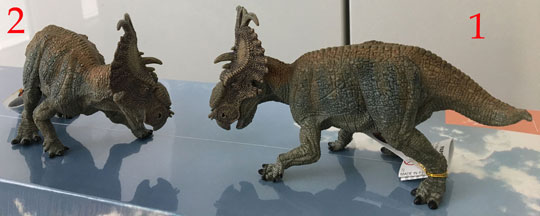
Pachyrhinosaurus Fossils have been Discovered in Alaska

Pachyrhinosaurus dinosaur model (Papo).

Papo Pachyrhinosaurus dinosaur model.  Fossils of a species of Pachyrhinosaurus have been found in Alaska.  Picture credit: Everything Dinosaur.

Picture credit: Everything Dinosaur

The model (above), is from the Papo model range, to view Papo prehistoric animals: Papo Prehistoric Animal Models.

Dr Druckenmiller went onto add that  the findings provide an entirely new chapter in the story of the life that once existed in Alaska and he added that he hoped to return to that site in the near future to continue this work.

As this part of Alaska remains relatively unexplored for Mesozoic fossils he and his team are confident that more discoveries will be made.

Dr Druckenmiller concluded:

“We are pretty sure there are other surprises waiting for us out there.”

Although it is very difficult to associate a specific genus of dinosaur to the trackways, the presence of small theropod tracks poses some interesting questions.  For example, was this animal a resident of the area or a migrant, perhaps following herbivores north as they looked for plant food?  Indeed, one could speculate that this is a juvenile animal, perhaps one that scavenged along the shoreline to see what animals had been stranded by the tide.

More fossils will have to be found before scientists can begin to piece together the ecosystem that once existed in ancient Alaska.

Go to Top