All about dinosaurs, fossils and prehistoric animals by Everything Dinosaur team members.
2 01, 2011

Review – David Attenborough’s “First Life”

By |2023-03-06T14:43:57+00:00January 2nd, 2011|Categories: Book Reviews, Main Page|1 Comment

A Review of the Book – “First Life”

Designed to accompany the two-part television series, “David Attenborough’s First Life” covers the billions of years of time, leading up to the development of advanced forms of life on our planet.  It is a chronological journal, split into eleven chapters that tells the story of the “slow burning fuse” that led to the explosion of life in the Cambrian, the development of the Phyla of organisms that are still with us today.

“First Life”

The text is informative, not too technical and designed for the lay person to follow.  There are many splendid photographs and lots of information on the fossil locations, although it would have been interesting to read more about some of the UK fossil locations such as Crail in Scotland and perhaps there are too few scary creatures for children to enjoy.  Although, it is amazing to see the strange and wonderful creatures known as the Ediacaran fauna (soft-bodied, bizarre organisms).

By the Late Precambrian, around six hundred million years ago, simple food chains had become established with over thirty different genera recognised, this simply ecosystem is known as the Ediacaran fauna after the Ediacara Hills, north of Adelaide in South Australia, where a variety of Late Precambrian fossils were discovered in the late 1940s.

The introduction, written by Sir David Attenborough, really brings out his passion for fossils and fossil collecting.  The highlight of the book, was reading about Sir David’s own connection with Charnwood forest, the site in Leicestershire, the county of Sir David’s childhood, where the important Precambrian fossil Charnia (Charnia masoni) was discovered.

Academic Content and Computer Generated Wonders

At over 285 pages in length, this book provides an appropriate balance between academic content and computer generated wonders.  One of the features of this book, are the extreme close up photographs of important fossils.  The vast majority of fossils from the Precambrian and the Cambrian geological period are extremely small, but the highly magnified and full colour photographs really help to bring the fossil evidence “to life”” as it were.  The reader is treated to some wonderful images, illustrations of the primitive sea landscapes and some excellent computer generated impressions and graphics as to what the fauna and flora of the Burgess Shale site might have looked like (British Columbia, Canada).

Trilobites Feature in the Television Series “First Life”

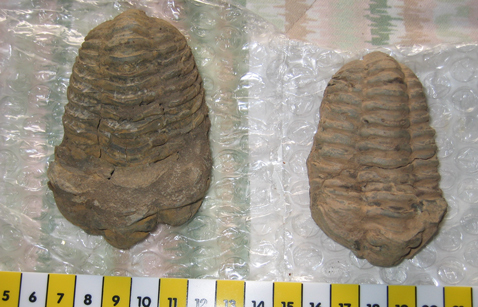
The definition of benthic.  A pair of trilobite fossils. Trilobites feature in the televison programme "First Life".

Trilobite fossils (Calymene).  Picture credit: Everything Dinosaur.

Picture credit: Everything Dinosaur

So in summary, a good book, an interesting read, perhaps not ideally suited for children but a fitting tribute to the work of scientists and to Sir David himself.

Prehistoric Animal Replicas

To view models and replicas of trilobites and other ancient creatures: CollectA Prehistoric Life Models.

1 01, 2011

Happy New Year from Everything Dinosaur

By |2023-03-06T14:44:56+00:00January 1st, 2011|Categories: Adobe CS5, Everything Dinosaur News and Updates, Main Page|0 Comments

Happy New Year to all our Readers

January 1st and just time to write to thank all our readers for staying with us over the last twelve months or so and to wish them all a peaceful and prosperous new year.  We put up a new banner on the front page of the Everything Dinosaur website Everything Dinosaur last night marking the start of 2011.

Happy New Year from Everything Dinosaur

Picture credit: Everything Dinosaur

Not to sure why we put a Quetzalcoatlus on the banner, pterosaurs are not traditionally associated with new year (not so far as we know), but I suspect this flying reptile was quite quick to photoshop which is why it was chosen.

Everything Dinosaur

Perhaps as it is soon to be the Chinese new year and it is going to be the year of the rabbit we subconsciously posted up a picture of an animal that if it were around today, may well feed on rabbits, hares and all things Lagomorpha.  Personally, I think the former is more likely to be the case.

Happy New Year!

Visit Everything Dinosaur’s website: Everything Dinosaur’s Website.

31 12, 2010

Our Palaeontology Predictions for 2011 – Having a Bit of Fun

By |2024-04-21T11:35:17+01:00December 31st, 2010|Categories: Dinosaur and Prehistoric Animal News Stories, Dinosaur Fans, Everything Dinosaur News and Updates, Main Page, Press Releases|0 Comments

What’s on the Horizon for 2011?

With the year coming to a close, this is a time for looking back and reflecting on the news stories and events of the last twelve months.  It is also an opportune moment to consider what news stories and articles we may be writing about in the year ahead.

Palaeontology Predictions

There is certainly a great deal going on in the field of Earth sciences at the moment.  Parts of the world, not previously well explored, are being mapped with many new fossil sites discovered.  In addition, lots of new research techniques are being applied to existing fossils and a substantial amount of new data is being collected.

Just for a bit of fun, we thought it would be a good idea if we had a go at predicting some of the news stories that may break in 2011.

So in no particular order, here are seven of our best guesses:

1). New Ceratopsian Genus to be Described

A number of new horned dinosaur genera have been described in the last year and we at Everything Dinosaur, expect this trend to continue.  This year we have had Sinoceratops (China), the giant Coahuilaceratops from Mexico, plus a number of new ceratopsian genera from the western United States and Canada, Medusaceratops for example.  We expect the trend for horned dinosaur discoveries to continue in 2011.

A Sinoceratops Scale Drawing

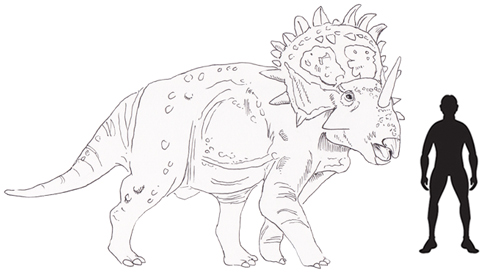
Sinoceratops scale drawing.

Sinoceratops scale drawing prepared for the Everything Dinosaur fact sheet. Picture credit: Everything Dinosaur.

Picture credit: Everything Dinosaur

2). Fresh Insight into Neanderthals

With the current work on the human genome and the extensive scientific study of hominid fossils we would expect to hear more about our closest hominid relatives on the human family tree.  Further insights into Neanderthal culture and behaviour, evidence perhaps of cross-breeding plus more data on Homo heidelbergensis.  We base this assumption on the fact that improved stability in countries like Iraq will permit the further exploration of a number of important hominid fossil sites.

3).  Further Marine Reptile Discoveries from the Jurassic Coast

We would expect to report on further marine reptile finds from Dorset’s Jurassic coast over the next twelve months.  We suspect that this World Heritage status stretch of coastline (UNESCO) will yield further fossils of marine reptiles – ichthyosaurs and plesiosaurs almost certainly, and perhaps one or two significant pliosaur fossils.

4). A New Trilobite Hunt for Everything Dinosaur

We predict that 2011 will give team members at Everything Dinosaur the chance to add to their collection of British trilobite fossils.  We intend to organise a number of trilobite fossil hunting trips, this time in Wales as well as in the midlands of England.

5). Everything Dinosaur Web Log to Reach 150,000 page views in a Month

The Everything Dinosaur web log or blog, first published online in May 2007, is going to be four years old next year.  Something like 1500 articles on prehistoric animal discoveries, palaeontologists and all things dinosaur would have been written by the time the fourth anniversary comes around.  Readership has grown steadily since the blog’s inception.  We try to inform, write in an appropriate style and to educate.  As a result of our continuing efforts we could break the 150,000 page views per month threshold sometime in the next few months.  Quite an achievement for these “dino buffs”.  We continue to commit a lot of our time to researching and writing articles, our intention is to try to add to the web log every day.

6).  Fossil Thefts to Continue

The theft of fossils from dig sites, we predict, will continue and indeed the black market for fossils and other rare artefacts will continue to grow.  Many newly discovered fossil locations and dig sites will be raided by trophy hunters and amateur fossil collectors.  A lot of the items will find their way into the hands of private collectors, either through under the counter sales or via auction sites.  These items will not be available for study by scientists and so their value to the scientific community is likely to be lost forever.  The removal of such objects from fossil sites, also denies palaeontologists the opportunity to study specimens “in situ”, thus valuable data about context, the environment and the fossilisation process may be lost.

7).  New Dinosaur Genus from the Korean Peninsula to be Announced

As relatively unexplored parts of the world are opened up, we can expect a lot of new dinosaur and prehistoric animal discoveries in 2011.  Expect a number of new finds from China, Spain, Portugal, Canada and the United States.  New dinosaurs from South America will also be announced next year, but we will predict that some of the more out of the way places will provide some exciting, new dinosaur discoveries over the next twelve months.  We predict that at least one new type of dinosaur from the Korean peninsula will be announced.

So just for a bit of fun, a quick list of some of the things we expect to be writing about in 2011.  One of the first things we must do in January is to review our list of predictions that we made in 2010, to see how well (or not so well) we did.

Visit Everything Dinosaur’s website: Everything Dinosaur.

30 12, 2010

Series Four of Primeval Starts on Saturday

By |2023-01-14T15:30:08+00:00December 30th, 2010|Categories: Dinosaur and Prehistoric Animal News Stories, Dinosaur Fans, Main Page|1 Comment

Primeval back on the Television with a new Series

The time travelling television series Primeval is back on terrestrial television this Saturday (New Years Day) with the start of the fourth series.  Although there have been a number of cast changes, the format is still the same with our team of dedicated scientists trying to solve the riddle of time portals that open up to permit creatures from different periods in Earth’s history to visit the Holocene.

Primeval

Prior to Primeval being broadcast on ITV1, the second ITV channel is showing a behind the scenes documentary with interviews with cast members, production crew and the special effects designers.  We can be fairly certain the dinosaurs will feature heavily in series four, expect a Spinosaurus and a baby “Spino” to be just two of the prehistoric animals the ARC team encounter.

Visit Everything Dinosaur’s award-winning and user-friendly website: Everything Dinosaur.

29 12, 2010

Review of New Horned Dinosaurs Book – “New Perspectives”

By |2023-01-14T15:27:43+00:00December 29th, 2010|Categories: Book Reviews, Main Page|0 Comments

Review of “New Perspectives on Horned Dinosaurs”

New Perspectives”, or to give the book its full title – “New Perspectives on Horned Dinosaurs – The Royal Tyrrell Museum Ceratopsian Symposium” is a comprehensive review of virtually all the recently published papers and journal articles on the ceratopsians.  It is everything and anything to do with that great family of ornithischian dinosaurs, the horned dinos, from Psittacosaurus to the enormous Triceratops.

Horned Dinosaurs

Over the last three years or so, there have been a number of spectacular new discoveries and a lot of exciting research carried out on the ceratopsians and this volume, sets out to update readers on the latest interpretation of their fossil record.  The book is split into thirty-six chapters and it is edited by Dr Michael J. Ryan of the Cleveland Museum of Natural History, Dr Brenda J. Chinnery-Allgeier of the University of Texas and Dr David Eberth of the Royal Tyrrell Museum (Alberta, Canada).

The list of contributors reads like a “who’s who” of modern palaeontology with contributions from the likes of esteemed scientists such as Phil Currie, Peter Dodson, Scott Sampson and Peter Larson.  More than five hundred pages dedicated to all things ceratopsian, including descriptions of ten new types, which have recently been discovered.

Models of Horned Dinosaurs Highlighting Ceratopid Diversity

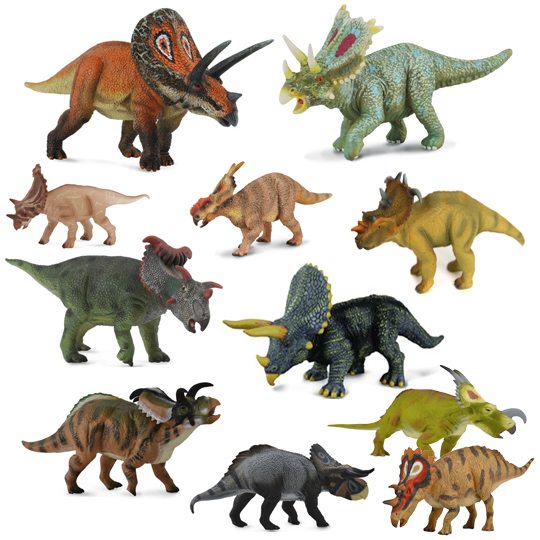
Different types of horned dinosaur.

Models demonstrate the diversity and variety of horned dinosaurs.

The picture (above) shows a huge variety of horned dinosaurs, all of which are represented in the CollectA model range: CollectA Age of Dinosaurs Popular Range.

Although, the book focuses mainly on North American discoveries there are some fascinating chapters dedicated to horned dinosaurs from farther afield.   For example, there is a chapter dedicated to the research on Archaeoceratops (China), as well as a new look at Psittacosaurus and a paper on insect trace fossils associated with the rotting remains of Protoceratops.

This really is a comprehensive guide and ideal for the undergraduate student, or enthusiastic amateur.  The book is very technical and is therefore not suitable for children.

28 12, 2010

Neanderthals Ate Their Greens According to New Study

By |2024-04-21T11:36:00+01:00December 28th, 2010|Categories: Dinosaur and Prehistoric Animal News Stories, Main Page|0 Comments

New Study Indicates much more Varied Diet for Neanderthals

The image of a brutish Neanderthal, armed with a primitive club and barely able to string together a series of grunts as a form of language has largely been dispelled.  Recent studies have changed dramatically our understanding and the subsequent image of the Neanderthal.  These people were sophisticated and very well adapted to the harsh climate of Europe back in the Pleistocene.  Their brains may actually have been bigger than our own (certainly in cubic volume terms).

However, one of the main differences between H. neanderthalensis and our own species, H. sapiens was thought to concern diet.  It had been suggested that Neanderthals consumed a lot more meat than us.  They were portrayed as being almost totally carnivorous.  Their dependence on large animals to hunt, creatures such as the Woolly Mammoth was thought to have made this particular species of human more vulnerable to extinction.  Once the large mammals died out, the Neanderthals would have gone too.

Neanderthals

A new study, published in the scientific journal “The Proceedings of the National Academy of Sciences”, shows that Neanderthal diet was far more sophisticated than previously thought, and on a par with our own species.

There have been a number of papers published this year demonstrating how closely the Neanderthals were to our species.  A scientific paper, released this spring, investigated the origin of what we call “human emotions”, to read more about this: The Origins of Human Empathy.

The revision of Neanderthal dietary habits has come about after an extensive study of their fossilised teeth.  Analysis of microscopic food particles trapped in Neanderthal teeth reveal evidence of a rich and varied diet, indicating that Neanderthals were able to exploit a variety of food resources.

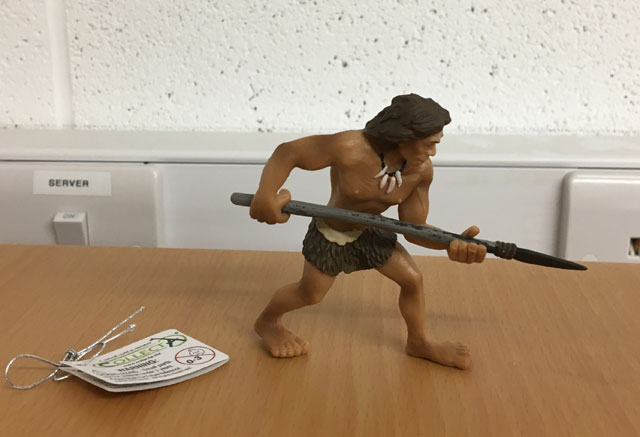
A Model of a Neanderthal Man

CollectA Neanderthal man model

Selecting a CollectA Neanderthal man figure for an Everything Dinosaur customer. Picture credit: Everything Dinosaur.

Picture credit: Everything Dinosaur

To view replicas of Neanderthals (whilst stocks last), and other prehistoric animal figures: CollectA Prehistoric Life Models and Figures.

The study reveals that Neanderthals ate a wide range of vegetables and pulses, such as wild grasses, beans, roots, tubers and date palms.  Much of the material studied confirms that Neanderthals cooked their food.  Cooking allows foods to be digested more easily and permits more nutrients to be extracted – perhaps each family group had their own favourite recipes.

The evidence, collated from a number of Neanderthal fossil sites, including cave sites in Iraq and Belgium suggest that Neanderthals controlled fire and ate a variety of food stuffs.

Commenting on the study, a spokesperson for the researchers stated:

 “Our results… suggest an overall sophistication in Neanderthal dietary regimes.”

27 12, 2010

Amateur Palaeontologist Claims “World’s First Pterosaur Embryo”

By |2023-03-06T14:46:38+00:00December 27th, 2010|Categories: Dinosaur and Prehistoric Animal News Stories, Dinosaur Fans, Main Page|0 Comments

CT Scan reveals Prehistoric Animal Embryos in Fossilised Eggs

Amateur palaeontologist and dinosaur enthusiast Dr Neal Naranjo was given quite a surprise when he had part of his extensive fossil collection subjected to CT scans, an egg from his collection, may contain the fossilised remains of a pterosaur embryo.  If this turns out to be true, then this would be the first evidence of a flying reptile embryo discovered to date.

Pterosaur Embryo

Pterosaurs are an extinct group of flying reptiles.  Their wings were formed out of skin that stretched from the body over the forelimbs and along an elongated fourth finger of each hand.  These creatures evolved in the Triassic and survived until the end of the Cretaceous Period, some sixty-six million years ago.

Texas resident, Dr Naranjo whose ambition is to open a natural history museum, took six eggs from his collection, all thought to be dating from the Cretaceous; but from a variety of different reptiles, to a local medical centre to have them scanned by a CT scanner so that their contents could be seen.  To his surprise, five of the eggs showed signs of containing the preserved remains of a baby prehistoric animal.

A CT (stands for computerised tomography) scanner sends out a series of powerful X-rays and enables researchers to build up a three-dimensional picture of the internal structure of an object.  Normally, such machines are located in hospitals or universities and provide information to doctors and other practitioners with regards to medical matters, but the strong X-rays can also penetrate rock and enable palaeontologists to see inside a fossil without having to dissect it.

CT Scans

CT scanners are used quite frequently by palaeontologists, for example, the giant Dorset pliosaur fossil is currently being scanned to build up a more complete picture of the internal structure of this huge predator’s jaws and skull.

To read more about the Dorset Pliosaur: Giant Pliosaur Fossil goes for a CT Scan.

When asked why, he sent the eggs for scanning, Dr Neal stated:

“I had these eggs, and I was always curious and wondering if something was inside.”

Although the pterosaur embryo has still to be formerly examined by museum specialists, if this specimen does prove to be the fossil of a baby pterosaur still within its egg, it will be the first such find known to science.

Pterosaur fossils are exceptionally rare, their pneumatised bones, although strong, are rarely preserved and we at Everything Dinosaur are only aware of a handful of pterosaur eggs being known from the fossil record.

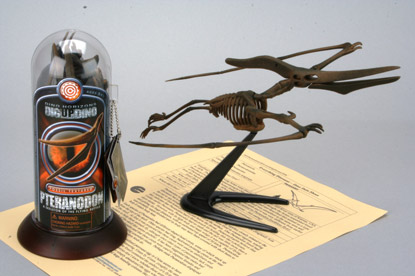
A Model of a Late Cretaceous Pterosaur (P. longiceps)

Picture credit: Everything Dinosaur

The picture shows a model of a fossilised skeleton of a Late Cretaceous flying reptile.  The kit is available to purchase online from Everything Dinosaur.

To view the range of pterosaur and dinosaur themed toys and gifts available: Visit Everything Dinosaur.

Pterosaur Eggs

Some scientists believe that pterosaur eggs were pliable, like extant turtle eggs and as they were more leathery then they would only survive the fossilisaton process in very rare instances.  Also, many pterosaur species are associated with marine sediments and like seabirds today, they may have chosen out of the way, rocky islands and cliff tops on which to nest, so material from such sights would be very unlikely to have been preserved as fossils.

Describing the moment when the images of the baby pterosaur first became apparent, Dr Naranjo said:

“When we saw it, we started yelling and screaming and jumping up and down and going ‘it’s a baby, it’s a baby'”.

Dr Naranjo has already received enquiries from a number of palaeontologists from the USA and Europe requesting that they be given the opportunity to examine the fossil in more detail.  He intends to take this specimen to the animal Tuscon Mineral and Fossil Show, so that experts can view it.

Although, most of the eggs scanned had been purchased, Dr Naranjo had found one specimen himself and this particular fossil egg contained the preserved embryo of a bizarre theropod called a therizinosaur (Scythe Lizard).

Commenting on the successful use of the Medical Centre’s CT scanner, Radiology Director Rebecca Petty said:

“We were all excited, for us to get to help in something like this was amazing.”

In addition to the eggs, Dr Naranjo brought in fossils from a Hadrosaur (duck-billed dinosaur) he had found in Montana.  The dinosaur had been bitten in the leg during its lifetime, and the doctor was curious to see what they could learn from the bite wound (the study of infections and wounds in fossils is referred to as pathology).  The CT scan revealed that the dinosaur had suffered from an infection that went all the way to the bone marrow.  Despite the infection, the dinosaur survived.

Dr Naranjo’s extensive fossil collection, including the eggs, will help form part of the collection for the Naranjo Natural History Museum, due to be sited in the town of Lufkin (Texas).  It has long been an ambition of Dr Naranjo to help establish a natural history museum in the area, and a few weeks ago his plans were given the go ahead.

For models and replicas of pterosaurs and other prehistoric animals: Pterosaur and Prehistoric Animal Models.

26 12, 2010

Review of “New Perspectives on Horned Dinosaurs”

By |2023-03-06T15:02:18+00:00December 26th, 2010|Categories: Book Reviews, Main Page|0 Comments

Book Review – “New Perspectives on Horned Dinosaurs”

“New Perspectives”, or to give the book its full title – “New Perspectives on Horned Dinosaurs – The Royal Tyrrell Museum Ceratopsian Symposium” is a comprehensive review of virtually all the recently published papers and journal articles on the ceratopsians.  It is everything and anything to do with that great family of ornithischian dinosaurs, the horned dinos, from Psittacosaurus to the enormous Triceratops.

Horned Dinosaurs

Over the last three years or so, there have been a number of spectacular new discoveries and a lot of exciting research carried out on the ceratopsians and this volume, sets out to update readers on the latest interpretation of their fossil record.  The book is split into thirty-six chapters and it is edited by Dr Michael J. Ryan of the Cleveland Museum of Natural History, Dr Brenda J. Chinnery-Allgeier of the University of Texas and Dr David Eberth of the Royal Tyrrell Museum (Alberta, Canada).

The list of contributors reads like a “who’s who” of modern palaeontology with contributions from the likes of esteemed scientists such as Phil Currie, Peter Dodson, Scott Sampson and Peter Larson.  More than five hundred pages dedicated to all things ceratopsian, including descriptions of ten new types, which have recently been discovered.

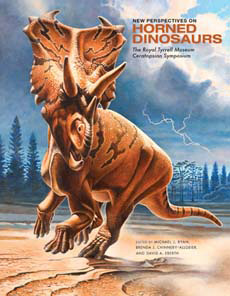
Front Cover of “New Perspectives”

Picture credit: Donna Sloan

The book can be further divided into five distinct sections.  Part one sets the scene and provides an overview of the research carried out on ceratopsids since the 1970s.  Part two, updates the reader on the latest research, highlights new discoveries and introduces the recently discovered new taxa.  The third part of the book, describes the latest research on ceratopsian behaviour, anatomy, ontogeny and functional biology.

“Horned Dinosaurs in Time and Space”

The penultimate part of the book, entitled “Horned Dinosaurs in Time and Space”, sets out to establish how these dinosaurs became so diverse and radiated out into a myriad of different environments and ecosystems.  This section also provides some remarkable insights into ceratopsid trace fossils and bone beds.

The final part of the book provides a history of horned dinosaur fossil collections, and this section works well with the excellent CD-rom that accompanies the volume.  The CD-rom lists ceratopsian discoveries and focuses on the work on ceratopsids in Canada.

The book is very technical and not really suitable for the casual reader and there are very few colour plates (hence the CD-rom), however, it is a “must have” for any budding undergraduate studying related Earth Sciences and for the enthusiastic amateur.

For models and replicas of horned dinosaurs, take a look at the Beasts of the Mesozoic ceratopsian figures: Beasts of the Mesozoic Ceratopsian Figures.

25 12, 2010

Merry Christmas from all at Everything Dinosaur

By |2023-03-06T15:03:10+00:00December 25th, 2010|Categories: Dinosaur Fans, Everything Dinosaur News and Updates, Main Page, Press Releases|0 Comments

Merry Christmas!

Seasons greetings to all our customers and readers of the Everything Dinosaur web log.  It has been a very busy year with lots of new research, exciting discoveries and some amazing fossil finds.  The compliments of the season to all our readers.

Everything Dinosaur

We at Everything Dinosaur, are already looking forward to 2011 and to all the new dinosaur and prehistoric animal themed articles that we will be writing.  Our aim is to write a new article for every single day, so there will be plenty of work ahead of us.

Merry Christmas from Everything Dinosaur

Picture credit: Everything Dinosaur

Wishing all our customers and readers a lovely Christmas and a happy New Year.

Visit the award-winning website of Everything Dinosaur: Everything Dinosaur.

24 12, 2010

Scanning a Pliosaur CT Scan to see if Dorset Giant is a New Species

By |2023-01-14T15:09:48+00:00December 24th, 2010|Categories: Dinosaur Fans, Main Page|0 Comments

Giant Dorset Pliosaur Fossil gets CT Scan

The fossilised remains of the skull and jaws of a giant sea monster of the Late Jurassic are to be scanned by one of the country’s most powerful CT scanners in a bid to learn more about the huge animal.  The analysis of thousands of X-ray images all helping to build up a 3-D image of the beast, a pliosaur, may lead scientists to conclude that this is a new species of marine reptile.

Pliosaur

Last year we reported on the discovery of huge 2.4 metre long fossil jaws that had been discovered on the Dorset coast.  The jaws and part of the skull that was also found belonged to a giant pliosaur, a marine reptile that would have been one of the top predators in the sea during the Late Jurassic, an animal capable of attacking and killing any other animal in its environment.  At the time of the discovery, local palaeontologist and Plesiosaur expert Richard Forrest stated that this pliosaur would have made T. rex “look like a kitten”.

To read the article on the discovery: Giant Dorset Pliosaur Discovery.

The X-rays will help to build up a three dimensional image of the skull, jaws and teeth providing scientists with an opportunity to look inside the fossil without actually having to dissect the fossilised bones.  The scans could establish if the giant fossil represents a new species, perhaps one of the largest carnivores known to science.

The most famous of all the pliosaurs, certainly one popular with young dinosaur fans who have watched the BBC documentary series “Walking with Dinosaurs” is Liopleurodon.  In the television series, Liopleurodon was depicted as being a ferocious hunter that measured over 25 metres in length and weighed a colossal 150 tonnes.  In reality the evidence of pliosaurs this big is not that convincing, Liopleurodon ferox for example, a species of Liopleurodon which has a number of fossil specimens ascribed to it, was perhaps as long as ten metres or so.  The Dorset giant, was probably bigger but without more body fossils it is hard to accurately determine just how large this animal was.

A Model of the Pliosaur Liopleurodon
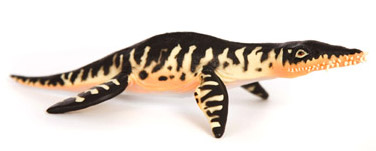
Picture credit: Everything Dinosaur

At the moment, palaeontologists have estimated that the “Dorset Giant” may have measured between 10 and 16 metres in length and weighed between 7 and 12 tonnes.

The skull, which was unearthed by a local fossil collector and then purchased by Dorset Country Council using Heritage Lottery Funds, is currently being removed from its matrix by expert fossil preparator Scott Moore-Fay.  Scott estimates that to prepare the fossil completely it is going to take more than 1,000 hours.

Diagrams show the potential size of the Dorset pliosaur, comparing it to a Killer Whale (Orca) and a frogman.  Over the last few years a number of fragmentary pliosaur remains have been discovered around the world, from places like Norway, Antarctica and Russia, which ones represent the largest types of pliosaur has led to a lot of debate and discussion amongst palaeontologists.

Commenting on his work Scott said:

“It’s incredibly exciting.  Nobody has ever seen this fossil, so I get to see it as it is coming out of the rock – it is almost like magic.”

However, while preparatory work can reveal the surface of the fossil in remarkable detail, a more hi-tech solution is needed to probe deeper inside.  Once the discovery was publicised, Professor Ian Sinclair at the nearby University of Southampton contacted the fossil’s owners and offered them the opportunity to use the powerful CT scanner that was being erected in the University’s engineering sciences department.

Professor Sinclair stated:

“When we have the situation of rare samples that are precious, like the pliosaur, we have to extract the most amount of information from them and we certainly don’t want to destroy them, so this really is the perfect tool.”

The CT scanner, which has been funded by the Engineering Physical Science Research Council (EPSRC) and the University of Southampton, is one of the most powerful machines of its kind in the UK, and one of the largest.  Such a large and powerful machine is essential if the rock matrix surrounding the precious fossil is to be penetrated and the secrets inside the fossil revealed.

This super scanner works in much the same way as a hospital CT scanner, although at much higher energy and resolution, by taking thousands of X-rays to build up an image of whatever object is inside.

University of Southampton engineer Dr Mark Mavrogordato explained:

“At the end, you have a 3-D volume representing your original specimen.  And you can slice it, dice it, however you want, as if you could dissect it with a knife, but you are doing it digitally and non-destructively.”

The team has begun scanning the prepared fossil one piece at a time to reveal as complete a pliosaur picture possible, including information about the internal bone structure and the positioning of hidden teeth.

Richard Forrest added:

“We hope that these CT scans will show the internal structure of the jaws, and how they are built to withstand such incredible forces.  By understanding this, we can learn more about its behaviour – how it hunted and attacked other creatures.”

The scans will also help to confirm whether this species is new to science.  If it is a new species it will need to be formally named and described.

Mr Forrest went on to comment:

 “From the outside, it looks similar to other pliosaurs found in the UK, although much, much bigger.  By looking at the inner architecture of the skull, in particular the brain-case, we should be able to establish if this is a species that we have not seen before.”

After the scientific analysis is complete and the fossil is fully prepared and mounted, it will go on display to the public in the summer 2011 at the Dorset County Museum in Dorchester.  It is hoped that the fossilised bones and teeth will be exhibited next to a life-size model of the animal’s huge, gaping jaws.  This would give visitors an impression as to just how terrifying this marine reptile would have been, as well as letting them gain an insight into the last view that many an ichthyosaur or plesiosaur would have seen before this huge leviathan gobbled them up.

Museums adviser for Dorset, David Tucker stated:

“The pliosaur will be displayed with its mouth agape, allowing people to get the best possible understanding of what the beast would have looked like in life.  We’ll also have a massive, life-sized model of the head that will demonstrate how terrifying its teeth were.”

To view models and replicas of pliosaurs and other marine reptiles: CollectA Age of Dinosaurs Popular Models.

Go to Top