All about dinosaurs, fossils and prehistoric animals by Everything Dinosaur team members.
4 08, 2020

Rare Malignant Cancer Diagnosed in Centrosaurus Bone

By |2024-03-09T19:14:55+00:00August 4th, 2020|Categories: Dinosaur and Prehistoric Animal News Stories, Dinosaur Fans, Main Page, Palaeontological articles, Photos/Pictures of Fossils|0 Comments

Bone Cancer (Osteosarcoma) Identified in Dinosaur Fibula

Scientists have identified a rare malignant cancer in the fossilised bone of a horned dinosaur.  Writing in “The Lancet Oncology”, the researchers report on the discovery and diagnosis of an osteosarcoma in the lower leg bone (fibula), of a Centrosaurus (Centrosaurus apertus).  This is the first time that an osteosarcoma has been found in the fossilised bones of a dinosaur.

An Osteosarcoma Identified in the Leg Bone of a Dinosaur (Centrosaurus apertus)
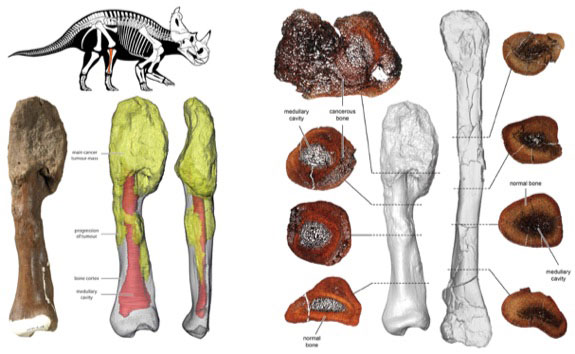
Malignant cancer identified in Centrosaurus fossil bone.
Malignant cancer identified in horned dinosaur leg bone.

Picture credit: Royal Ontario Museum

What is an Osteosarcoma?

Osteosarcoma is a cancer that produces immature bone.  There are an estimated 3.4 million cases reported in the human population each year.  It mostly occurs in young people, under the age of 25 and there is some evidence to suggest that it is more prevalent in males.  In our species, osteosarcoma is associated with periods of rapid bone growth, to date the cause, genetic alterations, oncogenic events and evolutionary history of osteosarcoma are poorly understood.

The research team included scientists from the Royal Ontario Museum, McMaster University (Ontario) and the Okayama University of Science (Japan), along with numerous other specialists in pathology, molecular medicine, image resonance and oncology.  They subjected the leg bone to high-resolution computed tomography (CT) scans.  Thin sections were than prepared and examined under a microscope to assess the specimen at the bone-cellular level.  The investigators were able to reach a diagnosis of osteosarcoma, the first time such a diagnosis has been identified in a member of the Dinosauria.

Centrosaurus Life Reconstruction
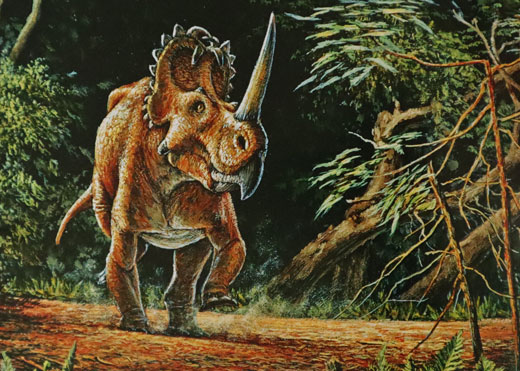
An illustration of Centrosaurus.
Centrosaurus life reconstruction.

Picture credit: Michael W. Skrepnick

Originally Believed to be a Healing Fracture in the Centrosaurus Bone

The Centrosaurus bone was found in 1989 in the Dinosaur Provincial Park (Alberta).  The badly malformed bone was thought to represent a healing fracture but it was decided to investigate its unusual morphology in order to better understand the pathology.

A Cast of the Deformed Bone (Fibula) of Centrosaurus
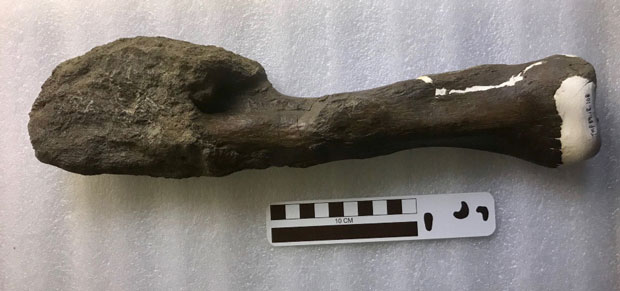
The malformed Centrosaurus dinosaur bone.
Evidence of a malignant tumour in a dinosaur bone.  A cast of the dinosaur bone showing the deformity

Picture credit: Danielle Dufault (Royal Ontario Museum)

One of the co-authors of the paper, Rhianne Crowther (Trent University, Ontario), commented:

“Diagnosis of aggressive cancer like this in dinosaurs has been elusive and requires medical expertise and multiple levels of analysis to properly identify.  Here, we show the unmistakable signature of advanced bone cancer in 76-million-year-old horned dinosaur — the first of its kind.  It’s very exciting.”

Confirming the Diagnosis, Human Compared to a Dinosaur

To confirm the diagnosis of osteosarcoma, the bone was compared to a normal fibula from a Centrosaurus.  It was then compared to a human fibula with a confirmed case of osteosarcoma.  The Centrosaurus was an adult dinosaur and the cancer was at an advanced stage, suggesting that it probably invaded other organs and parts of its body.  The bone comes from an extensive monodominant Centrosaurus bonebed, so this dinosaur probably died with a large number of other animals in its herd during a catastrophic flood.

David Evans, a palaeontologist at the Royal Ontario Museum added:

“The shin bone shows aggressive cancer at an advanced stage.  The cancer would have had crippling effects on the individual and made it very vulnerable to the formidable tyrannosaur predators of the time.  The fact that this plant-eating dinosaur lived in a large, protective herd may have allowed it to survive longer than it normally would have with such a devastating disease.”

Seper Ekhtiari, an Orthopaedic Surgery Resident at McMaster University, who had also been involved in this study, stated:

“It is both fascinating and inspiring to see a similar multidisciplinary effort that we use in diagnosing and treating osteosarcoma in our patients leading to the first diagnosis of osteosarcoma in a dinosaur.  This discovery reminds us of the common biological links throughout the animal kingdom and reinforces the theory that osteosarcoma tends to affect bones when and where they are growing most rapidly.”

It is hoped that this research will establish a new standard for the diagnosis of unclear pathology in vertebrate fossils.  Forging links between pathology preserved in fossilised bones and human medicine will help scientists to gain a better understanding of the evolution and genetics of various diseases.

Everything Dinosaur acknowledges the assistance of a media release from the Royal Ontario Museum in the compilation of this article.

The scientific paper: “First case of osteosarcoma in a dinosaur: a multimodal diagnosis” by Seper Ekhtiari, Kentaro Chiba, Snezana Popovic, Rhianne Crowther, Gregory Wohl, Andy Kin On Wong, Darren H Tanke, Danielle M Dufault, Olivia D Geen, Naveen Parasu, Mark A Crowther and David C Evans published in The Lancet Oncology.

The Everything Dinosaur website: Everything Dinosaur.
3 08, 2020

Scotland’s Own and Unique “Jurassic Park”

By |2024-03-09T14:59:15+00:00August 3rd, 2020|Categories: Dinosaur and Prehistoric Animal News Stories, Dinosaur Fans, Geology, Main Page, Palaeontological articles, Photos/Pictures of Fossils|0 Comments

Jurassic Fossils from the Isle of Skye Globally Significant

The filming might have resumed for the next instalment in the “Jurassic Park/World” franchise last week, but in the scientific community there has been an important development in the study and protection of Scotland’s very own “Jurassic Park”.

Significant Jurassic Fossils

Scientists from the University of Oxford, University College London, Birmingham University the University of Edinburgh and the National Museum of Scotland have published a new scientific paper that emphasises the importance of vertebrate fossils from the Isle of Skye.

The Isle of Skye is Heralded as One of the Most Important Places in the World for Middle Jurassic Vertebrate Fossils

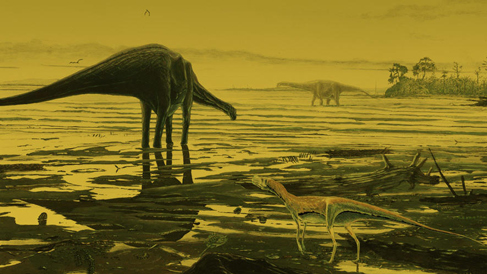
Isle of Skye Sauropods.
The Isle of Skye (Bathonian faunal stage).  A newly published scientific paper heralds the vertebrate fossils from the Kilmaluag Formation on the Isle of Skye as “globally significant”.

Picture credit: Jon Hoad

The Kilmaluag Formation

Outcrops of the Bathonian-aged Kilmaluag Formation on the Trotternish peninsula on the Isle of Skye hold vital information on how vertebrate life was evolving and changing around 167 million years ago.  The strata contain both body and trace fossils of numerous tetrapods including dinosaurs.  Since there are not that many highly fossiliferous sites around the world providing evidence of terrestrial ecosystems and biota from back in the Middle Jurassic, the Isle of Skye has long been recognised as a hugely significant.

The area was given greater legal protection last year, when the Scottish Government signed a Nature Conservation Order (NCO), to assist in the protection of the rare vertebrate fossils found in the area and to deter irresponsible fossil collecting on the island.

To read about the provision of the Nature Conservation Order: Legal Protection for Isle of Skye Fossil Sites.

In this new study, the researchers which include Scottish palaeontologist Elsa Panciroli, a research assistant in the department of Evolution and Palaeobiology at the University of Oxford, conclude that unlike other contemporaneous fossil localities from England, the strata of the Kilmaluag Formation provides partial skeletons, providing unprecedented insights and new data.

An Abundant Assemblage of Jurassic Fossils

The research team state that this location has yielded predominantly small-bodied tetrapods including amphibians, many types of reptiles (including pterosaurs and dinosaurs) and non-mammalian cynodonts as well as early mammals.  An abundant fossil fish and invertebrate assemblage is also reported.

A Sauropod Track from the Isle of Skye

Sauropod track on the foreshore (Isle of Skye).
Sauropod track from the Isle of Skye.  The Trotternish peninsula provides both body and trace fossils, such as this sauropod track for example.

Picture credit: Jon Hoad

The researchers provide a comprehensive overview of the Kilmaluag Formation, outlining the importance of its geology and the fossil discoveries made to date.  They also present evidence of several species that are being reported from the Isle of Skye for the first time.   The review places the vertebrate faunal assemblage in an international context and confirms the global significance of the region.

Insights into Early Mammal Evolution

Although the dinosaurs grab all the headlines, the Kilmaluag Formation is most likely to provide important information with regards to the evolutionary history of early mammals, the Squamata (lizards and snakes) along with amphibians.

To read Everything Dinosaur’s blog post about damage to dinosaur footprints being reported: Dinosaur Footprints Damaged on the Isle of Skye.

The link between the fossil sites in Wyoming and the Isle of Skye: What have Wyoming and the Isle of Skye got in Common?

Evidence of Scottish Stegosaurs: Scottish Stegosaurs.

The scientific paper: “Diverse vertebrate assemblage of the Kilmaluag Formation (Bathonian, Middle Jurassic) of Skye, Scotland” by Elsa Panciroli, Roger B. J. Benson, Stig Walsh, Richard J. Butler, Tiago Andrade Castro, Marc E. H. Jones and Susan E. Evans published by The Royal Society of Edinburgh/Cambridge University Press.

The Everything Dinosaur website: Everything Dinosaur.

2 08, 2020

“Early Jurassic Park” – Dilophosaurus wetherilli and a New YouTube Video

By |2024-03-09T14:54:37+00:00August 2nd, 2020|Categories: Adobe CS5, Dinosaur Fans, Everything Dinosaur Products, Main Page, Photos of Everything Dinosaur Products|0 Comments

“Early Jurassic Park” – Dilophosaurus wetherilli

Whilst working on their YouTube video explaining about the newly published scientific paper on Dilophosaurus, team members at Everything Dinosaur needed a visual to explain the importance of this North American dinosaur to palaeontologists as they try to improve their understanding about Early Jurassic dinosaur biota.  Interpreting Dilophosaurus fossil material has been hampered by their fragmentary nature and poor preservation.

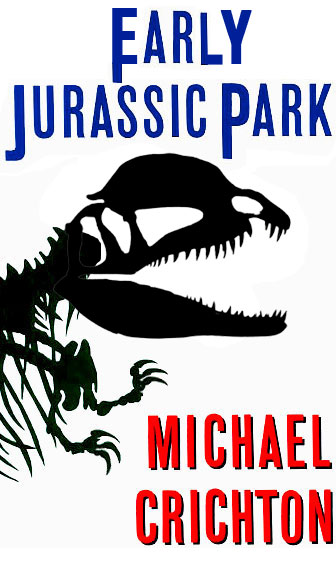
Attempting to summarise the research since the University of California field work from 1942, it was decided to modify an iconic book cover “Jurassic Park” by Michael Crichton.  The new research suggests that Dilophosaurus may have looked very different, it was probably not a weak-jawed scavenger but an apex predator, the most dangerous dinosaur in the ecosystem.

The Importance of Dilophosaurus wetherilli – An Important Dinosaur from the Early Jurassic

"Early Jurassic Park" - Dilophosaurus wetherilli.
“Early Jurassic Park” – demonstrating the significance of the Early Jurassic theropod Dilophosaurus wetherilli.

Picture credit: Everything Dinosaur

Dilophosaurus

Dilophosaurus was popularised in the famous dinosaur movie “Jurassic Park” which was released in 1993.  It also appeared in the novel written by Michael Crichton, upon which the film was based.  The small venomous dinosaur with its neck frill, reminiscent of the frilled-neck lizard of Australia (Chlamydosaurus kingii) was regarded as a major departure from the science by many movie-goers although Dilophosaurus played a prominent role in one of the most significant scenes of the whole franchise when Dennis Nedry, the computer programmer who had been bribed to smuggle dinosaur embryos off the resort, was attacked and eaten.

The Dilophosaurus from the Film “Jurassic Park”

ITOY Studio Dilophosaurus dinosaur model with articulated jaw.
The ITOY Studio Dilophosaurus dinosaur model has an articulated jaw. Picture credit: Everything Dinosaur.

Picture credit: Everything Dinosaur

To view dinosaur and prehistoric animal models: Dinosaur and Prehistoric Animal Figures.

In the newly published paper (Marsh and Rowe 2020), Dilophosaurus is depicted as a more robust, powerful animal and as far as the fossil record known to date goes, Dilophosaurus represents the largest terrestrial vertebrate known from the Early Jurassic of North America.

A Life Reconstruction of Dilophosaurus wetherilli Based on the 2020 Scientific Interpretation

Dilophosaurus wetherilli Makeover
An amazing puppet depicting Dilophosaurus wetherilli using the data from the newly published scientific paper was created by Brian Engh.

Picture credit: University of Texas at Austin

To read Everything Dinosaur’s blog post about the new scientific paper: Time to Beef Up Dilophosaurus.

The Everything Dinosaur YouTube channel, is packed with lots of amazing videos all about dinosaurs and prehistoric animals.  The channel has over 175 videos on it, providing lots of information to dinosaur fans and model collectors: Subscribe to Everything Dinosaur on YouTube.

Visit the Everything Dinosaur website: Everything Dinosaur.
1 08, 2020

Fieldwork Commencing Around the World

By |2024-03-09T14:49:43+00:00August 1st, 2020|Categories: Dinosaur and Prehistoric Animal News Stories, Main Page, Palaeontological articles|0 Comments

Fieldwork Commencing Around the World

The global coronavirus pandemic (COVID-19) has touched the lives of nearly everyone on the planet.  The measures in place to help restrict the spread of this highly infectious and pernicious disease have had a profound effect.  As some restrictions are lifted, one area of science is trying to get back to near normal working practices.  Fieldwork for a number of institutions and universities is beginning to commence once again, although with strict hygiene and social distancing measures in place.

Research Projects Commencing Around the World

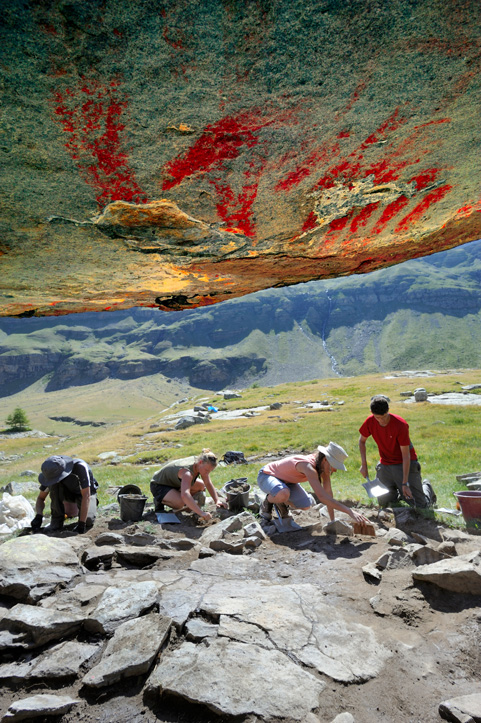
Abri Faravel fieldwork.
Fieldwork has commenced as scientists in the Northern Hemisphere hope to make the best of the summer weather.  However, great care will have to be taken with regards to personal hygiene and social distancing.  Close proximity working as seen here, is going to have to be re-visited and many dig sites and workstations will need to be reorganised.

Picture credit: Loïc Damelet, CNRS/Centre Camille Jullian

Not Normal Working Practices for Fieldwork

Scientists, like many in the rest of the population have got used to remote conference calls, webinars, Facebook discussion groups and Zoom calls.  Fieldwork will still have to be carried out and in many cases, fossils exposed on the surface, if they are not collected quite quickly, can soon be eroded away once exposed to the elements.

Field teams exploring fossil sites in the Northern Hemisphere hope to make the best of the warm summer weather.  Great care will have to be taken with regards to social distancing and personal hygiene.  Occupying adjacent workstations at a dig site, will have to be carefully considered, as will the need to share tools, water bottles, tents and such like.  Organising fieldwork involves a great deal of planning.  Under the current difficulties, these plans are going to have to be even more comprehensive.

Organising Fieldwork is Going to be Even More Challenging

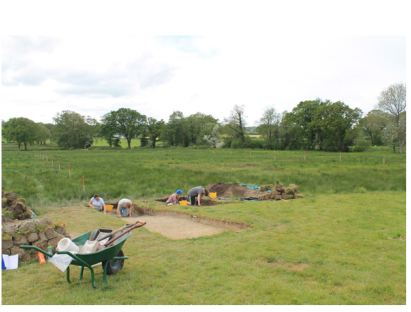
Flint tools found in Ceredigion.
University of Wales Trinity Saint David (UWTSD) – Lampeter campus working at the Neolithic dig site.  Fieldwork is going to have to be carefully managed under COVID-19 restrictions.

Picture credit: University of Wales Trinity Saint David (UWTSD)

A spokesperson from Everything Dinosaur commented:

“Having carefully reviewed the current guidelines, we have reluctantly cancelled all our planned fieldwork operations for the rest of this year.  This has been a tough decision to make, but in the interests of all the staff and the wider community, we felt it was the right thing to do.”

We wish all those academics, commercial fossil hunters, students and volunteers about to embark on fieldwork, every success with their endeavours. Stay safe, keep well.

The Everything Dinosaur website: Everything Dinosaur.
31 07, 2020

Time to “Beef Up” Dilophosaurus

By |2024-03-09T14:20:41+00:00July 31st, 2020|Categories: Adobe CS5, Dinosaur and Prehistoric Animal News Stories, Dinosaur Fans, Everything Dinosaur News and Updates, Everything Dinosaur videos, Main Page, Photos of Everything Dinosaur Products, Photos/Pictures of Fossils, Press Releases|0 Comments

Time to “Beef Up” Dilophosaurus wetherilli

A comprehensive review of the fossil material associated with the Early Jurassic crested theropod Dilophosaurus (D. wetherilli) has been published.  The consequences of this newly published paper for manufacturers of dinosaur models are profound.  It is likely that our view of “double crested lizard” will change and with the writing of this paper, all the Dilophosaurus figures and replicas are very probably all wrong!

It’s time to “beef up” Dilophosaurus and to stop depicting it as a lightly built, gracile, weak-jawed scavenger but to recognise that this dinosaur was an apex predator!

Everything Dinosaur team members have produced a short YouTube video that explains what has happened.

Time to “Beef Up” Dilophosaurus (D. wetherilli)

Video credit: Everything Dinosaur

All Dilophosaurus wetherilli Dinosaur Models May be Wrong!

An analysis of the five most-complete Dilophosaurus specimens reveals that Dilophosaurus had stronger jaws than previously thought.  That distinctive notch between the premaxilla and the maxilla (the upper jaw bones), which is so carefully depicted in numerous replicas and figures, might be much less pronounced.  The original interpretation of the “kink” being put down to the fragmented and poor condition of the fossil material.  The shape of the upper jaws may be a result of taphonomy and it might not reflect the actual shape of the bones.

Lots of Dilophosaurus Dinosaur Models Feature in Everything Dinosaur’s Video

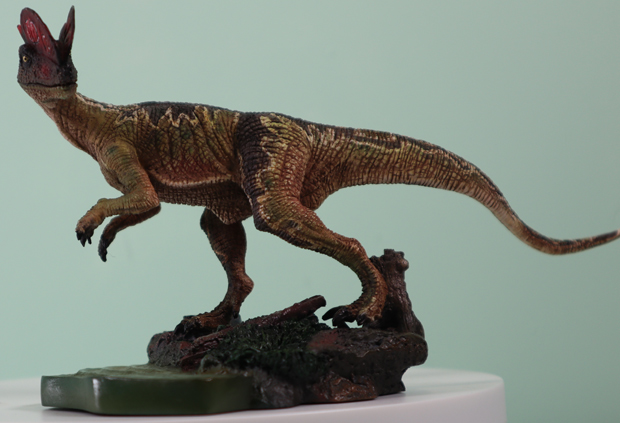
Wild Safari Dilophosaurus dinosaur model.
The Wild Safari Prehistoric World Dilophosaurus model came out in 2009 and it shows the characteristic anatomical traits formerly associated with this theropod dinosaur. Picture credit: Everything Dinosaur.

Picture credit: Everything Dinosaur

Nasal and Lacrimal Bones Form the Crests

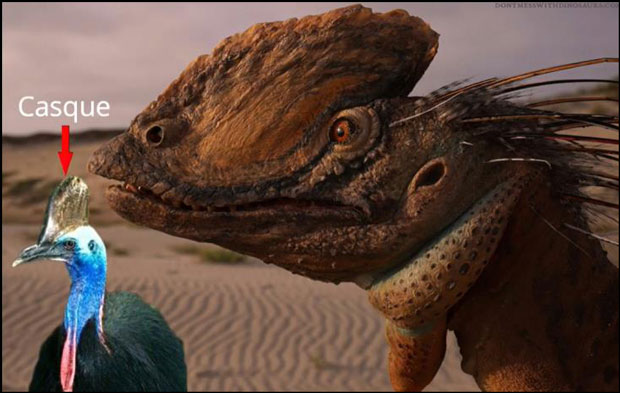
It is the nasal and lacrimal bones that form the famous crests.  This new paper suggests that these features were not thin and bony but the hollow, pneumatised cores were covered with keratin or keratinised skin making them much larger than previously thought.  Although their overall shape remains uncertain, these crests may have played a role in helping this large animal to lose heat.  Recently published research (Eastick et al), suggests that the casques of large, ground-dwelling birds such as cassowaries might act as thermal windows.

The casque on the top of the head of the cassowary could help this large bird to lose heat when it is very hot and restrict heat loss in cooler conditions.  At the time of publication (2019), it was proposed that these findings might have implications for the function of similar structures in avian and non-avian dinosaurs and that includes Dilophosaurus wetherilli.

Used for Display and Thermoregulation?

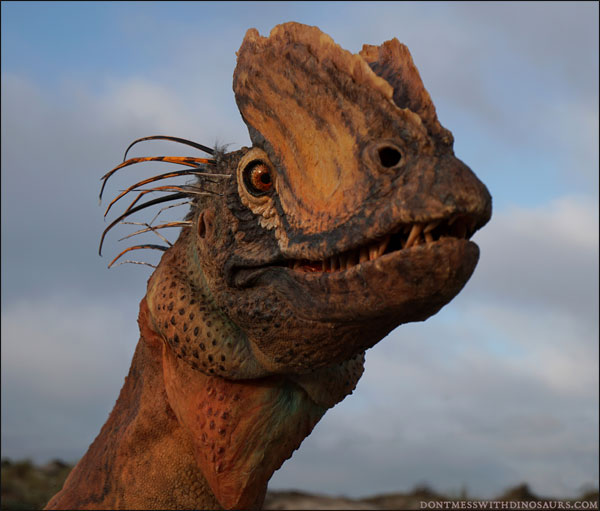
A new interpretation of Dilophosaurus wetherilli.
The new interpretation depicts Dilophosaurus as an apex predator which was very bird-like. Those crests could have played a role in thermoregulation.

Picture credit: Everything Dinosaur (puppet of Dilophosaurus created by Brian Engh)

Everything Dinosaur’s YouTube video highlighting the scientific paper on Dilophosaurus that may change the way models of this dinosaur are made lasts for a fraction over eleven minutes.  It provides an overview of the recent paper and discusses how future Dilophosaurus dinosaur models might look.

To read Everything Dinosaur’s blog post about the newly published research reviewing the Dilophosaurus wetherilli fossil material: Beefing Up Dilophosaurus.

Everything Dinosaur’s YouTube channel contains over 175 dinosaur and prehistoric animal videos, including model reviews, tips and hints about prehistoric animal model collecting, new releases, fossil discoveries, updates and insider information.

Discover Everything Dinosaur on YouTube: Everything Dinosaur on YouTube.  We recommend that you subscribe to our YouTube channel.

Everything Dinosaur would like to acknowledge the help and support of University of Texas at Austin/Jackson School of Geosciences for their help in creating our YouTube video.

The Everything Dinosaur website: Everything Dinosaur.
30 07, 2020

Vicious Prehistoric Owl from the Bighorn Basin

By |2024-03-09T14:16:04+00:00July 30th, 2020|Categories: Dinosaur and Prehistoric Animal News Stories, Dinosaur Fans, Main Page, Palaeontological articles, Photos/Pictures of Fossils|0 Comments

Primoptynx poliotauros – Large Owl that Hunted like a Hawk!

With the extinction of the non-avian dinosaurs some 66 million years ago, our mammalian ancestors diversified and thrived.  A large proportion of their predators had become extinct and this may have contributed to their success.  However, our furry friends were not to have everything go their way, as within a few million years other vertebrates, notably the birds had themselves diversified and begun to fill predatory niches in terrestrial ecosystems once occupied by less derived maniraptorans.

Primoptynx poliotauros

For example, a new species of large owl has been described from postcranial remains found in the Bighorn Basin of Wyoming.  This owl, which was approximately sixty centimetres tall, has particularly large and well developed talons on its hind and second toes.  Writing in the “Journal of Vertebrate Palaeonotology”, the research team responsible for describing the fossil material conclude that this large bird was a very dangerous threat to the numerous species of small and medium sized mammals within the ecosystem.  The owl has been named Primoptynx poliotauros.

The Fossil Remains of Primoptynx poliotauros Laid Out in Skeletal Position

Primoptynx poliotauros fossil material.
Primoptynx poliotauros fossil bones laid out in approximate skeletal position.  Note the scale bar of 10 cm.

Picture Credit: Senckenberg Research Institute/Tränkner

Big Owl with Big Talons

Lead author of the scientific paper, Dr Gerald Mayr, an ornithologist at the Senckenberg Research Institute and Natural History Museum Frankfurt commented:

“The fossil owl was about the size of a modern snowy owl (Bubo scandiacus).  However, it is clearly distinguished from all extant species by the different size of its talons. While in present-day owls the talons on all toes are approximately the same size, Primoptynx poliotauros has noticeably enlarged talons on its hind toe and second toe.”

The scientists postulate that as this prehistoric owl has a longer first and second toe, as seen in extant hawks and other members of the Accipitridae family, such as such as the Harpy eagle (H. harpyja), this suggests that P. poliotauros used its feet to dispatch prey items in a hawk-like manner, in contrast to extant owls that kill prey with their beak.

Co-author of the paper, Dr Thierry Smith (Royal Belgian Institute of Natural Sciences), explained:

“Owls today have four toes with claws of equal size to catch relatively small preys and kill them with the beak.  Primoptynx poliotauros has a longer first and second toe, as seen in hawks and other members of the family Accipitridae.  Those more developed toes are used to pin down prey, which are punctured by the talons.  So, it was an owl that hunted like a hawk on medium-sized mammals.”

From the Willwood Formation (Wyoming, USA)

The fossil material heralds from the Willwood Formation of the northern Bighorn Basin, Park County in Wyoming and the genus name is from the Latin for first “primus” and the “ptynx” for owl.  Although around 55 million years old, Primoptynx was not the “first owl”, there is evidence to suggest that these birds originated in the Cretaceous.

The fossils help to confirm the widespread and diverse species of owls that were present during the Eocene Epoch.  The success of owls (Strigiformes), runs in conjunction with the evolutionary development of placental mammals.  The later extinction of Primoptynx poliotauros and prehistoric proto-owls may have been due to the emergence of diurnal birds of prey in the Late Eocene.

Everything Dinosaur acknowledges the assistance of a media release from the Royal Belgian Institute of Natural Sciences in the compilation of this article.

The scientific paper: “Skeleton of a new owl from the early Eocene of North America (Aves, Strigiformes) with an accipitrid-like foot morphology” by Gerald Mayr, Philip D. Gingerich and Thierry Smith published in the Journal of Vertebrate Paleontology.

The Everything Dinosaur website: Everything Dinosaur.
29 07, 2020

New Study Supports Traditional View of Dinosaur Evolution

By |2024-03-09T14:12:11+00:00July 29th, 2020|Categories: Adobe CS5, Dinosaur and Prehistoric Animal News Stories, Dinosaur Fans, Geology, Main Page, Palaeontological articles|0 Comments

Study Suggests that Ornithischian and Saurischian Dinosaurs Evolved Around the Same Time

An international team of scientists from Brazil and Argentina in collaboration with a geochronologist from the Massachusetts Institute of Technology (MIT), have provided evidence to support the hypothesis that the Ornithischia and Saurischia diverged early on in dinosaur evolution and this supports the view of the dinosaur family tree as proposed by Seeley in 1887.

Writing in the journal “Scientific Reports”, the researchers which included Jahandar Ramezani (MIT), re-examined the fossils of Pisanosaurus mertii, dating these fossils to approximately 229 million years ago (Late Carnian stage of the Triassic).  Pisanosaurus is believed to be the earliest known ornithischian dinosaur, although some palaeontologists have concluded that this one-metre-long reptile is a dinosauriform.

An Analysis of Dinosaur Evolution

This new date suggests that bird-hipped dinosaurs were evolving at around the same as lizard-hipped forms (Saurischia), this challenges the hypothesis proposed by Baron et al in their 2017 paper which re-shaped the traditional view of dinosaur taxonomy.

To read more about the 2017 scientific paper: Root and Branch Reform of the Dinosaur Family Tree.

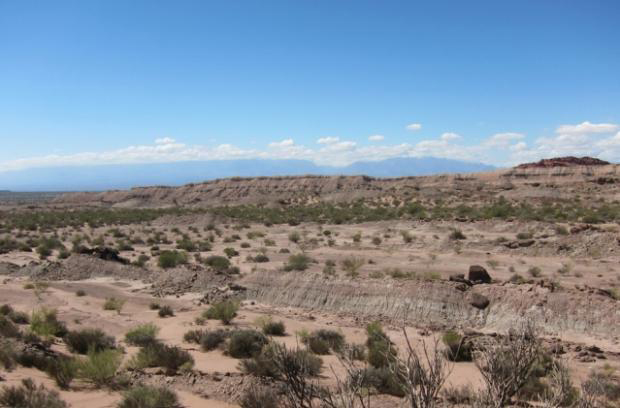
A View of the Ischigualasto Formation (Foreground)

A view of the The famous Ischigualasto Formation (foreground) the Sierra de Famattina Mountains can be seen on the horizon.
The famous Ischigualasto Formation (foreground), the Sierra de Famattina Mountains can be seen on the horizon (La Rioja province – Argentina).

Picture credit: Desojo et al

Accurately Dating the Ischigualasto Formation

The researchers focused their fossil finding efforts on the Hoyado del Cerro Las Lajas area, where outcrops of the Ischigualasto Formation can be found, but they are less well explored compared to contemporaneous strata within the “Valley of the Moon” geological park in San Juan Province.  Volcanic deposits yielded zircons at various levels and these minerals permitted the measurement of isotopes of uranium and lead (rate of radiometric decay).

The presence of these igneous rocks allowed the geochronologist to measure the relative proportion of isotopes present in the zircon crystals.  Radiometric dating permitted the scientists to make an estimate of the age of the bedding planes and infer the age of the fossils that they contain.  The study revealed that the Ischigualasto Formation overlaps with the deposition of another important fossil-bearing formation found in North America – the Chinle Formation.

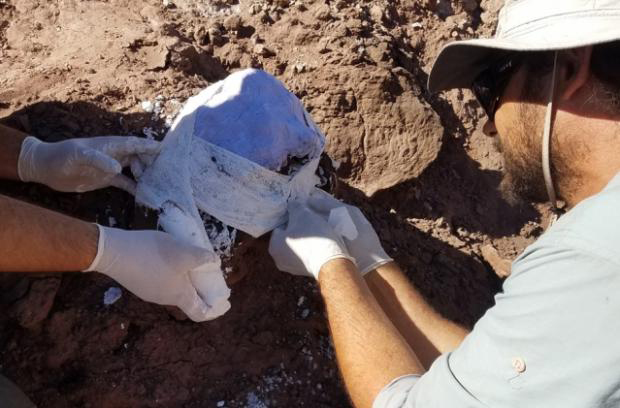
Carefully Jacketing a Specimen Prior to its Removal

Preparing a fossil specimen for removal.
A researcher carefully prepares a field specimen for removal.

Picture credit: Desojo et al

Overlapping with the Chinle Formation of the South-western United States

The middle layers of the Chinle Formation which outcrops in the south-western part of the USA contain a variety of vertebrate fossils, including early dinosaurs.  However, very few fossils if any, are associated with the lower levels of the Chinle Formation.   The lack for fossils, prevents palaeontologists from understanding more about the early radiation and diversity of the Dinosauria from their suspected origins in the southern hemisphere.  The rocks from which fossils of the  basal ornithischian dinosaur Pisanosaurus have been found were dated to approximately 229 million years ago.  From this data, the research team were able to conclude that the earliest bird-hipped dinosaurs evolved at around the same time as the first lizard-hipped dinosaurs appear in the fossil record.

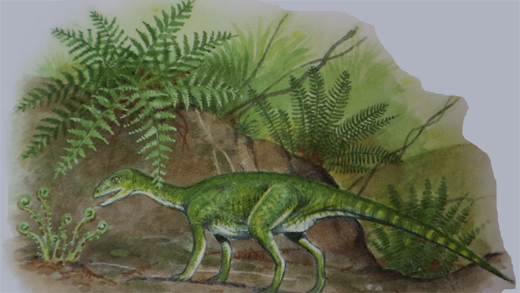
The Scientists Proposed that Pisanosaurus was Indeed an Ornithischian and it Lived Around 229 Million Years Ago

Pisanosaurus life reconstruction.
A life reconstruction of the Triassic ornithischian Pisanosaurus.

Dating of the Strata to Determine Dinosaur Evolution

Commenting on the contribution of the dating of the strata to the paper, Jahandar Ramezani stated:

“We can now say the earliest ornithiscians first showed up in the fossil record roughly around the same time as the saurischians, so we shouldn’t throw away the conventional family tree.  There are all these debates about where dinosaurs appeared, how they diversified, what the family tree looked like.  A lot of those questions are tied to geochronology, so we need really good, robust age constraints to help answer these questions.”

Uranium-bearing Zircon Crystals Allowed an Accurate Date for Parts of the Ischigualasto Formation to be Established

Zircon crystals help to date parts of the Ischigualasto Formation in Argentina.
Microscopic crystals of the uranium-bearing mineral zircon were identified in rock samples and these crystals permitted an accurate date for the rock layers to be calculated.

Picture credit: Desojo et al

Everything Dinosaur acknowledges the assistance of a media release from the Earth, Atmospheric and Planetary Sciences department of MIT in the compilation of this article

The scientific paper: “The Late Triassic Ischigualasto Formation at Cerro Las Lajas (La Rioja, Argentina): fossil tetrapods, high-resolution chronostratigraphy, and faunal correlations” by Julia B. Desojo, Lucas E. Fiorelli, Martín D. Ezcurra, Agustín G. Martinelli, Jahandar Ramezani, Átila. A. S. Da Rosa, M. Belén von Baczko, M. Jimena Trotteyn, Felipe C. Montefeltro, Miguel Ezpeleta and Max C. Langer published in Scientific Reports.

The Everything Dinosaur website: Visit Everything Dinosaur.

28 07, 2020

“Captain Hook” A New Dinosaur from Hell Creek

By |2024-03-09T14:06:34+00:00July 28th, 2020|Categories: Dinosaur and Prehistoric Animal News Stories, Dinosaur Fans, Main Page, Palaeontological articles, Photos/Pictures of Fossils|0 Comments

Trierarchuncus prairiensis – The Last Alvarezsaurid

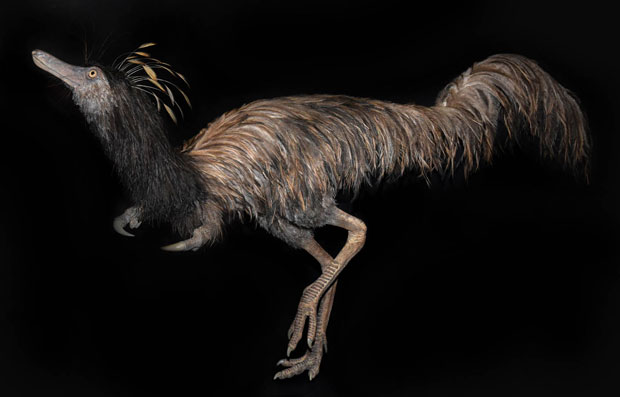
A new species of alvarezsaurid dinosaur has been described from fragmentary remains consisting of a foot bone, a partial radius (arm bone) and three thumb claws which might represent a progressive size series.  The little dinosaur has been named Trierarchuncus prairiensis and the fossils come from the uppermost Maastrichtian Hell Creek Formation of Montana and demonstrate that these bizarre, little theropods survived until the very end of the Cretaceous.

A Life Reconstruction of the Newly Described Alvarezsaurid T. prairiensis

Life reconstruction Trierarchuncus prairiensis.
Trierarchuncus prairiensis life reconstruction.

Picture credit: Badlands Dinosaur Museum (North Dakota) model created by Boban Filipovic

The Most Complete Alvarezsaurid Claw Described to Date

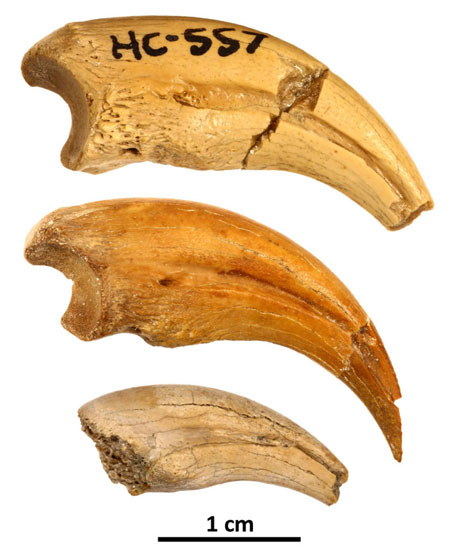
Writing in the journal “Cretaceous Research”, the research team that includes lead author Dr Denver Fowler (Badlands Dinosaur Museum), describe the three thumb claws (manual digit 1) which are of different sizes.  They conclude that these three claws probably represent a growth series and from this they can plot how the claw changed as the alvarezsaurid grew.  As Trierarchuncus matured, the thumb claw became more robust and roughened.

Blood vessel grooves on the manual ungual (claw) became more deeply embedded in the bone.  One claw, the middle-sized specimen, represents the most complete alvarezsaurid thumb claw described to date and it demonstrates that these claws were more curved than previously thought.  A powerful, strongly curved thumb claw would have helped this small dinosaur to rip into rotten wood in search of invertebrates.  It has also been suggested that alvarezsaurids evolved to exploit termites as a food source, that is, they exhibited termitophagy (specialised consumers of termites).  The single claw on each hand in association with strong forelimbs could have been used to tear apart termite nests.

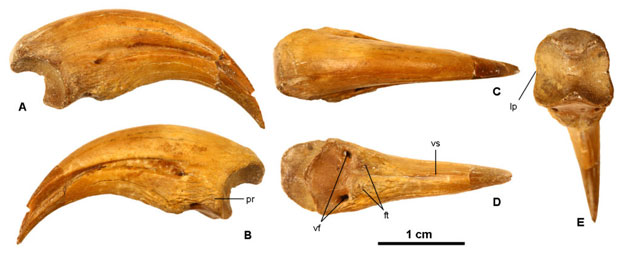
A View of the Three Alvarezsaurid Fossil Claws (Proposed Ontogenetic Series)

Three claws ascribed to the genus Trierarchuncus.
The three claws described in the scientific paper form a possible growth series.  The most complete alvarezsaurid claw described to date can be seen in the middle.  Note the strongly curved and hook-like claw, if this is a growth series, then it has been suggested that the thumb claw became more strongly curved as the animal matured.

Picture credit: Badlands Dinosaur Museum (North Dakota)

Inspired by Captain Hook!

The claws were the inspiration behind the dinosaur’s name.  The genus name comes from the Greek “trierarch”, a reference to the appointed officers responsible for a Greek warship, whilst “uncus” is the Latin for hook.  The trivial or species name honours the gentle, rolling prairies of eastern Montana where the fossils were found.  The name which is pronounced Try-er-arch-unk-cus pray-ree-en-sis  translates as “Captain Hook of the prairies”.  This is also a nod in the direction of the infamous “Captain Hook”, a fictional character, the nemesis of Peter Pan created by J. M. Barrie.

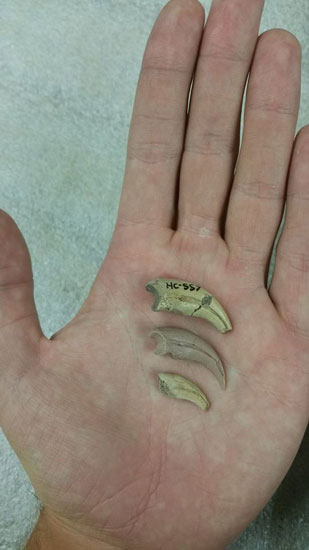
The Three Thumb Claws from the Alvarezsaurid in the Study

The three alvarezsaurid thumb claws showing a possible growth sequence.
Possible evidence of a growth series – alvarezsaurid manual unguals.  The human hand provides a scale, an adult Trierarchuncus was probably less than a metre in length.

Picture credit: Badlands Dinosaur Museum (North Dakota)

Implications for the Taxonomy and Phylogeny of the Alvarezsauroidea

If the three claw specimens do indeed represent a growth series (an ontogenetic series), then this discovery could have far-reaching consequences for all those maniraptoran dinosaurs confined within the Alvarezsauroidea.  If the claws of these dinosaurs changed radically as the animal grew and matured, then supposedly unique features (autapomorphies), used to erect other alvarezsaurid genera might be unreliable.  These features might be attributed to the relatively young age of the dinosaur when it died, rather than representing a defining anatomical characteristic that can lead to the naming of a new species.

Views of the Thumb Claw Showing Curvature (MOR 6622 – Holotype Claw)

Trierarchuncus prairiensis thumb claw showing curvature.
Views of the most complete Trierarchuncus thumb claw showing curvature.  The  holotype claw MOR 6622.

Picture credit: Badlands Dinosaur Museum (North Dakota)

The Youngest Known Alvarezsaurid

Stratigraphic data indicates that Trierarchuncus represents the youngest known alvarezsaurid.  Fossils associated with these types of theropod occur through most of the eighty-five metre thick Hell Creek Formation, with the uppermost specimen having been found within a few metres of the contact with the Palaeocene-aged Fort Union Formation.  It is likely that alvarezsaurids were present in North America throughout the Late Cretaceous and that they persisted until the extinction of the non-avian dinosaurs.

Evidence suggests that alvarezsaurids originated in Asia: Haplocheirus – Is it a bird?  No, it is a dinosaur.

Did alvarezsaurids eat eggs?  An article from 2018: Did Alvarezsaurids eat eggs?

The scientific paper: “Trierarchuncus prairiensis gen. et sp. nov., the last alvarezsaurid: Hell Creek Formation (uppermost Maastrichtian), Montana” by Denver W. Fowler, John P. Wilson, Elizabeth A. Freedman Fowler, Christopher R. Noto, Daniel Anduza and John R. Horner published in Cretaceous Research.

Visit the Everything Dinosaur website: Everything Dinosaur.
27 07, 2020

Microraptor Moulted Just Like Many Modern Birds

By |2024-03-09T10:29:36+00:00July 27th, 2020|Categories: Adobe CS5, Dinosaur and Prehistoric Animal News Stories, Dinosaur Fans, Main Page, Palaeontological articles, Photos/Pictures of Fossils|0 Comments

Evidence of Sequential Moult Identified in Microraptor gui

A team of Israeli scientists in collaboration with colleagues from China have found evidence in the holotype specimen of Microraptor (Microraptor gui) that this flying dinosaur sequentially moulted its feathers.  All living birds have to replace their feathers periodically in order to maintain their function, feathered dinosaurs underwent the same process to.  The way in which the feathers are shed and replaced provides palaeontologists with an opportunity to infer habits and behaviours about a long extinct animal.

The Holotype Fossil Material of Microraptor gui

Microraptor fossil.
Feathers are found preserved in many dinosaur fossils from China and a new study suggests that Microraptor sequentially moulted which has implications for the habit and behaviour of this volant dromaeosaurid.

Writing in the academic journal Current Biology, the scientists from the University of Haifa, the Society of Protection of Nature and the Jerusalem Bird Observatory (Israel), along with co-workers from the Chinese Academy of Sciences identified signs of sequential moulting on the fossilised wing of Microraptor gui.

Moulting Strategy Links to Habitat Selection and Flight Ability

Living birds generally moult their feathers in one of three main ways or strategies:

1).  A gradual direct replacement of all flight feathers in a slow moult with both wings showing similar stages of moult at the same time – referred to as sequential moulting.

2).  Simultaneous replacement of all the flight feathers – referred to as simultaneous moulting.

3).  A gradual, but not ordered moult in which feather replacement has no predictable sequence or direction – referred to as an irregular moult.

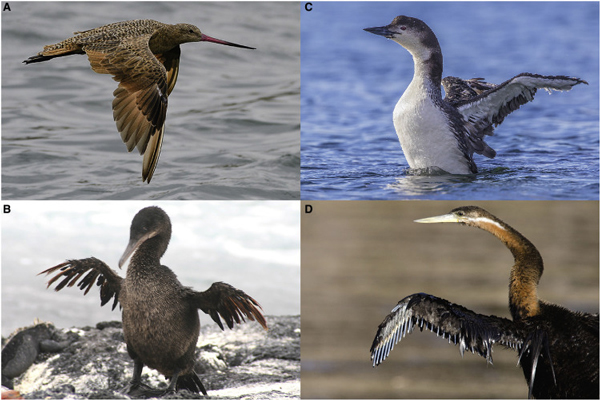
Different Moulting Strategies Identified in Extant Birds

Different strategies of feather moulting in living birds.
Examples of moult strategies in living birds.  Marbled godwit (Limosa fedoa) in (A) showing a gradual sequential moult.  The flightless cormorant (Nannopterum harrisi) during a non-sequential moult with both wings showing old, new and growing feathers without any order or symmetry.  A common loon (Gavia immer) after simultaneous shedding of all the wing’s feathers as part of a non-sequential simultaneous moult.  An African darter (Anhinga rufa) in (D) that is characterised by a non-sequential moult in which its flight feathers grow simultaneously.

Picture credit: Kiat et al plus Gartner, Salmond, S. P. d’Entremont, Francey (Journal of Current Biology)

Moulting Strategies

In total, the moulting strategies of 302 living bird species were studied, including active fliers and ground-dwelling birds incapable of powered flight.  These findings were than applied to the feather arrangement, composition and morphology as found in the wing of the Microraptor gui holotype specimen.  The researchers were unable to distinguish between simultaneous and irregular moulting (strategy 2 and 3), so they confined their study to a direct comparison between sequential moulting (strategy 1) and non-sequential moulting (strategies 2 and 3).

The moulting strategy adopted by a bird species impacts on their ability to fly and provides clues about their habitat.

For example,  those birds that spend much of their time in the air or live in habitats which are open with few hiding places to help them avoid predators, sequential moulting tends to be adopted.  This ensures that the birds can still fly even during moulting.  Birds that do not fly frequently, or that have access to plenty of hiding places in their habitat so that they can avoid detection by predators tend to shed a large number of feathers simultaneously and have a relatively rapid moult, typically no more than 2-3 weeks, but if they are a volant species their ability to fly is severely impeded during this time.

The Implications for Microraptor gui

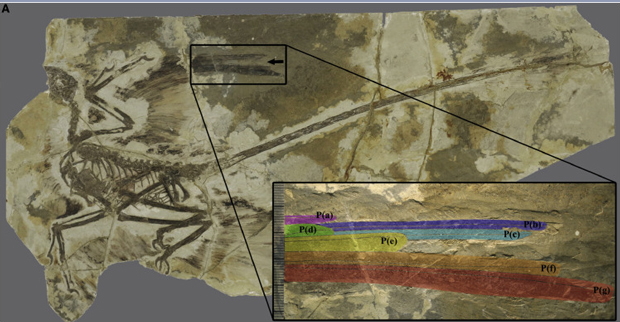
A detailed examination of the wing feathers preserved on the holotype specimen of Microraptor led the researchers to identify six feathers of differing sizes (a-g in the diagram below).  These feather lengths were in a sequence indicating that Microraptor moulted gradually and sequentially.

Evidence of Sequential Moulting in Microraptor (M. gui)

Sequential moulting in Microraptor.
The holotype specimen exhibits an active moult in the primaries (the arrow points to the moult-related wing gap).  The bottom right inset shows how the researchers identified seven primaries in the specimen’s wing, marked as P(a)–P(g).

Picture credit: Kiat et al (Journal of Current Biology)

This suggests that Microraptor probably spent a considerable portion of each day in the air and that it needed to be able to fly to avoid predators and to forage for food.  Furthermore, Microraptor required this capability on a daily basis, including during the moulting process.

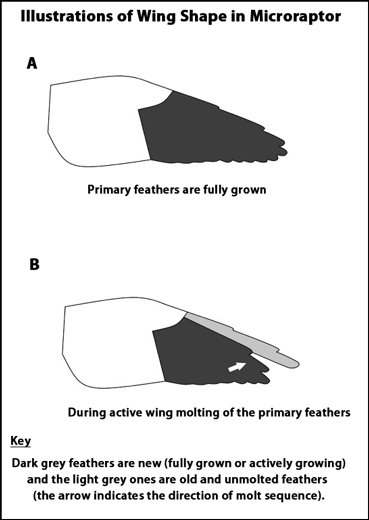
Wing Moult (Sequential Shedding) in Microraptor

Wing moult in Microraptor.
Illustration (A) shows fully grown primary feathers on the wing, whilst (B), shows light grey feathers which have yet to be shed.

Picture credit: Kiat et al (Journal of Current Biology) with additional annotation by Everything Dinosaur

Microraptor gui Demonstrating Sequential Moulting

Microraptor is the earliest known feathered vertebrate to demonstrate sequential moulting and this suggests that this strategy is nested very deep within the Maniraptora lineage that led to the evolution of birds.  It likely maintained its flight ability throughout the entire year.  These findings support the hypothesis that Microraptor was a strong, capable flier.  The researchers conclude that flight was essential for either its daily foraging or escaping from predators and that sequential moulting is the outcome of evolutionary pressures to maintain flight capability throughout the entire annual cycle in both extant birds and non-avialan paravian dinosaurs from 120 million years ago.

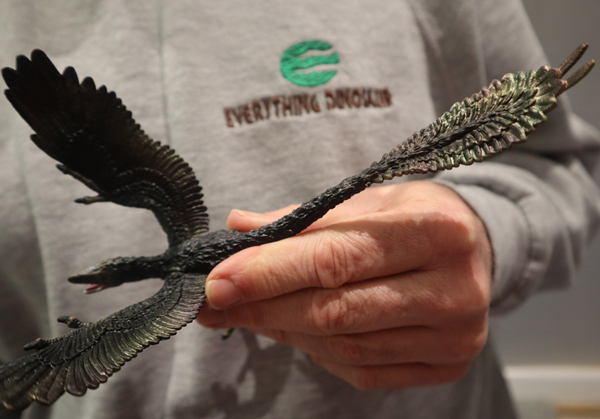
Microraptor Probably Sequentially Moulted Which Infers it was a Strong Flier

The CollectA Deluxe Microraptor Model.
Showing the iridescent feathers and the bifurcated tailfan of the CollectA Deluxe Microraptor model.  New study of the Microraptor gui holotype suggests sequential moulting and from this it is inferred that flight was essential for either Microraptor’s daily foraging or to avoid predators. Picture credit: Everything Dinosaur.

Picture credit: Everything Dinosaur

The picture (above) shows a CollectA Deluxe Microraptor model.

To view this range of models and figures: CollectA Deluxe Prehistoric Life Figures.

The scientific paper: “Sequential Molt in a Feathered Dinosaur and Implications for Early Paravian Ecology and Locomotion” by Yosef Kiat, Amir Balaban, Nir Sapir, Jingmai Kathleen O’Connor, Min Wang and Xing Xu published in the journal Current Biology.

The Everything Dinosaur website: Visit Everything Dinosaur.

26 07, 2020

A Unique Ornithopod Diorama

By |2024-03-09T08:46:45+00:00July 26th, 2020|Categories: Adobe CS5, Dinosaur Fans, Everything Dinosaur Products, Main Page, Photos of Everything Dinosaur Products, Press Releases|0 Comments

CollectA Fukuisaurus and CollectA Mantellisaurus Get Makeovers

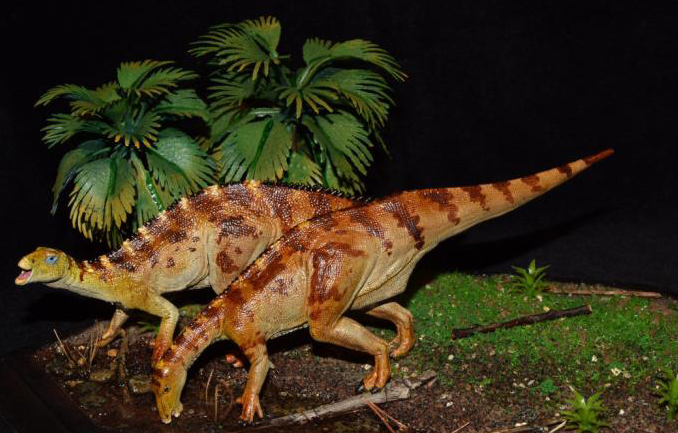
A very big thank you to dinosaur model collector Elizabeth who sent us pics of the CollectA 1:40 scale Fukuisaurus and the CollectA drinking Mantellisaurus that had been customised by the very talented Martin Garratt so that they represent the same species.  Elizabeth had commissioned the model maker to create a diorama featuring a pair of ornithopods, one female and one male.  With the addition of the 1:40 scale Fukuisaurus into the CollectA range this year, her plan to use two similar models to represent a male and a female of the same species came into fruition.

An Ornithopod Diorama

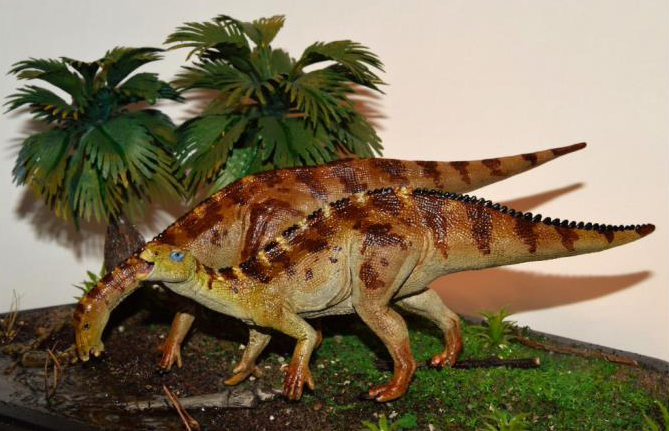
A Stunning Dinosaur Diorama Created by Martin Garratt

Two customised dinosaur models.
A beautiful pair of CollectA dinosaur models that have been customised on behalf of a client by the very talented model maker Martin Garratt.

Picture credit: Elizabeth

Two Herbivorous Dinosaurs at a Watering Hole

This beautiful diorama features the two CollectA figures and model maker Martin has placed them on the margins of a small pond, thereby taking advantage of the head down pose of the CollectA Mantellisaurus figure.

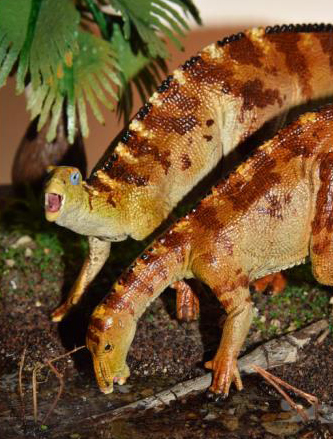
A Close-up View of the Two Dinosaur Figures

CollectA Fukuisaurus and Mantellisaurus have been customised by a model maker.
Customised Fukuisaurus and Mantellisaurus.  A model maker has created a superb diorama featuring two different dinosaur replicas but portraying them as one species of ornithopod.

Picture credit: Elizabeth

Fukuisaurus and Mantellisaurus

Although these two figures work exceptionally well in the diorama and they may have been contemporaneous, in reality Fukuisaurus and Mantellisaurus were separated by thousands of miles when these two herbivorous dinosaurs lived in the Early Cretaceous.  Mantellisaurus (M. atherfieldensis), is known from the Vectis Formation (Isle of Wight and Dorset in southern England), as well as equivalent level beds from western Europe).  In contrast, Fukuisaurus (F. tetoriensis), comes from exposures of the Kitadani Formation on the Japanese island of Honshu.

To view the CollectA Prehistoric Life range: CollectA Age of Dinosaurs Popular Prehistoric Life Figures.

Customised Dinosaur Models – Fukuisaurus and Mantellisaurus

Customised CollectA Mantellisaurus and Fukuisaurus.
A pair or ornithopods customised by Martin Garratt.  The CollectA Mantellisaurus (left) and the CollectA Fukuisaurus (right).

Picture credit: Elizabeth

Discussing Mantellisaurus and Fukuisaurus

In addition, although the size of Mantellisaurus is not known, it was considerably bigger and heavier than Fukuisaurus.  Although, it was more gracile than other Hadrosauriformes, palaeontologists have estimated that this dinosaur could have exceeded seven metres in length and weighed more than 1,000 kilograms.  Fukuisaurus, which is known from many more fossil specimens, the majority of which come from a single horizon, is estimated to have measured around 4.5 metres in length.  Fukuisaurus is estimated to have weighed around 400 kilograms.

The CollectA Models Next to Their Customised Counterparts

Customised CollectA dinosaur models (Fukuisaurus and Mantellisaurus).
The CollectA Fukuisaurus and Mantellisaurus compared to the customised figures.  Clockwise from left to right – customised CollectA Mantellisaurus, the CollectA Fukuisaurus in the manufacturer’s colour scheme, customised CollectA Fukuisaurus figure and finally, the CollectA Mantellisaurus in the factory livery.

Picture credit: Elizabeth

In her email to Everything Dinosaur, Elizabeth stated:

“CollectA models of Fukuisaurus and Mantellisaurus, repainted and based by Martin Garratt [UMF Models] to create a diorama of two dinosaurs of the same species at a pond – take your pick as to whether to call them Fukuisaurus or Mantellisaurus.”

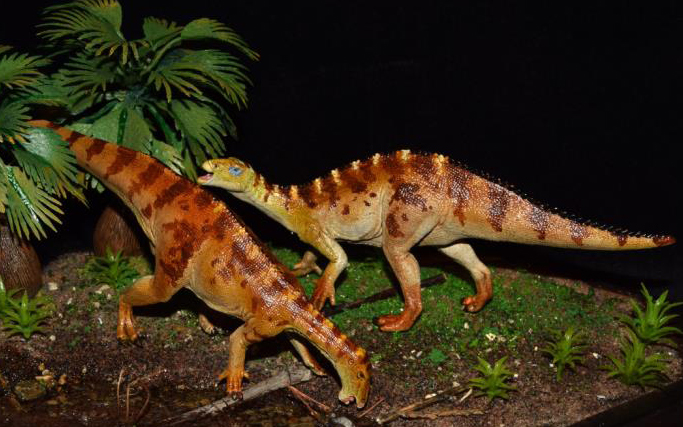
A Pair of Customised Ornithopods

Customised dinosaur models.
Ornithopod pair (CollectA Fukuisaurus and CollectA Mantellisaurus).  A pair of stunning customised figures on a small pond diorama.

Picture credit: Elizabeth

Our thanks once again to Elizabeth for sharing her superb photographs with Everything Dinosaur.

The Everything Dinosaur website: Everything Dinosaur.
Go to Top