Bring Back the Original Papo Green Standing T. rex?
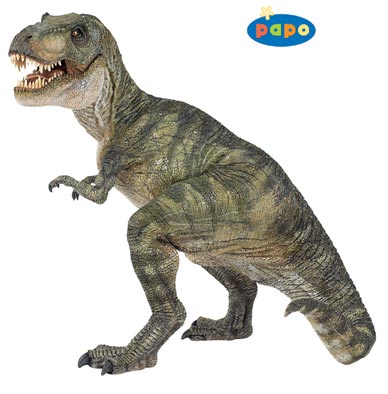
In one of our recent discussions with the management team at Papo, Everything Dinosaur team members were asked to provide feedback on the introduction for 2019 of the Papo brown running T. rex dinosaur model. Tyrannosaurs have been a staple of the Papo range ever since their first Tyrannosaurus rex, the famous green standing T. rex figure was introduced. Sales of the brown running Tyrannosaurus rex continue to be strong, but this got us thinking, what if Papo was to produce a limited production run of their original T. rex model?
The Iconic Papo Standing T. rex Dinosaur Model
The last of its kind, the Papo green standing T. rex dinosaur model.
The Papo Green T. rex is Officially Retired
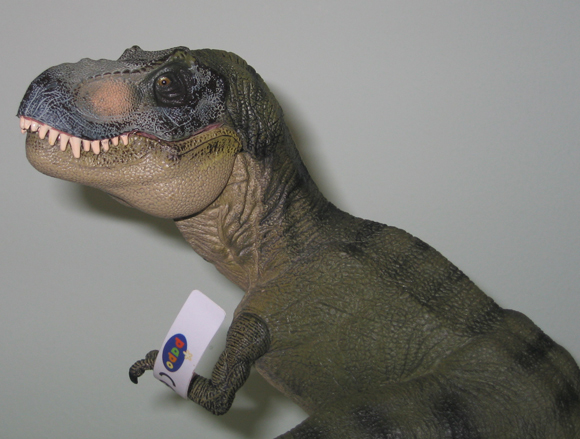
The original Papo T. rex was officially retired after the 2011 production run, however, Everything Dinosaur was able to use its influence to acquire the very last stocks of this dinosaur replica, but these very soon sold out. With its articulated lower jaw and peg-like, blunt teeth, this award winning dinosaur model had been very popular with young dinosaur fans and model collectors. It was replaced by the brown colour variant with a new head sculpt in May 2012, but Everything Dinosaur still receives periodic requests from model fans eager to get hold of this dinosaur figure.
Since then, the Papo range of prehistoric animal replicas has expanded considerably, but as the Papo imagery associated with their first “tyrant lizard king” seems to be out of copyright, young dinosaur fans have been increasingly exposed to images of this figure, but unable to obtain it.
At the time the original green standing T. rex figure from Papo was retired, a spokesperson from Everything Dinosaur commented:
“The Papo model T. rex with the product code 55001, has been replaced with a new, brown coloured version, but we have been inundated with requests to see if we could get hold of any models. It is pleasing to note that our influence and relationship with Papo is strong and we have been able to secure the remaining stock.”
The question is whether with the introduction of a brown running T. rex figure, should Papo bring back the original green standing T. rex?
The Papo Green Standing T. rexDinosaur Model – Long Extinct but Should it Come Back?
The Papo green standing T. rex dinosaur model. Should we start a campaign to re-introduce this long extinct figure?Picture credit: Everything Dinosaur.
Picture credit: Everything Dinosaur
Should Papo bring back for a limited time their original green standing Tyrannosaurus rex?
The CollectA Rearing Diplodocus – Niche Partitioning
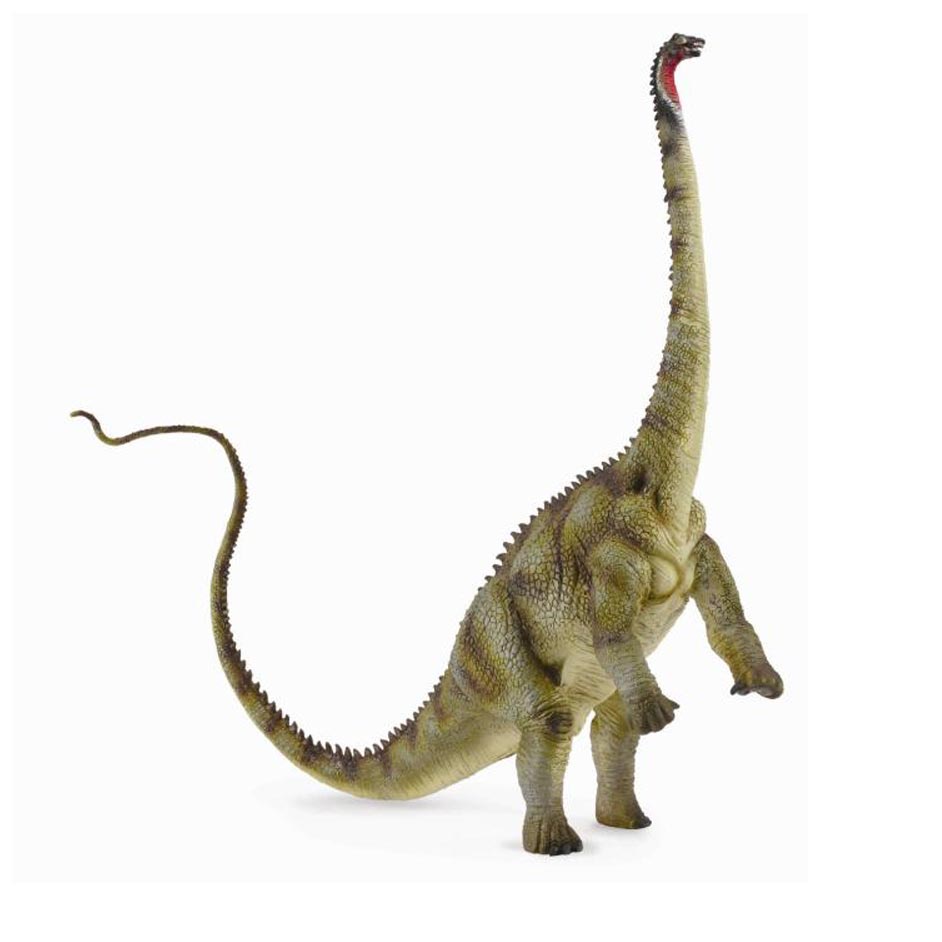
A beautifully sculpted and skilfully painted CollectA rearing Diplodocus dinosaur model helps us to demonstrate a concept called niche partitioning. The term niche partitioning is used by ecologists to explain how organisms use the resources in an environment differently to avoid competition and therefore, by doing this, they can all co-exist. Diplodocus is known to have co-existed with several other long-necked dinosaurs in the Late Jurassic, but they were able to share the same environment as they very probably fed on different types of vegetation. They were probably not directly competing with each other for resources.
The CollectA rearing Diplodocus can be posed in a rearing position, as if it is reaching high into the upper canopy of a forest in order to reach the leaves and branches at the very top of the trees that other dinosaurs could not reach. We created a short video (45 seconds), that demonstrates how the CollectA Diplodocus can be balanced to demonstrate niche partitioning.
The CollectA Diplodocus Demonstrates Niche Partitioning in the Sauropoda
Video credit: Everything Dinosaur
Providing a Challenge to Schoolchildren During a Dinosaur Workshop
When Everything Dinosaur team members visit schools, we explain this concept using dinosaurs as an example and then challenge the class to think of examples of niche partitioning within modern ecosystems. This helps reinforce understanding about food chains/food webs and how ecosystems are constructed. It also helps to demonstrate an important principle in palaeontology, the idea that we use comparisons from living creatures and environments today to help us understand life in the ancient past.
A rearing sauropod. As well as reaching food, the ability to rear could have had a secondary function as a defensive response to an attack from a predator.
Picture credit: M. V. Eashwar
Niche Partitioning
Many types of extant herbivorous animal, normally quadrupedal, are able to rear up onto their hind legs in order to reach food that otherwise they would not be able to access. As an extension to this exercise in schools, we ask the pupils to construct food webs to reflect how the chosen ecosystem functions.
Our team members have posted up numerous articles exploring this topic area on this blog.
CollectA have included several sauropod figures within their “Prehistoric Life” model range. The CollectA rearing Diplodocus model is one of the larger figures within this not-to-scale range, with a rearing height of approximately 23 centimetres.
New Study Suggests Tyrannosaurids More Manoeuvrable than Other Large Theropods
Researchers at the University of Wisconsin-La Crosse and the Oklahoma State University Centre for Health Sciences have applied mathematical models to assess the manoeuvrability of predatory dinosaurs. This research, published in the on-line journal PeerJ, involving numerous collaborators, suggests that large bodied tyrannosaurs were more agile and able to turn more sharply than other similar sized theropods such as allosaurs and carcharodontosaurids.
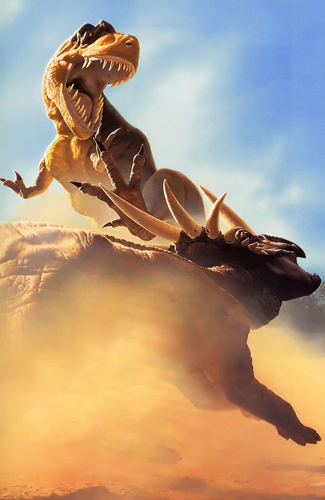
A Large Tyrannosaur Attacks a Styracosaurus
Tyrannosaur fighting a horned dinosaur. A new study suggests that large bodied tyrannosaurs may have been surprisingly agile.
Picture credit: John Gurche
A Factor in the Evolutionary Success of Tyrannosaurs
The research involving complex mathematics, a study of animal anatomy and physics compared how rapidly meat-eating dinosaurs could turn their bodies. In summary, the scientists concluded that tyrannosaurs could attack smaller, faster and more dangerous prey. It is suggested that the greater manoeuvrability of these carnivores may have been a factor in their evolutionary success.
Associate Professor at the University of Wisconsin-La Crosse, Eric Snively, in collaboration with co-author Haley O’Brien (Oklahoma State University Centre for Health Sciences) along with several other leading palaeontologists such as Professor Phil Currie (University of Alberta), demonstrated that whether a tyrannosaur was dog-sized or a fully-grown, mature adult, it retained its agility and manoeuvrability.
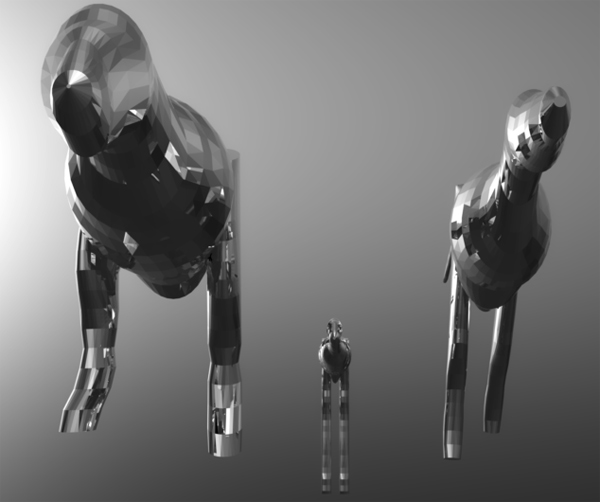
Three-dimensional Computer Models Used to Test Tyrannosaurid Manoeuvrability
Computer models were created to examine the agility of tyrannosaurids.
Picture credit: University of Wisconsin-La Crosse
Enhanced Agility Compared to Other Super-sized Theropods
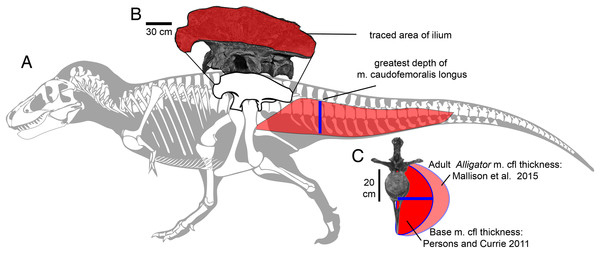
Tyrannosaurs were assessed to be more agile as they had relatively short bodies (anteroposteriorly short thoracic regions, and cervical vertebrae that aligned into posterodorsally retracted necks). In summary, shorter bodies meant less turning resistance and even their tiny arms helped! In addition, long, tall ilia bones (part of the hip), provided plenty of room for huge leg muscle attachments that gave the power needed for rapid turns and pivots.
The Size of the Ilia (Hip Bones) was Used to Infer Muscle Size Along with Postulated Tail Depth
Mapping muscle groups to assess the agility of tyrannosaurids. Tyrannosaur musculature was compared to that of an extant alligator.
Picture credit: PeerJ
In terms of the fastest results from the Tyrannosaur family, a horse-sized juvenile T. rex turned the quickest for its size, followed by the giant T. rex “Sue”, the enormous, mature adult from the Field Museum (Chicago).
Eric Snively described the T. rex turn as something akin to a “slow-motion-ten-tonne figure skater from hell,” quite apt in a way as T. rex fossils are known from the Hell Creek Formation.
Biomechanical Model Has Implications for Large Theropod Hunting Strategies
The researchers used very accurate anatomical assessments and rigorous statistics to create three-dimensional models that could then be tested for their range of movements. Different theropods were examined including Dilophosaurus, Ceratosaurus, Giganotosaurus, Sinraptor as well as numerous tyrannosaurs at different growth stages as well as smaller members of the Tyrannosauroidea Superfamily such as Raptorex. With respect to other theropods, tyrannosaurids were found to be increasingly agile without compromising their large body mass, such that in a pairwise comparison, tyrannosaurids were achieving the same agility performance as much smaller theropods. For example, a 500 kg Gorgosaurus had slightly greater agility scores than the 200 kg Eustreptospondylus, and an adult Tarbosaurus nearly twice the agility scores of the lighter Sinraptor.
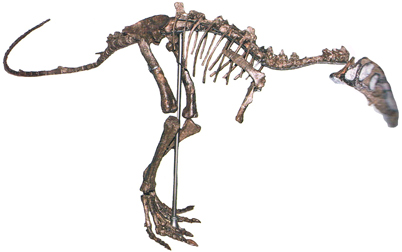
The Oxford University Specimen of Eustreptospondylus Used in the Study
The fossil specimen on display (E. oxoniensis).
Picture credit: Siri Scientific Press
Pursuing and Subduing Prey (Tyrannosaurs)
Enhanced agility and tight manoeuvrability in tyrannosaurids suggest that T. rex et al had superior abilities when it came to pursuing and subduing prey. This new research may have important implications when it comes to examining how large theropods hunted.
If tyrannosaurids were more agile and able to manoeuvre faster than other large predators they may have been more adept than earlier, super-sized, apex predators when it came to catching agile prey. It is postulated that this capability of tyrannosaurids is consistent with coprolite evidence that indicates that tyrannosaurids fed on juvenile ornithischians. Furthermore, it is proposed that healed tyrannosaur bite marks on fossilised remains of adult horned dinosaurs and hadrosaurs indicate an ability to outmanoeuvre quadrupedal prey.
A spokesperson from Everything Dinosaur commented:
“Whilst this is a fascinating piece of research, it is important that we don’t entirely discount observations of modern-day predator/prey interactions. Often an apex predator will select a weakened, or sick animal within a herd to attack. In addition, young animals are particularly vulnerable as they are smaller and less experienced in avoiding predators compared to adult animals.”
The largest non-tyrannosaurids, including Giganotosaurus, often lived in habitats alongside sauropod dinosaurs. These associations may suggest that allosauroids may have preferred less agile prey than did tyrannosaurids. It is also possible that stability conferred by high rotational inertia, as when holding onto giant prey, was more important for allosauroids than turning quickly.
The researchers intend to undertake research to assess the manoeuvrability of ceratopsids and other prey such as duck-billed dinosaurs before applying the same techniques to examine tyrannosaur bite forces.
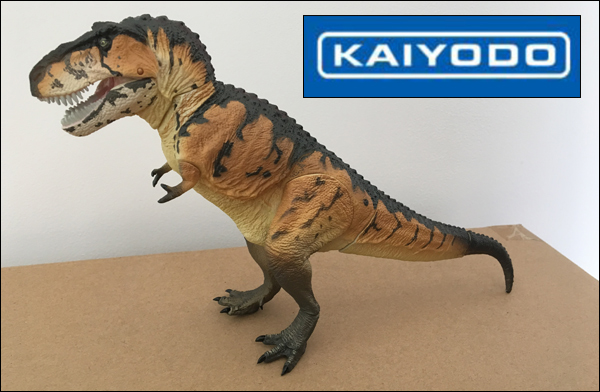
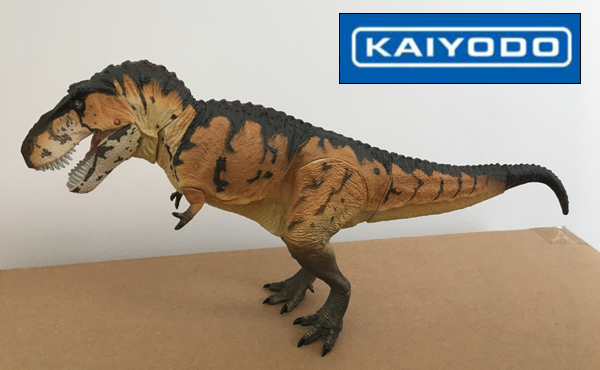
Designing dinosaur and prehistoric animal models is a tricky business. With the advent of three-dimensional printing technology and modelling software, things have got a little easier but there is still all the work involved in creating prototypes, mould building and so on. Today, we feature the Kaiyodo Sofubi Toy Box T. rex figure, a dinosaur model that was developed to demonstrate how scientific thinking regarding the stance of theropod dinosaurs such as Tyrannosaurus rex has changed over the last hundred years or so.
The Japanese model maker Kaiyodo has employed state-of-the-art modelling techniques to produce fantastic, highly collectable dinosaur models and figures. The design team excelled themselves when developing a collectable figure with ten points of articulation. Many models have an articulated lower jaw, but for the design team at Kaiyodo, doing the ordinary was out of the question, in their limited edition T. rex Toy Box figures, they opted for an articulated upper jaw instead.
Demonstrating the Articulated Upper Jaw on the Kaiyodo Sofubi Toy Box T. rex Figure
Video credit: Everything Dinosaur
Articulated Dinosaur Models
There has been a trend in recent years for dinosaur models to have articulated jaws and front limbs. One of the benefits of an articulated jaw for example, is this feature does permit collectors to be able to close the mouth of their figure. Many theropod dinosaur models tend to depict these animals with their mouth open, not a natural pose at all.
Most tetrapods don’t walk round all day with the jaws wide open. It is the lower jaw that is articulated in the vast majority of these figures. However, in order to demonstrate their engineering credentials, the design team at Kaiyodo gave their Sofubi Toy Box T. rex an articulated upper jaw (premaxilla and maxilla), as demonstrated in this short forty-five second video.
The Kaiyodo Sofubi Toy Box T. rex in “Kangaroo” Pose
Kaiyodo Sofubi Toy Box T. rex in a “kangaroo” pose. Picture credit: Everything Dinosaur.
Picture credit: Everything Dinosaur
From Kangaroo to a Balanced See-saw
When first scientifically described, Tyrannosaurus rex was illustrated as a biped whose tail dragged on the ground. The articulated tail of the Sofubi Toy Box T. rex permits the model to displayed in this position, a pose described as a “kangaroo pose” or sometimes a “kangaroo stance”. However, the ingenious engineering allows this figure to be displayed in what is thought to be a more anatomically accurate pose, with the centre of balance over the hips and the tail lifted off the ground – a sort of pose described as a “balanced see-saw”.
The Kaiyodo Sofubi T. rex Model in a “Balanced See-saw” Stance
The Kaiyodo Sofubi Toy Box articulated T. rex figure with the tail lifted off the ground.Picture credit: Everything Dinosaur.
Picture credit: Everything Dinosaur
When it comes to the engineering behind the design of dinosaur models, you have to hand it to Kaiyodo…
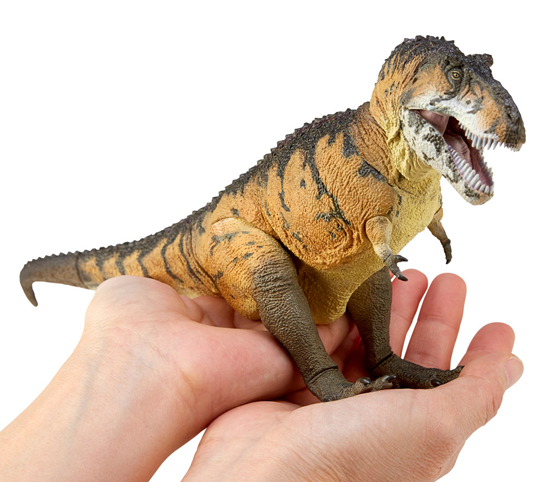
A Handy Dinosaur Model
Kaiyodo Sofubi Toy Box T. rex dinosaur figure (T. rex A).
The Kaiyodo Sofubi Toy Box T. rex figure is suitable for collectors from fifteen years and above and it can be found here: Kaiyodo Prehistoric Animal Models.
Feathered or Scaly Theropod Dinosaur Models? The Results are In
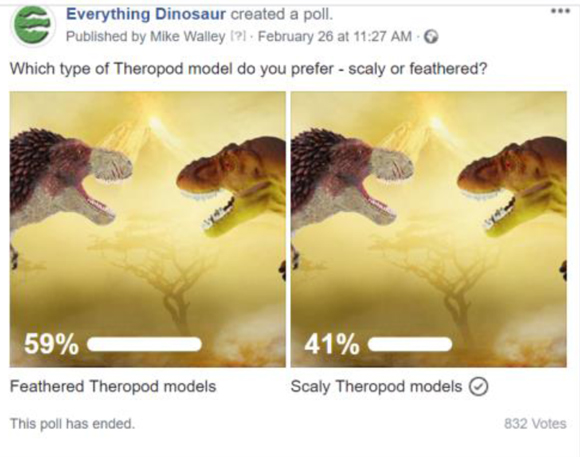
Recently, Everything Dinosaur team members set up a poll on the company’s Facebook site asking dinosaur fans and model enthusiasts which they preferred, feathered theropod dinosaur models or models of theropods with scaly skins?
The results are in and in this particular survey it is the feathered theropod dinosaur models that have come out on top. It’s a feather in the cap for feathered theropod model designers.
Which Type of Theropod Model do you Prefer – Feathered or Scaly?
In Everything Dinosaur’s survey of dinosaur model preferences with collectors it was the feathered theropods that triumphed. In this poll, 59% of respondents opted for the feathered dinosaur model option.
Picture credit: Everything Dinosaur
Theropod Models Reflecting Current Scientific Thinking
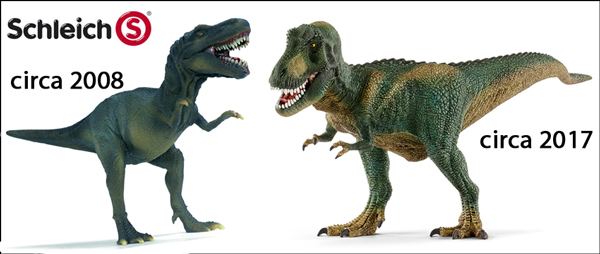
Step back ten years and virtually all the models of fearsome, carnivorous dinosaurs such as Allosaurus, Acrocanthosaurus and Tyrannosaurus rex were entirely devoid of a feathery integument. Many mainstream manufacturers still prefer to produce non-feathered figures, an example being Schleich of Germany.
Schleich Have Yet to Produce a Feathered T. rex Dinosaur Model
Comparing Schleich Tyrannosaurus rex dinosaur models through time. Picture credit: Everything Dinosaur.
Picture credit: Everything Dinosaur
Other model manufacturers have chosen to reflect current scientific thinking and produce feathered theropod replicas, including fuzzy T. rex dinosaur models. Schleich has moved towards introducing feathered theropods, a number of dromaeosaurids have been introduced into their range over the last few years with varying degrees of feathery integumentary covering.
A model of the Late Triassic, fast-running predator Tawa (T. hallae), which was introduced by Schleich in 2018, has a feathery crest on its head and a “tuft” of feathers on its tail. The Schleich Psittacosaurus, a model of an ornithischian dinosaur, which was also introduced by Schleich last year, had feathers, reflecting the current scientific thinking. In addition, the Oviraptor and the Therizinosaurus, both examples of theropod dinosaurs have feathers, perhaps it is just a matter of time before Schleich introduces a feathered Tyrannosaurus rex.
Schleich Prehistoric Animal Model Releases in 2018 – A Trend Towards More Feathers?
New Schleich prehistoric animal models (2018). The new Schleich models introduced last year showed examples of feathery integumentary coverings. Picture credit: Everything Dinosaur.
In the Everything Dinosaur poll, 59% of respondents voted in favour of feathered theropod dinosaur models, whilst 41% stated that they preferred scaly theropod figures. A big thank you to all those who participated. We appreciate all the comments that were posted up and the “shares” of our Facebook post too.
The Everything Dinosaur Facebook page provides status updates, photos, links to news stories and blog posts as well as lots of prehistoric animal model features.
Our thanks to dinosaur model fan and collector Caroline who sent us some beautiful photographs of her recently purchased Beasts of the Mesozoic Atrociraptor marshalli figure. The taxonomic position of Atrociraptor within the Dromaeosauridae remains contentious, however, with a short, powerful jaw and oversized teeth this predator lives up to its scientific name meaning, that of “cruel or savage thief”.
Everything Dinosaur were sent some Photographs of the Atrociraptor Figure Outdoors
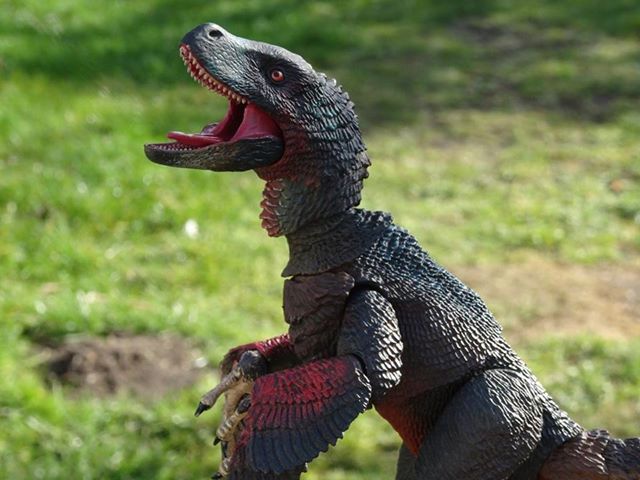
The Beasts of the Mesozoic Atrociraptor marshalli dinosaur model. A beautifully composed photograph.
Picture credit: Caroline
The outdoor location really brings out the colouration of the model, the exquisite way in which the bright red elements of the plumage have been blended in with the muted tones of brown and black. The sun lit model highlights the texture and the individual feathers on the torso and the top of hips can be clearly seen in this well-composed photograph.
Atrociraptor marshalli
Named and described in 2004, some eighty years after the far better known Velociraptor (V. mongoliensis) was described, this dinosaur is estimated to have reached a length of approximately two metres and weighed around fifteen kilogrammes. The fossil material associated with this genus comes from the famous Horseshoe Canyon Formation of southern Alberta, however, a single jaw fragment and some isolated teeth from the Two Medicine Formation of Montana may also represent Atrociraptor.
Everything Dinosaur’s Scale Drawing of Atrociraptor marshalli
A scale drawing of the dromaeosaurid Atrociraptor marshalli.Picture credit: Everything Dinosaur.
Picture credit: Everything Dinosaur
Fast Delivery of a Fast Member of the Dromaeosauridae
When sending her pictures to Everything Dinosaur Caroline commented:
“The order arrived not long ago. Thank you for the fast delivery. Please use the photos of the Beasts of the Mesozoic Atrociraptor marshalli if you wish.”
We are happy to post up Caroline’s excellent photographs, pictures of a fast running dinosaur, that was delivered quite fast as well.
The Beasts of the Mesozoic Atrociraptor marshalli Dinosaur Figure
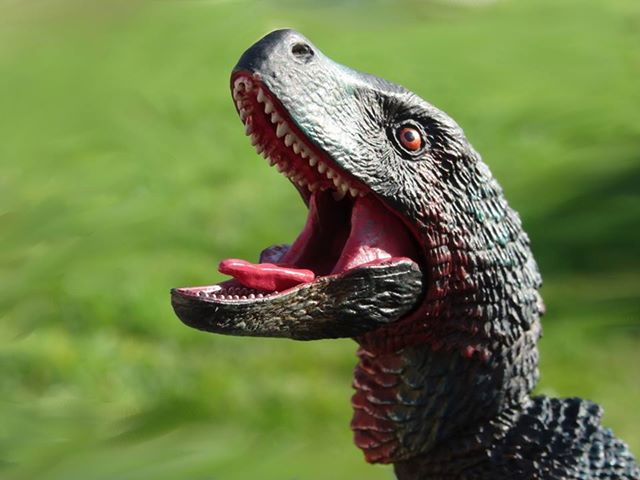
A close-up view of the distinctive short snout and the oversized teeth of the beautifully crafted Beasts of the Mesozoic Atrociraptor marshalli figure.
Picture credit: Caroline
The photograph (above), shows a close-up view of the head of the Beasts of the Mesozoic model. The characteristic short, robust snout and the oversized teeth that helped to define this genus can clearly be seen in this beautifully composed picture.
A spokesperson for Everything Dinosaur praised the images saying:
“We are always pleased to receive photographs of purchases from customers. The Atrociraptor model looks fantastic in these outdoor shots.”
To view the Beasts of the Mesozoic Atrociraptor marshalli and the rest of the Beasts of the Mesozoic articulated “raptor” models available from Everything Dinosaur: Beasts of the Mesozoic Models.
As it is March 1st, team members at Everything Dinosaur, thought it appropriate that on St David’s Day, the patron saint of Wales, it might be a good idea to post up a picture of one of the welsh dinosaurs such as Pantydraco (P. caducus) or the recently described Dracoraptor (D. hanigani), but in the end we decided to post up a picture of a very tiny pterosaur instead.
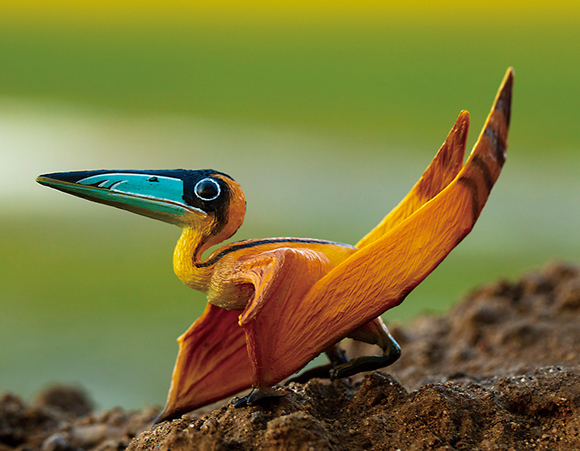
As we prepare for the arrival of the new for 2019 PNSO models, we have been busy researching and writing fact sheets to accompany sales of these figures. One of these new PNSO models is a replica of Nemicolopterus, which if it is a valid genus, represents the smallest member of the Pterosauria described to date.
Everything Dinosaur’s Scale Drawing of the Tiny Chinese Pterosaur Nemicolopterus crypticus
A scale drawing of the tiny pterosaur named Nemicolopterus. Picture credit: Everything Dinosaur.
Picture credit: Everything Dinosaur
A Tiny Chinese Pterosaur
With a wingspan not much bigger than a garden robin (Erithacus rubecula), Nemicolopterus probably weighed less than 100 grams. Assigned to the Tapejaridae family, this little flying reptile, known from a single fossil specimen, has attracted quite a lot of controversy since it was named and described in 2008.
The unfused bones and body proportions are very typical of a juvenile pterosaur. It has been suggested that the fossil specimen might not represent a tiny species, but the juvenile stage of a much larger pterosaur. For example, a number of academics have compared the Nemicolopterus fossil to juvenile specimens of the tapejarid Sinopterus, which is also known from China.
The New for 2019 PNSO Age of Dinosaurs Nemicolopterus Model
The PNSO Nemicolopterus (or whatever genus the figure should represent), is coming into stock at Everything Dinosaur in the next few weeks.
Dragons and Dinosaurs
It has been suggested that Nemicolopterus may not be a valid genus. It has been proposed that the fossil material should be re-assigned to the genus Sinopterus. Whatever the outcome, on March 1st, in honour of a Welsh national symbol and with a nod towards the orient and the legends of dragons from the Far East, we thought it appropriate to post up some images of a tiny flying reptile.
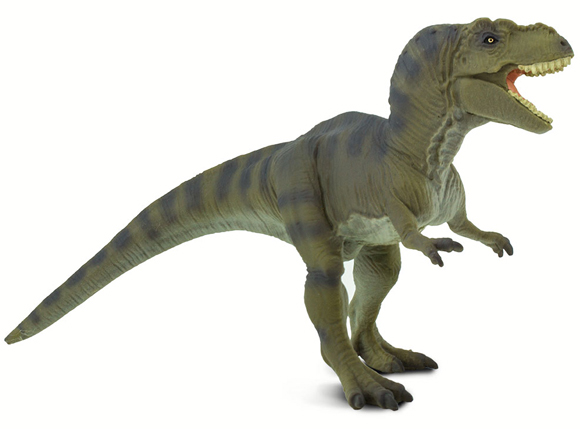
The Wild Safari Prehistoric World T. rex Dinosaur Model (2019)
Tyrannosaurus rex may have been formally named and described more than 100 years ago, but this iconic dinosaur has certainly not lost any of its appeal since Henry Fairfield Osborn’s scientific paper (1905). The “tyrant lizard king” remains as popular as ever with casts of skeletons adorning many natural history museums and no dinosaur movie seems complete without an appearance or two of a T. rex.
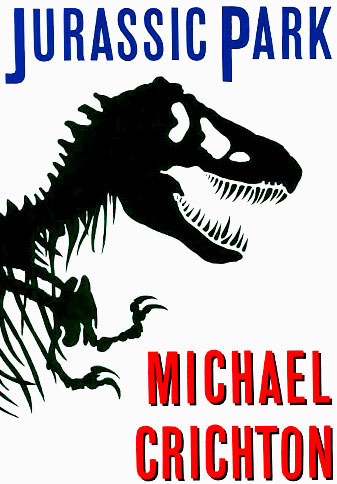
Tyrannosaurus rex on the Front Cover of the First Edition of the Novel “Jurassic Park”
The first edition of Jurassic Park, featured on the front cover a silhouette of a T. rex skeleton, albeit with a few anatomical discrepancies.
The Enduring Popularity of Tyrannosaurus rex
For dinosaur fans and prehistoric animal model collectors, there are a plethora of T. rex figures to collect and most manufacturers carry at least one replica of this, perhaps the most famous of all the dinosaurs, within their ranges. Today, we take a look at just one recently introduced figure, that of the 2019 Wild Safari Prehistoric World T. rex made by Safari Ltd.
The Wild Safari Prehistoric World T. rex Dinosaur Model (2019)
The Wild Safari Prehistoric World T. rex dinosaur model.
Wild Safari Prehistoric World T. rex Dinosaur Model
A lot of print space has been devoted to trying to explain this carnivores’ enduring popularity. In the 2019 Safari Ltd catalogue there are no less than five Tyrannosaurus rex models within the Wild Safari Prehistoric World range and that does not include the baby dinosaurs in eggs. The most recent figure was introduced a few weeks ago (see picture above), this has led to some speculation that a number of the older figures in this range will be withdrawn.
Measuring around seventeen centimetres in length and with that powerful head standing some eleven centimetres off the ground, this is not the largest T. rex figure available, but as with all the models in the Safari Ltd portfolio, it is well painted and has lots of fine detail. The figure has already attracted a 5-star review on the Everything Dinosaur website.
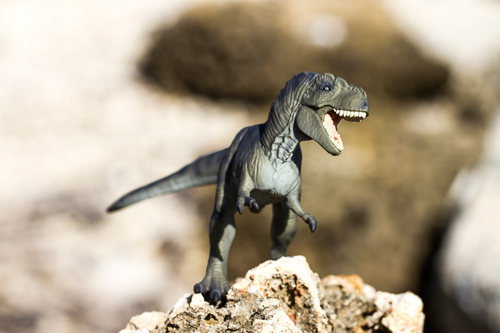
Safari Ltd have taken some beautiful photographs highlighting the exquisite details on their prehistoric animal models. We intend to post these pictures up onto our social media platforms as they permit model collectors the opportunity to see more than just the standard figure studio shots. Perhaps the photographs will inspire collectors to take their own pictures showcasing their very own “Jurassic Park”
An Outward Bound Tyrannosaurus rex
The new for 2019 Wild Safari Prehistoric World Tyrannosaurus rex figure.
To view the range of Wild Safari Prehistoric World figures available from Everything Dinosaur including the new for 2019 Tyrannosaurus rex: Wild Safari Prehistoric World,
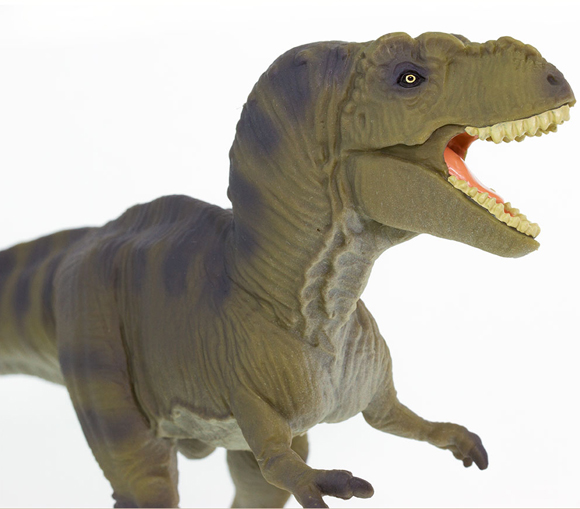
Admiring the Details – The Skin Folds and a Beautifully Painted Eye
A closer look at the new for 2019 Tyrannosaurus rex figure.
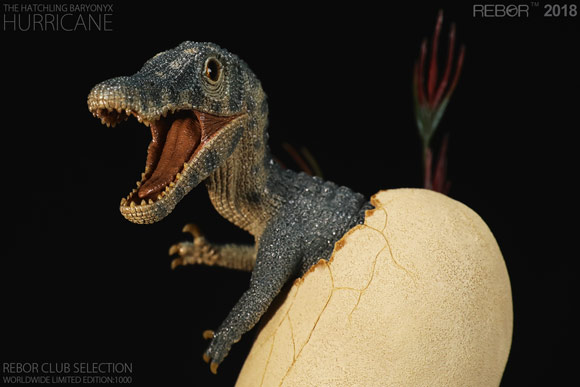
Our thanks to Caroline for sending into Everything Dinosaur, a beautiful, hand-drawn dinosaur themed card. Caroline had wanted to purchase one of the limited edition, Rebor hatching Baryonyx figures, but she was unable to make the purchase when these figures first came into stock. We received her request to reserve a Rebor “Hurricane”, one of just 1,000 replicas made. Our team members were happy to set a Baryonyx aside and a few weeks later Caroline was able to make her purchase.
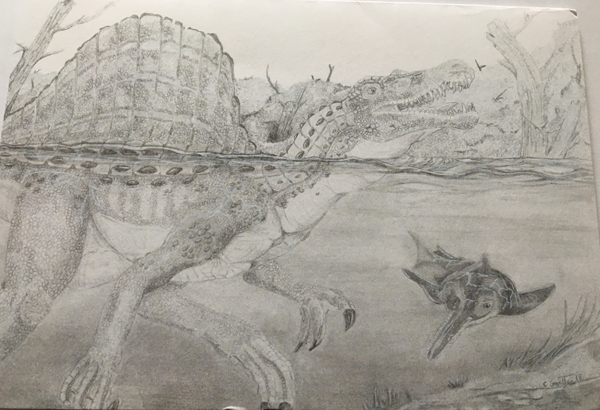
A Spinosaurus Illustration
As a thank you, we received this splendid illustration of a swimming Spinosaurus. The Onchopristis (an extinct sawfish), swimming close by had better watch out! Spinosaurus is believed to have been a piscivore.
Spinosaurus Going for a Swim
Spinosaurus going for a swim.
Picture credit: Caroline Smalley
Thank you for Reserving a Baryonyx
Caroline included a message with her card. She thanked us for holding onto the Rebor Hatching Baryonyx “Hurricane” figure and congratulated us on our customer service.
A spokesperson from Everything Dinosaur commented:
“It is always a pleasure to receive illustrations such as the swimming Spinosaurus from our customers. There are so many incredibly talented people out there and to be able to reconstruct a long extinct animal and place it within an environmental context is a real skill. We even noted the small theropod dinosaur illustrated on the inside of the card. We are happy to know that the limited edition Rebor Hatching Baryonyx figure has found a good home.”
Even the Rebor Hatching Baryonyx “Hurricane” Looks Impressed!
The limited edition hatching Baryonyx figure “Hurricane” by Rebor. Even the Rebor figure looks awestruck at seeing the Spinosaurus illustration, after all, these two theropods belong to the same family (Spinosauridae), although Baryonyx (B. walkeri) lived tens of millions of years earlier than Spinosaurus.
To view the range of Rebor prehistoric animal figures in stock at Everything Dinosaur: Rebor Models and Figures.
Our thanks once again to Caroline for sending in her wonderful dinosaur themed thank you card.
Researchers have discovered a new species of ancient marsupial that lived deep in the Arctic Circle approximately 69 million years ago (lower Maastrichtian faunal stage). The new mammal has been named Unnuakomys hutchisoni, not much bigger than a house mouse (Mus musculus), it is likely that this little creature was nocturnal and may have retreated to burrows to protect itself from periods of extreme cold. Known from more than sixty fossil specimens, the vast majority being tiny teeth but two dentaries (lower jaw bones ) were found along with a fragment of upper jaw (maxilla), this little mammal helps to flesh out the rich, diverse and unique Late Cretaceous biota of Alaska.
Little Mammals Such as the Marsupial Unnuakomys hutchisoni Lived in the Shadow of Dinosaurs
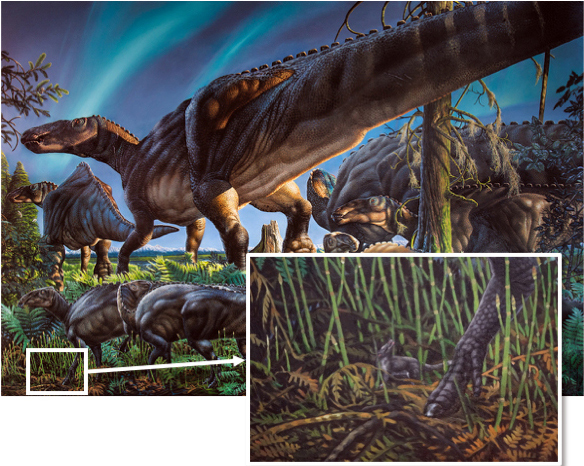
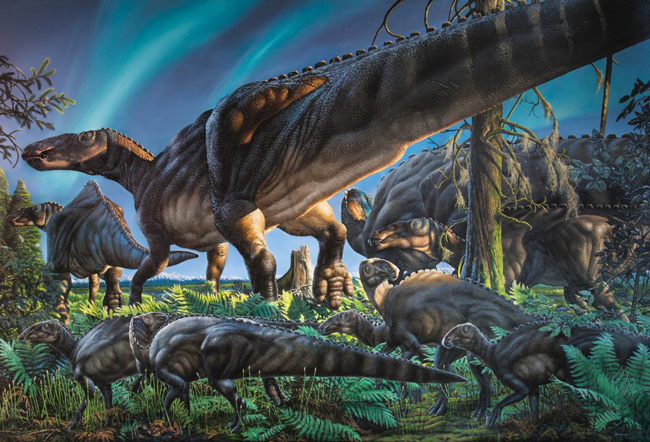
Hadrosaurs (Ugrunaaluk kuukpikensis) under the northern lights in the Late Cretaceous of Alaska – inset shows tiny mammal. See note at the bottom of this article.
Picture credit: James Havens
Fossils from the Pediomys Point Locality
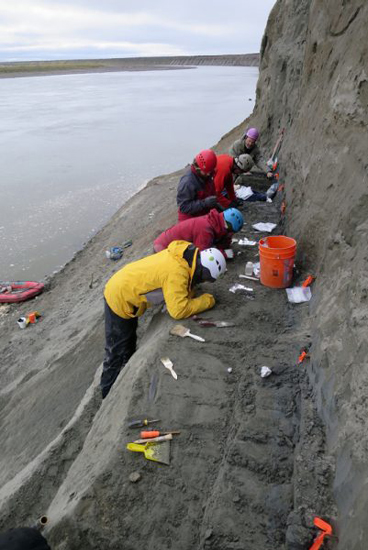
For several years now, researchers have been exploring the Upper Cretaceous strata that is exposed along the steep banks of the Colville River. The researchers, which include lead author of the paper on Unnuakomys hutchisoni, Jaelyn Eberle (University of Colorado) and her collaborator Patrick Druckenmiller (University of Fairbanks Alaska), have uncovered evidence of a unique assemblage of dinosaurs and the discovery of this little marsupial represents the most northern of this type of mammal known to science. The climate during the Late Cretaceous in this part of the world was not as severe as it is today, but the animals living this far north would have had to endure around four months of complete darkness each year and the temperatures would frequently drop below freezing. The fossil material representing U. hutchisoni was collected during the sieving of sediments from the Pediomys Point Locality of the Prince Creek Formation exposed along the Colville River on the North Slope of Alaska.
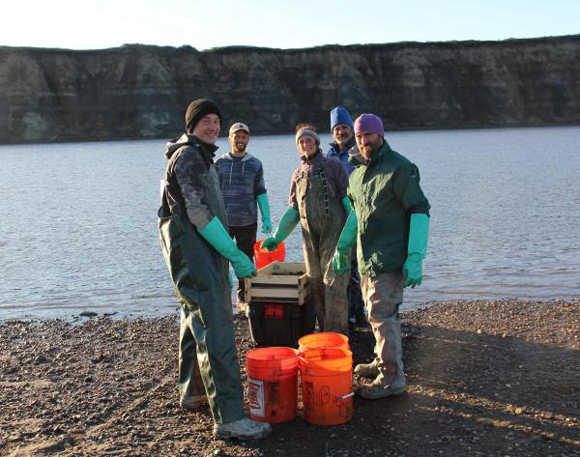
Field Team Members Pose Next to Buckets of Sediment Ready for Sieving
Field team members pose for a photograph next to buckets of sediment that they will sift through to search for tiny mammalian teeth.
Picture credit: Jaelyn Eberle
A Diverse Faunal Assemblage
This part of Alaska was some 80 degrees north around 69 million years ago. It was once thought that these high latitudes were virtually devoid of life, but that view has gradually changed as more fossil discoveries have been made. Teeth of U. hutchisoni greatly outnumber those recovered from other mammals at Pediomys Point, this could be down to sampling, or it could have arisen due to a preservation bias, perhaps the remains of this tiny mammal were more likely to be preserved than other mammal bones and teeth, although this is unlikely. The abundance of Unnuakomys fossils in relation to other mammals could indicate that this tiny animal thrived in an environment well above the Arctic Circle whose climatic extremes may have acted as a biogeographical barrier preventing the encroachment of other types of Late Cretaceous mammal.
Field Team Members Working on a Steeply Sloping Riverbank
Looking for fossils on a steep riverbank.
Picture credit: Patrick Druckenmiller
Patrick Druckenmiller stated:
“Northern Alaska was not only inhabited by a wide variety of dinosaurs, but in fact we’re finding there were also new species of mammals that helped to fill out the ecology. With every new species, we paint a new picture of this ancient polar landscape.”
“Night Mouse”
In a reflection of the likely ecology of this miniature marsupial, that of an animal well-adapted to living in the dark, Eberle and her colleagues gave the new mammal the genus name Unnuakomys, a mixture of Greek and the indigenous Iñupiaq language that means “night mouse.” The trivial name honours the palaeontologist J. Howard Hutchison, who was the first person to identify and explore this fossil assemblage.
The research team, whose project was funded with a National Science Foundation grant, identified the new marsupial using a painstaking process. With the help of numerous graduate and undergraduate students, they collected, washed and screened ancient river sediment collected on the North Slope and then carefully inspected it under a microscope. Over many years, they were able to locate numerous fossilised teeth, most of which were no bigger than a grain of sand.
Co-author of the paper, Gregory Erickson (Florida State University), explained:
“I liken it to searching for proverbial needles in haystacks, more rocks than fossils.”
Unnuakomys hutchisoni – Find the Teeth and Identify the Mammal
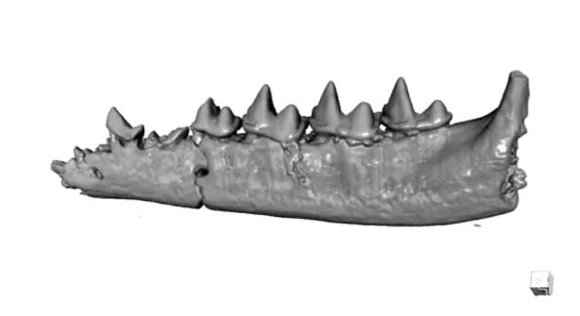
By far the most durable part of most mammal skeletons are the teeth, thanks to their coating of hard enamel. It is the shape of the teeth and their wear pattern, particularly the shape of the molars that allow palaeontologists to identify the type of mammal they have found simply by examining the teeth. Mammalian teeth have unique cusps on the crown that differ from species to species and they, as a result, are highly diagnostic. The triangular cusps on the teeth of U. hutchisoni are reminiscent of the triangular blades associated with pinking shears and are typical of an insectivore.
A Computer Generated Image Showing the Lower Jaw (Dentary) of Unnuakomys hutchisoni
Unnuakomys hutchisoni lower jaw bone with teeth.
Picture credit: University of Colorado Boulder
Other co-authors of the Journal of Systematic Palaeontology paper include William Clemens (University of California), Paul McCarthy (University of Alaska Fairbanks) and Anthony Fiorillo of the Perot Museum of Nature and Science.
Recycling a Scientific Illustration
In 2015, Everything Dinosaur reported upon the discovery of a unique species of Alaskan hadrosaur (Ugrunaaluk kuukpikensis), James Havens produced an exquisite piece of art showing a herd of these duck-billed dinosaurs moving through the Late Cretaceous, Alaskan landscape. To illustrate the likely position of U. hutchisoni in this ecosystem, the original artwork was carefully photoshopped to permit the inclusion of the little mammal (see inset above). As our understanding of the fauna and flora of Late Cretaceous Alaska evolves, the artwork may have to be altered again, in the meantime, we have an excuse to show the original illustration once more.
The Original Ugrunaaluk kuukpikensis Life Reconstruction (2015)
The original Ugrunaaluk illustration without the inclusion of a little marsupial.
The scientific paper: “Northernmost record of the Metatheria: A New Late Cretaceous Pediomyid from the North Slope of Alaska” by Jaelyn J. Eberle, William A. Clemens, Paul J. McCarthy, Anthony R. Fiorillo, Gregory M. Erickson and Patrick S. Druckenmiller published in the Journal of Systematic Palaeontology
Everything Dinosaur acknowledges the assistance of a press release from the University of Alaska Fairbanks in the compilation of this article.