All about dinosaurs, fossils and prehistoric animals by Everything Dinosaur team members.

Dinosaur and prehistoric animal themed articles, features and stories.

22 03, 2019

Exclusive Review by JurassicCollectables of the Kaiyodo Sofubi “Classic” T. rex

By |2023-11-30T07:36:59+00:00March 22nd, 2019|Categories: Dinosaur Fans, Everything Dinosaur Products, Everything Dinosaur videos, Main Page, Photos of Everything Dinosaur Products, Product Reviews|0 Comments

JurassicCollectables Reviews the Kaiyodo Sofubi Toy Box T. rex “Classic Colouration”

A few days ago, JurassicCollectables posted up onto their excellent YouTube channel an unboxing video featuring a trio of tyrannosaur models that we, at Everything Dinosaur had sent them.  The narrator could hardly contain his excitement as he opened the box and unwrapped the three colour variants of the Kaiyodo Sofubi Toy Box T. rex.  In that short, unboxing video we were promised that each model would be reviewed at length in the near future.  True to their word JurassicCollectables have posted up a video review of the Kaiyodo Sofubi Toy Box Tyrannosaurus rex “classic colouration”.

A Video Review of the Limited Edition “Classic” Kaiyodo T. rex Articulated Figure

Video credit: JurassicCollectables

Inspired by the Artwork of Zdeněk Burian

In this video review (it lasts for a little over twelve minutes), the narrator discusses the packaging (this model comes in a special edition box) and points out the degree of movement afforded by the ten points of articulation.  This tyrannosaur is known as the “classic”, as the colour scheme chosen for this figure was inspired by the highly influential Czech painter and illustrator Zdeněk Burian.

The Articulated Dinosaur Model Can be Placed in a Variety of Poses
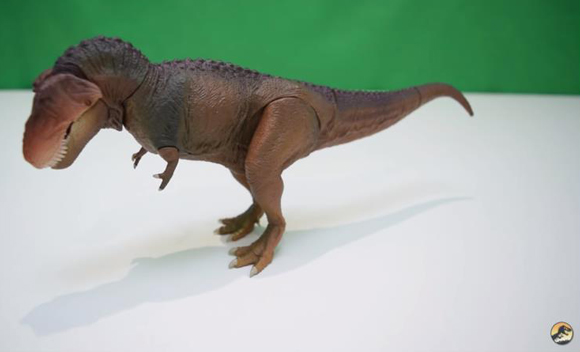
A video review of a Kaiyodo Sofubi Toy Box Tyrannosaurus rex "classic" colour.
The Kaiyodo Sofubi Toy Box T. rex can be put into a variety of poses.

Picture credit: JurassicCollectables

The recently reviewed Eofauna Scientific Research Giganotosaurus (G. carolinii), makes an appearance and helps to provide a size comparison with the Kaiyodo figure.  In addition, JurassicCollectables uses a Papo green standing T. rex model to help to give an impression of the figure’s size.  Naturally, off-colour Alan gets involved too and the narrator comments that when the Kaiyodo Sofubi Toy Box T. rex is placed next to the Alan Grant action figure, it looks like a juvenile T. rex.  This is highly appropriate as a juvenile Tyrannosaurus rex is referenced in the original Jurassic Park novel by Michael Crichton.

Beautiful Background Provided in the Presentation Box

The narrator comments upon the beautiful background image provided in the special presentation box and reflects on the skilful craftmanship and the care taken to produce the stunning paint scheme and the graceful airbrushing.   The mouth and jaws (the figure has an articulated upper jaw), are singled out for special praise.

The Kaiyodo Sofubi Toy Box T. rex Model Meets “Off-colour Alan”
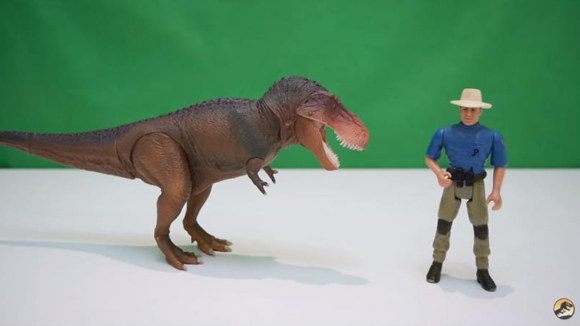
A video review of the Kaiyodo Sofubi Toy Box T. rex "classic" colour version.
The Kaiyodo Sofubi Toy Box T. rex meets “off-colour Alan”.

Picture credit: JurassicCollectables

To view the JurassicCollectables Kaiyodo unboxing article published by Everything Dinosaur: JurassicCollectables Unboxing a Trio of T. rex Figures.

The YouTube channel of JurassicCollectables is jam-packed with top quality dinosaur themed videos, it has attracted almost 79,000 subscribers.  Well done JurassicCollectables.  Find the YouTube channel here and don’t forget to subscribe: JurassicCollectables YouTube Channel.

There is Much to Admire in the Kaiyodo Sofubi Toy Box Tyrannosaurus rex Figure
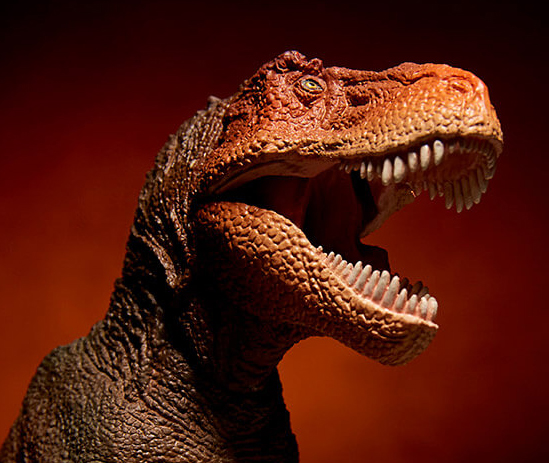
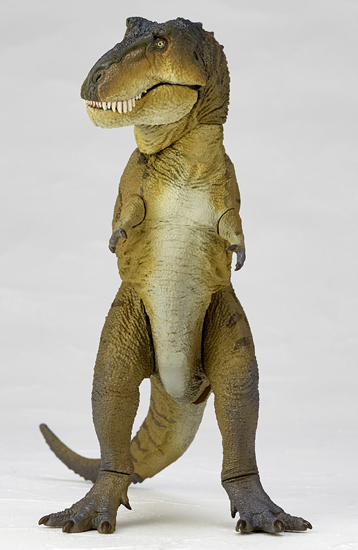
A close-up view of a Kaiyodo Sofubi Toy Box Tyrannosaurus rex "classic" colour.
A close-up view of the head of the Kaiyodo Sofubi Toy Box T. rex “classic” colouration. Picture credit: Everything Dinosaur.

Picture credit: Everything Dinosaur

Aimed at collectors and not for dinosaur fans under fifteen years of age, this limited edition and quite rare dinosaur model is available from Everything Dinosaur (whilst stocks last).

Find the Kaiyodo Sofubi Toy Box T. rex “classic” and the other Kaiyodo models here: Kaiyodo Dinosaur and Prehistoric Animal Figures.

Visit the Everything Dinosaur website: Visit Everything Dinosaur.

21 03, 2019

A Recipe for Dinosaur Shortbread Biscuits

By |2023-11-30T07:31:26+00:00March 21st, 2019|Categories: Adobe CS5, Dinosaur Fans, Educational Activities, Main Page, Press Releases, Teaching|0 Comments

Dinosaur Shortbread Biscuits Recipe

Here is a quick and simple recipe to make dinosaur shortbread biscuits.  Making biscuits such as these is a fun activity that young children can participate in.  These dinosaur shortbread biscuits make great treats or can be used to help with the catering for a dinosaur themed birthday party.

A Recipe for Dinosaur Shortbread Biscuits

Dinosaur shortbread biscuits recipe.
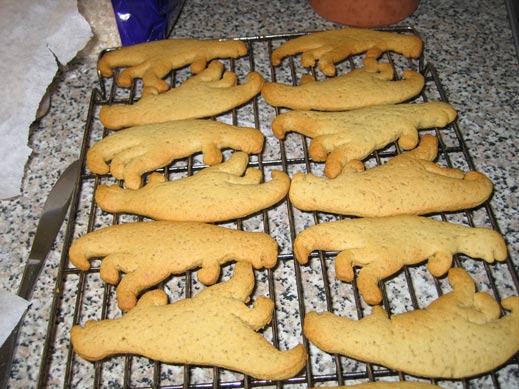
A recipe for dinosaur shortbread biscuits.  A simple biscuit recipe that is a great idea for a dinosaur themed birthday party – perfect for prehistoric party fun! Picture credit: Everything Dinosaur.

Picture credit: Everything Dinosaur

Ingredients (Makes About Twenty Biscuits)

  • Butter or margarine 110 grammes (4oz)
  • Caster sugar 50 grammes (2oz)
  • Plain flour, sifted 175 grammes (6oz)
  • Extra caster sugar for dusting

Method

  1. Preheat the oven to 150°C /300°F (Gas mark 2).  Lightly grease two baking sheets.
  2. Begin by first beating the butter (or margarine) with a wooden spoon to a soft consistency, and then beat in the sugar, followed by the sifted flour.
  3. Still using the wooden spoon, start to bring the mixture together, then finish off with your hands to form a paste.
  4. Transfer the mixture to a board lightly dusted with caster sugar, and then quickly and lightly roll it out to about 1/8 inch (3mm) thick (dusting the rolling pin with sugar if necessary).
  5. Cut the biscuits out using dinosaur biscuit cutters or, a dinosaur-shaped card that acts as a template and then arrange them on the baking sheet and bake on a highish shelf in the oven for 30 minutes.  Cool the biscuits on a wire rack, dust them with some caster sugar, and store in an airtight tin to keep them crisp.
  6. Once cooled, the biscuits can be iced and decorated to make a fun dinosaur themed snack or an ideal party food for a prehistoric animal themed party or other special occasion.

Dinosaur Biscuits – Just Out of the Oven

Dinosaur biscuits
Dinosaur biscuits cooling on a wire rack.  Once cooled, these biscuits can be decorated. Picture credit: Everything Dinosaur.

Picture credit: Everything Dinosaur

The Everything Dinosaur Weblog

The Everything Dinosaur weblog is crammed full of helpful articles aimed at the parents, grandparents and guardians of dinosaur enthusiasts and budding, young palaeontologists.  If you search our blog using terms such as “dinosaur party”, “cake” and “biscuit”, you will discover lots of helpful articles, ideas, recipes and suggestions to assist you with dinosaur themed party planning and other fun prehistoric animal orientated activities.  Have fun!

Everything Dinosaur is a UK-based supplier of dinosaur and prehistoric animal themed models, toys and merchandise, check-out our website: Visit Everything Dinosaur.
19 03, 2019

New Reflections on Hyaenodon gigas

By |2023-11-30T07:22:28+00:00March 19th, 2019|Categories: Adobe CS5, Dinosaur Fans, Everything Dinosaur Products, Main Page, Photos of Everything Dinosaur Products|0 Comments

Reflecting on Hyaenodon gigas

The extinct clade Creodonta, a term first used by the famous American palaeontologist Edward Drinker Cope (1875), was composed of a great variety of carnivorous mammals, of all shapes and sizes.  One of the most imposing of these predatory mammals was Hyaenodon gigas.  With a shoulder height of around 1.4 metres H. gigas was one of the largest members of the Hyaenodontidae family.  For a comparison, male Bengal tigers (Panthera tigris tigris), stand around 1 metre high at the shoulder.

A fully grown H. gigas is estimated to have weighed around half a tonne.  This was a very formidable carnivore.

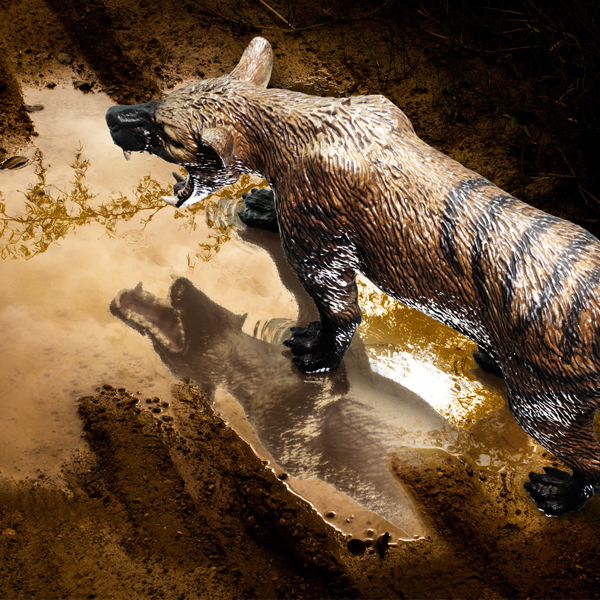
Those clever people at Safari Ltd have created a stunning image that highlights the beauty and detail of their Wild Safari Prehistoric World Hyaenodon model.

Reflecting on a Beautiful Prehistoric Animal Model – Hyaenodon gigas

A Hyaenodon gigas model.
The Hyaenodon gigas replica part of the Wild Safari Prehistoric World model series by Safari Ltd.

Picture credit: Safari Ltd/Everything Dinosaur

The Wild Safari Prehistoric World Hyaenodon gigas Model

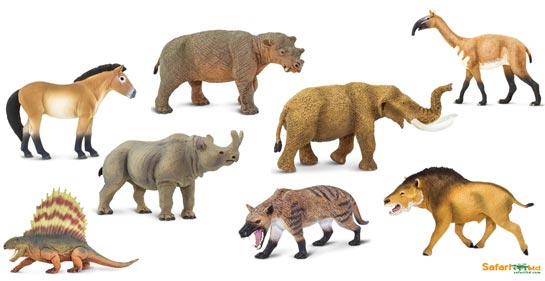
Last year, Safari Ltd introduced several new synapsid models.  For instance, a Przewalski’s horse was added to their “Winner’s Enclosure” collection.  Numerous prehistoric mammals as well as a stunning Dimetrodon replica were also launched.  In 2018, Safari Ltd added the Hyaenodon gigas, Uintatherium, Megacerops, Macrauchenia, a Daeodon and a model of an American Mastodon (Mammut americanum).

Super Synapsids on Display

New prehistoric animal models from Safari Ltd (2018).
Some wonderful synapsid models were introduced in 2018.  From top left Przewalski’s horse (extant) with the extinct pelycosaur Dimetrodon (below).  From left to right – Uintatherium, Megacerops, the American Mastodon, H. gigas, Macrauchenia and a trotting Daeodon model.

Picture credit: Everything Dinosaur

Naturally, each of these prehistoric animal figures is supplied with its very own fact sheet, so collectors and model fans can learn about the creature that the model represents.

Visit the Everything Dinosaur website: Everything Dinosaur.

Congratulations to Safari Ltd

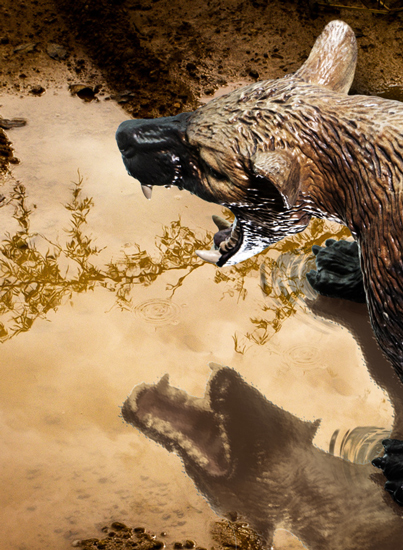
Our congratulations to Safari Ltd for making such a diverse range of figures and for producing such stunning images to accompany their model range.  The use of light and the clever photoshop effect of movement of the water in the puddle adds a new level of authenticity to their figures.  The reflection of the Hyaenodon model has been skilfully created and we look forward to posting up more examples of this sort of creativity on our blog in the near future.

A Stunning Image to Promote a Prehistoric Animal Model

The Wild Safari Prehistoric World Hyaenodon gigas model.
Reflecting on the Wild Safari Prehistoric World Hyaenodon gigas figure.

Picture credit: Safari Ltd/Everything Dinosaur

To view the range of Wild Safari Prehistoric World models and figures available from Everything Dinosaur: Wild Safari Prehistoric World Models and Replicas.

18 03, 2019

New CollectA 2019 Prehistoric Animal Models in Stock

By |2023-11-27T07:29:13+00:00March 18th, 2019|Categories: Dinosaur Fans, Everything Dinosaur News and Updates, Everything Dinosaur Products, Main Page, Photos of Everything Dinosaur Products, Press Releases|0 Comments

New CollectA 2019 Prehistoric Animal Models in Stock

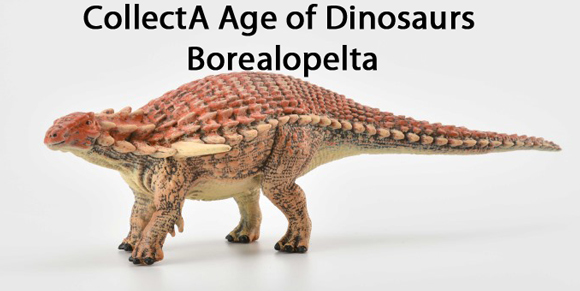
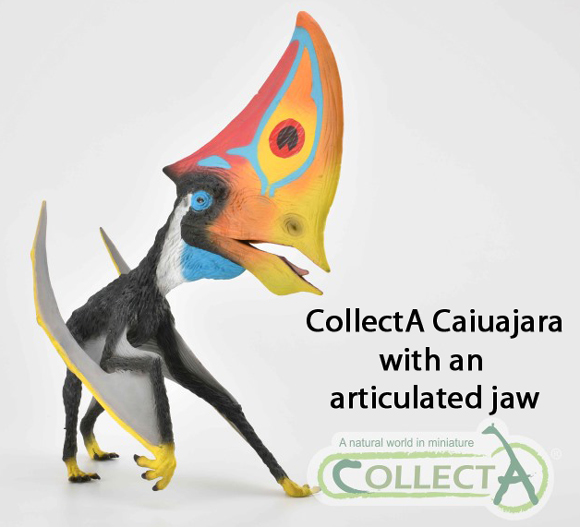
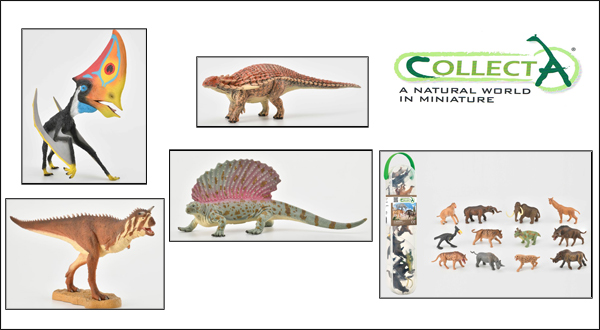
The first of the new for 2019 prehistoric animal models from CollectA have arrived at Everything Dinosaur.   The armoured dinosaur Borealopelta, the pterosaur Caiuajara, the deluxe Carnotaurus and the Edaphosaurus models are now all in stock.  In addition, the set of mini prehistoric animal models has also arrived at our warehouse.

In Stock at Everything Dinosaur, the Box of Mini Prehistoric Animal Models

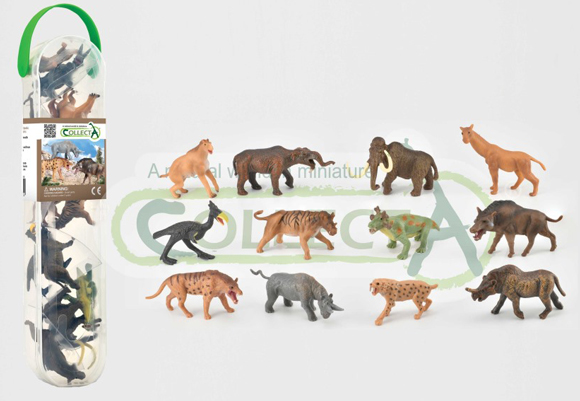
The CollectA Box of Mini Prehistoric Animals (2019)
The CollectA box of mini prehistoric animal models which is available in 2019. Twelve prehistoric animal models in the box set.

The CollectA Box of Mini Prehistoric Animal Models

Joining the CollectA mini sets of prehistoric animals series is this new box of mini prehistoric animals, twelve miniature replicas of larger figures within the CollectA range.  The models in the box include Megacerops, Daeodon, Paraceratherium, Smilodon, Arsinoitherium, Uintatherium, Andrewsarchus, Moropus, Deinotherium and a Woolly Mammoth.  All these are mammals from the Cenozoic, but interestingly the box set features a replica of the giant prehistoric bird Kelenken and the bizarre therapsid Estemmenosuchus – “crowned crocodile”.  Estemmenosuchus lived during the Permian, many millions of years before the other creatures featured in the box set evolved.

Borealopelta and the Pterosaur Caiuajara

One of the first of the new models to be announced, back in early November, was the Borealopelta, a model of an armoured dinosaur that was formally named and described in 2017 (Brown et al).

The CollectA Borealopelta Dinosaur Model

CollectA Age of Dinosaurs Borealopelta.
The CollectA Age of Dinosaurs Borealopelta dinosaur model.  CollectA have recently rebranded their prehistoric animal range and called it the “Age of Dinosaurs”. Picture credit: Everything Dinosaur.
Picture credit: Everything Dinosaur

One of the largest models introduced is that of the Brazilian pterosaur Caiuajara (C. dobruskii), it measures 23 centimetres long and that spectacular crest stands around 22 centimetres high.  It is a fantastic model of a flying reptile.  The Caiuajara model has an articulated lower jaw and it is great to see a replica of a pterosaur added to the CollectA model range.

The CollectA Deluxe Caiuajara Pterosaur Model with a Moveable Jaw

The CollectA Caiuajara with a moveable jaw.
The CollectA Deluxe Caiuajara pterosaur model.

Picture credit: CollectA with additional annotation by Everything Dinosaur

Visit the Everything Dinosaur website: Everything Dinosaur.
The CollectA Edaphosaurus and Carnotaurus Figures

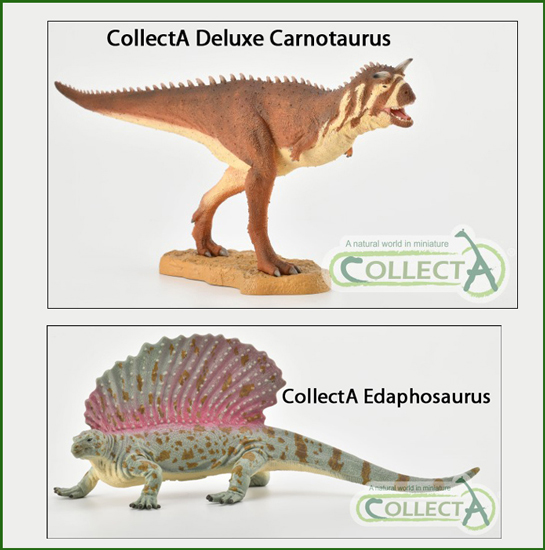
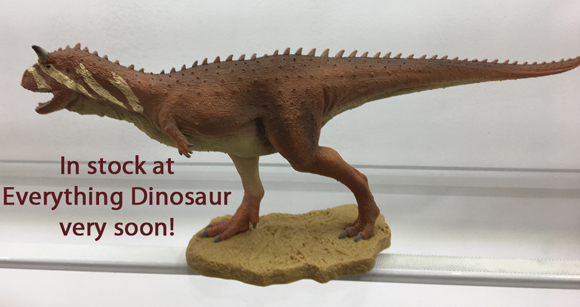
Dinosaur fans had been asking CollectA to produce a large, deluxe version of Carnotaurus to accompany their growing range of different types of theropod dinosaur included in the deluxe model range.  The CollectA Carnotaurus is spectacular and it has already attracted a number of positive comments on Everything Dinosaur’s Facebook page.  The Edaphosaurus figure has also been eagerly anticipated.  CollectA made a commitment some time ago to include more animals from the Palaeozoic in their model range.  The CollectA Edaphosaurus is the latest example of this policy.

The CollectA Edaphosaurus and the CollectA Deluxe Carnotaurus

CollectA Edaphosaurus and the CollectA Carnotaurus models.
A stunning pair! The CollectA Edaphosaurus and the CollectA Carnotaurus models.  The CollectA Deluxe Carnotaurus (top) and the CollectA Edaphosaurus (bottom).

Picture credit: CollectA with additional annotation by Everything Dinosaur

A spokesperson from Everything Dinosaur commented:

“It is fantastic to see the first of the new for 2019 CollectA prehistoric animal models arrive, we are looking forward to despatching the models to our customers who have requested these figures, these are certainly exciting times for CollectA.”

To view the range of Deluxe CollectA models available from Everything Dinosaur: CollectA Deluxe Prehistoric Animal Models.

To view the range of smaller, not to scale CollectA models and figures: CollectA Prehistoric Life Models.

17 03, 2019

New Study “Cracks” Dinosaur Egg Mystery

By |2023-11-30T07:21:09+00:00March 17th, 2019|Categories: Dinosaur and Prehistoric Animal News Stories, Dinosaur Fans, Main Page, Palaeontological articles, Photos/Pictures of Fossils|2 Comments

Dinosaurs Innovated When it Came to Egg Production

Many museums include the fossilised remains of dinosaur eggs amongst their natural history collections and palaeontologists are aware that reptiles were laying eggs on land long before the dinosaurs evolved, but what we know about the evolution of reptile eggs (amniotic eggs in general), is largely based on inference and conjecture.  The problem is, for the first 100 million years or so of amniote evolution, there is very little fossil data related to reptile reproduction to study.  What we do know, is based on Middle Jurassic to Late Cretaceous fossils.

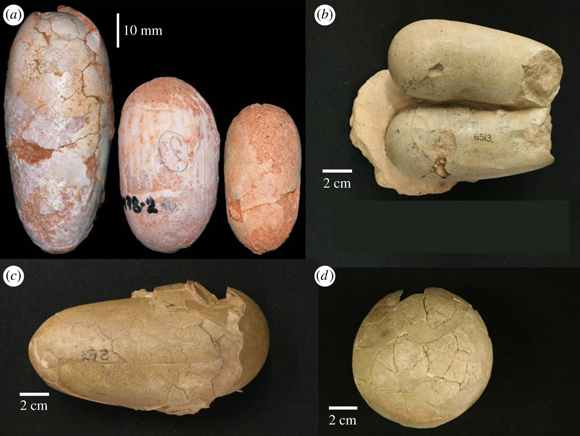
Although, dinosaur eggs are rare, the examples we do have, such as those associated with Asian oviraptorids demonstrate that dinosaur eggs had thick, hardened shells.  However, a new study suggests that it was not always like this and that the three main Sub-orders of the Dinosauria probably evolved thick, tough eggs independently.

Examples of Eggs from Different Archosaurs (Avian and Non-avian Dinosaurs)

Examples of fossil Archosaur eggs.
Examples of whole or partial fossilised eggs.

Picture credit: Royal Society Open Science

Studying Some of the World’s Oldest Dinosaur Eggs Reveals New Information

Writing in the on-line, open access journal “Scientific Reports”, a team of scientists, including Robert Reisz (University of Toronto Mississauga) and Koen Stein (Royal Belgian Institute of Natural Sciences, Brussels), have examined some of the oldest examples of dinosaur eggs known and revealed new information about the evolution of dinosaur reproduction.

The researchers examined the eggs and eggshells of three coeval, but geographically widely distributed Early Jurassic basal sauropodomorph dinosaurs (Sinemurian faunal stage).  These fossils came from Argentina, China and South Africa and include the eggs of Massospondylus and Lufengosaurus.  Their analysis showed that the basal sauropodomorph eggs all had the basic structure, they had a thin calcareous layer less than 100 microns thick.  This thin shell layer contrasts strongly with the much thicker calcareous shells associated with Late Jurassic and later dinosaur eggs.

At approximately 195 million years old, they are the earliest known eggs in the fossil record, and they were all laid by similar, herbivorous dinosaurs that ranged in size from four to eight metres in length and were the most common and widely spread dinosaurs of their time.  These types of plant-eating dinosaur were the forerunners of the giant sauropods of the Jurassic, dinosaurs such as Brontosaurus, Diplodocus and Brachiosaurus.

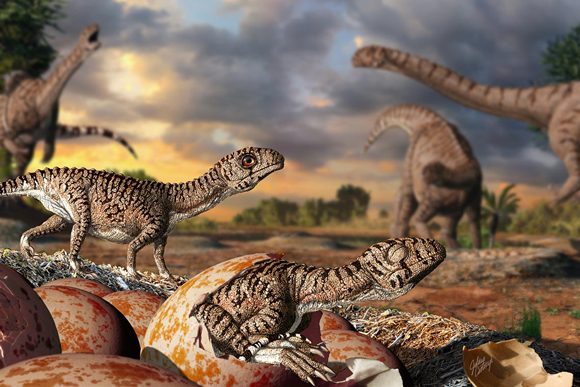
A Massospondylus Nesting Site (Life Reconstruction)

Massospondylus nesting site - life reconstruction.
Massospondylus (basal Sauropodomorpha) nesting site. Massospondylus fossil eggs from South Africa were used in the study.

Picture credit: Julius Csotonyi

Putting the Dinosaur Egg Research into Context

Putting the research into context Professor Reisz explained:

“Reptile and mammal precursors appear as skeletons in the fossil record starting 316 million years ago, yet we know nothing of their eggs and eggshells until 120 million years later.  It’s a great mystery that eggs suddenly show up at this point, but not earlier.”

The researchers concluded that these Early Jurassic eggs represented a step in the evolution of dinosaur reproduction, their shells were paper-thin and brittle, proportionately much thinner than the eggs of extant birds.  However, thicker, tougher eggshells in the Dinosauria were to evolve across all three Sub-orders later.  The much thicker eggshells associated with sauropods, ornithischian dinosaurs and the Theropoda must have evolved independently.

Professor Reisz added:

“We know that these early eggs had hard shells because during fossilisation they cracked and broke, but the shell pieces retained their original curvature.”

Other authors of the scientific paper include Edina Prondvai and Jean-Marc Baele.  Shell thickness was analysed along with membrane thickness, mineral content and distribution of pores, looking for clues about why these early eggs might have developed hard shells.  The scientists concluded that hard-shelled eggs evolved early in dinosaur evolution, with thickening of the calcareous layer (greater than 150 microns), occurring independently in several groups, but a few million years later other reptiles also developed hard-shelled eggs.  One possibility is that hard and eventually thicker shells may have evolved to shield dinosaur embryos and other reptiles from predators.

Professor Reisz commented:

“The hard shells would protect the embryos from invertebrates that could burrow into the buried egg nests and destroy them.”

Linked to Increased Oxygen in the Atmosphere

Advanced mineralisation of amniote eggshell including those of dinosaurs (≥150 microns in thickness), in general occurred not earlier than the Middle Jurassic and may correspond with a global trend of an increase in atmospheric oxygen.  If there were higher levels of atmospheric oxygen, then this would facilitate more efficient gaseous exchange through the porous eggshell and across the egg membranes.  More efficient diffusion would permit the evolution of thicker eggshells, which in turn would offer greater resistance to damage and more protection from predators.

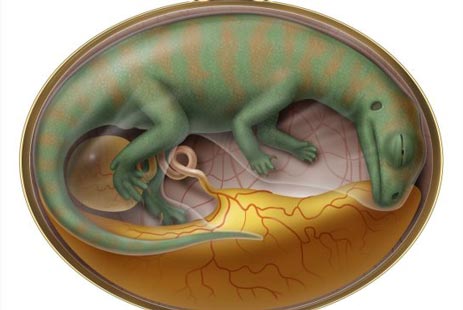
A Lufengosaurus Embryo

The embryo of a Lufengosaurus
New research into 195 million-year-old baby dinosaurs and their eggs.

Picture credit: D. Mazierski

Raising Further Questions About Mesozoic Reproduction Strategies

The study raises some intriguing questions that may well lead to further research projects.  For example, palaeontologists are aware that many types of marine reptile evolved viviparity (live birth), whilst the fossil evidence for the terrestrial Dinosauria seems to indicate that they continued to rely on egg laying.  Why didn’t the highly diverse dinosaurs evolve different reproductive strategies over their 160 million years of existence?

Everything Dinosaur acknowledges the assistance of a press release from the University of Toronto in the compilation of this article.

The scientific paper: “Structure and Evolutionary Implications of the Earliest (Sinemurian, Early Jurassic) Dinosaur Eggs and Eggshells” by Koen Stein, Edina Prondvai, Timothy Huang, Jean-Marc Baele, P. Martin Sander and Robert Reisz published in Scientific Reports.

Visit the award-winning Everything Dinosaur website: Everything Dinosaur.

16 03, 2019

JurassicCollectables Unboxing A Trio of T. rex Figures

By |2023-11-30T07:12:59+00:00March 16th, 2019|Categories: Dinosaur Fans, Everything Dinosaur News and Updates, Everything Dinosaur Products, Everything Dinosaur videos, Main Page, Photos of Everything Dinosaur Products|0 Comments

JurassicCollectables Unboxing A Trio of T. rex Figures

The talented team at JurassicCollectables got a surprise this week.  A large box was delivered to them, it came from us at Everything Dinosaur, but what did it contain?  The narrator could hardly contain his excitement as he carefully cut through the securing tape and examined the contents.  Inside, were all three of the rare, limited edition Kaiyodo Sofubi Toy Box T. rex dinosaur figures.  A trio of Tyrannosaurus rex models from Japan for JurassicCollectables to review.

An Unboxing Video (Kaiyodo Sofubi Toy Box T. rex Figures) from JurassicCollectables

Video credit: JurassicCollectables

What’s in the Box?

In this short video (it lasts just under three minutes), the narrator discovers all three of the Kaiyodo Sofubi Toy Box T. rex figures.  First out of the box is the yellow and black colour variant of this articulated dinosaur model series (SOFUBITOYBOX018A TYRANNOSAURUS REX).  The next dinosaur to feature is the “smoke green” colour variant from Kaiyodo (SOFUBITOYBOX018B TYRANNOSAURUS REX) and last but not least, the narrator reveals that the parcel also contained the beautiful “classic” colour variant which comes in its own presentation pack.

The narrator comments that he had to find a new place to shoot the video, as the box was so large, the three models are surprisingly big, they each measure around twenty-seven centimetres long.

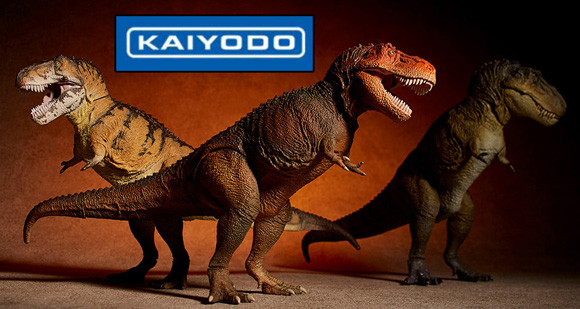
All Three of the Kaiyodo Sofubi Toy Box T. rex Dinosaur Figures

Kaiyodo Sofubi Toy Box T. rex figures.
The Kaiyodo Sofubi Toy Box T. rex figures.

Clever Articulation

All three models were made to highlight the capabilities of the design team at Kaiyodo, when it comes to constructing articulated prehistoric animal figures.  Each model has a total of ten points of articulation, as far as we at Everything Dinosaur know, this is the largest amount of articulation in any T. rex collectable figure which stands under thirty centimetres high.  The neck, the upper jaw, forelimbs and both ankles are articulated.  In addition, there are two points of articulation associated with the tail.

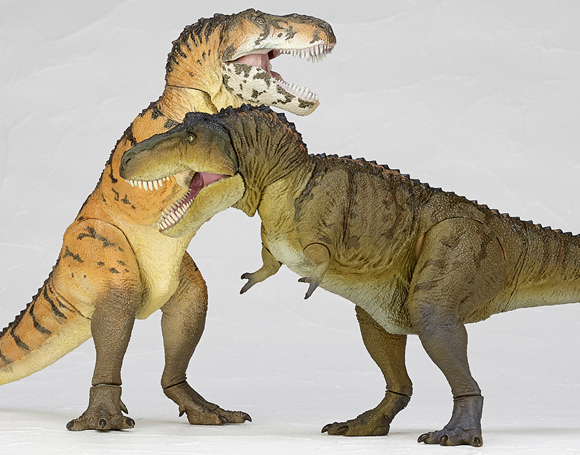
The Dinosaur Models can be placed in Different Poses

Kaiyodo Sofubi Toy Box T. rex figures.
Two of the Kaiyodo Sofubi Toy Box T. rex dinosaur models together.  Each model has ten points of articulation so that they can be put in different poses.

To view the range of Kaiyodo dinosaur models and other prehistoric animals available from Everything Dinosaur: Dinosaur Models and Prehistoric Animal Figures.

A History of Tyrannosaurus rex Poses in One Dinosaur Figure

The concept behind the design of these limited edition figures, is quite simple.  Kaiyodo wanted to produce a single dinosaur model that permitted the collector to place the T. rex in all its poses that have been proposed for how this dinosaur stood since it was formally named and scientifically described back in 1905.  This was quite a challenge, however, each model can be put into the traditional “kangaroo stance”, with the tail resting on the ground.  It can also be posed in numerous other configurations, representing more modern approaches to the stance of this hypercarnivore from the Late Cretaceous of North America.

The “Smoke Green” Kaiyodo Sofubi Toy Box T. rex Standing Tall

Kaiyodo Sofubi Toy Box T. rex dinosaur model (smoke green).
The Kaiyodo Sofubi Toy Box “smoke green” T. rex dinosaur model.

Picture credit: Everything Dinosaur

Rare Dinosaur Models

When first produced, these three figures were part of a limited production run and all colour versions are now all out of production (we think).  These Japanese models are certainly very rare and not widely available.  The Kaiyodo Sofubi articulated Tyrannosaurus rex figures are for collectors, they are classified as “collectable prehistoric animal figures”, as such they have a 15 years and above age classification.  These are articulated dinosaur models that have an age rating!

The “Classic” Kaiyodo Sofubi Toy Box Tyrannosaurus rex

The "Classic" Kaiyodo Sofubi Toy Box T. rex.
The “classic” Kaiyodo Sofubi Toy Box Tyrannosaurus rex figure.

Tyrannosaurus rex Models

We look forward to watching the model reviews from JurassicCollectables.

To see the huge range of prehistoric animal model reviews made by JurassicCollectables, check out their amazing YouTube channel, don’t forget to subscribe!  Catch: JurassicCollectables on YouTube.

Visit the award-winning Everything Dinosaur website: Everything Dinosaur.
15 03, 2019

Win a Dinosaur Book with Everything Dinosaur

By |2023-11-25T16:05:06+00:00March 15th, 2019|Categories: Adobe CS5, Dinosaur Fans, Everything Dinosaur News and Updates, Main Page, Press Releases|0 Comments

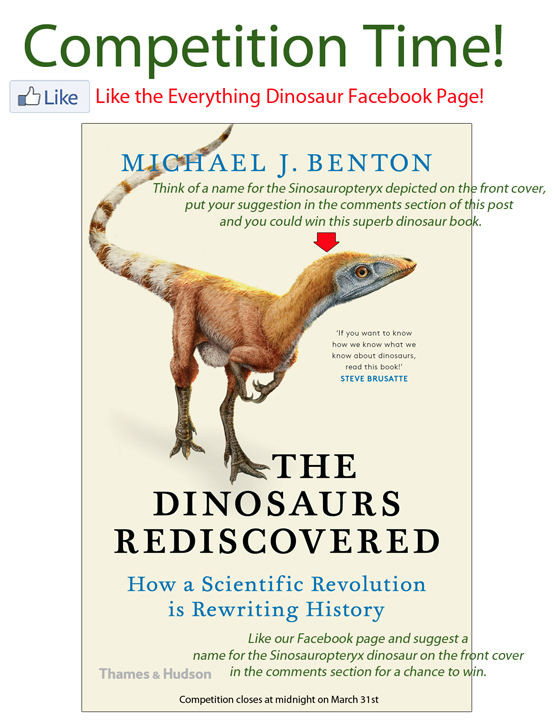
Win a Copy of the Superb “The Dinosaurs Rediscovered” by Professor Michael Benton

WIN! WIN! WIN! with Everything Dinosaur!  Win a copy of the brilliant new book by Professor Mike Benton

Everything Dinosaur Book Competition

THIS COMPETITION IS NOW CLOSED.

Everything Dinosaur has another super, dinosaur themed giveaway.  We have a copy of the brand new book by Professor Michael Benton “The Dinosaurs Rediscovered” and we are giving you the chance to win it.

Get to Grips with the Very Latest Dinosaur Discoveries and Research

Win a dinosaur book from Everything Dinosaur.
Win a copy of “The Dinosaurs Rediscovered” by Professor Michael Benton.

Aimed at serious dinosaur fanatics as well as general readers with an interest in science, this latest publication by the highly respected Professor Benton provides an authoritative account on how our knowledge about the Dinosauria has changed in recent years.  This really is a must have!  Make room on your book shelf for this excellent publication.  Even better, you can win a copy courtesy of Everything Dinosaur!

Win a Copy of “The Dinosaurs Rediscovered” in our Competition

All you have to do is “Like” Everything Dinosaur’s FACEBOOK page, then comment on our dinosaur book competition post giving a name for the superb Sinosauropteryx dinosaur model depicted on the front cover.  The Sinosauropteryx illustrated by Julius Csotonyi is stunning, but he/she needs a name!

Don’t Forget to Suggest a Name and to “Like” our Facebook Page

Like Everything Dinosaur on /Facebook
Like our Page (please).

We will draw the lucky winner at random and the Sinosauropteryx naming competition closes at midnight on Sunday 31st March.  Good luck!

Don’t forget to visit our Facebook page to enter (please give our Facebook page a “like”): Everything Dinosaur on Facebook.

To view Everything Dinosaur’s range of superb prehistoric animal and dinosaur themed gifts visit: Everything Dinosaur.
THIS COMPETITION IS NOW CLOSED.

Terms and Conditions of the Name the Front Cover Sinosauropteryx Competition

Automated entries are not permitted and will be excluded from the draw.

Only one entry per person.

The prize is non-transferable and no cash alternative will be offered.

The Everything Dinosaur name a Sinosauropteryx competition runs until midnight Sunday 31st March 2019.

Winner will be notified by private message on Facebook.

Prize includes postage and packing.

For full terms and conditions contact: Contact Everything Dinosaur.
THIS COMPETITION IS NOW CLOSED.

14 03, 2019

New CollectA Models On Their Way

By |2023-11-30T07:09:24+00:00March 14th, 2019|Categories: Adobe CS5, Dinosaur Fans, Everything Dinosaur News and Updates, Main Page, Photos of Everything Dinosaur Products, Press Releases|0 Comments

New for 2019 CollectA Models Due to Arrive Next Week

Exciting news for dinosaur fans and model collectors, the first batch of the new for 2019 prehistoric animal models from CollectA are due to arrive at Everything Dinosaur next week.  Stocks of the Borealopelta, the Deluxe 1:40 scale Carnotaurus, the super-sized pterosaur figure – Caiuajara and the 1:20 scale Deluxe Edaphosaurus are all on their way.  In addition, the new for 2019 set of mini prehistoric animal models are also due to arrive at the same time.

Coming into Stock at Everything Dinosaur

New for 2019 CollectA prehistoric animal models.
The first batch of new for 2019 CollectA prehistoric animal models are on their way to Everything Dinosaur. Picture credit: Everything Dinosaur.
Picture credit: Everything Dinosaur

The picture above shows the first four models coming into stock along with the mini prehistoric animal model set which will feature an additional twelve figures.  Back in November, when we were given the official go ahead to discuss the 2019 CollectA offering, Everything Dinosaur team members posted up the first pictures of these hand-painted models.  They were very well received.

A spokesperson from Everything Dinosaur commented:

” We are delighted to announce that the first new prehistoric animals from CollectA are going to be in stock very soon.  These quality models capture the essence of CollectA, they don’t just focus on dinosaurs, only two of the sixteen figures represent members of the Dinosauria [Carnotaurus and Borealopelta], we know how keen model collectors are to acquire animals from the Palaeozoic and Cenozoic Eras as well.”

Heading Your Way!  The CollectA Deluxe Carnotaurus Dinosaur Model

CollectA Deluxe 1:20 scale Carnotaurus dinosaur model.
CollectA Carnotaurus dinosaur model. Picture credit: Everything Dinosaur.
Picture credit: Everything Dinosaur

Visit the Everything Dinosaur website: Everything Dinosaur.
Detailed Prehistoric Animal Models

Many manufacturers focus on just a handful of figures, but the CollectA range is huge with a wide variety of prehistoric animals (and plants) represented.  Over recent years the company has introduced several sets of mini-prehistoric animal figures.   Later on this month, Everything Dinosaur will be receiving stocks of the prehistoric animal model set, or as we at Everything Dinosaur like to call it “the synapsids plus one”.  All the figures are synapsids, with the exception of the mini Kelenken model, which as a bird comes from the archosaur lineage of diapsids.

The CollectA Mini Prehistoric Animal Model Set

The CollectA Box of Mini Prehistoric Animals (2019)
The CollectA box of mini prehistoric animal models which is going to be available in 2019. Twelve prehistoric animal models.  Coming into Everything Dinosaur very soon. Picture credit: Everything Dinosaur.

Picture credit: Everything Dinosaur

How many of the twelve models in the set can you name?  As a clue and to give you a start, we have given you the name of one already.

Sailing Towards Us the Sail-backed Reptile Figure Edaphosaurus

The CollectA Edaphosaurus model.
The CollectA Edaphosaurus model.  If you look at the top right-hand corner of the photograph you can see the CollectA Carnotaurus coming into attack! Picture credit: Everything Dinosaur.

Picture credit: Everything Dinosaur

We are looking forward to getting all these new models into stock next week.  Rest assured all those dinosaur fans on our reserve lists, as soon as the models come in we will be emailing you to let you know that the figures are available and that we have set one aside.

To view the range of CollectA prehistoric animal models available from Everything Dinosaur: CollectA Prehistoric Animals.

13 03, 2019

New Giant Pliosaur From the Early Cretaceous of Colombia

By |2023-11-25T09:26:49+00:00March 13th, 2019|Categories: Dinosaur and Prehistoric Animal News Stories, Dinosaur Fans, Main Page, Photos/Pictures of Fossils|2 Comments

Sachicasaurus vitae – Brings a Whole Town to Life

A team of scientists from the Universidad Nacional de Colombia (Colombia), have announced the discovery of a new species of giant brachauchenine pliosaurid from Lower Cretaceous-aged beds in central Colombia.  The monster marine reptile, estimated to have measured around ten metres in length has been named Sachicasaurus vitae and is the largest of the three pliosaurid genera discovered to date from Colombian sediments.

Ironically, the species epithet for this formidable predator is Latin for “life”, a reference to the huge impact this discovery has had on the village of  Sáchica where the fossil was found.  It seems that the normally quiet village has had a considerable upsurge in visitors and commercial trade as the excavations of the huge specimen progressed.

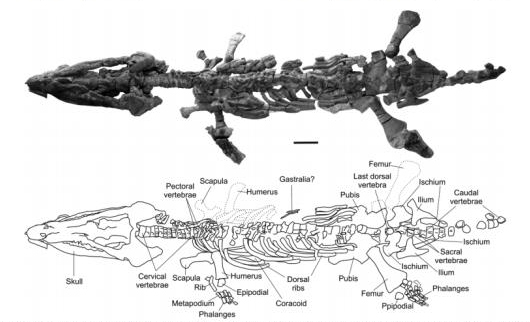
A Photograph of the Holotype Specimen and Accompanying Line Drawing

New pliosaurid Sachicasaurus from Columbia.
Sachicasaurus vitae photograph of fossils and skeletal line drawing.

Picture credit: Universidad Nacional de Colombia

The photograph (above), shows a dorsal view of the holotype (MP111209-1).  The dotted lines represent parts of the skeleton found separate from the main body fossil deposit.  The scale bar located below the photograph of the fossil indicates fifty centimetres.  The skull is more than two metres long.  The fossils come from Lower Cretaceous deposits located at Sáchica (the genus name honours the village).

Partially Articulated Specimen and Still Growing

The specimen was discovered in an articulated state and is estimated to have been around 9.9 metres long, but the researchers have concluded that the fossil remains represent a sub-adult animal so the maximum size for this marine reptile is unknown.  Pliosaurs are an extinct clade of short-necked plesiosaurs that were both temporally and geographically widespread.  Many pliosaurs were apex predators within Jurassic and Early Cretaceous marine environments.

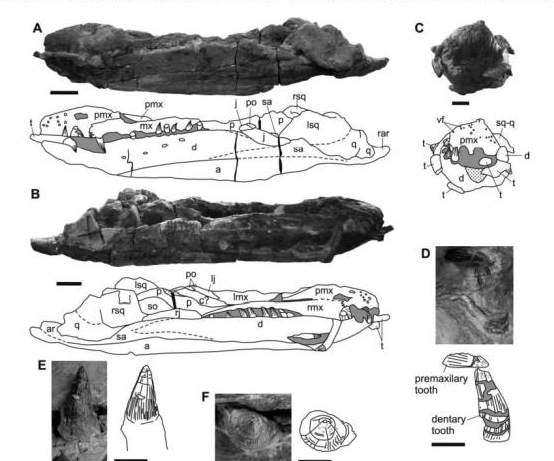
Sachicasaurus Jaw Bones and Associated Teeth

Sachicasaurus jaws and teeth.
Sachicasaurus vitae photographs and interpretative drawings of the jaws and teeth.

Picture credit: Universidad Nacional de Colombia

The Most Complete Pliosaur Discovered in Columbia

Sachicasaurus vitae represents the most complete pliosaurid fossil specimen found to date in Colombia, it is also the largest pliosaur known from this part of the world.   It lived approximately 125 million years ago (Barremian faunal stage of the Early Cretaceous).  For such a large animal the front flippers seem particularly small, this suggests that it might have had a different form of propulsion, perhaps being more reliant on the rear flippers and powerful strokes of its tail (assuming the presence of tail fluke).  Although the phylogeny of this marine reptile is uncertain, as it possessed a mix of primitive and more advanced anatomical traits, it has been placed within the Brachaucheninae and it may have been closely related to Kronosaurus.

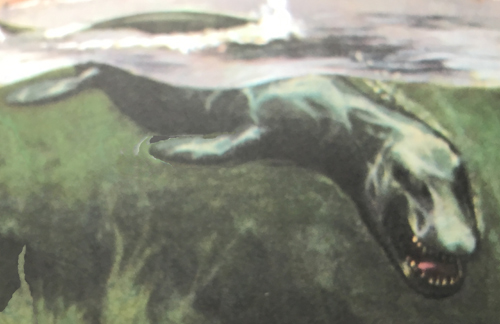
An Illustration of a Typical Pliosaur Marine Reptile

Pliosaur illustration.
An illustration of a typical pliosaurid marine reptile.

Picture credit: Everything Dinosaur

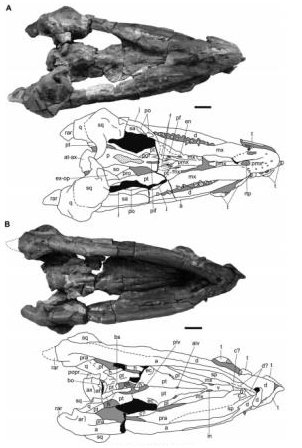
The Powerful Skull of Sachicasaurus vitae

Sachicasaurus vitae skull and line drawings.
Photographs and interpretive drawings of the skull in (A) dorsal view and (B) ventral views.

Picture credit: Universidad Nacional de Colombia

The Diversity of Coumbian Pliosaurids in the Early Cretaceous

The discovery of S. vitae highlights the diversity of pliosaurs known from the Early Cretaceous of Colombia.  Two other pliosaurs have been recorded from this part of South America, both of which are smaller than Sachicasaurus.  The occurrence of different genera of pliosaurids in the Barremian beds of Colombian suggests that the environmental conditions of the Colombian sea during the Early Cretaceous facilitated the development of sufficient marine life to sustain a diverse group of predators.

The other pliosaurs known from the Early Cretaceous of Colombia:

  • Stenorhynchosaurus (S. munozi) named in 2016.  It had a more elongated snout and may have been a specialised piscivore.
  • Acostasaurus (A. pavachoquensis) named in 2017.  It had a robust snout but was approximately half the size of Sachicasaurus.

Visit the award-winning Everything Dinosaur website: Everything Dinosaur.

11 03, 2019

New Australian Ornithopod Described

By |2023-11-24T14:03:06+00:00March 11th, 2019|Categories: Dinosaur and Prehistoric Animal News Stories, Dinosaur Fans, Main Page, Palaeontological articles, Photos/Pictures of Fossils|0 Comments

Galleonosaurus dorisae – A New Aussie Dinosaur

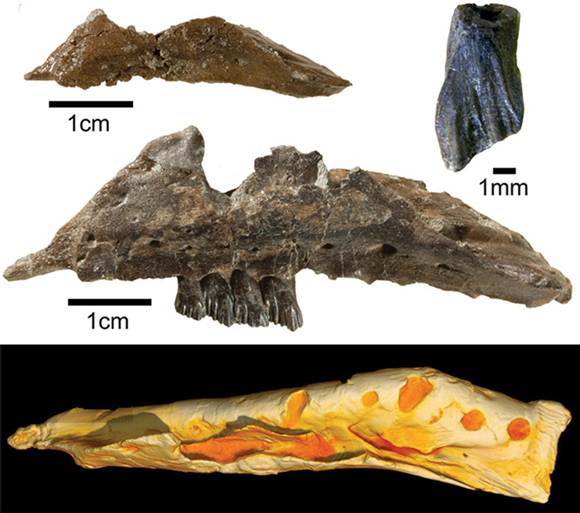
A new type of Australian dinosaur has been described from the fossilised remains of five upper jaw bones (maxillae) found at the Flat Rocks locality in the Wonthaggi Formation in the famous Gippsland Basin of Victoria.  Five small-bodied ornithopods are now known from the state of Victoria.  The new plant-eating dinosaur has been named Galleonosaurus dorisae.  The jaw bones are of different sizes and this has permitted palaeontologists to plot growth changes in these little dinosaurs as they matured.

Writing in the Journal of Palaeontology, the researchers which include Matthew Herne (University of New England, New South Wales) and Alistair Evans (Monash University, Melbourne), used detailed CT-scans of the fossil material to gain fresh insights into the structure and morphology of the cranial anatomy and dentition of small Australian ornithopods.  The research leading to the establishment of this new genus has also helped to define more clearly other small ornithopods known from the Gippsland Basin and the Otway Basin located on the opposite side of Port Phillip Bay.

A Life Reconstruction of the Newly Described Ornithopod Galleonosaurus dorisae

Galleonosaurus dorisae illustrated.
A life reconstruction of the newly described Australian ornithopod Galleonosaurus dorisae.

Picture credit: James Kuether

Galleonosaurus dorisae – “Galleon Lizard”

When the scientists were examining the maxillae, their shape reminded them of the upturned hull of an old-fashioned sailing ship – a galleon.  It was the morphology of the jaw that inspired the genus name “Galleon Lizard”.  The species or trivial name honours Doris Seegets-Villiers for her geological, palynological, and taphonomic work on the Flat Rocks fossil vertebrate locality.

Jaw Fossils and a Tooth with a CT-scan of the Fossil Material

Galleonosaurus fossiils and a CT-scan of a jaw.
Fossil jaw bones, a single tooth and a CT-scan image of a jaw bone (Galleonosaurus dorisae).

Picture credit: Herne et al

Niche Partitioning in Ornithopods

The plethora of vertebrate fossils at the Flat Rocks site, suggests that several more dinosaurs await discovery.  However, for the moment, the researchers are confident that Galleonosaurus shared its habitat with at least one other small, light, fast-running ornithopod – Qantassaurus intrepidus.  The jaws of Qantassaurus are more robust and more powerful.  The researchers were able to confirm that Q. intrepidus is uniquely characterised by a deep, foreshortened dentary (lower jaw).  This suggests that the robust Q. intrepidus and the more gracile jawed G. dorisae fed on different vegetation, they did not compete directly for food, an example of niche partitioning.

Dr Herne described Galleonosaurus:

“We know it would have been a two-legged, quite agile plant-eating dinosaur.  It seems that Galleonosaurus was no doubt closely related to possibly as many as four or five other species that look a little bit similar and were similar sizes, but we can tell they’re different by the anatomy of the jaws and the teeth.”

A Lush Conifer Dominated Rift Valley with an Immense Volcanic Mountain Chain to the East

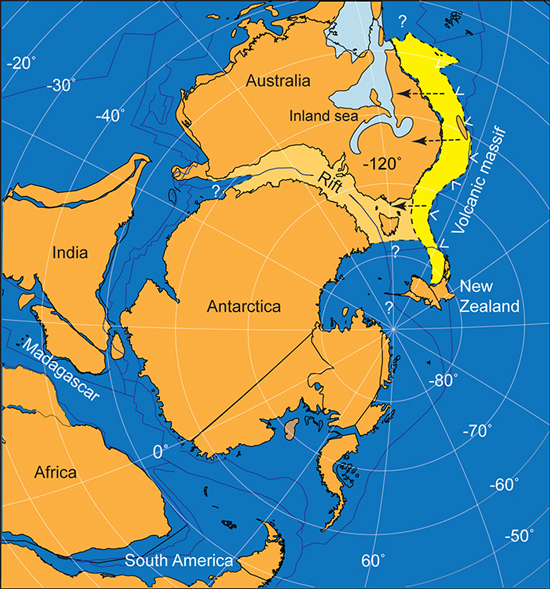
Extensive research on the Otway Formation material to the west of Port Phillip Bay in conjunction with research on the geology of the Gippsland Basin have permitted scientists to build up a picture of what life was like in this part of Australia during the Early Cretaceous.  The dinosaurs lived in an extensive rift valley that had formed as Australia began to separate from Antarctica.

Conifer forests dominated and at such high latitudes, the lush environment would have been subjected to long periods of extensive daylight in the summer, but conversely the winters would have been cold with little daylight each day.  Although the Earth’s climate was much warmer than today during the Early Cretaceous, it is quite possible that these little dinosaurs would have had to endure winter temperatures close to freezing.

Gondwana in the Early Cretaceous (Barremian Faunal Stage)

Gondwana in the Early Cretaceous.
Around 125 million years ago, although Gondwana was breaking up, Australia was still linked to Antarctica with a large volcanic mountain range to the east.

Picture credit: Herne et al

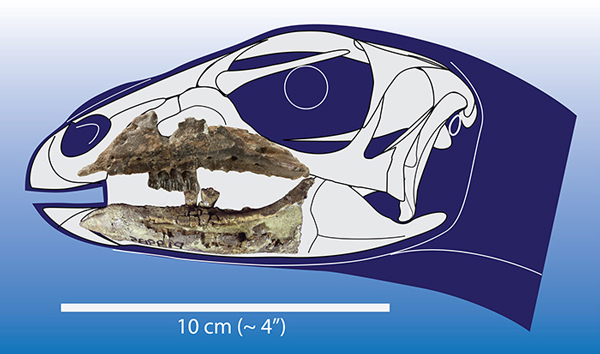
A Skeletal Reconstruction of the Skull of Galleonosaurus and the Anatomical Position of Jaw Material

Jaw fossils of Galleonosaurus dorisae.
An illustration of the skull of Galleonosaurus dorisae with fossil elements placed in the correct anatomical position.  The lower jaw shown in the image might pertain to G. dorisae based on a reassessment of other known lower jaw elements associated with Q. intrepidus and Atlascopcosaurus loadsi.

Picture credit: Herne et al

A Phylogenetic Analysis of Galleonosaurus dorisae

The scientists conclude that a highly diverse, small-bodied ornithopod fauna flourished in the periodically disturbed, high-latitude, riverine floodplain environment of the Australian-Antarctic rift valley during the Early Cretaceous (Barremian to Early Albian faunal stage).  A phylogenetic analysis places Galleonosaurus as the earliest member of the Elasmaria, a clade of Gondwanan ornithopods distantly related to the Hypsilophodonts.

The Five Victorian Ornithopods – Spanning 12 million years

The Lower Cretaceous rocks either side of Port Phillip Bay were laid down at different times during the Cretaceous.  The Gippsland Basin deposits close to the town of Inverloch, were laid down around 125 million years ago, however, the Otway Basin deposits (Eumeralla Formation), represent younger material laid down in the Early Albian (113 million years ago).

  1. Leaellynasaura amicagraphica – named in 1989 (Early Albian faunal stage), from the Eumeralla Formation (Otway Basin).
  2. Atlascopcosaurus loadsi – also named in 1989 from the Eumeralla Formation.
  3. Diluvicursor pickeringi – named in 2018 (Eumeralla Formation).  To read an article about the discovery of this dinosaur: Fast-running Ornithopod from Victoria.
  4. Qantassaurus intrepidus named in 1999 from the Wonthaggi Formation (Gippsland Basin) – older strata associated with the Barremian faunal stage of the Early Cretaceous.
  5. The newly described Galleonosaurus dorisae (2019), also from the Wonthaggi Formation.

Dr Herne stated:

“The interesting thing about that whole coast line is it gives us a decent age range over quite a long period.”

A spokesperson from Everything Dinosaur commented:

“It is likely that many more small dinosaurs are going to be named and described in the future.  Fossil finds from Victoria will, most likely, lead to further revisions of Gondwanan ornithopod taxonomy.”

For models and replicas of ornithopods and other dinosaurs: Dinosaur and Prehistoric Animal Models.

Go to Top