All about dinosaurs, fossils and prehistoric animals by Everything Dinosaur team members.

Dinosaur and prehistoric animal themed articles, features and stories.

1 04, 2019

Amazing Fossils Depict End Cretaceous Mass Extinction Event

By |2023-11-30T18:44:09+00:00April 1st, 2019|Categories: Dinosaur and Prehistoric Animal News Stories, Dinosaur Fans, Geology, Main Page, Palaeontological articles, Photos/Pictures of Fossils|0 Comments

Fossil Discovery Offers Detailed View Minutes After Chicxulub Impact

A paper published in the PNAS (Proceedings of the National Academy of Sciences – USA), provides a detailed snapshot of a terrible natural disaster linked to the Chicxulub bolide impact event.  A site (Tanis), in North Dakota’s Upper Cretaceous Hell Creek Formation, records the devastation caused by a massive surge of water which occurred as seismic shockwaves reverberated around the Earth as a result of the huge extra-terrestrial impact in what is now the Gulf of Mexico.

Examining Rock Layers Looking for Evidence
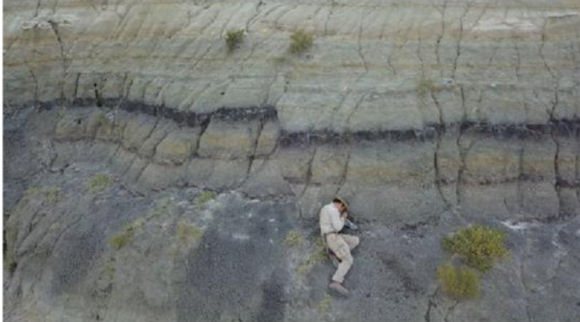
Exploring sediments, looking for fossils.
Identifying the K-T boundary at the margins of  Upper Cretaceous sediments.

Picture credit: Robert DePalma (University of Kansas)

Tanis Fossil Site – A “Motherlode” of Fossils

A team of palaeontologists, including researchers from the University of Kansas, the Black Hills Institute and Manchester University, in collaboration with a number of other academic institutions report on what has been described as a “motherlode of exquisitely-preserved plant, animal and fish fossils”, the remains of a river ecosystem which flowed into the Western Interior Seaway, which was wrecked within minutes of the extra-terrestrial impact event.

The site is described as a “rapidly emplaced high-energy onshore surge deposit” along the KT boundary that contains associated ejecta and iridium impactite associated with the End Cretaceous extinction event that resulted in the loss of many groups of terrestrial vertebrates including the pterosaurs and the dinosaurs as well as the extinction of a wide variety of marine organisms.

Lead author of the scientific paper, Robert DePalma (University of Kansas), described the Tanis fossil site as:

“A tangle mass of freshwater fish, terrestrial vertebrates, trees, branches, logs, marine ammonites and other marine creatures was all packed into this layer by the inland-directed surge”.

One of the Plaster Jackets from the Site Reveals the Devastation
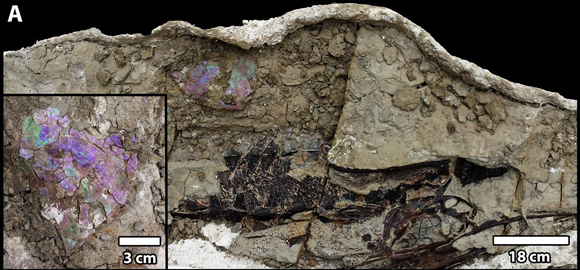
The Tanis Konservat-Lagerstätte
The Tanis Konservat-Lagerstätte.  Plaster field jacket  (A) with partially prepared (freshwater) acipenseriform fish next to a fragment from an ammonite shell (inset).

Picture credit: PNAS

The doctoral student went onto add:

“Timing of the incoming ejecta spherules matched the calculated arrival times of seismic waves from the impact, suggesting that the impact could very well have triggered the surge.”

Devastation Occurred Within Minutes of the Impact

The researchers conclude that the fossil site does not record a tsunami.  Tanis is more than 2,000 miles from the bolide impact site in the Gulf of Mexico, a tsunami would have taken at least seventeen hours to reach North Dakota, but seismic waves and a subsequent water surge would have occurred within minutes of the collision.

DePalma and his colleagues describe the rushing wave that shattered the Tanis site as a “seiche.”

What is a Seiche?

A seiche (pronounced “saysh”), relates to a standing wave in an enclosed or part-enclosed body of water.  This term was first used widely by the Swiss scientist François-Alphonse Forel (1841-1912), who pioneered the study of inland water ecosystems.  It is believed the etymology derives from the Swiss/French dialect meaning “swaying back and forth”, a reference to observations of water level changes in alpine lakes.  This phenomenon can have many causes, but seismic activity is known to lead to water surges.

DePalma explained:

“As the 2011 Tohoku earthquake in Japan showed us, seismic shaking can cause surges far from the epicentre.  In the Tohoku example, surges were triggered nearly 5,000 miles away in Norway just 30 minutes after impact.  So, the KT impact could have caused similar surges in the right-sized bodies of water worldwide, giving the first rapid “bloody nose” to those areas before any other form of aftermath could have reached them.”

According to Kansas University researchers, even before the surge arrived, acipenseriform fish (sturgeon) found at the site already had inhaled tiny spherules ejected from the Chicxulub impact.

Fish Fossils Show Evidence of Microtektites Embedded in Their Gills
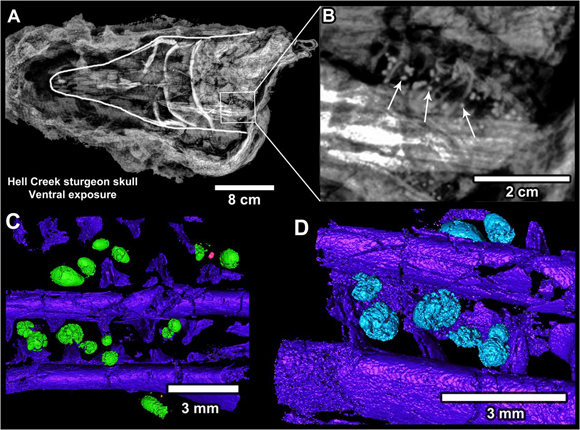
Microtektites from the Chicxulub impact recorded in fossil fish.
Fish Fossils from the Tanis fossil site show evidence of microtektites embedded in their gills.

Picture credit: PNAS

Microtektites Embedded in Gills

The picture above shows acipenseriform fish with ejecta clustered in the gill region.  Image (A) an X-ray of a fossil sturgeon head (outlined, pointing left; FAU.DGS.ND.161.115.T).  Magnified image (B) of the X-ray in (A) showing numerous ejecta spherules clustered within the gill region (arrows).  Images C and D are micro-CT images of another fish specimen (paddlefish), with microtektites embedded between the gill rakers in the same fashion.

Co-author David Burnham (Kansas University) stated:

“The fish were buried quickly, but not so quickly they didn’t have time to breathe the ejecta that was raining down to the river.  These fish weren’t bottom feeders, they breathed these in while swimming in the water column.  We’re finding little pieces of ejecta in the gill rakers of these fish, the bony supports for the gills.  We don’t know if some were killed by breathing this ejecta, too.”

One of the co-authors of the paper is Californian geologist Walter Alvarez, who, along with is his father Luis, postulated the theory of an impact event playing a role in the End Cretaceous extinction (1980).  They identified a layer of sediment in the strata marking the Cretaceous/Palaeogene boundary (KPg), that was enriched with the rare Earth element iridium and they concluded that an extra-terrestrial object must have collided with the Earth.

Described as a Lagerstätte of the KT Event

The number and quality of preservation of the fossils at Tanis are such that Burnham dubs it the “lagerstätte” of the KT event.  A lagerstätte, comes from the German “storage place”, it describes a sedimentary deposit that contains a large number of very well preserved fossils.  For example, the Tanis site preserves numerous acipenseriform fish, which are cartilaginous and not bony and therefore less likely to become fossils.

David Burnham added:

“The sedimentation happened so quickly everything is preserved in three dimensions, they’re not crushed.  It’s like an avalanche that collapses almost like a liquid, then sets like concrete.  They were killed pretty suddenly because of the violence of that water.  We have one fish that hit a tree and was broken in half.”

Indeed, the Tanis location contains many hundreds of articulated ancient fossil fish killed by the Chicxulub impact’s consequences and is remarkable for the biodiversity it reveals alone.

Mapping the Direction of the Surge and Examining the Fish Fossils
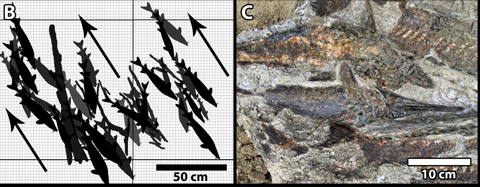
Carcasses orientated by flow and mass mortality deposit.
A site map (left) showing the flow of water indicated by the orientation of the material and a mass deposit of fish from the site.

Picture credit: PNAS

Several New Species

The scientists conclude that there are likely to be several new species of fish named as a result of this discovery.  In addition, some specimens are the best known examples of their genus found to date.  It was quickly realised that the surrounding matrix was deposited by a sudden, violent rush of water, a surge that was directed inland away from the Western Interior Seaway.  Impact debris including shocked minerals and ejecta spherules were found in the sediment and a compact layer of KT boundary clay overlies the deposit.

Tanis provides a post impact “snapshot,” including ejecta accretion and faunal mass death, advancing our understanding of the immediate effects of the Chicxulub impact.

According to Burnham, this site will advance our understanding of the Chicxulub impact significantly, describing Tanis as “smoking-gun evidence” of the aftermath.

Everything Dinosaur acknowledges the assistance of a press release from the University of Kansas in the compilation of this article.

The scientific paper: “A Seismically Induced Onshore Surge Deposit at the KPg Boundary, North Dakota” by Robert A. DePalma, Jan Smit, David A. Burnham, Klaudia Kuiper, Phillip L. Manning, Anton Oleinik, Peter Larson, Florentin J. Maurrasse, Johan Vellekoop, Mark A. Richards, Loren Gurche, and Walter Alvarez published in the PNAS.

Visit the award-winning Everything Dinosaur website: Everything Dinosaur.
31 03, 2019

New PNSO Prehistoric Animal Models

By |2023-11-30T14:28:38+00:00March 31st, 2019|Categories: Adobe CS5, Dinosaur Fans, Everything Dinosaur News and Updates, Everything Dinosaur Newsletters, Everything Dinosaur Products, Main Page, Photos of Everything Dinosaur Products, Press Releases|2 Comments

New PNSO Prehistoric Animal Models Debut in Everything Dinosaur Newsletter

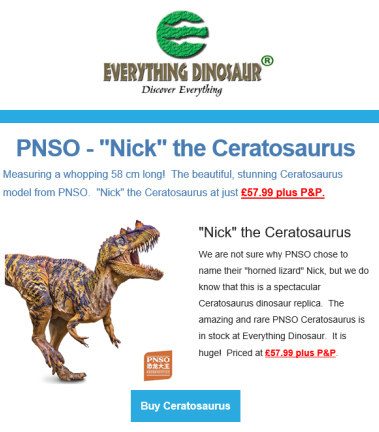
The latest Everything Dinosaur newsletter was published this week and it featured the new PNSO Age of Dinosaurs models as well as a couple of old favourites.  Just in at the warehouse, the giant “Nick” the Ceratosaurus figure, “Brook” the Ophthalmosaurus along with a 1:35 scale Mamenchisaurus and all twenty-four of the new for 2019 PNSO Toys that Accompany your Growth model series.

To view the new for 2019 PNSO Age of Dinosaurs figures including the new Ceratosaurus: PNSO Age of Dinosaurs.

The Huge PNSO Ceratosaurus Model Headlines the Everything Dinosaur Spring Newsletter

PNSO "Nick" the Ceratosaurus
The huge PNSO Ceratosaurus model – “Nick”. Picture credit: Everything Dinosaur.

Picture credit: Everything Dinosaur

The PNSO Age of Dinosaurs Ceratosaurus

This is a huge model, the box alone measures more than half a metre in length.  The model inside is enormous and it deserves top billing in our spring newsletter.  The figure is beautifully painted and depicts this Late Jurassic theropod in an aggressive pose with one foot raised off the ground.  The model is supplied with two supports to help it to be displayed.  It towers over other theropod dinosaur models.

The PNSO Ceratosaurus “Nick” Dinosaur Model

PNSO Ceratosaurus "Nick".
The giant PNSO Ceratosaurus dinosaur model.

Ophthalmosaurus Swims into View

The eagerly awaited PNSO Ophthalmosaurus has also arrived and it features in the newsletter too.  A number of academics, palaeontologists and other scientists have made enquiries about PNSO replicas.  The Ophthalmosaurus replica for example, will be used in science communications work.  As well as sending out the newsletter to our subscribers, team members were busy ensuring that all those customers who had requested one of these models was contacted.

The PNSO Ophthalmosaurus Figure Swims into Stock at Everything Dinosaur

PNSO Ophthalmosaurus "Brook".
The stunning PNSO Ophthalmosaurus model (Brook). Picture credit: Everything Dinosaur.

Picture credit: Everything Dinosaur

A New Mamenchisaurus Plus the Return of Megalodon and Basilosaurus

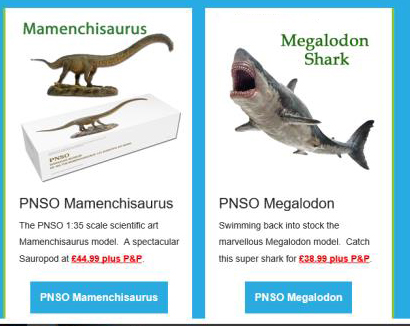
PNSO have created a 1:35 scale model of Mamenchisaurus, an iconic sauropod from China that had the longest neck relative to its body of any known member of the Sauropoda.  Mamenchisaurus had nineteen cervical vertebrae and the neck of this twenty-one metre monster measured a whopping fourteen metres or so.  It features in the Everything Dinosaur newsletter alongside a returning favourite, the PNSO Megalodon shark model is back in stock.

The PNSO 1:35 Scale Mamenchisaurus and the Return of the Megalodon

PNSO Mamenchisaurus and Megalodon models.
The PNSO 1:35 scale Mamenchisaurus model and the Megalodon model feature in the latest Everything Dinosaur newsletter. Picture credit: Everything Dinosaur.

Picture credit: Everything Dinosaur

PNSO T. rex “Wilson”, Triceratops “Doyle” and the Small Prehistoric Animal Figures

It can’t really be an Everything Dinosaur newsletter without one mention of Tyrannosaurus rex.  The 1/35 th scale T. rex called “Wilson” is back in stock along with its counterpart, the magnificent Triceratops “Doyle” which has been modelled in the same scale.

Also just arrived at Everything Dinosaur, are the latest editions to the PNSO small prehistoric animal model range.  The set includes twenty-four, beautifully sculpted little prehistoric animal figures in the PNSO Toys that Accompany your Growth series.  In the image, that we created for our spring newsletter, only fourteen of the twenty-four models were depicted, but this is enough to give model collectors a good idea of the breadth and the quality of this exciting replica series.

Mini Prehistoric Animals and a Special Offer for Newsletter Subscribers

Triceratops and T. rex along with PNSO small prehistoric animal models.
PNSO “Doyle” and “Wilson” 1:35 scale models and some of the amazing PNSO small prehistoric animal models. Picture credit: Everything Dinosaur.

Picture credit: Everything Dinosaur

Visit the Everything Dinosaur website: Everything Dinosaur.

Everything Dinosaur newsletter subscribers are amongst the first to learn about new models and replicas coming into stock.  Subscribers can also be the first to join a VIP reserve list to ensure that they can acquire items.  Our newsletter is sent out periodically and it is absolutely free to join.

A spokesperson from Everything Dinosaur commented:

“We are delighted to welcome more of the amazing PNSO prehistoric animal models into our company”

To request to join the Everything Dinosaur newsletter subscribers list: Simply Email Everything Dinosaur.

30 03, 2019

New Research into Juvenile Tyrannosaurus rex Feeding Traces

By |2023-11-30T14:32:45+00:00March 30th, 2019|Categories: Dinosaur and Prehistoric Animal News Stories, Dinosaur Fans, Main Page, Photos/Pictures of Fossils|0 Comments

Juvenile Tyrannosaurs Fed on Large Hadrosaurs Too

Scientists have identified tooth marks preserved in the tail bone of a duck-billed dinosaur as having been made by a sub-adult Tyrannosaurus rex.  The researchers conclude that late-stage juvenile and subadult tyrannosaurs were already feeding on the same types of large-bodied prey as adult animals, despite lacking the bone crushing jaws typical of a fully-grown, mature T. rex.

Writing in the academic journal PeerJ, the researchers Joseph E. Peterson and Karsen N. Daus (University of Wisconsin), suggest that this study helps scientists to better understand the diets of tyrannosaurs and the ecological role they played as predators in Late Cretaceous ecosystems.  Biostratigraphically, the victim’s fossils relate to sediments were Edmontosaurus fossils are found, so the prey has been tentatively identified as an Edmontosaurus.

Evidence of a Subadult T. rex Feeding on a Hadrosaur (Edmontosaurus)

Punctured caudal vertebra suggests feeding by a sub-adult T. rex
The punctured tail bone indicating feeding by a sub-adult T. rex.

Picture credit: PeerJ

The picture above shows views of the punctured tail bone (BMR P2007.4.1.) in (A) anterior view, (B) posterior view and (C) ventral view.  Images (D and E) are close-up views of the punctures identified on the bottom portion of the caudal vertebra.

Theropod Feeding Traces

Palaeontologists have identified numerous examples of theropod dinosaur feeding traces and tooth marks.  Such evidence provides information on predator/prey interactions, feeding behaviours and direct evidence of cannibalism in the Dinosauria.  However, in order to determine the meat-eating dinosaur that fed, causing the marks, it is important that the biostratigraphy is known and the approximate likely growth stage of the animal feeding.  The researchers state that currently, most recorded theropod feeding traces and bite marks are attributed to fully-grown, adult animals, but in this study, the bite marks were compared to various jaws of different aged T. rex specimens and it was concluded that the best fit for the feeding traces came from the maxilla of a late-stage juvenile T. rex estimated to be around 11-12 years old.  The dimensions and spacings on the caudal vertebra best matched the maxillary teeth of specimen number BMR P2002.4.1, a late-stage juvenile T. rex.

A Computer Generated Image Mapping the Feeding Traces

Juvenile T. rex feeding on the tail bone of a duck-billed dinosaur.
Identifying the bite marks on the tail bone of a hadrosaur.  The dimensions and spacings on the tail bone best matched the maxillary teeth (upper jaw) of BMR P2002.4.1, a late-stage juvenile Tyrannosaurus rex.

 Picture credit: PeerJ

A Tyrannosaur Hunting or Scavenging?

While bite marks resulting from active predation cannot easily be distinguished from post-mortem feeding traces, the position of the punctures in the hadrosaur tail bone suggest that the duck-billed dinosaur was already lying on its side and therefore it can be concluded that the traces come from post-mortem consumption.  The researchers propose that further identification of tyrannosaur feeding traces coupled with experimental studies of the biomechanics of tyrannosaur bite forces from younger ontogenetic stages may reveal dynamic dietary trends and ecological roles of Tyrannosaurus rex throughout the animal’s life cycle.

Furthermore, this evidence suggests that late-stage juvenile tyrannosaurs, at least in part, had a similar diet to the adult animals.

The scientific paper: “Feeding Traces Attributable to Juvenile Tyrannosaurus rex Offer Insight into Ontogenetic Dietary Trends” by Joseph E. Peterson and Karsen N. Daus published in the journal PeerJ.

For models of tyrannosaurs, hadrosaurs and other prehistoric animals: CollectA Prehistoric Animal Models.

29 03, 2019

The Biggest T. rex Known to Science – the Remarkable “Scotty”

By |2024-05-11T16:53:11+01:00March 29th, 2019|Categories: Dinosaur and Prehistoric Animal News Stories, Dinosaur Fans, Main Page, Photos/Pictures of Fossils|0 Comments

“Scotty” – The World’s Biggest T. rex

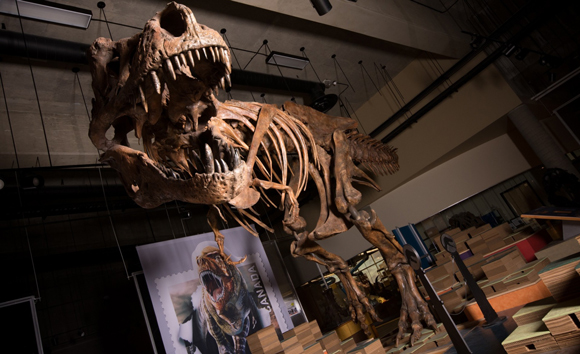
A scientific paper on what is regarded by many scientists as the world’s biggest Tyrannosaurus rex has been published.  It is time for the “T. rex” specimen nicknamed “Scotty” to step into the spotlight.  It measures around thirteen metres in length and represents an individual more than thirty years of age, remarkably old for a tyrannosaur.  Based on the diameter of the leg bones and other measurements, the body weight of this formidable carnivore has been estimated at 8.8 Tonnes.  It has been suggested that this specimen (RSM P2523.8), is a little longer and heavier than “Sue” (BHI2033), which resides in the Evolving Planet exhibit at the Field Museum in Chicago.

The “Scotty” T. rex Exhibit Preparing to Make Its Debut at the Royal Saskatchewan Museum

"Scotty" the Tyrannosaurus rex.

A reconstruction of the skeleton of “Scotty” the T. rex

Picture credit: Amanda Kelley

Gracile and Robust T. rex Forms

On August 16th, 1991, Robert Gebhardt, a high school teacher by profession but also a keen fossil hunter, was working with Tim Tokaryk (palaeontologist at the Eastend Fossil Research Station).  They were exploring the strata exposed along the Frenchman River Valley in Saskatchewan Province, for Robert this was an opportunity to learn more about field work.  However, within a few hours, Robert had found the base of a heavily worn tyrannosaur tooth, along with a caudal vertebra, the sort of discoveries that seasoned palaeontologists dream about.  Robert had discovered the oldest individual T. rex specimen.

For models and replicas of tyrannosaurs and an extensive range of related theropod dinosaurs: Dinosaur and Prehistoric Animal Figures.

Excavation Work Begins

It was not until June 1994, that the excavation work began on this new T. rex specimen in earnest.  The dig site became a visitor attraction in its own right with several thousand people coming to see how the huge bones representing about sixty-five percent of the skeleton were being excavated.  Unfortunately, the sandstone matrix surrounding the fossil bones and teeth was extremely hard, extracting the fossils from their 66-million-year-old rock tomb has proved to be one of the most challenging large theropod fossil preparations so far undertaken.

Scientists are aware that there seem to be two main types of Tyrannosaurus rex adult body plan – a robust form and a gracile form.  It is not known what these two different body types represent, one could be male, the other female, however, “Scotty”, so named after a celebratory drink of scotch after the initial fossil discovery, is a very robust Tyrannosaurus rex.

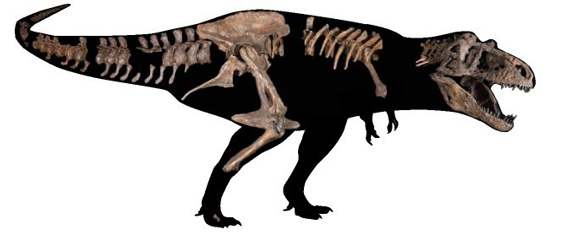
A Silhouette Showing the Fossil Material Associated with RSM P2523.8

The skeleton of "Scotty" the T. rex.

A silhouette outline showing the anatomical position of the known skeletal material of “Scotty”.

Picture credit: University of Alberta, via Agence France-Presse – Getty Images

Scott Persons, (University of Alberta) and one of the authors of the scientific paper published in The Anatomical Record, explained:

“This is the rex of rexes!”

There is considerable size variability among Tyrannosaurus.  Some individuals were lankier than others and some were more robust.  Scotty exemplifies the robust.  He comes out a bit heftier than other T. rex specimens.

Indeterminate Growth

Multiple measurements (including those of the skull, hip, and limbs) show that this was a robust individual with an estimated body mass exceeding all other known T. rex specimens and representatives of all other gigantic terrestrial theropods.  A histological analysis of the fibula (lower leg bone), indicates that Scotty was a mature, adult animal that was over thirty years of age when it died.

“Scotty” T. rex

Dinosaurs exhibit indeterminate growth, as opposed to most other extant tetrapods that have determinate growth.  Simply put, this means that a dinosaur grows rapidly when young (T. rex growth spurts in the teenage years for example), but when fully mature, the animal keeps growing albeit at a much reduced pace.  Therefore, a very old individual such as RSM P2523.8, could be larger than other tyrannosaurs, such as T. rex “Sue”, which is believed to have been around twenty-years of age when it died.

Persons stated:

“Scotty is the oldest T. rex known.  By which I mean, it would have had the most candles on its last birthday cake.  You can get an idea of how old a dinosaur is by cutting into its bones and studying its grown patterns.  Scotty is all old growth.”

Evidence of Pathology – Signs of a Violent Life

Although the fossil material is not as complete as the Field Museum T. rex, just like Sue, the fossilised bones of Scotty show plenty of pathology (evidence of injury or disease).  This dinosaur may have had a long life, but it was a tough life too.  A number of caudal vertebrae are damaged, it has been suggested that this pathology was caused by a bite from another T. rex.  As with many theropod specimens ribs show evidence of having been broken and subsequently healed and the jaw shows signs of an infection.

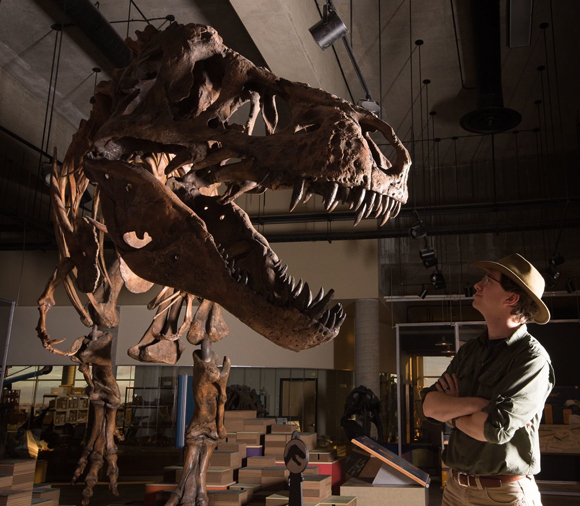
Palaeontologist Scott Persons Stares into the Jaws of “Scotty”

Palaeontologist Scott Persons with the cast of the T. rex "Scotty".

Scott Persons stares into the jaws of “Scotty”.

Picture credit: University of Alberta,  Amanda Kelley via Agence France-Presse – Getty Images

Cranial Armour?

Intriguingly, the skull exhibits a number of lumps and bumps which suggests that T. rex could have had armoured skin, a feature not seen in other T. rex cranial material.   A cast of the fossils will help to form a new mounted Tyrannosaurus rex display, part of an exhibit that is due to open at the Royal Saskatchewan Museum in May 2019.

Scott Persons added:

“I think there will always be bigger discoveries to be made, but as of right now, this particular Tyrannosaurus is the largest terrestrial predator known to science.”

Bigger Specimens Awaiting Discovery

The big, robust bones of this Tyrannosaurus rex probably represent the largest of this species so far described.  To most scientists and academics, which dinosaur was the biggest does not really matter, after all, the mass estimates for tyrannosaurs vary considerably.  However, the authors of the scientific paper, which include Phil Currie and Gregory Erickson, propose that RSM P2523.8 adds weight to the prior hypothesis that there is a sampling bias throughout the Dinosauria.  “Scotty” with its mature, thick-set bones indicates that many other dinosaur taxa grew to significantly greater sizes than currently recognised.

This means, that there are likely to be even bigger dinosaur specimens awaiting discovery…

For the time being, the Royal Saskatchewan Museum can claim that they are putting on display a cast of the heaviest T. rex known to science, a claim that they can make, at least for now.

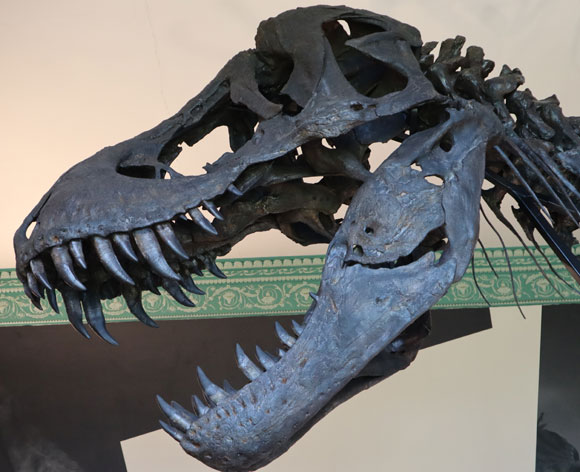
The Fossilised Remains of Even Older and Larger Specimens Probably Await Discovery

Titus the T. rex Skull and Jaws. Dinosaur extinction.

The skull of the T. rex exhibit on display at Wollaton Hall until August 2022.  Picture credit: Everything Dinosaur.

Picture credit: Everything Dinosaur

The scientific paper: “An Older and Exceptionally Large Adult Specimen of Tyrannosaurus rex” by W. Scott Persons IV, Philip J. Currie, Gregory M. Erickson published in the journal The Anatomical Record.

Visit Everything Dinosaur’s award-winning website: Everything Dinosaur.

28 03, 2019

Pterosaur Thursday a Spotlight on Nemicolopterus

By |2023-11-30T14:14:10+00:00March 28th, 2019|Categories: Dinosaur Fans, Everything Dinosaur Products, Everything Dinosaur videos, Main Page, Photos of Everything Dinosaur Products|0 Comments

A Spotlight on the PNSO Nemicolopterus Model

Many of the people that Everything Dinosaur team members follow on social media are fossil hunters.  We have noticed that today, Thursday, seems to feature a lot of our fossil hunting friends showcasing their finds using the meme “fossil flip Thursday”, some of our fossils are a little too delicate to flip, but we thought we could give it a try and highlight the excellent packaging of the PNSO Age of Dinosaurs small models.

We made a short video – pterosaur toss – featuring the new for 2019 PNSO Nemicolopterus figure.

Pterosaur Thursday – Nemicolopterus crypticus

Video credit: Everything Dinosaur

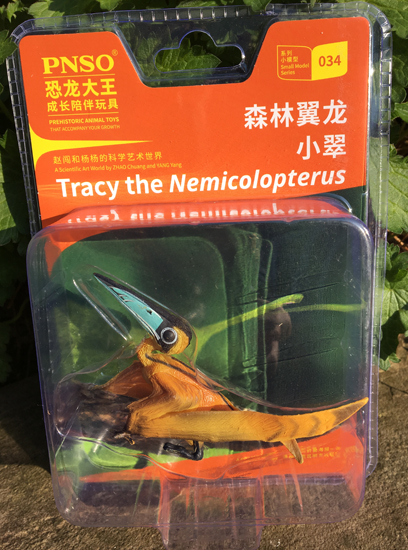
In this very brief video, (it lasts just over thirty seconds), we show the wonderful new PNSO product packaging.  Each of the new for 2019 PNSO figures has been presented in a blister pack which contains a backdrop reflecting the habitat of that animal.  For example, “Ricky” the Keichousaurus, a model of a Triassic marine reptile, has a seascape backdrop, whilst the pterosaur model Nemicolopterus has a forest background.  After all, this little flying reptile lived in an arboreal environment.

The PNSO Nemicolopterus Blister Pack

PNSO Nemicolopterus model.
The packaging associated with the PNSO Nemicolopterus model. Picture credit: Everything Dinosaur.

Picture credit: Everything Dinosaur

We even took advantage of the warm weather to photograph this little pterosaur against some foliage – our very own forest backdrop.

How Big was Nemicolopterus?

Known from only one specimen, this may not be a valid genus (nomen dubium), the fossil could represent a very young Sinopterus, a tapejarid that was scientifically described in 2003.  The skull for example, is around 4 cm in length, it is one of the smallest pterosaur fossils known to science.  Intriguingly, the PNSO Nemicolopterus replica is not much smaller than the fossil specimen.  This little flying reptile, whether a Nemicolopterus or a Sinopterus could have comfortably sat in the palm of your hand.

Everything Dinosaur’s Scale Drawing Showing the Estimated Size of the Nemicolopterus Specimen

Nemicolopterus crypticus scale drawing.
A scale drawing of the tiny pterosaur named Nemicolopterus.  The validity of this genus has been challenged.  It might not be valid, (nomen dubium), it is possible that the single specimen so far described represents a related tapejarid (Sinopterus). Picture credit: Everything Dinosaur.

Picture credit: Everything Dinosaur

The PNSO Age of Dinosaurs Model Range

The PNSO Age of Dinosaurs (Toys that Accompany your Growth) range features a total of forty-eight small models.  This is a diverse and varied range, for instance, several horned dinosaurs feature – Kosmoceratops, Einiosaurus, Liaoceratops, Xenoceratops, Pachyrhinosaurus and Chasmosaurus.  Many of the replicas and figures represent prehistoric animals that are unique to China, creatures such as the armoured dinosaur Tuojiangosaurus, the bizarre marine reptile Atopodentatus and the troodontid Mei long.  However, other models represent prehistoric animals that have no connection with China, or even Asia for that matter.  For example, the ferocious marine crocodile Dakosaurus or the Baryonyx dinosaur model.

To view the range of PNSO Age of Dinosaurs figures available from Everything Dinosaur: PNSO Age of Dinosaur Models.

The Everything Dinosaur website: Everything Dinosaur.

27 03, 2019

The Wild Safari Prehistoric World Malawisaurus

By |2023-11-30T14:07:58+00:00March 27th, 2019|Categories: Dinosaur Fans, Everything Dinosaur Products, Main Page, Photos of Everything Dinosaur Products|0 Comments

The Wild Safari Prehistoric World Malawisaurus

Since its introduction in 2018, the Wild Safari Prehistoric World Malawisaurus has been very well received by model collectors and fans of dinosaurs.  The fossils of a long-necked dinosaur from the Sitwe Valley area of northern Malawi were originally described by the English-born palaeontologist Sidney Henry Haughton.  He proposed that these fossil bones should be assigned to the genus Gigantosaurus, which had been established a few decades earlier.  Gigantosaurus is now regarded as an invalid taxon.

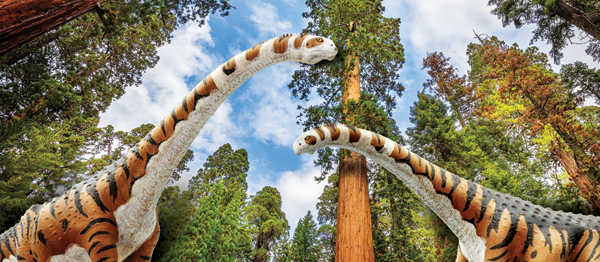
Safari Ltd have created a wonderful model of this African, herbivorous dinosaur and they have put together a stunning image showing two of these models in a primeval forest.

Taking a View on the Wild Safari Prehistoric World Malawisaurus Figure

The Wild Safari Prehistoric World Malawisaurus model.
The Wild Safari Prehistoric World Malawisaurus dinosaur model.

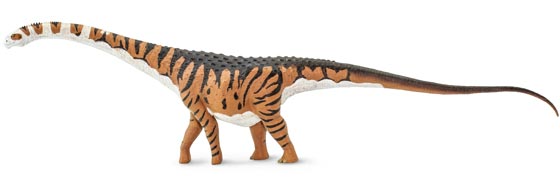
The Malawisaurus Model

Further exploration of the fossil bearing strata was undertaken in the 1980s by a joint field team supported by the Southern Methodist University and the Malawi Department of Antiquities.   As a result of these extensive excavations, around 150 dinosaur bones (Sauropoda) were found.  Following a review of the original fossils and these later fossil discoveries, the Malawisaurus genus was established in 1993.

The Wild Safari Prehistoric World Malawisaurus Model

Malawisaurus dinosaur model.
The Wild Safari Prehistoric World Malawisaurus dinosaur model from Safari Ltd.

The Malawisaurus Measurements

The model measures about thirty-six centimetres in length and the head stands some ten centimetres off the ground.  Everything Dinosaur sends out a fact sheet all about this titanosaur with sales of the model.  The fact sheet provides further information about Malawisaurus (M. dixeyi).

Visit the Everything Dinosaur website: Everything Dinosaur.
In the meantime, we congratulate the team at Safari Ltd for creating some super dinosaur and prehistoric animal themed images.  The species epithet honours Dr Dixey, who participated in the original expedition that uncovered the first fossil remains.

To view the Wild Safari Prehistoric World Malawisaurus and the other models in this excellent figure and replica series: Safari Ltd Wild Safari Prehistoric World Dinosaurs and Prehistoric Animal Models.

26 03, 2019

The Unique Atopodentatus Gets Our Attention

By |2023-11-30T10:03:11+00:00March 26th, 2019|Categories: Dinosaur Fans, Everything Dinosaur News and Updates, Everything Dinosaur Products, Main Page, Photos of Everything Dinosaur Products|0 Comments

The Unique Atopodentatus unicus

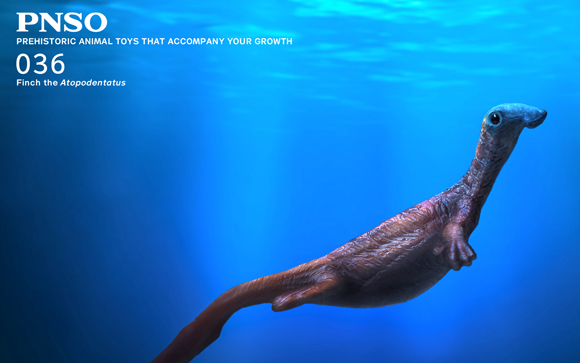
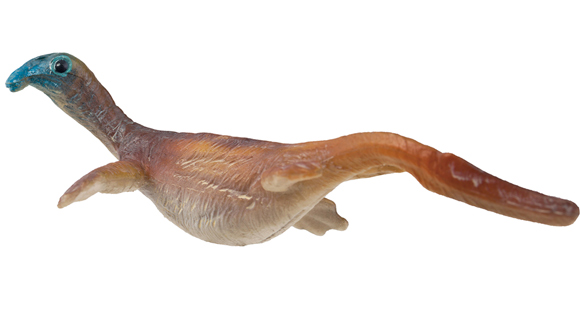
As the new for 2019 PNSO figures arrive at Everything Dinosaur, we have time to reflect on one of the new models.  The replica of the bizarre Triassic marine reptile Atopodentatus (A. unicus).  Although Atopodentatus was named and scientifically described less than five years ago, this three-metre-long tetrapod has certainly attracted a great deal of debate.  Where it sits phylogenetically has yet to be resolved.  Tentatively, it could be placed within the Sauropterygia.  The Sauropterygia is an extremely diverse Superorder of reptiles.  It includes the placodonts, plesiosaurs, nothosaurs and the Pachypleurosauria.*

The New for 2019 PNSO Atopodentatus Model

PNSO Atopodentatus (Finch).
The new for 2019 PNSO Atopodentatus model.

Pachypleurosauria* – PNSO have also introduced a pachypleurosaur into their “Prehistoric Animal Toys That Accompany Your Growth” range, one of the twenty-four new models is “Ricky” the Keichousaurus.

Atopodentatus – At First it was a Filter Feeder

The fossil material associated with this genus comes from south-western China (Guanling Formation).  The strata are thought to be Middle Triassic in age (Anisian faunal stage) and these marine deposits have helped scientists to construct a picture of how life bounced back from the devastating End Permian extinction event.  When first described, Atopodentatus was thought to feed by stirring up mud on the seabed to filter out small invertebrates.  The rostrum was thought to be downturned, resulting in this reptile having a vertical, zipper-like jaw.

A Life Reconstruction of Atopodentatus unicus (2014)

Atopodentatus life reconstruction (2014).
Strange Triassic marine reptile.  Atopodentatus unicus was thought to have had a downturned rostrum, a unique jaw configuration not found in other vertebrates.

Picture credit: Nobu Tamura (2014)

To read Everything Dinosaur’s article about the original scientific description of Atopodentatus: Bizarre New Triassic Marine Reptile Described.

A Marine Reptile with a “Hammerhead”

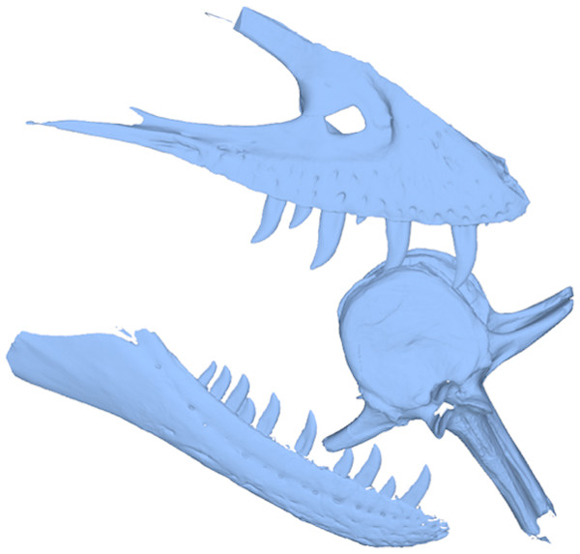
Turns out, Atopodentatus did not have such a unique and highly specialised feeding adaptation after all, but it is nonetheless, quite remarkable.  Additional specimens led to a new interpretation of the shape of the skull and rather than having a downturned rostrum, Atopodentatus had a set of jaws shaped like a hammerhead.  It was proposed that Atopodentatus was herbivorous.   The teeth lining the hammerhead were used to scrape seaweed and algae from rocks.  The plant material was then sucked into the back of the mouth and filtered by the long, thin tooth mesh.

Atopodentatus Life Reconstruction (2016)

Atopodentatus life reconstruction (2016).
An illustration Atopodentatus feeding underwater.

Picture credit: Y. Chen (Institute of Vertebrate Palaeontology and Palaeoanthropology)

To read Everything Dinosaur’s 2016 article about the reinterpretation of Atopodentatus: Atopodentatus Unzipped.

Atopodentatus unicus

Atopodentatus unicus still had a highly specialised feeding adaptation, although one not quite a peculiar as previously thought.  It still represents the oldest record of herbivory within marine reptiles and its discovery has helped scientists to better understand how marine ecosystems recovered after the End Permian extinction event.

Remarking on the addition of an Atopodentatus to the PNSO model range, a spokesperson from Everything Dinosaur commented:

“As a Chinese company, PNSO have attempted to focus on prehistoric animals that lived in China.  This has resulted in a whole new and never before created set of prehistoric animal replicas such as Atopodentatus and Keichousaurus.  Thanks to PNSO, Everything Dinosaur customers now have an even greater variety of prehistoric animal models to collect.”

The New for 2019 PNSO “Finch” – Atopodentatus Figure

PNSO Atopodentatus unicus model.
The PNSO Atopodentatus unicus model.

To view the PNSO Age of Dinosaurs range: PNSO Age of Dinosaurs.

Visit the Everything Dinosaur homepage: Everything Dinosaur.

25 03, 2019

Scientists Collaborate to Explore the Morrison Formation

By |2023-11-30T09:56:48+00:00March 25th, 2019|Categories: Dinosaur and Prehistoric Animal News Stories, Dinosaur Fans, Main Page, Palaeontological articles, Photos/Pictures of Fossils|0 Comments

Manchester University, the Morrison Formation and the “Jurassic Mile”

Scientists at Manchester University have joined forces with a major American Museum and European partners to map and explore an extraordinary Jurassic dinosaur site in the Badlands of Wyoming (USA).  The University of Manchester will act as the academic leaders on this newly announced £20 million ($27.5 USD) research project to examine and eventually exhibit fossils excavated from a recently discovered palaeontological site nicknamed the “Jurassic Mile”. The “Jurassic Mile” represents deposits from the famous Upper Jurassic Morrison Formation.

Exploring the Morrison Formation in Collaboration with the Children’s Museum of Indianapolis

The University of Manchester’s Professor Phil Manning and Dr Victoria Egerton will be collaborating with scientists from the Children’s Museum of Indianapolis.  Also involved are researchers from the Natural History Museum in London and the Naturalis Biodiversity Centre in Leiden (Netherlands).  In total, more than a hundred scientists and academics from three countries will join forces to work at a dig site representing Upper Jurassic strata from the Morrison Formation of Wyoming.  They hope to uncover new data to help explain the extraordinary diversity of the dinosaur biota known from this part of Laurasia in the Late Jurassic.

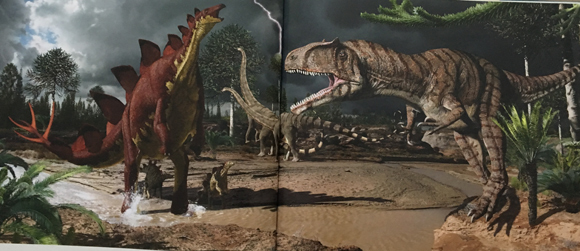
Life in the Late Jurassic – An Illustration of Morrison Formation Biota

Morrison Formation biota.
Life in the Late Jurassic (Morrison Formation biota).  An illustration of life in the Late Jurassic (Morrison Formation) by Julius Csotonyi.  A mother Stegosaurus defends her family from a marauding Allosaurus whilst a pair of diplodocids browse in the background.

Picture credit: Julius Csotonyi

The “Jurassic Mile”

Professor Manning, Dr Egerton and the team are calling the fossil-rich, mile-square plot of land, the “Jurassic Mile.”  There are four main quarries within the multi-level, 640-acre site that offer a diverse assemblage of Morrison Formation articulated and semi-articulated dinosaurs that has also yielded associated animals and fossil plants.  In addition, trace fossils in the form of dinosaur trackways have been identified, such tracks are rare in this part of the world.

Commenting on the significance of this collaborative field work, Professor Manning stated:

“It is splendid that such an important site has been discovered at just the right time, as the science of palaeontology is adapting existing and new imaging techniques to unpick the fossil remains of extinct life.  The imaging work that we undertake at Manchester is already world-leading and this is a great opportunity to develop this research with other world-class institutions.”

A Remarkable Fossil Assemblage

Nearly six hundred specimens, weighing more than six tons, have already been collected from this site over the past two years, despite the fact that only a fraction of the area has been explored.  Fossil bones found to date include the remains of an 20-metre plus brachiosaur and a 27-metre-long diplodocid.  Giant sauropods had giant bones, one of the recent discoveries is a 2-metre-long brachiosaur scapula (shoulder bone), numerous plaster-coated burlap jackets containing articulated bones are the reward for the researchers after a successful field season.

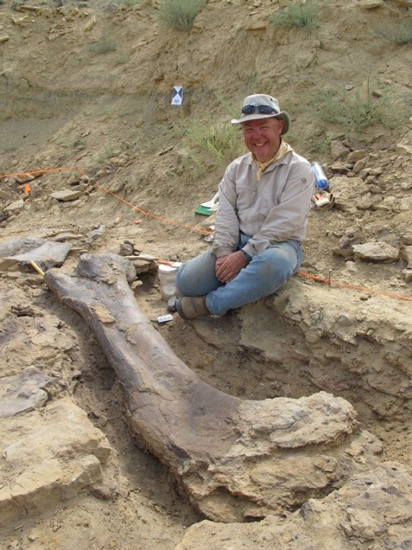
At a press conference, held today, the discovery of an extremely well-preserved 1.5-metre-long sauropod femur (thigh bone), was announced.

Professor Phil Manning (The University of Manchester) with the Sauropod Femur

Professor Phil Manning and the diplodocid femur.
Professor Phil Manning (The University of Manchester), poses next to the diplodocid femur.

Picture credit: The University of Manchester

Dr Jeffrey H. Patchen, President and CEO of The Children’s Museum of Indianapolis commented:

“We are bringing together an extraordinary international team for the first time that will critically analyse portions of the Morrison Formation in new ways.  This project reflects a natural synergy between three world-renowned museums, their research scientists and highly-respected research universities, each providing unique elements to complete one of the most interesting chapters in the evolution of Earth.”

Prehistoric Flora and Fauna

Dr Egerton from the Department of Earth and Environmental Science (Manchester University), explained:

“The preservation quality and sheer amount of plants at the Jurassic Mile is extraordinary.  During this period, there were no flowering plants and this site provides significant insight to what these giant animals ate and how they may have grown to be so large.”

The Jurassic Mile project is already utilising cutting-edge science from the international team.  The University of Manchester scientists will employ the Stanford Synchrotron particle accelerator along with some of the most powerful computers on the planet, to help resurrect the Jurassic and unearth the lost world and forgotten lives of some of the most remarkable terrestrial animals that have ever lived.

Everything Dinosaur acknowledges the assistance of a press release from Manchester University in the compilation of this article.

For models and replicas of prehistoric animals from the Morrison Formation: Dinosaur and Prehistoric Animal Models.

Visit the Everything Dinosaur website: Everything Dinosaur.

24 03, 2019

New Alligator Study Provides Insight into Dinosaur Hearing

By |2023-11-30T14:53:30+00:00March 24th, 2019|Categories: Animal News Stories, Dinosaur Fans, Main Page, Palaeontological articles|0 Comments

Alligator Hearing Study Provides Insight into Dinosaur Hearing

New research published in the “Journal of Neuroscience” identifies that living archosaurs – birds and crocodiles make a mental map of sounds in the same way.  This suggests that this auditory strategy existed in their common ancestor which has implications for dinosaur research.

Animal brains determine where a sound is coming from, by analysing the minute difference in time it takes audio waves to reach each ear—a cue known as interaural time difference.  What happens to the cue once the signals get to the brain depends on what kind of animal is doing the hearing.

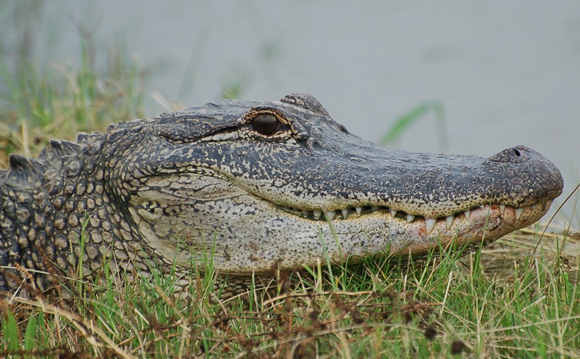
An American Alligator – New Research Suggests that Birds and Crocodilians Hear in the Same Way

An American alligator (Alligator mississippiensis).
A photograph of an American alligator.

Picture credit: Ruth Elsey Louisiana Department of Wildlife and Fisheries

Research into Archosaur Hearing

Scientists have known that birds are exceptionally good at creating neural maps to chart the location of sounds, and that the strategy differs in mammals.  Little was known, however, about how alligators process interaural time difference.

A new study of American alligators (Alligator mississippiensis), found that the reptiles form neural maps of sound in the same way birds do.  The research by Catherine Carr, a Distinguished University Professor of Biology at the University of Maryland and her colleague Lutz Kettler from the Technische Universität München, was published this week in the “Journal of Neuroscience”.

Most research into how animals analyse interaural time difference has focused on physical features such as skull size and shape, but Carr and Kettler believed it was important to look at evolutionary relationships.

Birds have very small head sizes compared with alligators, but the two groups share a common ancestor, as both Aves (birds) and crocodilians are members of the Archosauria.   Archosaurs began to emerge around 246 million years ago and split into two lineages; one that led to alligators and one that led to dinosaurs (and birds).  Although most dinosaurs died out during the mass extinction event 66 million years ago, some types of dinosaur survived and we see their descendants all around us today, these are the modern birds.

Alligator Study

Carr and Kettler’s findings indicate that the hearing strategy birds and alligators share may have less to do with head size and more to do with common ancestry.

Carr commented:

“Our research strongly suggests that this particular hearing strategy first evolved in their common ancestor.  The other option, that they independently evolved the same complex strategy, seems very unlikely.”

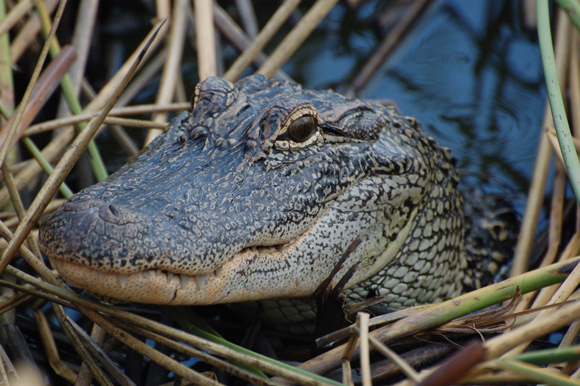
Sedated American Alligators were Fitted with Earphones

An American alligator.
A photograph of an American alligator.

Picture credit:  Ruth Elsey Louisiana Department of Wildlife and Fisheries

To study how alligators identify where sound comes from, the researchers anesthetised forty American Alligators and fitted them with earphones.  They played tones for the sleepy reptiles and measured the response of a structure in their brain stems called the nucleus laminaris.  This structure is the seat of auditory signal processing.  Their results showed that alligators create neural maps very similar to those previously measured in barn owls and chickens.  The same maps have not been recorded in the equivalent structure in mammal brains.

Implications for the Dinosauria

The Distinguished Professor added:

“We know so little about dinosaurs.  Comparative studies such as this one, which identify common traits extending back through evolutionary time add to our understanding of their biology.”

Everything Dinosaur acknowledges the assistance of a press release from the University of Maryland in the compilation of this article.

The scientific paper: “Neural Maps of Interaural Time Difference in the American Alligator: A Stable Feature in Modern Archosaurs” by Lutz Kettler and Catherine Carr and published in the Journal of Neuroscience.

Visit the Everything Dinosaur website: Everything Dinosaur.

23 03, 2019

New March 2019 Newsletter – Collecting CollectA

By |2023-11-30T15:32:55+00:00March 23rd, 2019|Categories: Adobe CS5, Dinosaur Fans, Everything Dinosaur Newsletters, Everything Dinosaur Products, Main Page, Photos of Everything Dinosaur Products, Press Releases|0 Comments

New CollectA Figures and a Special Offer on the Rare Bullyland Pteranodon sternbergi

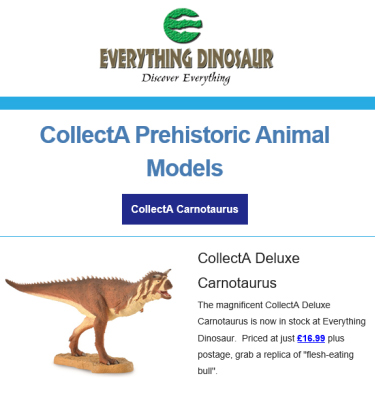
Everything Dinosaur’s first newsletter of the spring features the first of the new for 2019 CollectA figures and a special offer on an extremely rare Bullyland flying reptile figure.  The latest figures in the CollectA “Age of Dinosaurs” series have arrived and it is great to see the Deluxe Caiuajara with its movable jaw, the Borealopelta, Edaphosaurus and the box of mini prehistoric animal models in stock.  Top billing in the newsletter is given to the remarkable CollectA Deluxe Carnotaurus – we know how keen dinosaur fans and model collectors have been on this model since we announced that it was going into production, back in November (2018). An opportunity for Carnotaurus fans to rejoice.

To view the CollectA Deluxe models including the new Carnotaurus: Collecta Deluxe Prehistoric Life.

The CollectA Deluxe 1:40 Carnotaurus Model Headlines the Everything Dinosaur March Newsletter

CollectA Deluxe Carnotaurus model.
Top billing in the latest Everything Dinosaur newsletter. Picture credit: Everything Dinosaur.

Picture credit: Everything Dinosaur

The CollectA Edaphosaurus

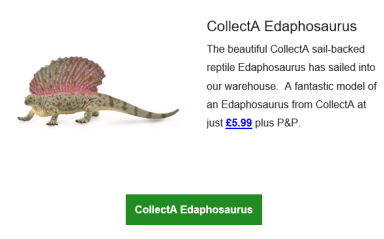
Ever since the 1:20 scale CollectA Dimetrodon was introduced in 2018, fans of this range have been eagerly looking forward to the addition of another Permian pelycosaur to this series.  The hand-painted 1:20 scale CollectA Edaphosaurus lives up to all the hyperbole and it makes a great accompaniment to the Dimetrodon figure.

To view the range of CollectA prehistoric animal models available from Everything Dinosaur including the Edaphosaurus: CollectA Prehistoric Life Models.

A Sail-backed Prehistoric Animal Model Sails into Stock at Everything Dinosaur

CollectA Edaphosaurus.
The new CollectA Edaphosaurus model features in an Everything Dinosaur newsletter. Picture credit: Everything Dinosaur.

Picture credit: Everything Dinosaur

Flying Reptiles from Brazil and an Armoured Dinosaur from a Canadian Mine

Everything Dinosaur has also received a shipment of Caiuajara models, complete with an articulated lower jaw.  Fossil of this pterosaur were found in Brazil.  The CollectA Borealopelta figure has also arrived, although sadly, several cases of models were lost during shipment.  A spokesperson from Everything Dinosaur commented that plans were in place to get more of these armoured dinosaur models into stock as quickly as possible.  Perhaps, the missing models have got lost in a mine, as the only known Borealopelta specimen was discovered in a mine located in north-eastern Alberta (Canada).

The CollectA Deluxe Caiuajara and the CollectA Borealopelta

The CollectA Deluxe Caiuajara with a moveable jaw and a CollectA Borealopelta.
CollectA Deluxe Caiuajara and the CollectA Borealopelta figure. Picture credit: Everything Dinosaur.

Picture credit: Everything Dinosaur

Mini Prehistoric Animal Models and a Special Offer on an Extremely Rare Replica

Also just arrived at Everything Dinosaur is the box of mini prehistoric animal models.  A set of twelve miniature figures produced by CollectA and designed to accompany their larger equivalents in the scale model series.  Last but not least, the March newsletter features a special offer!  A chance to purchase the very rare and long retired Bullyland Pteranodon sternbergi figure at the same price offered by Everything Dinosaur when it was last available nearly ten years ago!

Mini Prehistoric Animals and a Special Offer for Newsletter Subscribers

CollectA mini prehistoric animals and a Bullyland Pteranodon (P. sternbergi).
The new set of twelve mini prehistoric animal models from CollectA and a special offer on the very rare Bullyland Pteranodon sternbergi figure. Picture credit: Everything Dinosaur.

Picture credit: Everything Dinosaur

Everything Dinosaur newsletter subscribers are amongst the first to learn about new models and replicas coming into stock.  Subscribers can also be the first to join a priority reserve list to ensure that they can acquire new figures.  Our newsletter is sent out periodically and it is free to join.

A spokesperson from Everything Dinosaur commented:

“The newsletter is a fantastic way for our customers to be kept informed and to stay up-to-date with developments at Everything Dinosaur.”

To request to join the Everything Dinosaur newsletter subscribers list: Simply Email Everything Dinosaur.

Visit the Everything Dinosaur website: Everything Dinosaur.
Go to Top