All about dinosaurs, fossils and prehistoric animals by Everything Dinosaur team members.

Fossil finds, new dinosaur discoveries, news and views from the world of palaeontology and other Earth sciences.

7 02, 2019

New Defensive Dicraeosaurids – Forward Facing Spikes Deter Predators

By |2023-11-22T09:24:46+00:00February 7th, 2019|Categories: Dinosaur and Prehistoric Animal News Stories, Dinosaur Fans, Main Page, Photos/Pictures of Fossils|0 Comments

Bajadasaurus pronuspinax – Sauropod Defences

A newly described sauropod from northern Patagonia (Argentina), has provided palaeontologists with evidence to help explain why some of these long-necked dinosaurs evolved long, paired spines on the necks.  These features may have had a primary role as defensive structures helping to deter attacks from theropod predators.  The dinosaur has been named Bajadasaurus pronuspinax and it has been assigned to the Dicraeosauridae family, a sister family to the Diplodocidae within the Sauropoda.  Dicraeosaurids are characterised by having relatively shorter necks and distinctive vertebrae which had long, paired neural spines.  The function of these spines has long been debated.  They have been interpreted as playing a role in visual communication, sexual display and thermoregulation, however, this newly described dinosaur suggests that within this family of long-necked dinosaurs they evolved as a form of defence.

Illustrating Bajadasaurus pronuspinax and the Fossil Find Location
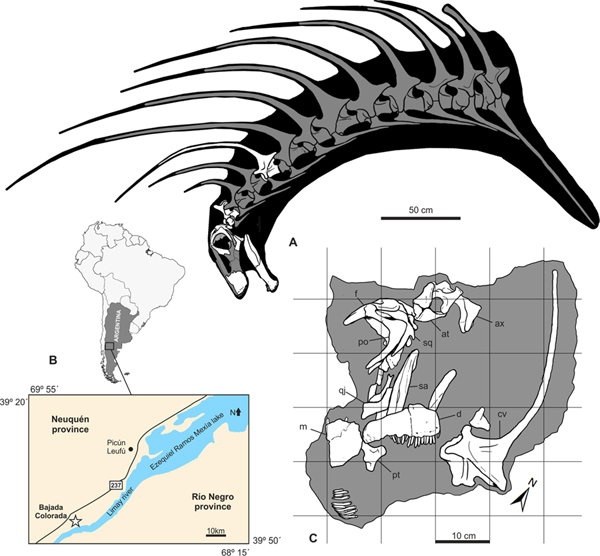
Bajadasaurus skeletal reconstrution and fossil find location.
A skeletal reconstruction of Bajadasaurus, location map of fossil finds and drawing of the fossil material in situ.

Picture credit: Gallina et al published in Scientific Reports

The image (above), shows a skeletal reconstruction of the head and neck of Bajadasaurus (A), with the preserved fossil material shown in white.  On the right of the image is a location map (B), showing the site of the fossil find, close to the Ezequiel Ramos Mexía lake in Neuquén Province, Argentina.  A line drawing is provided (C), that shows the association and the location of the fossils found at the dig site.

Interpreting Fossils One Cervical Vertebra at a Time

The authors of the scientific paper, propose that the elongated neural spines of this dinosaur always faced forward, presenting a formidable obstacle for any meat-eating dinosaur wanting to attack the animal’s neck.  However, it is worth noting that if the image (above), is studied, the theory of Bajadasaurus having a neck topped with defensive spikes, like some sort of Victorian railings is based on the discovery of a single neck bone, in the skeletal illustration placed in the position of the fifth cervical vertebra.  The appearance of B. pronuspinax is inferred by comparing these fossils to the better-known Amargasaurus (A. cazaui).  Until more fossils are found the appearance of Bajadasaurus and the orientation of those neural spines can only be speculated.

A Model of the Dicraeosaurid Amargasaurus

A model of Amargasaurus.
The Amargasaurus has been mounted onto a bespoke base.  The appearance of Bajadasaurus is based on a comparison with better-known, related dicraeosaurids such as Amargasaurus cazaui.

Lead-author of the study, Pablo Gallina and his colleagues, propose that these neural spines may have been covered with keratin and therefore much longer than the spines themselves.  The extent of the neural spines, the length of the keratin sheaths that covered them and the direction they pointed in, remains unknown.  Until more fossils of Bajadasaurus are found, those elongated neural spines remain a mystery.

Naming a New Dinosaur

That one cervical spine forms the basis for the species epithet.  The genus honours Bajada (Spanish for downhill), a reference to the fossil find location – Bajada Colorada.  The species name means “bent over, forward spines”, we shall see if more fossil discoveries reaffirm this interpretation.  Importantly, the fossil material assigned to Bajadasaurus includes much of the skull, thanks to these fossils, the palatal bones, the braincase and a nearly complete left dentary, palaeontologists have a much better idea about the size and morphology of dicraeosaurid dinosaur skulls.

Skull Material Associated with Bajadasaurus pronuspinax and Line Drawing
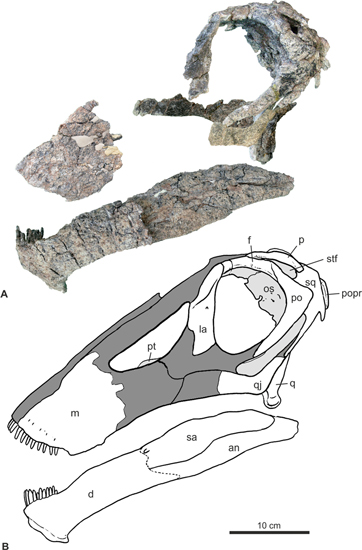
Bajadasaurus and line drawing.
Skull of Bajadasaurus pronuspinax, specimen number MMCh-PV 75 and line drawing.

Picture credit: Gallina et al published in Scientific Reports

The skull is quite small for a sauropod, dicraeosaurids described to date were not as big as some of their diplodocid cousins.  Size estimates range from around 10 to 13 metres in length.  The size of Bajadasaurus is unknown, but based on these fossils, it is likely that this dinosaur was within this size range too.  The orbits are quite large and their position on the top of the skull suggests that when this dinosaur had its head down and it was feeding, it was capable of seeing ahead (forward-directed, stereoscopic vision).

Comparing Bajadasaurus to the Geologically Younger Amargasaurus

The strata of the Bajada Colorada Formation represent sediments laid down at the very beginning of the Cretaceous (Lower Cretaceous, Berriasian/Valanginian faunal stages).  Bajadasaurus roamed Patagonia some 140 million years ago.  Amargasaurus, lived in the same part of South American but around fifteen million years later.

A Model of the Sauropod Dinosaur Bajadasaurus
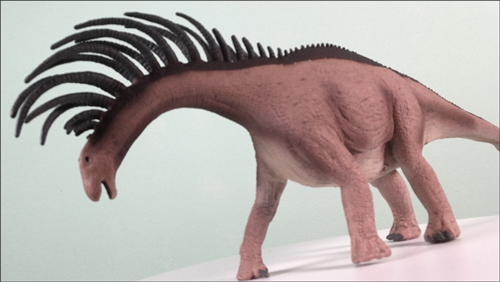
The CollectA Deluxe Bajadasaurus dinosaur model.
The new for 2020 CollectA Deluxe1:40 scale Bajadsaurus dinosaur model. Picture credit: Everything Dinosaur.

Picture credit: Everything Dinosaur

The picture (above) shows a CollectA Deluxe Bajadasaurus dinosaur model.

To view this model range: CollectA Deluxe Age of Dinosaurs Models.

The researchers suggest that the temporal difference between Bajadasaurus and Amargasaurus, supports the idea that the development of an array of defensive spines was likely adaptive over a long time period.  How effective these spines may have been against predators, is once again, open to speculation.  However, the presence of elongated neural spines would have given the impression of a larger animal with a thicker neck.  To a hungry, carnivorous dinosaur the appearance of a bigger more robust adversary may have been enough of a deterrent.

The scientific paper: “A New Long-spined Dinosaur from Patagonia Sheds Light on Sauropod Defence System” by Pablo A. Gallina, Sebastián Apesteguía, Juan I. Canale and Alejandro Haluza published as an open access article in the journal “Scientific Reports”.

Visit the Everything Dinosaur website: Everything Dinosaur.
5 02, 2019

Iconic Feather Fossil Did Not Belong to Archaeopteryx

By |2023-11-22T07:44:53+00:00February 5th, 2019|Categories: Dinosaur and Prehistoric Animal News Stories, Dinosaur Fans, Main Page, Photos/Pictures of Fossils|0 Comments

Single Feather Not From Archaeopteryx

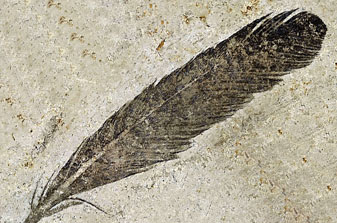
One of the most significant fossils to have ever been found, an iconic fossil in vertebrate palaeontology – a single fossilised feather from the Upper Jurassic Solnhofen limestone, is not quite what it seems.  The feather, long thought to be from an Archaeopteryx, is probably not from the “urvogel” at all.  The feather most likely was lost by a dinosaur, before it was blown into a shallow, calm lagoon and preserved as a carbonised film for 150 million years.

The Iconic Single Feather Fossil – Once Synonymous with Archaeopteryx is Not What it Seems

The Berlin feather - preserved as a carbonised film.
The slab from the Berlin museum showing the iconic feather, so long associated with Archaeopteryx but now thought to have belonged to a dinosaur.

An international research team which included Dr Michael Pittman (University of Hong Kong), have applied a novel, high-tech, imaging method called Laser-Stimulated Fluorescence (LSF), to  help solve a 150-year-old mystery and to confirm that this feather was not from Archaeopteryx.

Discovered in 1861

The specimen was discovered in 1861 and actually consists of a slab and counter slab component, housed in museums located in Berlin and Munich.  A year later, the fossil feather was formally described and heralded as coming from an Archaeopteryx (A. lithographica), although unlike most feather impressions associated with the dozen or so Archaeopteryx specimens known to science, this feather was preserved as a dark, carbonised film.  This was the first fossil feather ever discovered and at the time fossils of Archaeopteryx were heralded as evidence of a “missing link”, supporting Darwin’s recently published theory of natural selection.

The detailed scientific description published in 1862 commented upon a rather long quill visible on the fossil, but this is unseen today.  Even recent X-ray fluorescence and UV (ultraviolet), imaging studies did not end the controversy of the “missing quill”.  The original existence of this quill has therefore been debated and it was unclear if the single feather represented a primary, secondary, or primary covert feather from Archaeopteryx.

Archaeopteryx

Writing in the academic journal Scientific Reports, the researchers outline their work using the LSF technology and demonstrate its potential for providing new information about extensively studied fossil specimens.  The application of Laser-Stimulated Fluorescence is being developed by Thomas G Kaye of the Foundation for Scientific Advancement, Sierra Vista, Arizona (USA) and Dr Pittman.

Dr Pittman stated:

“My imaging work with Tom Kaye demonstrates that important discoveries remain to be made even in the most iconic and well-studied fossils.”

Detecting the Geochemical Presence of the Lost Quill

The application of LSF technology permitted the scientists, which included lead-author of the study Tom Kaye, to detect the geochemical halo from the rachis, matching the 1862 description.

Views of the Isolated Solnhofen Feather – Not from Archaeopteryx

Images of the Solnhofen isolated feather.
The isolated feather viewed under natural light (top), the original drawing from 1862 by Hermann von Meyer and under (LSF) showing the halo of the missing quill (bottom). Scale bar is 1 cm.

Picture credit: University of Hong Kong

Not Archaeopteryx but Probably from a Feathered Dinosaur

The shape of the feather has led the researchers to discount the idea that it came from an Archaeopteryx.  Instead, they conclude that it probably came from an unknown species of feathered dinosaur that lived alongside Archaeopteryx in the Solnhofen Archipelago.

Daniela Schwarz, a co-author of the scientific paper based at the Museum für Naturkunde, Berlin, commented:

“It is amazing that this new technique allows us to resolve the 150-year-old mystery of the missing quill.”

This new insight into an iconic fossil specimen also suggests that the diversity of feathered dinosaurs was likely higher in the ancient island archipelago than previously thought.

Tom Kaye added:

“The success of the LSF technique here is sure to lead to more discoveries and applications in other fields.  But, you’ll have to wait and see what we find next!”

Visit the award-winning Everything Dinosaur website: Everything Dinosaur.

1 02, 2019

Pachyrhinosaurus perotorum – New Research is Published

By |2023-11-22T06:50:06+00:00February 1st, 2019|Categories: Dinosaur and Prehistoric Animal News Stories, Dinosaur Fans, Main Page, Palaeontological articles|0 Comments

Puzzling Pachyrhinosaurs – The Remarkable Pachyrhinosaurus perotorum

Researchers from the Perot Museum of Nature and Science (Dallas, USA), in collaboration with the University of Toronto (Canada), have published an update on their research into one of the most remarkable Late Cretaceous dinosaurs known to science.

Pachyrhinosaurus perotorum

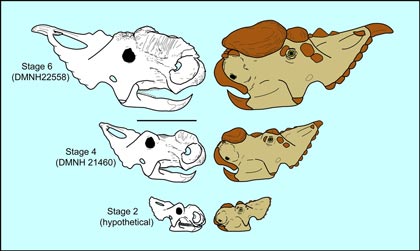
Back in 2011, Everything Dinosaur reported that field work in the high Arctic led by palaeontologists from the Perot Museum of Nature and Science had uncovered the fossilised remains of at least ten individual dinosaurs representing a new species of ceratopsian.  This horned dinosaur, a pachyrhinosaur, was named Pachyrhinosaurus perotorum and it became the third species to be assigned to this centrosaurine genus.  With numerous specimens to study, the palaeontologists could gain a fresh perspective on how horned dinosaurs changed as they grew up and develop a better understanding of the cranial ornamentation associated with the Ceratopsidae.

The Ontogeny of P. perotorum

Illustrating the ontogeny of a Pachyrhinosaurus (P. perotorum).
How a baby P. perotorum grew up.  With numerous individuals represented at the same dig site, palaeontologists can examine variation within a species and assess how these dinosaurs changed as they matured.

Picture credit: Perot Museum of Nature and Science

Updating Their Findings About Pachyrhinosaurus

The authors of the original scientific paper describing P. perotorum, Anthony Fiorillo and Ronald Tykoski, have published a new report in conjunction with Kentaro Chiba of the Department of Ecology and Evolutionary Biology at the University of Toronto, updating their research and providing more information on how this species can be distinguished from the two other species of Pachyrhinosaurus.

The continued preparation of fossil specimens collected from the type locality, the  Kikak-Tegoseak Quarry (Prince Creek Formation), has produced more skull elements to study.  The researchers note that their original reconstruction of the type parietal bone was incorrect, the parietal along with the squamosal bone form the neck frill in horned dinosaurs.  The parietal of P. perotorum is similar to the parietal bones of the other species – P. canadensis and P. lakustai.

It is postulated that Pachyrhinosaurus perotorum can be identified by an upturned tip of the rostrum, a dorsally shifted rostral bone lacking a sharply downturned, parrot-like beak and an enlarged median ridge at the posterior end of the nasal boss.  Other differences in cranial morphology are also tentatively proposed in the new scientific paper, published in the Journal of Systematic Palaeontology.

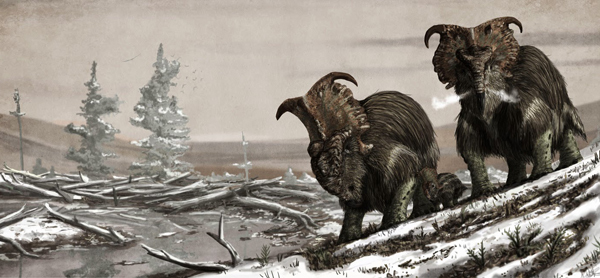
A Speculative Illustration of the High Northern Latitude Ceratopsian Pachyrhinosaurus perotorum

A northern Ceratopsian with a shaggy coat.
A speculative illustration of Pachyrhinosaurus perotorum with a shaggy coat of feathers.  Although northern Alaska was warmer in the Late Cretaceous than today, it would have been distinctly chilly, too cold for ectothermic reptiles and it has been speculated that the dinosaur biota of high latitudes may have been specifically adapted to cold climates.  In this illustration, Pachyrhinosaurus has been depicted with a long, shaggy coat of feathers to help keep out the cold.

Picture credit: Mark Witton

A Sister Taxon of Pachyrhinosaurus canadensis

A cladistic analysis undertaken by the team using this new dataset in conjunction with previous research confirms that the Pachyrhinosaurus genus is monophyletic (all descended from a common ancestor) and that Pachyrhinosaurus canadensis is the sister taxon to P. perotorum.  In addition, this research supports the idea that parietal and squamosal frill ornamentations alone do not adequately address the variables in craniofacial morphology needed to distinguish between species of Pachyrhinosaurus.

The continuing research into horned dinosaurs that lived at high latitudes is helping palaeontologists to gain a better understanding of a unique ecosystem that existed towards the end of the dinosaur age.  Pachyrhinosaurus perotorum is not only the youngest pachyrhinosaur species known, it is also the geologically youngest known centrosaurine.  With three species assigned to the genus, Pachyrhinosaurus is the most speciose of all the Centrosaurinae genera.

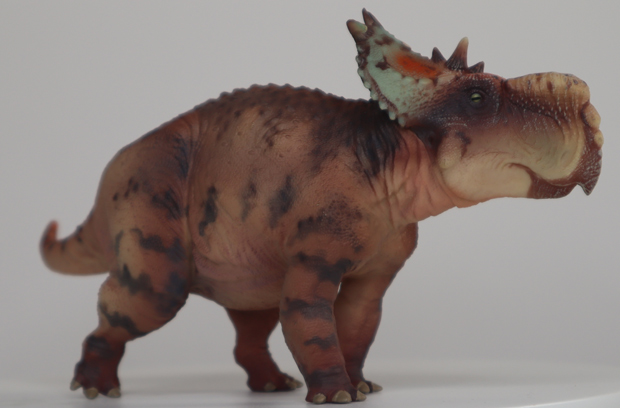
A Model of a Pachyrhinosaurus

The Haolonggood Pachyrhinosaurus dinosaur model (LvFang)
The Haolonggood Pachyrhinosaurus dinosaur model (LvFang) photgraphed in the studio. Picture credit: Everything Dinosaur.

Picture credit: Everything Dinosaur

The picture (above) shows a Pachyrhinosaurus model in the Haolonggood range of figures.

To view this range: Haolonggood Prehistoric Animal Models.

Commenting About Pachyrhinosaurus perotorum

A spokesperson from Everything Dinosaur commented:

“Pachyrhinosaurus perotorum holds a special place in Ceratopsidae research.  It lived at a higher latitude than any other horned dinosaur known to science and, as a consequence, had to endure some very tough and harsh climatic conditions.  Whether this dinosaur was a seasonal migrant to the area in summer to take advantage of the 24-hours of daylight that permitted abundant plant growth, or whether this reptile was a permanent resident remains uncertain.  However, the discovery of the fossilised remains of a juvenile at the Kikak-Tegoseak Quarry, suggests that this dinosaur could have been indigenous to northern Alaska during the Maastrichtian faunal stage.”

To read Everything Dinosaur’s original article from 2011 that announced the discovery of a third species of Pachyrhinosaurus: A New Species of Pachyrhinosaurus – P. perotorum.

The scientific paper: “New Data and Diagnosis for the Arctic Ceratopsid Dinosaur Pachyrhinosaurus perotorum” by Ronald S. Tykoski, Anthony R. Fiorillo and Kentara Chiba published in the Journal of Systematic Palaeontology.

Visit the Everything Dinosaur website: Everything Dinosaur.
31 01, 2019

A Newly Described Archosauromorph from Antarctica

By |2023-11-21T18:28:18+00:00January 31st, 2019|Categories: Dinosaur and Prehistoric Animal News Stories, Dinosaur Fans, Geology, Main Page, Photos/Pictures of Fossils|0 Comments

Antarctanax shackletoni – Rise of the Archosaurs

A team of researchers, including scientists from the Field Museum (Chicago, USA), the University of Witwatersrand (South Africa) and the Burke Museum (University of Washington, USA), have published a scientific paper announcing the discovery of an archosauriform archosauromorph, that roamed Antarctica in the Early Triassic.  The fossil discovery suggests that early archosaurs were more geographically widespread than previously thought and demonstrates that the biota of Antarctica may have been very different from other parts of the super-continent Pangaea as the planet recovered from the End-Permian mass extinction event.

A Diverse Fauna in Antarctica During the Early Triassic

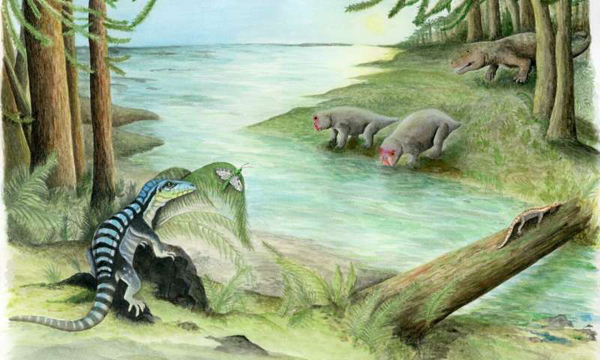
Antarctica around 250 million years ago (Antarctanax shackletoni is in the left foreground).
A typical scene in Antarctica during the Early Triassic.   Antarctanax is in the left foreground.

Picture credit: Adrienne Stroup (Field Museum, Chicago)

The illustration above depicts a typical ecosystem that existed in Antarctica approximately 250 million years ago.

Along the banks of a river, three archosaur inhabitants of the dense Voltzia conifer forest cross paths, Antarctanax shackletoni attempts to sneak up on an early titanopetran insect, an archosauromorph Prolacerta rests on a log, and an enigmatic large archosaur pursues two unsuspecting dicynodonts, (Lystrosaurus maccaigi).

“Antarctic King” – Antarctanax shackletoni

Commenting on the significance of the discovery of the iguana-sized animal, co-author of the scientific paper Brandon Peecook (Field Museum) stated:

“This new animal was an archosaur, an early relative of crocodiles and dinosaurs.  On its own, it just looks a little like a lizard, but evolutionarily, it’s one of the first members of that big group.  It tells us how dinosaurs and their closest relatives evolved and spread.”

The fossil skeleton is far from complete.  The material was collected from a site representing Lower Fremouw Formation deposits in the central Transantarctic Mountains.  The fossils consist of cervical and dorsal vertebrae, a single humerus and foot bones.  The reptile has been named Antarctanax shackletoni.  The genus name means “Antarctic King”, although this ancient, basal member of the group of reptiles that was to give rise to the dinosaurs, pterosaurs, crocodiles and birds, was probably not an apex predator.  This cannot be stated with certainty, after all, only one fossil specimen has been found, but Antarctanax shackletoni co-existed with a number of other vertebrates including amphibians, synapsids and at least one large archosauriform, which may have been the top predator.

The species name honours the polar explorer Ernest Shackleton.  It is suggested that Antarctanax hunted insects as well as smaller vertebrates.

Antarctanax – Where it Lived and When

Brandon Peecook, a member of the Integrative Research Centre, at the Field Museum explained that this fossil find (made in the 2010/11 field season), is significant because it demonstrates that the ecosystem in Antarctica bounced back relatively quickly after the End-Permian mass extinction event and that  archosauriforms were quite widespread at this time.

He stated:

“The more we find out about prehistoric Antarctica, the weirder it is.  We thought that Antarctic animals would be similar to the ones that were living in southern Africa, [Karoo Basin biota] since those landmasses were joined back then, but we’re finding that Antarctica’s wildlife is surprisingly unique.”

The fauna of the Lower Fremouw Formation traditionally has been considered to represent a subset of the Lystrosaurus Assemblage Zone of the Karoo Basin of southern Africa, with discrepancies largely a result of pronounced differences in sampling intensity.  However, a review of recent changes to the fauna, as well as a reassessment of occurrences based on older literature, indicates that significant discrepancies, including the co-occurrences of taxa known from both earlier and later in time and the presence of endemic forms in Antarctica, exist between the faunas of the Lystrosaurus Assemblage Zone and Lower Fremouw Formation.

In essence, Antarctica 250 million years ago had a different ecosystem to that associated with the contemporaneous Karoo Basin deposits.

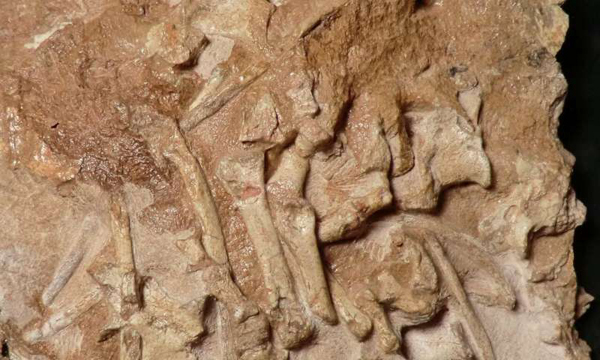
A Slab of Rock Containing Exposed Post-cranial Material Attributed to Antarctanax shackletoni

Antarctanax shackletoni fossils
Antarctanax shackletoni fossil material.

Picture credit: Brandon Peecook, Field Museum

As life on Earth recovered in the Early Triassic, so the archosaurs rapidly diversified and laid the foundation for the evolution of the Dinosauria, Pterosauria, crocodiles and those other archosaurs still very much with us today – the Aves (birds).

Post-doctoral Fellow Peecook, went on to state:

“Before the mass extinction, archosaurs were only found around the Equator, but after it, they were everywhere.   Antarctica had a combination of these brand-new animals and stragglers of animals that were already extinct in most places, what palaeontologists call ‘dead clades walking.’  You’ve got tomorrow’s animals and yesterday’s animals, co-habiting in a cool place.”

The fact that scientists have found Antarctanax helps bolster the idea that Antarctica was a place of rapid evolution and diversification after the mass extinction.

A spokesperson from Everything Dinosaur commented:

“Antarctica is an extremely difficult part of the world to prospect for fossils.  However, as more of the frozen continent is mapped and explored, so more fossil discoveries are going to occur.  Antarctanax shows that there was a diverse faunal assemblage on this part of Pangaea during the Early Triassic and this discovery will help palaeontologists to plot the evolution and distribution of archosaurs.”

Everything Dinosaur acknowledges the assistance of a press release from the Field Museum (Chicago), in the compilation of this article.

The scientific paper: “A Novel Archosauromorph from Antarctica and an Updated Review of a High-latitude Vertebrate Assemblage in the Wake of the End-Permian Mass Extinction” by Brandon R. Peecook, Roger M. H. Smith and Christian A. Sidor published in the Journal of Paleontology.

Visit the Everything Dinosaur website: Everything Dinosaur.
25 01, 2019

Link Between Bird Beak Shape and Feeding Ecology Not That Strong

By |2023-11-21T07:41:44+00:00January 25th, 2019|Categories: Animal News Stories, Dinosaur and Prehistoric Animal News Stories, Dinosaur Fans, Main Page|0 Comments

Bird Beak Shape Did Not Evolve to Help Process Different Types of Food

A team of international researchers, including scientists from Bristol University, have published a new scientific paper that provides a new perspective on how the beaks of birds adapted over time. It seems that the “strong relationship” between bird beak shape and what the bird eats might not be that strong a relationship after all.

New Research Shows a Link Between Beak Shape and Feeding Ecology but it is not as Strong as Previously Suggested

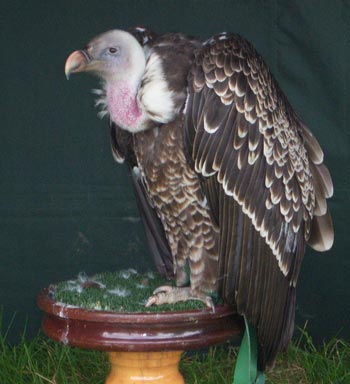
bird evolution is studied
Vultures could provide us with clues about the evolution of the beaks of birds. Picture credit: Everything Dinosaur.

Picture credit: Everything Dinosaur

Darwin and the Galapagos Finches

Charles Darwin famously observed that finches on different islands of the Galapagos possessed distinctive beak shapes.  He postulated that the beak shapes had come about due to natural selection as the birds adapted to fill unique niches within the ecosystem.  It had been assumed that this form-function relationship holds true across all species of bird.  In a new study looking at a total of 176 extant avian species and published in the academic journal “Evolution”, it is suggested that the beaks of birds are not as adapted to the food types they feed upon as it is generally believed.  After all, birds use their beaks for a variety of functions not just for feeding.

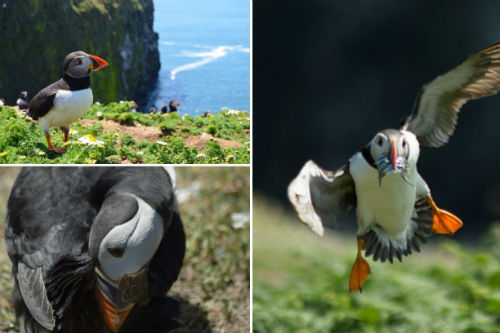
Puffins on the Island of Skomer – Beaks Perform a Variety of Tasks

Bird beaks used for various tasks not just feeding.
The beak on a bird is used for various tasks.  Functions of the beak include visual display, preening and feeding.

Picture credit: Sergio Martínez-Nebreda and Paula Medina-García

Bird Beak Evolution

The research team, consisting of scientists from the UK, the United States and Spain, used mathematical and computational statistical techniques to map the connection between beak shapes and functions in birds.  By measuring the beak shape in a wide range of modern bird species from museum collections and looking at information about how the beak is used by different species to consume different foods, the scientists were able to examine the link between beak shape and feeding behaviour.  Did feeding behaviour influence beak shape evolution?  If it did, how strong a link was this?

Co-author of the study, Professor Emily Rayfield (Bristol University), commented:

“This is, to our knowledge, the first approach to test a long-standing principle in biology: that the beak shape and function of birds is tightly linked to their feeding ecologies.”

Lead author of the research, Guillermo Navalón, a PhD student at Bristol University’s School of Earth Sciences added:

“The connection between beak shapes and feeding ecology in birds was much weaker and more complex than we expected and that while there is definitely a relationship there, many species with similarly shaped beaks forage in entirely different ways and on entirely different kinds of food.  This is something that has been shown in other animal groups, but in birds this relationship was always assumed to be stronger.”

Research co-author, Dr Jesús Marugán-Lobón from Universidad Autónoma de Madrid, explained:

“These results only made sense when you realise birds use the beak for literally everything!  Therefore, it also makes sense they evolved a versatile tool not just for getting food, but also to accomplish many other tasks.”

Important Implications for the Study of Fossil Birds

The study is part of a larger research programme by the team in collaboration with academics from other universities across Europe and the USA to better understand the main drivers of the evolution of the skull in birds, the only living members of the Theropoda.  Similar results were identified in a study of birds of prey, but this is the first time that the link between beak shape and ecology has been examined across a wide variety of bird families.

Guillermo Navalón added:

“These results have important implications for the study of fossil birds.  We have to be careful about inferring ecology in ancient birds, which we often assume based solely on the shape of the beak.”

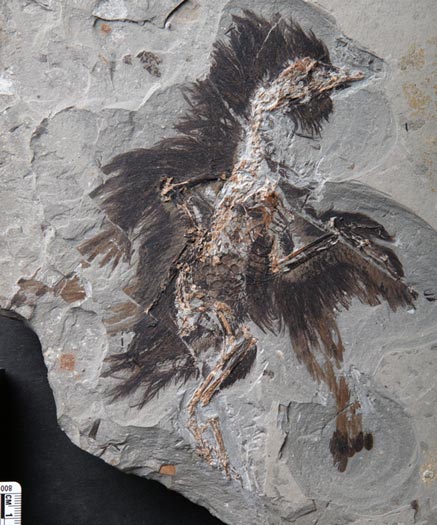
A Fossil Bird – Eoconfuciusornis

Eoconfuciusornis fossil bird.
The fossilised remains of a Lower Cretaceous bird from China (Eoconfuciusornis).  This new study has implications for how the beaks of fossil birds are interpreted.

Picture credit: Dr Xiaoli Wang (Linyi University)

What About the Pterosauria?

This study may also have implications for the Pterosauria.  Pterosaurs are extinct and they have no living close relatives, so what we know about these volant animals has to be deduced from their fossils.  There are many different types of beak associated with these flying reptiles and the link between shape and feeding ecology may not be as strong as previously thought.  The beaks of pterosaurs may not be as adapted to the food types they are thought to have fed upon.

A Wide Range of Different Beak Types Demonstrated in the Pterosauria

Examples of pterosaurs from the Museum Nacional collection.
The Pterosauria exhibit a wide variety of different types of mandible. Picture credit: Everything Dinosaur.

Picture credit: Everything Dinosaur

If the mandibles of pterosaurs were employed in a variety of functions such as display, preening and visual signalling as well as feeding could their beaks be not as well adapted to the food types they fed on as is generally believed?  These reptiles had more manipulative function in their hands and fingers than extant birds, but the function of the hand would have been limited by the animal’s wing membranes.

Everything Dinosaur acknowledges the assistance of a press release from the University of Bristol in the compilation of this article.

The scientific paper: “The Evolutionary Relationship between Beak Shape, Mechanical Advantage and Feeding Ecology in Modern Birds” by G. Navalón, J. A. Bright, J. Marugán‐Lobón and E.J. Rayfield published in the journal Evolution.

Visit the Everything Dinosaur website: Everything Dinosaur.
23 01, 2019

Prehistoric Shark Named after Video Game

By |2023-11-20T15:34:12+00:00January 23rd, 2019|Categories: Dinosaur and Prehistoric Animal News Stories, Dinosaur Fans, Main Page, Palaeontological articles, Photos/Pictures of Fossils|0 Comments

Galagadon nordquistae – Shark Resident of Hell Creek

Perhaps the most famous exhibit at the Field Museum (Chicago), is the Tyrannosaurus rex specimen named “Sue”, the most complete T. rex fossil discovered to date.  A great deal of research has been carried out on the 66 million-year-old fossilised bones of this giant, meat-eating theropod that measures over twelve metres in length.  However, the matrix that surrounded the fossil material has helped to shed light on another resident of the famous Hell Creek Formation of South Dakota.  Fossil teeth found in the matrix surrounding the bones of the most famous T. rex in the world has led to the naming and description of a prehistoric shark that lived in freshwater, say hello to Galagadon nordquistae.

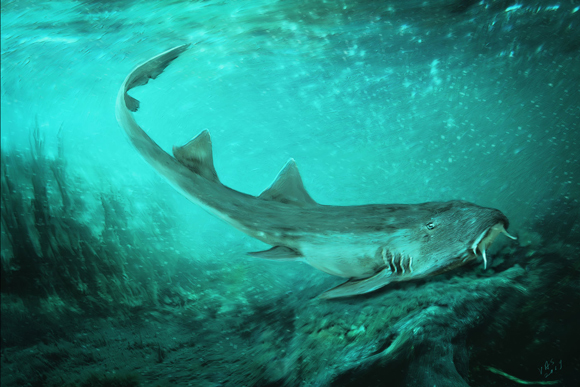
A Life Reconstruction of the Late Cretaceous Shark G. nordquistae

Galagadon nordquistae life reconstruction.
A life reconstruction of the Late Cretaceous shark Galagadon nordquistae.

Picture credit: Velizar Simeonovski (Field Museum)

Galagadon nordquistae – A Small, Freshwater Predator

Ever since the preparation work on “Sue” began in the 1990s, the leftover sediment (matrix), was carefully stored at the Field Museum.  Researchers examined this material searching for micro-fossils in a bid to build up a picture of what life was like in this part of Laramidia towards the end of the age of dinosaurs.  Teeth were found from a shark which would have measured around half a metre in length.

Peter Makovicky (Curator of Dinosaurs at the Field Museum) commented:

“This shark lived at the same as Sue the T. rex, it was part of the same world.  Most of its body wasn’t preserved, because sharks’ skeletons are made of cartilage, but we were able to find its tiny fossilised teeth.”

The shark, named Galagadon nordquistae, is described in a scientific paper published in the “Journal of Palaeontology”.

Named After a 1980s Video Game

Lead author of the research, Terry Gates (North Carolina State University), explained that the shark’s name was inspired by the stepped, triangular shape of the teeth that reminded the research team of the spaceships in the 1980s video game Galaga.  The species epithet honours Field Museum volunteer Karen Nordquist who discovered the fossilised teeth in the matrix material.

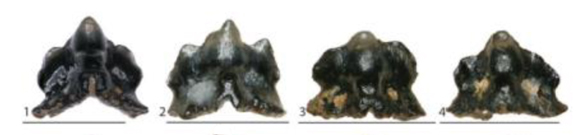
Fossil Teeth Reminded the Scientists of Video Game Spaceships

Galagadon fossil teeth.
Specimens of shark teeth (lingual view) assigned to Galagadon.  Scale bars = 1 mm.

Picture credit: Terry Gates (North Carolina State University)/Journal of Paleontology

Commentating on her fossil find, Nordquist stated:

“It [a tooth] was so tiny, you could miss it if you weren’t looking really carefully.  To the naked eye, it just looks like a little bump, you have to have a microscope to get a good view of it.”

Tiny Teeth Change our View of the Prehistoric Environment

The tiny teeth are only about a millimetre wide, about the size of a pinhead.  Galagadon was small too, estimated at around thirty to sixty centimetres in length.

Dr Makovicky added:

“Galagadon was less than two feet long, it’s not exactly Jaws.  It’s comparable to bamboo sharks living today.  It probably had a flat face and was very likely camouflage-coloured, since its relatives today have a camouflage pattern.  It would have eaten small invertebrates and probably spent a fair amount of time lying on the bottom of the riverbed.”

Galagadon may not have been huge, but its discovery has forced scientists into a re-think over what they thought they knew about the area where the T. rex named “Sue” was found.  It had been thought that the fossil locality represented a lake formed from a partially dried-up river, the presence of a shark suggests there must have been at least some connection to the sea.

Galagadon nordquistae – A Member of the Orectolobiformes

The shark has been classified as a member of the Orectolobiformes Order of sharks, making it distantly related to extant carpet sharks including bamboo sharks.  These types of shark are believed to have originated in the Jurassic and had a global distribution, today they are mostly restricted to waters in southeast Asia and Australia.

Co-author of the study, Eric Gorscak (Field Museum) explained:

“It’s surprising to find their fossils at the Sue locality.  During the Late Cretaceous, the continents continued to drift apart, further isolating dinosaurs and other land animals, and at the same time created the Atlantic and Indian oceans.  With occasional seaways connecting these young oceans, we have found fossils of marine life flourishing globally, including Galagadon and its relatives.”

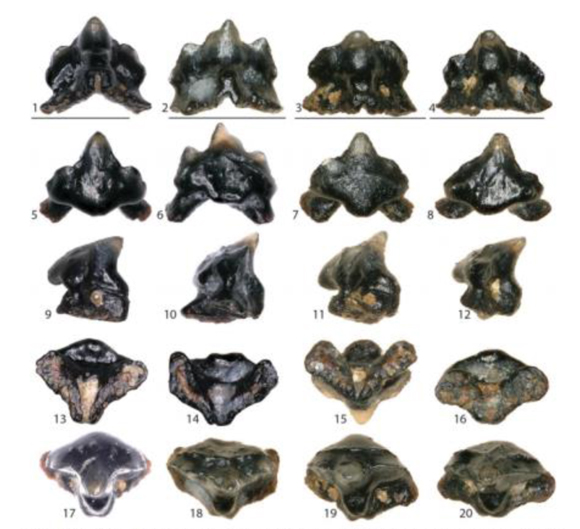
Various Views of the Galagadon Teeth

Views of Galagadon teeth.
Galagadon teeth. Specimens in lingual view (1–4), labial view (5–8), lateral view (9–12), basal view (13–16), and occlusal view (17–20). Scale bars = 1 mm.

Picture credit: Terry Gates (North Carolina State University)/Journal of Paleontology

Hell Creek – More than Flashy Dinosaurs

The study also reflects the importance of learning about fossils beyond big, flashy dinosaurs.  Each species discovered helps to build up a picture of the ecosystem in which the dinosaurs and other megafauna existed.

Karen Nordquist added:

“Most people, when they think of fossils, think of big huge dinosaur bones, but in the dirt, there are the bones of tiny animals.  When you get those bones and identify them, you get an idea of the whole environment, everything that lived with the big dinosaurs.  You learn so much from micro-sorting.”

The scientific paper: “New Sharks and Other Chondrichthyans from the Latest Maastrichtian (Late Cretaceous) of North America” by Terry A. Gates, Eric Gorscak and Peter J. Makovicky published in the Journal of Paleontology.

Everything Dinosaur acknowledges the help of a press release from the Field Museum (Chicago), in the compilation of this article.

Visit the award-winning and popular Everything Dinosaur website: Everything Dinosaur.
14 01, 2019

Astonishing Basilosaurus – The Apex Predator

By |2023-11-19T16:13:10+00:00January 14th, 2019|Categories: Dinosaur and Prehistoric Animal News Stories, Main Page, Palaeontological articles, Photos/Pictures of Fossils|0 Comments

Research Confirms Basilosaurus Was a Top Predator

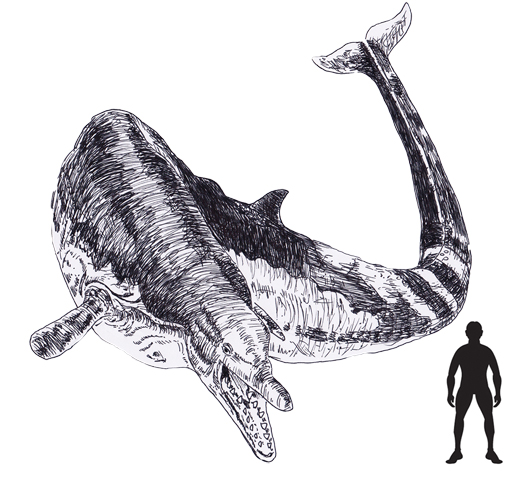
Readers with a long memory might remember an episode from the BBC “Walking with Beasts” television series that first aired in 2001.  In this sequel to “Walking with Dinosaurs”, the focus was placed upon the evolution of the mammals after the dinosaur extinction.  “Whale Killer”,  which was episode two in the six-part series, told the story of a pregnant Basilosaurus (archaic whale), desperately searching for food to help the calf growing inside her.  Thanks to raids on Dorudon whales and their young, the Basilosaurus is able to successfully give birth and this episode ends with the mother swimming away with her new-born calf following close behind.

An Illustration of the Fearsome Early Toothed Whale Basilosaurus

PNSO Basilosaurus illustration.
An illustration of Basilosaurus.  The human figure provides scale. Picture credit: Everything Dinosaur.

Picture credit: Everything Dinosaur

To view models and replicas of marine prehistoric animals: PNSO Age of Dinosaurs.

Analysis of Basilosaurus Stomach Contents

A team of researchers writing in the on-line, academic journal PLOS One, have published the results of stomach content analysis of Basilosaurus specimens from the Late Eocene-aged site at Wadi Al-Hitan in Egypt.  It is confirmed that Basilosaurus fed on smaller whales (juvenile Dorudon atrox) as well as large fish (Pycnodus mokattamensis).  The scientists, which included Manja Voss (Museum für Naturkunde Berlin) and Mohammed Sameh M. Antar from the Egyptian Environmental Affairs Agency, Cairo, state that this is the first direct evidence of Basilosaurus (B. isis) diet.

A Size Comparison Between an Adult Basilosaurus isis and an Adult Dorudon atrox

An adult Basilosaurus compared to an adult Dorudon whale.
Comparing an adult, fifteen-metre-long Basilosaurus isis museum mounted skeleton to a fully grown Dorudon atrox.

Picture credit: PLOS One/University of Michigan

Basilosaurus – Top of a Tethys Ocean Ecological Pyramid

The Late Eocene Epoch was a time of dramatic change and global extinction.  The once mighty Tethys Ocean was very much reduced, but the first, giant, toothed whales had evolved and the research team cite Basilosaurus isis, the Late Miocene Livyatan melvillei, and the extant Orca (Orcinus orca) as three marine apex predators known from relatively short intervals of time during the Cenozoic.  This research confirms the predator-prey relationship between the two most frequently found fossil whales at the Wadi Al-Hitan location.  Bite marks on the preserved skulls of Dorudon whales suggest predation and not scavenging behaviour by Basilosaurus.

A Photomosaic of a Basilosaurus Specimen (WH 10001)

Basilosaurus scattered remains.
Photomosaic of Basilosaurus isis (WH 10001) from the Gehannam Formation of Wadi Al Hitan.

Picture credit: PLOS One

The image above shows a photomosaic of a scattered and disarticulated Basilosaurus isis specimen from the Gehannam Formation of Wadi Al-Hitan.  The disarticulation of the fossil skeleton and the scattering suggests disturbance by scavengers and possibly long exposure on the seafloor prior to burial.

The researcher conclude that Basilosaurus was a top apex predator that hunted and ate its prey alive, rather than scavenging for scraps.  If the Wadi Al-Hitan site, represents a calving area for the Dorudon, then this would have made an ideal hunting spot for a hungry Basilosaurus.  The dramatic scenes in episode two of the “Walking with Beasts” television series, have more published scientific evidence to back up the screenplay.

The Everything Dinosaur website: Everything Dinosaur.
11 01, 2019

On the Trail of the “Hand Beast”

By |2023-11-19T07:22:35+00:00January 11th, 2019|Categories: Dinosaur and Prehistoric Animal News Stories, Dinosaur Fans, Everything Dinosaur Products, Geology, Main Page, Photos of Everything Dinosaur Products, Press Releases|0 Comments

New “Hand Beast” Chirotherium Exhibition

The county of Cheshire in north-west England has some fascinating geology, but from a palaeontological point of view, fossils are few and far between.  However, there are some notable exceptions, the sandstone quarries that once operated around the picturesque village of Lymm have provided evidence that before the dinosaurs evolved, this part of rural Cheshire was stalked by a powerful, three-metre-long predator – Chirotherium.

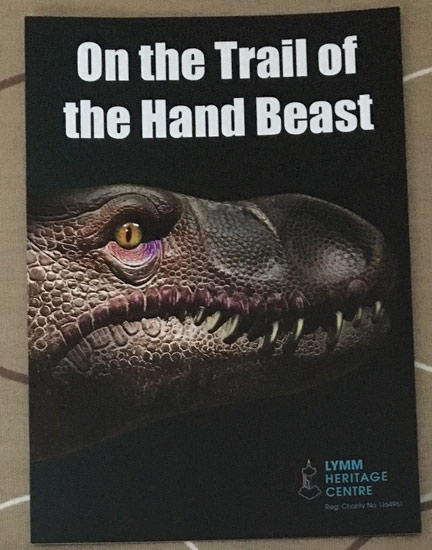
A new exhibition at the Lymm Heritage Centre, tells the story of Chirotherium and highlights the scientific importance of the trackways that revealed its existence.  Visitors will be able to get up close to this distant relative of today’s crocodiles, meeting “Kerry”, Lymm Heritage Centre’s resident archosaur (ruling reptile) as well as embarking on the trail of the “Hand Beast”.

On the Trail of the “Hand Beast” – Chirotherium

Lymm Heritage Centre - Chirotherium leaflet.
On the trail of the “Hand Beast” – Chirotherium (Lymm Heritage Centre).

Picture credit: Lymm Heritage Centre/Everything Dinosaur

Triassic Lymm – Deserts, Dunes and Salt Lakes

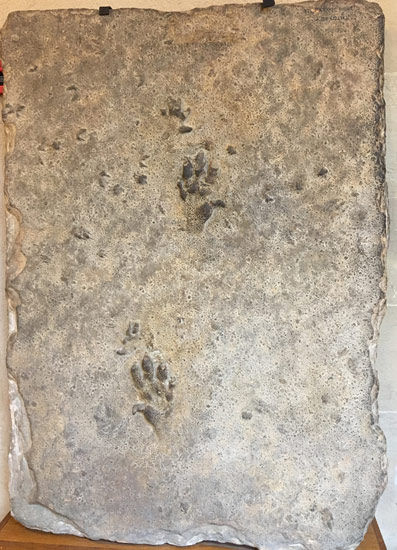
Strange, five-fingered tracks had been discovered in Triassic sandstones in Germany in the early 1830s.  More tracks were uncovered at Storeton on the Wirral in 1836.  As the demand for building materials grew, a number of sandstone quarries in the Lymm area were opened up and more footprints were found.

These trace fossils are preserved in the Tarporley Siltstones Formation, which was deposited in the early Middle Triassic.  Lymm was located on the super-continent of Pangaea and the rocks deposited in this region portray a dry, arid Triassic landscape, dominated by sand dunes and salt lakes which were close to the sea.  In areas, where freshwater was present, such as river valleys and oases, there was abundant life, but the animals and plants would have been very unfamiliar to us. The land was ruled by reptiles and one of the biggest and most dangerous was Chirotherium.

Tracks Assigned to the Ichnogenus Chirotherium on Display at Oxford University Natural History Museum

A Chirotheriuim trackway.
Chirotherium tracks on display at the Oxford University Museum of Natural History.  Note the five-fingered tracks (pentadactyle). Picture credit: Everything Dinosaur.

Picture credit: Everything Dinosaur

Face to Face with Chirotherium

This new exhibition at the Lymm Heritage Centre brings you face to face with the “Hand Beast” and the hard-working, dedicated team behind this informative, interactive exhibition have created lots of family-orientated activities to support learning.  You can go on your own fossil hunt, make prehistoric footprints and follow Lymm’s bespoke geology trail.

Further information about this new attraction, which officially opens tomorrow (January 12th), can be found here: On the Trail of the “Hand Beast”.

The exhibition is open from from 12 noon until 4pm Thursday to Sunday.

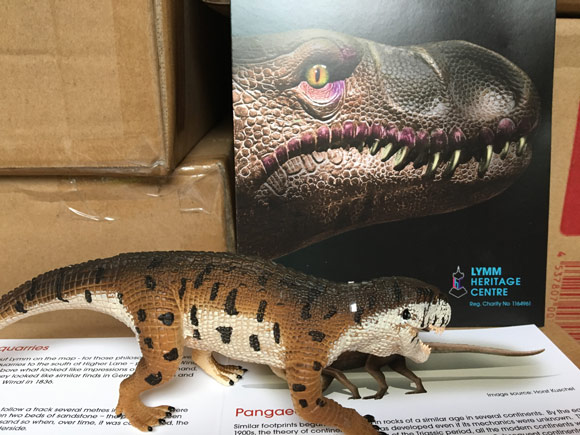
Everything Dinosaur team members have been involved in this project, many of the fossils have been supplied by our team members and visitors will be able to pick up a model of a Prestosuchus, a prehistoric animal that closely resembles the Chirotherium ichnogenus.

The model is from the Safari Ltd range, to view this range: Wild Safari Prehistoric World Figures.

The Prestosuchus Model is Available at the Trail of the “Hand Beast” Exhibition at Lymm Heritage Centre

Prestosuchus prehistoric animal model.
The Prestosuchus model takes an interest in the trail of the “Hand Beast” leaflet. Picture credit: Everything Dinosaur.

Picture credit: Everything Dinosaur

Visit the Everything Dinosaur website: Everything Dinosaur.
9 01, 2019

When Did Life on Land First Evolve?

By |2023-11-18T23:00:52+00:00January 9th, 2019|Categories: Dinosaur and Prehistoric Animal News Stories, Geology, Main Page, Palaeontological articles, Photos/Pictures of Fossils|0 Comments

Was There Life on Land During the Ediacaran?

The transition of vertebrates from fully aquatic to partially terrestrial animals has been well documented.  Transitional vertebrates such as the remarkable Tiktaalik roseae* provide evidence of the anatomical adaptations undertaken by back-boned animals as they conquered the land.  However, invertebrates got there first and before them the land was home to other organisms such as multi-cellular, photosynthesisng mats of algae.  When complex organisms, rather than members of the Plantae Kingdom or bacteria established themselves on land is somewhat controversial, but new clues might be emerging from fossils found in some of the oldest known soils on Earth.  Could land-dwelling organisms have been present during the Ediacaran?

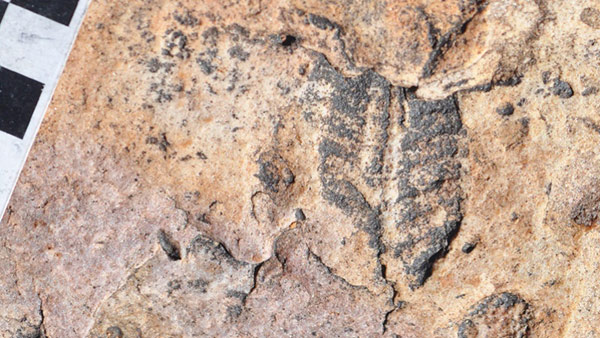
An Ediacaran Fossil Affected by Wind-drift Deposition

Evidence of wind-drift deposition in ancient Ediacaran sediments.
A portion of a quilted Ediacaran fossil is partly covered by ancient wind deposition – source Namibia.

Picture credit: Greg Retallack (Oregon University)

Not Marine Fossils But Fossils from a Fluvial Environment

Multi-cellular, terrestrial animals may have existed during the Ediacaran, that is the conclusion of Greg Retallack, fossil collections director at the University of Oregon’s Museum of Natural and Cultural History, writing in the journal Sedimentary Geology.  The evidence for such a conclusion emerged from fossil assemblages, previously considered to represent ocean organisms, found in thin layers of silt and sand located between thicker sandstone beds from Ediacaran-aged fossil localities of Nilpena, South Australia and in similarly aged rocks from Namibia.

The Ediacaran is the last geological period of the Precambrian (Neoproterozoic Era), it lasted from 635 million years ago to 542 million years ago and this period in Earth’s history was named after the Ediacara Hills, located north of Adelaide (South Australia), in which, geologist Reginald Sprigg discovered a remarkable collection of fossils representing bizarre, soft-bodied organisms.

Commenting on his new research Greg Retallack stated:

“These Ediacaran organisms are one of the enduring mysteris of the fossil record.  Were they worms, sea jellies, sea pens, amoebae, algae?  They are notoriously difficult to classify, but conventional wisdom has long held that they were marine organisms.”

Studying Interflag Sandstone Laminae

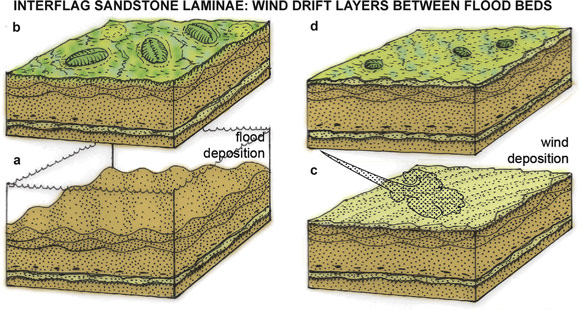
An in-depth, microscopic analysis of the sediments and their geochemical properties has led to a reassessment of the environmental conditions that led to their deposition.  The grains that make up the sediments, reveal telltale marks of ancient wind erosion, the sediments suggest wind-drift deposition between flood beds.  This indicates a terrestrial origin for them and not deposition in a marine environment, after all, wind (aeolian forces), hardly affect sand grains on the seabed.

These thin, silty to sandy layers that are “sandwiched” between thicker sandstone beds are referred to as interflag sandstone laminae, they are sometimes called “shims” or “microbial mat sandwiches”.  In the research paper, Greg Retallack found similar structures in modern river deposits as well as more ancient interflag sandstone laminae in Pennsylvanian (Upper Carboniferous), and Eocene fluvial levee facies.

Thin, Silty to Sandy Layers Deposited Between Thicker Layers of Sandstone

Interflag Sandstone Laminae
How interflag sandstone laminae form – wind deposition alternates with flood deposition – a phenomenon observed in modern fluvial environments.

Picture Credit: Greg Retallack (Oregon University)

Professor Retallack confirmed his diagnosis of an aeolian factor in the deposition by stating:

“Such wind-drifted layers are widespread on river levees and sandbars today.  They are present throughout the Flinders Ranges of South Australia and also in Ediacaran rocks of southern Namibia.”

If the sediments are affected by aeolian forces, then it follows that they were deposited in terrestrial environments and therefore the fossil assemblage associated with these deposits are very likely to represent a terrestrial biota.  The organisms that left these fossils would have been multicellular and quite complex, visible to the naked eye.  Such life would have preceded the emergence of the first land plants by many tens of millions of years.

Unearthing Important Clues

The Ediacaran biota remains extremely difficult to classify, only impressions have been preserved so the internal structure of most of these bizarre organisms is entirely unknown.  They could represent a “dead-end” in the evolution of complex life, or some of them might be ancestral to extant groups of animals.  The fauna of the Ediacaran might remain enigmatic, when it comes to learning what the fossils actually represent, but this new study offers some intriguing new evidence about the palaeoenvironment.

The Professor concluded:

“The investigation points to a terrestrial habitat for some of these organisms, and combined with growing evidence from studies of fossil soils and biological soil crust features, it suggests that they may have been land creatures such as lichens.”

*To read an article about Tiktaalik roseaeScientists Get to Grips with Tiktaalik’s Rear End.

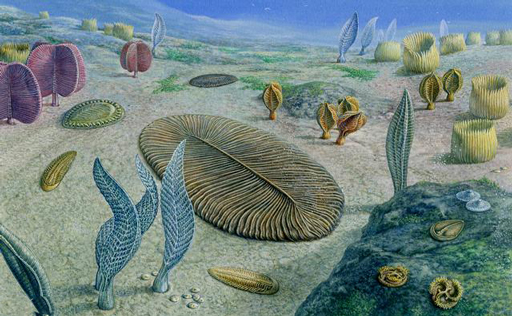
Life in the Ediacaran (Marine Biota)

Ediacaran marine life.
Life in the Ediacaran.  Up until now, most if not all of the life reconstructions have focused on a marine ecosystem scenario.

Picture credit: John Sibbick

The scientific paper: “Interflag Sandstone Laminae, A Novel Sedimentary Structure, with Implications for Ediacaran Paleoenvironments” by Gregory J. Retallack published in Sedimentary Geology.

Everything Dinosaur acknowledges the help of a press release from the Univesity of Oregon in the compilation of this article.

Visit the Everything Dinosaur website: Everything Dinosaur.
8 01, 2019

Computer Modelling Reveals Exciting Fossil Discovery

By |2023-11-18T17:57:40+00:00January 8th, 2019|Categories: Dinosaur and Prehistoric Animal News Stories, Dinosaur Fans, Main Page, Photos/Pictures of Fossils|0 Comments

CT Scanner Helps Palaeontologists to Map the Braincase of a Marine Reptile

A farmer’s field in Warwickshire was the site of a remarkable fossil discovery more than sixty years ago.  Thanks to the application of advanced medical science and computer modelling, a team of researchers including scientists from Manchester University, have been able to unlock secrets from inside the skull of a giant, Early Jurassic marine reptile.  The almost 200 million-year-old fossil, was found at Fell Mill Farm (Warwickshire, England), in 1955.  The material included a nearly one-metre-long skull of an ichthyosaur, it had been preserved in three-dimensions permitting scientists a rare glimpse into the internal workings of a prehistoric animal’s skull.

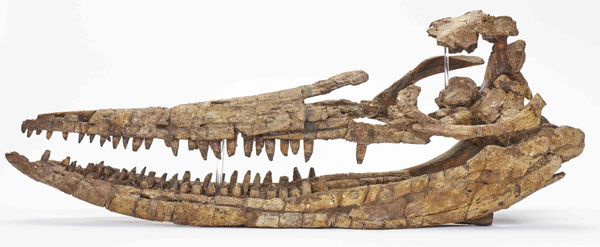
The Beautifully Preserved and Now Fully Restored Skull Specimen

Reconstructed Protoichthyosaurus skull.
The reconstructed, three-dimensional ichthyosaur skull (Protoichthyosaurus).

Picture credit: Thinktank, Birmingham Science Museum

Revealing New Information About a Rarely Preserved Marine Reptile Braincase

Most ichthyosaur cranial material is crushed, flattened and distorted during the fossilisation process.  This specimen permitted the research team which included Dean Lomax (Manchester University), skilled fossil preparator Nigel Larkin and Laura Porro (University College London), to study a near complete and undistorted three-dimensional skull providing new insights into ichthyosaur cranial anatomy and the morphology of the braincase.  Despite the fossil specimen’s excellent preservation, it had never been formally studied prior to this research.

Co-author of the paper, Nigel Larkin explained:

“Initially, the aim of the project was to clean and conserve the skull and partially dismantle it to rebuild it more accurately, ready for redisplay at the Thinktank Museum [Birmingham].  But we soon realised that the individual bones of the skull were exceptionally well preserved in three dimensions, better than in any other ichthyosaur skull we’d seen.  Furthermore, that they would respond well to CT scanning, enabling us to capture their shape digitally and to see their internal details.  This presented an opportunity that couldn’t be missed.”

Computed Tomography (CT) Scans

To help unlock the information contained inside the skull, the specimen was subjected to computed tomography (CT) scans using a large medical scanner located at the Royal Veterinary College (London).  The powerful X-rays in conjunction with computer modelling allowed a three-dimensional and highly accurate digital reconstruction of the fossil to be made.  This is the first time a digital reconstruction of a skull and mandible of a large marine reptile has ever been made available for research purposes and to the public.

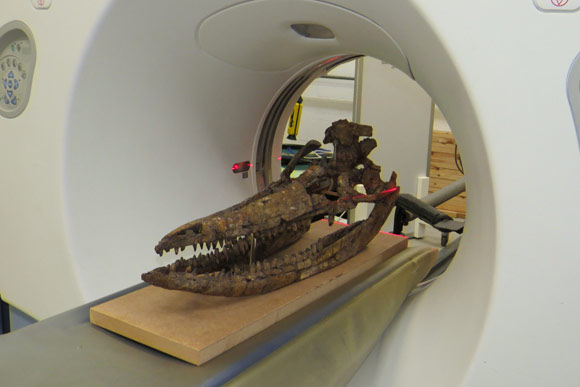
Going Through the CT Scanner

Scanning the skull of a marine reptile.
A large marine reptile skull is placed in a CT scanner.

Picture credit: Nigel Larkin photograph taken at Royal Veterinary College, London

Further computed tomography analysis (micro-CT scanning) took place at the University of Cambridge.

Study Clears Up Marine Reptile Fossil Identification

When originally labelled several decades ago, the ichthyosaur was classified as an example of the species Ichthyosaurus communis.  Indeed, when Everything Dinosaur wrote an article about this remarkably well-preserved skull back in 2016, the specimen was still being described as Ichthyosaurus.  However, lead-author and ichthyosaur expert, Dean Lomax became convinced as the research progressed, that this specimen represented a much rarer species.  He identified it as an example of an ichthyosaur called Protoichthyosaurus prostaxalis, the type species of this genus had originally been named in 1979.

To read the 2016 article that describes the skull and shows the post cranial material associated with this specimen: One of Britain’s Largest Ichthyosaurs Goes on Display.

With a skull almost twice as long as any other specimen of Protoichthyosaurus, this is the largest specimen known to science.

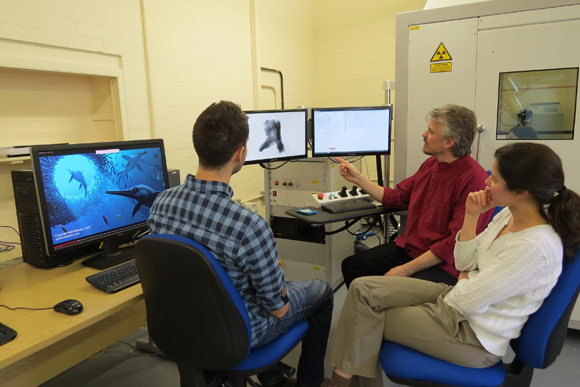
Research Team Members View the Results of the CT Scans

Viewing three-dimensional images of the fossil skull.
Dean Lomax (left), Laura Porro (centre) and Nigel Larkin (right) view 3-D images of the skull.

Picture credit:  Nigel Larkin, taken at the University of Cambridge

Lead-author Dean Lomax stated:

“The first time I saw this specimen I was puzzled by its excellent preservation.  Ichthyosaurs of this age (Early Jurassic), are usually ‘pancaked’, meaning that they are squished so that the original structure of the skull is either not preserved or is distorted or damaged.  So, to have a skull and portions of the skeleton of an ichthyosaur of this age preserved in three dimensions, and without any surrounding rock obscuring it, is something quite special.”

Protoichthyosaurus prostaxalis

Protoichthyosaurus was first erected by the British palaeontologist Robert Appleby forty years ago.  Prior to his research, the fossil material that Dr Appleby assigned to the new genus had been placed in the Ichthyosaurus genus.  Indeed, subsequent research challenged this assessment and for some time, the validity of the Protoichthyosaurus genus remained in doubt.

In 2017, Dean Lomax along with colleagues Professor Judy Massare (State University of New York) and Rashmi Mistry (Reading University), conducted a re-examination of the fossil material and carried out extensive comparisons between ichthyosaur and suspected Protoichthyosaurus specimens.  The researchers concluded that Protoichthyosaurus was indeed, a valid genus: Reaffirming Protoichthyosaurus as a Valid Genus.

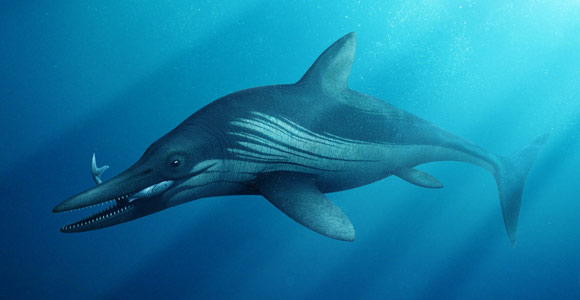
A Life Reconstruction of the Ichthyosaur Protoichthyosaurus prostaxalis

Protoichthyosaurus life reconstruction.
A life reconstruction of the ichthyosaur Protoichthyosaurus (P. prostaxalis).

Picture credit: Bob Nicholls @Paleocreations

Back to the Braincase

The skull is not quite complete, but several bones that make up the braincase, which are very rarely preserved in the Ichthyosauridae, are present.  The micro-CT scanning conducted at Cambridge University provided crucial data to help reconstruct the internal anatomy of the animal’s skull and brain.  The fossil only preserved bones from the left side of the braincase, however, using CT scans these elements were digitally mirrored and 3-D printed at life size to provide a complete braincase.

Commenting on how the use of modern technologies, such as medical scanners, have revolutionised the way in which palaeontologists are able to study and describe fossils, Dr Laura Porro stated:

“CT scanning allows us to look inside fossils – in this case, we could see long canals within the skull bones that originally contained blood vessels and nerves.  Scans also revealed the curation history of the specimen since its discovery in the ‘50s.  There were several areas reconstructed in plaster and clay, and one bone was so expertly modelled that only the scans revealed part of it was a fake.  Finally, there is the potential to digitally reconstruct the skull in 3-D.  This is hard (and risky) to do with the original, fragile and very heavy fossil bones; plus, we can now make the 3-D reconstruction freely available to other scientists and for education.”

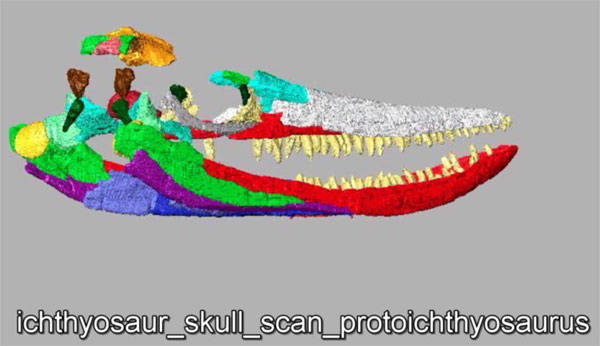
An Image of the Three-Dimensional Scan of the Protoichthyosaurus Skull Material

Three-dimensional scan of a Protoichthyosaurus skull.
A three-dimensional image from the scan of the Protoichthyosaurus skull.  Individual elements and bones are highlighted in different colours.

Picture credit: University of Manchester/Thinktank

Dean Lomax added:

“It’s taken more than half a century for this ichthyosaur to be studied and described, but it has been worth the wait.  Not only has our study revealed exciting information about the internal anatomy of the skull of this animal, but our findings will aid other palaeontologists in exploring its evolutionary relationship with other ichthyosaurs.”

Visit the Everything Dinosaur website: Everything Dinosaur.
Go to Top