Isisfordia molnari – A New Species of Australian Crocodile from the Cretaceous
Researchers from the University of New England (New South Wales), Queensland University and the Australian Opal Centre have described a new species of prehistoric crocodile. The Cretaceous-aged croc has been named Isisfordia molnari, it is the second species described within the Isisfordia genus, both are known from Australia, although I. duncani, which was named in 2006, heralds from the Winton Formation of Queensland, whilst the new species I. molnari, comes from the geologically younger Griman Creek Formation of New South Wales.
Isisfordia molnari
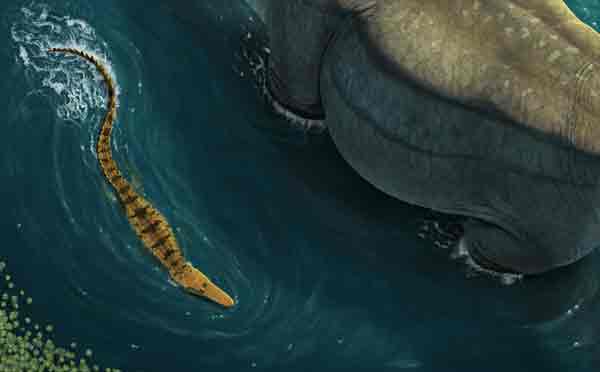
A Life Reconstruction of the Newly Described Prehistoric Crocodile Isisfordia molnari
Isisfordia molnari life reconstruction. A wading sauropod has nothing to fear from I. molnari.
Picture credit: José Vitor Silva
Honouring Ralph Molnar
The trivial name honours vertebrate palaeontologist Ralph Molnar, in recognition of his contribution to the research on crocodylomorphs from Gondwana. Molnar was one of the researchers responsible for the naming of Isisfordia duncani back in 2006.
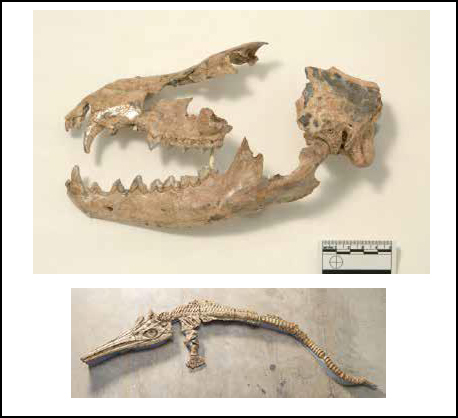
The new species has been erected based on a partial braincase and a fragment of jawbone (maxilla). Both fossils have been opalised and come from the Lightning Ridge area, but their exact provenance remains uncertain. The fossil jaw fragment had previously been designated as the holotype of Crocodylus (Bottosaurus) selaslophensis, but has, following a review, been assigned to this new species. This piece of jawbone complete with six teeth in situ had been donated to the Australian Museum in 1914. The partial braincase is probably a much more recent find, it was purchased by the Australian Museum in the early part of this century.
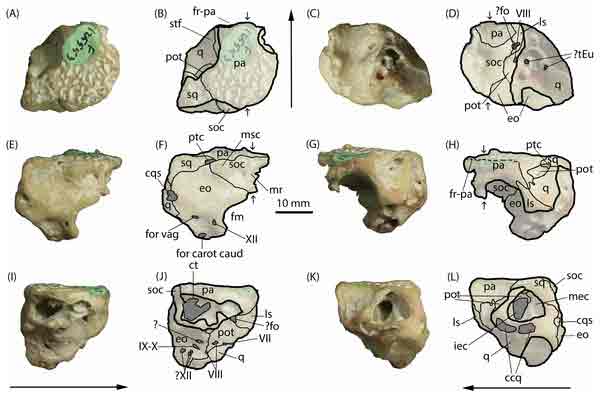
Photographs and Line Drawings of the Braincase of Isisfordia molnari
Photographs and line drawings of the braincase of Isisfordia molnari. (A, B) dorsal, (C, D) ventral, (E, F) caudal, (G, H) rostral, (I, J) right lateral and (K, L) left lateral views.
Picture credit: PeerJ
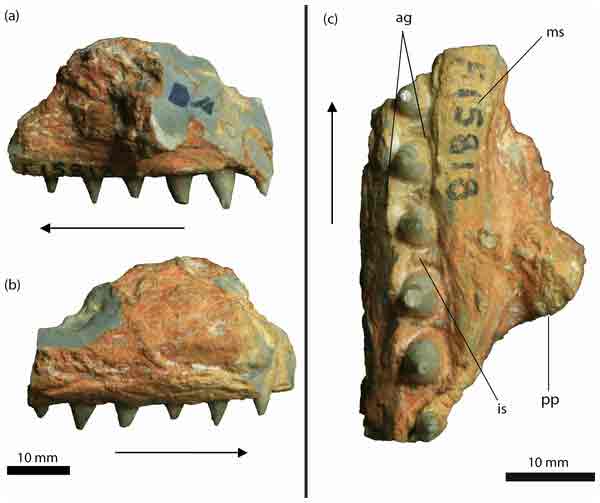
The Fragment of Upper Jawbone Assigned to the Newly Erected Species (I. molnari)
A fragment of jawbone now assigned to Isisfordia molnari. Arrows indicate rostral end ((A) medial, (B) lateral, (C) palatal views).
Picture credit: PeerJ
The scientific paper: “Isisfordia molnari sp. nov., a new basal eusuchian from the mid-Cretaceous of Lightning Ridge, Australia” by Lachlan J. Hart, Phil R. Bell, Elizabeth T. Smith and Steven W. Salisbury published in PeerJ.
Reports have been circulating from a number of Chinese media outlets concerning the discovery of an extensive fossil bed containing the remains of numerous dinosaurs in southwest China’s Chongqing Municipality. The fossil site has been known about for several years but there have been a number of reports this week circulating, hinting at the extent of the fossil discovery and indeed, suggesting that it is very likely that as a result of excavation work, new species of dinosaur will be named and described.
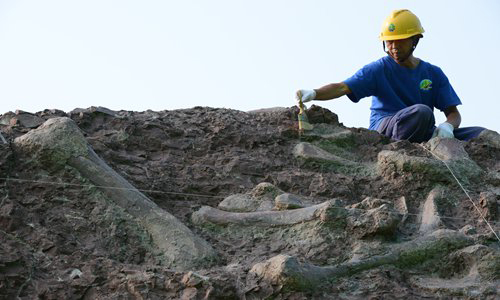
An Extensive Dinosaur Bonebed
Excavating an extensive fossil deposit.
Picture credit: VCG
The photograph (above), shows a Chinese field team member working on the “wall of dinosaur fossils”. The site of the fossil find is described as a location close to Laojun village, Pu’an town, in Yunyang county.
A New Dinosaur Species
The press reports state that scientists have identified different types of dinosaurs including theropods and basal ornithopods. The disarticulated remains represent a bone accumulation and the strata is reported to be around 174 million years old (Aalenian faunal stage of the Middle Jurassic). Commentators have described these fossil beds as very significant and likely to lead to the naming of new dinosaur species.
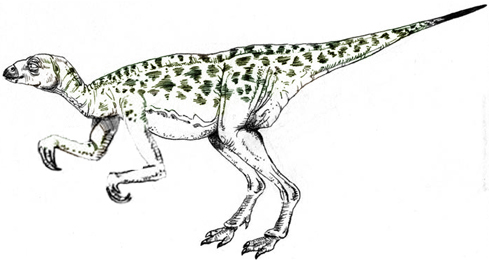
An Illustration of a Typical Basal Ornithopod
A typical example of a basal ornithopod. Picture credit: Everything Dinosaur.
Picture credit: Everything Dinosaur
Four Thousand Individual Fossil Pieces
The mixed fossil assemblage has already provided researchers with around 4,000 pieces of dinosaur bone to study, since the site was first explored and mapped in 2017.
A spokesperson from Everything Dinosaur commented:
“The site has been described as exceeding 150 metres in length with at least 17 distinct assemblages of fossils within it. Not much is known about the dinosaur biota from the earliest stages of the Middle Jurassic. Once all the bones have been removed, prepared and studied it is very likely that several new species of dinosaur will be announced. These dinosaurs will help palaeontologists to map the radiation and dispersal of several key groups of dinosaurs that were to dominate terrestrial ecosystems for the remainder of the Jurassic.”
The extensive fossil material could become China’s equivalent of America’s Dinosaur Monument in Utah. The Dinosaur Monument represents a congregation of dinosaur fossils that accumulated in a river deposit. Whilst similarities can be drawn between the two sites, the Chongqing Municipality deposits are approximately 25 million years older.
Perhaps, this could be China’s second “Great Wall”.
An scientific paper published in the academic journal “Cretaceous Research” details the remarkable discovery of a huge elasmosaurid plesiosaur from Upper Cretaceous deposits located on Seymour Island in Antarctica. The specimen, ascribed to the Aristonectes genus is estimated to have measured around 11 metres in length and could have weighed as much as fifteen tonnes. The strata from which the fossil material was collected is believed to have been laid down towards the end of the Cretaceous, thus this fossil discovery indicates that very large elasmosaurs were around towards the very end of the Mesozoic.
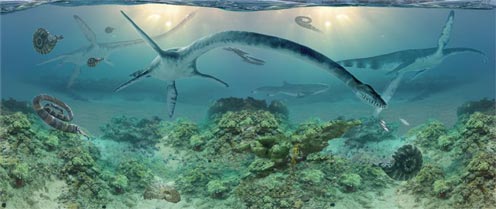
A Life Reconstruction of a Typical Elasmosaurid Marine Reptile
Late Cretaceous elasmosaurid from Seymour Island (Antarctica).
The image (above) shows an elasmosaur model from the Safari Ltd range.
Seymour Island – Helping to Map Marine Fauna at the Very End of the Cretaceous
The exposed sediments on the inhospitable and remote Seymour Island provide palaeontologists with the opportunity to study life that existed at the very end of the age of dinosaurs and the sequence of exposed rocks covers the transition from the end Cretaceous extinction event into the Palaeogene. The occurrence of this specimen, located approximately 2.3 metres or less below the Cretaceous-Palaeogene (K/Pg) boundary, suggests the persistence of these types of plesiosaurs (aristonectines), at high latitudes and also it verifies their chronostratigraphical distribution until the end Cretaceous, before the mass extinction the resulted in the loss of all marine reptiles with the exception of marine turtles.
This is not the first giant, marine reptile to be found on Seymour Island…
The fossil material (MLP 89-III-3-1), consisting of disarticulated post-cranial elements most probably representing an individual animal, comes from the uppermost Maastrichtian levels of the López de Bertodano Formation, Seymour Island (sometimes referred to as Marambio Island), Antarctica. The research team members conclude that this specimen is amongst the largest elasmosaurids known.
A field team found the first evidence of this animal back in 1989, but at the time, the team lacked the resources to excavate the specimen. Subsequent expeditions to the fossil site in 2005, 2012 and 2017 led to the removal of some 800 kilograms of fossil bones.
Large Elasmosaurids Thrived in High Latitudes at the End of the Cretaceous
Elasmosaurs illustrated. Large elasmosaurids persisted at high latitudes (Antarctica and within the Arctic Circle).
Picture credit: James Havens
A “Weird Plesiosaur”
Co-author of the scientific paper, José O’Gorman of the National Scientific and Technical Research Council of Argentina, commented that for years the researchers were not sure whether the fossils represented an elasmosaurid or something else, the animal is described as a “weird plesiosaur.”
The large size of this specimen coupled with the giant mosasaur fossils known from this locality suggest that these waters were highly productive and able to support a variety of megafauna. These conditions are likely to have persisted until the K/Pg mass extinction. Although, the animal has not been given a formal, binomial scientific name, the researchers conclude that it has affinities with the Aristonectinae, a sub-family within the Elasmosauridae.
The scientific paper: “A giant elasmosaurid (Sauropterygia; Plesiosauria) from Antarctica: New information on elasmosaurid body size diversity and aristonectine evolutionary scenarios” by J.P. O’Gorman, S. Santillana, R. Otero and M. Reguero published in the journal Cretaceous Research.
Tyrannosaurs Had Their Noses in Front When it Came to Sense of Smell
A team of scientists from University College Dublin have built upon the idea put forward in earlier research indicating that many dinosaurs such as Tyrannosaurus rex had an impressive sense of smell. In a recently published paper, the scientists examined the sense of smell of a wide range of living and extinct archosaurs and concluded that many different dinosaurs had an excellent olfactory sense but the tyrannosaurs probably had one of the keenest senses of smell amongst the Dinosauria.
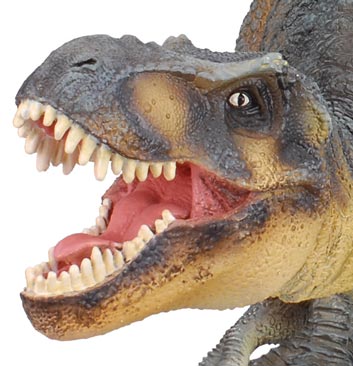
New Study Confirms T. rex Had a Powerful Sense of Smell
Up close to Tyrannosaurus rex. It could smell you probably before it could see you.
Olfactory Bulb Ratios
The brains of long extinct animals, like most soft tissues, are poor candidates for fossilisation, the size and the shape of an extinct animal’s brain can be inferred by looking at how the skull bones knit together to form the brain case. It is from this data that the size and the proportion of the brain dedicated to processing sensory data such as the sense of smell can be deduced.
It has been stated in the past that approximately 50% of the brain volume of a T. rex was made up of the olfactory bulb, that part of the brain that processes smells. Furthermore, in most modern animals, the size of the brain’s olfactory bulb also correlates with how well they can identify odours. Looking at the ratio between that part of the brain dedicated to processing smells and the size of the entire brain (the olfactory bulb ratio), can also provide evidence as to the ecological niche an animal is likely to have occupied in an ecosystem.
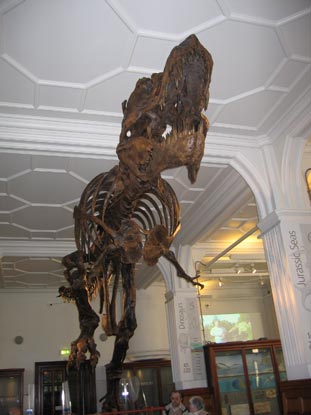
The King of the Tyrant Lizards Top of the Table for Olfactory Abilities Too
Tyrannosaurs had a highly developed sense of smell. Picture credit: Everything Dinosaur.
Picture credit: Everything Dinosaur
For example, a bird that hunts in low light levels using scent to find food, is likely to have adapted to its environment very differently from that of a kestrel that hunts in daylight and uses its keen eyesight to spot its prey.
Writing in the journal “Proceedings of the Royal Society B”, Dr John Finarelli and his colleague Graham Hughes (University College Dublin), used the olfactory bulb ratio in living archosaurs (crocodiles and birds) to infer the strength of smell amongst dinosaurs.
Studying Tyrannosaurs
Prior research has shown that the size of the olfactory bulb is related to the number of smell receptor genes in the DNA of a given animal and how much diversity they represent. Taken together, it is called the olfactory repertoire. In this new study, the researchers used the olfactory repertoire of modern birds and an alligator to estimate the olfactory ability of several types of dinosaurs. Based on this innovative research, the scientists concluded that T. rex probably had between 620 and 645 genes encoding its olfactory receptors, a gene count only slightly smaller than those in today’s chickens and domestic cats.
Closely related tyrannosaurs such as Albertosaurus, also had substantial olfactory receptor gene counts. Tyrannosaurs probably had the best sense of smell amongst the Dinosauria, this in turn can lead to inferences about how these theropods lived and behaved.
For example, tyrannosaurs were probably able to “sniff out” prey from far away. They were able to track down the carcass of another dinosaur and scavenge the corpse.
A Good Sense of Smell Has Many Other Uses in the Animal Kingdom
The researchers hope that this new study will not get drawn into the “T. rex a hunter or a scavenger debate”, the authors stress that a good sense of smell has many other uses other than finding food. Many animals use scent to mark and define territory, track down a mate, deter rivals and for intraspecific communication.
The University College Dublin scientists also highlighted a shift in scaling of olfactory bulb ratios to body size along the theropod lineage that led to the evolution of modern birds. The researchers conclude that by combining morphological and genomic data, it can be demonstrated that, while genetic information for extinct taxa is forever lost, it is potentially feasible to investigate evolutionary trajectories in extinct animals.
Amongst Living Vertebrates, It is the Elephant that Tops the Table for the Most Olfactory Receptor Genes
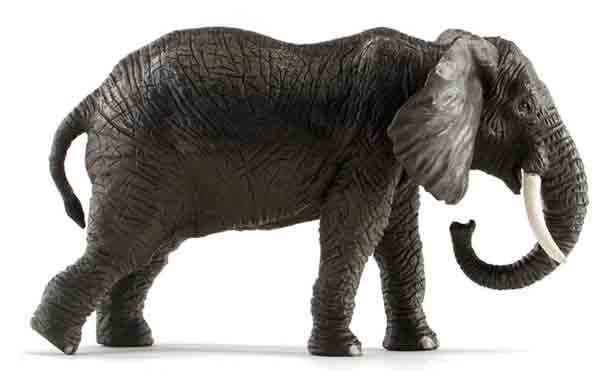
An African elephant (Loxodonta).
Amongst all living vertebrates, the record for the most olfactory receptor genes lies with the modern elephant, a herbivore with about 2,500 such genes. With such an exquisite sense of smell, elephants can “count” quantities of food by odour alone. The researchers looked at a number of different types of dinosaur in their study, sure enough, some plant-eating dinosaurs showed evidence of a greater reliance on smell than some carnivorous dinosaurs. For example, the Late Cretaceous herbivore Erlikosaurus (E. andrewsi), a theropod but a member of the Therizinosauridae had a greater number of projected olfactory receptor genes than Velociraptor and other predatory dromaeosaurids.
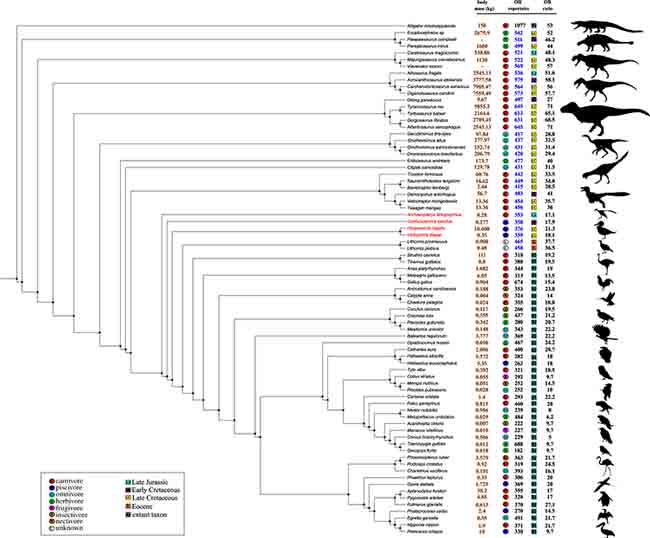
The Research Team Assessed Olfactory Bulb Ratio Compared to Body Mass Amongst Living and Extinct Archosaurs
Olfactory bulb ratios amongst living and extinct archosaurs. This new study confirmed earlier research indicating that the tyrannosaurs had a powerful sense of smell.
A team of scientists have described a new species of trilobite and at around thirty centimetres in length, this new species is the largest member of the Trilobita from Australia to have been described to date. Writing in the academic publication, the Journal of Systematic Palaeontology, the team consisting of researchers from the University of Adelaide, South Australian Museum and the University of New England describe Redlichia rex and suggest that it probably specialised in attacking and eating smaller trilobites. It might even have been a cannibal!
Redlichia rex
Lead author of the research, James Holmes, a PhD student at the University of Adelaide commented:
“We decided to name this new species of trilobite Redlichia rex (similar to Tyrannosaurus rex) because of its giant size, as well as its formidable legs with spines used for crushing and shredding food, which may have been other trilobites.”
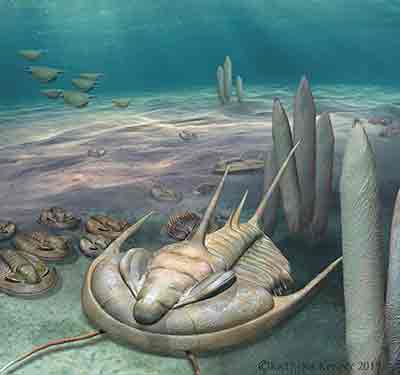
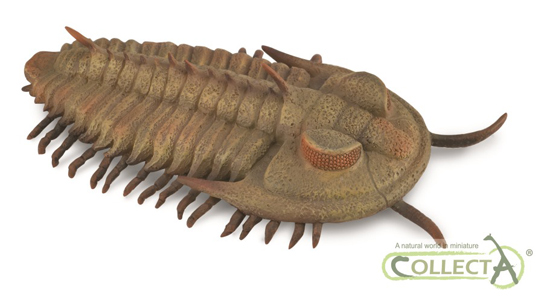
A Life Reconstruction of the Newly Described Trilobite Species Redlichia rex
A life reconstruction of the newly described Redlichia rex trilobite.
Picture credit: Katrina Kenny
An Exceptional State of Preservation
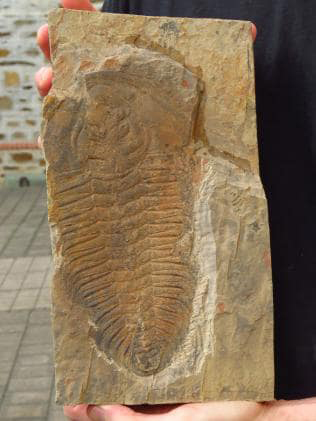
The fossil material comes from an exceptional Lagerstätte known as the Emu Bay Shale on Kangaroo Island, South Australia, these sediments represents shallow sea deposits laid down in the Early Cambrian. Around fifty different species of trilobite have been described from this location. Well-preserved, fully articulated specimens from this deposit are known to reach lengths in excess of 25 centimetres, representing one of the largest known Cambrian trilobites. Until now, all Redlichia specimens from the Emu Bay Shale have been referred to as Redlichia takooensis.
Previous studies recognised considerable differences in exoskeletal shape and morphology among specimens of varying sizes, which were thought to represent different growth stages of the same species (ontogeny). However, close examination of a large collection of recently acquired specimens shows that this variation actually represents two distinct morphs, interpreted by the researchers as representing a distinct and larger species – Redlichia rex.
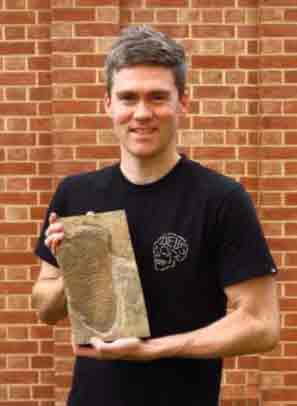
PhD Student James Holmes with a Fossil of R. rex
PhD student James Holmes and a fossil specimen of Redlichia rex.
Picture credit: University of Adelaide
Redlichia rex – Around 30 cm in Length
Many of the fossils demonstrated an exceptional state of preservation with soft parts such as the antennae and the legs preserved. At around 30 centimetres in length, Redlichia rex is almost twice as big as most other Australian trilobites recorded from Cambrian-aged rocks.
Co-study author, Diego García-Bellido, from the University of Adelaide and the South Australian Museum added:
“Interestingly, trilobite specimens from the Emu Bay Shale, including Redlichia rex, exhibit injuries that were caused by shell-crushing predators. There are also large specimens of fossilised poo (coprolites), containing trilobite fragments in this fossil deposit. The large size of injured Redlichia rex specimens and the associated coprolites suggests that either much bigger predators were targeting Redlichia rex, such as Anomalocaris – an even larger shrimp-like creature – or that the new species had cannibalistic tendencies.”
Evidence of an Evolutionary Arms Race
The naming of this new species demonstrates the diversity of the marine biota within this ancient sea environment and supports the idea that one of the principle drivers of the “Cambrian explosion” was the evolutionary “arms race” between predators and prey species. As predators became larger and more efficient hunters, so primary producers and secondary predators developed more effective defences, this in turn led to the evolution of more deadly predator species.
A Fossil Specimen (Redlichia rex)
A near complete specimen of the large Cambrian trilobite Redlichia rex.
Picture credit: University of Adelaide
James Holmes commented:
“The overall size and crushing legs of Redlichia rex are a likely consequence of the arms race that occurred at this time. This giant trilobite was likely the terror of smaller creatures on the Cambrian seafloor.”
Fossils of the amazing Cambrian marine biota including specimens of Redlichia rex are currently on display at the South Australian Museum (Adelaide).
The scientific paper: “The trilobite Redlichia from the lower Cambrian Emu Bay Shale Konservat-Lagerstätte of South Australia: systematics, ontogeny and soft-part anatomy” by James D. Holmes, John R. Paterson and Diego C. García-Bellido published in the Journal of Systematic Palaeontology.
Scolomastax sahlsteini – A Fearsome Cretaceous Crocodile Critter
The Woodbine Formation of eastern Texas has provided palaeontologists with another crocodyliform to study. The strata represent sediments laid down in a river delta system during the early stages of the Late Cretaceous (Cenomanian faunal stage). The vertebrate fossils found include dinosaurs, turtles, lungfish and several different types of crocodile including the fearsome Deltasuchus (D. motherali), that was named and described in 2017: Deltasuchus – A Dinosaur Crunching Crocodile.
Joining the list of crocodiles known from this location is Scolomastax sahlsteini, a much smaller animal that probably specialised in hunting fish and other small vertebrates. Its discovery reinforces the idea that there was niche partitioning in crocodyliforms associated with these sediments, that is, each genus focused on catching different types of prey and therefore avoided direct interspecific competition.
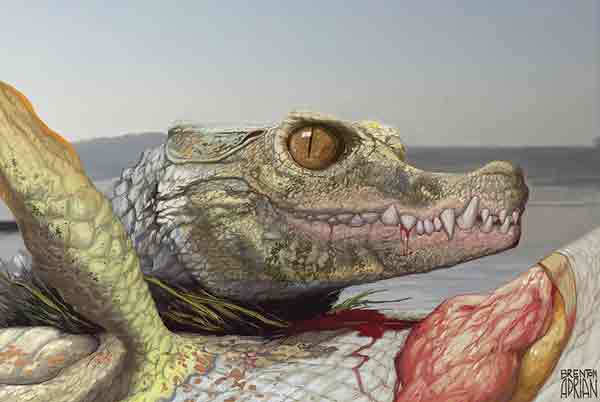
A Life Reconstruction of Scolomastax sahlsteini
Scolomastax a life reconstruction.
Picture credit: Brenton Adrian (University of Tennessee)
An Insight into the Cretaceous Ecosystem of Appalachia
Scolomastax sahlsteini lived approximately 96 million years ago. It has been described from a partial jawbone and this species differs from other prehistoric crocodyliforms associated with this fossil location in having a shortened mandible, reduced tooth count, heterodonty (teeth of different shapes), a dorsally expanded surangular and enlarged attachments for powerful jaw muscles.
Scolomastax sahlsteini
Scolomastax may have been not much bigger than a dwarf crocodile (Osteolaemus spp.), the smallest living crocodile species, but at around 1.5 metres in length, it had a formidable bite and was probably best avoided. Writing in the academic journal “The Anatomical Record”, the researchers conclude that Scolomastax may have specialised in eating shellfish, or turtles (durophagous diet). Scolomastax may even have been an omnivore, supplementing its diet with plant material. The fossils from this location (the Arlington archosaur Site), have provided palaeontologists with an insight into the fauna of the eastern part of the North America (Appalachia).
Commenting on the significance of the discovery, one of the co-authors of the scientific paper, Stephanie Drumheller-Horton, a palaeontologist at the University of Tennessee stated:
“People sometimes think that crocs haven’t changed much since the age of dinosaurs, but that just isn’t true. This little croc has several weird features that make us think it ate hard prey items and maybe even plants. We don’t have anything like it alive in the world today.”
A Geographical Puzzle
Co-author, Associate Professor Alan Turner (Stony Brook University), added:
“S. sahlsteini is part of a group of early croc relatives called paralligatorids. Most members of this group are from Asia, but we are starting to have a few examples of them from Texas. This helps us understand how groups were dispersing between Asia and North America prior to the closing of the Western Interior Seaway, the inland sea that split North America in two.”
The genus name means “pointed stake jaw”, whilst the species epithet honours long-time volunteer Arthur Sahlstein, who found the fossil jawbone. A phylogenetic analysis places this new genus within the Eusuchia, specifically a member of the Paralligatoridae and a sister taxon to Paralligator gradilifrons, which is known from Upper Cretaceous rocks of the Gobi Desert (Mongolia).
Scolomastax sahlsteini extends the record of paralligatorids into the Late Cretaceous (Cenomanian faunal stage) of North America. The jawbone fossil represents the first appearance of this clade on the poorly known landmass of Appalachia, supporting a biogeographic connection between North America and Asia in the Early Cretaceous prior to development of the Western Interior Seaway. The authors of the paper conclude that further analysis of the Paralligatoridae family is required in order to determine appropriate phylogeny.
The scientific paper: “An Enigmatic Small Neosuchian Crocodyliform from the Woodbine Formation of Texas” by Christopher R. Noto, Stephanie K. Drumheller, Thomas L. Adams and Alan H. Turner published in The Anatomical Record.
Everything Dinosaur acknowledges the assistance of a press release from the University of Tennessee (Knoxville) in the compilation of this article.
The First Archaeological Artefacts Found During the Search for Lost Prehistoric Settlements
During May 2019, an eleven-day expedition by European scientists from Belgium and Britain was undertaken to explore three sites of potential geological and archaeological interest in the southern North Sea. Through chance finds by fishermen over many decades, it has long been suspected that the southern North Sea hides a vast landscape that once was home to thousands of people. Over the past two years, the British team has been recreating the drowned landscape using data provided by oil and gas companies, windfarm developers and the coal board. The modelled landscape contains areas with a higher likelihood of past human activity, locations where prehistoric evidence for these activities might more likely be found.
Prospecting this drowned landscape in search of the evidence of people is a challenging activity, as the North Sea is not only one of the busiest seaways in the world but the weather often makes it inhospitable and this work can be dangerous. Furthermore, multiple utilities cross the area and visibility under water is often very poor.
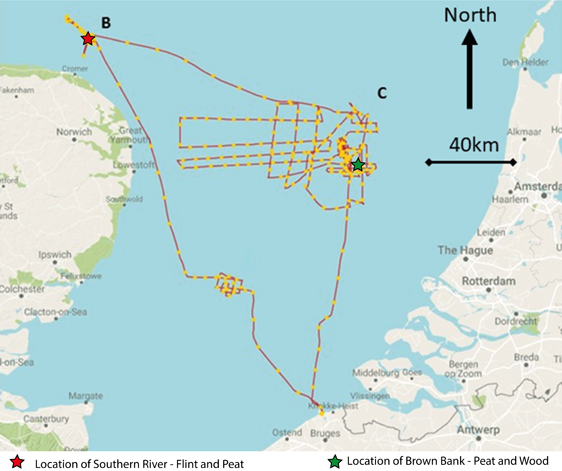
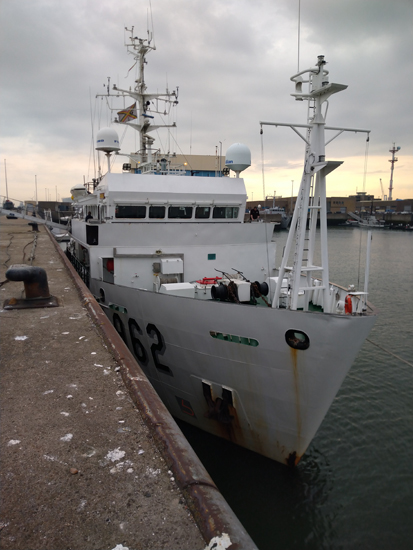
Given these challenging conditions, researchers on the Belgian vessel, RV Belgica, used acoustic techniques and physical sampling of the seabed to survey three of the high potential target areas. The team used both traditional geophysical techniques and a novel new technique with a parametric sonar. This specialised equipment enabled the highest resolution images to be obtained of the deposits beneath the seabed. Although the survey was heavily impacted by poor weather, confirmation of the occurrence of a well-preserved early Holocene land surface was made near Brown Bank (Area C in figure below), where several large samples of peat and ancient wood were recovered. This evidence strongly suggests that a prehistoric woodland once stood in this area.
The Research Team Identified a Prehistoric Woodland
Area of woodland identified in the southern North Sea – area C in the figure. Location of the flint find marked B.
Picture credit: The University of Bradford (Europe’s Lost Frontiers/VLIZ)
Difficult Weather Conditions Hampered the Research Efforts
Although hampered by the rough seas and bad weather the research team made considerable progress. Survey over Area B (see figure above), targeted a large river system identified in the model landscape. This area was focused on a zone where the river entered an ancient sea and was suspected to be a location where evidence of human activity was more likely to be preserved. The survey recorded not only remains of peat but also nodules of flint which may originate from submarine chalk outcrops near the ancient river and coast. These findings are supported by the results of vibrocores acquired in the area for the Europe’s Lost Frontiers project.
The Survey Vessel – The RV Belgica
The research vessel the RV Belgica.
Picture credit: The University of Bradford
First Archaeological Artefacts
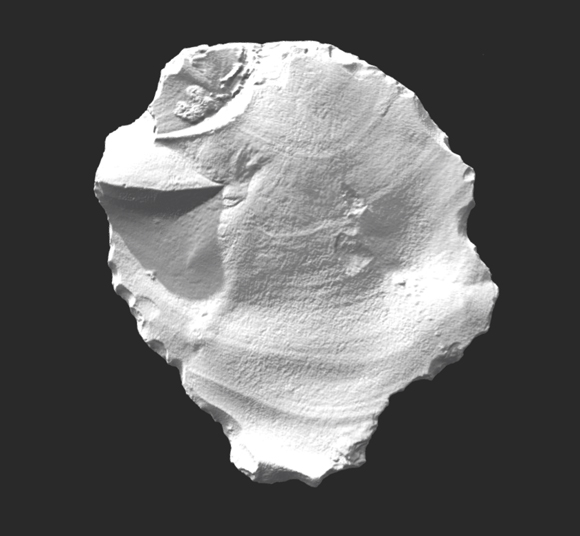
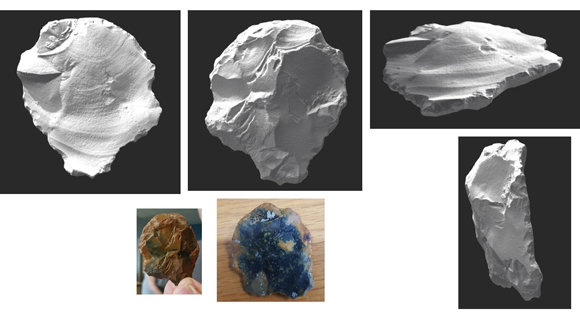
Further study has also revealed the first archaeological artefacts from the survey area. One was a small piece of flint that was possibly the waste product of stone tool making. The second was a larger piece, broken from the edge of a stone hammer, an artefact used to make a variety of other flint tools. As well as being evidence for flint tool production, the hammer fragment derived from a large battered flint nodule would once have been part of a personal tool kit. Research is still ongoing into this artefact and its context within the ancient North Sea landscape.
Laser Scan of the Flint
3-D laser scan of the flint, with raked lighting to show surface features.
Picture credit: Tom Sparrow, Visualising Heritage. University of Bradford
Images of the North Sea Flint
A series of images of the flint (laser scanned and colour photos) .
Picture credit: Tom Sparrow, Visualising Heritage. University of Bradford
Mapping the Southern River and the Brown Bank
In the relatively short period of time available for survey and sampling around the Southern River and the Brown Bank, the project methodology has clearly demonstrated its value. Marine geophysics has been used to map the topography of these lost lands and identify areas where prehistoric sediments may exist. Where these are accessible and are within areas of the landscape that are likely to be attractive for human occupation or use, sediments can be extracted for careful examination and with a higher expectation of making finds than was previously possible.
The material recovered suggests that the expedition has revealed a well-preserved, prehistoric landscape which, based on preliminary inspection of the material, must have contained a prehistoric woodland. The recovery of stone artefacts not only demonstrate that these landscapes were inhabited but also that archaeologists can, for the first time, prospect for evidence of human occupation in the deeper waters of the North Sea with some certainty of success. Work will now proceed to refine our knowledge of the larger context of these finds and to plan further expeditions to explore these hidden prehistoric landscapes.
Everything Dinosaur acknowledges the assistance of a press release from the University of Bradford in the compilation of this article.
With the discovery of the amazing feathered dinosaur fossils from China, scientists have had to re-think their views about the appearance of dinosaurs, but the story of the evolution of the feather goes more than just skin deep. In a follow up, to an earlier scientific paper published late last year that examined the evidence for four different types of feather in the Pterosauria, a team of researchers have concluded that the feather arose around 80 million years earlier than the first bird. Furthermore, the study, led by scientists at the University of Bristol proposes that feathers played a significant role in helping to shape modern terrestrial ecosystems.
Not Just a Flight of Fancy – Feathers Change the Way We Look at Archosaurs
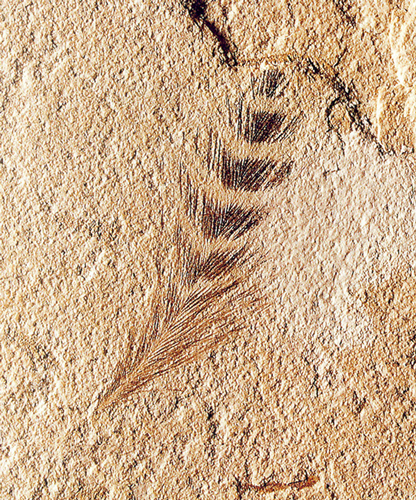
Numerous isolated feathers have been preserved indicating the presence of Avialae – primitive birds and theropod dinosaurs closely related to birds. In addition, feather-like structures have been identified in pterosaurs.
Picture credit: Museu Nacional
Changing Our Understanding of Feathers, Their Function and Role in Evolution
Writing in the academic journal “Trends in Ecology and Evolution”, the researchers develop the work undertaken last year that looked at evidence for feathers in flying reptile fossils from China and utilises techniques deployed in molecular biology to plot the development of integumentary producing genes within the Archosauria. If feathers did evolve in the Pterosauria as well as the Dinosauria, then this suggests that their common ancestor may have been feathered to. Feather-like structures probably arose relatively early in the evolution of the archosaurs.
Lead author of the paper, Professor Mike Benton (Bristol University), commented:
“The oldest bird is still Archaeopteryx first found in the Late Jurassic of southern Germany in 1861, although some species from China are a little older. Those fossils all show a diversity of feathers – down feathers over the body and long, vaned feathers on the wings. But, since 1994, palaeontologists have been contending with the perturbing discovery, based on hundreds of amazing specimens from China, that many dinosaurs also had feathers.”
Archaeopteryx – An Early Bird But Not The First Creature to Have Feathers
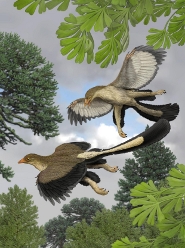
The first bird – “Urvogel”, the Archaeopteryx but not the first animal to have feathers.
Picture credit: Carl Buell
Links Between Fish Teeth, Scales, Feathers and Mammalian Hair
Feathers are modified epidermal appendages that consist mainly of horn-like proteins (β-proteins). Research has identified links at the genetic level between structures in vertebrates associated with shark teeth, dermal scales in teleost fishes, reptilian scales, feathers and mammalian body hair. The discovery that genes specific to the production of feathers evolved at the base of the Archosauria clade rather than in association with stem members of the Avialae (birds), is supported by fossil evidence in the form of numerous examples of feathered dinosaurs including examples of feathers in ornithischian dinosaurs as well as the Theropoda. Many of the authors of this new paper also worked on the study into feathers in pterosaurs published in December last year.
A Genetic Link Between Dermal Coverings in Tetrapods and Teleost Fish Scales
Fish scales linked to feathers in genome analysis.Picture credit: Everything Dinosaur.
Picture credit: Everything Dinosaur
Not Just Dinosaur Feathers
If feathers evolved before the evolution of flight, they probably arose first as simple monofilament structures most likely to aid the retention of body heat in the archosaurian ancestors of birds and dinosaurs, perhaps first appearing sometime in the Early Triassic, a time after the Permian mass extinction which had led to a massive terrestrial faunal turnover and the evolution of more active animals with upright, erect gaits.
Co-author of the study, Baoyu Jiang from the University of Nanjing (China), added:
“At first, the dinosaurs with feathers were close to the origin of birds in the evolutionary tree. This was not so hard to believe. So, the origin of feathers was pushed back at least to the origin of those bird-like dinosaurs, maybe 200 million years ago. In fact, we have shown that the same genome regulatory network drives the development of reptile scales, bird feathers, and mammal hairs. Feathers could have evolved very early.”
Pterosaurs had Feathers
The breakthrough for the research team occurred when two new types of pterosaur from China were studied. Their pycnofibres showed branching, they did not have monofilaments but tufts and downy-like feathers, this led to the conclusion that members of the Pterosauria had feathers too.
Baoyu Jiang continued: “The breakthrough came when we were studying two new pterosaurs from China.
Professor Benton postulated that this area of research indicates the origins of feathers some 250 million years ago.
The professor explained:
“The point of origin of pterosaurs, dinosaurs and their relatives. The Early Triassic world then was recovering from the most devastating mass extinction ever, and life on land had come back from near-total wipe-out. Palaeontologists had already noted that the new reptiles walked upright instead of sprawling, that their bone structure suggested fast growth and maybe even warm-bloodedness, and the mammal ancestors probably had hair by then. So, the dinosaurs, pterosaurs and their ancestors had feathers too. Feathers then probably arose to aid this speeding up of physiology and ecology, purely for insulation. The other functions of feathers, for display and of course for flight, came much later.”
The Importance of Kulindadromeus
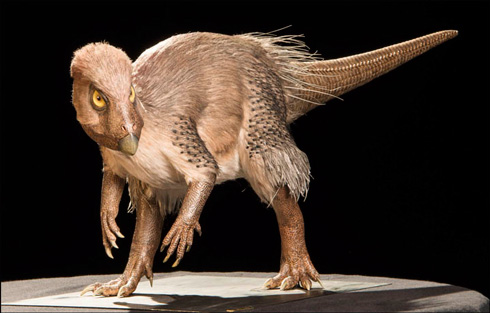
Co-author Dr Maria McNamara (University College Cork, Ireland), explained that the discovery of a feathered dinosaur not thought to be closely related to birds has changed the way some palaeontologists view the evolution of feathers. In 2014, a formal paper was published on a small, bird-hipped dinosaur that was named Kulindadromeus. Fossils of this small, Siberian herbivore showed that it had skin covered with scales on the legs and tail, but strange, feathery filaments over much of the rest of its body.
A Scale Model of the Feathered Ornithischian Dinosaur Kulindadromeus (K. zabaikalicus)
A 1:1 scale model of Kulindadromeus (Kulindadromeus zabaikalicus)
Picture credit: T. Hubin/RBINS
Dr McNamara commented:
“What surprised people was that this was a dinosaur that was as far from birds in the evolutionary tree as could be imagined. Perhaps feathers were present in the very first dinosaurs.”
Studying the Development of Dinosaur Feathers
Fellow co-author Danielle Dhouailly (University of Grenoble, France), studies the development of feathers in baby birds, especially their genomic control. Her research has demonstrated that modern birds such as chickens often have scales on their legs or necks, these are in fact evidence of reversal, what had once been feathers had reverted to their more ancient form, that of reptilian scales.
This research supports the idea that gene regulatory networks show that the development of scales, feathers and hairs are co-ordinated by a similar set of genes. Feathers and body hair probably evolved in the Early Triassic with the ancestors of mammals and birds, at a time when synapsids (the lineage of tetrapods that led to mammals) and archosaurs (dinosaurs and birds), show independent evidence of higher metabolic rates.
It was the mass extinction event at the end of the Permian that re-set the evolutionary clock and permitted the evolution of more active land animals, setting terrestrial lifeforms on a course that would ultimately lead to the rise of the dinosaurs, volant flight in the Dinosauria and of course the evolution of modern mammals including ourselves.
The scientific paper: “The Early Origin of Feathers” by M. J. Benton, D. Dhouailly, B. Jiang and M. McNamara published in Trends in Ecology & Evolution.
To read our earlier article (December 2018) that examined the evidence for four different kinds of feather-like structures associated with pterosaur fossils: Are the Feathers About to Fly in the Pterosauria?
To read an article from 2015 setting out a counter argument concluding that the majority of the Dinosauria probably did not have feathers: Most Dinosaurs Were Probably Scaly.
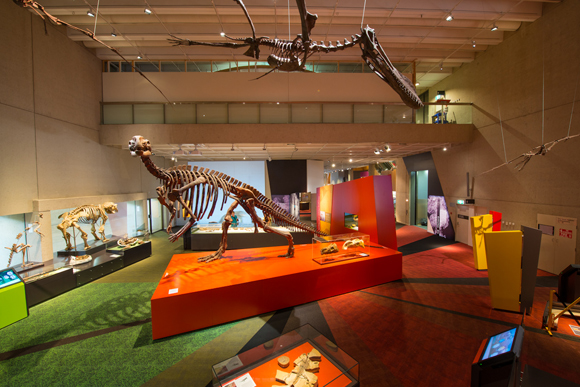
The “Lost Creatures” exhibition at the Queensland Museum (Australia), has been open for more than five years. Hasn’t the time flown by. The exhibition opened in December 2013, its aim was to document the amazing prehistoric creatures that once inhabited this part of Australia. The skilfully designed displays to be found on level two of the museum, took visitors on a journey from around 250 million years ago to more recent times to meet ancient megafauna such as giant monitor lizards, terrifying marine reptiles and of course, dinosaurs.
The “Lost Creatures” Exhibition at the Queensland Museum (Opening Publicity Photograph)
Dinosaurs, pterosaurs and other prehistoric animals from Queensland feature in the “Lost Creatures” exhibition.
Picture credit: Queensland Museum
Recently, Everything Dinosaur has produced a number of articles about Australian dinosaur discoveries, ironically, the most recent articles have featured dinosaur fossil finds, not from Queensland but from New South Wales.
Commenting on the significance of the exhibition when it first opened the Minister for Science, Innovation, Information Technology and the Arts, at the time, Ian Walker stated:
“Lost Creatures tells an epic story of the struggle to survive and reveals which species survived extinction events in Queensland’s distant past.”
Remains of Armoured Dinosaurs on Display
The remains of armoured dinosaurs make up part of the “Lost Creatures” exhibition.
Picture credit: Queensland Museum
More than a Hundred Fossils on Display
The exhibition consists of more than one hundred fossil specimens which combine with beautiful three-dimensional animal reconstructions and fossil casts to bring Queensland’s prehistoric fauna to life. Star attractions include the giant lizard Megalania, arguably Australia’s most famous dinosaur – Muttaburrasaurus and remains of ancient prehistoric mammals, some of the giant marsupials that dominated “down under”.
Giant Mammals and the Remains of Prehistoric Reptiles
The remains of giant mammals and marine creatures on display.
Picture credit: Queensland Museum
Exhibition Highlights
Exhibition highlights include remains of the enormous, prehistoric wombat Diprotodon as well as a life-size reconstruction of the hind leg of the sauropod Rhoetosaurus which stands over two metres high. In addition, more than ninety square metres of the famed Lark Quarry dinosaur trackways are on display along with a video speculating how the numerous dinosaur tracks might have formed.
When this exhibit first opened it was hailed as one of the most comprehensive overviews of Australia’s ancient megafauna, it is pleasing to see that after nearly six years it is still attracting lots and lots of visitors.
Everything Dinosaur acknowledgs the assistance of the Queensland Museum in the compilation of this article.
University Staff and Students Find Neolithic Artefacts
Staff and students from the University of Wales Trinity Saint David (UWTSD), Lampeter campus have uncovered evidence of New Stone Age activity in western Wales including the discovery of a stone axe that would have been a prized possession some 4,000 years ago.
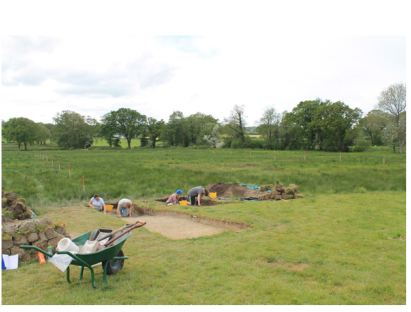
The stone axe find was made during an archaeological dig at Llanllyr in Talsarn, Ceredigion county. The dig is part of a programme of undergraduate fieldwork, enabling students to gain “hands on” experience and to practice field techniques. Excavations have been centred around low mounds surrounded by marshland, areas that are believed to have formed dry ground in the past and as such, they are key places to study for signs of early human habitation. These “islands” of raised, dry ground appear to have been the focus of activity in the Neolithic period (between four and six thousand years ago), when people left behind traces of their presence in the form of flint tools and other artefacts.
Staff and Students Working at the Archaeological Site
University of Wales Trinity Saint David (UWTSD) – Lampeter campus working at the Neolithic dig site.
Picture credit: University of Wales Trinity Saint David (UWTSD)
Trenches Dug to Explore the Deposition of Material
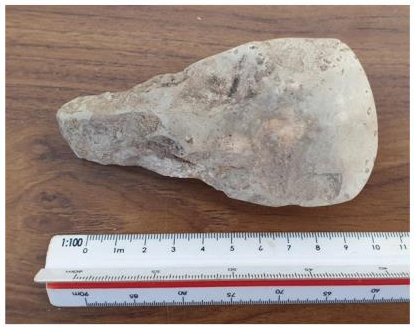
Exploratory trenches were dug at the site and in one, a ground stone axe was discovered. This rare artefact very probably had a wooden handle when in use thousands of years ago. The axe would have taken many hours of skilled labour to shape, academics have expressed surprise that such an object was abandoned in this landscape. The team from the University are also investigating the surrounding area using boreholes to recover samples suitable for reconstructing the ancient vegetation and to provide further data to help date the age of the stone tool finds.
The Flint Stone Axe Found at the Site
The stone axe with an archaeological ruler for scale. The chopping face of the axe can be seen on the right.
Picture credit: University of Wales Trinity Saint David (UWTSD)
Field Work Experience – An Important Teaching Aid
Joint leader of the dig team, Dr Martin Bates, a geoarchaeologist at the University of Wales Trinity Saint David commented:
“Running an excavation like this is an important part of our teaching here at Lampeter and giving our students the opportunity to gain the skills an archaeologist needs is very important. When we began our excavations, we did not anticipate finding Neolithic artefacts so this is a bonus for the team. Hopefully, we can come back next year with a new group of students and continue our investigation of this important piece of Ceredigion’s history.”
Lucky Student
Second-year student Joe Neal was the lucky person who uncovered the stone axe. The archaeology undergraduate student stated:
“It’s a great find for us, I couldn’t have hoped to find anything better. This is my first dig and the first time I have found anything, so this is great.”
Dr Ros Coard, Senior Lecturer in Archaeology at UWTSD, added:
“The University of Trinity Saint David has run excavations at the Llanllyr site over a number of years but mostly found later medieval material, so to find a much deeper pre-history is exciting and broadens our understanding of the Aeron Valley and this part of Ceredigion. It is a most unusual and unexpected find certainly warranting further exploration of the area.”
Everything Dinosaur acknowledges the assistance of a press release from the University of Wales Trinity Saint David in the compilation of this article.
To read about a New Stone Age jawbone with a beeswax filling: Neolithic Dentists.
To read an article about the mapping and recording of high altitude, ancient Stone Age artwork: High Rise Archaeology.