All about dinosaurs, fossils and prehistoric animals by Everything Dinosaur team members.

Fossil finds, new dinosaur discoveries, news and views from the world of palaeontology and other Earth sciences.

24 07, 2020

Irisosaurus yimenensis – New Species of “Core Prosauropod”

By |2024-03-09T08:34:48+00:00July 24th, 2020|Categories: Dinosaur and Prehistoric Animal News Stories, Dinosaur Fans, Main Page, Palaeontological articles|0 Comments

Irisosaurus yimenensis – New Species of “Core Prosauropod” from Southern China

Researchers writing in the open access journal Scientific Reports have described a new species of Early Jurassic herbivorous dinosaur from China.  The animal, named Irisosaurus yimenensis is known from fragmentary remains and demonstrates a suite of unusual anatomical features that suggests this genus is a member of the Sauropodiformes, between early-branching “core prosauropods” and the late-branching “sauropod-like” members of the non sauropodan sauropodomorphs.  The fossilised remains come from the Fengjiahe Formation close to the village of Zhanmatian in Yunnan province.

A Life Reconstruction of Irisosaurus yimenensis

Irisosaurus yimenensis illustration.
Irisosaurus yimenensis life reconstruction.  This herbivorous dinosaur is thought to have been bipedal, measuring approximately 5 metres in length and from the Early Jurassic of China (Pliensbachian faunal stage of the Early Jurassic).

Picture credit: Ang Li

Fossil Material Found in 2018

The researchers which include Claire Peyre de Fabrègues of Yunnan University analysed the partial skeleton and concluded that Irisosaurus has a body plan close to that of the so-called “core prosauropods” in having, for instance, cervical vertebrae longer than most dorsal vertebrae, gracile forelimbs which are much shorter than the hindlimbs, a deltopectoral crest extending half of the total length of the humerus and a unique carpal-metacarpal complex.  The fossil material has been dated to approximately 185 million years ago (Pliensbachian faunal stage of the Early Jurassic), it was discovered in 2018.  A phylogenetic analysis confirmed that Irisosaurus belongs to non-sauropodan sauropodomorphs and places it as the sister taxon to Mussasaurus which lived more than thirty million years early in Argentina.

Phylogenetic Analysis places Irisosaurus as the Sister Taxon to the South American Mussaurus
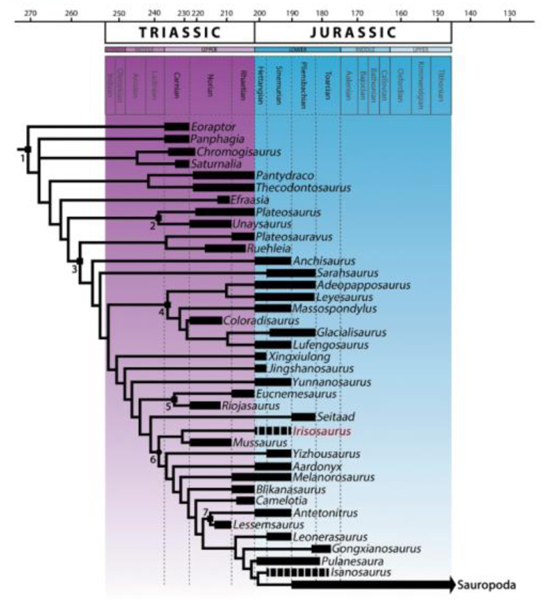
Irisosaurus phylogeny.
Phylogenetic analysis places Irisosaurus as the sister taxon to the South American Mussaurus

Picture credit: Scientific Reports

On the Road to the Sauropoda

The Sauropodomorpha is defined as saurischian dinosaurs that incorporate the Sauropoda and the early diverging sauropodomorphs.  The earliest sauropodomorphs are known from the Late Triassic, with most of the described species from Gondwana.  The Laurasian record of these types of dinosaurs does consist of some Triassic forms, but the majority of the known species date from the Jurassic.  Among the fourteen Jurassic non-sauropodan sauropodomorphs from Laurasia described to date, eight are from China.  Nearly all of the non-sauropodan sauropodomorph genera currently known from China were first reported from the Lufeng Formation, which is also associated with the Yunnan province.  The Fengjiahe Formation is the southern equivalent of the Lufeng Formation, it has revealed a similar ancient dinosaur dominated biota.

Silhouette of Irisosaurus yimenensis with Some of the Fossil Material
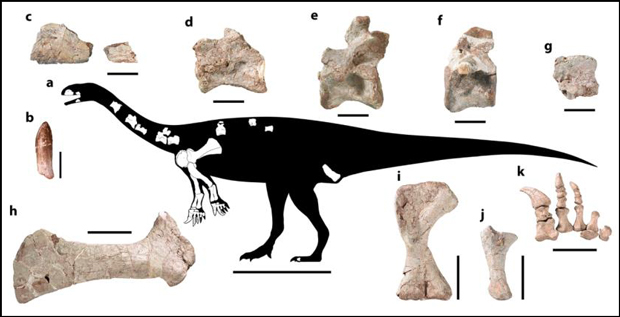
Irisosaurus yimenensis outline and fossil material.
Silhouette of Irisosaurus yimenensis with some of the fossil material.  The most informative elements are figured; (a) Outline; (b) Tooth; (c) Left maxilla; (d) Middle cervical; (e) Posterior cervical; (f) Anterior dorsal; (g) Middle dorsal neural spine; (h) Right scapula; (i) Right humerus; (j) Right ulna; (k) Right manus.  Scale bars = 1 m (a);1 cm (b); 5 cm (c–g); 10 cm (h–k).

Picture credit: Scientific Reports

What’s in a Name (Etymology)?

The generic name refers to the famous iridescent clouds of Yunnan Province (彩云之南). The specific epithet refers to Yimen County, where the type locality is located

The scientific paper: “A new species of early-diverging Sauropodiformes from the Lower Jurassic Fengjiahe Formation of Yunnan Province, China” by Claire Peyre de Fabrègues, Shundong Bi, Hongqing Li, Gang Li, Lei Yang and Xing Xu published in Scientific Reports.

The Everything Dinosaur website: Everything Dinosaur.
23 07, 2020

Stunning Scientific Paper on Hummingbird-sized Dinosaur Retracted

By |2024-03-09T08:30:18+00:00July 23rd, 2020|Categories: Dinosaur and Prehistoric Animal News Stories, Dinosaur Fans, Main Page, Palaeontological articles, Photos/Pictures of Fossils|0 Comments

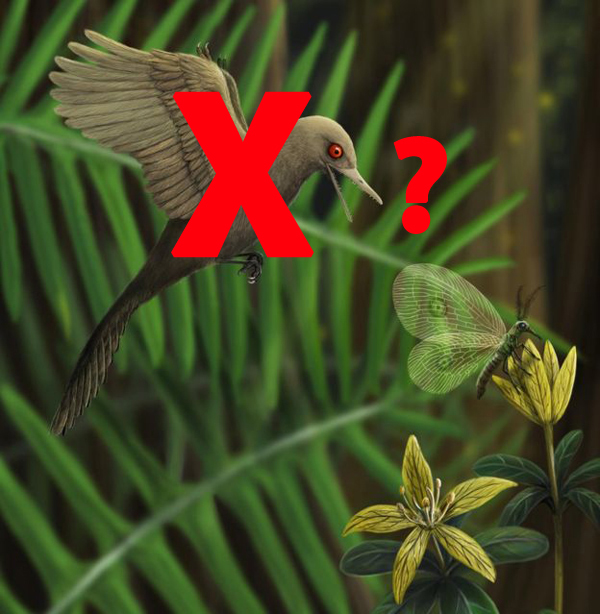
Scientific Paper on Oculudentavis khaungraae Retracted

On March the 11th (2020), a scientific paper was published in the academic journal “Nature” highlighting another remarkable discovery found in an amber nodule from northern Myanmar.  The Cretaceous-aged amber had already provided some astonishing information on the forest biota close to a coastline from around 100 million years ago.

An ammonite shell entombed in the ancient tree resin for example, then there was the remains of a tiny baby snake (Xiaophis myanmarensis), fossilised frogs and a whole range of insects, plant and pollen fossils, not to mention preserved remains of enantiornithine birds and a partial feathered tail from a dinosaur.  Everything Dinosaur had covered these discoveries within this blog, but this new paper, written by Xing et al concerned something truly breath-taking… the title of the paper summed it up nicely – “Hummingbird-sized dinosaur from the Cretaceous period of Myanmar”.

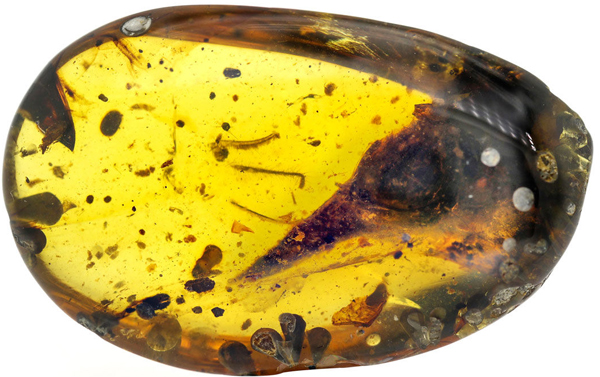
A Tiny Fossilised Skull – The Skull of a Maniraptoran?

Oculudentavis khaungraae skull in amber.
Tiny fossil skull preserved in amber (Oculudentavis khaungraae).

Picture credit: Lida Xing et al

Something Tiny But Very Big

The research team, comprised of scientists from the China University of Geosciences, the Natural History Museum of Los Angeles County (USA), the Royal Saskatchewan Museum (Canada) and the Chinese Academy of Sciences, described an amazingly well-preserved tiny fossil skull with very bird-like features but miniscule teeth present in its jaws.  The tiny specimen, less than 1.5 cm long was thought to represent the smallest dinosaur known to science.  The animal was named Oculudentavis khaungraae, the genus name means “eye tooth bird” in recognition of its enormous eyes and unusual characteristic of having some of the upper teeth located directly under the eye socket.

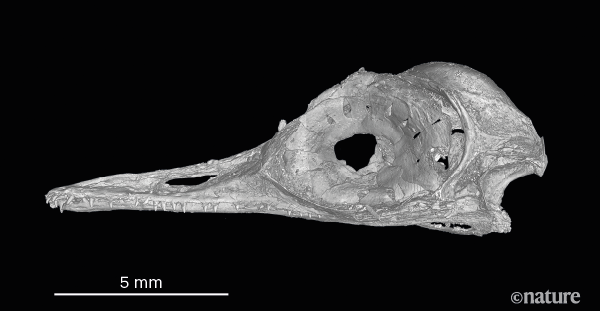
Computer Generated Image of the Bird-like Skull (O. khaungraae)

Oculudentavis khaungraae computer generated image of the skull.
Oculudentavis khaungraae computer generated image of the skull (left lateral view).  The genus name translates as “eye tooth bird”, whilst the trivial name honours the person who donated the amber nodule to a museum (Hupoge Amber Museum).

Picture credit: Xing et al (Nature)

Oculudentavis khaungraae was documented as representing the smallest dinosaur and compared to the smallest extant avian dinosaur Mellisuga helenae, the bee hummingbird.

However, in what we at Everything Dinosaur think is an unprecedented development, the scientific paper announcing this amazing discovery has, this week, been retracted.

A statement on the “Nature” website reads:

“We, the authors, are retracting this Article [the March 11th paper] to prevent inaccurate information from remaining in the literature.  Although the description of Oculudentavis khaungraae remains accurate, a new unpublished specimen casts doubts upon our hypothesis regarding the phylogenetic position of HPG-15-3.

The specimen number HPG-15-3, is the holotype cranial material currently in the collection of the Hupoge Amber Museum in China.

A Controversial Scientific Paper

Shortly after the scientific paper’s publication, a number of academics challenged the conclusions drawn and criticised the authors for their taxonomic assessment which relates to Oculudentavis khaungraae being classified as “bird-like” and placed within the Avialae, a clade that includes elements of the Maniraptora (some theropod dinosaurs and birds).

It was suggested that the phylogenetic assessment carried out was too biased towards resolving the placement of Oculudentavis as a bird or a very closely related dinosaur, rather than considering other data sets that might resolve its position elsewhere.  The “bird-like” skull is found in a number of lizards (examples of convergent evolution), several authors commented that the possibility of O. khaungraae being a lizard was discounted too quickly by the paper’s authors.

Everything Dinosaur reported these concerns and doubts in a follow up article to the original post about the scientific paper on March 15th (2020): Casting Doubt over Oculudentavis.

Can a Binomial Name be Obliterated?

It is rare for a scientific paper to be retracted, but occasionally this happens.  Papers can be retracted for any of a number of reasons, but normally a retraction occurs when serious questions surrounding its veracity are identified.  For example, a paper published in 1998 in the medical journal the “Lancet” by Wakefield et al reporting a link between the MMR vaccination and autism was retracted in 2012 following an extensive investigation.  The British Medical Journal (BMJ), put out a press release stating that following the investigation it had been concluded that the paper implying a link between the MMR jab and autism was an “an elaborate fraud.”

Dr Fiona Godlee, BMJ Editor in Chief stated at the time:

“The MMR scare was based not on bad science but on a deliberate fraud” and that such “clear evidence of falsification of data should now close the door on this damaging vaccine scare.”

The scientific binomial name Oculudentavis khaungraae is now in limbo.  It is a matter of record that the taxon name exists, but with the withdrawal of the paper, we at Everything Dinosaur are not sure what will happen.  It probably falls within the remit of the International Commission on Zoological Nomenclature (ICZN), to produce a ruling on how to treat this taxon.

This development does not undermine the astonishing fossil discoveries being made as researchers study amber from Myanmar, it might help to bring into focus some of the ethical issues associated with the commercial mining and use of funds, but scientific reporting is essentially built on trust.  Fossils have been frequently misidentified , as new evidence emerges so ideas, theories and hypotheses evolve and develop.  Normally, scientists correct their findings in subsequent papers, to have a scientific paper retracted is highly unusual.

Oculudentavis khaungraae – A Taxon in Limbo

Oculudentavis - is this an invalidated taxon?
The validity of the taxon is in limbo after scientific paper was retracted.

Picture credit: Han Zhixin with additional annotation by Everything Dinosaur

We shall await developments…

In the meantime, visit the Everything Dinosaur website: Everything Dinosaur.
17 07, 2020

Schleitheimia Fills a Sauropod-sized Gap in Dinosaur Evolution

By |2024-03-08T15:37:42+00:00July 17th, 2020|Categories: Dinosaur and Prehistoric Animal News Stories, Dinosaur Fans, Main Page, Palaeontological articles, Photos/Pictures of Fossils|0 Comments

Schleitheimia schutzi – Oldest Known Transitional Sauropodomorph

The biggest dinosaurs of all were the sauropods.  Famous giants such as Diplodocus and Brachiosaurus, exhibits of which adorn numerous main galleries of natural history museums around the world.  However, how these giant quadrupeds evolved from their much smaller sauropodomorph ancestors is poorly understood.  A team of scientists from Munich, Utrecht and Zürich have been able to identify a new ancestor of the long-necked dinosaurs (true Sauropoda),  from strata in the Swiss Canton of Schaffhausen.  The dinosaur named Schleitheimia schutzi is the oldest transitional form between the Sauropodomorpha and the Sauropoda described to date.

A Life Reconstruction of Schleitheimia schutzi

Schleitheimia schutzi life reconstruction.
An illustration of the giant, newly described Sauropodomorpha Schleitheimia schutzi.   A Plateosaurus is in the background and a predatory pseudosuchian can be seen in the foreground.

Picture credit: Beat Scheffold (Naturforschende Gesellschaft Schaffhausen)

Hidden Amongst the Substantial Plateosaurus Remains

Although there are several substantial bonebeds in Switzerland that represent the Plateosaurus genus, (a sauropodomorph) and our knowledge regarding the global distribution of this group has certainly improved over the last five years or so, the diversity of the Sauropodomorpha and its composition remains controversial.

The researchers which include Professor Oliver Rauhut from the Bayerische Staatssammlung für Paläontologie und Geologie, (Munich), Femke Holwerda currently at the Royal Tyrrell Museum (Alberta, Canada) and Heinz Furrer from Zürich University re-examined a series of fragmentary fossils recovered from three different locations associated with Plateosaurus bonebeds.  They concluded that the material represents the remains of two different, very big and robust sauropodomorphs.  One of these is described as a new taxon – Schleitheimia schutzi.

A Partial Femur Assigned to Schleitheimia schutzi

Partial femur assigned to Schleitheimia.
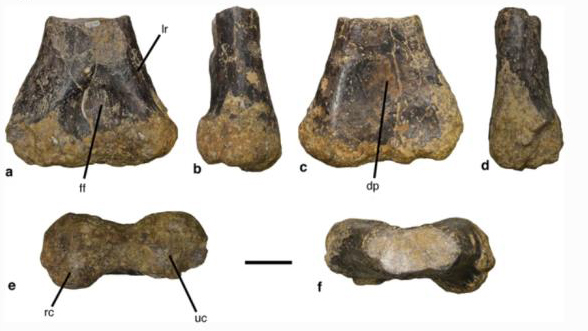
Distal end of left humerus of Schleitheimia schutzi n. gen., n. sp., PIMUZ A/III 549. a anterior view; b lateral view; c posterior view; d medial view; e distal view; f, proximal view of proximal break.  Scale bar = 5 cm.

Picture credit: Rauhut et al (Swiss Journal of Geosciences)

The fossils had been thought to represent large examples of Plateosaurus.  Some of the material had been collected decades ago and given the huge size of the bonebeds and their monodominant nature little further thought had been given to the over-sized bones associated with the sites.

Identifying Schleitheimia schutzi

Professor Rauhut explained:

“Although Schleitheimia schutzi probably looked quite similar to Plateosaurus, this dinosaur with an estimated 9 to 10 metres body length is already significantly larger than the latter.  The new species [S. schutzi] was apparently very robust and like its gigantic descendants, probably moved on all fours, while Plateosaurus mostly walked on its hind legs.”

The genus name honours the type locality at Schleitheim, Canton Schaffhausen, Switzerland, whilst the species name honours Emil Schutz (1916-1974) who collected the type material.

Special in Two Ways

Schleitheimia roamed central Europe around 210 million years ago (late Norian faunal stage of the Triassic).  This makes Schleitheimia a lot older than other known transitional types of dinosaur between sauropodomorphs and sauropods.  Secondly, it is the first transitional form known from the continent of Europe.  Phylogenetic assessment suggests that this dinosaur is a derived basal sauropodiform and possibly very close to the evolutionary line that led to the Sauropoda.  Its discovery highlights the diversity of sauropodomorphs in the Late Triassic and suggests that many types of sauropodomorph survived the end-Triassic extinction event and flourished in the early Jurassic.

Views of a Cervical Vertebra (Schleitheimia schutzi)

Neck bones (cervical vertebrae) attributed to Schleithimia.
Posterior cervical vertebra of Schleitheimia schutzi n. gen., n. sp., PIMUZ A/III 538. a, b left and right lateral views; c dorsal view; d anterior view; e posterior view; f ventral view. Scale bar = 5 cm.

Picture credit: Rauhut et al (Swiss Journal of Geosciences)

The scientific paper: “A derived sauropodiform dinosaur and other sauropodomorph material from the Late Triassic of Canton Schaffhausen, Switzerland” by Oliver W. M. Rauhut, Femke M. Holwerda and Heinz Furrer published in the Swiss Journal of Geosciences.

The Everything Dinosaur website: Everything Dinosaur.
15 07, 2020

Deadly Dolphin Predator of the Oligocene Epoch

By |2024-03-08T15:24:26+00:00July 15th, 2020|Categories: Dinosaur and Prehistoric Animal News Stories, Main Page, Palaeontological articles, Photos/Pictures of Fossils|0 Comments

Well-preserved Skeleton Provides Information on Evolution of Toothed Whales

The well-preserved fossilised remains of a large cetacean from the coastal low country of South Carolina is helping palaeontologists to better understand the evolution of rapid locomotion in toothed whales.  The specimen, which is nearly complete (cranial material, plus most of the spine and the remains of one flipper), was found in the early 1990s by Mark Havenstein, a commercial palaeontologist and a former student at the College of Charleston in South Carolina.  The skeleton was later acquired by a private fossil collector before being donated to the Mace Brown Museum of Natural History at the College.

Dangerous Prehistoric Dolphin

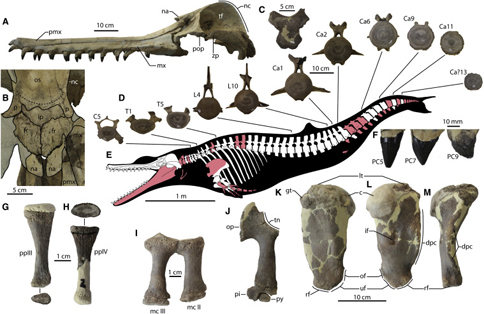
Writing in the academic journal “Current Biology”, a team of researchers led by Robert W. Boessenecker (Department of Geology and Environmental Geosciences, College of Charleston), have identified it as a large, predatory dolphin which shows adaptations within its skeleton to permit fast swimming.

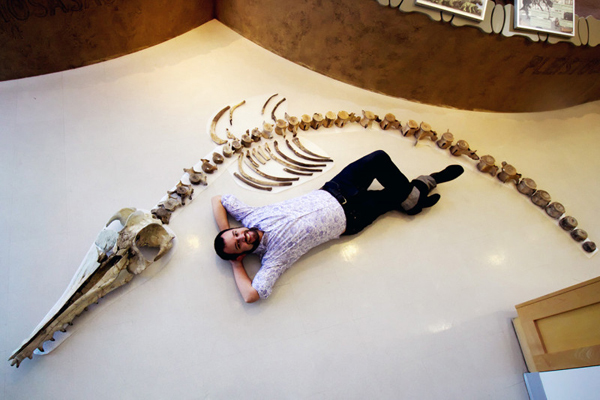
Palaeontologist Robert W. Boessenecker Poses with the Fossil Material

Palaeontologist Robert W. Boessenecker poses with the fossil material
Robert W. Boessenecker (Department of Geology and Environmental Geosciences, College of Charleston), poses with the Ankylorhiza prehistoric dolphin fossil material.

Picture credit: College of Charleston/Robert Boessenecker

Extant cetaceans are superbly adapted to a marine existence, with tail flukes a key evolutionary innovation in propulsion, an adaptation shared by all living species.  Some dolphins, for example, have been recorded swimming at speeds in excess of 50 km/h (27 knots).  These fast speeds and bursts of acceleration are attributed to the thrust provided by the powerful tail fluke with flippers providing steering.  These movements are enabled by a sturdy and powerful body with a relatively rigid torso consisting of numerous compacted vertebrae and movement in the water is adjusted by varying the angle of the flippers.

The Rarity of Oligocene Cetacean Skeletons

Eocene-aged cetaceans reveal a transition from a semi-aquatic lifestyle to a fully aquatic one with adaptations to permit a nektonic habit.  However, the rarity of Oligocene whale skeletons has hampered the efforts of palaeontologists to understand how the evolution of tail fluke-powered, but forelimb-controlled locomotion came about.  The newly named Ankylorhiza tiedemani, which had previously only been known from a partial rostrum, represents a transitional form in terms of its forelimb shape and structure.   Its forelimb is intermediate in morphology between stem cetaceans and living whales, whereas its axial skeleton displays incipient rigidity at the base of the tail with a flexible lumbar region.

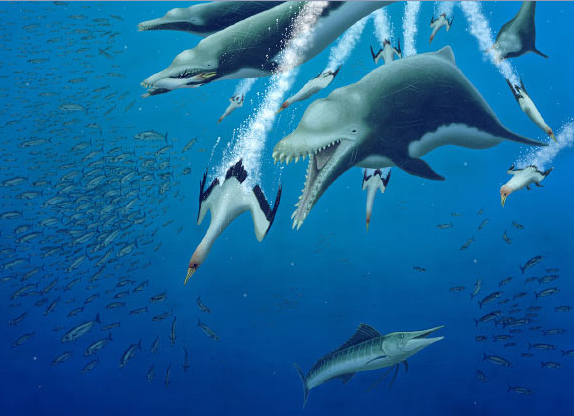
Ankylorhiza tiedemani Probably Occupied an Apex Predator Niche

Ankylorhiza tiedemani life reconstruction.
A pod of the dangerous prehistoric dolphin Ankylorhiza tiedemani attacking seabirds.

Picture credit: Robert Boessenecker

Commenting on the importance of the South Carolina specimen, lead author Robert Boessenecker explained that the discovery was one of the first skeletons found of a very early member of the toothed whales (Odontoceti), shortly after they diverged around 35-36 million years ago from baleen whales (Mysticeti).

He added:

“What makes that important is its evolutionary position as a very early branching dolphin.  Most early dolphins are known only from skulls, so having a skeleton with flippers and most of the vertebrae gives us an unprecedented look into the evolution of swimming adaptations.  That unprecedented window surprisingly told us that baleen whales and dolphins have many similarities owing to convergent evolution since their evolutionary split 35 million years ago.”

“Fused Roots”

The scientists estimate that Ankylorhiza grew to about 4.8 metres in length and probably occupied a similar predatory role in marine environments as modern orcas do today.  The genus name means “fused roots” and refers to the strongly fused tooth roots.

A phylogenetic assessment places Ankylorhiza near to the base of the toothed whale radiation and if this is the case, than it implies that several adaptations to aid locomotion such as a shortened humerus and a narrow but powerful peduncle (the end of the body that is adjacent to the fluke), evolved independently in both the Odontoceti and the Mysticeti.  In essence, that there is evidence to support the theory of convergent evolution in locomotor features between toothed and baleen whales.

The Fossil Material and a Skeletal Outline of Ankylorhiza tiedemani

Ankylorhiza fossil material.
Ankylorhiza fossils and skeletal outline.  Items in white are known fossils. The fossilised remains of a prehistoric dolphin.

Picture credit: Boessenecker et al (Current Biology)

A Prehistoric Dolphin with Primitive and Derived Characteristics

Ankylorhiza’s skeleton shows a combination of more derived as well as primitive features, thus helping to cement it as a basal member of the toothed whale lineage.

Robert Boessenecker stated:

“These primitive features are surprising because palaeontologists and biologists long assumed that many of the adaptations for rapid swimming in baleen whales and toothed whales were ancient adaptations shared thanks to their common heritage over the past 35 million years.”

Everything Dinosaur acknowledges the assistance of a press article from the College of Charleston in the compilation of this article.

The scientific paper: “Convergent Evolution of Swimming Adaptations in Modern Whales Revealed by a Large Macrophagous Dolphin from the Oligocene of South Carolina” by Robert W. Boessenecker, Morgan Churchill, Emily A. Buchholtz, Brian L. Beatty and Jonathan H. Geisler published in Current Biology.

The user-friendly Everything Dinosaur website: Everything Dinosaur.

13 07, 2020

Lusovenator santosi – A New Carcharodontosaur from the Upper Jurassic of Portugal

By |2024-03-08T08:02:11+00:00July 13th, 2020|Categories: Dinosaur and Prehistoric Animal News Stories, Dinosaur Fans, Main Page, Palaeontological articles, Photos/Pictures of Fossils|0 Comments

The “Hunter of Lusitania” – Lusovenator santosi

The fearsome carcharodontosaurids (family Carcharodontosauridae), comprise some of the largest terrestrial predators that ever lived.  Giant theropods such as Giganotosaurus, Carcharodontosaurus and Tyrannotitan rivalled the largest tyrannosaurs in terms of size and probably (in some cases), were even bigger.  It had been thought that these types of carnivorous dinosaur were confined to the Cretaceous, but there is a growing body of evidence to suggest that this group was well established and geographically widespread by the Late Jurassic.

Lusovenator santosi

A team of scientists writing in the “Journal of Vertebrate Paleontology” have described a new species of carcharodontosaurid based on fossils found in Portugal.  The dinosaur has been named Lusovenator santosi, the genus name translates as “hunter of Lusitania”, a reference to the Lusitanian Basin, the geological region where the fossils are from.  Their research supports the idea that these types of predators were present in the Northern Hemisphere some twenty million years earlier than previously thought.

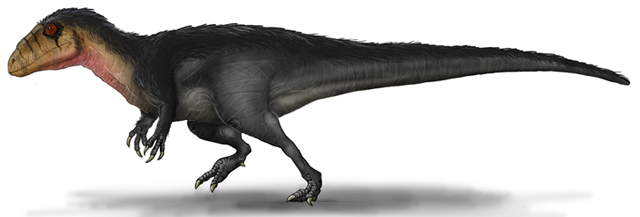
A Life Reconstruction of the Late Jurassic Carcharodontosaurid Lusovenator santosi

Lusovenator life reconstruction.
A life reconstruction of Lusovenator.

Picture credit: Carlos de Miguel Chaves

A Reassessment of Allosaur Fossil Material

The researchers, based in Lisbon and Madrid, re-evaluated fragmentary fossil material collected over the last two decades at sites located on the Portuguese coast about 35 miles (60 kilometres), north of Lisbon.  Initial examination suggested that this material represented a member of the Allosauridae, but a more detailed analysis of the fossils led the researchers to conclude that this material represented a dinosaur from the Carcharodontosauridae, a family nested within the clade Allosauria, but distinct from famous Late Jurassic super-predators such as Allosaurus fragilis, which is known from the western United States.

Lead author of the scientific paper, Elisabete Malafaia (University of Lisbon), commented that this discovery demonstrates the importance of the Iberian Peninsula as a key region for understanding the dispersal of carcharodontosaurids as well as other types of dinosaur across the northern hemisphere during the Late Jurassic and Early Cretaceous.

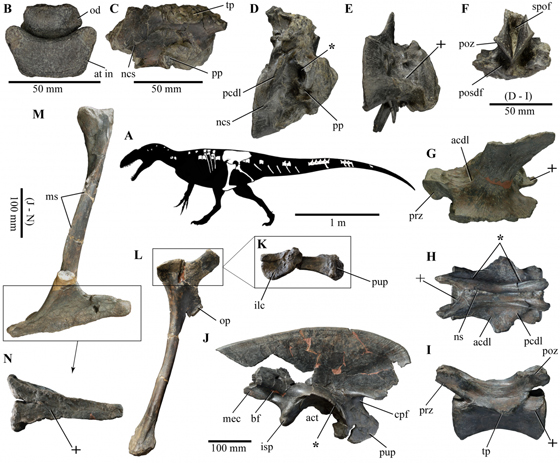
Fossil Material Assigned to Lusovenator santosi

Lusovenator fossil material.
Fossil material assigned to Lusovenator santosi with a silhouette showing skeletal location.

Picture credit: Malafaia et al (Journal of Vertebrate Palaeontology)

One of the Oldest Members of the Carcharodontosauridae

The oldest definitive carcharodontosaurid described to date is Veterupristisaurus (V. milneri) from the Middle Dinosaur Member of the famous Tendaguru Formation of Tanzania.  Veterupristisaurus (pronounced Vet-ter-roo-pris-tee-sore-us), is believed to have lived around 154 million years ago (Kimmeridgian faunal stage of the Late Jurassic).  Other fragmentary fossil remains from China and Germany have also been tentatively assigned to Late Jurassic carcharodontosaurids.  Lusovenator lived around 145 million years ago, as such, it is the oldest carcharodontosaurian allosauroid yet discovered from Laurasia.

The fossil material is believed to represent a relatively young animal, with a body length of approximately 3.5 metres.  Although, probably not fully grown, the vertebrae and the ilium show a number of anatomical traits that distinguish Lusovenator from the Allosauridae and nest it with the related, but distinct Carcharodontosauridae.

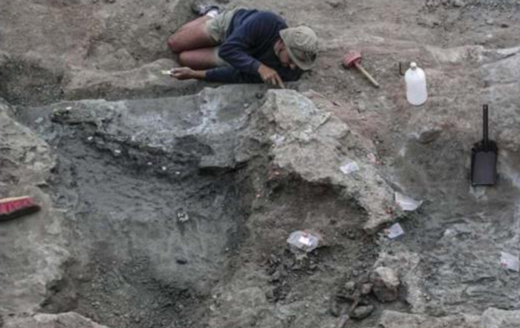
A Member of a Field Team Working on a Fossil Specimen

Field work - carefully extracting fossil material.
A field team member working on fossil material.

Picture credit: LUSA

Furthermore, the identification of this new species expands the diversity of theropod dinosaurs known from the Late Jurassic of Portugal and reinforces the theory that the Iberian Peninsula is a key region to help understand the dispersal of a number of different types of dinosaur across the Northern Hemisphere at the end of the Jurassic and into the Early Cretaceous.

The scientific paper: “A new carcharodontosaurian theropod from the Lusitanian Basin: evidence of allosauroid sympatry in the European Late Jurassic” by Elisabete Malafaia, Pedro Mocho, Fernando Escaso and Francisco Ortega published in the Journal of Vertebrate Paleontology.

The Everything Dinosaur website: Visit Everything Dinosaur.

10 07, 2020

Aratasaurus museunacionali “Lizard Born of Fire”

By |2024-03-07T06:35:26+00:00July 10th, 2020|Categories: Dinosaur and Prehistoric Animal News Stories, Dinosaur Fans, Main Page, Palaeontological articles, Photos/Pictures of Fossils|0 Comments

Aratasaurus museunacionali Newly Described Basal Coelurosaur

This month a new basal member of the Coelurosauria has been named and described from limb bones sourced from the Romualdo Formation in north-eastern Brazil.  The dinosaur has been named Aratasaurus museunacionali, the genus name translates as “lizard born of fire” a reference to the fact, the fossil had been in the National Museum of Brazil (Museu Nacional), when a fire ripped through the building.  Fortunately, the fossil material was not damaged and the research could be successfully concluded and a new genus of Early Cretaceous dinosaur described.

A New Theropod – Aratasaurus museunacionali

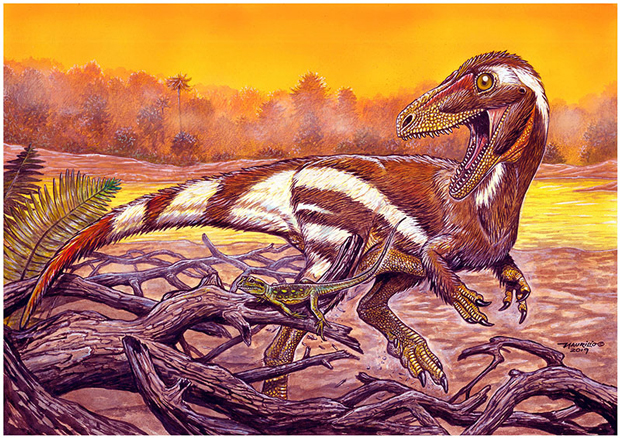
Aratasaurus museunacionali Life Reconstruction

Aratasaurus museonacionali illustration.
Aratasaurus museunacionali life reconstruction.

Picture credit: Museu Nacional

The species name honours the Museu Nacional in recognition of the tragic fire that took place in September 2018.  To read more about the fire: Devastating Fire at Brazil’s National Museum.

Helping to Better Understand the Coelurosauria

Juliana Sayão, a palaeontologist from the Federal University of Pernambuco and lead author of the scientific paper, commented that this new theropod will help scientists to better understand the evolutionary history of the Coelurosauria, an extensive clade of dinosaurs that consists of the tyrannosaurids, compsognathids, the ornithomimosaurs and the Maniraptora which includes birds.

A phylogenetic assessment suggests that Aratasaurus is closely related to Zuolong (Z. salleei), from the Late Jurassic of China, although it lived much more recently, the sediments from which the limb elements were excavated have been dated to approximately 110-115 million years ago (Albian faunal stage of the Cretaceous).

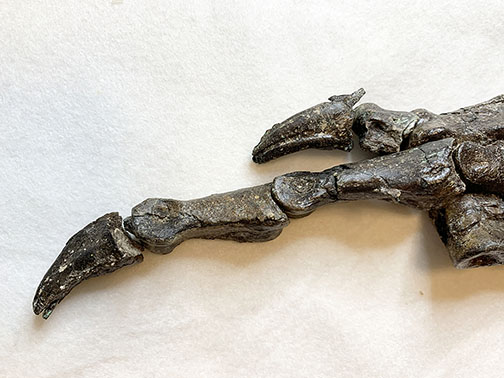
The Right Pes of Aratasaurus museunacionali after Preparation

Fossils associated with Aratasaurus museonacionali.
Aratasaurus museunacionali fossils.  The fossils although fragmentary and fragile were preserved in a partially articulated state.

Picture credit: Museu Nacional

Evidence of Seasonal Fires

The genus name might reflect the ordeal of the fire at the Museu Nacional but tiny pieces of fossilised wood found in association with the dinosaur bones suggest that Aratasaurus had to contend with forest fires within its ecosystem when it roamed this part of Gondwana more than 100 million years ago.

Highlighting the significance of this fossil discovery Juliana Sayão commented:

“Every discovery of a fossil is important because we obtain records that help to reconstruct the history of the planet and remake the path of evolution of the organisms that lived here millions of years ago.  Many times the fossil is unique and provides all the information about that species or group of animals”.

Brazil’s Newest Carnivorous Dinosaur

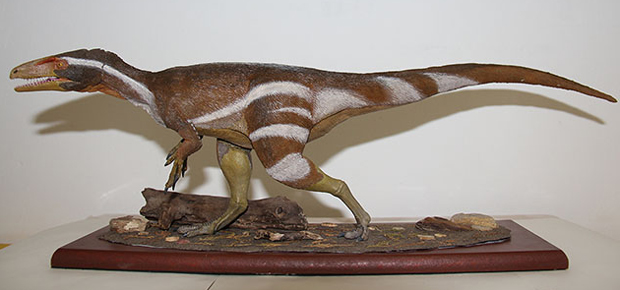
A model of the Brazil’s newest carnivorous dinosaur from the Araripe Basin has been commissioned.  Careful examination of the bone structure (histology), suggests that the individual was approximately four years old when it died.  Based on the growth rates of other, better known coelurosaurs, the researchers propose that the fossils represent a sub-adult specimen.  As such, the size estimate of around three metres in length probably does not represent the maximum size for this dinosaur species.

The Model of Aratasaurus museunacionali

Aratasaurus museonacionali model on display at the museum.
A detailed model of the newly described Aratasaurus museunacionali.

Picture credit: Museu Nacional

The fossils, consisting of a partial femur, a tibia and foot bones representing an incomplete right limb were discovered in 2008 and first taken to the Museum of Palaeontology Plácido Cidade Nuvens, in Santana do Cariri but transferred to the Laboratory of Paleobiology and Microstructures, at the Academic Centre of Vitória, (Federal University of Pernambuco), for further preparation and study.

As part of the research project, the fossil material was taken in 2016 to the Museu Nacional for further analysis.  Although caught up in the conflagration that destroyed much of the museum in 2018, the specimen survived and the analysis was able to be completed.

Photograph and Line Drawing Showing the Right Pes (Foot)

Fossil and line drawing of Aratasaurus pes.
Part of the holotype material for Aratasaurus with an accompanying line drawing showing metatarsals and pedal digits.  Scale bar equals 5 cm.

Picture credit: Manso Sayão et al (Scientific Reports)

Comments from Everything Dinosaur

A spokesperson from Everything Dinosaur commented:

“The specimen might be fragmentary, but it’s discovery underpins the significance of the Romualdo Formation and helps to extend our knowledge of the dinosaur biota inhabiting this part of Gondwana in the later stages of the Early Cretaceous.  As this genus has been classified as the sister taxon of the Chinese Zuolong, it suggests that basal coelurosaurs may have been more widely distributed and had a greater temporal range than previously thought.”

Everything Dinosaur acknowledges the assistance of a media release from the Museu Nacional in the compilation of this article.

The scientific paper: “The first theropod dinosaur (Coelurosauria, Theropoda) from the base of the Romualdo Formation (Albian), Araripe Basin, Northeast Brazil” by Juliana Manso Sayão, Antônio Álamo Feitosa Saraiva, Arthur Souza Brum, Renan Alfredo Machado Bantim, Rafael Cesar Lima Pedroso de Andrade, Xin Cheng, Flaviana Jorge de Lima, Helder de Paula Silva and Alexander W. A. Kellner published in Scientific Reports.

Visit the Everything Dinosaur website: Visit Everything Dinosaur.

9 07, 2020

Voracious Xiphactinus was More Widespread than Previously Thought

By |2024-03-07T06:24:21+00:00July 9th, 2020|Categories: Dinosaur and Prehistoric Animal News Stories, Dinosaur Fans, Main Page, Photos/Pictures of Fossils|0 Comments

The Voracious Xiphactinus was More Widespread than Previously Thought

Xiphactinus (pronounced zee-fak-tin-us), was a fast swimming voracious predator of Cretaceous seas.  With a body length of up to six metres, this bony fish was one of the top predators associated with the Western Interior Seaway of North America.  It has a formidable reputation amongst palaeontologists, as several fossils have been found which show the undigested body parts of prey, preserved inside the stomach cavity.  Perhaps, the most famous specimen that documents predatory behaviour is the Xiphactinus (X. audax), with the complete skeleton of a 1.8 metre-long fish preserved inside its skeleton which is on display at the Sternberg Museum of Natural History (Kansas).

A Voracious Predator

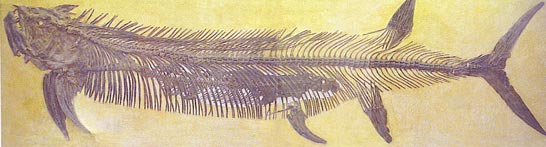
A Bony Fish with a Fearsome Reputation

Xiphactinus with its last meal preserved inside it.
A fossil fish within a fish.  The Xiphactinus audax specimen collected by George F. Sternberg (son of the famous American palaeontologist Charles H. Sternberg).  Inside the body cavity, a nearly complete specimen of the related ichthyodectid Gillicus arcuatus can be seen.

A team of scientists have reported this week the first occurrence of Xiphactinus from southern South America.  Writing in the academic journal “Alcheringa”, researchers from the Museo Argentino de Ciencias Naturales “Bernardino Rivadavia” in collaboration with a colleague from Universidad Maimónides, both located in Buenos Aires, report the discovery of fragments of upper jaw bone (maxilla), as well as vertebrae from the Salamanca Formation (Chubut Province, Argentina).  It is estimated that this fish lived around 70 million years ago (Maastrichtian age of the Late Cretaceous).

Xiphactinus Geographically and Temporally Widespread

Xiphactinus has been widely reported from Upper Cretaceous strata throughout the Northern Hemisphere, although to date, equivalent discoveries in the Southern Hemisphere have been limited to a single fossil specimen consisting of elements from the skull and the spine from the Cenomanian aged limestones of the La Aguada Member, La Luna Formation, near Monay, Candelaria Municipality in western Venezuela.

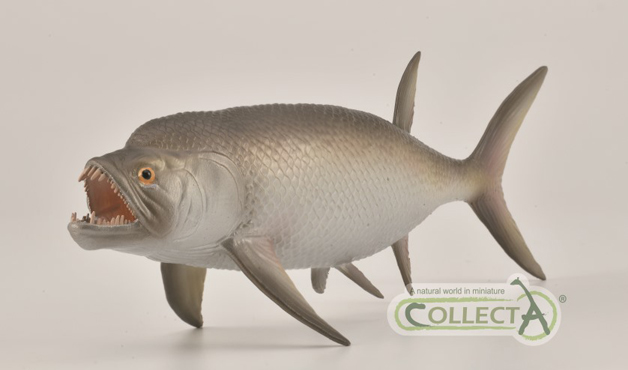
A Life Reconstruction Xiphactinus

CollectA Deluxe Xiphactinus model.
The CollectA Deluxe 1:40 scale Xiphactinus prehistoric fish model.

The picture (above) shows a CollectA Deluxe Xiphactinus model.

To view the CollectA Deluxe range of prehistoric animals: CollectA Deluxe Prehistoric Life Models.

This discovery extends the known geographical range for this genus and suggests that this teleost was widespread during the Cretaceous (Albian to Maastrichtian faunal stages).  It is related to the majority of fish species alive today, although the entire family of these types of predatory fish (Ichthyodectidae), became extinct at the end of the Cretaceous.

A Bony Fish with a Formidable Reputation

Xiphactinus attacks.
A bony fish with a very formidable reputation – Xiphactinus audax.

The scientific paper: “First record of the ichthyodectiform fish Xiphactinus (Teleostei) from Patagonia, Argentina” by Julieta J. De Pasqua, Federico L. Agnolin and Sergio Bogan published in Alcheringa: An Australasian Journal of Palaeontology.

Visit the Everything Dinosaur website: Everything Dinosaur.
8 07, 2020

Research on a Lower Jaw Suggests Dromaeosaurids Endemic to Alaska

By |2024-03-05T08:59:42+00:00July 8th, 2020|Categories: Dinosaur and Prehistoric Animal News Stories, Dinosaur Fans, Main Page, Photos/Pictures of Fossils|0 Comments

The First Juvenile Dromaeosaurid from Alaska

This blog has covered a lot of news stories about dinosaur fossil discoveries from Alaska, principally the remarkable Prince Creek Formation with its abundance of juvenile hadrosaurid remains.  A tiny partial lower jaw recovered from sediment screen washings indicates that dromaeosaurid dinosaurs were also present and from the size of the bone, complete with its two tiny teeth, it is likely that some dinosaurs were year-round residents and that they bred in the Arctic Circle.

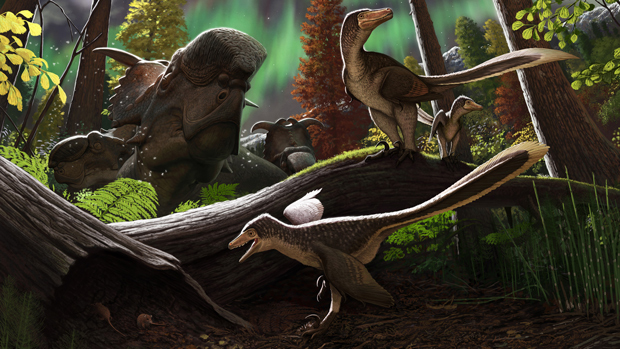
A Flock of Dromaeosaurids Pursue Prey Under the Noses of Pachyrhinosaurs

The "Alaskan Raptor".
A flock of dromaeosaurids chase small mammals whilst a herd of Pachyrhinosaurs are oblivious to the hunt going on underneath their feet.  Although isolated teeth have been tentatively assigned to the dromaeosaurids, this is the first incidence of fossil bone being found that indicates the presence of members of the Dromaeosauridae within the polar ecosystem.

Picture credit: Andrey Atuchin

A Juvenile Dromaeosaurid

Writing in the on-line academic journal PLOS One, researchers including Alfio Alessandro Chiarenza (Imperial College London) and Anthony R. Fiorillo (Southern Methodist University, Dallas Texas), report upon the discovery of the tiny jaw fragment that adds to a growing body of evidence that suggests Cretaceous Arctic dinosaurs of Alaska did not undergo long-distance migration, but rather they were year-round residents of these northern latitudes.

The fossil, which measures less than 1.5 cm in length, was collected from the Pediomys Point locality along the Colville River, some five miles (eight kilometres), upstream from the Liscomb bonebed with its abundant hadrosaurid remains.  Field team members had collected a large amount of bulk sediment over several field seasons and the specimen (specimen number DMNH21183), was recovered after screen washing and sorting of material conducted back at the Perot Museum of Nature and Science (Texas).

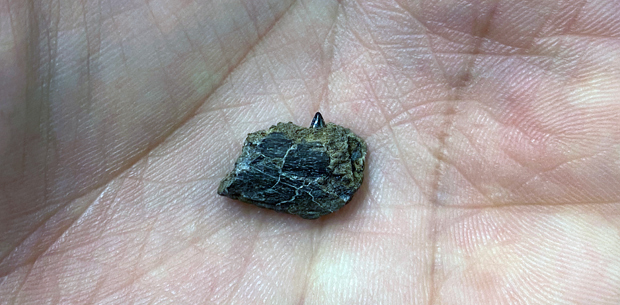
The Tiny Fossil Specimen (Assigned to a Saurornitholestinae Dromaeosaurid)

The tiny Arctic dromaeosaurid fossil jaw.
The tiny fossil dromaeosaurid jaw with one tooth erupted and one unerupted tooth present in the bone.

Picture credit: A. A. Chiarenza

Anatomical features such as the fibrous bone surface coupled with the small size of the fossil suggest a juvenile.

Dinosaurs of the Far North

Commenting on the significance of the fossil find, Anthony Fiorillo stated:

“Years ago, when dinosaurs were first found in the far north, the idea challenged what we think we know about dinosaurs.  For some time afterwards, there was a great debate as to whether or not those Arctic dinosaurs migrated or lived in the north year round.  All of those arguments were somewhat speculative in nature.  This study of a predatory dinosaur jaw from a baby provides the first physical proof that at least some dinosaurs not only lived in the far north, but they thrived there.  One might even say our study shows that the ancient north was a great place to raise a family and now we have to figure out why.”

What Type of Dromaeosaurid?

At least four different subclades of dromaeosaurid are known from the Late Cretaceous of North America (Dromaeosaurinae, Microraptorinae, Saurornitholestinae, and Velociraptorinae).  A phylogenetic assessment of the specimen suggests that this fossil represents a member of the Saurornitholestinae.  This subfamily consists of two species of Saurornitholestes and Atrociraptor, between them these dromaeosaurs, although restricted to the Late Cretaceous, do have a widespread palaeo-geographical range, with fossils found as far north as Alberta (Canada) and as far south as New Mexico in the USA.

The scientific paper: “The first juvenile dromaeosaurid (Dinosauria: Theropoda) from Arctic Alaska” by Alfio Alessandro Chiarenza , Anthony R. Fiorillo, Ronald S. Tykoski, Paul J. McCarthy, Peter P. Flaig and Dori L. Contreras published in the academic journal PLOS One.

To read our recent blog article about the hadrosaurids associated with the Prince Creek Formation: Is this the demise of a duck-billed dinosaur?

The Everything Dinosaur website: Everything Dinosaur.

7 07, 2020

Ancestor of the Dinosauria/Pterosauria

By |2024-03-05T08:54:58+00:00July 7th, 2020|Categories: Dinosaur and Prehistoric Animal News Stories, Dinosaur Fans, Main Page, Palaeontological articles|2 Comments

The Big Difference that Tiny Kongonaphon kely Made

This month, we have seen the publication of a scientific paper that details the discovery and scientific description of a black-bird-sized ancestor of the dinosaurs and pterosaurs that suggests these two great Orders of reptiles had very humble beginnings.  Standing less than ten centimetres high, Kongonaphon kely, along with the ever so slightly larger, probable ornithodiran Scleromochlus (from Scotland), indicate that there was a pronounced miniaturisation event close to the common ancestor of the Pterosauria and the Dinosauria.

Kongonaphon kely

Being small, means that you have a high surface area to volume ratio, so retaining body heat is a real problem.  It can be speculated that fuzzy, downy coats first evolved in the Ornithodira to provide thermal insulation.  There is some fossil evidence to suggest that the common ancestor of both dinosaurs and pterosaurs had a fuzzy integument.  In addition, small size could have been a key driver for the evolution of flight within the Pterosauria.

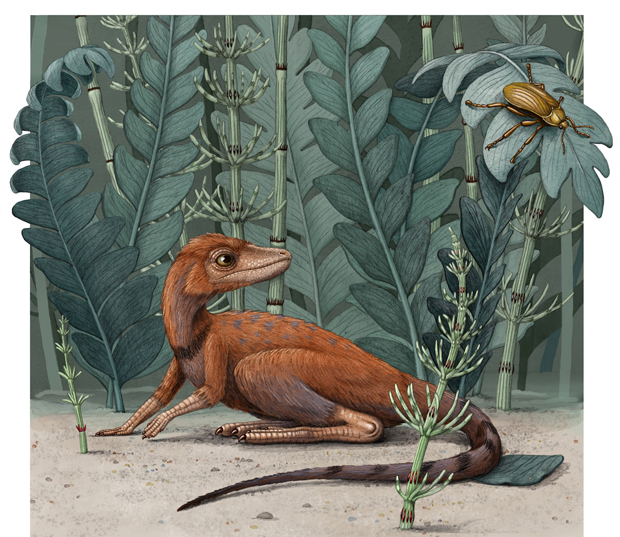
A Feathery Lagerpetid?  A Life Reconstruction of Kongonaphon kely

An illustration of Kongonaphon.
Kongonaphon life reconstruction.

Picture credit: Kammerer et al (Proceedings of the National Academy of Sciences)

Assigned to the Lagerpetidae

The origins of the Ornithodira, the clade that contains the last known common ancestor of the dinosaurs and pterosaurs plus all its descendants, is poorly understood.  If these animals were small and light, then this might explain their lack of presence in the fossil record. Kongonaphon comes from south-western Madagascar, its fragmentary remains were discovered by a field team in 1998.  Significantly, the fossil material includes elements from the skull and the upper jaw (maxilla), with several teeth preserved in situ. 

Analysis of the wear on the teeth suggests that this little animal fed on hard-shelled insects such as beetles, hence the insect illustrated in the top right of the Kongonaphon life reconstruction.

Phylogenetic analysis places Kongonaphon within the Lagerpetidae and as such it is the first lagerpetid known from Africa and the first to provide skull and jaw bones to extend our knowledge of this family.  Analysis of the tiny bones suggest that Kongonaphon was at least two years old when it died, so the fossils are likely to represent a mature or semi-mature animal and not a juvenile.

You Say Ornithodira, I Say Avemetatarsalia

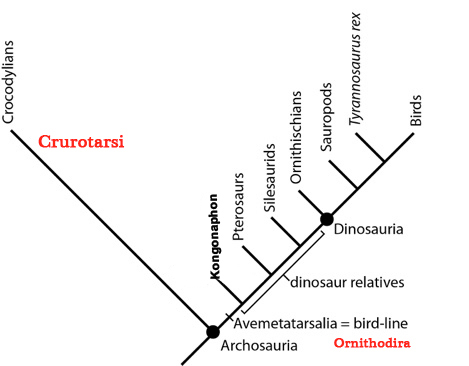
Within the Archosauria, there are two distinct clades, essentially classified by the shape and position of their ankle bones.  The Crurotarsi lineage – essentially the crocodilians and their extinct relatives and the Avemetatarsalia, the “bird-line archosaurs” such as dinosaurs, Aves and pterosaurs.  Ornithodira is another term sometimes used to describe the Avemetatarsalia.

In other words: Ornithodira = Avemetatarsalia.

Plotting the Taxonomic Relationship of Kongonaphon within the Avemetatarsalia

Kongonaphon as a member of the Avemetatarsalia.
Kongonaphon placed on the Avemetatarsalia branch of the Archosauria.

Picture credit: Sterling Nesbitt of Virginia Tech with additional annotation by Everything Dinosaur

The scientific paper: “A tiny ornithodiran archosaur from the Triassic of Madagascar and the role of miniaturization in dinosaur and pterosaur ancestry” by Christian F. Kammerer, Sterling J. Nesbitt, John J. Flynn, Lovasoa Ranivoharimanana, and André R. Wyssand published in the Proceedings of the National Academy of Sciences of the USA.

View the Everything Dinosaur website: Everything Dinosaur.
2 07, 2020

A New Study Examines Rare Japanese Dinosaur Eggs

By |2024-03-05T08:23:55+00:00July 2nd, 2020|Categories: Dinosaur and Prehistoric Animal News Stories, Dinosaur Fans, Geology, Main Page, Palaeontological articles, Photos/Pictures of Fossils|0 Comments

Dinosaur Eggs Provide a View on a “Hidden Ecosystem”

Not all the dinosaurs that ever existed are likely to be named and described by scientists.  Identifying these long extinct creatures relies on there being a fossil record of some sort to study.  A team of researchers writing in the journal “Cretaceous Research”, report on a new Lower Cretaceous fossil egg locality in Hyogo Prefecture, Japan, that provides a tantalising glimpse into a hidden dinosaur dominated ecosystem.

The researchers, which include Kohei Tanaka (University of Tsukuba, Japan) and Darla Zelenitsky (University of Calgary, Canada), describe eggs and eggshell fragments associated with four ootaxa, two of which are new to science.  The site reveals a hidden diversity of small dinosaurs, particularly non-avian theropods, in the Hyogo region and indicates the area was utilised for nesting by various small dinosaur species in the Early Cretaceous.

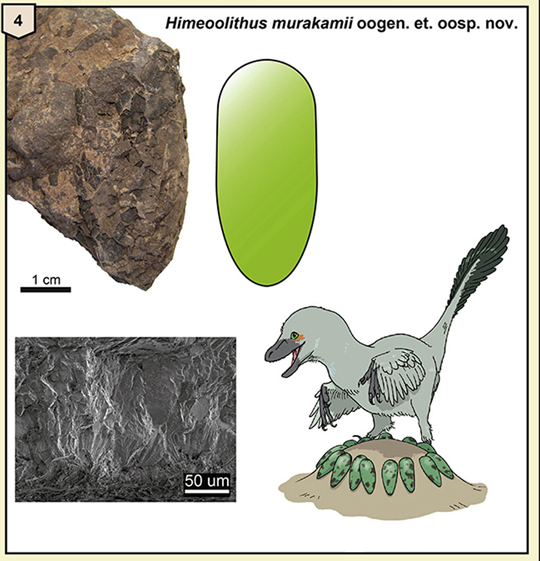
The Newly Erected Ootaxa Himeoolithus murakamii the Most Abundant Ootaxa from the Quarry Site

Himeoolithus murakamii a new ootaxa from Japan.
Himeoolithus murakamii egg fossil, high resolution image, line drawing of egg showing elongated shape and life reconstruction.

Picture credit: University of Tsukuba and Museum of Nature and Human Activities Hyogo Prefecture with life reconstruction by Ayaka Nagate

The Kamitaki Locality

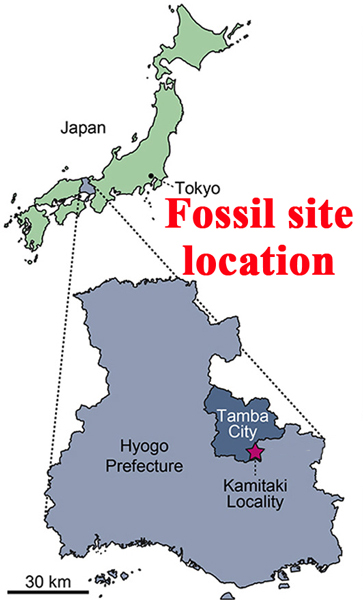
The fossil site, known as the Kamitaki locality lies close to the  Sasayama River in Kamitaki, Sannan-cho, Tamba City,  Hyogo Prefecture.  One horizon has yielded a variety of small vertebrate fossils including frogs and lizards, plus a partial tail from a titanosaur that was formally named and described in 2014 (Tambatitanis amicitiae).  Eggshell fragments are also associated with this part of the site.  However, a horizon some 5.5 to 6.75 metres above the bonebed layer has yielded an astonishing quantity of egg fossils, including a nearly complete egg, several partial eggs and hundreds of eggshell fragments.

The researchers conclude that this horizon represents a nesting area in which a variety of small theropods raised their young.

As a result of this research, two new theropod egg taxa have been named – Himeoolithus murakamii and Subtiliolithus hyogoensis.  Although no skeletal remains of these little dinosaurs have been found, the presence of all the egg fossils suggests that there were numerous different types of small theropod co-existing in this ancient ecosystem.

The Location of the Fossil Site within Hyogo Prefecture

Fossil site location.
The location of the Kamitaki fossil site and the discovery of the dinosaur eggs.

Picture credit: University of Tsukuba and Museum of Nature and Human Activities Hyogo Prefecture/Cretaceous Research with additional annotation by Everything Dinosaur

Examining the Mudstone Deposits

The mudstone deposits are thought to have been laid down around 110 million years ago (Albian faunal stage of the Lower Cretaceous) and the palaeoenvironment has been described as floodplain which was subjected to a extremes of seasonality with long periods of very dry conditions punctuated by a very wet season that led to flood events.

The most abundant ootaxon at the quarry, Himeoolithus, is represented by four eggs and over 1300 scattered eggshell fragments. Himeoolithus accounts for over 96% of all the egg fossils associated with this site.  Himeoolithus is the smallest non-avian theropod egg known to date, the scientists estimate that the egg probably weighed about as much as a quail egg (around 9.9 grammes).  It is also a very unusual shape, being elongate with its length 2.25 times its width (length : width ratio 2.25).

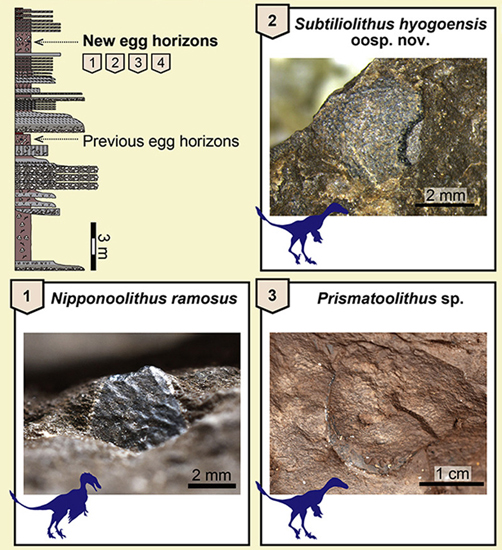
The new egg fossil horizon was discovered in 2015 and was mapped and intensively excavated in the winter of 2019.  In total, the egg fossil horizon and the lower Kamitaki Bonebed (Ohyamashimo Formation), have yielded six small theropod ootaxa.

The Stratigraphy of the Kamitaki Locality and Examples of Associated Ootaxa

Stratigraphy of the Kamitaki locality with examples of theropod ootaxa from the site.
The stratigraphy of the Kamitaki locality with examples of theropod ootaxa from the site.  Subtiliolithus hyogoensis is the second of the new ootaxa to be reported in the scientific paper.

Picture credit: University of Tsukuba and Museum of Nature and Human Activities Hyogo Prefecture/Cretaceous Research

Notable Biodiversity

The ootaxa demonstrate that this ancient habitat was home to a variety of small theropod dinosaurs.  It is likely that many other palaeoenvironments associated with the Lower Cretaceous were also home to a diverse variety of small theropods too, these animals being currently under-represented in the fossil record.

Lead author of the paper, Professor Kohei Tanaka, confirmed that the research team thought that the new egg fossil horizon was a nesting site and the deposit was not the result of a transportation and subsequent burial of egg material from another location:

“Our taphonomic analysis indicated that the nest we found was in situ, not transported and redeposited, because most of the eggshell fragments were positioned concave-up, not concave-down like we see when eggshells are transported.”

Commenting About the Dinosaur Eggs

The professor added:

“The high diversity of these small theropod eggs makes this one of the most diverse Early Cretaceous egg localities known.  Small theropod skeletal fossils are quite scarce in this area.  Therefore, these fossil eggs provide a useful window into the hidden ecological diversity of dinosaurs in the Early Cretaceous of south-western Japan, as well as into the nesting behaviour of small non-avian theropods.”

Everything Dinosaur acknowledges the assistance of a media release from the University of Tsukuba (Japan), in the compilation of this article.

The scientific paper: “Exceptionally small theropod eggs from the Lower Cretaceous Ohyamashimo Formation of Tamba, Hyogo Prefecture, Japan” by
Kohei Tanaka, Darla K. Zelenitsky, François Therrien, Tadahiro Ikeda, Katsuhiro Kubota, Haruo Saegusa, Tomonori Tanaka and Kenji Ikuno published in the journal Cretaceous Research.

The Everything Dinosaur website: Everything Dinosaur.
Go to Top