A scientific paper has been published this week in the journal “Science” that suggests that interactions between different species of human during the Middle and Late Pleistocene Epoch were much more complex than previously thought.
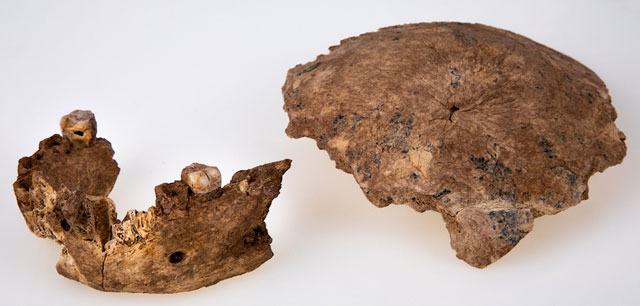
Researchers working in Israel have identified a previously unknown type of ancient human that lived alongside our own species (H. sapiens) more than 100,000 years ago. The remains consisting of a fragment from the top of the skull (parietal bones), the mandible and a lower second molar tooth discovered near the city of Ramla in the Central District of Israel, have been dated to around 140,000 – 120,000 years ago and these fossils represent one of the very last members of an ancient human group that may have been the ancestors of the Neanderthals.
The skull fragment (right) and the jawbone complete with some teeth (left). Picture credit: Avi Levin and Ilan Theiler, Sackler Faculty of Medicine.
Human Remains Found Amongst Stone Tools and Other Fossil Bones
Yossi Zaidner from the Institute of Archaeology at the Hebrew University of Jerusalem found the fossils during excavations to salvage Middle Pleistocene material and fossils that had been uncovered during construction work. Thousands of fossil bones depicting a rich and varied fauna including aurochs, horses and deer were also recovered. Stone tools were also found, analysis of these tools suggest they were constructed in the same manner that modern humans of the time also made their implements.
The researchers made virtual reconstructions of the fossils to permit their analysis using sophisticated computer software and to compare them with other hominin fossils from Europe, Asia and Africa. The results suggest that the Nesher Ramla hominin fossils represent late survivors of a population of humans who lived in the Middle East during the Middle Pleistocene period.
Rolf Quam, one of the co-authors of the scientific paper commented:
“The oldest fossils that show Neanderthal features are found in Western Europe, so researchers generally believe the Neanderthals originated there. However, migrations of different species from the Middle East into Europe may have provided genetic contributions to the Neanderthal gene pool during the course of their evolution.”
Everything Dinosaur acknowledges the assistance of a press release from Binghamton University State University of New York in the compilation of this article.
The study, “A Middle Pleistocene Homo from Nesher Ramla, Israel,” was published in Science, along with a companion paper discussing the culture, way of life and behaviour of the Nesher Ramla hominin.
In January 2020, Everything Dinosaur reported that a part of Flinders Range in South Australia that contains a unique record of Ediacaran life had gained official protection. This area has now become a national park helping to ensure the long-term future of one of the most important fossil sites in the world recording evidence of life before the Cambrian. Ancient fossils will now have greater protection.
The Nilpena fossil fields preserve examples of Precambrian biota. This area has been designated a national park and therefore receives greater protection under Australian law. Picture credit: Jason Irving.
Additional Protection for an Important Fossil Site
The newly formed Nilpena Ediacara National Park will replace the existing Ediacara National Conservation Park and adds around 60,000 hectares of extra land to the protection project, that is bigger than the area of the Isle of Man in the Irish Sea.
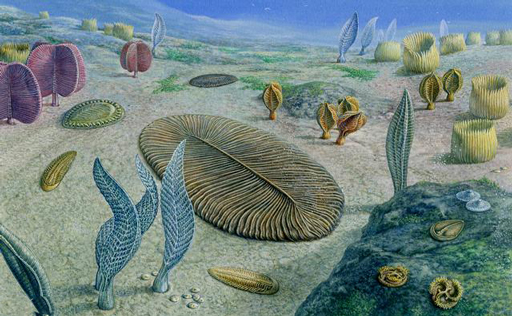
The site preserves the fossilised remains of an ancient marine biota from the Ediacaran geological period. Since this site was first discovered in 1946, around 40 highly fossiliferous beds have been identified preserving in exquisite detail a variety of soft-bodied lifeforms. These marine organisms represent some of the first, large complex animals to evolve and document the evolution of locomotion and sexual reproduction.
Life in the Ediacaran. The Nilpena site in Southern Australia provides a fossil record of the marine biota that thrived in a shallow sea at the end of the Ediacaran geological period around 550 million years ago. Picture credit: John Sibbick.
Protecting a Land of Ancient Fossils
South Australia’s Minister for the Environment and Water, David Speirs, stated that the new national park is a significant step on the road to getting the Flinders Ranges UNESCO World Heritage status.
The Minister commented:
“The fossil site at Nilpena, arguably the richest and most intact fossil site in the world, is an internationally significant palaeontological and geological research site.”
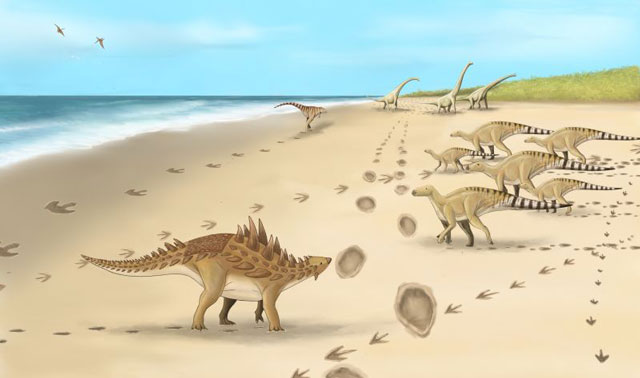
Researchers writing in the Proceedings of the Geologists’ Association have reported tracks from at least six different species of dinosaur found in Lower Cretaceous rocks at Folkestone in Kent. The tracks and trackways from the Lower Greensand Group date to around 112-110 million years ago (Albian faunal stage of the Cretaceous). As such, these rare trace fossils represent evidence of the last known dinosaurs to walk on the UK landmass.
An artist’s interpretation of the Folkestone dinosaur tracks. In the foreground a solitary ankylosaurid wanders up the beach passing a small herd of iguanodonts. In the background three titanosaurs are spooked by an approaching theropod. Picture credit: Megan Jacobs.
Evidence of Dinosaurs in Britain
The footprints were discovered in the cliffs and on the foreshore in Folkestone, Kent (southern England). Storms affect the cliffs and wash away sediments occasionally exposing fossils and in very rare cases, evidence of dinosaurs. Isolated vertebrae thought to represent an armoured dinosaur had been found previously and there have been reports of dinosaur tracks being discovered, but the paper published in the Proceedings of the Geologists’ Association is the first, formal, scientific assessment of these remarkable trace fossils.
A Challenge to Find a Dinosaur Footprint
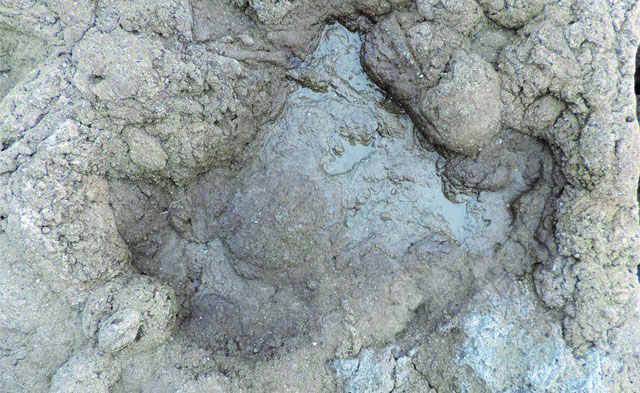
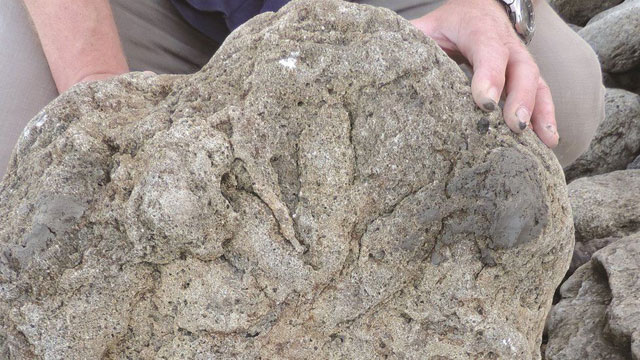
Philip Hadland, a curator at the Hastings Museum and Art Gallery, an expert on the fossils of Folkestone, found a dinosaur track, believed to represent an ornithopod on the 13th September 2017. After showing his find to Steve Friedrich, a local fossil hunter with decades of experience, Steve thought that he too might try his luck to see if he could spot one. Remarkably, within ten minutes Steve found a beautiful, three-toed print, most likely representing a theropod.
A large ornithopod track found at Folkestone in Kent. The fossil footprint, probably representing an iguanodontid, was found by Philip Hadland on 13th September 2017. Picture credit: University of Portsmouth/PA Media.
Professor of Palaeobiology at the University of Portsmouth and co-author of the scientific paper, David Martill, commented:
“It is quite an extraordinary discovery because these dinosaurs would have been the last to roam in this country before becoming extinct.”
A single theropod track from Folkestone (Kent). The tridactyl print found by Steve Friedrich. Picture credit: University of Portsmouth/PA Media.
Many of these remarkable specimens are on display at the Folkestone Museum.
These trace fossils have forced palaeontologists to rethink the Early Cretaceous depositional environment of this part of the Kent coast. Dinosaur footprints, together with fossil wood and oysters in a matrix of well-rounded quartz grains indicates a coastal depositional environment of an extremely shallow depth, perhaps with short periods of exposure as dry land.
Everything Dinosaur Comments
A spokesperson from Everything Dinosaur commented that an exposed beach may have provided an easier route for dinosaurs to use to travel from one food source to another. It was probably more convenient for these large animals to navigate a sandy beach than to try moving through dense undergrowth that would have been found further inland. Some of the dinosaurs could have been beachcombing, it is possible that the theropods may have visited the beach looking for any corpses that may have been washed up by the tide.
One of the authors of the scientific paper, Philip Hadland, has produced a really helpful guide to fossil hunting in the Folkestone area. Entitled “Fossils of Folkestone, Kent” it is available from Siri Scientific Press here: Siri Scientific Press.
Fossils of Folkestone, Kent by Philip Hadland.Picture credit: Everything Dinosaur.
The scientific paper: “The youngest dinosaur footprints from England and their palaeoenvironmental implications” by Philip T. Hadland, Steve Friedrich, Abdelouahed Lagnaoui and David M. Martill published in the Proceedings of the Geologists’ Association.
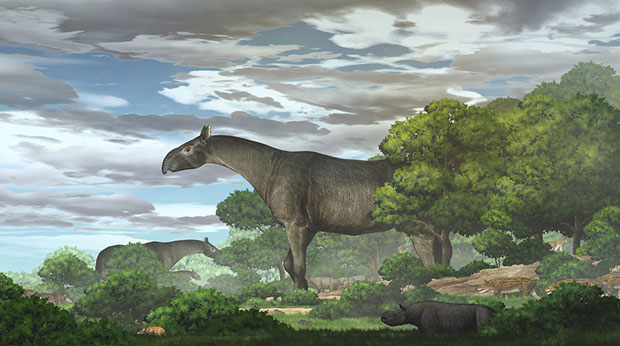
The giant prehistoric rhino, Paraceratherium, is considered the largest land mammal that ever lived. It was mainly found in Asia, especially China, Kazakhstan, Mongolia and Pakistan. How these giant, hornless rhinos dispersed across Asia was unknown, but the discovery of fossils in Gansu Province, has led to the naming of a new Paraceratherium species (Paraceratherium linxiaense) and shed light on how these amazing herbivores evolved and dispersed across the Asian continent.
A life reconstruction of the newly described Paraceratherium linxiaense with several other mammal fauna from the Linxia Basin (Oligocene Epoch) illustrated. Picture credit: Chen Yu.
Providing Important Clues About Paraceratherium Dispersal
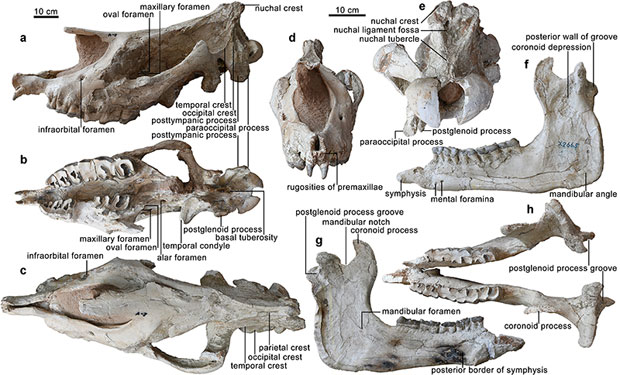
Writing in the academic journal “Communications Biology”, the researchers from the Chinese Academy of Sciences, the Hezheng Paleozoological Museum (Gansu Province), Henan University (Henan Province) and Harvard University describe fossils found near the village of Wangjiachuan (Gansu Province) in 2015 that enabled the establishment of a new species of Paraceratherium.
Analysis of the fossil material led the scientists to conclude that this new species was closely related to giant rhinos that once lived in Pakistan (Paraceratherium bugtiense), which suggests ancestral forms migrated across Central Asia.
The holotype (HMV 2006) of Paraceratherium linxiaense consisting of skull and jaw material. Picture credit: The Chinese Academy of Sciences.
The Remarkable Fauna of the Linxia Basin in the Late Oligocene
The fossil material which includes a skull and articulated mandible as well as the first cervical vertebra (atlas), as well as another neckbone and two thoracic vertebrae from a second individual were found in Late Oligocene deposits associated with the Jiaozigou Formation of Linxia Basin (Gansu Province), close to the north-eastern border of the Tibetan Plateau.
Around 26.5 million years ago, the open woodland environment of north-central China was home to a wide variety of prehistoric mammals including the giant rhinos Turpanotherium and Dzungariotherium, the rodent Tsaganomys, the creodont Megalopterodon, the chalicothere Schizotherium, the hyracodont Ardynia, the rhinocerotid Aprotodon, and the entelodont Paraentelodon – some of these animals are illustrated in the Paraceratherium linxiaense life reconstruction (above).
Standing taller than a giraffe and weighing approximately 20 tonnes, Paraceratherium linxiaense had a slender skull and a prehensile nose trunk similar to that of the modern tapir to help it to grab leaves and branches from the tops of trees, a food resource that no other animal in its environment could exploit.
Plotting the Distribution and Dispersal of Paraceratherium
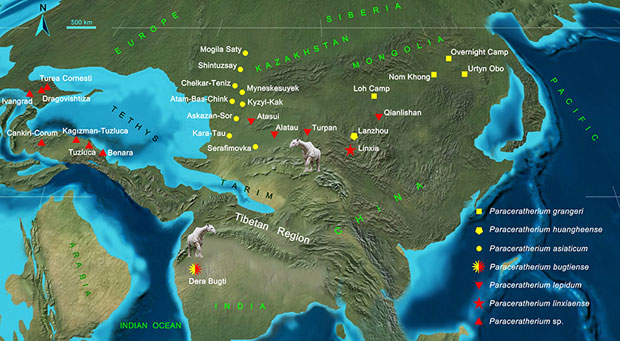
A phylogenetic analysis carried out by the research team suggests P. linxiaense as a derived form with a mix of basal and more advanced traits. The phylogenetic analysis produced a series of progressively more-derived species from P. grangeri, through P. huangheense, P. asiaticum, and P. bugtiense before finally terminating in P. linxiaense and what is thought to be its sister taxon P. lepidum.
The research team conclude that Paraceratherium linxiaense was a more specialised animal, with a more flexible neck, similar to P. lepidum, and both are derived from Paraceratherium bugtiense known from Pakistan. They team were then able to plot and map the spread of these giant rhinos across Asia.
Mapping and plotting the dispersal of Paraceratherium across Asia. Location of the early Oligocene species are marked by the yellow colour, and the red indicates the late Oligocene species. Picture credit: Institute of Vertebrate Paleontology and Paleoanthropology.
The researchers found that all six species of Paraceratherium are sister taxa to the hornless rhinoceros Aralotherium which is known from Kazakhstan and China and form a monophyletic clade in which P. grangeri is the most primitive, succeeded by P. huangheense and P. asiaticum.
The researchers were thus able to determine that, in the Early Oligocene, P. asiaticum dispersed westward to Kazakhstan and its descendant lineage expanded to South Asia as Paraceratherium bugtiense. In the Late Oligocene, Paraceratherium returned northward, crossing the Tibetan region, which implies that this area of Asia was not yet uplifted to form a high, difficult to traverse plateau. This migration led to two distinct species evolving P. lepidum to the west in Kazakhstan and P. linxiaense to the east in the Linxia Basin.
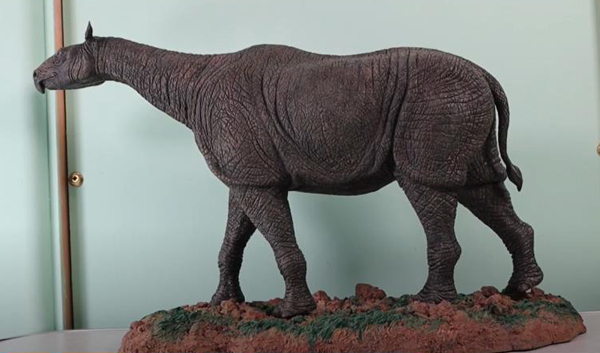
A view of the eagerly anticipated ITOY Studio Paraceratherium model. A replica of the largest land mammal known to science. Picture credit: Everything Dinosaur.
Picture credit: Everything Dinosaur
Contrasting the high altitude of the Tibetan region today to the environment of this region during the Late Oligocene Epoch, lead author of the research Professor Deng Tao explained that:
“Late Oligocene tropical conditions allowed the giant rhino to return northward to Central Asia, implying that the Tibetan region was still not uplifted as a high-elevation plateau.”
During the Oligocene, the giant rhino could disperse freely from the Mongolian Plateau to South Asia along the eastern coast of the Tethys Ocean and perhaps through Tibet. Up to the Late Oligocene, the evolution and migration from P. bugtiense to P. linxiaense and P. lepidum demonstrates that the “Tibetan Plateau” was not yet a barrier to the movement of the largest land mammal known to science.
The scientific paper: “An Oligocene giant rhino provides insights into Paraceratherium evolution” by Tao Deng, Xiaokang Lu, Shiqi Wang, Lawrence J. Flynn, Danhui Sun, Wen He and Shanqin Chen published in Communications Biology.
Since its publication last month, the storybook entitled “The Plesiosaur’s Neck” by Dr Adam S. Smith and Jonathan Emmett with splendid illustrations courtesy of Adam Larkum has been selling well.
“The Plesiosaur’s Neck” by Dr Adam S. Smith and Jonathan Emmett with illustrations by Adam Larkum. This delightful and imaginative tale of why plesiosaurs had long necks has been well received by fans of the Plesiosauria of all ages.
A Tale of a Neck
This delightful children’s book features Poppy an Albertonectes, a plesiosaur and member of the Elasmosauridae family. Albertonectes once swam in the sea in what is now the Canadian Province of Alberta. This Cretaceous marine reptile had an enormous 7-metre-long neck, which was longer than the rest of its body. It had an amazing 76 cervical vertebrae, more than any other elasmosaurid described to date. Poppy the plesiosaur, as an adult Albertonectes, had the longest neck of any elasmosaur known to science.
Our congratulations to Dr Adam Smith and Jonathan Emmett for putting together such a delightful book that combines palaeontology with such an enjoyable tale. Praise too, to the very talented award-winning illustrator Adam Larkum for his super illustrations.
We are sure that Alfie the ammonite and Bella the belemnite that chime in with comments would approve of all the fabulous reviews this book has received.
It’s a great book that will entertain and enthral young readers from 5 years and upwards.
“The Plesiosaurs Neck” ISBN number 9781912979424 is available now (2021). Published by Uclan Publishing. Priced at £7.99 it can be purchased here: Uclan Publishing.
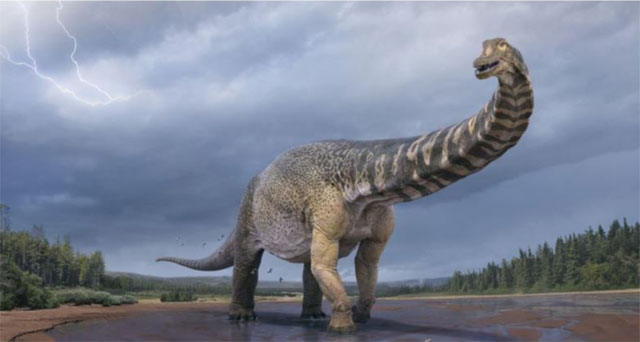
“Cooper” the giant Australian dinosaur, whose bones were found back in 2007 has been officially named. The largest animal ever to walk on the “land down under” has been named Australotitan (Australotitan cooperensis), this Cretaceous giant is estimated to have been around 30 metres in length, so Australotitan rivalled some of the giant South American titanosaurs, (to which it was distantly related), in size. Writing in the academic journal “PeerJ”, scientists describe this Australian titanosaur.
A life reconstruction of the newly named Australotitan cooperensis, the largest known animal to have ever lived in Australia. Picture credit: Queensland Museum.
“Southern Titan”
Writing in the academic journal “PeerJ”, the researchers who include corresponding author Scott Hocknull of the Queensland Museum and Robyn and Scott Mackenzie from the Eromanga Natural History Museum (Queensland), used limb bone comparisons to estimate the size of Australotitan. A sophisticated computer programme provided detailed 3-D surface scans of the fossil bones to permit autapomorphies to be identified that led to the erection of this new taxon.
A Giant Australian Titanosaur
The huge dinosaur, with a shoulder height of around 6 metres was named “Southern Titan”, the trivial (species name), honours the site of the fossil discovery – the Cooper-Eromanga Basin, Cooper Creek system and the common vernacular for this part of south-western Queensland “Cooper Country”.
Back in 2015, Everything Dinosaur reported on the on-going research being conducted on this titanosaur when final preparations were being made for the opening of the Eromanga Natural History Museum which was being built to house this specimen along with other dinosaur and marine reptile remains that had been found in Queensland.
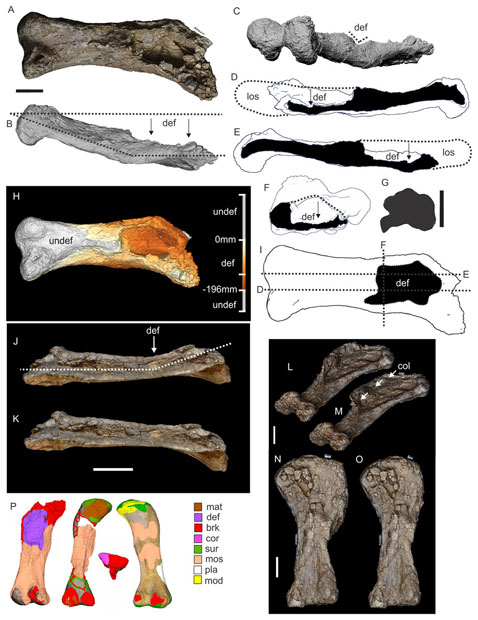
Several of the bones although almost complete show distortion. The bones of this particular titanosaur seem to have been trampled and partly crushed by the movements of another titanosaur that “walked over the grave” of Australotitan. The use of the 3-D bone scans permitted the researchers to correctly reconstruct bone morphology and a subsequent phylogenetic assessment revealed that A. cooperensis was related to three other, roughly contemporaneous sauropod taxa known from Queensland – Wintonotitan, Diamantinasaurus and Savannasaurus.
The right femur (specimen number EMF102) seems to have been trampled and crushed as another sauropod walked over it. Sophisticated 3-D scans were used to reconstruct the original shape of the bones and permit taxonomic study. Note scale bars = 20 cm. Picture credit: Hocknull et al
The scientific paper: “A new giant sauropod, Australotitan cooperensis gen. et sp. nov., from the mid-Cretaceous of Australia” by Scott A. Hocknull, Melville Wilkinson, Rochelle A. Lawrence, Vladislav Konstantinov, Stuart Mackenzie and Robyn Mackenzie published in PeerJ.
Earlier this spring, a team of researchers led by Pavel Skutschas (St Petersburg University, Russia), published a paper reporting on the study of 63 stegosaur teeth that had been found in Lower Cretaceous deposits in south-western Yakutia, located in eastern Siberia. Just like today, during the Early Cretaceous this part of Siberia was at a high latitude (palaeolatitude estimate of N 62°- 66.5°) and within the Arctic circle. The scientists conclude that these stegosaurs may have had some special adaptations to help them survive their harsh environment, such as a rapid tooth replacement rate to permit them to cope with a diet mainly consisting of conifer needles and branches.
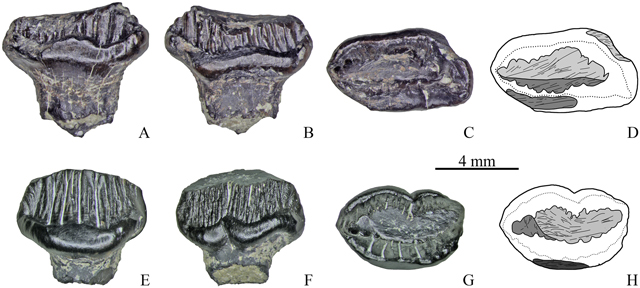
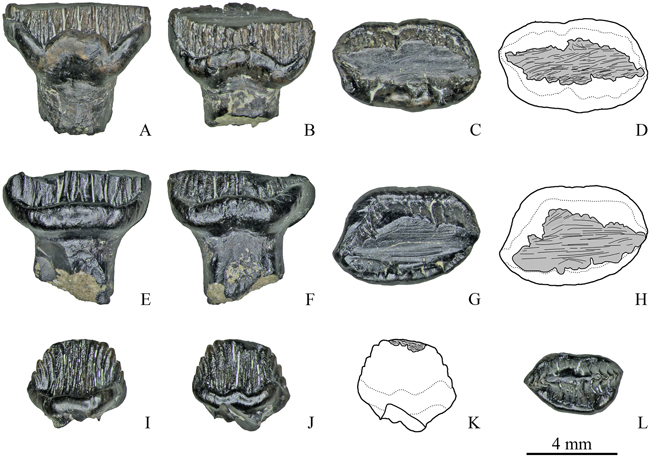
Maxillary teeth with two (A-D), and with three wear facets (E-H) of Stegosauria indet. from the Teete locality, Yakutia, Russia; Batylykh Formation (Lower Cretaceous). Specimens ZIN PH 80/246 (A-D), ZIN PH 57/246 (E-H) in labial (A, E), lingual (B, F), occlusal (C, G) views, and interpretive drawings (D, H) in occlusal views showing the wear facets with scratches. Picture credit: Skutschas et al.
Stegosaurs Probably Present All Year
There has been much debate amongst palaeontologists as to whether large herbivorous dinosaurs such as stegosaurs were permanent residents of high latitude palaeoenvironments, or whether they migrated up to these latitudes in the summer to take advantage of the long periods of daylight. In the height of summer, there would have been around twenty-two hours of daylight at this latitude presumably providing very favourable conditions for plant growth.
The researchers, writing in the on-line, academic journal PLOS One report the discovery of smaller stegosaur teeth in the excavations, which took place in 2012 and then in the summer months from 2017-2019. As it is thought that the teeth represent a single species of stegosaur, this indicates that both adults and juveniles were present at this site.
Lead author Pavel Skutschas an Associate Professor in the Department of Vertebrate Zoology at St Petersburg University commented:
“We have found teeth of animals of different ages. This suggests that the polar stegosaurs are most likely to have been sedentary that they reproduced and raised offspring on the same territory all year round”.
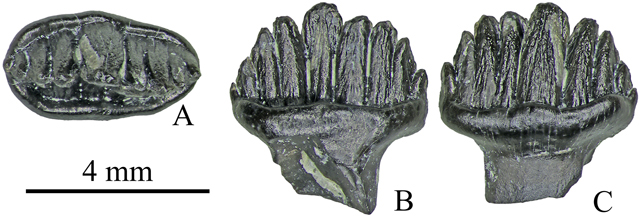
Small, relatively unworn tooth of an indeterminate stegosaur from the Teete locality in (A) occlusal, (B) labial and (C) lingual views. This suggests that both adult and juvenile stegosaurs were present. Picture credit: Skutschas et al.
A Diverse Prehistoric Fauna
The researchers from St Petersburg University worked together with colleagues from the Zoological Institute of the Russian Academy of Sciences, the Borissiak Paleontological Institute of the Russian Academy of Sciences, the University of Bonn (Germany) and the Diamond and Precious Metal Geology Institute of the Siberian Branch of the Russian Academy of Sciences to examine, excavate and sieve material from the Batylykh Formation, Sangar Series (Lower Cretaceous, Berriasian–Barremian faunal stage) along the banks of the Teete River in Suntar Ulus, Yakutia, Eastern Siberia.
This location has yielded dinosaur fossils (including theropods as well as ornithischian dinosaurs), turtles, salamanders and early mammals.
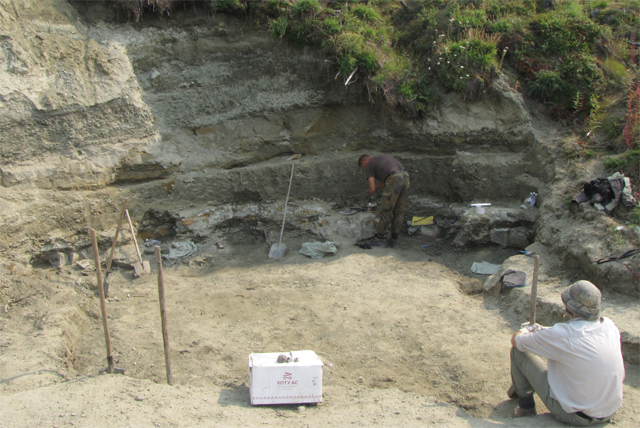
Researchers working at the excavation site. Picture credit: University of St Petersburg.
Stegosaurian remains are the most abundant and consist of numerous isolated teeth, vertebrae, ribs, pelvic elements and occasional cranial material. The stegosaur teeth were all retrieved by screen washing and sieving samples. Most exhibit a high degree of wear and indicate that these animals fed on very abrasive plant material. In addition, study of the tiny scratches on the teeth suggest tooth on tooth contact and precise dental occlusion in the Teete River stegosaurs.
Studying Stegosaurs
The microwear examined suggests that these animals had a more complex jaw movement to help them process food in their mouths, the tooth wear observed could not have occurred if these dinosaurs were only capable of moving their jaws up and down in a simple scissor-like action.
Maxillary teeth with a single apical facet of Stegosauria indet. from the Teete locality, Yakutia, Russia; Batylykh Formation (Lower Cretaceous). Specimens ZIN PH 7/246 (A–D), ZIN PH 11/246 (E–H), ZIN PH 20/246 (I–L), ZIN PH 6/246 (M–P) in labial (A, E, I, M), lingual (B, F, J, N), occlusal (C, G, K, P) views, and interpretive drawings in occlusal (D, H, L) and lingual (O) views showing the wear facets with scratches. Picture credit: Skutschas et al.
Rapid Tooth Replacement
Under the microscope, the researchers made another surprising discovery. The Teete stegosaurs are characterised by their relatively short tooth formation time. The teeth were rapidly replaced and the replacement teeth were formed in a relatively short time (95 days). This might have been an adaptation to the particularly abrasive diet of these herbivores which probably fed on conifers. Furthermore, the scientists identified the presence of a “wavy enamel pattern” on the teeth.
This type of enamel has also been found on the teeth of Psittacosaurus, a basal member of the horned dinosaurs (Ceratopsia) and within the Ornithopoda. The researchers conclude that this feature of teeth is a shared trait amongst bird-hipped dinosaurs. Whether it was present in the ancestor of the ornithischian dinosaurs or whether this histological feature is an example of convergent evolution in different types of plant-eating dinosaur is not known.
The scientific paper: “Wear patterns and dental functioning in an Early Cretaceous stegosaur from Yakutia, Eastern Russia” by Pavel P. Skutschas, Vera A. Gvozdkova, Alexander O. Averianov, Alexey V. Lopatin, Thomas Martin, Rico Schellhorn, Petr N. Kolosov, Valentina D. Markova, Veniamin V. Kolchanov, Dmitry V. Grigoriev, Ivan T. Kuzmin and Dmitry D. Vitenko published in PLOS One.
Scientists writing in the academic journal “PeerJ” have reported the discovery of an extensive pterosaur trackway from the Lower Cretaceous Shengjinkou Formation in the Xinjiang Uygur Autonomous Region in north-western China. The trackway consists of 114 small pterosaur tracks (57 handprints and 57 footprints). Analysis of these trace fossils has led to the erection of a new pterosaur ichnospecies – Pteraichnus wuerhoensis, although the researchers speculate that these tracks could have been made by the dsungaripterid pterosaur Noripterus complicidens.
A photograph of the tracksite with an interpretative line drawing. The tracks have been assigned to the new pterosaur ichnospecies Pteraichnus wuerhoensis. Picture credit Wei Gao.
A Complicated Trackway to Interpret
As 57 handprints (manus) and 57 footprints (pes) have been preserved on the same slab of finely-grained sandstone, the researchers confidently assert that the trackmaker was quadrupedal, but they can’t say for certain whether these prints were all produced at the same time. It is presumed that they would have been made over a short period of time on a muddy shoreline close to a large lake, as they would have needed to be covered by sediment quite quickly to permit their preservation. The lack of ripple marks or invertebrate trace fossils in the slab suggest that this surface was rapidly buried after only being exposed for a short period.
The handprints range in size from 1.9 cm long to 5.15 cm, whilst the feet impressions range in size from 2.68 cm to 5.71 cm. This suggests that the tracks were made by pterosaurs of different ages. This indicates that both adult and juvenile forms may have congregated at this location.
Gregarious Pterosaurs
The density of the Wuerho small pterosaur tracks was also remarked upon. The density is high, the assemblage would represent a density of tracks of around 365 per square metre. Generally, high densities of tracks (in excess of 100 per square metre), have often been cited as evidence of gregarious behaviour or high activity levels.
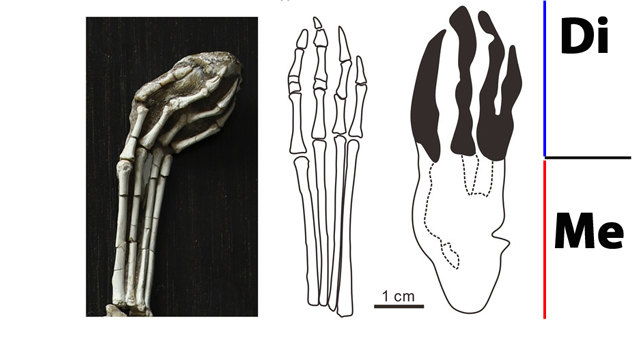
A detailed comparison with other pterosaur tracks suggests that these prints belong to the ichnogenus Pteraichnus, this is the tenth ichnospecies to be assigned to this ichnogenus. It being distinguished from the others by several traits, for example in these tracks the length of the toes on the foot are equal to the length of the metatarsal part of the foot. The ratio between the length of the toes and the rest of the foot is 1:1, this ratio is different from other reported pterosaur tracks assigned to the ichnogenus Pteraichnus.
The foot of the dsungaripterid pterosaur Noripterus complicidens (left) with outline drawing of N. complicidens foot (middle) and interpretative drawing of a track made by a foot (right). The researchers infer that these tracks were probably made by N. complicidens. The length of the digital part of the foot (Di) is equal to the length of the metatarsal part of foot (Me). The ratio between the length of the toes and the rest of the foot is 1:1 this ratio is different from other reported pterosaur tracks assigned to the ichnogenus Pteraichnus and therefore supports the theory that these tracks represent a new ichnospecies. Picture credit: Li et al with additional notation by Everything Dinosaur.
Tracks Possibly Made by Noripterus complicidens
The researchers from the Chinese Academy of Sciences (Centre for Excellence in Life and Palaeoenvironment), postulate that the tracks may have been made by the dsungaripterid pterosaur Noripterus complicidens. To date only two genera of pterosaur have been identified from fossils found in the Shengjinkou Formation in north-western China. They are both members of the Dsungaripteridae family, a group of advanced pterodactyloid pterosaurs with robust, stout skulls and strong limbs.
The two genera are Dsungaripterus (D. weii) and the slightly smaller Noripterus (N. complicidens). By comparing the tracks to the foot bone of Noripterus, the researchers concluded that these tracks were made by Noripterus, a pterosaur with a wingspan of approximately 2 metres that probably fed on shellfish, hence the congregation of pterosaur tracks at this site, although no feeding traces could be identified.
An incomplete specimen of the dsungaripterid pterosaur Noripterus complicidens. Picture credit: Junchang Lü.
The scientific paper: “A new pterosaur tracksite from the Lower Cretaceous of Wuerho, Junggar Basin, China: inferring the first putative pterosaur trackmaker” by Yang Li, Xiaolin Wang and Shunxing Jiang published in PeerJ.
New research published in the on-line academic journal “PeerJ” suggests that the bite of a juvenile T. rex was strong enough to puncture bone.
University of Wisconsin Oshkosh palaeontologist Joseph Peterson in collaboration with Shannon Brink, formerly at Wisconsin but now a student at East Carolina University along with Jack Tseng (University of Berkeley, California), tested the bite force that can be generated on the tip of a tooth from a teenage T. rex. They discovered that even though the tyrannosaur was far from fully grown, it could generate a bite force of up to 5,641 newtons, that’s much higher than an adult male lion (Panthera leo) and more than has been estimated for the giant abelisaurid Carnotaurus (C. sastrei).
In fact, this bite force estimate for a T. rex believed to have been around thirteen years of age is comparable to the calculated bite forces of many adult meat-eating dinosaurs such as Allosaurus fragilis.
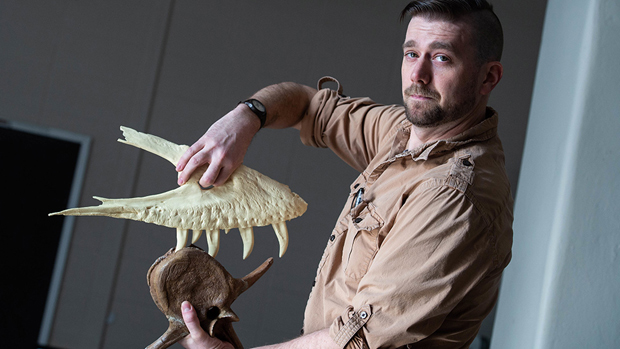
University of Wisconsin Oshkosh palaeontologist Joseph Peterson demonstrating the bone penetrating bite of a tyrannosaur. Picture credit: University of Wisconsin Oshkosh.
Where did Juvenile Tyrannosaurs Fit in Late Cretaceous Ecosystems
Whilst there has been quite a lot of research on the bite force potential of adult meat-eating dinosaurs, particularly tyrannosaurs, much less work has been undertaken to assess the bite forces generated by juveniles. By gaining a better understanding of the power of the jaws of these sub-adult predators, then palaeontologists can infer important information about their behaviour such as hunting strategies and preferred prey.
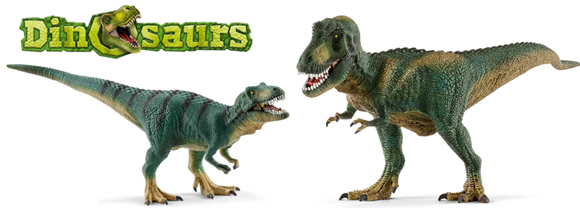
The Schleich juvenile T. rex and the 2017 Schleich T. rex model. Juvenile tyrannosaurs had a bone crunching bite.New research into the bite force generated by juvenile T. rex dinosaurs suggest that they could penetrate bone.
Crunching Cow Bones
In order to test the bite force, a replica of a tooth from a juvenile T. rex was mounted onto a mechanical testing frame used in the University’s engineering and science block. Numerous experiments were then carried out to see if the tooth could penetrate and crack the leg bone of a cow. Based on seventeen successful attempts to match the depth and shape of penetration marks identified in the fossil record, the researchers determined that a thirteen-year-old T. rex could have exerted up to 5,641 newtons of force, that’s somewhere between the bite force exerted by a modern-day hyena and a crocodile.
Impressive as it is, after all, we humans can muster a bite force across our incisors of around 300 newtons, the juvenile T. rex had a much weaker bite than that estimated for an adult. Some scientists have calculated that an adult T. rex could generate a bite force in excess of 35,000 newtons, easily enough pressure to shatter the bones of a hadrosaur or a Triceratops.
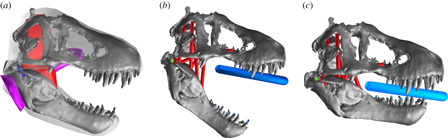
Bite down hard! Assessing the bite force of Tyrannosaurus rex. Picture credit: Biology Letters.
The study reveals that juvenile T. rexes were developing their biting techniques and strengthening their jaw muscles to be able crush bone once their adult teeth came in.
Commenting on the significance of this study, Joseph Peterson stated:
“This actually gives us a little bit of a metric to help us gauge how quickly the bite force is changing from juvenile to adulthood, and something to compare with how the body is changing during that same period of time. Are they already crushing bone? No, but they are puncturing it. It allows us to get a better idea of how they are feeding, what they are eating. It is just adding more to that full picture of how animals like tyrannosaurs lived and grew and the roles that they played in that ecosystem.”
The scientific paper: “Bite force estimates in juvenile Tyrannosaurus rex based on simulated puncture marks” by Joseph E. Peterson, Z. Jack Tseng and Shannon Brink published in PeerJ.
New research suggests that the remarkable Burgess Shale deposits may not preserve the remains of a single, complex Cambrian marine ecosystem but the animals that were to become preserved as fossils may have been transported to this location from much further away.
A New Research Paper Focusing on the Burgess Shale Deposits
Researchers led by Dr Nicholas Minter and Dr Orla Bath Enright (University of Portsmouth), writing in the academic journal “Communications Earth & Environment” postulate that the amazing biota associated with the Walcott Quarry could have undergone substantial transport prior to deposition. They suggest that this aggregation of fossils of primitive marine creatures might not represent the remains of a single, rich and diverse ecosystem but the accumulated remains of several prehistoric communities.
The rich and diverse Cambrian biota associated with the Walcott Quarry (British Columbia). Picture credit: Phlesch Bubble/Royal Ontario Museum.
Ancient Lifeforms Moved by Mudflows
In late August 1909, American palaeontologist Charles Walcott was exploring an area of shale deposits exposed in the mountains of British Columbia close to Mount Burgess. He discovered a profusion of fossils in the shales, many of which had their soft parts preserved. The strata consist of fine mud which were laid down between 510 and 505 million years ago and the location, now known as Walcott Quarry, was declared a UNESCO World Heritage site in 1984.
More than 65,000 fossil specimens have been collected representing more than 120 species. This fossil assemblage helped to support the theory of the “Cambrian explosion”, that towards the middle of the Cambrian there was a sudden burst of evolutionary activity leading to the evolution of the Phyla we have today. It had been thought that this Lagerstätte had been formed when catastrophic mudflows buried the ecosystem but the researchers, using flume experiments were able to demonstrate that the remains of delicate animals were capable of being transported tens of kilometres.
The research team were able to plot the movement of delicate animal remains in mudflows and they concluded that they would not have deteriorated further despite significant transport. Picture credit: Orla Bath Enright et al.
Taphonomic Assessment and Analysis of the Burgess Shale Deposits
The researchers used a combination of measurements and assessments at the Walcott Quarry site with flume tank laboratory tests to mimic the mudflows and the deposition. They concluded that the delicate bodies of certain creatures could have been moved over tens of kilometres without damage, creating the illusion of this Lagerstätte representing a single prehistoric community.
Field work being carried out at the Walcott Quarry located in the Burgess Shale of British Columbia. Picture credit: Orla Bath Enright.
The Deterioration of the Remains of Polychaete Worms
The University of Portsmouth was assisted in this research by scientists from University of Saskatchewan and Southampton University. They looked at one particular species of polychaete worm (Alitta virens) present in the shales, classified the degree of preservation for fossil specimens from entire/complete to degraded with just jaws and setae (bristle-like structures) left. They concluded that transport of the carcasses of these delicate animals did not significantly damage the remains further beyond what has already occurred due to normal decay processes.
Increasing states of polychaete degradation (Alitta virens). The researchers examined the fossilised remains of one species of polychaete worm and grouped the remains into categories related to the pristine state of the fossil material. It was concluded that the remains of soft-bodied, delicate animals could have been transported considerable distances and thus the Burgess Shale Lagerstätte might represent the preserved remains of more than one marine community. Picture credit: Orla Bath Enright et al.
Commenting on the implications this study might have Dr Bath Enright stated:
“We don’t know over what kind of overall time frame these many flows happened, but we know each one produced an ‘event bed’ that we see today stacked up on top of one another. These flows could pick up animals from multiple places as they moved across the seafloor and then dropped them all together in one place”.
Stratigraphy and interpretative line drawings from sediments associated with the Walcott Quarry. The image (B) shows Bed A from the Greater Phyllopod Bed of the Walcott Quarry, whilst (C) shows a line drawing of the sedimentation of Bed A. Soft-bodied organisms (1, 2, and 3) from the proposed mud flows will become mixed in the deposit. Picture (D) shows a thin-section scan from Bed A showing parallel laminae, erosive, scoured bases, and “floating” quartz grains (Q). White arrows indicate transitional cohesive flow deposits. Picture credit: Orla Bath Enright et al.
A Cautionary Note
This research indicates that the transportation of the remains of soft-bodied creatures does not unduly affect their degradation. Fossils found in a single layer of sediment and assumed to represent animals living together in a single ecosystem, could actually represent the accumulation of remains that have been gathered together and that these animals may have lived far apart. The study provides a cautionary note on how palaeontologists develop views on ancient ecosystems based on the fossilised remains of the creatures they study.
Intriguingly, for what appears to be such a rich and specious community, dominated by benthic organisms (living on the seafloor), there is very little evidence of trackways, burrows or bioturbation associated with this famous fossil site. The lack of these trace fossils suggests a predominantly low oxygen or anoxic habitat and this lends weight to the idea that the sediments in which the fossils were found do not represent the habitat of these creatures.
An Ottoia fossil (Burgess Shale). Many different types of worm are associated withthe Burgess Shale deposits but very few trace fossils such as burrows have been preserved. This lends weight to the idea that the remains of these animals were transported to the site from elsewhere.
What Caused the Mudflows?
It is not known precisely what caused the mudflows which buried and transported the animals which became fossilised, but the area was subject to multiple flows, causing well-preserved fossils to be found at numerous different levels in the shale.
Dr Bath Enright added:
“When we see multiple species accumulated together it can give the illusion we are seeing a single community. But we argue that an individual ‘event bed’ could be the product of several communities of animals being picked up from multiple places by a mudflow and then deposited together to give what looks like a much more complicated single community of animals”.
The scientific paper: “Flume experiments reveal flows in the Burgess Shale can sample and transport organisms across substantial distances” by Orla G. Bath Enright, Nicholas J. Minter, Esther J. Sumner, M. Gabriela Mángano and Luis A. Buatois published in Communications Earth & Environment.