All about dinosaurs, fossils and prehistoric animals by Everything Dinosaur team members.

Fossil finds, new dinosaur discoveries, news and views from the world of palaeontology and other Earth sciences.

29 05, 2021

A New, Giant Moroccan Mosasaur – Pluridens serpentis

By |2024-05-26T11:01:09+01:00May 29th, 2021|Categories: Adobe CS5, Dinosaur and Prehistoric Animal News Stories, Dinosaur Fans, Main Page, Palaeontological articles, Photos/Pictures of Fossils|0 Comments

This month (May 2021), has seen yet another scientific paper published describing a new species of mosasaur from the Late Cretaceous of Morocco. The newly described Pluridens serpentis reminds us that these whale-sized animals were related to snakes and lizards (Squamata). It may have sensed its marine environment in a similar way to extant sea snakes.

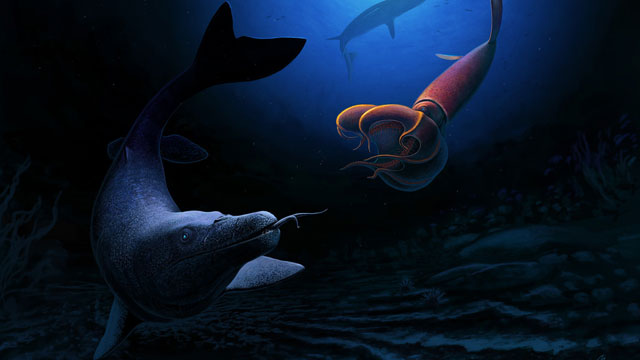
A life reconstruction of Pluridens serpentis
A life reconstruction of the Moroccan mosasaur Pluridens serpentis. The orbits (eye sockets), were disproportionately small when compared to other mosasaurs, it also had very sensitive jaws that were capable of helping it to make sense of its environment (as indicated by numerous neurovascular foramina on the premaxillae). It may have specialised in hunting prey in deep water, or in poorly lit habitats. Picture credit: Andrey Atuchin.

Morocco a Hot Bed of Late Cretaceous Mosasaurs

Mosasaurs were the last, great group of marine reptiles to evolve. They originated in the early Late Cretaceous and they were around for about 20 million years, a much shorter temporal range than other marine reptiles from the Mesozoic such as the ichthyosaurs and plesiosaurs. However, they were extremely successful and globally widespread with more than 40 different genera described.

The extensive phosphate beds of the Ouled Abdoun Basin in northern Morocco have proved to be a hot bed of mosasaur fossil remains. Thirteen mosasaur genera have been named and described from these Upper Cretaceous (Maastrichtian) deposits to date. For example, Everything Dinosaur wrote about the discovery of the specialised piscivore Gavialimimus almaghribensis in October 2020: Another New Species of Mosasaur from Morocco.

Based on Two Complete Skulls and Referred Jaw Material

Writing in the academic journal “Cretaceous Research”, scientists including Dr Nick Longrich (University of Bath), describe P. serpentis based on two complete skulls and referred jaw material. The skulls imply a total body length of around 6 to 8 metres, but the jaw material found indicates that Pluridens could have grown much larger, perhaps as big as 10 metres in length.

It had long, slender jaws lined with over a hundred tiny snake-like teeth which were well-adapted to grabbing small fish and squid. When compared to other mosasaurs, Pluridens had relatively small eyes, suggesting it had poor vision. It probably relied on other senses to understand its environment and to hunt. The upper snout (premaxilla), had dozens of openings for nerves (neurovascular foramina), hinting at the ability to hunt by sensing water movements and changes in pressure. These nerves may have been sensitive to tiny variations in water pressure, an adaptation seen in sea snakes.

The prepared skull of the newly described Moroccan mosasaur Pluridens serpentis
The prepared skull of the newly described Moroccan mosasaur Pluridens serpentis. Picture credit: Dr Nick Longrich.

Lead author of the study, Dr Longrich, (senior lecturer at the Milner Centre for Evolution, University of Bath), commented:

“Typically, when animals evolve small eyes, it’s because they’re relying more heavily on other senses. If it wasn’t using the eyes, then it’s very likely that it was using the tongue to hunt, like a snake. Many aquatic snakes and lizards – sea snakes and water monitors flick their forked tongues underwater, using chemical cues to track their prey. Mosasaurs would have resembled whales and dolphins, so it’s tempting to assume they lived like them. But they’re very different beasts – they’re huge lizards – so they probably acted like them.”

Thick, Robust and Heavy Jawbones

The researchers, who include scientists from the Natural History Museum of Sorbonne University (France), the University Cadi Ayyad in Marrakech and the OCP Group S. A. (both in Morocco), noted that the dentary (lower jaw bone) becomes massive and robust in the largest individuals, suggesting sexual selection and perhaps sexual dimorphism. In some species of extant beaked whales, the males use their jaws in combat (intraspecific combat). It is postulated that male Pluridens behaved in a similar way with the mandibles possibly functioning for combat as in modern beaked whales and some lizards such as Komodo dragons.

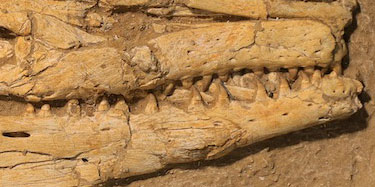
A close-up view of the jaw of Pluridens serpentis
A close-up view of the jaws of Pluridens showing the fang-like teeth and small holes in the jaw bones (foramina) – openings for nerves, hinting at the ability to hunt by sensing water movements and changes in pressure. Picture credit: Dr Nick Longrich.

Pluridens serpentis

The newly described Pluridens serpentis lends weight to the theory that mosasaurs were continuing to specialise and diversify until the very end of the Cretaceous. It is the thirteenth species of mosasaur to be identified from Morocco and very probably not the last. Team members at Everything Dinosaur are looking forward to the publication of future scientific papers, once again highlighting the remarkable diversity of North African mosasaurs during the Maastrichtian faunal stage of the Cretaceous.

The scientific paper: “Pluridens serpentis, a new mosasaurid (Mosasauridae: Halisaurinae) from the Maastrichtian of Morocco and implications for mosasaur diversity” by Nicholas R. Longrich, Nathalie Bardet, Fatima Khaldoune, Oussama Khadiri Yazami and Nour-Eddine Jalil published in Cretaceous Research.

The Everything Dinosaur website: Prehistoric Animal Figures and Models.

25 05, 2021

Rare Dinosaur Bones from Western Queensland

By |2024-05-26T10:47:51+01:00May 25th, 2021|Categories: Adobe CS5, Dinosaur and Prehistoric Animal News Stories, Dinosaur Fans, Main Page, Photos/Pictures of Fossils|0 Comments

Team members at Everything Dinosaur have received reports from Australian media sources that dinosaur bones have been discovered at Eromanga in western Queensland. The fossil bones believed to be cervical vertebrae (neck bones) represent the remains of a titanosaur. A field team from the Eromanga Natural History Museum has begun excavations and they suspect that the fossils, representing a titanosaur will end up being described as a new species.

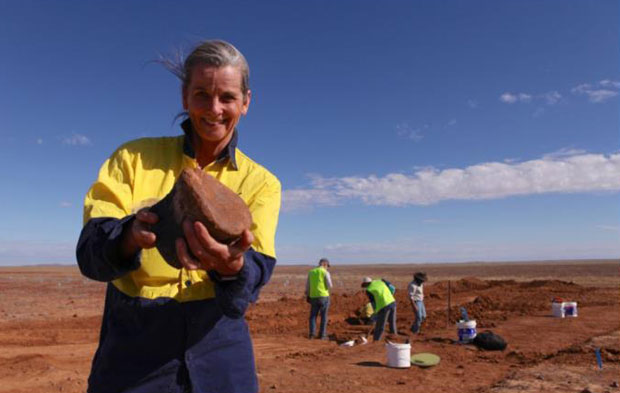
The director of the Eromanga Natural History Museum holds a fossil bone.
Robyn Mackenzie, Director and palaeontologist for the Eromanga Natural History Museum, holds one of the recently excavated dinosaur bones. Picture credit: Dan Llewellyn/Eromanga Natural History Museum).

Land of Giant Titanosaurs

Several dinosaurs have already been named and described from fossil remains found in this region. The sandstones, mudstones and silts represent deposits from an ancient river network. Given the depth of the formation (the Winton Formation), that exceeds 400 metres deep at some locations, palaeontologists have postulated that this part of Australia around 98-95 million years ago was home to a huge river comparable to the Mississippi today.

Palaeontologist and director of the Eromanga Natural History Museum, Robyn Mackenzie explained that the excavations were looking promising and that she was optimistic that more elements from the skeleton of the large herbivore would be found.

In 2015, Everything Dinosaur reported on the fossilised bones of Australia’s largest dinosaur going on public display for the first time. These fossils were found in the same region and represent an animal around thirty metres in length. The dinosaur was nicknamed “Cooper”.

To read more about the titanosaur nicknamed “Cooper”: A super-duper titanosaur called “Cooper”.

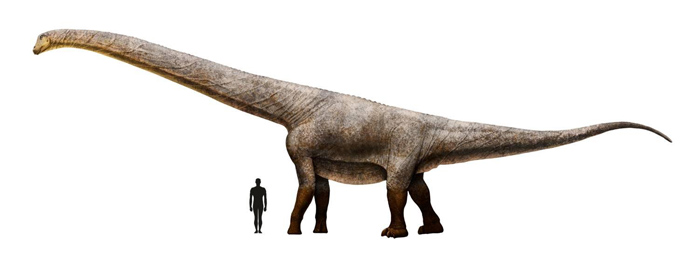
A scale drawing of an Australian Titanosaur.
Scale drawing of “Cooper”. This titanosaur, whose bones were found in 2007 and went on display in 2015 has yet to be formally scientifically described and named.

Fossils Found by Director’s Son

The site was first discovered in 2018 by Robyn Mackenzie’s son and daughter-in-law. Whilst out rounding up cattle dinosaur vertebrae were spotted exposed on the surface of the red clay soil.

Dinosaur Bones Exposed on the Surface
Dinosaur bones exposed on the surface.  Picture credit: Eromanga Natural History Museum.

A spokesperson from Everything Dinosaur stated that dinosaur bones from the early Late Cretaceous were relatively rare globally and the fossils from this part of western Australia are helping palaeontologists to better understand the dinosaur biota of southern Gondwana.

The Everything Dinosaur website: Dinosaur Models and Toys.

23 05, 2021

A Predator Becomes Prey as Remarkable Fossil is Investigated

By |2024-05-26T10:38:36+01:00May 23rd, 2021|Categories: Dinosaur and Prehistoric Animal News Stories, Main Page, Palaeontological articles, Photos/Pictures of Fossils|0 Comments

A team of scientists have interpreted a remarkable fossil from southern Germany as a rare example of predation in the fossil record. A belemnite (a squid-like animal), has been preserved with the remains of a crustacean still held in its arms. However, the belemnite (a cephalopod), never had a chance to finish its meal, its fossilised remains display damage that indicate that it too was predated upon.

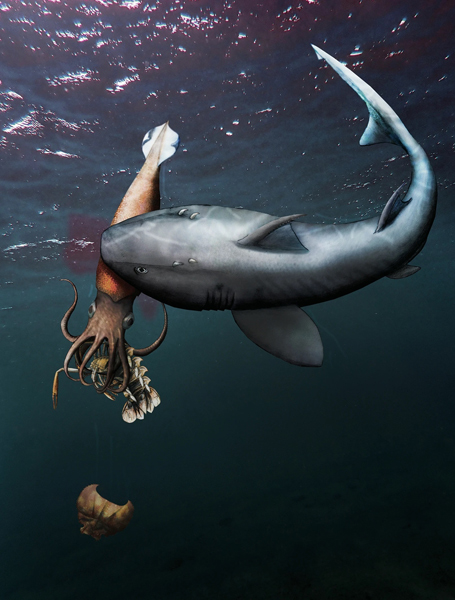
The belemnite was attacking the crustacean, when it too was attacked, presumably by a vertebrate predator which the researchers postulate was a type of prehistoric shark.

Shark Attacks Belemnite Attacking a Crustacean
Possible scenario explaining the taphonomy of the belemnite. Hybodus hauffianus (prehistoric shark), is known to have fed on belemnites, although it is unclear whether some individuals learned how to avoid the swallowing of the calcitic rostrum. The belemnite Passaloteuthis laevigata holds remains of the exuvia of Proeryon in its arms. Picture credit: Klug et al.

Discovered in 1970

The specimen was discovered in 1970 by amateur fossil collector Dieter Weber. The fossils come from the famous Lower Jurassic, Posidonia Shale from near Holzmaden (Germany). These marine shales which are exposed in Switzerland, Luxembourg, Austria and Holland as well as Germany, are famous for their beautifully preserved but crushed fossil specimens including many types of Early Jurassic marine reptile and fish.

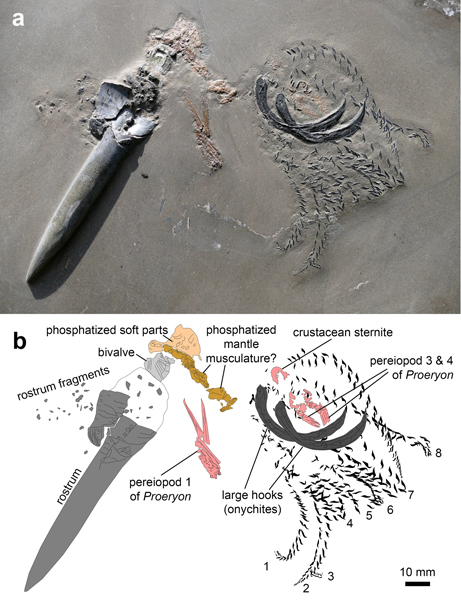
In Germany, these shales are known as the Posidonienschiefer Formation. The name of the formation is derived from the extensive and abundant fossils of the bivalve Posidonia bronni. Günter Schweigert (Natural History Museum Stuttgart), had been invited to view Herr Weber’s extensive private collection when he noted the fossilised remains of a belemnite (Passaloteuthis bisulcata) in close proximity to a crustacean. The remains of the crustacean, identified as an example of the decapod Proeryon, were still held in the arms of the belemnite and some soft tissue of the cephalopod had been preserved.

Evidence of Predation in an Early Jurassic Fossil Specimen
Taphocoenosis of a Passaloteuthis bisulcata with preserved arm crown and remains of its prey, SMNS 70514, Early Toarcian, Tenuicostatum Zone, Semicelatum Subzone, Ohmden, Germany. Photo of the specimen and its prey (a) Line drawing of fossil. Picture credit: Klug et al.

Damage to the Belemnite

When examined closely, the soft parts of the belemnite were far from complete and the scientists, which included researchers from the University of Zurich (Switzerland), Friedrich-Alexander-University (Erlangen, Germany), the Luxembourg National Museum of Natural History and the Ruhr-University Bochum (Germany), proposed that this was possible evidence of the belemnite having been attacked whilst in the process of subduing its prey.

Fossilised “Leftovers” – Pabulite

The specimen is interpreted as evidence of incomplete predation. The belemnite was attacked but not all of it was eaten. The assailant dropped the belemnite, which was still clutching the decapod, the remains settled on the seabed to be covered over in sediment and eventually turned to stone.

For this kind of fossil, one that provides circumstantial evidence to indicate these are the preserved remains of a dropped meal, the researchers coined the term “pabulite”. This word is derived from the Latin word “pabulum” for food and the Greek word “lithos” for stone.

What Sort of Animal Attacked the Belemnite?

As most of the belemnite soft parts between the arm crown and the calcitic rostrum are missing, the scientists postulate that this represents remains of a meal of a vertebrate predator, possibly of the Early Jurassic shark Hybodus hauffianus which is known to have eaten belemnites.

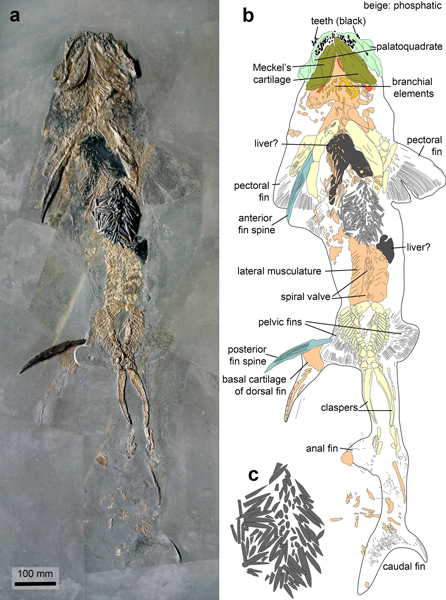
One remarkable fossil (SMNS 10062), in the collection of the Natural History Museum Stuttgart, depicts one of these small sharks which had at least 93 part or complete belemnite rostra wedged in its stomach. It has been suggested that this indigestible material probably killed the shark.

Hybodus shark fossil with stomach clogged by belemnite rostra
The Early Jurassic elasmobranch Hybodus hauffianus with its stomach clogged by belemnite rostra; SMNS 10062, Posidonia Shale, Toarcian, Holzmaden (Germany). Picture credit R. Böttcher.

Evidence of Behaviour Preserved in the Fossil Record

These fossilised leftovers provide a glimpse into a marine food web that existed 180 million years ago. In the recently published scientific paper, the researchers speculate that vertebrate predators of belemnites, animals such as ichthyosaurs, sharks and metriorhynchid crocodiles learned to avoid the hard, indigestible rostra of these cephalopods. Instead, they bit off the soft parts and consumed them leaving the rostrum of their victim to descend to the seafloor.

The researchers suggest that the association of the complete belemnite arm crown with a complete rostrum and some soft parts represent the remains of the meal of a vertebrate predator, which had learned enough about belemnite anatomy to avoid the rostrum. This idea lends further credibility to the hypothesis that belemnite predation might contribute to belemnite accumulations (so-called battlefields, where huge numbers of fossilised belemnite guards are found together) under certain circumstances.

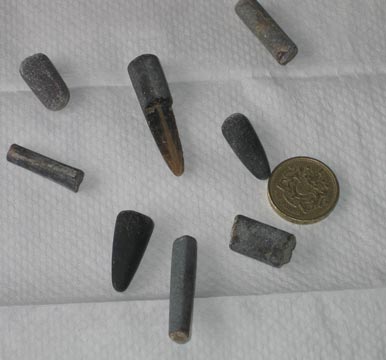
Some belemnite guard fossils, the coin shows scale.
Belemnite guard fossils from the “Jurassic Coast”. Picture credit: Everything Dinosaur.

Picture credit: Everything Dinosaur

The scientific paper: “Fossilized leftover falls as sources of palaeoecological data: a ‘pabulite’ comprising a crustacean, a belemnite and a vertebrate from the Early Jurassic Posidonia Shale” by Christian Klug, Günter Schweigert, René Hoffmann, Robert Weis and Kenneth De Baets published in the Swiss Journal of Palaeontology.

Visit the Everything Dinosaur website: Everything Dinosaur.

17 05, 2021

It was Other Mammals not Dinosaurs that Held the Mammals Back

By |2024-05-26T09:59:53+01:00May 17th, 2021|Categories: Adobe CS5, Dinosaur and Prehistoric Animal News Stories, Dinosaur Fans, Main Page|0 Comments

A team of scientists writing in the journal Current Biology have applied new statistical methods to assess how constrained different types of mammals were before and after the K-Pg extinction event that saw the demise of the non-avian dinosaurs. The researchers conclude that dinosaurs were probably not the main competitors of mammals during the Mesozoic. In addition, this study indicates that the ancestors of modern mammals during the age of the dinosaurs remained less diverse because of competition from other mammal groups.

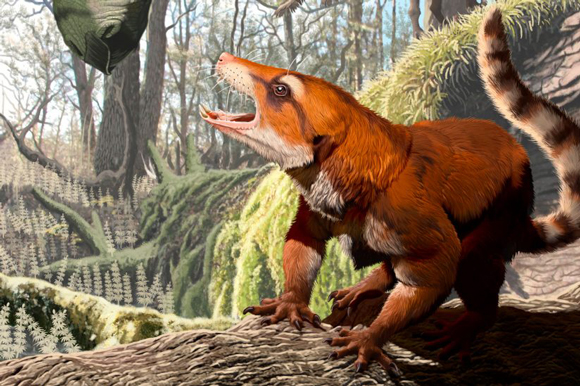
Cifelliodon wahkarmoosuch life reconstruction.
A life reconstruction of the stem mammal C. wahkarmoosuch. Mammals during the Mesozoic were thought to have been limited in their ecological niches due to the dominance of the Dinosauria. New research suggests that the dinosaurs were probably not the main competitors of mammaliaforms. Picture credit: Jorge A. Gonzalez.

Analysing the Variability of Mammal Fossils from the Mesozoic

The research involved scientists from the Oxford University Museum of Natural History, the University of Birmingham and Oxford University and its aim was to challenge the long held belief that it was the non-avian dinosaurs dominating terrestrial environments that in effect, held back and stunted the evolution of mammals. Their conclusions such as the extinction of other mammal groups was more beneficial to modern mammals than the extinction of non-bird dinosaurs, highlights the importance of testing established ideas about evolution with new, modern methods.

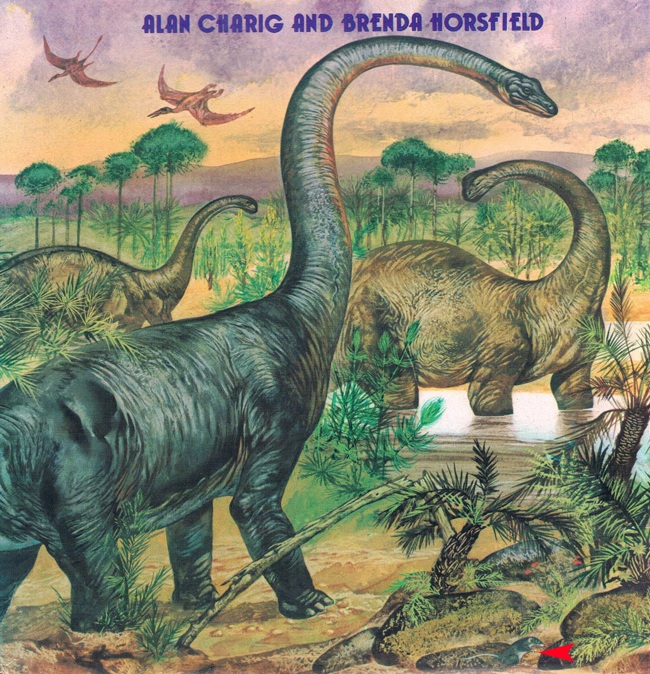
The front cover of "Before the Ark" features a small mammal.
The 1975 BBC book “Before the Ark” depicts a small mammal (arrowed) in a world dominated by dinosaurs and other reptiles. This new study challenged the old and established idea that it was the dinosaurs that outcompeted early mammals restricting them to small size and non-specialised roles with terrestrial ecosystems.

Earlier Branches of the Mammal Evolutionary Tree Dominated

Co-author of the study Dr Elsa Panciroli (Oxford University Museum of Natural History), commented:

“There were lots of exciting types of mammals in the time of dinosaurs that included gliding, swimming and burrowing species, but none of these mammals belonged to modern groups, they all come from earlier branches in the mammal tree. These other kinds of mammals mostly became extinct at the same time as the non-avian dinosaurs, at which point modern mammals start to become larger, explore new diets and ways of life. From our research it looks like before the extinction it was the earlier radiations of mammals that kept the modern mammals out of these exciting ecological roles by outcompeting them”.

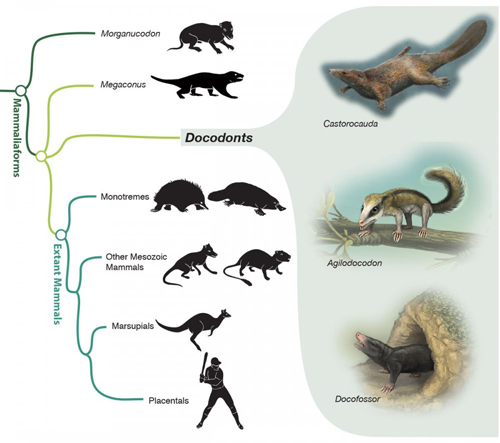
Examining the phylogeny of early mammaliaforms
Examining the phylogeny of early mammaliaforms. The diversity of early mammaliaforms such as the docodonts may have prevented the Metatheria (marsupials) and the Eutheria (placental mammals) which are collectively known as the Theria, from becoming more diverse in the Mesozoic. Picture credit: University of Chicago (illustration by April Neander).

The Therians Kept in Check by Other Types of Mammaliaforms

Most of the mammal species alive today trace their origins to groups that expanded explosively 66 million years ago, when a mass extinction killed all non-avian dinosaurs. It was traditionally thought that, before the extinction, mammals lived in the shadow of the dinosaurs. They were supposedly prevented from occupying the niches that were already occupied by the giant reptiles, keeping the mammals relatively small and unspecialised in terms of diet and lifestyle. It appeared that they were only able to flourish after the dinosaurs’ disappearance left these niches vacant.

However, new statistical methods were used to analyse how constrained different groups of mammals were in their evolution before and after the mass extinction. These methods identified the point where evolution stopped producing new traits and started producing features that had already evolved in other lineages. This allowed the researchers to identify the evolutionary “limits” placed on different groups of mammals, showing where they were being excluded from different niches by competition with other animals. The results suggest that it may not have been the dinosaurs that were placing the biggest constraints on the ancestors of modern mammals, but their closest relatives.

The study looked at the anatomy of all the different kinds of mammals living alongside dinosaurs, including the ancestors of modern groups, also known as therians (placentals and marsupials).

By measuring how frequently new features appeared, such as changes in the size and shape of their teeth and bones, and the pattern and timing of their appearance before and after the mass extinction, the researchers determined that the modern mammals were more constrained during the time of the dinosaurs than their close relatives. This meant that while their relatives were exploring larger body sizes, different diets, and novel ways of life such as climbing and gliding, they were excluding modern mammals from these lifestyles, keeping them small and generalist in their habits.

Everything Dinosaur acknowledges the assistance of a press release from the University of Oxford in the compilation of this article.

The scientific paper: “Mammaliaform extinctions as a driver of the morphological radiation of Cenozoic mammals” by Neil Brocklehurst, Elsa Panciroli, Gemma Louise Benevento and Roger B.J. Benson published in Current Biology.

Visit the Everything Dinosaur website: Everything Dinosaur.

14 05, 2021

Tlatolophus galorum new Lambeosaurine from Mexico

By |2024-05-26T09:38:32+01:00May 14th, 2021|Categories: Adobe CS5, Dinosaur and Prehistoric Animal News Stories, Dinosaur Fans, Main Page, Palaeontological articles|0 Comments

A new species of lambeosaurine hadrosaurid has been named and described this week from fossil material excavated from a site close to the town of Presa de San Antonio in northern Mexico. The dinosaur has been named (Tlatolophus galorum) and it represents the most complete lambeosaurine known to date from Mexico. A phylogenetic assessment of the extensive fossil material suggests that this dinosaur was more closely related to Parasaurolophus which is known from roughly contemporaneous strata further north than it was to the lambeosaur Velafrons coahuilensis, the first duck-billed dinosaur from Mexico to be scientifically described.

Life Reconstruction of Tlatolophus galorum.
Tlatolophus galorum life reconstruction. Picture credit: Marco Pineda.

The Tail of a Hadrosaur’s Tail

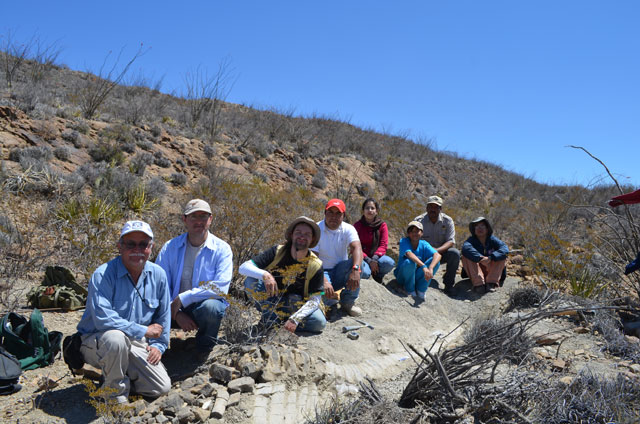
In 2013, Everything Dinosaur reported on the discovery of an articulated dinosaur tail in upper Campanian deposits of the Cerro del Pueblo Formation that had been putatively assigned to a hadrosaur. Field team members from the National Institute of Anthropology and History (INAH), an institution of the Ministry of Culture and the National Autonomous University of Mexico (UNAM) were despatched to excavate the specimen. The fossils had been spotted weathering on the surface in 2005, but serious field work did not commence until 2013.

The Tlatolophus galorum dig site
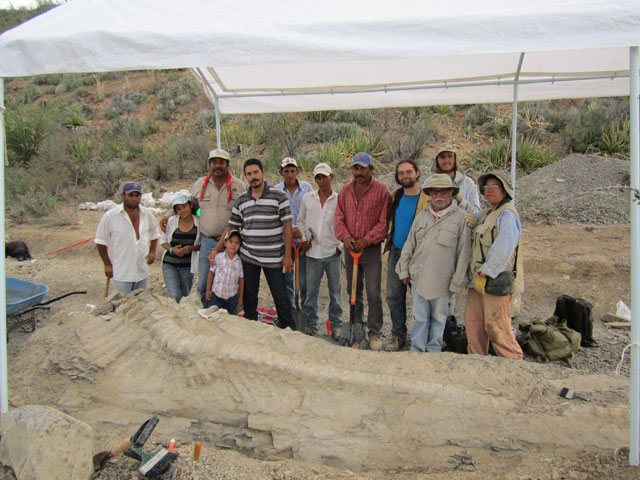
Tlatolophus galorum – the quarry. Field team members at the dig site, elements of the tail and hips can be seen exposed on the surface. Picture credit: INAH

Exposing More of the Specimen

The first aim was to collect and stabilise the material exposed to the elements on the surface. Once this had been taken care of further excavation work revealed that almost the entire tail was present (just the most distal elements were missing). As more of the specimen was revealed the field team slowly began to realise that the anterior portion of the dinosaur might be present too.

Co-author of the scientific paper, published this week in Cretaceous Research Ramírez Velasco (UNAM) commented:

“Although we had given up hope of finding the upper part of the specimen, once we recovered the tail, we continued excavating underneath where it was located. The surprise was that we began to find bones such as the femur, the scapula and other elements”.

The Excavation of Tlatolophus galorum
Field team members at an early stage of the excavation project, the tail of the hadrosaur has been exposed. Picture credit: INAH

An Elongated Drop-shaped Bone

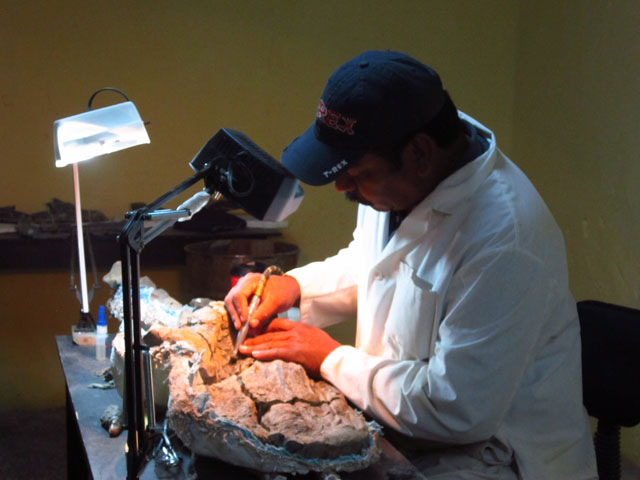
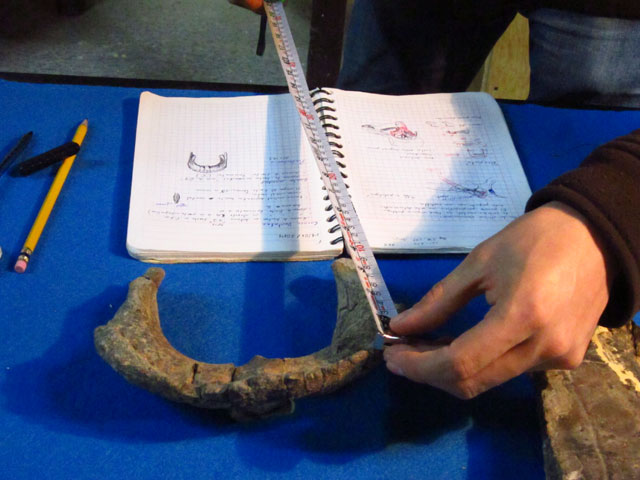
As more of the front half of the dinosaur was exposed, a drop-shaped bone was found. At first, this was interpreted as part of the pelvis, but researcher José López Espinoza suggested that this was a bone from the skull. It was only after careful cleaning, preparation and analysis in the laboratory that the scientists realised that they had 34 bone fragments that formed a considerable portion of the skull and jaws.

Tlatolophus galorum - preparing fossil material
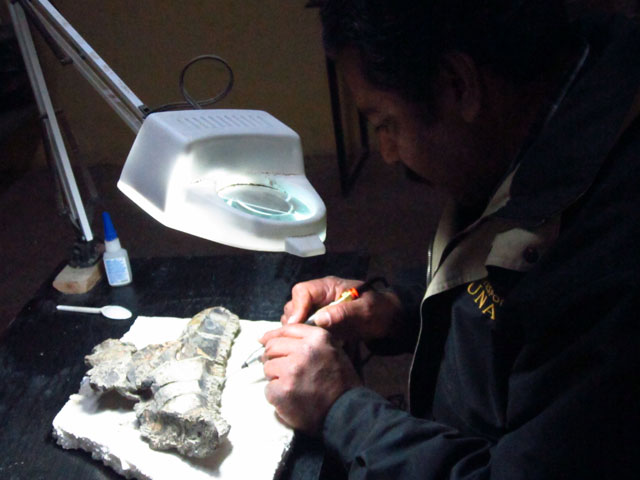
Air scribes being used to remove the matrix close to the bone (Tlatolophus galorum fossil preparation). Thirty-four bone fragments when pieced together formed the skull of the hadrosaur. Picture credit: INAH.

Identifying the Crest

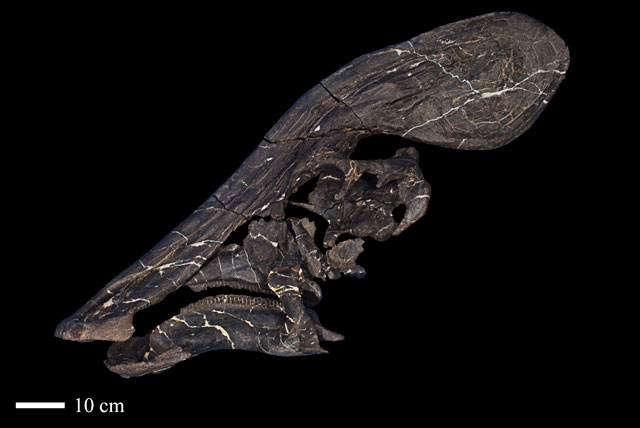
The team were excited to discovery that about 80% of the skull had been recovered including the premaxillae that formed the top part of this duck-billed dinosaur’s head crest. The crest measures an impressive 1.32 metres in length, as well as being able to determine the shape of the crest the scientists could also reconstruct the neurocranium, that part of the skull that housed the brain.

The fossilised skull of Tlatolophus galorum.
The skull of Tlatolophus galorum. Picture credit: Juan Miguel Contreras Fotógrafo (técnico del Instituto de Geología).

Comparison with Velafrons coahuilensis

With so much of the skull material preserved, the research team was able to compare these fossils to other lambeosaurines, including the contemporaneous Velafrons coahuilensis which is also known from the Cerro del Pueblo Formation. Taxonomic and phylogenetic assessments consigned Tlatolophus to the Parasaurolophini tribe, suggesting that it was more closely related to hadrosaurs found further north than it was to Velafrons.

Tlatolophus galorum - Examining the Bones
Careful assessment of the fossil bones to establish a new genus and to place Tlatolophus within the Parasaurolophini tribe. This Mexican dinosaur was closely related to the famous Parasaurolophus crested dinosaur. Picture credit: INAH.

Tlatolophus – What’s in a Name?

The etymology of this dinosaur’s name reflects the shape of the distinctive head crest. The genus name derives from the local Náhuatl dialect for the word “tlahtolli” which translates as “word” as the crest shape resembles a symbol used by native people to demonstrate communication. The Latin “lophus” means “crest” and therefore the genus name translates as “word crest”. The species or trivial name honours the philanthropist Jesús Garza Arocha and recognises the assistance of the López family, who helped the palaeontologists by providing accommodation, food and other facilities during the field seasons.

Cleaning and preparing Tlatolophus galorum fossils
Many hours of work in the preparation laboratory were required in order to clean and preserve the fossil material. The trivial name of this new dinosaur honours the philanthropist Jesús Garza Arocha without whose support much of the extensive preparation work would not have been undertaken. Picture credit: INAH

Tail Bones on Display

The articulated tail of Tlatolophus galorum is on display in the municipal capital of General Cepeda, where, with the support of the city council, a special area was set aside to highlight the dinosaur fossils that have been found in this region of northern Mexico.

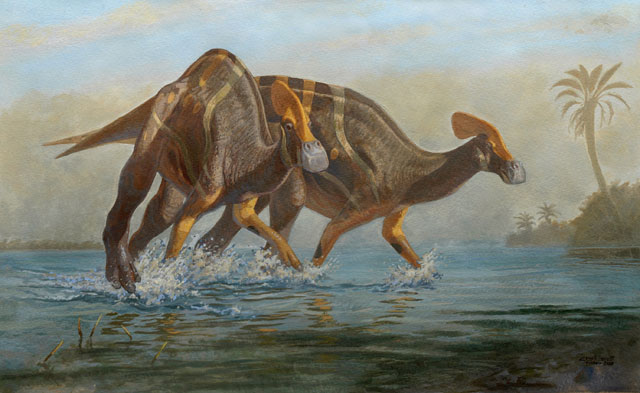
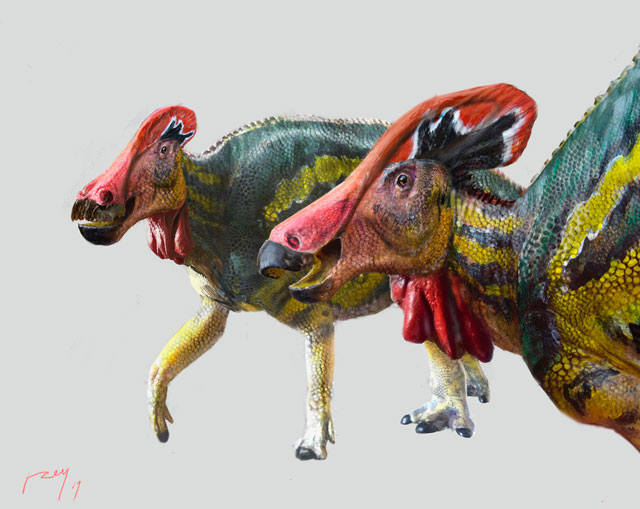
Tlatolophus galorum life reconstruction
A life reconstruction of the newly described hadrosaur Tlatolophus galorum (assigned to the Parasaurolophini tribe). Picture credit: Luis Rey.

Everything Dinosaur acknowledges the assistance of a media release and scientific notes provided by the INAH in the compilation of this article.

To read Everything Dinosaur’s 2013 blog post about the excavation work to uncover and remove the articulated tail of the specimen: The Tail of a Hadrosaur’s Tail.

To read about the discovery of Mexico’s first duck-billed dinosaur: Viva Mexico – New Duck Billed Dinosaur Discovered “South of the Border”

The scientific paper: “Tlatolophus galorum, gen. et sp. nov., a parasaurolophini dinosaur from the upper Campanian of the Cerro del Pueblo Formation, Coahuila, northern Mexico” by Ángel A. Ramírez-Velasco, Felisa J. Aguilar, René Hernández-Rivera, José Luis Gudiño Maussán, Marisol Lara Rodríguez and Jesús Alvarado-Ortega published in Cretaceous Research.

Haolonggood have introduced a model of Tlatolophus galorum.  To view the Haolonggood range: Haolonggood Prehistoric Animal Models.
12 05, 2021

Menefeeceratops – The Oldest Centrosaurine? That’s a Great Question!

By |2024-05-26T09:31:47+01:00May 12th, 2021|Categories: Adobe CS5, Dinosaur and Prehistoric Animal News Stories, Dinosaur Fans, Main Page, Photos/Pictures of Fossils|0 Comments

Fossilised dinosaur remains found over twenty years ago have been re-examined and determined to represent a new species of horned dinosaur. Menefeeceratops (M. sealeyi) from the early Campanian of New Mexico, might just be the oldest centrosaurine described to date.

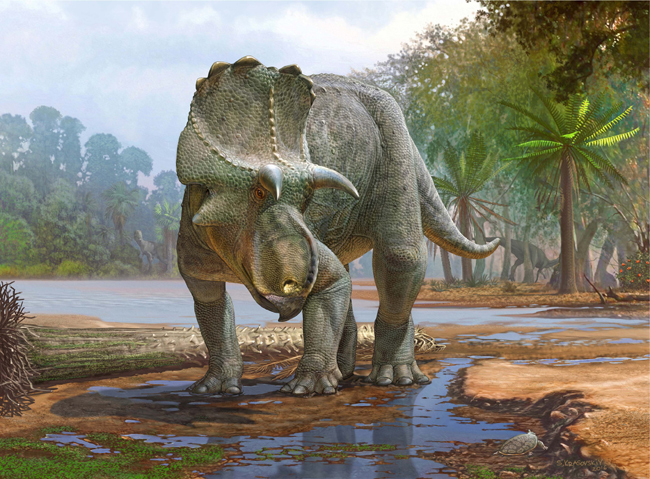
Menefeeceratops sealeyi life reconstruction.
Menefeeceratops sealeyi life reconstruction. Picture Credit: Sergey Krasovskiy. This horned dinosaur was contemporaneous with the tyrannosaur Dynamoterror (D. dynastes). This theropod can be seen in the background (right). Recent fossil discoveries are helping scientists to better understand the dinosaur dominated biota of southern Laramidia during the Campanian. The picture (above) also depicts a hadrosaur in the background (left), team members at Everything Dinosaur consider this to be a depiction of the saurolophine hadrosaur Ornatops (O. incantatus)

From the Menefee Formation of New Mexico

Researchers from the University of Pennsylvania, the New Mexico Museum of Natural History and Science in collaboration with a colleague from the State Museum of Pennsylvania, writing in the academic journal Paläontologische Zeitschrift, report on the reassessment of ceratopsian bones originally collected at a site near to Cuba, in New Mexico. The fossils, representing a partial skeleton of a single dinosaur were found by Paul Sealey, a research associate at the New Mexico Museum of Natural History and Science, whilst exploring the Allison Member of the Menefee Formation in 1996 and discussed in academic literature a year later but no genus name was proposed or other research conducted.

The fossils which consist of cranial and postcranial material remained within the collection of the New Mexico Museum of Natural History and Science, however, with dinosaurs being named and described from the Menefee Formation such as the tyrannosaur Dynamoterror dynastes and the nodosaurid Invictarx zephyri, both of which were named and described in 2018, interest in this specimen was reawakened. Further preparation revealed unique traits associated with the skull material that permitted the establishment of a new genus.

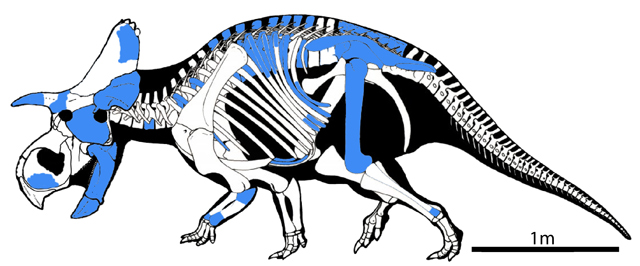
A skeletal reconstruction of Menefeeceratops showing known bones in blue.
Skeletal reconstruction of Menefeeceratops showing known bones in blue. Picture credit: Dalman et al.

Menefeeceratops sealeyi

Classified as a basal member of the Centrosaurinae, Menefeeceratops sealeyi helps palaeontologists to piece together the evolutionary history of the Ceratopsia. Estimated to have lived around 82 million years ago (Early Campanian), the authors of the scientific paper Sebastian Dalman, Spencer G. Lucas and Asher Lichtig (New Mexico Museum of Natural History and Science), Steven Jasinski (State Museum of Pennsylvania) and Peter Dodson (University of Pennsylvania) postulate that Menefeeceratops represents the earliest member of the centrosaurine subfamily of horned dinosaurs known to science.

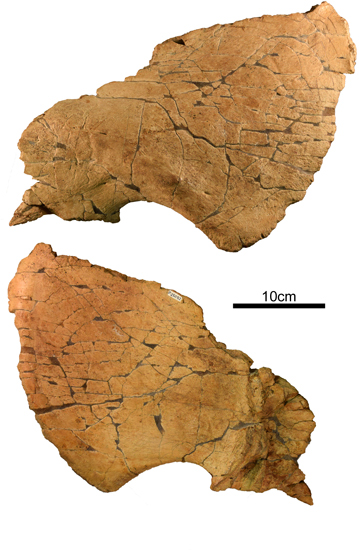
The distinctive shape of the squamosal (skull bone that formed part of the neck frill), permitted the scientists to erect a new genus. The name honours the Menefee Formation, whilst the trivial name recognises the work of Paul Sealey, not only for the original discovery but for his contribution to the study of the dinosaurs of New Mexico.

Views of the left squamosal bone of Menefeeceratops,
Views of the left squamosal bone of Menefeeceratops sealeyi (left lateral and right lateral views). Picture credit: Dalman et al. The squamosal, whilst less ornate than other ceratopsids has a distinctive shape which helped permit the erection of a new genus.

How Big was Menefeeceratops?

By comparing the bones of Menefeeceratops to more complete centrosaurine specimens, the research team were able to estimate the size of this dinosaur. They conclude that it was relatively small, when compared to later members of the Centrosaurinae such as Pachyrhinosaurus and Styracosaurus, at around 3.9 to 4.4 metres in length.

Commenting on the significance of the reassessment of the fossil material that led to the naming of Menefeeceratops, co-author of the scientific paper Spencer G. Lucas stated:

“Menefeeceratops shows us just how much we still have to learn about the horned dinosaurs of western North America. The oldest centrosaur, Menefeeceratops indicates that the southwest region of the United States was an important place in the evolution of the centrosaurs. The recognition of this new centrosaur adds to a growing diversity of centrosaurs, and thus provides impetus to further efforts to discover fossils of these kinds of dinosaurs.”

Authors involved in this study, also named and described the related but geologically much younger centrosaurine Crittendenceratops. To read about Crittendenceratops krzyzanowskii: A New Horned Dinosaur from Arizona.

Everything Dinosaur acknowledges the assistance of a media release from the University of Pennsylvania in the compilation of this article.

The scientific paper: “The oldest centrosaurine: a new ceratopsid dinosaur (Dinosauria: Ceratopsidae) from the Allison Member of the Menefee Formation (Upper Cretaceous, early Campanian), north-western New Mexico, USA” by Sebastian G. Dalman, Spencer G. Lucas, Steven E. Jasinski, Asher J. Lichtig & Peter Dodson published in Paläontologische Zeitschrift.

Visit the Everything Dinosaur website: Dinosaur Toys.

10 05, 2021

An Amazing Billion-Year-Old Fossil from Scotland

By |2024-05-26T09:25:18+01:00May 10th, 2021|Categories: Dinosaur and Prehistoric Animal News Stories, Geology, Main Page, Palaeontological articles, Photos/Pictures of Fossils|0 Comments

A one-billion-year-old microfossil found in the Scottish Highlands has been shown to consist of two distinct cell types and could represent the earliest example of a multicellular animal ever recorded. Scientists from the University of Sheffield in collaboration with colleagues from Boston College (USA), have published a paper describing the discovery of a tiny fossil that provides a new perspective on the transition from single-celled organisms to more complex multicellular forms.

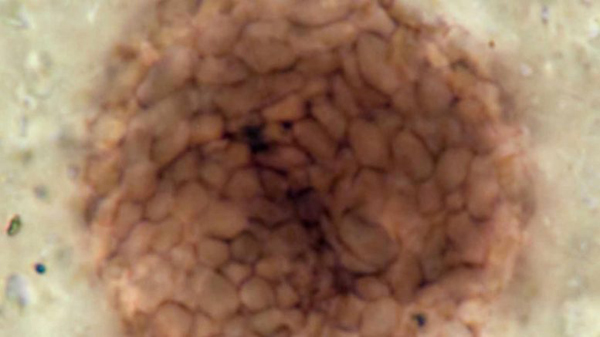
Image of Bicellum brasieri.
A highly magnified image of Bicellum brasieri preserved in petrographic thin sections. Two distinct cell shapes in the closely-packed cluster can be made out – elongate cells and more rounded ones. Picture credit: Professor Paul Strother (Weston Observatory of Boston College).

The photograph (above), shows an image of Bicellum brasieri, the cluster of cells measures around 20 microns in diameter, approximately 750 of these tiny organisms could sit on the head of a pin.

Lying Somewhere Between Single-celled and Multicellular Animals

The microscopic fossil material comes from the Mesoproterozoic-aged Diabaig Formation, which is exposed at Loch Torridon in the Northwest Scottish Highlands. It has been named Bicellum brasieri, the genus name being derived from the two types of cells (elongate and isodiametric) that were identified in the tightly grouped cell clusters.

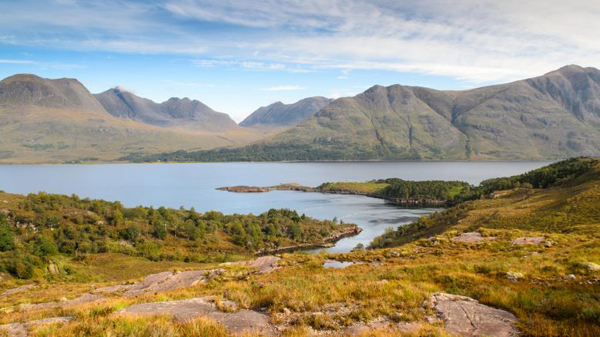
Loch Torridon the site of the fossil discovery
The picturesque Loch Torridon a sea loch on the west coast of Scotland in the Northwest Highlands. The site of the Bicellum brasieri fossil discovery. Picture credit: Sheffield University.

Classified as a Holozoan

Writing in the academic journal “Current Biology” the researchers who include lead author Professor Charles Wellman from the Department of Animal and Plant Sciences (Sheffield University), have assigned this primitive lifeform to the Holozoa – a clade that includes all animals and their closest single-celled relatives but excludes fungi. If their interpretation is correct, then B. brasieri is distantly related to all living animals including our own species Homo sapiens.

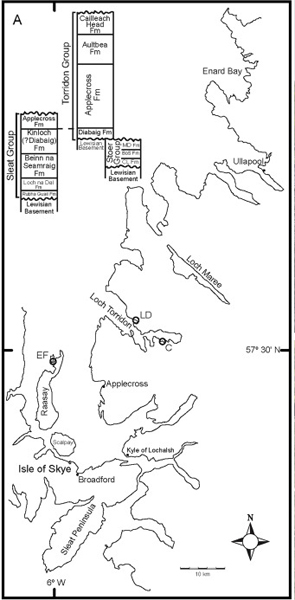
Location map and outline of the stratigraphy of the Bicellum brasieri fossil discovery.
Location map and outline of the stratigraphy of the Bicellum brasieri fossil discovery. Picture credit: Strother et al.

A Remarkable Record of a Significant Development for Life on Earth

The shales of the Diabaig Formation were laid down at the bottom of a freshwater lake. The microfossils preserved in these rocks represent planktonic and benthic forms of microscopic life that existed around a billion years ago. The discovery suggests more complex lifeforms were evolving during this time in Earth’s history. The material could represent the earliest multicellular animal known to science.

Professor Wellman explained:

“The origins of complex multicellularity and the origin of animals are considered two of the most important events in the history of life on Earth, our discovery sheds new light on both of these. We have found a primitive spherical organism made up of an arrangement of two distinct cell types, the first step towards a complex multicellular structure, something which has never been described before in the fossil record.”

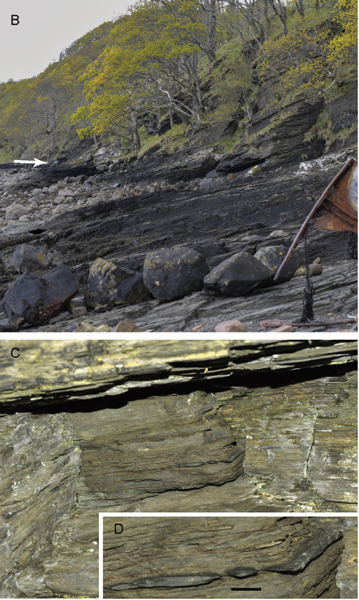
Bicellum fossil site location.
View of Diabaig Formation type section along the north shore of Loch Diabaig at the village of Lower Diabaig (B). The arrow marks the sample site. (C and D). View of dark shales (C) with lenticular, bedded phosphatic nodules in situ (D). Scale bar in (D), 5 cm. Picture credit: Strother et al.

Did the Animalia Evolve in the Sea or in Freshwater?

The exceptional preservation of the fossils enabled the research team to analyse them at both a cellular and subcellular level. The discovery of Bicellum brasieri challenges the long-held theory that complex life evolved in marine environments.

Professor Paul Strother, lead investigator of the research from Boston College stated:

“Biologists have speculated that the origin of animals included the incorporation and repurposing of prior genes that had evolved earlier in unicellular organisms. What we see in Bicellum is an example of such a genetic system, involving cell-cell adhesion and cell differentiation that may have been incorporated into the animal genome half a billion years later.”

This study has shed new light on the transition of single-celled organisms to more complex, sophisticated forms with cell specialisation.

The Boston College professor added:

“The discovery of this new fossil suggests to us that the evolution of multicellular animals had occurred at least one billion years ago and that early events prior to the evolution of animals may have occurred in freshwater like lakes rather than the ocean.”

The scientific paper: “A possible billion-year-old holozoan with differentiated multicellularity” by Paul K. Strother, Martin D. Brasier, David Wacey, Leslie Timpe, Martin Saunders and Charles H. Wellman published in Current Biology.

Visit the Everything Dinosaur website: Everything Dinosaur.

7 05, 2021

Nocturnal Dinosaurs Hunting in the Dark

By |2024-05-26T09:10:25+01:00May 7th, 2021|Categories: Adobe CS5, Dinosaur and Prehistoric Animal News Stories, Dinosaur Fans, Key Stage 3/4, Main Page, Palaeontological articles, Photos/Pictures of Fossils|0 Comments

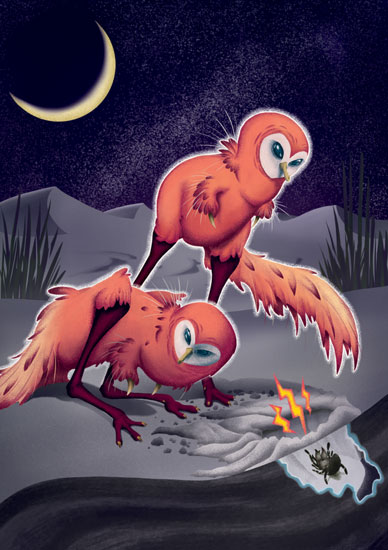
Scientists have proposed that the bizarre, chicken-sized alvarezsaurid Shuvuuia (S. deserti) had amazing eyesight and owl-like hearing, adaptations for a nocturnal hunter in its Late Cretaceous desert environment.

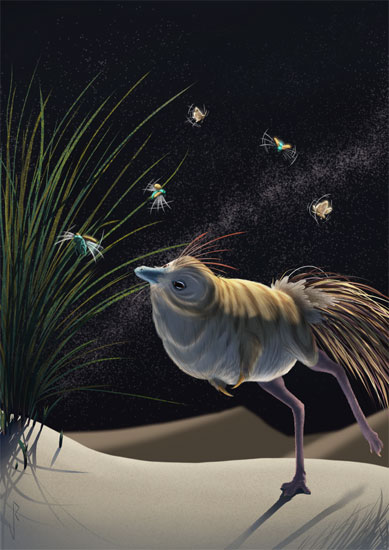
The Mongolian alvarezsaurid hunting at night
Shuvuuia deserti artist’s life reconstruction. Picture credit: Viktor Radermacher.

A Very Bizarre, Tiny Theropod

Named and described in 1998 from fossil material associated with the famous Djadochta Formation (Campanian faunal stage), Shuvuuia has been assigned to the Alvarezsauridae family of theropods. It may have been small (around 60 cm in length), but its skeleton shows a range of bizarre anatomical adaptations. It had long legs, a long tail, short but powerful forelimbs that ended in hands with greatly reduced, vestigial digits except for the thumb which was massive and had a large claw. The skull was very bird-like with disproportionately large orbits.

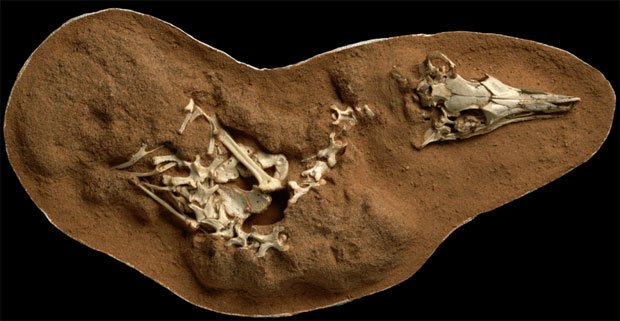
Photograph of fossilised Shuvuuia deserti skeleton.
Photograph of fossilised Shuvuuia deserti skeleton. Picture credit: Mick Ellison (American Museum of Natural History).

Writing in the academic journal “Science” a team of scientists led by Professor Jonah Choiniere (University of Witwatersrand, Johannesburg, South Africa), used sophisticated computerised tomography to examine the skull of Shuvuuia and to map this dinosaur’s sensory abilities, as part of a wider study into non-avian dinosaur sensory abilities.

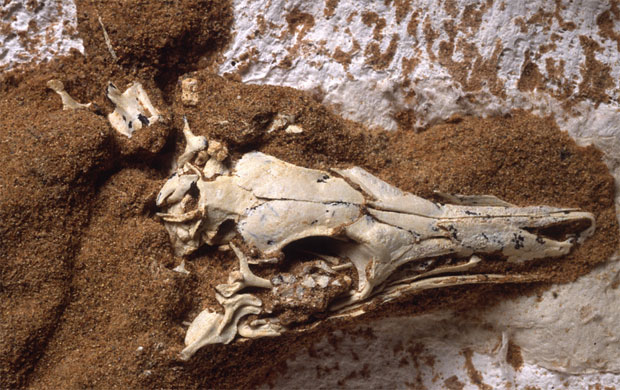
Shuvuuia deserti fossil skull
Photograph of fossilised Shuvuuia deserti skull. Picture credit: Mick Ellison (American Museum of Natural History).

Nocturnal Dinosaurs

The international team of researchers used CT scanning and detailed measurements to collect data on the relative size of the eyes and inner ears of nearly 100 living bird and extinct dinosaur species. There are more than 10,000 species of bird (avian dinosaurs) alive today, but only a few have evolved sensory abilities that enable them to track and hunt prey at night. Owls are probably the best known, but not all owls are nocturnal.

Kiwis hunt at night using their long, sensitive beaks to probe in the leaf litter for worms, whilst another bird endemic to New Zealand, the large, flightless Kakapo (a member of the parrots – Order Psittaciformes), is also nocturnal. Other birds active at night include the globally widespread black-capped night heron and the Stone-curlew (Burhinus oedicnemus) which is an occasional visitor to East Anglia in the UK.

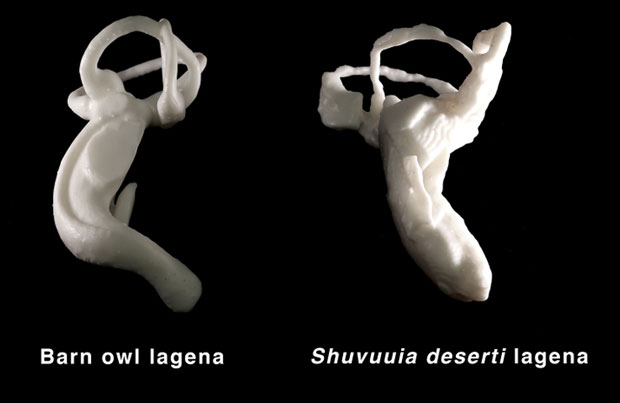
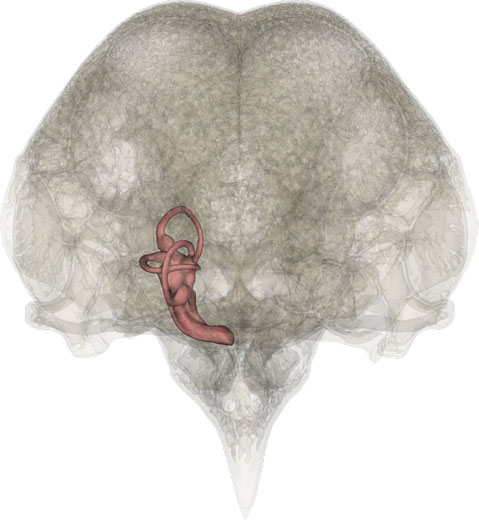
To measure hearing ability, the team measured the length of the lagena, the organ that processes incoming sound information (known as the cochlea in mammals). The barn owl, which can hunt in complete darkness using hearing alone, has the proportionally longest lagena of any bird.

Barn owl skull CT scan showing lagena
Barn owl skull CT scan showing lagena. Picture credit: Jonah Choiniere/Wits University.

Assessing Vision

To examine vision, the team looked at the scleral ring, a series of bones surrounding the pupil, of each species. Like a camera lens, the larger the pupil can open, the more light can get in, enabling better vision at night. By measuring the diameter of the ring, the scientists could estimate how much light the eye can gather.

The researchers found that many carnivorous theropods such as large tyrannosaurs and the much smaller Dromaeosaurus had vision optimised for the daytime, and better-than-average hearing presumably to help them hunt.

However, Shuvuuia, had both extraordinary hearing and night vision. The extremely large lagena of this species is almost identical in relative size to today’s barn owl, suggesting that Shuvuuia could have been a nocturnal hunter. With many predators sharing its Late Cretaceous desert environment, a night-time existence may have proved to be an effective strategy to avoid the attentions of much larger theropods.

Side by side comparison of the lagena of a Barn owl and Shuvuuia deserti
Side by side comparison of the lagena of a Barn owl (left) and Shuvuuia deserti (right). Picture credit: Jonah Choiniere/Wits University.

Commenting on the significance of this discovery, joint first author of the scientific paper, Dr James Neenan exclaimed:

“As I was digitally reconstructing the Shuvuuia skull, I couldn’t believe the lagena size. I called Professor Choiniere to have a look. We both thought it might be a mistake, so I processed the other ear – only then did we realise what a cool discovery we had on our hands!”

Extremely Large Eyes

The eyes of Shuvuuia were also remarkable. Skull measurements suggest that this little dinosaur had some of the proportionally largest pupils yet measured in birds or dinosaurs, This suggests that they could likely see very well at night.

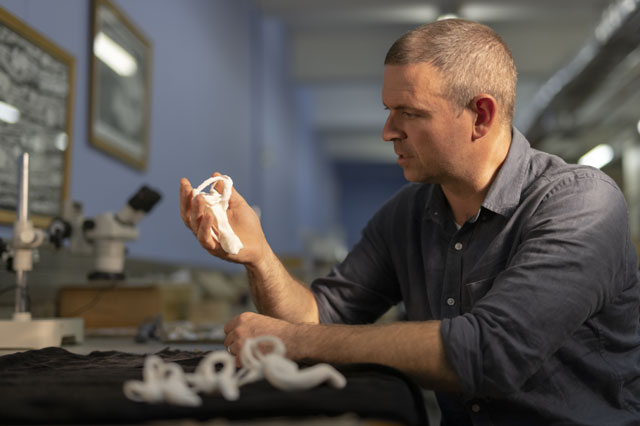
Professor Jonah Choiniere holding a 3D Print of a Shuvuuia lagena
Professor Jonah Choiniere holding a 3D printed model of the lagena of Shuvuuia deserti. Picture credit: Jonah Choiniere/Wits University.

The Alvarezsauridae remain one of the most unusual of all the types of non-avian dinosaur known to science. Their place within the ecosystems of the Late Cretaceous remains controversial. Geographically widespread, a recently described alvarezsaurid from China Qiupanykus zhangi may have been a specialised ovivore (egg-eater), whilst other palaeontologists have postulated that these theropods used their strong forelimbs and large thumb claws to break into termite mounds. Perhaps, these small (most probably feathered), dinosaurs occupied a number of niches within Late Cretaceous ecosystems – including that of a nocturnal hunter of small vertebrates and insects.

Shuvuuia deserti artist's reconstruction.
Shuvuuia deserti artist’s reconstruction. Picture credit: Viktor Radermacher.

To read Everything Dinosaur’s blog article about Qiupanykus zhangi and the evidence behind the egg-eating theory: Did Alvarezsaurids Eat Eggs?

Everything Dinosaur acknowledges the assistance of a media release from the University of Witwatersrand in the compilation of this article.

The scientific paper: “Evolution of vision and hearing modalities in theropod dinosaurs” by Jonah N. Choiniere, James M. Neenan, Lars Schmitz, David P. Ford, Kimberley E. J. Chapelle, Amy M. Balanoff, Justin S. Sipla, Justin A. Georgi, Stig A. Walsh, Mark A. Norell, Xing Xu, James M. Clark and Roger B. J. Benson published in the journal Science.

For dinosaur models and prehistoric animal figures: Dinosaur and Prehistoric Animal Figures.

1 05, 2021

The Regional and Temporal Diversity of Mongolian Dromaeosaurids

By |2024-05-26T08:52:58+01:00May 1st, 2021|Categories: Dinosaur and Prehistoric Animal News Stories, Dinosaur Fans, Main Page, Palaeontological articles, Photos/Pictures of Fossils|0 Comments

Earlier this year (January 2021), a new species of dromaeosaurid dinosaur was named and described from a partial skeleton excavated from deposits associated with the Barun Goyot Formation at Khulsan (Ömnögovi Province, Mongolia). The dinosaur, which was closely related to Velociraptor was named Shri devi. This little, fleet-footed carnivore was named after a female deity from Tibetan/Mongolian Buddhism.

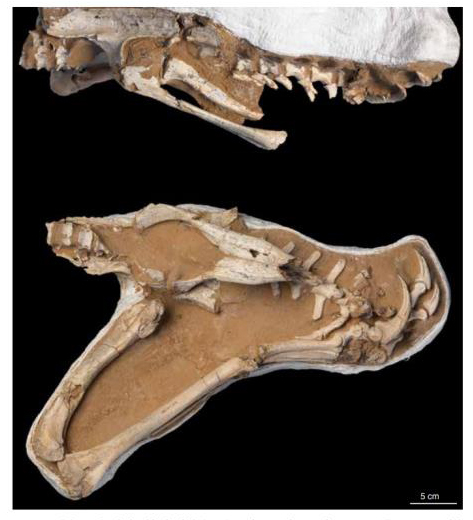
Shri devi fossil material.
Pelvis and right hind limb of Shri devi IGM 100/980 after initial preparation whilst still in burlap jacket. Lateral view (top image) and ventral view (bottom view). Note scale bar = 5 cm.

Plotting the Regional Diversity of Dromaeosaurids

Although dromaeosaurid fossils are relatively rare, there have been several new dromaeosaur species described from this region of Asia in the last two decades. Shri devi is the first unequivocal dromaeosaurid taxon from the Late Cretaceous Barun Goyot Formation. Dating of the strata associated with these fossil finds has been problematical, but generally it is thought that the Djadochta Formation is the oldest, with the Barun Goyot Formation lying above it and the Nemegt Formation deemed the youngest formation of these three fossil bearing deposits.

Fossil Material Found in 1991

The Shri devi material consisting of a partially articulated skeleton including preserved right hind limb, elements from the left leg, the pelvis along with cervical, dorsal and caudal vertebrae from a single individual was discovered in 1991 by a joint expedition between the Mongolian Academy of Sciences and the American Museum of Natural History.

A scale drawing of Shri devi
Shri devi scale drawing. Although the skull is not known, it is thought that this dinosaur was closely related to Velociraptor and about the same size. Picture credit: Everything Dinosaur.

Picture credit: Everything Dinosaur

The drawing above was commissioned for use with the Beasts of the Mesozoic articulated range of dramaeosaurid figures.

To view this range: Beasts of the Mesozoic Figures.

Dromaeosaurids although specious were rare within these palaeoenvironments, as many species are known from just one or two specimens. The discovery of S. devi has helped palaeontologists to map the regional and temporal differences of dromaeosaurs from this part of Late Cretaceous Asia.

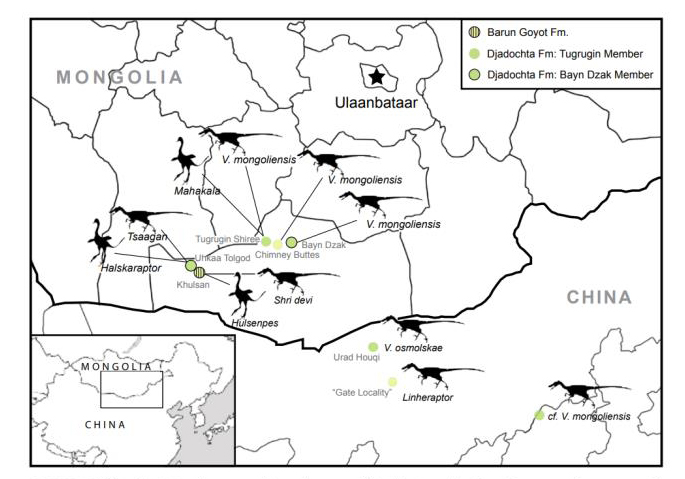
Different dromaeosaurids of Mongolia and Inner Mongolia
Map showing the geographical and temporal distribution of Late Cretaceous dromaeosaurids from Mongolia and Inner Mongolia. The different dromaeosaurid biota of the Barun Goyot Formation and the Tugrugin Member/Bayn Dzak Member of the Djadochta Formation.

When formally described (Turner et al), it was noted that the second toe, the one that possessed the enlarged sickle-like claw, was proportionately larger than that seen in similar sized dromaeosaurs such as Velociraptor mongoliensis. Shri devi could have had a slightly bigger second toe claw than Velociraptor.

Hind foot of Shri devi
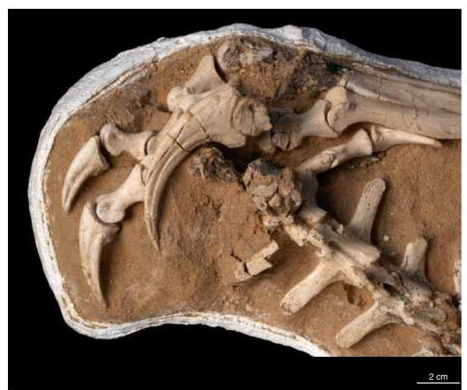
The foot of IGM 100/980 still in its burlap jacket (prior to final preparation). The large sickle claw on the second toe can be seen. Although approximately the same size as the closely related Velociraptor mongoliensis, the second toe claw of Shri devi seems to have been slightly larger. Note scale bar 2 cm.

Visit the award-winning Everything Dinosaur website: Everything Dinosaur.

30 04, 2021

Japan’s Second Hadrosaur (New Fossil Discovery)

By |2024-05-25T22:31:27+01:00April 30th, 2021|Categories: Adobe CS5, Dinosaur and Prehistoric Animal News Stories, Dinosaur Fans, Main Page, Palaeontological articles, Photos/Pictures of Fossils|0 Comments

Scientists from the Hokkaido University Museum in collaboration with colleagues from the Okayama University of Science have named a second hadrosaurid from the Late Cretaceous of Japan. Described from a partial skeleton, Yamatosaurus izanagii lived at the same time as the first duck-billed dinosaur named from Japan (Kamuysaurus japonicus), but these two dinosaurs probably did not co-exist, instead Kamuysaurus may have been restricted to more northern coastal environments whilst the newly described Yamatosaurus may have been confined to more southerly habitats.

Yamatosaurus izanagii Life Reconstruction with more Advance Forms of Duck-billed Dinosaur in the Background
Yamatosaurus izanagii life reconstruction (centre), with a Lambeosaurinae representative (right) and a representative of the Saurolophinae (left), the dentition and shoulder bones suggest that Yamatosaurus is a basal member of the Hadrosauridae family and its discovery supports the idea that hadrosaurs evolved in Asia. Picture credit: Masato Hattori.

Did the Hadrosauridae Originate in Asia or North America?

The researchers, who included Yoshitsugu Kobayashi, Ryuji Takasaki and Anthony R. Fiorillo (who wrote the scientific paper describing Kamuysaurus in 2019), plus Katsuhiro Kubota (Hokkaido University Museum), conducted a phylogenetic analysis suggesting that Yamatosaurus was a primitive member of the hadrosaur family. Intriguingly, the team also undertook a biogeographical analysis (plotting age of ornithopod fossil finds against geographical location). They conclude that basal hadrosaurids were widely distributed in both Asia and Appalachia (the landmass representing eastern North America).

The CollectA Kamjysaurus (lateral view).
Individual scales on the flanks and along the tail can be made out and the skin folds add to the realism of the figure. Picture credit: Everything Dinosaur.

Picture credit: Everything Dinosaur

The picture (above) shows a Kamuysaurus model that is in the CollectA Age of Dinosaurs Popular range.

To view this range: CollectA Age of Dinosaurs Popular Models.
In addition, the scientists postulate that the discovery of Yamatosaurus supports the theory that the sub-families of more derived duck-billed dinosaurs the Lambeosaurinae and the Saurolophinae originated in Asia and that towards the end of the Cretaceous, basal hadrosaurids such as Plesiohadros djadokhtaensis (Mongolia), Tanius sinensis (C‌hina) and Yamatosaurus (Japan) continued to thrive in eastern Asia but were extinct elsewhere.

Data Suggests an Asian Origin for Hadrosaurs
A biogeographical analysis indicates that the Hadrosauridae may have originated in Asia. The discovery of Yamatosaurus izanagii in Japan supports the idea of an Asian original for that line of ornithopods that evolved into hadrosaurs.

Discovered in Marine Sediments

Amateur fossil collector Mr. Shingo Kishimoto discovered the fossilised remains in 2004, whilst exploring exposures of the Kita-ama Formation on the island of Awaji (Hyogo Prefecture). The fossil material consists of a dentary (lower jawbone), along with the surangular, neck bones, bones from the tail, cervical ribs and a coracoid plus some isolated teeth.

Although hadrosaur fossils have been found in several locations in Japan (all four main islands – Hokkaido, Honshu, Shikoku, and Kyushu), they are, with the exception of the Kamuysaurus material, highly fragmentary consisting of teeth, portions of the limbs and vertebrae, this is only the second time that a new genus of duck-billed dinosaur has been erected from Japanese fossils.

The stratum from which the Yamatosaurus material was collected consists of marine mudstones of approximately the same age (early Maastrichtian), as the sediments in which Kamuysaurus was found.

Various views of the right dentary of Yamatosaurus
Right dentary of Yamatosaurus izanagii gen. et sp. nov. in lateral (a), medial (b), dorsal (c), ventral (d), and anterior (e) views.
Unique Traits and Basal Characteristics

Study of the nearly complete right dentary helped the researchers to erect a new, basal hadrosaur genus. Unlike other hadrosaurs Yamatosaurus had just one functional tooth in several battery positions and no branched ridges on the chewing surfaces. This suggests that Yamatosaurus evolved to feed differently compared to other duck-billed dinosaurs.
Furthermore, the coracoid (that with the scapula would have formed the shoulder joint), shows traits linked to the movement away from a bipedal gait to becoming quadrupedal. This bone shows transitional characteristics that in later, more derived hadrosaurs, were more fully developed permitting these animals to become facultative bipeds (adopting a quadrupedal gait but able to run on their hind legs if required to do so).

To read Everything Dinosaur’s article from 2019 about the formal description of the first hadrosaur named from Japan (Kamuysaurus japonicus): Japan’s Greatest Fossil Dinosaur Gets a Name.

The scientific paper: “A new basal hadrosaurid (Dinosauria: Ornithischia) from the latest Cretaceous Kita-ama Formation in Japan implies the origin of hadrosaurids” by Yoshitsugu Kobayashi, Ryuji Takasaki, Katsuhiro Kubota and Anthony R. Fiorillo published in Scientific Reports.

Visit the Everything Dinosaur website: Everything Dinosaur.

Go to Top