All about dinosaurs, fossils and prehistoric animals by Everything Dinosaur team members.

Fossil finds, new dinosaur discoveries, news and views from the world of palaeontology and other Earth sciences.

8 12, 2021

Spring/Summer End to the Reign of the Dinosaurs

By |2024-09-15T20:01:32+01:00December 8th, 2021|Categories: Dinosaur and Prehistoric Animal News Stories, Dinosaur Fans, Main Page, Palaeontological articles|0 Comments

A team of international researchers including scientists from the University of Manchester have published new research on the extinction of the dinosaurs. The study of Hell Creek Formation fossils suggests that the mass extinction event that marked the end of the Mesozoic some 66 million years ago took place in the spring/summer.

To clarify this, the event took place in the spring/summer season of the Northern Hemisphere. This newly published study in “Scientific Reports” supports earlier work that examined the preserved remains of water plants which also concluded a spring/summer time impact of the extra-terrestrial bolide that led to the extinction of about 75% of life on Earth.

Spring might be associated renewal and new life, but this catastrophic event led to the demise of the dinosaurs, the pterosaurs and most of the marine reptiles.

The end of the non-avian dinosaurs.

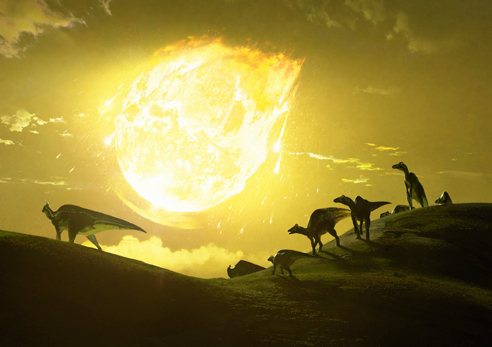
An artist’s impression of the bolide about to impact with the Gulf of Mexico 66 million years ago. Picture credit: Chase Stone.

Hell Creek Formation Fossils

The team led by University of Manchester PhD student Robert DePalma examined the Tanis research site in North Dakota, (USA). The Tanis site records the tumultuous impact event on a river system, it has preserved evidence of the scale of the catastrophe within the first few hours of the event. It provides a testament to the immense shockwaves that rocketed around the planet. The Tanis site is part of the famous Hell Creek Formation and it is regarded as one of the most highly detailed Cretaceous-Palaeogene (KPg) boundary sites in the world.

To read an earlier post from Everything Dinosaur about documenting the Tanis lagerstätte: Amazing Fossils Depict End Cretaceous Mass Extinction Event.

Commenting on the research, Robert DePalma explained:

“This project has been a huge undertaking but well worth it. For so many years we’ve collected and processed the data, and now we have compelling evidence that changes how we think of the KPg event, but can simultaneously help us better prepare for future ecological and environmental hazards”.

Examining a Global Event and its Impact on One Locality

Extensive research has documented the catastrophic Chicxulub bolide impact that hit the Yucatan Peninsula (Mexico) 66 million years ago: Most Accurate Date for KPg Extinction Event Established. The impact resulted in the most famous extinction event in our planet’s history, dramatically changing life on Earth and allowing the ascent of the mammals and eventually our own species.

DePalma added:

“Extinction can mark the end of a dynasty, but we must not forget that our own species might not have evolved if it weren’t for the impact and the timing of events that saw the end of the dinosaurs”.

The research team used a variety of techniques and lines of enquiry to document some of the finer details of this cataclysmic event, such as when did the impact occur. Multiple lines of evidence were explored including radiometric dating, stratigraphy, fossilised remains of biological marker species, and a distinctive capping layer of iridium-rich clay.

Tanis Deposits

It had already been concluded that the Tanis deposits represented the results of the seismic shockwaves and the resulting densely packed tangle of plants, animals, trees, and impact ejecta has provided an unprecedented opportunity to refine details on the KPg event, the biota that succumbed to it and the environment in which they lived.

However, time of year plays an important role in many biological functions, for example, reproduction, feeding strategies, host-parasite interactions, seasonal dormancy and breeding patterns. It is hence no surprise that the time of year for a global-scale hazard can play a big role in how severely it affects ecosystems. The seasonal timing of the Chicxulub impact has therefore been a critical question for the story of this mass extinction event.

The Iridium Capping Layer at the Tanis Deposit (Hell Creek Formation)

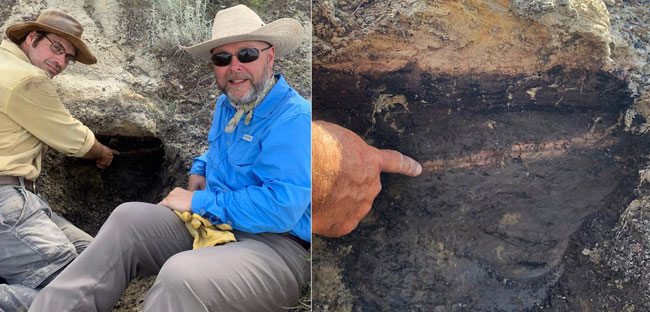
Robert DePalma (L) and Professor Phil Manning (R) at the Iridium-bearing KPg boundary clay layer capping Tanis. Picture credit: University of Manchester.

Growth Lines Examined

Growth lines examined in the exquisitely preserved bones of fossil fish confirm that all the fish died during the spring/summer growth season. This conclusion was also confirmed by isotopic analysis. The researchers used multiple additional lines of evidence to verify the isotopic data.

The examination of juvenile fossil fish, aided in part by cutting-edge Synchrotron-Rapid-Scanning X-Ray Fluorescence (SRS-XRF) carried out at the Stanford Synchrotron Radiation Lightsource (SSRL), provided a novel way of dating the seasonal variation observed in fossils from the deposit. By comparing the sizes of the youngest fish to the growth rates of analogous modern fish, the team predicted how long after hatching they were buried. Comparing this to known modern spawning seasons enabled the team to deduce the seasonal range that was represented by the deposit at the Tanis Lagerstätte. The bolide hit in the spring/summer seasons.

Co-author of the study, Loren Gurche (University of Kansas) commented:

“Animal behaviour can be a pretty powerful tool, so we overlapped even more evidence, this time of seasonal insect behaviour, such as leaf mining and mayfly activity. They all matched up…everything points to the fact that the impact happened during the northern hemisphere equivalent of spring to summer months”.

Hell Creek Fossils and the Remarkable Tanis Location

The researchers hope that their work in combination with other studies of the remarkable Tanis location will provide further insight into the KPg extinction event and facilitate a better understanding of the response of life to catastrophic global events.

Co-author of the paper, Professor Phil Manning (University of Manchester) added:

“The hindsight that the fossil record provides can yield critical data, which can be applied today, so that we might plan for tomorrow.”

Everything Dinosaur acknowledges the assistance of a press release from the University of Manchester in the compilation of this article.

The scientific paper: “Seasonal calibration of the end-cretaceous Chicxulub impact event” by Robert A. DePalma, Anton A. Oleinik, Loren P. Gurche, David A. Burnham, Jeremy J. Klingler, Curtis J. McKinney, Frederick P. Cichocki, Peter L. Larson, Victoria M. Egerton, Roy A. Wogelius, Nicholas P. Edwards, Uwe Bergmann and Phillip L. Manning published in Scientific Reports.

Visit the award-winning Everything Dinosaur website: The Everything Dinosaur Website.

3 12, 2021

Fantastic Festive Theropod Gift Ideas

By |2024-09-15T18:40:52+01:00December 3rd, 2021|Categories: Dinosaur and Prehistoric Animal News Stories, Dinosaur Fans, Educational Activities, Main Page|0 Comments

Searching for an unusual festive gift for a dinosaur fanatic can be a bit of a challenge. However, those hard-working and dedicated staff at Wollaton Hall, currently curating the Titus the T. rex is King exhibition, have it all in hand.  Make shopping for the festive season easier with a theropod dinosaur inspired gift idea.

If you are looking for new and exciting stocking filler present ideas for dinosaur fans of all ages, look no further with Titus T. rex is King unique Christmas gift vouchers and official merchandise.

Titus the T. rex Christmas gift experience

For a limited period (November until 24th December), exclusive festive-themed ticket vouchers will be available to purchase from the Wollaton Hall website. The opportunity to see a fossils of a real T. rex exhibited in England for the first time in over 100 years. Picture credit: Wollaton Hall.

For Dinosaur Fans of All Ages

This festive season, give a gift like no other with a truly unique experience to visit the first real Tyrannosaurus rex to be exhibited in England for over a hundred years.

For a limited period up until, Friday 24th December – exclusive festive-themed ticket vouchers will be available to purchase from the Wollaton Hall website. To ensure delivery in time for Christmas, the last chance to purchase the vouchers will be Sunday December 12th.

Visit the Wollaton Hall website to learn more about the Christmas 2021 offers: Visit Wollaton Hall website.

A range of special merchandise developed to accompany the exhibition is also available, including a limited-edition guidebook which provides a comprehensive overview of the discovery of Titus, the on-going research into the specimen and gives a glimpse of life 66 million years ago in the Hell Creek of Montana. There are plenty of stocking fillers including pens, bags, t-shirts and a limited-edition hardback companion guide – all ideal for dinosaur lovers of all ages.

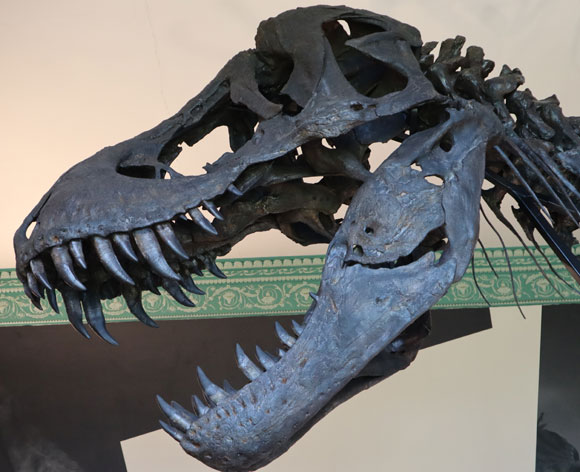
Titus the T. rex Skull and Jaws. Dinosaur extinction.

The skull of the T. rex exhibit on display at Wollaton Hall until August 2022. Picture credit: Everything Dinosaur.

Picture credit: Everything Dinosaur

The Titus: T. rex is King exhibition at Wollaton Hall Natural History Museum (Nottingham), which runs until August 2022, is a once in a lifetime experience and the perfect gift for friends and family of all ages. This is an exciting opportunity to see an amazing theropod dinosaur exhibit.

General tickets for TITUS T. REX IS KING are on sale now, set at £12 for an adult, £8 for a child (under 16 years), students and concessions, £32 for a family ticket (two adults and two children under 16 years) and under 3s and carers have no entry fees to pay. Excludes booking fee.

Please note: this exhibition has now closed.

The award-winning Everything Dinosaur website: Dinosaur Toys and Gifts.

2 12, 2021

Sizing Up Tethyshadros Thanks to New Research

By |2024-03-10T12:00:03+00:00December 2nd, 2021|Categories: Adobe CS5, Dinosaur and Prehistoric Animal News Stories, Dinosaur Fans, Main Page, Photos/Pictures of Fossils|0 Comments

Tethyshadros (T. insularis), which was formally named and described in 2009 from a superbly preserved fossil specimen discovered in a limestone quarry near to the village of Villaggio del Pescatore (Italy), had been thought to represent a dwarf hadrosaur. However, newly published research suggests that this Late Cretaceous dinosaur was not diminutive. Its body-size fits with the range in body sizes seen in other non-hadrosaurid Eurasian hadrosauroids.

The holotype specimen SC 57021 nicknamed “Antonio” represents a sub-adult. Writing in the academic journal “Scientific Reports”, researchers describe a second, much larger specimen SC 57247, which was discovered when “Antonio” was been excavated. The larger specimen given the moniker “Bruno” is much bigger and the original hypothesis that this taxon was a dwarf form is refuted in this new study.

Tethyshadros study.
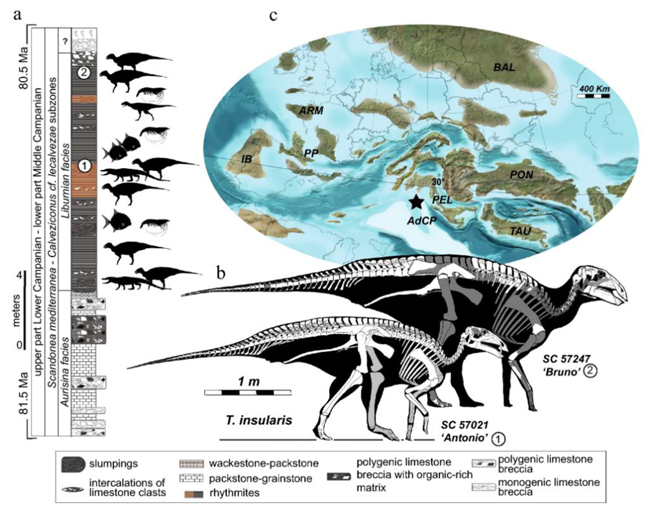
Diagram showing the stratigraphy of the site and the approximate placement of dinosaur and other fossil finds at the quarry (a) with a comparison of the holotype “Antonio” now regarded as sub-adult and the larger, much more mature specimen “Bruno” (b). Map of Europe in the Campanian showing the location of the island where Tethyshadros lived, the black star indicates the position (c). Picture credit: Chiarenza et al

Insular Dwarfism

During the Late Cretaceous much of Europe was covered by sea. There were numerous islands and these fragmented landmasses were populated by dinosaurs, many of which were dwarf forms when compared with closely related genera known from other continents. This was accepted as fossil evidence for the “island rule”, a theory, famously postulated by the 20th Century polymath Baron Franz Nopcsa von Felső-Szilvás. He proposed that the limited resources such as food, water and space on islands would result in a reduction of the size of animals that lived there. These island dwelling populations would become smaller over many generations when compared to their continental counterparts. Nopcsa referred to this idea as “insular dwarfism”.

The palaeo-Mediterranean region is best represented by the Villaggio del Pescatore quarry as it preserves a record of the fauna to be found on one of these islands. In this new research, this location is critically re-evaluated as early Campanian in age. This is significant, as it means that Tethyshadros lived prior to the final fragmentation stages of the European Archipelago. Tethyshadros lived prior to the emergence of the dwarf European taxa such as those animals associated with Hațeg Island which is geologically younger (Maastrichtian faunal stage of the Late Cretaceous).

Tethyshadros Fossils
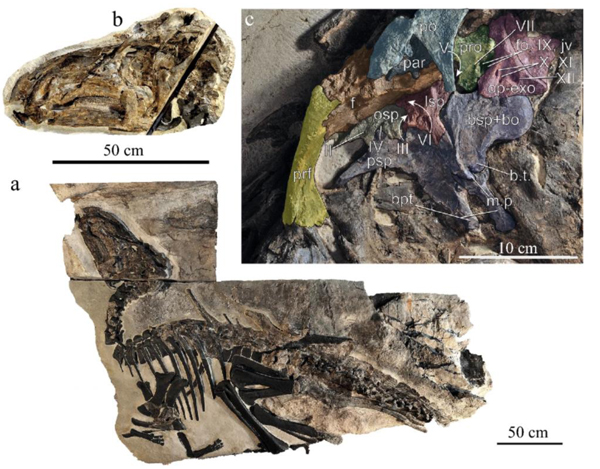
The new skeleton of Tethyshadros insularis “Bruno” (a) preserving details of its cranial anatomy such as the nearly complete skull (b) exposing its braincase (c) adding important information for the anatomy and systematic of this taxon. Elements in black are reconstructed. Picture credit: Chiarenza et al.

Examination of the bones of “Bruno” (histological study), confirms that these dinosaurs were bigger than previously thought. The research team, which included Alfio Alessandro Chiarenza (Universidade de Vigo, Spain) and Matteo Fabbri (Field Museum of Natural History, Chicago, USA), conducted a phylogenetic analysis examining the body size of Tethyshadros compared to related species. They discovered that the body size of T. insularis is within the range of the body sizes of other non-hadrosaurid Eurasian hadrosauroids

Tethyshadros was not a diminutive form, it was not a “pygmy” dinosaur. Team members at Everything Dinosaur have updated their Tethyshadros fact sheet which is supplied with sales of Tethyshadros figures.

Although “Antonio” and “Bruno” perhaps represent the most complete and best preserved of all the European dinosaur fossils discovered to date, Tethyshadros does not feature in many model ranges. However, a pair of Tethyshadros figures was added to the Wild Past series last year (2021).

To view the Wild Past model range: Wild Past Prehistoric Animal Models.

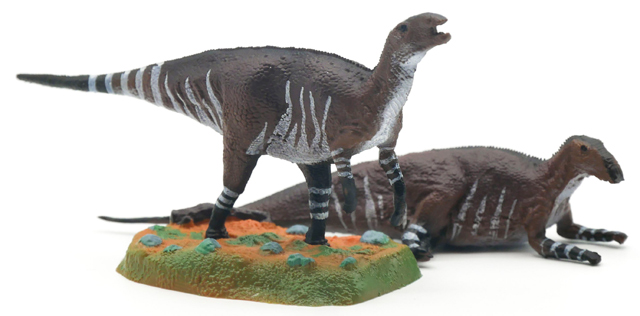
Wild Past Tethyshadros dinosaur models
The Wild Past Tethyshadros dinosaur models. Everything Dinosaur’s free fact sheet that is sent out with these models has been updated after the publication of the new T. insularis research.

The scientific paper: “An Italian dinosaur Lagerstätte reveals the tempo and mode of hadrosauriform body size evolution” by Alfio Alessandro Chiarenza, Matteo Fabbri, Lorenzo Consorti, Marco Muscioni, David C. Evans, Juan L. Cantalapiedra and Federico Fanti published in Scientific Reports.

1 12, 2021

New Armoured Dinosaur from Chile

By |2024-08-27T07:34:50+01:00December 1st, 2021|Categories: Adobe CS5, Dinosaur and Prehistoric Animal News Stories, Dinosaur Fans, Main Page, Palaeontological articles, Photos/Pictures of Fossils|0 Comments

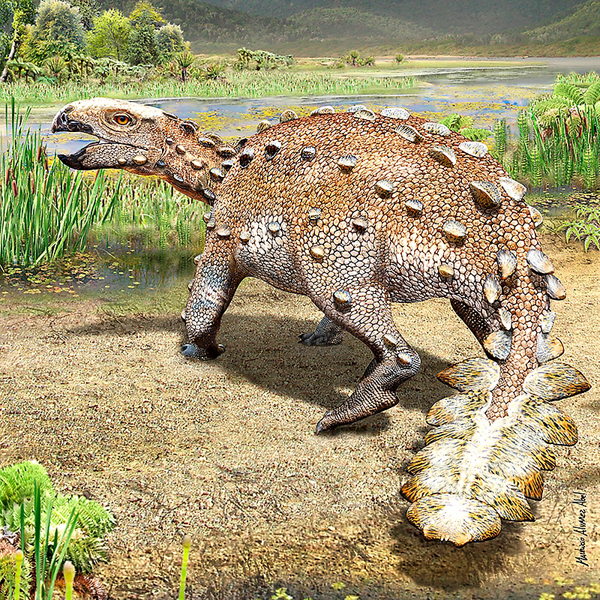
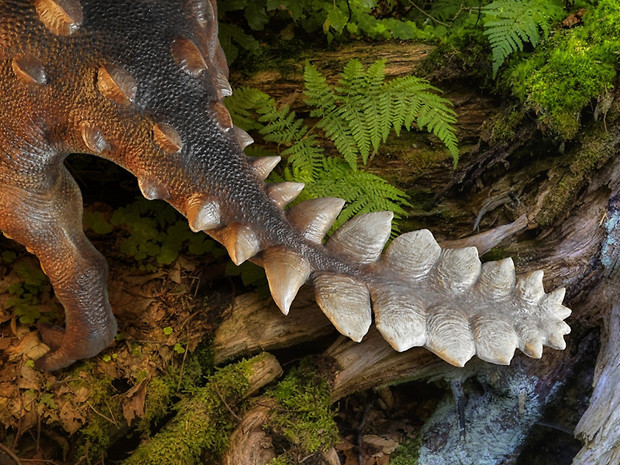
Scientists writing in the journal “Nature” have announced the discovery of a new species of Late Cretaceous ankylosaur from southernmost Chile. The dinosaur named Stegouros elengassen evolved a large tail weapon, unlike any other tail weapon known in the Dinosauria. Stegouros had a flat, frond-like structure formed by seven pairs of laterally projecting osteoderms. This formidable tail weapon superficially resembles a macuahuitl, a frightening war club used by Aztec warriors.

Stegouros life reconstruction

A life reconstruction of the newly described Gondwana ankylosaur Stegouros elengassen. Picture credit: Mauricio Álvarez.

Picture credit: Mauricio Álvarez

A Combination of Stegosaur and Ankylosaur Anatomical Characteristics

The researchers from the University of Chile (Universidad de Chile) in Santiago report on an articulated, nearly complete fossil specimen representing a single animal that was excavated by a field team in February 2018 from sediments relating to the Dorotea Formation in the province of Ultima Esperanza in southern Chile. Stegouros was very small for an ankylosaur, measuring around two metres in length and weighing approximately 100 kilograms.

It shows ankylosaurian cranial characters, but a largely ancestral postcranial skeleton, with some stegosaur-like characters.

A phylogenetic analysis places Stegouros in the Ankylosauria and the research team postulate that it is closely related to other ankylosaurs known from southern Gondwana such as Kunbarrasaurus from Australia and Antarctopelta, fossils of which were found on James Ross Island off the Antarctic Peninsula.

Stegouros fossil excavation.

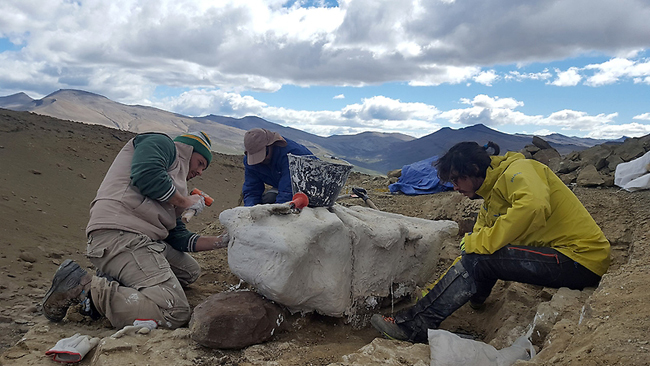
Field team members jacket the fossilised remains of Stegouros. Picture credit: Universidad de Chile.

Picture credit: Universidad de Chile

The Parankylosauria Clade

The researchers propose the establishment of a new clade of ankylosaurs – the Parankylosauria which consists of basal ankylosaurs that split from the main ankylosaurian lineage during the Middle Jurassic, although the fossil evidence for this is currently lacking with Stegouros, Antarctopelta and Kunbarrasaurus forming part of a ghost lineage of basal ankylosaurs with origins back in the mid-Jurassic.

Stegouros fossil remains.

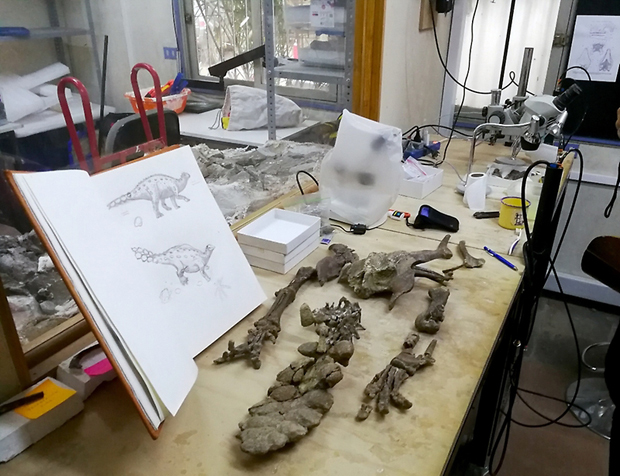
The posterior of the Stegouros specimen with the armoured tail clearly shown. Picture credit: Universidad de Chile.

A Transitional Ankylosaur

Commenting on the significance of this fossil discovery, lead author of the scientific paper, Sergio Soto, a researcher at the University of Chile stated that the fossilised remains of S. elengassen represent a “Rosetta Stone” for deciphering the fragmentary fossils of other ankylosaurs from southern Gondwana.

He added:

“Stegouros is an evolutionary link between ankylosaurs and other older lineages of armoured dinosaurs. Stegouros has only some of the features normally found in ankylosaurs, particularly the skull, but many others are absent. It also has some traits similar to stegosaurs, inherited from a common ancestor with them, but that other ankylosaurs lost in evolution.”

A close-up view of the armoured tail of Stegouros elengassen.

A close-up view of the armoured tail of Stegouros elengassen. The tail club served as a defensive structure perhaps used in intraspecific combat or to deter attacks from predators. Picture credit: Universidad de Chile.

Picture credit: Universidad de Chile

Stegouros roamed the Chilean Patagonia around 74 million years ago. The genus name translates as “roofed tail”, whilst the species name comes from a mythical armoured monster from the folklore of the indigenous Tehuelche people.

Note

CollectA introduced a 1:6 scale figure of this remarkable dinosaur in 2023.  Safari Ltd also added a Stegouros model to their range in 2024.

CollectA Deluxe 1:6 scale Stegouros elengassen dinosaur model

The CollectA Deluxe 1:6 scale Stegouros elengassen dinosaur model – due to be available mid 2023.

To view the range of CollectA Deluxe prehistoric animal figures available from Everything Dinosaur: CollectA Deluxe Prehistoric Life Models.

The scientific paper: “Bizarre tail weaponry in a transitional ankylosaur from subantarctic Chile” by Sergio Soto-Acuña, Alexander O. Vargas, Jonatan Kaluza, Marcelo A. Leppe, Joao F. Botelho, José Palma-Liberona, Carolina Simon-Gutstein, Roy A. Fernández, Héctor Ortiz, Verónica Milla, Bárbara Aravena, Leslie M. E. Manríquez, Jhonatan Alarcón-Muñoz, Juan Pablo Pino, Cristine Trevisan, Héctor Mansilla, Luis Felipe Hinojosa, Vicente Muñoz-Walther and David Rubilar-Rogers published in the journal Nature.

The Everything Dinosaur website: Dinosaur Toys and Models,

30 11, 2021

Effigia – A Triassic Browser According to New Research

By |2024-08-26T20:22:54+01:00November 30th, 2021|Categories: Dinosaur and Prehistoric Animal News Stories, Dinosaur Fans, Main Page, Palaeontological articles|0 Comments

A Triassic herbivore, known for its supposed similarities to a modern-day ostrich and ornithomimid dinosaurs has been revealed to have an entirely different approach to feeding than previously thought, according to newly published research. The new discovery reveals a much broader diversity of herbivore behaviour during the Triassic period than has been recognised to date.

Effigia life reconstruction

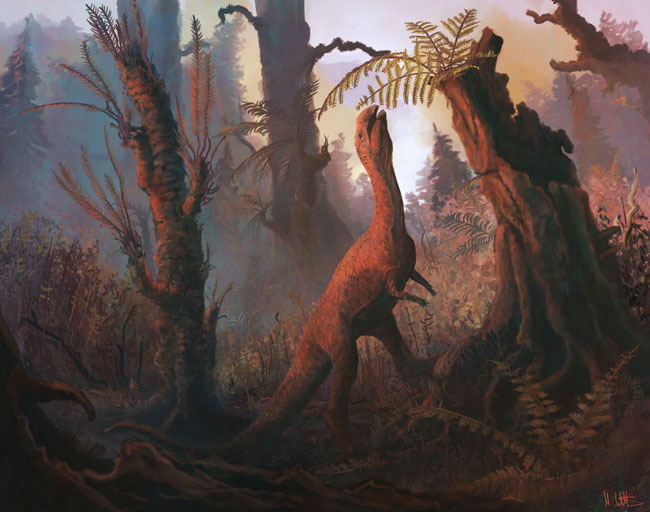
Effigia life reconstruction. New research has clarified the mode of feeding for this Late Triassic archosaur. It was probably a browser. Picture credit: Mark Witton.

Picture credit: Mark Witton

Effigia okeeffeae

Formally named and described in 2006 (Nesbitt and Norell), although fossils of this little archosaur on the crocodilian lineage of the Archosauria family tree were first found in the 1940s, Effigia (E. okeeffeae) roamed New Mexico around 205 million years ago.

Fossil remains had been relatively poorly preserved and the skull, in particular, was quite badly deformed, making accurate reconstruction challenging. Early analysis of the specimen concluded that it belonged to the group of reptiles that includes crocodilians and birds and which started to flourish in the Triassic period. Although more closely related to crocodilians, Effigia’s lightweight body, elongated neck, large eyes and beak shared many similarities with a modern-day ostrich, leading researchers to believe the animal fed by pecking plant material from the ground.

A new study of the fossil material, undertaken by experts at the University of Birmingham, has revealed this animal was probably an entirely different type of herbivore. The research, carried out in partnership with experts at the University of Bristol, University College London, University of York, Virginia Tech and the Natural History Museum in London, has been published in the academic journal “The Anatomical Record”.

The researchers examined CT scans of Effigia’s skull which permitted a much more accurate and three-dimensional reconstruction of the animal. This included new information about the morphology of the cranium, such as a more rounded, bulbous brain cavity and curved upper and lower jaws. Unlike the bill of an ostrich, which is more rounded, Effigia’s bill is concave with jaws that open and close a bit like a pair of shears.

Examining Different Forces on the Skull

The team used this information to model the effects of different forces acting on the skull, including what happens when the animal pecks at the ground. By modelling the forces the skull would need to withstand in order to feed by pecking, the researchers calculated that Effigia’s skull would probably have shattered. Instead, they suggest, the animal probably used its jaws to snip off and nibble pieces of soft plant material such as young shoots, or ferns. Effigia was likely to have been a selective browser.

Commenting on the significance of the research into the feeding habits of this Late Triassic archosaur, an animal that when first discovered was thought to be a dinosaur, lead researcher Dr Jordan Bestwick (University of Birmingham), stated:

“The herbivores we already recognise in the Triassic period fed either by digging for roots, such as the pig-like aetosaurs, or reaching for leaves high up in the treetops, like the long-necked sauropods. These two-legged browsers with a weak bite are unique to this period and show a previously unrecognised diversity among the herbivores of this period.”

Everything Dinosaur acknowledges the assistance of a media release from the University of Birmingham in the compilation of this article.

The scientific paper: “Cranial functional morphology of the pseudosuchian Effigia and implications for its ecological role in the Triassic” by Jordan Bestwick, Andrew S. Jones, Sterling J. Nesbitt, Stephan Lautenschlager, Emily J. Rayfield, Andrew R. Cuff, David J. Button, Paul M. Barrett, Laura B. Porro, Richard J. Butler published in The Anatomical Record.

The Everything Dinosaur website: Dinosaur Models and Toys.

24 11, 2021

Pelecanimimus Under the Spotlight

By |2024-08-26T17:48:20+01:00November 24th, 2021|Categories: Adobe CS5, Dinosaur and Prehistoric Animal News Stories, Dinosaur Fans, Main Page, Palaeontological articles, Photos/Pictures of Fossils|0 Comments

Known from a single specimen discovered in Spain back in 1993 Pelecanimimus (P. polyodon) from the Las Hoyas lagerstätte was the first unambiguous ornithomimosaur described from Europe. Although the scientific paper erecting the genus was published in 1994, no detailed examination of the holotype fossil material (LH 7777) had been undertaken.

A re-examination of the holotype fossil has been carried out by a team of international scientists, which included Francisco Ortega, one of the authors of the original scientific paper describing this 2-metre-long theropod. They conclude that Pelecanimimus was remarkably bird-like although as a member of the Ornithomimosauria it was not that closely related to the dinosaur lineage that led to the evolution of the birds.

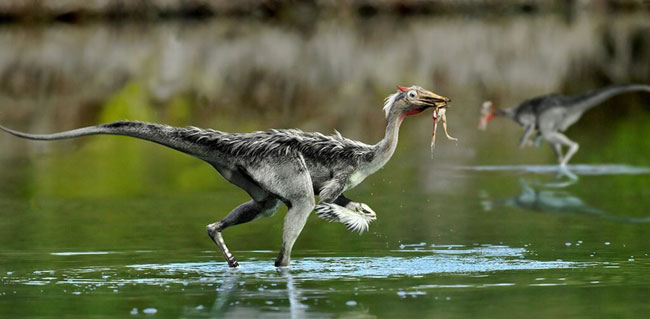
A life reconstruction of Pelecanimimus.
Pelecanimimus had more than 200 small teeth it its long narrow jaws. Palaeontologists believe that this small theropod filled an ecological niche similar to modern herons. It waded in the shallows catching fish and small amphibians. Picture credit: José Antonio Peñas Artero.

An Ossified Sternum

Pelecanimimus when it was named, was the only ornithomimosaur that had a preserved ossified sternum. The sternum is not usually preserved in theropods, it has been suggested that this part of the skeleton was not ossified and therefore it did not fossilise well, or perhaps the absence of this structure was due to preservational bias. The distance observed between the coracoids in articulated theropod specimens led to many palaeontologists inferring its presence. In this new paper, the researchers examined the shape of the sternum and concluded that its morphology was similar to the sternums of dinosaurs more closely related to birds such as Velociraptor and Oviraptor (the Maniraptora clade).

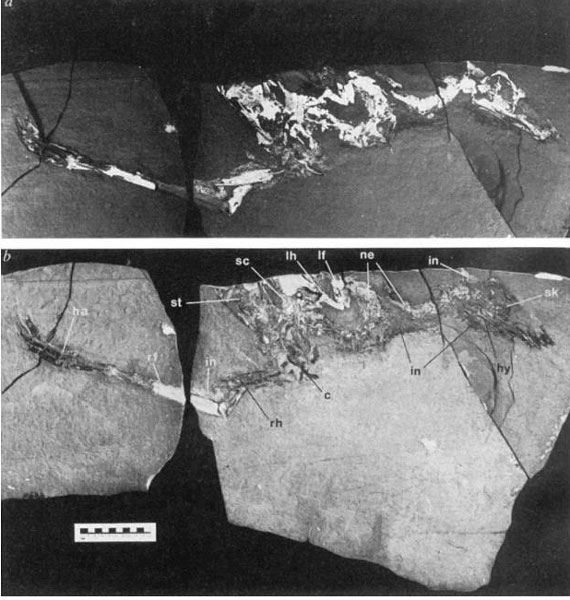
Pelecanimimus holotype fossil material
Pelecanimimus polyodon holotype (LH 7777) viewed under (a) ultraviolet light and (b) normal light. The slabs containing the skull and the manus (hand) have been prepared whilst the central slab with the body had yet to be fully cleaned and prepared for study when this dinosaur was named. Scale bar in cm. Picture credit: Pérez-Moreno et al.

Pelecanimimus Breathed Like a Bird

Furthermore, the research team found evidence of the presence of uncinate processes. These small, hook-shaped bones are linked to the ribs and are also present in extant and extinct birds. Pelecanimimus is the only known representative of the Ornithomimosauria with these structures and this is the first time that uncinate processes have been found in a non-maniraptoran theropod. If maniraptorans evolved these structures, along with the distantly related Pelecanimimus, this suggests convergent evolution.

In birds, uncinate processes function to increase the mechanical advantage for movements of the ribs and sternum during respiration. They make breathing more efficient. In summary, the research team suggest Pelecanimimus, breathed like a modern bird.

Elena Cuesta, the lead author of the study from the Fukui Prefectural University, Japan explained:

“The fact that Pelecanimimus preserved these processes suggests that it also had a bird-like breathing mechanism. Apparently, the origin of such avian-like features is older and more widespread than thought. However, the evolutionary history of both the ossified sternum and uncinate processes is still unclear. Nevertheless, their detection in Pelecanimimus confirms that these elements were present in Ornithomimosauria as well as in other dinosaurs.”

Pelecanimimus illustration.
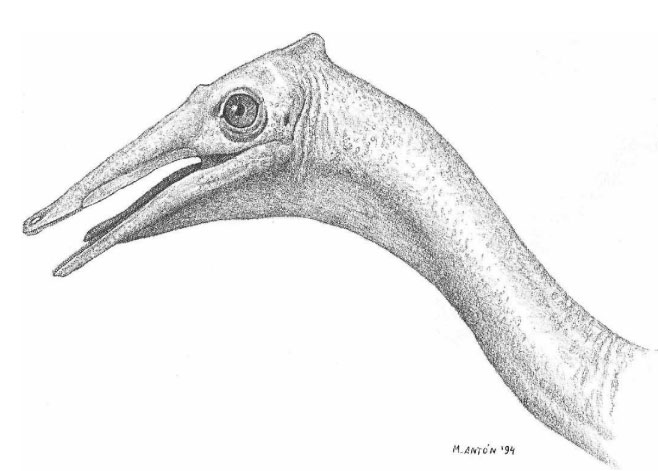
Pelecanimimus drawing of the head, showing the small head crest and the throat pouch. Integumentary impressions resembled the gular pouch of a pelican. It was this feature that inspired this dinosaur’s name. Picture credit: M. Antón.

Distinctive Features on the Hands

The joint Japanese/Spanish research team also discovered distinctive features on the hands. The manus of Pelecanimimus has conspicuously elongated metacarpals, particularly metacarpal I and lengthened distal phalanges, a feature also found in some later, more derived ornithomimosaur species. The authors of the study conclude that these anatomical features require the erection of a new clade, the Macrocheiriformes. This clade is defined as including Pelecanimimus and more derived ornithomimosaurs. The term Macrocheiriformes, means “forms with large hands.”

The scientific paper: “Pelecanimimus (Theropoda: Ornithomimosauria) postcranial anatomy and the evolution of the specialized manus in Ornithomimosaurs and sternum in maniraptoriforms” by Elena Cuesta, Daniel Vidal, Francisco Ortega, Masateru Shibata and José L Sanz published in the Zoological Journal of the Linnean Society.

23 11, 2021

Appalachia Gets a New Dinosaur

By |2023-07-15T11:41:30+01:00November 23rd, 2021|Categories: Adobe CS5, Dinosaur and Prehistoric Animal News Stories, Dinosaur Fans, Main Page, Palaeontological articles, Photos/Pictures of Fossils|0 Comments

A new dinosaur from Appalachia – Parrosaurus missouriensis.

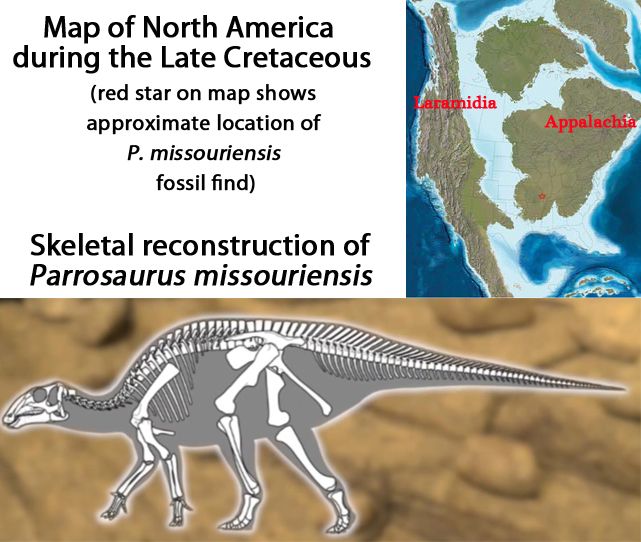
For much of the Cretaceous the North American landmass was effectively divided into two, by a shallow sea (Western Interior Seaway). At its greatest extent it was around 1,000 kilometres (600 miles) wide, the long, narrow landmass that represented the western part of North America is known as Laramidia and palaeontologists have amassed a huge amount of data about the abundant dinosaurs that roamed these ancient shores. The eastern landmass, Appalachia, stretched from Newfoundland in the north, to the mid-west American states, but in comparison little is known about the Appalachian dinosaur fauna.

A new species of duck-billed dinosaur has been added to the Appalachian biota, named Parrosaurus missouriensis and as the species epithet suggests, this Late Cretaceous herbivore was found in Missouri.

Parrosaurus map and skeletal reconstruction
A skeletal reconstruction of Parrosaurus and a map showing North America in the Late Cretaceous. The red star shows the approximate location of the Missouri fossil find. Picture credit: Fox2 and Everything Dinosaur.

Very Rare Dinosaur Discovery

In contrast to the extensive, rapidly eroding “Badlands” of Montana, Wyoming and North/South Dakota, rocks of Cretaceous age from the ancient landmass of Appalachia are not exposed to any great extent in eastern North America. Dinosaur fossil bearing units are not being eroded, they remain buried under other strata and to add to this dilemma, much of the eastern part of the USA is conurbation. However, there are bright spots for palaeontologists looking for dinosaur bones.

Mines, eroding rivers and construction sites can all provide opportunities for fossil discoveries. Indeed, it was the digging of a well near to the village of Glen Allen in Bollinger County, south-eastern Missouri back in 1942 that led to the finding of several dinosaur bones, the first time such fossils had been reported from the “Show Me State”.

The caudal vertebrae that were excavated from the site were thought to represent a sauropod and it was scientifically described and named Neosaurus missouriensis in 1945 (Gilmore and Stewart). It was noted that the genus name was already occupied, Neosaurus having been erected in 1869 for a Palaeozoic synapsid from France, so the scientific name was changed to Parrosaurus missouriensis.

Duck-billed Dinosaur Fossils

Ironically, duck-billed dinosaur fossils had been found in North Carolina and the species Hypsibema crassicauda was erected in 1869, a review of the Glen Allen material (Baird and Horner), led to the erection of the species Hypsibema missouriensis as the Missouri fossils were confirmed to be hadrosaurid and showed similarities with the fossils that had been found in North Carolina.

More recent excavations carried out at the Glen Allen site, led by fossil expert Guy Darrough and with the support of the Field Museum of Chicago has led to the discovery of at least four individual hadrosaur specimens. The fossils found in close association in black clay represent three adults and juvenile.

The site has yielded other fascinating fossils, providing a glimpse into the fauna of Appalachia. For example, a scute (dermal armour) from a giant crocodilian has been found, fossils of turtles discovered and even the tooth of a tyrannosaur has been uncovered.

Parrosaurus missouriensis fossil material.
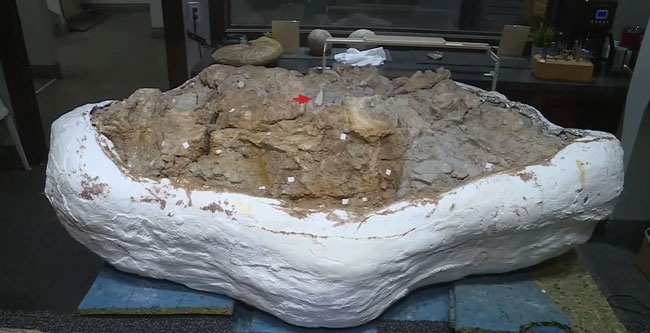
A Parrosaurus specimen in its protective burlap jacket. The broken tyrannosaur tooth found in close association with the hadrosaur bones is shown by the red arrow. Picture credit: Fox2.

Parrosaurus missouriensis

The extensive fossil material found as led to the establishment of a new species Parrosaurus missouriensis. This very notable fossil location might just prove to be a headache for the State administration, as in 2004 these fossils had been declared Missouri’s official State dinosaur when they were assigned to Hypsibema missouriensis.

Parrosaurus missouriensis life reconstruction
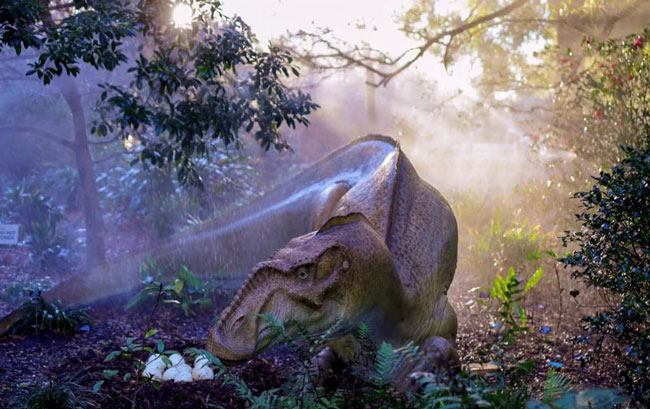
Parrosaurus missouriensis life reconstruction. Picture credit: Danny Morrison for the Saint Genevieve Museum Learning Centre.

The story has been widely reported and team members at Everything Dinosaur are optimistic that once the fossil material has been studied in detail and more of the specimens cleaned and prepared, then new discoveries will be made.

20 11, 2021

Toothless Theropod Dinosaur from Brazil

By |2024-08-26T17:32:06+01:00November 20th, 2021|Categories: Adobe CS5, Dinosaur and Prehistoric Animal News Stories, Main Page, Palaeontological articles, Photos/Pictures of Fossils|0 Comments

Scientists writing in the academic journal “Nature” have described a new species of dinosaur. It has been classified as a theropod and a member of the Ceratosauria, however, unlike the vast majority of the Theropoda it had no teeth. The dinosaur has been named Berthasaura leopoldinae and it roamed southern Brazil during the Cretaceous.

This little dinosaur lived in the same oasis environment as the recently described pterosaurs Keresdrakon vilsoni *and Caiuajara dobruskii ** measuring around a metre in length Berthasaura was no giant, but its fossilised remains, which were excavated from an outcrop overlooking a country road (Cruzeiro do Oeste Municipality, Paraná State), represent the most complete non-avian theropod known from the Cretaceous of Brazil.

The discovery of this little theropod dinosaur expands our knowledge of the palaeofauna associated with the Goio Êre Formation. It demonstrates that members of the Ceratosauria were capable of evolving different feeding strategies away from meat-eating. Although the research team cannot confirm the diet of Berthasaura they postulate that it could have been herbivorous or perhaps an omnivore.

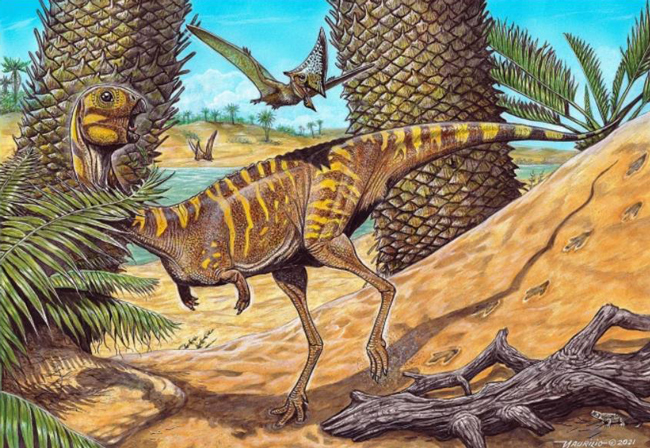
Berthasaura life reconstruction
A life reconstruction of the newly described toothless theropod Berthasaura leopoldinae with a pair of Caiuajara pterosaurs flying nearby. The strata in which the fossils were found represent an oasis environment surrounded by a desert. Picture credit: Maurílio Oliveira.

A Member of the Ceratosauria

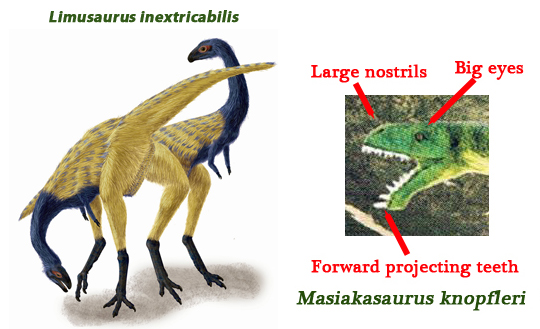
The first ceratosaurs (members of the Ceratosauria clade), probably evolved in the Late Triassic. This diverse theropod clade consists of three families. The Ceratosauridae and the Abelisauridae are mostly made up of mid-sized to large carnivores and they contain well-known dinosaurs such as Ceratosaurus (Ceratosauridae) and Carnotaurus, Rugops and Ekrixinatosaurus (abelisaurids). The third dinosaur family within the Ceratosauria are the poorly known Noasauridae. Noasaurids are generally much smaller and lighter

The largest known noasaurid taxon is Elaphrosaurus bambergi from the Late Jurassic of Tanzania, which may have been around six metres long. These theropods seemed to have occupied a variety of specialist niches in dinosaur-dominated ecosystems. For example, Masiakasaurus (M. knopfleri) from the Late Cretaceous of Madagascar had forward projecting teeth in its lower jaw, a possible adaptation to catching fish. In contrast, fossils of Limusaurus (L. inextricabilis) found in Upper Jurassic strata of north-eastern China, show that whilst juveniles had teeth, by the time these gracile theropods reached about three years of age they had lost all their teeth ***. Palaeontologists have postulated that adult Limusaurus were probably herbivorous whilst juveniles were most likely omnivores.

Examples of noasaurids.
Two noasaurids – Limusaurus (left) that lost all its teeth as it matured and Masiakasaurus which had forward projecting teeth in its lower jaw and is regarded as a piscivore. Picture credit: Portia Sloan and Everything Dinosaur.

Taking the Feminine Form for Saurus

The genus name honours Bertha Maria Júlia Lutz, who was a leading activist for women’s rights in Brazil, combined with saura, the feminine form of saurus from the Greek for lizard. The species epithet “leopoldinae” honours the first Brazilian empress, Maria Leopoldina who was instrumental in helping Brazil to become independent.

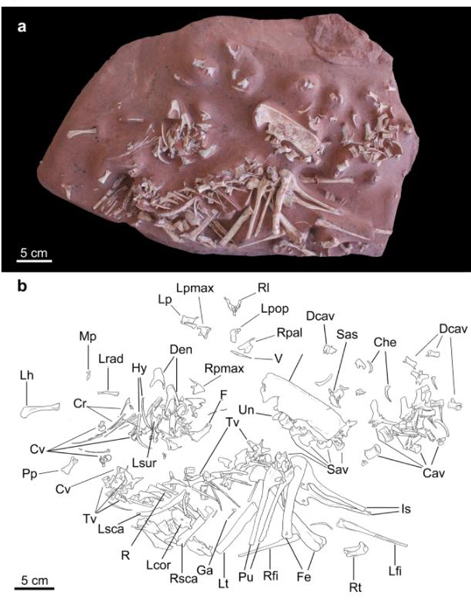
Berthasaura fossil and line drawing
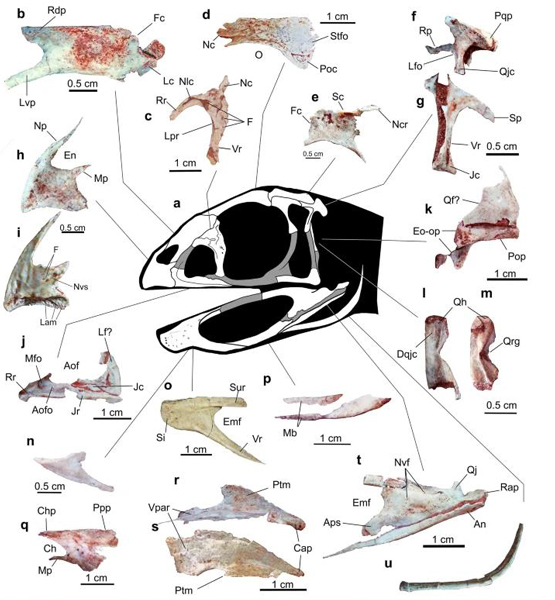
The holotype fossil of Berthasaura leopoldinae (MN 7821-V) which represents a disarticulated but nearly complete skeleton (A) and an interpretative line drawing (B). Picture credit: de Souza et al.

A Juvenile Theropod Dinosaur

Careful analysis of the fossilised bones indicated that the skeleton represents a juvenile. Skull bones and parts of the spine showed signs of not being fused and therefore, the research team, who were led by Geovane Alves de Souza (Universidade Federal do Rio de Janeiro), concluded that Berthasaura, in contrast to Limusaurus, probably did not have any teeth, even as a young animal.

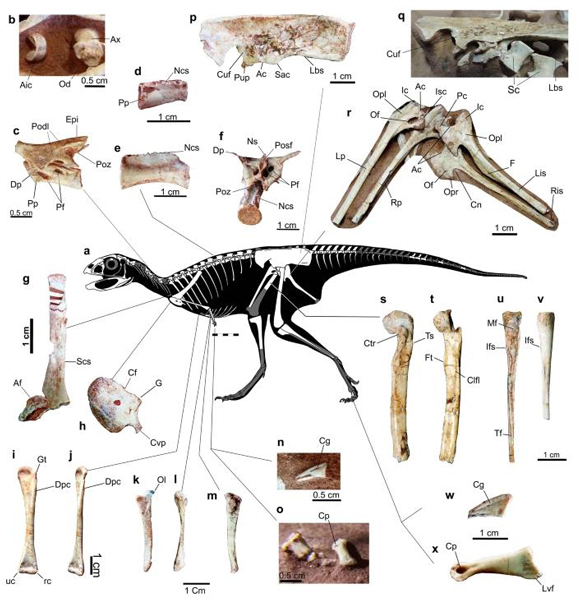
Examining the skeleton of Berthasaura.
Analysis of the fossil bones of Berthasaura. The fossil material represents a juvenile and is one of the most complete noasaurid skeletons described to date. Picture credit: de Souza et al.
Berthasaura skull fossils and interpretative line drawing.
An interpretative drawing of the skull of Berthasaura showing the placement of individual bones. Picture credit: de Souza et al.

A Basal Member of the Noasauridae

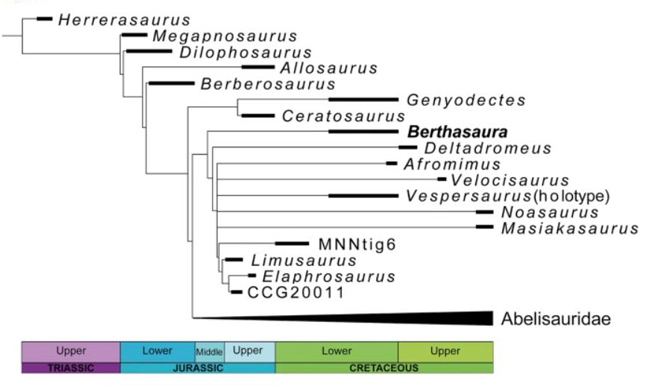
Taxonomic assessment of Berthasaura amongst the Noasauridae and within the wider Ceratosauria proved challenging for the research team. The lack of comparable noasaurid fossils limited the assessment that could be undertaken and it was difficult to conduct a phylogenetic assessment encompassing the Abelisauridae due to difficulties resolving taxonomic relationships between some poorly known abelisaurids. However, the scientists concluded that Berthasaura most likely represents a late, basal member of the Noasauridae and one that was not closely related to Limusaurus.

Phylogenetic relationship of Berthasaura leopoldinae.
Phylogenetic relationship of Berthasaura leopoldinae. Picture credit: de Souza et al.

To read Everything Dinosaur’s blog post about the discovery of Keresdrakon vilsoni * from 2019: New Brazilian Pterosaur Announced.

To read Everything Dinosaur’s blog post about Caiuajara dobruskii ** from 2014: New Species of Flying Reptile Identified from Pterosaur Graveyard.

Research that suggests Limusaurus lost its teeth as it grew up *** from 2016: Limusaurus – Dinosaur Species Lost its Teeth.

The scientific paper: “The first edentulous ceratosaur from South America” by Geovane Alves de Souza, Marina Bento Soares, Luiz Carlos Weinschütz, Everton Wilner, Ricardo Tadeu Lopes, Olga Maria Oliveira de Araújo and Alexander Wilhelm Armin Kellner published in Nature.

15 11, 2021

A New Species of Sauropodomorph Called Issi saaneq – “Cold Bone” from Greenland

By |2024-05-12T07:01:47+01:00November 15th, 2021|Categories: Adobe CS5, Dinosaur and Prehistoric Animal News Stories, Dinosaur Fans, Main Page, Palaeontological articles, Photos/Pictures of Fossils|0 Comments

This month has seen another new species of sauropodomorph named and described. Issi saaneq (pronounced is-y sa-ah-neq), roamed what is now eastern Greenland around 214 million years ago (Late Triassic), this new dinosaur has been named based on two fossil skulls believed to represent one juvenile and one older animal possibly a sub-adult. Ascribed to the Plateosauridae family and showing affinities to South American sauropodomorphs I. saaneq helps to extend our understanding of the evolution and development of these important early dinosaurs.

Computer generated models of skulls and a life reconstruction of Issi saaneq.
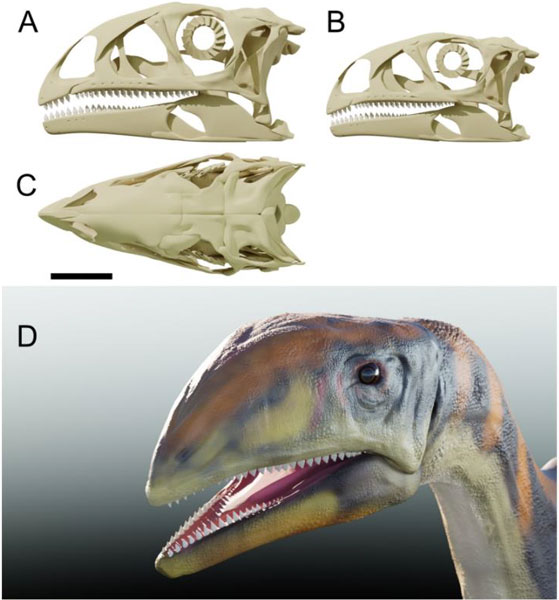
A image showing digital interpretative reconstruction of the skulls NHMD 164741 and NHMD 164758 and living representation of Issi saaneq. A digital interpretative reconstruction of the skull NHMD 164741 in left lateral view (A). Digital interpretative reconstruction of the smaller skull NHMD 164758 in left lateral view (B). Digital interpretative reconstruction of skull NHMD 164741 in dorsal view (C). Living representation of Issi saaneq (D). Scale bar = 50 mm.

Originally Assigned to Plateosaurus

The skull fossils were found in the early 1990s, during excavations of sediments representing lake shore deposits that make up part of the of the Malmros Klint Formation in Jameson Land, Greenland. The larger skull was found in 1991, the smaller skull, now believed to represent the same species was found subsequently along with numerous other fossils including skull material that has yet to be catalogued and described.

The two skulls (specimen numbers NHMD 164741 and NHMD 164758), are now part of the vertebrate fossil collection of the Natural History Museum of Denmark. Postcranial material was also found in association with the smaller skull (NHMD 164758) and this could have come from the same animal, but these bones have also not yet been examined in detail.

When first found, it was thought that these fossils were examples of Plateosaurus (P. engelhardt which is now regarded as nomen dubium with fossil material assigned to P. trossingensis). As several new sauropodomorphs had been described in recent years, the researchers were able to tap into the wealth of new fossil data and confidently assign the skulls to a new genus.

Commenting on the significance of the find, lead author of the scientific paper, published in the journal “Diversity”, Doctor Victor Beccari (Universidade Nova de Lisboa), stated:

“The anatomy of the two skulls is unique in many respects, for example in the shape and proportions of the bones. These specimens certainly belong to a new species.”

Photograph of the skulls NHMD 164741 and NHMD 164758
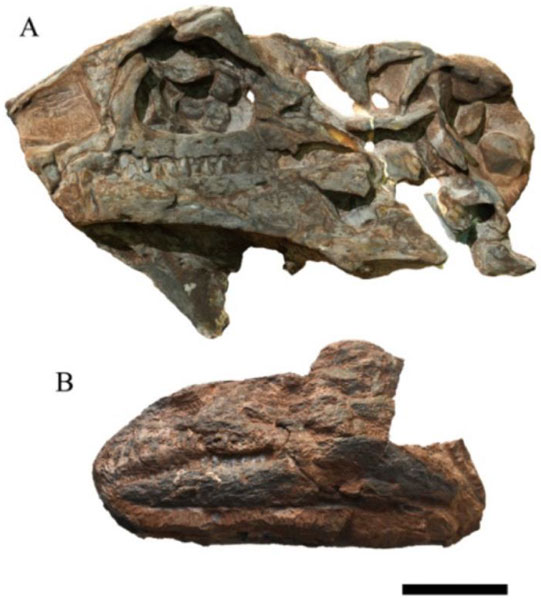
Photograph of the skulls NHMD 164741 and NHMD 164758 (A) NHMD 164741 in left lateral view and (B) NHMD 164758 in left lateral view. The smaller skull (NHMD 164758) represents a juvenile, whilst the larger skull (NHMD 164741) represents an older juvenile or a young adult. Picture credit: Beccari et al.

“Cold Bone” – Issi saaneq

Issi saaneq is the first non-avian dinosaur to be named from fossils found in Greenland. The name comes from the local Inuit language, with “issi” meaning cold and “saaneq” meaning bone. This is a reference to the harsh and very unpleasant weather conditions associated with the fossil site. The bones of this dinosaur were cold to the touch and the field team were often “frozen to the bone” as they worked in the extremely chilly conditions.

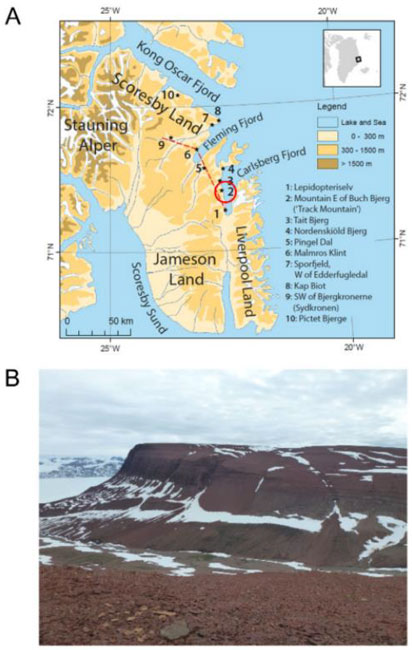
Jameson Land and the Issi saaneq fossil site
Location map of Jameson Land, central east Greenland (A), the Issi saaneq quarry is circled in red and indicated by the number 2. Photograph of the outcrop from which the fossil material was excavated (B). The conditions endured by the various field teams were extremely challenging and harsh.

Affinities with South American Sauropodomorphs as well as Plateosaurus

Phylogenetic assessment indicates that Issi saaneq has affinities to Brazilian plateosaurids such as Macrocollum (M. itaquii) and the European Plateosaurus, being recovered as the sister clade of Plateosaurus in this study. It is the northernmost record of a Late Triassic sauropodomorph.

To read Everything Dinosaur’s blog post about the naming and scientific description of Macrocollum itaquii: How Did Some Dinosaurs Get Long Necks?

The discovery of Issi saaneq expands the known geographical range of these dinosaurs and broadens our knowledge about the evolution of the Sauropodomorpha.

The scientific paper: “A New Sauropodomorph Dinosaur from the Late Triassic (Norian) of Jameson Land, Central East Greenland” by Victor Beccari, Octávio Mateus, Oliver Wings, Jesper Milàn and Lars B. Clemmensen published in Diversity.

8 11, 2021

Permian Beetles Provide Pointers to Remarkable Ecosystem Collapse

By |2024-08-26T15:56:32+01:00November 8th, 2021|Categories: Dinosaur and Prehistoric Animal News Stories, Dinosaur Fans, Main Page, Palaeontological articles, Photos/Pictures of Fossils|0 Comments

The COP26 conference continues to dominate the news. Countries are striving to find the commitments required to limit global warming to 1.5 degrees Celsius to mitigate the worst effects of global warming. Could the humble beetle provide a clue as to the consequences if the world’s leaders can’t find agreement?

A new study published in eLife this week, looked at beetle fossils, specifically those wood-eating (xylophagous) beetles, it seems the mass extinction event that took place around 252 million years ago devastated these insects. If the huge and diverse Coleoptera are not invulnerable to global climate change, then what chance does the last line of hominins have in the current climate crisis?

Permian beetle fossils and line drawings.
Examples of Permian beetles including fossilised wings and carapaces with (B and D) life reconstructions. Picture credit: Nanjing Institute of Geology and Palaeontology of the Chinese Academy of Sciences (NIGPAS).

The Mass Extinction Event at the End of the Permian

The end-Permian mass extinction event, led to the collapse of global marine and terrestrial ecosystems. It has been estimated that around 95 percent of all life on Earth died out. The ecological response of insects (Insecta), to this catastrophe is poorly understand. A team of scientists have reviewed the fossil record of wood-eating beetles associated with the Permian and Triassic and they have concluded that the collapse of forest ecosystems led to a dramatic decline in these beetles. Furthermore, xylophagous beetles may have been responsible for the decrease of oxygen concentrations in the Permian.

Dominated by Xylophagous Beetles

The fossil record may show some bias towards wood-eating beetles when compared to the preserved remains of other types of beetle with different diets, but in this new study the research team, which included scientists from Nanjing Institute of Geology and Palaeontology and Centre for Excellence in Life and Palaeoenvironment, the University of California and the London Natural History Museum, discovered that xylophagous beetles dominated the Coleoptera during the Early Permian.

Studying Permian Beetles

As different types of beetle evolved, their dominance declined until the end-Permian mass extinction event when the number of species collapsed. The lack of coal seams dating from around 252-247 million years ago, are a testament to the loss of forest habitats. New xylophagous beetles appeared widely in the early Middle Triassic, which is consistent with the restoration of forest ecosystems

Plotting the decline of wood-eating beetles.
Simplified phylogeny of Coleoptera (A) from the Early Permian to Middle Triassic. Thick lines indicate the known extent of the fossil record. The branches representing stem groups are shown in red. The ‘dead clade walking’ pattern is symbolised by the dashed line. Genus percentage of wood-eating groups from the Early Permian to Middle Triassic (B). Yellow graded band represents the “coal gap” a time when forest ecosystems collapsed. Picture credit: Zhao et al.

A Decrease in Atmospheric Oxygen

The concentration of oxygen in the atmosphere, peaked during the Carboniferous, but began to decline during the Permian. It is thought that the evolution of Permian terrestrial herbivores including wood-consuming beetles may have limited the transport and long-term burial of terrestrial organic compounds in marine sediments, resulting in less organic carbon burial and attendant declines in atmospheric oxygen.

Today, we are seeing a dramatic fall in the number of different types of insect. The loss of pollinators on world food supply has been well documented, however, xylophagous insects have been largely neglected in studies of the current extinction crisis. This research may help scientists to better understand future changes in insect diversity and abundance and the consequences of such developments as the world faces global environmental change.

Everything Dinosaur acknowledges the assistance of a media release from the Chinese Academy of Sciences in the compilation of this article.

The scientific paper: “Early evolution of beetles regulated by the end-Permian deforestation” by Xianye Zhao, Yilun Yu, Matthew E Clapham, Evgeny Yan, Jun Chen, Edmund A Jarzembowski, Xiangdong Zhao and Bo Wang published in eLife.

The Everything Dinosaur website: Prehistoric Animal Toys.

Go to Top