All about dinosaurs, fossils and prehistoric animals by Everything Dinosaur team members.

Fossil finds, new dinosaur discoveries, news and views from the world of palaeontology and other Earth sciences.

24 12, 2021

Red Spheres in Dinosaur Bone not Ancient Blood

By |2024-10-09T21:35:22+01:00December 24th, 2021|Categories: Adobe CS5, Dinosaur and Prehistoric Animal News Stories, Dinosaur Fans, Main Page, Palaeontological articles, Photos/Pictures of Fossils|0 Comments

Scientists from Virginia Tech and Des Moines University in the USA have challenged the idea that spheres identified under high magnification in thin sections of fossilised dinosaur bone are preserved fragments of dinosaur blood. The reddish coloured circular structures might not be remnants of blood cells, but instead they could be sediments that have been altered physically, chemically or via biological action to provide misleading data.

That is the conclusion made by the authors of a scientific paper published recently in the peer-reviewed, open-access journal PeerJ.

Has dinosaur blood been found?

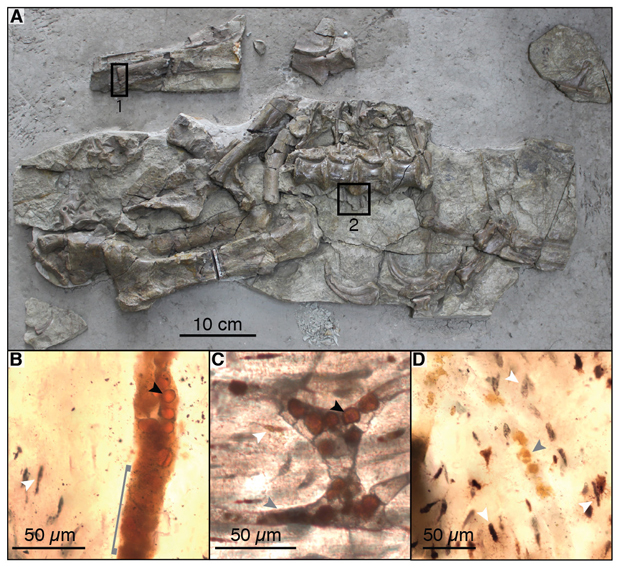
Photograph of sampled specimen (Beipiaosaurus inexpectus, IVPP V11559) (A) and transmitted light micrographs of representative thin sections (B–D). In the section images black arrows indicate spheres (putatively identified as red blood cells), white arrows indicate osteocyte lacunae and grey arrows indicate non-spherical vessel fills. The researchers suggest the spheres are not evidence of dinosaur blood. Picture credit: Korneisel et al.

Picture credit: Korneisel et al

Analysing the Holotype of Beipiaosaurus inexpectus

The researchers, who included Sterling J. Nesbitt (Department of Geosciences at Virginia Tech), analysed thin sections of bone from the holotype of the Chinese therizinosaur Beipiaosaurus inexpectus from the Jehol Lagerstätte. The fossil specimen (IVPP V11559) consists of both cranial and postcranial elements and it was found in sediments representing the Yixian Formation. This specimen was the subject of a paper earlier this year, remarkably when B. inexpectus was scientifically described only the skull elements were examined in detail. In October (2021), Everything Dinosaur published a blog post on the study of the postcranial material which provided more anatomical traits to help define this genus and clarify the evolution of the Therizinosauridae.

Our post can be found here: Beipiaosaurus Revisited.

In this study, the researchers employed a variety of sophisticated techniques including Ramon spectroscopy, X-ray spectrometry and Time of flight – secondary ion mass spectrometry to analyse thin sections of fossil bone from the Beipiaosaurus and compare them to similarly prepared thin sections of fossilised wood.

The team found that the bone had been dramatically altered by the fossilisation process (taphonomy). Vascular canals in the bone, once thought to contain preserved red blood cells, were filled with a mix of clay minerals and carbonaceous compounds. The spheres that were identified could not be analysed in isolation, but the researchers did not find any evidence of pyrite or haemoglobin fragments associated with a concentration of iron.

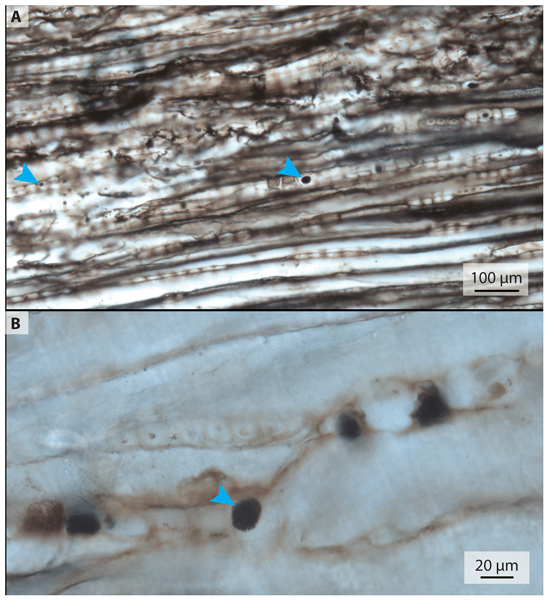
However, similar spheres were identified in the thin sections of fossilised wood which were found close to the Beipiaosaurus fossils and as such, had presumably been subjected to the same taphonomic processes.

Small spherical structures spotted in petrified wood

Transmitted light micrographs of fossil wood found near to the dinosaur fossil material seem to show similar, microscopic spherical structures. The blue arrows highlight small and large examples. At higher magnification (B) these spheres appear to consist of small crystals. Picture credit: Korneisel at al.

Picture credit: Korneisel et al

The researchers concluded that the reddish coloured spheres were not evidence of dinosaur blood, but more likely structures formed by diagenesis. Diagenesis is the process whereby sediments in sedimentary rocks are altered by the interaction of water, microbial activity or by physical and chemical processes.

This research suggests that further study of alleged red blood cells associated with fossil bone is required in order to confirm the assertions made in previous papers.

The scientific paper: “Putative fossil blood cells reinterpreted as diagenetic structures” by Dana E. Korneisel, Sterling J. Nesbitt, Sarah Werning and Shuhai Xiao published in PeerJ.

The award-winning Everything Dinosaur website: Dinosaur Models and Figures.

23 12, 2021

Largest-ever Millipede Fossil Found Described in New Paper

By |2024-10-09T21:29:27+01:00December 23rd, 2021|Categories: Dinosaur and Prehistoric Animal News Stories, Main Page, Palaeontological articles, Photos/Pictures of Fossils|0 Comments

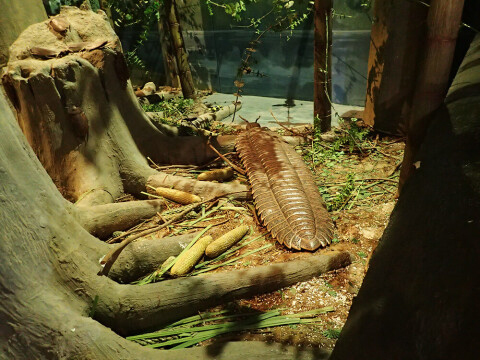
A recently described, fossilised partial exoskeleton of a giant millipede proves that some of these invertebrates matched the giant sea scorpions (eurypterids) in size. The fossil, discovered by chance at Howick Bay in Northumberland some 40 miles north of the city of Newcastle, back in January 2018, indicates that some terrestrial arthropods could have reached a length in excess of 2.6 metres.

The fossil has been identified as part of the moulted exoskeleton (an exuvium), of the colossal millipede Arthropleura, the preserved portion of the exoskeleton is around 75 cm in size, from this the total length of this huge arthropod is inferred. Intriguingly, the fossil was found in an ancient river channel, part of a delta that was surrounded by open woodland. Previously, it had been thought that Arthropleura inhabited swamps. This fossil discovery supports the hypothesis that Arthropleura preferred open, woody habitats.

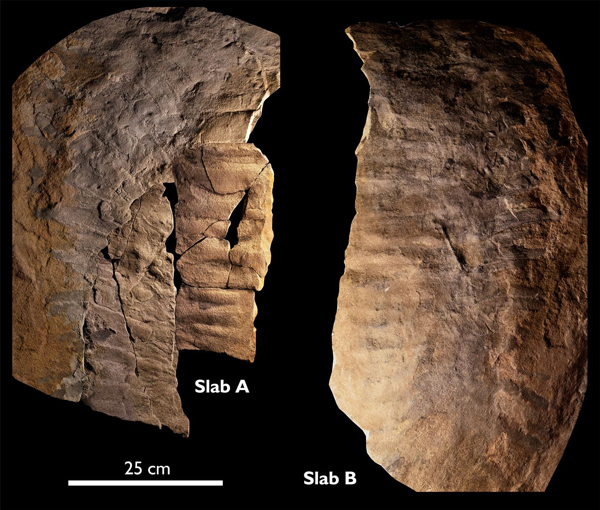
Arthropleura fossil from Northumberland

Specimen of partial remains of a giant Arthropleura (anterior 12–14 tergites) after excavation from the Serpukhovian Stainmore Formation, Howick Bay, Northumberland, England (CAMSM X.50355). Slab A and slab B are not true part and counterpart, but rather a split through the middle of a three-dimensional dorsal exoskeleton. Note scale bar = 25 cm. Picture credit: Davies et al.

Picture credit: Davies et al

A Chance Discovery

The fossil was discovered by chance. A large sandstone block (approximately 2 m × 3 m × 8 m) fell from the cliffs at Howick Bay. It cracked exposing the fossil and it was spotted by a former PhD student at the University of Cambridge who happened to be visiting the beach. As this area is a Site of Special Scientific Interest (SSSI) permission was sought from Natural England and the Howick Estate to extract the fossil and this work was undertaken in May 2018.

The block comes from the Stainmore Formation, which was laid down in the late Mississippian of the Carboniferous (Serpukhovian stage). The fossil is estimated to be around 323 million years old and it represents the earliest evidence for gigantism in Arthropleura. The specimen comes from the same regional sedimentary succession as the ichnotaxon Diplichnites cuithensis, the name given to the trace fossils of parallel tracks, some of which are half a metre wide, which have been interpreted as representing Arthropleura trackways.

An Amazing Millipede Fossil

The research team, consisting of scientists from Cambridge University, the University of Manchester and the Technical University Bergakademie Freiberg (Germany), published their study in the “Journal of the Geological Society”. The Northumberland specimen was compared to the two other known Arthropleura specimens, both of which were found in Germany and represent much smaller animals.

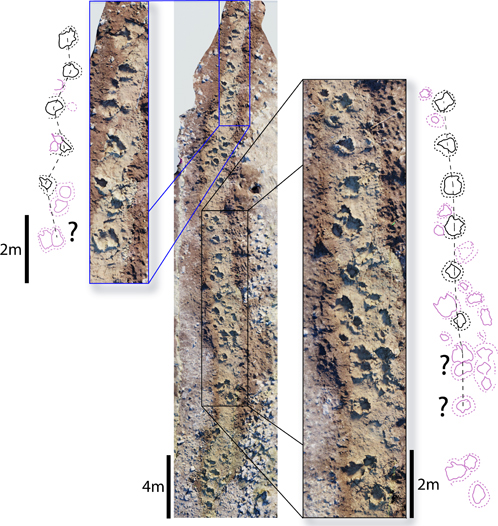
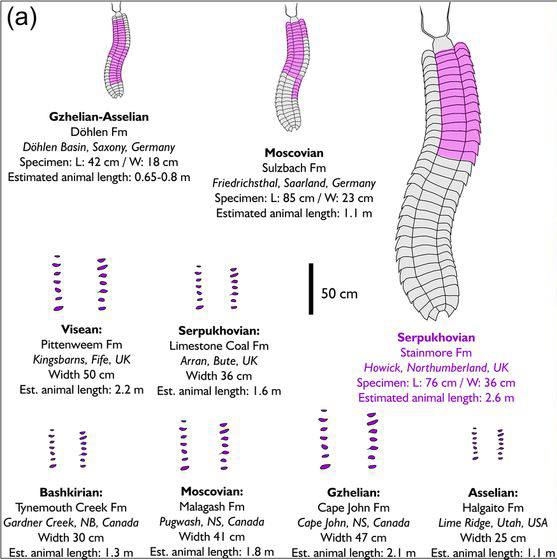
The Howick Arthropleura specimen compared to other articulated Arthropleura fossil remains.

Comparing the Howick arthropleura specimen to other articulated giant specimens (preserved remains highlighted in pink) and the largest Diplichnites cuithensis trackways known from each Carboniferous-Permian stage. Picture credit: Davies et al

Picture credit: Davies et al

What Did Arthropleura Eat?

Fossilised remains of the head have never been found. If it was a carnivore, with strong mouthparts these robust structures would have had a high likelihood of fossil preservation, as seen in the very distantly related marine, ancestral arthropod Anomalocaris from the Cambrian, where the disc-like mouth plates have been preserved. It has been speculated that, despite its huge size, Arthropleura may have been herbivorous.

Lead author of the scientific paper, Dr Neil Davies from Cambridge University’s Department of Earth Sciences commented:

“While we can’t know for sure what they ate, there were plenty of nutritious nuts and seeds available in the leaf litter at the time, and they may even have been predators that fed off other invertebrates and even small vertebrates such as amphibians”.

Where did Arthropleura Live?

The fossil has also provided additional information on the sort of habitat that may have been preferred by Arthropleura, previously, Arthropleura was thought to have inhabited swampy environments. The Northumberland fossil was found in an ancient river channel, which was part of a delta. This was not a swampy habitat, but an area that was quite open with sparse woodland.

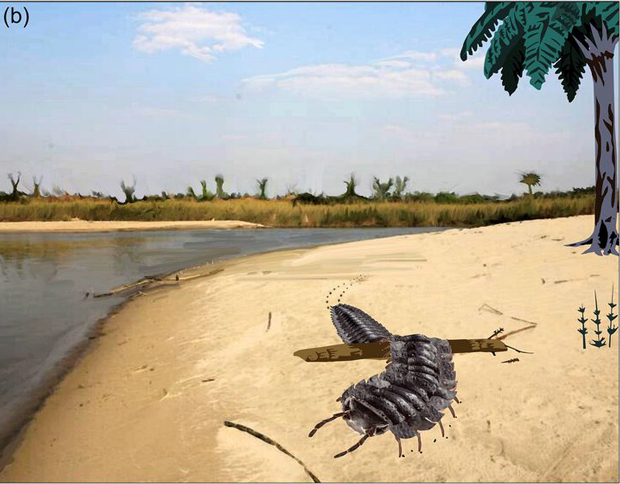
Arthropleura life reconstruction

A life reconstruction of the Northumberland Arthropleura specimen. This invertebrate inhabited a delta floodplain with closely associated open woodland rather than a swampy environment. Picture credit: Davies et al

Picture credit: Davies et al

Arthropleura is typically depicted as an inhabitant of swamps. It may have been limited to equatorial regions (the UK was close to the Equator for much of the Carboniferous), but this fossil suggests that it did not live in areas with standing water and saturated soils.

Arthropleura in a swamp habitat.

It had been suggested that Arthropleura inhabited swampy environments. Whilst it was probably limited to equatorial regions, this study suggests it preferred open woodland. Picture credit: National Museum of Wales.

Picture credit: National Museum of Wales

The scientific paper: “The largest arthropod in Earth history: insights from newly discovered Arthropleura remains (Serpukhovian Stainmore Formation, Northumberland, England)” by Neil S. Davies, Russell J. Garwood, William J. McMahon, Joerg W. Schneider and Anthony P. Shillito published in Journal of the Geological Society.

Visit Everything Dinosaur’s website: Everything Dinosaur.

22 12, 2021

Exquisitely Preserved Dinosaur Embryo Found Inside Fossilised Egg

By |2024-10-09T16:43:14+01:00December 22nd, 2021|Categories: Adobe CS5, Dinosaur and Prehistoric Animal News Stories, Dinosaur Fans, Main Page, Palaeontological articles, Photos/Pictures of Fossils, Teaching|0 Comments

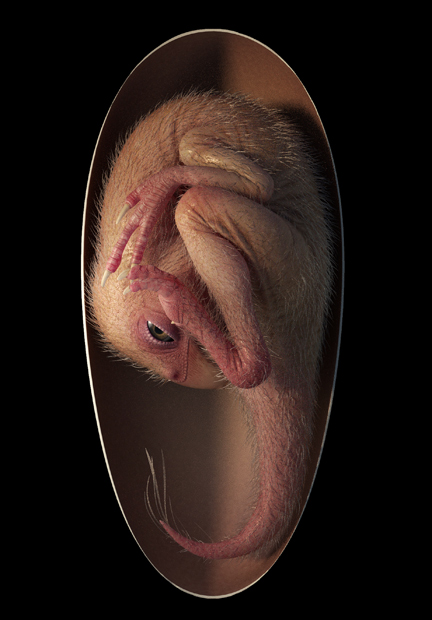
An exquisite dinosaur embryo from southern China has shed new light on the evolutionary link between the Dinosauria and modern birds. The beautifully preserved embryo of an oviraptorosaur has a posture inside the egg reminiscent of a late-stage modern bird embryo. This pre-hatching behaviour, previously considered unique to the Aves (birds), originated in the Theropoda.

Dinosaur embryo close-to-hatching.

Life reconstruction of a close-to-hatching oviraptorosaur dinosaur embryo, based on the new specimen “Baby Yingliang”. Picture credit: Lida Xing.

Picture credit: Lida Xing

“Baby Yingliang”

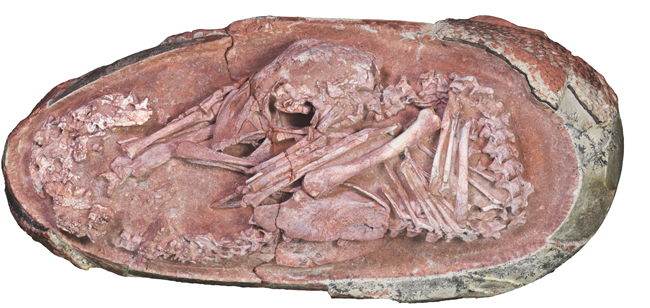
Writing in the journal “iScience”, the researchers who include Professor Lida Xing from the China University of Geosciences (Beijing), Professor Steve Brusatte (University of Edinburgh) and PhD student Fion Waisum Ma (University of Birmingham), describe the dinosaur embryo, nicknamed “Baby Yingliang”. Study of the fossilised remains preserved inside the egg (in-ovo), demonstrates that the head of the baby dinosaur lies ventral to the body, with the feet on either side and the back is curled along the blunt end of the egg. This posture had not been recorded in dinosaur embryos before. In modern birds, this posture is referred to as “tucking”. It is a behaviour controlled by the central nervous system and is critical for hatching success.

The oviraptorosaur embryo known as "Baby Yingliang"

The oviraptorosaur embryo known as “Baby Yingliang”, one of the best-preserved dinosaur embryos ever reported. Picture credit: Xing et al.

Picture credit: Xing et al

An Oviraptorosaur Embryo

The fossil comes from Upper Cretaceous deposits from Ganzhou Province (southern China). It is believed to be between 72 and 66 million years old. Lead author of the study, Professor Lida Xing explained that the fossil was acquired by the director of Yingliang Group, Mr Liang Liu, during the construction of Yingliang Stone Nature History Museum.

The embryo is articulated in its life position without much disruption from fossilisation. It has been identified as an oviraptorosaur, a toothless theropod dinosaur and a member of the Maniraptora. It was closely related to the dinosaur lineage that led to modern birds. The elongatoolithid egg measures 17 cm in length and the embryo inside measures 27 cm long.

Joint first author of the scientific paper, Fion Waisum Ma stated:

“Dinosaur embryos are some of the rarest fossils and most of them are incomplete with the bones dislocated. We are very excited about the discovery of ‘Baby Yingliang’. It is preserved in a great condition and helps us answer a lot of questions about dinosaur growth and reproduction. It is interesting to see this dinosaur embryo and a chicken embryo pose in a similar way inside the egg, which possibly indicates similar prehatching behaviours.”

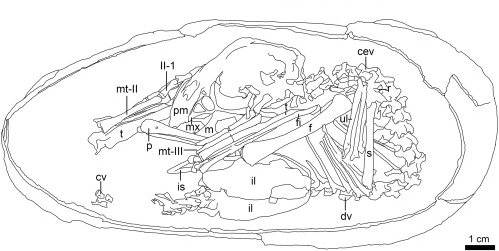
Oviraptorosaur embryo line drawing.

A line drawing of the oviraptorosaur embryo known as “Baby Yingliang”. Picture credit: Xing et al.

Picture credit: Xing et al

Plotting the Evolution of “Tucking” Behaviours

Birds develop this tucking posture, prior to hatching. Embryos that fail to adopt this posture have a higher chance of dying during the hatching process. By comparing this oviraptorosaur embryo with the embryos of other theropods, long-necked sauropod dinosaurs and birds, the researchers postulate that tucking behaviour, which was considered unique to birds, first evolved in theropod dinosaurs. Pinning down just when in geological time this behaviour evolved is dependent on the discovery of more dinosaur embryo fossils.

Co-author of the study, Steve Brusatte commented:

“This dinosaur embryo inside its egg is one of the most beautiful fossils I have ever seen. This little prenatal dinosaur looks just like a baby bird curled in its egg, which is yet more evidence that many features characteristic of today’s birds first evolved in their dinosaur ancestors.”

Everything Dinosaur acknowledges the assistance of a media release from the University of Birmingham in the compilation of this article.

The scientific paper: “An exquisitely preserved in-ovo theropod dinosaur embryo sheds light on avian-like prehatching postures” by Lida Xing, Kecheng Niu, Waisum Ma, Darla K. Zelenitsky, Tzu-Ruei Yang, Stephen L. Brusatte published in iScience.

Visit the Everything Dinosaur website: Everything Dinosaur.

21 12, 2021

Ancient Relative of Velociraptor from the Isle of Wight

By |2024-10-09T16:36:43+01:00December 21st, 2021|Categories: Dinosaur and Prehistoric Animal News Stories, Dinosaur Fans, Main Page, Palaeontological articles, Photos/Pictures of Fossils|0 Comments

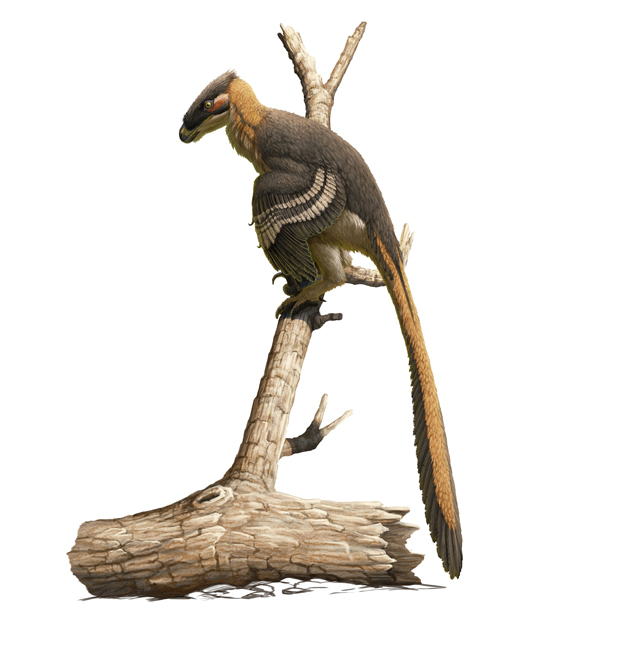
Researchers from the University of Bath and the University of Portsmouth have identified a new species of Early Cretaceous dromaeosaurid from fragmentary fossils found on the Isle of Wight. The new dinosaur, a distant relative of Velociraptor has been named Vectiraptor greeni and it is estimated to have been around 2.5 to 3 metres in length, powerfully built and although not the largest theropod associated with the Wessex Formation it would have been a formidable predator.

Vectiraptor greeni life reconstruction.

A life reconstruction of the newly described dromaeosaurid Vectiraptor greeni. This powerfully built predator may have been able to climb trees. Picture credit: Gabriel Ugueto.

Picture credit: Gabriel Ugueto

Fossil Teeth Hinted at the Presence of Dromaeosaurids

Fossil teeth found on the Isle of Wight hinted at the presence of a large dromaeosaurid, but no large dromaeosaur bones had been discovered. The only dromaeosaur known from the Isle of Wight is the much smaller Ornithodesmus (O. cluniculus), which was once thought to represent a primitive bird but has been assigned to the Dromaeosauridae.

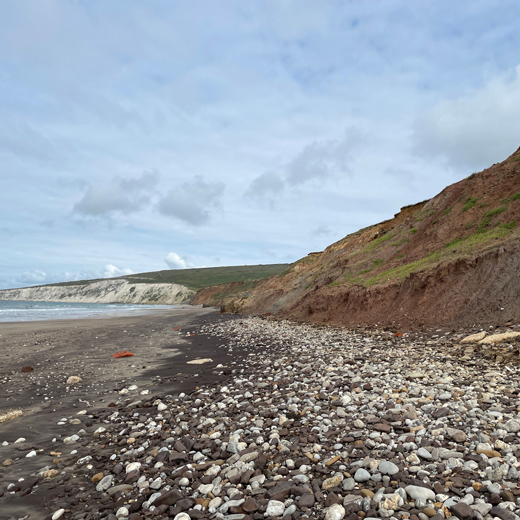
Local amateur fossil collector Mick Green discovered the bones on the foreshore of Compton Bay on the south coast of the island back in 2004. They had been washed out of the cliffs and they remained entombed in their matrix until in 2012 Mick gave up fossil collecting due to ill health and decided to spend more time cleaning and preparing the fossils that he had found.

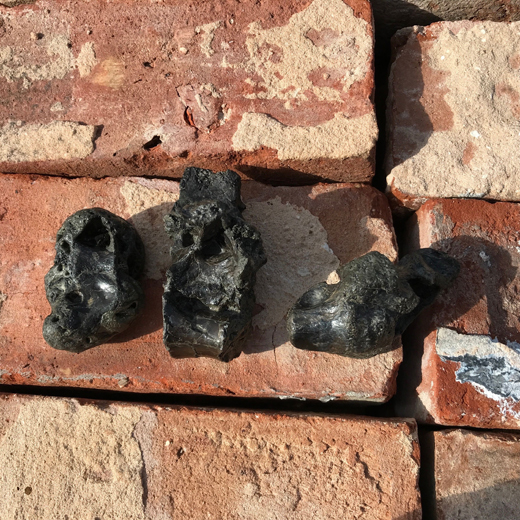
They were shown to palaeontologists Megan Jacobs (University of Portsmouth) and Dr Nick Longrich (University of Bath) and this led to the material, which consists of three dorsal vertebrae and a partial sacrum, being taken away for further analysis. The genus name translates from the Latin as “Isle of Wight thief” and the species name honours Mick Green.

Vectiraptor fossils.

Although fragmentary and eroded the vertebrae demonstrate a combination of features found only in the Dromaeosauridae, including relatively short and massive vertebrae, tall neural spines, and facets for the ribs set on long stalks. Picture credit: University of Bath.

Picture credit: University of Bath

Early Cretaceous Predator

Bigger theropods have been discovered such as the tyrannosauroid Eotyrannus and the carcharodontosaurid Neovenator. Recently, two large spinosaurids were reported: Two New Spinosaurids Described from the Isle of Wight.

Vectiraptor may have roamed the forests and avoided large open areas where other, larger predators lurked. With strong arms and talons, it may have climbed trees like modern leopards. The heavy bones suggest an animal that relied less on speed and more on strength, and perhaps ambushes, to tackle its prey.

Lead author of the paper, Dr Nick Longrich (University of Bath) stated:

“This was a large, and very heavily constructed animal. The bones are thick-walled and massive. It clearly didn’t hunt small prey, but animals as large or larger than itself.”

Vectiraptor fossil site.

Wessex Formation outcrops at Compton Bay on the Isle of Wight where the Vectiraptor fossils were discovered. Picture credit: University of Bath.

Picture credit: University of Bath

Dinosaur Dispersal

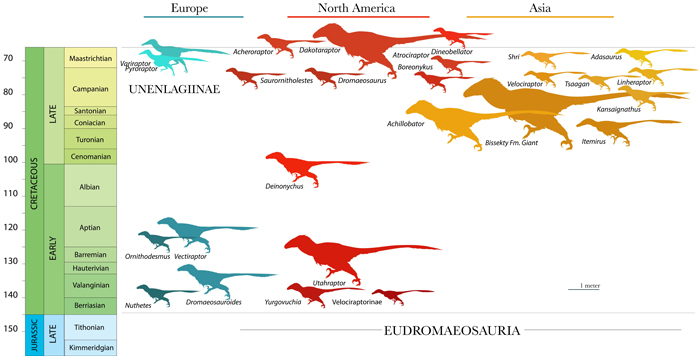
Vectiraptor resembles Early Cretaceous eudromaeosaurs from North America such as Deinonychus, suggesting a faunal exchange between Europe and North America. The diverse Early Cretaceous dinosaur assemblage found in England and Europe resulted from dispersal from North America, Asia, and West Gondwana, likely involving both land bridges and oceanic dispersal. Europe likely served as a biotic crossroads in the Early Cretaceous, allowing faunal interchange between landmasses.

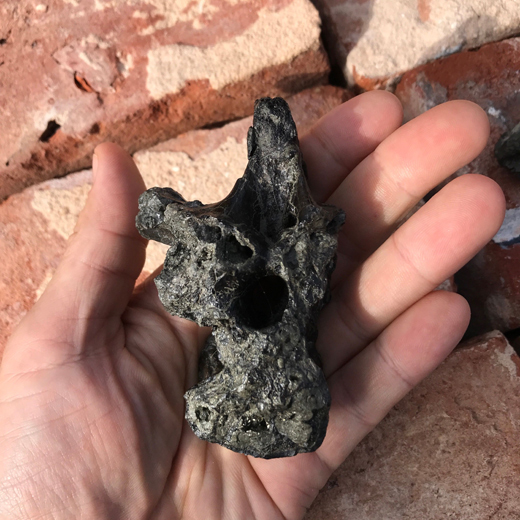
Vectiraptor dorsal vertebra.

The eroded, partial dorsal vertebra of Vectiraptor. Picture credit: Nick Longrich.

Picture credit: Dr Nick Longrich

Dr Longrich added:

“It’s a tantalising hint at the diversity of dinosaurs in England at this time. There’s an extraordinary diversity of dinosaurs known in England in the Cretaceous and even after more than a century of study, we continue to find new species.”

Eudromaeosauria stratigraphy and geography.

Dromaeosaurids closely related to Vectiraptor have been found in North America and Asia suggesting that during the Early Cretaceous southern England was an important dispersal route for dinosaurs. Picture credit: University of Bath.

Picture credit: University of Bath

The First Large Dromaeosaur Known from the UK

This is the first time a large raptor has been found in the UK. Co-author of the study, Megan Jacobs (University of Portsmouth), commented:

This dinosaur is incredibly exciting, adding to the huge diversity of dinosaurs here on the Isle of Wight, and helping to build a bigger picture of the Early Cretaceous world. This little dinosaur also serves as an excellent example of the importance of amateur fossil collectors, and how working with them can produce important scientific research, which would otherwise not be possible.”

Without the dedication of Mick Green and others like him, Vectiraptor would have been lost to the sea.

To read a recent Everything Dinosaur blog post about the discovery of a new species of ornithopod dinosaur from the Isle of Wight: New iguanodontid from the Isle of Wight.

Everything Dinosaur acknowledges the assistance of a media release from the University of Bath in the compilation of this article.

The scientific paper: “A new dromaeosaurid dinosaur from the Wessex Formation (Lower Cretaceous, Barremian) of the Isle of Wight, and implications for European palaeobiogeography” by Nicholas R. Longrich, David M. Martill and Megan L. Jacobs published in Cretaceous Research.

The Everything Dinosaur website: Dinosaur Models.

17 12, 2021

The Big Herbivores of the Nemegt Formation

By |2024-09-17T07:35:19+01:00December 17th, 2021|Categories: Dinosaur and Prehistoric Animal News Stories, Dinosaur Fans, Geology, Main Page, Palaeontological articles|0 Comments

In a recently published scientific paper describing a new species of armoured dinosaur from the Nemegt Formation, it was postulated that some Late Cretaceous ankylosaurs evolved a selective feeding habit in order to avoid competition from other herbivorous dinosaurs.

The ankylosaurs Tarchia teresae and the recently described Tarchia tumanovae had relatively narrow muzzles, compared to earlier ankylosaurids known from the Bayanshiree, Djadokhta and Baruungoyot Formations. Although these ankylosaurs were around five metres in length and perhaps weighed as much as two thousand kilograms, there were several much larger types of herbivorous dinosaur that co-existed with them.

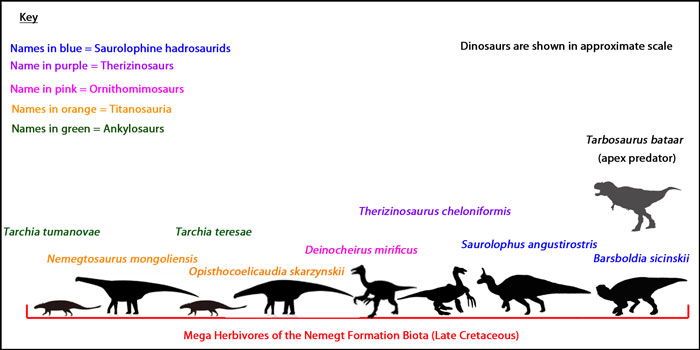
Mega herbivores of the Nemegt Formation

A diagram showing the major, large herbivores that have been scientifically described from the Upper Cretaceous Nemegt Formation of Mongolia. The relatively small size of the Tarchia spp. in comparison with the other large herbivorous dinosaurs may have led to selective pressure on these ankylosaurs to evolve a different feeding habit to reduce interspecific competition for food resources. Picture credit: Everything Dinosaur.

Picture credit: Everything Dinosaur

Evolving a Selective Feeding Strategy to Avoid Excessive Competition

Writing in the academic journal “Scientific Reports”, the researchers postulate that Tarchia species became more selective feeders as a result of competition from other larger herbivorous dinosaurs such as titanosaurs, therizinosaurs and ornithomimosaurs such as the giant Deinocheirus (D. mirificus).

The shift in feeding strategy may have coincided with the arrival of more bulk feeders such as saurolophine hadrosaurids, that may have entered Asia from North America. The invasion of new, highly efficient, bulk-feeding hadrosaurs, may have caused even greater interspecific competition for limited resources, possibly driving selection pressure on the diets of ankylosaurs.

To read Everything Dinosaur’s earlier article on the scientific description of Tarchia tumanovae: Tarchia tumanovae a New Ankylosaur Species.

Visit the award-winning website of Everything Dinosaur: Everything Dinosaur.

16 12, 2021

As Theropods Evolved Their Jaws Got Stronger

By |2024-09-17T07:31:43+01:00December 16th, 2021|Categories: Adobe CS5, Dinosaur and Prehistoric Animal News Stories, Main Page, Palaeontological articles, Photos/Pictures of Fossils|0 Comments

Scientists from the University of Birmingham in collaboration with a colleague from University College London have undertaken a detailed study of the lower jaws of theropod dinosaurs. They have concluded that the jaws of these dinosaurs, some of which are very closely related to modern birds, evolved over time to become stronger and more robust.

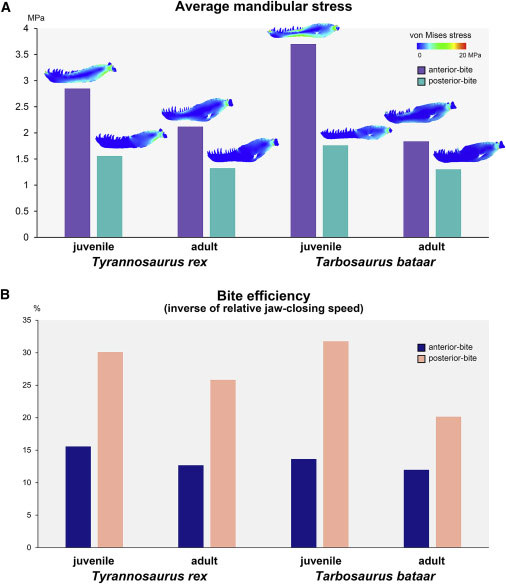
The study also examined bite stresses imposed on the jaws of Tyrannosaurus rex and Tarbosaurus bataar, looking at the differences in jaw stress between juveniles and adults. This research reveals that mature T. rex and T. bataar have lower jaws that are much more stress resistant than the jaws of juveniles. Adult tyrannosaurs also had a faster bite.

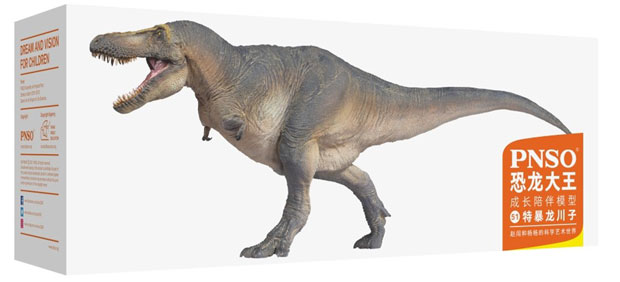
PNSO Chuanzi the Tarbosaurus product packaging

The product packaging for the new PNSO Tarbosaurus dinosaur replica.  A typical model of this Late Cretaceous tyrannosaur.

The picture (above) shows the packaging for the PNSO Tarbosaurus figure.

To view the PNSO range of models and figures: PNSO Age of Dinosaurs Figures.

Dinosaurs Studied Digitally

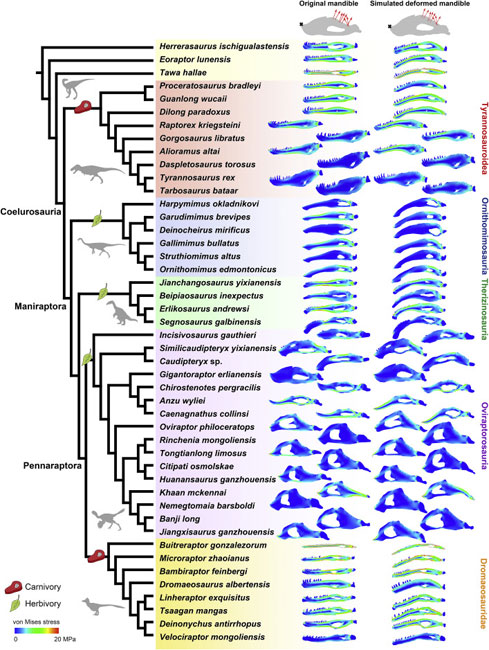
The research team used digital modelling and computer simulation to uncover a common trend of jaw strengthening in theropods – expanding the rear jaw portion in all groups, as well as evolving an upturned jaw in carnivores and a downturned jaw in herbivores.

Biomechanical analysis of the evolving morphology of the jaw demonstrated that these form changes made jaws mechanically more stable when biting, minimising the chance of damage such as a bone fracture.

The researchers created digital models of more than 40 lower jaws from five different theropod dinosaur groups, including typical carnivores like Tyrannosaurus rex and Velociraptor, and lesser-known omnivorous/herbivorous theropods like ornithomimosaurs, therizinosaurs and oviraptorosaurs. Their results are published in the journal “Current Biology”.

Lead author of the study, PhD student at the University of Birmingham Fion Waisum Ma stated:

“Although theropod dinosaurs are always depicted as fearsome predators in popular culture, they are in fact very diverse in terms of diets. It is interesting to observe the jaws becoming structurally stronger over time, in both carnivores and herbivores. This gives them the capacity to exploit a wider range of food items.”

The Dabasu theropod dinosaur biota.

Life reconstruction of the Late Cretaceous Iren Dabasu Formation fauna, showing theropod dinosaurs of various diets. Such dietary niche partitioning could have contributed to the diversification of theropod dinosaurs, which eventually led to the evolution of modern birds. Depicted species: Gigantoraptor, Garudimimus, Neimongosaurus and Velociraptor. Picture credit: Gabriel Ugueto.

Picture credit: Gabriel Ugueto

The Evolving and Diversifying Theropoda

Theropod dinosaurs underwent some of the most remarkable dietary changes in vertebrate evolutionary history, the first theropods were carnivorous, later theropods were apex predators and hypercarnivores. Over time, other dietary niches were exploited such as omnivory and herbivory, with some taxa eventually reverting to a carnivorous diet like their ancestors. The lower jaw is an important tool for food acquisition and its shape reflects adaptations to feeding modes and diets.

Theropod jaw study.

The research team examined the jaw shapes of five groups of theropod dinosaurs. They concluded that theropod jaws became more robust over time and that the anterior portion of the jaws of carnivores bent upward to strengthen the bone, whilst in several types of herbivore the front of jaw bent downwards and deepened to accommodate bite force stresses from cropping plants.

Picture credit: Ma et al

Fion Waisum Ma added:

“Theropod dinosaurs underwent extreme dietary changes during their evolutionary history of 165 million years. They started off as carnivores, later on evolved into more specialised carnivores, omnivores and herbivores. Studying how their feeding mechanics changed is key to understanding the dietary transitions in other vertebrate animals too.”

Examining the Jaws of Theropods

When the tyrannosauroid lineage was examined, the researchers identified that early forms such as Guanlong (G. wucaii) had relatively slender and straight jaws, but later tyrannosaurs such as Tarbosaurus and T. rex evolved much deeper jaws with their front portions bending upward, increasing jaw strength.

Having a strengthened jaw is especially important to herbivorous theropods, as their jaws experience considerable stress from repetitive plant cropping. Herbivores like Erlikosaurus and Caudipteryx have extremely downward-bending jaws that could help dissipate such stress.

Senior author of the study, Dr Stephan Lautenschlager, (University of Birmingham), commented:

“It is fascinating to see how theropod dinosaurs had evolved different strategies to increase jaw stability depending on their diet. This was achieved through bone remodelling – a mechanism where bone is deposited in regions of the jaw that experience high stresses during feeding.”

The Jaws of Late Cretaceous Tyrannosaurs

The scientists studied the feeding mechanics of tyrannosaurids through growth and observed that the deeper and more upturned jaws of adult tyrannosaurs, such as Tyrannosaurus and Tarbosaurus, are structurally stronger compared to those of their juvenile forms.

Commenting on the significance of this finding Dr Lautenschlager explained:

“The similarity between jaw strengthening through growth and through time suggests that developmental patterns in juvenile dinosaurs ultimately affected the evolution of the whole group. This likely facilitated the jaw evolution of theropod dinosaurs and their overall success for over 150 million years.”

Tarbosaurus and T. rex jaw study.

Comparison of biomechnical performance of the jaws of the tyrannosaurs T. rex and Tarbosaurus bataar. As these animals matured, their jaws became more robust and there was an increase in jaw-closing speed.

Picture credit: Ma et al

The research team concluded that there was a common tendency for the structural strengthening of the theropod lower jaw through time, irrespective of diet across the five major groups of theropods studied.

Everything Dinosaur acknowledges the assistance of a press release from the University of Birmingham in the compilation of this article.

The scientific paper: “Macroevolutionary trends in theropod dinosaur feeding mechanics” by Waisum Ma, Michael Pittman, Richard J, Butler and Stephan Lautenschlager published in Current Biology.

The award-winning Everything Dinosaur website: Dinosaur Figures.

15 12, 2021

A New Species of Ichthyosaur

By |2024-09-15T18:52:54+01:00December 15th, 2021|Categories: Adobe CS5, Dinosaur and Prehistoric Animal News Stories, Dinosaur Fans, Main Page, Palaeontological articles, Photos/Pictures of Fossils|0 Comments

A new species of Early Cretaceous ichthyosaur has been named and described following the study of fossilised remains found in Columbia. The fossils had previously been assigned to the ophthalmosaurian Platypterygius, but researchers from Canada, Germany and Columbia have erected a new species Kyhytysuka sachicarum.

An examination of the teeth in the jaws of the 94-cm-long skull, found that the anterior teeth were small whilst the teeth towards the back of the jaw were much bigger and robust. The researchers, who include Hans Larsson (Director of the Redpath Museum at McGill University), conclude that this ichthyosaur evolved unique dentition that enabled it to despatch large prey such as other marine reptiles.

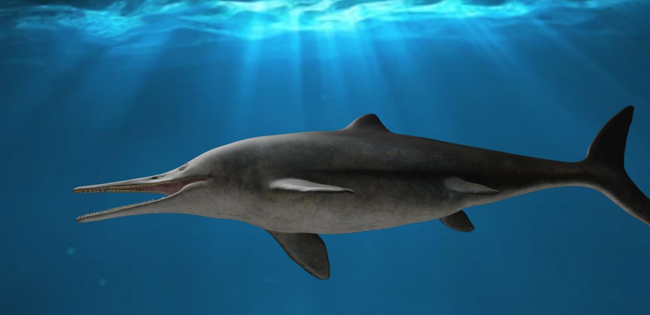
Kyhytysuka sachicarum life reconstruction.

A life reconstruction of the newly described, Early Cretaceous ichthyosaur Kyhytysuka sachicarum. Picture credit: Dirley Cortés.

The First Ichthyosaur Fossils from Columbia to be Described

The fossil specimen, consisting of a relatively uncrushed skull, preserved in three-dimensions, was the first definitive ichthyosaur material to have been found in Columbia (Paja Formation). The material was compared to other South American ichthyosaur fossils and assigned to the Platypterygius genus, being formally described and assigned to a new species – P. sachicarum in 1997.

Writing in the “Journal of Systematic Palaeontology”, the research team concluded that this fossil should really be placed in its own separate genus. The name Kyhytysuka translates from the ancient Muisca culture of central Columbia as “the one that cuts with something sharp”, a nod to the heterodont dentition in the jaw.

Hans Larsson explained:

“This animal evolved a unique dentition that allowed it to eat large prey. Whereas other ichthyosaurs had small, equally sized teeth for feeding on small prey, this new species modified its tooth sizes and spacing to build an arsenal of teeth for dispatching large prey, like big fishes and other marine reptiles.”

A Columbian Researcher Assists with the Study

This is an exciting opportunity for graduate researcher and co-author Dirley Cortés, who hopes to be able to continue to study Columbian marine reptiles, as she grew up in the mountainous area of Columbia close to where this fossil was discovered.

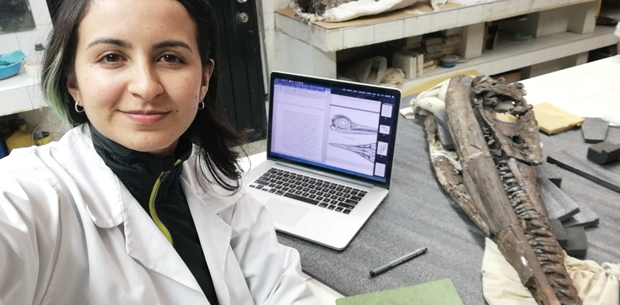
Dirley Cortés studies the ichthyosaur skull

Columbian researcher Dirley Cortés studying the skull of Kyhytysuka which was discovered in Columbia. Picture credit: Dirley Cortés.

A Fearsome Predator

The dentition of Kyhytysuka sachicarum is unique among ichthyosaurs. This ichthyosaur had heterodont dentition (teeth of different shapes and sizes in the jaw), the teeth at the front of the jaw were small and designed to pierce, further along the jaw the teeth were larger, and adapted to cut flesh, whilst teeth at the back of the jaw were more robust and better at crushing. These teeth and other skull adaptations imply that Kyhytysuka evolved as an apex predator specialising in the hunting and consuming of large vertebrates such as fish and other marine reptiles. As such, this is the first example of a Cretaceous hypercarnivorous ichthyosaur. A hypercarnivore is defined as an organism whose diet consists of at least 70% meat.

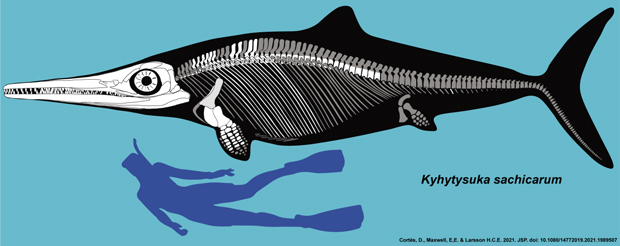
Skeletal drawing of Kyhytysuka.

A scale drawing of the fearsome Kyhytysuka ichthyosaur from the Early Cretaceous of Columbia. Known bones are shown in white. Picture credit: Dirley Cortés.

The scientific paper: “Re-appearance of hypercarnivore ichthyosaurs in the Cretaceous with differentiated dentition: revision of ‘Platypterygius’ sachicarum (Reptilia: Ichthyosauria, Ophthalmosauridae) from Colombia” by Dirley Cortés, Erin E. Maxwell and Hans C. E. Larsson published in the Journal of Systematic Palaeontology.

For models and replicas of marine reptiles and other prehistoric animals: Prehistoric Animal Models.

14 12, 2021

A New Species of Giant Sauropod is Described

By |2024-09-16T21:40:57+01:00December 14th, 2021|Categories: Adobe CS5, Dinosaur and Prehistoric Animal News Stories, Dinosaur Fans, Main Page, Palaeontological articles, Photos/Pictures of Fossils|0 Comments

Scientists have re-examined fossil bones associated with the Chinese mamenchisaurid dinosaur Hudiesaurus sinojapanorum and propose that the robust limb bone associated with this sauropod represents an entirely different genus which they have named Rhomaleopakhus turpanensis.

The forelimb bones are exceptionally stout and strong, particularly the ulna. These fossils represent a giant sauropod. The researchers, who include Professor Paul Barrett of the London Natural History Museum, speculate that strong forelimbs could have helped this dinosaur to “push off” from the ground so that it could rear up onto its back legs to feed. Strong forelimbs would also have helped to resist the deceleration forces as the huge dinosaur lowered itself back onto all fours.

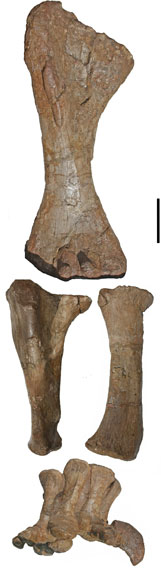
Rhomaleopakhus right forelimb

The robust right forelimb of Rhomaleopakhus turpanensis (specimen number IVPP V11121-1) showing the bones in approximate anatomical position (anterior view). The bones had been ascribed to Hudiesaurus sinojapanorum although they were not found at the same location as vertebrate that led to the erection of the Hudiesaurus genus. The forelimb bones demonstrate several autapomorphies that led the research team to propose a new genus R. turpanensis. Picture credit: Upchurch et al.

Picture credit: Upchurch et al.

Note – the scale bar in the picture (above) equals 20 cm. Although, only described from bones from the right forelimb, it is estimated that Rhomaleopakhus (pronounced Row-ma-lee-oh-pack-hus) could have been between 25 and 30 metres long.

Core Mamenchisaurus-like Taxa

In 1993, a joint Chinese/Japanese field team uncovered sauropod fossil material from the Jurassic-aged Kalazha Formation within Shanshan County in the Xinjiang Autonomous Region of north-western China. The fossils consisted of a single, huge vertebra, four teeth and a nearly complete right forelimb. On the basis of these fossils, a new member of the Mamenchisauridae family of long-necked dinosaurs was erected in 1997 – Hudiesaurus sinojapanorum. This dinosaur’s name translates as Chinese/Japanese butterfly lizard, in recognition of the co-operation between China and Japan in field excavations and because the vertebra had a flat butterfly-shaped process on the front base of the vertebral spine.

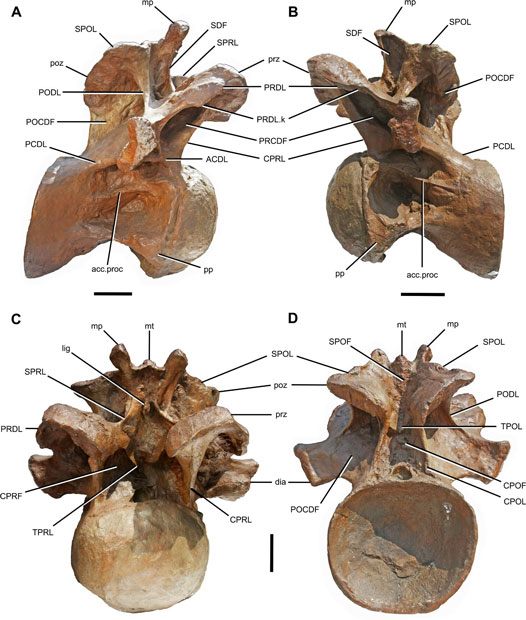
Hudiesaurus vertebra

Posterior cervical vertebra of Hudiesaurus sinojapanorum (IVPP V11120; holotype). A, right lateral view; B, left lateral view; C, anterior view; D, posterior view. Scale bar = 10 cm. Picture credit: Upchurch et al

Picture credit: Upchurch et al

Having reassessed the fossil material ascribed to Hudiesaurus the scientists, writing in the “Journal of Vertebrate Palaeontology”, suggest that the bone from the spine, with its unique anatomical characteristics should remain the holotype material for H. sinojapanorum, but the forelimb which was found 1.1 kilometres from the vertebra and the teeth should not be assigned to Hudiesaurus. Indeed, the researchers propose that the robust forelimb with its own unique anatomical characteristics represents a new taxon. The teeth are too poorly preserved and can only be assigned to “core Mamenchisaurus-like taxa”.

Closely Related Mamenchisaurids

The researchers from the Chinese Academy of Sciences, University College London as well as the London Natural History Museum undertook a phylogenetic assessment of the Hudiesaurus and the newly assigned Rhomaleopakhus fossil material. The analysis indicates that Hudiesaurus is closely related to the “core Mamenchisaurus-like taxon” Xinjiangtitan, although differences between them indicate that they should remain separate genera for the time being. The four, poorly preserved teeth cannot be identified with any certainty, but they too probably represent a mamenchisaurid. Rhomaleopakhus too is very likely a member of the Mamenchisauridae family, albeit closely related to Chuanjiesaurus and Analong from the Middle Jurassic and found in Yunnan Province (south-western China).

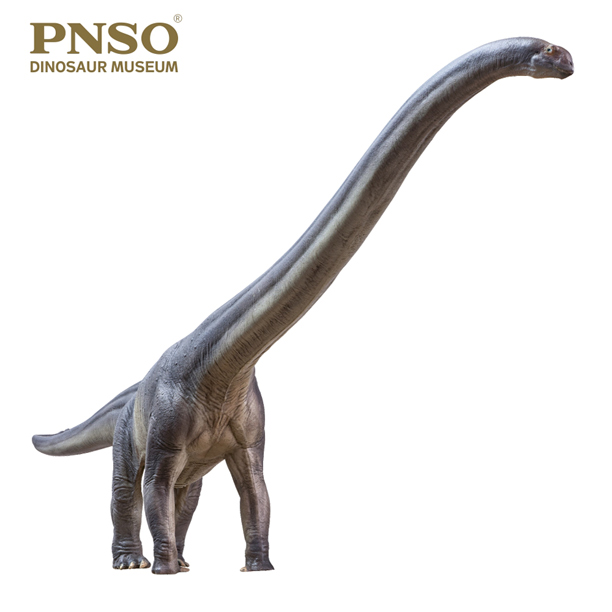
PNSO Er-ma the Mamenchisaurus dinosaur model (2021) in anterior view

A view of the giant PNSO Er-ma the Mamenchisaurus dinosaur model.  A typical mamenchisaurid sauropod, with a very long neck. Mamenchisaurids have many more cervical vertebrae (18+) when compared to most other sauropods. The evolution of an exceptionally long neck could have occurred as a way to exploit other food resources or perhaps through sexual selection.

View the extensive PNSO prehistoric animal model range: PNSO Dinosaur Figures.

The scientific paper: “Re-assessment of the Late Jurassic eusauropod dinosaur Hudiesaurus sinojapanorum Dong, 1997, from the Turpan Basin, China, and the evolution of hyper-robust antebrachia in sauropods” by Paul Upchurch, Philip D. Mannion, Xing Xu and Paul M. Barrett published in the Journal of Vertebrate Palaeontology.

The Everything Dinosaur website: Dinosaur Toys.

12 12, 2021

New Dinosaur Species Described – Arrudatitan

By |2024-09-16T20:22:26+01:00December 12th, 2021|Categories: Adobe CS5, Dinosaur and Prehistoric Animal News Stories, Dinosaur Fans, Main Page, Palaeontological articles, Photos/Pictures of Fossils|0 Comments

This year (2021), has been another bumper year for dinosaur discoveries with over forty new species of dinosaur described, including several from the British Isles such as Pendraig (P. milnerae) from Wales and four new dinosaurs described from fossil finds on the Isle of Wight (Brighstoneus, Ceratosuchops, Riparovenator and Vectiraptor).

New genera are erected based on new fossil discoveries. In addition, a new dinosaur genus or species can be established based on a revision of existing and previously studied fossil material. A new genus of Late Cretaceous, Brazilian titanosaur was announced this year, based on fragmentary remains that had previously been assigned to a titanosaur that roamed Argentina. Time for Arrudatitan maximus to step out of the shadows.

Arrudatitan maximus fossils

The fragmentary fossil bones previously assigned to the Argentinian titanosaur Aeolosaurus maximus and now defined as new Brazilian titanosaur taxon Arrudatitan maximus. Picture credit: Silva Junior et al.

Picture credit: Silva Junior et al

Aeolosaurus maximus

The Aeolosaurus genus was erected by the Argentinian palaeontologist Jaime Powell in 1987 when the first species was named (A. rionegrinus). It was a widespread genus known from numerous individuals collected from Upper Cretaceous deposits, most notably the Angostura Colorada Formation in Río Negro Province, but dinosaur fossils collected from the Bajo Barreal, Los Alamitos and Allen Formations of Argentina have also been assigned to this genus.

The Brazilian fossil remains that led to the erection of the species Aeolosaurus maximus in 2011, have always been regarded as somewhat of an outlier when compared to Aeolosaurus fossil remains discovered in Argentina. A. maximus was described based on vertebrae, ribs, a left ischium, a fragmentary scapula and elements from the limbs including a left femur discovered in 1997 eroding out of an outcrop of the Adamantina Formation in the state of São Paulo state south-eastern Brazil.

Researchers who included Julian Silva Junior (Universidade de São Paulo), reassessed the fossil material following a cladistic analysis in 2019 that challenged the taxonomic placement. Writing in “Historical Biology”, the scientists have confirmed the assertion expressed previously that the Brazilian fossil material represents a distinct genus and the fossils ascribed to Aeolosaurus maximus have been reassigned to the new dinosaur species Arrudatitan maximus.

Arrudatitan maximus scale drawing.

Although the size of A. maximus remains uncertain, based on the femur length of 1.55 metres, palaeontologists estimate that this titanosaur may have reached a length of around 15 metres.

Commenting on the revision, lead author of the scientific paper, doctoral student Julian Silva Junior stated:

“When analysing the caudal vertebrae, we found that they were different to those assigned to Aeolosaurus and these characteristics served to establish a diagnosis to propose a new genus.”

2021 – A Good Year for Titanosaur Discoveries

Several new titanosaur genera have been erected this year including Menucocelsior (M. arriagadai) and Ninjatitan (N. zapatai), which is the oldest titanosaur known to science.

Everything Dinosaur’s list of new titanosaurs named in 2021

  • Arackar licanantay a titanosaur from the Upper Cretaceous Hornitos Formation of Chile.
  • Arrudatitan maximus from the Upper Cretaceous Adamantina Formation of south-eastern Brazil.
  • Australotitan cooperensis a titanosaur from the Winton Formation of Queensland, Australia.
  • Garrigatitan meridionalis from the Upper Cretaceous Argiles Rutilantes Formation of south-eastern France.
  • Hamititan xinjiangensis from the Lower Cretaceous Shengjinkou Formation of north-western China which was coeval with the euhelopodid sauropod Silutitan (S. sinensis) which was also scientifically described in 2021.
  • Menucocelsior arriagadai from the Upper Cretaceous Allen Formation of Argentina.
  • Ninjatitan zapatai the earliest titanosaur known to date described from fossils found in the Lower Cretaceous Bajada Colorada Formation of Argentina.

To read blog posts about some of these newly described titanosaurs:

A new species of titanosaur from the Atacama Desert of northern Chile (Arackar licanantay): A New Titanosaur from Chile – Arackar licanantay.

Australian dinosaur “Cooper” named: “Cooper” – Australotitan cooperensis.

Our article on Hamititan xinjiangensis and Silutitan sinensis: Two New Sauropods from North-western China.

To read the Everything Dinosaur blog post about the earliest titanosaur known to science: Ninjatitan zapatai the Earliest Titanosaur.

The scientific paper: “Reassessment of Aeolosaurus maximus, a titanosaur dinosaur from the Late Cretaceous of Southeastern Brazil” by Julian C. G. Silva Junior, Agustín G. Martinelli, Fabiano V. Iori, Thiago S. Marinho, E. Martín Hechenleitner and Max C. Langer published in Historical Biology.

Visit the Everything Dinosaur website: Dinosaur Toys.

10 12, 2021

Tarchia tumanovae – New Ankylosaur Species

By |2024-09-15T20:38:09+01:00December 10th, 2021|Categories: Adobe CS5, Dinosaur and Prehistoric Animal News Stories, Dinosaur Fans, Main Page, Palaeontological articles, Photos/Pictures of Fossils|0 Comments

Scientists have named a new species of armoured dinosaur based on cranial and postcranial fossils collected in 2008 from the famous Nemegt Formation of the Gobi Desert, Mongolia. A detailed analysis of the fossil material consisting of a well-preserved skull, vertebrae, ribs, part of the hip and a tail club has been published in the journal “Scientific Reports”. The new ankylosaur has been named Tarchia tumanovae and it is the third species to be assigned to the Tarchia genus.

Tarchia tumanovae fossils and line drawings.

Location map (a) of the fossil discovery in Mongolia with (b) a larger scale map showing the fossil quarry. Photograph (c) shows the specimen (MPC-D 100/1353) partially excavated with (d) a line drawing of the fossils in situ. T. tumanovae illustrations show known fossil bones in white (e) dorsal view, (f) left lateral view and (g) shows a skeletal reconstruction with dermal armour. Picture credit: Park et al.

Picture credit: Park et al

Evidence of Injury and a Damaged Tail Club

A joint Korean/Mongolian expedition discovered the fossil material at Hermiin Tsav in the southern Gobi Desert. The ribs show signs of fracture healing and there are localised injuries on the pelvic bones. The researchers speculate that these injuries were probably caused by intraspecific combat. The pathology is consistent with tail club strikes. Intriguingly, the tail club of the skeleton also shows signs of injury. The tail club is asymmetrical when viewed from above (dorsal view). A badly healed ossified tendon on the tail knob handle is present, a possible injury caused as the tail was used during combat. Whether this injury occurred as a result of intraspecific combat or when deterring an attack from a theropod is unknown.

Noting a Change in the Diet of Late Cretaceous Ankylosaurids

The scientists noted wide muzzles are a character of low-level, bulk feeders, whereas those ankylosaurines with narrower muzzles such as T. tumanovae and the coeval, closely related Tarchia teresae were probably selective feeders. The researchers demonstrate that ankylosaurid diets shifted from one of low-level, relatively unfussy bulk feeders during the early Campanian to more selective diets as characterised by a narrower muzzle by the late Campanian/early Maastrichtian.

Views of the skull of Tarchia tumanovae with accompanying line drawings.

Photographs (a–d) and line drawings (e–h) of the skull of Tarchia tumanovae sp. nov. (MPC-D 100/1353). Photographs of the skull in (a) left lateral, (b) right lateral, (c) anterior, and (d) occipital views. Line drawings in (e) left lateral, (f) right lateral, (g) anterior, and (h) occipital views.

Picture credit: Park et al

It is not known why ankylosaurids show this trend towards selective feeding, although the researchers speculate that this change could have been a consequence of habitat change as the region gradually became less arid towards the very end of the Cretaceous. The research team also postulate that ankylosaurids evolved more selective browsing habits in response to the presence of bulk-feeding saurolophine hadrosaurids such as Saurolophus angustirostris and Barsboldia sicinskii.

Tarchia was a selective feeder

A diagram showing (a) a phylogenetic analysis of Tarchia tumanovae, placed in the context of geological time. Ankylosaurids from this region seem to have changed feeding strategies, (b), evolving narrower muzzles that indicate a switch from low-level bulk feeding to more selective browsing. Ankylosaurid fossils from the geologically older Bayanshiree and Djadokhta Formations which represent arid habitats had broad muzzles, whilst ankylosaurids from the younger and more humid Nemegt Formation have narrower muzzles. Picture credit: Park et al.

Picture credit: Park et al

Honouring a Famous Researcher

The species name honours Tat’yana A. Tumanova of the Russian Academy of Sciences, in recognition of her contribution to the study of Mongolian armoured dinosaurs.

The scientific paper: “A new ankylosaurid from the Upper Cretaceous Nemegt Formation of Mongolia and implications for paleoecology of armoured dinosaurs” by Jin-Young Park, Yuong-Nam Lee, Yoshitsugu Kobayashi, Louis L. Jacobs, Rinchen Barsbold, Hang-Jae Lee, Namsoo Kim, Kyo-Young Song and Michael J. Polcyn published in “Scientific Reports”.

The Everything Dinosaur website: Dinosaur Models: Dinosaur Models.

Go to Top