All about dinosaurs, fossils and prehistoric animals by Everything Dinosaur team members.

Fossil finds, new dinosaur discoveries, news and views from the world of palaeontology and other Earth sciences.

3 11, 2021

Remarkable Headless Pterosaur Defines an Entire Genus

By |2024-08-26T15:30:57+01:00November 3rd, 2021|Categories: Dinosaur and Prehistoric Animal News Stories, Dinosaur Fans, Main Page, Photos/Pictures of Fossils|0 Comments

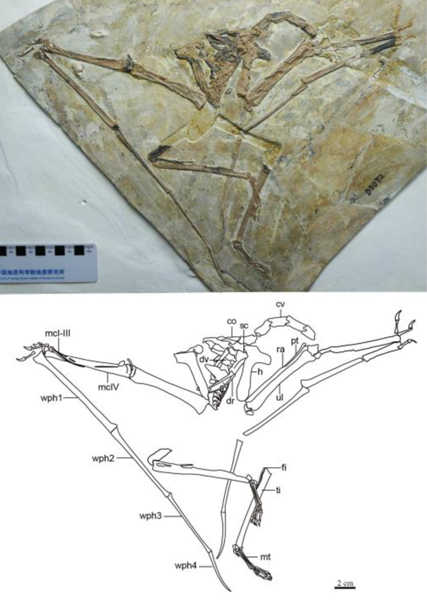
A headless pterosaur fossil has provided palaeontologists with a blueprint to workout which flying reptile fossils represent juveniles and which fossils represent fully-grown adults. The specimen which consists of partially articulated, postcranial material was collected privately before coming into the vertebrate fossil collection of the Dalian Natural History Museum, Liaoning Province (China). Partially fused bones indicate that the specimen represents a juvenile of the tapejarid pterosaur species Sinopterus dongi. As such, it provides a fantastic comparator enabling scientists to differentiate between pterosaur fossils representing animals at different growth stages as well as helping to determine which pterosaur fossils should be attributed to different species.

Sinopterus dongi pterosaur fossil and line drawing.

Specimen D3072 (Sinopterus dongi) view of the fossil (A) and accompanying line drawing (B). Note scale bar in (B) equals 2 cm. Picture credit: Shen et al.

Picture credit: Shen et al

Nemicolopterus – Unravelling the Jehol Biota

It is very likely that the fossil came from a location close to Chaoyang City (Liaoning), from rocks belonging to the Jiufotang Formation. Fossils from the Jiufotang Formation (early Aptian age), together with those associated with the underlying Yixian Formation (Barremian to early Aptian) and the Barremian-aged Huajiying Formation of the Sichakou-Senjitu Basin form the Jehol biota.

Several different types of pterosaur are associated with these strata and tapejarids are the most abundant. To date, there have been ten described specimens and dozens still awaiting formal study. Classifying the fossils and identifying genera and species has proved problematic.

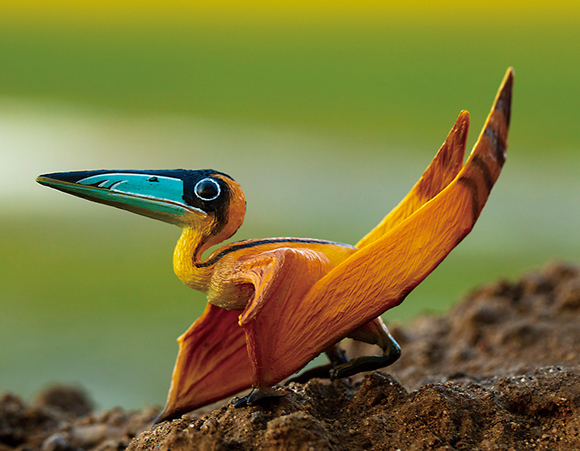
For example, the tiny pterosaur Nemicolopterus heralds from the Jiufotang Formation and there is some debate whether the fossil specimen is a distinct species, or whether the fossil represents a very young Sinopterus.

PNSO Nemicolopterus model.

The PNSO Nemicolopterus pterosaur model.

The newly studied specimen (D3072), might be missing its skull, but a detailed analysis reveals partially fused bones indicating that this is a juvenile. The fossil has been assigned to the tapejarid species Sinopterus dongi. Specimen number D3072 is so complete and well-preserved (some parts of the skeleton are in better condition than other parts), it has provided the research team with valuable information on the anatomical characteristics of young tapejarid pterosaurs.

A spokesperson from Everything Dinosaur explained:

“Specimen number D3072 is like the Rosetta stone that archaeologists were able to use to decipher Egyptian hieroglyphics. The fossil provides valuable information on the anatomy of juvenile tapejarids and it will help palaeontologists to work out which pterosaur fossils represent juveniles of already named species and which fossils may represent entirely new species.”

The research team have proposed that D3072 becomes the type specimen for Sinopterus dongi and they are confident that it will help shed new light on the osteology of the Sinopterus genus. It will provide a blueprint, playing a significant role in future comparative studies and helping to resolve taxonomic issues.

The scientific paper: “A new specimen of Sinopterus dongi (Pterosauria, Tapejaridae) from the Jiufotang Formation (Early Cretaceous, China)” by Caizhi Shen​, Rodrigo V. Pêgas​, Chunling Gao, Martin Kundrát, Lijun Zhang, Xuefang Wei and Xuanyu Zhou​ published in PeerJ.

The Everything Dinosaur website: Dinosaur and Pterosaur Toys.

2 11, 2021

Australian Meat-eater turns Vegetarian According to New Research

By |2024-08-26T15:23:04+01:00November 2nd, 2021|Categories: Adobe CS5, Dinosaur and Prehistoric Animal News Stories, Dinosaur Fans, Main Page, Palaeontological articles, Photos/Pictures of Fossils|0 Comments

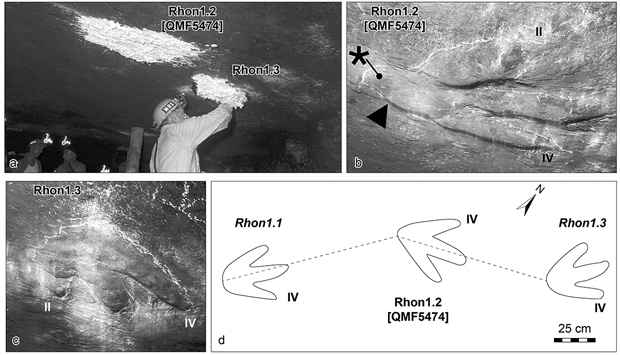
Fossilised dinosaur footprints dating from the Late Triassic that were once thought to represent a large, predatory dinosaur have been re-examined and are now thought to have been made by a mainly vegetarian sauropodomorph. A series of fossilised footprints preserved on the ceiling of a gallery in a coal mine close to the suburb of Dinmore (Queensland, Australia), had been assigned to the ichnogenus Eubrontes. The three-toed tracks, discovered in 1964, were thought to represent a track made by a large theropod dinosaur. They were regarded as the earliest known evidence for the presence of big meat-eating dinosaurs, however, the tracks have been reassessed and are now thought to represent a basal sauropodomorph.

Late Triassic sauropodomorph life reconstruction
A life reconstruction of a basal sauropodomorph. Picture credit: Anthony Romilio and Kamil Porembinski, CC by-SA2.0.

Walking on the Ceiling?

University of Queensland palaeontologist, Dr Anthony Romilio, lead author of the scientific paper published in the journal “Historical Biology”, commented:

“It must have been quite a sight for the first miners in the 1960s to see big bird-like footprints jutting down from the ceiling”.

Around 220 million years ago, dinosaurs walked across water-sodden layers of plant debris and these tracks were later filled in by fine silt and sand. Over millions of years the plant material turned into coal and this was removed by the miners, leaving a ceiling of siltstone and sandstone in the excavated galleries complete with the preserved natural casts of the dinosaur tracks.

Historical photographs of the coalmine ceiling dinosaur tracks.
Historical photographs of dinosaur footprints from the Striped Bacon coal seam mine ceiling, Rhondda colliery, Dinmore, Upper Triassic (Norian) Blackstone Formation. Taking plaster casts of the fossils in situ (A). Close-up view of track Rhon1.2 (B) and close-up view of track Rhon1.3 (C). Schematic drawing of the coalmine ceiling trackway (D). Picture credit: Queensland Museum.

The First and Only Evidence of an Australian Basal Sauropodomorph

The coalmine has been closed down, but the original photographs, drawings and plaster casts made in the 1960’s were available for study and under close scrutiny, the research team recognised that the tracks shared characteristics with the sauropodomorph ichnogenus Evazoum.

The Sauropodomorpha is a sister clade to the Theropoda within the lizard-hipped dinosaurs (Saurischia), the first sauropodomorphs evolved around 230 million years ago and these, large-bodied, long-necked herbivores were the ancestors of the huge sauropods that were to dominate many terrestrial ecosystems in the Jurassic. If the research team’s interpretation of the ceiling tracks is correct, these prints provide the first and only evidence of basal sauropodomorph dinosaurs from Australia.

2018 - The Rise of the Sauropodomorpha.
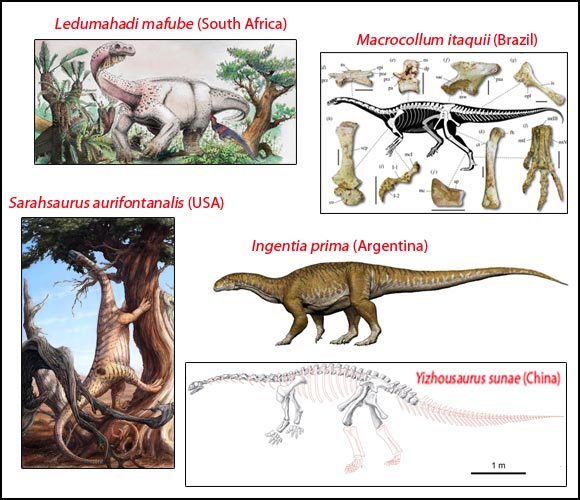
Over recent years, a number of Late Triassic/Early Jurassic sauropodomorph dinosaurs from around the world have been scientifically described.

The coalmine ceiling tracks suggest that the sauropodomorph that made them was around six metres long.

To read an article about other Australian tracks preserved on the ceiling of a cave: Mystery of Dinosaur Prints on Cave Ceiling Solved.

Views of a print from the Coalmine ceiling (Dinmore, Queensland).
Analysis of a track from the coalmine ceiling (Rhon1.2) and scale drawing of the hypothetical trackmaker. Plaster cast of Rhon1.2 (specimen number QMF5474), with (A) orthographic image, (B) ambient occlusion view, (C) elevation map and (D) contour map. Life reconstruction compared with a person for scale (E). Picture credit: Romilio et al.

Everything Dinosaur acknowledges the assistance of a media release from the University of Queensland in the compilation of this article.

The scientific paper: “Saurischian dinosaur tracks from the Upper Triassic of southern Queensland: possible evidence for Australia’s earliest sauropodomorph trackmaker” by Anthony Romilio, Hendrik Klein, Andréas Jannel and Steven W. Salisbury published in Historical Biology.

Visit the Everything Dinosaur website: Everything Dinosaur.

26 10, 2021

Re-drawing the “False Sabre-tooths” with New Research

By |2024-07-27T19:54:17+01:00October 26th, 2021|Categories: Adobe CS5, Dinosaur and Prehistoric Animal News Stories, Dinosaur Fans, Main Page, Palaeontological articles, Photos/Pictures of Fossils|0 Comments

Paul Barrett of the Department of Earth Sciences at the University of Oregon, has put the prehistoric “cats” amongst the prehistoric pigeons with the publishing of a new scientific paper that reassesses the evolution of the “false-sabre tooths”, the Nimravidae. Previous studies had focused on the remarkable, over-sized canines of these placental predators. The paper, published in the journal “Scientific Research”, examined non-sabre-tooth anatomical features and as a result, a different hypothesis on the evolution of nimravids has been proposed.

The skull of the nimravid Hoplophoneus.
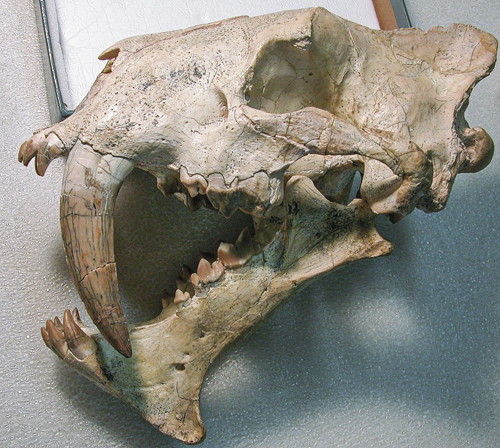
A view of the skull of the “false Sabre-tooth” Hoplophoneus (a member of the Nimravidae). Nimravids such as Hoplophoneus and Eusmilus adelos (which is the subject of the scientific paper published this week), are not true cats (felids) they are not closely related to members of the Felidae such as Smilodon, but they did evolve large, scimitar-like canines – an example of convergent evolution. Picture credit: R. Prothero.

An Over Emphasis on the Teeth and Skulls

Previous studies attempting to map the evolutionary history of the Nimravidae from their origins in the Middle Eocene Epoch to their extinction in the Late Miocene, had focused on examining the shape of the skull and the dentition (teeth). This over reliance on anatomical characters associated with the teeth and the necessary cranial adaptations to wield the enlarged canines led to palaeontologists thinking that these predators evolved in a relatively narrow, restricted way – that there was a gradual evolution of more specialised sabre-tooth features.

This new research based on sophisticated Bayesian analysis looking at a much broader suite of characters and traits suggests that the Nimravidae split, relatively early on in their evolution, into two distinct clusters. One branch (Hopliphoninae) became sabre-toothed hunters, whilst the second branch (Nimravinae) evolved traits reminiscent of extant big cats.

Eusmilus adelos fossils.
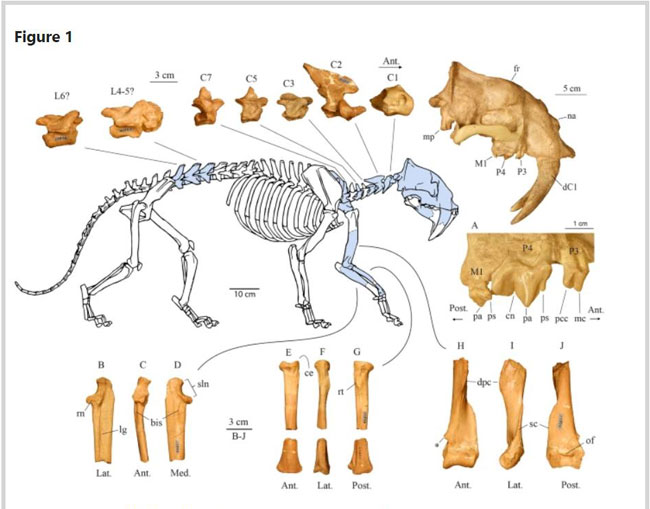
The partial skeleton of Eusmilus adelos (USNM 12820) with known fossil elements shaded light blue. E. adelos is estimated to around the same size as an African lion (P. leo). Skeletal reconstruction by Dhruv Franklin, picture credit: Paul Barrett (University of Oregon).

Eusmilus adelos

In addition to the reassessment of the evolutionary direction of the nimravids, PhD student Paul also examined the fossilised remains of a lion-sized specimen found in Wyoming (White River Formation). This has led to the erection of a new species Eusmilus adelos. Regarded as the biggest member of the Hopliphoninae described to date, it is suggested that a large predator such as E. adelos specialised in hunting prey bigger than itself. Eusmilus adelos may have tackled tapirs, rhinoceratids and large anthracotheriids (an extinct family of hooved, even-toed ungulates distantly related to hippos).

Studying False Sabre-tooths

Coeval hoplophonines were smaller and the author suggests these predators specialised in tackling much smaller prey. This niche partitioning (avoiding of competition by focusing on different resources), would have reflected what is seen on the plains of Africa today amongst extant felids. Large predators such as lions specialising in prey bigger than themselves, whilst smaller felids such as the caracal (Caracal caracal) and the leopard (Panthera pardus) tend to hunt prey smaller than themselves.

To read a related article from Everything Dinosaur that focuses on a study into the evolution of sabre-toothed predators across deep geological time, that suggests that these superficially similar animals evolved very different hunting strategies: Sabre-toothed Predators Evolved Different Hunting Styles.

The scientific paper: “The largest hoplophonine and a complex new hypothesis of nimravid evolution” by Paul Zachary Barrett published in Scientific Reports.

22 10, 2021

Early Dinosaurs Lived in Herds According to New Study

By |2024-07-27T18:28:13+01:00October 22nd, 2021|Categories: Dinosaur and Prehistoric Animal News Stories, Dinosaur Fans, Main Page, Palaeontological articles, Photos/Pictures of Fossils|0 Comments

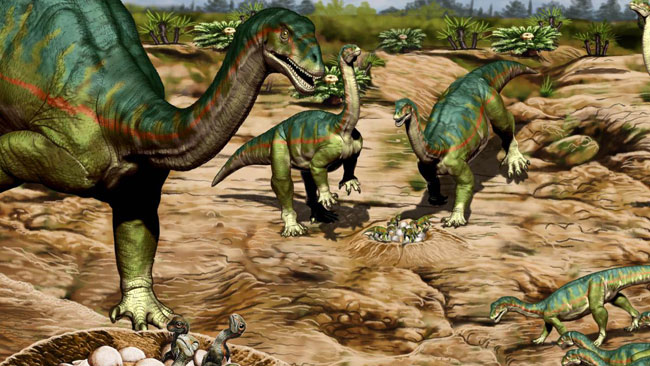
Researchers studying an extensive dinosaur nesting site associated with the Early Jurassic sauropodomorph Mussaurus patagonicus have suggested that these dinosaurs migrated to preferred colonial nesting areas and indulged in complex social behaviours. Articulated skeletons grouped in clusters of individuals of approximately the same age indicate the presence of social cohesion throughout life and age-segregation within a herd structure. This is the earliest evidence found to date of complex behaviours within the Dinosauria and the researchers postulate that their social behaviour may have been a key factor in their rise to dominance.

Mussaurus patagonicus nesting site.
New research on an extensive dinosaur nesting site in Patagonia suggests that early dinosaurs were highly social and lived in herds. A life reconstruction of the Mussaurus patagonicus nesting site. Picture credit: Jorge Gonzalez.

Dinosaurs Living in Herds

Substantial evidence has been uncovered to demonstrate that different types of herbivorous dinosaurs lived in herds. There are extensive trackways and substantial hadrosaur and ceratopsian bonebeds dating from the Late Cretaceous, there has also been some evidence, albeit controversial, to suggest that some meat-eating dinosaurs lived in packs or family groups, but when did this sort of behaviour evolve in the Dinosauria? A team of international researchers studying a 192-million-year-old nesting ground located in southern Argentina (Santa Cruz Province), have demonstrated that complex social behaviours existed in sauropodomorphs.

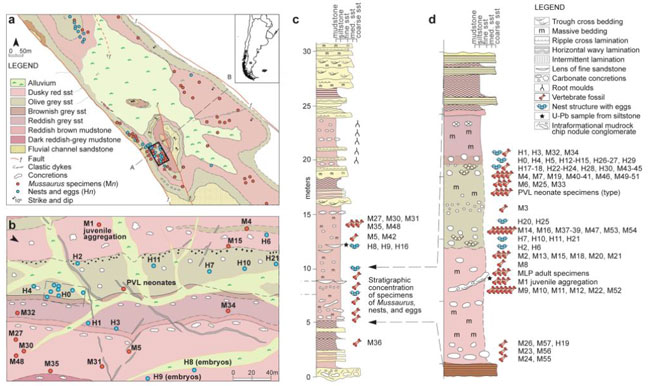
The site, which covers an area of approximately 1,000 square metres, the locality representing river and lake deposits part of the Laguna Colorada Formation, has yielded over 100 fossil eggs in various degrees of association, from individual finds to entire clutches and over 80 specimens of Mussaurus patagonicus, at very stages of growth from embryos to fully grown adults.

Map and stratigraphic section of the Laguna Colorada type locality.
Locality map and stratigraphic section of the Laguna Colorada type locality. (a) general map of fossil findings at the locality (red dots represent skeletal remains of M. patagonicus and blue dots represents eggs or nests, (b) detailed map of area with high fossil density (including associated juveniles, neonates, and nests). General stratigraphic section of the type locality (c) showing the position of skeletal remains and eggs/nests of M. patagonicus; (d) detailed stratigraphic section of the 3 m-thick interval with the highest concentration of Mussaurus skeletons and eggs. Picture credit: Pol et al.

The European Synchrotron Radiation Facility (ESRF)

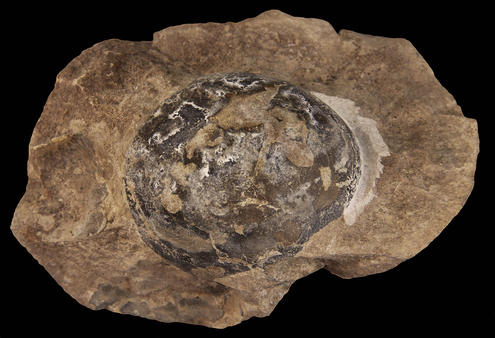
Thirty fossil eggs were selected to take the trip to the European Synchrotron Radiation Facility (ESRF) in Grenoble, France for further, detailed study. Once at the facility, the eggs were bombarded with powerful, high-intensity X-rays so that their contents could be revealed. This non-destructive technique permitted the research team, which was led by Diego Pol, a palaeontologist at CONICET (Consejo Nacional de Investigaciones Científicas y Técnicas), the Government agency that fosters science and technology in Argentina, to confirm that the eggs were those of Mussaurus patagonicus. The high-resolution computed tomography revealed fossilised embryos of Mussaurus within some of the eggs and showed all these fossils belong to a communal breeding site of a single dinosaur species.

Mussaurus patagonicus fossils.
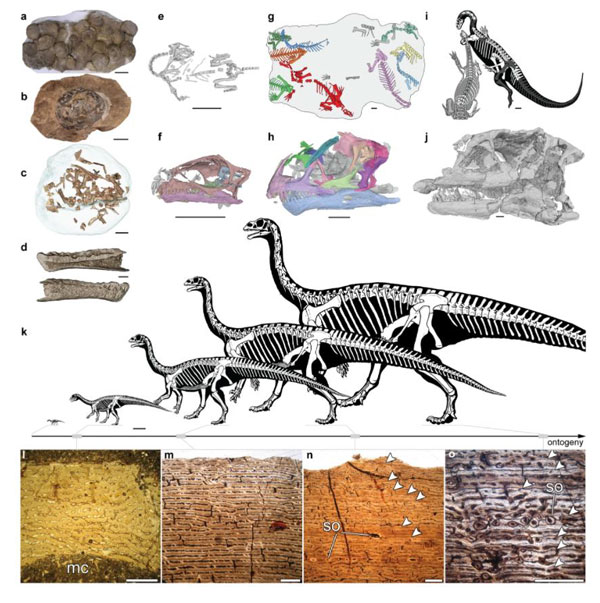
Fossil specimens from the nesting colony (a) nest, (b) single egg, (c) egg with embryo, jaw of embryo (d) with a line drawing of an embryo (e). Skull anatomy compared (f) embryo, skull of juvenile (h), skull of adult (j). Associated skeletons of juveniles (g) and associated skeletons of two adults (i) with (k) growth series for Mussaurus patagonicus and bone histology indicating ages (l-o). Picture credit: Pol et al.

An Organised and Regimented Herd Structure

Field work revealed that the Mussaurus skeletons were not randomly scattered across the site. They were clustered together according to their age. Babies were found in close proximity to the nests as would have been expected. However, the remains of one-year-olds were found closely associated with each other, including a group of eleven skeletons all preserved in the same resting pose. This suggests that Mussaurus youngsters stayed together, probably for protection against predators.

Intriguingly, the fossilised remains of adults and sub-adults were frequently found alone or in pairs. Perhaps the pair represented a male and female, which had got together for the breeding season.

The team which included Vincent Fernandez, a palaeontologist at the London Natural History Museum and former ESRF scientist, undertook histological analysis of thin sections of fossil bone so that they could observe the lines of arrested growth (LAGs) and calculate the age of the dinosaur.

Lead author Diego Pol explained:

“The bones of these dinosaurs grew in annual cycles, much as the tree rings, so by counting the growth cycles we could infer the age of the dinosaur”.

Social Behaviour – Key to the Success of the Dinosauria?

The location had proved difficult to date. Previous studies had suggested the site was much older, the deposits thought to have been laid down in the Late Triassic, but the team were able to accurately date the fossil site by plotting the decay of uranium to lead in zircon crystals found in siltstones in a fossil bearing layer (U–Pb zircon geochronology). The results prove that the Mussaurus nesting colonies were formed around 192 million years ago (Sinemurian faunal stage of the Early Jurassic). As fossil bones were found at several distinct layers, this suggests that these dinosaurs returned to this favoured nesting site year after year.

The researchers conclude that Mussaurus lived in well-organised herds and this is the first time these complex behaviours have been recorded in an early dinosaur. It pre-dates other records of dinosaur social behaviour by more than 40 million years. Furthermore, by studying colonial nesting in the similarly aged early sauropodomorphs Lufengosaurus from China and Massospondylus from South Africa, the team suggest that complex nesting behaviours and organised herd structures emerged very early in dinosaur evolution.

Mussaurus fossil egg.
The fossilised remains of a Mussaurus preserved inside an egg. Thirty eggs from the site were analysed using computed tomography confirming that this was a nest site occupied by a single dinosaur species. Picture credit: Diego Pol (CONICET).

Living in herds, exhibiting complex social behaviours and breeding in colonies at preferred nesting locations may have contributed to the success of these early dinosaurs, which enabled sauropodomorphs to become a mainstay of terrestrial ecosystems, laying the foundation for the success of the Sauropoda for most of the Mesozoic.

To read a related article on Mussaurus patagonicus from 2019, that looks at how the Laguna Colorada fossil site has helped palaeontologists to understand dinosaur locomotion: Some Baby Dinosaurs Crawled Before Learning to Walk on Two Legs.

The scientific paper: “Earliest evidence of herd-living and age segregation amongst dinosaurs” by Diego Pol, Adriana C. Mancuso, Roger M. H. Smith, Claudia A. Marsicano, Jahandar Ramezani, Ignacio A. Cerda, Alejandro Otero and Vincent Fernandez published in Scientific Reports.

For models of early dinosaurs and other prehistoric animal figures: Dinosaur Toys.

19 10, 2021

Giant Sea Scorpion from Southern China Described in New Scientific Paper

By |2024-07-27T17:46:20+01:00October 19th, 2021|Categories: Adobe CS5, Dinosaur and Prehistoric Animal News Stories, Main Page, Palaeontological articles, Photos/Pictures of Fossils|0 Comments

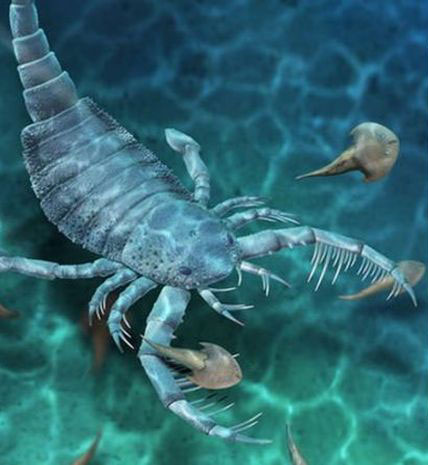
A team of scientists, including a researcher from the London Natural History Museum have named a new species of ancient sea scorpion (eurypterid), that at around one metre in length was probably a top predator in its marine environment. Named Terropterus xiushanensis, it has been assigned to the Mixopteridae family within the Eurypterida and as such, it is the oldest mixopterid described to date and the first to be associated with Gondwana.

Terropterus xiushanensis life reconstruction.
The newly described eurypterid from the Lower Silurian of southern China (Terropterus xiushanensis) was probably the top predator in the marine ecosystem. Here it is seen attempting to catch some jawless fish. Picture credit: Dinghua Yang.

Terropterus xiushanensis

Writing in the journal “Science Bulletin”, the research team describe this new marine arthropod based on several fossils mostly representing the spiny front appendages, excavated from the Lower Silurian (Llandovery) Xiushan Formation, Xiushan. Two incomplete, but much larger fossils from the roughly contemporaneous Fentou Formation of Wuhan in Hubei Province have also been assigned to the Terropterus genus.

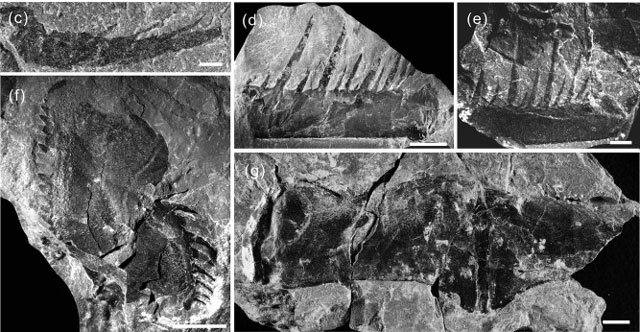
Terropterus xiushanensis fossils
Terropterus xiushanensis fossils (c) close-up of appendage V. Joint 5 or 6 of appendage III, paratype, NIGP 174786 (d). Joint 5 or 6 of appendage III, paratype, NIGP 174787 (e). Coxae, the first segment of a limb, paratype, NIGP 174788 (f). Genital operculum and the genital appendage, paratype, NIGP 174789 (g). Scale bars = 5 mm for (d), (f), (g); 2 mm for (e); 1 mm for (c). Picture credit: Wang et al.

A Formidable Predator

With an estimated length of around 1 metre, (based on the Fentou Formation fossils), Terropterus was far larger than any vertebrate predator known from Lower Silurian strata. Their second, and especially the third, pair of prosomal limbs are enlarged and armed with sharp spines. These limbs were presumably used for capturing prey, trilobites and other invertebrates as well as primitive fish.

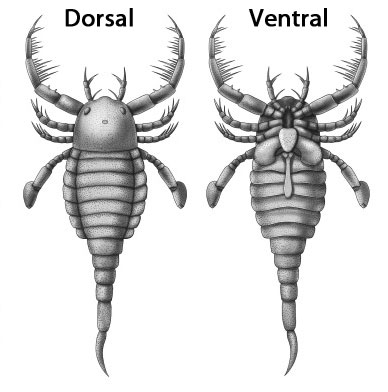
Terropterus xiushanensis line drawings.
A line drawing of Terropterus xiushanensis – left dorsal view and right ventral view. Picture credit: Wang et al with additional annotation by Everything Dinosaur.

Mixopterids More Widespread than Previously Thought

Little is known about the evolution and distribution of the Mixopteridae. Only four species in two genera have been described previously and most of the research into these eurypterids took place in the early 20th century. Until the discovery of Terropterus all the mixopterids were associated with the ancient landmass of Laurussia. Terropterus extends the range of this family into marine environments associated with Gondwana.

Members of the Mixopteridae

  • Mixopterus simonsoni 1883 (Estonia).
  • Lanarkopterus dolichoschelus 1899 (Scotland).
  • Mixopterus multispinosus 1921 (New York).
  • Mixopterus kiaeri 1934 (Norway).

Phylogenetic assessment suggests that T. xiushanensis is a sister taxon to L. dolichoschelus.

The researchers note that mixopterids might share a common body plan with highly specialised anterior appendages armed with spines, which presumably played a role in attacking and holding prey, but there are marked differences between the known genera. This might indicate that some mixopterids attacked different kinds of prey.

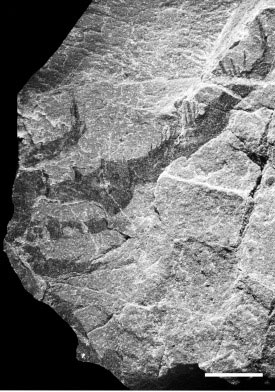
Terropterus xiushanensis appendages
The holotype (NIGP 174785) appendages of Terropterus xiushanensis. Note scale bar = 5 mm. Picture credit: Wang et al.

The scientific paper: “First mixopterid eurypterids (Arthropoda: Chelicerata) from the Lower Silurian of South China” by Han Wang, Jason Dunlop, Zhikun Gai, Xiaojie Lei, Edmund A. Jarzembowski and Bo Wang published in Science Bulletin.

For models and figures of prehistoric arthropods: Prehistoric Animal Toys and Models.

18 10, 2021

New Research Reveals Evidence of Organic Molecules in the Cells of a Caudipteryx

By |2024-07-27T17:43:28+01:00October 18th, 2021|Categories: Adobe CS5, Dinosaur and Prehistoric Animal News Stories, Dinosaur Fans, Key Stage 3/4, Main Page, Palaeontological articles, Photos/Pictures of Fossils|0 Comments

An almost perfectly preserved specimen of the very bird-like theropod Caudipteryx has provided researchers with evidence of organic molecule preservation at a cellular and nuclear level. Writing in “Communications Biology”, scientists from the Institute of Vertebrate Palaeontology and Palaeoanthropology of the Chinese Academy of Sciences, in collaboration with colleagues from the Shandong Tianyu Museum of Nature (Shandong Province, eastern China), report on a study of fossilised cells from cartilage associated with a Caudipteryx thigh bone that reveal exquisite molecular preservation.

Photograph and line drawing of Caudipteryx specimen number STM4-3
Photograph of the Caudipteryx specimen (A) with (B) a close-up of the femur showing the extracted fragment outlined in yellow. Illustrative line drawing (C). Picture credit: Xiaoting Zheng et al.

Fragments from a Femur

The specimen (number STM4-3), is in the Shandong Tianyu Museum of Nature vertebrate fossil collection, one of the largest collections of dinosaur fossils in the world. It was collected from the Yixian Formation near Chaoyang City, Dapingfang Town (Liaoning Province) and is almost complete and partially articulated. Gastroliths are preserved in the stomach cavity and the outline of some feathers can also be seen. A right femur, measuring 15 cm in length was examined, a fragment removed representing cartilage and divided into three portions to permit detailed scanning electron microscopy (SEM), histochemical staining, energy-dispersive X-ray spectroscopy (EDS) and transmission electron microscopy (TEM) along with chemical analysis.

The research team realised that some cells had been mineralised by silicification after the death of the animal. This silicification is most likely what permitted the excellent preservation of these cells.

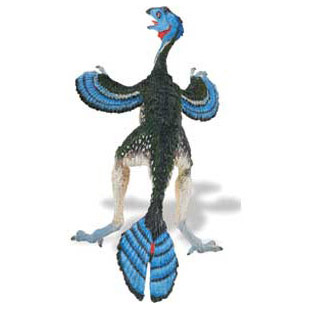
Cauditperyx.
A model of the theropod dinosaur Caudipteryx.

The picture (above) shows a Cauipteryx model produced by Safari Ltd.

To view the range of prehistoric animal figures in this range: Wild Safari Prehistoric World Models.

Li Zhiheng, an Associate Professor at the Institute of Vertebrate Palaeontology and Palaeoanthropology and a co-author of the study commented that the discovery of cellular preservation in the cartilage was not unexpected stating:

“Geological data has accumulated over the years and shown that fossil preservation in the Jehol Biota was exceptional due to fine volcanic ashes that entombed the carcasses and preserved them down to the cellular level”.

Healthy Cells and Unhealthy, Dying Cells

The researchers discovered two main types of cells, cells that were healthy at the time of fossilisation, along with unhealthy cells that were porous and fossilised while in the process of dying.

Co-author Alida Bailleul (Institute of Vertebrate Palaeontology and Palaeoanthropology), explained:

“It is possible that these cells were already dying even before the animal died”.

Cell death is a process that occurs naturally throughout the lives of all organisms. But being able to identify a fossilised cell at a specific life stage within the cell cycle is quite new in palaeontology.

Staining the Nuclei of Dinosaur Cells

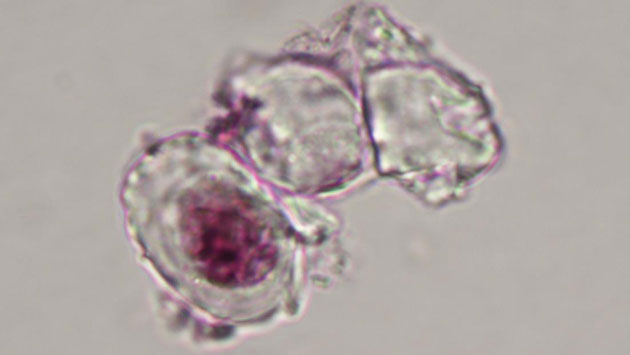
The team isolated some cells and stained them with a purple chemical used by biologists to identify nuclei material. This chemical, hematoxylin, is known to bind to the nuclei of cells. Cells from a chicken were also stained to provide an extant comparison. One dinosaur cell showed a purple nucleus with some darker purple threads. This provides strong evidence to support the idea that the 125-million-year-old dinosaur cell has a nucleus so well-preserved that it retains some original biomolecules and threads of chromatin.

Chromatin is found within the cells of all living organisms. It consists of tightly packed DNA molecules. The results of this study thus provide preliminary data suggesting that remnants of original dinosaur DNA may still be preserved.

Caudipteryx cells from the femur
Photographs of three cartilage cells from the femur of Caudipteryx. The purple chemical hematoxylin binds to the nuclei of cells. After the dinosaur cells were stained one cell showed a purple nucleus, this suggests that the 125-million-year-old fossil cell is so well preserved it has retained some original biomolecules and threads of chromatin. This cell replicated the reaction to hematoxylin expected from a cell of a living chicken. Picture credit: Alida Bailleul.

Much Further Work is Required

Whilst highlighting the significance of this study, after all discovering that 125-million-year-old dinosaur cells react to hematoxylin staining in the same way as living cells is remarkable, the researchers concede that a much more refined and precise approach will be required if dinosaur DNA is to be identified and recovered in any quantity.

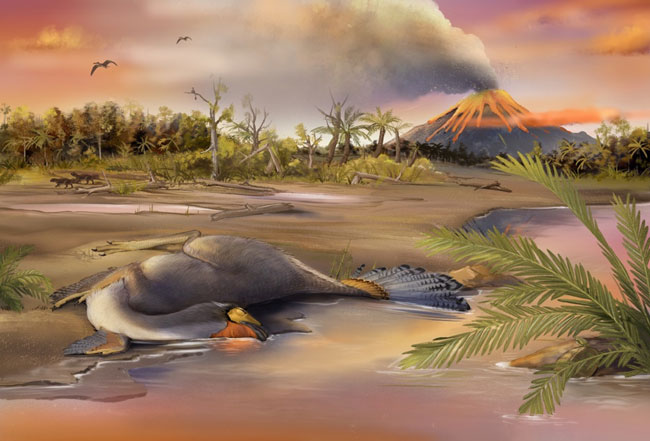
The Jehol Biota.
The Jehol Biota approximately 125 million years ago. The corpse of the Caudipteryx lies on the lake shore whilst a pair of Psittacosaurus wander past and pterosaurs fly overhead. A Confuciusornis bird perches on a tree, undeterred by the erupting volcano nearby. Picture credit: Zheng Qiuyang.

In 2020, Everything Dinosaur reported upon the discovery of chromosome-like chromatin threads preserved in the fossilised cartilage of a 75-million-year-old hadrosaur (Hypacrosaurus stebingeri). This study identified nuclear and cellular preservation which was previously unknown in a Cretaceous fossil specimen. To read our article: Cartilage, Proteins and Potential Dinosaur DNA?

The scientific paper: “Nuclear preservation in the cartilage of the Jehol dinosaur Caudipteryx” by Xiaoting Zheng, Alida M. Bailleul, Zhiheng Li, Xiaoli Wang and Zhonghe Zhou published in Communications Biology.

Visit the Everything Dinosaur website: Everything Dinosaur.

13 10, 2021

The Remarkable Beipiaosaurus Revisited

By |2024-07-27T17:16:03+01:00October 13th, 2021|Categories: Dinosaur and Prehistoric Animal News Stories, Dinosaur Fans, Main Page, Palaeontological articles, Photos/Pictures of Fossils|0 Comments

Fans of the now retired Carnegie Collection series of prehistoric animal models, might remember a model of the therizinosaur Beipiaosaurus (B. inexpectus). The model, introduced in 2006 and withdrawn in 2014, might have given dinosaur fans the wrong impression when it comes to this Chinese theropod. Not that the replica made by Safari Ltd was highly inaccurate, but when the model was produced, only the skull of Beipiaosaurus had actually been studied in detail.

Now, some twenty-two years after this small therizinosaur was named, scientists including Xing Xu who was one of the authors of the paper describing the skull, have revisited the fossil material and completed their analysis by focusing on the postcranial fossils.

Beipiaosaurus dinosaur model.
The Carnegie collection Beipiaosaurus dinosaur model which was retired in 2014. This model was produced at a time when only the skull of this dinosaur had been studied in detail.

Beipiaosaurus inexpectus

Named and described in 1999, from fossils found by a local farmer three years earlier, Beipiaosaurus heralds from the Lower Cretaceous Yixian Formation (Sihetun locality, near Beipiao), Liaoning Province, China. Described as a basal therizinosaur, it is thought to represent a key taxon in helping scientists to understand the evolution of the Therizinosauridae. Scientists writing in the on-line, open access journal PLOS One, provide an extensive description of the postcranial fossil material associated with the holotype specimen (IVPP V 11559). After Beipiaosaurus had been named, more bones associated with the holotype were found at the original fossil site and these fossils have helped palaeontologists to identity further unique, anatomical characteristics.

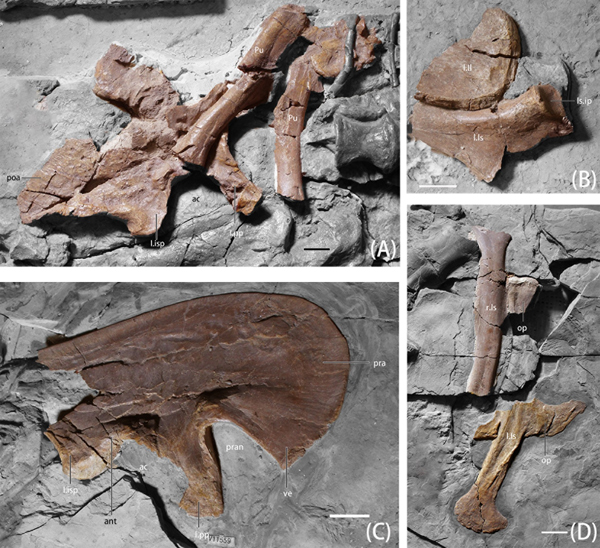
Photographs of pelvic girdle elements of Beipiaosaurus.
Photographs of pelvic girdle elements of B. inexpectus (IVPP V 11559). Picture credit: Liao et al.

Additional Autapomorphies

Analysis of the hip socket (acetabulum) length provided a new autapomorphy helping to distinguish Beipiaosaurus from other therizinosaurs.

The shape of the ilium, specifically the pubic peduncle (marked as I.P.P in picture C, above), provides a second unique characteristic for this genus identified in this study.

The manual ungual (finger claw bone) in digit III is the longest one in B. inexpectus. In other therizinosaurs, it is the manual ungual of digit II that is the longest. This is the third additional autapomorphy identified in this research paper.

Photographs of right forelimb elements of B. inexpectus.
Photographs of right forelimb elements of B. inexpectus (IVPP V 11559). The long ungual associated with digit III is unique to this taxon amongst known therizinosaurs. Picture credit: Liao et al.

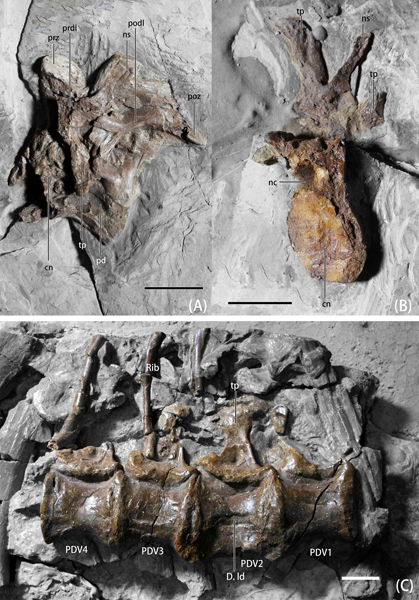
The authors of the scientific paper, provide a detailed description of the skeleton of Beipiaosaurus, including fossil bone associated with the holotype that have not been reported upon before. Their study has revised the diagnostic features associated with this dinosaur. For example, the researchers examined two dorsal vertebrae that had previously not been studied.

Photographs of B. inexpectus.
Photographs of the dorsal vertebrae of B. inexpectus (IVPP V 11559). This study examined in detail two dorsal vertebrae that had not been studied previously. Picture credit: Liao et al.

The new study into this feathered dinosaur that was named and described more than twenty years ago has helped palaeontologists to better understand the postcranial skeleton of Beipiaosaurus, helps distinguish it from other therizinosaurians and provides insights into therizinosaur evolution.

Furthermore, the researchers, who include Shiying Wang and Chun-Chi Liao (Chinese Academy of Sciences) and Lindsay Zanno (North Carolina Museum of Natural Sciences) as well as Xing Xu, identified several new synapomorphies helping to clarify the evolutionary history of the Therizinosauridae family. A synapomorphy is a characteristic present in an ancestral species and shared exclusively (in a more or less modified form) by its evolutionary descendants.

The scientific paper: “Postcranial osteology of Beipiaosaurus inexpectus (Theropoda: Therizinosauria” by Chun-Chi Liao, Lindsay E. Zanno, Shiying Wang and Xing Xu published in PLOS One.

Everything Dinosaur’s award-winning website: Dinosaur Models.

11 10, 2021

PNSO Tucson the Himalayasaurus

By |2024-07-27T17:02:55+01:00October 11th, 2021|Categories: Adobe CS5, Dinosaur and Prehistoric Animal News Stories, Dinosaur Fans, Everything Dinosaur News and Updates, Everything Dinosaur Products, Main Page, Press Releases|0 Comments

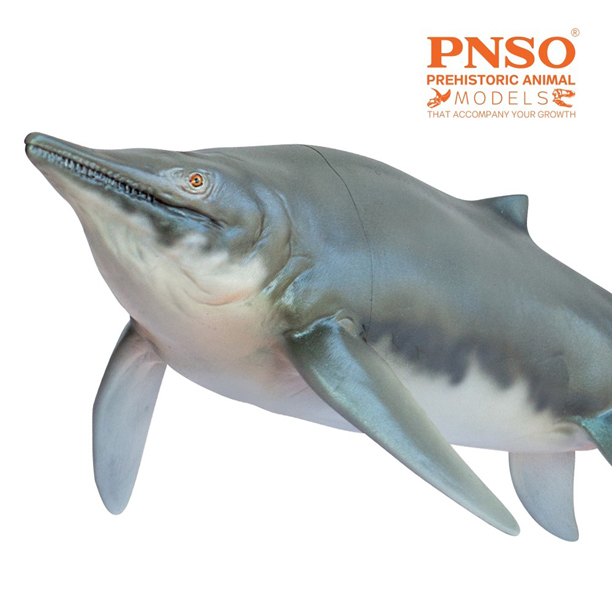
PNSO will add a replica of the giant, Late Triassic ichthyosaur Himalayasaurus to their mid-size model range. The replica called Tucson the Himalayasaurus is part of a shipment of PNSO prehistoric animal figures that are already heading towards our UK warehouse. We expect to have this exciting, new marine reptile model in stock in just a few weeks.

PNSO Tucson the Himalayasaurus (anterior view)
The PNSO Tucson the Himalayasaurus, a fantastic replica of a giant ichthyosaur.

Himalayasaurus tibetensis

Named and described by the highly influential Chinese palaeontologist Dong Zhiming in 1972, Himalayasaurus (H. tibetensis), is known from fragmentary remains. Its body size is uncertain, but comparisons with better-known members of the Ichthyosauria, specifically other large-bodied ichthyosaurs within the Shastosauridae family suggest that this marine reptile could have been more than 15 metres long and weighed in excess of 40 tonnes.

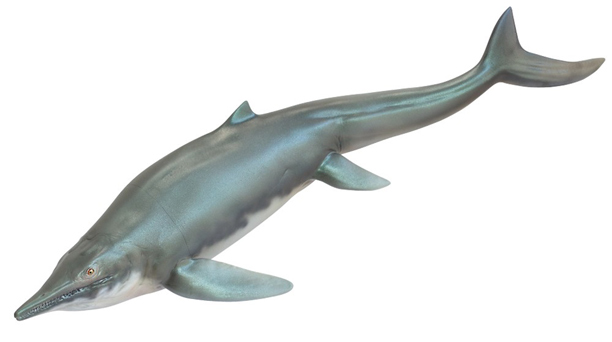
PNSO Himalayasaurus
The new for 2021 PNSO Tucson the Himalayasaurus model.

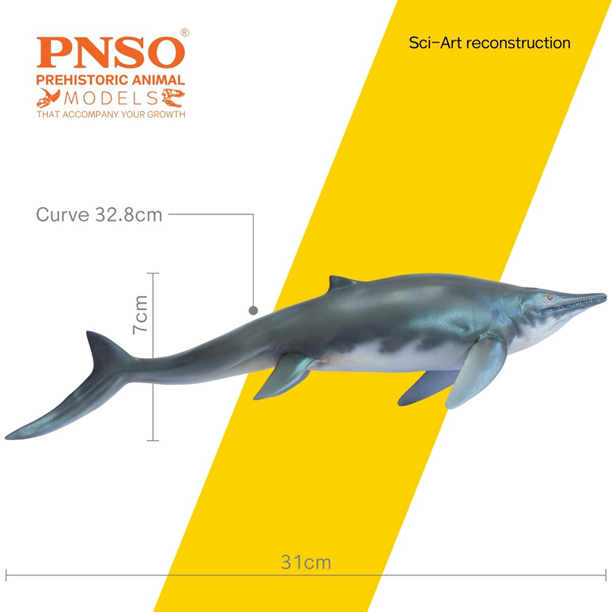
PNSO Himalayasaurus Model Measurements

The PNSO Himalayasaurus model measures 31 cm long. The actual model measures a total of 32.8 cm when the curvature of the replica is considered. The distance between the dorsal fin and the bottom lobe of the asymmetrical caudal fin is 7 cm.

PNSO do not publish a scale for their mid-size models. However, based on the curved length of the figure and the size estimate of Himalayasaurus postulated by palaeontologists, team members at Everything Dinosaur suggest that Tucson the Himalayasaurus is in approximately 1:45 scale.

PNSO Tucson the Himalayasaurus model measurements
The PNSO Tucson the Himalayasaurus measures 31 cm in length. The curved length of this marine reptile model is 32.8cm and the height 7 cm.

PNSO Tucson the Himalayasaurus

Everything Dinosaur team members are not sure why this particular marine reptile model has been named “Tucson”, what we are certain about is that this stunning figure will be supplied with two transparent support stands to help the model to be displayed.

Product packaging - PNSO Himalayasaurus
The product packaging for the PNSO Himalayasaurus marine reptile model. The figure is supplied with two transparent support stands to help the model to be displayed.

In Stock at Everything Dinosaur

A spokesperson for Everything Dinosaur confirmed that the PNSO Tucson the Himalayasaurus would be in stock at Everything Dinosaur possibly as early as November (2021). The spokesperson added:

“We have known about this exciting model for a while. The Himalayasaurus and other new for 2021 PNSO figures are already on the water heading for a UK port. It is wonderful to see PNSO bringing out more prehistoric marine animals to add to their recently introduced Helicoprion, Dunkleosteus, Basilosaurus, Tylosaurus and Kronosaurus models”.

To view the range of PNSO prehistoric animal models currently in stock at Everything Dinosaur: PNSO Age of Dinosaurs.

The Everything Dinosaur website: Dinosaur Models.

9 10, 2021

Over a Hundred Rare Theropod Tracks Studied in New Research

By |2024-07-27T16:53:43+01:00October 9th, 2021|Categories: Adobe CS5, Dinosaur and Prehistoric Animal News Stories, Dinosaur Fans, Main Page, Palaeontological articles, Photos/Pictures of Fossils|0 Comments

Scientists writing in the on-line, open access, academic journal “PeerJ” have reported upon the discovery of over 100 dinosaur fossil footprints. The footprints represent theropod dinosaurs and they vary in size indicating that a variety of meat-eating dinosaurs co-existed in the late Early Jurassic of Yunnan Province, China.

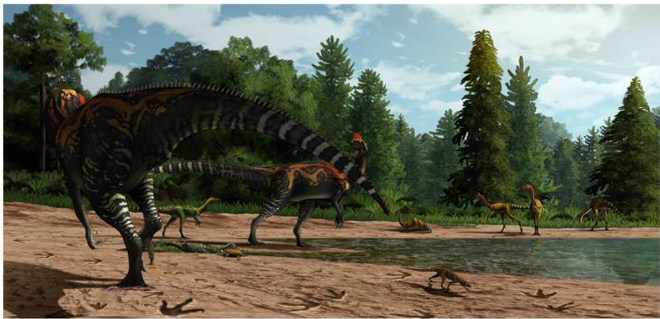
Yunnan theropods life reconstruction.
A life reconstruction depicting the lakeside palaeoenvironment with a variety of different theropods visiting the location. Picture credit: Yu Chen.

Yunnan Province Dinosaurs

Yunnan Province in south-western China is famous for its dinosaur fossils, the majority of which are body fossils, but there have been several published papers detailing track sites and more trace fossils from this province are due to be reported upon. The theropod assemblage track site is located close to the village of Xiyang, Jinning County in central Yunnan. The strata in which the tracks are located come from the Lower Jurassic Fengjiahe Formation and represent a lakeside environment (lacustrine). The reddish mudstone deposits that contain the tracks also preserve mud cracks that suggest the area was subject to droughts. The palaeoenvironment is believed to have been humid and warm (sub-tropical to tropical).

Theropod Tracks

The tracks have been known about for twenty years, but only recently has the site been extensively studied. Unfortunately, several prints had been lost to erosion prior to detailed analysis.

Yunnan theropod track site.
An overview of the track site with (A) an aerial photograph showing the track-bearing outcrop and (B) a line drawing showing the distribution of the theropod tracks. Morphotype A is highlighted in blue, morphotype B is highlighted in green and the single track of morphotype C is shown in red. Note scale bar equals 1 metre. Picture credit: Li et al.

Solitary Coelophysoid and Tetanuran Theropods

The Xiyang track site preserves 120 exposed footprints made by solitary theropod dinosaurs as they visited the lakeside. It is the largest theropod track site in terms of the total number of prints found, described to date from Yunnan. The prints have been assigned to three broad groups based on their size, they indicate that a variety of theropods were present in the ancient ecosystem including coelophysoid as well as larger tetanuran theropods.

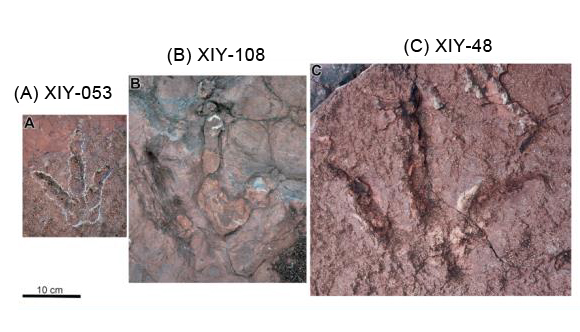
The largest print from the site (XIY-48) measures 39 cm long and 40 cm wide. Large claw marks are associated with each digit of this print. Fossils of the six-metre-long theropod Sinosaurus triassicus (formerly Dilophosaurus sinensis), are known from this area. Sinosaurus fossils from Lower Jurassic Fengjiahe Formation have been found around 500 metres away from the track site, it has been speculated that the largest print could represent a track made by a Sinosaurus, although as it is a footprint, it has been assigned to the ichnogenus Kayentapus.

Yunnan track site theropod footprints.
Photographs showing examples of the three different footprint morphotypes associated with the Yunnan track site. Not scale bar equals 10 cm. Picture credit: Li et al.

Classifying the Footprints

Although the size of any tracks left can be influenced by many factors, the research team conclude that at least three different kinds of theropods were visiting the site frequently. The three groups of prints that the tracks have been classified into are:

  1. Morphotype A (>8 cm to <21 cm) resembling the ichnogenus Grallator.
  2. Morphotype B (>27 cm to<30 cm) identified as the ichnospecies Kayentapus xiaohebaensis.
  3. Morphotype C (39 cm) an isolated print referred to the ichnogenus Kayentapus.
Line drawings comparing theropod footprints.
Line drawings comparing theropod tracks from the site with those from the Jurassic of China. XIY-053 is morphotype A (A), whilst (B) is XIY-108 morphotype B and (C) is morphotype C. Grallator yemiaoxiensis is shown (D), Kayentapus xiaohebaensis is (E) and (F) is Kayentapus hopii. Note scale bar = 10 cm. Picture credit: Li et al.

Large Predator Dinosaurs Rare in the Early Jurassic

In Yunnan, the majority of dinosaur fossils from Lower Jurassic rocks represent sauropodomorphs. Whilst the tracks of sauropodomorphs can be mistakenly identified as theropod prints, the researchers who include Hongqing Li of Yunnan University and Claire Peyre de Fabrègues (Department of Biology, Indiana University of Pennsylvania, USA), as well as colleagues from Yuxi Museum (Yunnan Province) and the Chinese Academy of Sciences are confident that this site provides a useful record of the diversity of meat-eating dinosaurs present in this region during the late Early Jurassic

Large terrestrial predators (animals in excess of five metres in length), are rare in Early Jurassic ecosystems. Large tracks are scarce at this site, but not absent. Carnivorous dinosaurs of all sizes presumably co-existed in this palaeoenvironment and were regular visitors to the lakeside in search of food or potential prey.

The scientific paper: “The largest theropod track site in Yunnan, China: a footprint assemblage from the Lower Jurassic Fengjiahe Formation” by Hongqing Li, Claire Peyre de Fabrègues, Shundong Bi, Yi Wang and Xing Xu published in PeerJ.

Visit the Everything Dinosaur website: Dinosaur Models and Toys.

7 10, 2021

A New Dinosaur Called Pendraig milnerae – “Chief Dragon”

By |2024-07-27T14:45:35+01:00October 7th, 2021|Categories: Adobe CS5, Dinosaur and Prehistoric Animal News Stories, Dinosaur Fans, Main Page, Palaeontological articles, Photos/Pictures of Fossils|0 Comments

Scientists have described the oldest theropod dinosaur from the UK. The dinosaur has been named Pendraig milnerae, the scientific name honours the dinosaur’s Welsh roots and recognises the contribution of Dr Angela Milner, who sadly passed away last August.

Everything Dinosaur recently blogged about the naming of two spinosaurids described from fragmentary fossils found on the Isle of Wight. The trivial name of one of these theropods, Riparovenator milnerae, also honours Dr Milner.

To read Everything Dinosaur’s recent blog post about the two newly described spinosaurids: Two New Spinosaurids from the Isle of Wight.

Ironically, the remains of Pendraig were already ancient fossils when the Isle of Wight spinosaurids roamed. The Pendraig fossils come from limestone fissure fills of the Pant-y-ffynnon Quarry in the Vale of Glamorgan (Wales). This infilled material, deposited in Carboniferous limestone is difficult to date, but it is thought that these fossils are between 215 and 201 million years old (late Norian, latest occurrence possibly late Rhaetian).

Pendraig milnerae life reconstruction.
A life reconstruction of Pendraig milnerae among the fissures of Pant-y-ffynnon with three individuals of the rhynchocephalian lepidosaur Clevosaurus cambrica for company (Late Triassic). Picture credit: James Robbins.

Misplaced Theropod Fossils

Writing in Royal Society Open Science, the researchers from the London Natural History Museum, the University of Birmingham and National Museums Scotland describe Pendraig milnerae based on an articulated pelvic girdle, sacrum and posterior dorsal vertebrae, and an associated left femur and by two referred specimens, comprising an isolated dorsal vertebra and a partial left ischium.

Co-author of the paper, Dr Susannah Maidment (London Natural History Museum), explained that the fossil material had been stored in a draw that contained crocodylomorphs. It was Dr Milner who was able to find the fossils within the vast Natural History Museum collection and to retrieve an unpublished PhD paper that had referred to them as part of a wider review of archosaurian remains associated with South Wales.

Pendraig milnerae pelvis and vertebrae.
Holotype fossil of Pendraig milnerae (NHMUK PV R 37591) the articulated pelvis and vertebrae (a) left lateral view and (b) right lateral view. Picture credit: Spiekman et al.

Welsh Dinosaurs

A phylogenetic analysis indicates that was a P. milnerae non-coelophysid coelophysoid and it represents the first-named, unambiguous theropod from the Triassic of the UK. The genus name translates from Middle Welsh as “chief dragon”. During the Late Triassic, the dinosaurs were not the dominant terrestrial animals that they were later to become. Discoveries of Triassic-aged theropods can help palaeontologists to better understand the evolution of these important tetrapods, the dinosaur lineage that led directly to modern birds.

Wales might be associated with dragons, but dinosaur discoveries are extremely rare in this part of the UK. Previously, only two dinosaur genera have been named – Pantydraco (P. cauducus) a basal sauropodomorph from a limestone fissure infill from the Pant-y-ffynnon Quarry and the coelophysoid Dracoraptor (D. hanigani) which was named and described in 2016 from fossils found near the Welsh town of Penarth.

Dracoraptor hanigani.
An illustration of the coelophysoid theropod dinosaur from Wales Dracoraptor hanigani. Picture credit: Bob Nicholls.

An Insular Dwarf

The palaeoenvironment in which Pendraig lived was most likely an archipelago and species that live on small islands with limited resources can become smaller than their mainland relatives due to a phenomenon known as insular dwarfism.

Measuring around 75 cm to a metre in length P. milnerae was indeed small, a characteristic that it shares with a number of other vertebrates known from the same deposits.

Lead author of the paper, Dr Stephan Spiekman (London Natural History Museum), explained:

“Because the fossil reptiles from this area, including Pendraig, are all quite small-sized, we used statistical analyses to investigate whether Pendraig might have been an insular dwarf. The results indicate that Pendraig is indeed small, even for a theropod of that time period, but not uniquely so”.

Analysis of the fossil bones, indicate that the material does not represent a juvenile or very young animal. However, the fossils do represent an animal that was probably not fully grown when it died.

Views of the left femur of Pendraig.
Various views of the holotype femur of Pendraig milnerae from the Late Triassic of Wales. Picture credit: Spiekman et al.

The researchers conclude that Pendraig may have been a dwarf form but as some other coelophysoid taxa also show a similar size reduction (based on femur bone length comparisons), it is not possible to say with certainty that this little Welsh, Triassic dinosaur was indeed an insular dwarf.

Dr Spiekman added:

“With this in mind, we need more evidence from more species to investigate the potential for island dwarfism in this area during that time, but if we could prove it, it would be the earliest known occurrence of this evolutionary phenomenon”.

The scientific paper: “Pendraig milnerae, a new small-sized coelophysoid theropod from the Late Triassic of Wales” by Stephan N. F. Spiekman, Martín D. Ezcurra, Richard J. Butler, Nicholas C. Fraser and Susannah C. R. Maidment published in Royal Society Open Science.

Visit the Everything Dinosaur: Dinosaur Toys.

Go to Top