All about dinosaurs, fossils and prehistoric animals by Everything Dinosaur team members.

Fossil finds, new dinosaur discoveries, news and views from the world of palaeontology and other Earth sciences.

1 10, 2022

Classifying Palaeontology in Video Games

By |2022-10-02T07:14:45+01:00October 1st, 2022|Categories: Dinosaur and Prehistoric Animal News Stories, Dinosaur Fans, Main Page, Palaeontological articles|4 Comments

Everything Dinosaur team members wrote a blog post a few days ago about how palaeontology is depicted in video games. The University of Birmingham led research, published recently in the journal EGUsphere Geoscience Communications, examined how the science of palaeontology is portrayed to the public, at a time when many people get a lot of their knowledge from media and entertainment.

To read Everything Dinosaur’s blog post about this research: Palaeontology in Video Games.

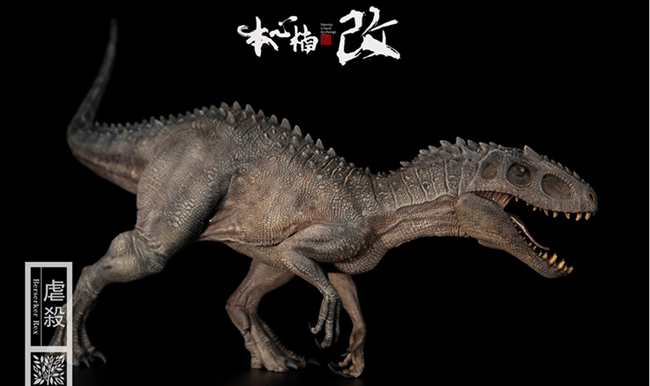
Nanmu Studio Indominus Berserker Rex
A model of a genetically designed dinosaur. Inspired by InGen? Video games and other media such as films are having a big influence on how the Dinosauria are perceived by the public.

Classifying How Video Games Depict Palaeontology

In order to understand how palaeontology and other related Earth sciences are portrayed, the research team looked at palaeontological content and classified it into a number of categories.

Here is the list of categories the team used:

  • Ancient animals as adversaries – using ancient animals – typically dinosaurs and pterosaurs – as adversaries that must be killed. Examples include The Legend of Zelda, Tomb Raider and Peter Jackson’s King Kong video game.
  • Ancient animals as tools – for example Yoshi, an omnivorous theropod dinosaur who first appeared in Super Mario World as a mount for the Mario brothers in their adventures to rescue Princess Peach.
  • Fossils as collectables – items found throughout the game setting to help the player progress through the game. For example, Red Dead Redemption 2 features a side quest to locate 30 fossil specimens in order to assist an aspiring palaeontologist.
  • Ancient animal management simulators, otherwise referred to as “park sims” – games such as the Jurassic World Evolution aim to construct a financially viable park or zoo.
  • Ancient animal simulators – players control an individual animal through an entire life cycle in a natural, open world, environment such as Saurian or Ancestors: The Humankind Odyssey.

Helping or Hindering the Perception of Palaeontology

Once the researchers had classified the video game content, they set about devising a rating system to determine whether the depiction hindered or helped the science of palaeontology and how it was depicted in cyberspace compared to the real world.

The factors analysed to determine the impact were:

  • Ancient death machines – ancient animals as vicious, frightening and brutish enemies for players to combat. AKA ‘monsterification’, the animal’s proportions and features like claws and horns are exaggerated – for example in Ark: Survival Evolved.
  • Fossil = dinosaur = Tyrannosaurus: lack of palaeodiversity – Dinosaurs have become almost synonymous with ancient life in the entertainment industry. Ancient animal diversity is often limited to a handful of “iconic” species recycled by the entertainment industry.
  • Palaeotrivia – In order to help players understand complex topics or introduce story elements, many games feature in-built encyclopaedias about characters, objects and locations in the game setting – particularly in park management games such as Jurassic World: Evolution series.
  • Depiction of palaeontological science – most palaeo-video games integrate science into gameplay that increases the knowledge of the player, but they can take creative liberties in order to make engaging gameplay mechanics. In essence, these games may depart from the science narrative all too readily.
  • Representation of ethics in palaeontological video games – Palaeontology has a long colonial history with deep-rooted exploitative practises which appear within games unchallenged, for example the illegal buying and selling of fossils in Jurassic World: Evolution.
  • Male, pale and stale – palaeontologists in video games are typically depicted as old, white men or the ‘Indiana Jones stereotype’ – for example Stardew Valley and Dinosaur Fossil Hunter.
  • Perpetuation of harmful, misogynistic, and racist tropes – while female lead characters are becoming more commonplace, games still sexualise women more than their male counterparts, particularly in depictions of early humans.

The Most Common Palaeontological Tropes

By highlighting the most common palaeontological tropes, both negative and positive, identified in video games, the researchers hope to assist science communicators when working in the virtual reality or gaming sector. In addition, by flagging common misconceptions and harmful tropes, the research team aims to raise awareness amongst game developers, who may be unaware that they could be perpetuating negative notions about the Earth sciences.

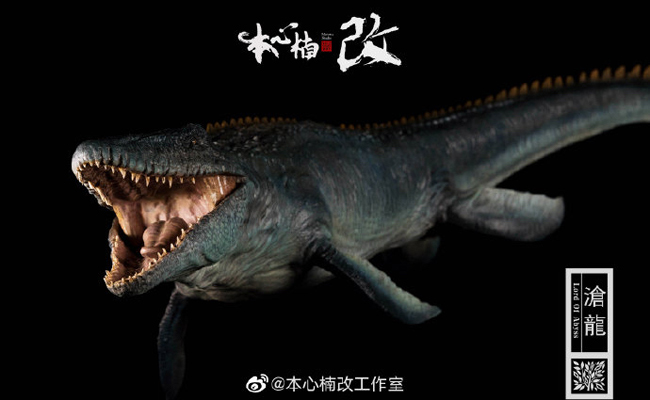
Mosasaurus model.
Nanmu Studio Mosasaurus “Lord of the Abyss”. A marine reptile model inspired by how prehistoric animals are depicted in movies and video games.

The prehistoric animal images used to illustrate this article feature Nanmu Studio prehistoric animal models. To view the Nanmu Studio range in stock at Everything Dinosaur: Nanmu Studio Dinosaur and Prehistoric Animal Models.

The scientific paper: “The perception of palaeontology in commercial off-the-shelf video games and an assessment of their potential as educational tools” by Thomas Clements, Jake Atterby, Terri Cleary, Richard P. Dearden and Valentina Rossi published in EGUsphere Geoscience Communications.

28 09, 2022

Research Suggests Ancient “Sharks” Appeared Much Earlier

By |2024-03-19T16:49:26+00:00September 28th, 2022|Categories: Dinosaur and Prehistoric Animal News Stories, Main Page, Palaeontological articles, Photos/Pictures of Fossils|0 Comments

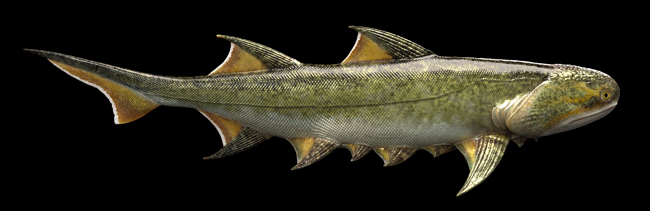
Newly published research suggests that ancient “sharks” appeared much earlier than previously thought. A fossil from China represents a new species of jawed fish (Qianodus duplicis) and its discovery suggests that fishes with true jaws first evolved in the Early Silurian.

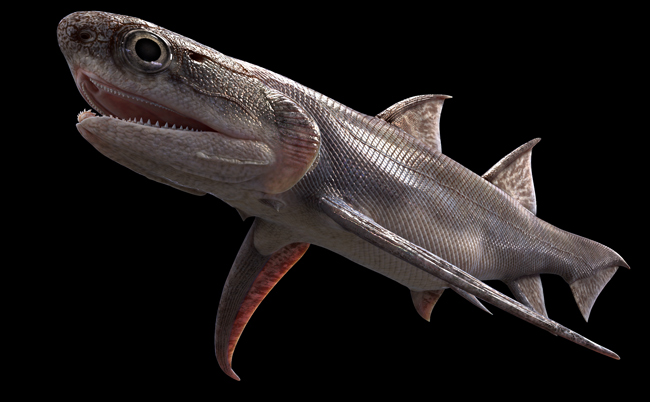
Qianodus duplicis life reconstruction
Qianodus duplicis, a new genus and species of an early Silurian gnathostome. Picture credit: Heming Zhang/University of Birmingham.

An Early Silurian Origin of Shark-like Jaws

The scientific paper, published in the journal “Nature” identifies Q. duplicis as the earliest record of a toothed gnathostome known to science. Its discovery extends the record of toothed gnathostomes by some 14 million years from the Late Silurian into the Early Silurian (around 439 million years ago).

The fossils (a handful of tiny teeth), found in China represent the earliest direct evidence for jawed vertebrates known to science.

Previously, the earliest jawed fish to be positively identified, included species from the Late Silurian, fossils thought to date from around 424 million years ago. These include the placoderms (Class Placodermi) partially armoured gnathostomes, and sarcopterygians, bony “lobe-finned” fishes found initially in China and Vietnam.

Confirming Evidence from Fossil Fish Scales

Co-author of the paper, Dr Ivan Sansom (University of Birmingham), commented:

“Until this point, we’ve picked up hints from fossil scales that the evolution of jawed fish occurred much earlier in the fossil record, but have not uncovered anything definite in the form of fossil teeth or fin spines.”

Construction workers building a new road in Guizhou Province uncovered fossil material and field teams from the Chinese Institute of Vertebrate Palaeontology and Palaeoanthropology (IVPP) and the Qujing Normal University (QJNU), were despatched to take samples and to analyse the Silurian-aged deposits.

The scientists found numerous scales, but also recovered several miniscule fossil teeth between 1.5 mm and 2.5 mm in length.

Dr Sansom explained:

“Scales are relatively easy to find because they are so plentiful, but teeth are much scarcer. The scale and speed at which IVPP and QJNU colleagues were able to sift through the material enabled us to identify these scarce remains more effectively than in previous projects.”

Around twenty of the tiny fossil teeth turned out to be from the same species (Qianodus duplicis). From the arrangement of the teeth and their morphology, the team established that they would have come from a fish with an arched jaw margin, with offset tooth rows, similar to those found in extant sharks. The team used a range of techniques, including Computed Tomography (CT scans), to establish a date for the samples.

What’s in a Name?

The new species Qianodus duplicis comes from “Qian” the ancient name for Guizhou Province, “odus” from the Greek for tooth, and duplicis, or double, referring to the paired rows of teeth.

A Cartilaginous Fish – Fanjingshania renovata

In a separate paper, also published today in Nature, the team also identified fossil elements that relate to “fin spines”, bony projections in front of the fins which can be seen today on Port Jackson sharks. These spiny structures form the basis for the identification of a new species Fanjingshania renovata named after Mount Fanjingshan which is close to the locality from where the fossil material was collected. The species name “renovata”, acknowledges renewal, the remodelling of the base of the spines and scales.

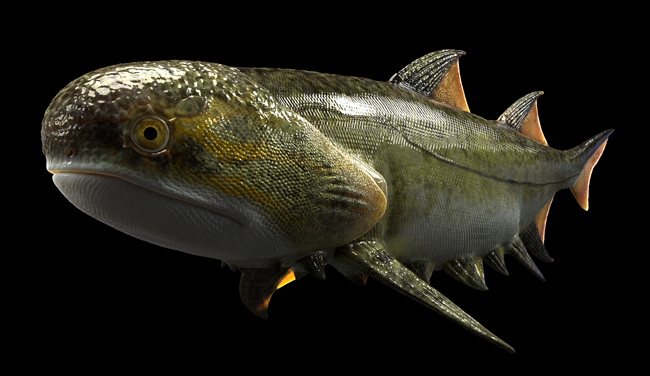
Fanjingshania renovata life reconstruction.
Fanjingshania renovata life reconstruction. Picture credit: Heming Zhang/University of Birmingham.

Lead author of both papers Dr Plamen Andreev (Qujing Normal University), commented:

“The early so-called “spiny sharks” had these features on all of their fins, but the examples that we have found belong to a much earlier period. These are the first creatures that we would recognise today as fish-like, evolving from creatures often referred to as “clams with tails”, from earlier in the Ordovician period.”

Ancient “Sharks” Appeared Much Earlier

Cartilaginous fish (chondrichthyans), including sharks, separated off at some point from osteichthyans (bony fish and tetrapods), from which our own species eventually evolved. The point at which this occurred, however, is obscured within ghost lineages in the Ordovician, where only hints in the fossil record have been found. Precisely how and when this separation happened, therefore, remains ambiguous.

Ancient "sharks" appeared much earlier.
Fanjingshania life reconstruction in lateral view. Picture credit: Heming Zhang/University of Birmingham.

Everything Dinosaur acknowledges the assistance of a media release from the University of Birmingham in the compilation of this article.

The scientific paper: “The oldest gnathostome teeth” by Plamen S. Andreev, Ivan J. Sansom, Qiang Li, Wenjin Zhao, Jianhua Wang, Chun-Chieh Wang, Lijian Peng, Liantao Jia, Tuo Qiao and Min Zhu published in Nature.

The scientific paper announcing Fanjingshania renovata: “Spiny chondrichthyan from the lower Silurian of South China” by Plamen S. Andreev, Ivan J. Sansom, Qiang Li, Wenjin Zhao, Jianhua Wang, Chun-Chieh Wang, Lijian Peng, Liantao Jia, Tuo Qiao and Min Zhu published in Nature.

27 09, 2022

Palaeontology in Video Games

By |2023-02-07T09:25:47+00:00September 27th, 2022|Categories: Adobe CS5, Dinosaur and Prehistoric Animal News Stories, Dinosaur Fans, Main Page, Palaeontological articles|3 Comments

Palaeontology, dinosaurs and prehistoric animals are frequently subjects for video games. Players have the opportunity to construct their own “Jurassic Park”, go fossil collecting and combat dinosaurs. A new study indicates that these games may contain negative and harmful themes that can confuse and lead to misconceptions about palaeontology.

An international team of researchers, led by scientists from the University of Birmingham, played and studied a variety of video games containing elements of palaeontology. An eclectic range of video games were sampled including Super Mario World, Animal Crossing and the “Jurassic Park/World” games. The team attempted to map what was “palaeo-fact” and what was “palaeo-fiction”.

A timeline of palaeontology in video games
Timeline of palaeontology in video games. Picture credit: Clements et al/University of Birmingham.

Sorting “Palaeo-fact” from “Palaeo-fiction”

Dr Thomas Clements (University of Birmingham) and a co-author of the study explained:

“Loads of people are inspired by and get their understanding of dinosaurs from movie blockbusters like Jurassic Park, but no one talks about how massive the gaming industry is in shaping not only the public’s understanding of ancient life and also of paleontological science.”

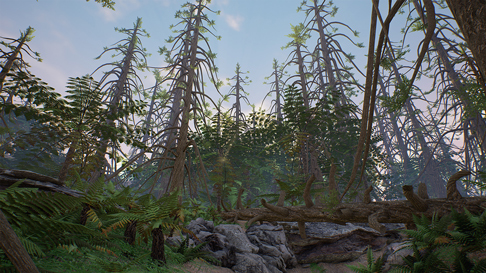
A Triassic forest from a video game.
Gamers will be able to explore a number of terrestrial environments. A Triassic forest environment from a video game. Picture credit: Daniel Carter.

Pleasantly Surprised by the Accuracy

The researchers were pleasantly surprised by the accuracy of some of the games. However, they quickly identified numerous negative tones that were repeatedly reflected in the gaming environment.

Dr Clements commented:

“When we played through many of these games, we were pleasantly surprised about the accuracy of games like Animal Crossing that provide accurate and educational information in a fun and engaging way. However, we also found that many games contain misleading, negative, and sometimes quite damaging themes – many already widespread issues in the gaming industry. It is common for palaeo-games to contain ethically dubious science, the illegal collection of fossils, ‘monsterification’ of animals, poor representation of minority groups, and the hypersexualisation of women.”
Writing in the journal EGUsphere Geoscience Communications, the scientists analysed the representation of palaeontology in hundreds of video games, classifying them into several categories. They then defined a number of factors which may help or hinder a video game’s effectiveness in promoting palaeontology to a wider audience. Their study has implications for ways that science communicators can address these issues when talking to the public about palaeontology and has a wider role in helping to support gender equality and ethnic diversity.

Portraying Palaeontology to the Public

Co-author Jake Atterby (University of Birmingham), stated:

“This paper is about how the science of palaeontology is portrayed to the public, at a time when many people get a lot of their knowledge from media and entertainment. Audiences can subconsciously learn from the media they consume, including depictions of our science that are deliberately exaggerated for entertainment. This can give players a false impression of ancient life and the work that we do. It is important for palaeontologists to understand the public’s perception of our science to help when we communicate our research.

Everything Dinosaur acknowledges the assistance of a media release from the University of Birmingham in the compilation of this article.

The scientific paper: “The perception of palaeontology in commercial off-the-shelf video games and an assessment of their potential as educational tools” by Thomas Clements, Jake Atterby, Terri Cleary, Richard P. Dearden and Valentina Rossi published in EGUsphere Geoscience Communications.

22 09, 2022

Bring Back “April” Campaign Launched to Restore Unique Fossil Specimen

By |2024-04-13T08:57:39+01:00September 22nd, 2022|Categories: Adobe CS5, Dinosaur and Prehistoric Animal News Stories, Dinosaur Fans, Main Page, Palaeontological articles|0 Comments

The University of Manchester has launched a campaign to bring back “April” the Tenontosaurus. Manchester Museum is asking for public support to install a stunning Tenontosaurus fossilised skeleton, one of the most complete specimens of this Early Cretaceous ornithopod ever found.

The Museum is hoping to raise £10,000 GBP ($11,280.00 USD), to enable the Tenontosaurus to be restored and installed in the Dinosaurs and Fossils gallery as an exhibit with the 110-million-year-old fossil bones in their correct anatomical positions.

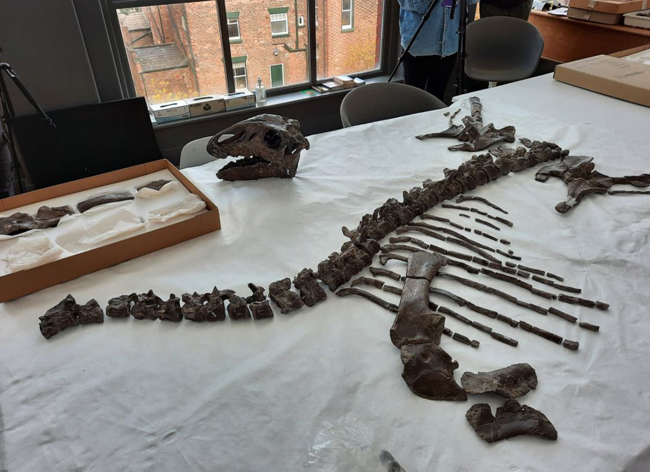
The fossilised remains of April the Tenontosaurus laid out in anatomical position.
The fossilised remains of “April” the Tenontosaurus partially laid out in anatomical position. Picture credit: The University of Manchester.

The Tenontosaurus specimen (MANCH LL.12275) was purchased by the University of Manchester in 1999. It has been the subject of a recent scientific paper which confirmed the presence of gastroliths (stomach stones), the first evidence of gastroliths to be identified in a derived member of the Ornithopoda.

To read about this scientific research: “April” the Tenontosaurus Reveals Her Secrets.

Bring Back “April”

The stunning fossil specimen comes from Montana, and it is affectionately named “April” after the wife of Barry James who originally prepared the fossil for display. When first put on show to the public it was portrayed in an upright position, like a super-sized kangaroo with its tail resting on the ground. However, research from Earth Sciences students from the University of Manchester has shed light on how the skeleton would have walked and posed in life.

Tenonotosaurus skeleton made ready for exhibition.
The original mount of “April” the Tenontosaurus. The skeleton was dismantled and put into storage when a replica of a T. rex skeleton made its debut at the museum. Picture credit: The University of Manchester.

Thousands of Hours of Restoration Work is Required

The Curator of the Earth Science Collections at the Manchester Museum David Gelsthorpe outlined the aims of the fund-raising effort and explained some of the problems that this restoration project will pose.

He commented:

“April is a Tenontosaurus purchased by Manchester Museum in 1999 and was previously displayed standing upright. Over the past few years, we have been working with a team of Earth Sciences students from the University of Manchester to carefully study April’s bones and find out more about her. Using their palaeontology skills and computer modelling, their research has helped us to better understand how she would have moved on all fours. As well as changing the way the skeleton stands, over 10,000 hours of careful conservation work is required to restore its bones.”

The Museum is requesting donations to help bring “April” back to her best and to permit her to be once again an integral part of the Museum’s Dinosaurs and Fossils Gallery.

To read more about this campaign and to make a donation: Support Manchester Museum Help Bring “April” Back.

The restored skull of "April" the Tenontosaurus
Tenontosaurus skull in left lateral view. The stunning and beautifully restored “April” the Tenontosaurus skull. Picture credit: The University of Manchester.

A New Dinosaur Display

If the fund raising succeeds than the Tenontosaurus specimen will form the focal point of a brand-new exhibition devoted entirely to the Dinosauria, planned for April 2023. Visitors will have the opportunity to view prehistoric giants, such as “Stan” the Tyrannosaurus rex cast and to learn about British dinosaur fossil discoveries. The demise of the Dinosauria and many other types of animals and plants as a result of a mass extinction event, some sixty-six million years ago, will be linked to today’s problems of climate change and the current rate of extinction.

Manchester Museum.
The front entrance of the Manchester Museum, a neo-Gothic building that houses approximately 4.5 million artefacts from the natural sciences and human history. A new dinosaur exhibit is scheduled to open in February 2023. Picture credit: The University of Manchester.

Plans for the new dinosaur exhibit are part of a larger scheme of improvements planned for Manchester Museum which has been entitled “Hello Future”.

To play your part and contribute to “April’s” restoration, please visit: Support Manchester Museum. Every donation will go towards helping to put “April” back on display.

Everything Dinosaur acknowledges the assistance of a media release from Manchester Museum in the compilation of this article.

16 09, 2022

A Devonian Heart

By |2023-02-25T20:51:42+00:00September 16th, 2022|Categories: Adobe CS5, Dinosaur and Prehistoric Animal News Stories, Main Page, Palaeontological articles, Photos/Pictures of Fossils|0 Comments

Researchers have discovered a 380-million-year-old fossilised heart, along with other internal organs of prehistoric fish. This exciting discovery is not only helping palaeontologists to understand the internal organs of placoderms, these fossils are also providing a fresh perspective on our own evolution.

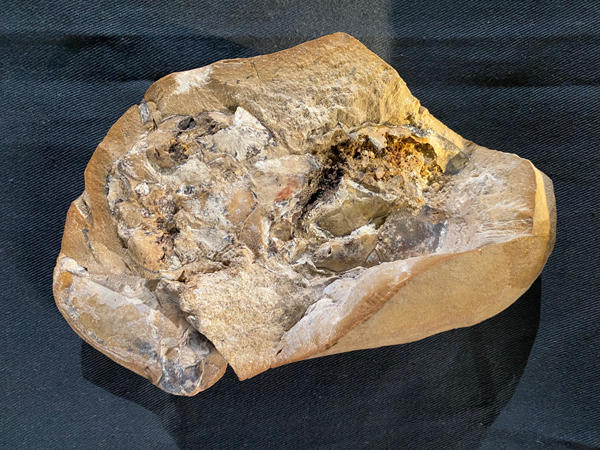
The Gogo fish fossil where the 380-million-year-old, 3-D preserved heart was discovered by the research team.
The Gogo fish fossil where the 380-million-year-old, 3-D preserved heart was discovered by the research team. Picture credit: Curtin University.

Fossilised Internal Organs in Ancient Armoured, Jawed Fish

The remarkably well-preserved fossils representing the Devonian placoderm Compagopiscis, come from the famous Gogo Formation, in the Kimberley region of Western Australia. The Gogo Lagerstätte preserves the fauna that once thrived on an ancient, shallow water reef. The fossils are thought to be around 380 million years old (Frasnian faunal stage of the Late Devonian).

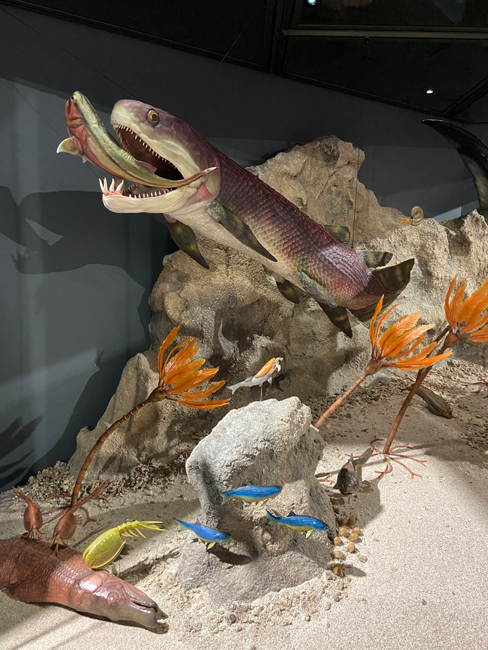
Gogo fish diorama
Gogo fish diorama at the West Australia Museum Boola Bardip depicting the typical fauna associated with the Gogo Lagerstätte. Typical inhabitants of a tropical reef that existed approximately 380 million years ago. Picture credit: Curtin University.

Soft Tissues Including Liver and Intestines but No Evidence of Lungs

The international research team led by scientists from Curtin University and the Western Australia Museum have published their findings in the academic journal “Science”. They have identified a number of internal organs preserved in three-dimensions including the liver and intestines. Additionally, the fossils show that the lungs are absent, refuting the hypothesis that lungs are ancestral in jawed vertebrates.

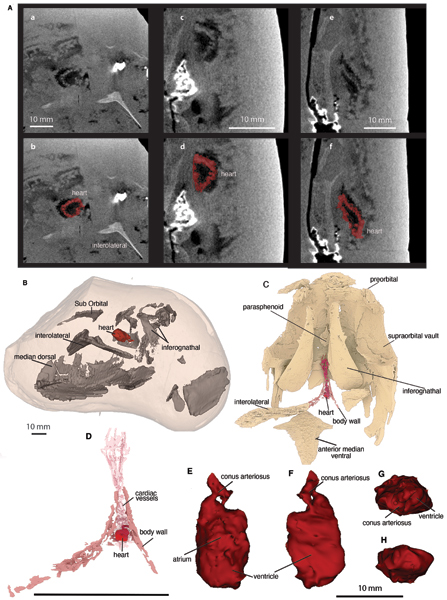
CT scans and interpretive models showing the heart of the placoderm Compagopiscis.
CT scans and interpretive models showing the heart of the placoderm Compagopiscis. Picture credit: Curtin University.

Details Revealed by Computerised Tomography

In collaboration with scientists at the Australian Nuclear Science and Technology Organisation in Sydney and the European Synchrotron Radiation Facility in Grenoble, France, researchers used neutron beams and synchrotron x-rays to scan the specimens, still embedded in limestone concretions. They constructed three-dimensional, computer-generated images of the soft tissues inside them based on the different densities of minerals deposited by the bacteria and the surrounding rock matrix.

Lead researcher and John Curtin Distinguished Professor Kate Trinajstic (Curtin’s School of Molecular
and Life Sciences and the Western Australian Museum), commented that to find three-dimensionally preserved tissues in Devonian fossils was an extremely rare event.

Professor Trinajstic explained:

“As a palaeontologist who has studied fossils for more than 20 years, I was truly amazed to find a 3-D and
beautifully preserved heart in a 380-million-year-old ancestor. Evolution is often thought of as a series of small steps, but these ancient fossils suggest there was a larger leap between jawless and jawed vertebrates. These fish literally have their hearts in their mouths and under their gills – just like sharks today.”

The Complex Heart of an Arthrodiran

This is the first time a 3-D representation of the heart of a member of the Arthrodira has been found. The Arthrodira are an extinct Order of jawed, armoured fish within the Class Placodermi. They thrived in the Devonian and some arthrodirans evolved into apex predators such as the huge Dunkleosteus.

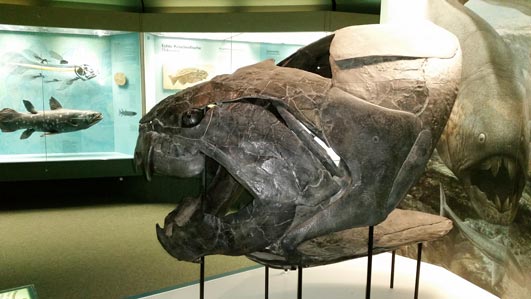
Dunkleosteus on display.
The spectacular Dunkleosteus exhibit. A giant apex predator of the Devonian. Picture credit: Everything Dinosaur.

The surprising complex heart is s-shaped and consists of two chambers with the smaller chamber sitting on top. Professor Trinajstic stated that these features were advanced in such early vertebrates, offering scientists a unique perspective on how the head and neck region began to change to accommodate jaws, a critical stage in the evolution of animals with backbones.

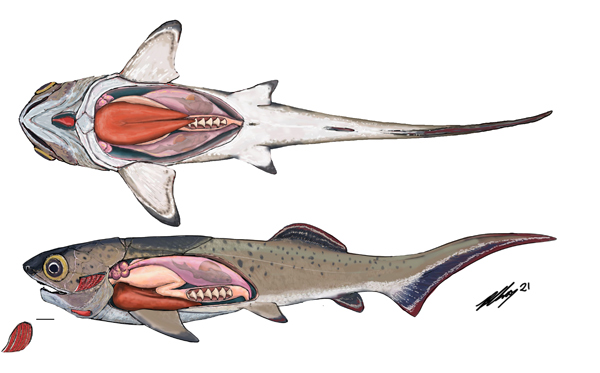
Reconstruction of arthrodire internal anatomy.
Reconstruction of arthrodire internal anatomy. Picture credit: Curtin University.

Learning About the Anatomy of a Primitive Jawed Fish

The discovery and subsequent detailed analysis of these mineralised soft tissues, in combination with earlier studies looking at muscle structure, placoderm embryos and evidence of viviparity makes the Gogo Lagerstätte an exceptionally important fossil resource as researchers strive to improve their knowledge of early vertebrates.

Professor Trinajstic added:

“For the first time, we can see all the organs together in a primitive jawed fish, and we were especially surprised to learn that they were not so different from us. However, there was one critical difference – the liver was large and enabled the fish to remain buoyant, just like sharks today. Some of today’s bony fish such as lungfish and bichirs have lungs that evolved from swim bladders, but it was significant that we found no evidence of lungs in any of the extinct armoured fishes we examined, which suggests that they evolved independently in the bony fishes at a later date.”

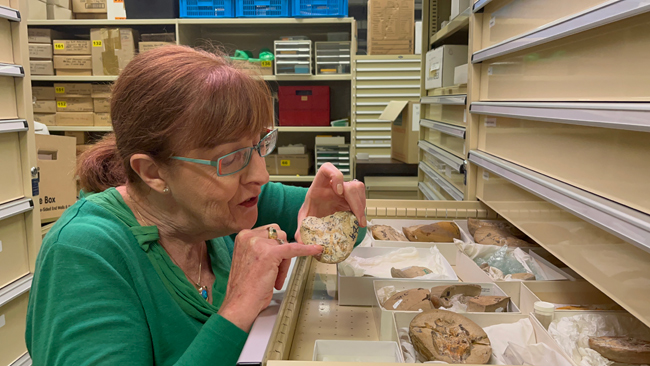
Professor Kate Trinajstic inspects the ancient fossils at the Western Australia Museum.
Professor Kate Trinajstic inspects the ancient fossils at the Western Australia Museum Boola Bardip. Picture credit: Curtin University.

The Stuff of Palaeontologists’ Dreams

Co-author of the scientific paper, Professor John Long (Flinders University, Adelaide, South Australia) commented:

“These new discoveries of soft organs in these ancient fishes are truly the stuff of palaeontologists’ dreams, for without doubt these fossils are the best preserved in the world for this age. They show the value of the Gogo fossils for understanding the big steps in our distant evolution. Gogo has given us world firsts, from the origins of sex to the oldest vertebrate heart, and is now one of the most significant fossil sites in the world. It’s time the site was seriously considered for world heritage status.”

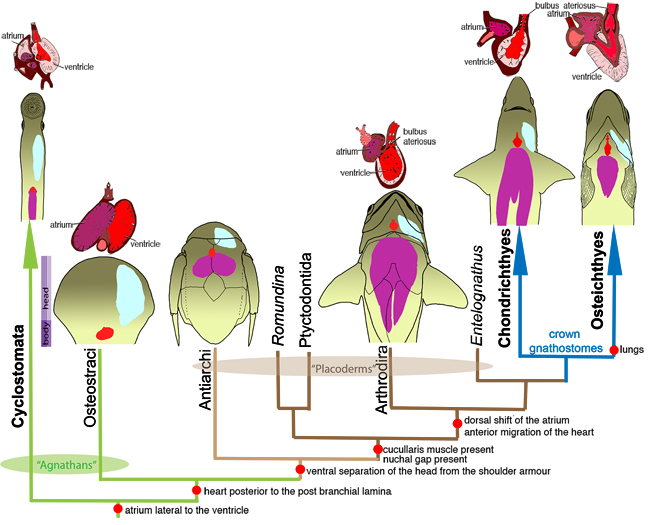
A cladogram depicting the evolution of the heart in early vertebrates.
A cladogram depicting the evolution of the heart in early vertebrates. Picture credit: Curtin University.

To read an earlier blog post about a fossil from the Upper Devonian Gogo Formation that indicates live birth (viviparity) in placoderms: Evidence of Live Birth (Viviparity) in a 380-million-year-old Fish.

Exceptional Fossils Meet Exceptional Technology

Co-author of the paper Professor Per Ahlberg (Uppsala University, Sweden) explained that access to state-of-the-art, non-destructive scanning technology enabled scientists to make such exceptional discoveries.

Professor Ahlberg explained:

“What’s really exceptional about the Gogo fishes is that their soft tissues are preserved in three dimensions. Most cases of soft-tissue preservation are found in flattened fossils, where the soft anatomy is little more than a stain on the rock. We are also very fortunate in that modern scanning techniques allow us to study these fragile soft tissues without destroying them. A couple of decades ago, the project would have been impossible.”

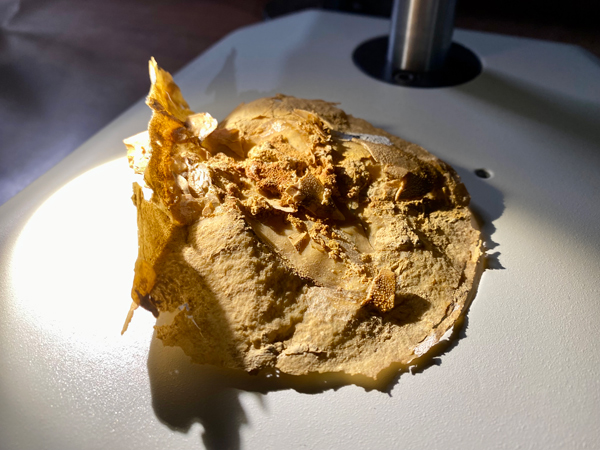
The preserved stomach of a Gogo fish fossil under the microscope.
The preserved stomach of a Gogo fish fossil under the microscope. Picture credit: Curtin University.

A Collaborative Effort

The research was truly a collaborative effort not only involving the Australian Nuclear Science and Technology Organisation and the European Synchrotron Radiation Facility, but also scientists from Flinders University, the Western Australian Museum, Uppsala University, South Australia Museum and Monash University’s Australian Regenerative Medicine Institute.

Everything Dinosaur acknowledges the assistance of a media release from Curtin University in the compilation of this article.

The scientific paper: “Exceptional preservation of organs in Devonian placoderms from the Gogo lagerstätte” by Kate Trinajstic, John A. Long, Sophie Sanchez, Catherine A. Boisvert, Daniel Snitting, Paul Tafforeau, Vincent Dupret, Alice M. Clement, Peter D. Currie, Brett Roelofs, Joseph J. Bevitt, Michael S. Y. Lee and Per E. Ahlberg published in the journal Science.

12 09, 2022

Nibbling Away at Earliest Date for True Mammals

By |2022-10-18T10:24:09+01:00September 12th, 2022|Categories: Adobe CS5, Dinosaur and Prehistoric Animal News Stories, Dinosaur Fans, Main Page, Palaeontological articles|0 Comments

An analysis of the teeth of a small shrew-like animal known as Brasilodon quadrangularis from Upper Triassic strata in the Paraná Basin of Brazil indicates that its fossils might represent the lineage towards true mammals. As such, it pushes back the origins of Mammaliaformes by 20 million years.

Analysis of three lower jaws from B. quadrangularis, each jaw representing a different growth stage demonstrates diphyodont dentition, a key characteristic of mammals.

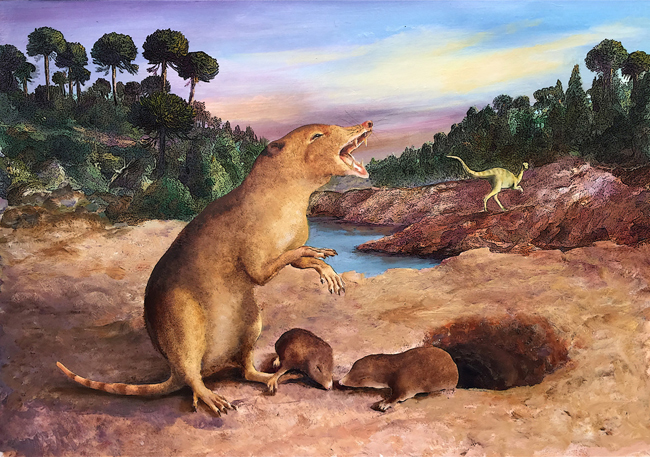
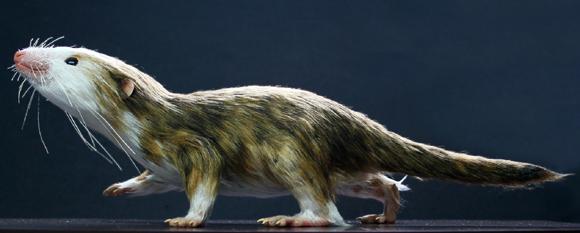
A life reconstruction of the newly described Brasilodon quadrangularis.
A life reconstruction of Brasilodon quadrangularis a contemporary of some of the oldest dinosaurs, one of which can be seen in the background. Picture credit: 2022 Anatomical Society Wiley.

Diphyodonty a Trait of Mammals and Their Near Relatives

Brasilodon is the oldest extinct vertebrate with two successive sets of teeth which includes only one set of replacements (diphyodonty). The first set starts developing during the embryonic stage and a second and last set of teeth develops once the animal is born. The dental replacement pattern occurs with the same temporal and morphological pattern that is a key feature of mammals. This differs from that of reptiles who regenerate new teeth multiple times during their lives, (polyphyodonty).

Researchers from the London Natural History Museum and King’s College London contributed to this international research programme which was led by scientists from the Federal University of Rio Grande do Sul.

Corresponding author of the paper, published in the “Journal of Anatomy”, Dr Martha Richter (Earth Sciences Department, Natural History Museum), commented:

“Comparative studies with recent mammal dentitions and tooth replacement modes suggest that this [B. quadrangularis] was a placental, relatively short-lived animal. Dated at 225.42 million years old, this is the oldest known mammal in the fossil record contributing to our understanding of the ecological landscape of this period and the evolution of modern mammals.”

20 Million Years Older than Morganucodon

The genus Morganucodon had been thought to represent the earliest mammaliaform, its fossils having been found in Europe (Wales), China and North America. Morganucodon fossil material is associated with the very latest Norian and the Rhaetian faunal stages of the Late Triassic. However, the genus Brasilodon is associated with much older Triassic deposition which took place around 225 million years ago.

Staying small helped A model of the Late Triassic mammaliaform evolution during the Mesozoic.
A model of the Late Triassic mammaliaform Morganucodon. Picture credit: University of Birmingham.

Mammalian Characteristics

Diphyodonty is a complex and unique phenomenon that along with tooth replacement involves profound, time-controlled changes to the skull anatomy, for instance the closure of the secondary palate (the roof of the mouth) that permits the young to suckle, while breathing at the same time. It has also been shown to be linked to endothermy and even placentation (live birth) and that other significant mammalian trait, the growth of hair and fur.

Brasilodon comes from the Caturrita Formation which preserves a rich assemblage of fossil vertebrates including sphenodonts, lepidosaurs, rhynchosaurs, dicynodonts and numerous cynodonts as well as silesaurids and dinosaurs (theropods and sauropodomorphs). Fossils also found in this formation hint at an ancestor of the Pterosauria (Faxinalipterus).

Brasilodon probably lived in burrows like many rodents today.

Everything Dinosaur acknowledges the assistance of a press release from the Natural History Museum (London) in the compilation of this article.

The scientific paper: “Diphyodont tooth replacement of Brasilodon—A Late Triassic eucynodont that challenges the time of origin of mammals” by Sergio F. Cabreira, Cesar L. Schultz, Lúcio R. da Silva, Luiz Henrique Puricelli Lora, Cristiane Pakulski, Rodrigo C. B. do Rêgo, Marina B. Soares, Moya Meredith Smith and Martha Richter published in the Journal of Anatomy.

9 09, 2022

Unravelling the Plateosauridae – A New Species is Announced (T. maierfritzorum)

By |2023-08-30T20:21:35+01:00September 9th, 2022|Categories: Adobe CS5, Dinosaur and Prehistoric Animal News Stories, Dinosaur Fans, Main Page, Palaeontological articles, Photos/Pictures of Fossils|0 Comments

Researchers have re-examined the fossilised remains of a Late Triassic, herbivorous dinosaur that had been assigned to the Plateosaurus genus and determined that the fossils represent a new species. The new dinosaur has been named Tuebingosaurus maierfritzorum and unlike Plateosaurus it was an obligate quadruped.

Tuebingosaurus fossils and scale drawing.
Skeletal silhouette of Tuebingosaurus with ascribed fossil bones shown in white. Silhouette of person provides the scale. The attribution of the bone marked in grey (fibula) is uncertain. Picture credit: Omar Rafael Regalado Fernandez / Ingmar Werneburg.

The genus Plateosaurus was erected in 1837 (Hermann von Meyer), before the term Dinosauria was coined, it was one of the first dinosaurs to be scientifically described. It has earned a reputation as somewhat of a taxonomic waste basket with numerous species assigned to it, often based on poorly preserved or fragmentary fossil remains.

Researchers at the University of Tübingen’s Senckenberg Centre for Human Evolution and Palaeoenvironment in Germany reassessed fossil bones discovered in Trossingen in 1922 and identified several unique anatomical traits leading them to conclude that these remains did not represent Plateosaurus as had previously been thought. Indeed, the bones are so different that they do not belong to a member of the Plateosauridae family, but most likely represent a member of the related clade the Massopoda.

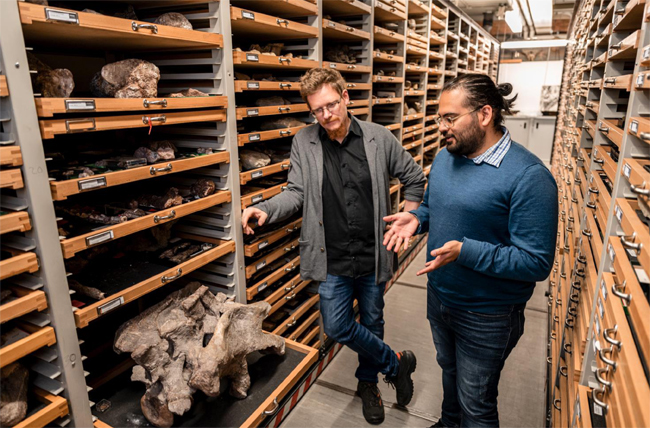
Tuebingosaurus hib bones viewed by the scientists.
Ingmar Werneburg (left) and Omar Rafael Regalado Fernandez (right) in the archive of the paleontological collection at Tübingen. The hips of Tuebingosaurus maierfritzorum can be seen in the foreground. Picture credit: Valentin Marquardt/Universität Tübingen.

Broader and More Robust Hips

Writing in the journal “Vertebrate Zoology”, the researchers, Dr Omar Rafael Regalado Fernandez and Dr Ingmar Werneburg demonstrate that the hips are much broader and more robust when compared with plateosaurs. In addition, the limb bones such as the femur are unusually large and the fused sacral vertebrae are characteristic of an obligate quadruped and not Plateosaurus that are believed to have been facultative bipeds (quadrupeds, but capable of walking on their hind legs if the need arose).

Tuebingosaurus fossils in display cabinet.
Two phalanges (toe bones) (centre) of Tuebingosaurus maierfritzorum in a display cabinet at the Württemberg Hall. Picture credit: Valentin Marquardt/Universität Tübingen.

The Swabian Alb Mountains

The fossil bones of Tuebingosaurus maierfritzorum display characteristics of sauropods, the super-sized, long-necked dinosaurs such as Diplodocus, Brontosaurus and Brachiosaurus that dominated terrestrial faunas some fifty million years after Tuebingosaurus roamed. The fossil material is part of Tübingen’s paleontological collection. It originated from a quarry site near Trossingen at the edge of the Swabian Alb mountain range in Baden-Württemberg (Germany). The area is famous for its extensive plateosaur bonebeds and the huge amount of Plateosaurus fossils collected confirm that this lizard-hipped genus was extremely common in the Late Triassic and that Plateosaurus lived in large herds.

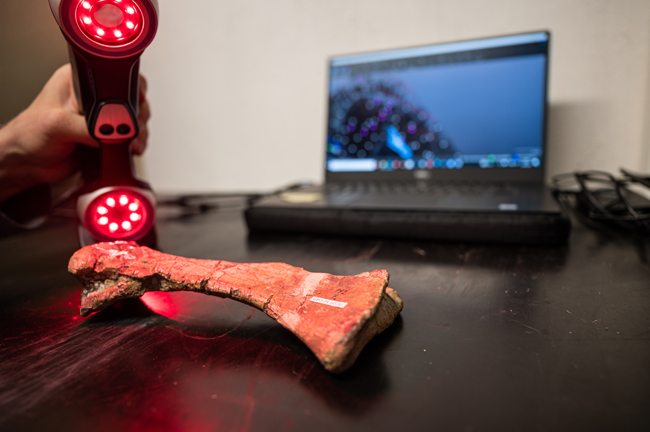
Scanning a Tuebingosaurus foot bone.
Three-dimensional image of a footbone from Tuebingosaurus being made with a handheld laser scanner. Picture credit: Valentin Marquardt/Universität Tübingen.

Following the in-depth analysis, which included scanning limb bones to provide a data source to compare to Plateosaurus fossils, the scientists concluded that these fossils represent a dinosaur more closely related to the Sauropoda than Plateosaurus.

The Trossingen Biota

Examination of the matrix material found in association with the Tuebingosaurus fossils, and the surface condition of the bones suggests that this dinosaur sunk into a swamp when it died. The bones on the left side of the body were exposed on the surface for several years and show signs of weathering.

Several different types of dinosaur are known from the Plateosaurus dominated Trossingen Formation, which dates to the Norian-Rhaetian faunal stages of the Late Triassic. Coelophysoids such as Liliensternus, which at around 5 metres long, could have predated upon Tuebingosaurus juveniles have been found. The Trossingen Formation has also yielded fragmentary fossils of other miscellaneous theropods plus evidence of different types of prosauropod.

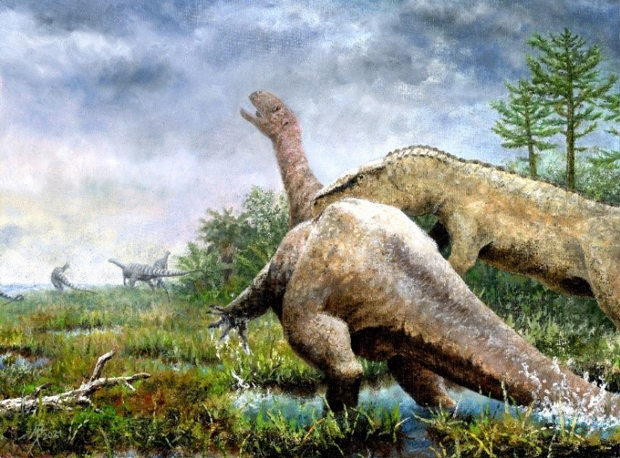
The large rauisuchian Teratosaurus (T. suevicus) is also known from the Trossingen Formation and in the image below an unfortunate Tuebingosaurus is being attacked by this six-metre-long, predator from the crocodilian lineage of the Archosauria.

Tuebingosaurus life reconstruction.
Reconstruction how the death of Tuebingosaurus maierfritzorum may have occurred. Bones of the predatory archosaur Teratosaurus were also found in Trossingen. However, it has only been proven that Tuebingosaurus fell on its right side. Weathering indicates that the bones on the left side of the body probably lay for several years on the surface. Picture credit: Marcus Burkhardt.

Tuebingosaurus maierfritzorum

The individual bones of Tuebingosaurus maierfritzorum (pronounced Too-bin-go-sore-us my-ah-frits-zor-um), had been stored separately but have now been united in their own permanent display case. The genus name honours the university city of Tübingen and its inhabitants, whilst the specific name pays tribute to two German zoologists, Professor Wolfgang Maier from Tübingen and Professor Uwe Fritz from Senckenberg Natural History Collections in Dresden.

This new dinosaur species has now been described in the latest edition of the Senckenberg Natural Science Society’s journal Vertebrate Zoology, which also pays tribute to Wolfgang Maier on his 80th birthday.

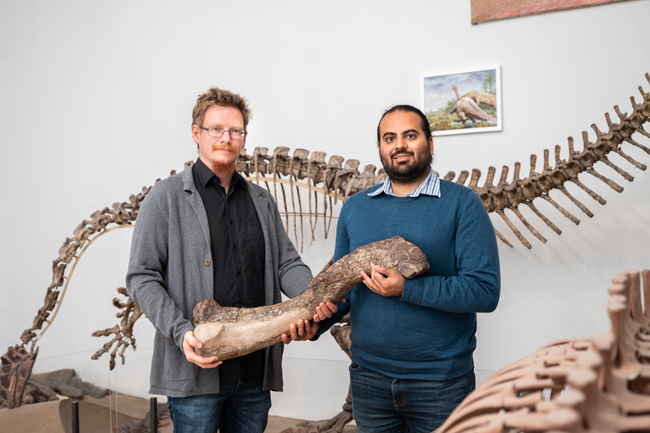
Ingmar Werneburg (left) and Omar Rafael Regalado Fernandez (right) hold a femur from Tuebingosaurus maierfritzorum
Researchers Ingmar Werneburg (left) and Omar Rafael Regalado Fernandez (right) hold a femur from Tuebingosaurus maierfritzorum. Picture credit: Valentin Marquardt/Universität Tübingen.

Everything Dinosaur acknowledges the assistance of a media release from the University of Tübingen in the compilation of this article.

The scientific paper: “A new massopodan sauropodomorph from Trossingen Formation (Germany) hidden as ‘Plateosaurus’ for 100 years in the historical Tübingen collection” by Omar Rafael Regalado Fernández, Ingmar Werneburg published in Vertebrate Zoology.

Visit the Everything Dinosaur website: Everything Dinosaur.

6 09, 2022

A New Abelisaurid from Argentina

By |2022-10-18T10:35:41+01:00September 6th, 2022|Categories: Adobe CS5, Dinosaur and Prehistoric Animal News Stories, Main Page, Palaeontological articles, Photos/Pictures of Fossils|0 Comments

A new species of dinosaur has been described from fossils found in Neuquén Province (Argentina). Named Elemgasem nubilus it is the first unambiguous abelisaurid known from the Coniacian faunal stage of the Late Cretaceous.

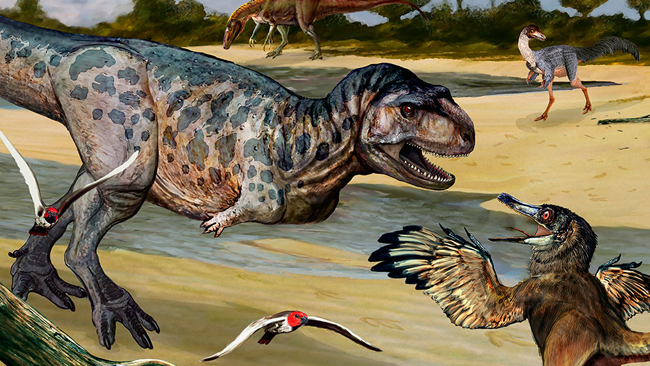
Elemgasem life reconstruction
A life reconstruction of the newly described abelisaurid Elemgasem nubilus depicted with other Late Cretaceous prehistoric fauna associated with the Portezuelo Formation of Patagonia. Picture credit: Abel Germán Montes.

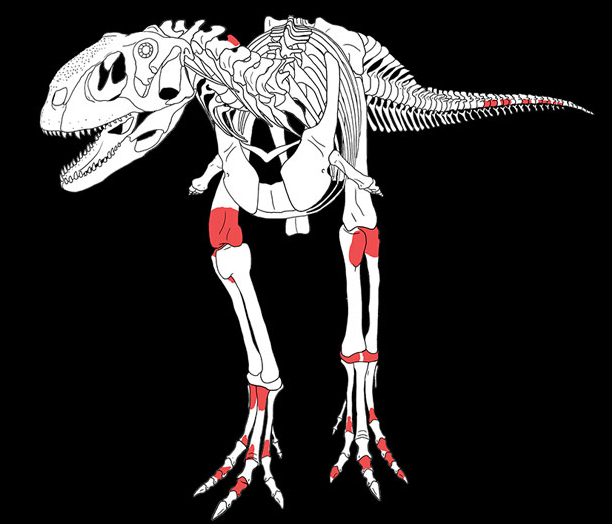
A field team of CONICET researchers have excavated the fragmentary remains of a new species of carnivorous dinosaur from Upper Cretaceous exposures near to the city of Plaza Huincul, in the province of Neuquén in Patagonia (Argentina). The fossils come from the Portezuelo Formation and represent an individual animal around four metres in length and standing approximately two metres tall. Bone histology revealed that this abelisaurid was around eight years old when it died. The histological analysis suggests that Elemgasem probably would not have grown much bigger, making this predator much smaller than related abelisaurids such as Carnotaurus and Ekrixinatosaurus.

Regarded as a sub-adult, the scientists who include co-author Rodolfo Coria (Universidad Nacional de Río Negro, Argentina), writing in the journal of The Palaeontological Association conclude that this dinosaur had already reached sexual maturity.

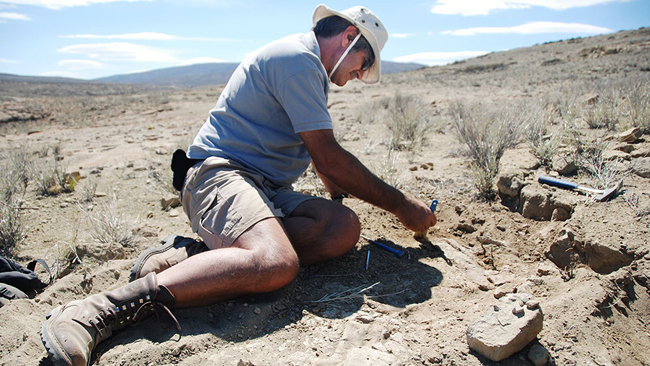
Palaeontologist Rodolfo Coria excavates dinosaur fossils
Co-author of the scientific paper Rodolfo Coria (Universidad Nacional de Río Negro) excavating fossils in Neuquén Province. Picture credit: CONICET.

Documenting the Evolution of the Abelisauridae

The Abelisauridae are a diverse group of medium-to-large-sized predatory dinosaurs predominately associated with the landmass of Gondwana. Numerous genera have been described based on fossils found in the Southern Hemisphere and they are known from almost all parts of Gondwana in all the faunal stages associated with the Late Cretaceous, except for the Coniacian (90 to 86 mya approximately).

This period in Earth’s history is marked by a turnover in terrestrial and marine fauna due to global climate change leading to worldwide extinctions.

Explaining the significance of these fossils, co-author Rodolfo Coria stated:

“The identification of a new species is always a scientifically relevant event, especially if the species belongs to an emblematic family of carnivorous dinosaurs such as the abelisaurs. Elemgasem represents a key piece in the puzzle of the evolution of this group, which began to be put together with the first findings of José Bonaparte, the most important Argentinean vertebrate palaeontologist of the 20th century – in the 1980s”

Although the fossil material is fragmentary, a new genus has been erected based on several autapomorphies including notable rugosity on the lateral surface of the fibula and the shape of the tail bones which are different from any other abelisaurid described to date.

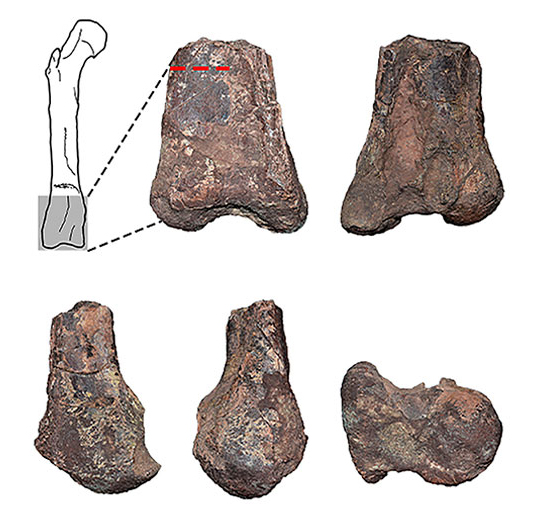
Views of the distal portion of the right femur of Elemgasem.
Views of the distal portion of the fossilised right femur of Elemgasem nubilus with an accompanying line drawing that shows the position of the bone. Picture credit: Mattia A. Baiano.

The First Abelisaurid from the Portezuelo Formation (New Abelisaurid)

Elemgasem is the first abelisaurid described from fossils from the Portezuelo Formation and it was part of a diverse dinosaur-dominated terrestrial fauna with several different types of theropod present including dromaeosaurids, alvarezsaurids and megaraptorids.

Phylogenetic analysis indicates the E. nubilus could be tentatively assigned to the Brachyrostra tribe within the Carnotaurinae subfamily, although the limited amount of fossilised material prevented the researchers from making a more positive taxonomic assessment.

The genus name is derived from the name of a god in the regional Tehuelche culture and the trivial name is from the Latin for “cloudy days”, a reference to the strange, foggy conditions that the dig team encountered whilst they worked in the field.

Elemgasem skeletal reconstruction.
Skeletal reconstruction of Elemgasem nubilus with known fossil elements shown in red. Picture credit: Abel Germán Montes.

Dr Coria added:

“We already knew of abelisaurian forms in older horizons [such as the Cenomanian] or more modern ones [such as the Campanian], so it was predictable that there would be some in intermediate times. What we did not expect was to find a comparatively small abelisaur like Elemgasem, whose size is clearly smaller than the rest of the species in the group, such as Carnotaurus, Aucasaurus or Skorpiovenator.”

It is the first abelisaurid from the Turonian–Coniacian interval and it increases the diversity of this theropod family at a time of marked turnover in the tetrapod fauna of South America.

Rebor has introduced several scale replicas of abelisaurid dinosaurs. To view the extensive range of Rebor models and figures available from Everything Dinosaur: Rebor Figures and Models.

Everything Dinosaur acknowledges the assistance of a media release from CONICET in the compilation of this article.

The scientific paper: “Elemgasem nubilus: a new brachyrostran abelisaurid (Theropoda, Ceratosauria) from the Portezuelo Formation (Upper Cretaceous) of Patagonia, Argentina” by Mattia A. Baiano, Diego Pol, Flavio Bellardini, Guillermo J. Windholz, Ignacio A. Cerda, Alberto C. Garrido and Rodolfo A. Coria published in Papers in Palaeontology.

1 09, 2022

New Research Identifies Africa’s Oldest Dinosaur

By |2024-04-13T09:00:52+01:00September 1st, 2022|Categories: Adobe CS5, Dinosaur and Prehistoric Animal News Stories, Dinosaur Fans, Main Page, Palaeontological articles, Photos/Pictures of Fossils|0 Comments

An international team of scientists have unearthed the remains of Africa’s oldest dinosaur skeleton. The fossils represent a sauropodomorph, which has been named Mbiresaurus raathi. The fossils were excavated from Pebbly Arkose Formation exposures in Mashonaland Central Province, Zimbabwe. This basal sauropodomorph and the associated vertebrate fauna discovered to date is helping scientists to better understand the dispersal and distribution of early dinosaurs and their contemporaries.

Mbiresaurus raathi life reconstruction
A life reconstruction of the sauropodomorph Mbiresaurus raathi (foreground) with examples of the Zimbabwean biota of the Upper Triassic Pebbly Arkose Formation. Two rhynchosaurs (front right) are not disturbed by the as yet, unnamed herrasaurid dinosaur pursuing a cynodont (back right). An aetosaur observes the goings on from the opposite bank (left). Picture credit: Andrey Atuchin.

Mbiresaurus raathi

The research team led by palaeontologists from Virginia Tech in collaboration with colleagues from the Natural History Museum of Zimbabwe, the Universidade de São Paulo, (São Paulo, Brazil) and the Chipembele Wildlife Education Centre, (Mfuwe, Zambia) have explored the extensive Upper Triassic sandstone exposures of the Pebbly Arkose Formation. As well as finding the nearly complete and articulated sauropodomorph specimen (M. raathi), the team have been documenting the vertebrate fauna associated with these 230-million-year-old deposits.

The first evidence of Africa’s oldest dinosaur known to science was found during fieldwork in 2017. Two years later, the team returned to excavate more of the specimen and to work on the fossilised remains of an as yet, unnamed theropod dinosaur discovered nearby.

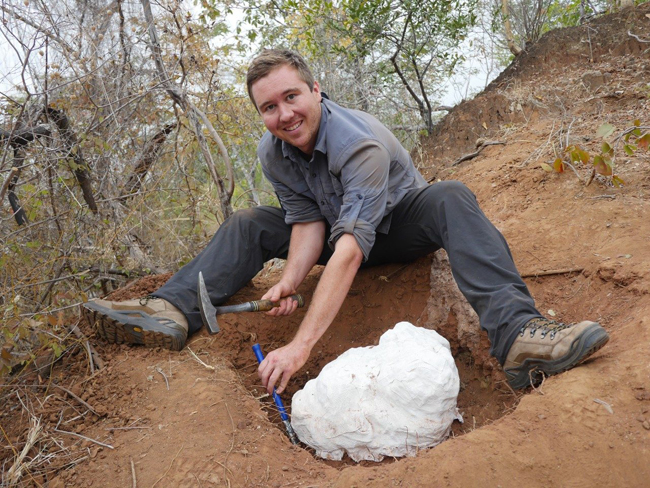
Excavating the fossilised remains of Mbiresaurus raathi.
Christopher Griffin in 2017, carefully excavating part of the Mbiresaurus raathi skeleton, wrapped in a plaster field jacket. Picture credit: Stephen Tolan for the Paleobiology & Geobiology Research Group at Virginia Tech.

The holotype (NHMZ 2222) consists of a considerable portion of the entire skeleton including skull material. A second specimen (NHMZ 2547), representing a larger individual was discovered in close proximity to the holotype. The research team estimate that Mbiresaurus was around two metres in length and weighed approximately 25 kilograms.

Chris Griffin holds a jaw fragment.
Christopher Griffin holds in his hand portion of the lower jaw of Mbiresaurus in Virginia Tech’s Derring Hall. Picture credit: Zach Murphy for the Paleobiology & Geobiology Research Group at Virginia Tech.

Commenting on the significance of this dinosaur discovery, field team member Christopher Griffin, who graduated in 2020 with a PhD in geosciences from the Virginia Tech College of Science, stated:

“The discovery of Mbiresaurus raathi fills in a critical geographic gap in the fossil record of the oldest dinosaurs and shows the power of hypothesis-driven fieldwork for testing predictions about the ancient past.”

Documenting the Early Dinosauria

South America is regarded by many palaeontologists as the cradle of dinosaur evolution. As far as scientists are able to deduce; based on the fossil record, the dinosaur dynasty began with the evolution of small, agile meat-eaters in South America. However, as landmasses at the time mostly consisted of a single, super-sized continent (Pangaea), it is perfectly feasible to propose that the Dinosauria arose elsewhere and spread across Pangaea.

Herrerasaurus scale drawing.
Herrerasaurus – potentially an early, carnivorous dinosaur from the Upper Triassic Ischigualasto Formation of north-western Argentina. The evolutionary origins of the Dinosauria remain ambiguous, it is hoped that further exploration of the Upper Triassic (Carnian) deposits of the Pebbly Arkose Formation will help palaeontologists to better understand dinosaur evolution and dispersal. Picture credit: Everything Dinosaur.

Dr Griffin added:

“These are Africa’s oldest-known definitive dinosaurs, roughly equivalent in age to the oldest dinosaurs found anywhere in the world. The oldest known dinosaurs, from roughly 230 million years ago, the Carnian Stage of the Late Triassic, are extremely rare and have been recovered from only a few places worldwide, mainly northern Argentina, southern Brazil, and India.”

Sterling Nesbitt, an associate professor at the Department of Geosciences at Virginia Tech and co-author of the scientific paper published this week in the journal “Nature”, explained that basal sauropodomorphs such as Mbiresaurus demonstrate how the early evolutionary history of the Dinosauria is being rewritten with every new discovery.

2019 expedition team in Harare (Zimbabwe)
Some of the 2019 expedition team photographed in Harare (Zimbabwe), prior to the fieldwork. From left are Kudzie Madzana, Edward Mbambo, Sterling Nesbitt, George Malunga, Christopher Griffin, Darlington Munyikwa. Picture credit: by Zach Murphy for Virginia Tech.

An Ancient Triassic Biota

The Carnian-aged fossils are providing scientists with evidence of a diverse reptilian biota which co-existed with the earliest dinosaurs. The fieldwork has revealed evidence of cynodonts, aetosaurs (armoured archosaurs more closely related to crocodylians than to the archosaur lineage that led to the birds and the dinosaurs), and rhynchosaurs.

The team also unearthed fossilised remains of an as yet, unnamed theropod dinosaur (herrerasaurid). These archaic animals are similar to the biota associated with contemporaneous deposits found in South America and India.

Excavating the herrerasaurid dinosaur.
Sterling Nesbitt (left) and Christopher Griffin excavate the fossilised remains of an as yet, unnamed herrerasaurid dinosaur in 2019. Picture credit: Murphy Allen for Virginia Tech.

What’s in a Name?

The genus name Mbiresaurus is from the local Shona language for the name of the district “Mbire” where the fossils were found and from the Greek for lizard. The species name honours palaeontologist Michael Raath for his pioneering work studying vertebrate fossils found in Zimbabwe. The research team conclude that Mbiresaurus was probably bipedal and from an analysis of its small, serrated teeth, it was probably herbivorous although omnivory cannot be ruled out.

A New Theory on the Early Dispersal of the Dinosauria

The researchers have postulated a new theory on dinosaur dispersal. As Africa was once part of the colossal super-continent Pangaea, the distribution and dispersal of the Dinosauria was constrained by climatic conditions across the landmass.

The central portion of Pangaea was dominated by extremely arid environments. These deserts acted as a barrier, the earliest dinosaurs were restricted to southern Pangaea. Only later in their evolutionary history, during a period of climate change resulting in a much wetter climate (Carnian Pluvial Event) did the Dinosauria disperse worldwide.

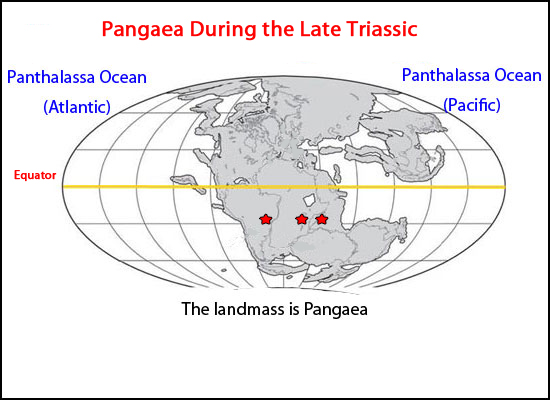
Pangaea dinosaur distribution (Carnian faunal stage).
The fossils from the Upper Triassic deposits of northern Zimbabwe from a geographical bridge between contemporaneous fossil bearing deposits in India and southern Brazil. The red stars demonstrate the link between the three locations with Zimbabwe in the centre. Picture credit: Everything Dinosaur.

The research team deliberately targeted Zimbabwe for fieldwork as the northern part of the country would have been located at roughly the same latitude as southern Brazil and India during the Late Triassic.

They conclude that the distribution of the first dinosaurs is correlated with palaeolatitude-linked climatic barriers, and dinosaurian dispersal to the rest of the super-continent was delayed until these barriers were removed. The distribution of the earliest members of the Dinosauria remained restricted by the climatic conditions that prevailed in southern Pangaea.

An Exciting Development for Palaeontology in Zimbabwe

The discovery of a nearly complete specimen of one of the earliest dinosaurs known to science provides a major boost to the Natural History Museum of Zimbabwe and demonstrates that palaeontologists from southern Africa have a major role to play in obtaining evidence about early dinosaur evolution.

Michel Zondo, a curator and fossil preparator at the Natural History Museum of Zimbabwe commented:

“The discovery of the Mbiresaurus is an exciting and special find for Zimbabwe and the entire palaeontological field. The fact that the Mbiresaurus skeleton is almost complete, makes it a perfect reference material for further finds. It is the first sauropodomorph find of its size from Zimbabwe, otherwise most of our sauropodomorph finds from here are usually of medium- to large-sized animals.”

Everything Dinosaur acknowledges the assistance of a media release from Virginia Tech in the compilation of this article.

The scientific paper: “Africa’s oldest dinosaurs reveal early suppression of dinosaur distribution” by Christopher T. Griffin, Brenen M. Wynd, Darlington Munyikwa, Tim J. Broderick, Michel Zondo, Stephen Tolan, Max C. Langer, Sterling J. Nesbitt and Hazel R. Taruvinga published in Nature.

29 08, 2022

Giant Sauropod in the Garden

By |2023-02-07T09:34:23+00:00August 29th, 2022|Categories: Adobe CS5, Dinosaur and Prehistoric Animal News Stories, Main Page, Palaeontological articles, Photos/Pictures of Fossils|0 Comments

Back in June (2022), Everything Dinosaur team members wrote about the “White Rock spinosaurid” *, what could turn out to be the biggest predatory dinosaur found to date in Europe. At the time, many media outlets mistakenly reported that these fossils, found on the Isle of Wight, represented “Europe’s biggest dinosaur”. Not true, the remains of what could be the largest dinosaur ever discovered in Europe are being excavated in a Portuguese back garden.

Field team members at the dig site.
Field team members pose next to the exposed ribs of the sauropod. Picture credit: Instituto Dom Luiz (Faculty of Sciences of the University of Lisbon, Portugal).

Giant Sauropod

The first fossils were uncovered in 2017 when the property owner in the city of Pombal, in the Leiria District, central Portugal, began construction work in the garden. The strata in this area of Portugal were laid down approximately 150 million years ago (Upper Jurassic) and the fossils are from a sauropod, a long-necked, long-tailed herbivore that could have measured more than 25 metres long.

Field team members working to expose the ribs.
Working to expose the sauropod ribs. Picture credit: Instituto Dom Luiz (Faculty of Sciences of the University of Lisbon, Portugal).

A joint Spanish/Portuguese field team have been working to expose, stabilise and remove the fossilised bones. In the picture above, two ribs have been coated in plaster and burlap in preparation for their removal from the site.

A European Brachiosaurid

Tentatively described as a member of the Brachiosauridae family, parts of the backbone and ribs have been excavated so far. The bones were found in virtually their original articulated and anatomical position.

Elisabete Malafaia, post-doctoral researcher at the Faculty of Sciences of the University of Lisbon and member of the field team excavating the giant bones stated that it was extremely unusual to find all the ribs of a sauropod, almost entirely intact. The skeleton was found in the position that the dinosaur probably died in, no post-mortem transport of the corpse took place.

Removing sediment around the ribs.
Removing sediment around the ribs. Picture credit: Instituto Dom Luiz (Faculty of Sciences of the University of Lisbon, Portugal).

The field team are optimistic that more bones remain buried, including the skull. To find an almost complete skeleton of this type of dinosaur would be a truly remarkable discovery with the potential to provide scientists with an enormous amount of data on Late Jurassic sauropods.

A Member of the Macronaria

The Neosauropoda clade, a sub-group within the Sauropoda is divided into two sub-clades. The Diplodocoidea and the Macronaria. The Macronaria are distinguished by having a large nasal (external naris), the diameter of the nasal opening exceeding the diameter of the eye socket (orbit). Brachiosaurids and the titanosaurs, which thrived during the Cretaceous, represent some of the biggest land animals to have ever existed.

Papo Brachiosaurus Model
A replica of a typical brachiosaurid (Brachiosaurus altithorax). Picture credit: Everything Dinosaur.

It has been speculated that the head height of the Portuguese sauropod could be as much as 12 metres, that would make this dinosaur tall enough to look over a three-storey house!

The giant ribs of the sauropod
The giant ribs of the sauropod. Picture credit: Instituto Dom Luiz (Faculty of Sciences of the University of Lisbon, Portugal).

Years of Laboratory Work Ahead

Dinosaur fans will have to be patient and wait for a formal scientific description. It is likely to take several years to fully prepare and study the huge, fossilised bones, of what is probably a new dinosaur species. A spokesperson from Everything Dinosaur commented that this was an amazing fossil find and that this Portuguese discovery could rival some of the sauropod fossils found in the roughly contemporaneous Morrison Formation of the western United States.

Carefully removing matrix surrounding the sauropod bones.
Carefully removing matrix surrounding the sauropod bones. Picture credit: Instituto Dom Luiz (Faculty of Sciences of the University of Lisbon, Portugal).

Everything Dinosaur contacted the Faculty of Sciences of the University of Lisbon media team to request images for this blog post, we acknowledge their assistance in the compilation of this article. The University’s press team kindly responded, supplied images and wrote:

“Obrigada pelo interesse neste trabalho. Partilho aqui algumas imagens com boa resolução.”

This translates as “thank you for your interest in this work, here are some high-resolution images for you.”

We look forward to hearing more about this remarkable discovery and the eventual naming and scientific description of a huge sauropod from a Portuguese garden.

“White Rock spinosaurid” * – to read Everything Dinosaur’s article from June, 2022 on the discovery of potentially Europe’s largest carnivorous dinosaur known to date: Super-sized Carnivorous Dinosaur from the Isle of Wight.

Go to Top